Book III—The Land of Giants.
Reading edition
All Alone on the Pampas—The Camp in the Cañon.
Alone on the Pampas. Alone in the moonlight. Alone amidst scenery so black, so bare, so desolate, that looking back now through a long vista of years, as I sit by my cosy English fireside, I shudder to think of it.
There was nought of life to be seen anywhere, save that single horseman on his trusty steed who stopped for a moment on an upland ridge to gaze around him. Not a tree; hardly a bush; the very grass itself in stunted patches, with rough boulders lying here and there as if they had been rained from the heavens. No signs of house nor habitation, only the sharply undulating plain, wherever the eye might turn, and far away on the western horizon, hills or mountains snow-clad, glimmering white in the uncertain light of moon and stars.
The moon? Yes, and I have oftentimes thought, while on the Pampas, that if one could reach that orb, it would be just such a landscape as this he would see on every side; and if wind blows there at all, it would be just such a wind, as is now moaning and sighing over this dreary plain from the distant Cordilleras.
It was neither a wild nor a stormy night, however. Behind a huge bank of yellow clouds, that lay high over the mountains, the lightning was flickering and playing every moment; the breeze was not high nor was it extra cold, being early summer in this region. It is the desolation and the exceeding lonesomeness of the situation that strikes to the heart and feelings of one when he thinks of it.
And the deep silence!
Were there no sounds at all? Very few; only that moaning, sighing, whispering wind, rising at times into almost a shriek, then dying away again till it could scarce be heard. A wind in which, had you been at all nervous, you might have almost declared you heard voices, human or ghostly. Only the wind, and now and then the cry of some night-hawk or its victim; or the plaintive, peevish yap of the prairie fox.
Very marked indeed is the silence by night on the Patagonian Pampas. Not more so anywhere except on the broad, glittering snow-fields of the Arctic “pack,” or the highest plateaus of the Himalayan hills.
So tall and square is the figure of the horseman, whose rifle is slung across his shoulders, and so active, yet sturdy and strong, does his horse look, that standing there on the ridge, he has all the picturesqueness of a mounted Arab.
He shudders slightly now and draws his guanaco mantle closer about him, gazes once more around as if taking his bearings, then rides slowly on.
Presently he comes near a bush, a stunted barberia and draws rein speedily, for from under it fierce green eyes glare at him, and a sound, which is half yawn half yell of anger, makes him place a hand on his revolver.
He does not fire, however; he waits. Then a huge puma gathers itself up and edges off, drawing its graceful length along the ground, but making off still with head turned towards him, and breathing hoarse defiance, till, with bounds and leaps, he is soon out sight. When the puma has quite disappeared, he rides on again, but with a little more caution, avoiding the bushes. Where there is one puma there may be, and generally is, another.
He does not draw rein again for a good hour. Uphill and downhill, but mostly on the gravelly level, till all at once he finds himself on the bank of a cañon or ravine.
He bends down now and pats the neck of his horse. The animal neighs, and is answered from the bottom of the glen; then the horseman slowly descends, carefully, and with judicious hand restraining the impatience of his steed. So steep is the bank that the hind legs of the horse sometimes slip right under him, and loosened stones roll down to the green sward below.
Low down in the strath here there is a stream of water, a river in fact, rushing along, its waters sparkling in the moonlight, and everywhere on its banks the sward is green and beautiful. Here a whole herd of horses are quietly grazing. They look up as the horseman approaches, and toss their heads as if happy to have a new companion, while from some little distance the barking of dogs is heard, and presently a huge animal—looking huger still in the uncertain light—comes bounding straight through the herd of horses, and challenges the rider. The dog’s hair is erect from head to stern, and he growls low but ominously.
“Good dog,” says Señor Castizo; “don’t you know me? Poor Ossian, poor boy!”
The dog knows him very well indeed, but gives him to understand that he—Ossian—is on guard to-night, and must be careful.
“It is easy to know you,” Ossian seems to say. “My nose has not failed me yet. I’d know you with my eyes shut. But what are you doing out alone at night? It looks bad. No, you needn’t call me poor boy. I’m not I’m Ossian, and with the exception of honest Bruce, the other dogs are not worth a bark. You can follow me now, but be careful.”
Ossian ran on in front, growling low to himself, and the horseman followed. As soon as they had rounded the corner of a rock bluff, they came in sight of the camp, and now Ossian stopped short and gave vent to such an alarm-peal that every one speedily rushed outside their tents. It might be hostile Indians, they thought. When living in the desert one must be at all times cautious.
But here was no hostile Indian, only honest, bold Castizo.
Peter and I were the first to rush towards him, and bid him welcome. I caught the horse by the head. The brute was longing to join the herd. Peter, always impulsive, grasped his friend’s hand even before he had dismounted.
“We were really getting anxious about you.”
“And supper’s all ready,” I added.
“Ah, that’s the way. I confess I’m hungry. I gave you two days’ start from Santa Cruz station, and so you see I’ve overtaken you, and I only slept one night on the Pampas.”
“Weren’t you afraid, sir, the pumas would eat you?”
“No, they don’t like live meat; but now, young fellows, I’m not going to be ‘sir’-ed. We can’t live together free and easy if we stand on ceremony. We are all equal on the Pampas.”
“But there is a cacique or chief among the Ishmaelites?”
“Yes; but a cacique holds a kind of sinecure office. He is partly chief and partly magistrate, gives himself a great many airs; and the women often laugh at him behind his back. I’ll be cacique if you like, but not ‘Sir.’”
“Well,” said Peter, “I’ll be bound we won’t laugh at you behind your back.”
As he spoke, Peter divested the horse of saddle and bridle, as nimbly as if he had been brought up in a stable all his life. It quite took me by surprise.
The saddle is a mere bundle of wood and skins, covered with rugs and gear. It is not uncomfortable to ride on once you are acquainted with it; but although we had been a few days on the Pampas, and had ridden as neatly as we could, we were still tired and exceedingly sore. The bridle is also of guanaco skin, and the bit of wood and thong. Nevertheless these hardy horses of the plains are well used to such primitive harness.
There is one fault with the saddle, which we soon found out: unless it be particularly well girt it has a disagreeable habit of wheeling to one side just when you are at a pleasant canter, or gallop perhaps, and so emptying you out.
“Here,” cried Peter, stuffing the gear into my arms, “take hold of that, Greenie, and look lively; the cacique is hungry.”
“I’m not Greenie,” I said; “if I was, Peter, old man, I’d pull your ears.”
“Oh, you’re not Greenie! Well, Jack, then, you shouldn’t be so like him in the moonlight. I’m going to put a black spot on one of your noses, so that I can tell t’other from which. Then I suppose I’d forget which I put the black spot on.”
“Better not try it on me,” I said.
The horse was loose now and free, and with a happy nicker he went trotting off to quench his thirst in the stream, previously to having his supper.
“Come on, boys, I’m starving. Good Ossian. Ah! you can be friendly enough now. Where is your kau (tent), Peter?”
“My cow, mon ami?”
“Yes, your kau.”
“We haven’t got a cow. We have some condensed milk.”
Castizo laughed.
“Why,” he explained, “a kau is a toldo, or tent.”
“Well, Cacique, I’ve heard of people, when overtaken by a blizzard on the North American prairies, killing a horse, disembowelling it, then getting inside and hauling the hole in after them; but it’s the first time I ever heard of a cow being used as a tent. We live to learn. Here’s the cow, mon ami. Will you walk inside, Señor Cacique?”
“Ah!” cried Castizo, rubbing his hands gleefully.
“Here’s a blaze of light and glory! Here’s comfort; here’s luxury!”
Then, even before he shook hands with Jill and Ritchie, Castizo must elevate his palms like a Spanish girl dancing, cock his head a little on one side, and smilingly sing a verse of a song which caused his eyes to sparkle with merriment, and made those laugh who listened to him.
“We’re glad to see you,” said Jill.
“Right glad to see you,” said Ritchie.
“I know you all are, boys. Thought I would lose myself, I suppose. Ah, no! I have been too long on the plains, and in forests, mountains, and wildernesses, to do that. My good Pedro here knows me.”
“Master likes to be alone—much,” said Pedro, a dark-haired, black-eyed, black-bearded, sturdy little Chilian.
This man’s face was preternaturally white. No sunshine ever scorched him brown, or even red; but perhaps the darkness of his hair brought out the pallor more. He had a pleasant smile, and two rows of teeth as white as a young puppy’s.
Lawlor was not far away; and with him also Castizo shook hands. So equality was established.
Our tent was not of guanaco skins, like that of the Indians who accompanied us on this expedition. We had a canvas marquee of small dimensions, but most comfortable, and so neatly made that it could pack together into a load for one horse, poles and all.
Castizo had been a Patagonian traveller for years. At first, he told us, he “herded” with the Indians under their tents of skin, and lived quite as they did, with the exception of the drinking of rum; but he soon found it better to import a little civilisation into his mode of life. So he did; and I advise any one who meditates going to the Patagonian Pampas to do the same.
Here we were in our handsome tent, with every comfort before and around us which it is capable of transporting into the wilderness.
The table was a piece of canvas spread on the ground in the middle of the tent. Candles—real candles—burned in the centre, stuck in a rudely formed sconce of wood, which in its turn was stuck through the canvas into the ground. Our seats were our huge, gown-like guanaco mantles, which by and by would serve us for blankets, when we lay down to sleep on our couches of withered grass.
Our dishes and plates were all of tin, easily packed and easily carried, and we had knives and forks. Had our table been a raised wooden one, it would have groaned, not so much with the variety of good things, but with their solidness and substantiality. Here were steak of guanaco, and stew of horseflesh—one of our pack animals had broken a leg the day before, and we were wise to make use of him—and here were roast ducks. Cakes we had, too, made of flour which had been half-roasted before it left Valparaiso. These cakes were made by Pedro, who was our very excellent cook. I think there must have been something else in them as well as flour. However they were very nice, and tasted and looked somewhat like a happy combination of Scotch haggis, Australian damper, and Irish scone.
We had no beer to drink; we had no wine; but we had yerba maté, which combines the invigorating qualities of both, with all the soothing, calming influence of a cup of good coffee or tea.
It is a kind of tea made of the dried leaves of the Paraguayan ilex, and is infused and drunk just as tea is; though the Patagonian Indians and hunters usually drink it through tubes pierced with little holes, so that they can have the infusion without the powder or leaves.
“Well, boys,” said Castizo, whose English, by the way, was irreproachable, “we’ve made a fairly good start. And your captain, with his adorable little wife—what an amiable creature she is—will be nearly half-way home by this time. Are you sorry you haven’t gone with them to see the mother?”
“Ah!” I said, “I know mother well: she will be pleased to hear we are enjoying ourselves, and learning something at the same time. Won’t she, Jill?”
“Assuredly; and so will aunt.”
“Well,” said Castizo, with a laugh, “as to learning something, there is no doubt about that. You will learn to be men. The Pampas is the best school in the world.”
“Whose sentry-go is it to-night?” said Peter.
“Mine, I believe,” said Jill, looking at his watch; “I go on in half an hour. Then Lawlor.”
“That’s right,” said Lawlor.
In less than an hour, we were all curled up in our toldo or kau, wrapped in our good guanaco robes, and fast asleep.
Out in the moonlight, however, Jill, with his rifle at the shoulder, paced steadily to and fro on sentry, and not very far off, leaning against one of the posts of the great skin tent, stood a Patagonian, also on duty. He looked a noble savage, erect and stately, and tall enough in his robe of skin to have passed for a veritable giant. Lying carelessly across his left arm, its point upwards, and gaily decorated with ostrich feathers, was his spear. A formidable weapon is this Patagonian spear, of immense length and strength, and tipped with a knife of stoutest steel. A swordsman has little chance against so terrible an instrument of warfare, for your giant antagonist can strike home long before you can get near enough to do execution. If very active and you can succeed in parrying one blow, you may seize the instrument, and rush in and slay your man; but, as the Scotch put it, “What would he be doing all this time?” He will not wait till you get quietly up to him, depend upon it. So I say that the best fencer that ever switched a foil is not a match for a Patagonian spearsman.
The Patagonians who formed part of our present camp were good fellows all. They were hired by Castizo, some at Puento Arenas, and some from a tribe stationed at or near Santa Cruz. Those from the former place, our cacique—as we may as well now call Castizo—had taken north with him in his yacht to Santa Cruz, and altogether our Indians numbered twenty-four souls. No women, no children, save those of the chief and his second in command. Our cacique knew better than to encumber himself with many of these on the march.
That these Patagonians would remain faithful to us, we had little doubt. For, first and foremost, they are, on the whole, good-natured and friendly to white men; secondly, they had only been paid in part, and would not get the remainder of their stores till we returned to Santa Cruz.
A glance at the map will show where this last place lies. But do not think it is a town. At the time of which I speak, it consisted indeed of but one estancia, on an island. It has an excellent harbour, however, and ships in distress often come here. Others, again, come regularly to meet the Indian tribes, and purchase from them skins, ostrich feathers, and curios.
There is a regular Indian encampment here. They all live in tents, and for the matter of that compare favourably with the gipsies we meet on our own Scottish borders at home.
How sound one sleeps on the Pampas! I scarcely knew my head was on the pillow till it was morning again, dogs barking and yelping, Indians shouting, horses neighing, and the bold, strong voice of the Patagonian chief as he harangued his men, heard high above all.
Chapter Twenty.
A Wild Ride—Cooking an Ostrich Whole—Quiet Evenings round the Camp Fire.
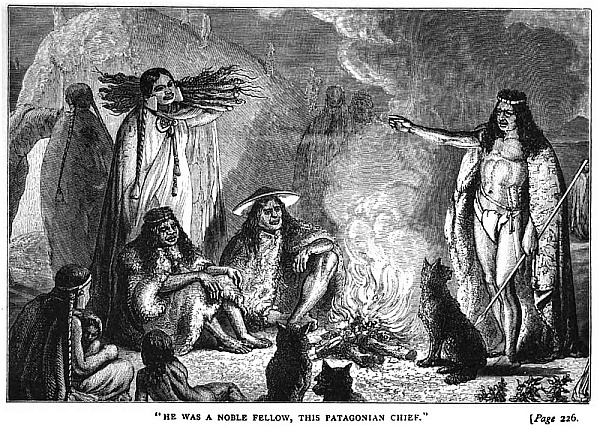
He was indeed a noble savage, this Patagonian chief. His name was Jeeka; at least it sounded like that. Peter said “Jeeka” was near enough, and to give it a better ring we added “Prince”—Prince Jeeka.
Peter admired him very much, as all young men admire nobility of figure.
“I’ll tell you what it is, Jack,” he said to me to-day; “if I had a figure like that fellow, it isn’t going to sea I’d be.”
“What would you do?”
“Take to the stage. What an Othello the fellow would make! Look at him now. What an air of quiet command, and such a voice! That is his favourite wife in the corner, with baby in her arms. She looks at him with fondness, not unmingled with awe. Even the dogs are listening, as if they understood every word he said.”
“It’s more than I do, Peter.”
In good weather—and this particular morning was beautiful—no one feels inclined to laze on the Pampas. Your sleep has been sweet and sound; your breakfast, principally of meat, as fat as you please, has been a hearty one, yet you do not feel heavy after it. On the contrary you have but one wish—to be up and away.
Our route to-day would lead us somewhat aside from this Rio Santa Cruz (the river of the Holy Cross), in a direction about west and by north, straight away, in fact, for the distant Cordillera range of mountains, which was to be our ultimate destination.
Ever since our start, and even before we started, we—Ritchie, Peter, Jill, and myself—had been practising morn, noon, and night with bolas and lasso. The latter needs no description, and a good horseman soon gets up to throwing it well, although there is a danger of being dragged headlong out of the saddle, when it becomes tightened between the lassoed animal and the thrower. The bolas are balls, two or three, of either stone or lead covered with skin, attached to the ends of some yards of thong. They are whirled rapidly round the head for a moment or two, then deftly allowed to fly off at a tangent, so that when they fall upon an animal, be it ostrich, guanaco, or even the South American lion called puma, they so hamper his movements that further flight is out of the question. The horseman speedily advances and puts a speedy end to the creature’s sufferings.
To-day the journey was a peculiarly arduous one. The sun was blazing down from an unclouded sky, making it positively hot for the climate; but after being heated, when we stopped a short time the cold east wind went searching through bones and marrow. We felt, as Peter expressed it, “suddenly placed inside an American patent freezer.”
The route was very rough: the same barren wilderness that we had been traversing for days; the same sort of sand-clay or gravel, under foot; the same stunted bushes, grass and thistle tufts; the same stony ground, the same up hill and down dell, over banks, up steep terraces, across plateaus, down into cartons and past salinas, near which was a greater abundance of vegetation, though nothing approaching to luxuriance. These salinas are salt lagoons or lakes. I feel sure, from their appearance, many of them are the craters of extinct volcanos. And indeed the whole country where we were to-day seemed as if at one time it had been overflown by lava, and subsequently rent and torn by earthquakes.
Castizo told Jill and me that all the land here at various periods of time had been raised from the level of the sea by the giant forces of nature operating beneath, and that this accounted for the terrace-like formation we now and then came to. But Jill and I were too young at that time to study geology. Besides, we had no more love for “ologies” at this period of our lives, than we had when poor Aunt Serapheema used to strike one o’clock on our knuckles at home. As we wanted to put as much land between us and the Atlantic as possible, we did not stay to-day for big hunting. Besides, we were not in the very best of hunting countries yet, though we saw several herds of guanaco, and a good many ostriches.
We had one little hunt, however. It was disobeying the orders of our cacique to break away from the line of march, but in this particular case we could not well help it. Besides, if any one was to blame, it was Ossian.
A fox, a huge beast like a wolf, ran across our path.
“Hurrah!” Ossian seemed to cry, “Yowff, yowff. Come on, Bruce. Here’s a chance!”
Away went the two dogs like two birds. Away went Jill after his pets like a third bird, while I brought up the rear.
We heard Castizo order a halt, so we thought it would be all right, and rode heedlessly on after the dogs. We must have ridden fully two miles when we came up with Ossian. Poor Bruce was nowhere in it; near him lay the fox, dead. I speedily dismounted, and secured the tail, which I fastened to Jill’s saddle. Then Bruce came up panting, and complained to us that his legs were not long enough. Guanacos, he said, were more his form; and this proved to be true enough, for he afterwards proved invaluable at this form of hunting.
As we were returning, we noticed an ostrich at some distance to the right. Our bolas were handy, and so off we went at a tangent, in pursuit. Another and another sprang up, and to my intense delight and Jill’s glory he succeeded in entangling one I shot the bird with my revolver, but I think even now I see the wild and frightened look the poor creature had in its quaint, queer face. We did not stop to possess ourselves of any of the meat, but secured the feathers, tied them in a bundle, and prepared to return in triumph.
Well, to retrace our trail was easy enough. We reached the spot where we had left our companions.
They were gone.
But where, whither? We could see the plains all round us when we rode up to the top of a ridge for very many miles, but never a vestige of the cavalcade.
“Jill,” I said, “we’re left and lost.”
“But they cannot surely have gone out of sight in so short a time!”
“Where are they then?”
“It seems to me as if the earth has opened and swallowed them up.”
And that was really and truly what had happened, with this difference: the earth had opened thousands of years before, and our companions were swallowed to-day. They were quietly preparing lunch down in the bottom of a green-carpeted cañon.
We were very glad to find them, and Peter told us after, he had been looking out for us all the time from behind a boulder at the top of the bank.
When Prince Jeeka found out we had killed an ostrich, and had not brought in the flesh, he was astonished.
“You young,” he said, smiling, “young, young—” Then he ordered an Indian to go and find it; which he did, and not long after brought it to camp.
Meanwhile the Indians had made a splendid fire in the lee of a rock, with roots and bushes pulled from the adjoining bank. I had once seen an ox roasted whole, but never before an ostrich.
The huge bird was speedily disembowelled. The entrails fell to the share of the mongrel greyhounds, or coarse-built whippets, and a deal of quarrelling they had over them. The blood was drunk by the chief and his wives. It certainly did not improve their copper-coloured complexions. Meanwhile stones were heated and placed inside the bird, the whole being finally lifted on to the bright fire, and partly covered. In about an hour it was cooked.
We were all hungry, and glad to share with the Indians. I cannot say I relished it very much; but hunger is sweet sauce, and it is never half so sweet as when squatting gipsy-fashion round a meal spread in the open air.
After a few hours’ rest we went on again, and so on and on day after day.
We seemed to be making forced marches, and seldom stayed to do much hunting, except simply for sake of fresh meat.
Unless one keeps a diary on the road—and that is what neither Jill nor I did—it is impossible to remember a tithe of the many little events that happen, or the character of the scenery. During the first six or eight days of this journey, however, there was but one character in the scenery, and that I have already noted; and great events were few and far between, so that only a few impressions remain recorded on the tablets of my memory.
I will never forget our quiet camp life of an evening, when the tents were raised, and we settled down for enjoyment. Sometimes even yet, when sleepless in bed of a night I allow my mind to revert to them, and they never fail to woo me to sweet and dreamless slumber.
The dinner was, of course, the great event of the evening, and it was wonderful how well Pedro cooked that meal, considering the few things at his command. Lawlor and he were our servants in a manner of speaking, but immediately after dinner they joined the group around the camp fire, and there we sat chatting and telling stories till ten o’clock or past.
Every one had something to tell, and Castizo, though full of adventurous stories and reminiscences himself, never failed to draw “yarns,” as sailors call them, from others.
Even Jill and I found our tongues, and told Castizo about the little escapades of our schoolboy days. He listened to these, I think, far more eagerly than he did to the wilder exploits of Ritchie, Lawlor, and Pedro.
He laughed heartily over our piratical experiences, running with, or being run away with by the hulk, and firing our pistols at the flag-ship.
“Your sister Mattie,” I remember him saying one evening, “must be a darling child, and as full of spirit and fun as a young puma.”
“She is all that,” “She is all that,” said Jill and I together.
It used to amuse Castizo to hear my brother and me, when mutually excited, speak thus together in one breath and in the same words. He would laugh, and then say—
“You boys seem to be animated with but one spirit between you.”
“One spirit is quite enough for Jill and me,” “One spirit is quite enough for Jack and me.”—this would be our answers.
It was not very often that Castizo was in the humour to tell us a story; but when we did get him to consent, we had descriptions of the most thrilling adventures, both by sea and land, that it is possible to imagine.
“Do,” I ventured to say once, “do the señora, your wife, and the señorita—”
“Dulzura,” said Peter.
“Miss you greatly, when from home?”
A strange change came over his countenance. From happiness and mirth it suddenly changed to melancholy the most acute. I felt sorry immediately I had spoken, and hastened to say—
“My dear friend, I have hurt your feelings; pray pardon my thoughtlessness.”
“Nay, nay,” he made haste to reply; “it is nothing. But my wife is gone. If ever angel lived and breathed on earth, it was Magdalena. Her death was to me an abiding sorrow. But I seem to see her and feel her presence even yet, and she is often with me when I am alone.”
This gave me the clue to what we had considered a mystery, namely, Castizo’s great fondness for spending a portion of almost every night all alone out in the Pampas. Whether it rained or blew, in fact whatsoever the weather was like, Castizo always went out. This habit he commenced, as I have already shown, when we first started, when he rode two lonesome days and nights after us; and the habit he kept up till the last.
But Castizo was always willing to oblige us with a song. He had a splendid voice, and sang as well in English as in Spanish or Chilian.
Pedro’s stories were also well worth listening to. His experiences had been many and varied; but, alas! many of them were, to say the least, very hazy, and there was a deal in the history of his life far too dark to tell. Yet he was a faithful fellow, and would any day go through fire and water to oblige us.
Peter never had a story to tell. When asked to “spin us a yarn” he would tap his clarionet, and say, with a smile—
“I tell all my stories, like the Arcadian shepherds, through my pipe.”
“Well, then, play,” Castizo would remark.
“Yes, play,” Jill would add emphatically; “our cacique commands you.”
“All right, Greenie dear,” Peter would reply, and play forthwith.
I do not think I ever heard sweeter melody anywhere than that which Peter discoursed on his pipe, as he called it, around the camp fire on the lonely Pampas.
Some of the Indians would be sure to come from their toldos, and draw near our door, whenever Peter began to play, especially Prince Jeeka and his favourite wife, Nadi.
They were invariably asked in, and just as invariably did poor Nadi bring with her some sewing to do, generally in the shape of a few pieces of guanaco skin, which she was sewing together to make a roba or mantle for her husband or herself.
Very gentle, quiet, and amiable was Nadi, and bound up in her child and noble husband. I say “noble” advisedly; for all the time we knew him he was always the “prince,” generous, kind to his wife and child, brave and unselfish in the extreme. And yet they told me that he had in his time done some terrible deeds, and had even with his own hand slain the cousin of his wife Nadi. When I looked at Jeeka, I could not find it in my heart to believe this.
Nadi used to sing. It was more a wail than anything else; though while doing so she used to nod her head, and smiles would steal over her dark but pretty face, while her eyes sparkled with excitement and fun. Her husband would join in the chorus, as if he, too, enjoyed it. Perhaps Castizo and Pedro knew what it was all about; I am sure none of the rest of us ever did.
Sometimes Jill, or Peter, and I used to go over to the toldos of the Indians. We always took with us a bit of tobacco, and sometimes a little bag of flour. We generally found them lazing in groups, smoking and playing cards or dice. But as soon as ever their own cacique, Jeeka, gave the word, all playing was almost instantly stopped, and soon after they had rolled their mantles more tightly round them, and gone off to sleep.
In the morning before the start, Jeeka invariably helped his wife into the saddle; then she, with her child and the other two women, rode leisurely on.
To be alone in the desert, is to be alone with God; and every one of us soon came to follow the habit of Castizo, and retire nightly a little way from the camp, there to commune with our Father above. Like as in the old, old times, Jill and I invariably went together, knelt together, and returned together.
Jeeka was a strange being. He was clever, for he could not only speak Spanish but tolerably good English, and he could think.
“What you go out for,” he said to me one morning, “last night?”
“To speak with the Great Good Spirit,” I replied. “He who made all things, and who keeps us in life and free from danger. Do you not speak with the Great Good Spirit?”
“Hum-m-m. Sometime. I think there is one, two, Great Spirit.”
“Yes, a Spirit of Evil, and a Great Good Spirit.”
“Hum-m-m. I sometime speak the one for good. Sometime I speak the other.”
“That is not right, Jeeka. We are told only to pray to the Great Good Spirit.”
“You told? Who tell you?”
I was getting out of my depth now, so I put him off for the present.
“Some day soon,” I said, “Jill, my brother, and I, will tell you all the strange story of the world.”
“You tell Nadi, my wife, too?”
“Yes, we will tell you both, and you shall tell your tribe.”
“Hum-m-m. Good!”
Next minute Jeeka had shaken off all concern and religious feeling, and was addressing his men in loud stentorian tones as to the duties of the day before us. For a great hunt was on the tapis.
Chapter Twenty One.
The “Murder Tree”—Wild and Exciting Sport—Jill and the Puma—Hostile Indians.
This was to be a memorable day in the history of our adventures, for troubles began that we did not see the end of for many a long month afterwards.
We were now in a splendid hunting district; herds of guanacos had been seen, with innumerable ostriches, besides animals of various kinds.
We had even noticed some wild horses in the distance, but they had evidently sniffed danger from afar, for they speedily drew off, and disappeared to the nor’ard in a cloud of dust.
Very early in the morning we crossed a river. I am unable at this date to give the name of it, but think it must have been some tributary of the now distant Rio Santa Cruz or of the Chico.
We Englishmen were all tolerably good horsemen now, thanks to Jeeka, who had given us lessons, and thanks to our good steeds themselves. They were wonderfully well trained. Peter and Lawlor were the worst riders, and got many a tumble and shaking; but instead of bolting when their riders fell off, the horses simply stood and looked at them, as much as to say: “What fun you can find in tumbling off our backs in that higgledy-piggledy way, we utterly fail to discover.”
An accident of this kind caused the greatest merriment among the Indians. They waved their spears in the air, and shouted with laughter. Even gentle Nadi clapped her hands, and cried “Engleese! Engleese!” She meant, of course, that there was nothing too eccentric for an Englishman to do, for the notion that they had fallen off accidentally never for a moment crossed her thoughts.
We got over the river easily enough, only Peter did not gird up his mantle in the true Patagonian fashion, and so when he reached bank he looked more like a half-drowned pole-cat ferret than anything else on earth. Again Nadi must clap her hands and laugh, and cry “Engleese! Engleese!”
On now over a vast undulating plain, with more bush than we had yet seen, and, wonder of wonders! one single tree, growing at the east side of a rock. I noticed that all the Indians gave the tree a wide birth. I asked one Indian to come with me towards it; he only answered “Malo, malo,” and rode away in another direction. So Jill and I went to see it. A more weird-looking tree I never had come near. It was almost dead; just a few green leaves, the rest of its branches bare and blackened, as if by fire. Near it, and half buried in the gravel, were several skulls and bones.
It was a murder tree!
Castizo told us this in the evening. Some Chilians, who were suspected of having proved false to a certain tribe, were taken to this dreary spot at midnight, and quietly “knifed.”
The story made us shudder, and both Jill and I dreamt about it afterwards.
Preparations were now set about to form a grand battue.
This is a form of hunting which I admit I do not admire, but it is common in nearly every country, Scotland and England not excepted. In this case it was to some extent a necessity. We wanted fresh meat, and the Indians wanted skins and feathers.
To say that we “youngsters” were not excited from the very commencement, would be to throw doubts upon our very nationality.
We were excited.
So much so, that the preliminaries seemed to us interminably long and dull. First of all a halt was called, and Jeeka held a short palaver with our cacique. As they spoke in Patagonian we could not tell what was said, but from the gestures they made it was evident that Castizo was placing the principal command of the hunt in the hands of Prince Jeeka.
Now guns and revolvers, lassoes and bolas, were seen to. After this, Jeeka disrobed himself, tying his mantle on his saddle, and almost at the same time four Indians followed his example. Off they presently rode in different directions, two bearing away to the right, and three, including Jeeka, to the left. They seemed to make or describe the arc of a circle. After they had been gone some time, a fire was seen in one place on the right, and another to the left. Four more Indians at once divested themselves of the roba, and rode after the others. So gradually they all dispersed. We followed in due time, “dislocating” ourselves just as the Indians had done, leaving the women with the spare horses, and one boy to follow slowly along the tract.
We soon sighted the Indians, who were careering to and fro, and gradually closing in. But the portion of country—a wide, rough, rolling, bushy plain—was very extensive, so that the afternoon was well begun before the real sport was.
We soon, however, noticed herds of guanaco here and there, and scared looking, strangely bewildered ostriches. The guanacos stampeded, the birds fled hither and thither, but were turned with yells and shouts wherever they went.
Presently a herd began to break between Jill and myself and some Indians.
Now was the time to display our skill. Our horses seemed to know more about this strange species of hunting than we did, for they carried us quickly near the flying herd. I swung and flung my bolas, and missed, and had to dismount. Jill was more fortunate, and soon killed his first guanaco. The Indians were very busy indeed; so was Castizo. I had never seen finer horsemanship than his was out of the circus itself. He and his steed seemed imbued with the same spirit. Indeed, it did not appear to be a man on horseback we saw before us, but some Centaur of old. As Ritchie said afterwards, man and horse were all of a-piece.
I made up soon after for my awkwardness, and an ostrich succumbed to my bolas.
Gradually as the circle narrowed, wilder and more exciting grew the sport. Wilder and wilder yet. It came to be almost a mêlée at last. It came to a slaughter and murder of the innocents. And we white men, tired of bolas work, laid birds and beasts dead around us by the dozen with our guns.
It has been said that the puma will not attack a man on horseback. But in cases like the present there is many an exception.
Jill had an adventure which I will never forget. Nor shall I ever forget the splendid display of his huge strength and skill as a rider, which Prince Jeeka made on this occasion.
From behind a green calpeta bush an immense puma charged down on my brother. I noticed that, but I was powerless to help him, though my rifle lay on my arm. But I noticed something else at the same moment—Jeeka coming thundering down to the charge. He was rapidly shortening his bolas till he swung but one ball.
The puma paused to spring—so terrible a countenance, such fierce, vindictive eyes, such awful teeth! Hurrah! Jeeka is on him or over him. There is a dull thud as the ball crashes against the brute’s skull. Next moment the beast is on his back, spitting blood and spasmodically kicking his last; while Jeeka is riding on as unconsciously as if he had not saved my dear Jill’s life.
I frequently saw Peter driving the battue. I sometimes saw him in the saddle; at other times I saw him on his back on the gravel, and once I noticed him crawling out of a bush into which his horse had shied him. At least he told us his horse had shied him there; but Jill only laughed at him, and said the facts were, he had no seat.
“No mistake about the seat,” said Peter. “It’s all there, and a precious hard one it is.”
Prince Jeeka told us that he had never conducted a more successful hunt in his life, and that there would be plenty of work now for his followers in curing skins, so that playing cards must for a time be abandoned.
As we rode on to a camping ground that night we saw the smoke of fires in the distance, and after about half an hour drew rein near a camp of strange Indians. They were men from the north, Castizo informed us, hardly so well mounted as we were, but even better armed than our own Indians.
As they at once sprang to their saddles on our approach, and as Jeeka marshalled his men in battle array, the danger of a fight appeared imminent.
Castizo, however, was equal to the occasion for once. He galloped in front of our Prince Jeeka and waved him back, the proud Patagonian chief obeying reluctantly. Then he stationed us white men on each flank of our little army, the women having already been beckoned off to a safe distance in the rear.
Castizo’s next move was a brave one. With revolver in his right hand he rode straight up to the northern cacique, and at once covered him. This chief’s spear had been pointed at Castizo’s breast, but after a few words from the latter it was raised. The spears of all his band were immediately after elevated also. Then the palaver began. There was much excited talking between Castizo and the strange cacique, and several times I expected to see Castizo put a bullet through his heart, for he still had him covered.
After a time matters grew more quiet, but I could frequently hear the name of Nadi mentioned. At last Castizo shouted, and with downcast head Nadi appeared—still on horseback—before them. Prince Jeeka was about to plunge forward and join his wife, but a word from Castizo restrained him. Had he done so, the consequences would have been terrible.
There was more wild talk, much of it addressed by the northern cacique to Nadi, who answered never a word, but sat as still as a statue, the tears raining down over her face and falling on her baby’s shoulders.
I was very sorry for Nadi, though I could not tell what it all meant.
At last the long stormy interview ended. Nadi made a gesture as if about to ask forgiveness from the strange cacique, but he turned from her.
Then the Indians of our party filed slowly past the others, Jeeka, with his wife riding beside him, exchanging glances of deadly hatred with the other cacique as he left him on his right hand.
When all had gone on, but not one moment before, Castizo slowly lowered his revolver, made a salaam, which was—not without some considerable degree of courtesy returned,—and came on after us.
I noticed soon after this that Nadi, with a fond smile, handed her baby to Jeeka, and that he kissed it and returned it. This was a very pretty little Patagonian love-passage that spoke volumes.
Peter asked Castizo for an explanation of the feud soon after, but was laughingly referred to Jeeka himself.
“That man, that cacique, is my Nadi’s blood-brother,”—he meant her real brother, for the term “brother” is often used among the Patagonians in the sense of sincere friendship. “I visit far north. I see Nadi; Nadi see me. I not can live without Nadi. I offer fifty horse for her. The brother refuse. Then I call my men; I ride to the brother’s camp. We fight, and kill much men. Then I carry Nadi away. I not give one horse. Ha, ha!”
“Then it was, after all, a case of elopement. It was young Lochnivar all over again, only ten times more so.”
“We see, then, Peter,” I said, “that the self-same feelings agitate the breasts of these savages as dwell in our own.”
“Yes,” said Peter, “human nature is the same all the world over.”
That evening, after supper, Jill asked Peter what his feelings were particularly.
“I don’t know,” was the reply, “which end of me is uppermost. I feel all bruised and sore, and just as though I had gone in at one end of a thrashing machine and come out at the other.”
“Won’t you sing us a song to-night, then?” said Castizo, laughing, “or play on your pipe?”
“Play, mon ami? Pipe, my friend? It’ll be when I’m asleep, then.”
“I tell you what it is, you know,” said Ritchie. “You wouldn’t find it ’alf so ’ard on ye if you were to stick more in the saddle.”
“Ah! well,” said Peter, “I’ll perhaps learn to. Anyhow, I mean to try. Good-night, boys; I’m off to the land of dreams.”
Extra precaution was used to-night to prevent a surprise. Although he had been riding all day, Castizo intimated his intention of keeping the middle watch. He knew the Patagonians well, and knew that, while he lived, Jeeka would not be forgiven by the chief whom he had made his brother-in-law in so heroic a manner. Sooner or later vengeance would come, and it would be sooner rather than later if the northern Indians should have their will.
But the night wore away peacefully, and next day a scout, who had been sent out early to see what was doing at the hostile camp, returned with a morsel of half-burnt wood in his hand. He silently handed it to Jeeka. It was cold to the heart.
The enemy had gone early.
Chapter Twenty Two.
A Blinding Summer-Snowstorm—Peter as a Horseman—Peter in a Fix.
Such is the exhilarating and toning power of the air on the Pampas, that though we had all lain down tired enough, we felt as fresh next morning as mountain trouts.
The only feeling that remained from our exertions of yesterday was a kind of gentle and not unpleasant languor. We were therefore in no great hurry to depart. But as towards ten o’clock the clouds began to bank up and obscure the sun in the north and east, and our present camp was not one of the best-positioned, Castizo gave the order for departure.
We had not gone far till up started an ostrich right from under Jill’s horse’s nose, and lo! and behold, our first find of a nest—if nest it could be called.
As there were but fifteen eggs in it, we were sure they would be fresh, so we quickly appropriated them, the poor bird himself and his mate, who was not far away, both falling victims to the bolas of the Indians.
Perhaps it was just as well; it took them away from sorrow.
A most exemplary parent and husband is the ostrich. The hen bird lays over a score of eggs, and the cock considers it his duty to do the greater part of the hatching. At all events, he sits on the nest for about eighteen hours out of the twenty-four, and before he leaves the nest carefully turns every egg over. Then he goes away to stretch his legs and scratch a bit for his breakfast, which it must be allowed he has fairly earned. While he is gone it is the hen’s turn to brood, so that between them, in about a month’s time, they usually succeed in raising a very large family of the most idiotic-looking chickens it has ever been my good fortune to cast eyes upon.
There is no close time for the ostrich on the Pampas of Patagonia, and it will probably be a very long time indeed before there is one. Meanwhile, despite hunters, white and brown, wild cats, pumas, and foxes, the birds thrive and abound in such quantities, that the wonder is that more sportsmen from this country do not go to Patagonia to try their luck.
As we advanced on our journey to-day the weather seemed to grow colder and colder. The wind went down at last. It had not been high all the morning. Then little morsels of snow began to fall. They were no bigger than millet-seeds, but Jeeka shook his head when he saw them, pointed upwards, then around him, and said something to our cacique in Patagonian.
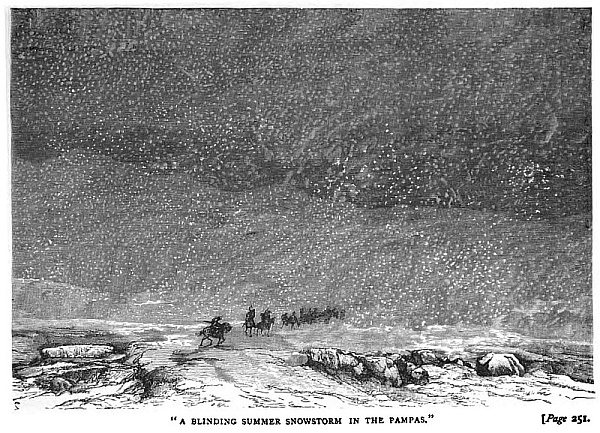
The millet-seed snow gradually merged into flakes; bigger and bigger did these grow, till at last we were in the midst of a blinding summer’s snowstorm.
It was impossible to see even a few yards ahead, so we formed into line, one going in front of the other, Jeeka and Castizo being ahead. Castizo had a compass. Jeeka seemed to carry a compass in the brain. He appeared to know every rock, every bush, and every tussock of grass, disguised though they now were in a mantle of snow.
By and by Castizo came to the rear, where, with heads down and with our arms often across our faces, leaving it entirely to the horses to follow the trail, Peter, Jill, and I were struggling on.
“How do you like it?” he said cheerfully to Jill, who was the centre figure.
“I’ve been more agreeably situated many a time,” replied Jill.
“And I’ve been more agreeably seat-uated too,” cried Peter, with a glance behind him, which almost cost him the seat he was punning about. For when on horseback, poor Peter was always like the rocking-stone on the Cornish hills—touch and go. Only the rocking-stone never does go. Peter did frequently, and although the sly dog at first pretended that he could ride, he had the reckless courage to confess now that he had been mistaken. He would not venture to look up in the air, he said, for anything; and whenever he was rash enough to glance behind him, as he did now, he had to clutch at the saddle with both hands.
“Peter!” I shouted, “you’ll fall, little boy.”
“He deserves to,” said Jill, “after making so despicable a pun.”
“Well,” said Castizo, laughing, “seat or no seat, Peter, you will have to remain in that saddle for many hours to come. You’ll have to dine there, too.”
“Will I, indeed? Well, mon ami, before night comes I’ll be as soft as a jellyfish or a lightly boiled egg. But never mind, if I’m to be a martyr, here goes. I’m willing.”
Just at that very moment, as if fate were all against Peter, his horse stumbled and the rider tumbled. Then the steed stood stock still, and Peter got up, rubbing himself amid a chorus of laughing. We really could not help it, he looked so comical and ridiculous. Castizo had to hold his sides, and Nadi, who was next in front, and of course jumped to the conclusion that Peter had done it on purpose, and that he was the most humorous youth under the sun, made the Pampa ring with her merry laughter.
“He, he, hee-ee!” she laughed. “O Engleese! Engleese!”
But Peter himself looked as solemn as a judge with the black cap on. He simply rubbed himself.
“That’s the way it’s done, you see,” he said at last. “You thought I would remain in the saddle for many hours, did you, my friend? Ah! you don’t know Peter Jeffries yet.”
“Well, Peter,” I said, “I should think that falling off would get somewhat monotonous at last.”
“I don’t fall off. The beast pitches me off Come, Jack, don’t you sit and grin there like a cub fox at a dead turkey. Get down and give a fellow a leg-up.”
I did as told, and Peter was soon seated once more. Nadi departed still laughing, for she never could imagine that any one, unless a squaw, would ask a “leg-up.” She imagined it was all part of the performance. Peter was evidently a favourite of hers.
This was still more evident when, about an hour afterwards, wishing to adjust her robe, she rode coolly alongside his horse and, before Peter could tell what she was about, deposited the baby in his arms.
Peter looked aghast, though he kept firm hold of the child.
“Honi soit qui mal y pense!” he said, solemnly. “Honey, suet, marling-spikes, and pens! I’m in a fix now. Jack, dear boy, are you behind me? I daren’t look round for the world!”
“I’m here,” I answered, choking with laughter.
“Pray for me, Jack. I’ll do as much for you again. Goodness gracious, Jack! if I’ve got to leave the saddle now, I’ll be death of this darling child. If the horse should stumble or baby should kick, it’s all up with us; and I haven’t made my will either.”
Here the baby sneezed, and Peter swayed unsteadily in the saddle.
“Hoop!” he cried. “I did think it was all up with me then. Jack, will you have baby?”
“Not I, thank you.”
“Jill, you’re a dear, good fellow. You’ll take the baby, won’t you? The mother has gone away forward somewhere. Do, old man. I’ll never call you Greenie again.”
“I won’t have little copper-face.”
“Well, then,” said Peter, doggedly, “if it should sneeze again there’ll be manslaughter. That’s all.”
But, greatly to our shipmate’s relief, back came Nadi, and once more secured her darling. Peter smiled now, but he gave a big sigh of relief that might have been heard all over the Pampas.
“You chaps,” he said, “boast about your feats of horsemanship; but just let any of you try riding over the wide wild prairie with a baby in your arms. Well, I’ve done that, and don’t you forget it.”
The storm grew worse instead of better; the snow fell thicker and faster every moment. And now something very strange occurred, for suddenly it became very dark. One would have thought night was falling. While we were all wondering what was about to happen, a blinding flash of lightning spread itself athwart the gloom, followed almost immediately after by a rattling peal of thunder. Flash succeeded flash, peal after peal of thunder, harsh, sharp, and deafening, reverberated from rock to rock. It was unlike any thunder I had ever heard before—not the deep bass roar that one listens to in a storm off the Cape, nor the crashing big-gun sound of thunder in the mountains. The noise was of a tearing, rending character, and resembled platoon or volley firing as near as anything I know of. But the effect of the lightning among the falling snow was most beautiful and wonderful. And whenever a more brilliant and dazzling flash than usual occurred, for a few seconds thereafter the flakes looked purple, blue, and crimson, and sometimes nearly black.
Our horses stood the storm well, for they are marvellously trained animals.
It got lighter now, and gradually the snow ceased to fall, and we could see the sky. Blue it was towards the eastern horizon, with one dark, unbroken canopy of clouds moving fast away overhead towards the Cordilleras.
Back rolled the great cloud-curtain, and presently out shone the glorious sun, and the scene around us was now beautiful but dazzling in the extreme.
We rode on through the Pampas all that day. Whenever we came to a lagoon—and we passed many—we noticed that the water looked as black as ink. It is the same with the sea in the Arctic regions, the contrast in colour accounting for the optical illusion.
We saw many ducks on these lakes, as well as a species of wild geese; but Castizo did not think it advisable to delay our advance for the sake of sport, especially as our larder was full to repletion.
The sun was setting when we reached our camping ground, which was under the lee of a terrace of rocks and close to a pretty little lake. Tired though we all were, more particularly Peter, we could not help pausing to marvel at the extraordinary beauty of the snow-clad hills of the west. Their strange and fantastic summits, and even far down towards the base of the mountains, were lit up with a glory of colour which in no country of the world have I ever seen rivalled or equalled. The shadows or shades were sharply defined and of a bluish purple hue. The high lights were either of pure white or the most delicate shades of crimson. What a beautiful world this is, after all, if we could be but content with it! and every sort of weather, every sort of scenery, and every season, whether spring, summer, autumn or winter, has its own peculiar charm to one who is at home with Nature or Nature’s God.
Our men and the Indians now bustled about, and in less than half an hour the toldos were erected and the dinner nearly ready. Our dish to-night was to be a Patagonian stew, the meat consisting of the tit-bits of the guanaco and ostrich, with a kind of tuberous root dug up by the Indians, and which is indeed a palatable adjunct to diet on the Pampas. Another dish was to be a mash of ostriches’ eggs, which, well salted and peppered and mixed with a morsel of guanaco suet, is food fit for a hungry king.
But while dinner was cooking, and in order to pass the time, Ritchie, Jill, and I went down by the side of the lagoon to look for game, while Peter lay down in the toldo to rub himself.
We had half an hour’s splendid sport. Owing to the weather, perhaps, the birds did not care to fly, so we had to shoot them afloat Ossian would not take the water to retrieve, so Bruce had all the work to do, and very nimbly and energetically he did it too. There were with us several of the ordinary Pampas whippets, but they merely sat with their tails in the snow and looked on. It really seemed to us that Bruce was showing off a bit on his own account, for although he might have waded into the water, this did not suit him. It was not effective enough. He must give one warning bark first to attract the attention of the mongrels—the bark sounding almost like the word “look?”—then down he came with a feathering rush, sprang far into the water, swam up to his bird, caught it nimbly and brought it out.
We retired early, and slept very sound indeed, particularly Peter.
Chapter Twenty Three.
“Our Horses Stampeded”—“Poor Benighted Heathens!”—Jill’s Little Joke—Telling Jeeka the Story of the world—Adventure in the Haunted Wood.
When we looked out next morning we found, to our surprise, that the snow had all gone from the Pampas.
“Isn’t it strange?” I said to Castizo.
“No,” he answered—“at least I should say ‘yes, it is strange,’ but then one must never marvel at anything that happens on the Pampas. If I’m any judge of the weather, however, well have summer now.”
Travelling to-day was exceedingly difficult, the ground being so wet and sloppy. Peter only tumbled once. We came to a river, and had some trouble getting over it. There should be no river here, though on very rare occasions the rain from the mountains, and more particularly the melting snow, has been known to come down in an immense force and fill the cañon from bank to bank.
As the weather soon grew fine once more, with the exception of now and then a drizzling rain or thick fog, which, however, did little more than damp the surface and lay the dust, Castizo, our worthy cacique, determined to take things easy.
We therefore set about enjoying ourselves as much as we could. Our report was at all times excellent. I could not help saying to Peter that a sportsman in this country who was not afraid of roughing it a little, might actually accumulate wealth.
“And bumps,” said Peter, solemnly. “My dear Jack,” he added, “it’s the roughing it that is the great drawback. Now I can walk as well as anybody. Or if I ride and the nag goes at a nice swinging gallop, then I’m as jolly as if on the quarter-deck of an A1-er. But these beastly nags go hippity-skippity, skippity-nippity, till it’s perfectly sickening.”
“Well, but Peter, old man, you ought to be getting quite hard by this time.”
“No, Jack, it’s all the other way. Instead of the saddle hardening me, I’m hardening the saddle. There is where the grief comes in, and I’m afraid it is breaking down an otherwise splendid constitution.”
“Have an extra rug under you, then.”
“A feather pillow would suit him best,” said Jill, laughing.
“I’ll tell Mother Coates about you, Mr Greenie, soon’s we get home. That is if there be anything left of me to get home.”
“Well, Peter,” continued Jill, “it is partly my fault, after all—your being so sore, I mean.”
“How, Greenie?”
“Because I neglected to ask Mother Coates for the cold cream before the steamer left Sandy Point.”
At this moment a herd of guanacos was sighted. There was a shout from the Indians, who at once spread out to surround them.
“Hurrah!” cried Peter. “Here’s for off. Hoop!”
And away went our erratic messmate, helter-skelter over the plains, quite forgetting the hardness of the saddle in that wild gallop.
Peter had become quite an adept at throwing either lasso or bolas. The only drawback here again being that after “heaving,” as he called it, he was apt to follow them, and this resulted in more bumps. It is really surprising to me that Peter never smashed his neck, or at the very least his collar-bones. When we congratulated him on his good luck in this respect, he replied—
“Why, how can I break bones? There isn’t a bone in my body, I tell you. I’m all pulp.”
Peter certainly had plenty of pluck.
I never saw Peter happier than one morning when awaking, we found that all our horses had stampeded. Perhaps stampeded is too strong a word. It would be more correct to say they had silently disappeared. So we had to walk in search of them.
The trail was evident enough, and led us still farther to the west. There was no mistake about it. Peter could walk if he could not ride. He was constantly turning round to us and calling—
“Come on, you fellows. Haven’t you got any legs under you? Such old dawdlers I never did see!”
The Indians said that the Gualichu had lured the horses away—meaning the evil spirit whom they sometimes worship.
The Gualichu might have been an evil spirit, but if so he was a most handsome one, and shaped like a small-headed, fiery-eyed, arch-necked stallion, with marvellous mane and tail.
I was surprised to see Jeeka level his gun at the beautiful brute and fire. The stallion rolled down dead, and after that we had but little difficulty in bringing back our steeds.
We encamped that night by a very small stream, which meandered through a chaos of round stones and boulders. And here, for the first time since we set out, we succeeded in catching fish—a kind of grey mountain trout; they were of excellent flavour, but small in size.
We saw some commotion among the Indians this evening after dinner, and found they were muttering prayers or incantations, and making salaams to the new moon.
“Poor benighted heathens!” said Peter, glancing up at the lunar scimitar, which had just escaped from beneath a little cloud. “Poor heathens! I quite feel for them.”
“But what are you doing,” said Jill, “with your hands in your pockets?”
“Why, I’m turning my money of course. Don’t you always do that when you see the new moon?”
“Poor benighted heathen!” cried Jill.
Peter now saw what was meant, and laughed as heartily as any one.
Presently we entered the toldo, and Peter sat down as usual to smooth his bumps. I noticed Jill looking towards him with a half-subdued smile of mischief on his face. Soon he glanced towards me, and we went out together.
“I’ve thought of a little trick to play Peter,” said Jill.
“Well?” I said.
“Get Nadi to give him the baby again.”
“But how will you manage?”
“Come and see.”
Nadi’s innocent face always lighted up with smiles when Jill and I went near her. My brother addressed her in broken Patagonian. It was very much broken, but it suited the purpose. Nevertheless, Nadi understood English well, though too shy to talk it.
“Peter,” he said, pointing to little copper-face. “Peter ywotisk, Peter kekoosh, moyout win coquet talenque.” (Peter is weary and cold, and would like to have the baby for a little while.)
Up jumped Nadi, her eyes sparkling with delight, and went off to the tent. We followed. In she went, and without a word popped the baby down on Peter’s knee, then retired most gracefully.
Everybody laughed at Peter, but, like a sensible young man, he made the best of it; and when we entered, looking as innocent as sucking guanacos, there he was talking away to the child, and making it laugh and crow more than ever its mother did.
“You see what it is to be a good-natured fellow,” Peter said to me. “Now you’ll live a long time before you get baby to hold.”
Peter often got baby after this, and I really think he came to like it, only he told Jeeka to inform his wife, that the danger of handing him the child when on horseback was extreme. So this never occurred again.
I think, on the whole, then, that Peter had the best of Jill and his little joke.
The country now became changed in aspect, far more rugged and hilly and wild, but at times its beauty was almost awesome.
One day we came upon a patch of woodland, the first real trees we had seen. Then we knew we were within a measurable distance of Castizo’s romantic home in the Cordilleran forests.
We encamped this night close to the wood.
The Indians did not, according to Jeeka, quite relish the propinquity. The wood was haunted by evil spirits. There was a fox with two heads that had been frequently seen within its dark shades, and there was something in white which Jeeka could not well define. It might have two heads or it might have twenty, he could not say; but it was very terrible, and death soon visited the person whose track this something-in-white crossed.
There was no good could accrue from laughing at Jeeka. I could not help thinking, however, what a pity it was so noble a fellow—savage, if you choose to call him so—should remain in such mental darkness. Could we not do a little to help him, Jill and I?
We might try. One never does know what one can do till a trial is made.
“Jeeka,” I said that evening, “will you go for a walk with Jill and me, and bring Nadi?”
“So, so,” was the reply, meaning “yes.”
We would have led him towards the wood, but he shook his head, and spoke but one word in a very firm and decided tone—
“Gualichu!”
He led us down into a rocky ravine where grew many strange bushes we had never seen before, and in the more open places an abundance of wild flowers, many like our own pinks and primroses that grow among the dear Cornish hills. In this ravine was a streamlet which, however, had so worn away its rocky bed that we could hardly see it. We could hear it, however, and when we peeped over the cliffs that formed its banks, there it was foaming and tearing along, and leaping from shelf to shelf of its stony bed. Sometimes it formed great pools of dark brown water, in which fish were leaping after the swarming flies.
Not far from this wild stream, and within hearing of its ceaseless song, we all threw ourselves on the grass in a ring. Nadi, woman-like, had brought some sewing with her, some beautiful skunk skins from which—we afterwards discovered—she was making a little roba or poncho for her favourite Peter.
“You’re not afraid of the Gualichu?” I said.
Jeeka looked hastily round as if to make sure there was nothing very dreadful in sight, before he replied—
“I shoot he quick, suppose I can.”
“But you shot him before in the shape of a horse?” I said.
“So, so.”
“And he has come to life again?”
“He, everywhere.”
“You speak the truth, Jeeka: the spirit of evil, if not the evil spirit in person, is everywhere. Now who, think you, made these grand old hills, the mountains beyond? Who made trees and those sweet flowers? Who made the horses at first, the guanaco and the ostrich? Who made man? Not the Gualichu, surely?”
“N-no. He not make them good,” said Jeeka, thoughtfully.
It was an innocent, childlike answer, but yet it brought to my mind at once the words in the first chapter of Genesis, “And God saw that it was good.”
It brought me at once to my subject too. I had felt very shy in speaking at first, but I felt it my duty to speak, and I really think I waxed eloquent as I proceeded. Words seemed to come at all events, simple words and simple language, but they suited the occasion.
I told Nadi and Jeeka the story of the world, the story of its fall, and of its redemption through the mercy and loving-kindness of the Good Spirit who made it.
A story so simple that babes and sucklings can understand it, appealed to the very hearts of these poor handsome heathens.
Nadi dropped her skunk skins in her lap, and listened open-mouthed. Jeeka was cutting the root of a bush which he had plucked into chips with his dagger. He never once looked up, but I knew he was listening too.
There was silence for a time after I had finished. Then Jeeka rose, and grasped my hand.
“Brother,” he said, “you tell me this story again? So, so?”
“So, so,” repeated poor Nadi.
During all my story she looked as though she understood every word, and I have no doubt she did; but her husband frequently interrupted me by saying to her—
“Ma Onques?” (Do you understand?) on which Nadi would merely nod assent, without taking her eyes a moment from my face.
I have often thought since then what a blessing it is that all a poor human being needs for his soul’s salvation is so easily understood, that even the intellect of a savage can compass and comprehend it. What a hard road it would be to the New Jerusalem were the finger-posts that point the way written in a language few could understand, or the directions couched in technicalities only a limited few could fathom. But no, there it is in a nutshell. “Repent, love, believe and be forgiven.”
The truth had got firm hold of Jeeka, or Jeeka had got firm hold of the truth. I was soon sure of that. It was not so much that he tried to be a better man, as that he seemed ever afterwards to live as if he were only “down here”—the woods are his own for a brief time,—and that his real home was in the far beyond.
He used often now to make Jill or me repeat the story of the world to him, and especially the story of the Cross. He always brought Nadi with him when he desired to speak to me on such subjects. But he sometimes asked us strange questions. Such as about the grass: was it a good crop in heaven? Horses: were they well trained? etc, etc. Once Jill read to him from the Revelation a passage where white horses are mentioned in a vision.
Jeeka was delighted, and made him read it over and over again. He was also greatly pleased with descriptions of Bible battles.
One day Jill read to him the description of the great fight between the Israelites and the Canaanites, in which it is said that the Lord caused great stones to be rained from heaven upon the enemy.
Jeeka here grew quite excited.
“Hum-m-m. So. So. So!” he cried. “The same thing I have seen.”
“You, Jeeka?”
“So, so. Big stone. Terrible fire, much smoke and t’under. Big stone fall eberywhere. So, so.”
As he spoke Jeeka waved his arm away towards the west, and I at once understood him to refer to an eruption of some great volcano of the Cordilleras, for there are several such.
What pleased Nadi more than anything else was the singing of hymns. She used to join with us, but it was more of a child’s voice than anything else.
However, Nadi was very young, not more than sixteen perhaps, wife and mother though she was.
Our route lay even more to the north than the west now, and it was soon evident that we were on the great border-line betwixt the wild bleak Pampas and the forest-clad mountains, which are but a continuation of the great Andes chain.
The way was now a winding one, for we often had to make long détours to get round a lake or the spur of a mountain, although the lower hills we still continued to face and cross.
Sport, and plenty of it, still fell to our lot, though the gun and revolver and spear came in now more handy than the bolas and lasso.
Even here, however, in the midst of the wildest mountain and sylvan scenery, there were vast stretches of level valleys and plateaus between the hills. Most of these were the feeding-grounds for vast herds of guanacos and of wild horses.
Our camping grounds of a night were now generally in some grass-covered glade, and it was indeed a pleasure to fall asleep in our toldo with the sound of the wind whispering through the trees like the murmur of waves on a sandy beach.
There were many night sounds now, however, besides the whispering of the trees, and some of these, to say the least, were not over-pleasant to listen to. If, for instance, we were anywhere near to rocky ground, there was the mournful and weird yelling of wild cats. These were mingled at times with the “Yap-yap-yeow—ow” of the Patagonian fox. There were also many strange cries and sounds which we could not account for, so we were fain to put them all down to the birds.
It was not safe to enter the forests by night; sometimes even in daytime there was danger enough. I remember I went to bathe one day by myself in a bright clear pool formed by a mountain torrent. The water was delightfully cool, so I stopped for a full hour enjoying myself.
After lounging a little by the river’s bank, dressing leisurely and falling into a kind of day-dream, I prepared to return. No one knew where I was, and if I were missed, both Jill and Peter would be anxious. I commenced to retrace my steps up a little pathway through an entanglement of bush and thorn, but had only advanced a short way when from the scrub in front I heard a low growl, emitted evidently by a puma, and he could not be many yards away. To fly was to court pursuit, and that meant death, for I had no arms of any kind. I shaded my eyes with my hand, and looked cautiously under the bush. Yes, yonder was a pair of huge green fiend-like eyes glaring at me, watching me as a cat watches a mouse.
I drew cautiously back, glad to get away with my life, and re-crossed the stream. But here I was on another horn of the dilemma, for the only other way back to the camp would take me fully three miles about, with the probability, too, that I might lose myself and wander about all night long. No, this would not do; I must scare that puma. The little pathway, it just then occurred to me, must have been made by wild beasts—perhaps pumas.
“Whatever man dares, he can do,” I said to myself, as I gathered an armful of big round stones. Then I advanced once more towards the puma’s bush, and shouting, threw a stone I was answered by a snap and a growling roar. Another stone: result the same, only the snap more vicious and the growl more angry. I was in for it now, so I threw the third stone with all the force I could command, giving vent at the same time a yell that would have startled a Chak-Chak Indian.
This had an effect that I had hardly bargained for. I had counted upon the denizen of that incense bush going off in any direction rather than mine. Not so. With a spitting coughing roar, that went through my nerves like a shock from a powerful battery, the brute sprang out towards me. But a merciful Providence was surely protecting me, for at the very moment the huge extended talons were nearly in my neck, another and larger puma bounded from the bush, striking the first and sending it rolling down the little pathway. Then over and over they rolled like two huge overgrown kittens, until they finally disappeared. Indeed it is evident enough the two beasts had been all the time romping together, and that even my presence did not suffice to interfere with their sense of fun.
Peter laughed heartily when I told him of the occurrence; but Jill did not. He even scolded me. What right had I to go away into the bush without him? he inquired, and hoped it would be a warning to me.
Poor innocent Jill!
The Indians, and even Jeeka, were rather afraid of the wood in which this adventure had taken place. It was haunted.
Strange, I thought, that so many woods were haunted.
Yet one cannot wonder at these poor people being superstitious, wandering so much as they do in this wild lone land, seeing so many sights and hearing so many strange sounds for which they cannot account.
Chapter Twenty Four.
A Journey to the Country of the Gualichu—The Earthquake—a wondrous sight—“I will pray to the Great Good Spirit.”
“I feel unusually fresh this morning,” said Peter one day as we all squatted down to breakfast.
“Considering,” he added, “the roughish time we had yesterday, I’m a little astonished at my recuperative powers.”
“What ship did you say?” said Ritchie.
“Recuperative powers, Edward. That’s the ship. And I didn’t know I had any. Why, when I turned in last night I said to Jack there, ‘Jack,’ says I, ‘I’m feeling ninety years of age.’ But this morning I can hold my age like a young hawk.”
“And the bumps, Peter?” I said.
“Gone down beautifully, Jack. Hardly a bump visible to-day. Just a blueness on some of the bone ends. Greenie, I’ll trouble you for another slice of that ostrich gizzard.”
“Well,” said Castizo, “I’m glad to see you all looking so bright and jolly. ‘Jolly’ is English, is it not?”
“Oh, thorough English!”
“Because, my boys all, I want to make a détour to-day, and pay a visit to an old friend of mine, Kaiso to name—King Kaiso in full. Kaiso means big, and big he is.”
“A giant.”
“A giant among giants, for he has surrounded himself with the biggest fellows he could find anywhere. He’s a funny fellow himself. He has been far travelled too: been to Chili and Monte Video, where he went as a show on the boards of a small theatre or concert place. As soon as he made money, however, he bought all the pretty and useful things he could find, and so retired to the fastnesses of his mountains. His troops are a strange band, of northern and southern Indians. The wonder to me is how he manages to keep peace among them. He keeps a private witch, however, a tame puma, and a medicine man.”
“I don’t mind the witch much,” said Peter, “they are usually pretty tame; but the puma, mon ami, is it tame? Has he a dog licence? Does he keep it chained up?”
“Oh, no, but it is very affectionate. Don’t let it lick your hand, that is all, for its tongue is exceedingly rough, and if it tastes blood, it is like King Kaiso with rum, it wants more. Jill, my plate is empty.”
“And does this King Kaiso,” said Ritchie, “live far from here.”
“Yes, several days’ hard ride.”
Peter groaned.
“But we’ll have a good rest when we get there. Then a few days more will take us home.”
Peter smiled now, and passed his plate to Jill again.
“Last time, and the only time in fact,” continued our cacique, “that I visited Kaiso, he condemned me to death. But this was at night, and Kaiso had some rum. He told me he would himself do me the honour to cut my head off with one of his very best swords. I thanked him, of course, and appeared quite pleased about it. But lo! in the morning he had forgotten all about it. We were half-way through breakfast when he said, ‘Oh, by de way, I was goin’ to lop your head off dis mornin’. But I too tire. I much too tire. Some oder day p’r’aps.’ I assured him not to trouble about the matter; that I could afford to wait, and would wait to oblige him.”
“And there was no more about it?”
“Never a word. He had finished all the rum, you see. But Kaiso lives in a strange land. His home is in the country of the Gualichu.”
“Gualichu! That’s the evil spirit, isn’t it?”
“Yes, Jill. But the only evil spirit I ever saw there had been imported from Jamaica.”
“Rum?”
“Rum, yes, that’s the real Gualichu. Well, Jack, you have good influence with Jeeka; go and tell him where we mean going. He will demur; I had the greatest difficulty in getting him to go last time, and he said he never would return.”
So as soon as breakfast was finished I paid a visit to Jeeka’s toldo. He was waiting while his people, harnessed up and were ready for the road.
“Jeeka,” I said, coming to the point at once, “we are going to visit King Kaiso!”
Jeeka’s face assumed an aspect of almost terror.
“What!” he said. “Go to Kaiso. Kaiso bad man. Kaiso all same’s Gualichu. He live in Gualichu land. Hum-m-m. I will not go. Kaiso kill us all. Hum-m. He have snake to hiss and bite. He have puma to roar and tear. He keep Gualichu man and Gualichu karken. He have fire all round de forest. But the forest itself not burn!”
I sat with Jeeka and Nadi a whole hour, and it needed all my powers of persuasion to make them consent to lead the way to the Gualichu land.
They did so at last, however, and long before the sun was high in the north we were well on our road.
It would take the greater part of a goodly volume, to give anything like a correct description and history of our journey to the land of the Gualichu. We had hills to climb, mountain torrents to wade, long dreary plains to cross that seemed never-ending, and deep jungle-like forests to penetrate through. Sometimes these last were as dark as gloaming even under the midday sun. In their gloomy thickets we could hear the voices of angry pumas, and we saw and shot some of these of immense size.
We saw one immense snake of the boa description, and we also saw some deer.
Castizo marvelled much at this.
“I did not know,” he said, “there were deer so far south.”
“Strayed out of some gentleman’s park,” said Peter, quizzingly.
“And as for boas, if that was a boa, how on earth did it come there!” continued Castizo.
“Oh, I know,” said Peter.
“Do you?” said Ritchie; “tell us.”
“Why it has escaped from Wombell’s Menagerie, of course.”
The idea of gentleman’s parks or Wombell’s Menagerie being in this wilderness was ridiculous enough; but Peter was in one of his funny moods.
We did not stop anywhere for sport, only when any wild creature crossed our hawse, as Ritchie phrased it, we brought it down for sake of its flesh or skin.
Hawks and vultures we found very numerous in these regions, and many strange animals we had never seen before, some of the ant-eating fraternity, others like ermines, but brilliantly coloured, and others again that seemed partly rat and partly nondescript. There were otters in the mountain streams, and fish in such marvellous abundance that, in one hour, Jill and I caught nearly one hundred and fifty.
(This would, indeed, be a land of pleasure for the sportsman. And yet only a month ago, I heard a member of a West-End club assure a friend that sport was played out. He had been everywhere, he said, and shot everything, and there really wasn’t anything left worth pointing a gun at.)
One dark night, while encamped near the borders of a deep, dark wood, we were all awakened by a strange feeling of qualmishness.
“I dreamt,” said Jill, “I was at sea for the first time again.”
“Something we’ve all eaten,” said Peter, “that hasn’t agreed with us, though I had nothing for supper except about a pound of that puma steak, and a few handfuls of ba-ba roots.”
“Hark! Listen.”
“Hark! Listen,” from Jill and me.
There was a noise in the distance as of heavy waggons rolling over a metal road, then the earth trembled and shook with a strange heaving motion as if water were rushing beneath the surface. The same feeling of qualmishness shot over us, and we all pressed our hands to our heads.
It was an earthquake.
The vibration had no sooner ceased than we heard Castizo’s voice calling to us.
“Come out, boys, and you’ll see something.”
We hurried on our clothes. I felt more nervous and frightened than ever I had done in my life before. So were Jill and Peter.
“I hope,” said the latter, “the earth won’t open and swallow us up. Fancy being buried alive!”
“It would soon be all over, Peter,” said Jill.
Castizo, Lawlor and Ritchie were already out in the open and gazing westward. A fitful, changeful light was on their faces, such as I had never seen before. Sometimes it was a rosy glimmer, then it would change to pale yellow or blue.
The light came from the western horizon, and the appearance there was simply appalling. A great cone-shaped hill was vomiting forth columns of smoke alternating with fierce and terrible flames. In the midst of the fire we saw innumerable dark bodies which were undoubtedly rocks.
The night was very dark, so that the eruption was more fearful than it would otherwise have been.
All the Indians were out; most of them lying on their faces, and, I thought, praying.
I went to Jeeka, who sat beside his wife on the grass. Nadi was weeping and moaning.
“Jeeka,” I said, “do not pray to the Gualichu. Pray to Him who made everything, and who loves us—the Great Good Spirit.”
“Did He make that fiery hill?”
“He made and governs everything.”
“Does He govern the Gualichu?”
“He governs every one on earth, and all things on and under the earth.”
“I will pray to the Great Good Spirit.”
Towards morning the eruption died away as quickly as it had begun. Then we retired, and slept well and soundly for several hours.
But next day there was something very like mutiny in our camp. The Indians now refused point blank to go farther with us into the land of the Gualichu.
Jeeka would have braved everything to oblige us, but cacique though he was, he could not go entirely against the wishes of his people.
So it was determined to leave them here in camp till we returned. It was but one day’s journey now to King Kaiso’s country, and Jeeka gave us a solemn pledge that he would not let his people desert. He would shoot them first, he said.
Then we white men saddled our horses, the Indians loaded our pack mares, and off we started all alone to see the terrible king, who kept pet pumas and snakes, tame witches and medicine men.
Chapter Twenty Five.
King Kaiso’s Land—A Regiment of Giants—Kaiso’s Witch—Condemned to Death.
Our first intimation we received that we were close on King Kaiso’s country, we had this same evening from a lot of dogs that were ranging through the wood we were in. A wood, singular to say, with hardly any undergrowth, but bedded feet deep with the fallen leaves and nut husks that had fallen in previous years.
The dogs yelped and ran. Presently we came upon a bevy of children whom our sudden appearance seemed to scare out of their senses. I shall never forget their looks of terror, nor the speed with which they fled screaming and howling out of the woods.
Soon we heard drums beating and a trumpet braying. “Braying” is exactly the right word in the right place, but, a donkey with a bad attack of whooping cough would have brayed far more musically.
Nevertheless, that trumpet was a call to arms. And we were no sooner clear of the trees than we saw a troop of fully fifty spear-armed warriors riding boldly towards us, from a gipsy-like encampment in the centre of a plain.
This was the flower of King Kaiso’s army. And yonder was the king himself at the head of them.
We halted, and as they came rushing on towards us, I thought I had never seen finer men in my life. Not one of them could have been less than six feet high in his potro boots, while the muscles of their arms and naked chests were wondrous to behold. They were naked to the waist, and their black hair, adorned with ostrich feathers, floated over their brawny shoulders.
The king was a giant, pure and simple. A very Saul among his soldiers, towering a good head and shoulders over the biggest among them.
We had halted, and when within about fifty yards of us, at a word of command from Kaiso, the troop suddenly drew rein, and stood like statues, looking most delightfully picturesque.
Castizo waved a white handkerchief. That was all. But the effect was wonderful.
Without saying a word, Kaiso pointed back towards the encampment. Round went each horse and away went the troop thundering over the plain, and in a few minutes had entirely disappeared.
Then, and not till then, did Kaiso advance. His greeting was most cordial. No, there was no sham. It really was sincere. There were actually tears in the giant’s eyes.
After asking Castizo fifty questions at least, he turned to us and shook us cordially by the hand, calling us “brothers,” and bidding us welcome to the country of the Kaisos.
Chatting and laughing pleasantly now he led us towards the toldos, telling us all that he meant to do to entertain us, and what we should have to eat. The menu, I remember, included horse, puma, guanaco, skunk, armadillo, eggs, fish of every sort, and yerba maté. It was evident he did not mean to starve us.
Kaiso was a fine bold-looking man. Although a giant, there was nothing repulsive about him. His frame was everywhere well knit, and when he bent his naked arm, his biceps stuck out like Donald Dinnie’s—and this is paying the king a very high compliment indeed.
Jill and I dismounted.
Peter was more cautious.
“I say, your majesty,” said Peter, “how’s your puma? I hope it is lively. I’m extremely fond of pumas.”
Kaiso did not reply verbally; he put two fingers of his right hand into his mouth and the puma came in a series of bounds from the wood not far off, and, arching his back, rubbed himself against his master’s leg.
Then the beast marched up to Castizo and went through the same performance. He evidently knew our cacique. He smelt Jill’s legs and mine, but made no sign of friendliness.
“Delightful creature!” said Peter from his saddle. “Tame, I suppose? Looks like a huge cat. Pussy, pussy, pussy.”
“Tame,” said the king. “So, see what I do now.”
What he did do was rather startling, and at the same time proved the strength of this Herculean king.
“Gollie! Gollie! Gollie!” he cried, and Gollie followed him for some distance. Then, after stroking him, he seized the huge animal by the tail, and, turning on a pivot himself, he whirled the puma off the ground and round and round in a circle for fully a minute. When he let go the beast lay in a heap, dead to all appearance.
“Dead!” said Peter, dismounting. “Well, Kaiso, old chap, you needn’t have killed him. I’m so sorry I sha’n’t be able to have any fun with him. Poor Gollie!”
“Gollie not dead,” cried the king, laughing. “Gollie drunk. Dat is all. Byme-by he come sober, and den you hab fun plenty.”
Peter’s face fell.
“I’m sorry I spoke,” he said.
“Peter,” I said, “you’re a humbug.”
Meanwhile Kaiso’s wives had made us maté, and we all squatted down to drink it. It was extremely refreshing, and as the puma presently got up and slunk away to the woods, even Peter grew happy once more.