Book III—The Land of Giants. (continued 2)
Reading edition
King Kaiso was as good as his word. He was hospitality personified. He seemed not to know how kind to be to us, and during the five days we sojourned with him the village was en gala, given up to games and festivities.
It was a strange country this, in which King Kaiso lived, close to the borders of a region of volcanoes, the fires of which we could see every night. But there was trace of volcanic action in the immediate vicinity. If ever there was a true oasis in the desert, this was one, and I could not help believing, with Castizo, that there were fires right beneath us, and that it was the heat from these which caused the luxuriant growth of tree and shrub and waving grass. The woods were, in some places, quite a sight to see, for not only did lovely ferns and the most charming of wild flowers grow everywhere, but even flowering creepers and climbers. Some of the latter were of the wistaria description, but in clusters of the deepest crimson, with a sweetness of odour that permeated the air in every direction.
Kaiso lived here in tents all summer, but his warriors and people went on frequent far-off hunting expeditions, and even visited Santa Cruz, bringing back many of the luxuries of civilisation.
Kaiso was never attacked. The Patagonian Indians are far too superstitious to venture anywhere near the Gualichu land. So Kaiso and his people, who numbered in all about three hundred souls, lived in peace. The king told us there was no Gualichu; his medicine man had driven him away, with the assistance of his witch.
We were introduced to this medicine man. He had a string of strange charms hanging round his neck, the fangs of wild beasts, curious coloured stones, and other trifles; and he carried attached to his spear a bunch of herbs. Otherwise there was nothing remarkable about him.
The witch we also saw. Instead of the old hag we imagined she would be, we were agreeably surprised to find a young girl of very prepossessing appearance, who smiled pleasantly on us, shook hands and made signs. She was deaf and dumb.
The bad spirit, the medicine man told us, had stolen her ears and tongue, but had given her much wisdom instead.
During the winter months Kaiso and his wives lived in caves.
We visited these caves, and found to our astonishment that they were completely lined with skins; all the walls, all the roofs, and all the floors were skin. The value of these skins must have been very great. Thousands of pounds would not purchase them in Europe.
Some of Kaiso’s customs were ridiculous enough. One was this: he insisted upon his wives having a Banian day, as we call it at sea, once a week. He not only insisted, but made sure of it; for the night before he clapped them all together in one of these hairy caves, and placed armed sentries before the door, and neither food nor drink was allowed to cross the threshold till they had fasted four and twenty hours.
“They get too fat,” Kaiso explained. “Suppose I not do that. Fat wife too slow. No good. No.”
Every day of our sojourn in the country of the Gualichu brought some new pleasure. As far as I can remember, the programme was somewhat as follows:—
First day. A grand hunt and battue in the forest, in which all hands engaged, even to the women and children. We killed many pumas, foxes as big as wolves, and other beasts and birds innumerable.
Second day. A great fishing expedition, with a feast of fish in the evening. We were more than astonished to-day to see little boys and girls leap from cliffs over a hundred feet high into deep pools in the river beneath. They also allowed themselves to be carried over a waterfall, and when we white folks thought we should never again behold them, lo! they bobbed up like seals close to our feet, smiling, and thinking it the best fun in the world.
Third day. A kind of circus. Marvellous display of horsemanship by Kaiso’s people. We tried to persuade Peter to display his prowess, but he begged to be excused owing to the bumps. Dance in the evening.
Fourth day. The marriage of a subordinate chief. This marriage was made on purpose to gratify us, for the chief had no particular desire to enter the holy bonds. Kaiso’s word was law, however. There was a grand procession to bring the bride home, and a wild ride all round the plain, with much clapping of hands, singing, and shouting.
Fifth day. This was our last, and I shall never forget it. It was to be devoted to harmless dancing and other frolics. But unfortunately some of Kaiso’s men who had been away at Santa Cruz arrived in the forenoon, bringing with them a large keg of rum.
“Now,” said Castizo to us, “the Gualichu has come in earnest.”
I am sorry to say that the rejoicing among the male portion of King Kaiso’s little community was universal, as soon as that keg of fire-water was broached. Even old quiet men, of whom there were several in camp, smacked their lips and grew garrulous in their glee.
To do him justice, Kaiso shared the poison liberally among his braves. After which, dancing and the wildest revelry became the order of the day. Everything, however, passed off pleasantly enough till near sunset, when some disagreement between two of the warriors was to be fought out with knives upon the spot. In this they were disappointed, however, for the women had taken the precaution to hide all warlike weapons. The warriors, however, were not to be entirely baulked in their designs. They commenced therefore to fight literally with teeth and nails, like wild beasts. The desire to tear each other spread through the camp like wild-fire. Donnybrook Fair was never anything to the scene we now witnessed.
We white folks stood aloof and simply looked on. It is dreadful to have to say that several men were killed with stones in this inhuman battle.
In the midst of it all up strode the giant Kaiso, with the keg of rum in his arms, and peace was immediately restored, and more rum distributed. The men who fought now commenced to sing and to hug each other, and vow eternal friendship; but in the midst of their ill-timed merriment it was heartrending to hear the wail of the women and children over dead husbands and fathers.
Kaiso had gradually changed during the afternoon from a fool to a raving maniac, rushing around with a bludgeon, felling his men and smashing the tents. He relapsed into idiocy again, but it was of a mischievous and fiendish kind.
Castizo tried to get him to eat. He would not; but he would drink maté mixed with rum. So our good cacique humoured him, hoping he would soon fall asleep.
Not so soon, however. He called his chiefs together, and waving an arm wildly in our direction, said briefly and fiercely,—
“Wirriow walloo! Eemook noosh. Lasso!”
His chiefs grinned and retired. But Castizo began to sing; but we could see it was but a ruse. Kaiso joined in with his deep bass voice, which was more like a lion’s roar than anything human. It was a song with a chorus, and a rattling one too, and this we all sang. We certainly were not very like men who were condemned to be strangled with the lasso early in the morning, but such had, indeed, been Kaiso’s command.
“More rum!” Kaiso would have it. But it told even on the brain of this giant before long, and he toppled back where he sat, and fell into a deep sleep.
What a sigh of relief Peter gave!
I was expecting that pet puma in every minute.
“D’ye think he’ll waken?”
“Oh no, he won’t wake to-night,” said Castizo.
“We’re going to be all hanged in the morning, aren’t we?” said Ritchie.
“Yes, that’s the order.”
“Well, if I had my way, I’d—”
“What?”
“Scupper the lot. Begin with Kaiso.”
“No, no, my friend; Kaiso is not a bad fellow when sober. I know a better plan than that Come with me. Lawlor, you’re a big fellow, carry the keg.”
Off we marched to the large toldo, where all who were awake of Kaiso’s warriors were still talking and shouting.
Seeing what we carried, they welcomed us with a shout and a yell.
Castizo was most liberal in his allowances. Nor did we leave the toldo till every warrior had succumbed.
“I pity their heads in the morning,” I said.
“So do I,” said Castizo, “for this is not rum, but the vilest arrack, brought to the country specially for these poor wretches.”
It is needless to say that there was no sleep for us that night.
Luckily it was fine, so about one o’clock in the morning we silently caught and saddled our horses, and rode away into the forest in the same way as we had come.
We had great difficulty in finding our way, and had to steer by our pocket-compasses. But we got through at last, and before the sun shone over the hills we were far beyond pursuit.
We arrived early in the afternoon, safe and sound, at our Indian camp, and were received with every sign of joy, no one having expected we would ever return from the land of Gualichu.
Chapter Twenty Six.
Castizo’s Idyllic Home in the Cordilleras—Preparing for winter—catching and Breaking Wild Horses.
So long had we lazed on the Pampas and on the borders of the Cordilleras, that summer had almost fled before we reached Castizo’s mountain home. It is probably doing ourselves injustice, however, to talk of lazing on the Pampas. The time was well spent, for if there be any happiness of a solid nature on earth, I think it had been ours during those all-too-short summer months. If you were to ask me for an analysis of this happiness, I think I should reply that it resulted from that perfect freedom from all care which only a true nomad ever enjoys, from the constant chain of adventures and incidents that surrounded us, from the strange scenery weird and wild, from the beauty of the sky night and morning, and, above all, from the perfect, the bounding health we enjoyed, health that made us laugh at danger and consider troubles, in whatever shape they came, trifles light as air.
Castizo had told us often about his estancia in the hills. For many years he had gone back and fore to it from Santa Cruz. It was simply a craze of his, he said; a mere whim or fad. He dearly loved loneliness, and in his own little Highlands he enjoyed it to the fullest extent. He was never afraid of the Indians. Not that he considered them immaculate as to virtue, and the soul of honour; but because his person, intact and safe and sound, represented to them so much property. He never paid them wholly until they had returned with him to the little station on the eastern coast, and then great indeed was their reward.
But all independently of this, I am convinced that these poor Indians dearly loved their white cacique, and that apart from any financial consideration, any one of them would have fought for him until he fell and died on the Pampa.
Yes, Castizo had spoken much to us of his life and adventures in the mountains, but he had not described his little village. Therefore we were not prepared for what we saw.
First, then, we had to cross a wide, extended, open plain or pampa, so great in extent indeed that we began to think the wilderness had commenced again.
In the very centre of this plain was a broad lagoon, but how fed or dried we could not tell, for no stream ran into nor out of it. There it was, nevertheless, and all round its borders bushes grew, and a rank, rushy kind of vegetation with tall flowers, crimson, blue, and bright yellow. We noticed with pleasure, too, that there were both ducks and geese on it. On the plain, moreover, we shot several birds of the grouse species, though quite different from any I had ever seen before.
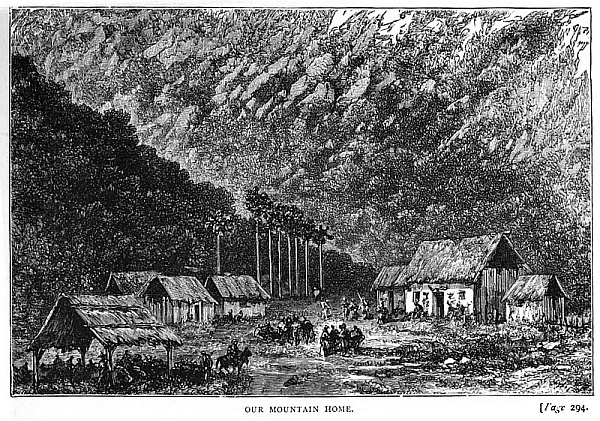
After we had ridden about an hour longer, a purple mist that had hitherto hidden the hills was lifted up like a veil by some slight change of wind, and there revealed in all its beauty was one of the loveliest little glens ever met with in a long summer’s ramble. And near the top, closely shut in and sheltered from the cold west winds by wooded hills, was our mountain home. Primitive enough, in all conscience, was this estancia, consisting of a mere collection of log huts, well thatched and cosy enough in appearance, but only one having any pretension to display. This last was plastered as to its walls, had a little garden in front, and flowers growing up over it.
Before we reached this tiny village we came upon the Indian camp, and here children and women and old men ran out to meet us, with joyful shouts that were re-echoed from the hills and rocks on every side.
Even before the wives embraced their husbands or the children their fathers, they all gathered round Castizo, the welcome they gave him bringing tears to his eyes.
“Yank! Yank! Yank!” they shouted a hundred times o’er. (Father! father! father!) Had he possessed a score of hands they would have shaken them all, while the pretty children who could not reach high enough must catch and kiss the border of his guanaco robe.
They took away his horse. He must walk the rest of the way. He must be in their midst and tell them all his adventures. Their Yank must speak to his children, and tell them too what he had brought them.
The girls had culled wild flowers, and these they hung round the necks of all our horses, so that the welcome was a general one.
No, we had not expected this. Neither had we expected that the inside of the principal cottage would be so well furnished. Everything was rough and homely, to be sure, but everything was comfortable and cosy. Viewed externally, it was difficult at first to see whence the smoke could issue, but as soon as we entered we noticed a very ample fireplace indeed, the smoke being conveyed away by a copper chimney issuing from the back of the house, and thus protected from the baffling winds of winter and spring.
We admired all we saw, and Peter at once ensconced himself in one of the easy chairs, and confessed that he felt happier and hungrier than he had done for many a long day.
Pedro had the toldo erected at some distance from the house, and proceeded forthwith to cook dinner.
After this meal Castizo went down to the Indian camp, accompanied by Lawlor, carrying a huge bundle containing the presents and pretty things brought to the old men and women and children all the way from Valparaiso. There were pipes and cards (Spanish) and dice-boxes of curious shapes for the former, trinkets and dolls and toys and sweets for the children, and for the ladies strings of beads, necklaces, bracelets, and lockets that made them almost scream with delight and admiration. As gewgaw after gewgaw was taken out the constant shout by these impulsive young ladies was—
“Heen careechi? Heen careechi?” (Who gets that?) followed by a grateful—
“O nareemo nachee!” (Many thanks!) from the lucky recipient.
Only one old man asked for rum. But Castizo shook his head and replied in Spanish, which this Indian understood—
“Never more, Goonok, never again. When last I brought rum to the camp, thinking you would but taste and put it away, hé aqui! you and your people drank all. All at once! You quarrelled and fought. There was much bloodshed, Goonok. You know the green grave at the corner of the wood yonder. There your brave son sleeps. He was killed that night, Goonok, by his own cousin’s hand. Never more, Goonok, never again.”
“Maté yerba?”
“Yes, plenty of that. As much maté as will last the camp all the livelong winter.”
“Hé!” cried the old man. “Is, then, our white cacique to stay with us through the winter?”
“Yes.”
“And his young men and all his followers?”
“All, Goonok, every one of us.”
“Then is Goonok indeed happy, and to-night, old as he is, Goonok will dance.”
It was only natural that a ball should follow the home-coming of the white father, as Castizo was sometimes called.
A special toldo was erected for the purpose by the Indians by making three kaus into one, and to the music of horrid drums and still more horrid pipes, very pretty dances were gone through indeed. It seemed to me a pity, however, that the men daubed their faces with paint or clay, as it gave them a grotesque appearance which bordered on the hideous.
At a sign from Castizo, and during a lull in the proceedings, Peter brought out his clarionet. He had hardly played a note ere a silence deep as death fell upon the assembled Indians. At first some of them ran away, as if frightened, but all soon returned and stood or sat listening entranced. How very deeply the music had affected them was proved by the sighs they gave vent to immediately after Peter had finished. There must be something genuinely good in the heart of those wild Tehuelches, or they could not love music so much.
We all slept well and soundly that night, there being nothing to disturb us save the occasional shrill scream of the Indian on sentry. This startled Jill and I at first, but as the sound died away in mournful cadence, instinct told us what it meant, and we slept all the better after it.
Though it was yet early in autumn, we took the advice of our own cacique and set about at once preparing for the long winter that was before us. For storms in these regions come on suddenly, sometimes, long before autumn is over.
Our people were divided into two parties, one to hunt, another to work at home and in the woods.
The former brought in the flesh of the guanaco, the ostrich, the armadillo, and even the skunk. Skunk meat certainly sounds offensive, but it is very delicious eating, nevertheless. This meat was carefully salted and stored in huge earthenware jars.
One way of storing meat was very strange to me, but, as I afterwards discovered, most effectual. It was first salted with pampas salt from the Salinas, it was then buried in a grave lined with salt-sprinkled leaves, and well packed down. Meat was also sun-dried and partially smoked.
Fish were caught in abundance, especially a sort of perch, and these were smoked with a peculiar kind of wood and stored away for winter use.
Firewood was also to be had in abundance, simply for the gathering. Much of this was dug up out of the boggy land, and was found to be “as fat as fir,” to use an expression of Ritchie’s.
There were many kinds of fruit in the forests, principally of the hardier species, and bushels of these were dried in the sun or by fire, and during the winter they made a valuable adjunct to our diet. Nuts too were plentiful.
But, after all, the most important item of food, not only for ourselves but for our horses, was a kind of tuberous root, which grew in any quantity in the glens and even on the banks out in the open plain. For two whole weeks we had fully a score of Indians, to say nothing of their children, digging and storing these roots. The mice were in millions all round our estancia, so the only safe way of preserving our roots and thereby preventing a famine was to dig graves and bury them. Even these had to be watched, so numerous were the mice.
Hay we stored in large quantities in stacks; also the tender herbage of several trees of which, when green, the horses ate with great relish.
We soon discovered that the armadillos were on the scent of our buried flesh food. So stakes were driven in the ground, and to these dogs were fastened every night in the immediate vicinity of our buried treasure. We did not intend, however, that these poor animals should be on sentry all night long exposed to the wind and rain, the sleet or the snow. We therefore built them shelters, so that they were cosy and happy.
We had our reward, for even on the second night of his watch one dog made an immensely large armadillo prisoner. I happened to be first about that morning, and seeing how eagerly the faithful canine sentry looked towards me, I went up to pat him, when he pointed to a huge ball-looking thing.
“That’s the robber,” the dog seemed to say; “I can’t get him to unroll himself, or I should soon let the stuffing out of him. Will you oblige me?”
I did not oblige the dog, as I object to take life in a cold-blooded manner. But an Indian did, and we had the ’dillo for dinner. Though somewhat peculiar in flavour, the flesh was as tender as that of a stewed rabbit.
So much fodder had we collected, that we determined to add to our stock of horses, feeling sure that some accident would befall a few of them before the winter was over.
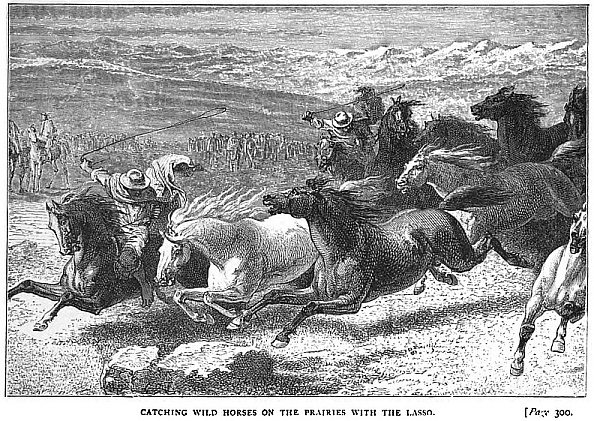
Jill and Ritchie joined the expedition to go over the plain in search of wild horses. Peter preferred to stay at home. He had no desire, he said, to raise his bumps again. I stayed with Peter to keep him company.
Jill and Ritchie were gone for three days, and I was getting uneasy when the whole cavalcade reappeared.
“Terribly wild work,” said Ritchie as he entered the log-house. “Ain’t I tired just?”
“Oh, I’m not a bit,” said Jill, coming in behind him.
Jill looked flushed and excited, and confessed to being delightfully hungry. He proved his words, too, when we all sat down to dinner.
The Indians had brought in with them five poor, dejected-looking animals that had been thrown with the lasso, and altogether used far more cruelly than I care to describe.
But these horses soon took to their food; then the breaking-in process was commenced. After being tormented until perfectly wild, and their strength almost quite expended with kicking and plunging, they were forcibly bitted and bridled. An Indian then waiting his chance would spring boldly on the bare-back of a steed, and the battle ’twixt man and beast commenced in downright earnest. The way the Indian breaker stuck to his horse, despite his rearing, plunging, and buck-jumping, was truly marvellous. If he was thrown, which he sometimes was, he sprang to his feet again, those around jeering and laughing at him, and though bruised and bleeding, vaulted once more on the horse’s back.
The battle had but one ending: total exhaustion of the horse, and victory of the Indian.
Only one poor animal escaped thorough subjection. This steed reared too far, fell backwards, and his skull coming against a piece of rock with a sickening thud, he never moved a leg again.
We had that horse for dinner.
Jeeka, seeing the accident, touched me on the shoulder.
“Poor horse!” he said, “good horse! He go there now. So, so?”
He pointed solemnly upwards with his whole arm as he spoke.
What could I answer? This was my convert to Christianity, the religion of love. I had read to him of horses in both the Bible and New Testament. Could I now say to him, “No, Jeeka, a horse has no hereafter?” Had I done so, I would not have been speaking my mind, as I do most sincerely believe that no creature God ever made is born to perish. So I nodded and smiled and said—
“So, so, Jeeka; so, so.”
Chapter Twenty Seven.
The Snow-Wind—Winter Life and Amusement—Death of “De Little Coqueet.”
“Listen,” said Castizo, one evening about a month after this, as we all sat round the fire in the log hut. “Listen, boys, listen all. That is the snow-wind. Winter is coming now in earnest. Pedro,” he added, “put more logs on the fire, and brew us a cup of yerba maté. Thank Heaven no one of us is out on the Pampa to-night, or belated in that dismal forest.”
The snow-wind!
Have you ever heard it, reader mine?
If you have listened to it only half as often as I have done, you will be able to tell it by the sound, as it goes moaning round your dwelling, although at the midnight hour. Should you even have gone to bed ere it comes on, and are awakened by it, you will shiver a little and say to yourself, “That is the snow-wind.” A nervous shiver it would be, a shiver born of thought and thankfulness, for there is something in the voice of this heartless wind which seldom fails to cast a momentary sadness over the spirits of the listener—not necessarily an unpleasant sadness, for you have to thank Heaven you are not out on the moor or out on the plain, and exposed to it. And if sitting by your own hearth when you hear it, the fire seems to burn more cheerily, and the room around you looks more pleasant and homelike.
The snow-wind does not shriek and whistle, and scream, as does an ordinary gale; it is heard but in one low, long-drawn dreary monotone. It never threatens to tear off roofs or uproot trees; it does not get very high at one moment to sink into semi-silence the next; it hardly ever alters its key-note, but keeps on—on—on in its one sad wail.
If you hear a wind like this on a winter’s night, be sure that, if flakes are not already falling, the snow is on its wings, and soon it will be shaken off.
The snow-wind! I have been out on the icy plains of Greenland when it has begun to blow, and made all haste to reach my ship. I have heard it in moorland wilds when far from home, and made speedy tracks backward to my hut, my very dogs seeming to know what was coming, and trotting on with heads down and tails almost trailing on the ground. If it comes at night the stars always hide themselves, and the very moon—should there be one—appears to shelter behind the unbroken surface of dark grey clouds.
Every wild creature knows the sough of the snow-wind. Bears creep farther into their dens when they hear it; wolves hide under the pine trees; the fox dreams not of leaving his burrow; rabbits cower closer beneath the tree roots, and birds seek shelter under the thickest boughs.
“The snow-wind,” continued Castizo. “Are we all safe and secure, Ritchie?”
“We be, I’m thinking, sir. I noticed the Indians covering the front of their huts. I think everything is done, and, before I came in, sir, I slewed the funnel round against the breeze; that’s the way the fire burns so cheerily.”
“Thanks, Ritchie; I’m sure I don’t know what we would do without so genuine a sailor to keep us straight. Ah! here comes Pedro with steaming bowls of maté. Now, boys all, I call this the acme of comfort.”
“So do we all,” cried Peter, jovially. “Oh, here’s to the Queen, God bless her!”
“God bless her,” said Ritchie. “I wonders now if ever she drank a basin o’ maté in all her born days. Strikes me, as a sailor like, sir, it’s better nor tea and beer, and better nor all the rum in the universe.”
Our talk was now of home. This soon gave place to yarns of our various adventures, Ritchie being in excellent form to-night, and, between the whiffs he took of his Indian pipe, he related to us some marvellous experiences. Though his English was not of the best, he managed to make it graphic, and every picture he drew, we seemed to see before us. I suppose Castizo saw those pictures in the fire. He kept gazing steadily into it, at all events, and was more silent than usual.
Perhaps his thoughts were not in Ritchie’s stories at all. I felt now, as I sat near him, that Castizo had a story to tell of his own life, if he only would, and I felt, too, the story was a sad one.
Presently he seemed to awaken from a reverie; he pulled himself together, as it were, lit a fresh cigar, and smiled round on us.
“I’ve been dreaming, boys,” he said.
“Dreaming with them black eyes o’ yours open, sir?” said Ritchie.
“Ay, Ritchie, ay; I often dream with my eyes open. But, Peter, where is your pipe?”
Peter got his pipe out, and very delightful music he discoursed.
But in every lull of the conversation we could hear the wail of the snow-wind.
Many a time and oft, while wintering under the Norland lights, in the long drear Arctic night, have I thought of the months we spent in that wild woodland glen close by the forests of the Cordilleras.
I have thought of them, and of my pleasant companions, when my ship was snowed up for weeks, during which never a star was visible, nor even the Aurora itself, when the darkness was filled with ice dust, borne along all over the snow-fields by whirlwinds that ever and anon collided, creating a chaos in which no creature ever born could live for half a minute. I have thought of them when wandering over the Alaskan plains, or sharing his hut with the humble but friendly native of Kamschatka. I have thought of them, and never without a certain degree of retrospective pleasure not unmingled with sadness. For many of my companions in that lonesome glen have since gone to the Land o’ the Leal. Ah! that Land o’ the Leal, what a happy place it must be, if only from the fact that we shall meet there the dear ones we lost on earth, and—there will be no more sad “good-byes!”
When we awoke the next morning after we had listened to the moaning of the snow-wind through the forest, through the harsh-leaved forest, there was an unusual silence. There was no wind now, and the cold was intense. It was dark, too, but soon the drift was dragged from our window, and a cheerful face peeped in at us. It was Ritchie’s.
“Are ye all alive and kicking, lads?”
“All alive, Ritchie, thank you. The kicking has all to come.”
“Well, bear a hand, and rig up; the breakfast is ready to serve.”
And such a breakfast when we did leave our room! The fish and the eggs were enough in themselves to make a hungry man’s mouth water; but then, besides, there was a grill, the very odour of which I wonder did not bring all the wild beasts in the forest around us.
Castizo’s bed was in this room, but it had been made up long ago. And there was Castizo waiting for us. He had been out, too, for his potro boots lay near the door, and his feet were encased in cosy slippers.
“This is perfectly jolly,” said Peter.
“It is delightful!”
“It is delightful!” from Jill and me.
“I’ve been sitting here reading a little book,” said our cacique, “and now and then comparing our present life with that of the poor people who have to winter in London or New York. The cold, damp wind out of doors, the slush and the snow, the rattle and roar of wheels, the vulgar shouting in the streets, the questionable viands, and, worse than all, the people one meets at breakfast and dinner. Here we have chosen our companions—we have chosen each other; we like each other, and will help one another.”
“That we will,” said Ritchie.
“A good cook, a capital sailor-man, the broad, brave shoulders of a Lawlor, the best of Indians, and three young men of the world. Should we not be happy and thankful? Peter, help me to a little more of Pedro’s mush. And, Pedro, bring the teapot. Thank you. Place it near the fire again.”
“Yes,” I said, “independence is a truly delightful thing.”
“The world is uncharitable—I mean the civilised world: in towns and cities you hardly know how to look and live to please people. If you seem independent, they hate you; if you are obsequious, they despise you. Jill, here is a tit-bit—ostrich gizzard, my boy! Pedro, have you seen to the dogs?”
“But,” I said, “even in cities you find wheat among the chaff.”
Castizo laughed lightly.
“Yes,” he said, “an ounce of wheat to a hundredweight of chaff. My dear boy, I know life; and I advance that if you put the souls of city folks through a sieve, you might find a good big honest one in a thousand. No more, I assure you.”
Snow was the order of the winter in our present home. But this did not keep us within doors. On the contrary, I think it added to our pleasures. We had splendid riding. Even Peter enjoyed it, and although he had many a tumble, much to the delight of Nadi, falling among soft snow, he said, was not half so disagreeable as tumbling among the rocks. The snow gave the bumps a chance.
Two things we might have done, but could not. Skating on the frozen lake would have been delightful, only we had no skates. Sleighing would have been pleasant, too, but we had not the tools to make a sledge.
We had a rude species of tobogganing, however, and in fine weather this was a constant pleasure to us. The Indians had never seen anything of the kind before, and entered into the fun heart and soul. Even Nadi liked it.
Sometimes Peter condescended to descend the toboggan slide with her as her knight. But as she always would insist on taking “that blessed baby”—as Peter called it—with her, it was at times a little awkward, particularly when they disappeared all three in a snow-drift, or when they flew off the board half-way down the hill, and rolled the rest of the way. “Baby’s a brick, though,” Peter said; “the little rascal never cries, just squeezes the snow out of its eyes with its knuckles, winks to me, and laughs.”
Yes, tobogganing is great fun. It was the beavers, by the way, who first taught the Indians of the Rocky Mountains the game. Then the Indians taught the whites; and I think it is far from fair not to erect a monument to the beaver in some public thoroughfare in Montreal or New York.
Peter and I, with the assistance of others, established a kind of circus. This was also great fun. The feats of horsemanship performed in our circle before the log-hut doors, I have never seen surpassed at any hippodrome at home or in Paris.
We had old men riders, bare-back, standing and sitting.
We had young boy riders.
We had girl riders. We had infant riders.
We had lasso performances and bolas play. Before the winter drew to a close, I verily believe that our company was good enough to make our fortune in any large city of Europe.
Peter once undertook to ride a Pampas pony, or rather a dwarf horse.
“It seems simple,” said Peter, “and I won’t have far to fall.”
Well, if Peter had studied for a month how best to amuse these Indians, he could not have fallen upon a better plan. “Fallen” did I say? Yes; and it seemed all falling, for Peter was no sooner on than he was off again; and the variety of different methods that pony adopted in spilling him proved it to be a little horse of the rarest versatility. No wonder Nadi clapped her hands as she shouted with laughter, crying—
“O, O, Angleese! Angleese!” Had this been an intentional display of Peter’s powers, it really would have been exceedingly clever; but tumbling off a horse came natural to Peter, so that instead of trying to fall off in a great many different ways, as the Indians all thought he was, he was all the while doing his very best to keep on top, as he called it.
Peter’s performance brought down the house, but it brought up his bumps again.
If tobogganing, hunting in the plains and forest, and fishing in the rivers, with circus riding, were our outdoor games, at night innocent games of cards, story-telling, singing, and dancing, helped to pass away the time till ten o’clock, after which all was silence in and around the camp and huts, except the doleful chant of the sentries.
The Indians by day, however, were certainly not always playing. They were often enough busy manufacturing various articles from silver, iron, copper, and wood, to say nothing of pipes. All these would barter well when spring came round and they met once more the white men of Santa Cruz, or even of Sandy Point itself. All this was men’s work; meanwhile the women were busy sewing skins.
Peter had already been presented with his little skunk-skin poncho or capa, and very proud he was thereof.
“Aren’t you fellows jealous!” he said, as he went marching up and down to show it off. “Just wait till you get a little poncho; there will be no holding you for pride.”
So one way or another the winter wore away far more quickly than would be imagined. Of course, Jill and I often thought of home and mother and Mattie. Sometimes our hearts would give an uneasy thud, as we remembered how long a time it was since we had seen them, or even heard from them.
What if our darling mother were dead! This would indeed be the greatest grief that could befall us. We could only hope for the best, and pray.
Every Sunday all through the winter we had reading and prayers in the log hut. Jeeka and his wife were constant in their attendance, and if Nadi did not understand all that was said, let us hope she learned enough for her soul’s salvation.
Grief had not yet visited our little settlement, but, alas! it was to come.
August was nearly at a close, and we were beginning to look forward to the coming of spring, when a more bitter snowstorm came on than any we had yet known. The snow was not so very deep, but the wind was very high and keen.
Early on the second morning of the second day of the storm, Nadi came running to our log-house, and, wringing her hands as if in terrible grief, asked for Peter.
“Nadi, what is it?” cried Peter, in great concern to see her tears. “What has happened?”
Nadi spoke English now. That showed how great and real was her anguish.
“Oh, come, come!” she cried; “come you, quick, plenty quick. De leetle coqueet, he die. Oh, come!”
Peter never stayed even to put his cap on, but hurried away through the snow with Nadi towards the Indian toldos.
It was too true. The poor baby was in extremis. Peter bent over it as he sat down. It knew him, and smiled in his face.
Peter gave it his forefinger, as he was wont to do, and this the poor little thing clutched with its soft hand, and held until it died. Child though it was, holding Peter’s finger seemed to give it confidence. It was as if some one was leading it safely through the dark valley.
I had never seen tears in Peter’s eyes till that morning.
Let us hope poor baby soon saw the Light.
Chapter Twenty Eight.
The Dreaded River-Lion—Adventure on the Plains—Lost in a Snowstorm—“To Sleep were Death.”
The grief of Jeeka and his wife Nadi for the death of their infant was positively painful to witness. Every one in the camp seemed also to partake in it. There was a kind of wake held the night before the funeral, and the wailing was greater than anything I have heard in Ireland on a like occasion.
At the grave, the horse on which Nadi and baby had travelled all across the Pampa was thrown and strangled, and all the child’s trinkets and playthings and even clothes were burned. The body was rolled in a guanaco robe and laid to rest, the clods were heaped in, and snow put over these. Then we all came silently back.
Next day everything was in statu quo except that baby was not there. We could trace signs of deep grief and a sleepless night in Jeeka’s and Nadi’s faces but they made no reference of any kind to their dead and gone darling.
One calm cold day, Ritchie and Jill returned from the river to say that they had seen a most wondrous sight. A huge animal with terrible teeth and eyes, shaped somewhat like a tiger, had rushed up out of one of the deepest, darkest pots or pools and attacked a native dog which was standing near.
The fight had been sharp and fierce, but before assistance could be rendered, the beast, whatever it was, had conquered the dog and dragged him down under water.
“Gol de Rio. Gol de Rio,” said Jeeka, who had heard the account. “Not go near. He all same as one Gualichu. Bad man! So, so.”
“Bad man here, or bad man there,” said Ritchie, “I mean to have a shot at him.”
We backed Ritchie in his wish, but as there was evidently no chance of getting Jeeka to come with us, we determined to set out ourselves next day.
We did, and waited four hours in ambush. But all in vain. The Gol de Rio, or water-lion, never showed face.
“He is gorging on the poor dog,” said Ritchie. “Let us give him a rest for a day or two.”
“I’ve a plan,” said Jill. “Let us tether the guanaco lamb to the bank, and stand by with our guns.”
The lamb was a poor forsaken little beast we had found half-dead beneath a tree, and taken home and tried to rear.
The plan was feasible. We went very early next morning and tied the wee thing up to a bush near the bank. It seemed to know there was danger as if by instinct, for it struggled and cried most plaintively and pitifully.
Meanwhile we hid behind a rock, with our guns in position.
We had not long to wait. First there was a ripple on the pool, then a monster brownish-yellow head was protruded, with paws near it paddling lightly as if for support. The face was whiskered, and the eyes looked extremely fierce. The beast looked cautiously round first, then it eyed the shivering lamb, and at once made for the bank.
When near its intended victim, it stopped as if about to spring, moving its long moustache rapidly fore and aft, as a cat does.
Three rifles rang out sharp and clear in the wintry air. Next moment the huge beast had turned on its back, and its death struggle was a brief one.
This was Jeeka’s Gol de Rio. He certainly merited the title; a more repulsive specimen of river otter I have never seen, before nor since.
We dragged him home with a lasso, and the Indian women and children ran screaming to their toldos when they saw him.
I was told afterwards that this river-lion had more than once seized children who were playing on the banks of the stream, and I can easily believe it.
Do horses, I have often wondered, possess any instinct to warn them of coming danger? The following adventure would seem to prove that they do.
One bright clear morning, Jill and I made up our minds to ride over to the lake in the plains and bring home, if possible, some birds. We took with us Ossian and Bruce. There was not a cloud in the sky when we set out, and all the surface of the ground was covered with hard dry snow. Unlike Patagonian Indians, white men cannot go very long without food; so Jill and I took a good solid luncheon in our bags, quite enough for ourselves and the dogs also. We had a snack behind our saddles also, so that I might say no huntsmen ever started in quest of sport under happier auspices.
“Good-bye, Peter, if you won’t come,” “Good-bye, Peter, if you won’t come,” we cried.
“My bumps!” shouted Peter.
So we waved him a laughing “Adieu!” and went cantering off.
“As the frost is so hard and the day so fine,” I said to Jill, “I think we’re sure to find some feathers on the lake, for it seldom if ever freezes.”
“We’re sure to, Jack. And won’t we look fine, clattering into camp to-night with the ducks and the geese all dangling to our saddles.”
“Peter will be jealous.”
“Poor Peter! it’s a pity he can’t ride better.”
So on we trotted, talking and laughing right merrily. Presently Jill said—
“Sing, Jack; I can give you a bit of a bass.”
I did sing, a rattling old saddle-song that I had learned at the Cape. Jill joined in, the horses’ feet kept excellent time, and the very dogs barked with glee as they went galloping on in front.
“Could anything be more jolly?” said Jill.
“Nothing in the world, Jill. I feel as happy as a village maid on her marriage morning.”
“Yes, and happiness and hunger go together. I think I could pick a bit already.”
“Jill, Jill! you’re just the same now as when a boy. Put anything in your pocket, and there never was any keeping your hands from it.”
At long last the black water of the lake appeared, and our happiness came to a crisis when we noticed numerous flocks of birds on it, grey, black, and white.
We would have a good bag.
We trotted round the water’s edge and finally dismounted.
All the forenoon we walked about, and had many a good shot. Bruce duly retrieved everything, and Ossian sat on the bank and looked on.
Then we went back to our horses, fed them and had our own luncheon; resting a good hour afterwards on the snow. The sun was shining so brightly that we did not feel the cold.
It was by this time pretty far on in the afternoon, but we had not yet made up the splendid bag we had promised ourselves; so we determined to continue the sport, although we already felt somewhat tired, the ground being rather rough.
This time we took the precaution to tie our horses to the calipaté or barberry bushes, with lassoes.
The day drew so quickly to a close—apparently, I mean, for time does slip fast away when one is enjoying himself.
When the sun sank at last, we found ourselves two good miles at least from our homes. We could not do the distance on such ground, and carrying so much game, under an hour.
“Never mind, Jill,” I said; “there will be a moon, you know.”
“Half a moon, but that’ll be enough. I believe I shall quite enjoy the canter home under the stars.”
“What is that yonder, Jill?” As I spoke, I pointed to a long white ridge that was slowly rising over the wooded hills and sierras.
“That is cloud!”
“I hope we are not going to have a change of weather.”
“Never mind, we’ll soon get home. An hour and a half will do it. Hurry up.”
We had been looking for a few minutes more at the ground beneath our feet than at anything else. When I glanced along the lake edge again, I could not believe my eyes, for a moment or two.
Jill gazed in the same direction.
“Our horses were gone!”
Far away on the plain we could descry two black moving spots. These were our steeds, but miles beyond our power of recall.
Night had quite fallen before we left the lake side, for we had to go right back to the places from which our horses had stampeded for our guanaco mantles.
The stars were shining brightly, and high in the heavens was Jill’s half-moon; so that for a time we had light enough. We gave many an anxious glance towards the west, however. We naturally wondered whether our horses had gone straight home. If so, assistance would speedily come. It was unlikely, however, for, excited with having obtained their freedom, the animals would be more apt to make for the forest, there to play truant for a time and crop the twiglets—already breaking into bud and burgeon—from their favourite bushes and trees.
By the time we had walked about three miles we felt very tired indeed, and agreed to abandon our game. We put them, therefore, in a heap on the plain, and continued our journey. But for that ominous cloud bank which was rising higher and higher, we should have taken the journey more easy, and perhaps have rested a while.
On we walked, almost dragging our weary limbs now. The night still continued fine, the moon seemed to change into molten silver, the stars literally sparkled and shone like diamonds in their background of dark ethereal blue.
There was something almost appalling, however, in the gradual approach of that great sheet of cloud, rising grim and dark on the western horizon. It came on and up more swiftly every minute, and soon covered one whole third of the heavens.
On and up, on and upwards, swallowing star after star, constellation after constellation, and now it has reached the moon itself, and for a moment only its outer edge is a rim of golden light; then the moon too disappears, is buried in the black advancing mass. Almost at the same time the wind comes moaning over the plain, accompanied with driving snow. It increases every minute, and soon it is nearly impossible to walk against it.
It is almost a hurricane now; it moans no longer, it roars, shrieks, howls around us, and the snow freezes into cakes upon our garments, into ice on our faces, into icicles on our hair.
Sometimes we turn round and walk with our backs to the terrible blast. Often we fall, but we help each other up, for we are hand in hand as brothers ever should be.
Jill whispers—it seems but a whisper though he is shouting—in my ear at last.
“I can do no more, brother. I am sinking.”
I feel glad—glad of the excuse to sink down among the snow and rest a little. Only a little. We creep close together, with our backs to the storm, pulling up our mantles round our heads and drawing in our legs for warmth. Oh, those good guanaco mantles, what a blessing they are now!
I keep talking to Jill and he to me, though we each have to shout into the other’s ear.
I remember calling—
“Jill, we must not sleep. Are you drowsy?”
“No, not very.”
“To sleep were death.”
After a few moments, in an agony of desperation, thinking and fearing more for my brother than myself, I spring up, and again we try to wrestle on. The dogs keep close to our heels, though we hardly can see them, so covered are they with snow and ice.
In vain, in vain. We can go no farther, and once more take shelter beneath our robes of skin. Ossian and Bruce creep partly between us.
We talk no more now, but determinedly try to keep awake.
A whole hour must have passed in this way. I am not on the plain now, it seems to me. I am wandering with my brother over the moorland at home, where when boys we met the convict. But the moor is strangely changed; it is all a-glimmer with radiant light. Every bush, branch, twig, and twiglet seem formed of coloured light or flame; the scene is gorgeous, enchanting.
Suddenly, all is dark. My brother is wrenched away from my grasp, and—I awake shrieking. I awake to find myself lying on the log-house floor on a couch of guanaco skins.
My brother is safe, and even the dogs.
In an hour’s time we are both well enough to get up and refresh ourselves with a cup of Pedro’s yerba maté.
But our escape had been little short of miraculous. We had wandered a long distance out of the track, for the wind had gone round, and were entirely buried when found, only faithful Ossian and Bruce’s voices had been heard high above the roaring storm.
We owed our lives to them.
Chapter Twenty Nine.
The Fight ’twixt Winter and Spring—A Never-to-be-Forgotten Evening—Attacked by Northern indians—The Fire.
Would Springtime never come again?
We had expected it weeks ago. The birds and beasts in the forest had expected it too. The former had commenced to sing, the latter had grown unusually active; guanacos had been in search of tender herbage, pumas had been in search of the guanacos. Hungry, lank, dismal-eyed foxes had come down to stare at the toldos when the dogs were eating; and even the armadillos had unrolled themselves from cosy caves and corners, and crawled at night towards the encampment.
Then the new snowstorm had come on all so suddenly too.
The denizens of the woods had taken shelter under the trees; in some of these the branches, snow-laden, had dropped groundward, forming quite a series of tents in the forest. In these the Indians had found whole colonies of great gawky-looking ostriches, and had made a harvest in feathers.
Lawlor, wading through the snow one day, and peeping in under the trees, came face to face with a puma. It would have gone hard with him had not Ritchie, rifle in hand, been close alongside and shot the huge beast while it was in the very act of springing.
But the dreary season came to an end at last, and the snow began to melt and to fly away. Then winter and spring seemed to fight together for the mastery. Winter riding on the wings of a fierce west wind that roared harshly through the woods and bent the trees before it. Winter driving before him battalions of threatening clouds, white, grey, and black, and trying to blot out the sun. Frost, with his crystal cohorts, struggling for every inch of ground, fighting for the lake of the plains, which had succumbed to the last terrible storm and was hardened over; fighting for the streams, the rapids, the cataracts.
The sun, in all his beauty and splendour, shooting out every now and then into the rifts of blue, and sending his darts groundwards at every unprotected spot, each ray a ray of hope for the long-enslaved earth. Sunshine glittering on the leaves of evergreen shrubs, shining on the needles of pines, and adorning every budding twig with radiant dew-drops, that erst were crystals of ice.
Spring victorious on the higher grounds, and sending down torrents and floods to assist its triumph in the lowlands and plains.
Winter at last vanquished and gone, and forced to fly even from under the trees and every shady nook.
Now comes a warm soft breeze from the north and the east, and all the land responds to it. Torrents still pour from the hills, but the woods grow green in little over a week, and wild flowers carpet every knoll and bank.
We are all active now in the estancia and in the camp. We are preparing for the long march back over the Pampa to Santa Cruz, where Castizo says he doubts not his little yacht is already lying safely at anchor, and his daughter anxiously waiting his appearance.
Horses are now better fed and tended, and regularly exercised day after day. Saddles are repaired, and stirrups and bridles seen to. The women are busier than ever with their needles. Boys and girls are twining sinews for the strings of bolas and for lassoes. The dogs seem wild with delight. They all appear to know we will soon be on the march once more, and they dearly love their life on the plains.
Our stores are nearly exhausted—I mean our coffee, tea, maté and sugar. Flesh is still abundant, and always is. So no one will be sorry to leave this lovely forest nook, albeit we have spent many a happy day in it.
“In three days more,” said Castizo one evening, as we all sat round the blazing logs, “we will be ready to start.”
“I feel a little sorry in leaving this place,” said Jill.
“There is nothing but leave-takings in this world,” said Castizo; “and the happier one is the quicker the time flies, and the sooner seems to come this leave-taking.”
“Never mind,” said Peter; “if our good cacique would only say he would take me, I should be right glad to return with him another day.”
“You will come back, I dare say, sir?” said Ritchie.
“If spared, yes. I may not spend another winter here though, for the simple reason that I will not have such pleasant company. I am fond of loneliness, still I shall ever look back to this winter as to some of the happiest months ever I spent in all my chequered career.”
“So shall we all,” I made bold to say.
“Hear, hear,” said Peter and Jill.
“You’ve been happy, Pedro?”
“Ah! señor, multo, multo.”
“Peter, your pipe.”
“Is that a command,” said Peter.
“Certainly. Am I not still your cacique?”
Peter got his pipe and commenced to play, and presently, after a gentle knock at the door, in came the giant Jeeka and his wife Nadi. They stood at some little distance till invited to draw nearer the fire. Then they squatted on a guanaco skin, Jeeka holding his wife’s hand in his lap, and both looking so pleased and happy.
I shall never forget their faces. I have but to place my hand over my eyes at this moment, and I see them once again.
Alas! little did they know what was before them. And little did any one there expect what happened before the sun of another day crimsoned the peaks of the lofty mountains.
Peter, Jill, and I sat long that night in our little room before turning in, talking of home. But Peter had something else to speak about. Need it be said that Dulzura—as he still delighted to call her—formed his chief subject for discourse to-night.
“Oh,” he said, “I only wonder you fellows did not hear my heart going pit-a-pat, when Castizo told us his daughter was coming round in the yacht.”
“My dear Peter,” Jill said, “I do believe you are actually in love.”
“Is it the first time you’ve discovered it, my honest Greenie? Haven’t I cause to be? Was there ever such a lovely or fascinating creature in the world as Dulzura! And I’m a man now, remember. Twenty-one, boys, or I will be in a month.”
He stroked an incipient moustache as he spoke, and appeared savage because Jill and I laughed at him.
“Suppose Dulzura is already engaged?” said Jill, somewhat provokingly.
“Jill, you’re a Job’s comforter,” replied Peter. “Of course, if she is engaged, there’s an end to the matter. I’d enter a convent and turn a father.”
“A pretty father you’d make,” cried Jill, laughing again.
“All right,” said Peter, “Wait till you’re in love, Greenie, and won’t I serve you out just!”
“Well, boys,” I put in, “a happy thought has just occurred to me.”
“Let’s have it.”
“Suppose we cease talking and all go to bed.”
“Right,” cried Peter, jumping up and beginning to undress.
In a few minutes more “good-nights” were said, and we were composing ourselves to sleep. Sleep in this region is deep and heavy, and I may surely add healthy, for one awakens in the morning feeling as fresh as the daisies or the proverbial lark.
I did not seem to have been asleep a quarter of an hour when Peter shook me by the shoulder.
“Jack, Jack,” he was saying, “there is something up.”
Peter was already dressed, and accustomed as I had been to scenes of danger I was soon following his example, though hardly knowing where I was or what I was doing.
“Don’t you hear?” said Peter.
I listened now. In a moment I was as wide awake as ever I have been in my life.
I remember everything that happened that morning as though ’twere but yesterday. It was morning too. Our windows faced the east, and there was a faint glimmering of the dawn already in the sky.
From the direction of the Indian camp, came first a subdued hum of angry voices. These were soon mingled with shouts of men and screams of women and children, and presently there were added the clash of weapons and the ring of revolver shots.
“They are fighting down at the toldos,” said Peter. “Hurry up with your dressing.”
“Whom are they fighting with?”
“I cannot say. It may be mutiny. Either that, or the Northern Indians are on us.”
“Heaven forbid.”
“Here, Greenie!” cried Peter.
“Jill, Jill!” I shouted, “Get up, brother. They are fighting.”
Jill sat up and listened for a moment, then threw himself doggedly back again on his pillow.
“Jill!” I roared, shaking him viciously, “get up, you silly sleepy boy. The Indians are on us.”
Jill appeared fairly roused now. He sprang up and began to hurry on his dress.
We, that is Peter and I, got our revolvers and stuck them in our belts—they were always kept loaded; then we took our swords and sallied out.
“Follow quick, Jill,” were my last words to my brother. “Look out for me and get to my side. We may have to do a bit more back to back work.”
We saw at a glance that it was Northern Indians with whom we had to deal, and quite a large party.
The fight was raging fiercely. Peter and I overtook Ritchie and Lawlor hurrying into the fray, and joined them. Castizo was already there. We could hear his stern words of command, and we noticed too that his revolver emptied many a saddle. Our people were fighting on foot, but fighting well and bravely. The women and children had already fled to the forest.
We came up at the right time, evidently, and the volleys we poured in created the greatest confusion in the ranks of the enemy. They seemed staggered for a little while, and made as if to retreat, but were rallied and came on once more to the charge.
How long we fought I could not say; it might have been ten minutes, or it might have been half an hour.
Suddenly there was a momentary lull, and I looked about me for Jill. He was nowhere to be seen. I shouted to Peter. He had not seen him. I extricated myself from the mêlée as best I could, and hurried back to the log-house. The poor foolish fellow must have gone to sleep again. As it happened, this is precisely what he had done. But, to my horror, I found the log-house surrounded by smoke. It was on fire.
And my brother was there, in its midst.
How I reached the door I never knew. At first I seemed dazed, nor am I certain that at any period of that dreadful night I regained the equilibrium of my senses.
I rushed in through smoke and flames. I could just distinguish my brother’s form lying half-dressed on his couch, but was speedily obliged to retreat.
Then I remember feeling angry with the fire, mad almost. Why should the flames take my brother from me, the being I loved as my own soul? No, no! Save him I must, save him I should! I looked upon the fire as a living thing, as a cruel, remorseless, merciless wild beast. I fought the fire. I defied it. I was calm, though; that is, I was calm as regards the rational sequence of my actions, but in reality I was a maniac for the time being. Do men, I wonder, who do marvellous deeds of daring in the field or lead forlorn hopes, feel and fight as I then did?
With a strength that did not appear to be my own, I tore down the blazing door-posts and door that barred my entrance. Then once more I was in the room. Groping around now, stumbling too, for I could see nothing in the smoke. Ah! here at last I have him; I have him at last now!
Out now I struggle and stagger, and fall choking in the morning air.
Chapter Thirty.
“It is better thus.”
Yes, Jill was saved. He soon revived, and was able to follow me down to the toldos.
My hands were badly burned, but I did not feel pain then. Such a gush of happiness had come over my heart when Jill spoke to me again, that I forgot everything else.
Daylight had by this time spread itself right athwart the sky; and I remember the morning was beautiful with one crimson feathery cloud over the eastern horizon, where the sun was soon to show.
By the time we reached the Indian camp, the battle was over and won. The survivors of the Northern Indians had been beaten back to the woods from which they had sallied, and there was but little fear that they would come again. Too many of their saddles had been emptied to encourage a renewal of the warfare.
It was a sad scene. The tents torn and flapping in the morning breeze, some of them down; broken spears and guns and daggers lying here and there; dead and dying horses; dead and dying men, the anguish of the women, the wailing of the children.
I took all this in at a glance. Then my eyes were riveted on a group at some little distance, and I hastened thither, to find Castizo kneeling beside the tall noble form of the prostrate Prince Jeeka.
He holds out his right hand as I approach; Castizo gives place to me, and I kneel where he had knelt. At his other side crouches Nadi. She is bewildered and silent, grief and anguish depicted in every line of her poor drawn, pinched face.
“Jeeka, Jeeka, are you much hurt? Who has done this?”
“Hurt? Yes. Ya shank, ya shank.” (I am tired and sleepy). “So, so.”
He closed his eyes for a moment. I thought he was gone, but he slowly opened them again, and looked at me.
“Poor Nadi!” he said. “It—was—her brother. So, so.”
This, then, was the key to the awful night’s work. Revenge. Verily these Patagonian Indians are men of like passions with ourselves.
“The Great Good Spirit is come. Jeeka goes—home. Tell me—the story of the—world. So, so.”
These were the last words poor Prince Jeeka ever spoke on earth. He had gone to learn the story of the world, in a better world than ours.
We all came away and left Nadi with her dear husband. Her face had fallen forward on his big broad chest, and she appeared convulsed with grief.
“Leave her a little,” Castizo said. “It is ever better thus.”
In about half an hour, or it might have been less, Peter and I returned.
Nadi had never moved from her position.
“Nadi, my poor woman,” said Peter. “Nadi, Nadi.”
She was still.
Peter touched her shoulder, then turned quickly round to me.
“She does not need our consolation, Jack,” he said, solemnly.
“What,” I cried, “is Nadi dead?”
“Nadi is dead!”
If I have any consolation at all in looking back to the events of that morning, it is to think that Jill and I had told to these poor heathens the sad, sweet story of this world.
Jeeka and his wife are buried side by side on the banks of the river that rolls through the forest, close to the spot where our old log-house stood.
“Amidst the forests of the West, By a dark stream they’re laid; The Indian knows their place of rest Far in the cedar shade.”
Chapter Thirty One.
On the Good Yacht “Magdalena”—“The very Seas used to sing to us”—The Home-Coming—The End.
At sea once more.
At sea in one of the smartest yachts that ever walked the waters like a thing of life.
At sea, and homeward bound. Ah! that was what sent the joyful flush to our cheeks and the glad glitter to our eyes, whenever we chose to think of the fact, and try to realise it.
The Magdalena in which we were sailing was no racer, but a splendid sea craft, and one that, as Ritchie said, could have shown a pair of clean heels to the best tea-ship in the merchant service. And that was saying a deal. She was broad in the beam for a yacht, but consequently safe and comfortable. Her masts were tall, but they were also strong, and she carried such a cloud of canvas that, seen from a distance, she must have looked a perfect albatross.
To say that her decks were as white as snow would be to talk figuratively, but literally they were as white as cocoanut husk and holystone could make them. The sails were really like snow in the sunshine, and there was not a bit of polished wood about her decks, whether in binnacle or capstan, that did not look as if varnished; nor a morsel of brass or copper that did not shine.
There was an awning over the quarter-deck by day, for we were in the tropics, and the sun blazed down with a heat sufficient to soften the pitch, if it did not absolutely make it boil.
Yonder, under the awning, sits Castizo, in a light coat and straw hat, quietly reading a book. Jill and I are walking rapidly up and down the deck, and Dulzura is standing beside Peter. Both are gazing down at the bubbling green water, that goes eddying along the good ship’s sides. Yet I do not think that either Dulzura or he is thinking very much about it.
But why, it may be reasonably asked, are we homeward bound, instead of bearing up for Castizo’s place at Valparaiso? Ah! thereby hangs a tale. And I will endeavour to tell it as it was told to us, on the very last night we spent on the Pampa.
We were barely one day’s journey from the port of Santa Cruz, and were bivouacked in a green cañon under the lee of the west barranca. Not far off were the toldos of our faithful Indians. Alas! we sadly missed Jeeka and poor Nadi, though. Not far off, the horses quietly grazed by the water’s edge.
We sat beside the fire of roots on our guanaco skins for the night was not warm.
There had been silence for a brief space. We were waiting for our maté. Presently it came in steaming bowls.
“Ah! thank you, Pedro. What should we do without you?” said Castizo.
“What, indeed?” “What, indeed?” said Jill and I.
“How anxious your daughter will be,” said Peter. “She has had quite a long time to wait for us.”
Castizo smiled.
“My daughter,” he replied, “will not be idle. She will have gone cruising. She is like me and like her poor mother—she hates inactivity.”
“You have only once before mentioned Miss Castizo’s mother in our hearing,” said Peter.
“True, Peter. But now that we are so soon to part—for you will meet a steamer at Puentas Arenas to take you back to your own country, and we may never meet again—I may as well give you a very brief outline of my life.”
We are all silent, and presently Castizo continued:
“It must be brief indeed; I am but a poor storyteller. Besides, I have but little to tell, and there is a tinge of sorrow over it all.
“I was born of a noble Spanish family, and found myself fatherless and wealthy at a very early age. I was always fond of wild sport and of a nomadic life, and before I had reached the age of twenty-five had visited most parts of the world in my own yacht, and been a soldier to boot. At a ball one night in Madrid I fell deeply in love with a beautiful young lady. She was quite of my own way of thinking as regards a wandering life. I will not dwell upon the happiness of my married life. Suffice it to say that Magdalena became the one bright star in my mental firmament. I do not think any one could have loved each other more than we did. Zenona, whom you, Peter, call Dulzura, was the first pledge of that love. About two years after her birth I accepted a post of great honour in Monte Video, and thither we went to settle down. We even sold our yacht, so content were we with the climate. Then Silvana was born.
“It was about a year after this that I noticed a marked change in my poor wife. She began to look ill. I wish now I had thrown up my post of honour. What did I need with honour, when I had riches and the whole love of such a wife as Magdalena?
“She must have a change. She must go home. I would follow in the course of a year. Ah! my dear friends, it is here the sorrow comes in. She entreated me, she begged of me in tears and anguish, not to ask her to leave me.
“No, no, no. I was obdurate. Oh, I must have been hard-hearted—mad, even.
“She went away. She sailed in a ship bound for France, a Spanish barque.”
Castizo paused, and I could see the tears in his eyes by the light of the fire.
“And the ship was wrecked?” said Peter.
I had never seen Peter look so strange before; he appeared almost wild.
“The ship,” said Castizo, slowly, almost solemnly, “must have foundered at sea, for I never saw nor heard of her more, nor of my poor dear wife and baby. That is my story: that is the key to the seeming mystery of my restlessness, and of my love for being alone at times. That is all.”
“No,” cried Peter, half rising from the recumbent position he had resumed when Castizo began to speak. “No, my friend Castizo; that is not all. That is not all, Jack. Is it?”
“I think not,” I said, and I was almost as excited now as Peter, while Jill, too, sat up with his eyes fixed on Castizo’s face, on which was a look of mingled curiosity and amazement.
“I will finish the story,” continued Peter, speaking as slowly as he could. “I knew your daughter Zenona the moment I first saw her at Puentas Arenas. I knew her eyes, her strangely beautiful face; I knew her hair, her wondrous hair. We have her counterpart at home, in the old house by the sea, where dwell Jack’s mother and aunt. You have heard them,”—he pointed to Jill and me—“you have heard them speak of their sister Mattie. Mattie is that counterpart.”
“I do not understand,” said Castizo.
“Nay, but listen, and you shall. The ship in which your poor wife and child were sent home, did not founder at sea. She was wrecked on the coast of Cornwall, and went in pieces next day. Not a timber of her was saved, her very name would have been unknown but that two sailors out of all the crew were saved, and your wife and child.”
“My wife and child! Say those words again!”
“Do not let me raise hopes, my friend, that must end in disappointment. The lady died.”
Castizo fell back with a moan, but sat up once more as Peter went on talking.
“But the child lived; is living now—at least so we must hope, for we left her well. She is their adopted sister Mattie.”
“This is indeed a strange ending to my story. What name did the ship so cast away sail by.”
Peter was silent.
“Neither Jill nor I remember,” I replied. “We are not quite sure we ever heard it. One of the shipwrecked sailors was killed. The other, whose name is Adriano, I have lost sight of for many a long year.”
Castizo’s face fell.
“There was no such man on board the Zenobia. I knew every man in the barque. Ha, Peter, my dear boy, I fear it was someone else’s ship, someone else’s wife and child. Can you give me the date?”
“Alas!” I said, “I cannot even do that for certain. It was a fisherman’s boat that saved those who were saved. It was the fisherman’s wife who kept the child, till by accident she became our sister. There is no other clue.”
“Was there not a large chest,” said Peter.
“Yes,” I said. Then I described the box most minutely to Castizo. It was such a strange box, taller than it was broad, the length and width the same, and painted blue.
It was Castizo’s turn now to show anxiety and excitement. He made me describe the box over and over again. I even took a pencil and sketched it from memory on a fly-leaf of the Bible dear mother had given me when a boy.
Then Castizo said, “That was my poor Magdalena’s box. Thank God, our child lives.”
He put but one more question to me.
“Was there nothing of value in the chest? Were there no papers, money, or rings or watches?”
“Nothing save clothes. I’ve often and often heard Mummy Gray, as Mattie calls her, wonder at that.”
“Then I’m more than ever convinced the chest was hers. It had a false bottom. The box was specially prepared for the voyage. Oh, boys, Heaven, in sending you to Puentas Arenas, condescended to answer my prayers. Now, instead of returning to Valparaiso, my yacht shall take you back to England.”
That, then, was what occurred on our last night on the Pampa; and the story begun by Castizo, and so opportunely finished by Peter with a little assistance from Jill and me, was the cause of our being here altogether, homeward bound in the good sea yacht Magdalena.
That was indeed an idyllic voyage. Even to Jill and me it was idyllic, ten times more so must it have been to Peter and Dulzura.
With the exception of a week in the doldrums while crossing the line, we had glorious weather all the way, with just the breezes a sailor loves, enough to fill the sails and carry us merrily onwards.
The very seas used to sing to us as they went seething past and away astern; and on sighting the dear chalky cliffs of England, the gulls that came out in flocks to meet us seemed to shriek us a welcome, and tell us all was well.
Perhaps we ought to have come farther up the Channel than we did, and sailed right into the great naval seaport, where dear father used to be stationed.
But no. We would do nothing of the sort, but—the weather being fine and only a gentle breeze now blowing—go right into the little bay, and anchor before our own door.
And so we did.
Yonder it was, dear old-fashioned Trafalgar Cottage. We all looked at it through the glass. Nothing altered, nothing. Balcony, garden, railings, and climbers all the same.
But there were no signs of life about, though smoke came from the chimney.
Oh dear, how a sailor’s heart does beat with anxiety when he reaches once more his native land; and how he does keep worrying and wondering whether his relations and friends are alive and well!
We are in the bay now, and the anchor is let go. What a delicious sound is that of the chain running out! No music in the world is half so sweet.
“Jack, Jack!” cries Jill, who was forward in the bows, the wind blowing off the land. “Run, Jack, run!”
I rushed forward.
“What is it, Jill? What is it?”
“Robert bringing round Trots. Hurrah!”
So it was. The same old Robert. The same old Trots.
“Look again. Look, look! Yonder is Aunt Serapheema getting in. And darling mother in the doorway.”
We were near enough to shout.
And shout we did. Peter joined in with a will, and Ritchie and Lawlor joined to help us.
Jill and I even crept out along bowsprit and jib-boom, and waved our handkerchiefs and shouted again.
Was there ever such an home-coming in the world I wonder!
Auntie knows our voices. Mother waves back to us.
“Call away the boat!”
In a few minutes more, rowed by the sturdy arms of Lawlor and Ritchie, the little boat is bounding over the water.
Then it is beached, and mother, half hysterical and wholly in tears, does not know which of us to hug first.
And the fact is she does not know till we tell her which is Jack and which is Jill.
“I’m Jack, mother;” “I’m Jill, mother,” we say.
Then we go all up home together.
Mattie was well, but away at school. She returned next day, however, and Jill and I were half afraid of her, so tall and beautiful had she become. But dear Mattie was self-possessed enough, though we semi-civilised sailors were shy.
This was a never-to-be-forgotten day. We had brought Mattie—we would always call her Mattie—a father and a sister. For this box was the box, and that is saying enough.
For many voyages after this, Jill and I sailed together in the same ships. And very often Ritchie and Lawlor were our shipmates.
We never saw nor heard anything more of Adriano. That was a little morsel of mystery never cleared up.
Castizo settled down in England, having bought property not far from the little churchyard where his dear wife is sleeping. He is there now, though he is getting old. With him live Peter and his wife Dulzura, as he still calls her, and it is ever a pleasure to meet them, and oftentimes, I scarcely need say, we talk of the dear old days on the Pampas and our life in the Land of the Giants.
Alas, poor Jill, though! It is sad to record how we were parted at last. We who thought the same thoughts, dreamt the same dreams, and were seldom separate by night or by day. We who had come through so many wild and stormy adventures hand in hand, I might say, to be parted so strangely.
We had come off a long voyage to the Arctic ice, and were together in London. We left each other but for an hour, it was agreed. I was back in time at the appointed place, but poor Jill never appeared. I never saw my brother again. No one could find out, though all search was made, whither he had gone, or been taken!
Long years have passed away since then. I have fallen heir to our long lost estates. Mother and aunt live with me in our noble home.
Mattie is my wife.
They say I look a sadder man.
This may be so. Yet I live in hope that poor Jill and I are sure to meet again some day—somewhere. And when lying awake at night, thinking about the past, I sometimes seem to hear a voice which I know to be my brother’s, saying—
“Come to me, Jack; come to me, for I cannot come to you.”
The End.
|
Chapter 1
| |
Chapter 2
| |
Chapter 3
| |
Chapter 4
| |
Chapter 5
| |
Chapter 6
| |
Chapter 7
| |
Chapter 8
| |
Chapter 9
| |
Chapter 10
| |
Chapter 11
| |
Chapter 12
| |
Chapter 13
| |
Chapter 14
| |
Chapter 15
| |
Chapter 16
| |
Chapter 17
| |
Chapter 18
| |
Chapter 19
| |
Chapter 20
| |
Chapter 21
| |
Chapter 22
| |
Chapter 23
| |
Chapter 24
| |
Chapter 25
| |
Chapter 26
| |
Chapter 27
| |
Chapter 28
| |
Chapter 29
| |
Chapter 30
| |
Chapter 31
|