WILD BEES, WASPS AND ANTS
Reading edition
And Other Stinging Insects
By
EDWARD SAUNDERS
F.R.S., F.L.S., etc
With numerous Illustrations in the text, and Four Coloured Plates by CONSTANCE A. SAUNDERS

LONDON GEORGE ROUTLEDGE & SONS, LIMITED New York: E. P. DUTTON & CO.
PREFACE
The object of this little book is to give in as simple a form as possible a short account of some of the British Wild Bees, Wasps, Ants, etc., scientifically known as the Hymenoptera Aculeata. Of these the non-scientific public rarely recognizes more than the Hive Bee, the Humble Bee, the Wasp, and the Hornet, whereas there are about 400 different kinds to be found in this country, and they can be recognized by any one who is disposed to make a special study of the group.
The author has not hesitated to make free use of the experiences of others in regard to the habits of the insects he describes, and he has not thought it necessary in each case to make separate acknowledgment of this. He takes this opportunity of thanking Mr. H. Donisthorpe and Mr. F. W. L. Sladen for assistance in the chapters on Ants and their Lodgers, and Humble Bees, respectively.
These pages are written only for the non-scientific, as the scientific entomologist will be already familiar with the elementary facts recorded; but it is hoped that they may be of interest to lovers of Nature who wish to know a little about the insects they see round them and how they spend their lives. Of this knowledge very little exists, as the scraps which have been here brought together evidence. There is an immense field open for research and observation, and the writer of this little book will be very glad if the following pages should encourage any one to take up the subject and add to our present scanty stock of information.
EDWARD SAUNDERS.
St. Ann's, Woking.
CONTENTS
PAGE
The Subject in General, 1
The Solitary Groups, 6
The Solitary Bees, 9
The Cuckoo Bees, 14
The Fossors, or Diggers, 18
The Solitary Wasps, 24
The Social Groups, 28
The Ants, 31
The Social Wasps, 35
The Humble Bees, 39
The Bees With Bifid Tongues, 44
The Bees with Pointed Tongues, 48
Leaf-Cutting Bees, 52
Osmia and Its Habits, 55
A Colony of Anthophora, 61
Bees and Pollen-Collecting, 65
On Bees' Tongues, and how They suck Honey, 72
A Dreadful Parasite, 77
Amongst the Bees at Work, 81
Ants, their Guests, and their Lodgers, 88
How can an "Aculeate" be Recognized?, 92
Males and Females, 95
The Vagaries of Colour and Structure in the Sexes, 100
The Distribution, Rarity, or Abundance of Various Species, 105
On Bees' Wings, 110
On Breeding Aculeates, etc., 113
On Colour, 119
The Development of Insects from the Egg, 124
On Structure, 132
Index, 141
LIST OF ILLUSTRATIONS IN THE TEXT
PAGE
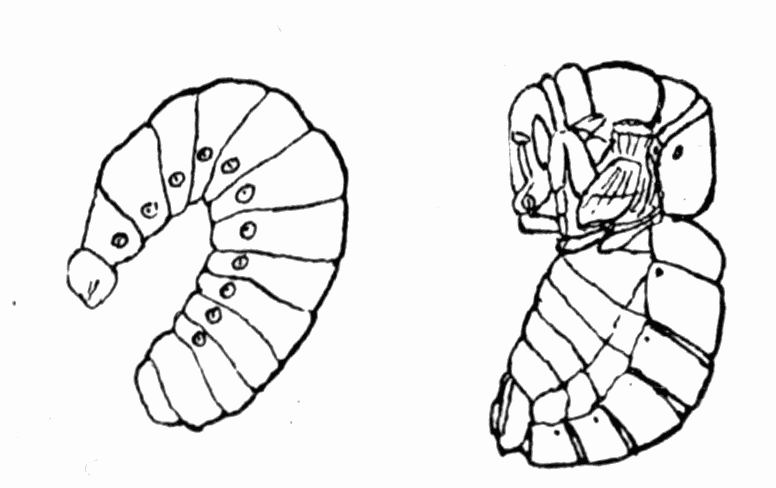
Fig. 1. Bombus, larva and nymph: after Packard 11
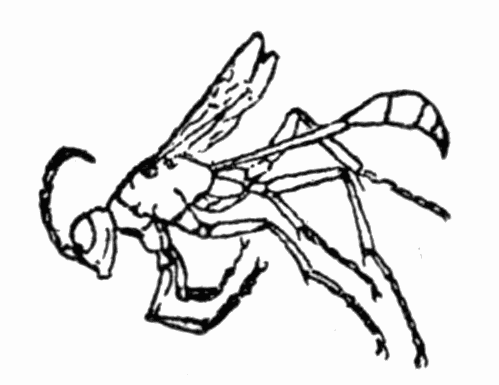
,, 2. Ammophila 22
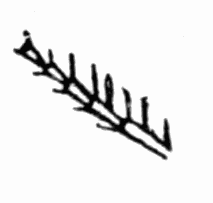
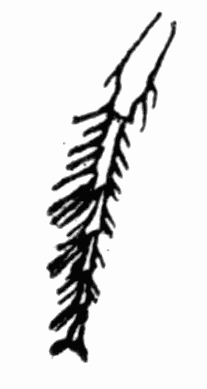
,, 3-4. Spines on the tarsi of female Ammophila 23
,, 5. Tubular entrance to hole of wasp 25
,, 6. Basal segments of ants 33
,, 7. Rose-leaf partially eaten by bees 52
,, 8. Tufted hairs of hind leg of Andrena 67
,, 9. Corbicula of humble bee 67
,, 10-12. Cleaning apparatus of bees 69
,, 13-18. Hairs of bees, magnified 71
,, 19. Tongues of bees, magnified 73
,, 20. Diagram of tongue of bee 75
,, 21. Stylops 77
,, 22. Stylops larva in abdominal cavity of bee 78
,, 23. Antennæ of "Keyhole" wasps 101
,, 24. Legs of male "Keyhole" wasps 101
,, 25. Tibia of male Crabro cribrarius 103
,, 26. Antennæ of male Crabro cribrarius 103
,, 27. Head of male and female Crabro clypeatus 103
,, 28. Parts of the insect 133
DESCRIPTION OF THE COLOURED PLATES
PLATE A
Figs. 1, 2, 3. Formica sanguinea Latr.: male, female, and worker. The host of Lomechusa (p. 89), also a slave-making species; makes irregular nests of dead leaves, etc., generally against a sloping bank.
Figs. 4, 5. Mutilla europæa Linn.: male and female. One of the few British species of Aculeates where the female is wingless; found in sandy places running in the sun.
Fig. 6. Cerceris arenaria L.: female; burrows in the sand, and provisions its nest with beetles (p. 20).
Fig. 7. Ammophila sabulosa L.: female; burrows in the sand, provisions its nest with caterpillars, peculiar for its very elongated waist (p. 22).
Fig. 8. Crabro cribrarius L.: male; peculiar for its paddle-like tibiæ and flattened antennæ (p. 103).
Fig. 9. Odynerus spinipes L.: male; peculiar for the form of its middle femora, which are cut out almost in two semicircles (p. 101); female makes a tubular entrance to her nest (p. 25).
PLATE B
Fig. 10.—Colletes succinctus L.: female; lines its cells with a gluey material (p. 44); colonizes in sandy banks; host of Epeolus rufipes (fig. 19).
Fig. 11. Sphecodes subquadratus Smith: female; cuckoo of a species of Halictus; female hibernates like its host (p. 17).
Fig. 12. Halictus lencozonius Schr.: burrows in the ground; the host of Sphecodes pilifrons Thoms (p. 17).
Fig. 13. Vespa crabro L.: female (the Hornet), nests in hollow trees; host of the rare beetle Velleius dilatatus (p. 38).
Fig. 14. Vespa vulgaris L.: female: one of our commonest wasps; nests usually in the ground (p. 35); host of a peculiar beetle (Metœcus paradoxus) (p. 38)
Figs. 15, 16. Andrena fulva Schr.: male and female; the bee which burrows in lawns, etc. (p. 9); host of Nomada ruficornis var. signata (p. 15).
Fig. 17. Panurgus ursinus Gmel.: Female; legs loaded with pollen, burrows in hard sandy paths, etc. (p. 49). Males sleep curled up amongst the rays of yellow composite flowers.
Fig. 18. Nomada ruficornis L. var. signata: cuckoo of Andrena fulva (figs. 15 and 16).
Fig. 19. Epeolus rufipes Thoms: female; cuckoo of Colletes succinctus (fig. 10).
PLATE C
Fig. 20.—Megachile maritima Kirby: female; burrows in the ground, makes its cells of pieces of leaves, which it cuts out with its mandibles; host of Cœlioxys conoidea.
Figs. 21, 22. Cœlioxys conoidea Illig: male and female; cuckoo of Megachile maritima.
Fig. 23. Burrows of Megachile Willughbiella Kirby, in a piece of rotten willow; each burrow originally contained six cells, but two of the left-hand series have been lost.
PLATE D
Figs. 24 and 25. Anthophora pilipes F.: male and female. A spring bee, the male of which may often be seen in gardens, darting from flower to flower (p. 81); while the female collects pollen; it forms large colonies (p. 62).
Fig. 26. Melecta armata Pz.: cuckoo of Anthophora pilipes.
Fig. 27. Anthidium manicatum L.: invests its cells with the down off the stems of labiate plants, which it strips off with its mandibles (p. 50).
Fig. 28. Osmia bicolor Schr.: female; nests in snail-shells, which it sometimes covers up with small pieces of grass-stems till a little mound is formed, resembling a diminutive ants' nest (p. 59).
Fig. 29. Bombus terrestris L.: female. One of the commonest of our Humble Bees; it nests in the ground. It is the host of Psithyrus vestalis, which resembles it very closely in colour; it is this species that was exhibited by Mr. Sladen at the Maidstone Agricultural Hall (p. 41).
Fig. 30. Bombus lapidarius L.: another common Humble Bee, also an underground builder; it is the host of Psithyrus rupestris.
Fig. 31. Psithyrus rupestris F.: female; the cuckoo of Bombus lapidarius, which it closely resembles except for the nearly black colour of the wings.
THE SUBJECT IN GENERAL
I think I ought here to say why I propose to limit myself to an account of a certain portion only of the Hymenoptera. The reason for this, in the first place, is that the section which I have selected is the only one of which I have any special knowledge; it consists of the bees, wasps, ants and sandwasps, four groups which make up the stinging section of the order—or perhaps more accurately, which have poison bags connected with their egg-laying apparatus or ovipositor. Another reason for their selection lies in their nesting habits; these enable one to get a further insight into their economy and ways than can be obtained from those of almost any other group or order—at any rate they make them comparatively easy to study; one can, so to say, find these little creatures at home, whereas in most orders there seems to be no definite home to which the individuals may be traced; a great advantage also in selecting the stinging groups for study is that they are creatures of the spring and summer, and of the sunshine, so that the weather which tempts them out to their duties is of the kind most agreeable to those who wish to investigate their habits.
The habits of the hive bee have not been touched on, as so many excellent treatises have been written on them that any observations here would be superfluous.
Although these groups are distinguished by their stinging habits, it is only the female that possesses a sting—the male is a most harmless creature and quite incapable of injuring any one. A male wasp or even a male hornet may be handled with absolute impunity, only it is wise to be certain as to the sex of the individual before presuming to play with it too much! A word here may perhaps be said about stinging. People often talk about a gnat stinging or a stinging fly; it may be difficult to define exactly what "to sting" means, but the writer has always considered that a sting is inflicted by the tail end of the creature or a bite by the mouth. A fly or gnat no doubt inserts its proboscis into one's flesh just as a wasp does its sting; but the actions of such opposite parts of the body surely demand distinct names. As we have been alluding to flies it may not be inappropriate to say here that all the creatures we are going to consider have four membranous wings except the worker ants and a very few forms which are comparatively seldom met with. By this character they may at once be known from flies, which have only two membranous wings. The large brown "drone flies", so often seen on the windows of our rooms, especially in autumn, and which most people mistake for hive bees, to which they certainly bear a considerable general resemblance, may be detected at once by wanting the two hind wings of the bee.
The "aculeate", or stinging, Hymenoptera, are divided into sections and families according to their structure; but the groups which stand out most clearly in regard to their habits are the solitary and social species, the predaceous and non-predaceous and the inquilines or cuckoos.
The vast majority of the aculeate Hymenoptera are what are called "solitary", i.e. one male and one female alone are interested in the production of the nest; but there are also three "social" groups—the ants, the true wasps, and the humble and hive bees.
These are called social because they form communities and all work together towards the maintenance of the nest. In the social species there are two forms of the females—the queens and the workers; these latter have the ovaries imperfectly developed, and in the humble bees and wasps they only differ outwardly from the fully developed females or queens by being smaller. In the ants, however, the workers are wingless, and of a very different form from that of the queen. The rôle of these workers seems to be to do the general work of the nest; they have been known to lay fertile eggs, but the resulting offspring has always been male.
Between these conditions of solitary and social we know of no actually intermediate stages. We do not seem to see any attempts on the part of solitary bees to become social or vice versâ. The only condition known which could possibly be considered as intermediate is shown in certain species where a number of individuals make their nests close to each other in some particular bank, forming a colony. These colonies are sometimes very extensive, and the burrows of the individual bees very close together; it has also been shown that the burrows sometimes unite—at the same time there seems to be no positive evidence that there is any work done in the colony which could be considered as done for the common good.
THE SOLITARY GROUPS
All the solitary kinds appear to feed themselves on vegetable juices, honey, etc., but there is a well-marked division between those who provision the cells of their offspring with insects, either fully developed or in the larval stages, and those who provision them with the pollen of flowers, honey, etc. The theory is that originally all fed their cells with insects, but that by degrees the more progressive found that the food which suited themselves would equally nourish their offspring, and accordingly provided them with vegetable nourishment. We find no intermediate stages. A certain class still goes on feeding on the old principle. The members of this class are known as "fossors" or diggers, while those which feed on the new principle are called "Anthophila" or flower-lovers. These are not very happy names, as many of the Anthophila dig out holes for their nests just in the same way as the fossors do, and many of the fossors are found in flowers, apparently enjoying them just as much as a truly anthophilous species would, although no doubt often with the ulterior object of capturing some insect for their young! Still these names are known as representing these two sections all over the world, and therefore it is better to keep to them even if they are not as descriptive as one would like them to be.
The fossors, or "diggers", have all comparatively short and bifid tongues, and have, as a rule, little in the way of hairy covering, and what hairs they have are simple and only in very rare instances branched or feather-like. The hind legs of the females are not modified in any way so as to enable them to collect pollen, their legs are usually long and slender, and they are admirably adapted to their life habits of hunting spiders, insects, etc., for their young.
On the other hand, the Anthophila or "flower-lovers", are specially adapted for pollen collecting. Their tongues vary from a short form like that of some fossors to the long tongues of the humble bees. Their hairs are always plumose or branched on some part of the body and the hind legs of the females in most species are provided on the tibia or shin with a special brush on which pollen may be collected. In some of the long-tongued bees, however, this brush occurs on the underside of the body instead of on the tibia. The pollen-collecting arrangements of the different genera of the Anthophila and the corresponding organs for cleaning off the pollen again are amongst the most interesting instances of modification and adaptation: some of the more striking of these will be mentioned later on. (See pp. 65 sqq.)
THE SOLITARY BEES
The life-history of an ordinary pair of solitary bees is, roughly, as follows: I will take for an example one of the spring species of Andrena. Many people know the little red bee, which for some apparently unaccountable reason suddenly appears in myriads on their lawn or gravel path, throwing up little mounds of finely powdered earth—in this respect being quite different from worm casts, which are formed of wet mould and the particles of which cling together—sometimes causing considerable alarm as to the possible effect on the lawn. These have hatched out from burrows made by their parents in the previous year, the mouths of which have been filled up with earth and therefore are quite invisible till the newly fledged bees gnaw their way out. They, in their turn, are now making fresh burrows for their own broods; possibly they infested some one else's lawn the year before or were only in comparatively small numbers on the lawn under notice and so passed unrecognized. They may safely be left alone, as they never seem to breed many consecutive years in one such locality: probably the treatment of a lawn does not suit them, mowing and rolling upsetting their arrangements. We will now consider these arrangements. The female bee, so soon as she realizes that she is charged with the duty of providing for her future offspring, makes a burrow in the ground, and the earth thrown up from the tunnel forms the little heap which is so observable; this burrow varies in depth from 6 to 12 inches and has short lateral branches; each of these she shapes, more or less, into the form of a cell, provisions it with a small mass of pollen mixed with honey for the maintenance of the larva when hatched, and lays her egg; she then seals up that cell and proceeds to the next, and in this way fills the burrow up until pretty near the surface. The bee caterpillar when hatched is a white grub-like creature which, after devouring the food provided for it, becomes more or less torpid; it then makes its final change of skin, after how long a period is probably uncertain, and appears in the nymph stage. Fig. 1. Bombus, larva and nymph: after Packard. This stage corresponds to the chrysalis of a moth or butterfly, the creature being shortened up and rather more like the perfect insect compacted into the smallest form possible. People are often misled into the idea that the caterpillar forms the chrysalis over its former self, whereas the chrysalis has been all the time forming inside the caterpillar and only shows itself when the final skin is shed; of course some caterpillars spin a cocoon over themselves before they change their skin, but then the true chrysalis is found inside the cocoon. A curious fact connected with the change from the nymph to the perfect insect is that this takes place sometimes as early as August in the year preceding their appearance; so that cells dug up in August may contain fully fledged insects which are not due to appear till April or May of the following year. It is wonderful also how long life can be sustained by these creatures in the "full-fed larva" condition. Some years ago I collected a number of pierced bramble stems in order to breed out some of the small "sandwasps" which nest in them. On opening them in May, when the perfect insects are generally ready to appear, I found that several of the larvæ had rather shrunk up and had not changed into nymphs. These I left in the stems, covering them up again, and they appeared as perfect insects in the May of the following year.
The account given of the nesting habits of the above Andrena of our lawns, etc., is more or less true of nearly all the solitary bees. Their methods vary, some burrow in the ground, some in old wood, some in snail shells, some in bramble stems or straws or the hollow stems of various plants, some in holes or crevices in walls, etc., and their methods of building their cells vary exceedingly: all of these are of great interest and some display an ingenuity which is quite surprising. Of these special nesting habits some of the most striking will be mentioned later on.
Before leaving these general remarks on the solitary bees the habits of two genera must be specially noticed, as they differ in an essential point from those of the others. These are known to entomologists under the names of Halictus and Sphecodes.
In most species of these the males and females of the new brood are not hatched out till after midsummer, and no work is done for the provisioning of new burrows that autumn; but the female, after having undertaken the duties of maternity, hibernates, i.e. goes back into a burrow and lives there till the next spring, the males dying off before the winter. In the spring the ♀ wakes up and does the necessary work for the future brood just as any ordinary spring bee would—but there are no attendant males—the duties of that sex having been performed in the autumn. The larvæ contained in these burrows hatch out after midsummer and therefore never spend a winter in the ground. In this respect they resemble the social bees and wasps, about which more hereafter; in the meanwhile a few words must be said about the cuckoos or inquilines, which are perhaps the most interesting creatures of all.
THE CUCKOO BEES
These cuckoos live at the expense of their hosts. The mother of the industrial brood makes her cell and provisions it, and lays her egg. The cuckoo bee manages to enter also and lay her egg in the same cell, the usual result being that the cuckoo devours most of the food instead of the rightful offspring, which gradually gets starved and dies, the cuckoo appearing in its place; but there have been cases, how frequent they are is difficult to say, in which both offsprings have emerged.
The whole problem of the relationships between host and cuckoo is most interesting. In some cases the cuckoos are so like their hosts that it is difficult to tell one from the other, in others they are so unlike that it is difficult to trace any resemblance between them. There are a great number of different kinds of cuckoos, and most of them select a special host to associate with, and are never found except with that species. There are, however, cases of cuckoos which visit the nests of more than one host, and cases of hosts which are visited by several kinds of cuckoos. In the short-tongued bees, with the exception of Halictus and Sphecodes, the cuckoos are quite unlike their hosts both in form and colour. In the Andrenas (the lawn bee being one of them) the hosts are clothed with reddish, or brown and black, hairs, and are of a more or less stout build (pl. B, 15, 16). The cuckoos are elegant in shape, almost devoid of hairs, and most of them are striped with yellow or brown across the body so that they present a wasp-like appearance (pl. B, 18). Species more unlike one another than host and cuckoo one could hardly imagine; still this stranger seems to get access to the nest of its host without opposition. In a colony of Andrena one may see the cuckoos (which rejoice in the name of Nomada or wanderers) flying about among the females of the industrious bee, and no alarm or concern appears to be felt by the latter. As we go up in the scale of bees, i.e. towards the more specialized, and arrive at those with longer tongues, the cuckoos are found as a rule to resemble their hosts more closely, both in colour and structure, and when we reach the social genus Bombus (i.e. the humble bees) we find the cuckoos so like their hosts (pl. D, 30, 31) that even entomologists of experience mistake one for the other. Apis (the hive bee) has no cuckoo. It seems to be theoretically probable that both cuckoo and host once originated from common parents; this is suggested by the similarity of structure of certain parts of both host and cuckoo, even in cases where they are otherwise most dissimilar. Andrena and Nomada, for instance, which are very unlike, as stated above, agree in both having very feeble stings and in possessing three conspicuous spines on the upper and posterior edge of the orbit of the larva. Also, although Andrena the host has a short tongue, and Nomada, its cuckoo, a long one, the appendages (labial palpi) of the latter's tongue are framed on the same plan as those of the tongue of Andrena, and are quite unlike those of the other long-tongued bees. On the other hand, the cuckoos of the social species resemble them so closely in structure as well as appearance that it is more necessary to search for points of difference than of similarity. There is only one case known of a cuckoo wasp, and that resembles its host even more closely than do the cuckoos of the humble bees. All these points certainly suggest the probability that the social bees and wasps and their cuckoos adopted different habits at a much more recent date than the solitary species, and therefore have not had so much time to become differentiated in structure. The only short-tongued bees which have cuckoos of similar structure are the species of Halictus (pl. B, 12); their cuckoos, Sphecodes (pl. B, 11), are closely allied to them, but then Halictus and Sphecodes are most peculiar genera; although short-tongued, their females spend the winter in the earth, as do the social bees and wasps (see p. 13), and they colonize largely, which may prove to be a step towards socialism.
THE FOSSORS OR DIGGERS
In many respects the insects of this section adopt the same methods as the solitary bees so far as the construction of their nests is concerned, but the food brought home for their offspring is animal instead of vegetable. In order to supply their larvæ with "fresh meat" these little creatures, when they have captured a suitable prey, sting it in such a way that it becomes paralyzed, but does not die; after provisioning a cell with the necessary number of these paralytics, the mother lays her egg on one of them or amongst them, and closes up the cell. In consequence of this wonderful maternal instinct, foresight, or whatever the faculty may be, the larva when hatched finds fresh food ready for consumption. The various species provision their nests with different kinds of foods, and some appear to be most fastidious in their selection, and are said never to err in choosing species of some particular family, thereby displaying a discernment worthy of any advanced entomologist. Some provision their cells with beetles, some with grasshoppers, others with spiders, caterpillars, plant lice, etc.
The strength possessed by the female fossor must be proportionately enormous, as she can bring back to her burrow, after paralyzing them, insects many times her own size. It is a most interesting sight to see the excitement and flurry of the captor as it tries to drag along some huge prey to its nest. I remember seeing one dragging along a good-sized caterpillar, of a noctuid moth, over rather rough ground: the poor creature had a difficult job; it had to go backwards itself, and pull the body of the caterpillar, after it—its behaviour was very much like that of an ant which has a large burden; at times it would loose its hold of it and try it from some other quarter; however, by degrees, by pulling and tugging, the prey was safely brought home, but the force expended must have been very great. Many species, however, hunt insects of much smaller size than themselves, and it is those which take a fancy to grasshoppers and caterpillars which seem to be the most doughty in deeds of force. One, a very rare kind in this country, sets its affection especially on the honey bee as a prey; the two insects are about equal in size, but the hive bee must be a dangerous foe to attack, and one would have thought as likely to sting its captor as its captor would be to sting it; also one would imagine that a hive bee, unless thoroughly paralyzed, would be a dangerous subject for a juvenile larva to commence making a meal upon! but whether the venture ever turns out unsatisfactorily there are no data to show, so far as I am aware. The larvæ must vary very much in their tastes; one can imagine that a nice juicy caterpillar, or even a good fat grasshopper, may be appetizing and easily assimilated, but one can equally fancy that the larvæ, who wake up to find their food consisting of small hard beetles, may feel more or less resentment against their parents' ideas of dainties for the young! Still they seem to thrive on it, and come out eventually as exact likenesses of their parents. A large number of the fossors inhabit dry sandy wastes, such as the dunes along the sea coast at Deal, Lowestoft, etc.; many of these, when they leave their burrows, throw up some sand over the hole so as completely to cover it; how these insects find the spot again after a lengthy chase after spiders or other prey is a marvel; and yet those who have observed carefully say that they come home from long distances with unerring precision. No sense of which we have any knowledge, however accentuated, seems to explain this. To be able to arrive back at a home in an extensive arid sandy plain, where no outward sign indicates its whereabouts, must surely require perception of a different nature from any of those with which we are endowed. Some fossors are subject to the depredations of cuckoos, just as the solitary bees are, but their cuckoos are rarely of aculeate origin. The only ones which I have had any opportunity of studying are the species which nest in bramble stems. The cuckoos which associate with them are some of the smaller jewel flies and Ichneumons: the habits of both these differ from those of the aculeate cuckoos, the jewel flies devouring the larva of the aculeate and the Ichneumon laying its eggs in it. The fossors Fig. 2. vary exceedingly in size, shape and colour. Our largest species are about an inch long and our smallest about the eighth of an inch, nearly all having the body where it joins the thorax constricted into a very narrow waist; this is sometimes of considerable length. In one genus known to entomologists by the name Ammophila (fig. 2) or "lover of the sand", the waist is practically the longest part of the body, so that looking at one sideways as it flies along, one could almost be deceived into thinking that there were two insects, one following the other (cf. pl. A, fig. 7). In colour, there seem to be three dominant schemes: Black (cf. pl. B, fig. 17); black with a red band across the body (cf. pl. A, fig. 7); and black banded with yellow, like a wasp (cf. pl. A, figs. 6 and 8, etc.) In some the yellow bands may not be complete, and appear only as spots on each side of the body segments, or the red band may be almost obliterated, or the black species may Fig. 3. Fig. 4. be more or less variegated with yellow spots on the head and thorax, but as a general rule all our species fall into one or other of these colour schemes. The females of some of our sand frequenting species have beautiful combs on their front feet, each joint of the tarsi having one or more long spines on its external side (figs. 3 and 4). These are of importance to them in their burrowing, as they enable them to move with one kick of their front leg a considerable amount of the dry sand in which they make their nests. Although sandy commons, etc., are the resort of many fossors, others may be found burrowing in wood or in hard pathways or banks; in fact, like most other insects, some of their members may be found almost anywhere.
THE SOLITARY WASPS
The ordinary wasps are acquaintances of every one, but the solitary or keyhole wasps are not so well known, although they are far from uncommon. They are little narrow black insects striped across the body with yellow, belonging to the genus Odynerus (pl. A, 9), and might hardly be recognized as belonging to the same family as the true or social wasps. Still they have considerable powers of stinging, and fold their wings lengthwise when at rest like their larger relatives. I dare say some people may have noticed that a wasp's wing sometimes assumes a narrow straight form, quite unlike what it is when expanded. This is due to the wasp being able to fold its wing lengthwise like a fan. The wasp tribe are, so far as I know, the only stinging Hymenoptera which have this power.
Fig. 5.
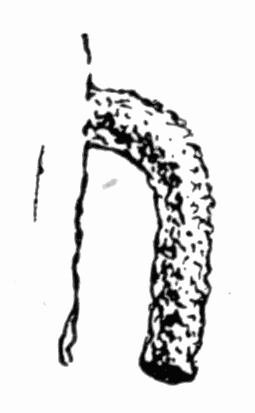
They make their nests of mud, etc., in crevices of walls, in banks, in plant stems, and often in most inconvenient places, such as keyholes, etc. Some of the solitary wasps have a very curious habit of making a tubular entrance to their hole. These may sometimes be seen projecting from sandy banks. The tube is composed of a series of little pellets of mud, which the wasp by degrees, with the help of its mouth secretions, sticks together till a sort of openwork curved tube of sometimes an inch long is formed (fig. 5). This curve is directed downwards, so that the wasp has to creep up it before reaching the actual orifice of the nest. It looks as if the first shower of rain would wash the whole structure away, and I have very little doubt that it often does so. The object of these tubes is difficult to appreciate. There is a bee on the continent which makes straight chimneys above its holes, so as to raise the entrance above the surrounding herbage; possibly these solitary wasps once required their tubes also for some such purpose, and have continued on truly conservative lines to build them long after all usefulness has passed away from the habit; anyhow they are very interesting and beautiful structures. I have found the tubes of one of our rarer species projecting perpendicularly out of the level sand, but even then the tubes were curved over at the end, so that the wasp had to go up and down again before entering its actual hole. The Rev. F. D. Morice in 1906 found the tubes of the same species in numbers projecting from the walls of an old stuccoed cottage situated close to the locality where I found mine, so it is evident that more than one situation suits its requirements. The solitary wasps provision their cells with caterpillars, stinging them in the same way as the fossors do. One very peculiar genus, of one species only in this country, has its body much narrowed at the waist by reason of the constricted form of the basal segment; it makes a little round nest of clay which it suspends from a twig of heather or other plant. This species is rarely met with except on the heathery commons of Surrey, Hants, Dorset, etc. The solitary wasps are subject to the attacks of cuckoos belonging to the jewel fly or Chrysis tribe; these behave differently from those belonging to the aculeate groups, as their larvæ do not eat the food laid up for the wasp, but wait till the wasp larva has finished feeding up, and then devour it. Unlike as these cuckoos are to their hosts in their brilliant metallic coloration, etc., they have structural characters curiously like theirs, so that even here a common parentage in bygone generations may be reasonably suspected. At present, however, they are placed, except by a few systematists, in quite distinct families of the Hymenoptera.
In general form these solitary wasps resemble the fossors more than the bees; they have mostly short tongues (I think all our British ones have), and their hairs are simple or more or less spirally twisted.
THE SOCIAL GROUPS
The social bees are certainly the most highly specialized of the Anthophila, and the social wasps of the Diploptera or insects with folded wings. The ants occupy a less definite position: they would seem to be the outcome of specialization among the fossors, only they feed their young with vegetable juices and not with animal as the latter do. They are always kept as a separate tribe under the name Heterogyna, but for our purposes the better known word "ant" will suffice.
The hive bee and the social wasps are the only British Hymenoptera which adopt the hexagonal cell-formation in their nests, the bee fashioning its cells in wax, the wasps and hornet in masticated wood or paper. The formation of ants' nests is far less regular, being composed of irregular passages, called galleries, and open spaces, no doubt built on a plan, but probably in respect of plan no two nests are exactly alike. The humble bees again differ from either in their nesting habits: the female in the spring seeks out a mouse's nest or other suitable foundation of moss, etc., in or on the surface of the ground, according to the species. This she lines with wax, deposits a heap of pollen, and lays her eggs in it. She also makes waxen cells for honey, but these are not hexagonal and symmetrical as are those of the hive bee, but are more like little pots, and are known as "honey pots".
It must be borne in mind that the economic arrangements of the wasps and humble bees only last for a single season, whereas those of the ant and hive bee exist for many years. In consequence of this the swarming habits belong exclusively to the ants and hive bee. That of the hive bee is well known to all, and most people must have observed the swarms of male and female ants which fill the air on some sultry summer or autumn evening. Thousands of these must perish, but a certain number of the females accept the responsibility of starting a fresh nest, and so the ant population is kept up. It will be seen from these remarks that the three social groups are very distinct in their methods of nest making, and have really very little in common except the social habit. The humble bees have their cuckoos; one species of wasp has a cuckoo, and there is a possible case of a cuckoo amongst the continental ants, but this has not yet been observed in this country. The ants harbour so many species of insects in their nests besides their own family that it is difficult to form an idea as to whether the case in question is at all analogous to that of host and cuckoo in the other aculeates or not.
THE ANTS
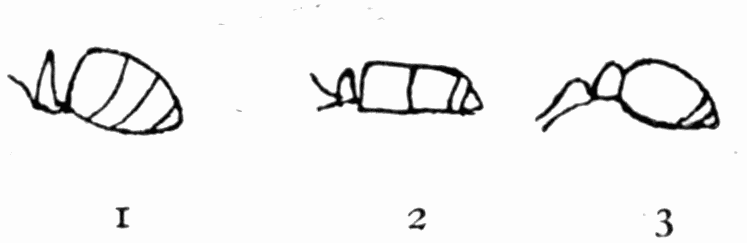
These little creatures are probably the most intelligent of all the insects—and yet at times they seem to wander about almost aimlessly. A worker may be found with an insect or something which it is eagerly dragging along and drops probably from fear. It appears anxious to regain its hold of it, but goes about in all sorts of wrong directions before it again finds it, it may be to make sure its enemy is clear away before it resumes operations, but the effect to the ordinary onlooker is one of sheer incapacity—at the same time the wonderful habits of the tribe, the way in which they keep plant lice for their larvæ, their methods of carrying each other, their nest-building, and the slave-making instincts of some of the species, show an intelligence surpassed by no other family of insects. Their nests are formed in very various ways: the same species even will sometimes nest under a stone and sometimes make ant hills; some of the large species make their nests of huge heaps of fir needles, and number 400 to 500 thousand in one nest—others live in quite small communities, nesting in bramble stems, old rotten wood, moss, etc. One little species, rare with us, lives in the walls of other ants' nests, just as mice live in the walls of our houses; another quite small species lives apparently on friendly terms with the common large red or horse ant, and may be found running about amongst them, on and in their nests, but, so far as I know, nothing is known as to how its young are reared. There is a curious division in the family between the ants that have true stings and those which have not. The large ants of our fir woods can bite and are able to eject poison through the apical opening of the body into the wound they create, but these as well as the larger and smaller black ants and some others have the sting undeveloped, whereas some of our small species have a sting which they can use with considerable effect; this difference in habit is accompanied by a difference in the structure in the basal segments of the body. In the stingless species the basal segment is reduced Fig. 6 to a flat upright transverse scale (fig. 6, 1); in the stinging ants two segments at the base are reduced to nodes (fig. 6, 3). There is an exception in the case of one little rare genus, Ponera, which has only the basal abdominal segment reduced to a scale although a much thicker scale than in the others (fig. 6, 2), and yet which has a distinct sting. These arrangements give the body very free movement so that the tail can be bent forward till it reaches the head. Another curious distinction between the stingers and non-stingers is that the larvæ of the former spin cocoons and those of the latter do not; the larvæ of Formica fusca occasionally do not do so, but they are an exception to the rule. Cocoon spinning seems to involve the larvæ in some difficulties, as without the help of the worker ants they are often unable to extract themselves from their prison. This is a condition which does not, I believe, exist in other groups. In the stingless ants there is a curious difference in habit between the species of the genus Formica, where, according to Forel, the workers do not follow in line over unknown ground, and frequently carry one another, the one carried being rolled up under the head of the other, and the species of Lasius, where the workers follow one another in line, but never carry each other. Among the stinging ants another method of carrying occurs in certain genera. The porter seizes the one she wishes to carry by the external edge of one of her mandibles and then throws her over her back, so that she lies along the back of her porter with her ventral aspect uppermost and her legs and antennæ folded as in the nymph state. Neither of these methods sounds very comfortable, but then probably an ant's idea of comfort and our own may be very different.
Lord Avebury, in his Ants, Bees and Wasps, tells us that he has known a male of Myrmica ruginodis live for nine months, although no doubt, as he says, they generally die almost immediately, and he has known queen ants to live for seven years, and workers, which he had in his nest, for six years.
THE SOCIAL WASPS
Of these we have only seven different kinds, and with the exception of the hornet they are all very much alike. One often hears people say that they have seen such a large wasp that they think it must have been a hornet, but no one who has ever seen a hornet could mistake a wasp for one. A hornet is red-brown with yellow markings (pl. B, 13), a wasp is black and yellow, and altogether a less formidable-looking creature (pl. B, 14). Even a queen wasp is not so large as a small worker hornet. The hornet nests in hollow trees, our three commoner wasps nest, as a rule, in the ground, but occasionally in outhouses, under roofs, etc. One of the others as a rule makes its nest in shrubs, but occasionally in the ground, another always nests in a bush or shrub, preferring a gooseberry or currant bush, and the only remaining one is a cuckoo of one of the ground species. The gooseberry-bush wasp is not a common species in the south, but in the midlands and north it is abundant. Wasps will eat most things, but are especially fond of syrups and sweets. One species, Vespa sylvestris, which seldom enters our houses, is very partial to the flowers of Scrophularia (Figwort). One rarely finds a plant of this in full blossom without finding its attendant wasps. I have seen other species of wasps also visiting it, but sylvestris is practically sure to be there. The diet which wasps provide for their larvæ is probably a mixed one, but consists largely of insects. Dr. Ormerod says that a microscopic examination of the contents of a larval stomach shows "the mass to consist of scales, hairs and other fragments of insects, hairs of vegetables and other substances less easy of recognition."
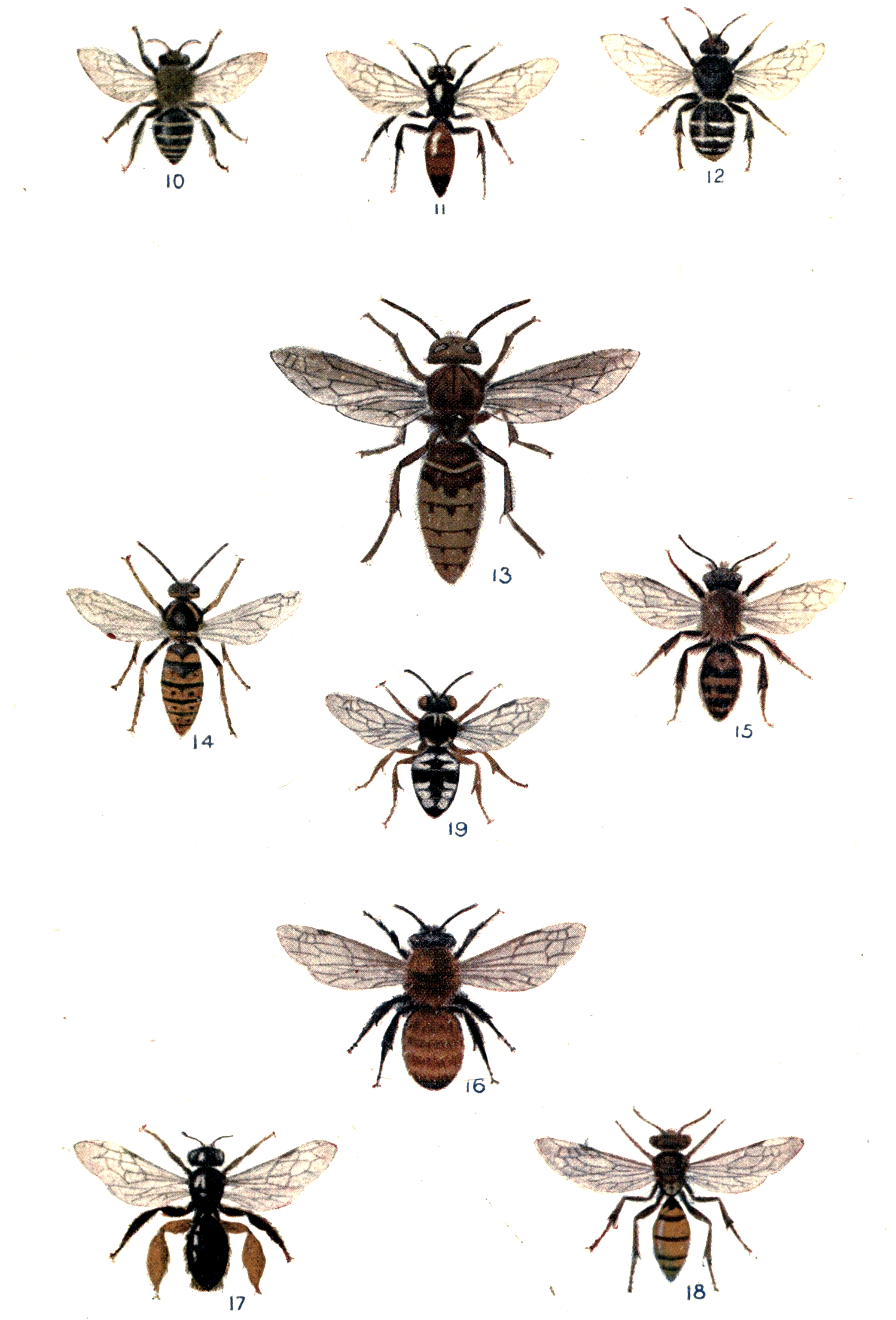
Plate B.
10. Colletes succinctus, female. 11. Sphecodes subquadratus, female. 12. Halictus leucozonius, female. 13. Vespa crabro, female. 14. Vespa vulgaris, female. 15. Andrena fulva, male. 16. Andrena fulva, female. 17. Panurgus banksianus, female. 18. Nomada ruficornis, var. signata, female. 19. Epeolus rufipes, female.
[face p. 36.
Wasps do not store honey in their nest; the papery nature of their cells would make such storage impossible. I dare say some of my readers will have noticed wasps sitting in the sun on a wooden paling busily engaged apparently eating something—they are really pulling off little fibres of wood which they chew up into a substance fitted for the walls of their cells; they will also chew paper, and the experiment has been tried of giving them coloured papers, which resulted in stripes of colour appearing in their nests. The different species vary somewhat in the architecture of their nests; but they are built very much on the same general plan. The population of some underground nests is very large. The Rev. G. A. Crawshay estimated the number in a large nest of Vespa vulgaris, which he took on September 20, 1904, at about 12,000; of these he actually counted, including eggs and larvæ, 11,370, and estimated the rest as having left the nest and escaped, so that anyhow the computation cannot be far wrong. This, however, was probably a very large nest. The cuckoo wasp (Vespa austriaca), formerly known as V. arborea, is an associate of Vespa rufa; its habits had been suspected for a long time, but Mr. Robson set all doubts at rest by finding the nymphs of the cuckoo in the actual nest of rufa. It is a rare species in the south, but far from uncommon as one goes north, and also in Ireland, where the relationship of the host and cuckoo have been carefully studied by Prof. Carpenter and Mr. Pack Beresford. Vespa vulgaris has a beetle parasite, but this is somewhat of a rarity. This creature Metœcus paradoxus lays its egg in the cell of the wasp, and enters the body of the larva, eventually entirely devouring it. The hornet also has a beetle associate, but this is a great rarity. It is a large black species of the "Devil's coach horse" or "Cock tail" tribe (Velleius dilatatus), but in what relation it stands to the hornet beyond inhabiting its nest is not known.
THE HUMBLE BEES
Of these beautiful creatures we have thirteen kinds in this country. Their velvety clothing and bright colours make them the favourites of most people. They are most industrious and may be seen on the wing from early morning often till quite late on summer evenings, whereas the solitary bees do not, as a rule, commence work till nine or ten in the morning, except in very hot weather, and generally retire about four or five p.m. There is an idea prevalent that humble bees do not sting, but this is fallacious. They can sting pretty severely, but I do not think they are so ready to use their defensive weapon as a wasp or hive bee is. The length of the tongue in these creatures makes them of great value to the farmer and gardener, as they can fertilize the red clover and probably other flowers which require a longer tongue to reach the nectary than is possessed by the hive bee. In New Zealand, when first the red clover was introduced from this country, it was found impossible to fertilize it, and humble bees had to be sent out. Now they are established there its fertilization is carried on quite successfully. The humble bees are divided into two natural groups, the underground species, i.e. those that make a subterranean nest, and the carder bees, as they have been called, which make a nest on the surface of the ground. The former live in much larger communities and are far more aggressive and pugnacious than the latter. They also feed their young, according to Mr. F. W. L. Sladen, of Ripple Court, in a different way. The carder bees "form little pockets or pouches of wax at the side of a wax-covered mass of growing larvæ into which the workers drop the pellets of pollen direct from their hind tibiæ. The pollen storers, on the contrary, store the newly gathered pollen in waxen cells, made for the purpose, or in old cocoons, specially set apart to receive it, from which it is taken and given to the larvæ mixed with honey through the mouths of the nurse-bees as required." As the author remarks, the methods of the underground species more resemble those of the hive bee than do those of the carder bees. Mr. Sladen has made many experiments in trying to domesticate humble bees, and succeeded so far with Bombus terrestris (pl. D, 29, our common black and yellow banded species with a tawny tail) as to get it to breed in captivity, and in 1899 was able to show nests in full work at the Maidstone agricultural show, the bees coming in and out of the building to their nest. An interesting case of one of the carder bees (Bombus agrorum) is recorded by F. Smith. It invaded a wren's nest, heaping up its pollen, etc., amongst the eggs of the bird, till the parent bird was forced to desert the nest. The underground species are more subject to the attacks of cuckoos than the carder bees. Altogether the humble bees afford an excellent subject for study, as they appear to be amenable to treatment, and to any one who could give time and careful attention to them many interesting problems connected with them and not yet understood might have light thrown upon them. Dead humble bees are often found in numbers in a mutilated state, under lime trees. These have been caught after they have filled themselves with honey, and become torpid in consequence, by the great tomtit and possibly other birds. The bird pecks a hole in the insect's thorax, enjoys the honey it has eaten and then drops the quivering body which falls to the ground. I once had the opportunity of seeing this slaughter going on, and was able to detect the great tomtit as the murderer.
In colour the humble bees vary remarkably, the variation occurring chiefly in the females. This variation is not so noticeable in this country, although in many species even here the variability is very great, but when we trace a common species such as terrestris, which varies very little here, over a large area such as the Palæarctic region its liveries are so diverse that its females have been treated as belonging to many different species. In the Siberian district its yellow bands become of a pale, almost whitish or straw colour, and the whole appearance of the insect is altered. If, instead of going north, we go to the Mediterranean region we find a large, fine form tolerably common, with bright yellow hairs on the legs. In Corsica again we find a quite different form; entirely black except for the bright red hairs on the apex of the body, and bright red tibiæ, clothed with red hairs. In the Canaries another coloration occurs: the whole insect is black with the exception of the apex of the body which is clothed with white hairs; but in all these the male varies comparatively little. In the Siberian and Canary forms it resembles the female, but in the others it varies very little from some varieties we find here. A rather similar series of varieties occurs in Bombus hortorum, another species little liable to variation here. In Italy and south-east Europe a form with entirely black body and black wings occurs, and in Corsica a black form with reddish hairs on the apical segments. The male keeps throughout very constant to its normal coloration. The tendency to vary towards an entirely black form seems to exist in nearly all the species, although in Britain black varieties of some are very rare.
THE BEES WITH BIFID TONGUES
In this country we have only two genera in which the tongue is bifid at the apex, and on this account they are kept together as close allies in our classification. They are, however, very different in general appearance. One of these groups is called Colletes, on account of its habit of lining its cells with a gluey material, the other, Prosopis, on account of the markings on the face. The various kinds of Colletes are densely clothed on the head and thorax with brownish hairs, and the segments of the body have whitish bands composed of a dense, tight-fitting, duvet of hairs (pl. B, 10). There is in this country only one exception, a large insect like a hive bee, but rarely met with, its headquarters being the Wallasey Sandhills near Liverpool, and other localities in Lancashire. All the species tend to colonize; some building in huge colonies in sandy cuttings, etc. They are preyed upon by a pretty little cuckoo bee called Epeolus (pl. B, 19), which is black, ornamented with brownish red and whitish spots. One of our best known species, Colletes fodiens, can often be found in abundance on the heads of ragwort along the sea-coast in July.
The other genus Prosopis is outwardly entirely unlike Colletes: its species are nearly all very small coal-black insects, with scarcely any noticeable hairs, rather unusually narrow and cylindrical in form; they emit a peculiar, agreeably scented fluid when handled; in the males the face is almost always white or yellow, in the females there is generally a yellow spot on each side near the eye. These little creatures are especially fond of burrowing in bramble stems. They like those which have been cut off in trimming the hedges, because in them the pith is exposed and they can burrow their way into it without gnawing through the wood. If any one, going along a hedge which has been trimmed, containing a lot of brambles, in the autumn or winter, would examine the cut-off ends they would soon find some with holes in them. These may be the work of Prosopis, but there are other bees and fossors which also burrow in this way. So the stems should be brought home and opened. Then the Prosopis cells may be known by the fine membranous pellicle which surrounds them, but possibly even then a little jewel-bee cuckoo may be found in possession of the cell, instead of the rightful owner. When these little bees emerge they are generally to be found on wild mignonette, bramble flowers or those of the wild parsley tribe. Some are very common, others of great rarity. The males of this genus seem to have a peculiar tendency to develop eccentricities in the shape of the first joint of the antennæ, or feelers, some having it expanded and concave, others rounded but thickened towards the apex; in only one British species, P. cornuta, does the female show any special peculiarity of form, but in this the face is produced on each side between the eyes into a distinct horn-shaped process. In the females there is scarcely any indication of pollen brush, and for this reason they used to be considered as possessors of cuckoo instincts, but there is now no doubt of their industrious habits; but there is no other genus of industrious bees in this country, with the exception of Ceratina, with so little specialization for pollen collecting.
THE BEES WITH POINTED TONGUES
All the genera, except the two mentioned in the last chapter, belong to this section, which comprises a variety of very different styles of bees, beginning with the short spear-shape-tongued species and ascending to the long-tongued species, which are considered to culminate in the hive bee. The habits of these genera vary very greatly in some respects; special notice has been or will be given of Halictus (pl. B, 12) and Sphecodes (B, 11), Andrena (B, 15, 16), Nomada (B, 18) and the other cuckoos, Osmia (D, 28) and Anthophora (D, 24, 25) and the leaf-cutting bees, but there are several other genera which deserve a passing notice, although their habits are not so peculiar as those of the specially selected ones. Cilissa, which is a very close ally of Andrena, is peculiar in having the hairs of the tongue erect and arranged almost in bottle-brush fashion. Its habits are much like those of Andrena. Dasypoda, so called on account of the enormously long hairs of the pollen brushes of the legs in the female, is one of our most beautiful bees; it is of moderate size, a little more than half an inch long, with a brown haired thorax, and a black body with white apical bands on the segments; the hind legs are rather unusually long and the brush is composed of very long bright fulvous hairs, and when the bee returns home laden with pollen it is, as F. Smith says, "sufficiently singular to attract the attention of the most apathetic observer." It burrows in sandy places much after the fashion of Andrena, etc. The male is a different looking insect, entirely covered with yellowish hairs. Panurgus (pl. B, 17) is a curious genus of coal-black bees, whose females have bright yellow pollen brushes on their hind legs; they visit yellow composite flowers and the males often sleep curled up amongst their rays; they are most active bees, and burrow generally in hard pathways. I was watching a large colony of one of the species near Chobham in the end of June—they were burrowing in a gravel path, under which the soil was of a black sandy nature; the path was scattered all over with little black hillocks of sand, and seemed alive with bees. It was showery weather, and occasionally the hillocks were washed nearly flat and a lot of sand must have entered their burrows—however, as soon as the sun came out again they cleaned out their holes and returned to their work. Panurgus is most businesslike in its pollen collecting; it flies in a rapid headlong way into a flower, and seems to do its best to bury itself, with a remarkable amount of action as if it was in a great hurry, and often bustles out of it again almost immediately and goes on to the next. Its methods suggest that it does more work in five minutes than any other bee would do in ten.
Another genus, Anthidium (pl. D, 27), this time one of the long-tongued bees, is peculiar in having the male larger than the female. Both sexes are black, variegated with yellow markings and spots, but the male is more ornate in this respect than the female and also has a peculiarly shaped body, which is unusually flat, curving downwards towards the apex, which is armed with five teeth, two bent ones on the sixth segment and three on the seventh. The female collects pollen on the underside of its body and collects the down off the stems of various plants, especially those of the dead nettle or "labiate" tribe, with which it invests its cells. I cannot do better than quote the following from F. Smith: "This is the social bee which White in his History of Selbourne has so well described in the following words: 'There is a sort of wild bee frequenting the Garden Campion for the sake of its tomentum, which probably it turns to some purpose in the business of nidification. It is very pleasant to see with what address it strips off the pubes running from the top to the bottom of a branch and shaving it bare with the dexterity of a hoop shaver; when it has got a vast bundle, almost as large as itself, it flies away, holding it secure between its chin and fore legs.'"
LEAF-CUTTING BEES
Fig. 7.
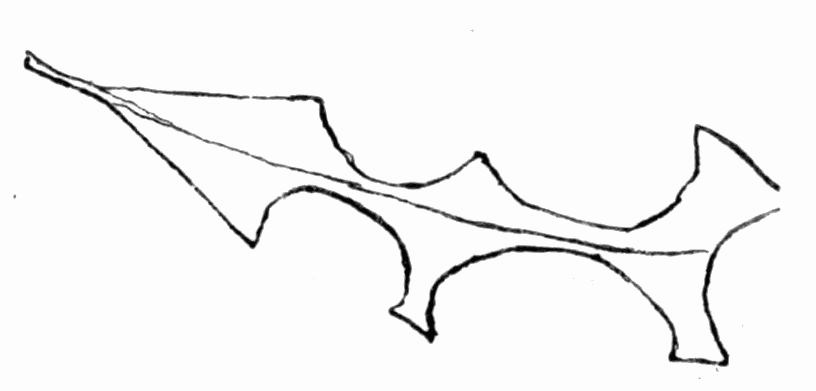
These are amongst the specially interesting of the bees in their habits. They are dull-brown coloured creatures rather like a stout hive bee in form (pl. C, 20). They all collect pollen on the underside of their body. They burrow either in decayed wood or in the ground, but they make their cells of pieces of leaves which they cut off from rose bushes or other plants; these cells when completed are wonderful works of art. Probably some of my readers may have noticed rose leaves with semicircular pieces cut out of them, and often with almost circular ones; this is the work of the leaf cutter (fig. 7).
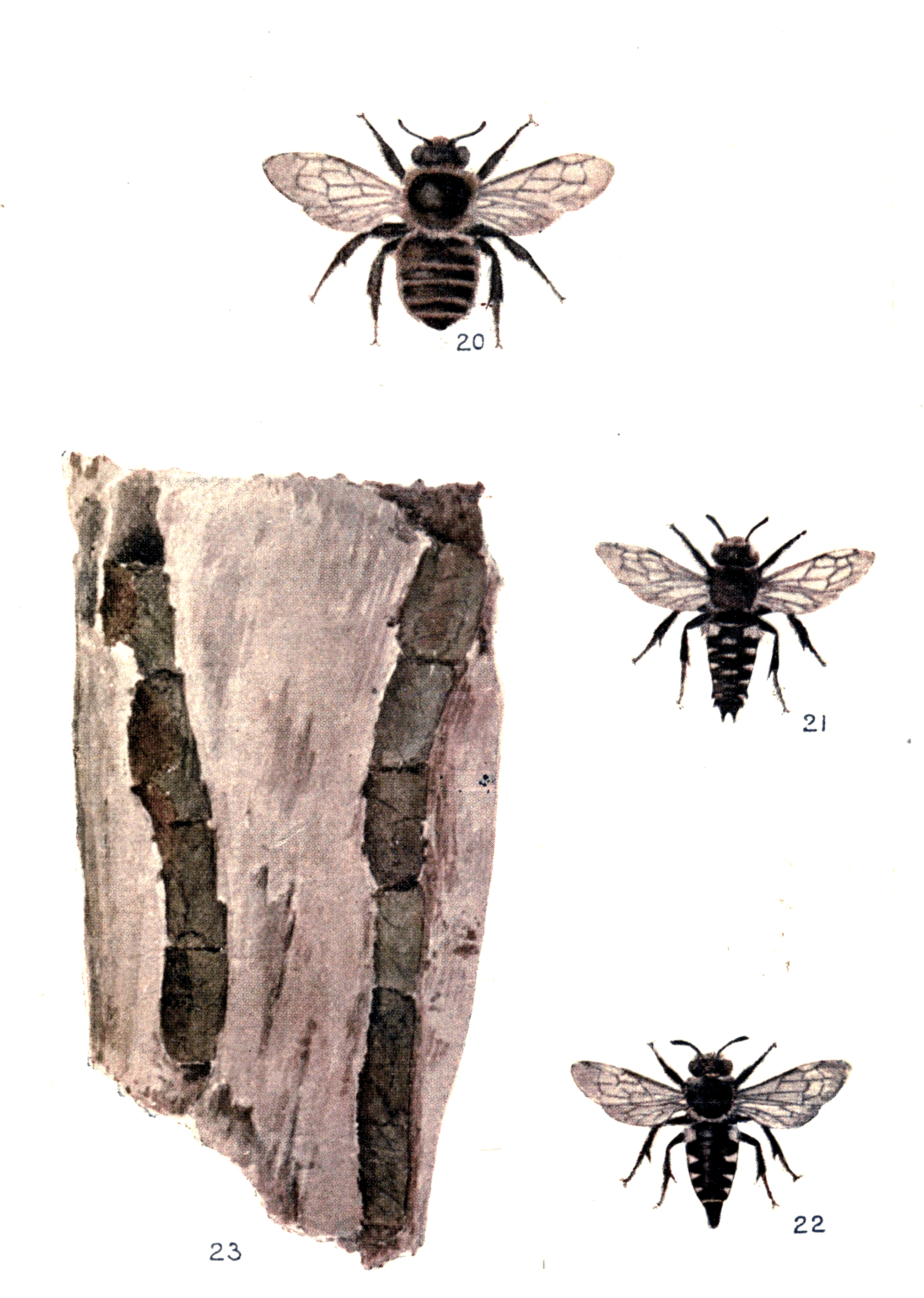
Plate C.
20. Megachile maritima, female. 21. Cœlioxys conoidea, male. 22. Cœlioxys conoidea, female. 23. Nest of Megachile willughbiella.
[face p. 52.
She alights on a leaf, holds on to the edge of the piece she wants to cut off with her legs, and then cuts it out by means of her jaws, or mandibles; as soon as it is cut free she uses her wings and so prevents herself from falling, and goes off with the cut off piece safely held under her body by her legs. I have frequently seen bees flying home with their leafy burden, and once or twice I have seen them cutting the pieces out. They cut round the piece they select with great rapidity—the marvel is that they can arrange so exactly as not to fall when the last attachment is removed. The pieces they cut have to be of several shapes in order to build up the cell they require; some are more or less lozenge shaped, some almost circular; the cells they make are somewhat thimble-shaped. The lozenge-shaped pieces are used to build up the sides and lower end of the cell, and the circular pieces to close it in with at the top; it is all cemented together with a gluey substance excreted by the bee. The burrows of the leaf-cutters are made, as stated above, either in the ground or in rotten wood. I have never had a subterranean nest to examine, but have had several nests in rotten wood under my notice, one of which is now before me (pl. C, 23). It is in a piece of very soft willow, almost in a touchwood condition. So that by carefully cutting away the wood I have been able to expose the whole series of cells. Two distinct burrows run almost parallel to each other; both of them are slightly curved and each has contained six cells; these are about half an inch long, and they fit one over another in the tube as closely as possible so as to look like two long thick green worms. Each cell is composed of many pieces of leaf, and the final plug which closes the cell is often made of several rounds of leaf one over the other. The amount of labour taken by the mother bee to make these cells must be enormous. The cells are provisioned like those of any other solitary bee with pollen, etc., and the egg is laid upon it. Most of the leaf-cutters have their attendant cuckoos, which are rather smaller than themselves, of a deep black with white bands on the sides of the body. The female has a very pointed tail, and the male's body ends in a series of spine-like projections (pl. C, 21, 22).
OSMIA AND ITS HABITS
I have tried as much as possible to avoid scientific names, but the misfortune is that there are hardly any popular names in use which can be attached for certain to any particular species, and unless this can be done it is of no use using vague names like the "Carpenter Bee", the "Mason Bee", etc. There are many carpenter bees and many mason bees, and though their habits may be alike in this one particular they differ among themselves in the way they use their tools, and it is necessary to know which one we are talking about. It is a common thing to hear people inveighing against Latin names, etc., but they forget that there are no English ones in use, and what is more important, that Greek and Latin names are common property to all nations, so that we can all know what we are talking about, whereas if we call an insect by an English name and the Russians call it by a Russian name, the difficulty of coming to a mutual understanding is very great. This is only an aside to justify the use of classical names. I quite feel that for popular use in this country a good series of English names might be useful, but we have not got one, and it would require a great deal of care and thought to frame a nomenclature which would really be useable by the persons who require it.
I have made these remarks here because Osmia is a genus whose members vary very much in their habits, and some species of which, like sensible beings, adapt their habits to their surroundings, so that no name such as carpenter bee, etc., would apply to all the species, or, as a rule, even to one. Osmia rufa especially adopts several methods of nesting. This little bee is clothed more or less all over with yellowish hairs; it is compact in shape like all the other species of Osmia, and like them collects its pollen on the underside of the body. It may sometimes be seen flying up and down the walls of a house looking for a crevice to build in, but it is not the least particular as to where to form its cells. In one memorable case the female selected a flute which had been left in a garden-arbour. The bee constructed fourteen cells in the tube of the instrument, commencing its first cell a quarter of an inch below the mouthhole. The flute is preserved in the Natural History Museum at South Kensington. At other times this species burrows in the ground, at others it makes its cells in crevices of old walls; it has been known to build in a lock, and is said sometimes to inhabit snail shells. Other species of Osmia almost always burrow in banks, but in no case does a habit seem to be uniformly adopted by a species. One well known and rare species, Osmia leucomelana, is a regular bramble-stick species, tunnelling down the pith in the centre of the stalks, but I once found it to my surprise in fair numbers nesting in a sandy bank. Other species again, as a rule, select snail shells to build in; they find an old disused shell lying about in some sheltered place and adapt it to their purposes, commencing their cells singly in the narrow whorls of the shell and side by side as they approach its mouth, i.e. if the shell be a wide-mouthed one like the common garden snail (Helix aspersa). F. Smith, who gives a very interesting account of these creatures in his Catalogue of British Hymenoptera in the British Museum, mentions a case where the bee finding the larger whorls of the shell too wide constructed two cells across the whorl. Another very interesting case given by Smith is of a nest of many cells of the rare Osmia inermis (which in his days was known as Osmia parietina). A slab of stone, 10 inches by 6, was brought to him with 230 cocoons of this Osmia attached to its under side; when found in the month of November, 1849, about a third of them were empty; in March of the following year a few males made their appearance and shortly afterwards a few females, and they continued to come out at intervals till the end of June, at which time he had 35 cocoons still unopened; in 1851 some more emerged, and he opened one or two of the closed ones and found that they still contained living larvæ; he closed them up again, and in April, 1852, examined them and found the larvæ still alive; at the end of May they changed to pupæ and appeared as perfect insects, the result being that some of the specimens were at least three years before reaching maturity.
There is a nest of yet another style adopted by one of our species (Osmia xanthomelana). This is formed of a series of pitcher-shaped cells made of mud, constructed at the roots of grass. The species which makes it is rare and seems to have its headquarters on the coasts of Wales, although it has occurred in the Isle of Wight and elsewhere. This species also is not constant in its habits, as it has been known to make its cells underground. A very curious habit was noticed some years ago by Mr. Vincent R. Perkins in another species of this genus (Osmia bicolor; pl. D, 28); the species nests in the ground or in snail shells, but, in the case under his observation, Mr. Perkins found that the little bees covered up all the snail shells in which they had built their cells with short pieces of "bents" so as to make a little hillock over each about two or three inches in height, somewhat resembling a miniature nest of Formica rufa, the large horse ant, each mound containing hundreds of pieces. This is the only record I know of this habit, which must entail a large amount of labour for the bee.
These varying habits in the same species show pretty clearly that these little creatures are not driven by any blind instinct in the adoption of their methods of nest building: they appear to have a distinct power of choice and adaptation according to their environment, unless of course it can be shown that the offspring of, say, a snail shell inhabitant follows its parents' habits, and that that of a ground borer does the same—but even that would not explain the case given by F. Smith, and quoted above, where an Osmia had filled up the whorls of a shell and then, finding the final whorl too large, placed two cells horizontally to fill it: that seems to indicate distinct design on the part of the bee and would be hard to explain as due to instinct. Unfortunately, with the exception of a very few, the species of Osmia are rare in this country, so that few opportunities are available for studying their habits, which are certainly amongst the most interesting of any genus.
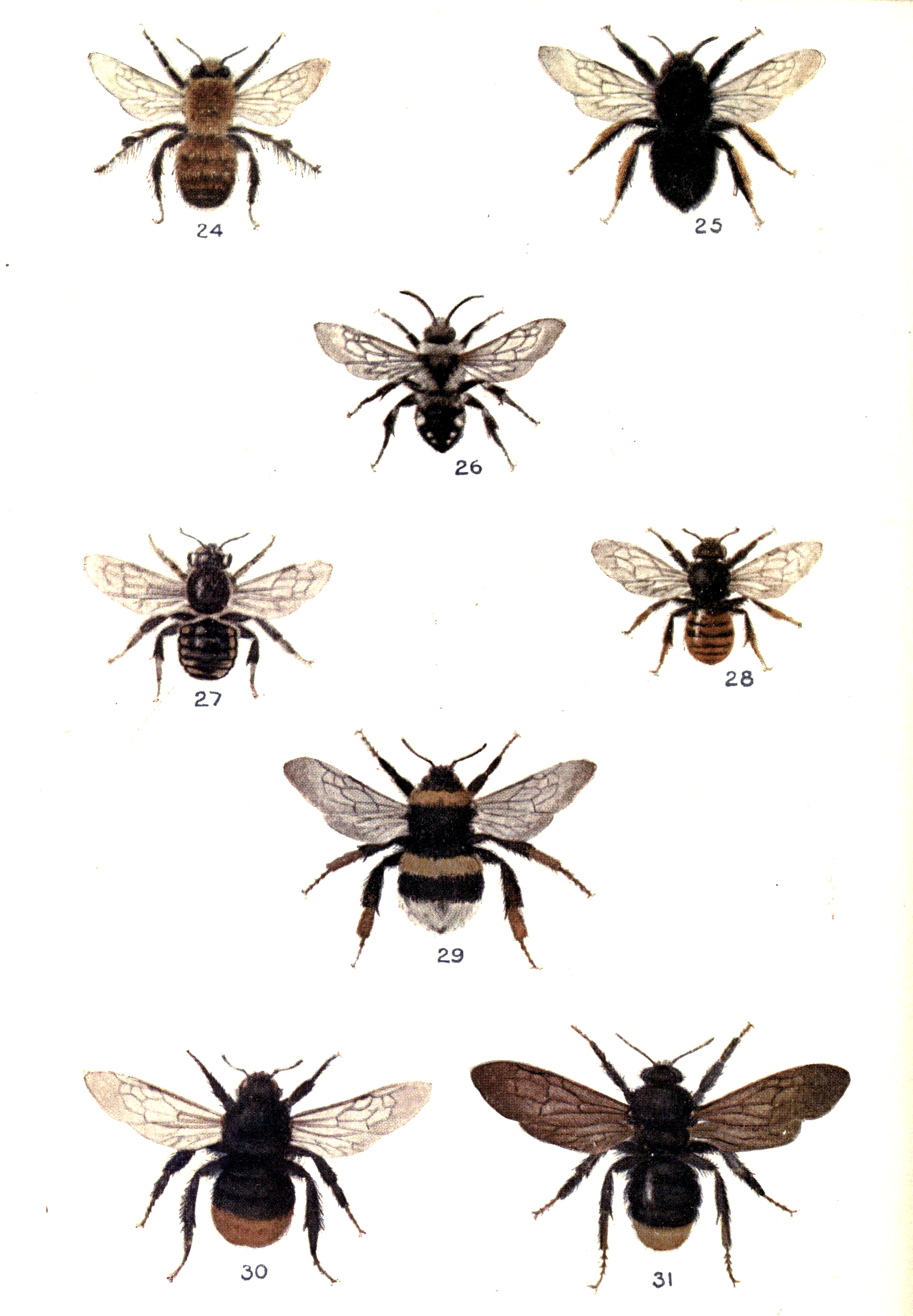
Plate D.
24. Anthophora pilipes, male. 25. Anthophora pilipes, female. 26. Melecta armata, female. 27. Anthidium manicatum, female. 28. Osmia bicolor, female. 29. Bombus terrestris, female. 30. Bombus lapidarius. female. 31. Psithyrus rupestris, female.
[face p. 61.
A COLONY OF ANTHOPHORA
Anthophora pilipes (pl. D, 24, 25), one of our early spring bees, often forms enormous colonies. I have sometimes seen sandpits in which the sides were riddled all over with holes of this species, and where the insects were in such numbers that a distinct hum was audible from the vibration of their wings. In such colonies one is sure to detect some of their cuckoo associates, Melecta armata (pl. D, 26). They are deep black bees, much of the same size as their hosts but with more pointed tails and with a small spot of snow-white hairs on the side of each segment of the body; like other cuckoos they sail about in a more demure way than their hosts, but a more lively scene than a large colony of Anthophora can hardly be found. The Anthophora provisions its cells with honey and pollen, and its egg in consequence floats on the top—the number of cells varies from five or six up to ten or eleven.
Anthophora pilipes has a very close relative in Anthophora retusa, which also forms large colonies, but it is as a rule less common. These two species are exceedingly alike, in fact it requires some skill on the part of the observer to differentiate their females. They are both black and clothed with black hairs, and both have yellow pollen-brushes, but in retusa the hairs are shorter and not quite of such a deep black as those of pilipes, and the spurs of the tibiæ are pale, whereas in pilipes they are black. The males, however, differ widely, although much alike in colour; in pilipes the feet of the middle pair of legs are clothed with enormously long hairs, the basal joint has a dense fringe of black hairs in front and some long black hairs behind (see pl. D, fig. 24); in retusa the basal joint of the middle pair of feet have a fan-shaped fringe of black hairs, and the rest of the joints are clothed with longer hairs, but not long enough to be specially noticeable. A. retusa is visited by the same cuckoo as A. pilipes and also by its rare ally Melecta luctuosa, which only differs from armata (pl. D, 26) in the larger and squarer spots of the body and various small structural characters hardly appreciable except by specialists. The Anthophoras have other parasites besides their cuckoos; one is a beetle, which, however, is rare, and which lays its egg in the Anthophora cells; the other is a very minute member of the Hymenopterous family, whose larva when hatched feeds upon the larva of the bee. Notwithstanding these disadvantages both species are abundant, although retusa is more local than pilipes. A very interesting fact connected with this genus has just been communicated to me by the Rev. F. D. Morice. John Ray, who lived in the seventeenth century, mentions in his book Historia Insectorum (published posthumously in 1710), p. 243, that a large colony of a bee, which from his description was clearly an Anthophora, as he specially calls attention to the great difference between the males and females, inhabited a certain locality at Kilby near "Hill Morton" in Northamptonshire. Mr. Morice, who for many years resided at Rugby, knew Hillmorton, as it is now spelled, well, and tells me that a large colony of Anthophora was in that same locality when he knew it only a few years ago. Of course there is no proof that it has been there throughout the intervening period, but there seems to be no reason to doubt it, and if so it is a most interesting case of a persistent colony.
BEES AND POLLEN-COLLECTING
Bees whether solitary or social enter flowers for the sake of the honey in their nectaries and the pollen on their anthers. In some cases the flowers automatically deposit pollen on the bees during the operation, which enables them to fertilize other flowers of the same species, but the pollen which the bee requires for its own use has to be worked for and collected on organs specially adapted for the purpose. These vary very much in the different families and genera; they exist only in the females, and, if the males get covered with pollen, as they often do, it is probably more by chance than purpose, and it is doubtful if it is of any value to the brood, although no doubt useful in fertilizing other flowers. All our bees, as has been pointed out before, are clothed more or less with branched or feather-like hairs, which would appear to be admirably adapted for the collecting of pollen. At the same time some species which have their bodies clothed with branched hairs have simple or spirally grooved hairs on the collecting organ—others collect on very much branched hairs—so that there seems to be no exact relationship between the plumosity of the hairs and their utility in collecting. The collecting brushes are either on the hind legs or, as in some cases, on the ventral surface of the body. In a female Andrena, the hind leg has a tuft of curled hairs near the base of the leg, and a more or less heavy brush on the outside of the tibia or shin (fig. 8). When a female returns after a collecting expedition these specially hairy regions are a mass of pollen grains, and the "beautiful yellow legs", so often remarked upon in some bees, are not always due to the colour of the hairs but to that of the grains of pollen adhering to them. The genera which collect on the under surface of the body have to visit flowers where the anthers lie in such a position that they can transfer the pollen on to it; the pea flower tribe are favourites with them, and also the Compositæ. All this section have long tongues so that they are able to reach the nectaries of Fig. 8. Fig. 9. plants with long tubular flowers. In visiting these the pollen is often deposited on the back of the bee; this it is able to transfer to its under side by means of the brushes on its feet or tarsi. The arrangements of the humble bees for pollen gathering are altogether different from those mentioned above. They have the hind shin outwardly shining and rather concave, with a series of long curved hairs running down each side of it and partly curving over it, so that they carry their mass of pollen in a sort of basket, scientifically called the "corbicula" (fig. 9); this would be impossible if the pollen were gathered dry, as it is by most of the solitary bees, so the bee moistens it on the flower with the nectar she has been sucking so as to make it sticky, and then transfers it into her basket by means of her foot brushes. The pollen therefore on the hind leg of a humble bee is all in one mass and can be removed as such. When the bee reaches her nest this must of course save her the trouble which the solitary bee must have of cleaning off all the separate grains of pollen which are mixed up among the hairs.
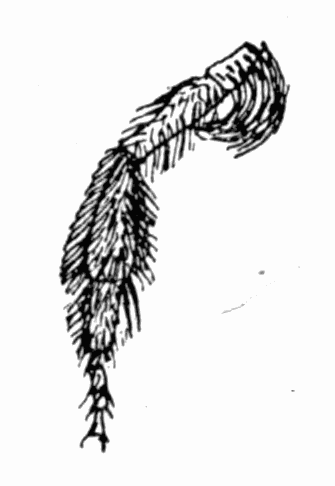
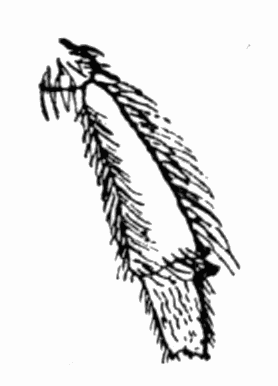
A word or two may be convenient here on the combs and cleaning apparatus of bees. Any one who has watched a bee clean itself will have noticed that the front legs work more or less horizontally—a bee will lower its head and bring its front leg over it with a curved motion—and that it will clean the sides of the face with a sort of shaving-like action, also that the antennæ are apparently pulled through the foot-joint in a remarkable way, often many times in succession. Now the foot of a bee consists of five joints, and is clothed with bristly looking hairs. If these hairs be examined through a microscope they will be found to be more or less razor-shaped, having a thick back and a dilated wing or knife-like blade (fig. 10). In some the blade is of some width, and the edge is evidently very sharp: these hairs or spines no doubt do the cleaning work, and admirably adapted they are to the purpose. The antennæ-cleaner Fig. 10. Fig. 11. Fig. 12. (it may possibly be used for other purposes too) is a still more wonderful adaptation; in the basal joint of the foot there is a semicircular incision, which, when examined under the microscope, is seen to be a small toothed comb. The foot itself fits into the tibia or shin, and at the apex of the latter is a modified spine which is dilated on one side into a wing, or knife-like blade; this shuts down on to the semicircular comb, and the insect by passing the antennæ between the two can clean off anything which may have stuck to it (fig. 11). When we come to examine the other legs we find that the inner surface of their tibiæ and tarsi, i.e. that which is nearest the body, is clothed with hairs which have the points dilated and spade-like (fig. 12), which allowing for the different action of the hind legs makes them just as good cleaners as the razors of the front pair; the spurs at the apex of the tibiæ, which are known as the calcaria, are also doubtless useful for cleaning purposes, and this is specially suggested by the beautiful saw-like form which they assume in some species; although there is no actual semicircular comb in the first joint of the tarsi, yet there can be little doubt that the spur and this joint in conjunction can act as a cleaning organ very much in the same way as the more elaborate arrangement in the front legs. Any one who has the opportunity of examining the hairs of bees under a microscope will be amply repaid for the trouble in noticing the beautiful shapes and structures which these organs assume. (Figs. 13-18; 17 showing pollen grains adhering.) At one time, when I was specially examining bee hairs, I shaved the various parts of a large number of species and mounted their hairs dry in microscopic slides, merely securing the cover glass with liquid glue; this was twenty years ago, and many are still quite good. It may seem a difficult operation to shave a bee, but the hairs come off very easily, and with a sharp dissecting knife for a razor as many hairs as one wants are almost immediately at one's disposal.
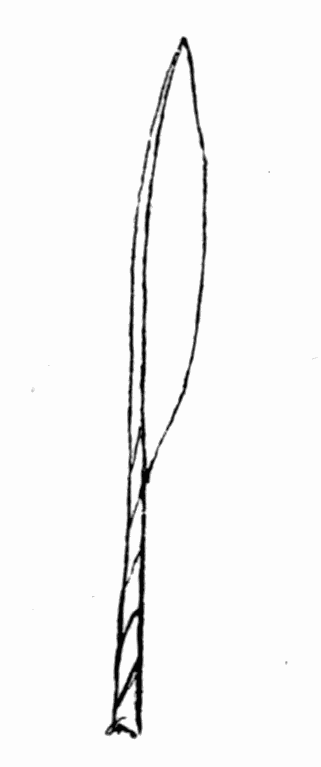
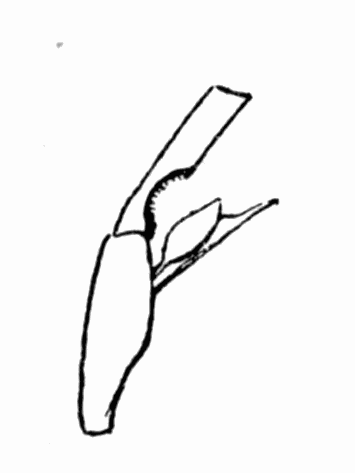
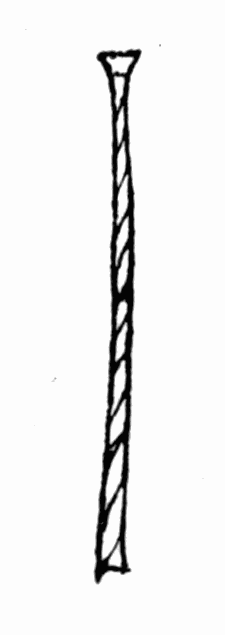
Fig. 13.
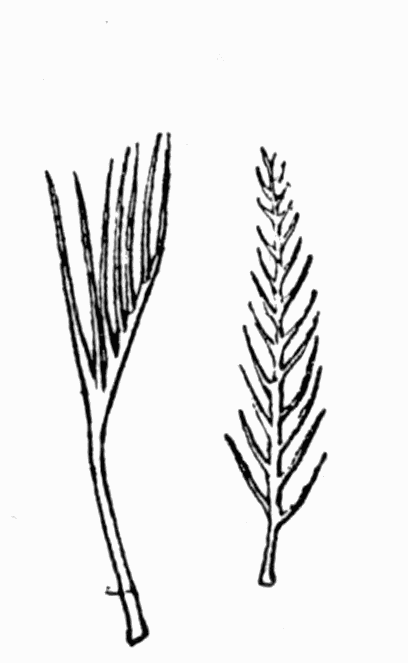
Fig. 14.
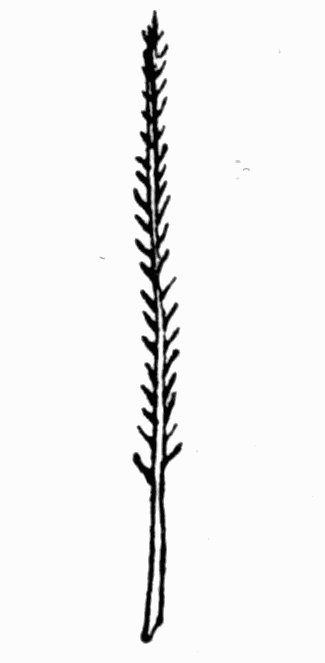
Fig. 15.
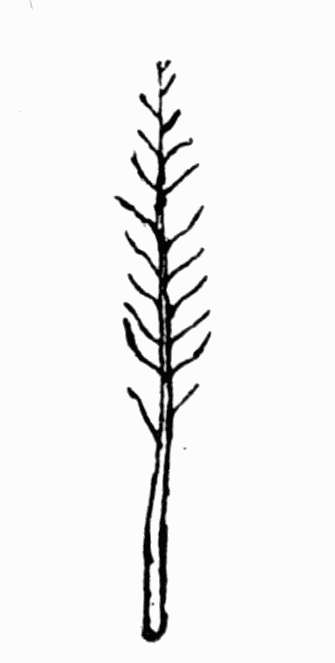
Fig. 16.
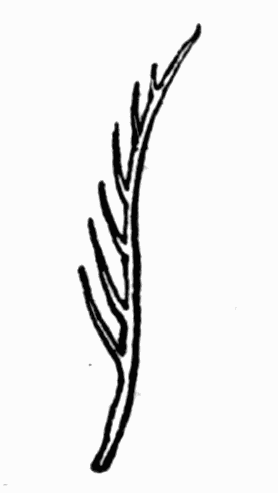
Fig. 17.
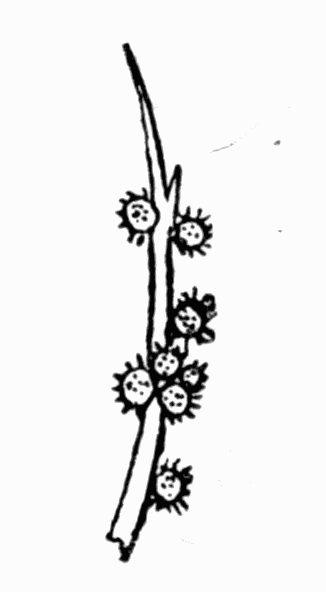
Fig. 18.
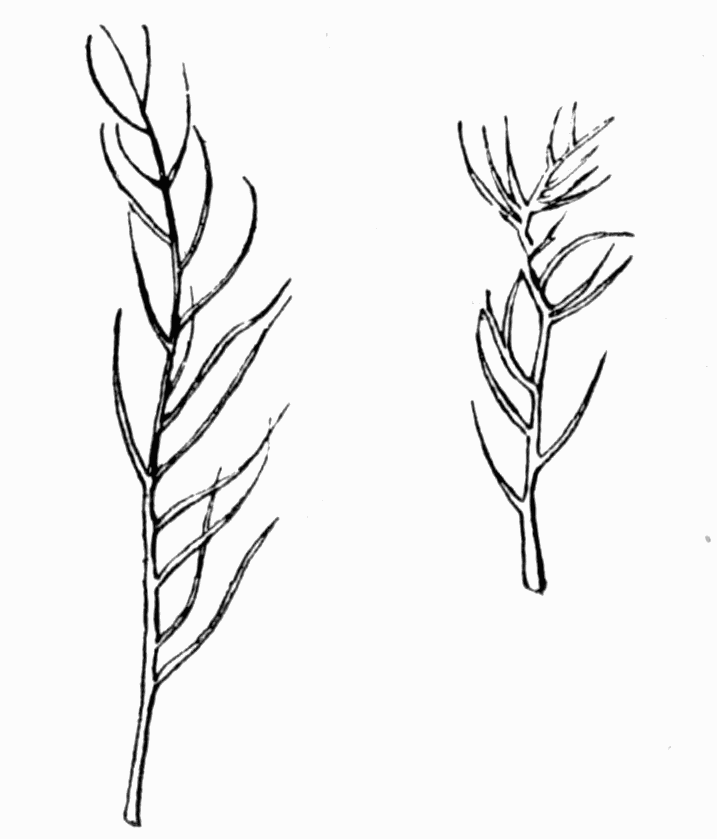
ON BEES' TONGUES, AND HOW THEY SUCK HONEY
In order to understand how a bee sucks honey it will be necessary to go into some rather careful details as to the construction of its tongue and mouth organs. These I will make as short and simple as I can, but the apparatus is a very complicated one, and it will be impossible to describe it without a good deal of technical phraseology.
The tongue has always been considered such an important feature in a bee's structure that it has been made the chief basis of their classification. On this subject I will only say that there are three principal types of tongues—a short bifid tongue (fig. 19, 3[1]), resembling those of the fossors; a short pointed one, shaped somewhat like a spear head (fig. 19, 2, 2a); and a long parallel-sided, ribbon-like tongue (fig. 19, 1, 1a). The bees are classified on what is considered to be an ascending scale, beginning with the bifid-tongued species, through those with the short spear shaped tongues to the higher forms, which have this organ elongate and parallel-sided.
Fig. 19.
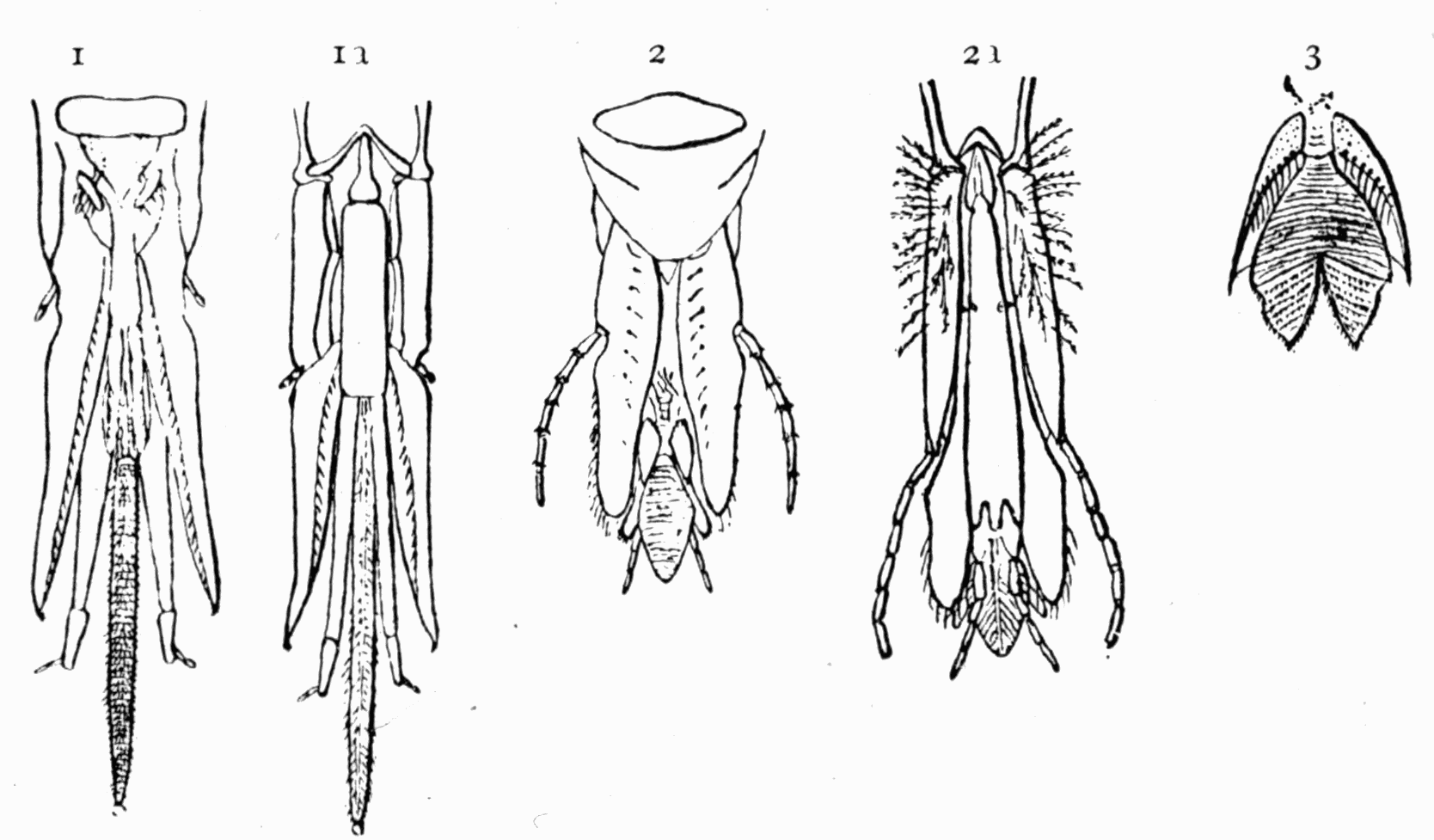
The tongue is the central organ of an elaborate combination of mouth parts, which I will now try to explain. If we turn a bee's head over and look at its underside we shall find a deep cavity, filled up with the base of this combination which fits into it. If we extend the tongue (a humble bee is a good subject on account of its large size, fig. 20) so as to draw its base out of the cavity, we shall find that in the edge of each side of the cavity there is articulated a short rod (20, A), more or less dilated at its apex, called the stipes; on the flattened ends of these rods there swings a joint shaped something like the "merrythought" bone of a chicken, called the lora or reins (20, B), to the central angle of which are suspended the pieces of the apparatus which terminate in the tongue. This V-shaped joint can swing over on its feet, and can therefore lie either between the stipites or rods with its angle pointing towards the tail of the bee, or in the opposite direction with its angle projecting beyond them and pointing forwards. It will at once be seen that by this turn of the V the tongue can be projected a distance equivalent to twice the length of the V.
This V-shaped joint varies much in the length of its arms, which are much longer in the long-tongued than in the short-tongued bees.
When we examine the parts that are suspended from this joint, we shall find that the actual tongue is separated from it by two distinct pieces; the first (i.e. that next to the lora) a short joint (the submentum, 20, C), the second (the mentum, 20, D) a long semi-cylindrical joint which holds as in a trough the softer parts at the base of the tongue. From the apex of the mentum project three organs; the central one is the actual tongue (or ligula, 20, E), and on each side are the organs which are called the labial palpi (20, F); these in the long-tongued bees more or less fold over the base of the tongue and protect it. There are two other large and important mouth parts called the maxillæ (20, G); these articulate on to the flattened apices of the cardines, outside the articulation of the feet of the lora, and extend on each side of the mentum; they also have flattened blades sheathing, when closed, the whole of the mentum above, as well as the base of the tongue.
Fig. 20.
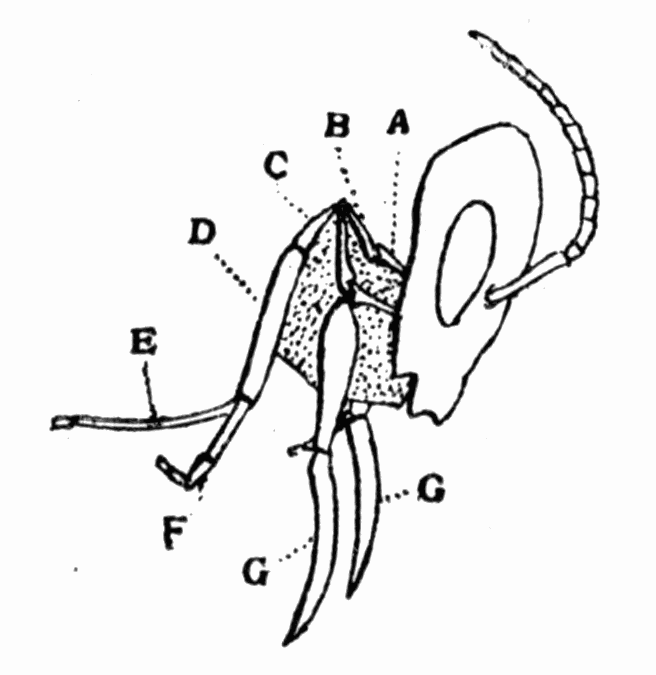
So far we have been looking at the back of the head and mouth parts; if we now look at the front we shall see the maxillæ; if we open these we shall see the tongue lying between the labial palpi, and at the base of the tongue we shall see two little sheaths called the paraglossæ; above these the softer parts lying in the trough of the mentum; from the base of the mentum, connecting with the maxillæ, there extends a membrane which entirely invests the spaces between the bases of these organs and extends up to the mouth. A membrane also extends between the stipites and lora, and closes the cavity at the back of the head. The back of the tongue in the act of sucking can be formed into a tube through which, partly, probably by capillary action, partly by the pumping action caused by the dilating and contracting of certain parts of the mechanism, the liquid food is drawn up into the æsophagus. This, I believe, has been shown to be the principle on which all bees, short- or long-tongued, suck up their honey. The subject could be treated at much greater length, and many other structures connected with the mouth parts discussed, but more minute details are unnecessary in an elementary work such as this, and I have therefore limited myself to a description of the broad principles of the process.
A DREADFUL PARASITE
Fig. 21.
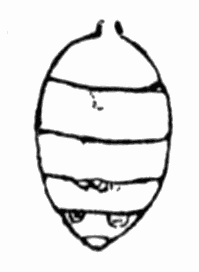
Of all the evils to which bee flesh is heir, there can hardly be any so terrible as the effects of the parasite Stylops on the species of Andrena and Halictus which it attacks. This very extraordinary creature, which is now considered to be a beetle, lives during the early stages of both sexes in the body of the bee, which it enters when the bee is in the larval state. Its head protrudes like a minute flat seed between the body segments (fig. 21), and so is visible externally, but the rest of the creature, which is a grub-like larva, rests amongst the intestines of the bee; the female matures in the bee's body and never leaves it. The male, however, when mature, escapes, leaving the Fig. 22. Stylops larva in abdominal cavity: after Perez. great hole which he inhabited open; he is provided with wings, and I have more than once caught one flying in the open—but to return to our afflicted bee. This may be attacked in either sex, and by one to five of the parasites. I have specimens myself with four parasites in them, and a case of five has been recorded. Mr. R. C. L. Perkins, writing on this subject, says: "On removing the integument dorsally from the bee, the large body of the female parasite will be seen lying above the viscera, often almost entirely concealing them". If this is the condition of a bee nourishing only one parasite, I must leave it to my readers to imagine the state of the poor wretch who is supporting five! The outward appearance of one with several parasites is generally much distorted; the abdomen is very much inflated, and the poor creature is unable to fly any distance, and can only crawl about, or perhaps take short flights of a foot or so. The effects, however, seem to be very different in different cases. I have caught Andrenas with two Stylops in them, flying about as usual and apparently none the worse for their inmates. Probably the position the parasite occupies may make a great difference in its effects on the bee.
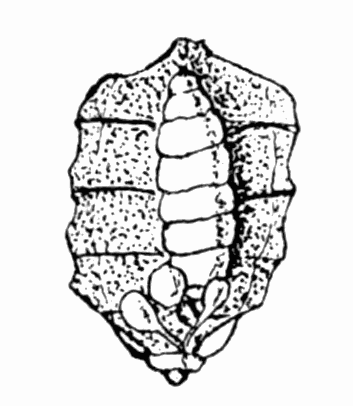
The most notable effect produced by Stylops is the alteration in the structure and colour of certain of the bee's characteristic features. In Andrena the males differ very considerably from the females both in form and colouring. They have no pollen-brushes on their legs, and in some few species the face above the mouth is white, whereas in the female it is black. Now the effect of the parasite seems to be to unsex as it were its victims so far as their outward appearance is concerned. This is no doubt due to the internal effects it has on the larva of the bee. Anyhow, if a female is attacked, in most cases the pollen-brush is much reduced, the face tends to become more hairy, and, if it be the female of a white-faced male, spots of white are often produced on the face. On the other hand, if it be a male subject, the hairiness of the face is diminished, the white colour is often reduced or absent, and the hairiness of the legs is increased.
Before the effects of the parasite were recognized, several new species were described simply on specimens of unusual appearance in consequence of its presence.
These effects, however, like the effects produced on the activity of the bee, vary exceedingly in extent. On some the parasite seems to have no effect, in others the alteration in appearance is very great. This, again, is probably due to the position of the parasites and to the pressure they exert on the reproductive organs of the body in the larval state.
AMONGST THE BEES AT WORK
Now I feel sure many will be thinking "It is all very well to talk about all these solitary and social bees, but I never see them. I certainly know a humble bee with a white tail and another with a red tail, and a wasp, and perhaps a hornet, but I never notice any others." The reason for this, no doubt, is that people are not as a rule observant, and even if they notice a creature one moment they probably forget all about it the next. If any one goes out on a bright spring morning, late in March or early in April, about 11 o'clock, into a garden well stocked with flowers, it will not, I think, be many minutes before an insect darts on the wing along some border, and, if attention be paid to the flowers, a little black hairy bee with yellow legs, like a small humble bee, will be seen diligently at work sucking honey from one of them. The darting bee, which is of a brownish red colour, gradually fading to grey after a few days' exposure to the sun, is the male, and the black one the female. The male rarely settles, but flies about courting the female. Often two or three males may be seen dodging and crossing each other in their flight. The name of this bee is Anthophora. It is quite a harbinger of spring, and I mention it especially as it so forces itself on one's attention, and there are few who will not meet with it without going especially on its quest.
Another opportunity of seeing several kinds of solitary bees flying together may be secured by standing on a sunny day in front of a sallow bush in full blossom, I mean what is commonly called "palm." Its catkins, when the anthers are out and covered with yellow pollen, are most attractive to all kinds of bees, humble bees, hive bees, and solitary bees, and any one who can manage to watch a sallow bush for some time will realize that there are many kinds of bees at work. Of course it is difficult, without special knowledge, to recognize which are bees and which are flies amongst the many which are coming and going, but the yellow-pollened legs of the female bees will generally betray them, as well as their steadier flight. A fly turns about more rapidly than a bee, and sits down much more abruptly. Bees are very captious about the weather; they do not like an east wind and are, apparently, very sensitive to coming wet. I have often gone out on a bright morning and been surprised to find nothing stirring, and then clouds have come up and proved the wisdom of the bees in staying at home. They also fly very little in cloudy weather, especially in the early spring, when the temperature is reduced by cloud below their fancy. One may be watching a sallow bush and see dozens of insects flying about. A cloud shadows it, and almost immediately they disappear, to appear again as suddenly with the return of the sun's rays. It is interesting to watch bees at work collecting pollen, etc., but if any one wishes to study them at home, their nesting haunts must, of course, be visited. These are so various that it is impossible to point them all out, but the best locality to select is a sandy bank facing south. In June or July such a bank is often alive with bees, sand-wasps, etc.; here, again, we want sunshine or the bees will stay in their holes. Even when dull, however, it is a very interesting spot, and we can notice the numbers of holes bored in the bank, and their different sizes and shapes; most of them are round, but some sandwasps make very irregular holes. If we look closely at some of the holes we shall see something closing the aperture, and, if we are too inquisitive, that something will disappear down the hole like lightning; it is the face of the owner of the burrow waiting to come out for the first ray of sunshine, but the owner is very timid and it will be some minutes before she puts her face so near danger again. In most of the sandwasps the face is clothed with bright silvery, or sometimes golden, hairs, and it is a very pretty sight to see these little silvery faces peering out of their burrows. Again, one may sometimes notice a little stream of sand emerging from a hole; this is from some bee who is enlarging her domain or clearing out some of the sand which occasionally falls in. In some cases this ejection of sand is done with a great deal of action: the sand comes streaming out and then the bee follows, quite up to the mouth of the passage, kicking out the sand as hard as it can. The moment, however, that the sun comes out the whole bank is full of life; and just as in the case of the sallow bush, one wonders where it has all been during the shadow. Bees will now be seen flying home laden with pollen; they will pause at the opening of their burrow and then disappear suddenly into its depths. In a very short time they will reappear quite clean and ready for another journey. Their cleaning apparatus must be wonderfully well adapted to its purpose. I have often had to remove the pollen from a bee's leg to see what colour the hairs are, and it takes some time even to brush enough of it off to ascertain this, and yet the natural cleaning process seems to take no time in comparison. But to return to our bank, numbers of bees will be seen coursing up and down and hardly ever settling; these are males paying what attention they can to any females who have time to attend to them, and often falling foul of other males intent on similar pursuits. If one has good luck in the choice of one's bank an elegant wasp-like creature may occasionally be seen amongst the others; this is one of the cuckoos. The flight of all the cuckoo bees is peculiar; it is much quieter and slower than that of the hosts, and a cuckoo may easily be seen solemnly flying up and down the bank, over the various holes, no doubt watching for the proper opportunity to enter one, and deposit its egg in it. This deliberate flight seems a curious habit in a creature which one would think would wish to escape detection. If it seemed to inspire fear in the mind of its host it would be different, but they appear to fly about together unconcerned at each other's presence, and the cuckoo sails along demurely and imposes on its hosts' labours without any apparent resentment on the latter's part; both seem to accept their relationship as a matter of course. Another very interesting frequenter of sandy banks is a pretty little stout sandwasp, about a quarter of an inch long, called Oxybelus. It has a very bright silvery face which shines most brilliantly in the sun, and the body has a row of white spots on each side, and it brings flies back to its nest. It is very active and common, and may often be seen with its fly going back to its hole. There is a rare species of the same genus, which is clothed all over with silvery hairs, and this in some places, curiously enough, selects as its victim a fly which is also coated with silver. There are, of course, many other inhabitants in such a bank as this. There are sure to be ants, which are always interesting to watch, and probably now and then a Pompilus will appear on the scene. These exceedingly lively creatures which run at a very rapid pace, vibrating their wings as they go, and taking short flights between the runs, are on the hunt for spiders. They will be seen to forage amongst any grass or herbage there may be on the bank, and if they can only secure a spider it is stung and paralyzed and carried off at once to the nest. Of course every sand bank will not yield a great number of insects, but some, especially in sandy districts like Woking, Oxshott, and other parts of the Surrey commons, and the New Forest, simply teem with life—and would repay any one for hours of watching and observation.