WILD BEES, WASPS AND ANTS (continued 2)
Reading edition
ANTS, THEIR GUESTS AND THEIR LODGERS
The number of insects of different kinds which live in ants' nests, either as scavengers, stray visitors who have found a lodging for the moment, as guests carefully taken care of and appreciated by the ants, or as lodgers, either tolerated or hostile to their hosts and persecuted, and parasites, is very great. The most interesting of these from the ordinary observer's point of view are the true guests and the lodgers. The true guests are carefully attended to by the ants; they include such insects as the Aphides or plant lice, and others which the ants use as "cows" to secure the saccharine juices which they can obtain from them, and also certain strange beetles which have tufts of golden hairs on their body, which the ants lick—on account of what E. Wasmann[2] calls the etherealized oil given off by them. These beetles are fairly numerous and belong to several quite distinct families; the one which perhaps is amongst the most interesting is a creature called Lomechusa strumosa. This insect has rather an interesting history in connexion with our British fauna. It used to be considered as an indigenous insect, but so many years passed without any one finding it, that the old records were suspected as doubtful, and it was removed from the list of British species. In 1906, however, it was rediscovered near Woking in a nest of Formica sanguinea (pl. A, 1, 2, 3), one of the large red ants, by Mr. H. Donisthorpe. The life-history of Lomechusa is a very curious one: it is taken great care of by the ants, and its larvæ are even placed by them with their own, on which it feeds. Its numbers are kept down apparently by the overzeal of the ants to take care of them. The ants bring their own pupæ up frequently to obtain light and air and with them it brings up the Lomechusa pupæ—this seems not to suit the latter and results in the death of many of them. It is a most interesting case of how a due balance can be maintained, and what might prove an enemy kept in his proper place by kind intentions. There are also in ants' nests what Dr. Wasmann calls "tolerated lodgers"; these are mostly creatures which are supposed to escape the notice of the ants, either by their small size or by their slow, lethargic, or on the other hand very rapid movements—these in many cases act as scavengers, living on the dead bodies of insects, etc., brought in by the ants.
The hostile lodgers are real enemies to the ants and devour their brood, and in consequence they are always at war with each other. These creatures generally resemble the ants considerably in form and colour and especially in their movements.
Besides these lodgers there are numerous parasites of the ants, such as mites, etc., so that an ant colony is a very wonderful mixture of diverse inhabitants. The distinctions given above as to the habits of the various lodgers are not always kept up, as, in some, two or more of these habits are combined. The whole study of ants and their guests is a most fascinating one: many of the latter are great rarities and much sought after by collectors. Unfortunately, the great drawback in collecting them is the havoc caused to the nests of the ants. These structures have been the result of enormous labour on the part of these little creatures, and one cannot regard their destruction without sincere regret. I think any one who, when collecting beetles, disturbs a large nest of the little garden ant (Lasius niger) or the little yellow ant (Lasius flavus) by turning over a stone, as the writer has often done himself, must have experienced a like regret at having broken up all the beautiful passages and galleries which the ants have constructed so carefully.
HOW CAN AN "ACULEATE" BE RECOGNIZED?
This is not an easy question to answer. We cannot make hard and fast definitions which will determine exactly what belongs to this group and what to that; there are always some intermediate forms which present themselves and make our classification unsatisfactory, but, I think, for all purposes of practical observation in the field we may say that if we find a creature with four membranous wings, burrowing in the ground or making a nest in any way, it is an aculeate or stinger. Also, that if we find a hairy-bodied insect with four clear wings collecting pollen or sucking nectar from a flower it is a bee. There are, of course, characters by which the stinging groups can be known almost for certain, but there is no single one which can be given to recognize them by. They are known by a combination of many, and these are frequently small structural details which do not appeal to the field observer; in fact, which are unappreciable except under magnification. One of the chief difficulties experienced by an observer who is not versed in classification is to avoid being deceived by various flies, which in many cases greatly resemble bees, and especially wasps or the wasp-like fossors. They may mostly be known by their flight, and, when they settle, by their behaviour. A fly is more sudden in its movements—those wasp-like flies, for instance, which poise themselves in the air and appear quite stationary but dart off in a second when approached, betray themselves at once by their alertness. Anthophora and Saropoda poise in the air and dart somewhat after the same fashion, but they never remain poised for long, and do not get away from their position so rapidly. Also, a fly when it settles remains quiet, whereas an aculeate if in a flower sets to work collecting pollen, or if basking in the sun on a leaf rarely rests for many seconds without moving in some way. On a flower, if an insect is seen quietly sitting with its head away from the centre of the flower, it is almost certain to be a fly. Most of the little bees (Halicti) which visit dandelions and such like "composites" fly in to them with some rapidity, attack them sideways, and move round the "flower", no doubt getting pollen from each floret in succession and with a businesslike action about it all, which is very different from the behaviour of any fly. The flies which really closely resemble bees in their flight are those which lay their eggs in the burrows of various bees and sandwasps. They are really deceptive. Last summer on the sandhills at Southbourne, near Bournemouth, I again and again was deceived by a small fly with a red belt across its body, thinking it was a red-bodied sandwasp. These it really only resembles on the wing. After having been taken in once or twice one felt ashamed of oneself for not recognizing it. The flies also which associate with the humble bees are often coloured very much like them, and could easily be mistaken for small specimens of the bees were it not for their behaviour and wings, which show a dark spot on the upper margin, not existing in the wing of the bee.
MALES AND FEMALES
These differ from each other very greatly in many cases. Eccentricity in structure almost always occurs in the male; excess of coloration usually in the female. In size the male is generally the smaller and the less robustly built of the two. Among the pollen-collectors, the male is usually less densely clothed with hairs than the ♀. In the fossors this rule is rather reversed, but in that section neither sex is densely clothed with hairs as are most of the pollenigerous bees.
The male has normally thirteen joints in its antennæ, and the female only twelve. There are exceptions to this rule amongst the ants and in certain fossors of the genus Crabro, some species of which have the antennæ considerably distorted, and have two joints welded apparently into one. Another distinction between the sexes is that the male has seven dorsal segments of the body exposed to view, and the female only six. In the males of some of those bees which collect pollen on the underside of the body, the body above terminates with the sixth segment. This is because the seventh is turned over on to the underside, and faces downwards, its apex pointing towards the head. This arrangement of course leaves less room for the regular ventral segments, and the usual apical segments are in consequence "telescoped" up under the fourth, so that the apical opening of the body lies on its underside between the fourth ventral and the inverted seventh dorsal segments. This very curious structure occurs only in those bees whose females collect pollen on the underside, and the reason of it is to me quite inexplicable. The females of a few of the fossors are destitute of wings; but in this country we have no wingless males, except in the case of one little ant (Formicoxenus); this lives in the nest of the common large red ant, and its male can hardly be known from the worker except by the number of joints in the antennæ and the absence of a sting. In the cases where the female is wingless, the male as a rule is much the larger of the two sexes. There are few more puzzling questions than those which arise over these eccentricities of structure; they seem to have no relation to any habits of the creatures' lives so far as we can judge, neither can one suggest any useful purpose which they can serve. In some groups the males of all the species seem built on one regular plan—in others the males of each species seem to vie with the next as to what eccentricity of structure in antennæ or legs or apex of the body it can exhibit. In numbers, the males probably considerably exceed the females, and are far more frequently met with, as they seem to be less particular as to weather, and not being intent on obtaining food for their offspring they fly about more casually, and certainly are more in evidence generally.
The great difference in structure, etc., between the males and females makes the work of pairing the sexes very difficult, especially in those genera where the males and females appear together only for a few weeks, as is the case in Halictus and Sphecodes. If one visits a locality in the spring one may catch any number of females of Halictus, but no males appear till the late summer or autumn, and, unless one visits the same spot again when both sexes are out, it is impossible to associate males and females. I have at the present moment in my collection several males, which, being in doubt about myself, I have communicated to continental authorities, who have returned them to me as possibly the male of so and so! and we shall have to remain in uncertainty about them till some one happens to take both sexes together, when the mystery will be solved.
In time of appearance the males always precede the females—in burrows, such as those of the leaf-cutting bees, etc., it may seem puzzling as to how this is arranged, as one cell is placed over the other so that those lower down in the tube cannot pass those higher up. This difficulty is got over by the arrangement that the first eggs laid by the mother bee are female and the last male, so that those at the top belong to this latter sex; these emerge as soon as the warmth of the sun is great enough to energize them sufficiently to break through their cell covering, when they emerge and wait for the appearance of their females. The males of some species of Andrena seem to take great pleasure in flying rapidly up and down hedgerows, hardly ever settling, and apparently far away from their females, which are probably pollen collecting in dandelions or some such flowers in the neighbourhood.
THE VAGARIES OF COLOUR AND STRUCTURE IN THE SEXES
As a rule the male is rather smaller and especially slenderer than the female, but there are notable exceptions; in one genus of the fossors, Myrmosa for instance, the male is many times larger than the female. In this case the male is winged and the female is wingless. Also, if there is a difference in brightness of coloration between the sexes, as a rule the male is duller than the female—this is especially the case among the bees—but if there is any eccentricity in the form of the limbs it is almost sure to occur in the male, and I think one would not go far wrong in saying that when peculiar features occur in the female, the reason for them is more or less apparent, whereas for the eccentricities of the male there really often seems to be no assignable cause. These male eccentricities are often exceedingly marked. A very good Fig. 23. Fig. 24. example of them occurs among the small "keyhole" wasps. All the British species are practically alike in coloration. They may vary in having a greater or less number of yellow bands on the body, but otherwise their distinctions rest on structure. In the females the antennæ are slightly thickened towards the apex, but otherwise they are simple. The males, however, are divided into three quite distinct groups. In the first of these, the end joints of the antennæ are rolled up in more or less of a spiral (fig. 23, 2); in the second, the apical joint is turned sharply back like a hook (fig. 23, 1); in the third, the end joints of the antennæ are simple and more or less like those of the female. Now if we examine the legs of the males in the first group we shall find still greater peculiarities; in two of our species there is a long yellow spine at the extreme base of the middle leg on the little joint by which it articulates on to the body (fig. 24, 2), and a curious pencil of hairs on each side of the mouth. In two others, the femora, or thighs of the middle legs, are cut into two deep somewhat semicircular incisions (fig. 24, 1)—a most curious character; but here again the females have no corresponding peculiarities. There seems to be no explanation known for these vagaries, and yet one feels that there must be some object served by them. If we turn to the bees we shall find that in many species the face of the male is white to a greater or less extent, whereas that character is very rare in the female. The front feet are produced into a wide flattened form in some, in others the middle legs are extraordinarily developed, and provided with tufts of hairs, etc. Another form of male development lies in the form of the head. This is sometimes very much enlarged—often varying considerably in this respect in specimens of the same species; there is often a projecting tooth or spine on the mandible or jaw at its base, or frequently on the cheek just above it. Then in the fossors the males of the genus Crabro break out into numerous eccentricities; in some, two or more of the joints of the antennæ are soldered together and curved or cut out into curious forms (fig. 26); in others the front shin or tibia is formed like a concave shield or shell (fig. 25), and all the joints of that leg more or less distorted; in another male (a rather doubtful native which has not been taken in this country for fifty years) the head is narrowed behind into an almost ridiculously small neck, being quite triangular in form, viewed from above, with the eyes projecting from its anterior angles (fig. 27, 1), the female head being of normal form (fig. 27, 2).
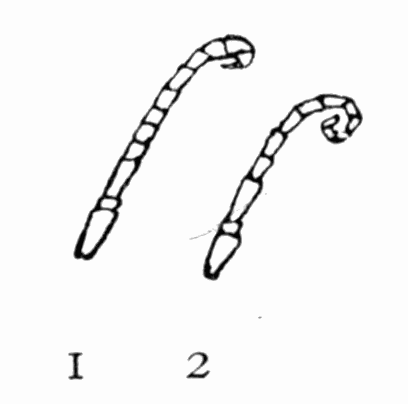
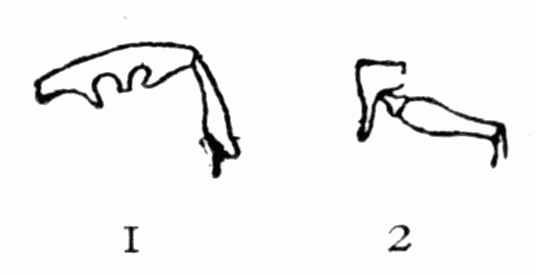
Fig. 25.
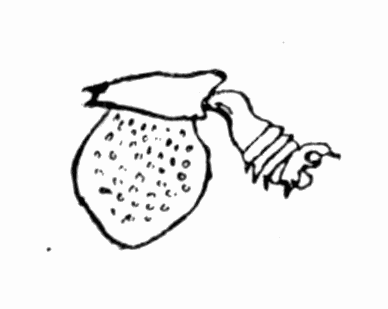
Fig. 26.
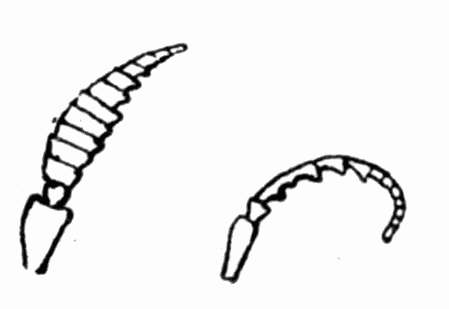
Fig. 27.
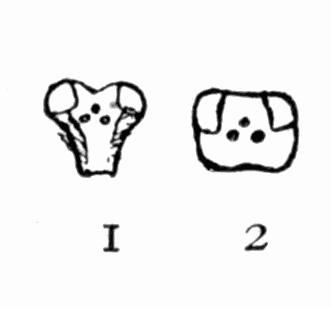
In the males of several species of fossors and bees the eyes are enormously developed, joining one another on the top of the head. This condition occurs also in the drone of the hive bee. The male of Astatus, which has this character, has also a peculiar habit. It sits basking in the sun on some bare sandy spot, and when disturbed makes a sort of circular detour and pitches down again exactly on the spot from which it started up. An increased length of the antennæ is another male characteristic. This is carried to an extraordinary development in what is called the "long horned bee"; this bee, which is pretty common in some places, has antennæ which, when directed backwards, are almost as long as its body—the female has quite an ordinary pair.
Another set of male characters which are of great value to systematists lies in the hidden apical segments of the underside; although these are hidden, being telescoped up inside the segments which close the apical opening of the body, they often assume most curious and beautiful forms, and are characters whereby the males of a species may be determined with certainty when the females defy all one's endeavours to discover their identity.
THE DISTRIBUTION, RARITY, OR ABUNDANCE OF VARIOUS SPECIES
There are few points about which we know less than the causes of distribution and rarity, although there are certain tolerably well recognized laws which govern the occurrence of some species in certain localities. What I mean is that marshy spots, say salt marshes for instance, attract certain beetles and bugs which are never found except in such places; certain kinds of flowers attract bees which never appear to visit any others, but these localities and kinds of flowers occur often at great distances from each other, and why—given a certain flower you probably find a certain bee peculiar to it; or given a certain kind of marsh you probably find a certain beetle, although the localities may be hundreds of miles apart—I think still awaits explanation. I will give an example with which I am personally well acquainted. There is a rare little bee (Macropis labiata) which at one time was looked upon as an extreme rarity, having only occurred three or four times in this country. Mr. F. Enoch, comparatively lately, took a fair number on the flowers of the greater loose-strife (Lysimachia vulgaris) along the canal at Woking; now that its food-plant is known, it has occurred in several other places in numbers, and no doubt wherever the Lysimachia is abundant Macropis will probably occur, but how the little creature has been distributed over the places where this plant occurs, which are often far distant from each other, seems to me to be an unsolved problem. Then there is another puzzling point, and that is the extreme rarity of certain insects. No doubt in many cases this is due to ignorance of their habits, as it has frequently happened that species once considered of great rarity have occurred in abundance when their habits have been discovered, as in the case of Macropis, but there are some cases which do not seem to be explainable in this way. I will again give an example which has been specially under my own observation. Dufourea vulgaris, a little black bee, which certainly might not be recognized from its outward appearance, as there are many which very closely resemble it, is still one of our greatest rarities, only three British examples having been recorded. The first was taken by Sir Sidney Saunders at Chewton, Hants, on the twelfth of August, 1879; this was a male; the second, a female, was taken by Mr. T. R. Billups at Woking, on the first of August, 1881; and the third by myself at Chobham (about four miles from Woking) on the first of August, 1891. I believe in all cases these were taken on yellow composite flowers. The flight and behaviour of the male I caught were so peculiar, as it wriggled itself into the flower, that I knew at once I had caught a rarity, and remarked to my companions that I believed I had got a Dufourea. I also hazarded the remark that it was "ten years since it had been taken." When I got home and looked up the former record it was ten years to a day. Now there are few places in England that have been better worked for the bee tribe than the Woking, Chobham, and Weybridge neighbourhood; it has been worked by experienced men who would see a difference in the flight of an insect directly. The late Mr. F. Smith, in his day our leading authority, the Rev. F. D. Morice, than whom no one has probably worked the neighbourhood more thoroughly, Mr. T. R. Billups, Mr. E. B. Nevinson, and the late Mr. A. Beaumont, have all been over the ground again and again, and yet only these two Dufoureas! and these taken four miles apart. Here again is a problem which is very perplexing! What part in nature does this little rarity play? No doubt like everything else it has its duties, and its corner to fill, but beyond that one can suggest nothing.
Other bees are often exceedingly abundant in one season and very rare the next, or they will entirely desert a locality where they have been abundant, and move somewhere else—the occasional scarceness is due probably to continued wet weather, which often appears to kill the larvæ. Cold winters seem to have no injurious effect, although at one time they were thought to determine the scarcity or otherwise of the bees of the following summer. It has, I think, been clearly shown that larvæ can stand almost any amount of cold, although they succumb to the effects of mildew produced by wet, but there is often no apparent reason why a well established colony should migrate to quite new pastures. Sometimes the proximity of new buildings or the digging up of ground may disturb them, but I know of colonies that have gone from where I knew them a comparatively few years ago, and where I can detect no change likely to have affected them. On the other hand there are colonies which one has known all one's life and which still go on as strongly or more strongly than ever—the case quoted under Anthophora, p. 63, shows what persistence there can be in some.
ON BEES' WINGS
The Bees and the other stinging groups have four wings like all the Hymenoptera. These wings are almost always clear and transparent, at any rate amongst the British species, there being only one exception which I can call to mind in the female of the cuckoo of our large red-tailed humble-bee, which has the wings blackish; also they are never spotted, as in some flies. The hind or lower wings unite with the upper by a series of very beautiful hooks which extend along their upper margin and fix on to the posterior edge of the front wing, which is folded back on itself so as to receive them; in flight the two wings are united, but when at rest they separate; these hooks are beautiful objects under a microscope; their numbers vary; and in some cases this variation is useful in distinguishing closely allied species from one another. The hum of a bee is caused, to a great extent, by the vibration of the wings, but it has been shown that a loud buzzing noise can be emitted by bees which have lost their wings; this proceeds from the spiracles or holes in the outer covering of the creature through which it breathes. It is therefore not always easy to say how much of the hum is caused by wing vibration and how much by the action of the spiracles. Some, in fact most, of our solitary bees are almost silent in flight, and their note can be heard only when large numbers are flying together; others have a very peculiar shrill hum, by which even the species can almost be recognized. In bright, hot, sunny weather their flight is more rapid and their note attains a higher pitch. The bees with the highest pitched hum with which I am acquainted are the two smaller species of Anthophora and Saropoda bimaculata.
In early spring, when it is hot in the sunshine and cold when a cloud covers the sun, it is no unusual thing to see a bee drop to the ground. The cold seems to paralyze altogether their powers of flight. When at rest a bee folds its wings along the sides of its back, but only in the wasp tribe is there the arrangement for them to be folded longitudinally. The shape of the wings varies very little, but the arrangement and number of their cells vary considerably. There are some very interesting genera in which the neuration of some of the cells is so slightly indicated that they are hardly visible, and can be seen only when the wing is held in certain lights; these faintly indicated cells are nearly always those towards the apex of the wing, the neuration of the basal part of the wing being as strong as in the other genera. There are a few moths in this country which very much resemble, both in the colour of their bodies and their clear wings, the wasp tribe, but they may be known by the brown band of scales at the apex of the wings and also by the absence of the narrow waist, which exists in all the stinging tribes. The only wingless forms which we know are to be found amongst the ants and the fossors, and as a rule are females, but in a few cases in the ants, and in some foreign species of the genus Mutilla, the male is apterous also.
ON BREEDING ACULEATES, ETC.
Any one who wishes to study the life-histories of these insects, and has leisure to do so, can easily obtain various larvæ by digging for them in suitable places. If, for instance, during the summer, bees, etc., have been noticed entering holes in a certain bank or sandy spot, their larvæ or nymphs can be got in the autumn by digging down for about a foot in the direction of the holes, and if they be brought home and put into glass-top boxes they will generally emerge at their right time without giving any further trouble; it must, however, be remembered that the grubs are very soft and tender skinned, and it is better to avoid handling them if possible; they should be moved with a small soft camel-hair pencil, and it is well to put something soft at the bottom of the box so that if they fall in they will not be damaged. If the wood-boring species are being collected, care must of course be taken in splitting the wood; most of these make a pupa case over themselves, and are in that respect easier to deal with. A label should be put in each box to show where the larvæ, etc., were found. An old rotten stump of a tree will often produce a good number of species. Then there are the bramble-stem borers; these can be left in the stems. I have generally found it convenient, after arriving home, to split the stems down, to see if there are any living creatures in them, and, if there are, to close them up again, and, tie a little very fine net or gauze bag over the top of each stem; in this way one can find out exactly what insects come from what stem, and determine the cuckoos (if any) which belong to each. As the season advances towards May, it is well to give all the larvæ, etc., an occasional glimpse of the sun; they should not be left in the sun long enough for them to get dried up too much, but the sun is a very important factor in tempting them to emerge; naked larvæ and nymphs, in glass-top boxes, should be treated very carefully in this respect, as they are deprived of their natural surroundings, in which the actual sunshine would never reach them—it would be better to place them in a sunny room, screened off from the actual rays of the sun, so that its warmth only would be felt. If they do not emerge the first year, it should not be taken for granted that they are dead, as very likely they will appear in the following spring. I have bred leaf-cutting bees several times with great success, and others I know have been successful with many species. The fear is to get them dried up too much; it is therefore not desirable to keep them in a very hot room. When first the insects emerge, their hairs are often more or less matted together, and they should be put in the sun in a larger box, so that they can crawl about and clean themselves; portions also of the skin in which they have been enveloped frequently adhere to them for some little time, but as a rule, unless the creature be too weak, these are very soon cleaned off. Breeding is a fascinating amusement, but it requires a great deal of attention when the emerging season begins, as the boxes want constant watching, or the insects will emerge unnoticed, and, if not given proper air and sunshine, may die without cleaning themselves properly.
If it is desired to preserve the specimens, they should be killed either with cyanide of potassium, ether, or chloroform. If the first of these agents is used, a piece of about the size of a small hazel nut should be put at the bottom of a bottle (for collecting purposes, an ordinary "Coleoptera bottle", which can be obtained from any naturalist's shop, is the most convenient) and should be kept down by a wad of blotting paper, well pressed down upon it; this prevents the cyanide, as it liquifies, from wetting the hairs, etc., of the insects. Over this a piece of white paper should be placed; this will get stained at once when there is much damp, and should then be changed. The objections to cyanide are its very poisonous nature, and the stiffness which is caused by its use to the specimens killed by it, and also its tendency to turn yellow colours red. I always use it myself as I think it is preferable to the other insecticides, notwithstanding its demerits, but then I do not extend the legs and wings of my specimens, but simply leave them in whatever position they happen to die. Ether is a very favourite method of killing with many; a few drops in a bottle with some paper in it is sufficient to last for some hours; it however soon evaporates in hot weather, and it is necessary to carry a small phial of it in one's pocket to replenish the supply when exhausted; this makes one smell of ether perpetually, which is more than I can stand. But the insects killed in this way are beautifully supple, and, for those who wish to set their captures as they would Lepidoptera, it is an excellent medium, i.e. if they don't mind its smell; it has also the benefit of not affecting colour. Chloroform acts much as ether does. When killed, I strongly recommend collectors to pin their specimens through the thorax with a very fine pin (those used for micro-lepidoptera are the best), and then to pin this through a narrow strip of card, mounted on a long stout pin; in this way the insect can be moved about by the strong pin, and the thorax of the insect itself is not destroyed, as it often is in the case of the smaller species by the use of thicker pins. The cards should be cut as small as possible; they need not be more than a quarter of an inch long. The insect should be pinned at right angles to the long axis of the card, and the long pin should be inserted on the right-hand side of the insect so as not quite to touch it. In this way the insects look quite as neat as if they were pinned direct. Locality labels, etc., should be affixed to the long pin, and the insects should be stored in cabinets or boxes.
ON COLOUR
There is but little tendency towards brilliant coloration amongst our native aculeates. No doubt our comparatively high latitude accounts for this to some extent, as also the fact that the aculeates do not, as a rule, elsewhere assume great brilliancy. Even in the tropics and other warm regions, where bright green, blue or coppery coloured species occur, they are comparatively few in number. In this country metallic colours are to be found in less than a dozen species, and in most of these it exists only as a tinge. Amongst our ants and wasps it does not exist at all, unless the slight bronziness of the typical form of Formica fusca be so considered. The fossors can exhibit only a bluish tint in Mutilla Europæa (pl. A, 4, 5), and a slight bronzy tinge in two of quite the smallest species, Miscophus maritimus and the ♂ of Crabro albilabris. The bees can do a little better; five species of Halictus have a distinctly bronzy head and thorax, and in three the bronzy colour extends to the abdomen; there is also another with a very dull green tinge on the thorax; besides these there is a little bright blue bee, Ceratina (unfortunately a great rarity in this country) and two or three species of Osmia, showing more or less tendency to bronziness, and one which is distinctly bluish; but, considering our indigenous species number nearly 400, this is a very small, and compared with other countries I should think an abnormally small, proportion.
Species with bodies banded like a wasp's are much more abundant—no less than eighty of our native kinds having this style of coloration. The bands may be reduced to lateral spots, but such cases, I think, are only modifications of the banded scheme.
Black species with a more or less pronounced red band across the body number about seventy, and a general testaceous or yellowish colour occurs in a few ants, but not elsewhere among the British aculeates. Nearly all the rest are black or dark brown so far as the actual surface of the body is concerned; but amongst the bees there is often a dense clothing of coloured hairs sometimes so dense that the surface of the body may be rendered invisible. These coloured hairs may be distributed into brilliant bands, as in the humble bees, or they may be uniformly black, as in some of their varieties and in the females of the spring species of Anthophora (pl. D, 25), or entirely red as in Andrena fulva (pl. B, 16), or black on the thorax and red on the abdomen as in Osmia bicolor (pl. D, 28), or vice versâ as in Andrena thoracica, etc., but the most usual condition is that where the hairs form more or less pale bands along the joints of the segments, either immediately above or below them or both; sometimes these bands are very obscurely indicated, and visible only in certain positions. At others they are vividly white; to a certain extent this banded condition recalls the waspy coloration. The hairs, however, of the bands are rarely yellow, but as a rule greyish or white, or of a grade of colour slightly paler than those of the disc. There are some rather interesting points which arise out of this rough analysis. Among the bees, all the species which have a waspy coloration are cuckoos, with only one exception (Anthidium) (pl. D, 27), as are also nearly all those which have red bands. With the exception of the males of three species of Halictus, and both sexes of three or four species of Andrena, all the red-banded forms belong to the genus Sphecodes (pl. B, 11), which is a cuckoo genus. The red coloration occurs chiefly on nearly naked surfaces; this is specially noticeable in those bees which have two varieties, such as Andrena rosæ, one dull coloured and the other red-banded: in these cases the dull form is hairy and the red nearly naked. The greatest proportionate number of banded species occurs amongst the fossors, and these are seldom clothed with hairs to any extent. These bands seem to me probably to depend a good deal on retarded development. Dark and hairy bands, both as a rule, follow the joints of the segments, as stated above. I only say as a rule, as there are many where the banding does not follow this principle, but in far the larger majority the bands, whether of dark colour or hairs, are apical. As the segments overlap at the joints it is evident that their discs would tend to mature more rapidly than the overlapping bases and apices, and the longer period spent in hardening and drying of the overlapping parts would favour the development of dark pigment and of hairs. Many species have the extreme apices of the segments pale, but with the apical integument so very thin, often looking nearly transparent and membranous, that its development would be very rapid. Again, in the case of red coloration, the red generally occurs on the discs of the segments, the apices and sides often being dark, and in cases where in one species both black and banded forms occur, with intermediate varieties, the last remnant of red colour is generally situated in the centre of the segment. By far the gayest effect is displayed by our humble bees, and, but for them and a few of the species of Andrena and the wasp-coloured species, our aculeates would be a very sombre lot.
THE DEVELOPMENT OF INSECTS FROM THE EGG
Although this and the following chapter may not be interesting to all my readers, I think it is only right to add some remarks on the structure and classification of insects, so that any one who wishes to follow up the subject may gather a few general ideas which may induce them to take up some technical and scientific work in which they will get fuller and more exact data on the difficulties which are involved in such simple questions as "What is an insect?" "How are the different orders of insects distinguished from each other?" "What is a species?" etc.
To realize the characters of an insect in its perfect or "imago" state, we may for the moment forget what often seems to be its most important features, and which are frequently its most extensive parts, viz. its limbs or appendages; by limbs are meant its wings, legs, horns or antennæ, jaws or mandibles, etc.: strip these all off, and we have a limbless trunk, which many would not recognize as belonging to an insect at all; still this limbless trunk possesses characters which assert its insect nature, as it may be known from other limbless trunks by being divided into three parts by two great transverse divisions; in most insects these are extremely well marked, and in all they have a very real existence. The parts thus divided off are known by the names of head, thorax, and abdomen. Anybody knows how easy it is to break off the head or body of a dried insect. Now the head or body breaks off at one of these divisions, and it is this partitioning of the body into three sections which makes one of the strongest characters in the definition of an insect. The three parts, thus divided off, each possesses special functions in the life of the creature. In the head are contained the principal organs of sense and brain; in the thorax, the organs of locomotion; and in the body those of digestion, reproduction, etc.
This division into three parts does not however always hold good in the early stages of the insect's life, and we must remember that the creature commences life on leaving the egg, and not merely on its emergence from the chrysalis, so that we have to reckon with caterpillars, grubs and all sorts of curious immature forms in our conceptions of an insect.
These early stages do not as a rule interest the public much, but it is well to bear in mind that the "perfect insect" stage is reached by some insects along apparently a very different road from that travelled by others. Some leave the egg as caterpillars or grubs, and after various changes of skin become apparently lifeless chrysalids, from which they emerge as perfect insects. Others leave the egg as diminutive likenesses of their parents, and run or hop about much as they do, attaining the perfect insect stage simply by a series of changes of skin, without any definite quiescent or chrysalis condition.
The observation, therefore, which one often hears that insects never grow, has to be taken with caution; all insects grow in their early stages, but it is an obvious truth that insects do not grow after they attain the imago or "perfect insect" condition. A small fly will never become a large fly, nor a small beetle a large beetle. This is only because we do not recognize their caterpillars or grubs as flies and beetles; but a grasshopper we know grows, because its early stages are of the same general form as the perfect insect, and we see the little ones hopping about in some places, and if we visit the same place later on we notice that they have grown, but as soon as they cast their last skin and obtain the free use of their wings, growth ceases, as it does in a fly or a beetle or in any other insect.
It must not be supposed that the limbs of insects are of no value in their identification. We only removed them in order to emphasize the great importance of the character derived from the regional constrictions of the body, which is considered to be certainly one of the most, if not the most, important of any. Besides this character every perfect insect should have six legs, four wings, and various appendages on the head, such as antennæ, mandibles, maxillæ, labium, etc.; some of these may be so modified as hardly to be recognizable, but they are hardly ever absent altogether; for instance, the two fore wings of a beetle are modified into what are called wing cases, and fold over its back, protecting the two hind wings, which are more or less membranous, as are those of a bee. They have not the functions of locomotive organs, and are used in flight as poisers. Again in the case of a fly, the hind wings seem to be absent, but they are considered to be represented by two little projecting organs which look like large headed pins or nails, but which are quite useless for locomotive purposes.
The organs of the mouth are especially liable to modification, and on these the older authors used to frame their classification. Insects were divided by them, primarily, into two great divisions, viz. those which had a biting and those which had a sucking mouth; treated in this way, the following orders fall into the division with biting mouths:—
Coleoptera, or beetles; Hymenoptera, or bees, wasps, ants, etc.; Orthoptera and Neuroptera, which include the grasshoppers, earwigs, cockroaches, dragonflies, May flies, etc.
And into the division with sucking mouths:—
Lepidoptera, or butterflies and moths; Diptera or flies, gnats, etc.; Hemiptera, or bugs, including the plant-lice, etc.
These divisions, however, have not been found to be very satisfactory, although very simple when dealing only with the perfect insect stage. In the first place, being framed on this stage only, they are not always applicable to the earlier phases of the insect's life—for instance, although a butterfly or moth has a sucking proboscis, their caterpillars have strong biting jaws, as any gardener well knows. Also bees, wasps, etc., rather upset the arrangement, as they have not only a sucking mouth but also strong biting jaws.
This system of classification has therefore been discarded by most entomologists in favour of that based on the difference between those insects which pass through the distinctive stages of caterpillar and chrysalis on the one hand, and those which emerge from the egg as diminutive likenesses of their parents on the other. In this arrangement, the Coleoptera, Hymenoptera, Lepidoptera, Diptera and Neuroptera, fall into the first division, or Heteromorphæ as they are called; and the Hemiptera and Orthoptera into the second or Homomorphæ. The dragonflies are the only slightly discordant elements in this arrangement, as, although their larvæ have six legs and walk about under the water and never assume an actual chrysalis condition, still they can hardly be said to resemble their gorgeously coloured parents which fly about so majestically over our ponds, etc.; still this is only one of the many cases which show that nature cannot be held down by any of the arbitrary rules we make for her classification.
The Hymenoptera are therefore characterized and distinguished from other insects by having both a biting and sucking mouth, four clear wings, and by passing through the distinctive liveries of caterpillar or grub, and chrysalis or nymph. It is with this order only with which we have been dealing. To distinguish the aculeate section from the many other forms of the Hymenoptera is too complex a task to undertake here, but the presence of a narrow waist between the thorax and the body, the number of joints in the antennæ never exceeding thirteen in the male, twelve in the female, and the presence of a sting capable of ejecting poison in this latter sex, are the most prominent features by which the aculeates may be recognized.
ON STRUCTURE
Although in the foregoing chapter a little has been said on this subject, there is a great deal more that a student should learn about the general form of these creatures.
They begin life as white or nearly colourless grubs, which, after various changes of skin, assume what is called the nymph or pupa stage, during which a change occurs, believed to be peculiar to the Hymenoptera; the fifth segment of the larval body is transferred to the mass which is called the thorax, so that a portion of what looks like thorax is really the first segment of the abdomen. Continental writers call this portion sometimes the first abdominal segment and sometimes the median segment, but Newman gave it a definite name, the "propodeum", and the most convenient method seems to be to call it so, and treat it as a part of the thorax, calling the first or basal segment of the abdomen that which immediately follows the regional constriction, which occurs between the propodeum and the abdomen.
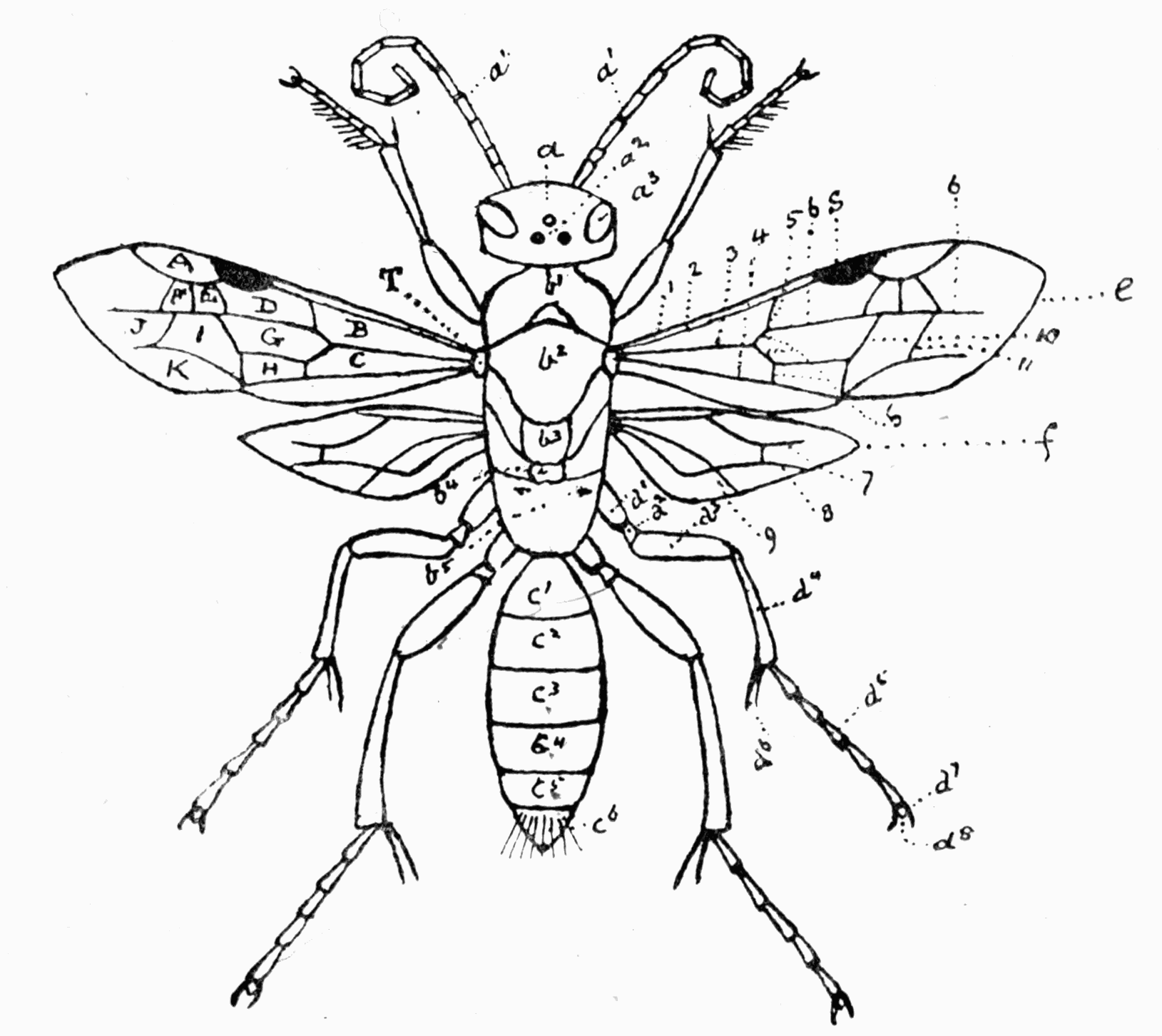
Fig. 28.
a Head. a1 Antennæ. a2 Ocelli. a3 Compound eyes.
b1 Prothorax. b2 Scutum of Mesothorax. b3 Scutellum of Mesothorax. b4 Post-Scutellum of Metathorax. b5 Propodeum.
c1 c2, etc., Segments of Abdomen.
Legs. d1 Coxa. d2 Trochanter. d3 Femur. d4 Tibia. d5 Tarsi. d6 Calcaria or Spurs. d7 Unguiculi or claws. d8 Pulvillus.
e Front wing. 1 Costal nervure. 2 Post Costal nervure. 3 Median nervure. 4 Posterior nervure. 5 Basal nervure. 6 Cubital nervure. 10 1st Recurrent nervure. 11 2nd Recurrent nervure.
f. Hind wing. 7 Anterior nervure. 8 Median nervure. 9 Posterior nervure.
Cells. A Marginal. B Upper basal. C Lower basal. D 1st Submarginal. E 2nd Submarginal. F 3rd Submarginal. G 1st Discoidal. H 2nd Discoidal. I 3rd Discoidal. J 1st Apical. K 2nd Apical.
The perfect insect when it emerges has therefore a head, a thorax of four segments, and an abdomen of seven visible dorsal segments in the male, and of six in the female. The ♂ has six ventral segments exposed, and often the apex of the eighth, which is frequently elongate, the seventh being almost always short and hidden; the eighth dorsal segment can be discovered hidden under the seventh, but it is very rarely exposed. The head (a) bears numerous appendages; a pair of antennæ (a1), usually of thirteen joints in the male and of twelve in the female; two compound eyes (a3), composed of many facets; three simple eyes (or ocelli) (a2), which are situated on its vertex; two mandibles; two maxillæ, bearing palpi on each side, of a varying number of joints; and a labium, or tongue, which also bears at its base two four-jointed palpi (cf. fig. 20).
The thorax, as we are considering it, consists of four segments—the prothorax (b1), which bears the two front legs; the mesothorax (b2), which bears the intermediate pair of legs and the anterior pair of wings; and the metathorax (b3), which bears the posterior pair of wings and the hind legs. The propodeum has no appendages. The mesothorax above has two parts, a larger portion in front called by some the scutum (b2), and a smaller portion behind called the scutellum (b3). These are separated from each other by a transverse impression, and the scutellum is often raised into a sort of little shield; behind this is another little elevation called the post-scutellum (b4); this is really the dorsal apex of the metathorax, and behind this lies the propodeum (b5). Each leg is composed of various parts, and articulates into a cavity of the thorax called the acetabulum. The first two joints of the leg, the coxa (d1) and the trochanter (d2), are very short; then follows the femur or thigh (d3); then the tibia or shin (d4); and finally the tarsi (d5), which compose the foot. At the apex of the tibia are usually two spines called the calcaria (d6). The tarsi are five-jointed, the joints following each other in a linear arrangement, and in the Anthophila the basal joint is more or less dilated; the apical joint bears two claws (unguiculi, d7) which are sometimes toothed, and between them, in some genera, there is what is called a pulvillus (d8) or cushion; this is very large and dilated in some of the fossors.
The wing neuration is always rather troublesome, as various authors use different names for the veins and cells. To begin with the anterior wing (e), there are four nerves which start from the base and run horizontally; the first of these, which forms the anterior margin of the wing, is called the costal nervure (1); immediately below this, and running almost parallel to it with scarcely any space between them, is the post-costal nervure (2); these end in the stigma (s), a dark in-crassation towards the apex of the wing; from the stigma a nerve, curving first downwards and then up to the anterior margin of the wing, encloses the marginal cell (A). Below the post-costal nervure, and situated about the centre of the wing, is the third longitudinal nervure called the median nervure (3); behind this again runs the posterior nervure (4), and behind that the actual margin of the wing which is not provided with a protecting nervure, but is only folded back so as to receive the hooks of the posterior wing. Across the wing at, roughly, about a third of its length from the body runs the basal nervure (5); this extends in a somewhat zigzag line from the post-costal to the posterior nervure crossing the median, and thereby enclosing two cells, the upper basal cell (B) and the lower basal cell (C). From the centre of the apical nerve of each of these cells extends a longitudinal nervure; the upper of these runs out nearly to the apical margin of the wing and is called the cubital nervure (6); this is united to the nervure of the marginal cell by one, two, or three cross nervures, enclosing thereby one, two, or three cells called the first (D), second (E), and third (F) submarginal cells. The nervure from the lower basal cell is a short one, as it is met by a cross nervure called the first recurrent nervure (10), which runs from the cubital to the posterior, thereby enclosing two cells, the first (G) and second (H) discoidal. The second recurrent (11) leaves the cubital nearer the apex of the wing than the first, meeting a nervure which, springing from the outer posterior angle of the second discoidal, closes the third discoidal (I), and, curving slightly upwards, nearly reaches the apical margin of the wing. Beyond the second recurrent, and behind this last nervure which we have been talking about, are two spaces not actually enclosed, but called the first (J) and second (K) apical cells.
The posterior wings have very few cells. Like the anterior pair they have three longitudinal nervures; the anterior (7), which runs close and parallel to the anterior nerveless margin, and often touches it at about half the length of the wing; the median (8) and posterior (9) run in diverging lines from the base towards the exterior margin of the wing, the anterior and median nervures being almost always joined by a cross nervure, and the median usually united to the posterior by a cross or curved nervure. The actual base of the anterior wing is covered by a little convex somewhat shell-like cap, called the tegula (T). The abdomen is composed of a series of segments in linear arrangement (c1 c2, etc.). These call for no special remark, beyond what has been said in the chapter on males and females, but those who wish to investigate the very interesting questions connected with the terminal segments of these creatures should consult some more technical work.[3] The arrangements of the mouth parts and of the apical segments of the Hymenoptera afford perhaps the most important structural characters of the order, but they involve an amount of dissection and study which can only be undertaken by those who are inclined to give themselves up to this subject as a speciality.
INDEX
Abdomen, 125 Acetabulum, 135 Ammophila, 22 Andrena, 9, 12, 15, 48, 77, 79, 122, 139 — fulva, 121 — rosæ, 138 — thoracica, 121 Antennæ, 101, 103, 134 Anthidium, 50, 121 Anthophila, 6 Anthophora, 48, 61, 82, 93, 109, 111, 121 — pilipes, 61 — retusa, 62 Ants, 28, 31, 88 Aphides, 88 Apis, 16 Astatus, 103 Banded bodies, 120 Beetles, 20 Biting, 3, 32 Black Species, 120 Bombus, 16 — terrestris, 41, 42 Brain, 125 Bramble Stems, 12 Breeding, 113 Broods, 13 Burrows, 9 Calcaria, 70, 135 Carder Bees, 40 Cardines, 75 Carpenter bee, 55 Caterpillar, 19, 20 Cells, 10, 12, 28, 29, 40, 58 — hexagonal, 28 — pitcher-shaped, 58 — waxen, 29, 40 Ceratina, 47, 128 Chimneys, 25 Chloroform, 118 Chrysis, 27 Cilissa, 48 Cleaning hairs, 68 Clover fertilization, 39 Cockroaches, 128 Cocoons, 33, 58 Coleoptera, 128, 129 Colletes, 44 Colonies, 5, 63 Colour, 100 Colour schemes, 22 Combs, 23, 68, 69 Corbicula, 67 Coxæ, 135 Crabro, 95, 102 — albilabris, 119 Cuckoos, 3, 14, 30, 54 — flight of, 85 Cyanide, 116 Dasypoda, 48 Development, 124 Digestion, 125 Diggers, 6, 7 Diptera, 129 Distribution, 105 Domestication, 41 Drone flies, 3 Dufourea, 106 Earwigs, 128 English names, 55 Epeolus, 45 Ether, 117 Eyes, 134 Females, 95 Femur, 135 Figwort, 36 Figure of insect, 133 Flies, 3, 129 Flower lovers, 6 Flute, 57 Food, 6, 28 Foot, 135 Formica, 34, 59 — fusca, 119 — sanguinea, 89 Formicoxenus, 96 Fossors, 6, 7 Galleries, 28 Grasshoppers, 19, 128 Growth, 126 Guests of Ants, 89 Hairs, 65, 71 Halictus, 13, 15, 17, 77, 94, 97, 119, 122 Head, 125 Hemiptera, 129, 130 Heterogyna, 28, 31 Heteromorphæ, 130 Hive bee, 2, 16 Homing instinct, 21 Homomorphæ, 130 Honey pots, 29 Hornets, 35 Humble bees, 39 — mutilated, 41 Hymenoptera, 128, 129 Ichneumons, 21 Inquilines, 3 Jewel flies, 21, 27 Keyhole wasps, 101 Killing bottles, 126 Knife-like hairs, 68 Labels, 118 Labial palpi, 5 Labium, 127, 134 Larva, 11, 13 Lasius niger, 91 — flavus, 91 Latin names, 55 Lawn bee, 9 Leaf-cutting bees, 52 Lepidoptera, 129 Ligula, 75, 134 Limbs, 125, 127 Locomotion, 125 Lodgers with ants, 89 Lomechusa, 89 Long-horned bee, 104 Lora, 74 Lysimachia, 106 Macropis, 106 Males, 95 Male wasp, 2 — hornet, 2 Mandibles, 127, 129 Mason bee, 55 Maxillæ, 75, 127, 134 Mayflies, 128 Melecta armata, 61 — luctuosa, 62 Mentum, 74 Metœcus paradoxus, 38 Mimicking flies, 94 Miscophus, 119 Moss, 29 Mouse's nest, 29 Mouth, 128 Mutilla, 112, 119 Myrmica, 34 Myrmosa, 100 Nests, 24, 26, 31, 35, 45, 49 — in bramble stems, 45 — Humble bees, 40 — of leaves, 53 — of paper, 37 — in wren's nest, 41 Neuration, 136 — figure and explanation of, 133 Neuroptera, 128, 129 Nodes, 33 Nomada, 15, 48 Non-predaceous hymenoptera, 3 Nymph, 11 Odynerus, 24 Orthoptera, 128, 130 Osmia, 48, 56, 120 — bicolor, 59, 121 — inermis, 58 — leucomelana, 57 — parietina, 58 — rufa, 56 Ovaries, 4 Ovipositer, 1 Oxybelus, 86 Palm, 82 Palpi, 134 Panurgus, 49 Paper, 37 Paraglossæ, 76 Paralytics, 18 Plant lice, 19 Poison bags, 1 Pollen collecting, 65 Pompilus, 87 Ponera, 33 Porterage, 34 Post-scutellum, 135 Predaceous species, 3 Preservation, 116 Propodeum, 132, 135 Prosopis, 44, 46 — cornuta, 47 Pulvillus, 135 Queens, 4 Rarity, 105 Ray, John, 63 Sallows, 82 Sandy bank, 83 Saropoda, 93, 111 Scale, 33 Scrophularia, 36 Scutellum, 135 Scutum, 135 Segments, 96 Setting, 117 Sexual structure, 100 Shin, 135 Snail shells, 12, 57 Social species, 3, 4, 28 Solitary species, 3, 4, 6 Spade-like hairs, 69 Sphecodes, 13, 15, 17, 48, 97, 122 Spiders, 19 Stinging, 2, 38 Stings, 2, 32 Stipes, 74 Straws, 12 Structure, 132 Stylops, 77 Submentum, 74 Swarming, 29 Tarsi, 135 Tegula, 133, 138 Thigh, 135 Thorax, 125, 129 Tibia, 135 Tomtit, 42 Tongues, 15, 39, 44, 49, 66, 72 Trochanter, 135 Tubular entrance, 25 Unguiculi, 135 Vagaries of structure, 104 Velleius dilatatus, 38 Vespa sylvestris, 36 Walls, 12 Wasps, social, 35 — solitary, 24 Waspy coloration, 120, 121 Wings, 110 — cells, 112, 133 — folded, 24, 28 — hooks, 110 — nervures, 133 Workers, 4 Wrens' nests, 41 Yellow-coloured species, 120
NOTES
[1] In this case, only the actual tongue (or ligula) and its paraglossæ are figured.
[2] The Guests of Ants and Termites, by E. Wasmann, S. J., translated by H. Donisthorpe, F.Z.S. (Ent. Record, Vol. xii., 1900.)
[3] cf. Transactions of the Entomological Society of London, 1884, p. 251 et seq.: Hymenoptera Aculeate of the British Islands, etc.