Mrs Molesworth
Reading edition
"White Turrets"
Chapter One.
“Hertha.”
A dull afternoon in November. In London, too, where, though bright and beautiful November days are not utterly unknown, they are, it must be allowed, the exception.
A not very lively scene indoors either.
A large—too large for the present purpose at least—concert-room in a public building, very far from well filled, and somewhat dimly lighted; the dimness aggravated by a suspicion of fog.
“Rather an unlucky day, I fear,” said one lady to her next neighbour. “Still, at this season, what can one expect?”
“And after all,” was the reply, “the dull season is the best for charity things. People—such of them as are in town—are glad of something to do.”
For the concert was one for a benevolent object, not seemingly a very popular one, or possibly merely but little known. It had been difficult to collect the performers, more difficult to obtain the lady patronesses, most difficult of all to sell the tickets. And as a natural consequence, but few had been sold.
“The programme is a very fair one,” resumed the first speaker, glancing at it as she spoke.
“I’m glad you think so,” replied the other lady, who had had some hand in getting up the concert. “That last violin solo was a little too long.”
“Perhaps so—but still—the audience was very attentive; more than attentive indeed. Just look at those two girls—I have been watching their faces. They seem quite absorbed and delighted. Look at them now. What pretty girls they are, too!”
Mrs Balderson—for such was the name of the second speaker—smiled. Her companion’s remarks pleased her.
“They are two young friends of mine,” she replied in a lower tone. “I put them in front so as to see the performers well. They are full of interest in everything. They are staying with me for two or three weeks—their first real visit to London.”
“Indeed! how you must enjoy having them! Are they relations?” came next.
Mrs Balderson answered in a semi-whisper, till a slight rustle of expectancy warned her that the momentary interval between the long solo and a song which came next was over, and she relapsed into dutiful silence.
The sisters in front had been talking also, though in subdued tones.
“Celia,” said the elder of the two, a handsome, eager-faced girl, with brown hair and eyes—“Celia, are we not lucky? Do you see what the first song is?”
“I saw it ever so long ago, but I did not tell you. I thought it would be such a surprise. I wish you hadn’t seen it till you heard it,” said the younger girl.
“What an Irishism!” returned the other, laughing. “You mustn’t count on my short-sightedness, you see;” for Winifred, the elder girl, was a trifle short-sighted. “I am very glad I saw it; I like the pleasures of anticipation.”
She did not look her age, though she was fond of impressing upon her friends that she was “no longer very young.” Her complexion and the rounded outlines of her face might have been in keeping with seventeen or eighteen. Only a certain tone of decision, a slight, very slight touch of brusqueness, made her twenty-four years credible. Late hours and heated rooms, the wear and tear of over-amusement or over-excitement, had nothing to answer for in the case of these country girls—country girls, in a sense, of the old-fashioned kind.
Celia, who was not yet twenty, was prettier than her sister; taller and fairer—a more flowerlike creature—with an entire absence of self-consciousness, born to a certain extent, perhaps, of her absolute reliance upon Winifred, which added curiously to her charm.
“So do I,” she replied. “I like to know the name of the singer and to picture her to myself beforehand—especially when she is going to sing anything one loves so clearly as,” and she mentioned the song (an old ballad which I will not name, as I should like my readers to think of the old ballad they care for most). “If she is ugly or ungraceful, I shall just shut my eyes after the first glance and try to forget her. But her name is—pretty? no, not exactly, but nice, somehow, and rather queer. ‘Hertha Norreys.’ Did you ever hear it before, Winifred?”
”‘Norreys,’ spelt like that, is a very good name,” said Winifred the all-wise, “but ‘Hertha!’ What is it I know about ‘Hertha?’ We must look it out in our ‘Christian names,’ Celia, when—”
But a touch on her arm from the quicker-eyed Celia silenced her, and like their chaperon and her friend, they grew mute, more than mute, motionless with interest which soon developed into an intenser feeling, as they watched the new-comer quietly making her way to the front of the platform. Saw her, and soon heard her. Yet the two perceptions seemed almost as one. From that first day, it was and ever remained to both—to Winifred especially, perhaps—impossible to think of Hertha Norreys in her absence except as singing, impossible to hear elsewhere the familiar notes of her favourite songs without seeing her.
For her songs, as a rule, were well known and simple; ballads familiar to most of us—the kind of thing which is, in great measure, “made” by the artist; which may be “marred” into utter nonentity.
And she was not—no, certainly not—“pretty,” and by no means “to the multitude” beautiful, though the word describes less inadequately than a poorer one the impression she made on the “some;” an impression which after knowledge of her, never lessened or effaced. She was not very tall, though of what used to be considered more than average height for a woman: nothing in or about her was startling or even striking. Her features, though in almost perfect proportion—perhaps for that very reason—never provoked admiration of their individual merits; her eyes, clear and sweet, could light up with affection or with occasionally a flash of consciousness almost approaching the inspiration of genius, into rare beauty; her whole face, her whole personality, spoke above all of simple yet powerful goodness, the true, large-hearted, thoughtful goodness of a noble woman.
At this time Hertha Norreys was twenty-eight.
The Maryon sisters—for Maryon was their surname—sat, as I said, in more than silence, while the wonderful—yes, wonderful I must call them in their perfect purity and sweetness—notes floated over them; now in joyousness, now in pathos, to die away at last in unutterable regret, as dies the wind on an autumn evening.
She was encored, of course. Though not in the first ranks of vocalists, for her voice was of no astounding compass, Miss Norreys was allowed on all hands to be “very good, very good indeed in her way,” and in herself she was a favourite with many, though not with all; so it was the proper thing, especially on an occasion like the present, when she gave her services gratuitously, to applaud her heartily.
And till she had reappeared and sung again the last verse of the ballad, neither Winifred nor Celia spoke or moved.
Then came—from Celia—the first half-timid words.
“I am so glad she sang the last verse over again,” she whispered. “Anything else would have spoilt it.”
“Of course,” said Winifred, and her tone was a little impatient. But in a moment, ashamed of her hastiness, she spoke again. “Oh, Celia,” she said, “I am not cross. But I seem so—so worked up. Isn’t she wonderful? Not her singing only—and after all, I know you understand music better than I do—but the whole of her, her face, her way of moving, even her dress! It was just perfect.”
“Blue-grey bengaline—that lovely shade,” said Celia, in whom there was now and then a queer, sudden matter-of-fact-ness which a superficial observer would rather have expected to find in Winifred. “And it fitted so well—so naturally, you know.”
“Everything about her is natural—that’s the beauty of it,” Winifred replied, repressing her indignation at hearing the texture of her divinity’s garments put into vulgar words. (“I wonder Celia does not tell me how many yards of stuff there must be in the dress,” she said to herself.) “Everything about her is natural—at least in perfect harmony,” she repeated, and then she gave a deep sigh. “Celia, is she to sing again?” she inquired in a low voice.
“Yes,” Celia replied, consulting the programme she held, “once—no, twice—once alone and another time in a trio, or quartette rather. I daresay it is some kind of glee: the name sounds like that.”
“I shall not care for that,” said Winifred, “but oh, I am so glad she is to sing again alone.”
She did care for the quartette when it came, for Miss Norreys’ voice was far ahead of the others, and then there was the pleasure of seeing her! And the third time she sang, the impression of the first was intensified, for though the song itself was a gayer one, the indescribable pathos of her voice was there too—it was as if a spirit were singing of joys which had once been his, long ago, in some golden age of childhood.
After that, Winifred, though she sat silent and apparently attentive, heard but little of the music.
Then came the little bustle of collecting discarded cloaks and furs, and the interchange of remarks upon the performance, as the “assistants,” in the French sense, most of whom were women, made their way to the door.
“Winifred, my dear, Celia,” said their hostess, when they were waiting with her for the carriage at the entrance, “I want to introduce you to my friend, Lady Campion.”
“You have enjoyed the concert, I think,” said the stranger—the same whose remarks about the Maryon girls had pleased Mrs Balderson.
“Very much, oh, very, very much,” both sisters replied.
Their chaperon gave a little smile of satisfaction as she glanced at Lady Campion.
“There’s some pleasure in having girls like these to take about, isn’t there?” the smile and glance seemed to say, and the answering expression in Lady Campion’s bright eyes showed that she understood.
“It is cold, isn’t it?” said Mrs Balderson, drawing her fur-lined cloak more closely round her, with a slight shiver.
“It looks cold,” replied Lady Campion, as she glanced up and down the street where the incipient fog veiling the dim red still lingering in the sky, and the yellow glare of the just-lighted lamps, gave a curious, half-mysterious effect, not without its charm. “It looks cold,” she repeated, “but I don’t think that it really is so.”
“It was beautifully warm in the concert-room,” said Winifred. “London is so much less chilly than the country just now. It is so delightful to be here.”
“Yet the country is often charming in November: there are days when one longs to sit out sketching,” said Lady Campion, who tried her hand at painting as well as at several other accomplishments. “The hazy colouring is so wonderful sometimes.”
“If I were an artist,” said Celia, who had not yet spoken, “I should like nothing better than to try London effects on a day like this. I never saw anything more curious than the lights just now.”
Lady Campion glanced at her in some surprise. There was a touch of originality in the remark which she had not expected, for she had already in her own mind put down Celia as “the pretty sister,” and Winifred as “the clever one.”
Just then Mrs Balderson’s footman hurried up to announce the carriage.
“Good-bye, so glad to have met you,” said his mistress, as she began to shake hands with her friend. “But—how are you going home?” she added suddenly. “You are driving, of course?”
“No, that is to say I have no carriage here. I am going to get a hansom,” replied the younger woman.
“Then do come with us, and let us drop you. It will not be out of our way at all,” said Mrs Balderson, cordially. “There is plenty of room for us all.”
“Thank you very much. Well, yes, it would be very nice,” replied Lady Campion, who felt rather pleased to see a little more of the two girls. They interested her, and she liked to be interested.
So in another moment or two the four found themselves comfortably ensconced in the landau, which, like everything belonging to Mrs Balderson, gave one a not unpleasing impression of space and plenty—of a rather old-fashioned kind.
“You are not tired, my dear Winifred? You have not got a headache, I hope?” said her hostess. For Miss Maryon was sitting silent with an absent look.
The girl started, then she smiled brightly. Her smile was very pleasant, relieving her face from the heaviness which in repose was its possible defect. And she had beautiful teeth!
“Oh dear, no,” she replied. “I never have headaches. None of us do, except Louise, and that very, very seldom. I was—only thinking.”
“I know,” said Celia. “Mrs Balderson, shall I tell you what it is? Winifred has fallen in love, and at first sight.”
“My dear!” exclaimed Mrs Balderson, rather taken aback, while Lady Campion listened with a quiet smile, her interest and amusement increasing.
“Yes,” Celia went on, unabashed, “and so have I, though not quite so badly, perhaps. It is Miss Norreys—Miss Hertha Norreys, the singer.”
Mrs Balderson’s face cleared.
“She is so—I can’t find a word for her,” said Winifred, half apologetically, but tacitly pleading guilty to her sister’s impeachment. “Isn’t she wonderful, Mrs Balderson?—you think her so, I am sure; don’t you?” she went on, turning to Lady Campion, in whose face she fancied she read quicker sympathy.
“I think she sings charmingly, in her own way,” began the elder woman, who was by no means ignorant of music; “and in herself she is, of course, most—”
“No, no; I agree with Miss Maryon,” interrupted Lady Campion, but in a pretty eager way peculiar to her, which took away all shadow of offensiveness from the solecism. “Hertha Norreys, take her all together, is wonderful. I know no one the least, the very least like her.”
“You know her, then?” exclaimed Winifred, her eyes sparkling. “You know her privately?”
“Is it her real name?” added Celia, “I thought actors and singers always changed their names, or at least altered them somehow.”
“Not always—more often indeed not now-a-days, when they are of her class and position,” Lady Campion replied. “She is an ‘artist,’ so to say, of the modern school, retaining all the privileges that are hers by birth, except—and that ‘except,’ I fear, means a great deal—that she is, or would be if she did nothing, very poor.”
“If she did nothing?” repeated Winifred, musingly. “What a different,”—then she broke off hurriedly, asking again—“You know her? Privately—personally, I mean?”
Lady Campion nodded her head.
“I have that honour,” she said quaintly. “And an honour it is. But here we are at my own door. A thousand thanks, dear Mrs Balderson; but—now, won’t you do me another kindness? Come in and have tea with me, and I shall be able to tell our young friends a little more about my dear Hertha.”
Mrs Balderson hesitated. Her first impulse was always to do whatever she was asked to do, if such doing, that is to say, promised to give pleasure to the asker or any one else concerned. But, as often happened—for she had learned by experience—there came second thoughts.
“I fear I must not,” she said. “Mr Balderson and Eric are coming home early. Eric has some accompaniments he wants me to try over before dinner. But I should be very glad for you girls to stay half an hour or so with Lady Campion,” she went on, turning to the Maryons. “I cannot send the carriage back again, I fear, for I have had it out so much to-day, but your footman could see them into a hansom; they would be all right?” she added, reverting to Lady Campion.
“Oh, perfectly. I shall be delighted,” she replied; and the “delight,” without any polite figure of speech, shone in Winifred’s eyes, as she eagerly repeated the word “perfectly,” adding—“That will be charming. Celia and I want very much to go about a little alone in hansoms—to learn to manage for ourselves.”
But Celia hesitated.
“Winifred,” she said, “I think one of us should write home. We only sent a postcard of our arrival last night, and they will be so looking forward to a letter to-morrow morning. I had planned to write just now as soon as we go in. Might I—could I go home with you, dear Mrs Balderson, and—and Winifred stay with—”
She spoke nervously, for she felt her sister’s disapproval.
“Certainly not,” said Miss Maryon, decidedly. “Of course, if any one writes, it must be me. Not that I think it necessary—in fact, you are absurd, Celia. But still, as you have got it into your head. Thank you a thousand times,” she went on, turning to Lady Campion with a frank heartiness which was one of her attractions. “I am ashamed to make such a fuss. Perhaps Celia is right, but—you will ask us again to come to see you, I hope? I should so enjoy it, and I long to hear about Miss Norreys.”
“I like the elder girl best,” thought Lady Campion, as she entered her own house. “She is so entirely unaffected: the other, it strikes me, is a bit of a prig.”
But it is not the mark of a prig to look guilty; and poor Celia looked decidedly guilty as they drove off again. Mrs Balderson, gifted with the kind of tact which comes from an extremely warm heart, exerted herself to disperse the little cloud which had arisen, by giving her young friends a few details about Lady Campion.
“She is so clever,” she said; “she can do almost anything she sets herself to. But I think she takes up too many things. She has no children, and few responsibilities; for they are not very rich—just comfortably off—and her husband is much older than she, and manages everything, so her time is greatly in her own hands.”
“What a pity she married!” exclaimed Winifred, with extreme conviction. “She might have been really great at something, if she had not thrown herself into trammels.”
Mrs Balderson smiled, but there was some perplexity in her smile.
“My dear!” she exclaimed, “you don’t mean to say that that is how you look upon marriage—a happy marriage, too, for Sir Hugh Campion is devoted to his wife and she to him, only he spoils her a little.”
“Ah, yes,” said Winifred, “a plaything when not a slave! I have my own ideas, dear Mrs Balderson, but you mustn’t be shocked at me. You must allow that happy marriages are rare.”
“If you mean perfect marriages, perhaps so. But happy marriages—no, I can’t agree with you. I know as many happy-together husbands and wives as mothers and daughters, or brothers and sisters, or any other relations,” said Mrs Balderson.
“I am using the word ‘happy’ in a wider and deeper sense than yours,” said Winifred, a little loftily. “But we must talk about it some other time. I flatter myself I have thought it out pretty thoroughly.”
“At one—no, two-and-twenty?” said her hostess, with a good-humoured smile.
“I am four-and-twenty—past,” said Winifred. They had reached Mrs Balderson’s house by this time.
“Come and have some tea before you take off your things,” she said. “It is sure to be ready. And then you can write your letters up-stairs if you like. I hope the servants keep up a good fire in your room, Winifred?”
“Oh dear yes,” said Winifred. “Not that we really need one. London houses are so much warmer than country ones, you know.”
“Yes—we have a few advantages over you, I allow,” said Mrs Balderson. “This house is very warm though it is commonplace. But even that must be a change to you after your wonderful old home, with its quaint nooks and crannies and odd-shaped rooms, inexplicable staircases, and—oh, that reminds me. You must tell Lady Campion all about your ghost when we see her again. Ghosts are one of her manias.”
A slight frown showed itself on Winifred’s face at the words.
“You know I don’t believe in it,” she said. “It is so silly.”
“Oh, Winifred, don’t say that,” exclaimed Celia, with sudden anxiety. “It always frightens me a little when you speak so.”
Chapter Two.
Black and Pink.
Eric Balderson was awaiting his mother—not impatiently, he was never impatient about anything—in the drawing-room, as she had foreseen when they went in. And so was tea, thanks to Eric. He was one of those people in whose case it is not difficult to take the bad with the good, for the latter so decidedly predominated. If slow, tiresomely slow sometimes, he was so considerate; if in a certain sense heavy, he was so entirely to be relied upon, and in unselfish thoughtfulness for others, above all in small matters—for in important ones I cannot endorse the popular axiom that “the best of men are selfish”—he was almost like a woman.
“Now, isn’t that nice?” said his mother, appreciatively. “Tea just ready. You are clever, Eric. Isn’t he a good boy, Winifred? Of course it’s all due to my splendid bringing up, but still he does me credit, doesn’t he?”
Winifred smiled, but did not speak. She knew he was excellent, but she did not care much for Eric Balderson. Celia liked him better.
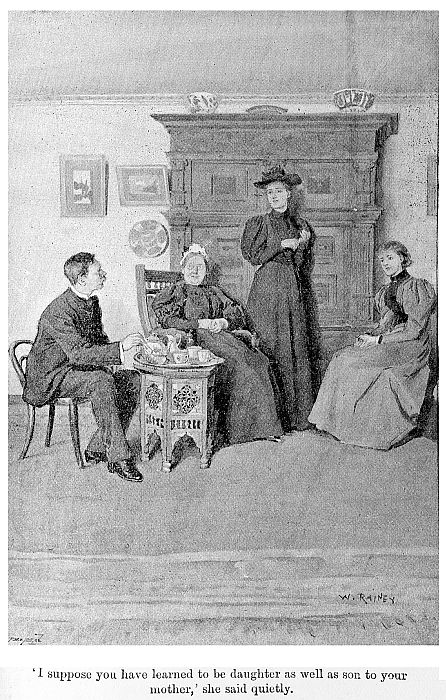
“I suppose you have learned to be daughter as well as son to your mother,” she said quietly, as she stood by the table, while this very “tame-cat” young man, as Winifred contemptuously called him, poured out the tea for his mother and her young friends.
“Yes, that’s to say she has had to put up with my feeble efforts in that direction, failing better,” he said. “Now then, I think I have got hers—my mother’s—tea just as she likes it; will you be so good as to tell me of any peculiarities of taste of yours, or your sister’s—cream, sugar, both or neither, or which?”
“Winifred takes no cream—I take both. Yes, I will hand Mrs Balderson hers, and you can look after Winifred. This is mine? Thank you,” and Celia seated herself near the tea-table.
“Did you enjoy the concert this afternoon?” young Mr Balderson inquired. “It was a concert you were at, wasn’t it?”
“Oh yes, very much, very much indeed,” said Celia. “It was a very nice concert. But the thing that we cared for most was Miss Norreys’ singing.”
“Miss Norreys—Hertha Norreys, do you mean?”
“Yes,” said Mrs Balderson, “these girls have both fallen in love with her, Eric.”
“With her as well as with her singing,” said Winifred.
Eric looked up with a comical expression.
“She is very charming, I am told,” he said. “I cannot testify to the fact from personal experience, for you can’t exactly call a person charming who deliberately snubs you.”
“How do you mean?” said his mother. “I didn’t know you had ever met Miss Norreys, and if you have, why should you think she snubbed you?”
“Because she did,” Eric replied simply.
Winifred’s eyes sparkled. Her admiration for Hertha rose still higher.
“Just what I should have expected of her,” she thought to herself.
“My dear Eric,” said his mother, with a very slight touch of annoyance in her tone, “I think you talk nonsense sometimes.”
He smiled.
“Sometimes, perhaps, but not always,” he said.
But he rose from his seat as he spoke, for he was more than quick at reading his mother’s feelings, and went towards the piano.
“I’ll look out the songs, mother, that I want to try over,” he remarked. “That’s to say, if you are still good for a little practising before dinner.”
“Certainly I am. Indeed, we hurried home partly on that account,” Mrs Balderson replied. “I will run up-stairs and take off my things in a moment. And you, dears, will have a little quiet time for your letters, and for resting, if you are tired.”
“I shall be glad to write my letters, but I am not the least tired, thank you,” said Winifred, in her clear, slightly incisive tone, almost as if resenting the kindly imputation.
“I am, rather,” said Celia gently.
“I scarcely see how you could help it, after such a busy day,” agreed Mrs Balderson. “You have been on the go since early this morning. Such a contrast from your regular restful life at home. Not that we Londoners can stand so much fatigue as country people often imagine we can, fancying that a rush is our usual existence.” She was leaving the room as she spoke, but stopped to add, “Remember I want you to be fresh this evening, though it is only a small party. Your cousin is coming, for one.”
“Oh dear,” said Winifred, in a half-complaining voice, when her hostess had gone, “I forgot about Lennox being in London just now. Mrs Balderson really need not have troubled to ask him. We have quite enough of him at home.”
Eric glanced at her.
“I fear we can scarcely put him off now, except with grave discourtesy,” he said. And Winifred could not tell if he was laughing at her or not. “Besides,” he went on, “though I cannot hope the fact would carry any weight with it, I am very fond of Lennox. I do my best to see something of him whenever I get a chance.”
“Oh yes,” said Winifred, coolly, “I know you and he are chums. Well, as long as he does not sit beside me at dinner and entertain me with questions about the cows and the pigs and the old women at home, whom I am more than thankful to forget for a week or two—”
“He shall not sit beside you at dinner; so much I can guarantee,” said Eric. And though Winifred thanked him laughingly, as if all that had been said was a joke, she did not entirely disagree with Celia’s first observation when they found themselves alone in their own room.
“Winifred,” said Celia, “I think Mr Eric Balderson was really rather angry at your tone about Lennox. I heard it in his voice, though he has that dry way of speaking that makes it difficult to know whether he is in fun or earnest.”
She was standing in front of the fire—a brightly glowing one—in the large room, which, with a dressing-room out of it, the two girls shared together. And as she spoke she turned round slowly, and looked at her sister half timidly.
“Well, and what if he were?” said Winifred. “After all, Lennox is our cousin, not his. He does not need to take up the cudgels in the poor dear’s defence. It would be very impertinent.”
“He would not mean it that way,” said Celia, “and though you are so much cleverer and wiser than I, you know, Winifred, onlookers sometimes see the most. Don’t you think, considering how things are with Lennox, it would be better always to speak very nicely of him? After all, his caring for you is no crime—you need not despise him for it.”
“Oh, bother!” said Winifred, throwing herself back into a comfortable chintz-covered arm-chair, “perhaps it would be better. But I hate beating about the bush and always thinking such a lot about what to say and not to say. I do like to be natural. However, I’ll be more careful. But I am so tired of Lennox and all that dull, humdrum country life that Mrs Balderson calls restful and delightful. And so are you, Celia; we are at one on these subjects.”
“Of course we are,” said the younger girl, “though my feeling is not that I want to leave home, but simply to have—you know what—my chance, my test, which I cannot have at home. But you are very good, dear Winifred, not to think me impertinent for warning you.”
For a moment or two there was silence.
Then said Winifred, raising herself, “I must write to mamma.”
A shadow of disappointment flitted across Celia’s face, but there was no trace of it in her voice.
“To mamma?” she said. “Oh, then, I will write to Louise.”
“Of course,” said Winifred, majestically. “It would never do for me not to write first to mamma. Indeed, I don’t see that there is any hurry for your writing at all.”
She got out her paper and pens as she spoke. Then with the queer mixture of candid self-deprecation which existed in her, side by side with unusual self-assertion, she startled Celia by an unexpected speech.
“About what you were saying of Lennox just now, Celia,” she began, her fingers toying idly with the pen she had already dipped into the ink, “do you know, at the bottom of my heart, I don’t think I believe that he does care for me?”
Celia gasped.
“Winifred,” she exclaimed, “that is going too far. Whatever he is not, he is certainly not a mean hypocrite. You can’t think that for—for any selfish or interested motives, he would pretend to care for you? He couldn’t.”
“No, no, I don’t think him the least of a hypocrite,” said Winifred, eagerly. “You don’t understand, Celia. He thinks he does, quite honestly. He’s always been put in the position—not told he must care for me, for, of course, with a man of any spirit or principle that would only drive him the other way. And Lennox has plenty of principle and spirit too, of a kind. But he has been tacitly told he does, and so he has come to believe it.”
Celia looked extremely perplexed. This was a new light indeed upon the subject, but a light which seemed, at first at any rate, only to increase the already existing perplexity.
“If—if you think that,” she said at last, “I don’t wonder at what you always say about him. I mean about it all. Not that I don’t sympathise with you—I do, as you know. I couldn’t imagine being in love with Lennox;” and she smiled to herself, as it were, at the very thought. “But I always thought it must make a great difference if a girl knows a man is very devoted to her, you know.”
“Oh,” said Winifred, in her very off-hand way, “as far as that goes, I think I could stand Lennox better if I knew he did not care much for me,” which paradoxical speech gave her younger sister considerable food for reflection. And before Celia spoke again, Winifred dismissed the subject in her high-handed fashion, quite ignoring the fact that it was she herself, and she alone, who had started the conversation.
“You really must not chatter or let me chatter any more, Celia,” she said. “I must get my letter written.”
And for the best part of an hour there was no sound to be heard but the scratching of their pens—of Winifred’s pen alone after a while, for Celia’s correspondence was confined to her sister Louise, while Miss Maryon, once she had got her hand in, so to say, went on writing long after her rather short and not very graphic letter to her mother was finished. For she was a young woman of great energy and almost perfect physical condition. It was quite true, as she had declared to Mrs Balderson, that she was not “the very least tired.”
She looked up suddenly, when she had closed and addressed her fourth envelope.
“It must be getting rather late,” she said.
“Shall I ring for our letters to be taken down, do you think, Celia? They are not in time for to-night’s mail, but still, if posted now, they will get to Barleyfield for the afternoon delivery to-morrow.”
But to her question there came no reply, and looking up, the silence was quickly explained to her. Celia was fast asleep! Her pretty head supported by her arm, which had found a resting-place on the end of a sofa standing by, she was far away in some happy dreamland probably, to judge by the half-smile upon her face, and the calm, childlike softness of her breathing.
“Poor little Celia,” said Winifred to herself. “How sweet she looks!” and with deft and gentle hand she moved the couch, so that the fair head itself could lean on the cushion. “Let me see,” she went on, glancing at the clock on the mantel-piece, “a quarter—no, five minutes to seven. I will run down with the letters so as not to wake her by ringing, and then I will let her sleep till a quarter past. She will be all the brighter for it afterwards.”
Bright, and better than bright—each charming in her own way—looked the two girls an hour later when they entered the drawing-room again, where their hostess and her husband, a thin, elderly man, with pleasant, luminous blue eyes, and grey hair rapidly turning to white, were having a consultation after the orthodox conjugal fashion as to “who takes whom” down to dinner.
“At my left, you say, my dear? Young Mrs Fancourt at my left?—oh yes, Lennox Maryon takes her. Why, I thought—” Mr Balderson was saying, when the opening of the door made him stop abruptly, looking after the manner of men decidedly guilty, as an admonitory “sh” from his wife warned him that the new-comers were his young guests.
“That’s right,” said Mrs Balderson, heartily. “Good girls. I like to have my home party about me on these little occasions. What can that lazy Eric be doing? He is not generally so late.”
The delinquent entered as she spoke—before, indeed, the door had closed behind the two sisters. He came quietly into the room with some little laughing rejoinder to his mother, and walked over to where Mr Balderson was standing, without seeming to notice either Winifred or Celia in any special way. Yet Celia was perfectly aware that even as he passed them he took in every detail of their appearance and attire.
“I hope he thinks we are nicely dressed,” she thought, though she would not have liked Winifred to read her unspoken reflection. “I suspect he is rather critical, though in a nice way. Well, Winifred looks very pretty, I am sure, but I wish she were not quite so fond of black.”
Yes, Winifred looked very well indeed, for, though her black dress was almost severely simple, it was of rich material and fitted well. This was in accordance with Miss Maryon’s principles. She would have scorned to spend much time or thought upon her clothes, still shabbiness or dowdiness or eccentricity she did not consider a fitting accompaniment of woman as she should be. The worst that could be said of her way of dressing was that it was far too old, and on the whole monotonous. But to strangers this latter defect was naturally absent, and perhaps the very heaviness and stiffness of style she affected had practically the opposite result of making the girl herself look all the younger.
However that may have been, she was genuinely indifferent about herself; to-night her thoughts were more on dress than usual, nevertheless, for she was exceedingly interested in Celia’s appearance, and, considering her theories, almost inconsistently eager that she should be admired.
“Does she not look lovely?” she could not help whispering to Mrs Balderson, and her whole face sparkled with pleasure when there came the hearty reply.
“Most lovely; that pale pink suits her to perfection, and—” But the rest of the kind woman’s admiration remained unexpressed, for at that moment some of her guests were announced, and she had to hasten forward to meet them. Others followed quickly, causing a little bustle in the room, under cover of which a young man made his way in quietly; not sorry to do so, if the truth were told, for Mr Lennox Maryon, very much at home in the hunting-field or at a steeplechase, was decidedly shy in a London drawing-room. Nor was the consciousness of his cousin Winifred’s observant, albeit short-sighted, brown eyes, likely to put him more at his ease.
He was in luck, however, on the present occasion. Both Winifred, and Celia were for the moment somewhat apart from the Baldersons and their other guests, feeling, perhaps, as perfect strangers to the latter, just a little “out of it.” Lennox hurried up to them with great satisfaction, though not without a touch of the nervousness which somehow always hovered about him when near Winifred.
“How are you?” he said with somewhat unnecessary emphasis, considering there was not the slightest need for anxiety as to the state of health of either of the girls. “So delighted to find you here. When did you come up? left all well at home, eh?”
“One question at a time, please, Lennox, if you have no objection,” said Winifred, coldly. “Not that any of yours strike me as very important; we came up yesterday, and we are both perfectly well, and as you saw everybody at home the day before, there is no reason for special anxiety about their health that I can see.”
Lennox gave a half-awkward little laugh. What he was laughing at he could not have told, but he took it for granted that Winifred’s speeches had something clever in them, and the laugh helped to hide his shyness. And he did not overhear Celia’s reproachful tone as she whispered in her sister’s ear:
“Winifred, how can you? Poor old Lennox.”
“We are enjoying ourselves very much indeed, Lennox, you will be glad to hear,” the younger girl said brightly. “I can scarcely believe we only left them all yesterday. It is delightful to see a home face again.”
The young man turned to her gratefully, his handsome, rather sunburnt features lighting up with a very pleasant smile.
“Good little Celia,” he said approvingly. “I don’t believe there’s much fear of your falling in love with London.”
There was a little bitterness underlying the accent he put on the pronoun. Winifred heard it, and was ready for battle on the spot.
“Celia is absurd,” she exclaimed. “She is only talking that kind of way to please you, Lennox. Why, the very first thing she said this morning was: ‘Oh, Winifred, if only we were to be here three months instead of three weeks!’ You know it was, Celia.”
“And no harm in it, that I can see, if she did say so,” said Lennox, flushing a little. “I think London’s very good fun, myself, once in a way.”
He could pluck up a spirit now and then with Winifred, but I scarcely think it profited him much.
“Very good fun!” she repeated. “You do express yourself so oddly, Lennox. I am afraid our ideas on the subject of London are not more likely to agree than on—”
But a touch on her arm stopped her. Celia was drawing her attention to the fact that Mr Balderson was on the point of introducing a man to her. An elderly, or at least middle-aged, man, whose name was known to her as that of a distinguished-in-his-own-line writer.
“Mr Sunningdale—Miss Maryon.”
The middle-aged man bowed somewhat absently. He dined out most nights of his life; he saw only a young woman in black, whom he did not remember ever having seen before, and he had been interrupted in a conversation, at the other side of the room, with a woman he knew well, whose conversation always amused him. These little contretemps will happen in the best-regulated houses. He was not an ill-tempered man, and resigned himself to fate. But Winifred’s face, on the contrary, changed from steely coldness to sunshine. You would scarcely have recognised her for the same girl, as she replied to some little commonplace observation of the great man’s with her most winning manner.
“Good eyes,” thought he to himself, “I hope I shall not need to talk to her much;” while Winifred, in a flutter of gratification, was saying to herself how very kind it was of Mrs Balderson to have given her to Mr Sunningdale, of all people, to take her in to dinner.
Lennox moved away with a little sigh, which Celia heard, though it was all but inaudible. The girl’s tender heart quivered for him, for she was far from endorsing her elder sister’s startling suggestion that Lennox did not really “care for her.”
“He is just devoted to her—quite devoted,” thought Celia. “How unlucky it seems! These things generally go that way, I suppose; at least, if what one reads in novels is true. I hope that I shall never care for any one, and that no one will care for me, for it would be sure to be only on one side or the other.”
She had no time to say anything consoling or sympathising to her cousin—indeed, what could she have said?—for he was already told off to his lady, the young Mrs Fancourt, whom Mr Balderson had alluded to; and Celia herself was soon appropriated by the husband of the pretty little woman in question, on whose arm she made her way down-stairs.
She had scarcely looked at him; she was thinking so much of Winifred and Lennox, that she was quite indifferent about her own fate, and Mr Fancourt, a good-natured man, whose rather limited ideas were entirely absorbed by admiration for his wife, soon gave her up as decidedly dull and heavy. Celia did not care—she had plenty to think of and plenty to amuse herself with; she was rather glad when her monosyllables resulted in Mr Fancourt’s directing his attentions to the woman on his other side. And one or two courses had been removed before a voice on her right hand startled her into realising that she had a neighbour in that quarter too.
“Miss Maryon, what are you thinking about so intently?” were the words she heard. “I have been watching you for quite five minutes—you are in a regular brown study.”
Celia started, then smiled, and, finally, as she became satisfied that Eric—for it was he—was not really shocked at her, could not repress a little laugh.
“I am so sorry,” she said. “Why didn’t you speak to me before? I didn’t even know you were there.”
“So I saw—at least, I hoped it was so—that there was no special motive in the resolute way in which you turned a cold shoulder upon me, and—”
“No,” said Celia, laughing again, “my shoulders are not at all cold, thank you. This part of the room is delightfully out of any draught.”
“And,” continued Eric, “fixed your eyes upon the flowers in front of you, and let your thoughts wander to— No! that I can’t guess. I wonder where they were wandering to.”
Chapter Three.
At the Dinner-Table.
“Not very far,” said Celia, smiling, and colouring a little. “I was very much entertained by watching all the people round the table, and perhaps I was thinking mostly of poor old Len.”
Eric looked across in young Maryon’s direction.
“Why do you say ‘poor old Len’?” he inquired. “I think he’s quite happy. Mrs Fancourt seems to be drawing him out beautifully.”
Celia glanced at her companion doubtfully.
“Do you really think so?” she asked, “or are you saying it to—to draw me out?”
“I really think so, and I don’t need to draw you out,” he replied. “I know exactly what you mean about Lennox, and—you needn’t pity him. It will be all right.”
“Oh, I am afraid not,” said Celia. “I’m afraid it will never come right. I didn’t know you knew about it, but as you do—no,” and her voice dropped almost to a whisper, “Winifred will never care for him. I see it more and more, and now she is thinking all sorts of things—quite differently, you know.”
“Indeed,” said Eric, raising his eyebrows in inquiry, “do you mean—is there—some other more fortunate person in the field?”
“No, no, not that at all,” said Celia. “Winifred has much higher ideas than most girls. She wants to make a path for herself—to feel that she is doing something with her life—and she must be right. Why should girls be condemned to do and be nothing? A young man without a profession is always considered the greatest mistake. Why should women be forced into leading idle and useless lives?”
“They never should be,” said Eric, “I quite agree with you. But there are considerations: if a girl does marry, you will allow that she finds her work cut out for her—her vocation or profession, or whatever you like to call it. And I do not think any woman has a right to cast herself adrift from the chances of marrying, so to say; she should allow herself fair-play.”
Celia gave her head the tiniest of tosses. “Winifred does not want to marry, and she is old enough to judge,” she said. “I don’t deny—well, honestly, I should have been very happy if she had married Lennox, that is to say; if she could have cared for him. It would have pleased a good many people, and—did you ever hear the legend of White Turrets?” she went on, dropping her voice, and looking half-frightened at herself.
“No,” said Eric, with interest. “I’ve heard something about its being haunted, like nearly all very old houses, but I never heard of any legend.”
“Ah, well, there is one. It and the ghost are mixed up together,” said Celia, still in a slightly awe-struck tone. “It—she is supposed to be the spirit of an ancestress of ours, who was cruelly treated because she had no son. She had two or three daughters, and she died soon after the last was born, and she left a sort of a curse. No,” with a little shudder, “I don’t like to call it that. It was more like a—”
“A prophecy,” suggested Eric.
“Yes,” said Celia, her face clearing, “it was more like that. It was to warn her descendants that the luck, so to say, should run in the female line, and that whenever a man was the owner of the place, the Maryons might—”
“Look out for squalls,” Eric could not resist adding.
Celia glanced at him half indignantly.
“If you’re laughing at me,” she said, “I won’t tell it you.”
“I beg your pardon, I do really,” he said, penitently. “It was only that I did not like to see you looking so solemn about it.”
“I can’t help it,” said the girl, simply. “It always makes me a little frightened, though I know it’s silly. Winifred gets quite vexed if it is mentioned. She says it is contemptible nonsense. Louise believes it, but she is so good, it doesn’t frighten her. Still, for other reasons, we seldom allude to it. It has come so true, over and over again: I could tell you lots of things. Papa, you know, has had heaps of trouble. Poor papa, just think what a life of endurance his is! So you see if—if Winifred could have married Lennox (he is our second-cousin, you know), it would have done so well—keeping the old name, and she being the owner of the place.”
“I see,” said young Balderson.
“Or even if she could have been a more ordinary sort of girl, content to settle down at home,” Celia went on, “for—” and here the frightened look came over her face again—“there’s more in the legend: the worst luck of all is to come if a woman of the family deserts her post. And once a rather flighty great-grand-aunt of ours did—she couldn’t live at home, because she thought it was a dull part of the country, and she came up to London, and travelled about to amuse herself, and all sorts of things happened.”
“Did burglars break in, or was the house burnt down, or—?” began Eric, but Celia interrupted him.
“You are laughing at me again,” she said reproachfully. “No, it was worse than that. Her son turned out very badly, and was killed in a duel, and her daughter died, and they lost a lot of money, and in the end it came to our grandmother, you see, whose husband took the name Maryon. But the family has never been so well off since.”
“And in the face of all those warnings, your sister persists—no, what is it she wants to do or not to do?” said the young man, looking rather perplexed. “The ghost can’t bully her for not marrying a man she doesn’t care for, surely? I thought better of ghosts than that!”
“No, it’s not that. It is that she wants to leave home and make a career for herself. And I admire her for it. That’s why we were so pleased to come here: we want to find out about a lot of things.”
Eric looked really grave.
“Why is your sister not content to stay at home?” he inquired. “Even if she were a man, there are men whose vocation it is not to have a profession, whose work and duties are there, all ready for them. Is it not much the same with Miss Maryon, considering your father’s illness, and all there must be to look after?”
His hearer seemed surprised and almost startled. There are aspects of our daily life, ways of looking at our surroundings, with which we might long have been familiar—commonplace, matter-of-fact reflections, requiring no special genius of discrimination to call them forth—which, nevertheless when put into words by an outsider, strike us with extraordinary effect. Almost do they come upon us with the force of a revelation.
So was it just now with Celia Maryon. As she took in the full bearing of young Balderson’s observations, she felt more and more struck by them. She looked up in his face with a strange cloud in her eyes, and Eric himself felt surprised. He imagined that he had somehow or other hurt or offended her.
“I beg your pardon,” he began, “if— Of course I would not be so presumptuous as to suppose I could judge of the circumstances.”
Celia smiled. She would be true to her colours at any cost, and her colours meant her sister Winifred. The truth was that she was at a loss how to reply; she had never looked at things in this light before. She wanted to think it all over quietly by herself, but she was not going to allow this to any one else.
“No,” she said, “of course you can’t judge. You don’t know Winifred, or what there is in her. My other sister, Louise, is the home one. She is not nearly so clever as Winifred, but she does pretty well. The bailiff isn’t bad, though I’m afraid he’s going to leave, and old Mr Peckerton, the lawyer, comes over if he’s wanted. Things go on in a groovy, old-fashioned way, but, oh, no! Winifred could never find her life-work in these directions.”
And again Celia smiled, a superior, almost contemptuous little smile this time. Her own words half-persuaded herself that she had been foolish to be so impressed by the young man’s scarcely conscious remonstrance.
“Ah, of course I can’t pretend to judge,” he repeated, and the modesty of his tone encouraged her to say a little more, to stifle her own misgivings as much as to keep up her sister’s dignity.
“Winifred is intended for a larger life altogether,” she said. “And there are three of us at home. People are beginning to see the facts about women’s lives differently. Why should we be condemned to trivial idleness? Look how some have thrown off the trammels! There is Miss Norreys, for instance. Could you imagine her spending her life in ordering legs of mutton and darning stockings?”
“No,” said Eric simply, “I couldn’t. And I don’t think any woman’s life need be, or should be, so dull and narrow. But still, Hertha Norreys is not a fair example. She has a gift, an undoubted gift. I think its greatness is scarcely yet recognised by herself or others; perhaps it never will be. But still she has not ignored it. She felt she had a talent and she was bound to cultivate it, and she has done so. In her case there was no choice.”
Celia looked interested.
“I am glad you allow that, at any rate,” she said, and glancing at her, the young man almost fancied that she blushed a little. “Of course I think cleverness like Winifred’s a gift, but I can understand ordinary people not looking upon it as if she had a great talent for music, or—or painting. It is easier when you have the one distinct power. Now there is Lady Campion. Your mother seems to think her so talented, but she has not concentrated her talents.”
“No,” said Eric, drily, “she certainly has not.”
“And,” pursued Celia, “she is married. She shouldn’t have married if she wanted to be something.”
“But perhaps she didn’t, or, at least, not what you call ‘something.’ She thinks herself very much ‘something’ or ‘somebody,’ and her marriage has certainly not stood in her light.” Celia hesitated.
“You don’t like Lady Campion?” she said, abruptly.
“Oh yes, I do,” he replied, lightly. “She’s by no means a bad sort of woman,” he went on, hastily. Celia was not the kind of girl to whom it seemed natural to talk slang. “But she wouldn’t have been half what she is if she hadn’t married. The best of her, in my humble opinion, comes out as a wife. I like to see her with her husband. She recognises his superiority.”
“Oh dear,” thought Celia, “what a man’s way of putting it!”
“For he really is a first-rate fellow in his own line. And she is not a genius, though she is—oh yes! she is—clever, though sometimes she makes herself just a little ridiculous.”
Celia did not speak. This was again a new light to her. She felt confused. She had pictured Lady Campion quite differently, somehow, and she felt sure Winifred had done the same, pitying her for having married and thus rashly clipped her wings.
“She—Lady Campion—admires Miss Norreys exceedingly,” said Celia, after a little silence. “That should be a bond between you, for I can see you admire her exceedingly too.”
Eric looked somewhat surprised. The young girl had more perception than he had given her credit for.
“Yes,” he said, “I do. I admire her very much indeed. As an artist, I place her more highly than might be generally thought reasonable, and, as a woman, yes, I admire her too, and respect her, except for—”
“What?” asked Celia, eagerly.
“I cannot tell you,” he answered. “I was going to say that, as a woman, there is one direction in which I cannot admire her. But I cannot explain more fully, and perhaps I may have misjudged her. She is one in whom it would be difficult to believe there existed any of the weaknesses that one finds in smaller characters.”
This was high praise. Celia’s interest in Hertha grew with every word.
“I wish I knew her,” she said, earnestly. “I should so like to meet her.”
Her words reached the ears of her companion on the other side. Mr Fancourt was beginning to feel as if he had had about enough of the neighbour—a talkative woman of forty or thereabouts, well up in the topics of the day, and of his own small section of the world in particular—on his left, whom hitherto he had deliberately chosen in preference to the pretty young creature on his right. And now, with the calm insouciance of an experienced diner-out, he turned to Celia.
“There must be more in her than I suspected,” he said to himself. “She seems to have succeeded in making Balderson talk, and he can be pretty heavy in hand when it doesn’t suit him to be lively.”
“You are speaking of Miss Norreys, are you not?” he asked. The name had caught his attention, and, when Celia bowed in response—“Yes, she is charming,” he went on. “It is curious: I have found myself thinking of her two or three times during dinner. There is a certain something which I cannot define, which reminds me of her in that girl on the other side of the table—nearer our host—yes,” as he followed Celia’s eyes, “the girl next but one to my wife. You know her, Mrs Fancourt, by sight—in pale green? No?” (He thought everybody knew his wife.) “Ah, well, you know her now.”
“She is very pretty,” said Celia, simply.
“I cannot contradict you,” he said, with a well-pleased smile, which made Celia think that, after all, he must be rather a nice man—she liked husbands who thought their wives very pretty—and disposed her to question the truth of Winifred’s sweeping assertion that conjugal affection was never to be found among “smart” people. “But,” continued Mr Fancourt, “look at the girl I mentioned—the girl in black. Do you see the slight something—scarcely resemblance—about her, which recalls Miss Norreys?”
In her turn Celia now smiled with pleasure.
“She is my sister,” she replied. “She will be delighted when she hears what you say. No, I don’t think it would have struck me that there was any likeness. But I daresay there is some likeness in character. My sister is very self-reliant and—and—dauntless. And I should think there is something of that about Miss Norreys.”
Having found a topic of interest, the rest of the dinner passed pleasantly enough, and Mr Fancourt felt that doing his duty had not been the arduous task he had anticipated.
But it was her conversation with Eric Balderson which left its mark on Celia’s mind.
“Oh, Celia,” said Winifred, when she managed to get her sister to herself for a moment in the drawing-room, “I feel in a new world. Mr Sunningdale has been talking to me so delightfully, so perfectly. All my intuitions about the larger, wider life I should find in London are being realised. How narrow our small home-world seems in comparison! I told Mr Sunningdale something of what I am hoping to do, and I can see he sympathised in my longing to throw off the narrow trammels we have been brought up in. People here have much wider ideas!”
“You must have made friends very quickly,” said Celia.
In her tone there was not the complete and responsive sympathy which she was, as a rule, eagerly ready to give to her sister. She could not help it. A slight chill of doubt, of questioning of the perfect wisdom of Winifred’s theories, had been, though unintentionally, cast over her. But the elder Miss Maryon was too excited and enthusiastic to perceive it, and this Celia was glad to see. For, after all, the faintest idea of disagreement with Winifred’s opinions or judgment was extraordinary and unnatural to her.
“Yes,” said Winifred, “we did. But it does not need time to make friends when people are sympathetic. Mr Sunningdale has evidently thought out all the great questions of the day about women most thoroughly.”
She looked so bright and happy, so handsome and almost brilliant, that her younger sister gazed in loving admiration.
“Dear Winifred,” she said to herself. “No wonder Mr Sunningdale or Mr Anybody admires her when she looks like that. I do feel sorry for dear old Lennox though.”
Poor Mr Sunningdale! Much had been credited to him which he would have been greatly astonished to hear of. He was, as has been said, a kind-hearted and eminently good-natured man; a man, too, who not only had a special line of distinction, but was above the smallness of being ashamed of talking about what he really understood. And Winifred Maryon was certainly intelligent enough to be a good listener, all of which explains the two having “got on so well.” It was not, to do her justice, till towards the end of dinner that Winifred ventured to allude to her aspirations. And the great man, gratified, as even great men can be, by the enthusiastic admiration—or veneration—in the girl’s bright eyes, listened—how could he have done less?—to her confidences, with here and there a word or smile of kindly, half-amused encouragement. Though, truth to tell, the subject matter of these same confidences, if it did not go in at one ear to come out at the other, left but the vaguest and most fleeting impression behind it.
“Pretty girl—handsome rather than pretty—intelligent, too, but rather bitten by the advanced ideas of the day. She’ll settle down when she’s married,” was his commentary upon her to his hostess. “An heiress, did you say? All the better, if she falls into good hands.”
And if Mrs Balderson had begun to build air-castles as to the possible consequences of her introduction—Winifred being, as she expressed it, “just the sort of girl to prefer a man a good deal older than herself”—they speedily fell to the ground. Mr Sunningdale had a history: the not uncommon one of an adored girl-wife dead almost before he had realised she was his. And, despite the cynicism which many declared lay beneath his surface good-nature, there was something deeper down still. He was not the man to dream of a second marriage.
Nor, as we know, were Miss Maryon’s ideas likely to turn the least in such “commonplace” directions.
The results of this first taste of London society were, however, to all appearance, eminently satisfactory. Winifred, as she bade her kind hostess good-night, was profuse in her thanks for the delightful evening she had spent. And if Celia’s pretty eyes had a slight shadow over them, it could only have been that she was a little tired, thought the good woman.
“You took care of her at dinner, I hope, Eric?” she said to her son, who had been known to be afflicted with fits of absence on social occasions of the kind.
“Oh dear, yes. We got on capitally, like a house on fire,” he replied, cordially. “I was so much obliged to you for giving me Celia to look after instead of her sister. I can’t stand that other girl, and I think Lennox a lucky fellow to be out of it.”
“It is to be hoped he will come to see it in that light himself,” said Mrs Balderson. “Not that I agree with you about Winifred. I like and admire her extremely, and I can understand her feeling that poor Lennox is not enough for her. With her talents and strength of character she may aspire higher, not to speak of her—well—material advantages.”
Eric gave a little grunt.
Mrs Balderson sometimes found her son’s grunts irritating.
“Celia, of course, is a sweet little thing,” she proceeded; “but nothing in her.”
Mrs Balderson was not a worldly mother. Still she did not much want Eric to fall in love with Celia.
He grunted again.
“You are very uncivil, Eric,” she said, with a touch of asperity. “Can’t you say out what you mean? When you are like that, you make me feel you are influenced by nothing but commonplace, masculine contradiction.”
“Perhaps so,” he replied.
Chapter Four.
A First Step.
“Winifred,” said Mrs Balderson, the next morning but one, at the breakfast-table, “here is something that will please you, I think,” and she held out to Miss Maryon a letter she had just opened.
It was from Lady Campion, asking them—the sisters and their hostess, or, if Mrs Balderson were otherwise engaged, the Maryon girls by themselves—to tea that same day, to meet Miss Norreys!
Winifred’s eyes sparkled.
“Oh, how delightful!” she said. “How kind of her to have remembered about it!”
But Mrs Balderson’s face had clouded over with an expression of perplexity.
“It is unlucky,” she said. “I had forgotten for the moment that we were engaged to go with my cousins, the Nestertons, to the Exhibition of Embroidery in Street, and to tea with them afterwards. It is a pity. Mrs Nesterton took some trouble to arrange it, and it is the last day of the Exhibition.”
“Oh, but it really doesn’t matter,” said Miss Maryon, and on Mrs Balderson’s looking up with some surprise—for she had supposed that Winifred was exceedingly anxious to meet the woman she had so admired—“I mean,” she went on calmly, “I don’t at all mind missing the Exhibition, and I really don’t know the Nestertons, you see, dear Mrs Balderson.”
Mrs Balderson did not feel very “dear” at that moment.
“There are other things to be considered,” she said, stiffly. “You were very eager to see the Exhibition, and I cannot be rude to my cousins, whether you know them or not, my dear Winifred. Besides, there is your sister as well as yourself. What do you say, Celia?”
It was new for Winifred to take in that Celia could have a voice of her own apart from hers; it was new for Celia to realise the fact. But she saw that Mrs Balderson was annoyed; she had infinitely greater power of putting herself in another’s place than was possessed by her elder sister.
“I should be very sorry not to see the embroidery,” she replied, quickly, her face flushing a little, “besides it would never do to be so rude to Mrs Nesterton.”
“I think Lady Campion deserves some consideration too,” said Winifred, unyieldingly. “She is a very busy person, and she has evidently planned this on purpose to please m— us. And Miss Norreys must be a still busier person. I don’t see that Mrs Nesterton could be offended if it were all explained to her.”
There was something in what she said as regarded Lady Campion and Miss Norreys. But Mrs Balderson, for once, was really vexed.
“Engagements are engagements,” she said, in a dry tone not usual with her.
Celia’s face was still flushed. If only she could give Winifred a hint to be more deferential! She was so used to taking the lead at home, thought Celia, she could not help that authoritative manner.
Eric Balderson had watched the breakfast-table drama with slightly cynical interest. It gratified him to see Miss Maryon showing herself to disadvantage. He did not like her. But he loved his mother, and he liked Celia. He did not wish them to be worried. And he was of a kindlier nature than he allowed to himself. So he came to the rescue.
“Can’t you make a compromise?” he said. “Supposing Miss Maryon goes to Lady Campion’s, and you, mother, and Miss Celia Maryon keep to the Nesterton engagement? You might call for Miss Maryon on your way back, which would give Ce— Miss Celia Maryon,” with a slight twinkle of amusement in his eyes at his own involuntary freedom, “a good chance of seeing Miss Norreys too. And,”—with an obtrusively ponderous sigh—“if it would smooth down Cousin Barbara, I certainly haven’t called there for an immense time. I might—there’s no saying to what lengths the spirit of self-sacrifice won’t carry me—I might meet you myself at the Exhibition, and go back to the Nestertons’ with you.”
Mrs Balderson’s face cleared. She hated being vexed with anybody; it was quite against her nature, if not her principles; she was already regretting her cold words to Winifred, and was pleased to find a consistent way out of the difficulty.
“That would be very nice,” she said, heartily. “The Nestertons would be so pleased to have you, Eric, that I daresay they would scarcely regret even Winifred.”
It was hardly in human nature to have refrained from this little hit.
“Exactly,” said Winifred, coolly. “They can’t miss me when they don’t know me. Very likely they will not even notice I am not there.”
Her coolness struck Celia as it had never done before. She would have given worlds to hint to her sister that something in the way of thanks for falling in with her wishes, to both her hostess and her son, would not have been unbecoming. But the suggestion would have been thrown away upon Miss Maryon, who was a striking example of the possibility of not seeing what she did not want to see. A word timidly hazarded by Celia on the subject, when they found themselves alone for a moment a short time afterwards, showed the younger sister that any such effort was better unmade.
The afternoon’s programme was adhered to, Celia setting off with Mrs Balderson to the “rendezvous” at the Exhibition, in apparently great content, for, if she were secretly disappointed at the small chance of her having more than a glimpse of Hertha Norreys, she was too unselfish and too sensible of what was due to her kind old friend to show it.
And at about a quarter to five, Winifred, in happy independence, and blissfully unconscious of having in any way fallen short in consideration of others or deference to their wishes, found herself making her way into Lady Campion’s drawing-room.
Her heart—for she was a girlish creature after all—beat considerably faster than usual: much faster, in all probability, than if she had been about to be introduced to some personage of exalted rank or social position. Her short-sightedness added somewhat also to her unusual embarrassment. For the room was fitfully, rather than dimly, lighted, after the fashion of drawing-rooms of the present day; and Winifred was used to old-fashioned lamps and white-panelled wainscoting, reflecting the clear, generally diffused radiance. And there seemed to her to be a whole crowd of people sitting or standing about, as somewhat awkwardly, only just avoiding a catastrophe of some kind, she threaded her way through the too abundant pretty things on every side to the lady of the house.
She was not annoyed or ashamed of herself, however. She was too much in earnest about meeting Miss Norreys to think about herself. So there was real simplicity in her bearing, though, for once in her life, she looked decidedly timid. And the look added wonderfully to her charm—in some eyes at least.
It is to be doubted if Hertha would ever have “taken to” the girl as she did, but for the gentleness and appeal about her, this first time they met.
For Lady Campion had found time to whisper a word or two to her friend when Miss Maryon’s name was announced.
“This is one of the little country girls—the one,” she said, “who fell so desperately in love with you the other day, as I was telling you. Be nice to her, poor dear, won’t you? Don’t be stuck-up and stand-off.”
For both these dreadful things Miss Norreys could be, said rumour—and rumour sometimes speaks truly, on occasion. But not when she was sorry for any one, not when her large, pitiful heart was touched; then no woman could be sweeter and gentler and less alarming than Hertha.
And her first glance at Winifred made her sorry for her. Lady Campion’s “poor dear” had misled Miss Norreys. She had no idea that the girl was one of the prosperous of the earth, and Winifred was plainly dressed. She was neat, but that was about all. Her morning attire left more to be desired than her evening toilettes, which, though a trifle heavy, perhaps, and on the outside of simplicity, were yet, as I said, of rich material, whereas her country ideas had not risen far as regarded the tailor-made tweeds and black or blue serges which were her usual winter garments.
And the room was imperfectly lighted. All that Miss Norreys saw was a girl of not more than average height and slightly square build, standing with perplexed eyes and an unmistakable air of strangeness, looking about for Lady Campion.
The face was a good one, good in form and pleasant in colouring; the eyes, despite their bewilderment, were clear and sweet; the whole was sweeter than Winifred’s face was wont to be, thanks to the passing touch of wistfulness and perplexity.
In a moment Lady Campion was greeting her, exerting the charm of manner on which she not unjustly prided herself, to make the girl feel at her ease.
And soon Winifred found herself replying, with her usual readiness, to her hostess’s inquiries as to what had become of Mrs Balderson and “your sister.”
“They are coming later,” said Miss Maryon. “They have gone first to the Lace Exhibition, in Street, and then to the Nestertons. It was an old engagement, but Mrs Balderson will certainly call here on her way home.”
“It was very good of you to come,” said Lady Campion. “It would have been too bad if you had all failed us.”
“I was only too delighted,” said Winifred. “I am so glad to see you again, and,”—with a not unbecoming hesitation and rising colour, as she glanced towards where she had, by this time, discovered Hertha—“you know I am so grateful to you for giving me the chance of meeting Miss Norreys. It was so very good of you to remember my wish.”
That Lady Campion was still remembering it she felt doubtful, as other guests came crowding round her, and she showed signs of moving away.
“I must say it right out, or she will forget to introduce me,” thought Winifred, with her customary determination.
But Lady Campion was not quite so flighty and unreliable as she got the credit of being. And she was really good-natured; she rather liked Winifred’s downrightness. With a hand on her arm, she gently drew the girl forward towards the couch where sat Miss Norreys, a not uninterested spectator of the little drama.
“Lady Campion is a kind woman,” she said to herself. For there had been times when she was inclined to judge the lady in question too severely. With all her gifts, Hertha did not possess the capricious power so often found where one could least expect it, so even more frequently absent where one would have made sure of it—of correct, almost unfailing discernment of character. She was often mistaken, and being by nature much more enthusiastic than she allowed to appear, she had often been disappointed. And this had resulted in a certain hardening of her sympathies, which one felt to be perplexing. Sometimes, too, she had found herself obliged to reverse an unfavourable impression—a demand of honesty which brings with it some sting of mortification, interfering with the softening effect of what should be a gratifying discovery.
But hers was a character to mellow as she grew older. And with her a spark of pity was at all times, enough to ensure a glow of kindly interest.
This was what happened just now. She rose from her seat as Lady Campion and Winifred approached, and held out her hand with ready graciousness to the—as she imagined—somewhat shrinking girl, who was feeling herself, no doubt, strange and out of her element.
“It would have been kinder to have asked her by herself—or at least not among quite such a crowd,” she thought.
And to any one knowing Winifred, there would have been something almost amusing in the half-protecting tone with which Miss Norreys at once addressed her. But if love is blind, so is youthful enthusiasm, and Winifred was truly enthusiastic about the young singer. More than this, that any one could by any possibility look upon her as an object of protection or pity had never dawned upon the girl, whose self-confidence and matter-of-fact preoccupation with her own ideas often dulled her perceptions. If she noticed any special warmth in Miss Norreys’ greeting, she put it down, though perhaps scarcely in so many words, to the favourable impression she herself made on her new acquaintance.
“We took to each other from the first moment,” she said to Celia afterwards in describing the meeting.
“Will you come and sit down by me for a little—there is plenty of room on the sofa?” said Hertha, and Winifred delightedly obeyed. “Lady Campion tells me,” she went on, “that this is, practically, almost your first visit to London. I think I envy you.”
“Do you?” said Winifred, not quite sure of her meaning. “I—I really don’t know. We live quite, quite in the country, you see. It is, of course, very interesting to see London for the first time when one is old enough to take it in better, but—”
“That is what I meant,” interrupted Miss Norreys, pleased at being understood. “I did not mean—at least I was not just then thinking of the other side—the delights of true country life, of ‘quite, quite in the country’ life,” with a little smile.
“Oh!” said Winifred with a sigh. “If you knew what it was—all the year round—so monotonous, so narrow. I feel, since coming here, as if all my time hitherto had been wasted.”
“Poor child!” thought Miss Norreys, “a country parson’s daughter, I think Helena Campion said and, of course, poor. I can fancy the life must be rather terrible—grinding away to make both ends meet. Probably a lot of younger brothers and sisters. And she is evidently a clever girl—a girl of ideas.”
“It is never too late to mend,” she said, cheerfully. “You will go home enriched by a store of new thoughts and knowledge. I doubt if you would have benefited in the same way had you seen more of this wonderful—yes, it is wonderful—modern London life when you were younger. Though you are very young still.”
“No,” said Winifred, quaintly, with a little shake of her head, “I am not very young. And—I have come up to London with an object. I have waited so long, and I have tried to be patient! But now, at last, I do trust I am to find an opening. I must get something to do—a career. It was surely a good omen that I should have seen you, Miss Norreys, the very first day, for I feel you will sympathise with me—you who have risen above the stupid old-fashioned trammels so grandly. Of course I know there can be no comparison—you are a genius, I have only very ordinary powers very imperfectly trained. But I have determination and courage. I feel it is in me to do something—not to be condemned to the terribly narrow life, which is all I have to look to unless I succeed.”
She spoke so rapidly, and yet so earnestly, that Hertha could not attempt to stop her. Yet it was hardly the place or time for a personal discussion of the kind. Miss Norreys felt touched, and yet a trifle annoyed. It was scarcely fair of Lady Campion, who must have known all about this girl, to have encouraged her to thus appeal to her, a stranger, for advice and assistance. For, in plain English, these, no doubt, were what she was in want of.
“And what can I do for her?” thought Hertha. “My world is the musical world. She does not speak of any special gifts in that direction. Yet, poor girl, evidently she is in the right about doing something. I do sympathise with that. If I had had no music in me, no voice, or no distinct talent, still I could have done something, rather than drag on, striving to make both ends meet, with no energy left for better things, as some poor women do.”
These reflections passed through her mind, softening her momentary irritation. But for a few minutes she sat silent.
Winifred watched her intently.
“You will advise me?” she said at last, in a half-whisper. “You do sympathise with me?”
Miss Norreys roused herself.
“My dear Miss Maryon,” she said, “of course I sympathise with you; I understand the position only too well, and I feel for you very much. But what can I do? You have no marked musical talent, I suppose; the only advice of mine really worth anything, for it is backed by my own experience, would refer to a musical career.”
Winifred shook her head.
“No,” she said. “I am not musical. I wish I were—at least—no, I am not sure that that is the gift I covet most. Yet, do not misunderstand me,” she added hastily; “I love music. When listening to some music, when listening to your voice, I feel as if my soul were awakening, as if it had found itself.”
She was in earnest—her eyes glowed, her really fine features seemed full of emotion; yet, was it her extreme, though unconscious, egotism that slightly repelled Miss Norreys?
“I wish she were not so high-flown,” she thought. “Still, she is not affected: she does not mean to be so, at any rate. And she is candid. But I do love simplicity. I don’t think she would ever do to be a governess, but probably she has no thought of so commonplace a career.”
“Then what—in what direction do you mean to turn?” she asked aloud. “You have thought too much about it not to have some definite ideas?”
“I have several,” Winifred replied eagerly. “I ask nothing better than to tell you all. And what I thought you would advise me about was as to living in London: I must arrange that almost first of anything. Don’t you think I am quite old enough to live alone?”
“Certainly not,” Miss Norreys replied, with a smile. “Besides, you would find it very expensive if you care about any sort of comfort.”
“I don’t,” said Winifred, confidently. “But—well, yes, I suppose I must consider it to some extent, for the sake of my people, you see—and—if you really think I can’t live alone—”
But at that moment Hertha saw approaching her a great friend of hers—a man to whom she was bound by long-standing ties of affection and gratitude, but whom, owing to his and her own busy lives, she met less frequently than she would have wished. She turned to Winifred—
“I must speak to Mr—to the man who had just come in,” she said, half-rising from her seat.
“Some other time, perhaps, Miss Maryon—”
“How tiresome!” said Winifred. “Just when we were getting into a really nice talk. Cannot you just say a word or two to him, and come back again, Miss Norreys?”
But Hertha was on her feet by this time.
“We must arrange some other day. I will write to you,” she said, hurriedly, eager not to miss the pleasant chance before her.
And Winifred remained alone on the sofa. She was satisfied on the whole; she had made a beginning. Miss Norreys was appreciative, and she felt sure of her ground with her.
“If such a thing could be as my living with her!” thought Winifred. “That would be ideal. Whatever work I take up, I could manage to fit it in to such an arrangement. And if I decide on writing as my principal occupation, of course I shall be very independent—pen and ink can do their work anywhere.”
She watched Miss Norreys and the tall stranger—a man of forty or thereabouts—slightly grey, and with a somewhat peculiar stoop.
“How good she is!” thought Winifred; “I can see he is boring her. I wonder what they are talking about.”
Better, perhaps, for her that she could not hear. “I did not interrupt you, I hope,” the new-comer was saying. “You seemed rather engrossed with that little person on the sofa. But I came here on purpose to see you.”
“I hoped, too, I should see you,” she replied. “No, the girl over there is a stranger to me, Helena Campion introduced us—rather rashly, for the poor thing imagines I can help her, and I really can’t. She has to make her way in the world, and wants advice. I am sorry for her, but—I am really so busy.”
“My dear, you must not take any more burdens upon you. You really must not,” said her old friend, decidedly. “What does the girl want? She is a lady, I suppose—well educated? I might introduce her to the ‘Reasonable Help Society.’ They are increasing their staff, and she might get a small salary.”
Miss Norreys looked and felt grateful.
“It would be most good of you,” she said. “I should be glad to help her, or, indeed, any one so placed, but the little I can do is in my own line, and I am overwhelmed with applications for assistance and advice in that direction.”
Mr Montague nodded sympathisingly.
“No one would believe it,” continued Hertha, with a half-rueful smile, “I could easily spend all my time in answering letters, trying songs, listening to would-be vocalists, and where would my own work be then? Yet the service which each asks—the individual service—seems so small. But how they mount up!”
“It is the same in every department,” her friend replied. “Once your name gets before the world, people seem to think you are common property, and have no right to your own time and strength. Literary people are even more bothered than you, if that is any comfort to you. For it is not every one that can deceive him or herself into imagining they possess musical gifts, whereas everybody nowadays has a try at authorship.”
And if Hertha’s smile had been rueful, Mr Montague’s was grim.
“This girl is not musical, Heaven be praised!” Miss Norreys replied.
“I rejoice to hear it—for your sake,” he answered, fervently. “Tell me her name,” and he drew out a tiny note-book.
“Maryon—Miss Maryon—that is all I know,” said Hertha.
“Miss Marion,” he wrote, “Marion what?”
“Oh, it is her surname—M-a-r-y, not ‘i’,” she corrected. “Lady Campion mentioned it in her note. A Miss Maryon who was dying to meet me, or some nonsense.”
“It is too bad,” Mr Montague repeated. “But I will see what I can do, and she must call at the office to be examined as to her capabilities. ‘Maryon,’ an uncommon name. There are some rich people—a very old family—Maryons down in Brakeshire.”
“Ah, she can’t belong to them, poor girl,” said Hertha.
And then, feeling she had done her duty, she and Mr Montague turned to other things.
Chapter Five.
Misapprehension and Misgiving.
Lady Campion’s drawing-room continued to fill—to fill and to empty—for as some went out, others came in. And everywhere and at all moments, Hertha Norreys was surrounded and eagerly greeted.
“It is wonderful how much she is made of,” thought Winifred from her corner. “Not, of course, that she does not deserve it, but I have so often been told that the best people are not the most appreciated by the common herd.”
The expression would scarcely have been deemed appropriate. If there was one thing Lady Campion prided herself on, it was that her “habitués” formed a very uncommon herd indeed. Her lions and lionesses must be well dressed and charming—perfectly well-bred and unexceptionable. And as Winifred heard the names—now and then mentioned to her in passing by her good-natured hostess, or by some of the friends she introduced the girl to, with the excuse that she was “a perfect stranger, never been in London before”—of men and women she had hitherto reverenced from afar, she began to allow to herself that if she had known it was to be so much of a party, she would have dressed better. “Though I never imagined people like ‘so-and-so’ cared about dressing at all,” she added to herself.
The rooms were thinning—indeed they had never been what to more experienced eyes would have seemed very full, when Mrs Balderson—followed by Celia, Eric bringing up the rear—came in.
“What a lovely girl!” said a voice beside Winifred; and turning with quick pleasure, she saw that the speaker was Miss Norreys’s Mr Montague. And close beside him, though Winifred had not been aware of her proximity, stood Hertha herself.
“Yes, indeed,” she replied, warmly. “She is like a beautiful lily.”
Celia was better—at least more becomingly—dressed than her sister, and her taller, more graceful figure showed whatever she wore to advantage.
Mrs Balderson had reviewed her before they went out, and Winifred had taken her usual interest in Celia’s appearance, attiring herself, later in the afternoon, with her customary indifference to everything but neatness.
A flush of gratification rose to her face at the words she overheard, and moving forward so as to approach Hertha a little more nearly, she said in a low voice:
“I am so glad you admire her: she is my sister, my younger sister.”
Miss Norreys turned. For a moment she half doubted if she herself was addressed. In the interest of meetings and talk she had almost forgotten Winifred’s existence. But now the face, looking up at her so brightly and eagerly, attracted her much more than before.
“Your sister, Miss Maryon!” she said, with a sunny smile on her face; “well, I need not repeat what I said, as you heard it. But it is certainly true.”
And she felt drawn to the girl as she had not hitherto done.
“May I, oh, may I introduce her to you?” Winifred went on, and encouraged by Miss Norreys’ “By all means, if you like.”
“Celia, Celia!” she said anxiously—for Celia at that moment was being monopolised by some friends of Mrs Balderson’s—“Celia,” when the girl at last heard her, “do come here. I want to introduce you to Miss Norreys.”
Celia was feeling profoundly shy, and her shyness, as usual, veiled itself by excessive stiffness. The impression she made upon Hertha was not of the most favourable.
“She is very pretty, very pretty,” thought Miss Norreys, “but evidently nothing more, and very spoilt. This poor dear elder sister denies herself, no doubt, to do all she can for her. Their very dress shows it. I must not be prejudiced. I daresay this girl is a noble character. I must be kind to her.”
And it was with increased cordiality she bade Winifred good-bye, having already got her address and promised to write to her.
“Is she not too delightful?” said Winifred, ecstatically, to her sister.
“She has evidently taken a great fancy to you,” replied Celia, evasively. “And that is the thing.” In her heart she felt a touch of disappointment. “Why did Miss Norreys look at me with a kind of disapproval?” she asked herself. “She surely can’t be stuck-up or capricious—she has such a good face.”
“Do you think she will really be able to help us—you?” she went on.
“I am sure of it. I had not time to tell her about you, Celia, but you see once I get an independent footing it will be all right for you. I managed to tell her a good deal. I am certain she sympathises with the position, the longing for emancipation—oh, yes, I feel that I have got my foot on the first rung of the ladder,” she concluded, enthusiastically.
Some days passed, nevertheless, without any more of the ladder appearing through the haze. Miss Norreys made no sign. The days passed pleasantly, however, so pleasantly that Winifred sometimes felt half guilty for enjoying them and making no further effort towards the realisation of those schemes for the future which had been the underlying “but” of her own and, indeed, of Celia’s visit to London. It was difficult to do anything, or to know what to do. Mrs Balderson, in her innocence of these girls having any thoughts or aspirations other than those she remembered in her own girlhood, exhausted herself in the endeavour to make them enjoy themselves, to “have a good time,” and she succeeded. They had never had a better—never, indeed, half so good!
They were scarcely free, however, to do anything but what was planned for them. Morning, noon, and night for the first two weeks of their stay, engagements of all kinds were the order of the day. Shoppings, exhibitions, concerts, plays, afternoon teas, occasional dinner-parties at home, or, more rarely, an invitation for one girl to accompany her host and hostess to dine elsewhere, one or two very mild winter dances even—what, in the old and less sophisticated days, would have been called “carpet-dances”—all these things followed each other in such quick rotation as to make life in London, even in November, seem to these country girls a sort of kaleidoscope.
“I suppose we are learning a good deal, even unconsciously. I suppose it is all a sort of experience it is well to go through,” said Winifred, dubiously. “But it is not what I expected. I see what it is, Celia; I shall have to come up again on my own account, really, to go into things and arrange something. Father and mother cannot object now that I have got friends here, and some one to advise me.”
“Do you mean Miss Norreys?” said Celia.
“Yes—and—I should not be very surprised if Lady Campion asked me to stay with her, do you know? She was quite interested the other day when I said a little to her—just a very little—of my wish to do something. She seemed quite struck by it, and said she would like to talk more about it.”
“Are you sure she understood what you mean? She may have thought you would like to help in her Decoration Guilds, or Shakespeare Recitals, or some of those things she has so many of,” said Celia. “There are heaps of those half-play, half-work things for girls who don’t need to work really, you know.”
Celia had guessed rightly. Lady Campion, though she had inadvertently conveyed to Miss Norreys a wrong impression of Miss Maryon’s position, had no thought of suggesting to the girl any work of the kind Winifred had set before herself.
Her face clouded over a little at Celia’s words.
“But I don’t want to be thought that sort of girl,” she said. “I don’t want to be thought rich, and I am not rich. I am dependent on papa. Besides, if I were—if I had been a son, I should not have been debarred from a profession because I was the heir to ‘White Turrets’ and Busheyreeds, and all the property. Why should a woman be treated differently in such a case? Why should her wings be clipped and she be restricted to a narrow, monotonous life any more than a man?”
Celia scented danger. She saw that Winifred was lashing herself up to one of her “revolts,” as she called them herself sometimes, and she knew that any, even the slightest suspicion of less full sympathy than she had hitherto been able to give would be sharply resented. Yet she was too honest to evade the possible discordance, painful though the smallest disagreement with her sister would be to her. For a moment or two she sat silent. Then she said boldly:
“I am not sure of that ground, Winifred. I have been seeing things a little differently lately. If you had been a son—placed as you are—I doubt if it would have been thought right for you to have a profession—outside work, so to say—when there is so much to do at home.”
“What nonsense!” said Winifred. “Do you mean to say that because a man had property to look after he would be debarred from cultivating his special gifts? Why, some, perhaps not many, but some of our greatest men—artists as well as statesmen and writers—have been rich men, men of property. No, it is only women who are always hedged-in with one excuse or another.”
“But you haven’t any special gifts,” said Celia, “at least you always say so. Your wish is to be of use, and—to be independent;” and in her heart she felt the latter should have been placed first. “You can’t be a statesman, and I don’t think even you would regret that for a woman. But you can be of any amount of use at home. And you could study all sorts of things about the management of property that would help you to be still more so.”