Mrs Molesworth (continued 2)
Reading edition
She felt half-frightened at her own daring, and her fears were not without foundation. Winifred stared at her, not quite sure if she were going to let herself get angry or not.
“What has come over you, Celia?” she said at last. “You are worse than Louise. Who has been talking to you and putting all these ideas into your head? Do you apply them to yourself too? What about your longing to paint—to have really good instruction?”
“I still long for it,” said Celia, “and I think I still believe it would be right for me to have it. I think I should test myself so as to find out if, I have a gift, a decided gift. For if so, I should cultivate it. In my case no definite responsibilities are before me in life, as is the case with you, yet—”
“Rubbish!” said Winifred, crossly. “There are just as many before you and Louise as before me. I shall never marry, and you and she will be just as much concerned in the management of things some day as I.”
“Perhaps,” said Celia, “but not just yet, in any case. And yet—as I was going to say—I don’t quite see at present what is right for me to do. If there are many difficulties in the way, if it would cause unhappiness at home, perhaps it would be my duty to wait—to wait even for the testing myself,” and she sighed. “I don’t want to leave home for the sake of leaving home, but I do want to know if I am deceiving myself in thinking I have a gift. And father and mother are so kind and reasonable. I don’t think I need give up the idea.”
“You are very selfish, dreadfully selfish, though perhaps you don’t know it,” said Winifred. “You would make out that what you want is right just because you want it. But I, many years older than you, who have thought over these questions for the last ten years—”
“You are not many years older than I, and ten years ago you were ever so much younger than I am now. You were a child,” interrupted Celia.
”—Who have thought about these questions ever since I could think at all,” Winifred resumed calmly—for, to do her justice, she was by no means bad-tempered, and seldom lost her self-control—“am to give up my deepest and most cherished hopes, because—no, I really can’t say why! Because I want to leave the beaten track, I suppose.”
“You won’t see things any other way,” said Celia, “so it’s no use talking about it. Perhaps it may be best for you to try the experiment, though in a different way from me. Anyway, don’t let us quarrel about it, whatever we do, dearest Winifred. Of course your coming to live in London would make it all infinitely nicer for me, if,” and a troubled expression crossed her face, “if it is really right for us both to leave home.”
“There is Louise at home. She asks nothing better than to jog-trot along for ever in the same monotonous way. She is an anachronism. She would have been perfectly happy a hundred years ago, or even longer ago than that, when it never occurred to any one that a woman could want anything more exciting than her spinning-wheel and her tapestry-frame.”
“Or her napery press and pot-pourri jars,” added Celia, with a smile. “Well, after all, there is to me a wonderful charm about those days; there must have been a great deal of tenderness and delicacy about a lady’s life, which get rubbed off nowadays. And there is a good deal of sense in what Louise says. Monotony is not the worst evil. Why, lots of married women have monotonous lives.”
“If they have, it has been of their own choice,” said Winifred. “What I complain of is the being condemned to narrowness and dullness if you don’t marry. Short of marriage, a girl is allowed no other possibility of outlet.”
“But,” protested Celia, “though that may be the case for some, or many even, when there are duties that you are born into, surely it is different? And even beyond that—is it not possible that what you call dull, narrow lives, filled with stupid little odds and ends of usefulness, that don’t seem usefulness at all, may be the very discipline needed by some—may be meant for them?”
“Oh,” said Winifred impatiently, “if you are going off to the very highest grounds of all, I suppose the being an old maid in an attic may be the best discipline for old maids in attics, but it is the system of narrowing down women’s lives that is wrong. And if in their girlhood some of the old maids had rebelled, and insisted on taking their stand as men do, things would have been better by now. There must be individual resistance. Think what Hertha Norreys’s life would have been if she had simply accepted things!”
“Ah, but it was different for her. She had a great talent, and she needed to work,” said Celia. “In a case like hers there could be no doubt. I really don’t pity girls who need to work so much as others in some ways. Not the rich—they can always, if they wish, find ways of being useful: the very conditions of their lives bring opportunities. But girls whose lives are very uninteresting, and yet not poor exactly, I pity them—girls who even can scarcely afford to get books to read.”
“They should throw nonsensical dignity to the winds, and work,” said Winifred.
“Yes, I think so too,” said Celia.
She had been thinking a great deal lately—more really and thoroughly and dispassionately than ever before in her life. She was coming to realise that, even to questions of apparently purely personal interest, there may be—there is—more than one side. And the starting-point of all these meditations had been the half-unconscious remarks of Eric Balderson the day he sat beside her at dinner and endeavoured to make amends for Mr Fancourt’s neglect.
The mention of Miss Norreys made Winifred determine to remain inactive no longer.
“I must write to her,” she decided. “I must beg her to let me see her once before I leave. We shall certainly not stay more than a week longer,”—their original three weeks had already expired—“and I must have some plan for the future before I go home, otherwise I shall really feel that the golden opportunity of this visit has been wasted. I must arrange something about where to stay when I come up again, to go into things more definitely. There is no chance now of Lady Campion’s asking me, unluckily.”
For Sir Hugh Campion had had a return of bronchitis, and was ordered abroad for the winter, his wife, of course, accompanying him. This had happened so suddenly that Lady Campion and Hertha had not met since the afternoon of Winifred’s introduction to the latter. No opportunity, therefore, had arisen of rectifying the mistaken impression Lady Campion had unintentionally conveyed to her friend of Miss Maryon’s position and circumstances.
And all these days the remembrance of the eager, bright-eyed girl, who had so abruptly appealed to her for advice and assistance, had clung to Hertha with almost annoying pertinacity. Winifred—though she did not think of her by that name, never having heard it—would be expecting to hear from her, she felt sure. Yet what could she say? She herself had heard nothing more from Mr Montague; there was no use in making appointments, or inviting the girl to come to see her, when she had absolutely nothing to tell her. And an appointment, or a “told-off” afternoon, in Hertha’s busy life, meant a great deal more than some people would find it easy to believe.
But, as often happens, the very first post after Winifred had despatched her own note to Miss Norreys, brought a letter to herself from Hertha—a letter that filled her with excitement and sanguine anticipations. It ran:
“Dear Miss Maryon—I have not forgotten your wish and my promise that we should meet again. But I have waited a few days in hopes of having something to tell you of which might make it more worth your while to come to see me. And to my great pleasure these hopes are to some extent fulfilled. By a lucky chance, just after you had spoken to me, I came across the very person the most able to help in such a case. Through his kindness, I have a proposal to make to you. I will tell you all particulars if you will call here to-morrow, Friday, at half-past four in the afternoon, when I shall be disengaged for a short time. The whole thing seems really a piece of good luck, for, as I told you, I have neither experience of, nor influence in, any line of life but my own.—Yours very truly,— “Hertha Benedict Norreys.”
Winifred’s eyes gleamed. But she kept her delight to herself, merely dashing off a word of rapturous gratitude to her new friend, and eager acceptance of her invitation. She said nothing to either her sister or Mrs Balderson beyond announcing the fact that “to-morrow afternoon” she had an engagement which would prevent her going out with them.
Mrs Balderson was annoyed. She felt, with justice, that, having given herself so much trouble for her young guests, and to a great extent disorganised her usual arrangements in their behalf, she should at least have been consulted as to any independent engagements they wished to make.
“I do not understand Winifred,” she said to her son. “Her manners, at least her ways, are certainly rather like those of an advanced or ‘emancipated’ young woman of the day. Yet surely it is impossible that she can have got hold of any of those ideas in that quiet, sheltered, almost old-fashioned country life of theirs. And her mother is such a perfect model of good breeding.”
Eric shrugged his shoulders.
“Quien sabe,” he said. “Ideas are in the air, I suppose. You never can tell where they will crop up. Why, even Celia has her theories—only she is very different from her sister, both in character and temperament. But I wouldn’t worry about Winifred, my dear mother. You have been more than good to them both, and they know it—at any rate, Celia does—and they will be leaving very soon.”
“Yes, I shall be sorry for Celia to go. She is very sweet. But I could not take the responsibility of Winifred for long. As I said, I do not understand her. Don’t be afraid, however, of my making any fuss. I would not on any account spoil the last few days of their visit by beginning to find fault.”
So Winifred set off, uninterfered with, to call on Miss Norreys, while Celia accompanied Mrs Balderson to the large annual meeting of a charitable society, in which the kind-hearted and liberal woman was much interested.
Celia was interested too. She had the happy power of throwing herself very thoroughly into the surroundings of the moment, and her mind in the last two or three weeks had begun to open in several new directions.
But all through the speeches and reports which followed each other in rapid succession, and which she would have liked to listen to with an un-preoccupied mind, there kept rising the half-uneasy thought: “I wonder where Winifred has gone, and why she did not tell me all about it. Can it be on account of what I said the other day? I hope she won’t do anything rash.”
For some things, Celia felt she would not be sorry to be home again—“with mother and Louise”—yet the sense of disappointment that she had made no way towards the realisation of her own ardent wish was keen to her. And Winifred did not seem to sympathise in this as she used to do.
“She called me selfish,” thought Celia, “because I said that perhaps—perhaps it might be different for her and me. I wonder why we don’t seem quite as much at one as when we were at home.”
Chapter Six.
An Opening.
Miss Norreys had a tiny home of her own, at some considerable distance from the Balderson mansion, which was about as far west as it could be to be yet in a thoroughly good position. The house in question was tiny in some ways, but it scarcely gave one that impression, for it contained one very large room, originally, in all probability, intended for a studio, which Hertha had converted into a music-room, a small so-called drawing-room or boudoir leading into it, being her own private sanctum.
She lived alone now, save for an old servant, who had never left her—who had solved the problem of out-staying the proverbial twenty-one years without degenerating from the “faithful friend” of the middle seven into the “unendurable tyrant” of the last term. But Miss Norreys had not been long alone. Only three short years ago, the mother, the adored mother, whose later life had been rendered peaceful and happy by the daughter’s brave energy, the young brother, whose education and start in the world was all his sister’s doing, had both been with her. Now the former was at rest in the unknown country, which yet, as life goes on, and we think of the sweet souls who have preceded us there, loses the dread sense of strangeness—seems almost to grow more familiar than this side of the river. And the other, Hertha’s dearly-loved Jasper, was away in India, the right place for him as a poor man, and where he was already rewarding her for her devotion by his unexceptionable and promising life.
“If only it were not so far away,” she would say to herself sometimes, as many another woman in England says to herself every day. And then she would let her thoughts revert to the time when they were all three together, to the struggles which, viewed in the tender light of the past, seemed to have been nothing but happiness, to the delight, doubled by being shared, with which she had realised the fact of her first success.
“How proud we were when we took this house!” she said to herself. “How hot Jasper made himself with hanging up all the curtains and things in the studio! How could I ever have murmured at anything then!”
It was not often she allowed herself to indulge in these reminiscences. She was full of real sentiment, but she had a wholesome dread of anything approaching sentimentalism, of which, living alone as she did, she knew she must beware. Only sometimes, in the enforced pauses of her busy life, she would allow herself the “treat,” as she called it, of going back to the past for a while, though there were other pages of her girl-life which, for the sake of her own peace of mind, she kept resolutely under lock and key.
She was sitting idle for once—her thoughts busied with the bright and peaceful memories of the two so dear to her—on the day that she was expecting Miss Maryon to call. It was not often that she could afford to spare an afternoon, and her doing so now was out of the purest and most disinterested kindness to the girl who had appealed to her so unexpectedly. And when Hertha made up her mind to a thing she did it thoroughly.
“To judge by her talk at Helena Campion’s, that day,” she said to herself, “she will not be content with half an hour or so. I had better arrange to be free for the rest of the afternoon. Besides, of course, there really will be a good deal to discuss, for I am sure she is quite extraordinarily inexperienced, despite her funny little assumptions of wisdom.”
Almost on the stroke of the appointed hour, the bell rang.
“Come,” thought Miss Norreys, as she heard Winifred’s clear, decided tones, inquiring for herself, “she is punctual, and so much the better. So many of these would-be independent and self-reliant young women prejudice others almost from the first by their airy disregard of every one else’s convenience.”
No—to a certain extent Winifred was really practical and reliable. She was grateful, too, to Hertha, and so anxious to stand well with her that the last twenty minutes had been spent in walking up and down the street till within a minute or so of the appointed hour.
She came in, looking eager and yet a little shy. Her bright, short-sighted eyes glanced with evident interest round the pretty little room, opening at one end, “à deux battants,” into the large studio, which was but dimly lighted, then returned to rest with unmistakable admiration upon her young hostess.
“Oh, how delightful, how charming it all is!” she exclaimed, impulsively. “Oh, Miss Norreys, thank you so much, so very much, for letting me come to see you.”
“I am pleased to see you. I shall be very glad if I can be of any use to you,” Hertha replied. It was not in her essentially generous nature to repress the girl, whose enthusiasm was plainly sincere. “Will you take your cloak off? My rooms are not cold. We shall have tea directly. In the meantime, before we begin to talk, would you like to see my little domain? I am very proud of my music-room.”
She led the way into the larger room, turning up the light as she entered it. It was very tastefully arranged—some few good pictures, one or two pretty cabinets, and a respectable number of well-bound books filling glass-doored cases at one end, all relics of more prosperous times, giving a certain dignity to the whole. There were two pianos, and a harp stood in one corner.
Winifred stood entranced.
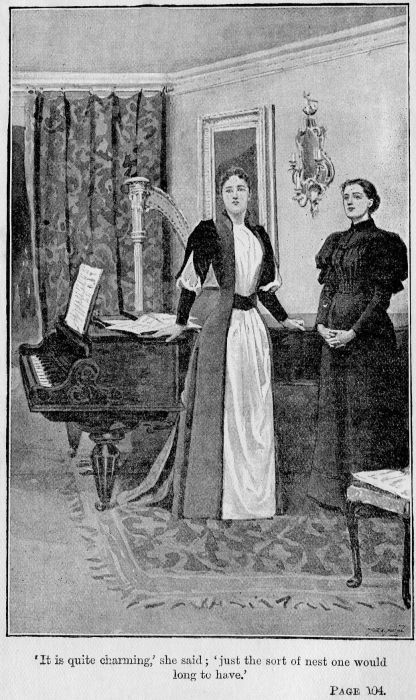
“It is quite charming,” she said; “just the sort of nest one would long to have.”
Hertha was amused at the expression. She considered her big room much more than a “nest.”
“My young friend does not seem to realise how rare such quarters are in London,” she thought. “I suppose she is used to a bare, but perhaps not very small, country vicarage.”
“Yes, I am very lucky indeed,” she replied. “A room like this is a great ‘find’ in London.”
“Is it really?” said Winifred, peering up at the ceiling. “Oh dear, it is just what I should like.”
Miss Norreys repressed the desire to tell her that, as things were with her, she might as well wish for Aladdin’s palace at once.
“She will learn by experience,” she said to herself.
“And the whole thing—your life, yourself,” Winifred went on—“it is like the realisation of a dream to me. Your splendid independence and freedom. Just think of the contrast between you and an ordinary girl living at home in slavery, or at least in a sort of prolonged childhood, with no personal standing, no liberty to follow her own intuitions.”
A shadow crossed Hertha’s beautiful forehead.
“I have not always lived alone like this,” she said. “Not, indeed, for very long. This house is endeared to me by having spent several years in it with my two,”—her voice faltered a little—“my mother and my brother. I have never wished for what you call ‘independence.’ I was too happy while I had one or two who cared to direct me. I loved being treated like a child.”
“You must have been most fortunately placed,” said Winifred.
“I was,” replied Hertha. “My parents were just perfect. It was circumstances and,”—she hesitated, for she was touching on uncertain ground—“a good deal, perhaps, the fact of my having a voice, a talent, which led me to leave the beaten path. No desire to throw off the dear home ties. I have often wondered what I should have done with my voice had I not needed to utilise it; how far it would have been right to give up time to cultivating it; how far, so to say, the possession of a voice means ‘a vocation.’ That sounds like a poor attempt at a pun,” she ended off with a smile.
But Winifred did not notice her little piece of fun.
“You would have done just what you have done,” she burst out. “You would never have been content in the beaten track—in the narrow, hedged-in life, which is what most women lead.”
“I’m afraid I should have been very content,” said Hertha. “I am not at all sure that I am not by nature very lazy. The energy of many—I think I might say of most women now-a-days—appals me. I don’t agree with you that the ‘narrow, hedged-in lives’ are the lot of the ‘most,’ not in London, anyhow.”
“Well, no, perhaps not in London,” Winifred agreed. “That is why I want to come here.”
“And, oh dear!” said Miss Norreys with again a little smile that seemed more of the nature of a sigh, “you don’t know how I long sometimes for that sort of life. Fancy, with parents and sisters and an old-fashioned home in the country—the sort of place that has not changed much for hundreds of years, where you can distil your own lavender-water and make great jars full of pot-pourri, where there is a lady’s walk and a ghost, and where you know every saint’s face in the windows at church—oh, what a lovely life it might be! If my lot had fallen in such lines, I hope I should have had the energy to cultivate my voice and to use it to give pleasure to others, to poor folk above all; but oh, how joyfully I should have hurried home from my enforced visits to London! I used to dream of such a life,” she added. “Now it is different. I am alone. No place could be much ‘home’ to me.”
A curious expression flickered over Winifred’s face.
“How—how strange!” she said, vaguely. “I did not think you were like that, Miss Norreys. I suppose it is poetry,” she went on. “I suppose you are poetical in a way I don’t understand. Have you ever seen the sort of place you describe? If you had such a home, it would pretty certainly not have the charm you imagine.”
“Oh yes, it would,” said Hertha. “It would have had, I mean. I am not high-flown. There must be such a beautiful content in feeling there you are, in a centre where God has put you—where you can be of use to many, ‘hedged-in’ to clear and distinct duties and responsibilities. I suppose I needed the other side or it would not have come to me. I might have been lazy.”
She took a certain satisfaction in repeating this, for, though she really meant all she said, there was something about Winifred’s half dogmatic, half matter-of-fact insistance on her own views and opinions that provoked Hertha to a kind of contradiction—almost to wish to shock her!
Just then the entrance of tea caused a momentary diversion. There was nothing of the Bohemian about Hertha. The little table was set out with scrupulous though simple care. There was a touch of genuine “old-fashionedness,” very distinct from the modern affectations and imitations of picturesque quaintness, about her, which added to her charm by its unexpectedness. But Winifred Maryon, for reasons which will explain themselves, was not specially struck by it. She accepted all she saw, in her inexperience, as a matter of course.
“Have I ever seen such a house as I have been talking about?” Miss Norreys went on, as she poured out the tea into two really old willow-pattern cups, adding sugar and cream from a small silver bowl and jug, worn thin with many years of daily use. “No, not exactly. There was a place which we once had reason to think would have been ours, which could have been made perfectly beautiful—but it never came into our hands, and now it is pulled down and the land built over. As things are, I do not regret it. Will you have another cup of tea, Miss Maryon? Yes; that’s right. And now we must get to business, and talk about you, not me.”
But Winifred’s enthusiasm for her new friend was so great that even the absorbing interest of her own affairs paled before it.
“I love so to hear about yourself and what you think and feel,” she said. “I cannot believe we really differ about anything. You have beautified your life so, unconsciously, that you can scarcely realise the dullness and monotony of some women’s lives.”
“Oh yes, indeed I do,” replied Miss Norreys.
“If I did not, do you think you would now be sitting here with me? I could never pretend sympathy I did not feel. Lady Campion told me a little, very little, about you, but, of course, I understand you far better from yourself. I sympathise with all my heart in your wish to do something—to strike out a career for yourself.”
“Oh yes,” said Winifred, breathlessly.
“No one could sympathise in it more heartily than I,” Hertha went on. “For years, you know, I worked hard for my mother and brother, and—though I don’t need you to tell me about it—I am sure that some similar motive inspires you, as well as the wish to feel yourself some one, something, which an energetic woman, placed as you are, must feel.”
The colour rose a little in Winifred’s face. Hertha, with instinctive delicacy, glanced away. She knew that direct owning to poverty was painful to some people.
“Ye-es,” said Miss Maryon, at last. “It is—there are—more than one motive. I want to help my sister, too, the one you saw. I am positively certain she has great talent for painting if she had a chance of cultivating it.
“Indeed?” said Hertha, “that simplifies her line of action. What she has to do is to test herself. Then you want to help her to get good teaching, and, I suppose, to make a home for her in London? Yes, she is too young and too beautiful to attempt anything of the kind without some one to take care of her. And—can you both be spared at home?”
“We have another sister at home, and, though my father is in delicate health, my mother is well and active. We have thought about it for a long time—Celia and I.”
“Poor souls! Two fewer to provide for, no doubt, is a consideration,” thought Hertha.
“Does Mrs Balderson know about it? Is she likely to help you in any way?” she asked aloud. “I do not know her personally, but I have heard she is truly kind.”
“She has been very kind in having us here. But she would not sympathise in our plans. She is—old-fashioned, I suppose. She thinks girls should stay quietly at home.”
“Ah, indeed,” said Hertha, her mind rapidly picturing to itself what, in such a case, the “staying quietly at home” must mean: the poor, unbeautiful surroundings, the colourless lives, the pain and almost degradation of the terrible “genteel poverty.”
“But she is very kind,” repeated Winifred, her conscience smiting her; “she asked us out of kindness. She would like us to marry,” with a little smile. “But, of course, I never shall. She likes Celia the best, I think.”
Again Hertha’s imagination jumped to hasty conclusions. “I see it all,” she thought. “She wants to show the pretty one to advantage, to give her a chance, as people say.”
“And is there any prospect of Celia’s marrying?” she asked.
Winifred shook her head.
“Oh no!” she replied, with a touch of something like indignation, which Miss Norreys could not understand. “Celia would never change so—she would not desert me.”
“But, my dear Miss Maryon, it might be a very good thing, if and always supposing, of course, that it was some one she cared for,” said Hertha.
“Placed as—”
“There is no use discussing remote contingencies,” interrupted Winifred, and Miss Norreys, imagining that her pride in her sister made it bitter to realise that the possibility was remote, beautiful though Celia was, said no more.
“Well, then, to be practical,” she replied, “what you have told me makes me feel that the proposal I have to lay before you may suit you even better than I had expected. For you cannot have Celia with you, or—or afford good teaching for her until you have made a beginning yourself, and got a home ready.”
“I must certainly have somewhere to bring her to,” said Winifred, evasively, “and somewhere for myself too,” with a smile. “I should like to get things a little in order, as it were, so far settled, for, you see, I am old enough to decide for myself, before I tell my people at home about it. It would make my mother so much less anxious if I could tell her it was settled.”
“But,” exclaimed Hertha, rather taken aback, “your people do know what you are intending? You are not acting against their wishes?”
“Oh no—that is to say, they do know, thoroughly,” said Winifred, with evident candour. “As for their wishes—why, no, mother does not wish us to leave home. Mothers never do—do they? She would like us all to stay near her always, I suppose. But she understands, and—she is very kind.”
“Kind” struck Hertha as a somewhat curious word to use of a mother in such a case.
“She should be very proud of you both,” she said quickly, while her mind’s eye pictured the overworked parson’s wife reluctant to let her girls go forth to make their way, even though the relief and satisfaction of seeing them in the path of success could not but be great. “If you get on well, it cannot but be a comfort to her, I should think.”
“She knows Celia has great talent, and she does think it should be cultivated,” replied Winifred, and again something in her tone slightly perplexed Miss Norreys. “I don’t think she feels the same about me, for, you see, I have no very special line. But there are quantities of men who have no very special line, and yet do well, and are of use in their generation. So why not women?”
And she looked up inquiringly at Hertha.
“Why not? There is no reason against it when the motives are sound and good, as in your case I think it must be,” Miss Norreys replied, half hoping that this would lead to further confidence. But Winifred did not speak, so she went on: “The chance I have to tell you of really is a chance, though it may not sound very splendid. Through an old friend of mine, Mr Montague, you can have the offer of a post in the Reasonable Help Society, provided, of course, you can pass a certain examination. It is a very well-managed society: they try to kill two birds with one stone by engaging to do the work—charitable work, of course—girls like yourself, who—who feel they should do something for themselves, to be independent, and in many cases, with the hope of eventually helping their friends.
“It is right they should be paid,” said Miss Maryon, quickly. “I have thought a good deal about that. I don’t believe in unpaid work.”
“I should be very sorry to make such a sweeping assertion,” said Hertha, with a smile. “However, in this case, the question is not raised. You will be paid—fifty pounds a year to begin, and the prospect of an increase, if all goes well. But remember,” as she caught sight of a bright gleam of satisfaction lighting up Winifred’s face, “fifty pounds are not a fortune. You are very inexperienced. I daresay it seems a great deal to you, but it won’t go very far.”
“I am not so inexperienced as you think, dear Miss Norreys,” said Winifred, quietly. “I shall be able to manage, and to have Celia with me before long. It is not the money, but the feeling that it is a beginning, something really to do, and that I shall take the greatest interest in. There is nothing I have more at heart than the problem of how to help without pauperising our lower classes I may be of more use to the Reasonable Help Society than would be thought likely,” she concluded, with a funny little touch of self-assertion.
“I hope so, I am sure—and with all my heart I hope the Reasonable Help Society will be of use to you. Then you decide on accepting it?—that is to say, on offering yourself as a candidate for the post?”
“Oh dear, yes. Most certainly I do,” said Winifred. “And I thank you a thousand times.”
“It was much more Mr Montague’s doing than mine,” said Hertha. “And, indeed, the whole thing was a chance—a lucky one, I trust.”
“And can you tell me when I must call at the office, or must I write, or what?” asked Winifred.
“Yes,” Miss Norreys replied. “Mr Montague sent full particulars. You must call any morning, but the sooner the better, at this address;” and she held out a paper.
“I will go to-morrow,” said Winifred.
“And if you say that you have no home in London, the secretary will give you a list of lodgings where some of their employees live. Nothing very grand, of course, plain, but not uncomfortable, with thoroughly respectable people.”
“Oh that will be all right,” said Winifred. “I will find something to begin with, I daresay, and if I don’t like it, I can easily move.”
Her tone made Hertha rather uneasy again.
“But all moves are expensive,” she said. “Try to settle down if possible.”
“Ah, well, yes, if I can get rooms for Celia too.”
“Rooms!” thought Hertha. “What does she expect? But she must buy experience, I suppose.” So after detailing to her some more of the information received from Mr Montague, she let her go, without volunteering further advice.
And Winifred, feeling that she had taken the first plunge into independence and “a career,” bade her new friend good-bye for the present, with many times repeated expressions of gratitude.
Chapter Seven.
At White Turrets.
A clear, mild, late-autumn morning in the country—clear, though the sunshine, what there is of it, is thin and pallid; mild, yet with a certain slow chill in the air which is not inspiriting; over and through and behind all, the indescribable autumn feeling, the subdued consciousness of warmth and brightness passed, as distinct as is age from youth, from the equally indescribable hopefulness of even the least genial spring-time.
Yet there is no need to remind any one of the charm of such a day at such a season. Perhaps there is none, amidst the many fascinations of our ever-the-same yet ever-varying journey through space, more powerful, more irresistible, than the fascination of the fall of the year. As a rule, it is the young who love autumn best: they can afford to enjoy its subdued vitality as a contrast to their own overflowing life. The old, or the growing old, on the contrary, forget sometimes their own failing powers in the delightful exhilaration of reviving nature around them, in the songs of the birds and the blossoming of the buds, in the new life which, to many, one would hope, tells of deeper truths than lie on the surface.
A girl was standing by a window—an open window, so mild was the morning—overlooking a gravelled terrace walk. She was fairly tall, brown haired, and gentle eyed. Not as lovely as her sister Celia; scarcely, perhaps, as handsome, strictly speaking, as Winifred, the eldest of the three, yet with an undeniable charm of her own—a very gracious presence. For this was Louise, the second of the Maryon daughters.
And all about her seemed harmonious. The simple yet stately room, with the ancient white wainscoting, so rare in an English country-house, the perfect, though old-fashioned, appointments of the breakfast-table behind her: above all, perhaps, the scene from the window—the broad terrace, with the miniature ramparts, and the stiff, quaint, flower-beds beneath; and the park beyond, fading into dark masses of trees in the distance.
But Louise Maryon was not looking out; her eyes were fixed on a letter in her hand. And as the door opened quietly she looked up with eagerness.
“They are coming, mamma!” she exclaimed joyfully. “They are really coming to-night. Winifred’s mysterious business is settled at last, Celia says. Isn’t it delightful that we shall have them really back to-day? But,”—as a glance showed her that her mother, too, held a letter in her hand, and that her face scarcely reflected the pleasure Louise herself was feeling—“have you heard, too? Is your letter from Winifred?”
“Yes, dear,” Mrs Maryon replied, with a little sigh. “It is from Winifred. Your father was awake early, so the bag was brought up-stairs—you found yours on the table? I sent it down. Yes, mine is from Winifred. Of course I am delighted they are really coming, but, Louise, I am afraid the experiment of this visit to London has done no good. Your sister is evidently as determined as ever.”
Louise’s face fell a little, more, perhaps, out of sympathy with her mother’s disappointment than from any keen sense of it herself. She had not expected otherwise.
“Celia seems to me to be in a most reasonable frame of mind,” she said. “Nothing could be sweeter and nicer than all she says.”
“Celia is different,” said the mother. “There is sense and reason in her wish to cultivate the talent she believes she has, or at least to find out how much she has. She would never have been unreasonable if Winifred had not put it into her head;” and Mrs Maryon sighed again.
She was more like her eldest daughter in appearance—the slight, tall figures and fairer complexions of the younger girls were from their father’s side. Yet, in character, Winifred more resembled Mr Maryon, though the long chastening of delicate health—since a terrible accident some years before—had so mellowed and refined an originally self-willed and almost despotic nature, that papa’s “gentleness” and well-nigh womanly consideration for others were household words in the family. The mother, full of intelligence and good sense, was nevertheless constitutionally timid and even shy. So, between Mr Maryon’s fear of his own natural imperiousness, and his wife’s almost morbid want of self-assertion, the clever, precocious child had developed into the self-willed, self-opinionated, though always candid and high-principled girl.
In the case of the other sisters, no bad results appeared to have followed their rather exceptional up-bringing. Louise was essentially well balanced and unselfish; Celia too talented to be self-engrossed. She lived in a world where self is quickly lost sight of, though her great capacity for affection kept her from losing touch with the real people and the real life around her.
Louise, as she took her place at the breakfast-table, tried to think of what she could say to cheer her mother.
“I suppose Winifred must judge for herself, mamma,” she said. “You have always said so, and, after all, even if she is away from home for a few months, she may settle down all the better afterwards.”
“I doubt it,” said Mrs Maryon. “Once she has tasted the sweets of independence, and a more exciting life, I doubt if she will ever ‘settle down,’ as you say, unless she married, and of that—at least of the marriage we hoped for—I suppose there is no chance now.”
“I am very sorry for Lennox,” said Louise, simply. “But for his sake, her being away for a while may be better. I think he is accepting the thing—but still her being away would make it easier. And then he need not leave off coming about us as usual. We should miss him, and it would be hard upon him, for he is rather lonely.”
“It has been hard upon him already. Yes, if I could think Winifred would have enough of it in a while, as you say, Louise! But she seems already to have got one foot into that half-Bohemian society she has always been longing for. I cannot think how she has managed it from so solid a house as the Baldersons’! Her letter is full of some singer—a Miss Norreys—whom she has taken a perfect ‘furore’ for, and who, she says, has been most kind in helping her. Really, as if the child were a poor little governess! And to think of all the responsibilities awaiting her here—of all that must be hers some day! No, I cannot see how Winifred can blind herself to the duties so distinctly hers. And she will fall more and more out of it all. She will know nothing about the property or its management.”
“But, mamma dear, we may hope that papa will live a great many years. He is no worse than ten years ago. And Winifred may fall in love and marry some day. It would do her all the good in the world,” said Louise.
“Some actor or singer, perhaps,” said her mother. “I should be thankful she has no taste for the stage, and no special musical talent, for there is no knowing what she might not have wished to do in such a case.”
“The Baldersons are very musical. I suppose that is how Winifred has met Miss Norreys. Celia speaks of her too. She says she is really quite charming, and that Winifred can get nothing but good from her. But what it is that she is ‘helping’ Winifred about, Celia does not say.”
“I wish we could see her—this Miss Norreys, I mean,” said Mrs Maryon. “She seems to be acquiring so much influence over Winifred.”
“I have heard her name, I am sure,” said Louise. “Well, anyway, mother dear, we shall know all about it in a few hours. So try not to worry in the meantime. Shall I go up to papa now? Will he be ready for me?”
For to a great extent Louise acted as her father’s secretary, and the post was no sinecure.
“Mr Peckerton is coming this afternoon,” said Mrs Maryon, “and that always tires your father. Make him do as little as possible beforehand. Perhaps you had better run up to him now, and talk the day over. I shall be busy too—the vicar is coming about the new schoolmistress.”
“And there are all the Christmas presents for the children to go over,” said Louise. “I am thankful Celia is coming back.”
The journey from London was not a very long one. Late in the season as it was, the sun had not yet set when Winifred and Celia found themselves steaming into their own station, where a carriage and a pencilled note from Louise awaited them.
“I have been longing to go to meet you, but find I cannot manage it, as Mr Peckerton is here and papa needs me. So delightful to know you are coming home.”
“Dear me!” said Winifred, when she and Celia were comfortably settled in the carriage, and bowling away quickly on the smooth high-road to White Turrets—“dear me, what a ‘Little Peddlington’ life it will seem after London! Poor Louise, as full of her accounts and village matters and old women’s flannel petticoats as ever, I suppose!”
Celia did not reply. Winifred’s tone jarred upon her. She was gazing out of the window at the reddening sky, just where the sun was setting. It was a lovely evening, and her whole feelings were touched and quickened by the returning home. A moment or two later they drove in at their own lodge, and then a turn in the avenue—a grand old avenue, bordered by trees which had lived through more than one or two human generations—brought them, while still at some distance, within view of the house itself.
It could scarcely have been seen to greater advantage than standing out as it did against the autumn sky, with the sunset glow illuminating the clouds, banked up, blue-grey and cold looking near the horizon; though overhead the pearly, neutral-tinted expanse, already shadowing into darker tones, still told of the mildness and calm of the fast-waning day.
“Look, Winifred, look,” cried the younger girl, “did you ever see the house more picturesque? It has that wonderful old-world look—the ‘fairy-story look,’ I used to call it when I was little. It is as pure white as if it had just sprung up by magic, and yet it seems as if it might have been standing there for thousands of years—as if the White Cat had just ridden off from the door on a hunting-party.”
“Or as if the Sleeping Beauty were sleeping there still, waiting for the perfect prince, who never comes except in your fairy tales, Celia,” said Winifred, with a touch of contempt in her tone. But the fancy did not displease her sister. She only laughed softly.
“Well, we don’t waste much thought on him,” she said. “Dear old White Turrets! I do love it. It doesn’t need a prince, Winifred. You know it has always prospered best in the hands of a woman.”
Winifred’s face clouded.
“I wish you would forget that old nonsense,” she said. “There are women and women—no one will understand that. It may suit some women to drone along and never leave their own village, but it wouldn’t suit me, and that is all that I am concerned about.”
Celia sighed, but her sigh was not a very profound one. She was feeling too happy for that.
“If I could only get up and down to London for painting lessons every day by magic,” she said, “I should never want to leave home at all—never.”
“Nonsense, Celia,” said Winifred. “You would never do anything worth doing if you tied yourself to the out-of-the-world sort of life we have here. You need to imbibe the spirit of the day. You need friction, a hundred inspiring and inspiriting influences, even if you are a genius.”
“Winifred,” said the younger girl reproachfully, “how can you speak so? Heaven knows I have never thought myself a genius. Still—I daresay there is something in what you say. Certainly I need to test myself with others, if that is what you mean by friction. But oh! here we are—and there is dear old Louise, looking just as she did the day we left, only a good deal happier.”
“Poor dear Louise,” repeated Winifred. “Yes, she is the modern incarnation of one of Miss Austen’s heroines. But it is nice to see her again.”
And the greetings between the three sisters could not have been more affectionate and loving than they were.
It was not till much later that evening that Louise got Celia to herself for a good talk. At dinner, with both the father and mother present, the conversation had been bright and full of interest, Winifred describing, with her ready flow of language, what she and her sister had seen and done and been struck by in London, and Celia contributing her quota. Questions about the Baldersons, too, were asked and answered, and a casual observer would have imagined the family “understanding” to have been perfect.
But below it all, the five themselves were conscious of a certain constraint: something was smouldering beneath the surface, and Mrs Maryon’s face, when in repose, showed lines of fresh anxiety and troubled anticipation.
“I won’t keep you up to-night, my dear mother,” said Winifred, as bed-time approached—Mr Maryon, feeling the effects of the afternoon’s business with Mr Peckerton, having already been wheeled away in his invalid-chair. “You look tired, and I want to write a letter in my own room for the first post in the morning. But to-morrow we must have a regular good talk, and you shall hear everything there is to tell.”
“Celia,” said Louise, when the two younger sisters were by themselves in Celia’s room, “I mustn’t keep you up long, for you look rather tired too. But do tell me—what has Winifred to say? What has she been doing, or what is she going to do? Of course you could not tell much in your letters—we settled that before you left—and when Lennox saw you, you had only just arrived there. But I am so anxious to know everything, for several reasons.”
“Was Lennox in very low spirits when he came back?” asked Celia in the first place, instead of answering Louise. “That’s one thing settled. It’s as certain as anything can be that he need never dream of Winifred. I have come not to wish it. She is too prejudiced to do him justice.”
“I think so too,” said Louise. “It is only for papa’s and mamma’s sake I regret it now. No, he was not low-spirited. He has made up his mind to it, I think. And,”—she hesitated—“he even laughs a little at Winifred sometimes.”
Celia’s colour rose.
“That is very presumptuous of him,” she said, but she checked herself. “Of course he can’t understand her, so perhaps it is a good thing if he takes that line. She has quite decided, Louise. It is all settled. She is going to London in January, for good.”
Louise drew a deep breath.
“I cannot believe it,” she said. “Leaving all she might do here, when every day I see more and more how valuable her strong brain and clear judgment would be. For papa, though not worse, is not better, Celia. He is so quickly exhausted. I do my best, but I am not the clever one of the family. I can’t understand it. Going out to seek for work when it is at her very feet, crying to be done.”
“It is not work Winifred wants; it is a career,” said Celia, laconically.
“But she has no special gift—no—no ‘vocation’ to anything in particular,” said Louise.
“She thinks it is her vocation to show that women should be as free as men,” said Celia. “She is full of organised benevolent work just now, and she wants to prove that women can do it as well as—no, far better than men. But I have tacitly promised her to let her tell all particulars herself, so I had better not say any more.”
“Only one thing—this Miss—Miss something Norreys, that Winifred has mentioned so enthusiastically in her letters—has she influenced her?” asked Louise.
“She is the best friend Winifred could have,” Celia replied. “She is both beautiful and talented and good. Yes, and wise too. But—I have not seen her much. I doubt if she really understands the position.”
There was a little silence. Then Louise spoke again.
“Celia,” she said, with a touch of hesitation, “you have changed a little—or a great deal? You don’t look at things so entirely from Winifred’s point of view, do you?”
“No,” said Celia, frankly, “I don’t. I have changed. I hope, perhaps, I have grown wiser, that I have learned to see things outside ourselves more than I did. Winifred would tell you it was all the other way,” she added, with a smile. “She thinks I have grown narrow and conventional.”
“But you haven’t changed about yourself—about your wish to see what talent you have—to test yourself, as you say?” asked Louise, eagerly. “I should not like that.”
“No, I feel just the same. I feel that I must try—that is to say, unless some very clear overmastering question of duty interferes. I know I have some talent, and, even if it is nothing remarkable, I think I should cultivate it, and if,”—here the girl’s voice trembled a little—“if it were to be remarkable—well, all the more reason for developing it.”
“Yes. You are right. I know you are,” said Louise. “I am so glad. But then it is about Winifred you have changed?”
“Not exactly—or rather, it is about Winifred, as a type of so many girls nowadays. I cannot go as far as she does, and yet you see the position is very invidious. It makes me seem selfish and presumptuous and—almost conceited,” and Celia’s face clouded over. “A very little thing began the change in me,” she went on. “An almost chance remark of Eric Balderson’s. Then I tried to think it out, and I wondered at myself for having agreed with Winifred as I did. For her case is a peculiarly strong one the other way, I now see. Her life is before her. It is not like that of some women who have reason to feel hedged-in and stunted, even though I am beginning to think that very often it is their own fault. I am afraid a good deal comes from love of excitement, though, of course, there is the other side of it too. But it would take hours to tell you all I have been thinking.”
“And I have kept you up too long already, dear,” said Louise. “Only—Celia, I must tell you one thing—the White Weeper has been seen again.”
Celia started, and grew white herself.
“Oh, Louise,” she said, “I wish you hadn’t told me to-night. You don’t mind, I know, but—”
“Celia, dearest, I’m so sorry,” said Louise, penitently. “I never knew you minded it either. I was, in a way, glad of it. I fancied it might have some effect on Winifred, even though she only mocks at it. It is curious, for it is a good while since it has been seen. And even if it is only some peculiar shadow, some atmospheric effect, as people try to make out, still—its being seen just now might make Winifred think.”
Celia shook her head.
“She would not allow it, even if it did,” she said. “It’s no good telling her about it. She only gets very cross. When,”—and again she trembled a little—“when was it seen, and by whom, and where?”
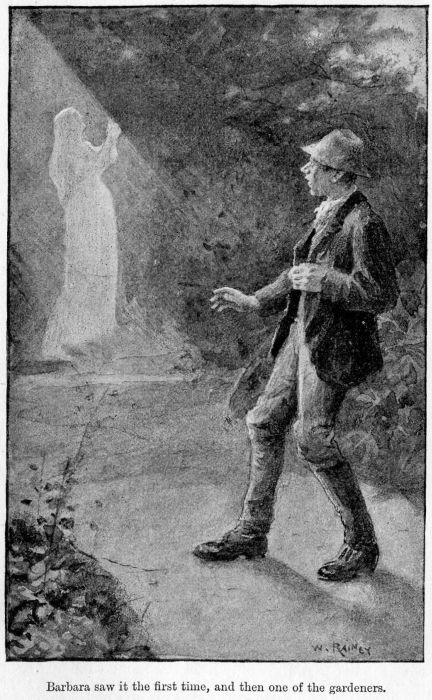
“Twice,” said Louise, “just as usual. In the yew-tree avenue. Barbara saw it the first time, and then one of the gardeners—the new one, quite a young man. It is always new-comers who see it. And none of the people about know of it, except Barbara and Horton, and one or two of the very old ones, who never speak of it. Luckily the young man told Horton of it first, and Horton bound him over not to speak of it. He told him he would be laughed at, and so he would.”
“How long ago?” asked Celia.
“Last week. She, or it, was crying quietly, Barbara said. Not violently. So Barbara took it as just a gentle warning—not any very dreadful thing. She is quite satisfied that it was for Winifred.”
“I wish Winifred could see it for herself,” said Celia, with a little not unnatural irritation. She was feeling both tired and frightened. “Louise, you will leave the door wide open between our rooms. I can’t understand your not being frightened.”
“Well, anyway, dear, you know it never comes into the house,” said Louise, reassuringly.
“It never has, that we know of,” said Celia, “but still, if it were much provoked or defied. No, no, Louise, don’t tell Winifred about it. I should be afraid what she might say or do, for she is never frightened of anything.”
Louise looked greatly distressed.
“Dear Celia,” she said, “I wish you wouldn’t take it that way. I feel quite differently about it. I look upon the White Weeper as a kind of protector—a living spirit who wants to keep harm from us.”
“Do you?” said Celia, rather grimly. “Well, then, I’m afraid I’m like the boy who, when he was told he need not mind the dark, as his guardian angel was always beside him, replied that that was just what he was ‘afeared on.’ I don’t know if I’ve a bad conscience—compared with yours, I daresay I have—but I know that I devoutly trust I shall never be favoured with the sight of our family ghost. Do you mean to say, Louise, that you would have courage to speak to her?”
Louise hesitated.
“I don’t know,” she said, “I hope I would. Yes, I think I would if it were to be for good to any of those I love.”
“I do believe you would. You are an angel;” and she drew Louise’s wavy brown head down to her, as the elder girl was turning to leave her, and kissed her tenderly.
The door was left open—wide open—that night between their rooms, but the sisters’ slumbers were undisturbed. Louise was too happy to know that Celia was beside her again to think of anything else, even if she had been given to ghostly fears, which she certainly was not.
And Celia was happy too, though tired—happy to be at home again, and to feel that Louise and she understood each other so thoroughly.
The next morning brought about the “long talk” between Winifred and her mother. It was not so very long after all, for the same ground had been gone over so often that there was not much new to say. And when Mrs Maryon became convinced that the visit to London had only intensified her daughter’s determination—had, indeed, practically resulted in Winifred’s taking upon herself engagements which it would have been scarcely honourable to break—she had the wisdom to accept the position, and not to add bitterness to the whole by further and useless discussion.
But though the daughter went singing up-stairs to her own quarters, congratulating herself that things had passed off more easily than she had expected, the mother’s face looked sadly pained and anxious when Louise ventured to join her, after making sure that the interview with her elder sister was over.
“May I come in, mamma?” she said. “Tell me— Oh dear, you are looking very troubled!”
“Yes, dear, I am feeling so,” Mrs Maryon replied. “Winifred has really carried out her intentions. She has—fancy, Louise—she has engaged herself as some sort of sub-secretary or clerk to one of these new philanthropic societies. The Reasonable Help Society, I think she calls it. I daresay it is a very good thing—no doubt it is—and besides helping the poor, I daresay it provides employment for many penniless girls of a better class. But Winifred! with her position and responsibilities, and the home duties she could do so well, if she would—Louise, it is almost incredible.”
“It is better than becoming a woman doctor or an hospital nurse, surely,” said Louise.
“I don’t know. She has no taste for either. But if she had become an hospital nurse it might have brought her to her senses, and at least she would have acquired some useful knowledge.”
“So she may, as things are,” replied Louise, who, whatever her own feelings, tried determinedly to look on the bright side of things for her mother’s sake. “And really, vexing as it is, her pertinacity is rather fine—worthy of a better cause. How clever of her to have got this thing! for I am sure it is difficult, unless the society is glad to find a girl who gives her services for nothing.”
“Oh dear, no. It is not even that,” said Mrs Maryon. “She is to have fifty pounds a year! She does not approve of the principle of unpaid labour, she says. She got the offer of this post through this new friend of hers—Miss Norreys. I think Mrs Balderson should have been more careful whom she introduced to the girls. Miss Norreys must be a very advanced ‘women’s rights’ sort of a person.”
“Celia says not. She says she is perfectly charming and perfectly womanly,” said Louise.
“Then—she cannot have understood all about Winifred. I wish I could see her. I shall certainly not allow Celia to join Winifred in London next spring, without knowing more of this young woman, who seems to have done all the mischief.”
“Oh no, mamma. It was done before Winifred ever saw her. You know we hoped—though not very much—that London might have changed Winifred’s ideas. If it has to be, Miss Norreys may be a very good friend.”
“I should like to see her,” Mrs Maryon repeated. And then she added, with a sigh: “Winifred has accepted this post for January. She will not be much longer at home.”
Chapter Eight.
An Invitation and a Journey.
Hertha Norreys stood staring at a letter—or letters rather—which she held in her hand, with an air of perplexity and surprise.
“I can’t make it out,” she said to herself. “It seems so odd and inconsistent. And—I have not done so very much for her after all. They write as if I were her dearest friend, and in a sense responsible for her! I like her. There is a great deal of good in her, but the only real service I have done her since she came to London was getting Mr Montague to beg her in again, that time she was given notice of dismissal for defiance of the society’s rules.”
A smile came over Miss Norreys’s face at the recollection of the circumstances, and with the letters still in her hand, she sat down at her neat breakfast-table. And when she had poured out her coffee and begun to eat, she glanced through them again. They had both come together, one from Winifred enclosing the other, which was from Mrs Maryon, simply inscribed to Miss Norreys, but without any address.
This was Winifred’s:
“Dearest friend,” and the words again drew forth a smile from the reader— “I have just received the enclosed from my mother. It was left open for me to read the contents. I hope you will not mind their asking you in this unceremonious way, though I confess I think they should have left the invitation to me. I am afraid you would find it dreadfully dull down there. I am not at all sure if I shall get down myself for Easter, as I scarcely see how I am to be spared here. If I go, it will be principally for poor little Celia’s sake; though now it would, of course, be for yours too, should you possibly care to go. It certainly is very pretty in our part of the country in the spring. You will let me know what you decide!—Ever yours devotedly,— “Winifred R.V. Maryon.”
The enclosure was a slightly stiff and yet cordial invitation—an invitation which gave one the feeling that the writer had not the slightest doubt of its being at once and eagerly accepted—to Miss Norreys, to spend Easter week at White Turrets.
“You would give us pleasure by doing so,” wrote Mrs Maryon, “and we should be glad to have an opportunity of thanking you for your kindness to my daughter, and of making the acquaintance of one to whom in her present life she looks for advice and direction. And there are several things I should be glad to talk over with you. We expect Winifred at the time I name, and you and she could travel together. I think there are special return tickets issued about Easter, and I hope a little country air would do you good.”
Hertha read and re-read. Was there, or was there not, a slight touch of “patronisingness” in the letter? The idea rather amused her.
“It is almost impossible,” she said to herself. ”‘Poor and proud’ explains it, I suppose. Winifred was delighted to get the fifty pounds salary. I wish they had not asked me, for any visitor causes expense when people are so poor, and unaccustomed to that sort of thing. No doubt they think me very poor too—poorer than I am now, I am glad to say; the railway fare information is evidently given with that idea.”
Then she poured out a second cup of coffee, and proceeded with her cogitations.
“I have several invitations for Easter, but with out being cynical or suspicious I know that some, at least, of them are more for my voice than me. And my voice had much better stay at home or go to sleep. And it would be a rest of its kind to be with a simple country family like that—no dressing to speak of—I need not take a maid. It must be a pretty quaint place, too, I fancy. I wonder if ‘White Turrets’ is the name of a village, or what? It doesn’t seem likely that their house would have so important a name, though there are old farmhouses in some countries, scarcely more than cottages, with very grand names. I remember,”—she glanced at the letter again. “It must be their house or the village, for I see the railway station and post-town are both different. Dear me—the Maryons are rather extravagant as to note-paper! If one didn’t know it was impossible, this might have come from some big place!”
Then her thoughts reverted to her own plans.
“I should like to see that pretty younger sister again,” she thought. “And, after all, it will not increase any real or imaginary responsibility about Winifred if I come to a clear understanding with her mother. Not that I would shirk responsibility if it were a duty, but in this case it would be a mockery. She is not a girl to be either led or advised, and the reason that I am still her dearest friend is that I have—except on that one occasion—left her to buy her own experience. She needs to do so.”
The “one occasion” to which Hertha’s thoughts referred had been that of a crisis in Winifred’s relations with the society for which she worked—a crisis which, at the cost of considerable mortification, had left her a wiser woman. For it was only the finish up of a series of annoyances which had begun almost from the first day of her engagement, the cause of which may be summed up very shortly—Miss Maryon’s absolute ignorance of the meaning of the word obedience.
She was quite sure she knew the best way to manage the work better than those who had been at it for years; she was brimful of eagerness to distinguish herself, and of a kind of enthusiasm; she was energetic and hard-working, but she was entirely without deference. And underlying all her talk about the dignity of labour, the contemptibleness of an ordinary woman’s home-life, was a strong, though, unexpressed belief that she was doing the society no small honour in working for it, and that, by some instinct which she did not seek to define, the society should be aware of the fact.
The result of all this can be easily imagined. Though valuable as a steady and zealous worker, she was entirely inexperienced, and want of compliance with the rules was not to be endured.
“We can get scores of girls better fitted for the post at any moment,” said the much-worried secretary in reply to Mr Montague’s entreaties that they would give his protégée another trial. And in reality it was far more owing to the skilful pleadings, made in all good faith, of Hertha’s friend, as to the importance of the salary to a girl so placed, the disappointment her dismissal would cause to her friends as well as to herself, than from any conviction of Miss Maryon’s special abilities, that the secretary at last gave in.
He knew Mr Montague well, and his post had given him exceptional opportunities for the cultivation of discernment.
“Are you sure,” he said towards the close of the interview, looking up with a keen glance from under his bushy eyebrows, “are you sure this girl is really so dependent on her work? There is no story about her that we have not been told, is there? It’s no case of a self-willed young woman running away from home—an uncongenial stepmother, or any nonsense exaggerated into importance? She is not a girl to give in, even if in the wrong.”
Mr Montague started.
“What makes you fancy such a thing?” he asked.
The secretary considered.
“I can scarcely say—an impression, perhaps. Still there are trifling circumstances—she is very careless about money, thinks nothing of hansoms, for instance. And you know one of her great offences has been giving charity without permission, and, naturally, most injudiciously—” He gave an impatient exclamation. “Enough to bring our whole society into disrepute,” he said, “contravening its very raison-d’être.”
Mr Montague felt uncomfortable, and yet he had no real grounds for misgiving.
“I can only repeat the reason of any interest I feel in her,” he said, “and that is that she is a friend of Miss Norreys—the last woman in the world to aid or abet any silly girl in the sort of conduct you suggest.”
The secretary’s brow cleared.
“True,” he said, “I had forgotten.”
Mr Montague called that very day to relate his success to Miss Norreys, but she was not at home. Then he contented himself with a note, merely stating that Winifred was to have another chance, feeling that any further discussion about her would be more satisfactory in speaking than in writing. He tried to see Hertha again, but again failed, and then a summons to an invalid sister at Cairo took him out of England for several weeks, without his meeting Miss Norreys at all.
Mrs Maryon’s invitation was accepted, simply, and with no effusive expressions of gratitude, though with all the kindly acknowledgment that it seemed to Hertha to call for.
“I have been undecided where to go at Easter,” wrote Miss Norreys, “but, among several invitations, none seems to promise me the quiet I really feel I need so surely as your very thoughtful one. It will be pleasant, too, to travel down with your daughter, for I have not seen her for some time, she, as well as I, being so busy. Indeed, I feel that you greatly overrate any little service I may have had it in my power to render her. My sympathy, as I think she knows, she can always count upon.”
Mrs Maryon read this with a feeling of some perplexity. She could not make up her mind what she should feel about and towards this Miss Hertha Norreys. She handed the letter to Louise.
“I cannot quite decide if we shall like her or not,” she said. “What is there in her way of writing that is not quite—I don’t know what to call it—not ‘deferential,’ that is too strong, for I suppose she is really a perfect gentlewoman; but almost as if she thought we were ‘out of everything,’ as if rest and quiet were all she could possibly expect here?”
“Well, to a certain extent they are,” said Louise with a smile. “Very likely Winifred has impressed upon her the extreme monotony and dullness of our life. But I suppose what you feel is the tone of the emancipated young woman of the day, mother—though from Celia’s description of her I fancied Miss Norreys above that. However, we shall soon see her for ourselves, and I do agree with you that it is a very good thing she is coming. You will be able to judge for yourself about her—especially on Celia’s account.”
“Of course, I hope she will enjoy it,” said Mrs Maryon. “I don’t like the idea of bringing her down here merely as a satisfaction to myself. Lennox has promised to spend Easter with us, hasn’t he; and that friend of his, Captain Hillyer?”
“Yes,” said Louise, “I’m sure we can count upon them. I wish Eric Balderson could have come, but he is going abroad for three weeks with his mother. It would have been a little return for their great kindness to Winifred and Celia.”
“He knows he can come whenever he likes,” replied her mother. “Yes, they were very kind; but sometimes, Louise, I wonder if that visit to London was not a mistake. It only seemed to clench matters.”
“No,” said Louise, “nothing would have kept back Winifred, mother. Do try to believe that.”
Easter, though it fell early that year, was wonderfully bright and mild. The morning which saw Miss Norreys and Winifred off to the country was, as to weather, a real red-letter day, and Hertha’s spirits, as she drove to the station where she and her “devoted friend” were to meet, rose higher and higher.
Not that she was anticipating any special enjoyments in her visit. More than once she had asked herself if she were not acting foolishly in bestowing a whole week of her rare holidays upon perfect strangers—and strangers whom she had no particularly strong reasons for expecting to find sympathetic and congenial.
“I really don’t know why I accepted,” she thought.
But this morning she felt a sort of reward—if reward she deserved, as she said to herself—in the beautiful promises of spring delights that met her even in the dingy streets through which a hansom rapidly carried her.
“What will it not be in the country?” was almost her first greeting to Winifred, when that young lady appeared, more punctually than was her habit, in honour of her expected guest. “If this weather lasts it will be perfectly—heavenly. Primroses and gorse always picture to me the streets of gold far more exquisitely than the thought of the hard, cold metal.”
And her eyes sparkled, and her beautiful expressive face flushed with the quick instinctive response to nature which was one of her characteristics.
Winifred looked at her in some surprise. This phase of Miss Norreys’s character was new to her, but as it was Miss Norreys and no one else, the girl’s instinct was to admire and not criticise.
“You make me afraid to say what I have been wishing all the morning,” she said with a little smile.
“Indeed, and what is that?” inquired Hertha.
“Oh,” said Winifred, “it just struck me, seeing this nice weather, how delightful, how much more delightful, it would have been to have a week’s holiday in London with you. How many places we could have gone to see; what long charming mornings we could have spent, reading and talking, at the British Museum, for instance! Whereas—oh dear, I can scarcely hope to have you much to myself down at White Turrets.”
“But it is the country that makes all the difference in the world,” said Hertha. “Even if I had not fixed to go, I don’t think anything would have kept me in London to-day. Everything, every leaf, every bird’s twitter, every breath of air, seems to be calling us out of the dust and glare of the weary streets.”
“I suppose it’s all a question of novelty,” said Winifred. “You see spring in the country is such an old experience to me. There’s nothing new in it.”
“Nothing new!” repeated Hertha, with a touch of scorn. “You don’t suppose I have always lived in a town, do you? But as for ‘nothing new’ in the spring—why it is always new. Ever-returning youth is its very essence. You cannot know anything of the true feeling of spring to speak so.”
“Perhaps not,” said Winifred, and for her the tone was very humble. “I am not at all poetical: I have told you so.”
This softened Hertha, to whose nature the position of antagonism was never congenial.
“And I, perhaps, am foolishly enthusiastic in some ways,” she said. “I feel so exuberant this morning.”
“I am so glad,” said Winifred fervently.
Then it proved to be time to take their tickets.
“You travel th—,” Miss Norreys was beginning, when Winifred interrupted her.
“I am quite pleased to go second,” she said eagerly. “I—I thought you would like it better, and I arranged for it.”
“Poor girl!” thought Hertha. “No doubt she has been saving in something else, to make up for the extra expense, which, doubtless, is for my sake. She has some very nice instincts about her, but I wish she could believe I don’t mind going third. Still it might hurt her to urge the point.”
They found a comfortable compartment, not unpleasantly crowded, which at that season was rather exceptional good luck, and, thanks partly to the presence of strangers, partly to Winifred’s respect for her friend’s remark, that she found few things more tiring than much talking in the railway, the journey was for the most part performed in silence.
As they approached its end, they found themselves at last alone, and Hertha, who had been enjoying with quiet though intense appreciation the varying view from her window of fields and trees in their first exquisite tenderness of green, of primroses on the banks, and homesteads in whose nestling orchards the fruit-trees were already in blossom, turned to Winifred with a smile of glad pleasure.
“Is the country remarkably pretty and picturesque about here?” she asked, “or is it all the charm of the contrast to my London eyes? It seems to me I have never loved a spring day really before.”
“I am so glad,” said Winifred, her own face reflecting the ready sympathy which, poetical or not, her devotion to Hertha never failed in. “I am so very glad. It makes me hope that, after all, you will not find a week at home too dull and dreary. You see, we can be perfectly independent: you and I can stroll about the woods talking all day long if we like.”
“But you will want to see as much as you can of your mother and sisters, considering you are only with them for a week,” said Hertha. “And I shall like to get to know your pretty Celia a little better. Don’t trouble about me, Miss Maryon, I beg you. I shall be perfectly content. I only hope I shall give no trouble, and that none of you will—will make the very least difference with my being there.”
Winifred looked slightly perplexed.
“Any difference!” she repeated, “I don’t see what difference your being with us could make, except the pleasure of having you. You see, in a country-house there is always a good deal of coming and going—there are not the ‘told-off’ hours and days as in London. But, by-the-by,” she added suddenly, “I did not see your maid at the station. Have you not brought her?”
“N-no,” said Miss Norreys, “I said to Mrs Maryon, when I wrote, that I could do without her, I thought.”
“Oh, of course it will be all right,” said Winifred, quickly, at once thinking of the expense for her friend. “Nothing will be easier than for— But here we are,” she broke off, as at that moment the train slackened, and she turned to gather together the odds and ends lying about the carriage. “Just put them near the door. Dawson will see to them,” she went on. Then she added, with a little rising colour, “Don’t you think—would you mind calling me ‘Winifred’? before my own people, you know. I would so like it.”
“I will try,” said Hertha, smiling. “I may forget sometimes, but as you wish it, I will try.”
“Thank you,” replied Winifred. “Oh, there is Louise. Poor dear old Louise! She loves coming to meet arrivals. She is not very ‘interesting,’ you know—just a girl of the old type, but as good as gold. You need not be more with her than you like, if she bores you.”
“I am not afraid of that,” said Hertha; “very few people bore me. But you have scarcely ever mentioned her to me. Which is she?” as she ran her eye along the platform, where they were just drawing up, and seeing no one quite answering to her mental picture of the probably dowdy, certainly commonplace, ungifted “home” sister.
“Not that—”
How glad she was afterwards that she had never completed the sentence! The person she was on the point of pointing out was a remarkably plain, indeed, shabby, little young woman, barely answering to the word “lady,” even in its most conventional sense. No, no, that could not be a sister of Winifred’s, still less of beautiful Celia’s.
“Oh, what pretty ponies!” she went on, hastily, as she caught sight of a charming low carriage, just visible through the station gates, “and what a sweet-looking girl driving them. How her hair glistens in the sunshine!”
“Yes,” said Winifred, calmly, “that’s Louise. Oh, Dawson—yes, take all these little things and bring them up with the luggage. Don’t trouble about anything, dear Miss Norreys—they will be all right,” as an unexceptionably correct young groom proceeded to load himself with their smaller goods and chattels.
Chapter Nine.
The White Weeper.
Hertha felt stupefied: but she had the presence of mind to say nothing more, and to wait for the further development of this extraordinary mystification. Winifred, evidently in happy security that their luggage was in good hands, led the way to the pony carriage, where a joyful—
“Dear Winifred—Miss Norreys—I am so glad to see you,” followed by excuses at not daring to leave her place, “as the ponies are sometimes just a little fidgety with the trains, you know,” left no shadow of doubt as to the identity of the girl with the bright brown hair. “There is comfortable room for three, as Winifred never minds sitting at the back,” Louise went on; and Winifred, after kissing her sister, endorsed this statement by declaring she would rather sit anywhere than have to drive.
“Do you not like driving?” said Miss Norreys, feeling that she must say something, though a curious sensation of indignation against Winifred for the sort of trick she seemed to have played her was fast taking form and growing in her heart.
Winifred shook her head. “I am too short-sighted, for one thing,” she said, “and then the only thing that I enjoy in driving is reading, and of course you can’t read if you’ve got the reins.”
“Read!” repeated Miss Norreys, with a slight and not altogether approving smile. “Certainly not. But reading,” and she turned to Louise.
“Your sister soars above me,” she said. “I can imagine no volume ever printed that one could glance at for an instant with such an open book of beauty before us as this;” and her eyes sparkled with that look of exquisite and intense enjoyment which, with some, we feel is almost “akin to tears.” “I don’t think I ever felt the marvel and the magic of spring more than to-day.”
Louise glanced at her, and by the sweetness of the glance, and the kindness of the whole—not remarkably pretty, but thoroughly lovable and womanly face, Hertha felt that she ran no risk of being misunderstood.
“Yes,” the girl replied, “a morning like this makes one echo the ‘very good,’ with all one’s heart, as far as Nature is concerned.”
Then a little sigh made itself heard.
“Winifred,” she said, “you will be very sorry—papa is not well. He had one of his bad attacks yesterday. He is better, but of course very weak, as usual.”
“He must have been doing something imprudent,” said Winifred, with a touch of asperity which, with many people, is the expression of real anxiety. “He has been so well lately.”
“It has been leading up to it, I fear,” said Louise. “There has been a great deal of extra work, and I am afraid more of it has fallen on him than should have been the case, though I have done my best—I am not so clever or clear-headed as Winifred,” she added, with a smile, to Miss Norreys, “and in a large prop—”
An exclamation from her companion interrupted her.
“What a beautiful old house! A perfect Sleeping Beauty’s palace,” cried Miss Norreys. “Do tell me whose it is. It must be a show place.”
It never occurred to her that the great white house, seen to peculiar advantage from their present point of view, as it rose among the trees, its many latticed windows glistening in the sunshine—a sort of fairy dignity brooding over all—could be the Maryons’ home. For though she felt that she had been, it seemed to her, inexcusably misled by Winifred as to her family’s social position and means, she could not all at once have realised how “very pleasant” were the material places in which their lines were laid.
Again Louise smiled, but this time with a surprised and almost reproachful glance of interrogation at her sister.
“Has not Winifred told you about our dear old home?” she said. “We think there is nothing like it in the world. Winifred, have you never described it to Miss Norreys?”
“We have always had so many other things to talk of,” said Winifred, indifferently. “Besides, I am not good at description.”
Hertha felt too provoked to look at her.
“You are right,” she said warmly to Louise, “I am sure there cannot be another place like it. There is something dreamy about it, too, even in this brilliant sunshine.”
“You feel that?” said the girl eagerly. “I am so glad. Yes, there is a very peculiar charm about it. I think it must be that it is so little changed from what it must have been hundreds of years ago. It is so easy in one’s fancy to re-people it with those who used to live in it and love it as we do now. Celia makes up all sorts of stories, based on the real history and legends of the place. Sometimes,” with a little laugh, “she really frightens herself, for we have a ghost. We call her the—”
“Louise,” said Winifred, “I just won’t have you tell Miss Norreys that idiotic old story. I wish all ghost stories and nonsense of the kind were forbidden by Act of Parliament.”
“We should be in many ways the losers if it were so,” said Hertha, quietly. She could not understand Winifred, for there was evident earnestness under her half-laughing tone.
“What a strange, inconsistent girl she is!” thought the elder woman. “She looks and seems honesty itself, it is the thing that attracted me to her; and yet how she has deceived, or at least misled me, and through me, Mr Montague and others. I feel hot when I think of it! Still she does not feel ashamed, and she must have known I should be undeceived as soon as I came here. And now this about ghosts? Is it possible she is really afraid of that sort of thing, and that it makes her dislike her home? She certainly does not look as if she had ever had a fright.”
Her silence during these cogitations had reacted on her companions, and for a few minutes neither spoke. Then Winifred turned abruptly to Louise.
“Who is with you?” she said, “or who is coming? Lennox, of course, and any friends of his?”
“Yes,” Louise replied with the slightest possible increase of colour in her face. “Lennox and Captain Hillyer. We shall be quite a cheerful Easter party, if only papa gets better quickly.”
“Dear me,” thought Miss Norreys, who was not above all feminine weaknesses, “I do feel very angry with you, Winifred Maryon. I shall be all wrong about my clothes even: I shall have to telegraph for evening dresses.”
They were entering the drive by now. It was in keeping with all the rest. Long and straight, with thickly growing trees at each side, which gave an additional touch of mystery to the approach to the house. And though straight—so that the building standing somewhat high on its terraced summit, was conspicuous, the white flights of steps, gleaming like the walls themselves in the sunshine—the road dipped considerably, though gradually, here and there, causing all but the turrets, from which the house evidently took its name, momentarily to disappear.
Hertha, for the time, forgot all else in her true sense of pleasure and interest. And no words she could have chosen, had she been the most calculating of mortals, would have made such a pleasing impression in the still dubious Mrs Maryon as those with which her new guest replied to her words of cordial but slightly constrained greeting.
“I have never been so enchanted by anything as by the first sight of your exquisite old house. I feel for once in real fairy-land.”
And graceful Celia, in her pale-grey dress, with a flush on her cheeks and shy welcome in her lovely eyes, might, indeed, have been the Sleeping Beauty just awakened.
That “first impression” grew instead of fading, for it was well rooted. Both Mrs Maryon and her guest, so different in all else, so entirely unlike each other in the circumstances of their lives—the one so sheltered and protected, so curiously ignorant of life save in her own experience of it; the other, so early thrown upon herself, clung to by others at an age when most are still clinging and dependent; yet neither of the two either narrowed or hardened—these two, thanks to their genuine womanliness and unselfish single-mindedness, made friends, and such a friendship lasts.
By some tacit agreement the “talk,” which on Mrs Maryon’s part had been one underlying motive of the invitation, was during the first few days evaded. They did talk, but not so much about Winifred as of themselves, their personal feelings, and almost at once Mrs Maryon knew that she had utterly misjudged this girl, or woman, as Hertha preferred to call herself. Though it had arisen through no fault of her own, Winifred’s mother was acutely conscious of the prejudice she had harboured against Miss Norreys, and it now seemed to her as if she could not do enough to make amends for the mistaken opinion she was yet far too delicate-minded to avow to its object; and Hertha, on her side, bided her time for the explanation which she knew was unavoidable. She was feeling her way, anxious not to blame Winifred unduly, difficult as she found it to understand the girl, or to sympathise with the line she had taken up.
But the long tête-à-têtes with her friend which Miss Maryon had looked forward to did not come to pass. Instead, Hertha seemed never tired of talking to her hostess, relating to her as they grew to know each other better, tender recollections of her own mother and bygone days, which she seldom now allowed herself to dwell upon.
And Winifred, one of whose good qualities was a remarkable absence of jealousy, consoled herself by reflecting that Hertha was probably actuated by real regard for herself.
“She sees that it will make everything easier for mamma to like and trust her, and thus to get rid of all these old prejudices against women with a career,” she thought.
Altogether the days passed pleasantly. Hertha allowed herself, for the time, to live in the present. Her interest in both Celia and Louise deepened; of Celia’s unusual talent she became convinced, and she determined to do anything in her power to help the young girl to cultivate it. Mr Maryon recovered sufficiently to join the family party in the later hours of the day, when his cheerfulness made one almost forget his chronic invalidism.
“I like your cousin Lennox so much,” said Hertha one day to Celia; “I had no idea from the little I had heard of him that he was so—well, interesting, as well as sterling.”
“I am so glad you like him,” said Celia, her face lighting up. “Yes, he is very nice, though not, perhaps, exactly clever.”
“He is not stupid,” said Hertha.
“Oh, no; not stupid. He’s just the sort of man that would have got on splendidly if he had had a clever wife. It is such a pity,” and she sighed a little. “I daresay you have noticed—he is so devoted to Winifred, and she doesn’t care for him in the least.”
“To Winifred!” said Miss Norreys. “No, I certainly should not have thought so. Are you sure—it is not one of Winifred’s freaks to think so?” she was going to add, but stopped in time.
“Oh, quite sure,” said Celia, with the slightest possible inflection of annoyance. “Winifred is not at all the sort of girl to flirt, or anything like that. And I think it is only natural that he should be devoted to her. She is so clever, and so—unlike the common run, and Lennox has looked up to her all his life. We should all have been so glad, for then she could have settled down at home, or close to home, for good. Len’s little place is only two miles away. And it would have kept White Turrets in the family. He is our second-cousin, you know.”
“These arrangements seldom come to pass, however,” said Miss Norreys, philosophically. “Had that anything to do with Winifred’s dislike to staying at home, do you think?”
“Oh dear, no,” said Celia. “She did not think it a matter of much importance. She has always wanted to take a line of her own; she has always felt herself cramped by ordinary life. And she wants so to be of real use.”
The two were walking up and down the terrace. For a moment or two Hertha did not speak. Then she said quietly:
“Perhaps I should not discuss the matter with you, dear Celia. You are so much younger than I. But, before I go, I want to have a long talk with your mother. I must tell you that I was completely mistaken about you all. I had no idea whatever that Winifred had such a home, such plain home duties and responsibilities, as I strongly suspect she has. I—I thought you were very poor, and that she had to earn money to help you all.”
Celia grew crimson, and almost gasped for breath. “Miss Norreys!” she exclaimed. Then she added eagerly, “Winifred did not mean to mislead you—she is not like that.”
“N-no,” said Hertha. “I was very indignant at first, but now I don’t think she meant anything, except at all costs to get her own way. Of course there was no calculated deceit about it, otherwise she would have found some means of preventing my coming here. But she has placed me myself in a very disagreeable position, as I must make her see. And she must face the consequences. But I should like to know—you have plenty of sense—do you think she is doing right?”
Celia was sorely pressed. Her loyalty to Winifred rose up in arms. But she was taken at a disadvantage: she had always believed that Miss Norreys had warmly aided and abetted Winifred in her search for a career.
“I—I am so surprised,” she said at last. “I suppose it is best for me to tell you the truth. Yes, at the bottom of my heart I now think—I did not always, but I do now—that she could find plenty to do, and plenty opportunities of being useful to others, here at home. Especially as—you know all that, I suppose? You know that all the property, and it is large, will be hers. She is in the position of an eldest son.”
More and more astonished, Miss Norreys felt at a loss for words.
“No, I had no idea of that,” she said. “That puts her duty beyond all question. I cannot understand her. I feel almost inclined to say I have no patience with her.”
In her excitement she walked on rapidly. They had just, for the second or third time in their stroll, reached the end of the long front terrace, where some steps led down to a straight but more shaded walk, running parallel with one side of the house. Hertha was beginning to go down the steps, when Celia laid her hand on her arm. Turning in some surprise, Miss Norreys saw that she was paler than usual.