Front matter (continued 5)
Reading edition
They held no regular services at these times, for some were always on duty. But there was much prayer among them, and when the watches changed, the one in charge, Blair, Evans, or Cathie, would give his band of helpers a few brave words to carry with them—grateful thanks for perils past, hopeful prayers for safety in the hours to come. For they never knew but what the evil seeds might even then be working in any one of them, and they went with fear in their hearts though their faith and hope were strong, and their faces were tuned to quietness.
Evans wore himself thin with his ceaseless toils. As medical director the burden of the fight was on his shoulders, and he divided himself between the stricken camps in proportion to their needs. The going to and fro consumed much time, though he himself maintained that it did him good. But he showed the wear and tear so visibly at last that his wife, who had had a medical training at home, insisted on taking over the east coast hospital herself, and she joined Stuart and his wife there.
The epidemic ran its course, the dead were reverently wrapped in their mats, weighted with rocks, and towed out to sea on a small raft, and there committed to the deep. The convalescents began to creep about the beach and show a languid interest in life.
Ha'o was among the first to get into the sunshine. While none were neglected, Blair and Jean and Nai had nursed him as though all their lives depended on his recovery. And indeed, to Blair's thinking, very much more than their simple lives depended on Ha'o. He looked on him as the corner-stone of the work on Kapaa'a, and his death would have been a terrible blow to them all.
As Jean had said, he had great hopes that this sharp trial might also turn to good. He tackled Ha'o the very first day he judged him well enough for discussion.
"This has been a terrible time, Ha'o, my friend. Have you any idea why it came upon you?"
"It was your new God sent it, I suppose," said Ha'o gloomily, with the air of a child giving an expected answer with mental reservations of his own.
"God permits such things. If men will do wrong they must suffer. That is how they learn to do right. If you want to bang your head against this rock, God won't stop you. But the recollection of what you suffer may stop you doing the same again."
"What wrong did we do? You killed the yellow men too."
"But we did not eat them. Not one of us has been ill. Not one of Ra'a's people has been ill. They also kept apart."
Ha'o looked sombrely out over the lagoon. He was thinking of his boy.
"Kenni," he said presently, "I know you do not like us to eat men; but our fathers did so, and their fathers, and never have we had this crawling death before."
"Perhaps it was to teach you and your people. See, Ha'o! We want you to take your right place in the world. It was for that we came. It was for that we beat off the yellow men who would have carried you away. We are ready to give our lives to help you. But we must have the foundations firm or we cannot build. You do not build a house on running sand, nor a platform on cracking poles."
"What do you want me to do?"
"Promise me, here and now, that you will never eat man again, and that you will make it tabu to your people. They will do what you say. They are frightened. God never meant man to be eaten."
"How do you know, Kenni?"
"He forbade man even to kill man, but of the beasts He has provided He said, 'Kill and eat.'"
"You killed the yellow men," he said again.
"To save you from them."
"Then you did wrong too. Why did the crawling death not touch you?"
"It is not right to kill men, yet if a man attacks you, and in defending yourself he gets killed, the blame is his, not yours."
"You never tasted man, Kenni, did you?"
"No, never," said Blair, with an expression of disgust.
"Then you cannot know how good he is. My people think there is nothing equal to man—except woman or child, which are better still. But I will promise you never to eat yellow man again, Kenni."
"That is not enough. Unless you will give up eating man of any kind we must go. We have provided other food. You cannot go hungry. The pigs and the goats are all over the island. The paw-paws grow while you sleep. You have taro and bananas, and breadfruit and coco-nuts. You have the chance to become a nation, strong and powerful. You are sole chief on Kapaa'a now. I would have you chief of the other islands also. But if you prefer to eat man I can do nothing for you. It is the foundation of all the rest that you give up eating man."
"My little son did not eat of the yellow men, Kenni, but your God took him. Why?"
"It was the disease took him. It is the most terrible thing for passing from one to another. Could you stand the thought of your little son being eaten, Ha'o?"
"My son? No! I would have died sooner than let him be eaten."
"Yet you say other men's babies are good to eat."
Ha'o looked at him, and then lay looking out over the lagoon.
"See, Ha'o," said Blair at last, "if the thought of your little son will turn you from flesh-eating, he will have done more for Kapaa'a in the short time he lived than you have done in all your life, and we shall remember Ha'o's little son always as the beginning of the better times."
The brown man lay thinking a long time and one may not know his thoughts. But at last he said quietly—
"Twice you have saved my life and my people, Kenni. I am your man. You must not go away. For the thought of my little son who is dead I will give up eating man. I will become a nation."
"And you will answer for the rest?"
"I will answer for the rest. If any man eats man I will kill him."
Ha'o kept his word, and so, in the death of his little son, the foundations were laid in Kapaa'a, and the black cloud broke once more in blessing.
CHAPTER XXIV
GAIN OF LOSS
With a clean bill of health, and Ha'o as supreme chief anxious to become a nation, and therefore ready to follow the white men's ideas, matters began to progress rapidly.
The first thing to be done, as soon as the men could be spared from hospital work, was to get rid of the Blackbirders.
Captain Cathie, vehemently backed up by Aunt Jannet, would even now have made short work of them.
"Give 'em a fair trial and string 'em up," was his simple idea of the justice that would meet the case. And "Hear, hear!" said Aunt Jannet with energy.
"I really don't think they're likely ever to come back, after the lesson they've had this time," said Blair.
"They wouldn't if I had my way," said Cathie grimly. "Vermin like that is best stamped out when it's under your foot."
"We stamped pretty hard last time. They'll recognise that the game is not worth the candle."
So, in due course, the larger schooner, which was the older and poorer found of the two, was provisioned for the voyage, and the prisoners were brought over from the valley and put on board of her. Blair and Stuart and Cathie awaited them there, and, through Stuart, Blair told them very explicitly what would happen if they ever showed face in those waters again. Then the refitted Torch towed them out to the offing, and bade them make tracks for home, and followed them with dogged restraint for three days to see that they did it, and the island was once more purged of contamination.
When the captain got back, Blair laughingly asked him if they had got safely away, and Aunt Jannet eyed him with a spark of hope.
"They're gone," said Cathie, with a gloomy nod. "I'd have felt better if they'd gone by the shorter road."
"You ought to have scuttled them, captain," said Aunt Jannet.
Then followed many busy full days. First the village was rebuilt on a plan Blair had thought out during his hospital watches. The bush between the hills was all cleared away and burnt on the spot, leaving only the palms standing, and on this open space, with the shallow river brawling through the middle, the houses were built. Stereotyped lines, both as to design and location, were purposely avoided, and the result was eminently pleasing. Fresh plantations of taro and bananas were started, pawpaw trees and breadfruit were put in wherever space offered, and a close fence across the valley kept the pigs and goats from intruding.
The next great undertaking was the making of a decent road up to One-Tree Pass, for the benefit of the east coast community. And at all these works, brown men and white, Ha'o's people and the late rebels, the atoll men, and the east coasters, high and low without exception, toiled side by side, to the very great promotion of good feeling and mutual understanding. The ladies, meanwhile, fostered among the women and children all such imitative habits as were judged good for them, and after the stress and storm the peaceful times made for growth and enlightenment, and feelings of security and content such as Kapaa'a had never known before.
Of direct religious teaching there was no lack, though it still ran more to practice than to precept. Native habits and customs were interfered with as little as possible, save wherein they palpably ran counter to Nature's own laws and made for deterioration rather than uplifting.
The white men held their services regularly, and made them as simple as possible so that gleams of the light might penetrate dark hearts but by no means dark understandings. The brown men, at their work in the plantations, along the hillsides after the pigs and goats, and skimming along the combers on the other side of the ridge, chanted merry hymns whose meanings they understood not, but which did them no harm, and were very good to hear. The women learned many things in their own homes and in the mission houses, and the tubby, brown children rollicked nakedly in the school-house, learned games in which they delighted, and some of them were even beginning their ABC.
"Charles, my son," said Blair to Evans, as they were all sitting in usual conclave on the verandah one evening, "what do you say to vaccinating the whole community, lock, stock, and barrel? All, I mean, that did not have the plague. There may be some germs of it lurking in hidden corners yet."
"I'm willing, if you can bring them to it. I can take them in batches."
"I'll speak to Ha'o. He can make them do pretty well anything he pleases. I'm more and more thankful that he was spared to us."
"And Nai too," said Jean. "She is a great help. The women do whatever she tells them, and she's as bright as a needle. What do you think she came to ask for to-day, Ken?"
"No idea. Not a pair of shoes, I hope."
"No—some hairpins! She wanted to do her hair like ours."
"The eternal feminine," laughed Blair. "Well?"
"I assured her that it looked far nicer hanging loose with flowers stuck in it. But she was so disappointed that I had to give her the pins. You won't recognise the women in a day or two, I expect."
Blair explained the vaccination idea to Ha'o, and made it as clear as the limitations of language and understanding of so abstruse a matter permitted.
"You would give them a little crawling death to keep them from having it big?" said Ha'o, after much explanation.
"Yes, that is what it comes to."
"All those who did not have it before?"
"Yes."
"I will order it. It is right that Ra'a's people should taste it too."
Exactly what he told them they never learned, but in due course a batch of stalwart brown men came doubtfully into the compound, and watched Evans with apprehensive, white-eyed glances as he deftly pricked and bound up their arms, and sent them away looking doubtfully at their white bandages, in evident expectation of speedy and unique developments.
They were in fine healthy condition and the operation was prosperous. The bandage-wearers regarded them as badges of distinction. They looked upon their inoculation as a ceremonial necessary to full admission to the white alliance, and Blair was at once scandalised and amused by a crowd clamouring round the house next day for similar honours.
"Kenni," they cried, "make us Christians too! Prick our arms and give us our badges."
So their arms were pricked and they got their badges, and were no longer subject to the taunts of the favoured first batch, which had nearly led to friction in the village the night before.
CHAPTER XXV
THE LIFTING VEIL
Jean, and Alison Evans, and Mary Stuart found the tubby youngsters, and especially the little round, brown babies, irresistibly attractive. Such merry, mischievous little imps the former, and each newcomer such a wonder of soft, sleek, dimpled, black-velvet-eyed brownness, that their hearts went out to them, and the mothers laughed at their doting absorption and cackled strenuously and meaningly among themselves. And Aunt Jannet, never having had any children of her own, knew more about the rights and wrongs of their upbringing than any single mother ever knew in this world before, and had to be restrained by main force at times from putting some of her more strenuous theories into practice. But the good-natured brown women came to understand even Aunt Jannet's peculiarities in time, and to accept her efforts, so far as they accorded with their own ideas, with something like appreciation.
For educative purposes the children were, up to a certain age, left entirely to the care of the ladies, and it would have been hard to say whether pupils or teachers enjoyed most the time spent in nominal study in the wide, open schoolroom, or the still merrier jinks on the beach and river bank.
If Jean Blair's quondam friends in London could have seen her at play with her naked brown boys and girls on Kapaa'a front—well, in the first place they would not have known her, and when they did they would have renounced her acquaintance at once.
For the purpose of opening their little minds to better things than their fathers and mothers had known, she brought herself down to their level, became almost one of themselves, romped and played and danced with them, in the water and out of it, and captured all their hearts. And she enjoyed this partial and temporary reversion to nature as she had never enjoyed life before. The children learned many things without knowing that they were being taught, and Jean herself learned not a little also.
Aunt Jannet looked on with surprise, and spasms of doubt at times—it was all so different from her ideas of missionary work. But she had much to occupy her in connection with the other women, and as regards things generally she held an open mind, with a reserve of gentle sarcasm in case these extremely odd ways should turn out worse than she knew her own more precise methods would have done.
The men took the older boys in hand and employed ways quite as unconventional and with equally happy results, and the girls of size were well left to the care of Alison Evans and Mary Stuart, whose special training had fitted them excellently for the work.
In addition to the extraordinary curriculum of their school, the men were working hard at the new foundations of life in Kapaa'a.
It was a beginning of things such as Kenneth Blair's soul delighted in. He was at it night and day, and suffered no whit from all the hard work. For it was better even than recreation, since to all intents and purposes it was creation itself, the bringing of order out of chaos, the evolution of new life.
Ha'o, in the large hope of becoming a nation, worked with them hand to hand, and heart to heart. Savage born and all untutored, he was gifted with a sharp wit and a clear understanding, and he was a born ruler of men. He was tall in stature, and his bearing they had noted even in the hold of the Blackbirder. Of late his presence had seemed to increase in dignity, possibly from his own large belief in the future, possibly because they viewed him in the light of what they hoped to make him. Whatever it was, his own people noticed it also, and even the last returned prodigals never ventured to cross him.
His confidence in the wisdom and good faith of the white men was implicit. When he placed his hand in Blair's, the day they landed, and proclaimed himself his man, and again when they discussed the delicate subject of man-eating after his illness, he meant what he said and stuck to it loyally.
Not that he by any means assented at once to every suggestion they made. He could argue like an Old Bailey lawyer, and until a matter was explained to him so that he understood all the ins and outs, and the ultimate end and aim of it, and saw from his own point of view just how it would affect his people and himself, he would have none of it.
He would listen politely, follow with the most patient intentness, question till it was clear, argue-bargle occasionally, as Captain Cathie put it, and then,—"Kenni, it is good. It shall be,"—and some new brick was ready for the foundations.
They all enjoyed an argument with Ha'o. The turns of his quick mind were so odd and illuminating at times, that, as Evans said, it was actually educational.
Stuart especially delighted in him.
"He's an absolute revelation," he said, "And I'm more and more certain that there's more than ordinary savage blood in him. It's very queer to think of, you know, Blair. It's a clear case of reversion."
"And of evolution."
"I wonder now, if, by any conjunction of circumstances, we in Great Britain could ever go back like that."
"Impossible. The very suggestion is horrible."
"Nothing is impossible," said Evans. "The whole country might be devastated by a pestilence, and the few survivors might lapse into anything."
"Unless the whole earth were devastated in the same way, the survivors would have common sense enough to get back to their kind. But all this won't help Kapaa'a boys, so let's get to business."
They went very wisely to work, with the wisdom of long deliberation on other men's failures and successes. They imposed no restrictions save such as were absolutely necessary for the general well-being, and even these made for freedom. For the freedom of savagery is bondage worse than slavery.
They promulgated through Ha'o simple rules for the protection of life and property, and saw them carried out with the most rigid inflexibility. Any disputes, and there were many, were brought before the chief sitting in judgment on the verandah of his house on certain days, with the white men in attendance to assist his deliberations.
At first the Torch men acted as police when necessary, and carried out the orders of the court. But before long certain of the tribesmen, becoming distinguished above their fellows for their sobriety of conduct and general demeanour, were nominated to headships of sections, and did all that was necessary.
And Kapaa'a slept of a night, freed for ever from the stealthy terrors of the dark.
CHAPTER XXVI
THE GENTLE MARTYR
All these matters took time, and while their hands and hearts were full of them there came to them certain other little matters which filled both hands and hearts to overflowing.
To Kenneth and Jean Blair was born a son, and a month later to Charles and Alison Evans a daughter, and it is doubtful if anything in the history of Kapaa'a had ever stirred the feminine portion of the community to such a pitch of excitement and enthusiasm as did the arrival of these little white strangers.
"Now," said the brown women, with deeper lights in their lustrous eyes, as they gazed admiringly on the little pink-and-white squirmers, "you belong to us indeed, since you have borne children among us."
And every day they made pilgrimages to the two new shrines, and sat worshipfully, while the unconscious little saints performed their morning ablutions and then lay gazing placidly out of their blue eyes at the sights which no one else could see. Those striking blue eyes—the blue of the sky up above—completed the capture of the dark-eyed ones. There were blue eyes in plenty among the grown-up whites, but never were blue eyes like these, and the dark eyes never tired of gazing at them.
Of the rapturous joy of the two mothers, and the deep thankfulness of the fathers, there is no need to speak. For a time the new maternal cares monopolised the former, and the latter went into their island work with new high lights in their faces and with even greater vigour than before.
Aunt Harvey exulted in those babies as though she had had not a little to do with bringing them about, and Mary Stuart gloated over them with blushing cheeks and kindling eyes that told their own hopeful stories.
Every man of the Torch offered his services as nursemaid to carry them about the beach, and the numbers of small brothers and sisters they had all been in the habit of devoting their early years to was simply marvellous.
The christening ceremony—Kenneth Kapaa'a Blair and Alison Kaapa'a Evans—was an occasion of high festival throughout the islands, and Blair, with his life-work always large in his mind, turned it to account. Aunt Harvey was not present at that high ceremony, to her very great regret but more greatly to her honour. And this is how it came about.
Intercourse with the other islands had been constantly maintained by the regular visitations of the Torch and the quondam Blackbird schooner—renamed the Jean Arnot and captained by Jim Gregor, first officer of the Torch; but, compared with what had been done on Kapaa'a, the advances had been small.
Blair had, for a long while past, recognised the fact that the greatest object-lesson he could possibly offer the other chiefs was the sight of what was being done on Kapaa'a. But at the first suggestion of taking them over in the ship to see for themselves, their suspicions were in arms. That was an old trick of the white men's. They had all heard how the brown men were decoyed on board the white men's ships under wonderful promises, and never heard of again. They accepted all he gave them, they listened to all he had to say, but sail away in the big ship they would not.
Here was a chance not to be missed. Surely never in this world was there seen a younger pair of missionaries than Master Kenneth Kapaa'a Blair—Kenni-Kenni to the natives—and Miss Alison Kapaa'a Evans—Alivani—when they set out, in their frills and furbelows, to wile the hearts of the brown men and women of the outer islands.
Ha'o and Nai went with them, to add their persuasions and the argument of their presence to the rest, and Aunt Jannet went because she knew something untoward would happen to those babies unless her eye was on them.
Blair knew it would be no easy matter at best, and it was not.
At Kanele, the first island they came to, the largest of the group after Kapaa'a, about thirty miles away, the old chief Maru received them with the heartiest of welcomes, and his old wife and her daughter-in-law and all the other women went into raptures over the blue-eyed babies.
But when the subject of the visit was cautiously broached, the old man stiffened at once with his natural suspicion and declined the invitation on the spot, and nothing they could say would persuade him to it.
They stayed the night, however, and Ha'o had much talk with the old man's son, a bright stalwart fellow over six feet high whose name was Kahili. In the morning Kahili announced his intention of going with the white men. Whereupon loud lamentations from his father and mother and wife and children, who clung to him wherever they could grip, and expressed their intention of anchoring him to his native soil at cost of their lives. He reasoned with them good-humouredly at first, but finally began to get angry at the exhibition, and the more they tried to dissuade him the more determined was he to go.
Then, suddenly, the old chief surprised them all by proposing a bargain. If the white men would leave their grandmother—Aunt Jannet Harvey to wit—as pledge of their honourable intentions, both he and Kahili his son would go in the big ship, and when they returned safe and sound the ship could take the grandmother away.
Blair laughed so much over the old fellow's 'cuteness that he came near to dispelling their suspicions. And the matter being explained to Aunt Jannet, without undue insistence upon the maturity of her new dignity, that good lady, with a somewhat forlorn attempt at nonchalance, accepted the offer on the spot, and said she would stop. And what it cost her no man may venture to say, for she had been looking forward to the christening of Jean's boy as a white stone day in her life.
"It's for the good of the work, Kenneth, so get away with them before I change my mind," said she, bravely enough.
"Oh, Aunt Jannet, I shall miss you so," from Jean, with a suspicion of tears in her voice.
"Not a bit, child. You'll have far too much to think of, and I'll be perfectly all right here."
"But—you——" for Jean knew all her longing in the matter.
"I'll chum up with Mrs. Maru, and we'll be as happy as—h'm"—with a glance at the native houses among the trees—"well, as things in a rug, you know. You shall tell me all about it when I get back. Don't let Ken forget to send for me."
She kissed the babies as though she knew in her own mind that she would never set eyes on them again, waved her adieus gallantly from the white shell beach, and when the Torch had swept out of sight round the corner she went up into a thicket of lemon hibiscus, and had it out all by herself there. Then she preened her ruffled plumes, and went down and rated Mrs. Maru for the untidiness of her dwelling-place, till the old lady regretted more than ever the exchange she had made. By degrees, however, Aunt Jannet's natural goodness and masterfulness overcame her disappointment. The two became capital friends, and talked away at one another, on a twenty-five per cent. basis of understanding, which left the most extraordinary views of the other's life on each of their minds.
Her self-sacrifice, however, bore excellent fruit. Old Maru and Kahili proved admirable bait for Blair's fishing. Persuaded themselves to a somewhat doubtful step, the step once taken they became most zealous partisans of their new cause. Assured, by the solid fact of Aunt Jannet's temporary residence on Kanele, of their own safety, they laughed to scorn the fears of others as doubtful in the matter as they themselves had originally been.
Their assured confidence amounted well-nigh to boastfulness.
"Look at us," they said, "we have no mistrust in going with the white men. Put away your fears, and come along."
The Torch made a most prosperous collection, and returned to Kapaa'a laden with dusky notables.
It would have been difficult to imagine anything less like a Christian martyr than Aunt Jannet Harvey, sitting opposite her hostess on Kanele, conscientiously eating away at the food with which they kept her supplied, wrestling strenuously with the intricacies of the Kanelese dialect, and an object of extreme curiosity to all the other women, and of wonderment to herself. But martyrs are found in the strangest guise, and Aunt Jannet wrought well for Kapaa'a when she consented to stop on Kanele that day.
The strangers viewed with amazement the changes in Kapaa'a. They had raided there aforetime, and fought more than one bloody battle on the white beach of the lagoon. For Kapaa'a, the largest of the islands and the richest, had always been an object of envy to the rest, and more than one warrior chief of the outer isles had cast longing eyes upon it, and had planned and schemed till he could attempt its conquest.
Now they found it richer and stronger than ever in the white men's alliance. They saw its comfortable homes, and large plantations of strange new grains and fruits. They were introduced to the pleasures of the chase. They ate piglet and wild goat, and found them good. They tasted still deeper of the novel atmosphere of law and order, and found these things also very good.
They watched the boys at cricket and football, and the men, brown and white, fencing and boxing as though their lives depended on it, and no harm done. They watched the cutlass drill, and tingled to do likewise. They saw the white men bowl over coco-nuts with their Winchesters at many times the distance they could hurl a spear, and do the same again quicker than they could wink, and for their benefit Long Tom bellowed his loudest, and they heard the roar of him clang to and fro among the hills. They compared the new Kapaa'a boats with their own, and they sat open-mouthed and listened to the last squeals of an ironwood tree from up the valley, as the circular saw cleft it into planks which they could not have imitated with weeks of hardest labour. And—they saw men sleep without weapons by their sides, and without fear. And these things wrought powerfully upon them, and set them thinking.
The christening feast of Kenni-Kenni and Alivani was long remembered in the Dark Islands. Aunt Jannet Harvey always professed regret at having missed it, but Kenneth Blair always assured her, with a great light in his face, that in missing it as she had done she had rendered service to the mission which no words could express.
Aunt Jannet's exile ran into a longer term than she had expected, and there were many anxious faces and apprehensive hearts in the island villages before the Torch came gliding quietly round the heads, and dropped her passengers at their homes.
They all came laden with presents, which already, before they landed, inclined them favourably towards similar trips in the future. But they brought with them also richer invisible freight of new ideas and new hopes, which kept their tongues wagging for weeks afterwards, and set their brains working.
For the visit had not by any means been confined to sight-seeing and enjoyment. The white men turned it to fullest account in the clear and definite explanation of their views and hopes for the whole group of islands, offering all an equal share in the new order of things on the sole condition of union and cohesion. The higher matters which lay closest to their hearts were touched on, but only lightly as yet. Blair had no faith in outward conversion born of a hankering after material good things. He had a firm belief in the advantages of hastening slowly. Get the savages out of their savagery, open the dark minds to the lower lights, and the higher would come in good time.
He suggested regular meetings of the headmen on Kapaa'a, and the idea was received with acclaim. Kapaa'a was a storehouse of good things. They desired no better than to come there often. And in that he saw the germ of a united nation. Ha'o, as the most advanced among them, would naturally preside. Of Ha'o's loyalty and level-headedness he had no doubt. He was years ahead of the rest already. Blair believed his influence would grow, and in time make itself felt throughout the whole group, and through Ha'o he hoped to win them all to the higher life.
If on these highest matters of all he touched as yet but lightly, in others, concerning their material welfare, he gave them some very straight talk, by way of putting them on their guard against that which might come any day.
He told them that other white men would come offering to trade with them, to buy their land, to do great things for them, and of such he begged them to beware, and to allow him to deal with them.
He told them just what had happened in other places, where grasping white traders had pushed themselves in, bringing in with them drink, disease, and dispossession. He showed them how they, the heads of the communities, were responsible for their people. And he promised them every advantage these other men could offer them without any of the penalties.
"What do these traders come for?" he asked them, and answered himself, "To benefit themselves. And what do we come for? To benefit you. The time may be close at hand when you will have to choose between us. As you choose, so will your future be."
So the notables went back to their island homes with much to think about, and Aunt Jannet came back from Kanele, and Kenneth Blair and his friends had good reason for high hopes of the future.
It was a spring-time of hope for all of them. The work was prospering, and their hearts were full of gladness.
"Quite happy, Jean?" asked Blair, as he came up quietly and sat down beside her, where the sweet water ran into the salt, and the small waves of the lagoon creamed softly up the white sand.
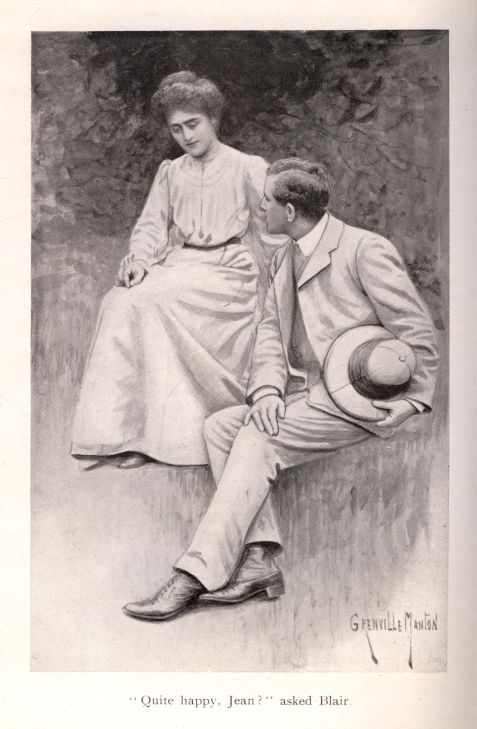
"Quite happy, Jean?" asked Blair
"Happy, dear? Could any one possibly be happier? Look at that!"—Master Kenni-Kenni rolling gleefully on a white spread at her feet in a state of nudity, and gurgling paroxysms of happiness.
"He's a fine little fellow"—and he poked his son playfully in his fat little stomach, provoking fat-creased laughter and dimples and more gurgles.
"He's the finest little fellow in the whole world, and he's yours and mine, Ken. God has been very good to us, dear. I sometimes feel as if we had no right to be quite so happy while——"
"While?"
"One can't help thinking of the poor little souls in the slums and alleys at home. It really doesn't seem right, somehow. If we could only bring them all out here——"
"I wish it were possible, but it isn't. Meanwhile, this is our chosen work, and by God's grace it seems like to prosper. I am very grateful that you are content here, dear. After London——"
"London! I'd give the whole of London for one curl of Kenni-Kenni's hair. Isn't it beautiful? There never was any silk like it in this world."
"Never!" said Blair with conviction.
Then Alison Evans and Mary Stuart came across to them, Mary carrying Alivani.
"We have come to worship too," said Alison. "I wish you'd order Mary to give me my baby, Mr. Blair. I can hardly get touching her when she's about."
"Well, Jean won't let me have hers," laughed Mary in self-defence.
"Jean was just valuing the whole of London Town against one curl of that young man's hair. So you see what the whole of him's worth, Mary. Oh yes, you may touch him, if you'll promise not to spoil a hair of his head."
Mary laid Alivani down on the white spread by Kenni-Kenni, and the two gurgled and kicked in company, while she knelt over them with absorbed face and happy lights in her eyes.
"Jean was wishing she could bring all the poor children in London to kick on the beach here," said Blair.
"Yes. I often think how very much better off the children here are," said Alison Evans.
"In some respects."
"In all respects, I'm inclined to think. Their fathers and mothers almost worship them. Cruelty to children is unheard of. Bodily they are miles ahead——"
"And morally and spiritually?" he said, to draw her on.
"I have seen children at home, in Glasgow and Edinburgh, almost as benighted as these, and not half so pleasant to deal with. Now, with the chances we are giving them, I think these are infinitely the better off."
"Under the new order of things, perhaps. But hitherto you must remember that death dodged life round every corner here, and life broke off very short at times. However, we cannot clean up all the world; but, please God, we'll do our best with this little bit of it. And now," jumping up, "I must get back to work, or your masters will be calling me names. Don't kill those two infants with kindness, Mary."
He stood looking down upon them all for a moment, while the women all bent over the wrigglers on the white cloth.
"Is it possible that not one of you ever feels a longing for the fleshpots of Egypt?" he asked, with a smile.
"Do we ever show any symptoms?" asked Jean.
"You certainly do at the moment. You all three look as if you would like to devour those children on the spot," and he went away to grind out dialects with Matti and Ha'o.
CHAPTER XXVII
PEACE WITH A SPEAR
The work progressed favourably but not without occasional set-backs. On Kapaa'a, where its supervision was most constant, the advance was naturally greatest. On the outer islands the brown men and women were effusive in their promises—in expectation of largesse. Like the prodigals of all time, they were always ready to discount future benefits—which they did not very fully understand and considered somewhat problematic—for a trifle on account, which they understood extremely well. But the moment their preceptors' backs were turned, the promises were forgotten in immediate enjoyment of the reward.
All this was only what was to be expected, and in no way disconcerted the labourers in the field. Blair would rate the delinquents good-humouredly for their shortcomings, and they would acknowledge them like schoolboys, promise amendment, and break the promise before the Torch had rounded the Head. He felt himself in closer touch with them, however, on each visit, and was satisfied. His plans and hopes were very wide-reaching, and God's temples, natural, physical, or spiritual, do not rise in a day.
Occasionally there were more serious lapses, and these had to be dealt with firmly but delicately, so thin were the cords by which he held them.
Aia, the smallest island of the group, lay a short five miles beyond Kanele, sacred to the memory of Aunt Jannet Harvey. Aia had a population of about fifty. Kanele three times as many.
Blair and Jean and Kenni-Kenni landed on the latter one day, on one of the regular rounds of visitation, and received the usual expectant welcome from old Maru and Kahili and the rest. The women crowded enthusiastically round Jean and her boy, while Blair talked to the men and divided among them the things he had brought. They stopped on shore several hours and were regaled with fruits and coco-nuts. When they got into the boat the whole population lined the beach and waved them farewells.
"We really seem to be getting hold of them at last," said Blair, as they rolled along towards the Torch.
"They are very friendly and seem very glad to see us," said Jean, and they went on to Aia.
"Something wrong," said Captain Cathie, as the Torch drew in.
The village was not in its usual place. There were no people about.
They landed cautiously, Blair and Cathie and half a dozen men, and found the houses in ruins. With added caution they climbed the hill, and in time came upon the villagers lurking in holes and crannies.
Their story was simple. The very day after the Torch's last visit, the men of Kanele, headed by Maru and young Kahili, had come over in their canoes and demanded the goods they had received from the white men. These being refused, they proceeded to take them by force. The Aia men were outnumbered and beaten, their village burned, and several of them killed—and eaten. The rest had lived in the fear of death ever since.
Blair was a man of wrath that day. His first feeling was the same as Captain Cathie's, in whom the natural man always ran strong.
"Well, captain, what do you advise?" he asked.
"I'd like to give those Kanele men a right good skelping," said Cathie warmly. "Something they wouldn't forget in a hurry."
"So would I, but I'm not sure of the wisdom of it."
"Truckling beggars! Sweet as milk when we're there, and playing the devil the minute our back's turned. They need a lesson."
"We'll take the night over it. It's a serious matter."
They walked the deck far into the night, with the big stars swimming in the smooth black rollers, and the distant roar of the Aia surges, now to port and now to starboard, as they beat gently to and fro in default of anchorage.
"In the first place," said Blair, summing up their ideas, "these people are not safe here. Whatever we do or don't do, the Kanele men will take it out of them as soon as we're gone. We must do our best to persuade them to migrate to Kapaa'a. That will be a good thing for them and a good thing for us. As to the Kanele men, the difficulty is that we want to retain our hold on them. This affair only shows how great the need is. And if we take measures against them—any measures almost—we are like to weaken the small hold we have now."
"All the same," said Cathie bluntly, "it won't do to let 'em think they can carry on like this and nothing said about it. That'd be fair provoking them to do the same again."
"It's difficult to know just what to do," said Blair; and Jean down below, with Kenni-Kenni nestling close in her arms, heard the four feet tramping, tramping, slowly and heavily, to and fro, till she fell asleep. They seemed to be still tramping whenever the Torch gave a sudden kick and woke her. But there was a sense of guardianship in the very sound, and Kenni-Kenni's soft head against her heart was very comforting.
In the morning they set to work on the plans they had arrived at overnight.
Blair went ashore early, while Cathie prepared for his passengers.
It did not need five minutes' talk to show the Aia men how unsafe their position was. It was self-evident. But it took much talk and persuasion to induce them to migrate to Kapaa'a.
They saw the advantages. Some of them had been there already and seen for themselves; but the brown men cling to their own bits of coral or volcanic rock as strenuously as Highland crofter to his dripping heather, or Irish peasant to his patch of bog.
The women, however, had listened to those marvellous accounts of the unheard-of security of life and property on Kapaa'a, and now they joined forces with Blair and carried the day. By sunset they were all aboard the Torch with such belongings as the Kanele men had left them. The Torch beat to and fro again throughout the night, and not a native closed an eye for the strangeness of it all, and in the early morning Blair was ashore again on Kanele. He had assured Jean there was no danger; but he left Captain Cathie behind—to look after the crowd of brown men and women.
He walked boldly up to old Maru's house, and found it still asleep.
The old man started up wide awake at his call, and the look on his face was a matrix of Blair's—detected wrong quailing before righteous wrath.
"You know what I have come about, Maru," said Blair. "You have done ill by Aia. Why?"
"It was the young men. They desired more goods."
"Call the young men. I will speak to them."
But there was no need to call them. They had seen the Torch and were coming, and coming in expectation of possible trouble, for they all came armed.
"Yes, I see you know why I have come back," said Blair, as they thronged about the house. "You have done wrong, and you have got to answer for it. We came here to make life brighter by bringing peace——"
"We don't want peace. Fighting is very much better," growled one.
"Oh, you are brave men! How many men were there on Aia? Twenty-five at most. And how many of you went over? More than sixty. Oh yes, you like fighting when the others are weak. How will you like it when you are beaten and running for your lives into the hills? You have done ill, and you must answer for it. Maru and Kahili will come with me to Kapaa'a, and we will decide what shall be done."
"Not me!" said old Maru, or words to that effect, and drew from its hiding-place one of the axes Blair had given him, and began to swing it gently in his hand.
"If you do not come, we shall fetch you. It is for you to say. If we have to fetch you, it will make trouble."
Old Maru's axe swung gently to and fro, to and fro, as though hungering to bite, but doubtful.
"That would not serve you, Maru," said Blair quietly. "Though you cut me in pieces, the rest would come and you would suffer the more. The old times are past. We have come to give you better times. Peace you shall have, though we have to bring it with club and spear."
And just then Long Tom on the yacht bellowed his tremendous note, and the brown men looked round apprehensively.
"That is my big canoe speaking," said Blair. "But it is only a warning. It can strike as hard as it talks. Will you save trouble by coming, Maru?"
"I will not go."
"Then we shall come for you. I am sorry; but the wrong-doing is yours.... Let no man lift his hand, or worse will follow," he said, as a restless movement rustled among them. Then eyeing them steadily, he passed through, not sure at what moment axe or club might fall on his head. But so high was his look that no man, even of those he had passed, found courage for the blow, and he walked down to the beach alone.
"I'm mighty glad to see you back whole," said Cathie, as Blair swung up on deck. "I saw their clubs through the glass, and I misdoubted them. They wouldn't come?"
"No, they wouldn't come, so I promised to fetch them. Now we'll get on, captain. First to land our passengers on Kapaa'a, and then as we decided last night."
Ha'o and the rest were mightily surprised at the size of the Torch's company. But the chief jumped to Blair's views at once.
"You will soon become a nation at this rate, Ha'o."
"I will deal well with them," said Ha'o.
"And now as to the men of Kanele?"
"We will make an end of them."
"I want them as part of your nation, and dead men are no use. If we go in force enough, I do not think they will fight. But they have broken the peace, and they must have a lesson."
"We will teach them with the spear. It will be a lesson for the others also. When shall we start?"
"The sooner the better; but first we must see the newcomers housed."
That took two days, and then the Torch and the Jean Arnot sailed with larger crews than they were in the habit of carrying. First round the other islands, at each of which Blair and Ha'o landed and had a talk with the headmen and explained their ideas to them.
And much hard talking it took, in some cases, to carry their views. But they were set on it, and they prevailed.
From each village they enlisted the headman and certain of his followers, from six to ten, according to the population, and in due course came down on Kanele one hundred and fifty brown men and eighteen whites, with Long Tom in reserve, and great hopes that so large a display would suffice without any fighting.
All the boats on Kapaa'a had been requisitioned for the debarkation, and it was an imposing flotilla that drew in to Kanele beach that day to bring peace at the point of the spear. And, composed, as the gathering was, of the most discordant elements, it was yet all moulded to one purpose by the strong will of one man, and by the very differences that separated its units one from another. For each component felt itself but a part of the whole, and in a minority which left it no option but to work with the rest.
Not a soul was to be seen on shore, but they knew that black eyes watched stealthily from every cover.
"Maru! Kahili! We have come for you," shouted Blair. "Here are Ha'o of Kapaa'a, and Ruel of Anape——" and he recited all the names of the head-men. "We will give you till the shadows are smallest to come in. Then be it on your own heads!" and the great company sat down on the beach to pass the time.
"Will they come?" asked Blair of Ha'o.
"They will come," said Ha'o. "They would have no chance against us, and they are not fools."
Blair seized the opportunity for more talk with the leading men from the other islands. He showed them that none were safe if raiding were permitted, not even the strongest, for against the strongest combination might prevail. The only security was in union against illdoers; and he rubbed that lesson into them till they were not likely to forget it.
Before the wheeling shadows had shortened the slim black lines of the palms into their spreading crowns, a tumult broke out inland, and as they all stood expectant, a mob, in which were many women, came hurrying along, with old Maru and Kahili on its front like corks on a swelling tide.
"It is well," said Blair, as he went to meet them. "You have given us much trouble, but you have saved yourselves more. Do you understand, Maru, and you, Kahili, and all you men and women of Kanele, what this great company means? It means that the old times are gone for ever, and that the better times are come. If there is to be any fighting in future, we of Kapaa'a and the islands round about will have our say in the matter. Take those two to the boats," and at a sign from him a file of Torches led the prisoners away. "There are others among you who prefer war to peace," he said. "I want them also."
This caused a hubbub amongst them, and much hot discussion, but at last certain ones were evolved from the crowd, and pushed to the front protesting, and to the number of ten he had them marched down to the boats, amid the wailing of their women.
"Now, listen!" cried Blair, waving down their cries with a peremptory hand. "Is it to be peace or war henceforth?"
"Peace," wailed the women, and the men stood silent. "Then let the women bring here all the spears and clubs, for you will not need them."
This was touching them on the raw, for the brown man's weapons are his dearest possessions.
But this was to be a lesson once and for all, and not for the men of Kanele only.
"I must have them," said Blair. "If you will not bring them, we must get them ourselves. Which shall it be?"
The men stood, stubborn and sulky. Some of the women on the outskirts of the crowd began to trickle away.
Then old Maru's wife crept up downcastly from the side of the throng, carrying two long spears and a club, and cast them on the sand at Blair's feet.
"It is good, Maruaine," he said gently.
"You will not kill our men, Missi?" she asked piteously.
"I have come to make your lives happier, Maruaine. I will not hurt a hair of their heads. But they must learn, and this is the first lesson."
Kahili's wife followed, and one by one the other women came, with more spears and clubs, till the pile was a goodly one.
Then he had a fire kindled beneath them, and the brown men watched its easy lighting with a match with wonder, but twisted uneasily as the weapons were consumed.
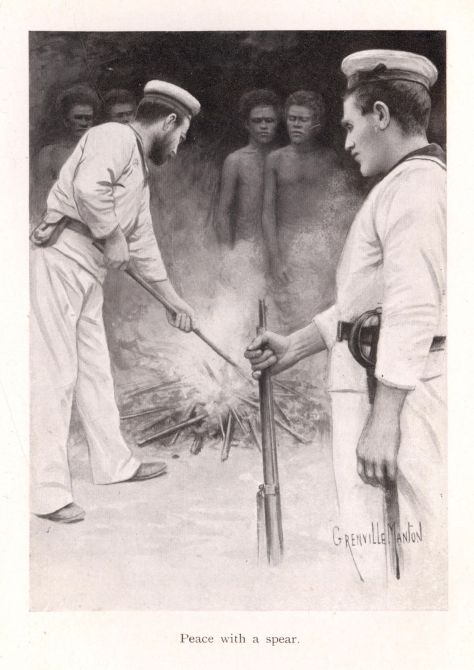
Peace with a spear.
"Now, listen!" said Blair, when the crackling died down. "Maru and Kahili, and the others we have taken will go with us to Kapaa'a for a time, and will live with us there. We intend them no harm. They will, I hope, learn many things amongst us, and then they will come back and tell you of them. We wish your good, only your good, always your good. But those who do ill, who break the peace, and rob their weaker neighbours, will have to answer to us for it. Ha'o of Kapaa'a has known us now a long time. He will tell you that we mean you well."
And Ha'o stood out before them, tall and brown, and said, in a voice that rang above the wash of the surf and the pattering of the palm fronds—
"Kenni is my brother. He has done great things for Kapaa'a. Twice he saved my life, and the lives of my people. Three times he risked his own life, and the lives of his people. His blood has run for us. What Kenni says and does is good. Any man who thinks otherwise I am ready to talk to him," and it was evident to all that Ha'o's talk would be strong, and to the point.
Blair said a word or two to him, and he added—
"While Maru and Kahili are living with us, Maru's wife will be your chief. She is a wise woman, and loves peace more than war. Has any one anything to say against it?"
No one at the moment desired to say anything against it, whatever they might think or feel.
"It is well," said Ha'o. "Let no man speak against it when we are not here. Now you will bring us food, and then we will go home."
Two very sober and thoughtful men were Maru and Kahili as Kanele sank into the sea astern. They were treated, however, with every consideration, and Blair was at much pains to explain his ideas to them so far as concerned themselves. For the rest, it was curious to notice how the men of each island kept themselves to themselves. There were differences of dialect, of course, which interfered somewhat with freedom of intercourse, but there were also lifelong memories of bloody feuds which kept them apart. It was a mighty step towards better times to see them there in peaceful toleration of one another's presence. The dividing lines were at once the mark of the past and the sign of the future. A year before they would have been at one another's throats.
On Kapaa'a the hostages received the same equal treatment with the rest. They were given houses and tools, and shown how to use them. They joined in the chase, and developed discriminating tastes in the matter of fresh-killed pig and goat cooked in paw-paw leaves. They were neither talked at nor preached at. They were simply allowed to absorb the new atmosphere of law and order, and found it good. And in due time they were returned to their own island new men, with the seeds of still larger knowledge within them.
CHAPTER XXVIII
NO THOROUGHFARE
It would be difficult to tell in words the exaltation of spirit which possessed Kenneth Blair at the brave show the new order of things was making in these Dark Islands of his choice. It was a beginning after his own heart, and he rejoiced in it greatly.
I can imagine what he must have looked like as he went about his Master's business—clad always in white from head to foot, and carrying always that high look of his, blazing with enthusiasm and the mighty joy of life, which caught the eye and held it. Kekera—White Fire—the brown men often called him, and he looked it to the life.
He felt things growing under his hand, and his heart was full. A beginning of beginnings and visible growth—what more could the soul of man desire?
Domestic concerns were prospering also. Mary Stuart had the satisfaction of her heart in a little son, and Kenni-Kenni and Alivani crawled neck and neck races on the white beach together. The schools were full, for the teaching was so sheer a delight that the wriggling brown bodies and glancing black eyes felt a day missed a day lost. If ever learning came without tears it did to these. They were actually beginning to use English words now and again in their talk and play—by way of showing off at first, indeed, but presently as a matter of course. And the larger children, their fathers and mothers, were imbibing new ideas of all kinds at a revolutionary rate. They were even beginning to put theirs into "Kown im!" and to show some knowledge of what the words meant.
And so far there had been no further disturbance from the outside; but they were always on the look-out for it, and it came, and in the expected shape.
The Dark Islands lie far out of the ordinary track of commerce. For that very reason, when once discovered, they offered unusual inducements to such as found the usual fields too small, and too hot, for their peculiar forms of immorality. The outposts of civilisation, such as it is, have not infrequently been pushed forward by individuals whom civilisation could no longer tolerate in its midst. It was such a one who came out of his way—and incidentally out of the way of some who ardently desired to lay hands on him—to bring the amenities of commerce and civilisation to the Dark Islands.
Old Maru, and his son Kahili, and the other hostages to law and order, had returned to their homes full to the brim of new ideas and great intentions, and Blair reposed great hopes in them.
He and Cathie, on one of their usual rounds of the islands in the Torch, came sailing round Kanele Head one day and were surprised to find a ship at anchor in the bay.
"Ah!" broke from them both at the sight.
"So that's come," said Cathie. "Bound to sooner or later. Nip it tight, sir, is my advice."
He gave some orders to the mate, and they went ashore.
A burly individual in sailorly garb came down the beach from Maru's house to meet them. He was stout and evil-faced, with small blue eyes and tangled hay-coloured beard and moustache, and the roll in his walk seemed too pronounced to come entirely from much walking of slippery decks.
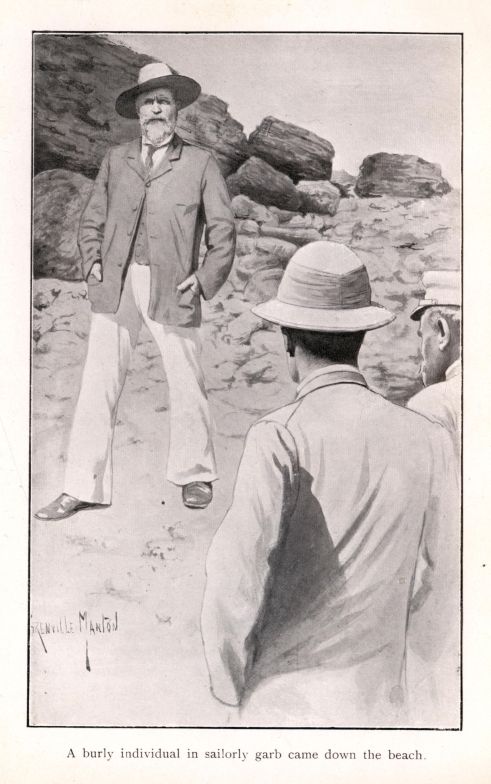
A burly individual in sailorly garb came down the beach.
"Morning," he said curtly. "Traders?"
"No, sir. Missionaries in charge."
"Gee-whilikins!"
"Yes, very much so," and Blair pulled out his watch. The man needed no investigation. His character was written all over him. "It is now nine o'clock. I will give you till half-past ten to clear out of here. If your anchor is not up by that time you will take the consequences. Understand?"
"Say, have you bought this island, mister?" gaped the other.
"Yes, from the devil and all his works, so you clear out. It is now two minutes past nine, and you've got eighty-eight minutes left."
"Well, I'm——"
"You will be if you don't stir your stumps."
"And suppos'n I say I'll be hanged if I go."
"I should consider it not unlikely. You certainly will if you stay."
"Well, I am——! Was it missionaries you said?"
"That's what I said."
"Very well, then," said the invader, pulling himself together, "I'll see you eternally annihilated first." That was not his exact expression, but it is printable and will suffice.
"Eighty-six minutes left," said Blair quietly.
Captain Cathie waved his hat three times to the Torch, and Long Tom's angry bellow rolled up into the hills and lined the side of the trader with curious faces.
"Missionaries! Well, I am——" and he looked at them, and then at the Torch with the cloud of blue-white smoke drifting slowly away from her deck, and then turned and humped his shoulders and went back the way he had come, and Blair and Cathie followed him.
They were all fast asleep at Maru's house, and not likely to waken in a hurry, if the empty rum bottles scattered about were anything to go by. There were some opened cases of trade lying about, and the scraps and remnants of a feast—in addition to the inert forms of old Maru and his wife, and Kahili and his wife, and some of their people.
"Eighty minutes!" said Blair grimly, as he looked round on this undoing of his work.
"Say, mister, couldn't we come to some arrangement?" began the trader.
"Certainly! The arrangement is that you up anchor and away inside—seventy-nine minutes," with a glance at his watch.
"I guess you'll pay for this 'fore you're done, mister. I'm an American citizen."
"Sorry to hear it."
"And an American citizen don't stand bein' fired out like this and no reasons given—not by a long sight!"
"There are our reasons," said Blair, pointing to the heavy sleepers, "and there are yours," and he pointed to the half-emptied case of rum. "Seventy-eight minutes more!"
The American citizen looked him over for a moment but found no hope of amelioration in his face.
"Well, I'm——" and he turned to the door and whistled shrilly to his ship, and presently a boat came slouchily across to the shore.
"Carry them things aboard," he ordered, and saw it done, and then followed his men into the boat.
Then he stood up in the stern and delivered himself luridly on missionaries in general, and on this new kind, as represented by Blair and Cathie, in particular.
"You'll hear of me again, my sons, sure as my name's Hartford Crawley. Yes, by thunder, you will, and don't you forget it!" was his valediction with threatening fist, and they could hear him cursing all the way to the ship.
Blair and Cathie returned to the Torch. At half-past ten Long Tom thundered a reminder to Mr. Crawley that his time was up, and before the echoes died away, the trader's anchor was apeak and his sails were dropping sulkily to the breeze.
He headed slowly out to sea, and was surprised to find the Torch do the same.
He took a notion towards the south. Long Tom barked angrily at him.
He tried a move towards the north. Long Tom barked again. Due west was his course, and they would permit him no other.
All day long the Torch followed him like a sheep dog, and at night drew in so close that they could hear Mr. Crawley still swearing at large. Fortunately, the moon was almost at the full, and he had no chance of slipping away in the dark. For three days they dogged him and kept him to his course. Then they ranged up within speaking distance and delivered their final word, "These islands are not open to traders. If you ever return you do so at your peril." Then they turned and laid their course for Kanele.
Arbitrary action, undoubtedly, but Kenneth Blair was the last man in the world to shirk what he deemed his duty from any fear of possible after consequences.
Maru and the rest were in their right minds when they got back to the island. They were full of excuses and explanations, but Blair said little to them beyond emphasising the fact that these were the men he had warned them against, and that their coming would make for evil times among them. And old Maru, in the keen recollection of the very bad head he had had the day after the trader's supper party was disposed to think he was right.
CHAPTER XXIX
THE ACT OF GOD
A full year of quiet progress left no monumental happenings to record.
The islands were rising rapidly out of their original darkness, and the hearts of the workers were as full as their hands.
Growth in the homes had necessitated ampler accommodation for scholars and worshippers outside. A church and two school-houses had been built to supply the absolute want, and were in full use.
The r and the capital H had got into "Crown Him!" and in some quarters a visible understanding of the meaning of the invocation.
Matters all round were progressing favourably. The bodily health of the islands was good, morally and spiritually it was improving. Law and order were striking slow roots into the shaky quagmire of custom and superstition, and Ha'o was in fair way to become a nation. For the headmen of the smaller islands came regularly to Kapaa'a for consultation—and gifts—and his influence over them grew steadily.
In all matters economic and politic Blair put Ha'o forward as head and front. For himself, he desired nothing but the good of the people, and he judged it best that the executive power should remain in native hands so long as they continued capable and trustworthy. In these matters Ha'o had justified him to the fullest, and had shown himself an apt, not to say an ambitious, pupil. Feuds were of rarer occurrence, and had even been brought to Kapaa'a for adjustment. Cannibalism was no longer openly indulged in, even in the outer islands, and they were hopeful that its day was past.
Evans and his wife had been resident for some months past on Kanele, Charles and Mary Stuart were on Anape, and the Jean Arnot had had a busy time going to and fro between the settlements. The Torch, with Captain Cathie on board, had made a voyage to Sydney, carrying letters home, and bringing back supplies and news. That was nearly twelve months ago, and was the only communication they had had with civilisation since they turned their backs on it.
Kenneth Blair and Jean and Aunt Jannet Harvey and Captain Cathie were sitting one evening on the platform of the mission house, enjoying the well-earned rest of busy workers. Master Kenni-Kenni was crawling about at their feet in light attire, with a strong band of knitted wool round his sturdy body, to which a thin rope and Aunt Jannet were attached, to keep him from falling overboard.
The sun was sinking, red and misty, into a bank of cloud which lay heavily across the western sky, though it still wanted an hour of sunset. The lagoon was sombre red, the spouts of foam on the reef gleamed dusty rose white, the hills behind were dull red bronze and the mouth of the valley was filling with purple shadows.
Cathie had been giving them the latest news of the Evanses and Stuarts, whom he had just been visiting in the Torch, which, with the Jean Arnot, now lay rolling sleepily over their own black shadows in the lagoon.
"Well," said Aunt Jannet, as she hauled Kenni-Kenni back from destruction and the edge of the platform, which for the moment was the limit of his ambition, "I've been hot in my life before, but to-day beats everything. It was like an oven."
"I had to start the engines to get home," said Cathie. "I came in by the lower entrance and there wasn't a breath of air. But we'll have a change soon, and a big one too if the barometer's anything to go by. I've been getting out double cables and kedges to the rocks for both the ships."
"We wondered what you were busy at," said Blair. "You expect a heavy blow?"
"You never can tell, and it's best to be on the safe side. We've been uncommonly lucky so far. But when the weather does get its back up here it sometimes gets it pretty high——Hel—lo!"
The arm of the hill which ran down into the water hid the seaward view on that side. As Cathie spoke, a trim black vessel, with a thin trail of smoke at its cream-coloured funnel, came silently round the point.
They all jumped up at so unusual a sight and stood watching eagerly.
"Service ship," said Cathie. "What on earth is she doing here?"
At sight of the two ships in the lagoon the stranger slowed down, and then her syren pealed shrilly across the water.
"We'd better go and see," said Blair, and the two sprang down off the platform and ran to the whale-boat drawn up on the beach. The Torch men and a crowd of curious natives were already there.
"Now, lads, show the navy men how you can row," was the captain's order, and in two minutes the white boat was bounding towards the opening in the reef. It leaped the rollers and presently drew in to the rows of bronzed faces which lined the side of the ship and looked on approvingly.
"This is Kapaa'a, I presume?" asked a tall man in a heavily-braided cap.
"This is Kapaa'a," said Blair.
"And is this Mr. Blair?"
"I am Kenneth Blair. This is Captain Cathie."
"Come on board, gentlemen." A ladder dropped over the side, and they swung up to the deck.
"Can we get inside there, captain?" asked the tall man. "And is there anchorage? I don't much like the look of the weather and the barometer is unusually low."
"Yes, sir, it's going to blow, or I'm much mistaken. You can get in all right. There's no bottom to that hole in the reef. But whether you'll be better inside or outside, if it blows hard, I wouldn't like to say. I've kedged both the schooners there, and I think they'll ride it out."
"And there's plenty of water and good holding?"
"Plenty water to within a couple of hundred yards of the shore. The shelf breaks there. Holding's fair. You'd better kedge same as we've done."
"Perhaps you'll con her in for us to what you consider a good position. We shall be here for some time, and it'll be pleasanter inside. You'll excuse me, Mr. Blair, for the moment. We'll have plenty of time to talk when we get ashore," and he went up on to the bridge with Cathie, and the big ship headed for the reef. She went weltering through the passage with the big rollers roaring at her stern, and crept up under lee of the southern ridge. Then the anchor went down with a plunge, and the boats dropped lightly into the water to carry the kedges and cables to the rocks.
Blair stood watching observantly. The ship he saw was H.M.S. Bonita. He casually asked one of the men, who happened to stand by him for a moment, where they were from, and was told "Australia," and the captain's name was Plantagenet Pym. Captain Pym had seemed a bit stiff in his manner, Blair thought, but that style, he knew, often went with a heavily-braided cap, and he thought no more of it.
Presently the two captains came down from the bridge and approached him.
"You will permit me to offer you such hospitality as the island affords, captain?" said Blair.
The other seemed to hesitate for a moment, then he replied, "Thank you, Mr. Blair, I shall have to be ashore part of the time so I will avail myself of your offer. I will accompany you in five minutes. Can I offer you any refreshment—a glass of wine?" and on their declining this he disappeared below.
He was up again inside the five minutes, and with a word or two to his senior lieutenant, descended the ladder into the whale-boat.
"Your crew does you credit, captain," he said to Cathie, as the proximity of the uniform braced every man of them to his best.
"Picked men, every one of them, sir, and good men all," said Cathie proudly, and every man felt himself a good inch taller.
The dull red glow had faded off the hills and out of the sky. The water of the lagoon was the colour of lead, with a sullen heave in it. The jets of foam on the reef looked like the fangs of wolves against the dark sky beyond. There were cold whispers in the air, and the palm-trees on shore shivered audibly. The white mission-houses and buildings gleamed chill white against the dark hill, but yet gave a touch of comfort and civilisation to the scene.
The crowding natives were greatly impressed by the sight of Captain Pym. Ha'o underwent the process of presentation with extreme dignity, and then Blair led the captain to his house.
"Why—Mr. Pym!" cried Aunt Jannet, who was nearest the steps and so met him first. "It is good of you just to drop in on us in this way," and she shook his hand with a warmth that almost succeeded in infusing the like into his response.
"Yes, I've come over six thousand miles to call on you, Mrs. Harvey. And how are you, Mrs. Blair? Still suffering exile with equanimity?"
"No exile, no suffering, Captain Pym," said Jean brightly. "We are all enjoying ourselves extremely, I assure you."
"Well, I suppose one can bring one's mind to anything."
"If it's the right kind of mind, you can," said Aunt Jannet heartily.
There was just a touch of implication in her tone and manner that some folks were not the happy possessors of that kind of mind. Captain Pym stiffened back into officiality somewhat.
"And you really experience no longings for London again, Mrs. Blair?" he asked, metaphorically turning his back on Aunt Jannet, who magnanimously went inside to see after supper.
"Not the very slightest."
"Marvellous!"
"You see I have here what I had not in London You shall see my boy in the morning. He's the finest little fellow in the world."
"Ah! ... I suppose that fills many a want."
"He fills our hearts so that there is no room for wants. Are you making a long stay?"
"That depends. A few days, at all events."
"We shall have heaps of things to show you. All our work here, and there's a wonderful valley down there with great stone gods that date back to about the time of the flood. Some ancient race that used to live here, they say. We will have a picnic there."
"If I have time I shall enjoy it."
In due course the time came, but Captain Pym enjoyed it less than he had anticipated.
"Now, good people, supper's ready, and you'll all catch your deaths if you sit out there any longer," called Aunt Jannet from the doorway. "We have been stewing with the heat all day," she added to Captain Pym, "and now it's gone to the other extreme. I think you must have brought a cold wind with you, captain."
"We haven't had a breath all day. It looks like a spell of dirty weather," said the captain.
The wind was coming off the sea in cold gusts. A weary half moon was bucketting through a rout of ragged clouds, which sped on over the mountains as if in haste to hide themselves from some unseen pursuer. In the gaps of the hurrying clouds the moon and a few stars shone wanly, and in their dim, ineffective light, the water of the lagoon tossed brokenly like a pan of boiling lead. The flying rags of cloud came from the dark bank in the west into which the sun had dropped. It was spreading upwards. The roar of the reef sounded harsher than usual and full of threatening. There was a strange uncanny look and feeling abroad.
"We're certainly in for something," said Captain Cathie, as he stood looking out to sea. "I've never seen it quite like this before. I shall go and sleep aboard the Torch"—which did not add to their cheerfulness.
"You'll have some supper first, captain?" said Aunt Jannet.
"Oh, yes, I'll make sure of some supper. If it's to be a fight I can fight better on a full stomach than an empty one."
So they went inside, and found it pleasant to close the door, which was a very unusual thing with them.
Captain Pym's manner during supper was still somewhat stiff and formal; but he unbent enough to give them the latest astonishing news of the outside world, the lack of which was the one thing they felt somewhat at times. But it was only when the pipes were alight afterwards that he disclosed himself.
"You are wondering, no doubt, what brings me here, Mr. Blair," he said.
"Well—yes, somewhat. You are the first visitor we have had."
"Not quite. And it is because of those others that I am here."
Blair looked at him in surprise. Captain Cathie nodded understandingly, as though in confirmation of his own thoughts.
"Certain complaints have been made to the Government concerning some of your doings here, and they have sent me to look into the matter."
"I—see. You refer to the kidnappers we put a stopper on——"
"That complaint comes from Peru. There is one also from the American government——"
"Ah, yes—Mr.—What-was-his-name?—Crawley, was it? He promised we should hear from him. Well, sir, we shall be glad to put our side of the case before you. You shall see what we have done here since we came, and no doubt you will appreciate our desire to safeguard our work in every possible way. We have done no single thing we in any way regret, and we would not hesitate to do the same again if occasion should arise."
"Ah," said Captain Pym, with a knowing official nod, "you gentlemen of the cloth, when you get right away from any authority but your own, sometimes go to extremes, and are perhaps tempted to magnify your office somewhat."
"That is quite impossible," said Blair quietly. "I consider my office the very highest in the world. As far as in me lies I have worked up to my ideal of it, and shall continue to do so. As to going to extremes, we have simply defended our work from spoliation. That also we shall continue to do."
"Hear, hear!" said Aunt Jannet energetically, and Captain Pym frowned officially at the pair of them.
"Supposing, Captain Pym," broke in Cathie, by way of lightning conductor, "you had an unarmed tender attached to your ship, and an enemy stole up in the night and carried her off, crew and all, you would consider yourself justified in following and bringing her back, and taking payment out of the other side."
"That's the way to put it," said Aunt Jannet.
"The cases are not parallel, sir. That would be a casus belli, and I should of course do my duty. You have no authority——"
"Oh yes, we have," said Blair warmly. "The very highest"—and as Captain Pym did not seem to appreciate that point, he added—"but, apart from that, we have the endorsement of Mr. Annesley, the Colonial Secretary. He and the Earl of Selsea were good enough to take very great interest in our intended work here. I laid all my plans before them, and they approved them. In fact, they spoke of a protectorate."
"The Earl of Selsea is dead, and Mr. Annesley retired from office twelve months ago."
"Ah, that may account for things. I am very sorry to hear that. However, we don't need the protectorate. Kapaa'a is almost on to its own feet, and can speak for itself."
"And what position does Mr. Blair occupy in the government?" asked Pym, with a cynical touch in his voice.
"None whatever, sir, and desires none. We have consistently worked through the chief Ha'o, whom you met on the beach. Nothing has been done without his approval. It is his elevation and his people's that we desire, not our own, and I think I may say he is as keen on it as we are."
"From all accounts, however, your work has by no means been confined entirely to the spiritual department, Mr. Blair; Long Toms and Winchesters hardly come within the strict bounds of the missionary calling."
"The shepherd may use his crook to keep the wolves off his flock. Our crooks consist, as you say, of Winchesters and a Long Tom. If we had not had them we should not be here—nor would our flock. My ideas of missionary duties may strike you as somewhat advanced, Captain Pym, but then, you see, I have the advantage of knowing all the requirements of the case. The very first essential to progress is peace, and you can't procure it with words when you're dealing with elementary facts."
"If we'd settled all those elementary facts at the start, as Captain Cathie and I advised, we would have heard no more about them," said Aunt Jannet, with a regretful shake of the head. "It's possible to be too conscientious for this world."
"We work for both, you see. I admit that a clean sweep would have saved much trouble. But I couldn't bring myself to hanging them, richly as they deserved it. As to the American citizen, his end and aim was to introduce the drink traffic, and that we won't have at any price. Not even under government orders."
Their talk had been so vital that the waxing of the gale outside had passed unnoticed, though the door was jerking at its latch and the windows buzzed like bees.
When the discussion came to a pause, Captain Cathie jumped up and went to the window.
"I'm off," he said quickly.
"If Mrs. Blair will excuse me for to-night, I will go too," said Pym. "If there is risk for the Torch there is risk for the Bonita, and I would sooner be on the spot."
"I hope there is no danger," said Jean. "We have had many a big storm, but the ships have never suffered."
"Barometer's lower than it's ever been since we came here," said Cathie, with a shake of the head; "and I've no doubt Captain Pym feels as I do, that when you don't know what's in the wind it's as well to be where you can find out."
"Quite so," said Captain Pym, and Blair went down with them to the boat.
They were nearly blown off their feet before they got to it, and the waves that swept up the white beach were such as they had never seen on it before. The rush of the wind in their ears dulled all other sounds. In the spasmodic gleams of the moon through the ragged clouds they could see the rollers sweeping over the barrier reef with unbroken crests, and the usually placid lagoon was in a turmoil.
"Can we manage it?" shouted Pym, in Cathie's ear.
"Under the lee of the ledge there," shouted Cathie, and pounded on the door of the men's house for his crew.
Blair helped them down with the boat, saw them all soaked through before they could get afloat, and then watched them toil away into the lee of the protecting ridge of rocks.
"They'll have their own to-do to get there," he said, when he got back to the house. "The waves are coming right in over the reef. I never saw anything like it."
"Is this man going to make trouble for us, Ken?" asked Jean anxiously.
"Oh, I don't think so. Don't worry about him, dear. He's a bit bumptious and unsympathetic, but I think we can show him that we could have done no less than we did. He doesn't trouble me in the slightest. Whatever he does, our work stands and tells its own tale."
In the morning it seemed to the unknowing as though the storm had blown itself out. The wind had fallen, but the sky was heavy; dark grey clouds boiled along close above mud-coloured waves, and the horizon lay just back of the reef. The sun made a faint fight for a show, but looked and felt out of place, and after pushing ghostly fingers through stray holes in the clouds, and peeping at the water below, went into retirement again.
The two captains came ashore after breakfast, but when Jean expressed satisfaction at the passing of the storm without any damage, Cathie only shook his head.
"Now, Captain Pym," said Blair, as they walked along towards the village, "let me remind you that less than two years ago these people were eating one another, and delighting in it. There has not been a man eaten on Kapaa'a for over twelve months now. Here is the boys' school. That is the girls'. As it is Sunday, they are all in church waiting for us. Perhaps you will stop for the service. It is very short and simple. Then we will go on and show you other evidences of our work."
The church was crowded, and when the brown men and women and children sang "Crown Him!" at the full stretch of their lungs, most of their black eyes were fixed on Captain Pym—to his great discomfort—as though they applied the hymn specifically to him, which possibly some of them did.
After service Blair conducted him to the village, and on to the plantations and taro fields, and even Captain Pym's official phlegm and preconceived notions had to acknowledge that, for a country three years ago buried in barbarism, the sights he saw were very striking.
He did not say much. His feelings were at strife. He had come to condemn, and he found himself forced to admit and admire.
The plantations had by degrees crept a considerable way up the valley. The party came back along the shoulder of Ra'a's hill, and as they came towards the open a furious gust of wind carried them almost off their feet.
And then they saw the most appalling sight of their lives, and one they never forgot.
Out of the dim grey curtain of the west there appeared a monstrous sinuous shape that reached from sky to sea, and came swirling towards the island with an easy voluptuous grace that was full at once of haphazard fortuity and most malign intention.
They stood frozen. Blair suddenly gripped Pym by the arm. He could not speak.
Behind the first monster came another, and another, and another, all reeling hither and thither like drunken demons, but all making straight for the island.
"Good God!" cried Pym, and instinctively put his hands to his mouth to shout a warning to his ship, a shout that could not have carried five inches.
Then he commenced to run down the hill as he had never run in his life before. His whole thought was for his ship and his men, Blair's and Cathie's for the people below.
Captain Pym reached the beach through a crowd of fugitives making for the hillside. The monsters had been sighted, and panic was afoot.
Blair and Cathie rushed down through the village, shouting—
"To the hills!" and sped on.
Jean and Aunt Jannet Harvey, busy in the house, had seen nothing. The two men dashed up the steps. Blair seized his boy under one arm, and dragged his wife by the other. Cathie laid hold of Aunt Jannet, and with a gasping word of explanation which only filled the women with fear, and explained nothing, they ran for the southern hill, whose arm ran out into the sea.
Only when they had got half-way up it did they dare to turn and look.
They saw Pym ramping alone on the beach like a madman.
They saw the first of the hideous whirling monsters hop lightly over the swollen reef without a pause and pirouette in the lagoon. Then a blast of smoke whirled from the deck of the Torch, and the dull sound of the gun went quickly past them. The monster writhed and broke, and the pendulous head of it swept inland. The ships pitched at their moorings till the kedge cables snapped and they seemed standing on their sterns. The waves of the lagoon churned up to the platforms of the mission-houses.
"Good lad! Good lad!" shouted Cathie.
Then the other three monsters, as though in answer to the challenge, as though endued with malignant understanding and most devilish determination, bent and swung and reeled over the reef and flung themselves towards the ships.
They saw Captain Pym suddenly throw up his hands above his head in a gesture of utter impotence and despair, and then turn and make for the hill.
The watchers crouched in a crevice of the hillside and gazed narrow-eyed, and their breaths came quick and short, not from the run but because their hearts were in their throats and choked their breathing.
It was a most terrible sight. The powers of all evil—death, destruction, and malignity—against the puny works of man.
The three awful whirling shapes danced and swung in the lagoon, showing off all their evil graces. Three ineffectual flashes broke from the gunboat, but they avoided them with an easy swing, as though they understood and were on their guard. They reeled towards one another and seemed to take evil counsel together. Then, as though moved by one mind, they swooped down straight on the ships.
"Oh, cruel! cruel!" moaned Jean, clasping her boy to her and hiding her face in him.
Captain Cathie groaned as he watched, and then burst into incoherent, and unusual, and most excusable blasphemies.
Aunt Jannet and Kenneth Blair stared in dreadful fascination.
For one of the whirling monsters reached the ships, picked them up, and smashed them and itself together in one dreadful destruction. When the wild welter settled down and permitted sight, the lagoon was bare save for scattered fragments and struggling figures.
Another of the awful things made for the opposite mountain side. They saw it strike and break there. The solid earth crumbled and splashed like mud, and palms and rocks slid down to the sea, while the swollen hanging top of it swung away along the hillside belching ragged torrents as it went.
The remaining one went roaring past them like a great wounded beast, and tore up the valley, breaking itself and scattering destruction broadcast. They heard the final crash of it away up among the hills, and a foaming torrent came sweeping down the valley carrying everything before it.
All this time the wind was blowing a hurricane, Such palms as were left standing whipped and writhed in vain agonies. Some snapped like carrots and lay still. The rain beat mercilessly on the fearful watchers and bit like whips. Blair bent over his wife and boy to shield them with his body. Aunt Jannet, dishevelled and grey, and haggard, still peered out at the horrors in front.
A sound from her, between a gasp and a groan, and a sudden terrified clutch at his arm, brought Blair's face up to the crowning horror.
There came a roaring from the sea the like of which was never heard before. A mighty wall of water came rushing on the land to overwhelm it. It leaped high over the ridge of rocks that lay like a protecting arm round the nearer curve of the lagoon. The jets of it went rocketting up to heaven, and the mighty ridged crest bristled like an avalanche.
Blair sprang upright instinctively, to face the danger standing, and dug his fingers deep into the cracks of the rocks in front of him.
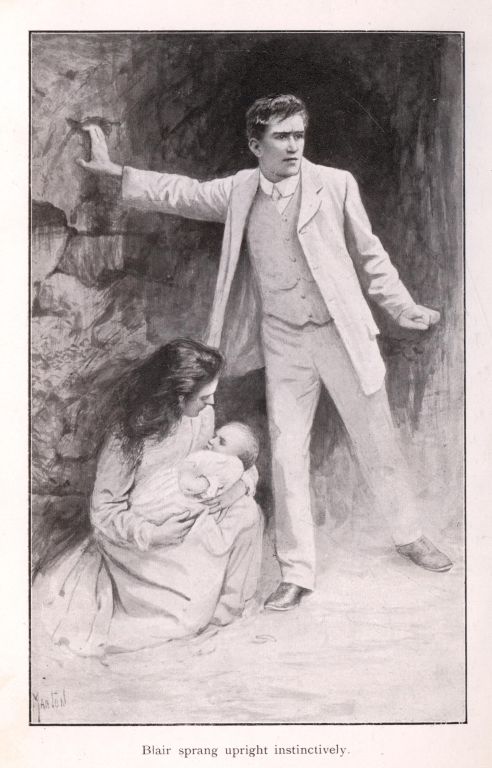
Blair sprang upright instinctively.
The great wave broke on the solid earth with the crash of an earthquake. It was half-way up the hillside, and the opposite hill was suddenly shortened, and stood in the open sea. The valley was a boiling waterway of hideous and inexpressible confusion.
"It is the end of the world," gasped Aunt Jannet, and sank down, and looked no more.
"My God! My God!" groaned Cathie.
"God help us all!" said Blair, and the rain whipped his face till it seemed as hard and set as the neighbouring rocks.
They spent the night there in extremest misery, sodden through and through, chilled to the bone, faint with hunger. Even Kenni-Kenni was damp, though two protecting bodies did their best to shelter him. And all night long the only sounds in their ears were the hiss and rush and roar of many waters, as the terrible sea went back to its deeps, and the clouds discharged their ceaseless torrents, and the troubled land got rid of its torment.
And over and above the weariness of their bodies, their hearts were sick within them at thought of the destruction of all their work and all their hopes. For whether a soul besides themselves was left alive they knew not.
CHAPTER XXX
WIPED OUT
Jean and Aunt Jannet were dozing fitfully, fairly spent with the strain and misery of it all. Cathie's grey beard was on his chest, but whether he slept Blair could not tell.
He himself sat on his rock, chilled to the marrow of his bones, and watched with heavy eyes the slow birth of new life after the deadly horrors of the night. And his heart was as cold as his body.
He wrestled manfully with that which was in him, but surely man's faith and courage were rarely put to sorer test. He had striven so hard, and toiled so ceaselessly, at utmost stretch of hand and heart and brain, and here, just as the harvest was ripening, it was all dashed into nothing, as though by the stroke of an angry hand. Oh, it was hard, hard, hard!
But he fought out his fight singlehanded, and found himself—where steadfast faith and undaunted courage have always firm footing. And a spark of hope struggled up in him to meet the sun. The beginnings of things had always had a charm for him. And here must be a new beginning. They were back at first principles and the elementary facts of life. But, truly, there is a mighty difference between a beginning and a beginning again, and it calls for the best that is in a man to begin again with the heart with which he began before.