Front matter (continued 4)
Reading edition
The times seemed in all ways propitious. Ha'o, indeed, would have preferred that the white men's favours should have been kept all for himself, but Blair was at pains to explain to him that nothing less than the whole island, and if possible all the islands, would satisfy him. In view of what he knew would follow sooner or later, he tried to explain to the brown man that if it were possible to unite the various communities on Kapaa'a under one paramount chief it would be for the great benefit of all.
To which Ha'o replied succinctly—
"Then we must kill Ra'a," and rose to the prospect.
Ra'a had been quiescent for some time now. There was occasional friction between members of the various factions, but nothing more than was to be expected under the circumstances. They were simply squabbles, resulting in no general disquiet, though symptomatic of the underlying feeling that was abroad.
Ha'o, however, never ceased his warnings. Ra'a he said feelingly, was not to be trusted, and the only right and proper thing for the white men to do was to join him in wiping him out, and the sooner the better. And, simply from a political point of view, Blair could not but confess to himself that the weight of evidence was in Ha'o's favour. For Ra'a remained in truculent retirement, and doggedly rejected all efforts at conciliation. Blair had gone up the mountain more than once since that first time, and had done his utmost to win him over. Ra'a accepted all his presents as his rightful due, but gave absolutely nothing in return, not even worthless promises. He was the black cloud on the horizon, and they could only hope that he would remain a cloud and not develop into a storm.
Each week that passed strengthened Ha'o's hands. Not only did it give him time to arm and consolidate his own little community, but his numbers were constantly increased by ones and twos, as the dwellers in the hills took note of the advantages enjoyed by those on the shore through their intercourse with the white men, and desired to share in them. Ha'o permitted the return of these prodigals, since it was better to have them under his hand than beyond his reach. He put little faith in them, but had the wisdom to keep his feelings to himself. Blair welcomed them as straws indicative of the current, but Ha'o, better versed in the ways of his race, pushed on his preparations for the conflict which he foresaw these very secessions would sooner or later precipitate.
When Blair told him of his impending trip of exploration, and tried to induce him to come with them, Ha'o stated bluntly that he preferred to remain at home. It was not impossible that he had it in his mind that if anything happened in Blair's absence, he would have the freer hand to act as he pleased. For the white men were ever on the side of magnanimity, and magnanimity, where Ra'a was concerned, was to Ha'o simple foolishness.
CHAPTER XVIII
SETBACKS
So the Torch slipped down the lagoon like a picture, and Nai and the other ladies completed their laundry operations, and in due course the red sun dropped into the sea, without the explosive hiss which seemed inevitable, and night fell on the little community as peacefully as usual.
Evans conducted their evening service, and the attentive ring of brown men and women round the platform of the house hummed the tunes gaily, echoed the white "Amen" with the gusto of children after a long sermon, and dispersed like big bumble-bees to their homes.
Jean could not sleep that night. It was the first time she and Kenneth had been separated, since their marriage, and she felt as lonely as the circumstances demanded. She got up at last and slipped on a dressing-gown, and went out and sat on the platform.
The soft lip-lap of the water on the beach, and the distant growl of the surf, were soothing, and she sat looking at the great new stars, with which she was becoming friendly by degrees, and thinking of her husband, and wondering how far he had got, and of the vast change her marriage had made in her life.
She had never for one moment regretted it. All her heaven on earth was centred in Kenneth. So long as he remained to her, all the rest was nothing. And before long they would begin to see the fruit of their quiet sowing, the Dark Islands would be dark no longer, and they would be living a quiet, happy life among a new and contented people. It was a grand and glorious work. No, she had no regrets—since she had Kenneth.
On her right across the river, as she sat facing the sea, the mountain loomed sombre and menacing—the hill Difficulty. Her thoughts ran back to that trying morning when she and Kenneth faced the hill, and what it held, all alone, not knowing whether they would ever come back alive. Like many another hill on life's highway, its menace had been chiefly in their own fears, and had disappeared on closer acquaintance. How she wished that uncomfortable man Ra'a would go away, or be reconciled to his brother, or do anything that would allow the community to settle down in peace to its new life's work.
She knew much of Blair's great hopes and large ideas, and how essential he considered it that the islands should as soon as possible attain to some kind of central government, so that they might unite in opposing an inflexible front to any attempt at interference from the outside. The Dark Islands for the Dark Islanders was his aim and object in life at present, and this truculent savage on the hill there was keeping everything back. She almost had it in her heart to wish Ra'a's speedy and sudden death.
Blair had often spoken of the evils that had followed the admission of traders in others of the South Sea Islands—drink, disease, dispossession—and how the communities were ruined before ever they had a chance of better things. Yes, surely, she thought, if Ra'a could meet with some happy accident, which would end him, it would be for the good of the community at large. That was not a thought that would commend itself to Kenneth, she knew, but she could not help thinking it. What a mighty relief it would be if Ha'o walked in some morning, and said, "Ra'a is dead." She felt as if she could almost forgive him if he had done the deed himself.
Then she thought she heard, a sound in the gloom of the hillside. She strained into the darkness and listened intently. She heard nothing, but still felt a sense of discomfort. After all, it might quite likely be one of the natives prowling about, though, as a rule, their fear of ghosts and evil spirits kept them indoors after nightfall, and it needed very strong inducement to take them abroad.
She was still peering towards the hill with puckered brow, when a curdling, short-cut yell ripped the silence behind, in the direction of the village, and in a moment pandemonium seemed loosed, and the night was alive with horrors—screams and yells and all the turmoil of warfare.
That first deadly cry sent Jean flying inside for Aunt Jannet. The good lady met her at the door of her own room with an anxious—
"What in the name of goodness——?" and then Alison Evans and Mary Stuart came tumbling in upon them, and Evans called to them from the ground outside to stop where they were, and they would be all right.
It was not in human nature, however, to stand huddled in the dark, asking one another questions which none of them could answer, when the answer was shrieking outside, and they all crept, trembling, to the verandah, and stood silently facing the danger, whatever it might be.
They heard Evans quietly ordering his men, and felt safer. And beyond, the shouts and yells waxed and waned and wavered to and fro. Once they thought they were coming in their direction, and their hearts thumped painfully. Then the tumult drifted away again, and at last passed furiously towards the taro fields, and died away on the mountain-side.
Then new sounds arose, cries of victory, little less blood-curdling than the shouts of battle, and the ladies crept back into the dark room, assured of their own safety, but with horrible premonitions of what these might portend.
Presently the shadowy darkness over by the river resolved itself into a mob of black figures which came towards the mission-houses, leaping and brandishing its newly-fleshed weapons, and shouting at the top of its voice, in horrible incongruity, and the more horrible in that the tune was perfectly correct, "Kown 'im! kown 'im! kown 'im! kown 'im! Law-daw-faw!"
They circled the fence, leaping and shouting and singing, and the men of the yacht inside grasped their weapons to repel an onslaught. But the brown men had had their fill of fighting for that night, and were only there to advertise their victory.
Evans said a word or two to them, but learned only that Ra'a had come down from the hill and attacked the village, but that they had been ready for him. They were too excited to be able to give any details yet, and presently they drew off and went shouting and singing home.
Jean, with something of a shock, remembered her ill-wishes for Ra'a, and wondered with discomfort, now that the bald possibility faced her so closely, if they had been realised. If they had, she would feel almost as if she had had a hand in his death.
Then a native drum began beating in the village, and the ceaseless monotony of its deep, dolorous boom fretted their ears, and set their hearts jumping, and jangled their nerves to the point of agony. They covered their ears with their hands, they stuffed their fingers into them, but the drum beat in through their temples. They clasped their heads tightly to keep them from splitting, but the drum beat in all the same. When it ceased abruptly at last, and they ventured to lift their heads, they saw one another's pale faces in a faint gleam that stole in through the windows. The darkness over the village was pulsing with the glow of great fires, and as they glanced fearfully at one another they knew that the same horrible thought was in all their minds.
It was dawn before the noises died away, and Evans came in to them with a grim, grey face. He said nothing, but nodded silently—and their horror was confirmed.
Yes, truly, it was a decided change from Kensington and Hyde Park.
No soul from the village came near them that day, nor did any of them venture out except Evans, who went along twice during the day to see what was going on, but returned each time with pinched lips and a despondent shake of the head.
The following day the brown men were about again, but sluggishly, as though the fight had used up all their energies, or something else had clogged them. It was another two days before they settled down to work, and even then they were not quite as they had been.
Ha'o had kept away from them. When Evans came across him at last, he endeavoured to get some particulars of the fight, and gathered that Ra'a had probably watched the departure of the Torch, and thought it an opportunity not to be missed. He had crept down in the dark, hoping to surprise the village, and then make easy prey of the mission-houses and their contents. Ha'o had foreseen the possibility of such an attempt. Evans understood him to say that in Ra'a's place it was just what he would have done himself. So he had men on the watch, and the rest slept armed, and instead of a surprise, the hill-men walked into an ambush—and paid. Ra'a himself had escaped, leaving a dozen or so of his men behind. They had eaten them, said Ha'o, in a matter-of-course way. Ra'a had gone farther into the hills, and to follow him would be dangerous. And so to the boat-building once more, and much singing of "Kown 'im! kown 'im! kown 'im!" which sounded more than ever out of place under the circumstances.
Nai also put in an appearance that day, and to such an extent does the mind prejudice the eye, that it seemed to Jean and the rest that even she was changed from what she had been. In a word, it was difficult to look upon any of these sleek brown men and women without thinking with disgust of the horrible orgies in which they had been indulging. Their humanity seemed but skin deep, and just below it the wild beast lurked and peeped through the glancing black eyes.
Nor was it easy to conceal their feelings entirely, and perhaps Nai's womanly intuition perceived a touch of frost in the atmosphere. She stayed but a short time, and then went quietly away.
"I'm sorry," said Jean, with a sense of discomfort; "but really I could not feel towards her quite as usual."
"Of course you couldn't—nobody could," said Aunt Jannet briskly. "If I knew how to talk to them, I'd tell them what I think of the whole business. I'd make their ears tingle, I warrant you."
"I wish Kenneth was here. He would know just what to do."
"He'll tell you, my dear, that it's no good talking to them. You must just go slow, and break them off it by degrees. All the same, it would be a relief to one's mind to give them a right good scolding."
"They've been used to it all their lives, you see."
"All the worse for them. They ought to be ashamed of themselves."
"But that's just what they don't understand. Suppose a brown man came over to England and remonstrated with us for killing and eating beautiful little lambs and graceful cows——"
"Fudge, child! Lambs and cows aren't human beings," grunted Aunt Jannet. "They haven't souls."
"I don't know that the fact of men having souls makes much difference when it's only a question of their dead bodies being eaten. But I do hope Kenneth can break them off it! It is too horrible! And one can't help thinking of it every time one looks at them. Though I suppose it was just the same before we came."
"What they did before we came was not our fault. What they do now is, and the sooner Kenneth puts a stop to it the better," was Aunt Jannet's final word.
Matters went on quietly—Evans and the men of the yacht clearing and breaking up ground for trial plantings of various seeds, the brown men busy on their boats to the tune of "Kown 'im!" the women, brown and white, busy on their household duties, the children laughing and screaming—till, on the seventh day, a brown runner came, fresh from the surf behind the ridge, to tell them that the Torch was in sight. And instantly they dropped what they were at, to scramble up the shoulder of the hill and wave their joyful welcome. Not a white man or woman there but felt a new sense of security and hopefulness at sight of her, and it was chiefly because on board of her was the wise head and great heart to which they had all come to look for guidance and inspiration in their work.
It was a very joyful meeting when the anchor rattled down, and Blair and Stuart and Captain Cathie jumped ashore from the whale-boat, and the brown men welcomed them, outwardly at all events, with as much gusto as the whites.
And great stories Blair and the others had to tell of their doings out beyond. The brown men and women crowded round the platform till late into the night, laughing and chattering with appreciation of the white men's volubility, though they could not understand a word of it all.
It had been a most satisfactory trip. They had visited all the six islands of the group, and had landed at various places on each of them. They had found the natives suspicious at first, but amenable to presents and open to their advances when they found nothing ulterior in them. In fact, in several places, when the brown men found them actually going away, without any attempts at kidnapping or otherwise molesting them, they followed in their canoes for long distances begging them to return.
"It's a glorious field," said Blair, stretching out his arms energetically as though to gather it all in at once, "if we can only occupy it and fence it round before the degraders come. And we must, for one of those islands given over to the devil would be like a plague spot infecting all the rest."
Then they told him of the happenings at home. He was startled at Ra'a's outbreak and at thought of the consequences if it had proved successful.
"I hate the thought of coercing him or any one," he said thoughtfully; "but until he either comes in, which I fear is hopeless, or is got rid of in some way, he is going to be a terrible hindrance to our work."
"Deport him to yon outer island, Mr. Blair, with such of his people as stick to him," suggested Cathie; "then the rest will have peace."
"Easily said, captain, and a good idea; but how?"
"It would mean fighting, I suppose," said Cathie briskly, "unless common-sense led him to give in quietly. Sometimes it pays best in the long run to grip your nettle at once and grip it hard."
"He'll never give in till he is forced to," said Blair. "Yet I can't see my way to use our force against him. How can we preach peace to these people if we begin by using the sword ourselves?"
"If you give the rest peace, it may be better than preaching it," said Aunt Jannet. "I agree with Captain Cathie. There'll be no peace till that man is got rid of. And, for goodness' sake, do stop them eating one another, Kenneth. I haven't enjoyed a meal since, and I can't look at one of them without thinking that a day or two ago he was munching one of his fellows."
"We shall break them off it by degrees."
"By degrees!—by degrees!" cried Aunt Jannet. "It is too horrible. You ought to go straight to Ha'o and tell him we won't have any more of it."
"And suppose he said, as would be very natural, that he'd do as he pleased? What would you do then, Aunt Jannet?"
"I'd tell him if he didn't stop it I'd make him, or else we'd all go away and leave him."
"Ay, well, you see, we can't make him and we're not going away, so it's no good telling him that. We must use our common sense. These people have eaten human flesh all their lives. It is the greatest treat they can have. If you argued the point with Ha'o, he would probably say that, as between man and pig, man is the cleaner feeder of the two, and therefore must be the better eating. When we have pigs enough, we'll work them on to pork. Until we can get them on to something they like as much, or, better still, get them to feel that man was not meant to be eaten by man, I fear words won't go for much."
"And do you mean to say that you'll pass the matter over without a word, Kenneth?" asked Aunt Jannet.
"I don't say that, and I don't intend to. But if you imagine, Aunt Jannet, that a cannibal is going to give up his daintiest dish simply for being spoken to, I'm afraid you'll be disappointed."
He made his first attempt against cannibalism the next day, and returned from it with a humorous twinkle in his eye.
"Well?" asked Aunt Jannet.
"Well," said Blair, "Ha'o holds that it can't be wrong for him to eat men when we do the same."
"If he'll wait till he sees us doing it, I'll find no fault with him."
"I assured him that white people never ate human flesh. And what do you think was his proof that we did? He pointed to some of those corned-beef tins with George Washington's head on the label, and said, 'There!' and nothing I could say would convince him that George Washington did not represent the contents. He is under the impression that we can our people at home for convenience, and carry them about with us in that way. I assured him it was cow, but it was no use. He could not believe anyone would kill such a beautiful animal as a cow simply for food. He said he would give ten men for one cow any day. So there we are, you see. It will be a matter of time. Meanwhile, I suggest peeling George Washington off the rest of those meat tins!"
"Well, I never!" said Aunt Jannet. "And Ra'a?"
"He is as anxious as you and Captain Cathie to make an end of him; but he acknowledges that it would be dangerous to follow him into the hills, and would certainly mean considerable loss of life, so for the present I have dissuaded him from it."
CHAPTER XIX
FORWARD
This is not a missionary chronicle, but simply a brief record of some of the doings of Jean and Kenneth Blair. It is impossible, therefore, to enter into anything like a detailed account of their work among their chosen people, interesting as that would be. Only the more salient points can be touched upon, such as stood out from the level of hard, plodding, often dry and dreary work, as God's mountain masterpieces stand out in our travel-memories, and remain with us when the long level plains are forgotten. And just as the mountain's grandeur is the record of Nature's strife and endurance, so these salient points in a man's life as a rule mark battle-grounds and commemorate strife—and sometimes victory.
Kenneth Blair always found a vast and quite unique enjoyment in the first beginnings of things. I myself have heard him express a whimsically-veiled, but none the less profound, regret that it had not been possible for him to be present at the very first beginning of all, when "in the dim grey dawn of things, earth drew from out the void and rounded to its shape."
It was very characteristic of the man, and explains to some extent the whole-hearted delight he found in his work in the Dark Islands.
Here, if not a new-created world, was one sunk in nether gloom, to which no glimmer of the light had yet penetrated. As regards things spiritual, it was virgin soil—worse, it was a veritable swamp of heathenism, a quagmire overlaid with the strangling growths and festering remains of ages of superstition, cruelty, and thick darkness. And this in one of the fairest spots on earth.
You anti-missioners, who sit at home and mumble platitudes on the needless waste of life and time and money, spent in the effort to lift these outer fringes of the night, how very little you know!
They are quite happy as they are, those outer ones, you say. Life comes—and goes—easily with them. They have all they want. Why disturb them? Why introduce upsetting notions? Why open their minds to wants only to fill them at so heavy a cost?
The answer is so simple. Would you see any child of yours condemned, for no fault of its own, to sit in outer darkness, if at any cost to yourself you could open the door to the light and warmth you yourself enjoy? Would you refrain from opening the door to a neighbour's child, to a stranger's child, to any child whatsoever, if your hand was on the handle?
These others are children also. In spite of their blue skies and crystal seas and waving palms, they are buried in a darkness like unto death. It is for us who rejoice in the light to help them towards it. Our own great inheritance carries with it an inevitable and inalienable obligation. Shirk it we may and do, cancel it we cannot.
It was the recognition of this paramount duty, in perhaps somewhat abnormal measure, that made Kenneth Blair what he was. He brought to the work the white fire of a mighty enthusiasm which nothing could damp, and which did one good to look upon. The spur of what he deemed a former lapse urged him at times, perhaps, to extremes in the matter of personal risk; but if any man ever carried the courage of his convictions to their fullest limit, without a thought for himself, that did Kenneth Blair. With it all a simplicity of manner which was never at fault, because it assumed nothing; a natural gaiety and high-heartedness which carried him bravely through many a difficult place, and drew even the brown men to him; and a width of view, with a long forward reach, which might have made a statesman of him, had he not chosen this higher path.
To see him at football on the beach with a shrieking crowd of brown boys, himself as much a boy as the nakedest of the lot, was one thing. And to see him pondering, or hear him unfolding to the others, his plans for the Dark Islands, was quite another.
He had seen the strange, and in some cases awful, developments of civilisation in some of the other islands. He had pondered them for years, and had studied cause and effect from germ to ultimate issue. They were as warning lights to him. The wonderful chance which placed in his hands the financial lever had awakened mighty hopes in him. In his mind's eye he saw the Dark Islands enlightened, self-governing, self-possessing, self-supporting—a prospect worth any man's life's work.
Of the preliminary clearing work, then, we will say little. It was dry and dull and dreary enough at times to provoke Aunt Jannet Harvey to active remonstrance at the apparent inactivity of the propaganda. But the quiet work, confined as it was almost entirely to the presentation of better ways of life by force of example, and the very occasional dropping here and there of a seed of precept, began to show some small signs of fruit at last.
Within a very short time Nai's advanced notions in the matter of dress had caught on, and instead of the precarious ridi fringe, towels, or, in default of them, a strip of striped calico, had become the fashionable female attire. Within six months the brown men were going about fully clothed—in a loin cloth.
"It's better than nothing," said Aunt Jannet. "It keeps them from looking absolutely indecent anyway, and as for the children it doesn't matter," for the children all flatly refused any attempt to clothe them. Time after time she had made furtive experiments on them, but they all proved abortive. They took her gifts of cloth and so on willingly, but turned them to unexpected and unintended uses.
Within six months the children were coming to school—some of them, and irregularly—and were actually, in some cases, beginning to have vague ideas as to why they came. It was not much, but it was in the right direction.
Within six months the white men had learned enough of the language to be able, with their additional slight knowledge of Samoan, to understand and make themselves understood—to some extent. And the brown men, in exchange, had acquired a number of English words and had added considerably to their repertoire of hymns—the tunes they picked up marvellously, and the words they chattered like parrots.
They had also learned to handle white men's tools with facility, and they still stole them when opportunity offered, though not quite so freely as at first. They had also seen marvellous things come up out of the earth from the white men's plantings, and had learned to what uses they could be put. They had seen wonders of the white men's ingenuity, chief among which was the diversion of a rapid little stream, which from time immemorial had flowed to the sea on the other side of the ridge. By a very simple damming operation, to which the cracks and cavities of the ridge readily lent themselves, the torrent now came down the nearer side, and by means of a water-wheel, of John MacNeil's construction operated a circular saw and various other labour-saving appliances, and then flowed in a sparkling stream through the middle of the mission settlement. The water-wheel and the circular saw were endless enjoyments to the brown men, women, and children, and they would sit watching them by the hour when they could have been more profitably employed about their other affairs.
Matters politic had also advanced somewhat. In place of three parties in the close neighbourhood of the station, there were now only two. Ra'a was still at large in the hills, but the leaderless faction had gradually disintegrated, some few joining him, but the larger portion returning by degrees to their allegiance to Ha'o, drawn thereto by the manifest advantages of the white men's friendliness.
And Ha'o himself had behaved well. Constant intercourse, even through the misty medium of scarce understood tongues, with men like Blair and Stuart and Evans, could not but have its effect on any man, and on this clear-headed, sharp-witted savage the effects had been very marked.
He was naturally intelligent, and, according to his lights, of a most gentlemanly disposition. His understanding developed still more through his observation of the white men and their ways. He recognised their superiority in most things and, as headman of his tribe, was emulous of their accomplishment. He lapsed at lengthening intervals into his natural savageries, but, beyond this, never swerved by a hair's breadth from his loyalty to the men who had restored him to his home.
Nai was rejoicing mightily in the possession of a sleek, plump, black-eyed baby, the first son born to Ha'o. His other wives had given him daughters, but since his return to the island, and their tardy return to him, he had declined to have anything to do with any of them beyond seeing that they were fed. Nai's community in his dangers and sufferings had concentrated all his savage affections upon her, and now she had justified him by giving him a son.
Blair reposed great faith in these three, and counted on them as corner-stones in the mighty future.
The valley of the gods had proved a famous breeding-place. Goats and pigs and ducks abounded there. The brown men had been introduced to roast pig and goat flesh, and found it equal almost to man flesh. But nothing would induce them to go there for it.
So, with mighty labours, for the animals were become perfectly wild in their freedom, a number of them were given the run of the island, and the novel excitements of the chase bade fair to afford the brown men full vent for the energies that had hitherto run in the direction of battle and murder and sudden death. Certainly the newcomers played havoc for a time with the taro fields and plantain and banana groves. But this also made for good, since it involved fencing operations on an extensive scale, and steady work tended to keep the devil of idle hands at bay.
"The curse of savagery is the lack of employment," was one of Blair's maxims. "They get to fighting simply from having nothing else to do. Get them to work, and it is a mighty step upwards."
So, but for Ra'a, the recalcitrant, the reunion of the tribe on this side of the island would have been complete. And this was so essential to Blair's far-reaching plans for its safety and redemption that he spared no pains to bring it about.
At risk which could not be estimated, he went up alone into the hills more than once to endeavour to reconcile the insubordinates to the facts of the case. He guaranteed them life, liberty, and equal advantages with the rest if they would return to their allegiance. Failing that, he offered them safe conduct to one of the smaller, thinly-populated islands, with supplies of tools, seeds, and animals, and the assistance of one of his colleagues in turning these to account.
But Ra'a would have none of it, and his dominant will so far was strong enough to keep his turbulent crew from breaking away towards the fleshpots. The loosing of the pigs and goats had provided them also with food and sport, and, since collisions between the various hunting parties were not infrequent, life was eminently tolerable, though it lived on the point of death.
On these embassies Blair had emphatically declined to take Jean with him, on account of the indefiniteness of the journeying. Ra'a was constantly shifting camp, and each time he had to be sought afresh, with the imminent chance of the seeker meeting death in the quest. Jean dreaded these lonely journeys terribly, but she acquiesced sensibly, and each time bade him farewell in the full knowledge that it might be for the last time.
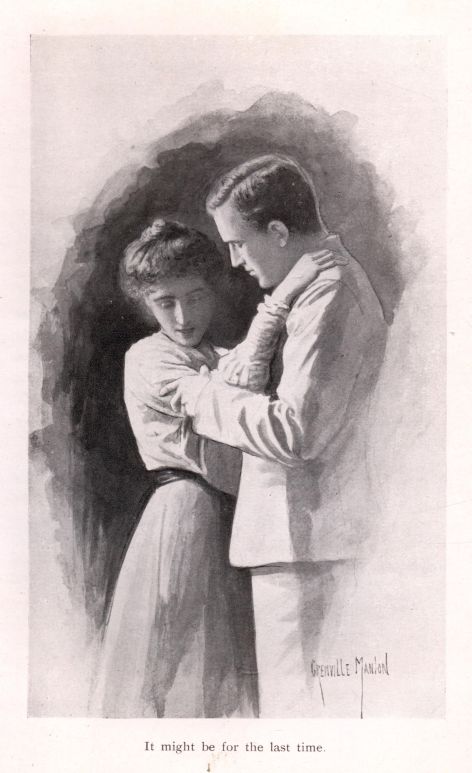
It might be for the last time.
She was, indeed, becoming reconciled to partings as incidental to the missionary life. The Torch was constantly coming and going among the islands now, and sometimes the ladies were allowed to go and sometimes not. Relations with the outlying tribes were progressing satisfactorily. In most cases, after two or three calls with no exhibition of cloven hoofs or ulterior designs on the part of their visitors, the natives welcomed them in the most friendly fashion. In some cases they still held back, and regarded them with suspicion and distrust, but on the whole the tendency was towards confidence and friendship.
CHAPTER XX
MANY FORMS OF GRACE
We have glanced at the higher phases of Kenneth Blair's character, the more homely ones were no less strenuous and striking.
Anything less like a saint in daily life one could hardly imagine. In his love of fun and frolic he was a big, clean-hearted schoolboy, full of jokes, and with a laugh that did one good to listen to and was as infectious as the mumps. Out of harness, on the sands or in the sea, with the brown men and boys and his own, or up the hills after pigs and goats, he let himself go with an abandon which only helped to brace the straps when he geared again.
He set them to football, cricket, boxing, and fencing, for all of which his foresight had made provision, kite-flying on a scale so gigantic as to set the natives gaping, rowing, swimming—anything and everything that might harmlessly take the place of the excitements their savage natures craved, and which served at the same time to strengthen the bonds between white and brown, he pressed into the service.
The boxing-gloves and basket-hilted fencing-sticks became absolute means of grace to the islanders. Here was scope for fighting to any extent, with no ill results. They took to them amazingly, and what was lacking in science was more than made up in zeal. And if these fighting bouts filled specific wants of their own, they also provided no less excellent entertainment for the onlookers.
At first they put both gloves and sticks to the primitive service of belabouring their opponents to the utmost capacity of their muscles, and the sight of two stalwart brown men, clad only in boxing-gloves or basket-hilt, pounding away at one another with every ounce that was in them, and with never an attempt at defence, kept the white men in paroxysms of laughter. But punishment even of so comparatively mild a character as that soon led to more advanced ideas, and before long the browns were a match for the whites, and were never tired of the sport.
Captain Cathie, when he was not ranging the seas in the Torch, put his men through their cutlass drill on the beach as regularly as if the houses behind had been a coastguard instead of a mission-station, and to the brown men this was a sight never to be missed. The measured sweep and clash of the glancing steel fascinated them. Presently they were asking for cutlass drill also, and it was not denied them. Such things might to some seem roundabout steps on the road to salvation—to Kenneth Blair they were very direct and important ones.
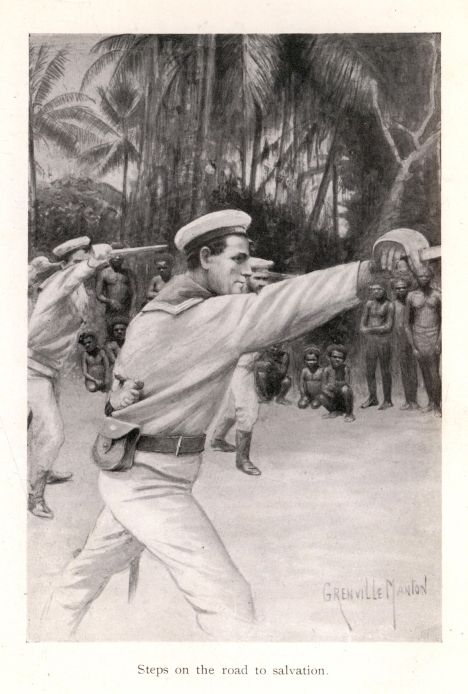
Steps on the road to salvation.
With these brown men and women he was forbearing and long-suffering to a degree which, in the opinion of some of his friends, passed reasonable bounds. That, perhaps, only went to prove the breadth and depth of his nature. He could flame, however, with the best when occasion called, yet there was a righteousness in his anger which lifted it above the common anger of smaller men.
From whatever distant strain they drew, the girls of Kapaa'a were undoubtedly good looking. Physically they were models of sinuous beauty, wild, dark-eyed nymphs, with manes of flower-decked hair and natural graces of action that came of ages of unfettered life and limbs. Their pretty faces and kittenish ways might well play havoc with the hearts—or say the fancies—of hot-blooded young sailormen, and these coquettes of the ridi-fringe were no whit behind their kind in the full appreciation of their powers.
Blair saw the danger as soon as he saw the girls. He had a way of looking facts square in the face without any blinking. He talked very straight to his boys, pointing out the cons of the case with the utmost frankness, and exhorting them to caution and restraint in their dealing with the island women. That so few casualties occurred spoke volumes for his moral grip over his men.
The danger was very real, for the brown girls' estimation of the attentions of the white men was open and unblushing, and tended to irritation on the part of discarded brown lovers.
Captain Cathie, in one of his bluffer moments, bluntly suggested wholesale marriage as a preventive of irregularities, and the starting of a new race on that basis, instancing the Pitcairners as typical resultants. But Blair bade him postpone any such notions until the islanders had at all events attained to some degree of civilisation.
"Trained and educated, there is no reason why our island girls should not make excellent wives," said he; "but the time is not ripe yet. Nothing but bitterness and disillusion can come of the mingling of natures so opposite. Meanwhile, if our lads can stand the test they will be all the better for it."
Nothing serious happened—outwardly at any rate, though it is not impossible that a good deal went on of which the authorities were not aware—until, one day, one of the men was missing, and no one knew—or at all events would say—what had become of him.
Captain Cathie discovered the lapsus when he had his men out for drill on the beach.
"Where's Sandy Lean?" he asked.
No answer, but covert grins from the rest, and flashes of laughter from the girls who were watching—laughter which evoked a growl from the brown men.
"Very well! We'll deal with Sandy afterwards. Fall in, men! 'Tention!" and the drill proceeded.
When it was over, the captain questioned two or three of them as to Sandy's probable whereabouts, but got nothing out of them. So he marched over to Blair's quarters, where the four heads of the community were hammering away at the language, Ha'o giving and receiving, and Matti straightening out kinks.
"Sandy Lean's away, Mr. Blair, and I can't get track of him," announced the captain.
"Ah!" and Blair drummed quietly on the table till the hot anger cooled. "So that's come at last," he said presently. "I'm sorry. The man's a fool, but as he has chosen, so he must lie."
He explained the matter to Ha'o, who showed no surprise and still less annoyance. His manner even implied that he looked upon the alliance as an honour to Kapaa'a, and that any other view of it might be popularly resented.
"Can you find the man for us?" asked Blair.
"What do you want with him?" asked Ha'o.
"He must marry the girl."
"I will find him," and next day he brought word that the fugitives were camped lightly in the hills, in one of the houses vacated by the dissolved third faction.
Blair, Cathie, and Ha'o accordingly set off at once to straighten the matter out, and a couple of hours' climbing brought them to the place.
Sandy Lean's old mother in Greenock Vennel would surely not have known him in his present estate. With the bonds and trammels of civilisation he had lightly discarded also its outward and visible tokens. His only clothing was a kilt of white cotton, whereby he was already paying tribute to folly in the clouds of flies and mosquitoes which levied toll on his white skin. In the hope of circumventing them, or with a loverly idea of assimilation to his brown bride, he had smeared himself with mud from the taro fields, and was now a motley pastel in black and red and white.
The sound of his voice, droning a comic song, drew them to the house, where he lay flat on his back on a mat. By his side sat the brown girl, doing her best to keep off the flies with a bunch of leaves.
"Hoots, lassie, scat 'em!—scat 'em!" he broke out. "They nip like the de'il himsel'. It's the kiss of a cold Scotch mist I'm wantin'."
The dusky bride greeted the newcomers with a smile broad enough to typify her happiness and victory. She had proved herself stronger than the white men, and was satisfied with her prize. She had woven a garland of crimson hibiscus into her dark hair and another round her neck, and with her lustrous eyes and gleaming smile she made a very pretty picture. In a playful mood she had also inserted a crimson flower behind each ear of her captive, and when, at her warning word, he sat up suddenly, he looked supremely silly and was aware of it.
"So you've made your choice, Lean?" said Blair quietly.
And Sandy glowered back at him with defiant confusion, while the flies settled on his shoulders.
"You're the first to fall away from us," said Blair, "and it would have been better, I think, if you had waited. However, as you have decided, so it must be. You have no wife at home?"
"No, sir."
"Very well. Stand up before me with the girl and take her hand."
They stood up in their surprise, and he read the marriage service over them, insisting on Sandy's responses and taking the girl's for granted, since there was no possible doubt about her wishes.
"Now," he said, when it was over, "she is your wife, and you are at liberty to return to the village. Ha'o will see you married again there according to the island custom, so that the people may understand that you really are married. You have taken yourself off the ship's books, of course, and you will have to support yourself and your wife. I hope you will treat her well. No doubt her relatives will see to it if you do not. It would, I think, be as well for you to keep in touch with the mission, and we will do what we can to help you. You can have tools and seeds. If you get into any trouble, come to me. Now goodbye—and—see you treat that girl well." And they left the newly-married couple to their honeymooning.
It was some days before Mr. and Mrs. Sandy descended from the clouds to the humdrum cares of life. Ha'o punctiliously performed over them all the rites and ceremonies observable in marriage on Kapaa'a, and before they were ended the bridegroom began to weary of all the fuss and to long for the easier accommodations of civilised life.
But Sandy's troubles were only beginning. With much labour he built for himself and his wife a house of parts, and his wife's relatives expressed themselves highly pleased with it, and immediately quartered themselves there, not simply in very great contentment, but fairly uplifted with their lot. They began to put on airs on the strength of the lofty alliance, and at the same time to put off even such trifling habits of labour and thrift as had hitherto supplied their daily wants without any undue exertion. Sandy remonstrated verbally, and at times otherwise, but custom was against him, and there was no shirking the burden. The other men visited him pretty regularly, and gave him a hand with his planting in their spare time; but in spite of his pretty wife, with her odd, outlandish ways, the sight of his full house offered them no inducements to follow his example. He was a standing warning to the rest, and so was not without his uses.
CHAPTER XXI
MIGHT OF RIGHT
Matters were progressing thus, surely if slowly, when a sudden sharp stroke fell upon them—sudden, but not altogether unlooked for.
With the individual as with the nation, peaceful times are growing times; and yet, to both individual and nation, there come times of stress and strife, when the slow upbuilding of the years is put sharply to the test, and, surviving, is the stronger for the strain. Winter's storms provoke the oak to deepest rooting.
At times, indeed, too long a period of peaceful growth may lead to over-fatness and deterioration. The nation and the man that waxes over-fat grows lean of soul. But that is a side issue at the moment. The little community on Kapaa'a was too near to its swaddling bands to be in any danger of fatty degeneration. And yet the stressful time that came to it made for good in every way. It had been striking roots and feelers. Well for it that time had been given them to grip the soil before the storm burst. As it was, they only gripped the tighter, and the breaking of the storm cleared the air, and made for more prosperous weather.
Captain Cathie, in his capacity of watch-dog, had never for a single moment relaxed his precautions at home, or his keen-eyed vigilance abroad. When he was touring the islands, his glasses swept the horizon continually, with a special eye to the east, which was the threatening quarter.
"Those yellow deevils will come back, as sure as we're here," was his constant word.
And so the beach was never bare of stacks of neatly-cut wood from away up the valley, and the bunkers of the Torch were always full, and the men were regularly drilled, and Long Tom was ready to speak at a moment's notice.
Each day, when the Torch lay at anchor in the lagoon, he took the steam-launch, or, occasionally, one of the whale-boats, by way of exercise for muscles, through the reef, to an offing whence he could obtain wide views of the approaches to the islands.
"In there," he would say, "I feel like a man with his back to the wall. It's safe enough, but there's no telling what's behind it."
And the wall was quite too high to climb, for the only eastward view from the summit of the hill was of the higher ridge, which ran right across the island, with only one possible passage, and that but a narrow one.
They used to mildly chaff the old man about his fears, but he took it all with characteristic good humour.
"Ay, ay, all right!" he would say. "Just you wait, and we'll see who laughs last. When they come, it'll be no laughing matter, I'm thinking."
"They've probably forgotten all about us by this time, and have found easier pickings elsewhere," said Blair.
"That kind doesn't forget in a hurry, and they know they've only got to break us up to get all the pickings here they want," said Cathie stubbornly.
And it was thanks to these ceaseless precautions that, when the time came, they were not taken unawares.
Cathie had run out in the launch one morning as usual, and presently came plunging back through the passage with a haste that betokened the unusual.
"They're coming," he said quietly, as the others met him on the beach.
"What, the nightmares?" said Blair, with a keen glance, for the captain was not above a joke.
"Ay, the nightmares, sure enough. A brig and two tops'l schooners working up steady from the south-east. They'll carry a heap of men, I'm thinking, and we'll have our hands full."
"Right? How soon can they be here, captain?"
"Wind's light—a couple of hours, I should say, at soonest."
"Our old plans stand?"
They had long since discussed the possible campaign, though not very lately.
"If they have as many men as I expect, we'll have to change 'em a bit. Unless they're absolute fools, which it's as well not to reckon on, they'll split and strike us more than one side at once. There's easy landing the other side the island."
"But a difficult way across."
"They don't know that, and they'll trust to luck to get across once they're ashore."
"You can keep this side all safe with the Torch, I suppose, captain?"
"Any quarter this time?" asked Cathie anxiously.
"Make quite sure of their intentions first. Then, if they are what we have reason to suspect, hit hard and end it."
"I'll keep this side all safe," said Cathie briskly, "and when I've cleared them here, I'll take a run round to the back and wipe 'em up there too."
"How many men can you spare us, captain?"
"I can do with six besides those below," said Cathie, after a moment's consideration. "Under steam we'll have the weather gauge all the time, and we'll give 'em no chance to board."
"That leaves us ten. Give us your ten best, captain, and see that each man has a revolver in addition to his Winchester and cutlass. Better beat up your men at once with the drum, Ha'o. What about Ra'a? Will he rest quiet, or will he take advantage of the matter to attack us, or will he help us?"
"He won't help. He may attack. If we are beaten, he is chief," said Ha'o, with a look which implied that the proper thing to do under the circumstances was to wipe out Ra'a forthwith.
"Run the ladies across to the Happy Valley at once then, captain, and take Lean and his wife to look after them, if she'll go. Will you send your women and children there too, Ha'o? They would be safe from Ra'a, at all events."
But Ha'o, knowing his people, shook his head.
"They will not go."
And so it proved. Fighting, the women understood, though they did not like it, but spirits they neither understood nor liked, and they would take no risks in such matters. They chose in preference to go up the southern hill, where they could keep a look-out for Ra'a and could scatter if he showed head.
The ladies understood the necessities of the case. Their preparations were quickly made, and within the hour they were landed in the Happy Valley, with Sandy Lean, armed to the teeth, to guard them from any stray yellow skins who might get in, an eventuality which was not at all likely. Sandy's wife chose to go with her man, which was a gratifying sign of moral improvement through marriage, and they tried their best to get Nai and her baby boy to go too, but she would not.
Captain Cathie saw to the armament of the land contingent, and gave them a strenuous word or two of his own. Then he carried the Torch through the passage in the reef and lay waiting for his prey.
Close upon a hundred men answered the call of the drum. They were armed only with fire-hardened wooden spears and clubs, and the axes they had used in more peaceful pursuits. But they had had no fighting for some time past, they were defending their hearths and homes, and with the yellow men keen in their memories, they were aching to be at them. And the little band of heavily-armed whites gave both edge and backbone to their courage and made them formidable.
Blair, Stuart, and Evans carried Winchesters and revolvers.
"Our cause is a just one," said Blair. "We will defend it by every means in our power. These men's blood is on their own heads." And there was that in all their faces which boded ill for the invaders.
The only communication between the east and west sides of the island was over a dip in the central ridge which, from its most prominent feature, they had named One-Tree Pass. On the farther side the slope was gradual and easy. On the mission side the ground was so broken, and the ascent so precipitous, that for all ordinary usage the pass was impracticable. No one ever dreamed of using it unless under most urgent necessity. No more urgent necessity had ever arisen than this present, and One-Tree Pass for once in its life became the active centre of the island.
The defending force scrambled up the broken way, and before it reached the pass Long Tom was bellowing angrily behind them, and was answered by another gun which sounded equally loud and defiant. The hill shoulders, however, hid what was going on, and they could only hope that Captain Cathie would be able to hold his own and something more.
Blair placed his men among the boulders overlooking the pass, and crept on along the ridge with Ha'o and Evans and Stuart, until they could look out over the long, easy sweep of the hill to the farther sea.
Opposite the landing-place lay the two schooners, with boats plying rapidly between them and the shore. The landing had evidently been disputed. The village was in flames and brown figures were creeping cautiously up the hill. The beach was filling rapidly with men from the ships.
"It will be a couple of hours before they get here," said Blair, and with instinctive foresight, in view of his greater work, "I wish we could get hold of those brown fellows. If they know that we're fighting their battle, it will pave our way with them later on."
He put it to Ha'o, and eventually the latter slipped away down the hillside, none too eagerly, to endeavour to intercept the fugitives and bring them in, if it were possible.
There was no difficulty in intercepting them. They were flying for their lives. Bringing them in, however, was quite another matter.
They recognised Ha'o, by his speech, as from the other side of the island—hostile therefore, and not to be trusted; and it took all his diplomacy, through the veil of a different dialect, to persuade the first half-dozen to the venture.
The sight of Blair, however, reassured them. They recognised him from his calls in the Torch, and presently they were off along the hills to bring in their fellows.
Altogether about thirty terrified men and women came in. The women were sent on down the valley. The men lay down among the rocks with the defending party.
Meanwhile the marauders had completed their landing and had begun their march, like the shadow of a black cloud creeping slowly up the hillside. Before them, urged on by blows from behind, crept two reluctant brown guides with ropes round their necks. There was no fear of the yellow men missing the pass. They toiled upward with stubborn determination, and wasted breath in voluble commination of the length of the way, when they could have employed it more usefully in compassing it.
And there was no possible doubt of their intentions. Slaughter and plunder were written all over them, as plain to see as the nature of a hyæna in the cut of its slinking face.
Nevertheless, Blair would permit no attack unchallenged. As the bristling crest of the black wave foamed cursing into the level of the pass, he drew cautiously back under cover till the whole should be there. When he struck, he would strike with all his might. This was a nettle to be gripped hard, to be squeezed to pulp and trampled out of sight.
The yellow men flung themselves flat and cursed their wind back. And the pass lay blank and bare and open under the glare of the sun. Not a stone rattled, not a shadow moved. The one lone palm seemed cast in brown.
In due course, and with the aid of many curses, the marauders got to their feet at last, and came pressing loosely along behind their unwilling guides. They passed unchallenged the place where Blair knelt behind a big rock. Below and on each side, pinched brown faces craned anxiously over restless brown shoulders at him, eager for the word. It was not till the motley crew had passed that he stepped out suddenly from his cover, and stood, a tall white figure, in the sun-glare.
"Hola!" he cried. "What are you after?" And instantly such a villainous array of vicious yellow faces was turned on him as he had never before in his life set eyes on.
A babble broke out among them.
"Dios! It is he!"
"It is the fighting padre!"
"It is the devil himself!"
"Down with him!"
"Our turn now, señor missionary!"
And one answer to his question which needed no knowledge of bastard Spanish for its translation. A sharp report, and a bullet buzzed past his head.
Other guns were rising to correct the insufficiency of the first.
"Give it them, boys!" shouted Blair, and before the words were out of his mouth, rocks and fire-pointed spears were raining on them, back and front, and as they tried in vain to face both sides at once, there came the quick crackle of the Winchesters and a ringing cheer from the Torch men at the end of the pass.
The yellow men reeled under their flailing. The ground was cumbered with bodies and the air with curses. The momentary panic drove them in upon themselves and bunched them together.
But the weak point about the thrown spear as a weapon of offence is the fact that, once hurled, it is gone. The yellow men were an undisciplined mob, Ishmaelites all, accustomed every man to fight for himself and ready to fight at any moment, but their death dealers remained in their hands, and they outnumbered the Torch men by seven to one. The Torches poured in volley after volley. The yellow men tightened their defence and replied in kind; while the brown men danced wildly among the rocks, and hurled stones and clubs, and were shot down like rabbits.
Blair's men were falling all round him. The sight was too much for him. He snatched a club from the ground and sprang down the hillside. In a moment the sides of the pass vomited brown men frenzied for the fight.
"Kown 'im!—kown 'im!—kown 'im!" they yelled, and hurled themselves on the enemy.
The Torch men, reduced in number, fired one more round and came racing in with their cutlasses. The yellow men replied, and then clubbed their guns and thrashed wildly at the advancing tide.
Under such conditions, and with the might of right as well as numbers against them, the yellow men gave way and drifted back towards the mouth of the pass, fighting stubbornly all the way.
And Kenneth Blair forgot that he was a man of peace. He saw his brown men falling all round him, ripped and bashed and broken, and he dashed into that fight as he had dashed into many a more peaceful one on the football field at home. He saw nothing at the moment but the vicious yellow faces and shaggy heads of the despoilers. He knew nothing but the necessity of demolishing them, and with his unaccustomed club he smote with all his might at every head he could reach, as his forbears long ago struck down the Northmen when they came wading ashore from their beaked ships on the coast of Caledonia.
The brown men eyed him with amazement, and yelled with unholy joy at sight of his Berserk fury. The teacher was a man like themselves, and could let himself loose like the rest of them. And Blair thought neither of them nor himself, or of anything whatsoever, save the necessity of ridding the island of the vermin that would pollute it.
For once in his life he tasted the wild, mad joy of battle.
His red club whirled and fell, and wherever it fell there fell a gap, and in him raged a red fury which nothing could appease or oppose.
He would surely have been a terrible sight to himself—his white face set to slaughter, and smeared with blood from a bullet graze on the temple, his white clothes spattered red, his eyes ablaze, and that murderous red club whirling and smashing to the tune that plunged in his veins.
At the end of the pass, where it dipped towards the sea, the yellow men broke, and it was over, so far as danger to the island was concerned. But not by any means over as concerned the yellow men. Never yet did enemy break and flee but prudence and restraint fled with him. Cast-iron discipline may leash it in the bulk, but in the individual the lust of death will out and have its way. The wild beast that lurks in every man once roused is ill to curb, and hardest, maybe, in the man not easily provoked. And here was no pretence of discipline. The furies were afoot that day, and death and destruction were rampant.
Blair found himself plunging down the hill path after a scattered mob of yellow men. They were too breathless to curse. Their only hope was the sea.
The prey was escaping. Terror lent it wings stronger than the fury behind. He hurled his dripping club among them, and one man fell.
At one side, among the boulders, he caught a glimpse of Ha'o, all aflame with battle, doing dreadful things with a dripping red axe. So horrible did he look, so utterly inhuman and wholly possessed of the devil, that Blair gasped at the sight. Then he stumbled to a rock and dropped his bursting head into his hands—and came to himself.
The pursuit sped on down the hillside. The yells and shouts died away towards the sea.
He raised his head at last, and his bloodshot eyes looked heavily after them.
"God forgive me!" he gasped. "I have been in hell."
He jumped up with the idea of stopping the work he had started. But that was impossible. As well try to stop the mountain snow in its death gallop. The red fury had gone down the hill like an avalanche. Until its force was spent it must run its course.
Now that the fire had died out of him he found his legs trembling so that he could hardly walk. He sank down again on his boulder and drew his hand dazedly across his brow, streaking it horribly with fresh smears of blood.
He looked round him, at the blue sea, the white surge, the quiet ships. He heard the shouts below. He saw a boat put off from the shore and labour heavily towards one of the ships.
"God forgive me!" he groaned once more. "I have been killing men."
But the only man he was actually conscious of killing was the one at whom he had hurled his club in his last spasm. And when he got up heavily, and went down to him where he lay in the glare of the sun, he found the man was not dead, and he was glad. He carried him carefully to the partial shelter of a rock, and propped him up, and gave him water from a runlet close by. He drank deeply himself, and washed his hands and face and plunged his head under water. He noticed now for the first time that his white jacket was spattered all over with blood. He tore it off and flung it from him.
The reaction which followed his temporary possession left him limp and exhausted, and burdened with a heavy mental load which as yet he made no attempt at lightening.
Then he went slowly down the hill, and saw one of the schooners loosing her sails in a hurried and shifty fashion. From that he gathered that some of the invaders had escaped, and he was too unaccustomed a warrior to regret it.
The rest, who had followed the pursuit to the shore, were held back by no such considerations however. To them the yellow men were enemies to be smitten hip and thigh, to be destroyed root and branch. When they reached the beach and saw the broken boat-load lumbering towards the schooner, the Torch men and a number of natives flung themselves into one of the other boats and set off after them with the most final intentions.
The schooner caught the breeze and began to make way. The Torch men played on her with their Winchesters, a chance shot dropped the helmsman, her head fell off, and she was theirs. Some of the yellow men jumped overboard. For the rest—well, the Torches knew Captain Cathie's views, and the islanders were of a like mind.
Blair passed several dead men as he went down the hill, but saw no wounded ones. As he neared the remains of the village he came upon the bodies of the first victims of the invasion, brown men and women and children.
He had seen nothing of Evans and Stuart since the fight began. Evans he had placed in command of the Torches; Stuart had been in charge of the opposite side of the pass.
The brown men were leaping about the beach inflated with their victory. The Torch men had anchored the one schooner and were now securing the other.
A sudden shout along the beach showed him a yellow man fleeing for his life with half a dozen islanders after him. He had been hidden in the bushes till they stumbled upon him. The sight of his twitching face and agonised eyes remained with Blair for many a day. There had been many such eyes and faces up there on the hillside, but he had had no eyes to see them. Now he was himself, and would stop the dreadful work.
He ran towards the man to succour him. But succour was the last thing the other looked for in him. His long knife was in his hand. Escape was hopeless, but here was a chance for a blow in return. He flew at Blair like a wild cat, and drove the knife at his neck. Blair swerved instinctively, and it went through his shoulder. The wild cat was on him with gnashing teeth and flaming eyes, snarling, grappling, biting him.
They rolled over and over in the sand. Then sinewy brown fingers gripped the other and tore him away, with a mouthful of Blair's shirt between his teeth, and in a moment he lay still.
Blair lay still also. The last things he remembered were the horror of that animalised snarling grip, and a dreadful agony in the shoulder as he rolled over in the sand with the knife still sticking in him.
When he came to, he found himself the centre of a group of the island men who were looking down on him with troubled faces. They gave a shout when he opened his eyes, and presently he was sitting up showing them how to bind up the wound with strips of his torn shirt. The knife had been pulled out while he lay unconscious—for the sake of the knife.
The Torch men came leisurely ashore after securing the schooner and found him so. He had lost blood freely both from head and shoulder, and felt sick and dizzy. They made a stretcher out of a couple of oars and a native mat, and at his request carried him at once up the hill to the pass.
He was anxious about the others; he had no recollection of seeing them since the fight began. It seemed to him that since he picked up that club and leaped down into the pass he had seen nothing but vicious yellow faces and evil eyes, and broken heads, and bodies that suddenly crumbled and fell.
His mind was relieved by the sight of Evans as soon as they topped the pass. And at distant sight of the stretcher Evans came running up with an anxious face.
"Serious?" he asked.
"Don't think so. A jag through the arm and a scratch on the face, but I felt sick and couldn't climb the hill. Where's Stuart?"
"Back here. Got a bullet through the leg. No bones broken, but he won't walk for a week or two."
"Many others wounded?"
"Two Torches, half a dozen natives, and a dozen of the yellow men. Frightful blackguards they are too. Makes me wish they'd been killed outright just to look at them."
Blair nodded. He could not plead wholly guiltless in that respect.
A dozen yellow men on their hands would be an anxiety and a burden. A light affliction, however, compared with what might have been if the invaders had caught them napping. And so they must make the best of it, and be thankful for things as they were.
"Now see here, boys," he said, sitting up on the stretcher. "We've had our fight and by God's mercy we've won. I'm afraid we all lost our heads a bit while it was on"—at which, and their recollection of him in the fight, the sailors grinned—"and I think we cannot blame ourselves for that. But these men who are left on our hands are tabu. The islanders will kill them if they get the chance, and we must prevent it. What is done in the hot blood of battle is done. But killing in cold blood is murder. You have all fought valiantly. Don't spoil it by any such doings. And, by the way, Evans, there's another of them lying under a rock to the left of the path over there. You might see to him. I flung my club after a bunch of them and this fellow went down, but he was only stunned."
"I'll go and bring him up at once, before the brown fellows come."
"No news of Cathie, I suppose. When did his big gun stop?"
"Over an hour ago. We've no news. I hope it's all right. I'd have sent down but I'd no one to send."
"Which of you boys will go for news?" asked Blair. "I doubt if we can all get down to-night."
"That you can't," said Evans. "It'll be a case of go easy for some days for all you hipped ones."
All the men volunteered at once. Every one of them was keen to know what had been going on on the other side of the island.
"You seem fairly fresh, Irvine. Tell Captain Cathie how we've gone on here, and that casualties are not serious. If he can spare us some more help we can do with it to get the wounded down. Ask him to send word to the ladies also. They will be anxious about us all. And if he can send us something to eat we'll be glad of it. I'm feeling empty after it all."
"I'll go after your half-deader," said Evans. "One of you come with me in case he can't walk."
But he was back empty-handed in a quarter of an hour.
"Gone?" asked Blair, with a pinched face.
"He's dead, but you didn't kill him. Some one came after you and split his head with an axe."
"Ah!" said Blair gloomily, "these others will fare the same unless we see to it. We'll go to them, Evans, in case any of our brown friends come prowling round."
But the brown men were much too busy, and we may drop more of a veil over their proceedings than the night did. Big fires were glowing along the beach before it was dark, and no brown man came up the hill that night.
They went along to the temporary hospital Evans had made among the rocks. The beds consisted of the softest patches of ground he could find, and the only furnishings were the patients. He had hastily bandaged their wounds, however, and all, except the yellow men, were fairly cheerful.
Stuart, indeed, became almost hilarious at sight of Blair as an invalid also.
"I was thinking ill of myself for getting hit," he said; "but since you're in the same boat I feel better."
"Glad to be of use," said Blair, "and very thankful things are no worse. They might have been. There were more of them than I expected, and they fought harder than their cause justified."
"Even rats will fight in a corner," said Evans.
Just before dark Captain Cathie came panting in on them, in the best of spirits and with many rough words for the road. He had half a dozen of his men with him, and they brought an ample supply of food.
"Well, captain, how have things gone with you?"
"We mustn't complain, sir. He'd brought a gun along as heavy as ours and we had a fine set-to. But with our steam we had the weather hand all the time and just waltzed round him. He did his best to board, but we thought differently."
"And how did it end? Where is he now?"
Captain Cathie jabbed his finger downwards two or three times in eloquent silence.
"Sunk?"
"Sunk with all aboard, big gun and all. No more trouble from that quarter. We plugged him more than once below the water-line and we saw he was settling down. But it came sudden at the end."
"And you were not able to save any of them?"
"We were not"—said Cathie emphatically, and after a moment's pause added—"and what on earth would we have done with 'em if we had?"
"We have about a dozen on our hands here—all wounded."
"Humph!" grunted Cathie.
"We couldn't very well kill them in cold blood, you see."
"And what'll you do with 'em, Mr. Blair?"
"I don't know yet. We'll have to think that over. Did you send word to the ladies how things had gone all round?"
"I went over myself with young Irvine and told 'em all about it. They were all very thankful it was over and no more harm done."
"And how is the Torch?"
"Ah!" said the old man, with an aggrieved shake of the head, "she got it pretty hot; that's why I couldn't get round to wipe out those schooners. Both her masts are down, and she got a shot into the machinery. The men are seeing what they can do to it. The masts we can fit ourselves."
"And you've no casualties?"
"Some splinter wounds and some bit bruises from the spars. Nothing of consequence, sir."
"Well, we're very well through a nasty job, captain, and we've reason to be thankful for it. Now suppose we have something to eat—I'm starving."
CHAPTER XXII
PAX
It took some days to get matters shipshape after the general upheaval of the invasion.
For one thing, the brown men were much too busy on the other side of the island to settle down to ordinary work. Most of the women and children had joined them there, the villages were deserted, and there was an intangible something in the mental and moral atmosphere which made for depression.
Blair sent Evans over to see Ha'o, and endeavour to bring him back to his right mind. Evans returned downcast, and described what he had seen only to Blair and Stuart. Aunt Jannet, if she had heard, would have had a fit.
The ladies were back in their own homes, and the crippled Blackbirds were bottled up in the Happy Valley, under the wardership of Sandy Lean and his wife and a small guard of Torch men. It seemed like desecration of the beautiful spot to use it as a prison, but it was the only place in the island where the yellow men would be reasonably safe from the brown ones.
The stars in their courses fought for Joshua. In like manner the strange, stern facts of life fought now for Kenneth Blair. The cloud which had threatened his work with destruction broke in unexpected blessing. The fight in One-Tree Pass was an epoch in the history of Kapaa'a.
In the first place it had brought into line—fighting line indeed, but none the less permanent on that account—the various factions in the island, and developed among them a hitherto undreamed-of community of interests. Not by any means for the first time in history, a general menace from without welded into one a diversity of hostile fragments, and discovered to them an unexpected identity of ideas. On a microscopic scale it was, in its results, the Franco-German war over again.
The men from the eastern coast, who had borne the first brunt of the invasion, had lost everything, including their headman. But they had found more than they had lost. They had found out that the western men were not necessarily their enemies, and that both they and the white men were ready to fight to the death to save the island from the grip of the yellow men.
They fully recognised that without the white men's help the marauders would have had their will, and matters would in all probability have gone very differently. In their way they were grateful, and by no means blind to the advantages of the white alliance. That their gratitude was based in no small degree on a sense of favours to come, in no way lessened its utility as a factor in the solution of political difficulties.
They too would share the benefits reaped by the western men from the white men's friendship, and when differences arose amongst them at once as to the choice of a headman, it was the most natural thing in the world to refer the rival claims to Blair, who might reasonably be expected to be without local bias in the matter.
The opportunity was too good to be lost. Blair was at pains to make clear to them the great advantages which would accrue from the union of all the communities under one head, and finally they argued the matter out among themselves and agreed to accept Ha'o as chief, with local headmen chosen by him and Blair.
They reaped their harvest at once and were content. Their houses were rebuilt, tools were given them, and they were initiated into the mysteries of the new foods and fruits introduced by the white men. A proper road was promised to further communication between the opposite sides of the island, and, so far, the descent of the Blackbirds made for good.
In another and quite unexpected direction also the invasion wrought in the direction of Blair's aims.
They were all sitting on the verandah of his house one night, watching the lightning play tremulously up and down the western sky, listening to the surf, and discussing matters generally. Captain Cathie, in the little leisure the refitting of the Torch afforded him, was much exercised in his mind as to what was to be done with the prisoners. Aunt Jannet had just expressed the opinion that it was a very great pity they had not all been scuttled.
"It does seem a pity you could not have made a clean sweep of them like Captain Cathie did, Kenneth," said she.
"Well, you see, we couldn't kill them in cold blood, Aunt Jannet."
"And now you've got them alive in cold blood what on earth are you going to do with them?"
"I see nothing for it but shipping them off home as soon as they are fit to travel. What do you say, Cathie?"
"I suppose there's nothing else for it," said Cathie gloomily. "We don't want them here, and yet I'm loth to turn them loose."
"I don't think they'll ever come back, after the reception they had this time."
"I don't know that they will, but they'll be at the same game somewhere else. I look on them as I do on mad dogs—best got rid of."
"Right!" said Aunt Jannet with emphasis.
"The trouble is that men are not dogs, you see——"
"That they're not. Dogs are mostly honest and good to look at," said Aunt Jannet again.
"We could put them on one of the schooners, and you could convoy them part way home," said Blair to Cathie. "I really don't think we have anything more to fear from them."
"I can do all that," said Cathie. "But all the same I'd as lieve they were none of them going home."
"Why?"
"Well, you never know. If ever they can do us a mischief you may take your davy they'll do it."
"I don't really see what they can do, captain."
But Cathie only shook his head. Perhaps his ideas were too vague to clothe in words.
Just then a shadowy figure slipped out of the darkness under the house, reached up, and rolled something softly along the platform towards them.
"Hello! What's this?" said Cathie.
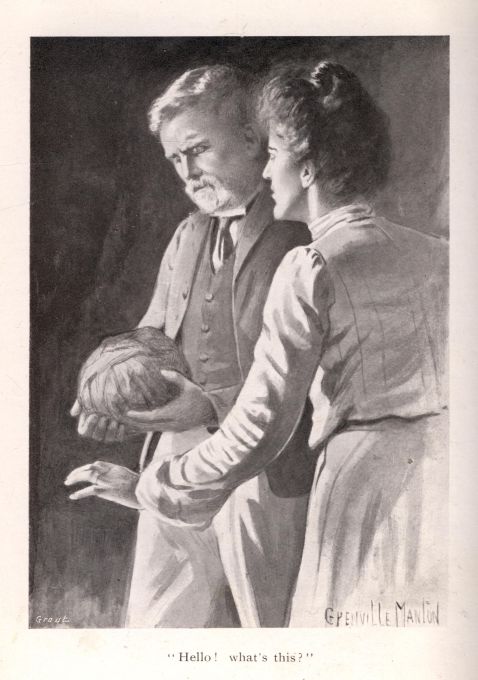
"Hello! what's this?"
"A present—for Aunt Jannet, I should say," laughed Blair. "Some dusky admirer bringing tribute."
"A thankoffering to the wounded warriors," said Evans.
"An unusually fine coco-nut," said Stuart, tipping it with his usable foot. "Carefully wrapped in leaves, too."
Captain Cathie picked it up, and began to open the bundle. Evans struck a match, and match and bundle fell suddenly with a dull, dead bump to the floor, and were followed by a quite involuntary and seamanlike oath from the captain.
"What is it?" cried the younger ladies in a breath.
"Come away!" said Aunt Jannet hastily, and set the example herself.
"It's a man's head," said Evans gravely, as he tried to light a lamp.
And when the lamp was lit, and the bundle lay open in their midst, they saw that he was right—it was the head of a man.
An exclamation burst from Blair as he bent over the ghastly offering, while the others wondered what it might mean.
Was it a challenge?—a defiance?—a threat?
None of these.
"It is the head of Ra'a," said Blair at last. "I wonder who it was that brought it? If we knew that, we might guess what it means."
There had been no fighting of late between Ha'o's people and Ra'a's. In fact, the quiescence of the latter during the other troubles had been cause for congratulation. And since then everything had been quiet in the villages—over-quiet, the quietness of repletion. Evans had indeed begun to fear ill results from the over-indulgence of savage appetites.
"What do you make of it, captain?" asked Blair at last, as of one more versed than the rest in heathen ways.
"Hanged if I know!" said the old man, with a puzzled frown.
"I take it, it is a sign of submission on the part of Ra'a's men," said Blair quietly. "Ra'a himself would never have come in of his own accord. His men have wanted to, and so they have brought him."
"I shouldn't wonder," said Cathie. "It's just the thing they might do."
And in the morning they sent up early for Ha'o, and showed him the message, and asked his opinion.
"Kenni is right," he said at last. "They submit."
And presently he went boldly up the mountain-side and in due course came back with Ra'a's followers in a straggling tail behind him.
He explained afterwards to Blair that Ra'a's men had wanted for a long time past to come in and enjoy all the benefits they saw the others receiving, but Ra'a had held them back, telling them that the whites were only tricking Ha'o and his people and would presently carry them away. They had seen the arrival of the Blackbird ships, had watched the fight at sea, and also that in the pass, and these had convinced them of the good intentions of the white men. Finally they had taken matters into their own hands and settled things their own way.
And so the divisions in the island were healed by blood, and that which had seemed like to wreck their hopes turned marvellously to their highest good.
CHAPTER XXIII
THE SCOURGE OF GOD
But there was trouble of a quite unexpected kind brewing.
The yellow men in their lives had slain a certain number of the brown. In their deaths they slew still more.
The whites had hoped that, with the introduction of new food supplies, the unnatural but deep-rooted native craving for human flesh would have disappeared. The final rites of the battlefield shocked them exceedingly, and words had so far failed to convince Ha'o and his people of the error of their ways.
"You eat pig," was Ha'o's blunt argument in reply, "and man is cleaner than pig."
There was, however, an argument in preparation for him with which the white men had nothing whatever to do, but which drove home conviction beyond dispute and in the most terrifying fashion.
Ever since the fighting, and the subsequent orgies, the villages had been unusually quiet. Even the wholesale submission of Ra'a's men produced little excitement among them.
"They are like snakes after a full meal," said Cathie. "They've eaten too much, and it'll take 'em all their time to digest it."
Evans, however, had his doubts. He hinted to Blair that he feared an outbreak of sickness, but as yet could form no opinion as to its character. The men had lost all their energy, the women were depressed, the children listless. It was as though the strenuous doings at One-Tree Pass had sucked all the life out of them. And Evans went in and out of the houses with a keen eye for symptoms.
It was about a fortnight after the fight that Blair, going up to the village, met him coming hastily from it, and was startled at the sight of his face.
"What is it, Evans?" he asked.
"It's come—I feared it, but could not be sure—smallpox."
"God help us! ... How has it got here?"
"I can only imagine," said Evans, with a quick, meaning look at him.
"Good God! How very horrible!"
"Yes. They'll have a lesson they'll never forget, and many of them will never have the chance to. What about our wives, Blair? Shall we send them away till it is over?"
Kenneth Blair's lips pinched tight at the thought of it all, and he walked heavily and in silence.
"We are in God's hands," he said at last. "I think it must be left to themselves to decide."
"Then they will stop," said Evans decisively.
"Yes, they will stop," said Blair. "God grant us a safe deliverance!"
"Amen!" said Evans, and they walked in the shadow of the coming death.
The ladies received the news with white faces but stout hearts, and did not hesitate one moment.
Their place was beside the men. They did not wait to count the cost, though in each one of them was the dull, dread knowledge of what that cost might be. Their duty was to these brown kinsfolk of their adoption, and they were British born.
Evans took charge of the defence with all the energy and skill that were in him, and, possessing their souls in God, they all went quietly into the fight, compared with which the battle of One-Tree Pass was veriest child's play.
The village was sheltered by the bush and the crowding palms. Every man was taken off the dismantled Torch, and set to work building a hospital on the beach, a long, open house of poles and palm-leaves, through which the fresh sea breezes could blow at will. Soft springy couches of palm-leaves were ranged inside, and the simple preparations were complete.
Not the smallest of the horrors and perplexities of the situation was the wholesale nature of the seizure. Springing from one identical cause, the results came all together. The hospital was filled before it was finished, and the builders could not keep pace with the demands for accommodation.
Not one of Ra'a's people suffered—clear indication of the ghastly origin of the evil. Blair induced them to return for the time being to their village on the hillside, and such of Ha'o's people as showed no signs of infection he camped temporarily on the opposite hill. Every house from which the sick were carried was promptly burned. The brown folk could not understand such radical measures, but they were scared by the sights they saw, and they did as they were told.
So suddenly had the catastrophe come upon them, and in so wholesale a fashion, that their thoughts had had no time to travel beyond their own immediate concerns. But when the work was steadily under way Blair bethought him suddenly of their new allies on the east coast, and he begged Captain Cathie to run round in the launch and see how matters were going with them.
Cathie returned in due course with a long face and the news that things were just as bad there, and Stuart and his wife promptly offered to go round and carry out the same measures as had been started at the home settlement. They were given half a dozen Torch men, whom they could ill spare. Evans promised to come round as soon as he possibly could, and the launch chuffed gallantly away to the relief of the still more necessitous on the other side of the island. Stuart could still only limp, and would have been better not to attempt even that, but the healing of his own wound was a small thing compared with that which had to be done. As a matter of fact he limped slightly for the rest of his life in consequence—a most honourable limp.
Then followed for all of them a time of patient endurance and endless self-sacrifice, which, trying as it was, still wrought mightily for and in them.
They went to and fro in that long open shed with quiet set faces, soothing and alleviating as far as these were possible, whispering hope to the hopeless, and insisting inflexibly on the observance of rules in which the only hope lay, rules the meaning of which these brown children could not understand, and which they broke at every opportunity.
Death sat grimly down before them and laid siege to them, and the little band of white-faced women and grim-faced men fought him day by day and life by life, losing heavily but refusing to be beaten.
They met one another with such cheerfulness as they could muster, and even with quiet strained smiles at times, but ever with keen apprehensive glances for what each feared any day to find in the other. A time for the trying of souls, with none of the glamour and activities of actual warfare, but with perils infinitely more appalling in their insidiousness and impalpability.
"Ech, Jean, my dear!" murmured Aunt Jannet Harvey one evening, as she and Jean and Alison Evans met outside for a few full draughts of sweet sea air. "It's terrible, terrible work. You're looking white; child. I wish you were back in London."
"I don't," said Jean cheerfully. "We're doing our appointed work, and I feel as if I'd never done anything worth doing at home. Kenneth says he believes this will be a corner-stone in the building up of the island."
"Ay, ay! Well, it's good to be able to take a hopeful view of things when they're about as bad as they can be. And I don't see that they could be much worse."
"Oh yes, they could," said Jean quickly. "Some of us might have taken it, which would be very much worse. We have to thank Mr. Evans for that, Alison."
"Charlie says he thinks we're through the worst," said Alison quietly.
"I wish I could see it," said Aunt Jannet.
"We have only had three deaths to-day, and most of the others are past the crisis. It's been a terrible clearance. There's that poor little baby crying again. I must go," and they separated to their various duties.
It was Nai's baby boy that cried, and it died in its mother's arms that night. She yielded it sorrowfully to those who took away the dead, and returned wearily to her husband's couch to keep the flies off him with a palm branch. Nai herself had been too much occupied with her baby to go with the others across the island after the fight, and she had not developed the disease. The baby had taken it, however, and Nai had nursed him and his father indefatigably, and now the boy was gone just as his father turned the corner, and the little mother was broken-hearted. They comforted her by telling her that Ha'o would live, and she fanned away wearily to the tune of her sobs that would not be kept in.
Jean, as she flitted noiselessly to and fro, with cold water for this one and medicine for that, and hopeful words for all, and special ones for Nai, thought now and again of the mighty change her marriage had wrought in her life, but never once regretted what she had done and all she had left. And more than once the dreadful thought came upon her—"Supposing Ken were to take the sickness and die and leave me alone!" Ah, then she felt as though her world would fall to pieces, and she prayed, as she had never prayed in her life before, that he might be spared, or that they might go together.
The one thing that wrought itself indelibly into all their memories was the contrast between their hospital work and its setting. Inside the long palm-thatched sheds—the moans and murmurs and restless movements of the sufferers; the ever-fluttering fans which kept off the plague of insects, and alleviated to some extent the pungency of the atmosphere; the irresistible depression induced by the close presence of insidious, crawling death. And outside—the implacable glare of the sunshine; the smooth, slow-heaving, blue mirror of the lagoon; the metronomic roar and long white flashes of the surge on the reef; the palms swinging slowly and solemnly with a sound like the patter of falling rain; and up above, the pale blue sky. Death in its most repulsive form, set in a picture of surpassing beauty, which yet had in it something of pitilessness from the very sharpness of the contrast. These things they never forgot.