Front matter
Reading edition
Earth was conquered by Venus and her master. But the mysterious faces of Mt. Rushmore became the gods that gave hope and fighting courage to beaten Man!
[Transcriber's Note: This etext was produced from Fantastic Adventures November 1943. Extensive research did not uncover any evidence that the U.S. copyright on this publication was renewed.]
"That," said Stephen Duane, "is that!" He wiped his hands on an acid-stained apron, turned to his assistant. "We all set now, Chuck? Got the stuff?"
"Right here, Lootenant."
"What? What's that you called me?" Stephen Duane's voice flattened.
"I said—" Chuck began.
"I heard you. Chuck, for Pete's sake, won't you lay off that 'Lieutenant' nonsense? I've got a front handle; one you've been using for three years. What's the matter? Don't you like it any more?"
Chuck Lafferty shrugged. "Them," he said patiently, "was the good old days. But times has changed. We're in the Army now. You've got bars on your shoulders—remember?—and I'm just a sergeant. Which makes a difference."
"Nuts!" snorted Steve. "I'm still a chemist, Chuck, and you're my lab assistant. And so far as you're concerned, I'm still just plain old Steve Duane. Get it?"
"Yeah. Yeah, sure, Lootenant."
"Wha-a-at?"
"I mean, yeah, sure—er—Steve."
"That's better. Now, let's get to work on the final experiment. If this gas does what I think it will, World War II is going to end all of a sudden, and a madman named Hitler is going to be caught with his panzers down. Let's find out. Bring that flask over here while I get one of the guinea pigs from the cage. Put it on the—Wait a minute! Who left that door open?"
Chuck, gingerly lifting a small, stoppered vial from its shockproof rack, glanced over his shoulder wonderingly.
"Not me!" he denied. "I always make sure it's shut. Maybe the guard outside—?"
"Well, whoever did it," frowned Duane, "must be more careful. Our country's at war, and there's been entirely too much enemy sabotage and espionage around these parts already! You outside there! Guard!"
A khaki-clad figure appeared in the doorway, saluted smartly.
"Yes, Lieutenant?"
"Close that door, soldier, and see that it's kept—say! What is this, anyway? Why the gas-mask?"
The guard's voice was weirdly muffled by his rubbery face covering.
"Orders, sir. Trial blackout and mock gas attack in fifteen minutes, sir. All men on duty have been ordered into masks, sir."
"So?" Steve Duane stared at the guard thoughtfully. "Well, in that case, you may resume your post. But this time close the door carefully. Oh, and by the way, soldier—"
He spoke with studied casualness as the guard turned away. The other man glanced back.
"Yes, Lieutenant?"
"You might be kind enough to—Achtung!"
His voice shifted abruptly from a tone of easy camaraderie to one of sharp command. It was an old ruse—but it worked! Reflexes conditioned into the soldier's body through long years of training exercised themselves. The man's heels clicked together, his frame stiffened.
On that instant, his suspicion verified, Steve Duane hurled himself forward.
"I thought so!" he roared. "A spy at our very door, eh? Grab him, Chuck!"
But the room was wide, and the Nazi spy had realized his mistake the moment he made it. He, too, swept into swift action. A tug wrenched the .44 from his holster; impetuously he ripped the mask from his face to reveal eyes gleaming with fanatic determination. Malice thickened the heretofore well-concealed guttural accent which bespoke his ancestry.
"Stop! Another step, Leutnant, and you die! We are alone here. That has been arranged. We are not so foolishly overconfident as you stupid Americans. Ja—" He laughed—"it was I, Eric von Rath, who opened the door, the better to watch your progress, hear your braggart claims. Zu, you have a new weapon to end the war, nicht wahr? But our Fuehrer is the one who will use that weapon. Now—" He swung the ugly muzzle of his automatic to bear on Chuck Lafferty—"bring me the vial! Quickly, bitte! I have no time to waste—"
Dazed by the sudden turn of events, Chuck faltered a half step forward, stopped, turned questioning eyes to Duane. Steve nodded imperceptibly. His quick mind had appraised the gravity of the situation, found but one slim chance of coming out on top.
To take the flask from Lafferty's hand the Nazi must for a split second, at least, relax his guard. It was narrow figuring, but if in that second he could move....
"Go ahead, Chuck. Give it to him," he ordered.
"B-but—" hesitated Chuck.
"Give it to him!"
The enemy agent laughed coarsely. "Your Leutnant is no fool. A coward, yes; but, then, all Americans are cowards at heart, nein? Bring the flask here! Ach—be careful, you blundering eisel!"
The last sentence broke in a gasp from von Rath. He was not the only one to shout warning. Steve's fearful voice echoed his cry.
"Good Lord, Chuck, be careful! Don't drop that! We will all be—look out! Be care—"
The cold sweat of sudden fear broke on his forehead. Not fear of his foeman, but of what might now seize them all. Even as he shouted, the glass shattered upon the floor. From if rose a pale, chill, ominous mist. A sharp, unidentifiable odor assailed his nostrils; black vertigo staggered him. The world reeled and tumbled into wells of seething darkness; the darkness was peopled with gray, swirling phantasms; he sensed motion within and about him; a multitude of half-heard sounds rolled like surging waters past his ears. This for a fearful moment. Then:
"—ful!" he cried. "That's dangerous, Chuck—"
His hands groped forward, governed by an instinctive motion, to catch the falling flask. But, amazingly, they met and clutched nothing! More frightening still, the muscles of his well-knit, athletic body flamed with sudden agony, racked in protest as if they had been welded for months in a plaster cast.
Over straining sinews and bones that ached horribly, Lieutenant Stephen Duane had no more control than has a month old baby. With a gasp more of shock than of fear, he pitched headlong to his knees, his chest, his elbows.
He tried to roll, that his shoulders might break his fall, and succeeded in a measure, but concrete grated against one cheek painfully. The jolt shook him like the impact of a sledgehammer. He spat dry dust flavored with the warm, salty taste of blood and cried again:
"Chuck! Chuck, what—?"
Then the paralysis which had held him lessened; with an effort he lifted his head and stared about him, eyes stark with incomprehension.
The laboratory was gone! The bright-gleaming lights had vanished, as had the rows upon rows of glistening beakers and retorts ... the work-benches and hooded range ... the centrifuge and tubes and hissing Bunsens ... the vast intricate array of chemical paraphernalia that should be here ... all were gone!
There was only this dingy, windowless room, bare and musty, lighted by the feeble flames of candles guttering upon worn wall-sconces.
A sense of panic fear tugged at Steve Duane's heart. He cried yet again, "Chuck! Chuck Lafferty! Where are you?"
The answer came from behind him. Drowsily at first, as if the speaker were wakening to respond from the depths of drug-numbed slumber, then more coherently, the answer gaining speed like the disc of a hand-started phonograph.
"—grab it, Steve! It slipped! Look out! The gas is escap—"
Steve turned just in time to see his subordinate and lab assistant strain frozen muscles forward in futile attempt to stay the fall of a non-existent bottle. Chuck's eyes were open, but their blankness mirrored nothing. He was toppling, as grotesquely as had Duane a moment before, to the floor.
Clenching his lips against the pain that flooded him with every motion, Steve inched forward to cushion his chum's fall. Chuck's body, locked as if in rigor mortis, was a dead weight. Not only that, but—a sudden realization heightened Steve's sense of eerie—cold!
Chuck's body was cold! Not with the soft clamminess of a drugged or shellshocked invalid, but with the all-pervading iciness of carven marble!
But stiff or limber, cold or quick, Lafferty's white lips were moving. And they framed Steve's own query.
"Steve—what happened? Where are we? And what are we doing here?"
Steve said, "Flex your fingers, chum. That's right; work 'em. Yeah, I know it hurts, but it unfreezes 'em. Now, try moving those knees and elbows."
Chuck performed, obediently, the exercises Steve had found loosened his own rigid body. Soon he, too, was able to lift his head and stare about him. He turned to his superior officer, but Steve's shake of the head answered his questions before they were given voice.
"I don't know, Chuck. It's all—fantastic! What's the last thing you remember? Before you woke up, I mean."
"Woke up?" repeated Lafferty wonderingly. "I wasn't even asleep. What do you mean, woke—?"
"That," commented Steve queerly, "is what you think! You weren't asleep, eh? Well, take a look at the hunk of statuary behind you."
Chuck turned and gulped. "The—the Jerry!"
"Right! That's what you looked like, chum, a moment ago. And me, too, I suppose. But I wouldn't know about that, and I wasn't on deck to watch myself unfreeze—as he's doing right now. Catch him, Chuck!"
"The hell with him!" said Chuck. "Let him break his dirty Nazi neck!" But he obeyed. The German woke blubbering with pain and fright, howled for mercy when he discovered his hands no longer held a weapon of destruction. But no thought of vengeance motivated Steve at the moment; his sole interest was in learning what weird fate had befallen them. There was time and enough to handle their enemy as he deserved; now the problem was to find out what had happened. Therefore he gave the German the benefit of his advice, and in a short time the three erstwhile "statuettes" sat staring at each other in dim perplexity.
"This is not peace between us," he warned the German agent. "Only a truce until we find out what's happened. One false move, and—" He stopped significantly; then, to Chuck, "All right, Chuck. Your story. You were saying—?"
"I don't know," wailed Lafferty, "from nothing! All I know is that just a couple of minutes ago you ordered me to hand this lug a flask of that new anesthetic we were working on. I—I stumbled, and the flask slipped from my hands. As I fell, I tried to grab it—"
"And I yelled, 'Be careful!'"
"That's right. And then—and then all at once here I was, stiff as a board and falling flat on my puss. In this place—whatever it is! Steve—" Chuck stared at the young officer fearfully—"you don't think we—we're dead, do you? I mean, maybe the gas asphyxiated us, or something—?"
"If we are," stated Duane bluntly, "my Sunday-school teacher had the wrong steer on the afterworld. I hurt when I came to. And disembodied spirits don't have nervous systems; not that I know of. Anyhow, have you noticed your clothes?"
Chuck did, now, for the first time. He stared, then fingered wildly at the apparel in which he was clad. Perhaps unclad would be more apt. For his garments—like those worn by Steve and the spy—consisted of a metal harness about the loins, a short, metal-cloth cape suspended from the shoulders, and a pair of doeskin sandals.
He gasped, "Hell's bells, Steve! Superman duds!"
"Except," pointed out Duane, "that Superman, even in his balmiest days, never decked himself out in cloth like the stuff we have on! Don't you recognize the metal?"
Chuck squinted more closely at the material of which their garments were woven, then: "Gold!" he croaked. "Solid gold! Sweet Moses, Steve, now I know I'm off my nut! I drop a flask of gas, draw a blank—and snap out of it flopping on my pan with 18 karat panties on! What makes here? A gag?"
"It's no gag," said Steve soberly. "I don't pretend to know all the answers, Chuck, but there are several facts I can deduce from what I see in this room. The first one is—our new gas worked."
"W-worked?"
"Better," nodded Steve, "or worse than we ever dared hope. There's only one logical explanation for the situation we find ourselves in. You dropped the flask, the anesthetic knocked us out, slowing down our basal metabolism—according to my expectations—and we fell into a state of catalepsy.
"That is why our muscles were stiff, our bodies cold and our joints rigid. Our minds recognized no lapse of time. That does not mean there has been none. All of our functions—breathing, digestion, elimination—have been slowed." He turned to the third member of their party. "Can you remember what happened? You were farthest from the fumes. You—Hey! What do you think you're doing? Come back here!"
Von Rath had been inching away from them stealthily. Now, well out of arm's reach, he leaped suddenly to his feet, raced toward a doorway at the far side of the chamber.
"A trick, nein? You are trying to make me reveal my Vaterland's secrets? You don't catch me in your dirty, democratic trap. I—"
His words ended with the same dramatic suddenness as his headlong flight. For as if stricken by lightning, all at once he dropped to the floor and lay still! Blood burst from his nose and mouth.
In a flash, the two Americans were at his side. Awe weighted Chuck Lafferty's words.
"Goddlemighty, what hit him? He went down just like he was pole-axed, Steve!"
But Steve, having satisfied himself that the spy was only unconscious, had already found the answer. He swept his hands before him, felt cool smoothness beneath their palms.
"Glass!" he said. "A solid wall of it! We're caged like animals under a bell!"
"What?" Lafferty, too, pawed wildly at the crystal-cool invisibility that bound them. "But air, Steve! There's air coming through somewhere—"
Duane's questing eyes had found the answer.
"Up there," he said. "See—near the ceiling? It's a wide crack in the glass. Chuck, I'm beginning to piece the puzzle together. It's mad, but it all ties in.
"That crack up there may be the thing that caused us to waken! From the appearance of this chamber, it used to be hermetically sealed! Then the dome split, air seeped in, and we wakened. But if that is true, what has seemed to us but a second's time may in reality have been weeks ... years...."
"Years!"
"Possibly," warned Steve, "longer than that! It was experimental work we were engaged in, Chuck. Methioprane was a compound about which nothing was known. Set yourself for a shock. While we slept, not only years but centuries may have passed!"
"Centuries!" echoed Lafferty bleakly. "B-but, Steve—the war? Who won? And where are we now? How—?"
Steve Duane shook his head.
"You know as much about that as I do. I'm guessing, anyway. There may be another explanation. But—" His head turned—"I think we'll know the answer in a few minutes."
"Eh? What do you mean? How?"
"Because," replied Steve tautly, "unless my ears are deceiving me, we're about to entertain guests. I heard footsteps coming down the outer corridor a moment ago, and—see? Now the door is opening!"
CHAPTER II
Priestess Beth
What manner of men Steve Duane expected to see enter the cavernous chamber, he could not have really told. Men of a future era—for by now he was firmly convinced that it was a future era in which he and his companions had roused—might differ from men of the Twentieth Century in great or in no degree. He could even conceive of looking upon members of the long-heralded race of supermen, and was fully prepared to greet such arrivals.
This presumptuous logic, based on hunch, was typical of Duane. Unorthodox, perhaps—but it was this high, swift, imaginative quality of thought which had set him apart as one of his country's ablest young chemical engineers. If hunches like these occasionally led him to error, more often they led him to success in fields where others had failed.
But this time his surmise was completely wrong. For it was no lofty-browed race of supercultured beings who stepped through the doorway. It was, instead—
"Babes!" choked Chuck Lafferty. "Holy cow—dolls!"
"Quiet!" breathed Steve swiftly. But he, too, gazed at the corps of newcomers with numb astonishment. Women they were—but what women! Steve Duane was a scientist. As such he had allotted no place in his scheme of life for the weaker sex. But he knew now, in a single blinding moment, that this was only because never before had he looked upon such a woman as she who headed this group.
From the top of her dust-golden head to the soles of her doeskin sandals she was perfection. Tawny hair, shorn to shoulder-length, cascaded down over firm neck and shoulders to frame features strong with dignity and grace. Breast-cups of filigreed gold highlighted the smooth, golden sheen of her flesh. From beneath the folds of a sarong-like loincloth her long, straight limbs carried her forward in pantherine grace.
Her manner was at once imperious and oddly humble as she led the way to the dais upon which Steve and Chuck stood. Approaching them, she intoned a curious chant in a voice warm and mellow as the dimly-heard thrum of harpstrings.
With an effort, Steve wrenched his eyes away, and in a whisper warned, "Steady, Chuck! Don't move a muscle. It's dark in this corner. Hold the pose you were frozen in before we woke. They may not notice our change of position, or him. We'll play 'possum ... try to learn something about...."
Then he stopped in obedience to his own command, and held himself rigidly motionless as the tiny band drew nearer. He saw, now, that not all of the group shared the delicacy of the dust-golden Diana who led them. Only one other—and she a maid of thirteen or fourteen—wore the kirtle and peculiar amulet which he judged to be a badge of office.
The others fell into types as sharply diverse as day and night. First, waddling meekly behind the chieftain, came a huddle of pale and flabby-fleshed matrons, grossly obese of figure, flaccid of breast, vacant of eye. These moved with a slow, tantalizing undulation of hip and thigh which disgusted rather than enticed Steve.
Encircling these, tense as fighting falcons, marched the second distinctive type. No weakling billows of fat were these, but lean, hard warriors, granite-jawed, with eyes that stared straight forward in uncompromising challenge.
These Amazons wore no gold-cloth habiliments. Their breachclouts were of coarse, sweat-stained leather, and their flat, dry, masculine breasts were stifled beneath straitlaced halters, giving freedom of movement to their sword arms.
A third type brought up the rear. Neither masculine nor cloyingly feminine were these. They might have been dull husks of neuter gender for all the physical emotion the sight of their thick, peasant bodies aroused. Their flesh was dark with long exposure to burning sun and driving sleet, they had gnarled, calloused fingers and strong, broad wrists.
They were heavy of jowl and brow, their stringy hair was crudely hacked to the neck-line, then caught in a clubbed knot. Aprons of shoddy felt were their only garments. Their legs bulged, sturdy and asensual as limestone pediments, from beneath these grimy skirts.
This much Steve Duane saw with growing wonder. Then the band drew still nearer, and the chant of the golden Diana became audible.
At first the words meant nothing. They were part of an intoned, indistinguishable blur, signifying nothing. Then suddenly—as if one strophe of a sacred ritual had ended and another begun—the chant slowed. Halting words emerged from the meaningless drone—and it was no longer meaningless. As one mesmerized, Steve hearkened incredulously to the chant of the dust-gold maiden.
"Osé, can you see by the Daans' surly light—"
The American national anthem! Steve's eyes narrowed in dazed bewilderment. Francis Scott Key's immortal words—immortal indeed!—but phrased all wrong, curiously accented, broken in the wrong places! Behind him, Chuck emitted a tiny gasp, but it went unnoticed as the voice of the cantor lifted sonorously.
"—the rockets' red glare-bombs bursting in air—"
There it was again! The right words, or right syllables, but improperly cadenced so that the whole true meaning of the song was distorted! Holding his peace was the hardest task Steve Duane had ever undertaken. Every fretful instinct urged him to interrupt this grotesquely mangled hymn.
But it was wiser, reason warned him, to just listen. Listen and learn more. The girl had lifted her head now, and was looking directly at him. A mist of reflected candlelight enmeshed her hair with a halo of golden glory. And there was radiance in her eyes, too; a bright, high burning, with which was somehow strangely mingled desperation and—hope! Liquid fire flamed in her throbbing voice.
"Osé, does that star-spangled banner yet wave O'er the land, O, Thou Free? Or Thy hoam, O, Thou Brave?"
The last note of the chant dwindled into silence. A strange, strained, watchful hush settled over the little band of women as if they were waiting for—for what? Steve Duane did not know. A manifestation of some sort? Quite possibly. It was perfectly obvious by now that to these women, for some obscure reason, he and his companions were objects of worship. The glass-encased dais upon which they stood was an altar—a shrine!
But—Lord! If this were so, for how many countless decades or centuries had they been immured here? What mighty evolutionary or sociological force had wrought these physical changes upon one-time fair and lovely womankind? And—where were the men of this day?
As if in answer to his unvoiced query, was presented the next act of this weird tableau. The circle of obese matrons parted, disgorging from their midst one whom, in the wan light, Steve had not noticed before. A tiny, withered parody of a man with painted lips and cheeks, kohl-blackened lashes, elaborately ringletted hair tumbling shoulder-deep to a white samite frock.
As this futile creature was loosed, terror glittered in his beady eyes; he emitted a small, high-pitched bleat and strove to break from his guards. But the warrior women, grim and adamant as stone, formed a phalanx about him, a barricade of hard flesh which stood unyielding before the panic thrusts of his soft, white fists.
Then it was the dust-gold maiden turned to the young neophyte, accepted from her an object which gleamed evilly in the sallow light; then it was the voices of the loose-fleshed matrons rose in mournful keening; then it was that two of the apron-girt women stepped forward to seize the struggling male in oaken grip, tearing the samite frock from his body, baring his soft, hairless chest to the knife.
And then it was that Steve Duane horribly understood the meaning of this ritual. Chuck Lafferty got it, too. His voice exploded in Steve's ear.
"Hell's flaming fire, Steve, they're sacrificing the little guy—to us!"
But Duane had already recognized the finale to which the drama was moving, and was already in motion. He raced to the transparent barrier.
"Stop!" he cried. "Stop—!"
There was no way of knowing whether or not his words were audible to those outside. True, the glass dome of their prison was cracked, but even so the curved surface might mute all sounds. But communication is not a matter of sound-waves alone; action has a tongue. Steve lifted his arm—as he had seen the golden priestess raise hers a moment before—in the universal symbol for cessation.
His gesture saved the doomed man's life. The raised blade stayed ... then clattered to the floor from the dust-gold maiden's nerveless fingers. Heads turned, and faces hard and soft adopted one expression of awed terror. Voices rose in a bedlam of confusion; then, as one, the women tumbled to their knees!
Cringing, they cowered there prostrate. But one had the courage to raise her eyes again: the leader. On her brow was a furrow of perplexity as if she were trying to recollect some once-heard, half-forgotten instruction. Then her visage lighted; her voice lifted in clarion call.
"Jain! The Slumberers have awakened—at last! The Day of Freedom dawns! To the Sacred Wheel, swiftly!"
A flame of joy burst in the eyes of one of the grim-faced warrior women; her lean flanks tensed as, leaping to her feet, she hurried across the chamber to a huge, metal wheel on the farther wall. Sweat sprang from her forehead, her sinews knotted in cords as she tugged at this device. It held fast. Again she wrenched its spokes, white lines of strain upon her jaw. This time red flakes of rust showered to the floor, the wheel groaned protest at being thus rudely roused from an age of disuse—and slowly turned!
As it did so, Steve was conscious of a draft of cool air about his ankles, his knees, his thighs. Looking sharply he saw that the nether rim of the glass prison was separating from the edge of the dais; the whole structure hoisted upward like the gigantic bell it was.
Slowly as it had started, the movement stopped. And Steve and Chuck—along with the wide-eyed von Rath, whom the fresh air had revived, and who had now lurched to his feet—stood face to face with their worshippers!
Now the leader dropped to one knee; in a voice which even determination could not steady quavered:
"Hail, O Slumberers! Aie, look with mercy upon us, Thy children, for lo! we have tarried and kept the faith, even as was ordained!"
Chuck stared at the speaker.
"Hey, what makes here? A revival meeting? How come this 'faith and ordained' chatter?"
The German was equally taken aback. So much so that for the moment he quite forgot the neo-paganistic pretensions of his creed, and relapsed into the speech-habits of one-time Christian Germany.
"Gott im Himmel!" he exclaimed. "Vas—?"
Only Steve Duane had the acuteness to comprehend the lofty place to which he and his companions had been elevated, and the quickness of mind to take advantage of it. Aside, he whispered hurriedly, "Don't you get it? We are their gods—or the symbols of their gods! Quiet, now!" And to the girl, in a gravely commanding voice:
"Rise, O Priestess!" he said. "The Slumberers hear, and are merciful. Is there one in command here?"
The priestess rose with slowly returning assurance.
"Not here, O Wise One; but elsewhere in Fautnox sits the Mother in everlasting wisdom."
The Mother, thought Steve swiftly. Then his surmise as to the sociological organization of this race had not been wrong. It was a matriarchy, divided into groups of warriors, workers, and—what else could the flabby-fleshed ones be but breeders? That accounted for the sole male being a pampered, bedizened pet.
But—"Fautnox"? Doubt clouded his eyes; he bit his lip. Then his trusted ally, hunch, came to his rescue. Why, of course! A concrete, subterranean chamber of massive size. A wild wealth of gold used lavishly, almost negligently, by a civilization obviously semi-barbaric. A language which owned English as its parent, but was changed by untold ages of misuse and elision. Fautnox was—Fort Knox, Kentucky![1]
The next words of the priestess brought verification of his guess. Humbly she said, yet proudly, too:
"Come, O Slumberers! Let Thy handmaiden, Beth, lead Thee to the Mother of the Tucki Clan."
She made a sign of obeisance, whirled, issued orders to those who followed her. Instantly the kneeling ones rose. The warriors formed an avenue before the dais; metal clanged! on metal as a score of bright blades whipped from scabbards.
Chuck Lafferty started. "Now, wait a minute, Steve! I don't like them swords, nohow! You sure this Mardi Gras is on the level?"
"Positive!" asserted Duane. "Keep your tongue still and follow me. The Marines have landed, and the situation is well in hand. You, von Rath—come along! And don't forget, I don't need much of an excuse to slug you. So watch out!"
Thus marched the trio of "Slumberers," surrounded by a triumphant band, upward from the cavern through the strong, bastioned corridors of a citadel which had once served as the repository for a mighty nation's riches, to meet the Mother.
In one expectation, Steve Duane was disappointed.
He considered it a foregone conclusion their journey would take them to the surface, into sunshine or moonlight as the case might be. But though they rose several levels, they never left the subterranean depths. News of their awakening, spreading swiftly and mysteriously as only tidings of evil or great joy can spread, had somehow gone before them; clansfolk poured from everywhere to crowd the passageways through which they traveled.
In vain were drawn the warriors' swords, futile were the commands of the soldier-captain, Jain. The crowd pressed forward, screaming wild paeans of joy, to look upon, to touch the garments of their demigods. Had there been a rigid caste system in this community, it was forgotten now. Laborers and breeders stood shoulder to shoulder, weeping openly with joy. Here a towering warrior lifted a spindling male that he might see, above the heads of the throng, the Deliverers. There an awed worker stood with gaping mouth in the midst of a bevy of shrill-piping breeders, a dirty blot against their immaculate whiteness.
It was with relief, and barely with whole skins, that the small procession wound its way finally through a guarded door into the sanctuary of the Mother's hoam.
There was nothing pretentious about the chamber. It was just another room, barren as any they had passed through, simply furnished with the scant necessities of life. But two things served to differentiate it from other dwelling-places: the tremendous heap of parchment rolls overflowing from loose racks in one corner—and the woman who rose to greet them as they entered.
For her, Steve Duane could conceive no other feeling than one of instant affection. A ruler she was, a tyrant she might be, but there was goodness, honor and truth in the gaze she bent upon them, gentleness in her voice as she spoke.
"Then it is true!" she breathed. "You have wakened, and after all these long and weary years, I have lived to see the ancient prophecies fulfilled. Now am I, Mother Maatha of the Tucki Clan, content to die. For at last you have come to free us, as was promised—"
Her white head bent, her soft eyes filled with tears of happiness, and she stretched forth a lean, tremulous hand. Steve moved forward, took it between his own.
"Yes, Mother," he said gently, "we have come. But I do not understand. You speak of freedom as if it were a lost thing. Who holds you captive? Not—" A sudden fear struck him—"not the Nazis?"
The old woman shook her head.
"The word you use is strange to me, O Wise One. But surely, you, who are All-Wise and Eternal, know that all Earth lies crushed beneath the heel of the vandals from Daan?"
CHAPTER III
Attack
"Daan?" repeated Steve wonderingly. "Daan, Mother?"
"Yes, O Everlasting. Daan, the shining star of morn and eventide. Surely you know how, many snows ago, before my mother's mother's mother learned the Rites, the invaders from Daan swooped down upon Earth in their rockets, destroying all who stood before them? How they seized Earth's mighty cities and vanquished equally both the Women and the Wild Ones?"
Surprisingly, it was von Rath who spoke. To Steve's astonishment, the German seemed to have forgotten, faced with this new problem, their own ideological differences. He said incredulously, "Leutnant, the star of morgen und abend! That is—"
"I know," said Steve. "The planet Venus! They call it 'Daan'; why, I do not know. Perhaps from our word 'dawn.' But I'm beginning to understand their distortion of America's national anthem. I wondered why she chanted of the '—Daan's surly light—' and the '—rockets' red glare-bombs—.'
"But—" And he turned to the Mother querulously—"how can we help you? We are but three, and you are many."
"It is written," said the Mother Maatha confidently, "that one day the Slumberers shall waken, and that with their wakening the one known as Dwain shall reveal the Great Secret which he alone knows. It is also written that this knowledge will forevermore bring peace to Earth. You, O Slumberer, are Dwain?"
"I am Duane. But I know of no secret—"
"Wait a minute, Steve!" That was Lafferty. "You're forgetting something, ain't you? You do know a secret!"
"What?"
"Methioprane! Don't you get it? We went beddy-bye, Lord knows how long ago. Nobody else knew nothing about that gas we was working on. All they knew was that when they come in and found the three of us laid out colder than herring, we had evidently sniffed it. The medicos examined us, and found out we was still alive, only in a state of coma, or suspended animalation, or whatever you call it. So—"
"You're right, Chuck! You must be right! They must have moved us here to Fort Knox, left a message to succeeding generations that our glass tomb was to be kept inviolate till one day we should waken. But—how long? Mother, surely you must know? How long have we slept?"
The Mother nodded sagely.
"Yes, O Dwain, I know. When they advised me of your wakening, I performed the magic of Numbers. Your sleep began in the year One-Nine-and-Four-Two. It is now the year Three-Four-and-Eight-Eight—"
"The Thirty-Fifth Century!" cried Steve. "Chuck, we have slept for more than fifteen hundred years!"
But if he had expected Chuck Lafferty to be dismayed by this revelation, he had another thing coming.
Chuck just grunted. "That," he said, "ain't hard to believe. I been wondering why I'm so confounded hungry. Now I know. It's been a helluva long time since breakfast, pal!"
The Mother, Maatha, stirred anxiously at his words.
"But I neglect my duty!" she exclaimed. "Beth, send for food. The gods are an-hungered."
"As you say, O Mother." The priestess slipped away. Soon she re-appeared, followed by workers bearing golden trays laden with food and drink. These they placed before the trio without lifting their eyes, then backed from the room. Steve looked after them curiously.
"But, Mother Maatha, you must tell your clansfolk we are not gods. We are but men—"
"Men!" The Priestess Beth almost dropped the golden ewer from which she was pouring water. "Men!"
The Mother said hastily—too hastily, thought Steve Duane—and in a tone of admonition, "Be not so swift of ear, child, when is spoken that of which you know naught. The god but jests, nor is it ours to comment on his words.
"O, Wise One—" She changed the subject quickly—"is it not true, then, that you do bear us the knowledge of a Great Secret? A new weapon with which we may wreak vengeance on our enemies?"
Steve answered slowly, "It is true, O Mother, that I hold such a secret. But—" He was thinking of the chemical problem involved in the preparation of his invention, the anesthetic methioprane. Not only did the preparatory process for its sublimation require intricate equipment unknown to this crude culture; it also demanded an ingredient which even in Steve's day had been so frightfully rare that it had taken ten months to segregate the flaskfull used in his experiments.
The basic ingredient of methioprane was the seed-pod of the swamp-musk, a tank-epiphyte so delicate, so sensitive, that even in Steve's day—fifteen hundred years ago—it had been virtually extinct. Only the painstaking plant husbandry of a hundred patriotic botanists had enabled Steve to continue his work. It had been hoped that once his research was done, and crowned with success, the end-product of his labors might be analyzed, and its formula synthesized from ingredients less rare.
And in a day which had known nylon, alnico, plastics; had made felt hats of cows' milk, automobile bodies of rolled oats, and women's hose of water, coal and air, this might have been possible. But now—
"Tell me first, O Mother," said Steve, "something of these Daan invaders. It is needful to know their nature if I am to prepare a weapon against them. When came their rockets to Earth? How strong is their rulership over our world? And was it they who destroyed all the males and left the women to fend for themselves?"
"But, Wise One!" exclaimed the priestess Beth, "None ever caused the Women to 'fend for themselves!' We Women are the rulers of humankind, and ever have been. Surely you know that—or do you jest again?"
And once more the Mother interrupted hurriedly, with an all-too-obvious desire to change the subject.
"A hundred seasons have come and gone, O Dwain," she said, "since first the Daan fleet landed on this planet. But we shall talk of this in more detail later. There is a query I would put to you."
"It is told in the records of the Ancient Ones that of the Slumberers two were good and one was evil. It is told that when the Slumberers waken, the evil one must die. Which is he who must face judgment?"
"Well!" said Chuck Lafferty. "Now we're starting to get somewhere! Them records is okay, huh, Steve? All right, von Rat—here it comes! Fifteen hundred years late, but you know the old saying."
The German's face was a white mask of fear. Well it might be, for at the Mother's query, the ranks of the warrior women had snapped together; now they were standing with drawn swords ready for any command. At that moment, a nod of Steve Duane's head, a word from his lips, would have cost the enemy agent his life.
But no such word was forthcoming. Instead, his brow drawn thoughtfully, Steve turned and spoke to the Nazi in his native tongue.
"You hear that, von Rath? You understand?"
"Ja, mein Leutnant! But—but you must not let them do this thing! It is barbarous ... uncivilized...."
"No more so," pointed out Duane grimly, "than taking young women and girls from their homes and sending them to the front for the amusement of fighting troops, or shooting fifty hostages for every one of your own soldiers slain. But that's neither here nor there. The point is, we used to be enemies, but that period of mankind's history is dead and gone, buried beneath fifteen centuries of dust.
"We are now three exiles of Time, the only remaining representatives of a civilization now vanished. We can never return to our own warring world. The very differences which made us foes have been obliterated by the ages and, from what the Mother says, I suspect by an even greater peril to humankind.
"Now, what do you say? Will you join us? Lay aside the old enmity and hatred? Or—shall I tell which Slumberer was the 'evil one?'"
Von Rath said, "There is but one possible answer, mein Kamerad. You are right: it is futile to continue our ancient warfare in this strange new world. I am your ally."
The women were listening, wide-eyed, to this "speech of the gods." Chuck Lafferty, who knew no more of the German tongue than they, was also listening suspiciously. He glared discontent as his superior offered von Rath his hand, growled as the erstwhile Nazi met it hesitantly.
"Hey, what's the big idea, Steve? You turning Fifth Columnist on me? Turn that heel over to the dames!"
"No, Chuck. Whatever his faults, despite our former differences, von Rath is an intelligent man. We must respect him as such, and accept his help in solving our new problems. Therefore—" He turned to the Mother—"There has been some mistake, O Mother. The records are wrong. There was no evil one amongst the Slumberers. We are three brothers pledged as one to aid you."
The Mother said humbly, "So be it, O Dwain. Shall I then dismiss the warriors?"
"Do so."
The Mother motioned to Beth. The priestess murmured a command to the warrior chieftain, Jain, and reluctantly but obediently the strait-harnessed ones wheeled and marched from the room. The Mother turned again to Steve.
"And now, O Wise One—?"
"First," suggested Steve, "let us learn those things which have happened since we slept. In the year out of which we came a great war was raging. The forces of peace defended themselves against hordes of international anarchy. What was the result? How ended this conflict, and did men—?"
"Forgive me, O Dwain!" Again, at the sound of that tabu word, the Mother interrupted hastily, casting a worried, sidelong glance at the priestess Beth. "Perhaps it were best we should discuss these holy matters privately. Such secrets are not fit for maiden ears. The priestess is unenlightened; she has not yet embarked upon the sacred Pilgrimage."
"Pilgrimage?" repeated Steve wonderingly.
"Yes, O Everlasting. She has not yet visited 'Kota, the Place of the Gods. She does not know—"
"But, Mother!" pleaded the dust-gold maiden, "Soon I shall go, and will then be initiate to these mysteries. May I not stay now and garner wisdom from the lips of the Ancient Ones? By Taamuz and Ibrim I swear—yea, even by far-seeing Tedhi—no word I hear shall escape my lips!"
The Mother shook her head, her lips pressed together firmly.
"It is forbidden, my daughter. Only after you have seen with your own eyes the Place of the Gods and learned its dread secret can you join this consultation. Such knowledge, coming suddenly, might destroy your very sanity. Go, now, to your hoam and recite thrice the magic of fives—"
Steve, wisely, held his counsel, nor tried to interfere in matters of ritual which he did not understand. Chuck Lafferty was less inhibited. He said:
"Hell's imps, let the kid stick around if she wants! We'll keep it clean. What's this all about, anyway? I don't get it. Where's this 'Place of the Gods,' and who are Taamuz and Teddy and—?"
"Teddy!" The name leaped from Steve Duane's tongue. He, too, had been vainly trying to decipher the girl's words. Lafferty's altered pronunciation gave him the clue he needed. "Teddy ... Thomas ... Abraham! Mother—this 'Place of the Gods' of which you speak! Is it in Dakota? South Dakota?"
The Mother Maatha answered perplexedly, "Verily, the Place of the Gods is in 'Kota, O Eternal One. But it lies to the north of here, not south. Across the plains of Zurri and 'Braska territories, beyond the Big Water—"
"I thought so!" shouted Steve. "I knew I was right! Chuck, this is terrific! You wouldn't believe—"
"Believe what?" demanded Lafferty. "Thunderation, I don't even understand! Give out! What's it all about?"
"Why, don't you see? The 'gods' these women worship are—"
But not at that moment was Chuck to be let in on his discovery. For there came another interruption, this time in the shape of a warrior messenger.
"They come, O Mother! They come again!"
Alarm dawned swiftly in the old woman's eyes. In an instant she was on her feet.
"Who comes, my daughter? Not the—the Daans?"
"Nay, Mother, none so dangerous as they, thank Jarg! But a foe dangerous enough. It is the animals of the forests who storm our citadel with wicked force and fury. The filthy male creatures of the outland, O Mother. The Wild Ones!"
CHAPTER IV
Revelation
Chuck Lafferty yelped, "Oh, boy! Fun!" and started from the room. Steve halted him with a word.
"Chuck! Where do you think you're going?"
"Why—why, I dunno. Topside, I suppose. There's a scrap going on somewhere around here, ain't they?"
"A fight," said Steve. "But not our fight. I don't exactly understand—" To the Mother he said—"Just who are these 'Wild Ones,' O Mother? Fierce beasts?"
"Beasts, yes, O Dwain," replied the matriarch. "But of the two-legged variety. They are the foul males who some say are a brutish branch of our own human race—though it is hard to credit that theory. Matted, hairy creatures dwelling in the junglelands of Tizathy. They have no females of their own, as we have drone-men to impregnate our breeding-mothers, so when need and nature tightens their loins, they make raids upon our encampments to capture Women, that they may replenish their race."
The priestess Beth was standing before Steve, eagerness brightening the steel-blue of her eyes.
"It was for this, O Dwain," she cried, "you wakened! To rid us once and evermore of these who prey upon us. Come! Come with me and see how brave Women vanquish their foes!"
Steve glanced at von Rath. The German nodded.
"It were well to learn what sort of enemies we shall meet in this time, Leutnant Duane."
"Right!" agreed Steve. "Very well, priestess. Lead the way."
The way carried them again upward from the bowels of Fautnox, debouching at last into a walled enclosure which, at some dim period of the past, may have been a courtyard. Ages had taken their toll, however, of the once-sturdy barricades. Their firmness had been breached in a dozen spots; gray piles of stone and detritus were strewn beneath wide openings which a barbarian clan with no knowledge of cement had found no way of mending.
It was before these entrances the battle raged most fiercely. Within the court, no breeders or pet males were to be seen; apparently they had all been removed to safer spots. The workers and the warriors defended the citadel. Of these, the warriors did the actual fighting; the workers acted as an auxiliary corps, bearing fresh supplies of lances, arrows and bows to the fighting-women when their stores were depleted or broken, rallying the Amazons to weakened salients when danger loomed, dragging the wounded from the field of conflict.
This much saw Duane at a glance. Then his eye swung to the attackers, and his body stiffened.
In some respects, Beth had told the truth. The Wild Ones were dirty, hairy, unkempt. Their garments and weapons were crude as compared with the golden equipage of the Women. But there ended their brutishness, their loutishness. Though they fought savagely, it was clear to the most un-military eye that their main effort was not toward wholesale slaughter and destruction—but to capture!
When a Wild One fell, perhaps suffering from only a minor wound, all feminine adversaries within sword-thrust were upon him in an instant, his body was literally hacked to bits before it was abandoned. But when a Woman fell—then it was a different story! Attackers surged forward en masse, with a sort of savage desperation, recklessly braving death in order to take, unharmed, their prisoner!
And incredible as it might seem—those who bore the captured warriors clawing and screaming from the fray, did so with an almost hallowed tenderness!
But this was the tide of battle only as seen through unprejudiced eyes. At Steve's shoulder, the priestess Beth's golden body was tense with rage and hatred, her hands gripped his arm hotly.
"You see, O Dwain? Behold how the vandals lay waste the flower of our womanhood; Vengeance, Eternal One! Cast a spell upon them; yea, call down the fury of the Ancients upon those who would despoil our—"
Steve turned to Chuck.
"Well, chum? You still itching to get in the war?"
Lafferty's eyes were mirrors of surprise.
"Who—me?" he gasped. "Hell's imps, no! Why, them guys ain't wild animals at all. They're not matinee idols, I grant you, but they're no worse than—well, than a couple of hundred pro wrestlers from our own time. Steve, they're men! Like—"
Steve said, "What do you say, von Rath?"
"I am confused," admitted the German, "but I believe your friend is right. These are barbarians, but nevertheless true members of the genus Homo sapiens. This battle is stark madness! Gross Gott! Women against men—"
The priestess had drawn away, was staring at them as one aghast.
"In the Name of Jarg," she whispered awfully, "what blasphemy is this? Men! You compare these hideous creatures with our sacred charges? Am I mad?"
"Not mad, honey," grinned Steve suddenly, "just sort of befuddled. You and the rest of your gang. And it's about time you snapped out of it. I think I can turn the trick. I don't think those 'Wild Ones' ever got around to studying the Greek wars, so it ought to work.
"Can you issue commands to your warriors? I thought so. All right, then. Tell the fighting-women to withdraw to the protection of the walls, out of sight, and the workers to retreat toward this building."
"What! You bid me—Here!" The priestess Beth drew from her girdle a long, slim, golden knife, handed it to him. With a sob she clenched her fists upon her cupped breasts.
Steve stared at her in astonishment.
"What the—?"
"Strike!" she begged from between white lips. "Strike hard and true, O Slumberer. For I must defy even you, a god. What you bid me do is treason, and rather death than I should betray my Clan!"
Von Rath's eyes were admiring. He said raptly, "But what eine fraulein!" Duane was less impressed with her histronics. He said, "Oh, nuts!" and tossed the dagger back to her. "Look, sister," he said wearily, "skip the mellerdrama. You want to win this fracas, don't you?"
"But—but, yes, O Wise One—"
"Okay, then. Do what I say. This isn't 'a sell-out; it's what we gods call the 'Trojan horse' trick. Magic, see? The good old ousemay-aptray."
The priestess seized on the one word she understood. "Magic! Aie, Thy forgiveness, O Eternal One. I leap to obey Thy commands."
"Well, get going—" commented Steve gloomily—"before there aren't any Wild Ones left to capture. Well?"
Chuck scratched his head as the priestess ran to the warrior captain, Jain, and transmitted Steve's orders.
"I don't get it," he complained. "I don't get it at all. Whose side are you playing on, anyway?"
"I'm tired explaining," said Steve. "Wait and see!"
He hadn't long to wait. The scheme of wily Odysseus worked as well in the Thirty-fifth Century as in pre-historic Troy.[2] Better, perhaps. The Trojans had their Cassandra; the Wild Ones had no soothsayer to warn them against a ruse. Men who had never won a battle against their better-armed adversaries leaped eagerly through the breeches abandoned by the retreating women.
In a solid swarm they flooded half-way across the open courtyard, leaving flanks and rear exposed. And then:
"Warriors!" cried Steve. "Close the openings behind them! Your foes are trapped!"
And it was so! The Wild Ones were caught in a vise; their thin ranks were hopelessly sandwiched between divisions of warriors and workers. The very portals they had fought so hard to win were now closed avenues to freedom.
As they stared wildly about them, muttering, milling in aimless circles, preparing to sell their lives dearly, the golden voice of Beth rang out over the court.
"Upon them, Women of Tucki! Destroy the invaders ... strike and kill till the last lies drowned in his blood! The gods have blessed us with victory! Kill! Kill—"
"Whew!" said Lafferty. "Gentle wench, ain't she?"
But Steve had no time to bandy words. In an instant golden lances, arrows of barbed death would fill the air, and his plan would end in a massacre. He shouted again, drowning out the maiden's lesser voice.
"Nay, hold! Stay your wrath! Hear our command: Let not another drop of blood be shed! These 'Wild Ones' are not beasts or fiends, but humans like yourselves! Men—and your rightful mates!"
The silence which greeted his words was sudden and devastatingly complete. Steve seized that moment to whisper to his companions, "Come on! Let's get down there before the dam busts!" and swiftly the three moved toward the center of the courtyard.
Then the moment was shattered by a howling simoon of sound. The hoarse gasps of the workers merged with strident cries of wonder ripped from the throats of the warriors; with these mingled a grateful roar of acclamation from the trapped males.
But—overwhelming tribute to the awe in which these Women held their gods—not a spear was cast, not a bow bent. All held their positions save one: the priestess Beth. Dust-gold flame in motion, she burst her way through the throng to confront Steve with blazing fury.
"Wherefore, O Dwain, this untoward mercy? Can it be you do not know the Law? It is written that all Wild Ones be slain, nor their mildest stripling spared!"
There was only one language this beautiful, but barbaric, creature could understand. Steve employed it. With a shrug he cast her hand from his arm as if its touch defiled him; in a voice of thunder he said:
"Woman, you question me? I am the Law!"
Then, having tossed in his raise, he held his breath. If she called his cards—
But the bluff worked. Color fled from the priestess' lips; she stared at him strangely for a moment, then sank to one knee. In a low voice:
"Yes, O Eternal One!" she whispered. "Thou art the Law!"
"Then listen," bade Steve, "and learn, O priestess!" And he turned to the awestruck captives. "Which of you calls himself leader of this band?"
One stepped forward hesitantly. He was covered with sweat and blood, grimy, bearded, but his features were fine, his eyes those of a reasoning creature.
"I am the leader, O Mighty One."
"You call yourself—?"
"Jon, O Heaven-sent."
"Tell me, then, Jon, and tell this Woman. Are you a man, or are you not?"
A subtle straightening lifted the Wild One's breast, his chin, his eyes. He said firmly:
"I am a Man!"
"But—" protested Beth.
"Shut up, sister!" snapped Steve. "Jon—why do you make war upon the Women?"
"We do not make war upon them, O Firm-of-Hand. Only when our need of mates becomes acute do we seek to linber[3] new mothers for our children that our seed may live on."
"Blasphemy!" screamed the priestess. "I will listen no more! He is no Man. Men are weakling creatures who serve only to enripen our breeding-mothers. This beast—"
"Quiet!" ordered Steve. "Jon, why have you not told these Women you are Men?"
The bearded one shrugged. "It has been tried, Great Chieftain. Many times has it been tried in ages past, but no Woman will listen. They hunt us with packs, they dig pits to trap us and line the pits with sharp sticks, they do not heed our cries for truce and understanding—"
"It is forbidden," defended Beth haughtily, "that a Woman should hear a Wild One's speech. He is no Man—"
Steve's patience snapped.
"He is a Man, O priestess—even as I am a Man, and my comrades also!"
The priestess Beth fell back a pace, her eyes glazed with something akin to horror. "Thou art ... a ... Man?"
"Not only I," Steve told her, "but the very gods you worship, O puzzled one. You cannot believe? Then come!" He spoke gently. "Come with me to the Mother, Beth. You cannot doubt her. She will tell you I speak the truth. You, Jon—come with us!"
Eager to settle this matter once and for all, he led the way back into the citadel, down the corridors to the hoam of the Mother. Under stern command to maintain a truce they left the warrior band and the knot of captive Wild Ones. Jon followed hopefully, the priestess like one stricken. At last they reached the room wherein waited the matriarch. She rose and hobbled forward to greet them.
"The battle is done, O Wise Ones? You have destroyed our foes? Aye, I see it is so. But—but you bring one with you? Why is this?"
The priestess broke her silence, bursting forward to kneel trembling before the old woman.
"Mother, doom is upon us! The legends erred. These are no Deliverers who have risen from the tomb to aid us, but mocking demons! He, the one called Dwain, has confessed that he is no god, but a Man! And with horrid blasphemy—forgive me, O Mother!—he said that, yea, even our gods were Men!"
The eyes of the Mother clouded, her lips moved in an unintelligible phrase that might have been a prayer. And she stared at Duane beseechingly.
"O Slumberer," she said, "you—you have told? Then the time for the Revelation has come?"
"It has come," said Steve quietly. "Speak, Mother."
The Mother laid a trembling hand on Beth's dust-gold hair. And:
"Then hear, O my daughter," she said, "and learn the Great Secret which until now no common Woman has been allowed to suspect, which no priestess has ever known until after she has made the sacred pilgrimage to the Place of the Gods.
"The Gods—great Jarg and solemn Taamuz, lean Ibrim and far-seeing Tedhi—are not Women like ourselves. Deep in the shadowed grottoes of far 'Kota I have looked upon them; I have seen their faces strong and fine, covered with the crisp Man-hair. The Gods of the Ancients, O Beth—are Men!"
Chuck glanced at Duane curiously.
"She's seen the gods, Steve?"
Steve nodded. "So have we, Chuck—in the modeling. I'm not surprised these women worshipped their statues. They must be impressive to a civilization so backward as this. In the Black Hills ... the side of a mountain carven in a gigantic work of art ... don't you remember? George ... Thomas ... Teddy ... Abraham...."
"Mount Rushmore!" gasped Chuck. "That is the 'Place of the Gods'!"
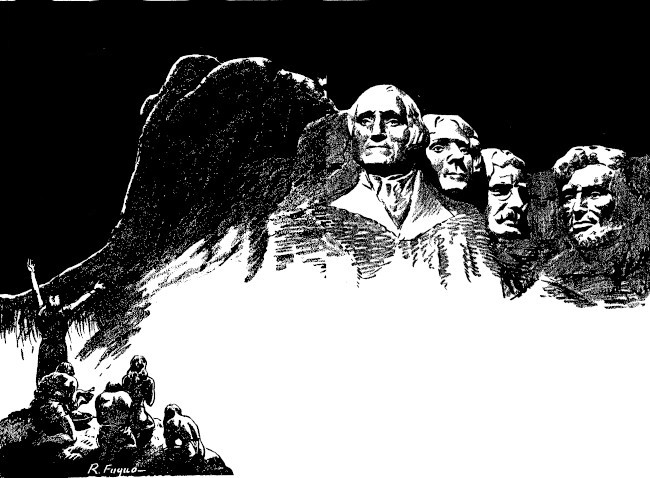
Mt. Rushmore was the Mecca of this future world.
"Exactly!"
"But—but how—?"
"Listen," suggested Steve. "I think we can learn much from the Mother's words."
For the Mother had closed her eyes. In a recitative monotone she was intoning a message to the dazed priestess at her feet.
"Thus say the holy records: 'And in those days were Men the Masters of humankind, and Men were truly in the image of the gods. And mighty were the works of men; over highways of creet and steel they raced swift chariots which took their sustenance from vapored liquid; they spoke to each other from afar over wires that hummed and goblets that glowed; in those days none wanted for food, they spent their days in laughter, their nights in gaming and magic.
"'But it came to pass that some Men, zealous to rule all others, made war upon their brothers. Great and terrible were the weapons of their destruction: great catapults, which hurled fire and flame and exploding death; snarling hand-bows which shot steel arrowheads; with gases they wreaked woe, and with waters that burn the flesh.
"'On earth and sea they made these battles, and even in the air. For in those days, the Ancient Ones were winged, like the birds. They soared high, making great thunders, and when they warred they dropped huge eggs of death.
"'For many years this battle waged, and, lo! neither side could gain a victory. In those days, it was the Men who fought while the Women kept the hoams. So the Men fought and died till their number was as the sands of the sea. Until at last there came a day when the Women despaired and cried out, "Alas! Alas!"
"'Then joined the Women in conclave; great was their sadness. And they vowed to rid themselves forever of war and of the brutal Men. They stopped sending fire-eggs to the Men who battled on Earth's five seas; they built walled forts and hid themselves therein.
"'Then the Men cried, "Give us weapons!" and behold! there were no more weapons, and the men cried, "Give us food, lest we perish of hunger!' and lo! the Earth was parched. So the Men came back to their hoams, seeking their Women.
"'Then the Women would not receive them, and now was bitter warfare again between Men and Women. But the Women in their walled cities vanquished the brutal males, and they did flee to the hills and jungles.
"'Thus it was in the old days....'"
CHAPTER V
Captured
The matriarch's voice dwindled into silence. For an awkward moment none spoke. Then said Jon, leader of the Wild Ones, "Great are the records of thy Clan, O Mother. Often I have pondered on these matters, nor solved them not. We have no legends like these; only one that before the Daans came to Earth, we Men were the lords of humankind."
The priestess Beth was forged of stronger stuff than Steve Duane had believed or dared hope. The knowledge thrust upon her must have come as a staggering shock, but she met it unflinching.
"But, Mother Maatha," was her only demurrer, "if the Ancient Ones and the gods were Men, then what are those which we call men? And—what means this Revelation to our mode of living?"
"Our men," replied the Mother, "are the inbred males born to our breeding-mothers. They are not true Men; this is a truth known to Clan Mothers for many generations. But what could we do? How else perpetuate our Clan? It was forbidden that Women should have contact with the Wild Ones. And it is certain that these—" She stared at Jon with evident repugnance—"are not cast in the mould of the gods we worship."
Steve stepped forward, placed a hand on the shoulder of the hesitant Jon.
"Judge not a man by his garments, O Mother of Women, nor by your own high standards. Bathe this creature, cleanse the blood from his wounds, anoint him with sweet-scented oil, shave the hair from his lips and chin, and beneath his layers of grime you will find one wrought in the image of the gods.
"You have asked, priestess Beth, what the Revelation means to your mode of living? I will tell you. No more must Women war on Men, nor Men attack and seek to linber Women. A new era is proclaimed by us, the Slumberers. Henceforth must Wild Ones and Women join in common amity and purpose!"
"Join in—!"
"Even more," continued Steve boldly, "there shall no longer be castes of Women. No longer must Women be forced to adopt the professions of warrior, worker or breeder, but each shall have the privilege of being wooed and won by a Man, her mate!"
A new radiance shone in the eyes of the Mother. She whispered, "Now are the prophecies fulfilled, indeed. A mate for each Woman! Now is the empty loneliness of sterile wombs banished forever—"
"But how," demanded Beth shrewdly, "is this 'wooing' done? Must we first subdue the Men, and then—?"
"Each shall choose the one she wants," Steve advised her, "then win him as she can. Thus, also, it was in the old days."
Beth looked at Jon and wrinkled her nose. She gazed through a portal of the Mother's hoam and studied a spindling pet male peering inquisitively in at the meeting, and sniffed contemptuously. She frowned.
She said, "And you—O Dwain? Did you not claim to be a Man?"
"That is right."
"Very well, then," said the priestess. "I will make my choice of mates now. I choose you!"
"N-now, wait a minute—" began Steve.
"Shall I come to your hoam tonight?" asked the dust-gold maid with alarming ingenuousness, "Or will you attend me in mine? I do not understand these matters so well, O Dwain. But one of the breeding-mothers can teach me the Rites—"
Lafferty stole a sidelong glance at Steve's suddenly flaming cheeks, and chuckled, "Okay, buster. Let's hear you talk your way out of this one!" Steve coughed nervously and changed the subject.
"You—er—you must not be so hasty, priestess," he said. "There are other—er—more important matters. About the Daans, for instance. Though we gain unity ourselves, yet we are a conquered people. Before we can rebuild humankind's lost civilization, we must first hurl the invader from Earth. To do this, we need force.
"Jon—can you communicate with other tribes of Wild Ones? Call them hither for a general conclave?"
The bearded outlander nodded thoughtfully. "Yes. I think so. It will not be easy. Our tribes are scattered and far-flung, nor is there great unity amongst us, but—yes. It can be done. It will take many days and nights, though."
"How about you, Mother Maatha? Can you summon Women of other Clans to a grand council at Fautnox?"
"I can, O Wise One. The Mother Mairlee of Lextun is my sworn sister; we made the Pilgrimage together. The Tensee Clans owe us a debt of honor since we aided them in defending their mountain stronghold, Ashful, against an attacking horde of Wild Ones as many snows ago as I have fingers. These will surely come at my call, as will the Clina and Yana Clans, and I will bid them bring all others they can persuade. But this will take time, O Dwain. The way is long and the roads bad."
Von Rath coughed gently.
"If I might make a suggestion, Leutnant—?"
"Yes?"
"Since we plot to overthrow ein herrenvolk, would it not be well to learn more about those whom we plan to attack? These Daans are a mystery to us—"
"Absolutely right!" agreed Steve. "And that's how I had planned to spend the weeks that must intervene before our forces can be drawn together. Mother, where lies the nearest Daan encampment?"
"To the north of Fautnox," said the Mother promptly, "two days walking. In a city of the Ancients called Sinnaty, where once dwelt a mighty Clan known as the Reds."
"Reds!" exclaimed von Rath. "You hear, Duane? Then our Fuehrer was right in warning the world against the menace of Bolshevik Russia! Small wonder man's civilization toppled, if even your nation succumbed to—"
Chuck Lafferty made a rude noise with his lips.
"Guess again, 'kraut," he chuckled. "These Reds was different. They did their scrapping with bats and baseballs, and their boss was a 'Dictator' named McKechnie. Cincinnati, eh? Boy, many's the time I've parked my tootsies in a bed in the Netherland Plaza.[4] Steve, remember the night we—"
But his words had struck a responsive chord. A gasp escaped the Mother Maatha.
"Nedlunplaza! Yes, that is it! That is the name of the Daans' fortress in Sinnaty!"
Steve Duane grunted satisfaction.
"In that case," he said, "call the room-clerk and make reservations. We're on our way to Cincy!"
Two days later, they were not merely on their way to the one-time Queen City of the Ohio but almost there.
There were eight in their party. Duane and Lafferty and von Rath—whom, despite their pledge of mutual aid, Steve preferred to keep under surveillance—headed the group. The warrior captain, Jain, commanded a trio of fighting-women who had been assigned to guide and guard them on their adventure. Eighth member of the expedition was the priestess Beth. Over Steve's protest she had insisted on coming.
"It is my right," she declared, "as a priestess. If I go not, the journey is without favor in the sight of Jarg."
"But—" argued Steve.
"Moreover," insisted the girl, "one must go to serve as interpreter and counsel. You Slumberers know not the ways of those through whose territory you must pass."
"Just the same—" fumed Steve.
"Furthermore," concluded Beth firmly, "I have chosen you as my mate. And it is written that a Woman must stand by her Man at all times, nor desert him in hour of peril."
There was no answer to that. So, completely floored and none too gracefully, Steve surrendered.
But however little he may have desired her presence, now that she was here, Steve Duane was forced to concede that her aid had proven invaluable. It was she who, by reading of the stars, had reoriented them after an evening of blundering aimlessly through a trackless forest. It was she who stalled the attack of a small band of Rovers, addressing the ruler of these unattached Women in their own slurred dialect and bidding her take her followers to the Mother at Fautnox. It was she, also, who snared wild hares in seines of hair and cotton, dug scrawny taters from furrowless fields, and prepared meals for them all. For these, she explained, were the rightful duties of a priestess.
Only in one respect did her company prove more of an embarrassment than a pleasure: the persistence with which she attached herself to him. This was not so bad in the daytime. As a matter of fact, it was good to tramp through leafy dells with the keen, live scent of summer vibrant in your nostrils, watching the sudden scamperings of curious chipmunks startled by your passage, and the arrow-flight of swift-flushing birds; hearing the muted murmur of river waters rushing pell-mell to a distant sea as it had in countless ages past and would for endless aeons; feeling the soft warmth of a shoulder firm against your own in carefree comradeship. But it was—well, awkward to say the least, thought Steve, to seek your blanket at night and find it already occupied by one who looked up at you with drowsy expectancy, and damned uncomfortable to spend the night huddled by the glowing embers of a campfire.
Chuck heard Steve's grumbling with a stare of blank astonishment.
"Well, cripes!" he exploded. "You ain't got nothing to squawk about! You said yourself we was stuck here in this new world forever, didn't you? Well, then—?"
"That's not the point," wrangled Steve. "If we want to change an entire culture and substitute a brand new design for living, we must set the example ourselves in our behavior towards these women. We can't confuse liberty with license."
"You mean," said Chuck, "everything's got to be done fair and square, eh? Marriage, and all that stuff?"
"That's the idea."
"Well, then—" Lafferty stroked his jaw—"why not that? I got eyes in my head. You like the kid, don't you?"
Steve answered, "That's the hell of it; I do! If we had met in a different age, under other circumstances—"
"No dice, pal! If you like her, why don't you set a real honest-to-John example by marrying her? Show the Women that the new system will pan out."
"Because," explained Steve bitterly, "it wouldn't be fair to Beth. I'd be getting her under false pretenses. You see, she still thinks I'm a god. She's doing this purely and simply because she considers it her duty. Beth's not in love with me. She doesn't even know what love is!"
Lafferty shrugged and turned away.
"Well, okay," he said. "It's your worry. All I got to say is: Some guys want everything!"
And so, as the third twilight of their march neared, they approached the stronghold of the Daans. The wild trails gave way to highways of cracked "creet" through which hopeful spires of grass had broken in patches ... the highway bore them to a deserted village Beth called "Covton", which once, Steve knew, had been the populous city of Covington, Kentucky ... and they stood, at last, on the southern bank of the rolling Ohio looking into the enemy-held fortress of Sinnaty.
In the happier day, not one but a half dozen spans had bridged this river. They were gone now; their rust-encrusted skeletons still thrust redly from the water like the bones of drowned monsters. But where Twentieth Century man had thrown his cantilevers, where a later, barbaric era had allowed them to decay and fall, now stood a gleaming anomaly which brought a gasp to Steve Duane's lips.
"Sweet snakes!" he exclaimed. "Am I nuts, or do you see what I see? A glass bridge!"
"The answer," said Chuck, awed, "is yes. To both."
But the German, von Rath, was staring at the edifice narrowly. Now he said, "A bridge, true. But glass, nein!"
"What? But it's transparent!"
"Exactly! Too transparent—do you see what I mean? There is no diffraction whatsoever in that structure."
"But—but if it ain't glass—" stammered Chuck.
"Then it must be," recognized Duane, "plastic! Like the lutice of our day, but of an infinitely superior quality. Right, von Rath? But—but if they can create such things as this, we have been underestimating them. What sort of beings are these Daans—"
"Magnificent!" The German's eyes were gleaming with admiration. "What kultur, what refinement! Truly, they must be a great people who built this structure—"
And:
"Don't look now," interrupted Chuck somewhat acidly, "but if you'd peek more and peep less you can get a gander at the bozos you're yapping about. 'Cause, unless I'm completely cockeyed, there's a bunch of 'em coming toward us right now!"
All followed the direction of his gaze. He had made no mistake. A band of men, previously concealed by a bulwark of the bridge, was now approaching them. Or—were they men? They were manlike in general build and structure, being neither shorter nor taller than Duane, apparently weighing about the same, but—there were differences.
Evolution on Venus must have somewhere diverged from the path taken by Earth's anthropological mankind, and chosen a pathway derivative from amphibious or piscatorial forebears. For the Daans were dead-white of complexion, their hair was a bleached thatch of silver, their eyes so lowly pigmented that there was no sharp distinction between eyeball and iris. The forward jut of their jaws gave them a truculent, almost carp-like look, and between their fingers—now hovering above the hilts of curiously-wrought weapons tucked in their girdles—stretched translucent films of flesh, a faint, vestigial webbing inherited from aqueous ancestors.
Beth shrank as she looked upon the newcomers, and an exclamation, less of fear than of awed hatred, broke from her lips.
"O Dwain! Now you have seen them, let us flee—"
"Steady!" said Steve soothingly. "Hold tight. It's all right, my priestess."
Chuck said, "Whaddya mean, hold tight, Steve? Do we just stand here and let them fish-on-legs catch us? Looks to me like it would be smarter to take it on the lam."
"We wait!" ordered Steve succinctly. "Our desire is to get into their fortress, isn't it? I know no better way." He took a step forward, raised an arm in greeting. "Peace, O Daans!" he said. "We are eight wayfarers seeking lodging for the night. Yonder city looks inviting. Can we—?"
He at the head of the armed band grated his men to a halt, stared at the earthlings suspiciously. Then:
"Whence come you?" he demanded.
"From Loovil," equivocated Steve. "We come from the territory of Tucki—"
"So?" rasped the Daan captain. And he crisped swift commands to his followers in the Earth tongue. "We have been fortunate to find those we sought so soon. Seize them! Bind them well that we may take them to the Overlords!"
CHAPTER VI
Rodrik of Mish-kin
In the moments that followed, Steve Duane could feel his mantle of "godhood" slipping from him; its loss was plain to be seen in the eyes of the Women who were his companions.
He had no doubt that, given their own choice, Jain's warriors would have died then and there rather than submit to the Venusians' bonds. His conciliatory policy had caused him to "lose face" before these battle-scarred veterans. Beth did not like it, nor did Chuck Lafferty approve. Lafferty argued hotly, "It's one thing to walk into their town, Steve, but it's another to be toted in like a trussed duck! There's only six of these white lobsters. Say the word, and—"
"The word," said Steve grimly, "is—wait!"
But even he was forced to admit to himself that he hadn't expected this sort of treatment at the hands of the invaders. After all, they had approached the Daan fortress openly, had neither evaded nor attempted to withstand these others. More humane captors would, under the circumstances, have dispensed with the added humiliation of gyves. Not so the Daans. From their harnesses they uncoiled lengths of plastic rope, pliant but incredibly tough. With this they lashed their prisoners, linked them in single file, and herded them across the bridge to the fortress-city.
Vainly Steve tried to reason with the corps captain, demanding to know why he and his comrades had been bound; the Venusian merely grunted and, with the muzzle of his odd hand-weapon, prodded him to silence.
Only von Rath seemed to understand the reason behind the Daans' high-handed treatment. To Steve he said stolidly, "But of course they take us prisoner. They could not well do otherwise, could they? After all, we are their enemies."
"But we surrendered freely. We are entitled to sane and decent treatment—"
The Nazi shook his head disdainfully.
"Ach, you Yankees! Always the dreamers! Warfare is no silly child's game, mein Leutnant. It is a grim business. The true warrior never trusts nor turns his back on his antagonist. As for treatment—the conqueror treats his prisoner as just what he is: a conquered foe. That is realism!"
Steve said caustically, "Yes. I know what you mean. We've all heard about your Nazi concentration camps."
Von Rath shrugged.
"What would you have us do with our captives, coddle them like house-pets?"
"At least," commented Steve, "give them clothing and shelter, sufficient food and medical attention, as we do your soldiers in our prison-camps."
"But," protested von Rath in astonishment, "you hold so few of our brave soldiers, compared to the vast numbers of yours who have deserted to our side! Moreover, you treat our men well because you know you must. Our Fuehrer has promised that the blood of each slain German will be avenged a hundred times over, nicht wahr?"
"Your Fuehrer," snorted Chuck, "is good at promises. He promised your army plenty of fuel oil, too. But you ain't got it yet. Trouble with Adolf is, he picked the wrong method of getting it, attacking the Russians. I know an easier way. All he had to do was build a pipeline from Berlin to the Baku oil-fields, and shove one end of the pipe in his mouth. If he could suck like he can blow, Germany would have more oil than the whole state of Texas!"
Von Rath stiffened, his eyes darting malice.
"That," he stormed, "is dirty democratic propaganda! Our Fuehrer is—"
"Was!" interrupted Steve.
"Eh?"
"Was," repeated Steve wearily, "not is. You two seem to have forgotten where we are. Stop fighting a war that was over fifteen centuries ago!"
Both men stopped wrangling abruptly, glanced at each other rather sheepishly. Chuck said, "Yeah. I guess you got something there, Steve," and von Rath said, "Ja, we have been foolish."
Even so, his defense of the Daans had reminded Steve again that even yet the Nazi was not altogether to be trusted.
Meanwhile, they had crossed the bridge into the city now known as "Sinnaty." The bridge carried them to the heart of the city; still it was with the utmost difficulty Duane—who had known Cincinnati—oriented himself.
It was as if a Twentieth Century New Yorker suddenly should find himself treading the muddy footpaths of New Amsterdam. The geography was the same, but the street pattern was so completely altered as to be practically unrecognizable. Where had been rows of smart shops and office buildings, there now ranged clusters of tumbledown shacks, shanties so squalid as to be mere pig-stys.
Gone were the fine asphalt avenues; age had crumbled them to dust; rain and snow had dissolved this dust, the feet of careless generations had turned the roadways to a quagmire of muck. Animals—cats, dogs, swine, an occasional horse or cow—roamed the streets unmolested, cropping the sparse grass by the roadsides or rooting through the garbage that befouled the air.
Two witnesses remained that this had once been Ohio's second largest city. Still intact was that great, paved intersection which had been Fountain Square ... and beside it, heart-stirringly beautiful in this scene of desolation and squalor, still stood proudly erect the mighty spire of Carew Tower. It was toward this building the Daans herded their prisoners.
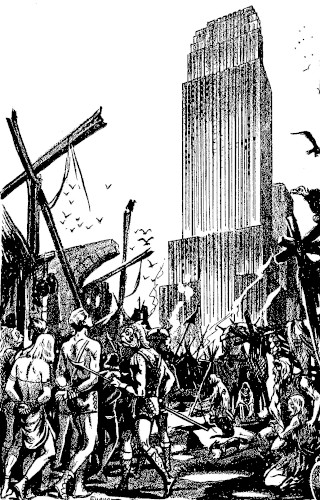
The mighty spire of Carew Tower still stood proudly erect amid the ruins of Cincinnati.
A few humans, both men and women, were on the streets. But these slunk along in the shadows of the dilapidated houses, and when they glimpsed the Daans, scurried furtively, hastily, into the nearest shelter. Steve Duane's hands clenched at his sides to see this evidence of mankind's abject peonage, and in that moment he vowed that, though it cost him his life, he must do something!—to resurrect the glory which had once been Man's, and the pride which had once been America's!
But if the Overlords of Daan let their subjects live like beasts, they maintained a high standard of existence for themselves. The "Nedlunplaza" was, if anything, an even more gorgeous building than it had been in the days when its great lobby entertained visitors from forty-eight states, a hundred nations.
It had been converted into a stronghold, a fortress, a citadel at once impregnable and breathtakingly opulent. A layer of some gleaming metal—silver, perhaps—overlay its erstwhile granite frame. Buttressed walls had been stretched about it; from the occasional watchtowers of these, Daan warriors looked down over their territory. At a call, the gates were flung open. The captives marched into the Daans' capital. Across terraced flags to that which had once been the hotel's lobby ... thence upward in an elevator....
"But, hey!" muttered Chuck. "How come this elevator? I thought these people didn't know nothing about—"
Steve grunted tightly.
"Humans don't. They have forgotten everything of our mechanistic civilization. Look at Beth and Jain. Scared to death. This probably seems like magic to them. But there's nothing wrong with the Daans' science. They know what these things are—and how to use 'em. Any race which can discover spaceflight—"
"Silence!" rasped the Daan group-leader. "Out, now! This is your prison. You will wait here until sent for."
The moving cage quivered to a stop, the door opened, and the octet of captives were thrust from it. Those who had brought them thus far accompanied them no farther. Stepping from the elevator, they moved into custody of other Venusians not only armed with the now-familiar crystalline hand-weapons but also equipped with short, thick-handled, barb-tipped cat-o'-nine-tails.
These, without curiosity or comment, loosed them of their bonds and rudely shouldered them through heavy bronze doorway. The door clanged! shut and they were alone.
Chuck said, "Well, I'll be damned!"
"Well, I'll be damned!" repeated Chuck Lafferty. "Of all the hoosegows I've ever been in, this one takes the cake! Steve—are we supposed to be prisoners?"
"Nothing else but," grunted Duane succinctly.
"But it's nuts!" declared Chuck. "Prisoners oughta be barred or walled or underground or something—"
"You," Steve told him, "should soak up a little bit of von Rath's realism. Or read Elizabethan poetry. Richard Lovelace was right. 'Stone walls do not a prison make', pal! See those windows?"
"Sure I see 'em. And they ain't barred."
"No. But they look straight down about two hundred feet. That's a long way to tumble. Don't kid yourself. We aren't free just because they removed our bonds and loosed us to do as we will."
Von Rath said soberly, "Duane speaks truth, Lafferty. A high, well-guarded tower is the strongest of all prisons. In the Middle Ages all dungeons were built at the tops of castles. Chillon ... der Rathaus ... the bloody tower of London. This is but another evidence of the Daans' superiority over humans. Being wiser, stronger, better organized, they can afford to be contemptuous of their prisoners. They need not bind us. One rebellious move, and they can starve us into submission."
"That's right," agreed Steve. "As a matter of fact, there's only one factor in our favor—and that is the very thing you just mentioned, von Rath. Their contempt for humankind. They have had only to deal with—well, with the poor barbarians of this day. They don't suspect that we three are different. Sharper, more resourceful, and perhaps almost as intelligent as themselves."
The priestess Beth had been listening wide-eyed and comprehending perhaps only half of what she heard. Now, with a small sign of obeisance, "And what," she asked, "do we now, O Dwain? Wait quietly, or prepare magic to destroy our foes upon their return?"
"First," Steve told her, "we get one thing straight. You've got to stop addressing me like something on a marble pedestal. Our chances of success depend on the Venusians not finding out who we are. So lay off that, 'O Dwain!' stuff."
"It shall be as you say, O Dwain," agreed the dust-gold maiden meekly. "But—but how should one address one of the gods—"
"I'm not one of the—Oh, hell!" snorted Steve. "Do we have to go through all that again? Look, Beth—I've told you time and time again that I am a man!"
"Yes, Master. A Man-god."
"Man-god your—Well, never mind! If I were one of the Men of your Clan, you'd call me by my given name—right? Well, from now on that's the ticket. I'm Steve, get it? And this is Chuck, and this is—what's your name, von Rath?—oh, yes, I remember—Eric!"
"Steve ... Chuck ... Ay-rik. Very well, Wise Slumberer. Henceforth it shall be as you say. Jain, you hear?"
"Yes, priestess. We hear and obey."
"Good!" sighed Steve. "Well, now, that's settled—let's take a look around this joint. I don't see any PRIVATE: KEEP OUT signs on the doors, so I guess we're free to wander."
For in addition to the windows which lighted the room, several doors other than the bronze portal through which they had entered off it. Toward the nearest of these Steve led his wondering group.
The door opened easily. And it opened upon a scene which surprised them all. They were not the only prisoners in the tower of Nedlunplaza. The chamber into which they strode was vast, and thickly strewn with humans of all ages, colors and descriptions. Conditions, too. Many were of the furtive, fearful type Duane had seen in the streets of Sinnaty, others were "Wild Ones" like Jon and his tribe—but a few were of a type whose existence in this era the time-exiles had not even suspected. Strong-thewed, intelligent-seeming Men like themselves!
At their entrance, all heads turned at once. Voices raised, for the most part in mourning, but a scattered few in a sort of gloating triumph. And this spontaneous roar roused to movement; the gleeful cries coalesced into a single word:
"Women!"
So swiftly that even Steve Duane, whose mind usually accepted new circumstances with lightning speed, was shocked into immobility, male figures rose and hurtled forward toward the newcomers!
But if the three time-travellers were stunned motionless, not so the women of the Tucki Clan. Barbaric they might be, superstitious they undoubtedly were—but their defensive reflexes had been trained in a hard school; the bitter school of experience.
In the twinkling of an eye, the warrior captain Jain had cried, "On guard!"—and like automatons trained to split-second precision she and her three fighters had whipped steel from scabbards and formed a shield before their priestess and their gods.
Against this biting rampart, not even such a woman-hungry sea of males dared dash itself. The cries assumed an angry, baffled tone, but the attack slowed ... stalled. For an instant there was silence, then one voice, boldly desperate, cried, "On them! What mean their weapons? They are but four, and we are many—"
Steve understood, now, why the Daans had not removed their sidearms while in all other ways holding them in strict bondage. Here was sickening evidence of the difficulties he faced in welding the pitiful remnants of humanity to a force which might overthrow Earth's invaders. Here were men who, though serfs to a master race, spent their blood, their hate, their energies upon each other rather than those who should be their natural enemies.
Eyes blazing, he thrust himself into the forefront beside Jain; his cry was a flaming challenge.
"What manner of men are you? We came in peace—but if war is what you want, then—come on! Who would first like the hot blood let from his veins?"
Answer came from an unexpected source. From the far side of the chamber ... from another door which opened suddenly ... appeared one tall and fair as Stephen Duane himself. In a glance the newcomer appraised the situation, his voice put an end to the mob's mutterings.
"Hold! What have we here? Aaah—new Women?" His cold, gray-blue eyes swept the newly-arrived group, lighted appreciatively as they came to rest on Beth, who had taken her place at Steve's side. "Good! Subdue the men and divide the warriors as you will. But touch not the golden one. She is mine!"
Chuck gasped, "Hoddya like that for nerve, Steve!"
Steve didn't like it. Not a bit. His brow darkened dangerously. "Yours?" he cried. "Guess again, buster! She's not yours till you take her! By what right—?"
"By the right of the power," mocked the other, "that is mine, stranger. I am Rodrik. Rodrik of Mish-kin—ruler of the prisoners of Nedlunplaza!"
CHAPTER VII
Lady Loala
Chuck Lafferty sniffed, "Ruler, eh? Well, a ruler's only got twelve inches, mister—and I got eighteen inches of good steel right here in my fist. If you'd like to—"
"Wait, Chuck!" crisped Steve. Things were beginning to size up a little better now. He stared at the self-styled "ruler of Nedlunplaza" thoughtfully. He said, "Ruler by right of your power, is that it, Rodrik? Then you are strongest of all here?"
"I am the strongest of arm," proclaimed Rodrik, "the fiercest of heart, most skilled with sword and lance, wisest and most cunning—"
"Bashfulest, too, maybe?" suggested Lafferty.
"A shrinking violet," grinned Steve. "Only don't forget to cross the 't' in 'shrinking'." And to Rodrik—"I too am a ruler in my native territory, Rodrik. Therefore I challenge you to pit your strength against mine, here and now, for the prize of these Women who are my own."
"It is not meet," said the ruler disdainfully, "that I should soil my hands against one so puny. I, Rodrik, who alone and unaided have slain the fierce jungle wolf, snared the sharp-fanged boar with bare hands, shattered the ranks of a warrior Clan—"
"Child's play!" taunted Steve. "In my youth, Rodrik, I met and bested the horrible Intercollegiate Fisticuffs Champion, fighting against staggering odds under the sacred and dreadful Marquis of Queensbury rules! Can you say as much?"
The priestess Beth, who until this moment had seemed fearful not so much for her own safety as for that of the man she was pledged to protect, now turned to Chuck dubiously.
"Is—is this really so, O Chuck?" she murmured. "He did destroy the terrible intakul—intrical—?"
"Sister," chuckled Lafferty, "he moidered him! Left-jabbed him silly, then crossed a kayo to the solar plexus. If Rodrik of Mish-kin gets sucked into this deal, he's gonna get tagged on the whiskers—but plenty!"
"The language of the gods," whispered the girl in awe, "is strange to my humble ears. But I am reassured. What can I do to help?"
"Just say," grinned Chuck, "the magic words: 'Sock him, Steve!' That oughta help."
The priestess made a swift, pious movement. "Your suggestion, O Chuck, is my command."
Meanwhile, Rodrik of Mish-kin had pressed forward to confront Steve. Ranged face to face, there was a startling similarity between the two men. Both were over six feet tall, both were blond of hair, fair of skin, blue of eye. But there the likeness ended. Steve's brow was smooth, unfurrowed; his lips were drawn in an amused, almost hopeful, half smile. The other man's eyes were sultry, his lips drawn thin with anger at having his authority thus challenged.
For a long moment he glared at Steve, as if the very ferocity of his looks might cow his antagonist. But finally it was he, not Steve, who dropped his eyes. He turned to his followers.
"Enough of this!" he snarled. "The stranger lies. Destroy him and his fellow males. The Women are ours."
And again the hands of the eight adventurers tightened upon their hilts. But strangely the blood-lust of the prison band seemed to have cooled. One who had pressed most ardently now voiced the doubt of his fellows.
"That we cannot do now, O Rodrik," he demurred. "He has put the question—challenged you, the ruler of our band, to private combat. The challenge must be met. It is the Law."
Rodrik's fair cheeks flamed with sudden anger.
"Fool! Can you not see he is a braggart and a liar? At him—"
"It is the Law!" repeated the other man stubbornly.
"Very well, then!" cried Rodrik, goaded out of patience. "See how I meet and destroy this interloper—"
And in one blurring motion he whirled, lashed his sword from his belt, and hurled himself upon Steve.
But Duane's smile had not masked carelessness. Fast as Rodrik moved, he moved even more swiftly. His blade met that of the other in midair with a chilling zzzwiing! Shock numbed his opponent's fingers, a twist sent the sword flying across the room. Rodrik cried aloud, a cry of dismay mingled with fear. His hand darted to his harness, withdrew, flashed—and winged death sang past Steve's ear as he left his feet in a diving tackle.
His shoulder smashed his foeman's knees. Rodrik staggered backward, arms flailing, and Steve pressed his advantage. With a lunge, he was on his feet again, closing in on Rodrik, battering him with sledgehammer lefts and rights. The ruler of Nedlunplaza's prisoners moaned and spat blood. Powerful man that he was, this type of onslaught, performed under the "sacred and dreadful" Marquis of Queensbury rules, was beyond his ken.
Realizing this, Steve relented. Face close to that of his antagonist, Duane offered, "Enough? Are you satisfied now, Rodrik? Do you yield?"
The reply was half-choked, gasping.
"I ... yield ... stranger."
"Good!" said Steve. "Then—aaagh!" His proffer of peace and amity ended in a retching groan. For as his fists fell to his sides, Rodrik moved with devilish treachery. His booted foot found Duane's groin, driving Steve to his knees, twisting and nauseated, lips working to hold back the sickly bile churning within him.
Chuck Lafferty's outraged scream ripped the darkness which threatened to engulf him.
"The damned, sneaking scoundrel! Steve—are you all right? Out of the way! Let me at—"
In that moment, while Steve was helpless and Chuck still too far away to be of any assistance, Rodrik of Mish-kin could have won his battle—had he dared. But he had learned a wholesome respect for his opponent, and it was his way to end the fight with cold steel, not with the vigor of his own fists. He whirled, eyes darting about the room, found what he was looking for, and raced toward his sword.
But rage, cold and deadly, flooded Stephen Duane like an icy cascade. From somewhere deep within him came strength he had not known he possessed. He lurched to his feet, threw himself after his enemy. They met again before Rodrik's hand could clutch the sword—and their meeting was the downfall of Rodrik of Mish-kin.
For no peace offer was granted him now. With deadly fury Steve went to work on his opponent. His blows cut like the bite of an axe in heartwood: right and left to the body until Rodrik's mouth gaped like an angry wound, his knees sagged beneath him, his guard pawed futilely at the battering rams which bent him double ... then lefts and rights to the unprotected face, hard knuckles raising great welts on his fair cheeks, welts which tore and bled....
Then:
"This one," rasped Steve, "is on the house!" And he let it go. A hay-maker from the floor that caught Rodrik on his way down to meet it. Rodrik sighed once, wearily—then his eyes rolled back in his head. His legs seemed to melt beneath him; he sprawled on the floor like a flayed carcass.