Front matter (continued 3)
Reading edition
Curiously enough, the dense cloud-banks through which the Oalumuo had plunged to its landing did not enswaddle this scene, nor conceal the colorfully magnificent skyline of the metropolis which surrounded the spaceport like a heaven-spanning rampart. Or perhaps that was not so curious as logical. For surely—Duane's swift reason told him—any race which could create such wonders as these had also long since learned how to harness and subdue the meteorological disadvantages of its native world. Plainly this island of freedom from the all-pervading Venusian fog was an artificial one.
So lost was he in wonderment and speculation that it was not until a hand touched his shoulder that he realized he was being addressed for possibly the second or third time by the young space-officer who had been his guide and companion throughout the journey.
He spun, startled. "Oh, I—I beg your pardon, Thaamo. I was lost in dreaming. I did not realize—"
The friendly officer smiled.
"It is good to be home again, is it not, Captain Huumo? Fair Daan is a delight to the eyes after lonely years of service on our colony. Ah, well—it has been a pleasant enough journey. What are your plans now, my Captain? You will report to the Supreme Council, no doubt?"
On this point Okuno's instructions had been clear.
Duane nodded. "Yes."
"Of course. Then you will be traveling by aereo to the palace. You had best make haste, Captain Huumo, ere the last flight leaves without you."
The season was warm, the air dusty-dry, but there was suddenly upon Stephen Duane's forehead a cold, dank perspiration. For, standing there with the gaze of his acquaintance upon him, he realized in that instant that there was too much he still did not know about the customs and the culture of the Daans.
He knew neither where the palace lay, nor what this "aereo" was by which he might reach it, nor even in which direction he should now turn with assured movement to dispel the half-suspicious curiosity of his mariner friend.
But at that moment relief came from an unexpected quarter. There sounded beside him a light tinkle of laughter and his eyes lifted to meet the taunting, gray-green eyes of the Lady Loala.
"Hasten him not, Aarkan Thaamo. Captain Huumo waits for me. But I am ready now. Come, Captain—" She rested a pale hand lightly upon his arm—"let us go." And gratefully Steve Duane allowed himself to be led away.
But a few moments later, in the seclusion of the Lady Loala's tiny, individual aereo, a small craft which Duane discovered to be somewhat similar to the two-passenger planes of his own century save that it traveled silently and effortlessly on an atomic power-beam transmitted from central control stations, rather than by any independent motor of its own, the argent Overlord mocked Steve for his recent awkward moment.
"You are a poor dissembler, Steve of Emmeity. Happy for you that you masquerade only to deceive your Earth brethren, and not the Daans. Methinks your play-acting would come to a swift end if we were those upon whom you attempted to spy, rather than the stupider humans."
Steve grinned, not half so ruefully as the Lady Loala believed, and conceded, "You are right, my princess. Deceit rests poorly upon my features, even though those features have been altered to make me resemble one of your own race.
"I am afraid the Lord Okuno's efforts to make me look like a true Daan were not altogether successful. The episode with Thaamo was not the first time I have come near betraying my real identity. And as for you—you penetrated my disguise the moment you laid eyes upon me."
Loala said softly, "Who should know thee better than I, Steve of Emmeity? True, I recognized you immediately. But perhaps my eyes knew you less swiftly than my heart.
"You see, human, you please me greatly. Yes, frankly, I admit it; even I, Loala, Overlord of Sinnaty, confess I find you—interesting.
"But be of good heart. Here on Daan no other will recognize you, nor none suspect you an earthling, as none aboard the Oalumuo questioned your race. And your secret is safe with me. Though I do not understand why Okuno found it necessary to disguise you as a Daan when he sent you on this mission."
"It was done," explained Steve hastily, "not to deceive the Daans, but the men and women of Earth amongst whom I must move and mingle freely. Were they to realize I were one of their own kind, Okuno said, they would destroy me before ever I found a chance to identify and point out the wakened Slumberers."
"I see," nodded Loala. "Well, Okuno is a wise Councillor. In his judgment I place implicit faith. Still—" Her eyes met Steve's archly—"it strikes me you have taken too seriously this mission of yours. Those were long, lazy hours aboard the Oalumuo, my Steve. Hours we might have spent pleasantly together."
And Steve said staunchly, "There is nothing under sun and stars I should have liked better, O Vision of Loveliness. But—"
"But—?" prompted the Lady Loala.
"But the Lord Okuno has promised that if I perform this mission faithfully and well there may await me even a greater prize than that of mere acceptance into the Brotherhood. To a chosen few, he told me, is granted the privilege of full Daan citizenship, complete membership in the master race. This, O Wakener of Dreams, is my hope and my ambition. To win that coveted honor, so I may not only become your Earthly consort, but aspire to the position of your true Daan mate—"
Steve's eyes met those of the Venusian woman boldly. And this time it was her pale cheeks into which crept the faintest suspicion of color as she dropped her eyes, murmuring, "I—I fear you presume too much, Steve of Emmeity."
But the Lady Loala was not displeased. Nor did she, Steve guessed shrewdly, represent in any way an obstacle to his future plans. Loala would not betray him. Any lurking doubts which might have lingered in her bosom had been swept away by the tide of her own desires.
Thus, his true identity a secret known only to one Daan, and she one who would not reveal it, the major hurdle of Stephen Duane's great impersonation was overcome.
The Daan's Supreme Council accepted himself and his credentials for what they purported to be, strove to discern no human lineaments beneath his cleverly wrought mask, and freely granted that privilege for which Duane pleaded: the right of visiting the marshland slave camp wherein labored earthmen and women transported hither from Earth.
Standing before the Council, Steve experienced his first disappointment in the Daans. Under the circumstances, "disappointment" was perhaps a curious word to use, even to himself. Yet it was the only one to describe his feelings. Up to this time he had felt bitterness toward the Venusians for what they had done to Earth, had hated certain members of the master race for the brutal way they had treated their human slaves; but despite these personal animosities he had been forced to concede an intellectual approval of their skill, their culture, and above all, their superb scientific accomplishments.
Yet now he found himself standing not in such a trim, functional chamber as had been the council hall of Nedlunplaza. The palace of the Supreme Council on Daan was a sybaritic pleasure-dome which on Earth had had its counterpart centuries before Stephen Duane first drew breath.
It was in such a court as this the effete emperors of imperial France had dallied with glamorous mistresses while starving subjects fell plague-ridden in the gutters. Surrounded by such pleasures had the last Roman tyrants squandered their heritage in riotous abandon. Here was such opulence as had rotted the heart of Saladan's kingdom, Priam's, Cleopatra's, and the sea-girdling empire of Phillip.
Duane needed no textbook to tell him the history of the Daans. He knew what had happened; the evidence lay before his eyes.
The Venusians had been a mighty race. Only a strong and stout-hearted people could have raised from the morass of this eternally fog-veiled planet such cities and such sciences. Only daring and stalwart people could have accomplished those wonders the Daans accepted as commonplaces. Labor had played its part in this rise to superiority; labor of back and brain. Sweat of muscle and furrow of brow had created an empire. But now those who had striven so mightily were gone, leaving behind a languorous and unappreciative race to despoil the glories their forefathers had so magnificently wrought.
The present Daan empire was a spoiled, stagnant civilization. It dwelt amidst splendors created for it by vanished generations, reveled greedily amongst luxuries earned by the sweat of predecessor's brows. That was why slave labor was imported from Earth; to lift the burden of honest toil from hands become too proud and soft to fend for themselves.
Those Daans who maintained the scattered outposts on Earth were perhaps the last atavistic remnants of a once-great race. They, at least, could and did work for themselves; had the strength and the courage to wage incessant conflict for possession of a territory precious to the mother land.
But these members of the Supreme Council, languid, lolling, grimacing creatures who spoke in accents of exaggerated boredom, nibbled at wines and sweetmeats as they talked, pausing from time to time to fondle diaphanously-veiled females of their harem corps, were no opponents to be feared. They were, rather—Steve's eyes narrowed minutely and his jaw set—wastrels to be outwitted and overthrown.
Now one of the Council was speaking to him, his voice a shrill simper of amusement.
"To the swamps, Captain Huumo? Of course you have our permission—if you really feel you must. But why any Daan noble would choose to go there and in this season—! Why do you wish to go?"
Steve's answer was half truthful. "Because it is said, my Lord, that at the recent battle of Loovil were taken into custody certain humans who call themselves the 'Slumberers.' The Chief Executioner, Okuno, sent me hither to find these three and return them to Earth for judgment."
"Slumberers?" drawled his questioner. "But surely that ancient myth has been exploded by now, Captain? It is written in the Archives that when our ancestors took Earth centuries ago its people worshipped these fabulous creatures. Have they not learned by now—?"
The Lady Loala interrupted, sharply, impatiently. Glancing at her in surprise, Steve could not help but feel that she, too, had found cause for disappointment in the namby-pamby behavior of her superiors.
"Pardon, O Masters," she said, "but the Captain Huumo speaks truth. We who have lately served, fighting and working—" she stressed the verbs with delicate irony that escaped all save Steve—"on Earth are conscious of a new spirit of rebellion amongst that planet's people. A rebirth of the independence which made them bitter foes centuries ago.
"Our spies inform us that word spreads like wildfire amongst the humans that the Slumberers have awakened, and the hour to strike for human liberation is nigh. If this be true, there may again be bloody warfare on our colony."
"But our fleet, my Lady—" offered one of the Masters—"it is swift and powerful—"
"That I know," said the Lady Loala grimly, "and this I also know—that had Daan not an armada of fighting vessels as an ever-ready threat to hurl against Earth's children, by their vigor and strength, by their renascent determination for freedom they might tomorrow break the bonds of servitude in which we hold them. You may thank the waters whence our ancestors sprang, O my Lords, that we have this mighty fleet at our command."
"We are duly grateful, Lady Loala," yawned the first Councillor impatiently. "But since we have this bulwark, there is no reason to become apprehensive. Was it thus to warn us and spoil our pleasure that you journeyed hither from Earth?"
The Lady Loala shrugged and abandoned the futile attempt to make her Masters understand. "It was, my Lord. But I see now my mission has been vain. Therefore, with your permission I shall withdraw and arrange to return to my post with the first outgoing transport."
"Very well. But wait! Did you not say it was within your territory the Slumberers are reputed to have awakened?"
"Aye, my Lord."
"Then since the first transport is not scheduled to leave for several days, would it not be well for you to accompany the Captain Huumo on his search for these—fabulous creatures?"
There was a mocking lilt to the Councillor's voice. Even Stephen Duane, who was not familiar with Daan traits and trends, read the meaning behind his words. Reminder of the responsibilities habitually shirked had wakened the Council's spite. None too subtly the Lady Loala was being punished for the temerarious violation of their languor, in thus being sent to the equatorial swamplands.
But if Loala recognized this sentence as punishment she showed it neither by word nor expression. Instead, with almost eager alacrity she said, "Very well, my Lord. Your wish is my command. It shall be as you say."
Thus Stephen Duane found himself burdened with the one companion of all Daandom whom he wanted least to take with him on his journey.
CHAPTER XV
Swamp Gold
As on the following day he and the Lady Loala neared their destination by private aereo, Steve Duane came to the conclusion that not without reason had the Daan Supreme Councillor spoken distastefully of the summer climate in this section of the planet.
Nothing in Duane's experience had prepared him for such devastating heat as that which waxed stronger and more devouring as they approached their goal. Earth of Duane's day had known its uncomfortable spots ... the Mohave, the Sahara, the pouring-room of a steel mill, a New York night club in midsummer ... but nowhere had heat ever been so constant, so unavoidable, so overwhelmingly depressing as here in the equatorial regions of Daan.
For one thing, the planet was some twenty-five millions of miles nearer the sun than was Earth. For another, it was enveloped in a swaddling cloak of moisture-laden atmosphere. The third and culminating blow was the terrain over which they flew: a vast and squamous marshland, jungle-thick, steamy and frothy with the scums and scents of myriad forms of torrid, aqueous life.
This combination of sights and smells and stifling heat not only weakened but sickened Steve Duane. The Lady Loala did not seem to share his discomfort completely. Apparently the pores of her dead-white skin were better adapted to this climate than were those of the Earth man. But even she was far from comfortable.
Traveling over this terrain was like tunneling in a closed sled through rifts of downy cotton, so constantly was their ship engulfed in solid layers of fog. Only at brief intervals and for briefer flashes did the interminable mist clear long enough to reveal below them the sprawling green tracery of jungle, or a black and sluggish river winding its sultry way through a half-drowned plain.
And, traveling thus, Duane realized that the beam transmission method of Daan aircraft was not only a great accomplishment but, indeed, the only possible means of flight over a planet so humid as Daan. Only about cities and major outposts did atmosphere-clearing units offer flyers somewhat better than 0-0 visibility. Elsewhere, were it not for the narrow transmission of the atomic power setup, aereo drivers would have been forced to fly by dead reckoning at all times.
Now, however, their craft was approaching one of these cleared patches of atmosphere. The cottony blanket about them was thinning into tufted clots. And Loala, glancing at the instrument panel before her, nodded to Steve.
"This is the slave camp, Steve of Emmeity."
And deftly she guided the little ship to rest on a field which appeared beneath them.
They were greeted upon landing by one who identified himself as the Chief Warden of this slave camp. He was a hulking, truculent brute, more goggling of eye, more prognathous of jaw than most of the Daans. He descended upon them with belligerent alacrity, growling curt queries. But upon learning his visitors were an Overlord and a noble of high rank, his attitude underwent a swift, chameleon-like change. At once he was bowing and scraping, obsequiously servile.
"Yes, my Lady! Yes, my Lord!" he answered their queries. "The new prisoners are quartered here. Of a certainty you may interview them. I will have you shown to their pens immediately. Amarro! Hither quickly, lazy one, and guide our guests to the sties of the Earthborn scum!"
The lieutenant who answered his summons was scarcely less prepossessing of appearance; but Stephen Duane paid him the mental compliment of acknowledging that here was one Daan, at least, with a few vestiges of dignity and compassion.
He frowned at his commander, reminded gently, "But Grudo, they are asleep. It is their hour of rest. They have but returned from long hours of back-breaking toil in the swamps—"
"Silence, weakling!" bellowed Grudo irately. "There is no rest for slaves unto the grave. Convey our visitors where they would go instantly!"
And to Loala and Steve as the abashed Amarro shrugged and silently led the way, "This is what comes," he grumbled, "of allowing Daan warriors to visit that accursed colony, Earth. Before Amarro vacationed there, he was the best hand with the lash of all my guards; since his return he coddles our prisoners like house-pets. You will forgive me if I do not accompany you? I must go now and make preparations that you may eat, drink, and be entertained when you have finished your task. May Daan live forever!"
"May Daan live forever!" repeated Steve and Loala ritually, and followed their guide to the pens wherein were herded the Earthborn prisoners.
It were folly to attempt to describe the revolting squalor of the prisoners' barracks. Grudo had not chosen wrongly when he called their quarters "sties." If anything, the word over-glamorized the conditions under which the slaves were kept.
After threading his way through an intricate series of barricades and across an open area through which even Amarro walked gingerly, explaining as he did so that this entire field was groundmined with atomic bombs against the possibility of a single prisoner's escaping, Steve's heart sickened within him to look at last upon the filthy pens into which were huddled a thousand emprisoned Earth cattle, including those who had so recently and gallantly fought beside him at the taking of Loovil.
The miasmic odors emanating from the swamps were but part of the appalling stench which rose to offend his nostrils. Odors of death and decay, sickness and filth, stagnant waters alive with squirming life, rotten food ... these were the conditions under which the effete Daans maintained their "mastery" over once free earthmen.
Yet what men must endure they somehow can. And even in this scene of degradation, somehow the exhausted prisoners contrived to sleep—until Amarro issued the order which brought the entire camp to its feet as a brazen klaxon clamored its strident signal over the barracks.
Then haggard humans, trained by lash and rack to obey the summons of that signal, came straggling from their quarters to stare in dumb bewilderment at their gaudily-raimented visitors. And it was then Amarro turned to Stephen Duane.
Perhaps it was only imagination on Duane's part, but for an instant he thought he detected in the guard's eyes a sullen glitter of disdain as Amarro muttered, "Here are those you seek, noble Lord. Fear them not. They are too weak and weary to resent your questioning."
And the Lady Loala glanced at Steve.
"Do you see them, Steve of Emmeity? See you the trio you came to identify? Those known as the Slumberers?"
Steve did not hurry his answer. He had already seen and grievously recognized many of those he loved. Beth ... and the Mother Maatha. Chuck Lafferty who, even in befouled exhaustion, managed to maintain a shadow of his erstwhile proud defiance. The Wild Ones' leader, Jon. Lina, warrior captain of a Tensee Clan.
But there was one whose sight evaded him, and that one, for the nonce at least, perhaps the most important of them all. Steve turned to Amarro, frowning.
"I am not altogether sure. I saw the Slumberers but once, and then for a short time. It is not easy to recognize them under these conditions. But there is one face I have not forgotten. I see it not here now. A human tall as myself ... with close-cropped hair of yellow, pale blue eyes, heavy jaw and thick lips...."
Amarro started. "What, my Lord? Say you that one is a Slumberer? He is not here."
"Not here?" cried Steve in swift alarm. "Then where is he?"
"He is back at our headquarters," explained the guard, "undergoing hospitalization. He was wounded when brought from Earth, and could do no work. His mind was affected so he knew not where he was, nor whom. He begins to show signs of recovery now, though—"
A swift pang of fear coursed through Stephen Duane. So far he and his comrades had been fortunate. Von Rath's amnesia was the only reason Chuck still lived and he, Duane, trod the soil of Daan freely. But if von Rath recovered, it would be but a matter of time before....
His voice lifted sharply, excitedly.
"I must see him at once, Amarro. Take us back to headquarters immediately—"
His very excitement was his undoing. For his voice carried clearly across the ground which separated him from his former comrades. At the sound of that voice one slim and dust-gold figure thrust forward suddenly, and a heart-stoppingly familiar voice cried,
"Steve! O Dwain! O Slumberer—thou hast come at last to free us!"
Then everything happened at once. Chuck Lafferty's eyes widened in belated recognition, and he moved in swifter comprehension of the evil Beth had unwittingly done; leaped to the girl's side and clamped a stifling hand over her lips.
But of the mob, only these two identified Duane with gladness or understanding. Through the rest stirred an ominous murmur which heightened instantly to screams of rage and hatred.
A mad voice cried, "Betrayer!", and a hundred throats took up the cry.
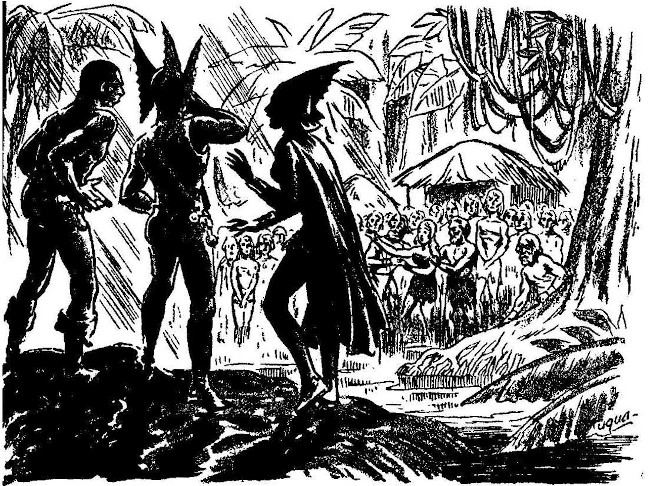
A mad voice cried, "Betrayer!"
"It is he, Dwain! The Slumberer who betrayed us!"
And with one concerted movement, like the liberation of flood-waters loosed from their dam, the prisoners surged forward, eyes burning, bare hands aquiver with hatred, to seek revenge upon the rescuer they thought a traitor to their cause!
In the immediacy of this peril it was only the swift action of the guard Amarro which saved the two visitors.
Steve Duane was stricken motionless by this catastrophic disruption of his plans. The Lady Loala was too dazed by the accusation against her favorite to defend herself. She whirled to Steve, her gray-green eyes startled.
"What is this, Steve of Emmeity? They call you Slumberer? What means—?"
Steve answered hurriedly, "There—there must be some terrible mistake. I know not what they mean, my Lady. They confuse me with one of their false gods."
But Amarro, after one stunned glance at Steve, had sprung into action. Ray weapons seemed to leap from his harness to his hands, and in a voice of thunder he cried to the advancing throng, "Back, dogs! Back to your kennels and stop baying! That human who takes another step forward—dies!"
And before the swift menace of his gesture the small uprising trembled and fell apart. Already the privations of this camp had taken their toll upon the spirit of the earthlings. Like cowed creatures they quelled before the lone Venusian. Their babble died, and listlessly they permitted themselves to be forced back into the building which housed them.
Amarro turned to Steve with a curiously level gaze that embodied half a question.
"They hate you, Captain Huumo. It is not safe that you remain here. Perhaps we should return to headquarters."
But Steve said, "No. At the last moment I thought I recognized amongst them one of the Slumberers. Saw you that dark-haired earthman in the forefront? The one who silenced the wench who accused me? I would speak to him. Is there some place we could go for—private questioning?"
Deliberately he fingered his ray-gun while voicing the final phrase. For this, he knew, was a familiar method of "private questioning" used by the Daans in this era as it had been used by totalitarian leaders of his own.
And to both Amarro and Loala the query made sense. Loala smiled thinly, and Amarro replied, "There is such a place, my Captain. That small hut over there. But—may I remind your Lordship these slaves are valuable? We destroy them only on major provocation."
"I understand, guard," said Steve haughtily. "Now bring me the prisoner. And you, my Lady, there is something in what this guard says. Perhaps it would be safer if you retired."
And Fortune at last was tossing the breaks his way. For the Lady Loala nodded.
"Aye, Captain Huumo, that I shall do. I will await you at headquarters."
And she left.
So, short minutes later, Amarro having brought his prisoner to the shack wherein Duane waited, and having left, securing the door behind him, Steve stood at last face to face again with his friend and companion of a lifetime.
In that glad moment it did not matter that his proud trappings were stainless, while Chuck's reeked from head to foot with the prison's filth. Gleefully Steve rushed to his chum's side, gripped him in a bear hug of brotherly affection.
"Chuck!" he cried, his voice breaking. "Chuck, you old son-of-a-gun! I was afraid we'd never meet again. But I made it, pal! I made it!"
And if some of the captives had lost their spirit under Daan treatment, Chuck Lafferty, at least, was made of sterner stuff. For his answer was typical of himself. He answered Steve with a grin sincere if weary.
"Okay," he snorted. "Okay, bud. But I'm warning you—if you kiss me you gotta marry me! Now, for God's sake, pal, talk and talk fast. What are you doing here in them duds? And what in the name of creeping pink lizards have they done to your homely puss? You look like something that crawled off an autopsy table!"
"Better that," chuckled Steve, "than somebody who's going to. Don't look now, pal, but I'm a ranking noble of the Daans."
"You're—what?" Chuck's grin faded abruptly. "You mean, Steve, the bunch was right? You have sold us out? Gone over to their side?"
Steve stared at him long and steadily.
"Do you have to ask that, Chuck?"
And Chuck's eyes fell, then raised again slowly.
"No, I don't. I don't even know why the words came out, Steve. But that's what some of them have been saying. Beth and me and the Mother Maatha and maybe a few others, we're just about the only ones left who still believe in you."
Steve said soberly, "Loovil was that bad, Chuck?"
Chuck nodded. "It was worse. We were just getting settled when the Daan warship came. We were powerless. I don't think there's one stone left on another in that city. And—you see what's left of our 'tremendous army' of two thousand.
"But—" He shook his head and with that gesture tried to dismiss visions of horror forever indelibly imprinted on his mind—"but there's no use talking about that now. What's next on the program? You're here to free us, ain't you? Have we got a half-way fighting chance to—?"
Steve said hotly, "I'm here not only to free you, but maybe to free all Earth, Chuck!"
And in swift sentences he told his friend all that had transpired since their parting. Of Rodrik's death and the false Lord Okuno. Of his visit to the Supreme Council and the results thereof.
"And so," he concluded, "that gives you some idea of the organization we've formed. One huge enough to reclaim Earth for mankind—if we can find some way of immobilizing the Venusian spacefleet here on Daan until our forces have destroyed the invaders. But—" And he shook his head sadly—"that's the stumbling block, Chuck. I've got to find an answer to it somehow ... but it's a tremendous problem. One hundred war-ships cradled at the spaceport, just waiting the word to go into action ... and we have no arms to throw against them!
"Lord!" he moaned bitterly, "if the legends of the Clans had only been true! If only we did have that precious secret the Women expected the Slumberers to bring from their tomb!"
"Good goddlemitey!" cried Chuck. "I ain't told you?"
"Eh? What's that? Told me what?"
Chuck's eyes were wide. His words tumbled in hectic confusion from his lips.
"What I've learned since I've been here, Steve. Maybe that legend about our bringing earthmen a weapon ain't so cockeyed after all. Do you know the work they set us at here in these swamps? Reclaiming the marshes, destroying the rank vegetation that grows wild here, acres and acres of—"
Steve interrupted softly, "Yes, Chuck. I know. It has been horrible. But we'll try to change all that—"
"Shut up, you fool," howled Chuck. "Change it? You're damn right we'll change it. That's what I'm trying to tell you. Them acres upon acres of what the Venusians think is good-for-nothing vegetation ... the stuff we're clearing away ... do you know what is it?"
"Of course not," said Steve impatiently. "But—"
"Then I'll tell you," roared Chuck, "if you'll shut that big yap of yours and give me a chance to talk. It's—swamp-musk, Steve! The rarest epiphyte on Earth grows wild here on Daan like daisies. Swamp-musk—the basic ingredient of methioprane!"
CHAPTER XVI
A Friend in Need
For a moment while his blood seemed to halt in his veins, Stephen Duane stared at his friend. Then his heart resumed its interrupted tempo with violent resurgence, and he gripped Chuck's arm fiercely.
"Swamp-musk!" he choked. "Chuck—are you sure?"
"Listen," said Lafferty, "I ain't no surer of my own name. These swamps are simply lousy with that stuff. There's so much of it that if it was poison ivy I'd be one big itch on legs!"
"And the Venusians don't know what it is?"
Chuck snorted. "They know what it is. They call it klaar, which is Venusian for 'nuisance weed.' But they don't know what it can do, or why would they have us destroying it as fast as we can clear it out of the bogs?
"Hell, no, Steve! They ain't nobody alive on these two worlds in this century that knows what klaar can do except you and me."
That, knew Stephen Duane, was true. The anesthetic gas, methioprane, had been an invention of his own, one upon which, of all mankind, only he and Chuck had worked. Its secret had slumbered with them in the oblivion of subterranean Fautnox for fifteen centuries.
Now a great hope overwhelmed Duane. For the first time, a blazing shaft of light illuminated the murky fog of doubt through which he had stumbled, groping vainly for some means wherewith to overthrow Earth's rulers. The actual preparation of methioprane from swamp-musk was not a difficult feat of chemistry. It was one so simple, indeed, that a handful of men with but a few primitive pieces of equipment could create vast volumes of the potent gas. All needful now was to find the time, the place, the workers to perform this labor.
To Chuck he blazed, "That settles it! I've got to get you out of this camp! We've got to escape and find a hidden refuge where we can start manufacturing methioprane—and plenty of it. But, where? Where?" He beat his temple angrily with the heel of one fist, as if by so doing he could stimulate the duality of his Earth-Venusian brain to knowledge of some sanctuary.
But it was Lafferty who supplied the answer.
"Escape," he snorted, "your hat! What do we want to escape for? We got a ready-made laboratory all set up for us!"
"What?"
"Sure," explained Chuck. "The prison barracks. It's the perfect hideout, Steve. Right under the Daans' noses, where they won't suspect a thing. If we lammed, they'd be out on our trails chasing us with whatever they use for bloodhounds on this stinking planet.
"But the Daans never come into or near our barracks; not even to feed us. We're nothing but swine to them. Our sty ain't fine enough for their lordly feet. They just dump our food at the entrance to the prison area and let us find it or starve. When it's work time, they call us. When it's rest time, they kick us back into our pens and forget about us.
"All we need, Steve, is equipment. That's what you've got to do for us. Keep on playing the part of a Daan nobleman, and somehow find a way to smuggle lab equipment in here. And—" pledged Chuck Lafferty grimly—"I'll supervise the manufacture of enough methioprane to put this whole damn planet to sleep till the crack of doom!"
Duane nodded happily. "That's the answer, Chuck. Yes, it's the perfect answer. But—yourselves? Beth, and the Mother Maatha, the others—can you endure this—?"
"Don't worry about us," grated Lafferty. "We've been enduring it with nothing to hope for. Now that there's a chance to fight back and do something, we'll be in there pitching." He grinned mirthlessly and paraphrased the staunch declaration of another fighting man in an earlier day. "Just give us the equipment, Steve, and we'll finish the job!"
So Duane left his friend. And when they had emerged from the tiny shack in which they had held the conversation which might decide the fate of the two worlds, Lafferty returned to the barracks and Steve called the waiting guard, Amarro, to lead him back to the higher, cleaner terrain whereupon were built the Daan administrative buildings.
Apparently Amarro had not presumed to eavesdrop on the conversation of a Venusian nobleman, but Steve felt he could detect an atmosphere of uncertainty or suspicion emanating from the prison guard. Several times as they wended their way through the treacherous barricades, Amarro seemed on the verge of offering some query. More than once his eyes scrutinized Duane with curious speculation. But Steve silenced all attempts at speech with curt, monosyllabic grunts, and they reached their destination without an accusation having been made or denied.
Loala and the Chief Warden were awaiting his arrival. Apparently they had found subjects of mutual interest, for their heads were close together when Steve entered the administration building. They separated swiftly, and Grudo said in that greasy tone of semi-humility Steve loathed, "Greetings, O most noble Huumo! You have finished your questioning?"
"I have," grunted Steve disgustedly ... and shrugged. "I was wrong. The creature is an ignorant earthman, vulgar and loutish as all his race. He is no Slumberer. Methinks there have never been such thing as Slumberers."
Loala studied him from beneath long, veiling lashes.
"You lingered long enough with this 'vulgar lout', my Captain."
Steve snarled, "The man had complaints to make, and I tarried to hear them. To be truthful, some of his grievances seem justified. He complained that the water prisoners are forced to drink is vile and disease-ridden, pointed out that his companions sicken and die like lice."
Grudo laughed coarsely. "What matter? When these slaves die there are thousands more on our colony."
"Nevertheless," said Steve, "the human's point was well taken. Sick slaves are valueless. I told the man I would do something to assure them a supply of cleaner water. But—" he added hastily—"I also told him we would turn no hand to provide for their comfort. What they want done they must do for themselves.
"Still it will do no harm for us to provide them with the needed equipment. You can requisition a distillation unit, Grudo? Some vats, coils, storage containers ... that sort of thing?"
"Why," acknowledged Grudo frowning, "I suppose so. But—"
And he glanced at the Lady Loala questioningly. Her gray-green eyes had never left Steve's face. Now those eyes hardened to the color of frosted agate. She said slowly,
"Yes, Captain Huumo, that seems harmless enough, and can be done. Perhaps you yourself would like to help the earthlings install this unit?"
Duane said eagerly, "Why—why, yes. I should be glad to help in any way—" Then he stopped abruptly, warned by the note of sarcasm in the girl's voice. "I, my Lady? I soil my hands in labor for such as these? I do not understand."
"On the contrary," said Loala, her voice more harshly grating than Duane had ever heard it, "I think you understand too well, Captain Huumo! So you learned nothing from the earthman, eh? You suspect there are no such creatures as Slumberers? But while you tarried, plotting with your friend—we have learned otherwise! Grudo, call the informer!"
Her voice cracked like the bite of a lashing whip. Steve stared.
"What? I don't—"
Then the words of denial faltered and died on his lips. For Grudo had opened the door, and into the room now stepped one whose entrance was like that of a spectre of doom. An earthman with bandaged head who stared at Stephen Duane with eyes reflecting not only malice and triumph but—restored sanity.
To this one the Lady Loala spoke.
"Well," she cried, "is this he of whom you told us?"
And:
"Aye, it is he!" declared Eric von Rath. "Even beneath that disguise I know him well. He who stands before you is the Daans' worst enemy—that Slumberer known as Stephen Duane!"
In that moment of betrayal tottered and fell the dreamworld of freedom Stephen Duane had been building within his heart. This was the one blow he had feared, and it had fallen. Von Rath's mind had cleared at last of its amnesia, and his first act had been to align himself with humanity's foes.
This, knew Duane with dull, sickening certainty, was the end of the trail; the last act of a drama foredoomed to tragedy. Gone now was the last hope he might live to see Earth liberated.
But if he died, as he would surely die, there was one who would not live to gloat upon his passing. With a cry of rage Steve ripped his ray crystal from its pouch on his harness, turned it upon the suddenly blanching von Rath and fingered its press.
But even as its lethal flame spewed from the opening, his enemies moved. Grudo hurled himself forward, dragging Steve to the floor by sheer brute force, slashing the weapon from his grasp. The rays spent themselves aimlessly on adamant walls and ceilings. And Grudo cried, "A hand here, Amarro! Secure me this skulking spy."
Against two strong and determined foes Steve Duane was helpless. A few minutes later, bleeding and disheveled, hands lashed to his sides with coils upon coils of biting plastic cord, he stood staring defiantly at his captors.
"Very well," he groaned. "I am Stephen Duane, one of the Slumberers. The masquerade is over and this scene of our little playlet is done. But the curtain has not yet fallen on the last act. Though I die, what I have fought for lives on. Others like myself will rise after me. And I tell you now, proud Overlords of Earth, the day will surely come when humanity shall overthrow your tyrannies as mankind ever in the past has destroyed those who set themselves up in omnipotence.
"And as for you, von Rath—" He turned blazing eyes to the German, smirking out of combat range—"if ever again these bonds are stricken from my hands, those hands will surely throttle the breath from your black throat."
Von Rath laughed uneasily.
"That is a vow you will never keep, mein Leutnant. The Daans, like myself, are realists. They are too clever to allow an avowed enemy to exist. We understand each other, I and they. Meanwhile, for your insolence—"
And he took a step forward, arm lifted to strike the bound prisoner before him. But the Lady Loala stayed his gesture with a command.
"Stop, earthman! Presume not over-much on your newly-won favor. The Daans need no human aid in handling their captives. Begone about your business until you are sent for."
The German wilted before her gaze. With a muttered apology he slunk away. Then turned the Lady Loala to her one-time favorite, and though she spoke imperiously still, her tone was edged with the faintest note of regret.
"Now this is a mad thing you have done, Steve of Emmeity," she said. "Have you no wisdom? Were you not content to leave things as they were?"
Steve said, "No, my Lady. I do not expect you to understand—quite. But perhaps you can if I tell you that in the day whence I came, earthmen were not the cringing, servile creatures you have known them to be. They were a strong race, proud and noble as your own. I did what I could to regain that lost freedom. No human worthy of the name would have been content to do otherwise."
"I am not speaking now of governments or empires, human Steve," said the silver lady softly. "Years change all things. No reasoning soul but realizes that some day Daan's dominion over Earth was bound to pass. But all this might have come in the fullness of time. It was not necessary you should hold yourself alone responsible for its accomplishment.
"So I speak not of empires, but of individuals. Did you not know when you espoused this foredoomed cause that your failure would spell an end to the dreams of intimacy you and I have shared?"
Even in the depths of his own darkest hour, Duane felt a shred of compassion for the Lady Loala. A Daan and an Overlord she was, but she was a woman, too, and one at this moment sadly forlorn.
He said quietly, "Aye, my Lady. Even this I knew."
"Then how could you, Steve of Emmeity? Why did you—?"
She stopped abruptly, her gray-green eyes narrowing shrewdly. "I begin to understand. Then these, too, your professions of admiration for me, they were all part of the plan. They, too, were insincere."
Steve said with perfect candor, "No, my Lady Loala, they were not altogether insincere."
"Not altogether!" The Overlord seized the words, hurled them back at him through clenched teeth. "But in part, at least! There is another woman, then, whose charms you find more alluring than those of the Lady Loala? Yes, there is! I read it in your eyes. Speak, I command you! Which is she who has so captured your fancy? Speak, that I may teach her the folly of pitting her fleshly wiles against the magnificence of a Daan princess.
"Is she perhaps that muck-begrimed slut who cried aloud your name in the prison camp? Or some other flabby creature, cowering in her hut on distant Earth? Speak, I say!"
But Duane said nothing, and after a tense moment the flame died from the Lady Loala's eyes. Her features tightened to a silver mask, and she turned to the guard Amarro.
"Remove this creature from my sight," she commanded. "He should die now, but the Supreme Council must be shown that there were Slumberers, and that one was in our very midst. Turn him into the pens with his fellow swine."
And she turned her back. Amarro prodded Steve toward the door. "Move along, earthman," he commanded gruffly.
They left the administration building, started toward the prison camp. But when the door had closed behind them, and they two were alone, a strange thing happened. Amarro turned and stared at Steve, long and appraisingly, then spoke a sentence which sent a blaze of fire coursing through Steve's veins.
"You are a strange person," he said. "You arouse my curiosity, earthman. Tell me—have you kinsmen on distant Terra?"
CHAPTER XVII
Fortress in the Fen
Out of the depths of despair, Amarro's simple query came to Duane like the warm and welcome hand of a friend in blinding fog. Excitement hammered his pulse-beats to a rising fever. In vain he reminded himself that Amarro's choice of words might be purely coincidental, that the Daan prison guard might be, as he had claimed, merely curious. For Steve was thinking of Okuno's last instructions. He heard again the voice of the grave and gentle masquerader on Earth:
"Mark well this interchange, O Slumberer. Should one say to you, 'Have you kinsmen on distant Terra?', answer that questioner—"
And—for better or worse—Steve responded as he had been told.
"Aye," he said, his eyes searching Amarro's face, "I have many brothers."
And his breath caught in his throat as the guarded light in Amarro's eyes lifted, and his captor said firmly but clearly, "The brave never lack for brethren, O Dwain!"
A cry of gladness almost escaped Duane's lips. Okuno had spoken truly when he said that even in the most unexpected places might he find allies.
"Then you," cried Steve, "are one of us. You, too—"
"Hush!" Amarro warned him sharply. "Careful, O Dwain! Warn them not. We must move swiftly.
"When we reach the barricade, I will pause to remove your bonds, and motion you toward the prison camp with leveled ray-gun. You must seize the gun and strike me senseless with it. Stay not your strength, but strike hard and true that none may suspect me. It is important I should remain at this post I have held ever since the former Amarro visited Earth."
"I get it," breathed Steve. "Then what shall I do? Where shall I go?"
"Flee to the swamp-edge," Amarro's nod designated the direction. "There, beside a small dock, you will find a motor-skiff. Leap into this, press the red stud on the instrument panel, and its automatic controls will speed you to my private refuge hidden in the fens. There await me. I shall come to you as soon as possible."
"And the other prisoners?"
"Think not of them, O Dwain, but of yourself. Now, the moment approaches—"
"Wait," breathed Steve hastily. "There is one thing vitally important. You heard my request for distillation apparatus?"
"Yes."
"Then somehow see that this machinery is smuggled to those in the camp. Will you do this?"
"I will, O Dwain. And now, in the name of freedom, strike—and strike hard!"
And with the words, Amarro sheared the bonds from Duane's wrists, thrust a hand against Steve's shoulder coarsely, and cried that all might hear, "Into your wallow, pig of Earth! Join your fellow—aaah!"
His sentence died in a groan as Steve, obeying his instructions to the letter, tore the weapon from his grasp and slashed it violently across the Daan's head. Amarro sank to the ground, a limp and sodden mass. And Duane fled.
Hours later, when Stephen Duane and Amarro met again, it was under strangely new conditions. When, from the tiny island upon which his precipitant flight had ended, he heard throbbing in his ears the hum of an atomic motor similar to that propelling the boat which conveyed him hither, he rose and sought cover, emerged only when he was certain the arrival was none other than his newfound ally. Then he hurried to the beach and welcomed Amarro.
"Thank God," he breathed, "you're all right! I couldn't wait to see. But you fell so heavily I was afraid I struck too hard."
Amarro grinned ruefully.
"You struck," he assured Steve, "hard enough. But that was well. I was still unconscious when they found me. No one dreams I aided your escape.
"Should you wonder how I managed to get here so soon, I'm supposedly searching for you. And I am but one of scores, O Dwain. Grudo sent an emergency call to headquarters, and soon these fens will be combed by a hundred bloodthirsty Daans."
Steve said, "Then must I press on still farther?"
"No. This island is small, and it is but one of thousands in this wild, uncharted swampland. Through the eternal mists they might search for weeks without ever stumbling upon it. But even if they should—" Amarro grinned—"they won't find you. Because you will be completely out of sight."
"On this exposed beach?"
"Only surfaces," reminded Amarro, "are exposed, O Dwain. There is more here than meets the eye. Help me shift these motorcraft to concealment; then I will show you."
A few minutes later, their boats hidden beneath the small landing pier, Amarro led Steve to what appeared to be a small natural promontory near the center of the island. Before a huge granite boulder, taller by half than a man, he stopped, scrabbled briefly in the sand, and uncovered a small metal disc. This he fingered in a curious fashion. And as he did so, Stephen Duane gasped aloud. For the boulder, which had seemed firmly entrenched in its foundation, swung smoothly to one side, exposing a narrow, artificial passageway leading into the subterranean bowels of the island refuge.
Amarro turned, smiling.
"Here, O Slumberer, is my real refuge, prepared against our hour of pressing need. Follow me to that which will be your home on Daan so long as you have need of one."
Full twenty feet the corridor drove into the heart of the jungle island, then opened into a series of underground chambers which were to be Stephen's hideout. And looking upon this place, hope blossomed within Duane more strongly than it had ever dared since his wakening from an age-old slumber.
For everything was here ... everything. Not only food and drink with which to sustain life, but the little luxuries—soft beds and warm clothing; a musical instrument, the Daan's equivalent of a phonograph; books to read—were stored here as well. And—most important—constructed within the refuge were those two things which Duane needed most. A compact but efficient chemical laboratory, and a powerful ultra-wave communicator over which he could converse with Okuno on far-away Earth.
Swiftly Amarro instructed him in the operation of those Daan inventions with which he was not familiar. The atomic cooking-range and incinerating unit, the ultra-wave transmitter. Then he gripped Steve's hand in farewell.
"I place my hand in thine thus, O Dwain," he said, "for thus I am told men pledged their faith in the old days. I must go now, ere my absence awakens suspicion. But be of good cheer. That which you asked me to do for the prisoners will be taken care of. Hidden safely here, do what you can and must, and from time to time I will visit you. But be at all times cautious. Stay off the surface of the isle, and answer no calls unless they be from voices you recognize. Goodbye."
And he was gone.
So settled Stephen Duane for a period which on Earth would have been reckoned as three weeks. On slower-turning Venus, and especially here in these marshes which knew only the filtered light of cloud-drenched sunshine, it was hard to mark the passage of time. But days and nights meant nothing to Duane. When he hungered, he ate. When his brain and body wearied of the innumerable tasks to which he set himself, he slept.
Nor was his period of incarceration dreary. There was much to occupy his time. Twice Amarro came furtively and left with equal stealth, each time advising Steve as to the progress of those still captive in the prison camp.
Much, Amarro told him, had been accomplished. The administrative buildings of the camp were a beehive thronged with Daan warriors who each dusk returned disgruntled and petulant. Meanwhile, as the search for the fugitive Slumberer preoccupied the Daans, the back-breaking labor of the Earth prisoners had been suspended. Amarro, with no voice to say him nay, had requisitioned a "water distillation unit" for the convict barracks. And now night and day earthmen and women labored with rekindled vigor to turn out in vast quantities containers of that gaseous by-product Chuck Lafferty was distilling from Venusian klaar.
"It is my task," Amarro said proudly, "to smuggle these containers out of the camp and into those strategic points which we must strike when the Day of Freedom dawns. And you, O Dwain? You have spoken to our brethren on Earth?"
"Constantly," Steve told him grimly. "And there's good news from there, too. Okuno tells me word of the Slumberers' wakening has spread like wildfire throughout all of Tizathy. Converts flock to our rallying-points from every mount and valley, lake and plain.
"One strong and gallant ally has Okuno found. A golden warrior-priestess from the hills of Jinnia. It appears this priestess, Meg, and her consort, one known as Daiv, are of a superior wisdom and culture. For several years they have known the Great Secret: that the gods of old were no 'gods' at all, but men like us. And in their own small way they have transmitted the Revelation over vast areas. Now have they joined our cause, and those who follow them number in the hundreds of thousands. But you spoke of strategic points, Amarro? You mean the palace of the Supreme Council; such places as that?"
"That is the one place," confessed Amarro ruefully, "we have been unable to cache cylinders of our anesthetic weapon. But elsewhere in public buildings, and even on ships of the Great Armada—"
"Wait!" interrupted Steve sharply. "That reminds me. Here is something Chuck Lafferty will want to know—"
And before Amarro left, Duane sketched for him a series of diagrams which should prove of vital interest to Lafferty's laborers when, as Amarro had phrased it, the Day of Freedom dawned.
Thus three weeks sped more swiftly than waters churning a millrace. And at last came the hour when Duane felt the long-delayed blow might be struck.
He knew full well the dangers before him and his comrades. But he knew equally well that their preparations were as well laid as was humanly possible, and that with each succeeding day the danger of their conspiracy being detected loomed ever nearer.
Thus, speaking to Okuno over the now familiar ultra-wave circuit, he issued to that salient's commander the order Okuno had been awaiting.
"The hour has come, my friend," he said simply. "Strike when you will."
Across more than twenty-five million miles of yawning space Okuno's voice broke in a little gasp.
"You mean we can strike without fear of reprisal, O Slumberer? The Venusian fleet has been rendered impotent?"
"Not as yet," said Duane. "But it will be. You on Earth must strike before we do. We need the confusion and turmoil into which news of your uprising will throw the Daan militia to serve as a shield concealing our own final preparations. When excitement has blinded them to the small but important movements we must make, we too will strike."
"So be it," acknowledged Okuno with a blind confidence which warmed Duane's heart. "Then this shall be our last conversation, O Eternal One, until the fight is won. May the gods of Earth bless you!"
"And may they," said Duane, "fight at your side as you herald the dawning of a new day. Till we meet again, my friend!"
And the connection was severed.
There remained now but one thing. To inform Amarro when he visited that night—as he had promised to do—that already the Earth rebellion was under way, and to set into motion those wheels which his and Lafferty's efforts had greased.
So Stephen Duane, tense and impatient for the first time since he had sought refuge, paced the floor of his underground refuge like a caged tiger, awaiting the grate of stone upon sand which would bespeak Amarro's arrival.
But the sound which finally reached his waiting ears was one even more cheering. For it was as though Amarro, by some prescience, had guessed the significance of this night's meeting. The sound which reached Duane's ears from the island surface was not the guard's husky whisper—but the sound of his own name, loudly cried in a dear, familiar voice.
"Dwain! Steve! Where are you? Open to me swiftly!"
Duane's heart leaped. Beth! Amarro must have told her of this spot, and in the fogs above she was searching for him on a barren island.
He needed no second bidding. Eagerly he raced up the corridor, released the catch which opened the boulder door, stepped forth—and into sight of a company of armed Daans at whose head stood Grudo, and with whom was a silver woman who, even now, was lifting again her voice in perfect imitation of Beth's loved tones.
"Dwain! O Steve!"
Steve Duane choked, "Loala—you! It was a trick; a trap!"
Then he said nothing more. For at that moment something brutally hard smashed down upon his head with crushing force. The fog of Daan thickened to eddying darkness, and Stephen Duane pitched forward, senseless, into the waiting arms of his captors.
CHAPTER XVIII
The Offer of Loala
What Duane recalled of the ensuing hours was a maelstrom of confusion, a phantasmagoria composed of incoherent snatches, peopled with creatures who moved before his vision fleetingly, lingered for a moment, then faded.
Later he dimly recalled once opening his eyes to find himself lying in the thwarts of a motor-skiff scudding through the tortuous channels of a marshland stream. He was conscious of dank mists choking his nostrils and the humid spray of fen waters drenching him as the tiny craft sped toward an unguessed destination.
When next he wakened all this had disappeared. His body, which had been wet, was parched and dry; his mouth was cottony with thirst, and his head hammered brassily. He lay in the cabin of an aereo flashing swiftly through the atmosphere of Venus. A covey of armed guards surrounded him. When he muttered a feeble plaint for water, one dashed a dipperful in his face and laughed harshly as Steve, bound hand and foot, attempted to gulp a few precious drops.
Then again merciful unconsciousness welcomed him, and he knew no more until he wakened for a third time to find himself lying on a crude pallet within a metal-walled room which was obviously a prison cell in the palace of the Daan capital.
Of this he assured himself when, staggering weakly to his feet, he lurched to a grilled opening in one wall and looked down across a great courtyard bristling with armed men over the rooftops of the Daan's mightiest city to the distant spacedrome which, even from this distance Steve could see, was swarming with a black host of humans and Daans performing indistinguishable tasks in, around, and about the spaceships of Daan's great Armada.
His head still throbbed terribly, but with each passing moment an iota of additional strength seeped back into his superbly conditioned body. And save for a weakness born solely of hunger and thirst, Stephen Duane was very nearly recuperated from the effects of his recent assault by the time his gaolers discovered he had come to.
Then one of the warders came with welcome refreshment and unwelcome tidings. As he pushed the first through a movable grill in the corridor door, he donated the second freely.
"Still alive, eh, dog of Earth?" he taunted grimly. "Well, eat and drink heartily; this may be your last meal. You must have a skull of bronze, human. I did not expect to find you on your feet when I came here."
Steve said, "I'm in the palace tower?"
"That's right," grunted his gaoler. "But not for long. The Supreme Council has ordered you be brought before them as soon as you waken. They have a few questions to ask before—"
He left the matter of Steve's fate dangling, but the smirk of malice on his lips was suggestion enough.
Steve asked, "And the excitement at the spacedrome? What means that?"
The guard grinned evilly.
"It means an end to all coddling of you Earth scum. We Daans have been too lenient with you, human. But now your rebelliousness has taught us the error of our ways. We like not the news reaching us from your miserable planet. The Armada is being fueled and equipped to give you earthmen such a lesson in Daan justice as was never before taught. Now, no more questions. Prepare yourself to visit those who will judge you."
Thus a few minutes later Stephen Duane found himself for the second time in the great council hall of the palace of the Daans, face to face with the effete three who ruled the Venusian empire.
If he had thought before the Masters of Daan were a decadent set, he saw now convincing proof of this belief. For strong men deal strongly with those who oppose them. Though they slay their enemies, they do so honorably and openly; oftimes even with a reluctant recognition of their foe-men's prowess.
But weaklings respect not even the dignity of death. And the Venusian masters were weak. There was a feral spitefulness in their attitude toward him who stood before them. Though they blustered and threatened as they questioned Steve, he could sense beneath their vindictiveness an uncertainty, a superstitious dread, which under any other circumstances might have been almost laughable.
For one said to him petulantly, "So you are one of those whom humans call 'Slumberers?' Well, where are the god-like powers you boast? Can you free yourself from these halls? Can you call down the lightnings of heaven to strike us on our thrones? Can you stay the slow death on the rack which is your sure payment for the trouble you have caused us?"
Duane said slowly, savoring the moment, "Nay, Lords of Daan. These things I would not do if I could. But there is this I can promise you. Your puny vengeance on me will prove vain. For each drop of blood you force from my veins, a Daan shall make payment with his life. As my bones crumble beneath your instruments of torture, even so shall the empire of Daan crumble, crushing you beneath its fall."
Another of the Masters bleated fretfully, "You mouth great boasts, earthman, for one whose carcass shall soon rot on the ramparts of this citadel. But as you die so will all rebel earthlings like yourself. One by one shall we find those who defy us and mete out to them the punishment they deserve."
Duane laughed in the Master's face.
"So, my Lord? Some you will find perhaps. But—all? I wonder. Only a short time hence you received me with great honors in this very hall as the proud Daan nobleman, 'Captain Huumo.' Does not the memory of this strike fear to your bosom?
"Look about you, my Lord. These 'friends and noblemen' gathered in this chamber—can you tell which are true Daans and which masquerading earthmen like myself who, at any moment, may bury an avenging dagger in your breast?
"Look sharply, my Lord. For truly I tell you your highest councils are laced with humans like myself who will carry on the work for which you have condemned me. Look closely at each face. Can you tell which face is truly Daan and which is the artificially bleached complexion of an earthman? Aye, even look at each other, you three who sit in the highest seats of judgment. Are you certain that not even one of your own august body is an interloper, a spy waiting his moment to turn against you?"
His shrewd technique, his psychological employment of fifth column tactics borrowed from the masters of boring-from-within of his own era, found root in the suspicious hearts of the Masters. A bruit whispered about the council hall as Daan fingers sought weapons in Daan harnesses, and each listening nobleman edged cautiously from his nearest neighbor. Even the three Masters cast furtive glances at each other as though wondering if possibly—just possibly—there could be something in this man's taunts.
Then Steve's first accuser spoke again, his voice shrill.
"Enough of this! You were summoned hither to hear our judgment, not impugn the dignity and honor of the master race.
"Your efforts are fruitless, earthman. Even now the Armada is being readied. From every city and town, hill and fen, have been conveyed hither hordes of slaves to load our spacecraft. Before Daan turns again upon its axis our mighty fleet will be soaring Earthward to lash your miserable planet with such horrors as never you dreamed could be unleashed.
"When this has been accomplished will be time enough to weed out such few false Daans as, like yourself, may have managed to insinuate themselves into our midst. So when you writhe upon the rack, person of Earth, think not of those trifling successes your rebel mobs have made on your native planet, but of the devastating vengeance which will surely reclaim our tottering colony."
The unwitting revelation stiffened Steve Duane with joy. His eyes lighted, and his lips parted in a grim smile.
"Successes, my Lord? Then our fighters have overthrown your strongholds as was planned?"
The Master's pale cheeks glowed with unaccustomed color as he realized his error. He said with sudden savagery, "It matters not. You came hither for trial, not triumph! Take him back to his dungeon, guard, until we have decided a fitting punishment for him."
And Duane was led away.
But judgment was not so swift in forthcoming as had been threatened. All that day Stephen Duane languished in his cell. Nor could he learn from his truculent guard anything more of that which was transpiring on far-away Earth. All Duane knew was that—apparently—Okuno's rebellion had been crowned with initial success. The Master's slip of the tongue had revealed this; further proof lay in the ever-heightening excitement at the spacedrome.
Its vast plain was like a mighty ant-hill upon which lay a hundred glistening metal eggs. To and from each of these objects filed streams of scurrying figures. One such column poured into a forward port of each ship, never afterward to emerge. These, Duane rightly guessed, would be the Daan warriors taking up transport quarters. The stern port was serviced by two files. One which approached slowly, heavy-laden with supplies, fuel, ammunition; the other of which streamed back to ordnance depots more swiftly to pick up new burdens. These would be the slaves, laboring to charge the fleet for its mission.
And watching these preparations, Steve felt his joy overshadowed with a sense of deepening sadness. The Master had spoken truly in claiming this Armada would overwhelm Earth's uprising. Soon these hundred rockets would blast from their cradles on flaming pillars to flash Earthward.
And that, groaned Steve, was his fault. His capture had made it possible for the Daans to quell this rebellion. He had promised Okuno the spacefleet would be immobilized, then had permitted himself to fall pitiful prey to a woman's ruse. Had he but waited within the underground refuge until Amarro returned to tell him all was well and in readiness....
The sound of footsteps approaching his cell brought an abrupt end to Duane's mournful reverie. He moved from the window opening and squared his shoulders to meet as bravely as possible those finally coming to convey him to his doom.
There sounded the murmur of voices, then the grate of metal upon metal. Slowly the door swung open, and a lone figure stepped into his cell. At the sight of this figure Duane's frozen mask slackened into lines of astonishment. For it was no warrior band which confronted him. It was, instead, she whose silver loveliness was surpassed on two planets only by the dust-gold beauty of one other.
It was the Lady Loala.
Then Duane's surprise coalesced into a tiny grimace of understanding. He said slowly, "So, my Lady, you could not resist this last opportunity to taunt my helplessness."
And—it was completely wrong, completely illogical. The Lady Loala should have flashed into instant indignation, lashed back at him with all the dignity and fury of her superior station. But strangely she did not. She said instead, in a mild and strangely troubled voice,
"You speak but half a truth, Stephen Duane. I could not resist this last opportunity to see you again—and to plead with you for sanity."
Duane stared at her starkly.
"Plead with me? You, Lady Loala? But this is madness. The Supreme Council has decided my fate—"
"Not yet," said the argent princess swiftly. "I have addressed myself to them, human Steve. I stand high in their council and in their favor. Even though you be the most dangerous rebel ever to set himself against the majesty of Daan, they have listened to my pleas. There is one last way in which I can save you."
"And that is—?" demanded Steve.
"We of Daan," said Loala simply, "have a great science. None surpass us in knowledge of mental and physiological change. You have seen how we inscribe electrical brain-images on metal cylinders. Similarly we can, if we wish, alter the entire brain structures of both Daans and humans.
"There is an operation that can be performed upon you, Steve of Emmeity. A simple and painless one. You need but place yourself in a certain chamber, and of your own free will permit that our apparatus activate the electrical network which is your brain pattern. Our delicate instruments can utterly erase every thought and recollection which is now yours by changing the contours of your brain. Then by superimposing new forms upon this plastic gray matter, you can be given an entire new series of thought-habits and memories.
"In other words, human Steve, the Supreme Council has permitted this for my sake: that the human brain of Steve of Emmeity be expunged. And in its place you be given a new brain pattern; that of a true and loyal Daan. Well—?" She paused and looked at him breathlessly—"What say you, Steve of Emmeity?"
CHAPTER XIX
End of the Trail
For a moment Steve knew not what to say. It never occurred to him to doubt the truth of Loala's claim. One thing he had never questioned was the superb scientific ability of this race. His own knowledge of biological science assured him that such master surgeons as the Daans undoubtedly could accomplish this incredible feat.
The only question in his mind was: was it worthwhile he should save his life at such a cost? The thought struck him swiftly that it was not truly his life, the life of Stephen Duane, which would be saved. The fleshly frame which encompassed his personality would live and breathe, true. But that essence which was himself would, in this operation, be as truly destroyed as if his heart were stilled.
He stammered, "But, Loala, if it is I you would save, surely you realize that after such an operation I would no longer be myself."
Loala said, "The change would alter your false ideologies, Steve of Emmeity. But it need not necessarily change those other things about you I—admire. The operation would remove the last traces of rebelliousness which separate me and thee. Your new brain pattern would retain only such things as—" fiercely—"once made you vow you found me desirable. Well, human Steve? Decide. For time grows short, and I may make this offer but a single time."
Steve said, "And if I accept, Lady Loala? What then would those who were my comrades think of me? They will see the body of Stephen Duane living proudly and gladly, a nobleman amongst Daans, consort of a Daan princess. They will know I have forsaken the cause, betrayed them—"
The Lady Loala waved a silver hand impatiently.
"They will think nothing, Steve of Emmeity, nor judge you not. When our spacefleet reaches Earth the rebellion will be quelled, and all those who had a part in it will be no more."
And it was then Stephen Duane realized, with a rising hope which was at the same time a heartbreaking sadness, that which he must do. That which was the last great service he could perform for the gallant men and women, the beautiful Earth, he loved.
He made his decision. And as one who shops at a market-place, he haggled for his bargain. To Loala of Daan he said softly, "I speak not to an Overlord and a princess now, but as a man of one world to a woman of another. Speak truly, my Lady. Do I mean so much to you?"
Whatever Duane might have liked or disliked about this woman in the past there was one truth shining-clear. She was one who followed the urgings of her own desires, nor masked them not. She lifted frank gray-green eyes to his.
"Yes, Steve of Emmeity," she said candidly, "this much you mean to me."
"This much," pressed Steve, "and how much more? Would you, for my sake, stay the blow which is shortly to descend upon that Earth, those comrades whom you ask me to abandon?"
The Lady Loala said, "I do not understand."
"You know that a short time hence the Armada departs earthward. For my agreement to undergo this operation, will you arrange that the arrival of the Armada will not loose a fury of destruction? That the punitive expedition will reestablish control of Earth quietly, and with as little blood-shed as possible? In short, will you grant amnesty to my fellow rebels, nor wreak terrible vengeance upon them for what has been done?"
Loala cried, "But this is impossible, Steve of Emmeity! Never has Daan supremacy been so threatened—"
"Never before," Steve reminded her, "did Slumberers awake. Nor ever again shall this happen. You have said yourself it is inevitable that at some future time Earth must be free. Now I bargain with you that we earthmen cease our efforts to accomplish this immediately, and you Daans refrain from destroying the human seed which shall, perhaps centuries hence when you and I are dust, liberate itself.
"Surely you see, my Lady Loala," he wheedled, "that what the future may bring concerns us not. We seek only our present happiness—"
The Lady Loala was swayed. Her eyes mirrored indecision. She whispered, "But—but the Supreme Council—"
"Is weak," said Steve, "and you are strong, wielding great power over them. Hark, my Lady. Who is to say but that someday you and I, working side by side together, may not even rise to the posts of supreme authority now held by the decadent trio? Then could we not work out for both our planets a new design for living?"
"Hush!" warned Loala nervously. "You speak treason, Steve of Emmeity! To rise against the Supreme Council—"
"Is not folly," pleaded Steve. "You know as well as I that one sharp blow would depose them. And if the new brain you give me has daring and sincerity, this you and I can do together."
"Yes," whispered the Lady Loala. "You and I together. It is possible, Steve of Emmeity."
"Then you will do it? And even the ringleaders you will allow to go free? My friend, the one known as Chuck ... the priestess Beth...?"
The troubled eyes darkened swiftly, stormily.
"Nay," denied the Lady Loala savagely, "there is one who cannot go free! I will share you with no other woman, whether of Earth or Daan!"
"You need share me with no other," Steve reminded her with a trace of sadness, "when the operation is done. My mind and heart will be yours alone."
"But she will remember."
"Until," pointed out Steve, "the first time we meet and I know her not. Well, my Lady—what say you? You must decide swiftly. Footsteps approach. If I am not mistaken, the footsteps of my executioners."
The last words settled the indecision of the Daan princess. A shudder coursed through her; instinctively one pale, soft hand stretched forth to touch Stephen Duane's arm possessively. And:
"Very well," cried the Lady Loala. "It shall be as you say. It is a bargain, Steve of Emmeity!"
Then as once again the cell door swung open, this time to expose a phalanx of Venusian guards come to convey their prisoner to execution, she whirled to face the soldiers like a lioness.
"Nay, touch him not!" she cried savagely. "I care not what your orders are; they will be countermanded so soon as I can reach the ears of the Supreme Council. This prisoner goes not to the rack, but to the Mental Laboratory. Take him thither. Prepare him for operation and await my coming."
So entered Stephen Duane upon the last ordeal of an adventure the most imaginative man of his century might never have dared conceive.
To the Mental Laboratory he was led by grumbling but obedient guards. There he was stripped of all raiment containing any metallic appurtenances and prepared for placement into a cabinet similar to that wherein he had undergone a lesser and transitory change weeks—or was it ages?—ago on his native Earth.
True to her promise the Lady Loala tarried not long. Duane had waited but a few minutes when she burst breathlessly into the room bearing an order signed by the Masters of the Supreme Council. This she hurled at the guards and dismissed them. Now there were in the room but herself and Steve, the technologist of Daan mental clinic, and his assistant.
The master surgeon nodded acquiescence to Loala's query.
"The chamber is ready, my Lady. The operation can be performed whensoever it pleases you."
Loala smiled at Steve. He found himself wondering dimly whether, when next he looked upon that smile, some trace of lingering sadness in his heart would remind him the lips which framed it were but second-best in his affection, or whether he would truly be so altered that his heart would thrill to bursting with its invitation.
He found it hard to believe that anything man or Daan could do, any device man or Daan might invent, could destroy the cherished vision of a dust-gold maiden locked in his heart, or broom away the memory of warm lips which had met his own in the touching-of-mouths. But....
"You are ready, Steve of Emmeity?" asked Loala softly.
He had made a bargain. And that it was a bargain, Duane knew well. The ens, the mental personality of one person, for perhaps a half million lives. One heart's longing balanced against the aspirations of an entire race. This was the greatest barter any man had ever made. It was no time for self pity. He should be fiercely glad such an opportunity had presented itself. He nodded.
"I am ready, Loala. Yet—" He smiled slowly—"there is one thing more. After I leave this cabinet I shall not care ... but now, for the few seconds remaining to the brain of Stephen Duane, it is a matter of great curiosity. Tell me, my Lady, how goes the Earth rebellion?"
Loala said, "Though the cause is doomed, Steve of Emmeity, you should be proud to know you builded your movement well. Everywhere your followers have overwhelmed our Earth garrisons. Kleevlun has fallen and Washtun; Ashful; Sangleez; every citadel on Tizathy.
"Even our outposts on other Earth continents are in rebel hands. Blin, Lunnon, Kiro, a hundred more. Aye, even strong Sinnaty, which was my bastion and pride, is now the stronghold of a rebel masquerader whom I considered one of my loyalest nobles, the Lord Okuno."
"And I have your promise," said Steve, "that mercy will be granted these rebels when the Armada reaches Earth?"
The Lady Loala nodded. "That I swear, Steve of Emmeity. In fact—" She paused, glanced suddenly at the moving hand of a chronometer set in the laboratory wall—"in fact, I have the assurance of the Council that such orders are to be audioed to every commander of the fleet before the Armada jets for Earth, moments hence. If you would enter the cabinet with the spoken vow of Daan honor in your ears, you may hear for yourself...."
She turned to the wall, pressed a stud set therein, and from a small grill issued a voice Steve Duane remembered. It was that of one of the Masters of the Supreme Council.
"—therefore we," he was saying, "the Masters of Daan, do hereby command and ordain that this punitive expedition shall refrain from accomplishing that utter destruction of the Earth colony previously ordered. It is our sage decision—"
The voice droned on. Steve turned grateful eyes to the waiting Overlord.
"You have done well, O Loala. It is as I said; they are weaklings, you are strong."
"It was not easy," Loala told him. "But I pointed out that with you, the spearhead of the rebellion, blunted, the movement would falter and die. Moreover, I appealed to their greed, pointing out our continuous need for human slaves. And now, Steve of Emmeity, can you seek forgetfulness and a new life with a happy heart?"
Not with a happy heart, thought Steve regretfully. Never with a happy heart. But at least with one fear-free and comforted by the knowledge his comrades were safe. He took a step forward.
"Yes, my Lady. I am ready."
And he opened the door of the cabinet ... then whirled, startled. For the door of the clinic had burst open suddenly, and into the room charged one so maddened with fury that his face was drawn into almost unrecognizable lines. A voice smote Duane's ears with raging violence, but the accusation of the newcomer was hurled not so much at Steve as at she who stood a few paces from his side.
"So, my Lady Loala!" screamed the earthling traitor, von Rath. "You, too, have fallen a victim to the mouthings of this lying Slumberer! Even you, a Daan, would betray the master race!"
Loala's eyes glinted. Her arm lifted.
"Earthman," she cried, "depart! It is not yours to judge the decision of the Overlords."
"It is mine," screamed von Rath, "to destroy one who would overthrow the master race of which I am a Brother. Even though the Council be beguiled, I am not. You, Stephen Duane, die now!"
And with the swiftness of a striking cobra his hand tugged a ray-weapon from its harness, pointed at Steve and clenched convulsively.
CHAPTER XX
"And Thus Be It Ever...."
Flaming radiation from the crystal seared a livid path across the room. Duane gasped and tumbled to the floor, hands clawing futilely at his own harness, now stripped of all defensive weapons, rolled and pulled to his knees, trying to close the gap between himself and his attacker before the maddened German could spear him on that lethal ray.
But if Steve was weaponless, another was not. A cry of burning rage burst from the lips of the Lady Loala, and a whirring something whispered a threnody of death across the room as she whipped a small, jeweled dagger from her side, hurled it at von Rath.
Too hastily she threw. The poniard missed its mark. But in ducking away, the one-time Nazi spy caught the whirling impact of the dagger's pommel on his right wrist. His crystalline weapon flew from nerveless fingers, skittered across the floor, rays of death still spuming from its orifice.
Duane needed but that one moment. With a leap and a bound he was upon the man to whom he had promised death should ever again they meet.
Von Rath, scrambling after his fallen weapon on all fours, swiveled in time to see unleashed vengeance crashing toward him. He forgot the crystal then, and with a shrill cry of panic turned to flee.
But he never reached the door. Steve caught him first. And there was inexorable certainty in the settling of his hands about the German's throat.
"This I promised you, von Rath," he roared. "It comes late, but at last it comes!"
And his fingers tightened.
What von Rath screamed in those last moments, Duane did not know nor ever was to learn. Perhaps his last breath cursed the fellow Slumberer whose hands with dreadful certainty crushed the breath of life from his lungs. Perhaps in that last moment the son of pagan Germany voiced futile pleas to a forgotten God. Whatever his words, they found no hearkening ear. Steve's great hands tightened till a darkness thickened the traitor's veins, and his tongue thrust from gasping lips. Tightened until hoarse rawls choked into silence and the body before him became a dead weight beneath his grasp.
Then, and only then, Stephen Duane's tense fingers unclenched. The flesh which had housed Eric von Rath slumped to the floor like a bag of sodden meal. It was then, too, Stephen Duane turned to the woman of Daan.
"Now, indeed," he said, "can I suffer any change a happier man. It was worth waiting—Loala!"
The cry burst from his lips. Shocked, he leaped across the chamber to where the two technicians bent anxiously over their fallen princess. Brushing them aside, Steve lifted the girl's head, cradled it in the crook of his elbow.
"Loala!" he cried. "My princess! What—?"
Then understanding struck him.
"Von Rath!" he whispered. "His weapon! As it flew from his hand, its rays struck you!"
And the silver woman's eyelids lifted slowly.
"Yes, Steve of Emmeity," whispered Loala. "It was meant for you. But I am almost glad it happened thus."
Steve whirled to the chief surgeon.
"Well, do something!" he cried. "You're a medical man, aren't you? Don't just stand there; do something!"
The Daan savant shook his head slowly.
"There is little we can do. Her flesh is charred to a crisp. Had we time—" He frowned—"we could graft new flesh to her burns, perhaps save her life. But the operation would take hours. She cannot live so long. She would die under the knife."
Duane cried, "But you've got to try something!"
And again Loala's eyes opened for a moment. He had to bend to hear her words.
"It does not matter, Steve of Emmeity. It would never have worked anyway, my plan. Though science altered your brain, no instrument could erase the scorings on your heart.
"In a month, a year—who knows?—one day at sight of that Earth woman an ancient memory would have wakened within you, and I would have lost you again. It is better this way. But—" She smiled feebly—"you did, just now, call me ... your princess. Did you not, Steve of Emmeity?"
A warmth misted Duane's eyes, and he whispered hoarsely, "I did, O Mistress of Every Delight."
"And this time," smiled Loala wanly, "you meant it, human Steve. It is enough. But—" A slight shudder stirred through her—"what is that I hear? A voice speaks madness. Someone cries your name!"
And Steve, stunned, looked up. In this moment of true sorrow he had not realized his name was roaring through the audio unit. Now he heard it again, clarion-clear, in the voice of Chuck Lafferty.
"Steve!" Chuck was crying. "Steve, can you hear me? It's all right, pal. We've got 'em!"
Steve rose, the weight of Loala a mere nothingness in his arms, hurried to the wall and pressed the button which opened the audio to a two-way transmission.
"Lafferty!" he cried into the orifice. "This is Duane! Where are you, boy? What do you mean? Have you—?"
And Chuck's voice returned, riotously triumphant. "Wherever you are, Steve, take a look out the nearest window."
Steve turned. Within the past few minutes, unheard in the confusion which had reigned here, a hundred thunderous blasts must have scorched the heavens over Daan. For now, roaring high above the city, circled the mighty armada of the Overlords.
Steve cried, "The fleet! It has taken off! But Chuck, where are you calling from?"
And incredibly—Chuck Lafferty laughed again.
"Don't look now, Steve," he bellowed, "but them ships you're looking at is us! We've captured every last vessel in the Daan spacefleet! Me and the rest of the slaves! We did what you said ... carried containers of methioprane into the ships while we were supposed to be loading them for the flight ... then dumped the stuff loose in the air distribution outlets you charted for us. The Venusians is gone beddy-bye. But our bunch was wearing masks and we've grabbed the Armada without a casualty!"
"And—and the ground defenses?"
"One peep out of them," chortled Chuck, "and we'll blast 'em from here to breakfast! Our guns is manned, and I've notified the Supreme Council that if they don't surrender unconditionally and Johnny-on-the-spot we'll put all Daans to sleep for the next couple of thousand years!"
Loala stirred in Steve's arms. And curiously, in those eyes which should have shown grief at the defeat of her empire, there was something akin to pride. She whispered,
"Then you succeeded after all, my Steve. Somehow ... I am ... almost glad...."
"Loala!" choked Steve. Then an idea struck him. He turned to the silent surgeon. "Time!" he rasped. "You said time is what you need?"
"Yes, earthman. She cannot live much longer—"
"She can," roared Steve, "and she will! Chuck! Send someone here to the Mental Laboratory of the palace with methioprane. And—hurry, man! For God's sake, hurry! The life of a brave woman depends on the speed of your actions!"
Then, to the medical experts, "Get your tables ready, and what instruments you need. My men are bringing you an anesthetic which will give you all the time you need. Under it, the Lady Loala will not die because she cannot. And by the time she comes to—God knows how long hence—her scars will be completely healed.
"Loala, you understand what I am doing? It will be a long sleep. When you waken, I will be gone. But it is the only way—"
He stopped speaking. For the gray-green eyes had closed, and the Lady Loala lay unconscious in his arms. Stephen Duane bent tenderly. For the first, last, and only time in his life he touched his lips to the brow of the silver princess. And:
"Sleep well, my Lady Loala!" whispered Steve. "Sleep well and safely, O Mistress of a Thousand Charms...."
Thus went the Lady Loala, most beautiful and noblest of all Daan Overlords, to an age-long sleep. Nor was she the only Daan to seek the frozen slumber of methioprane. When centuries hence she wakened, it would be in a strangely new and—Stephen Duane hoped—a better world. But amidst its strangeness she would find herself surrounded by at least a handful of warriors, courtiers, and friends from this present era.
For not with complete complaisance did all the Daans accept defeat at the hands of their erstwhile slaves. Some there were, staunch fighting men, who—though they fought in the cause of decadent empire—utterly refused to surrender. Their stubborn resistance found humane ending beneath the breath of the new anesthetic weapon.
And even when all active opposition had been quelled, and a cringing Supreme Council had accepted every one of Stephen Duane's demands, there were a few proud nobles who preferred oblivion to the "ignominy and disgrace" of living under a new interplanetary order under which—as Duane's charter plainly set forth—henceforth Earth was to govern itself and pay no fealty to Daan, earthmen and Daans were to meet in future commerce and council not as Overlords and slaves, but as equals.
To those who could not swallow their pride for the betterment of both races, Duane granted the boon they asked, hoping that by the time they wakened from their slumbers, two brave new worlds would have proven the justice of Earth's liberation.
Other matters of state were arranged before the earthlings finally sought the ship which was to carry them back to their native planet.
All human slaves were freed; their owners pledged to compensate them for years spent in penniless toil. Promise of the Daan Scientific Council was exacted that this society would lend its aid to the renascent Earth empire, assisting the backward planet in rehabilitating its lost knowledge and culture.
Ambassadorships were arranged, and the groundwork for future trade treaties laid. Then, that Earth might have some measure of self defense whilst its citizens engaged in what must surely be decades—perhaps centuries—of reconstruction, the Daan armada was split into two parts.
One half of this magnificent fleet, manned by erstwhile slaves under Daan instructors, was henceforth to be Earth's property. But, fairly, Duane did not simply seize these ships ... though they would have been a small payment for the years of subjugation under which earthlings had labored. A fair valuation was set, and for the space-navy Earth's new government promised to pay in commercial products needed by the Venusians.
So finally were concluded all these negotiations immediately necessary. And because Duane's heart hungered for sight again of his sun-blessed native planet, its sweet, green hills and foam-lashed seas, at last came the day when Earth's new spacefleet was to take off for its home base.
Upon the bridge of the flagship stood those who had captained humanity to freedom. All preparations had been made; now but a word of command was needed to thrust these fifty-odd giants into the void on pillars of flame.
One last look cast Steve Duane at the mighty skyline of Daan's capital. Then he issued the word.
"Home!" he said simply.
And in more than four dozen vessels propelling studs were pressed, and the heavens shook with the thunder of roaring jets.
Chuck Lafferty made a strange, rinsing movement with his hands.
"So that," he sighed, "is that. Us and Caesar, eh, Steve? Now for good old Mother Earth, and a long nap."
Steve grinned at him.
"That's what you think, chum. If a nap's what you want, you'd better take advantage of the ten-day trip through space. Because when we get back to Earth we're going to be the busiest guys alive.
"There's a big job facing us, Chuck. Us and all mankind. We have a wide world to reclaim, centuries of lost time to make up. And," he admitted frankly, "I don't know what you think about it, but I'm looking forward to it eagerly.
"This is the chance of a thousand lifetimes. A chance to start all over, with a clean slate. Build the kind of civilization men have always dreamed of, but never before achieved. A civilization built on friendship, honor, and truth; mutual understanding and sympathy. If we make a go of it, even the Daans will fall in line; recognize our self-seized rights to be considered their equals."
The Mother Maatha said raptly, "Aye, even so, O Dwain. Thus, too, it was written in the Promise. That a new world should spring from the wakening of the Slumberers."
Steve turned to the dust-gold girl beside him, smiling.
"And what say you, my priestess Beth? What shall be your part in these new endeavors?"
The girl lifted eyes wide with question to his.
"But what else should I do," she asked, "than remain with you to council and advise you, O Dwain? Where else should I be than at the side of my mate?"
Chuck snorted amusement. "That's one thing you ain't going to change in the new world, Steve," he chuckled. "The men will still be doing the work, but the women will still be cracking the whip."
The shadow of an old misgiving clung to Stephen Duane. To Beth he said, "And why would you stay with me, my Beth? Because I am one of the gods?"
And this time there was no awe, but something else, something finer and truer and more to Steve's heart's liking, in Beth's eyes as she answered him softly.