THE FURROW
Reading edition
The saga of the 4th Armored as its iron tread cut deep into Germany
By Sgt. Saul Levitt YANK Staff Correspondent
WITH THE 4TH ARMORED DIVISION IN GERMANY—The iron tread of the 4th Armored Division is moving across Germany and nothing can hold it. Everywhere along the way the earth-shaking power of its big tanks is visible. The crowds of people streaming along the roads—French, Russian and Czech—are freed peoples beginning to march home through the furrow plowed by the armor. That armor is still ahead of us, it doesn’t stop. What is more, even the CPs behind it don’t know exactly where it is.
“Get to the next town and keep going,” they say. “You’ll find it.”
We are on its track all right, for we’re moving through towns where the ruins still smolder and smoke. “The 4th Armored was here two days ago,” someone says. Elsewhere, a great furrow in the fields shows where the tanks bedded down and rested for a few hours.
Our jeep follows the armor’s tracks. There are fires on the horizon. Around us lie the hostile fields, the stretches of woods where no one moves. Someone is probably watching from there, though, for it is off the track of the armor. The following Infantry will have to clean this hostile country up.
We came to a town which Combat Command “B” of the 4th Armored plastered a day ago. It is still smoking. The effect of the roaring tanks and of the long, black gun-muzzles that stick out ahead of them shows in the faces of the German civilians of this community.
“They’re around here somewhere,” says somebody. “Get on the autobahn, pick up a 4th Armored supply truck and keep following.”
There is a low sky overhead. We find the armor’s deep furrow in the muddy hills, and climb and reach the autobahn, a great German highway, where traffic is meager and fast. A 4th Armored truck is ahead and we are catching up. Some planes make their turn and we get out of the jeep and, by God, they are Me-109s beating up the road toward us.
There is nothing faster than a plane and nothing slower than a man at a time like this. We scramble down an embankment and into a culvert and all hell is breaking out above us. The 50 calibers on the ground and the 20mm cannonfire of the planes are both going at once and the ground above is being rapped with the sound of giant hailstones. Then silence.
Again they come. The Germans don’t want us on their favorite highway. Three times more we hear the thunder of their engines, the whistling of their wings, and the rapping of the 20 mm. hailstones. Then it’s quiet again. We climb up the embankment and into the jeep and get going.
We wish we could find that armor somewhere and 25 miles farther on we finally overtake its tail-end. Down below the highway rest the tanks, the half-tracks, the jeeps and the big guns spread out in a pasture like resting cattle, right in the middle of Germany as if to say: “What are you going to do about it?”
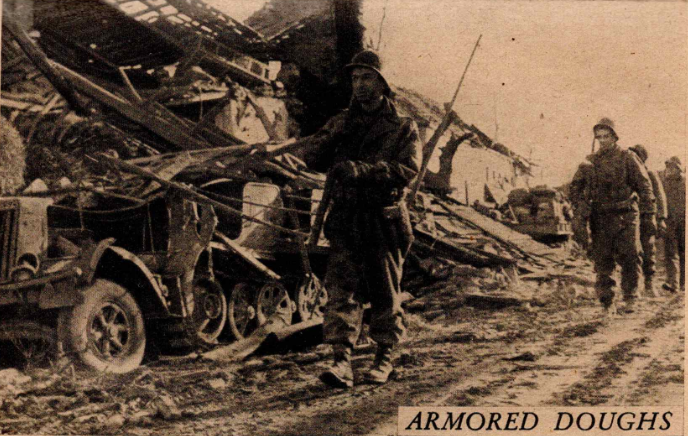
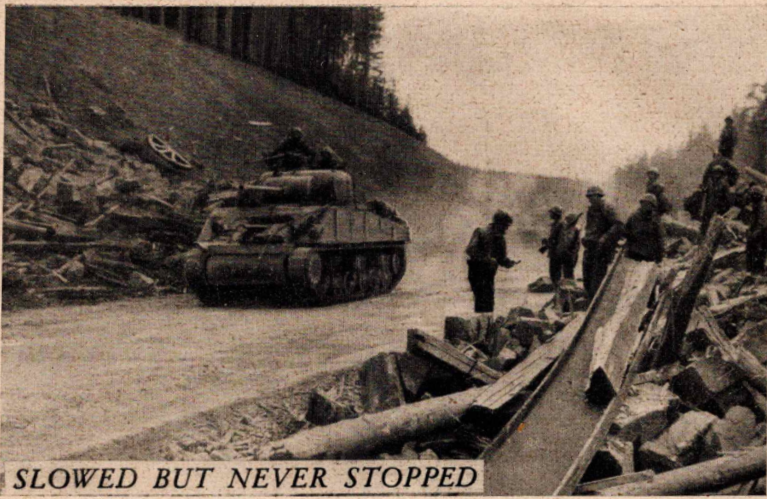
There are fires on many parts of the horizon. The biggest is to the south, where a whole train is burning as one car after another explodes. “We were trying to get a couple of Panther tanks on the other side of the tracks,” says someone. “So we got the train which was in our way.”
The nose of the 4th. Armored is still farther up, past Creuzberg. We are some 25 miles west of Gotha and more than 75 miles from Frankfurt, which was yesterday’s news. German women who pass in the village of Nesselroden move about with their faces averted. In the house we stop at there is a place marked for everything and everything is in its proper place. A place is marked for the table towel, another for the glass towel, a third for the blessing of God on the house, a fourth for the picture of the son in the Nazi uniform. Signs and slogans are everywhere. All night long a clock in the house rings out the hours and half hours, adding another touch of order to this too-perfectly-ordered home and providing assurance that even in his sleep a good German will know what’s what.
The next day we move up the long train of armor toward Combat Command “B”. It is a winding trail that avoids the autobahn and the big town of Eisenach, which has not yet been taken. On we go, over back-country roads, past civilians with beaten faces. The Werra River isn’t wide here, but there was a tough fight for it yesterday. The 4th Armored’s 24th Armored Engineer Battalion bridged it under enemy fire, saw their bridge knocked out, and put it in again. A small river and small bridge, but a big operation.
We get past Creuzberg, which resisted yesterday and paid for it, for there is no patience in the 4th Armored. The 4th wrecked Creuzberg because Creuzberg wouldn’t surrender, and now people are shoveling through the still-smoking ashes, looking for things.
Farther on we move, through a woods, and get one of those shocks of a kid moving through a toy chamber of horrors at Coney Island. There are dead German tanks in the woods, facing the road and hidden until you come right up on them. Then it’s as if the tanks were alive and had got you right there. But the tanks are dead. This was a German tank-maintenance and repair area. Live American armor has already caught this crippled German armor, lighting charges under it and throwing white phosphorus stuff at it. Now the German tanks smoke and burn, and one is just a pink stove, silently burning in the woods.
This is evidence of how the Germans have been driven to cover. They have had to hide tank-repair areas in the woods because nothing that shows in Germany is safe from our air these days. We have driven them to the woods and to the caves, and now we are pushing them east, out of their own country.
We get out of the woods in a hurry because it is eerie there and maybe Germans are watching us go by. More fires are burning on the horizon. The deep track of the tanks is still ahead of us. We reach a town which is only a few miles from the big city of Gotha. The German air comes up again and the sky is filled with smoke and the sounds of anti-aircraft and cannon. We climb a hill to another woods, where Me-109s are tucked in among the trees. The Germans had smashed these planes themselves as the armor ran them down. These deadly little planes have knocked out may Forts and Libs, and here they are broken and burnt by the Germans in a woods.
The 4th Armored is moving out of Metebach now, and we get in behind a half-track and follow down the road. The tanks wheel in their iron treads, the machineguns point at the sky, and Aspach shows up, five miles from Gotha. From within the houses, the civilians watch, but if you look at one of them steadily he turns away. The power of the armor is shadowed in these German faces. They stick their heads out of their windows and watch blankly, absolutely neutral.
And now the tanks and half-tracks move up to a crossroads outside of Aspach. They cover the roads out of town in long powerful lines as the evening comes down. More fires blaze on the horizon. The German air comes over again, the Me-109s moving across the sky as the .50-caliber fire goes after them. The planes twist, turn and plunge through the sky after a Cub plane, like a hawk after a sparrow. The Cub comes down low over the fields with an Me dropping after it and the guns of the armor drive the Me off just in time. The German air comes in again as the sun goes down—two, three, four times more—and one at last grabs a vehicle in the long line on the road and the vehicle begins to burn. Another Me comes across, no more than 10 feet above the column, turning on one wing, almost striking the ground, but keeping going. No planes are knocked down here tonight, but the report is that more than 34 were brought down yesterday and we have been able to count at least six wrecked ones during this movement toward Gotha.
The 4th should be in Gotha by tomorrow morning, and now it rests outside the city. Rain begins to fall, but the fires sowed by the big guns still burn on the horizon and so does our column’s vehicle which the Me hit on the road. The 4th will move through fires into the city of Gotha tomorrow morning.
In the morning there is a brief moment of indecision. Gotha has been asked to surrender, and if it will not, then the big guns will go to work. The 4th isn’t going to wait very long. Finally, it appears that Gotha will surrender. The surrender has been demanded by the Division and at last the answer comes through the armored infantry battalion, which is up front at the edge of the city. Minutes from now another German city will fall and within 10 days and 200 miles of movement we will have taken Darmstadt, llanau, Aschaffenburg, Hersfeld and Gotha.
The German air comes up over the road and we get into a patch of woods. Under the roar of the guns and the enemy engines overhead, the infantrymen had a word or two to say about this ebbing war. Pfc. Joseph Tegge of Anderson, Ind., a. rifleman, wanted to know what the hell the Germans are fighting for at this stage of the game.
“A stubborn bastard,” he says. “He knows he’s done for, but he keeps on fighting anyway.”
The men are exasperated; it doesn’t make sense anymore. Yesterday, 16 of our infantrymen had been killed while protecting a tank.
We leave the woods and move on, and then the enemy air goes to work again and we get into a barn where T/5 Wilson E. Kendall of Ogdensburg, N. Y., who has been with the 4th Armored since Pine Camp, comes up with that one about going home.
Then the air is clear once more, like after a rain squall, and we get into the jeep and move slowly down a hill into Gotha, past German dead in ditches, past a burnt-out American tank, past a hospital for German soldiers where a guy at a window thumbs his nose at us and then disappears. If he tries that on our tankers, they’ll surely go up after him.
We get down into the square and are at the City Hall, where pieces of broken glass lie all over the streets.
We are again in the midst of one of those starting-from-scratch moments. In the City Hall are the temporary German officials of the city of Gotha together with Lt. Robert Townsend of San Antonio, Tex., aide to the 4th Armored commander, Major General William M. Hoge.
“You will first of all bring in all arms, cameras and ammunition,” says Townsend. He sits down in the old council chamber of the City Hall, surrounded by murals of the ancient city. A Hollander, a young fellow from Rotterdam who speaks both English and German, acts as interpreter. He has been in Germany for several years, another one of the millions of dragooned “auslanders,” or foreign laborers, in the Reich.
The Germans around the table look shrewd and they talk with the tact of losers. Order begins to appear. The men of the 89th Infantry Division show in the town, moving from house to house, and you can see them in the square from the windows of the City Hall.
A Polish woman with a small child stands outside the door and the assistant Division commander, coming into the council chamber, pauses for a moment in the doorway and tells the woman that things will be better for them soon.
We leave Gotha that afternoon, grabbing the tail of the 4th Armored as it goes through, and now the columns curve south, driving 15 miles to Ohrdruf and Mühlberg, and coming to rest more than 200 miles from the Rhine.
On the very edge of Mühlberg the column comes across what must be the last German train going east. The Division’s artillery simply wheels a 155mm. howitzer around and knocks out the train. It is Sgt. Roy Mercurio’s gun crew which does this. Mercurio is from Toledo, Ohio, and his gunners are Cpl. Cleo Smith of Los Gates, Calif., Pfc. Homer Garrison of Shelbyville, Mo., and Pfc. Joe Valenti of St. Louis, Mo.
When we reach Mühlberg, a soldier asks: “How far are we from Texas?” We draw a map on the ground, using a stick for a pencil, drawing the outline of the eastern coast of the United States, as we remember it, and the outline of the western coast of Europe, and then France and Germany as far as Gotha. We figure over that map for a while and finally somebody says: “Nearly 5,000 miles to Texas, maybe.” And the soldier from Texas sighs and walks off.
Heading back, we can follow the long furrow which the 4th Armored has plowed since it broke through at a point above Frankfurt. This country behind the 4th Armored, which was deadly three days ago, has been cleared. Now the liberated, thousands of them, are going home through the furrow. French and English soldiers of 1940, Czechs, Poles and Russians are on the road. We can go back now along one of the world’s finest roads, which Hitler built for war and not for civilians, and which the Americans are now using for war. Our traffic, our supplies and infantry, is pouring through, pouring east, as thick as Fourth of July traffic on the Lincoln Highway.
It is one of the great sights of our time and on the faces of the Germans along the way there is still the look of numb amazement that an enemy from thousands of miles away actually rides through Germany now.
And tomorrow morning the 4th Armored will cut its tread deeper into the German earth again, moving eastward.
* * *
Every Man A Matricide
German soldiers facing the 4th Armored were told (according to a captured document): each American had qualified for the Division by proving that (1) he had been born a bastard, (2) he had murdered his mother—TIME, March 19, 1945.
* * *