OHRDRUF
Reading edition
By Sgt. SAUL LEVITT YANK Magazine, May 11, 1945
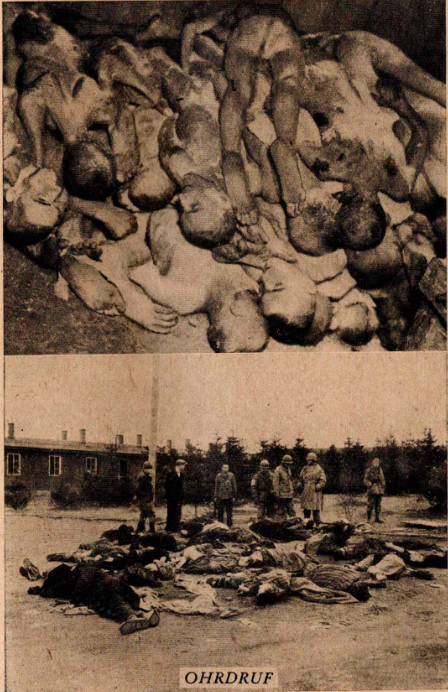
OHRDRUF, GERMANY—There is no death smell yet in Concentration Camp North Stalag III, in Ohrdruf. It was cold when the tanks of Combat Command A of the Fourth Armored Division rolled into this town a few days ago and it is still cold and damp. The victims had been killed the day before the tanks arrived, but there had been no time to burn and bury the bodies because we had been advancing too rapidly.
Now three days later, the bodies are still there, and it has stayed cold so you can walk around them at fairly close range. There are 31 bodies lying on the ground in one place and more than that number piled on top of one another in a shack. The bodies are all partly or completely naked. Around some of them blood has made pancakes of red mud on the ground. Some of the bodies are very thin with the incredible thinness of severe malnutrition.
The living survivors of the camp say that one of the dead is an American soldier and they point the body out. He lies on a stretcher, naked with a blanket half over him. He had been a tall, clean-cut man. There is a bullet hole through his throat.
The victims in the shack, piled six deep, were both beaten and shot to death. Quicklime was thrown over them and all the bodies are naked, thin and some with changed coloring, perhaps from the lime or from illness.
The story of the dead is told by the living who hid away when it came time to move the camp farther eastward by rail.
There were more than 2,000 men in the camp. Those who were killed were too sick or too tired to climb into the railroad cars. So they were clubbed until they fell and then were shot at close range.
The men in the camp included Belgians, French, Russians, Serbs and Poles. There is one 16-year-old Jewish lad among the survivors. There are also three Russian officers who made it. Two of them are doctors—a major and a captain—and the third is a young lieutenant who flew a Yank fighter plane for the Red Air Force. The doctors worked as laborers until a few days before the evacuation of the camp. Then, just before the end, they were put to work on some of the sick in an effort to get them ready for the movement.
The Americans going through this camp are very quiet. They have already seen much death, but they stare at this death, which is uglier and harder to look at than the death of war, with impassive faces and big eyes.
Major John R. Scotti of Brooklyn, N. Y., Combat Command A’s medical officer-in-charge, burst out in a loud voice, not speaking to any one in particular. He just stood in the middle of the camp and shouted out what he felt and no one acted surprised to hear his voice booming out big like that.
“I tell you,” he said, and his angry voice was shaking, “all that German medical science is nil. This is how they have progressed in the last four years. They have now found the cure-all for typhus and malnutrition. It’s a bullet through the head.”
The commander of Combat Command A, Colonel Hayden Sears of Boston, Mass., acted the next day. He must have been thinking of this all night and what he did was to assemble the leading citizens of Ohrdruf, including the richest man in the community. Ohrdruf is a neat, well-to-do suburban town with hedges around some of its brick houses and concrete walks leading to their main entrances.
The richest man in Ohrdruf is a painting contractor who made a lot of money in the last few years on war work for the German Army and now owns a castle on the way to the concentration camp.
Colonel Sears, a big, tough-looking man, ordered the leading citizens of Ohrdruf out from behind the smug privacy of their hedges and housefronts and had them driven in Army trucks to the concentration camp to let them see this killing that is sprawled on the bare ground and piled in a shack.
The crowd of the best people in Ohrdruf stood around the dead and looked at the bodies sullenly. One of them said at last: “This is the work of only one per cent of the German Army and you should not blame the rest.”
Then the colonel spoke briefly and impersonally through an interpreter. “Tell them,” he said, “that they have been brought here to see with their own eyes what is reprehensible from any human standard and that we hold the entire German nation responsible by their support and toleration of the Nazi government.”
The crowd stared at the dead and not at the colonel. Then the people of Ohrdruf went back to their houses.
The colonel and his soldiers went back to their tanks, and we went out of this place and through Ohrdruf and Gotha, where the names of Beethoven, Mozart and Brahms are set in shining, gold letters across the front of the opera house.
Russell Davenport With Patton’s Boys: