WESTOVER OF WANALAH (continued 5)
Reading edition
It will be better, I think, to accept my decision as final.—Page 365.
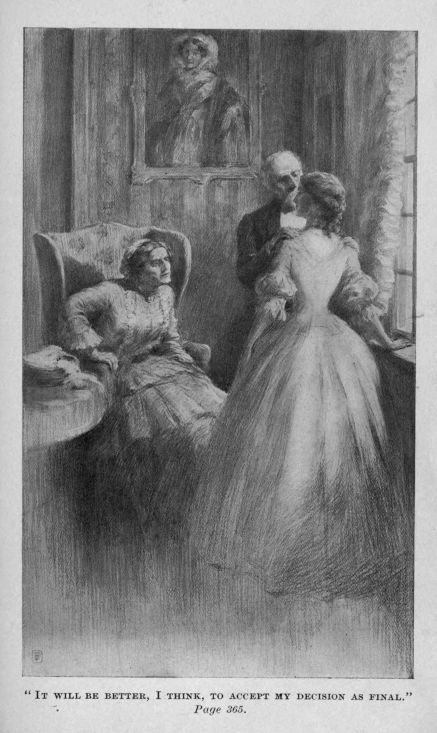
The old lady rose in wrath, alarm, indignation and all the other emotions of an exciting sort, and demanded to know what her niece meant by such an accusation of infamy. At the same time Colonel Conway exclaimed:
"Oh, daughter, daughter, you do not mean what you say. Take it back! You are excited. You are beside yourself!"
"I am not in the least excited," the young woman answered. "I did not wish or intend to mention that aspect of the matter, but Aunt Betsy insisted upon it. I have no desire to emphasize it or to insist upon it, if only my authority as mistress at The Oaks is properly recognized. As your daughter, Father, I am entitled to that dignity which you yourself have been fond of insisting upon; and as your daughter I intend to exercise the authority and maintain the dignity of that position so long as you permit me to hold it. When you cease to permit that, I shall leave The Oaks and go to my own plantation of Tye, which my mother left me. You must remember that I am a grown woman of twenty-one, and that I am not a dependent upon anybody."
"Now, daughter," interrupted Colonel Conway with affection, "you are talking nonsense. You know that you are mistress of The Oaks, and—"
"That is quite all I am insisting upon. As mistress of The Oaks I do not intend to have my authority questioned or my affairs interfered with by anybody. I'm sorry I have this occasion to assert myself, but the circumstances are not of my making."
"But what do you mean, you—you—you ill-regulated girl,—in charging me with a crime?" almost shrieked the elder woman as she confronted her niece in an attitude that suggested a desire to shake her. "What do you mean? What do you mean?"
"You'd better let that phase of the affair drop, Aunt Betsy," answered the girl with a calm that additionally exasperated her aunt.
"No, I will not let it drop. You have uttered an accusation that I cannot and will not let pass. You must say what you meant by it."
"I will say it if you insist," answered Margaret, still preserving her exasperating calm.
"I do insist. I will not rest under such an accusation. Go on! Tell me what you meant."
"I will," said Margaret. "You remember that five years ago an attempt was made to open our mail bag in some political interest. Father appealed to the Government for its protection, and from that day to this it has gone back and forth under a United States mail lock. In tampering with its contents—in abstracting from it letters addressed to me, you—I don't like to put the matter into plain words. Let me say instead that you violated the law which renders the United States mail sacred. I'm sorry I have had to call your attention to such a matter, but you forced the necessity upon me."
By this time it was necessary to summon maids and get "Aunt Betsy" back to bed again,—genuinely ill this time.
It was not until she was made as comfortable as circumstances permitted, that Colonel Conway and his daughter returned to the library and resumed their conversation.
"Now, daughter," said the old soldier, "I am ready to do anything to right this wrong—anything, of course, that will not compromise your aunt."
"Father," responded the girl with a world of tenderness in her voice, "you ought not to have anything to do in the matter. It is Aunt Betsy who has wrought all the mischief. She has deceived you; she has deceived me; she has deceived Mr. Westover. It should be her duty, not yours, to undo the wrong she has done."
"But, my dear daughter, how can she? She is a woman."
"I know that, Father, and I know our Virginian view of such things. But it is all wrong. You men of Virginia have granted to us women a license that ought not to be. If one of us utters a slander, you hold yourselves responsible for it even unto death. If one of us lies—it isn't a ladylike term, I know, but it is what I mean—if one of us lies you hold yourselves bound to maintain the lie and answer for it, even at the pistol's point. You Virginia gentlemen insist upon only one point of honor for women. So long as we observe that, we may lie and cheat and slander at will and you sustain us in it. It is all wrong. If a woman does mischief, she should herself atone for it. In this case it is Aunt Betsy who has wrought the wrong and it is Aunt Betsy who should undo it."
"But how can she, dear?"
"By going to Mr. Westover, or writing to him, and saying frankly: 'I robbed the post bag of your letters to Margaret and her letters to you.' That is what a brave man would do. Why should not a brave woman do the same?"
"But, daughter, your aunt is a lady and excessively sensitive."
"She forgot to be a lady when she did this infamous thing, and her sensitiveness is mainly a pretence assumed to play upon your chivalry and to deceive you and others. If she were honest in mind, a real, genuine, conscientious sensitiveness would prompt her to make precisely the reparation I have suggested. As she is utterly dishonest and dishonorable instead, I quite understand that no force, moral or physical, could ever compel her to an act of reparation like that."
"My dear, you are very hard upon your poor old aunt."
"Not at all, Father. Truth is as much an obligation of women as of men. So is courage of the moral sort. But it is idle to expect that after generations in which you gentlemen of Virginia have excused us from all obligations except that of chastity. You have assumed our protection, and you have met that obligation bravely; but—well, I have thought much on that subject, and what I have thought is of no consequence. What are you going to do by way of righting the wrong Aunt Betsy has done, as you excuse her from the obligation of herself righting it?"
"I'll do anything you suggest—anything that will not compromise your aunt. You see I must protect her."
"I understand. The one who has wrought the wrong must be spared the consequences. The victims of it must bear them. I have nothing whatever to suggest, Father."
And with that she advanced, kissed him tenderly, said:
"Poor, dear old Dad!" and quietly left the room.
Then it was that Colonel Conway set himself to satisfy his daughter's conscience and his own by writing a letter to Boyd Westover. Then it was that, after repeated failures, he compromised with his conscience by writing to Dr. Carley Farnsworth instead.
Then it was that under Dr. Carley Farnsworth's instructions Millicent Danvers sent Colonel Conway and Margaret to bed.
"Aunt Betsy" was already sleeping the sleep of one who feels that she has adroitly escaped uncomfortable consequences.
XXXI A SUNSET INTERVIEW
The days were growing short, and so when Jack Towns approached The Oaks that afternoon, the sun was setting and Millicent was watching it from a little hilltop just beyond the orchard and perhaps half a mile from the house.
Jack came upon her there and was fascinated with the picture she presented. With her head bare and her hair in some disorder as a result of facing the west wind too fearlessly, she wore upon her shoulders a voluminous mass of fleecy knitted work known in those days as a "nubia," or, by those who preferred good English to very bad dog-Latin, a "cloud." As he approached from the east he saw her figure silhouetted against the glowing western sky, and the grace of it fascinated him. It was like a great picture—suggesting one of Turner's interpretations of Venice, with an absorbing human interest added to the glow and glory of it.
For to Jack Towns the girl who turned to greet him as he rode up was a very absorbing human interest indeed. The hour he had passed in converse with her on the day before, had left him with a glamor upon him which even his jaunty indifference to permanent impressions could not dismiss. He had been moved to make this special visit to The Oaks by an irresistible desire to see more of a young woman whose superiority of mind and character was strongly impressed upon him, and whose very peculiarities—mainly due to differences of environment and education—were strangely appealing to his imagination.
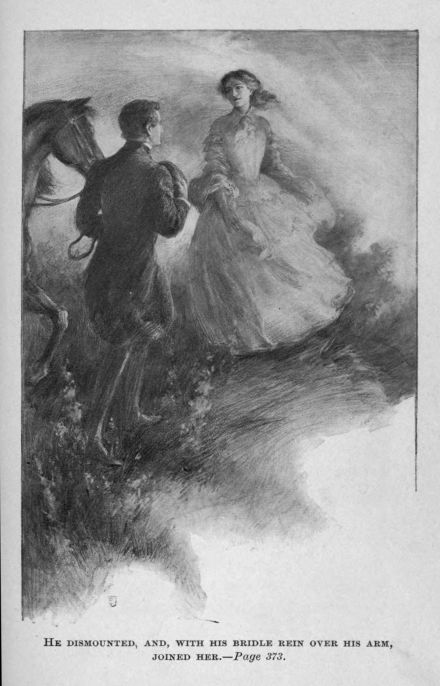
Upon approaching her there upon the little, sun illumined hilltop, he dismounted, and, with bridle rein over his arm, joined her in admiration of the glowing sunset.
He dismounted, and, with his bridle rein over his arm, joined her.—Page 373.
After the first greetings were over she said:
"Do you know, Mr. Towns, I think that is where your chivalry comes from?" And as she said it, she waved her hand toward the horizon with its gold and purple, intermingled with pinks and blues and exquisite greens that the dyer's art has never matched.
"I mean," she added without waiting to be asked for an explanation, "that you Virginians are inspired with gentleness and chivalry by the quality of the climate in which you live, and that your sunsets give color to your imaginings of courage, optimism, and high endeavor."
"I doff my hat in acknowledgement of the double compliment," he said, "to our climate and to our manhood. But surely fine sunsets are not our exclusive possession. You must have such at the North?"
"Sometimes—not often. They are so rare indeed that we make note of them and recall them afterwards as pleasant memories."
"But isn't that because you live in a large city where the vapors of industry cloud the sky and shut out nature's displays?"
"I do not live in a large city, Mr. Towns, except for the two or three worst months of the year, and not always even then. I live on the 'blue hills of Milton.' My father has a country place there, and since he has grown old enough to relax a little in his business enterprises, we live there almost all the year round. So you see I know our climate quite irrespective of the factory chimneys and their fumes. The sunset is dying out. I don't like to see the death of beauty or grandeur or glory of any kind. Let's turn our faces toward the house."
As they turned Jack Towns in his own mind formulated his impressions in this wise:
"Here is a young woman who can think for herself and without any regard whatever for the conventions of thought; she is inspired with an appreciation of truth and beauty, which is only another way of saying that she is a poet in her soul—thank God she is not a poet in the magazines, for that would be dreadful. She has common sense, too, in an uncommon abundance. Jack Towns, you are falling in love in a way you never dreamed of before, and the fact doesn't alarm you in the least."
As his meditations kept him silent for a longer time than is usual when youth and beauty walk together in the gloaming, Millicent was the first to speak.
"I wish you could know our 'blue hills of Milton.' They have some attractions of their own."
"They certainly have," he answered. "I know them—at least in a small way."
"Why, how did that come about?" she asked in surprise. "I understood you to say you were never in Boston but once."
"'And that same is thrue for you,' as my Irish office attendant would say. I was never in Boston until a few weeks ago, when I went thither to arrange some financial affairs for a client of mine"—he did not mention Westover's name. "I had some negotiations with a banking firm there, and the head of the establishment was exceedingly courteous to me. He took me to his country place to spend the Sunday. By a curious coincidence, his surname is the same as yours—Danvers. He's the head of the banking house of Danvers, Appleton and Wentworth. I wonder if by any chance he's a relative of yours. At any rate he deserves to be. For a more courtly gentleman I have never met. He's the sort of educated, refined, polished, considerate person that only three States in this Union produce, so far as I have been able to observe."
"Which are the three States, please,—that is to say, if you are free to designate them?"
"Massachusetts, Virginia, and South Carolina. Mind, I don't say that such gentlemen are not found in other States. It is only that those of them whom I have personally met have happened to be sons of one or other of the three States mentioned."
"I suppose there is a reason for that," answered Millicent.
"What is it?" he inquired in answer.
"They are the three oldest commonwealths," she answered, "and the three most conservative. You have a saying here in Virginia—a true saying, I think—that 'it takes three generations to make a gentleman.' The three States you have named have lived their own lives for a good many more than three generations, and so they have had time to make gentlemen. Still—"
She did not continue her sentence, till Towns urged her to do so. Then she said:
"I was going to say that about the most perfect gentleman I ever met was Jake Greenfield, a Vermonter, without education beyond what he called the 'rujimenteries,' whom I met in the Rocky Mountains."
"Tell me about him," implored Jack, saying nothing of his own acquaintance with Jake, who had been his companion and shrewd adviser during his stay in the Rocky Mountains in Boyd Westover's interest. "Tell me about him."
"I will," she answered. "I am always pleased to celebrate his virtues. Jake is ignorant, unfamiliar with the ways of society, and wholly unformed as to his manners, but he is instinctively a gentleman. He habitually eats with his knife—a dirk-like thing that he carries in his belt. He has no hesitation about sitting at table and picking his teeth with a fork. It never occurs to him to apologize for lighting his pipe at table or quitting the company before the others have done. None of the conventions of civilized life have dawned upon his intelligence as matters worthy of attention. When I knew him, if a single pie sat before him he would carefully count noses and divide it equally; but if the table were well dotted with pies he would seize upon the one nearest him and devour it from his hand without enlisting the services of knife or fork in aid of the process.
"I met him in the Rocky Mountains where my father had some mining interests, and I was a good deal distressed and disgusted by his lack of manners until I came to know the real man who lived under so rough an exterior."
"How did that come about? Tell me, please," said Jack Towns as he handed his companion up the two or three steps that led to the porch.
"It was a rather thrilling experience," she answered, "at least in its beginning. I was only a girl then of eighteen or nineteen. I had gone to the Rockies with my father for the sake of 'roughing it,' as they say out there, and enjoying the out-of-door life. I was in the habit of riding alone, anywhere I pleased, for the region was a wilderness and nobody lived in it except a few surface miners. One day I rode away till I came to a little stream, a few inches deep, which was crossed by a ford. The road to and from the stream had been cut by nature or by man, through bluff banks, twenty feet high. I crossed the stream, scarcely wetting the fetlocks of my horse. I rode up through the cut on the other side to the high ground above, and thence on through a delightfully wild region, until presently it began to rain in that sudden and torrential way that belongs to the Rocky Mountains. I turned my horse about and trotted him somewhat hurriedly toward the ford I had crossed. When I got there I found the trickling little brook swollen to a mountain torrent, but I did not recognize the change as a matter of consequence. I saw that the water had risen, but to me that meant only that where I had had to make my horse wade fetlock deep before, I must make him wade knee deep now. I pushed him into the stream and almost instantly he was swept from his footing. The depth required swimming, and the onrush of the waters was so great that swimming across the stream was impossible. The horse made a gallant struggle to reach the other side within the roadway space, but he was swept away down stream. I was afloat on his back, imprisoned as it were between two perpendicular bluffs that offered no point of possible landing or rescue.
"Just as I fully realized my situation Jake Greenfield, mounted upon a strong horse, appeared on the bank above.
"'Hold on for your life!' he cried to me, 'an' I'll be with you in half a minute.' With that he turned his horse's head and rode away for thirty or forty paces. Then, suddenly turning about, he rode straight toward the bluff, digging spurs into his horse's flanks at every step, and lashing his rumps with a black snake whip by way of making sure that he should not refuse the leap. A moment later there was a splash and a struggle in the water. Jake Greenfield's horse had leaped into the stream from the bluff twenty feet or more above, with Jake Greenfield on his back, and the two had sunk beneath the flood within a few feet of me as I clung to my horse.
"After a few moments both came to the surface, and the snortings of the horse indicated that his breathing capacity was impaired. By way of sparing him Jake slipped off the saddle and took hold of a stirrup strap as a towing line. But his poor horse's powers were exhausted and he could sustain himself no longer. He gave up the struggle and sank beneath the flood, a martyr to the duty he owed to his master—man. Pardon me, I'm making a long story of this, but the details interest me so."
"They interest me, too," quickly responded her companion. "You cannot narrate them in too minute detail to please me. I could listen all night to the story. Go on, please."
"Well, Jake continued to swim until presently he caught my horse's tail and used it as a means of keeping up with me. Then he said:
"'Turn him to the right! Keep close in shore. There's a little break in the bluffs just ahead, and may be we can make it! More to the right! Closer in shore! There! There's the break. Make him catch bottom there if you can,' You see, Mr. Towns, every word spoken at that time was burned into my memory, and I recall every detail as vividly as if the thing had happened yesterday, or even to-day.
"I succeeded in 'beaching' my horse at that little break in the bank. It was literally like beaching him, for no sooner had he taken three or four steps through shoaling water toward the land, than he lay down, utterly exhausted."
Here the girl stopped in her narrative, as if it had been done. Jack Towns had no mind thus to lose the climax.
"You haven't told me yet in what way Jake proved himself a gentleman."
"That is true," she answered, "and it was that that I set out to tell you. Somehow heroism always appeals to me, and in telling you of Jake's heroism I forgot the other end of the story. I was soaked through, of course, and chilled to the bone. So Jake took me by the arm—he wanted to take me on his back but I wouldn't let him—and hurried me to one of his cabins. You see, as caretaker of the mining lands, he had several cabins, scattered about over them. He told me there was a motherly old squaw there who would look after me, but when we got there the squaw, after the manner of her race, had wandered away somewhere and was not likely to return. Jake built a big fire in the cabin chimney, and then went outside, telling me to 'shuck off them soakin' clothes' and wrap myself up in the quilts that covered the sole orderly bed in the place. As I did so I bethought me of the conventionalities, and when Jake came back to cook my supper and dry my clothes, I protested that I could not consent to stay there alone, and without even a squaw to sustain my dignity. I simply must go to my father, I said, and when he objected that the mountain torrent lay between and was by this time twenty-fold fiercer in its fury than when I had dared it before, I declared that it made no difference; that at all hazards I must make my way to my father's quarters that night. By way of making the matter impersonal and in that way sparing his feelings, I dwelt upon the anxiety my father must feel for me. I think Jake understood my real objection to the situation. Indeed I know he did, for by way of reply he said:
"'Ef you only could rest quiet here an' not worrit overmuch, I've been a-plannin' to go up the mountain to where the stream don't 'mount to nothin', an' cross it an' go down an' tell Mr. Danvers as how you is safe an' sound nevertheless of your bein' tired out an' chilly an' all that. Ef you kin spare me, I'd like to do that.'
"Not at all realizing the fact that that torrent had its beginning twenty miles away and in mountains so precipitous that no man could scale them, I gave eager consent to his proposal, and after preparing such supper as he could for me, the devoted fellow—no, the chivalric gentleman, I mean—set forth in the torrential rain. I learned afterwards that he toiled up the stream for six miles, plunged into it and the darkness, breasted his way across it as it swept him down its resistless current, and with difficulty effected a landing on the opposite side four miles below his starting point. Thence he trudged through the darkness and the rain to my father's quarters, where rescue parties were forming to hunt for me. That's the story. Don't you agree with me that Jake's a gentleman in the true sense of the word?"
"All that is what I should have expected of Jake," answered the young man. "You see I've just returned from that region, and during my stay there I was closely associated with him."
The girl uttered a little exclamation of astonishment; then, with that perfect self-possession which Jack Towns had found to be the most fascinating thing about her, she added:
"Confidence deserves confidence in return, and before you go," for Jack had risen and the two were advancing toward his restless, pawing horse, "it seems only fair to tell you that what you have said of the Boston banker who entertained you over Sunday has been very gratifying to me, for the reason that the gentleman concerned is my father, and the house you found so hospitable is my home. I sincerely hope you'll have other occasions to visit us there."
Jack's instant thought was:
"I'll make the occasions, and I'll do it pretty soon too," but he confined his speech to the courtesies of the moment, and a minute later he was riding at half speed toward Wanalah, wondering if his absence had kept supper waiting, and not caring in the least whether it had done so or not.
XXXII WHAT HAPPENED AT FIGHTING CREEK
In Virginia in the late fifties there was no question of principle or policy or anything else at issue between the Whig and Democratic parties. Even in national politics there was none. The Whigs were supposed to represent tariff protection and internal improvements. The Democrats stood for free trade and sailors' rights, but neither the one nor the other of these cries represented anything vital, any policy that was pending.
In Virginia the instinct of self-preservation, awakened by hostility at the North to the institution of slavery, had stimulated both parties to an intemperate, uncompromising, relentless advocacy of slavery as a system right in itself,—a thing that nobody really believed,—and whenever Whig and Democrat met in debate, the only question between them was which could go to the greatest extreme in that direction. There were the old antagonisms between the two parties. They were still remembered with bitterness, and men grew excited and even violent in their discussion; but nobody on either side could have said what they meant, for the sufficient reason that they meant just nothing at all. There was a new, Free Soil party rapidly gaining strength at the North, and by both Whigs and Democrats in Virginia that party was regarded as the common enemy, to be fought to the death. But while waiting for that, the Whigs and Democrats fought each other for precedence and place.
Political speaking under such conditions was apt to be uninteresting to others than the speakers, unless it involved something of accidental and unusual moment. If any speaker under the excitement of perfervid oratory happened to use terms which his adversary could construe to be offensive to himself, there was instantly awakened the interest that pertains to a quarrel which may presently ripen into a duel or a street fight.
Nothing of that kind occurred at Fighting Creek on the day after Jack Towns's visit to Millicent, but some other things occurred that gave peculiar interest to the occasion. Carley Farnsworth read from the platform the note in which Colonel Conway pledged himself to the support of Westover's nomination. That in itself was a staggering blow to Webb's candidacy. As Foggy, whose phrases were apt to be picturesque, put the matter:
"It knocks the underpinnin' out of our campaign, and it looks to me, Webb, as if it might knock the stuffin' out'n you."
But staggering as the announcement was, there was far worse to come.
When Sam Butler, the Democratic candidate for Senator, had emptied his mind and mouth of all the florid rhetorical phrases he had sat up of nights to construct, he brought a matter of practical political importance to the front.
"I have endeavored to show you, my fellow citizens, that Democratic principles ought to triumph in this election; but neither you nor I can fail to see that there is no chance of that in this senatorial district. After consultation with my friends and political advisers, I have decided that the issue lies solely between the regular and the independent Whig candidates; and as between these two I think no Democrat can hesitate to choose Mr. Boyd Westover as the fittest man to represent us. I therefore resign my own candidacy in Mr. Westover's behalf, and I urge all my friends, all loyal Democrats in the district, to vote for him. I have been moved to this decision by impulses of patriotism and by a sense of duty to the district and to my fellow citizens."
This was a thunderbolt out of a clear sky, and for a full minute the crowd stood paralyzed with astonishment. Then Butler's most active supporter—by prearrangement of course—leaped to the platform and cried out:
"Friends, Democrats, patriots! It occurs to me that our party in this county has named no candidate for the lower house of the Legislature. In order that the Democratic vote shall not be completely unrecorded, I move that we now name Samuel Butler, Esq., for that honorable place. His candidacy for that will in no way interfere with his self-sacrificing decision to take himself out of the senatorial campaign. I ask all Democrats here present to gather in the prize barn across the road, to consider this suggestion."
A "prize barn" was one in which there were appliances for pressing leaf tobacco into hogsheads.
Ten minutes later it was announced that the late Democratic candidate for Senator had been unanimously nominated for the House of Delegates.
"Now I know," said Carley Farnsworth to himself, "what Edgar Coffey's message from Judy to Butler meant. It's the shrewdest bit of play I ever heard of. By securing his withdrawal from the senatorial contest, the Queen of the Mountains has enormously swelled Boyd's planter vote. And by way of accomplishing that she has promised the mountain vote to Butler for the lower office, and it will elect him beyond a doubt. On the whole, I reckon I won't explain the matter to Westover. He's quixotic, and he knows nothing of politics. But, by Jove, it was a master stroke on Judy's part."
That night when Edgar Coffey made his report to Judy, telling her of the adroit and graceful way in which the program had been carried out by Butler, her comment was:
"Some folks has more sense'n you'd think."
When he had told her of the confidence with which Webb was reckoning upon the mountain vote to offset the loss, she added:
"An' some folks ain't got the sense the law allows 'em."
But if Webb had less political sense "than the law allowed him," there were certain of his followers who were better endowed. Foggy, in particular, realized the situation, and, by way of meeting it, summoned Webb and a dozen or so of his immediate supporters to a conference in the hostelry of a neighboring county seat.
There Foggy laid down the law to the optimistic candidate.
"These here two happenings," he said, "mean trouble. All the swell Whig planters who were holding back because of Colonel Conway's stand will now vote for Westover, and use their influence to make their overseers and others do the same. Every Democrat in the district will vote for him as a matter of course. They want to beat the regular Whig nominee, and now that they haven't a candidate of their own, they'll vote for Westover. Now what have we got to meet all this with?"
Webb suggested the mountain vote, and Foggy instantly replied:
"So far as I can see, we ain't got no mortgage on that, and if we are to carry it we've got to go after it."
So they went on discussing the situation, ending by ordering a vigorous campaign in the mountains with Webb for leader and Judy Peters as the Dominant Power to be approached with negotiations.
When Jack Towns heard of this program, he went to Carley Farnsworth in some alarm, to suggest some counter move.
"I am conducting this campaign," answered the little doctor, "and I am in confidential relations with Judy. I'll tell you, Jack, but you must keep the secret, that it was Judy herself who conceived and planned and organized Boyd's candidacy. She made one of the best diagnoses I ever heard of in his case, and her therapeutics is matchless. Let her alone. She has made up her mind to elect Westover with such a majority as shall be convincing even to him, and she will do it you may be sure. If she wants to see any of us she'll have Edgar Coffey whisper a hint of her desire into our ears. Until she does that we mustn't interfere. She might resent it as a reflection on her skill in political management. Now let me drop a hint into your ear. I said just now that I was managing this campaign. That was a vainglorious boast. I didn't persuade Butler to retire in Westover's favor, but somebody arranged that. Have you any idea who it was? And if at the end of the campaign Butler should find himself elected to the lower house of the Legislature by virtue of the entire mountain vote added to the regular Democratic poll down here, do you imagine for an instant that the result would take him by surprise? Now keep mum about all these things. I am only making suggestions by way of preventing you from making mistakes. Don't say a word to Boyd about it."
XXXIII CONSPIRACIES
Jack Towns was particularly pleased with the reassurance that Farnsworth gave him respecting the campaign. It set him free. In his loyalty to Boyd Westover he would have ridden all night and all day in aid of his friend's election; but he greatly preferred to go to Dr. Carver's and dance all night with Millicent.
In fact he did very nearly that. He put his name down on her card for every set that wasn't taken in advance, and he danced all of them but three or four which she elected to "sit out." If she had been accompanied by a chaperon, she would have had to restrict Mr. Towns's allowance of sets, but chaperons were not deemed necessary for well-bred young women in Virginia. Such young women were supposed to know how to behave properly, and as for protection, was not the entire adult male population ready and eager to render it upon occasion?
Moreover, Jack Towns did not in fact secure an undue proportion of Millicent's sets, for the reason that all the young men in the company, who managed to get possession of her card in time, put their names on it, for one dance each. She rigidly restricted them to one. Perhaps she considered Jack. But she put no restriction on Jack Towns in the matter, and Jack was so ill-mannered in his infatuation that he asked no other young woman for her card, except in the case of Charlotte Deane. Charlotte was no longer as young as she could have wished, and she was distinctly not beautiful or brilliant. So Jack, observing that there were no throngs of young men about her, asked for her card and put his name down for two dances.
For the rest, he devoted his attention to Millicent Danvers until everybody was set wondering if at last Jack Towns had really and truly fallen in love. The same question arose in Jack's own mind, but he, at least, was able to answer it. "Yes," he admitted to himself, "I have had many fleeting fancies before, but none that resembled this. I am determined to win Millicent Danvers if devotion can accomplish it. I never felt in that way before. Always I have felt, that while one young woman pleased me, there were others who might be equally pleasing. I don't feel so now. It is Millicent Danvers now, or nobody with me. I wonder what she will think of my big, disorderly bachelor establishment if she ever consents to be its mistress? I'll wager something handsome that she'll—well, it will be time enough to speculate on that when I have won her. By the way, she would say that differently—'when I shall have won her.' Anyhow my present task is to win her. If I do that she will take care of the rest. And after all a bachelor establishment isn't a home. Just think of the difference between my big house, where everything is in chaos, and that home of hers among the blue hills of Milton."
So he went on, thinking, wondering, speculating, so long as she was fulfilling an engagement to dance with somebody else whom he hated and held in unmerited contempt without any assignable reason. And when his own turn came and he danced with her, his fancies floated before his eyes as a dream pervades the mind, a dream that so rejoices as to make of waking a calamity.
Millicent did well whatever she did at all. In dancing with her, Jack felt that she simply lifted herself half an inch or so from the floor and floated about without again touching it. It was a delight to dance with her, as every young man who had enjoyed the experience stood ready to testify, but Jack Towns rejoiced even more in "sitting out" a set. For then, with her arm in his he could promenade the porches, or the pair could stroll out into the grounds where common prudence and courtesy required him frequently to readjust the wrappings that protected her otherwise bare arms and shoulders, or, better still, he could seek out a secluded nook in the porch or elsewhere, where they two might talk of things that held interest for both of them in common.
It was during one of these confabs, when they sat out two dances in succession, that Jack Towns invited himself to Boston and to Millicent's home in the blue hills of Milton. It came about in this way. Jack was really and earnestly in love, for the first time in his life, and the impulse to tell Millicent so was well nigh irresistible. But Jack was a Virginian, and he recognized the right of a young woman to be courted in her own home. He restrained his impulse of speech, therefore, so far as open avowals were concerned, but his utterances, short of a declaration, were such as to leave the young woman in no doubt as to his attitude and purpose.
When she spoke of her prospective home-going, he asked, a little eagerly perhaps, when that was to occur. She answered:
"It must be very soon—as soon as I shall have done a duty that rests upon me. I'm sorry Mr. Boyd Westover isn't here to-night. He told me, when I met him casually this afternoon, that he was obliged to return to Wanalah."
"I suppose he was," answered Jack Towns in a peculiarly inscrutable tone that he adopted upon occasion. "But why? Do you particularly want to see him?"
"Yes, not only particularly but peremptorily. It is a part of the duty I have set myself. I cannot go back to Boston till I do."
"I see," he answered. "If you like I'll call at The Oaks and ask you to ride with me. We can ride over to Wanalah, and I'll see to it that he shall be there at the time."
"Oh, no, no, no! That would never do. There are reasons which I cannot explain, if you'll excuse me. I must meet Mr. Westover casually, quite by accident as it were."
"Very well, then," answered Jack, with all the confidence he was accustomed to assume at a court trial when his case was an uncertain one. "I'll arrange the accident and create the 'casualty.' You have only to respond favorably to the invitations you receive during the next few days. I'll take care of the rest."
There was a certain masterful self-confidence in his words and tone that was somehow exceedingly pleasing to Millicent. She felt that Jack Towns was a man of limitless resource, a man accustomed to do things and to get others to do things, a man to be leant upon with confidence, and the feeling was altogether comforting. The thought that floated vaguely through her mind, though she shrank from formulating it, was that if ever Jack Towns should love a woman, that woman would be exceedingly comfortable in the certainty that his care of her would be always tenderly solicitous in its impulse, aggressively masterful in its manifestation, and measurelessly ingenious in its devices of safety for her against every ill. If she had permitted her thought to frame itself, as she resolutely refused to do, it would have been to the effect that he was a man into whose arms the woman he loved might throw herself in full assurance of a welcome and in trustful confidence of all-loving, all-daring protection. She did not let the thought formulate itself, but it floated nebulously in her mind, which was perhaps even more dangerous—if indeed there was any danger involved.
In answer to his words she said:
"You are certainly very good. I'll leave it to you to arrange for me, and as soon as I know definitely that my duty is done, I shall go back to Boston,—or at least as soon after that as my brother can come down here to escort me. You know the journey is a trying one."
"Yes, I know. But why trouble your brother needlessly? I shall be obliged to go to Boston sometime soon, and if you permit, I shall be glad to be your escort."
Jack was not fibbing. It is true that he had no business that required him to visit Boston, and yet he really felt it necessary for him to go thither. He had fully decided to ask Millicent Danvers to become his wife, and he must go to Boston for that.
Millicent was right in saying that the journey was a trying one. In that infant age of railroad service the trip from Richmond to Boston involved eight or ten changes of cars, some of them at midnight. There were no sleeping cars, no parlor cars, no dining cars, no buffet cars—nothing in fact but rattletrap coaches, linked together with chains and pins and controlled only by hand brakes. No car ran through, or further than its own railway terminus. The connections were never close, and for the waiting times between there were no accommodations other than those which an open and often rain-drenched railway platform afforded.
But there was the question of chaperonage to be considered. Boston notions on that subject were different from Virginia notions. In Virginia it was held that a man in escort of a woman was in honor bound to protect her not only against all others but against himself as well. He must not, under such circumstances, permit his conversation even remotely to approach the confines of courtship. He must maintain, from beginning to end of the escorting, the attitude of one performing a duty with absolutely unemotional and impersonal temper. The man escorting was supposed to be a gentleman who would suffer no harm to come to the woman under his escort, even if his life should be the forfeit.
But Jack Towns understood the difference between Northern and Southern manners in that respect, and so, to his offer of escort, he promptly added:
"My good old negro Mammy will go with you, of course. She'll see that you have all the comforts that are possible on such a trip."
"But if you take her to Massachusetts she will be free, will she not?" asked Millicent.
"Free? Yes. She is free now to do as she pleases, and she regulates me with the high hand, just as she did when I was a baby. Why she even dominates my dress. Not long ago I came to breakfast with a blue cravat on, and she made me change it on the ground that I had a murder case to defend that day and she thought black would be more appropriate. When I get ready to go to the club in the afternoon, she inspects me, and if any detail of my costume fails to meet the exigent requirements of her code, I have to make a change, no matter how hurried I am. Oh, she's free. Why, she took away the breakfast I had ordered the cook to prepare for me the other day because it included fried eggs, and she was persuaded that fried eggs didn't agree with me. She is absolute mistress in my establishment, and every darkey there recognizes the fact. Her authority is supreme; mine is utterly subordinate. If I want any change made in the household arrangements, I must appeal to her to order it. Fortunately she always gives the order because she still regards me as her 'precious chile,' for whom everything must be done, and whose uttermost whim is to be gratified, regardless of the convenience of other folk, high or low."
"But she is a slave," answered Millicent, "and—"
"In a way, I suppose she is," he interrupted, "but all the eloquence of all the orators of Boston could not convince her that her condition in life could be improved. She is absolute mistress of an establishment and of the poor fellow who owns it. She has everything that her heart desires, everything that her imagination can conjure up as a want. Her present is provided for, and her old age is secure. I don't know any device of freedom that can match that."
"Neither do I," Millicent answered; "but I cannot approve slavery as an institution. I am prejudiced, perhaps, but—"
"I am not prejudiced," he answered, "but I thoroughly agree with your dislike of slavery as an institution. All our great Virginians, Thomas Jefferson, John Randolph, George Wythe, Henry Clay, and the rest, have regarded the institution as an inherited evil to be got rid of in any way that might be practicable, in any way that might give to the negroes a chance to become self-supporting citizens. Thomas Jefferson put the Virginian thought into an apt phrase when he said that in freeing the negroes we must not 'arm them with freedom and a dagger.' He might have added, as many Virginians have done in practice, that we must arm them with a hoe and a plow."
"I see," she said, "and history teaches us that Virginia has done more for the restriction of slavery than any other State. It was in her cession of the Northwest territory that a clause was written forever excluding slavery from that region; and we cannot forget that in the convention which framed the constitution, the Virginia delegates fought vigorously for a provision to stop the African slave trade in the year 1800, and the New England delegates fought to continue it for eight years longer. I think these things are not understood, and I think I sympathize with your Virginian resentment of outside interference by people who do not understand. At any rate I shall carry back to Boston with me a very different impression of your attitude from that which I had before. I shall be honored to have you for my escort, Mr. Towns, and delighted to be coddled all the way home by your dear old Mammy."
At that moment one of the young men who had secured a place on Millicent's card came to claim his dance, and the conversation was at an end.
But Jack Towns had a problem to solve. He had promised to bring Millicent and Westover together without seeming intention, and he did not know how he was to do it. Suddenly a thought came to him, and, as he had exhausted his claim upon Millicent's dancing card, he took French leave, mounted his mare and set off for Chinquapin Knob, whither Carley Farnsworth had preceded him many hours before. He arrived there about breakfast time and entered at once into negotiations.
Carley Farnsworth, as Jack Towns knew, was in close touch with Judy Peters; for these two friends of Boyd Westover had many confidences with respect to the campaign, of which Westover himself knew nothing, and Towns had learned all about Judy's attitude and initiative in Boyd's campaign.
"Of course Boyd's election is secure," said Jack, as he buttered a slice of the hot breakfast bread; "and now that Butler has withdrawn and Colonel Conway has endorsed his candidacy, his support will include a large majority of the vote down here."
"Yes, and that is what Judy and I have been working for. Her influence in the mountains, when she gets ready to give the word, will settle the question of election. But Judy is practising psychological therapeutics. She wouldn't recognize the words, but they represent the facts. Her sole interest in this thing is to brace Boyd up by showing him that his fellow men believe in him. To that end she has planned to secure as heavy a vote for him as possible down here among the planter people. To that end she has held back all intimations of her purpose in the mountains. To that end she arranged with Butler to withdraw from the senatorial contest and run for the lower house instead. Of course you understand that she means to elect him to that."
"No, does she?" asked Towns in astonishment. "I hadn't thought of that. How astonishing!"
"Well, it is only a conjecture of mine, but it is what is going to happen. Judy always pays her debts to the last cent. In this case, by his own withdrawal Butler throws every Democratic vote in the district to Boyd, and you don't imagine, do you, that he did that without prospect of a recompense? Of course Judy negotiated it, and it is my conjecture that the price she is to pay is the mountain vote for Butler's election to the House of Delegates, which, with the Democratic vote down here, will elect him. Of course I know nothing about the matter. It is only that I can see through a millstone if there is a hole in it. And besides I know Judy's ways. She doesn't care a fig for this election except to make it serve her purpose of setting Boyd up again and making him feel that he is Westover of Wanalah."
"I see," answered Jack; "and the old woman would do anything in reason, I suppose, to aid in the accomplishment of that purpose?"
"Anything in reason? Yes. And anything out of reason too. What is it you have in mind?"
"Well, I want Judy to give a frolic of some kind, and I'll take Miss Danvers to it. Can you arrange that?"
"Easily, if it is likely to benefit Boyd. But I don't see—"
"Of course you don't. But I tell you it will do more for his rejuvenation than would his unanimous election to the Senate. Of course he must be there, and so must Miss Danvers. I will take care of the rest."
"What is it you're up to, Jack?" asked Farnsworth in not unnatural curiosity.
"I shall not tell you, except that I want Miss Danvers and Boyd Westover to meet casually. Besides, Miss Danvers is an interested and sympathetic student of Virginia life, and I want to show her the mountain side of it before she goes back to Boston. How soon can you arrange the thing, Carley?"
"Well, let's see. Edgar Coffey, who is not supposed to know me by sight or by name is to be here to-night. He will see Judy tomorrow, some time, and deliver my messages about Butler's withdrawal and the rest of it. Will next Saturday do for the party?"
"Yes, if you can arrange it so soon."
"Judy does things promptly, when she is minded to do them at all, and in this case she is sure to be so minded. You may safely invite Miss Danvers to be one of the guests at next Saturday's frolic. Now you must go to bed. You had a hard day yesterday, and made a brilliant speech, and of course you danced all night with Miss Danvers. Since then you have ridden fifteen miles with a load on your mind. It is time for you to take some rest. The front room in the west wing is prepared for you. Go!"
XXXIV JUDY'S PLANS OF CAMPAIGN
The events at Fighting Creek threw Webb's political advisers into something like panic. They realized that Butler's withdrawal and Colonel Conway's support of Westover's candidacy would give Westover a majority vote in the piedmont section of the district. If Webb was to win at all, it must be by securing the mountain vote. To that end they sent all their speakers into the mountains, arranging that Webb himself should speak there twice or thrice a day. He was a plausible fellow, persuasive in his oratory and capable of verbal acrobatics of a kind likely to be attractive to simple minded audiences. But chiefly, Webb's backers relied upon negotiations with Judy Peters, whose control over the mountain vote of her own county was almost absolute, and whose influence over the vote in other mountain parts of the district was apt to be controlling if she saw fit to exercise it, as in many cases she did not.
In the present campaign Judy had given no sign. Apparently she was altogether indifferent. If she should persist in that indifference, then a vigorous speaking campaign might turn the battle; but if she could be induced to take an active interest in Webb's election, the result would be secure.
So Webb and some of his most persuasive lieutenants were set to "arouse Judy's interest." They visited her immediately after the Fighting Creek disaster, and told her of the danger that impended. She entertained them with glorified fried chicken, stewed shoat, salt pork with cream gravy, apple butter, and limitless apple jack, but she declined to commit herself. To all their solicitations she replied in carefully equivocal phrases that left them pleased, encouraged, but by no means satisfied.
"The old gal's a-goin' back on us, it's my belief," said Foggy when these results were reported to him.
"You are certainly mistaken," Webb answered. "I had a long, confidential talk with her and I came away from the conference with an unshakable conviction that she means to throw her uttermost influence in my favor."
"Did she say so in plain words?" asked Foggy.
"No, not precisely that, but she certainly intended to give me that impression. You don't know Judy, or you would understand. She likes to keep one hanging on, as it were. She never commits herself by definite promises. Sometimes she doesn't let even her henchmen know how they are going to vote until the night before election. We can safely trust ourselves in Judy's hands."
"Well, I hope you're right, but I'd feel a good deal better," responded Foggy, "if we had a definite promise."
No sooner was the visit of the Webb forces over than Judy turned to Sapphira and said:
"Go an' hang my red petticoat on the frontmost panel o' the fence, an' leave it there."
"Is Edgar Coffey a-comin' long by here this evenin'?" asked the girl who had rendered this service on several former occasions.
"Don't be too knowin', Sapphiry, an' don't git yourself into a inquirin' frame o' mind. That there red petticoat's enough fer you to think about jest now."
About sunset Edgar Coffey came slouching up the road, apparently intending to pass the place without stopping, but when he saw the red petticoat hanging over the top rail of the fence he seemed suddenly to remember that he wanted a drink of water from Judy's glacial spring, with something to temper its coldness perhaps. So he leaped the fence, and passing around the house, toward the spring, confronted Judy at her back door. Quite casually she invited him in, and after her hospitable habit she brought forth a decanter of apple jack for his entertainment.
"Now drink sparin'-like, Edgar," she said, "'cause you's got business to ten' to an' I don't want none o' that confusion o' tongues the Bible tells about. But mend your drink an' git over your tired an' then I'll give you your pinters."
Edgar Coffey was habitually a sober man. That is to say he never drank liquor that he must pay for; but when the tipple cost him nothing he was apt to make up for lost time. Judy, whose habit it was to know all about the men she dealt with, knew this, and upon occasion tempered her alcoholic hospitality with prudent reserve. If she had had no mission for Edgar Coffey to fulfil, he might have emptied the bottle without interference on her part. As it was, she withdrew the supply as soon as he had filled his little tumbler for the third time, and as soon as he had emptied it again she addressed herself to the business in hand.
"That there William Wilberforce Webb has been here with his gang, to 'lectioneer me," she said. She would have used some opprobrious epithet with Webb's name if she could have thought of one that seemed to her more scornful than the man's own cumbersome name did.
"Yes, I knowed they was a-comin'," answered Edgar.
"Never mind what you knowed. Listen to me. You is to go an' git Morris Bryant an' Lem Fulcher, an' Wyatt Fletcher an' two or three others, an' 'tend his speakin' meetin's, specially' them as don't lay close to here—them as is held in the furder parts o' the mountings where may be a word from me don't count for as much as it does round here."
"Is we to raise a racket an' break up the meetin's?"
"No. Yous is to be as meek as Moses, an' ax questions, jest as ef you was doubtful like an' a seekin' information. But you ain't to ax William Wilberforce Webb none o' the questions, 'cause he mout answer 'em an' spile the game. 'Tain't answers we want, but effec's. You is to ax everybody you see, what that feller's wagon-load o' name means. An' you's to wonder, jest curious like whar he got it to tote round. An' then you can sort o' explain your curiosity by sayin' you's heard somewhere's as how William Wilberforce is one o' the biggest abolitionists, an' wonder whether Webb is his nephew or his son, an' if Webb ain't maybe a abolitionist in disguise, a tryin' to git into the Legislatur. Ef anybody answers your questions an' tries to explain, you can jest say, 'Well, I dunno nothin' 'bout it, only it looks sort o' 'spicious like,' an' go away an' hunt up another crowd. You know how to do a sneakin' thing like that, Edgar, better'n anybody I ever seen, an' the men I's named fer your feller sinners ain't no slouches at that sort o' thing nuther. You's got no call to argify or say anything as anybody can pick up. You-all's business is jest to ax questions, raise suspicions an' make impressions."
She chuckled as Edgar winked at her in token of complete comprehension, and as she did so she muttered:
"That feller's name'll be the death of him yit."
Then she added:
"Now you can have another pull at the apple jack, Edgar, an' then you must be off, fer they's a big Webb gatherin' 'pinted fer to-morrer over at Olivet church, an' I want all you fellers to be thar."
"Wait a minute, Judy," said the hulking mountaineer as he unlimbered his legs and sat upright in his chair. "I's got a message fer you from Dr. Carley Farnsworth."
"Why didn't you tell me that fust off?" asked Judy almost angrily.
"'Cause 'twouldn't 'a' been polite, like, tell you was done speakin'. 'Ladies fust' is my motto."
"All right. Limber up your tongue an' tell me what 'tis."
"Well, he says he'll cover all expenses, but you is to give a very select—them was his words—a very select Brunswick Stew here next Saturday an' let him bring up a wagon-load o' folks from down below. He says it'll do more'n the 'lection itself for Westover in the way you an' him is a-thinkin' of. I didn't ax him what he meant by that, 'cause he seemed to think you'd know all about it. Oh, he said you must be sure to send a partic'lar invite to Westover. He's to speak over at Cob Station Friday."
Judy received the message placidly, and, without comment upon it, hurried Edgar Coffey away on his mission.
"Well," she said to herself presently, "Carley Farnsworth ain't no fool; but I'd give somethin' purty to know how he expects me to make a Brunswick Stew this late in the fall when they ain't a tomato or a ear o' green corn left alive in all the land."
Then suddenly she called for her three sons, Daniel Webster, Henry Clay, and Theonidas, who happened to be at home at the time.
"We's a goin' to give a barbecue nex' Saturday, right out in the patch o' red oak an' black gum woods. So you's got to git to work. Kill an' dress a shoat an' two lambs an' 'bout a dozen chickens, an' hang 'em in the spring house to cool. Then you three haul out the lumber from the corn crib an' knock up a lot o' tables. No, Daniel Webster an' Henry Clay can ten' to that, while Theonidas digs the roastin' pits an' chops some oak an' hickory wood to roast with. Chop it short, Theonidas, an' split it fine, so's it'll go to coals quick."
After she had given these orders and instructed Sapphira as to duties that must devolve on her, she busied her mind with other things relating to the affair. First of all she filled and lighted her pipe and sat down in a big rocking chair to "do a little studyin'."
"Very select," she mused. "That means I mustn't let the fellers drink too much. I can ten' to that, so they ain't no bother. He's a goin' to bring a lot o' stuck-ups with him. That's all right, an' I'll make 'em think we's purty nigh on to bein' sort o' civilized ourselves. Le's see; Burch Wrigley an' Lewis Vance an' Jim Woodson won't do. They'd go round chawin' meat an' a holdin' it in their han's what hain't been washed sence Noah's flood cleaned things up, like. Them fellers ain't to have no invites. I'll send 'em a feed in a bucket instid.
"Le' me see! Jim Wood's a-goin' down to the speakin' at Cob Station, Friday. I'll tell him to tell Boyd to come up here Friday night. Then I'll have him on the ground fer Saturday. Oh say, Judy, I'll send a invite to William Wilberforce Webb! It'll be good fun to see him when he fin's out what sort o' party I's got, an' oh Jemimy! When he fin's Boyd here! An' jes' ten days 'fore the 'lection too! It'll be fun all over the woods!"
And Judy was so pleased with her little device for amusement that she chuckled over it for full ten minutes afterward. She wound up her chuckling with the exclamation:
"William Wilberforce Webb! Blue lightning what a name! By the time Edgar Coffey an' them fellers is through with him he'll wish he'd boxed up that name an' put it in his cellar 'fore ever he come up into the mountings. An' I'll string out the whole o' that name every time I speak to him on Saturday."
Having thus settled upon her arrangements and set them going, Judy turned her meditations into another channel.
"Of course Carley Farnsworth knows what he's about, but I don't. May be I can figger it out, though. He sent word as how this thing would do more good to Boyd than the 'lection itself. I reckon it somehow tetches on his trouble with that gal what's been a preyin' on his mind. I reckon that's it, an' Carley sees how to make it patch things up like. Course that's it. They wouldn't be no sense in it ef that wasn't the meanin'. All right. Ef we can straighten things out, twix' Boyd an' the gal, they won't be no more trouble o' no sort 'bout him. They ain't never no cause to worry 'bout a feller that's got a big office an' a little gal all to wunst, I reckon."
XXXV A MOUNTAIN TOP REVELATION
The barbecue at Judy's was successful in every way. Jack Towns and Carley Farnsworth took two crowded wagon-loads of young women up the mountain, starting early in the morning, and there were a dozen or twenty young men on horseback to complete the piedmont contingent. Boyd Westover was already at Judy's, and the Queen had summoned all the presentable mountain folk, male and female, to the feast and frolic.
Millicent had begged Margaret to go, but there were conclusive reasons why she should not, some of which she mentioned in excuse and some of which she forbore to mention. Her aunt was really ill, as a result of shock. Her father was by no means well. She herself was in distress, and above and beyond all, she did not wish to meet Boyd Westover. She could conceive of nothing more embarrassing than a meeting with him under the circumstances. She did not say so to Millicent, but Millicent understood, and Millicent had plans of her own, in aid of which, as Jack Towns had clearly set forth, to her, this expedition had been organized.
Another absentee, whose absence Judy resented rather angrily and vituperatively, because his absence robbed her of anticipated fun, was William Wilberforce Webb. He was on his way to Judy's when he learned that Boyd Westover was there. Then suddenly he remembered some engagement that took him in a different direction and far away from the festivity. He sent an elaborately apologetic and rhetorically grandiloquent letter of apology, which Judy did not read further than the opening sentences that announced his inability to be present.
Having dug so much of meaning out of the rubbish of words in which it was hidden, she muttered:
"The durned coward!" and cast the letter into the fire.
But there was fun enough and to spare. The mountaineers understood that this was a show, that they were the performers and that the guests from the piedmont region were the audience. They put forth their utmost endeavors to entertain, and they were abundantly successful. Their contests of strength and agility, their exhibitions of skill with the rifle, in throwing "rocks" at a minute mark, and in other ways, won a degree of applause that might have satisfied even the morbid desires of an opera company.
Millicent was standing by Westover's side, talking of indifferent things, when some change of program in the athletics created an unannounced intermission. She seized upon the occasion for the accomplishment of the purpose that had brought her thither.
"There must be a grand view," she suggested, "from the top of that rock up there."
"There is," he answered, "and I'd like you to enjoy it. Will you mind walking—or perhaps I should say climbing—up there?"
She responded gladly and the two set off. The climb was not an easy one, and it was quite half an hour before they reached the summit. When they arrived there Westover led his companion to the best points of observation, but he was disappointed to find that her enthusiasm was less than he had hoped.
"You don't care much for the views after all," he ventured to say, half reproachfully.
"Yes, I do. Or rather, I should enjoy them intensely, if it were not that I have something on my mind, something that it is my duty to do and that I fear I shall go wrong in doing. It was for that that I came up here with you, Mr. Westover, in order that I might talk with you apart from the crowd down there."
She paused timorously, and nervously stripped the glove she had unconsciously removed from her hand. By way of encouragement, Boyd Westover said:
"Go on. I shall be glad to hear anything you have to tell me."
She remained meditatively silent for half a minute more. Then she asked, with great, open, honest eyes looking into his:
"Mr. Westover, can you, do you believe a woman—in the same way that you take a man's word, I mean? If Mr. Towns, or Dr. Farnsworth, should solemnly assure you of the perfect truth of anything they might have to say to you, you would believe him as implicitly as if his statement were a fact within your personal knowledge. Can you believe a woman's solemn assurance in the same way and to the same extent?"
"When you are the woman making the statement, yes!" he answered gallantly, but with an assurance of sincerity in his voice, and with a still more emphatic assurance of sincerity in the eyes that looked straight into hers. "I shall believe anything you tell me as firmly as I believe in my own existence, or in the stability of the rocks under our feet."
"I thank you sincerely," she said, with that Bostonian fulness of expression that had peculiarly charmed all the Virginians who had enjoyed a meeting with her. "Now I'll make the statement that you are to believe as absolutely true."
She paused, as if framing her utterance carefully. After a moment she said:
"In what I am going to say to you, and in seeking this opportunity to say it, I do not represent anybody but myself. Especially I do not represent Margaret Conway."
He started a little at the name, and she observed the fact, but she went on, not heeding it.
"Indeed in telling you what I am going to tell you, I am violating Margaret's earnest and express commands. Perhaps I am even violating a confidence of friendship. I don't know, and it makes no difference. It is my duty to tell you, and I'll do that duty at all hazards. It involves the life-long happiness or unhappiness of two persons whom I hold in affectionate regard."
By this time Westover, nervous, restless, troubled and enthusiastic as he was, was wrought up to the verge of delirium.
"Tell me!" he cried earnestly. "Tell me quickly! I can endure the suspense no longer."
In reply the girl, who had completely recovered her self-control, said very deliberately:
"What I have to tell you may perhaps explain many things that you have not hitherto understood. It is this: the letters you wrote to Margaret Conway at the time of your trouble were never delivered to her; the letters she wrote to you at that time were never posted. That is all."
"How do you know this?" he asked, seizing her by the shoulders as if intent upon shaking the answer out of her. "Do you know it or is it only conjecture? Tell me, quick, how do you know it?"
"I have seen the letters," she answered, calmly enjoying his half-mad excitement.
"But how do you know mine were not received and hers not mailed?"
"I have seen them," she answered. "Yours were not opened and Margaret had never seen them. Hers were addressed and stamped, but bore no postmarks. Be perfectly sure, Mr. Westover, that I know all I say."
"But who interfered? Why were the letters stopped in transit?" he asked almost angrily.
"That I am not free to tell you. I am concerned only for you and Margaret. The rest concerns another person, and I have no right—"
"Was it Colonel Conway? Did he—"
"Mr. Westover, you know Colonel Conway. Therefore you know it was not he, just as you know that he isn't a coward or anything else dishonorable. Now please don't ask me any further questions. I have already violated obligations, I suppose. At any rate I have put you in possession of the essential facts. The rest lies with you. We must go down the hill now."
The two started off together, but before they had journeyed far, Westover stopped suddenly and, taking both the girl's hands in his, said fervently:
"I thank God, and I thank you, Millicent Danvers. To the end of my life I shall thank you. Now let us be off, for I must get away from here."
She did not ask him why, but she understood and approved.
XXXVI THE MEETING AT THE OAKS
As the two neared the scene of Judy's festivities, Millicent suddenly stopped and, looking straight into Westover's eyes, asked:
"You are very sure you believe me, and that I have acted upon the prompting of conscience alone?"
"Millicent Danvers, I never believed anything in my life more confidently than I do that."
"And do you think I have done right?"
"Right? Yes. You have saved two lives from wreck and wretchedness. Could anything be righter than that? You have a sensitive conscience; bid it rest easy in the consciousness of a brave deed well done. Charles Kingsley says: 'God gives it to few men to carry a line to a stranded ship.' That is what God has given it to you to do. Be sure I shall not compromise you in any way, and may God always bless you!"
Both were too much overwrought to indulge in further speech. They hurried on to the house, and Boyd went instantly to Judy, saying:
"I'm sorry to miss the rest of the frolic and especially the evening dance; but I find I must leave immediately."
"That's all right, Boyd, ef it's becase o' the gal," answered Judy with womanly sympathy. "Jest set still here fer five minutes an' I'll have Theonidas bring your horse round to the road back o' the house, so's nobody'll see you a settin' off. Say, Boyd, that Boston gal's awful nice. I wish 'twas her."
"Let Jack Towns dance with her to-night, Judy, and you'll be satisfied."
Five minutes later Westover was in the saddle and hurrying down the mountain as rapidly as his concern for the welfare and the bones of Rob Roy would permit. That enthusiastic quadruped had an unconquerable preference for the faster gaits familiar to horse flesh, and, if left to himself, he would have gone at a gallop all the way down the mountain. But his master, with a discretion superior to his, restrained him, permitting only a trot on the levels and compelling what the horse evidently regarded as an absurd walk down the steeper inclines.
In spite of all restraints the good horse carried him over the twenty-mile distance in little more than two hours' time, and it was at the gloaming time that he approached The Oaks.
He had formed no plans when he rode away from Judy Peters's place. His first thought as he went down the mountain was that he would go to Wanalah, write a letter to Margaret, enclose it in a note to Colonel Conway and send it by a special messenger. He abandoned that program promptly, and after framing and rejecting several others of less elaborate formality, he resolved to go straight to Margaret.
"I have a right to do that," he said to himself. "Now that I know what her attitude has been it is not only my privilege but my duty to deal directly with her, to tell her what I have learned, to tell her of the misapprehension I have labored under, to renew my suit and to learn from her lips what her present feeling is. I know that, already, but it will be reassuring to have her tell me of it. God bless that Boston girl and her New England conscience and her courage! For it required courage of a high order to do what she did. Not many people would have dared do it."
So thinking he rode into the house grounds at The Oaks while the last glow of daylight was fading out of the sunset side of the sky.
Seeing a young negro, he dismounted and tossed the rein to the boy, saying:
"Don't stable him; just walk him back and forth till he cools down and then hitch him somewhere handy; I shall ride again presently."
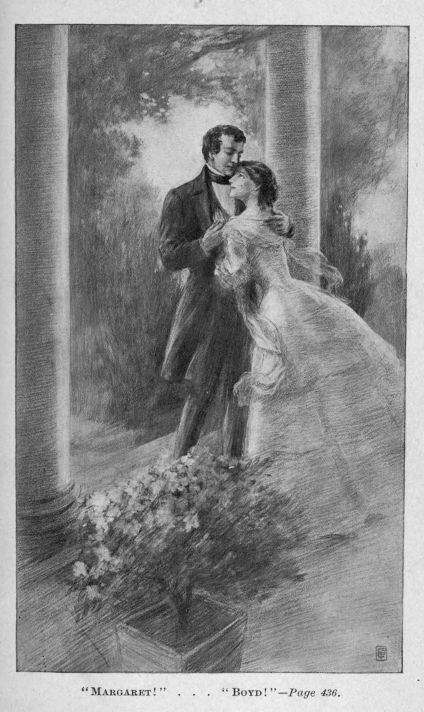
Walking rapidly up the path he stepped upon the porch, and there met Margaret face to face for the first time since he had gaily bidden her adieu at midsummer.
"Margaret!" he exclaimed.
"Boyd!" she answered, and a moment later he had taken her in his arms and caressed her fervently.
"Margaret!" . . . "Boyd!"—Page 436.
"You have come at last!" she said as she withdrew herself from his embrace.
"At last?" he asked in answer. "It was only two hours ago that I learned that I might come at all. I was twenty miles away then, and I am here now, here to claim fulfilment of the most glorious promise a woman ever made to a man—here to claim you, Margaret."
"I know," she answered, as they sank into porch chairs. "Don't let us waste time in explanations, now that they are so utterly unnecessary. Just let us be happy."
The conversation thus begun lasted until near supper time. It is not necessary to report it for the information of any who have been lovers, and as for the rest, they would never understand.
Just before the late supper time Westover suddenly awakened to his duty.
"I must see your father," he said. "Without his permission I have no right to consider myself a guest in his house."
Margaret, knowing her father's perplexed eagerness to see Westover and be reconciled with him, smiled as she answered:
"I'll send for Father."
She did so, and presently the old Colonel came limping into the porch. As he approached, Margaret slipped into the house, leaving the two men alone.
They greeted each other with a cordiality that rendered all explanations and apologies needless, but Colonel Conway insisted upon explaining and apologizing.
"I've been a coward, Boyd! I've been an abject coward."
"I don't know any other man living who would dare say that, Colonel."
"Perhaps not. No, I suppose not. Still it is true, and I'm profoundly ashamed of it."
"Now my dear Colonel Conway," interjected Westover, "let us not talk of that. This is the happiest hour of my life and, I hope, of Margaret's. Let us not spoil it by discussing disagreeable things which are completely past and gone."
"But there are some things that I must explain, Boyd, and you must listen to me. I ought to have gone to you in Richmond at the time of your trouble. I didn't, because I was forbidden to do so by an authority which I was cowardly enough to yield to. Margaret—great woman that she is—told me then I was a coward, and she was right. When you came back to Wanalah my purpose was to go to you at once, but the same authority forbade, giving me a sufficient reason in the fact that you had written no line to Margaret. I know better now, but only within the past few days. Under that mistaken belief I refused to join in your nomination. A few days ago a catastrophe here revealed the truth to both Margaret and me. She appealed to me to do what my sense of honor might suggest. That meant that I should go to you at once, grasp your hand, tell you of the misapprehension and of the facts that removed it, and ask your pardon. No, don't interrupt. You are generously disposed to spare me, but I shall not consent to be spared. My first impulse was to do what Margaret expected of me. But an appeal was made to me to spare another—the culprit in the case—and I weakly yielded to it. I compromised with my conscience and my honor. I wrote to Dr. Farnsworth the letter you have doubtless seen, and I did no more. It was all cowardice, and I am heartily ashamed of it. Will you forgive me, Boyd?"
"Colonel Conway," answered Boyd with intense earnestness, "no man with a cowardly nerve in his body could ever have made the manly self-accusing apology you have offered to me. You grievously wrong yourself. It was not cowardice that restrained you, but a tender and generous consideration for a helpless person who was entitled to every protection you could give her. Now let us talk no more of this! Let us never refer to it! Let it be a dead thing of a dead past—a thing done with, forgotten, banished forever from our minds!"
"You are very generous," answered the now feeble old man. "But that is not a thing to be wondered at. You are Westover of Wanalah, and for nearly two hundred years that name has stood for all there is of gentle, generous and courageous manhood. You'll stay to supper of course?"
"No, Colonel. I have much to do to-night. I must ride at once—as soon as I shall have said 'good night' to Margaret."
It took a considerable time for the saying of that good night.
"I'll be over here at ten o'clock to-morrow morning, Margaret," he said, "and we'll go for a ride. I'll have a servant bring over a young filly I have in my stables, that you'll be delighted to ride. She's spirited, but as gentle as a zephyr—that's what I've named her—'Zephyr'—and her paces are perfect. She's to be yours from this time forth. I personally educated her for you last summer, before—before the trouble came."
"But to-morrow is Sunday; aren't we to go to church?"
"No. We are going to Wanalah, so that you may look over the place and see what alterations are needed. I must tell you, Margaret, that an investment,—very wise or very lucky, I don't know which,—made by my father in my name, has suddenly borne fruit, making me, Jack Towns says—and he has charge of the business—three times over the richest man in Virginia. The wealth is of no consequence in itself, but I mention it so that in deciding what shall be done at Wanalah you need have no fear of expense before your eyes."
"But church is at Round Hill, to-morrow, almost under our noses. If we don't attend, what will people say?"
"Hang 'people.' We are 'people' now. We're happy and we're going to stay happy. And after all what can they say? They'll say that Boyd Westover and Margaret Conway are very much in love with each other, and we don't care to contradict that, do we?"
"I do not," she answered.
"Neither do I. So let them say on. They'll wonder when it is to be, and I'm wondering about that myself now. When is it to be, Margaret?"
"I don't know. Of course I must have time to make a trousseau."
"What for?" he asked. "Hang the trousseau, or make it after we're married. What's the difference? You've plenty of clothes, and you're charming in any of them."
"But Boyd, dear,—"
"But Margaret dear," he interrupted, "you see our marriage was to have occurred in the late summer or early fall. It has already been unreasonably delayed. It is nonsense to delay it further. Think a little, and think quick, and name a day."
"If you must have it so, I suppose it must be so. You are the Master now. And besides—"
She did not finish her sentence till he challenged it, saying:
"Besides what, Margaret?"
"I was only thinking," she answered, "that I can't persuade Millicent to stay much longer, and I do want her to be my first bridesmaid. You see, Boyd, it isn't only that I'm very fond of her—I am very grateful to her."
"So am I," he answered with emphasis, but neither the one nor the other said aught of the occasion for gratitude. They both understood. But he eagerly grasped at the helping hand:
"Then you must name a very early day, or she will have flitted."
"Let me see," she said; "the election will occur one week from next Tuesday; that is ten days hence. Our wedding shall occur on the day after you are elected Senator."
"But suppose I should not be elected?"
"In that case the day will come round just the same," she said; "but you will be elected. I have Dr. Farnsworth's positive assurance that you will be elected by the largest majority any candidate ever received in this district, and Dr. Farnsworth is a man who deals exclusively in facts, never in conjectures."
"Then you have concerned yourself about my election?"
"How could it be otherwise? As I told you in the long ago, Boyd, I am not a woman who loves lightly or lightly forgets."
"I know," he answered. "Your father is taking his supper alone. Go to him at once. I'll mount and away."
XXXVII THE OLD CLOCK TICKS AGAIN
"It's a rambling old place," Westover said, as he and Margaret strolled through the vast spaces of the Wanalah rooms with their highly polished white ash floors, their wealth of stoutly built, time darkened furniture, their ancient, oaken wainscots and their hospitably spacious fireplaces. "I suppose a modern judgment would say tear it down and build anew—"
"Then the modern judgment shall have no welcome when I am mistress here. Tear down Wanalah, with its walls of thick masonry, its generously large rooms, and its memories? Only a vandal would do that. I'll tell you, Boyd, there is only one change I'd like you to make here."
"I'll make it. What is it?"
"There's a beautiful old standing clock in the dining room that has never ticked since I have known Wanalah. Won't you have somebody put new works into it and set it going again?"
"Yes," he answered, "but it shall not run until you and I return from our wedding trip and you enter the house as its mistress. We'll go to it together then and set it going, to mark time in a new era at Wanalah."
"You are very good and thoughtful and tender, Boyd. I suppose you are a trifle romantic also, but I shall certainly not quarrel with that, now or ever."
"Speaking of our wedding trip, Margaret," he said eagerly, "what is it to be? We can go anywhere you like and everywhere you like and for as long as you like."
"Am I really free to choose?" she asked, looking into his eyes.
"Yes, really and absolutely."
"What I would like best, then, would be to go up to that place of yours in the high mountains. It was there that you suffered most on my account; I want you to rejoice and be happy there, Boyd, by way of recompense."
"But it's rough living up there, Margaret; perhaps you'd find it——"
"I'd find it delightful. How could it be otherwise, with just you and me there?"
"It shall be so then. Nothing could delight me more. I'll get Theonidas to carry my things back up there at once. They are still at Judy's. And we'll take along with us whatever baggage you want."
"That will be very little. It is the air, the sunshine, the rain, the freedom and you, Boyd, that I want. And besides, you know you have forbidden me to have a trousseau. I'll be a wood nymph or a water witch or something of that sort, and such beings do not bother with baggage, I suppose."
During the next week, Westover was speaking day and night, all over the district. He really cared nothing for the office he was running for, but it was his temperament to do his mightiest to win in any contest in which he had a part, and in this case he had the additional impulse to gratify Margaret by securing the biggest majority possible for his election.
Meanwhile, in his enthusiasm, Colonel Conway forgot all about his gout, and busied himself in the fulfilment of the promise he had long ago given, to fill The Oaks at the wedding time with the most brilliant company the country could furnish, and to have feasting there of a kind that might make the occasion memorable. He even made a journey to Washington and fairly forced his old commander in the Mexican War, General Scott, to be a guest, honored and honoring the occasion.
Judy Peters was also an honored guest. When Westover learned at last what part she had borne in his nomination and in his campaign, he rode all the way up to her place to persuade her to come. And when the time arrived, he sent the Wanalah carriage to fetch her. She appeared at the ceremony, in a gown more gaudily gorgeous than any that had been seen in that region since "the time whereof the memory of man runneth not to the contrary."
Colonel Conway devoted his particular attention to her. Among other special courtesies he shared with her a bottle of precious old Madeira—too precious, as he told her, to be "wasted on a lot of young fellows whose palates are not educated up to it."
She drank the wine with relish, and after the third thimbleful glass she gave judgment.
"It's better 'n apple jack, but in the matter o' taste, 'tain't quite up to peach an' honey, is it now, Bob?"
Since his boyhood nobody had ever ventured to address Colonel Conway as "Bob," but as it came from Judy's barbaric and privileged lips, he rather liked it.
The wedding was held in the early morning because Boyd Westover had explained, without a hint of whither they were bound, that he and Margaret had a long journey to make before nightfall.
The wedding morn was on the day following the election, and the returns were all in. Carley Farnsworth summarized them to the company by announcing that Westover was elected by the vote of more than three-fourths and nearly four-fifths of the citizens of the district.
Then he added:
"And Sam Butler, Democrat, is elected to the House of Delegates, chiefly by the mountain vote, which seems to have been pretty nearly solid for him."
Judy Peters beamed upon Colonel Conway, and ventured the remark:
"'Tain't no use a-votin', Colonel, ef you don't stick together an' vote to 'lect. That's our way up in the mountings."
"Ah, Judy," the Colonel replied, "I'm afraid you're a sad sinner. I'm afraid you manipulated that vote."
"I ain't close acquainted with that big word o' your'n, Bob, but I was purty nigh right in my jedgment as to how this here 'lection was a goin' to come out. Say, Bob, what d'you think that there comb-cut rooster William Wilberforce Webb thinks of hisself by now? I wonder ef he'll unload some o' that name?"
Westover and his bride left as soon as the ceremony was over, but Colonel Conway kept the festivities going all day, and there was a dance at night.
The occasion was rich in opportunities for Jack Towns, and, with the alert energy which was characteristic of him, he made the most of them. When, two days later, he left for Boston as Millicent's escort, there was no room for doubt in anybody's mind as to the outcome of his visit to the blue hills of Milton.
It was a month later, and winter had begun, when Westover and Margaret—just entering the house—went to the clock and set it going. She said something—no matter what. He said nothing, but gathering her head to his breast, he caressed her. Words seemed superfluous.
THE END.
********
The Potter and the Clay
A Romance of To-day
By MAUD HOWARD PETERSON. Illustrated by Charlotte Harding. l2mo, decorated cloth, $1.50
A strong and impressive story—one of the most forceful of recent novels by a new author of promise and ability. The motive is love versus loyalty; the characters are alive and human; the plot is puzzling, and the action is remarkably vivid.
A Carolina Cavalier
A Romance of the Revolution
By GEORGE CARY EGGLESTON. Illustrated by C. D. Williams. 12mo, cloth, rough edges, gilt top, $1.50
This is a historical romance of love, loyalty, and fighting. The action passes in South Carolina during the stormy days of British invasion, in the region once made famous by Simms and not touched since his day. It is full of vigor, plot, and action. Tories and patriots, war and adventure, love and valor crowd its pages and hold the reader's attention from first to last.
The Little Green Door
By MARY E. STONE BASSETT
Eight illustrations by Louise Clarke and twenty-five decorative half-title pages by Ethel Pearce Clements
12mo Cloth $1.50
A charming romance of the time of Louis XIII. The door which gives the title to the book leads to a beautiful retired garden belonging to the King. In this garden is developed one of the sweetest and tenderest romances ever told. The tone of the book is singularly pure and elevated, although its power is intense.
"This is a tale of limpid purity and sweetness, which, although its action is developed amid the intrigues and deceptions of a corrupt French court, remains fine and delicate to the end. There is power as well as poetry in the little romance, so delicate in conception."—Chicago Daily News.
"Tender, sweet, passionate, pure; a lily from the garden of loves."—Baltimore Herald.
"The story is exquisitely pure and tender, possessing a finished daintiness that will charm all clean-minded persons."—Louisville Courier-Journal.
"This book carries with it all the exhilaration of a beautiful nature, of flowers, birds, and living things, and the beauty of a winsome personality of a pure, beautiful girl. It is a romance entirely of the fancy, but a refreshing one."—Chicago Tribune.
"The little romance is charmingly wrought, and will be sure to find its way to the heart of the reader."—Boston Transcript.
Lothrop, Lee & Shepard Co. BOSTON