WESTOVER OF WANALAH (continued 2)
Reading edition
"I will try to be interested, Jack; for your sake I'll do my best. But what interest can a man in my position feel in anything?"
"Now listen to me, Boyd!" Jack Towns said commandingly, and rising to his feet to say it. "Listen to me. You are morbid. You need calomel or something. You're the victim of some mistake and you're in sore trouble. But you are not disgraced. Nobody can disgrace a man but the man himself. You are conscious of your own honor; what matters it what others think? Besides, no honest man in Virginia believes that you are guilty of a sneaking crime or capable of it. The jury that convicted you didn't believe it and not one of them believes it now. The Judge who will sentence you doesn't believe it. If the envious and malignant falsely pretend to believe it, why should you care for the despicable pretense of people so utterly unworthy? If cowards fight shy of your acquaintance, lest recognition of you should compromise themselves, why should you care for the acquaintance of such poltroons? You are Westover of Wanalah—inheritor of an honorable name. You will be that so long as you shall live. It behoves you to bear that name with head erect and with contempt alone for those who do not recognize your worthiness to bear it. This affair is an unfortunate incident. It will soon be over, and you will have a lifetime before you in which to teach men the falsity of the accusation against you. There. My lecture is done. Let us get to these papers. They hold great news for you."
When the two were seated, Jack took up a letter, which was first of the papers in the order of consideration.
"This is from a firm of lawyers, Dodge, Denslow and Deming of Denver—charmingly alliterative throughout—do you happen to know who they are?"
"Yes, in a way. There was a memorandum among my father's papers, that mentioned them."
"Well, go on. What did it say, or reveal, or suggest? This is business, Boyd. Put your thinking machine on it."
"I will,—to oblige you, Jack. The memorandum catalogued a long list of mining lands and mining claims somewhere up in the Rocky Mountains or in some side issue of a range—you'll find the paper in my desk at home—lands and claims which my father had bought during one of his journeys out that way and had placed in my name, as a provision for me in case of accident."
"That accounts for these papers being in your name and not your father's," interrupted Jack. "I was puzzled by that. But go on. I want to hear all about it."
"Well, you know my father was an optimist—a dreamer almost—and he was possessed of an idea, reflected in the memorandum, that these things would make the future Westover of Wanalah—myself or my son if I should have one—enormously rich. As nearly as I could make out, the multitudinous lands and mining claims he bought in my name covered a large area of entirely untillable and not very accessible land somewhere up in the high mountains, where grub-staked miners scratched the surface for silver ore, with now and then a little find of gold. They worked on shares somehow, and this law firm collected my share from time to time and remitted it. It was so small a part of the assets of the estate that I've forgotten how much it was. That's all I know of Dodge, Denslow & Deming."
"You're likely to know a good deal more about them hereafter," said Jack, "if I can awaken in your mind a reasonable interest in a matter that promises to make you the richest man in Virginia, twice or thrice over."
"Cui bono?" responded Boyd. "When my prison term ends I shall have enough, without that, to feed me, and I've nobody else to feed."
"Boyd Westover, if you go on in that mood, I'll chuck you into the bath tub again and set the shower going without giving you a chance to shed your clothes. Can't you see that when you—when—well, when present difficulties are over, this thing will give you an interest in life, something to occupy your mind, something to manage and—oh, I forgot, you don't know the facts yet. It appears from these papers—we won't bother now to read them in detail—that the mining lands your father bought in your name, have proved to be about the richest in the world. They cover practically all of one of the richest deposits of gold, silver, lead, and quicksilver, ever discovered. Listen. This is the way Jake Greenfield puts it in a letter. Jake seems to be a shrewd Yankee whom your lawyers have established on the lands to watch operations and prevent trespass. He writes to the lawyers:
"'I don't s'pose Mr. Westover nor you neither's got a krect idee of what he's got up here. It's like an injun's blanket, with fringes all round it. He's got the blanket an' these fellers what's opened up mines north an' south of him has got the fringes. Nachurly they's a tryin' to git in under the blanket, but I'm a watchin' out an' they're a doin' no trespassin'. They's got the fence corners an' Mr. Weststover's got the field. They's plannin' to buy him out an' they's got experts an' engineers an' lawyers enuff here to run a ship or an orphan asylum. My say to Mr. West Stover is don't bargain with 'em till you know for yourself. That used to be our way in Varmont, whare I come from. This is my wink to a blind hoss, an' a nod with it.'
"The lawyers seem to have taken Jake Greenfield's counsel seriously, so far at least as to send experts of their own to study the situation, and these seem to confirm Jake's judgment. So do these other letters, from the mining men who want to buy you out. I'll read them."
"Can't you summarize them in your own words, Jack?" interrupted Boyd. "The thing doesn't greatly interest me, and—"
"Well, listen then, and perhaps I can awaken your interest. These people it appears are amply backed by New York and Boston bankers. In fact the bankers really constitute the company, and they seem to know their own minds. They have spent some hundreds of thousands in setting up machinery and all that sort of thing, and they say their mining operations are paying heavy dividends—twenty-five or thirty per cent. on their investment. But the richest leads or lodes or veins or whatever they are called, lie beneath your land. You've got the blanket and they only the fringe, as Jake picturesquely puts it. They want to buy the blanket, or get in under it somehow, and they're prepared to pay for what they want. They propose to organize a new company to work the whole thing; they to put in their plant, their costly machinery, their mining privileges and all their other assets, and you to put in your mineral lands. They make you a flat offer of nine hundred thousand dollars in money, and thirty-nine per cent. of the stock of the new company, if you will join them in this project by ceding your lands, mining rights, etc., to the joint concern. Perhaps they can be induced to do better even than that, as they seem very eager, but that is what they offer to begin with. It means fabulous wealth to you if their hopes as to the profits of the new company are measurably fulfilled, and even if they are not fulfilled at all it means that you can wear Wanalah plantation as a watch charm for all your life to come. Isn't that a fine prospect?"
Jack was disappointed in Boyd's reply. He had hoped that this startling happening might awaken his friend to a new interest in life and life's affairs, but, after swallowing two oysters and slowly sipping half a glass of ale, the unfortunate young man said, in a melancholy tone:
"I suppose the thing ought to be looked into. If I were a free man again, I'd make my way out into those wilds and see what could be done. As it is—"
"As it is," broke in Jack Towns, "you're going to execute a sweeping power of attorney authorizing me to act for you, and I'm going out there. When you—well, I mean later,—you'll take hold of the thing yourself, and those hustling fellows out there will wake you up, if I can't. Go to bed now, if you feel like it. I'll prepare the power of attorney and you can execute it at breakfast time. I must say you're uncommonly bad company."
"I suppose I am," said Boyd as he shuffled off to his bedroom.
XI THE EVENTS OF A MORNING
It was with a firm step and with head erect, and, more significant still, with eyes that looked straight into other eyes without a suggestion of flinching, that Boyd Westover entered the court room on the morning appointed for the pronouncement of sentence upon him. Jack Towns, who accompanied him, thought he had never seen so superb an exhibition of stoicism as that which Boyd had given throughout this affair.
"But this caps the climax," he said to the Commonwealth's Attorney, whose drawn features showed clearly the distress he felt in view of the duty he had to do in moving that sentence be pronounced upon his old schoolmate, his boyhood's comrade, whom he had been compelled to prosecute and convict of an infamous crime.
"Just look at him," Jack whispered. "For all that his appearance or his manner could mean you'd think he had come here to deliver an oration on some distinguished occasion. It's simply magnificent!"
"It is simply horrible—my part of it, I mean," answered the other with a suppressed groan.
There was no further time for conversation. The moment had come when Boyd Westover must be called to the bar to receive the sentence of the court. The Commonwealth's Attorney made the necessary motion in a voice that could hardly be heard because of his lack of control over his organs of speech. The Judge tried hard to deliver the little address he had carefully prepared as a means of suggesting what he could not say—that in spite of everything he could not personally regard Boyd Westover as a man actually guilty of crime. His voice behaved so badly that after a futile attempt he gave up the effort to say anything, except the formal words that condemned the prisoner to serve a term at hard labor in the State prison.
The term fixed by the sentence was the shortest that the law allowed, but what comfort was there in that to a sensitive man like Boyd Westover, to whom disgrace for half a minute meant the same thing as disgrace for all time? It is doubtful that he even grasped the meaning of the words used in limiting the sentence to the briefest time allowed.
As there were papers to be made out and signed, Jack Towns and his client sat for a brief while waiting. Presently there was a little commotion in the outer corridor and a moment later a bailiff hurriedly entered and made his way to the Commonwealth's Attorney, to whom he whispered excitedly. That officer asked a brief question or two under his breath. Then he turned to the court and said, while all listened with the greatest interest:
"If your honor please, something has happened—something out of the ordinary, something important, something which if I am correctly informed vitally concerns business now before the court. I ask to be excused for a few minutes in order that I may learn the facts and report them to the court."
With that, receiving a nod of approval from the Judge, he withdrew.
When he had gone the Judge said:
"We may as well save what we can of the time of waiting. Mr. Clerk, if you have the papers ready in the Westover case I'll sign them."
They were passed to him and, after he had signed them, handed over to the sheriff, thus completing that matter at once.
A moment later, the Commonwealth's Attorney returned, pale to the lips, trembling like one in an ague fit, and with the muscles about his mouth twitching in a way that was positively painful to all who looked at him.
In a voice that was hard, metallic, and obviously controlled only by a supreme effort of the will, he addressed the court.
"There has been a terrible mistake made," he said with none of the formalities of speech usual in addressing a tribunal,—"a disastrous, cruel, irreparable mistake, for my share in which I hide my head in shame as I ask God and man to pardon me. In convicting and sentencing Boyd Westover, we have convicted and sentenced an innocent man. The real culprit is now in a jury room adjoining this apartment. He has been caught in a repetition of the act for which Boyd Westover has been convicted and sentenced. He has confessed that he was the offender on the former occasion, and the committing magistrate before whom he was brought this morning has brought him hither to repeat his confession and to let your honor look upon him. It is the most phenomenal case of mistaken identity I ever knew or heard of. Even fiction, with its limitless license of invention, offers no parallel that I ever heard of. The resemblance between this man and Boyd Westover is so perfect, so startling in its completeness that I could never have believed it upon any testimony other than that of my own eyes. I ask permission to bring the prisoner into court."
By this time the court room was packed with all sorts and conditions of men, for the news of what had happened during the night before had spread like wildfire over the city.
A minute later the prisoner, who gave his name as "Dolly Andrews," but admitted that "Dolly" was short for Adolphus, was brought to the bar. At the Commonwealth's Attorney's request, Boyd Westover moved forward and stood by his side.
The two men were precisely alike in size, form and feature, but strangely unlike in expression. As Jack Towns put the matter: "Boyd Westover, being a gentleman, looks into your eyes when he speaks to you or you to him; the other fellow looks anywhere but at you. In the one face there is intelligence,—in the other a low cunning; in the one an alert outlook, in the other a look of morbid introspection. Still the two men are absolutely alike in all physical respects—more alike than I supposed that even twins could be. I could myself easily mistake one for the other, and I don't wonder that a lot of excited school girls, routed out of bed in the middle of the night and with only bedroom candles to see by, made the terrible mistake they did."
The problem now was what to do. Fortunately the committing magistrate was a man of wise discretion. He presented himself in court and said to the Judge:
"I have not yet committed this man, though he was caught in the act and has made full confession, both as to his present offence and as to the former crime, of which another has been mistakenly convicted. I have thought it better to bring him before your honor and ask you to sit as committing magistrate in the case, in order that you may yourself hear his confession. It has seemed to me that this course was best in aid of justice in another case."
After an exchange of dignified compliments, the Judge, sitting as a committing magistrate, heard the case. During the preceding night there had been an alarm of "burglars" in Le Voiser's school. As before, the matron marshalled her charges for retreat, but this time there were two stalwart men on the premises and awaiting call. Monsieur Le Voiser had looked out for that, by ordering his furnace man and his steward to sleep in a room within convenient call, and when the intruder attempted to escape they were there to seize and hold him by physical force.
They testified to the facts.
Then the culprit repeated the confession he had already made. He seemed in no way ashamed, and he did not hesitate. He declared that it was he, and not Boyd Westover, who had invaded the school on the former occasion, and when asked what his motive was, he disclaimed all purposes of robbery and sought to justify himself by the solemn declaration:
"On both occasions I went there under the command of the Supreme Being."
"Just what do you mean by that?" asked the Judge, testily.
"I am divinely commissioned to marry Miss—"
"Stop!" commanded the Judge. "Don't mention the young lady's name. Just say 'a certain young lady.' We won't have her name dragged into the case."
"Very well," said the culprit. "It is only that I am acting under a divine commission and have nothing to conceal. I must marry the young lady in question. I met her in the street once, and talked to her on the subject. She mistook me for Boyd Westover, and I thought it best to use that name in my dealings with her. You see, Judge, when one is divinely commissioned to achieve a purpose, details make no difference."
"Go on," said the Judge; "omit explanations and arguments, and tell what happened."
"The young lady rejected my addresses. I was not discouraged by that. I had been divinely warned to expect it. I wrote her many notes, but she did not reply to them. Then I saw my duty clearly. I decided to use gentle force and carry her away with me, leaving the divine influence to chasten her proud spirit and teach her the duty of loving me. I have been twice defeated in my endeavors. I shall succeed when the appointed time is ripe. I must be patient and faithful, that is all."
"After all," whispered Jack Towns to the Commonwealth's Attorney, "that hysterical girl who said he had come to abduct her was right, except in her identification of the man."
"Yes, but the exception is one of disastrous consequences. Help me, Towns, to right this wrong! I'll never do the like again. I'll never prosecute another case so long as I live. I've already sent in my resignation from office."
"You're a sublimated idiot," said Jack. "Listen. The Judge is speaking."
"I will commit this man to await the action of the Grand Jury," the Judge said. "In the meanwhile the Court suggests to the Commonwealth's Attorney the propriety of asking for a commission in lunacy to inquire into this man's sanity."
Thus spurred out of the lethargic collapse into which he had fallen, the official prosecutor made the necessary motion and the court promptly appointed the commission.
Then Jack Towns arose to ask:
"What is to be done to right the wrong in the case of my client? And more especially, what is to be done to prevent the aggravation of that wrong? I call attention to the fact that the papers committing this obviously innocent man to the penitentiary are already in the hands of the sheriff, who has no right to exercise discretion in the case. In the ordinary course of events my client, innocent of offence as he obviously is, must pass the portals of the prison within the hour. I ask the court to prevent this crowning wrong in a case in which enough and too much of wrong has been done already."
The Judge was in full sympathy, but for order's sake he asked if the Commonwealth's Attorney desired to be heard in opposition to the request of the counsel.
"Not in opposition," said the official, "but in full and hearty sympathy. I feel that a great wrong has been done; I feel this so strongly that I have sent to the proper authority my resignation of the office I hold, in order that I may never again have part or lot in a wrong so grievous. I earnestly second the request of the counsel for the prisoner that everything shall be done which the law permits, to prevent further wrong and to right the wrong already done."
"Very well," said the Judge. "The sheriff is ordered to return to the clerk the papers in his possession. The prisoner is paroled in the custody of his counsel, to await further proceedings. Unfortunately the court knows of no process of law by which the fact of this innocent man's conviction and sentence can be undone. It is not within the power of man to make that not to be which has been. The court cannot undo the proceedings that have been had in this case. It can only make an earnest effort to prevent the wrongful results of those proceedings. To that end I purpose to go in person before the Governor of the State to ask for the fullest reparation that can be made, namely, a pardon—pardon for a crime that has not been committed. It seems almost a mockery, but it is the best that is possible under the law. In order to give all the emphasis I can to the proceedings, I shall adjourn court for a time, and ask the Commonwealth's Attorney to accompany me on this mission of justice. Further than that, I direct him to summon the members of the jury that convicted Boyd Westover of a crime of which he is not guilty, to go with us before the Governor and join us in our request. So far as the securing of a pardon is concerned, no effort of this kind is necessary; but the court deems it proper in this case to make this united appeal of judge, jury, and prosecutor by way of emphasizing our recognition of the injustice done. The court stands adjourned until four o'clock this afternoon, at which hour Mr. Boyd Westover"—the Judge no longer spoke of him as "the prisoner"—"will present himself here and the court will itself deliver to him—as it is fitting that the court should do in such a case—the papers relieving him, so far as it is possible now to relieve him, of all the consequences of a clearly erroneous accusation and conviction."
When the Judge ceased speaking, Boyd Westover made a profound bow to him, saying simply: "I thank you." Then turning to Towns he said:
"Come, Jack! I'm faint and hungry. Let's go to Tom Griffin's and get something to eat."
Tom Griffin's was a place well known in the Richmond of that old time. Tom himself was a negro slave who enjoyed vastly more liberty than any free man of color ever did in Virginia. Every gentleman in Richmond was his personal friend; so was every aristocratic planter east of the Blue Ridge. Any one of them would have drawn his check in payment for Tom's liberty, if Tom had desired to be free. But Tom Griffin wanted nothing of the kind. He was happy and he knew when he was well off. If his freedom had been bought, he must, under the law, have left his native state, whose people were his friends and whose associations meant to him all that life could mean.
He knew all there was to know of catering and of cookery. Better still, as he phrased it, he "instincted just how to make things good to eat." He had genius, in short, and the fact was recognized and celebrated by every man in Virginia who had a palate and the price—and who enjoyed Tom Griffin's favor. For Tom Griffin's place was no ordinary restaurant. Men of the common herd were not welcomed there. Only those whom he recognized as his friends—and his friendships were rigidly restricted to the aristocratic class—were privileged to sit at Tom's polished old mahogany table, and enjoy sora, or canvas backs or terrapin in perfection. Only such were served with his glorified chine and spare-ribs, his roast turkey or his forequarters of spring lamb. And those who were so privileged could never be persuaded to believe that anybody else in all the world could even by accident serve any viand in such perfection as that in which every viand came from Tom Griffin's expert hands.
Tom probably knew who his master was, but nobody else ever asked. Tom probably paid his master a liberal compensation for his time; he could well afford to do so. For Tom Griffin was rich—so rich that many a young Virginian whose frequent rash expenditures threatened to involve him in argument with his father, found relief in a loan from Tom Griffin's hand, concerning which no papers were passed. These loans were certain to be repaid. They were debts of honor, seeing that as a suitor Tom Griffin—a negro slave—would have had no standing in court.
Tom Griffin had waiters in adequate force, but he never permitted them to serve a gentleman without his personal superintendence. If a gentleman wanted a glass of water during his meal—as even Virginia gentlemen sometimes did—Tom regarded his waiter as a person competent to serve it. The waiter could clear away the used crockery, too, and see to it that lighted wax candles were in place for cigar-lighting purposes. There were other minor offices that Tom permitted to his waiters. But when it came to serving a dish, Tom took the function upon himself.
"You see," he once explained, "the boys is so stupid. If I've laid myself out to have a dish just right, I ain't a goin' to spile all my work by lettin' a clumsy nigger slap-bang it on the table, like as if he was a sellin' fish in the market."
In accordance with his custom, therefore, Tom personally served a dinner that Boyd Westover had not ordered. There were soft crabs to begin with. There was a whole fore-quarter of genuine spring lamb for Boyd to carve at will. There were the earliest peas of the season, secured by Tom Griffin's "System," which consisted in letting all the market gardeners know that he paid higher prices than anybody else for the first and best of every garden's product, and, more important still, that any gardener failing to give him first choice would be cut off his list, a proscription too serious to be faced with composure. There were the first tomatoes of the season, too, and there was everything else that was possible, including a meringe a la créme, black coffee and cigars at the end.
Boyd Westover had ordered nothing of the sort, but Tom Griffin served it all quite as if he had done so, and when it came upon the table Tom busied himself and a corkscrew in opening a dusty, cobwebbed bottle of antique Madeira, saying as he did so:
"Dis is Ann Maria wine, Mas' Boyd, an' dere ain't much of it left in Old Virginia, I reckon. Will you 'scuse me ef I say I ain't paid no attention to your order in gittin' your dinner ready, an' I ain't asked what sort o' wine you wanted? De explanation is dat Tom Griffin is a furnishin' this here dinner an' this here Ann Maria Madeira, as his contribution to de joyful occasion. Gentlemen, I trust your appetites is good."
With that Tom withdrew too hastily for protest or remonstrance. As he went he snatched a napkin from a vacant table, with which to dry his dusky cheeks of the tears that were streaming down them in spite of all his efforts at self-control.
Tom had learned from his customers to speak fairly correct English, and his lapse into the negro dialect of his boyhood on this occasion was the "outward and visible sign of the inward" emotional disturbance that Boyd Westover's experience had wrought in his all-affectionate soul.
XII AFTER THE STORM
Hungry as Boyd Westover had declared himself to be, and tempting as was the dinner that Tom Griffin served, the young man ate with scant appetite, and when the meal was over his friend was anxiously worried.
"See here, Boyd!" he said. "In view of all the circumstances you ought to be the jolliest fellow in Richmond to-day. You've borne up astonishingly during the real stress of this affair. Why should you flunk now that it's all over and you're a victor?"
"I'm not flunking. I'll never flunk, but stoicism costs," answered Westover.
"Just how do you mean?"
"I mean that my determination to bear a bold and unflinching front as it becomes a Westover to do when the penitentiary doors were yawning for me, with lifelong disgrace as my portion, has taken more out of me than you can easily believe. To a man raised in our traditions, the prospect of disgrace and shame is a fearful thing to face. A score of agonizing deaths by torture would have been to me as nothing in comparison with what I have suffered in contemplation of this horror. I have faced the thing as bravely as I could. That much I owed to my name, my caste, my lineage—call it what you will. But my bank account of endurance is running low now. My drafts upon it have been heavy and—well, there have been no deposits to strengthen it."
He was thinking bitterly of Margaret Conway's defection.
"Don't let us talk of that. I'm as nearly on the verge of collapse as a healthy man can be, that's all."
"But you are vindicated, and when your pardon comes this afternoon—"
"Pardon? Yes. For a crime I did not commit. Think of it, Jack. From this hour forth I shall be a man accused, convicted and sentenced for a crime of infamous character, and graciously pardoned for it. It couldn't be worse—except to my own soul—if I were guilty. The pardon undoes nothing but the punishment. It doesn't wipe out the stain. It doesn't—oh, well, you understand. I am free, but my life is ruined. If I were called as a witness in court, the opposing attorney would be free to ask me if I had not been convicted of a felony and sentenced, and I should have to answer yes. Then he could forbid me to explain. The thing is horrible. The law as it stands is infamously unjust. Why should I be a pardoned criminal when I have committed no crime? Why should not the court that convicted me and sentenced me under a mistake have power to undo the wrong by another trial or procedure of some kind? Why should I not be acquitted of a false accusation instead of being 'pardoned' for an offence never committed? No, don't bother to answer. I know the answer already. Such cases are too rare for the law to have provided for them, though it is the law's boast that there is no wrong for which it doesn't provide a remedy. However, let's talk of something else. I'm going off for rest. I suppose this Rocky Mountain matter ought to be looked after. Will you go out there as my representative, under your blanket power of attorney, and do whatever you think best about it? There seems to be money enough in it to pay you all you want in the way of fees, according to your representation."
"I'll go, of course. But I wish you would go instead, or go with me. It would divert your mind, and, believe me, Boyd, you need such diversion more than anything else. Why can't you go?"
"Because I must rest, and because—well, because of many things. Never mind. I'm not going and you are. I'm going a fishing. Draw up all the necessary papers and I'll execute them. Can you get them ready to-night? I want to go away to-morrow morning and forget."
"Where will you go? To Wanalah?"
"No; except for brief preparations. To the mountains. You know I own three or four high mountain tops up in the Blue Ridge, with the swales, called valleys, that lie between. The land is worthless, but the woods up there are full of game and the brooks alive with trout. My grandfather bought the vast tract as an indulgence and my father kept it with a like purpose. There's a shack of some sort up there I believe. If not, I can build one in a half day, and it will interest me to chink and daub it."
Jack Towns sat silent for a time. Then he said:
"I heartily disapprove of your plan. It means solitude, and you need association with men to cure you of morbid and unwholesome feelings."
"But I can associate with men only upon sufferance. You've heard of the person who said: 'The more I see of men, the better I like dogs.' I'm not quite of his mind, but anyhow I'm going up into the high mountains with my dogs, my guns and my fishing tackle. So get all the papers ready, Jack, and let me get away as soon as possible."
Again, Jack Towns sat silent and troubled. After awhile he said:
"Of course you'll go to my house to-night and be my guest so long as you remain in Richmond?"
"Thank you, I will if you'll see to it that no visitors get at me. I want to go to sleep as soon as this thing's over and I'd like to stay asleep forever."
"You're all wrong, but of course as a guest in my house you'll be protected from everything that is reasonably or unreasonably disagreeable to you. But really, Boyd, the people who are sure to call to-night—"
"Yes, I know. They will call to offer congratulations which are in fact commiserations and condolences. I don't care to attend my own funeral in the capacity of chief mourner, just yet. I shouldn't mind the funeral, with myself for the corpse, but I'm not prepared to play the part of chief mourner."
"You're morbid, Boyd."
"Perhaps so, but I'm going to become healthy again. Now listen. I'm going off into the mountains to match my wits with those of the wiliest trout, the shyest deer, the most experienced wild turkey gobblers, and now and then perhaps to try conclusions with a sly old bear. By the time I return to civilization, I'll have decided upon my career. I'm going to do something—I don't know what. But by that time I'll know."
"Good! That's the way to look at things. After all, the strain your stoicism has put upon you hasn't robbed you of your robust manhood, and that is what I feared."
"My dear Jack, I couldn't lose that and go on living. It is only that I must have a little time in which to pull myself together and see what I can do. If your mission to the Rocky Mountains proves that those fellows out there are right, and that a great wealth is ready to my hand, I may turn philanthropist, or I may enter upon great business undertakings which by their employment of multitudes of men at good wages are perhaps the most philanthropic of all endeavors. I don't know. I can't think till I sleep and rest. At any rate while I am recovering tone up in the high mountains of the Blue Ridge, you will find out what monetary tools I have to work with. Theology teaches us that the primal curse was a condemnation to work. It was the primal blessing instead. That's an aside. I have good friends up in the mountains, chief among whom is Judy Peters."
"The Queen of the mountains? I've heard of her. She's an erratic political factor with whom every candidate must reckon, I'm told."
"She's all that. She controls the mountain vote in her district as absolutely as the Superintendent of the Penitentiary was to have controlled me—"
"Now, my dear Boyd, I beg you to put aside that sort of brooding. It's morbid, it's hurtful to your character, it's—"
"Yes, I know. But I'm not pardoned yet, you know, and naturally—never mind. I was speaking of Judy. She doesn't abuse her political power. In many elections she doesn't use it at all. She says to her subjects: 'I ain't choosed 'twixt them two candidates. Choose for yourselves.' But when she does choose and intimates her choice the men of the mountain all vote her way, and their vote makes an end of all uncertainty as to the result of that election. But it isn't only in politics that she rules. A Baptist preacher went up that way once and became pastor of a church. For a while he 'cut a wide swath,' as Judy said. But he made the mistake of offending her majesty by some indiscreet criticism of her. She manifested no displeasure, but on the next Sunday and the next he found a meeting house full of empty benches to preach to. Then he quit, as Judy afterwards explained, 'because his usefulness was at its end.' It's the same way with everything else. Ordinarily she does not interfere, but when she does her interference is instantly effective. It's a common saying up there that 'ef you want to stay in the mountings comfortable like, you don't want to git yourself into Judy Peters's bad books.'"
"On what does her extraordinary influence rest?"
"It would be hard to say. Partly I should say upon her extraordinary sagacity, especially in her judgment of men and her penetration of their motives. My father used to say she had second sight of the Scottish sort. It is certain that no man ever deceives her for long, no false pretense ever endures her scrutiny, and she never falters in her judgments. She is as relentless as Fate itself and as merciless in her dealings with what she adjudges to be wrong. As she doesn't know what fear means, she is equally resolute in her active support of all causes that enlist her sympathy. She is ignorant, as we reckon such things, but her sagacity is well nigh supernatural, and she keeps herself informed on all matters that interest her, with an accuracy that a detective bureau might envy. She is kindly, but not courteous. She hates shams with an elemental intensity. If you are a guest in her house she fulfils every obligation of hospitality, but she tells you no lies either in word or deed. She will lay herself out to serve you with sublime fried chicken and glorified waffles, but if she catches you in a falsehood she'll tell you you are a liar even while she presses the apple butter or the maple syrup upon your acceptance. In brief, Judy Peters is altogether a natural human being, whose elemental passions have never been curbed by convention, whose courage is of the kind that never shrinks from the recognition of truth or from its telling in plain words. If she likes you she will say so. If she dislikes you she will tell you the fact in equally plain words. If she is in doubt about you, she will tell you she 'ain't choosed yit' as to you. That's Judy. Still my description utterly lacks something, I don't know what—personality perhaps. You must know Judy personally if you would understand her. Her malignity, in cases that seem to her to call for it, is well nigh beyond conception in its devilish ingenuity and persistence; her loyalty, on the other hand, stops at nothing that may serve its fortunate beneficiary. She was my father's friend, in her odd way, and she is mine. My father once rendered her a service; I don't know what it was, and she won't tell me. He always said it was a trifle of no consequence; she always answers my inquiries about it by saying:
"''Tain't none o' your business, Boyd, what he done for me, but ef I could 'a' turned these here mountings upside down an' he'd 'a' give the word as how he wanted it done, over the mountings would 'a' gone, you kin bet your bottom dollar on that proposition.'
"She is my friend on my father's account and nothing can change that. If I should try to deceive her she'd denounce me to my face as a liar, but she'd make the mountains too hot to hold anybody else who should suggest such a thing, and she'd go on doing her mightiest in my interest, in spite of my fault. In her way she is a wholesome sort of person for me to meet just now, and I'm going to spend a few days with her, just for the bracing up she'll give me. After that I'll go on up into the high mountains."
So ended the dinner and the conversation. Next morning Westover set out for Wanalah, where he intended to spend a few days giving necessary directions and equipping himself with supplies for his sojourn in the mountains. These consisted of books, mainly, with a bag of corn meal, a ham or two, a few sides of bacon, guns, ammunition, fishing tackle and rough clothing, all of which were loaded into an ox cart, which a negro boy was to drive in leisurely fashion to Judy Peters's. Beyond that, in the climb up the mountainside, oxen would be of less use than bother, and Westover depended upon the long legs and strong arms of mountaineers to manage the further transportation.
XIII "AUNT BETSY" TAKES THE HELM
It would have been a dangerous thing for any man to accuse Colonel Conway of cowardice. Personal courage was his in full measure. Three times during the Mexican war he had been promoted—rising from lieutenant to colonel—and each time in special recognition of "conspicuous gallantry in action." He was afraid of no man and no company of men. He did and dared throughout his life with absolute disregard of danger.
But Colonel Conway was mightily afraid of his sister Betsy, as his daughter had said. Why, he could not have told, but the fact remained that he was afraid of that elderly little woman, encased as she was in an armor of conventionalities, gentle but resolute, and mercilessly insistent upon what she decreed to be "proper" conduct.
When the negro boy who daily brought the letter bag from the post office to The Oaks reported that Mr. Boyd Westover had come up from Richmond and was to stay only for a day or two at Wanalah, Colonel Conway promptly announced his purpose to ride over and congratulate him. The family were at the breakfast table at the time and the Colonel observed that his daughter paled at the mention of his purpose, though she said nothing in reply to his declaration. His sister, "Aunt Betsy," also said nothing. It was her habit to say nothing till the time was ripe.
Immediately after breakfast Margaret sought speech with her father.
"You are right, father, and what you purpose is the part of an honorable man. You ought to go to Boyd and take his hand, and make him feel that men of your kind and his kind understand. But—" She paused uncertainly.
"'But' what, daughter?" asked the Colonel, eagerly scanning her face.
"Nothing. I was only going to say that perhaps it will be just as well not to mention me—unless he does so first."
There was that in her hesitating utterance which awakened the Colonel's attention and curiosity.
"But why not, Margaret?" he questioned. "Surely it is about you he will be most eager to hear."
"If so he will ask. If he doesn't, I beg of you—"
"Why, surely you've heard from him frequently during this trouble—and you've written to him?"
"I've written to him, yes."
"And he has written to you, of course?"
The girl stood silent, while she plucked honeysuckles from the vines that shrouded the porch in which they stood, and nervously pulled them to pieces.
"Answer me, child," the Colonel said in a tone of command. "Hasn't Boyd Westover written to you during all this trouble?"
"I have received no letter from him," she answered hesitatingly.
"Do you mean that he hasn't written to you of his arrest, trial and all the rest of it, of his vindication and—"
"I have had no letter from him," she repeated.
"Hasn't he even offered you a release from your engagement?"
"I have had no letter from him," she said again, but this time she lost her self control and blurted out the thought that had troubled her for many days.
"Oh Father," she said, seizing his arm as if to detain him, "there has been some cruel mistake, some miscarriage, something, I don't know what. I only know that Boyd Westover is a gentleman and would never have neglected such a duty."
"As he has neglected it, he is unworthy of a gentleman's recognition, Margaret. I shall not go near him."
"You are judging him unheard," she promptly and passionately answered; "and oh, Father, that isn't like you, because it is unworthy, and nothing unworthy or unjust is like you. I beg of you, give him a chance. You need do nothing but make a call. The explanation will follow—if there is an explanation. If there isn't—well, we shall know."
"I'll go, daughter, of course. It is my duty. But I'll force the explanation. I have a right to ask him why, being engaged to marry my daughter, he has sent her no release, in view of the circumstances. That will bring out all there is to say on the subject."
At that point in their conversation the father and daughter were interrupted by the advent of "Aunt Betsy," who passed from the house into the porch quite casually, and said to Margaret:
"When you have leisure, dear, you'd better see Janet. She has come to say that Diana is much worse this morning and that the doctor, who was in a hurry, left some important written directions out at the quarters."
Quick to respond to duty, especially where the sick of the plantation were concerned, Margaret was in the saddle a minute later and galloping toward the "quarters," as the negro village was called in plantation nomenclature.
No sooner had her sorrel palfry's white tail flashed its signal of departure through the outer grove, than "Aunt Betsy" turned to her brother, saying:
"Of course you forgot yourself, brother, when you impulsively declared your purpose to visit Mr. Boyd Westover to-day. The one serious fault in your nature is impulsiveness. You are too chivalric, too trusting, too confident of others, too apt to think of them as men like yourself."
"What is it you want to say, Betsy?" asked the Colonel as he sank limply into one of the porch chairs.
"Only that upon reflection you must see that it won't do for you to call upon Mr. Westover."
"But why not?"
"There are a dozen reasons. He's a man under a cloud you know. He has been regularly convicted of a crime, and sentenced for it, and—"
"But he has been fully vindicated and pardoned," interrupted the Colonel.
"Yes, of course. Fully vindicated by the confession of a demented man who may or may not know what he is saying. It may be—well, anything may be, you know, and opinions in this community are likely to be divided as to the matter of Mr. Boyd Westover's guilt. So long as that remains unsettled the Master of The Oaks cannot afford to take sides by visiting Wanalah."
"You mean that I, Colonel Robert Conway, of The Oaks, am not free to do as I damn please just because a lot of pestilent old gossips think to say me nay?"
"You misunderstand me, Robert, and you grieve me to the heart by the violence of your language."
"Did I swear? If so I beg pardon, but sometimes oaths will slip out. It's a bad habit I acquired in the army."
"You utterly fail to understand me," said "Aunt Betsy." "I am not concerned about myself or you, or the family name, though that is dearer to me than all else in the world. I'm concerned for Margaret. You are a man, of course, but even a man ought to see that for Margaret's father to visit Westover of Wanalah, under existing circumstances, would be everywhere interpreted as throwing Margaret at his head, challenging him to fulfil his engagement with her. In brief it would be almost the equivalent of that vulgar impossibility in Virginia, a breach of promise suit."
"Aunt Betsy" saw in Colonel Conway's face that she had carried her point, and she did not imperil the result by further speech. She suddenly applied her handkerchief to her eyes instead, and hastily retreated to her room, confident that on that day at least her brother would not ride over to Wanalah.
XIV WESTOVER AT WANALAH
But if Colonel Conway did not visit Westover during his brief stay at Wanalah, some others did. In the main they were elderly men of his own social class, whose purpose was sincere to express their pleasure in his escape from an embarrassing perplexity. But their very sincerity proved to be the undoing of their purpose. They hardly knew how to approach the subject of his trouble without offence and yet it seemed necessary to speak of it. It isn't easy to tell a man of high place in the world that you are pleased with his accidental escape from a term of penal servitude in the penitentiary. As a result of this embarrassment the congratulations of these gentlemen, which were meant to be cordial, seemed to Westover to be coldly commiserative instead. Meant to be comradely, they seemed to him condescending almost to the point of offensiveness. To make matters worse, Westover's visitors were as sorely embarrassed as he was, and by way of escape, every one of them, upon one pretext or another, declined his invitation to stay to dinner which, under ordinary circumstances, every one of them would have accepted quite as a matter of course. To him this suggested avoidance of intimacy.
Perhaps all this was emphasized to his mind by his experience with the earliest of his visitors on that day. This was William Wilberforce Webb, a young lawyer who as representative of the county in the House of Delegates—the legislature of Virginia—regarded himself as "a rising young statesman, in the direct line of promotion."
Mr. Webb was not a man in Westover's class, and in visiting Wanalah at all he was guilty of something approaching presumption, under the rules of the social régime of that time and country. Still, as the representative of the county in the legislature, he had a right perhaps to regard himself as privileged to that extent.
However that might be, Westover welcomed him cordially as the first of his neighbors to call. He extended the customary hospitalities of the house, which the other accepted. Then the two fell into conversation upon general topics, drifting into more personal themes by natural processes. Lacking the tact that comes of good breeding, the voluble and self appreciative lawyer presently sought to exalt his own condescension in promptly calling upon Westover.
"You see I have no hidebound prejudices, Westover, and in my position, as the representative of the people, the promptitude of my visit may encourage others to recognize you, in spite of what has happened."
Pale to the lips with passion, Westover rose as the man spoke, moved to the edge of the porch in which they had been sitting, and, calling to a negro boy, said:
"Bring this gentleman's horse to the door at once; do you hear? He has imperative business elsewhere than at Wanalah."
There was no mistaking the meaning of this, and Webb was quick to comprehend it. Rising angrily he asked:
"What do you mean, sir?"
"You heard my instruction to the boy," answered Westover in an even, unexcited voice. "You can infer my meaning from that. By the way, the boy has obeyed promptly and your horse is waiting for you."
The man was unaccustomed to such deliberation and self control in the speech of an angry person, but he sought to imitate it as he had sought before to copy the manners of those whose social position he envied. He suppressed the impulse of intemperate speech and, assuming the dignity that he thought belonged to him in right of his "position," said:
"You will hear from me, promptly, Mr. Westover."
"At your pleasure, sir," answered Westover. "I shall remain at Wanalah for four days, after to-day. After that I shall be absent for a time, but should your message to me be delayed so long, which I can hardly conceive to be possible, you can communicate with me later through my overseer, with whom I shall leave an address to be used only in emergencies. Should you leave any message with him he will have instructions to forward it to me by a special courier who will lose no time in its delivery."
This was a crowning affront to a man of Webb's extraction, and perhaps Westover meant it to be such. The overseer class in Virginia was the most inferior of all, and the very suggestion of one gentleman that he would communicate with another through his overseer would have implied insult. If Westover had been speaking to one whom he regarded as an equal he would have said:
"My address for a time will be uncertain, but my overseer will have it and I'll instruct him to keep my lawyer informed of it from time to time."
To make matters worse, it was the bitterest drop of gall in Webb's cup that he was himself descended from a race of overseers. His father, indeed, had never served in that capacity, for the reason that the grandfather had left him enough money to buy a little plantation of his own and struggle for recognition as a member of the planter class. But Webb had learned by experience that there was vitality in the Virginian dogma that "it takes three generations to make a gentleman."
The suggestion, therefore, that he might, if necessary, communicate with Westover through the Wanalah overseer, was peculiarly offensive to Webb. Whether Westover had intended it to be so or not, there is no means of finding out. He was angry enough to intend anything.
But this encounter spoiled Westover's capacity to enjoy the visits of his later coming friends. It set his sensitiveness on edge, as it were, and prompted his mind to misinterpretation, so that when he was left to dine alone at Wanalah that day the very spaciousness of the dining room seemed to mock his solitude, while the polished furniture that had witnessed so much of joyous festivity in that great banquet hall seemed to have put on mourning for its master.
About sunset, however, relief came to Westover's spirit in the person of Dr. Carley Farnsworth. His real name was Don Carlos Farnsworth, and he was a physician, but to Westover as to every other friend he had ever had, he was known as "Carley." Carley was in many ways peculiar. He was cynical at times and always disposed to take a whimsical view of things. His sense of humor was alert and keen, though he never in his life made a joke and very rarely laughed. His most whimsical interpretations of events and situations were delivered in solemn, philosophical fervor, and with a seriousness that well nigh undid the humor of them.
He arrived at Wanalah about sunset, and greeted his old friend cordially, and quite as if his visit had been an ordinary one with no "circumstances" of any kind behind it. Carley Farnsworth was a gentleman, that was all. He had tact and nous, and above all a sympathy so abounding that trespass upon another's sensibilities was impossible to him. Even in examining patients, it was said of him that he asked all his questions in a way that made them seem a matter of course.
After the first greetings were over he said:
"I've been rather impatiently waiting for your return to Wanalah, Boyd, because I've been wanting to floor you with half a dozen authorities that agree with me as to the construction of ut with the subjunctive in that passage we came so near fighting about. I've devoted all my time lately to the task of accumulating ammunition and after supper I'm going to blow you clear out of the arena. But supper first, of course. I'm a hungry hygienist and I know the flavor of the Wanalah hams. By the way, you and I are alone; why shouldn't we be dissolute? If you'll tell your cook to serve us some roasted black-eyed peas, such as you and I ate here a year ago,—roasted in the pod you know, and served with the hot ashes on them,—I'll promise to be happy for a whole year to come. Of course there'll be broiled tomatoes as an adjunct to the cold ham, and paper thin wafer biscuit to keep our digestions in order, and after supper we'll discuss 'ut with the subjunctive' as far into the night as you please."
"Thank you," said Westover, smiling for the first time that day. "I'm ready for the contest, though really I don't think either of us is Latin scholar enough to be entitled to 'views' on the subject."
"There you annoyingly agree with the authorities," answered Dr. Farnsworth. "You see I wrote to Professor Anthon on the subject, submitting my contentions, and he replied most courteously, suggesting that if I would supplement my obviously rudimentary Latin studies with a more considerable reading of Latin texts,—he mentioned fifteen hundred or so that he thought I might profitably run through in my leisure moments,—I would gain some slight insight into the grammatical problem I had undertaken to settle out of my own inner consciousness and Bullion's Latin Grammar. The thing put me on my mettle, so I wrote to our own University professor, Dr. Gessner Harrison. What do you think? He replied: 'My dear Dr. Farnsworth: You're a sublimated idiot and a good many different kinds of a donkey.' Those weren't his exact words, you understand, but the paraphrase fairly interprets the spirit of his reply. However, we'll leave all that till after supper."
So he chattered on, after his habit, and he succeeded not only in preventing talk of depressing things, but in amusing his host so far as to awaken something like jollity in him.
But an occurrence during supper threatened to spoil all. A missive arrived from Webb, borne not by a friend commissioned to "act for him," but by a negro servant.
Westover tore the envelope open and read the few lines written upon the sheet within. They ran as follows:
"Mr. Webb intimated to Mr. Westover today that he would presently send him a hostile note. Upon reflection Mr. Webb has decided that he cannot afford to send anything of the kind. It seems to him and to such friends as he has had time to consult that recent events affecting Mr. Westover's status in society—events which need not be specified in detail—have rendered it unnecessary and unbecoming for any gentleman to pay attention to anything that Mr. Westover may say or do."
Having read the insolent message with no sign of anger that would have been observed by anybody, Westover turned to his dining-room servant and said, quite indifferently:
"Send the boy who brought that note to me. I wish to speak to him."
When the negro messenger entered, Westover asked:
"Do you belong to Mr. Webb?"
"No, sir. Laws a Massy, Mas' Boyd, he don't own no folks er nothin' else. He jes' hires me to fetch and carry for him sometimes."
"I thought so. How much did he pay you to bring this note to me?"
"Eighteen pence, sir."
"Well, now I want you to carry it back to him and I'll give you two and threepence for the service. I'll make it half a dollar, if you'll tell him just what I say."
In old Virginia "eighteen pence" meant a quarter of a dollar, and "two and threepence" meant thirty-seven and a half cents, the shilling then being sixteen and two-thirds cents, as the result of some ancient debasement of coin in England.
"Suttenly, sir. Ef what you wants me to say is so superfluous like as to make him mad, I reckon I kin run faster'n he kin."
"Very well then. I want you to hand him back his letter and say:
"'Mas' Boyd Westover says he hasn't time just now to ride seven miles to the Court House to pull your nose or slap your jaws, but he'll attend to the matter at the first convenient opportunity.' Can you say that?"
"No," interrupted Carley Farnsworth. "Why should you want him to? It wouldn't add a cubit to the stature of your dignity and it wouldn't be any worse affront to Webb than you can put upon him by sending his note back without a word. He would rejoice in a quarrel with you—a safe one at arm's length I mean. It would exalt him in the eyes of others, and as he's a member of the legislature sure of his reelection, you can't challenge him or he you. You may hold any view you please as to 'ut' with the subjunctive, but on this matter you simply mustn't obey the impulses of temporary anger. Send the letter back without a word, and to-morrow you'll thank me for bringing philosophy and common sense to the restraint of an impulse that has its root in the dormant but still potential savagery of your nature."
Westover laughed at the solemn ponderousness of his friend's utterance, and the laughter was good for him.
"You're right, of course," he said. "Here, Sam, just take this letter back to Mr. Webb and tell him I sent no message of any kind. And here's your half dollar."
Then, as the negro left the room the young man said:
"After all, my time hasn't come yet, and meanwhile I must preserve my dignity. You see, Carley, I am still Westover of Wanalah, and I mean to prove it to all men by doing things. I don't know yet what things they are to be, but they must be worthy of the name I bear. I'm going off to rest and think for a while, and when I come back to Wanalah Jack Towns will tell me what tools I have to work with. Meanwhile brawling with an underbred fellow like Webb would be most unbecoming."
"I'm glad to see that you have lucid intervals, Boyd," answered his friend. "I reckon we won't bother with Latin Grammar to-night. Let's play backgammon instead. But in the meantime let me give you a professional opinion and some professional advice. You are neurasthenic and you've got to get over it. Your mountain trip will be good for you, but it would be better still if you could get up a fight of some sort. I'll try to stir up something of the kind for you, when you get back. Anyhow, you've got to quit thinking about yourself. Let me assure you that there are thousands of more interesting topics to think about. There's lettuce, for example, and there is music, to say nothing of onions and roe herrings and the Missouri Compromise, and the relations of agriculture to national wealth, and 'possum hunting, and black-eyed peas and the Dred Scott decision and the morality of flipping quarters at crack loo. Oh, here's the backgammon board. Let's get to work."
XV UP AT JUDY'S
Robust as he was, Boyd Westover felt himself somewhat weary and footsore when he put one hand on the top rail of Judy Peters's gateless fence and sprang over it to greet his hostess.
She was waiting for him of course. She had caught sight of him far down the mountain, at one of the many turns of the road which were conveniently visible from her door or her other points of observation. It was not Judy's habit to be surprised by any arrival. She had had no warning of Westover's intended visit, but she was keen of vision, and had had no difficulty in recognizing the wayfarer four miles away, if measured by the tortuosities of the road, and perhaps a mile away as the crow flies.
That had been two or three hours before the time of his actual arrival, but Judy had not wondered at the delay. She knew Boyd's ways and she had made out that he had fishing tackle with him.
"Sapphiry," she had asked her daughter, "how many chickens has you got picked an' fixed in the spring house."
"Four," answered Sapphira. "Why, Mammy?"
"Never you mind why." Then relenting toward the girl's curiosity she said:
"Boyd Westover's a comin', an' he'll be mighty hungry fer supper. He's afoot an' it's more'n twenty mile from his place here. Besides that he's got four big branches to fish afore he gits here an' that'll take a heap o' walkin' to say nothin' o' the len'th o' the road. So you jes' go on with your ironin' till I tell you to set about gittin' supper."
"May be he won't fish the branches," suggested the girl.
"Yes, an' may be the moon'll rise in the west to-night an' run wrong way 'crost the firmament. It's the same sort of a may be, an' that sort never happens."
"What you reckon he's a comin' fer, Mammy?" asked Sapphira as she held up a stiffly starched garment to inspect her work.
"Dunno, an' it don't make no difference neither, as the feller says. Boyd Westover's father always found a welcome a waitin' at the fence when he come to Judy Peters's house, an' I's got the same sort o' welcome a holdin' out both han's for Boyd when he comes." Then by way of a more direct though conjectural answer to her daughter's question she added:
"Reckon he wants to git away from them stuckups down his way. I hear they's a been a botherin' of him o' late. Coffey, William, son to Jesse, was a tellin' me all about it."
The form "Coffey, William, son to Jesse," was one in familiar use in the mountains as a means of identifying one among a multitude of men bearing the same name. There were several families whose membership was so all pervasive of that region that some such method of identification on the polling lists and elsewhere was a necessity, and the polling list nomenclature had been very generally adopted into ordinary use.
"What was 't all 'bout, Mammy?"
"I dunno, only, whatever 'twas, another feller done it."
With that lucid explanation Judy set her flatiron on a trivet in front of the fire and went to one of her points of vantage to scan the road below. On her return she took Sapphira's flatiron from her hand, saying:
"I'll finish up the ironin'. They ain't but three or four pieces. You run over to the furdest 'tater patch an' gravel a pan o' potaters. Git a plenty of 'em, kase they's mighty good with fish."
To "gravel" potatoes is to dig into the "hill" in which the vines grow, from its side remove the larger potatoes from the rootlets, close up the opening and leave the vines to bring the remaining tubers to perfection. It is a process that yields new potatoes before their time and without destroying the growths. The potatoes secured in that way are very small, very unwholesome, but altogether delicious.
"May be he didn't git no fish," said Sapphira doubtingly.
"Well, you jes' look after the potater maybes. That's your job. The fish'll git here all right kase I seen him a cleanin' of 'em on the rocks down 'long Samson's branch. He won't fish no more this evenin' an' he'll be here in less 'n an hour. So mosey along an' git them potaters. Soon's I git through with this petticoat, I'll sif' some meal fer batter bread, git out a crock o' apple butter, an' cut up some tomatuses. Boyd Westover's hungry an' he's a goin' to have a good supper ef Judy Peters knows her business, an' she thinks she do."
When Boyd nimbly swung himself over the fence, all preliminary preparations for the evening meal were completely made, and Judy stood ready to welcome him. In his honor she had changed the limp, hot weather gown that had served her during her ironing, for a stiffly starched calico in the violently high colors of which her barbaric soul mightily rejoiced.
For greeting Judy said:
"You's come up to shake off the stuck-ups, Boyd, an' git among natural folks I s'pose. Anyhow you're welcome. Them's beauties," looking into Boyd's fish basket, "an' they's a flat-back an' two catfish among 'em. I'd ruther eat a catfish or a flat-back any time than a trout. Trout's sort o' stuck up fish, even ef they does live up here in the mountings. But I ain't forgot how to make trout good with the sauce your pappy learnt me how to make—sauce All on Days he called it,—an' I'll make you some fer supper."
Presumably Judy meant sauce Hollandaise. At any rate the sauce she served with the trout that night was a glorified example of the dressing that chefs call by that name, improved by the gastronomic genius of the late Westover of Wanalah, and made by Judy Peters, whose instinct was infallible in the manufacture of things delectable to the palate.
Suddenly Judy observed something in Boyd Westover's face,—a look of utter weariness that she was sagacious enough to interpret aright, though she made no mention of her interpretation.
"He's got things on his mind," she reflected; "an' they's more tiresome like than all the trampin' a feller can do. His legs is good fer twice the walkin' he's done to-day. Never mind. We'll fix that up afore we're through."
Then turning to Westover she said:
"You is awful tired, Boyd, even ef you did clear the fence like a yearlin' colt. Now you's a goin' to rest. Never min' tellin' me nothin' 'bout what you're here for nor none o' the rest of it. You's a-goin' to have a nap. It'll be a hour or may be two hour afore supper's ready, 'cause I's got that sauce All on Days to make, an' it's a slow job. It's awful hot this evenin'"—Judy meant afternoon, but like the more aristocratic Virginians she called everything between noon and nightfall "evening" and everything after dusk "night," as in very fact it was.
"It's awful hot this evenin', but they's a good breeze a blowin' through the passage, an' they's a broad sofy there, three foot wide an' seven foot long, an' there you's a goin' to spen' the time twix this an' supper. They's pillers a plenty, an' you ain't got nothin' to do only to lay down an' git a good rest. Come on in."
Five minutes later Boyd Westover was comfortably asleep, with the assurance that there were no shams or false pretenses in the hospitality he was enjoying, and it was more than two hours later before Judy permitted him to be waked. She was accustomed to dominate everything in her own household, suppers included, and this particular supper she had "sot back" by a full hour in order that her guest might have his nap out. Even then she forbade a rude awakening. She simply parsed two or three times through the broad passageway between the two log houses that constituted her home, until the swish of her starched calico skirts awakened him "drop by drop like," as she explained to Sapphira and those of her long-legged sons who had "turned up" for supper in the maternal home. Those boys, Webster, Henry Clay, Andrew Jackson and Theonidas—heaven only knows where Judy got that name—were always uncertain quantities in the household. Each was a law unto himself. They came and went at their own free will, giving no account of themselves. Home was home to them. They appeared there, sure of a welcome, whenever it suited their convenience to do so. Sometimes all four would be there; sometimes not one of them would appear for months at a time. In either case no questions were asked and no accounts given. The boys were strong of limb, alert, industrious, independent. They made their own living by doing any sort of work that fell in their way, and they envied no man his lot or his possessions. They were types of a robust citizenship of which the Trusts and the Trades Unions—conspiracies both in restraint alike of trade and of liberty—have left us small trace in this modern world.
Their ages varied from thirteen to nineteen years; their height from five feet ten to six feet three; their muscularity and their sturdy self reliance not at all.
XVI JUDY PETERS'S DIAGNOSIS
"Now come out here, Boyd," said Judy when the supper was over. "They's a full moon or purty nigh onto it, an' it's a raisin', an' the weather's good an' hot,—good fer growin' corn, an' not bad fer apples an' pertaters. You an' me is a goin' to have a good long talk. Take that there rockin' chair an' make yourself comfortable, like, 'cause I want to hear all about it."
Now come out here, Boyd.—Page 161.
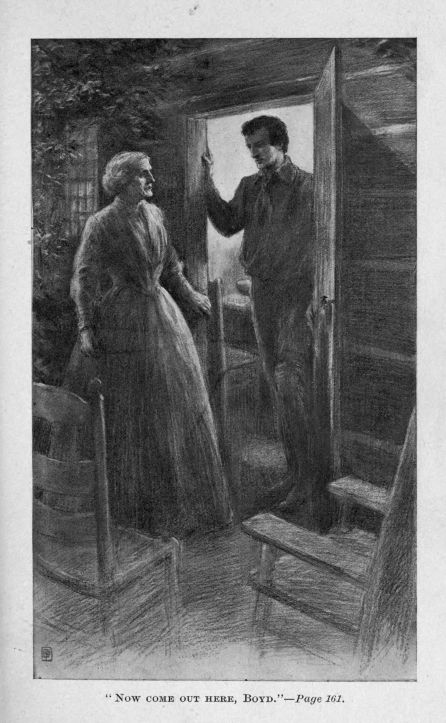
The rocking chairs sat upon a broad porch or platform, for it had no roof over it, and the rising moon flooded the place with light.
"Now tell me all about it," said Judy when the two were seated.
It is to be said that Judy knew "all about it" already, at least all about what had happened up to a very few days before. It was her habit to keep herself fully informed on all subjects that interested her, and she was mightily interested in everything that concerned any Westover.
Her loyalty to the Westovers had its own reasons for being. These she never explained. She rarely explained anything personal to herself. But that loyalty was barbaric in its intensity of devotion, savage in its vindictiveness toward whatever and whomsoever antagonized the Westovers, and recklessly relentless in its manifestations.
As soon as Boyd Westover fell into difficulties in Richmond, she sent one of her henchmen there with instructions to employ a lawyer to keep her informed. When Boyd returned to Wanalah she sent Edgar Coffey to the county seat to report happenings and conditions. She said to him:
"Edgar, I has choosed you fer this job, bekase o' several pints in your character. You is slick an' sly, an' you ain't got no principles to stand in your way, an' you seems to be stupid, so's nobody'll suspect you or keep silent when you's about. You kin lie so natural like that nobody but me'd ever suspect you was a lyin' at all. What you's got to do is to go down there to the Court House on some sort o' made up business like, an' hang 'round an' listen, an' find out how the stuck-ups is a treatin' Boyd Westover. Then you come back here an' tell me 'bout it. Ef them stuckups treats him fa'r an' squa'r like, it'll be all right. Ef they don't, I'll make some of 'em wisht they hadn't never 'a' been borned." This last utterance was addressed only to herself.
Edgar Coffey had returned on the evening before Westover's arrival and his report had included some account of Webb's boasting that he had "declined to consider Boyd Westover as a man entitled to the attention of a gentleman."
"Now wait, Edgar," Judy said, when Coffey reported this; "don't let your loose tongue git away with you. Did you hear him say that hisself—the durned little two-cent postage?"
"Yes, Judy, sure an' certain; an' everybody down that way's a laughin' in their sleeves 'bout it. They says, says they, 'Why, ef Boyd Westover was to git a real mad on him, that feller wouldn't make a mouthful fer him.'"
"No more would he," said Judy, addressing herself.
So Judy knew in advance the whole story that she asked Westover to tell her; but she wanted to hear his version of it and find out his mood of mind concerning it, and so she gave no sign of knowing anything. That was Judy's way.
Just as the two comfortably seated themselves Theonidas—the thirteen year old son of the house—emerged from within bearing a tray on which were a stone jug, a vase-like glass, containing honey in the comb, two tumblers and a little array of spoons.
"Now wait a minute, Boyd," said Judy as she directed the placing of the tray on a table that stood between her and Westover. "You's got a lot o' durned temperance nonsense mixed up with your good sense, but this is a 'ceptional occasion; I ain't yit had a chanst to drink to the new 'Westover of Wanalah,' nor yit to congratulate you; an' besides that, they ain't no harm in a glass o' peach an' honey when I raised the honey an' made the peach myself, an' specially when the peach is thirteen year ole in the bar'l. So you an' me is a goin' to have a glass o' peach an' honey together, sich as folks don't often taste these days. They was three bar'ls o' that there peach brandy, when my husband, Marcellus, an' me made it, thirteen year ago, an' that jug's got the last drop that's left of it. An' the best of it is they ain't never anybody but the best been let to let it trickle down their throats. When it were five year old I sold one bar'l of it to Tom Griffin in Richmond, 'cause he never would let anybody but the best have any of it. When it were ten year old I give one bar'l of it to your pappy, 'cause I jes' know'd what sort o' folks he'd let drink it. You see the peaches that year—thirteen year ago—was extra superfine, an' I picked out the very best of 'em for them three bar'ls o' brandy, an' they ain't been no peach like it ever made in these here mountings. So now you an' me's a goin' to have a glass o' peach an' honey, an' sip it slow like, while we talk, so's that we kin git the taste in our throats an' all the way down. You see, Boyd, they's tricks in makin' peach jes' as they is in politics an' religion an' school teachin' and gittin' married. They wa'n't no trick when I got married, mind. I don't mean that. Marcellus Peters was as good a man as these here mountings ever raised, an' now he's been dead more'n a dozen years I ain't got no complaint to make 'bout him. Only he hadn't much 'git there' in him. It didn't make much difference, 'cause I could ten' to that part o' the business myself. But he did know how to make peach an' apple brandy. You see, Boyd, they's tricks in makin' peach, as I was a sayin', an' Marcellus he know'd all of 'em. I ain't a sayin' he didn't work 'em off on folks as didn't know nor care. He'd git a order fer peach when he hadn't no peach, an' he'd fill the order. He'd take ten pound or so o' dried peaches an' set 'em to stew fer an hour or so. Then he'd put 'em through the bung hole of a bar'l o' apple brandy, an' let 'em 'sociate with the brandy like, fer three or four days, rollin' the bar'l now an' then to shake it up, like. Then he'd draw that brandy off into another bar'l, an' it was fine old peach. Same with cherry brandy, or blackberry, an' the stuck-ups didn't know the difference. But this here peach is differenter. It was made of peaches, good peaches, such as you'd smile to eat, an' Tom Griffin was glad to pay me seven dollars a gallon for the bar'l of it he got. I reckon he'd pay twice that ef he could git another bar'l of it now."
Judy Peters was not talking without a definite purpose. She never did that. Even when her conversation rambled as it did on this occasion, it rambled of set purpose and with deliberate intent. This time her purpose was to induce a like rambling impulse on Boyd Westover's part, so that she might not only hear from his lips the whole story of his tribulations, but gather, by the wayside of his conversation as it were, a clear impression of his present mood and attitude of mind, something which could not be gained by direct questioning.
In all this the shrewdly wise old woman succeeded, and when Boyd Westover bade her good night as the clock struck twelve, she knew all she wanted to know about him. After he had gone to bed she lighted her pipe anew and summed up her conclusions in the case of the young man beneath her roof in reflections to the following effect:
"He's a feelin' it more'n's good fer him.
"He's wrong in his mind or his liver or his lights, an' the fust needfulness is to set 'em right.
"He's a doin' the right thing in a goin' off up into the high mountings. It'll straighten out the liver an' lights an' I'll make Theonidas go with him, jes' to take the rough off, an' to keep him in company like. That'll be healthier fer him.
"They's somethin' about a gal in the case, but jes' naturally I couldn't git at that. Men is sech fools 'bout women anyhow! A young feller will pick one purty gal out'n a dozen, all on 'em jes' as purty an' jes' as smart as she is, an' ef she gives him the mitten he'll go mournin' about, jes' as ef she was the onliest tadpole in the puddle, while all the rest o' the dozen purty gals is a standin' ready to make as big a fool out'n him as ever she could 'a' done. It's cur'ous but 'tain't to be helped no way, I reckon.
"Howsomever the thing to do is to git him interested in somethin', an' I kin manage that. He'll git healthy like, up thar' in the high mountings, an' by the time he comes back I'll git somethin' ready fer him to do."
Boyd was already better in spirits when he greeted the sun the next morning from the top of a hill near Judy's place. The air of the mountains had been good for him. Better still had been Judy's cordiality and her naturalness. After all his depression had been rooted in the artificialities of human association, and in Judy Peters's company there was no such artificiality. She had not hesitated to interrupt his narrative of events at various points to tell him that in this or that particular he had been a "darned fool," or a "frosted potater vine," or a "dod dasted idjit," or something else of the sort that she thought helpful to her endeavor to bring him back to a healthy mental condition.
Her main reliance for his restoration to normality, however, was in getting something strenuous for him to do. "Hard work's the calomel he needs, an' a good hard fight's his quinine. It'll cure his chills, an' I'll git it ready fer him."
With that determination fixed in her mind, Judy knocked the ashes out of her pipe, covered up the kitchen fire, set some roe herrings to soak, and went to bed. Sleep was to her healthy soul a matter of course.
XVII JUDY INFORMS HERSELF AND MAKES PLANS
It was well past midsummer when Westover after a stay of three days went from Judy Peters's place up into the higher and more desolate parts of the mountain region. He was accompanied by Theonidas, whose instructions from his mother were minute and explicit.
"B'ar in mind, Theonidas," she said to him in an intimate conversation, "as how your duty's to keep him busy with things outsiden' hisself. He's got too many books 'long with him, but they's good ef he don't git to readin' of 'em by daylight. You's got to look out fer that. Ef you find him a readin' an' a broodin' by daylight, you jes' find out somethin' 'bout a b'ar or a catamount hangin' round, an' git him to lookin' fer that. An' ef he gits to readin' too late o' nights, showin' as how his min's oneasy like, you kin git up a night hunt or somethin' like that, or ef that don't work you kin go out an' yell like a painter till he gits his gun."
A "painter," in mountain parlance, meant a panther, or more properly the mountain lion, a catlike, predatory beast between whom and the mountaineers there was eternal war.
"Anyhow, Theonidas," concluded Judy, "you ain't no fool, an' now as you knows my intentions, you's to carry 'em out. Keep him a goin'. Keep him busy. Keep him so durned tired that he can't help sleepin' o' nights. That's your cawntract. Ef he gits contrary an' won't git sleepy an' you can't think o' nothin' else to do, jes' you set down an' tell him a lot o' your yarns. He's too perlite not to let you talk on, an' I ain't never knowed nothin' as would put a feller to sleep quicker'n one o' your yarns, Theonidas."
In the event there proved to be no need of the soporific influence of Theonidas's yarns. Westover had gone into the mountains to distract his mind with sport, and he pursued that purpose ceaselessly by day and by night. He would hunt deer, bears, turkeys, squirrels, pheasants and every other species of game as it came into the advancing season, throughout the day, and at night after a campfire dinner which he cooked for himself, he and Theonidas would go eagerly in quest of night prowlers—'coons, 'possums, and painters. Now and then he would send Theonidas down the mountain with a present of game for Judy, while he himself exercised his wits in controversy with a certain wily old trout that was accustomed to jeer at him from one or another pool of the stream that flowed by the cabin door. Sometimes he sent a haunch of venison, a half dozen pheasants or a brace of young wild turkey gobblers, with a request that Judy should arrange for their delivery to Carley Farnsworth, a commission he knew she would execute to the letter.
In brief, young Westover was growing healthy of mind and body again, while the books he had brought with him to serve as a means of killing time lay unopened in the log cabin where he slept for long hours at such times as physical weariness forbade him further to follow the sports of the glorious out of doors.
In the meanwhile Judy Peters was maturing her plans. She kept Edgar Coffey most of the time in the plantation part of the county, with instructions to find out how the people down there felt toward Westover, and who among them might be trusted to aid her in a project she had formed, when the time should be ripe for its execution. As a result of Edgar's mousing inquiries and her own shrewd skill in discriminating between truth and falsehood in his periodical reports, Judy Peters knew more about sentiment in the piedmont region than anybody there did, not excepting William Wilberforce Webb, whose personal concern it was to inform himself accurately as to that. She knew, as Webb did not, that the great majority of the men of Westover's own class—the men of assured social position—were strongly disposed to regard his misfortune with generous sympathy, while those of less well assured standing were disposed to shrug shoulders and give hints of doubt.
She learned one thing, however, that troubled her a good deal. Among those of Westover's own class there was a vague, undefined but none the less hurtful suspicion that he had somehow failed of manly chivalry in his treatment of Margaret Conway. The suspicion had its origin in the fact that Colonel Conway would in no way discuss Westover's case or express any opinion concerning him or his conduct. On the other hand it lacked definiteness for the same reason. If there were no truth in it, people argued, Colonel Conway would certainly plant a heavy heel upon the rumor as an act of simple justice to a falsely accused young man; if there were truth in it, it was difficult to understand why Colonel Conway did not call the young man to account in some way.
Of all these conditions Judy was fully informed and when the autumn came, with the general election in prospect, she directed Edgar Coffey to find out definitely concerning the prospective "enominations," as she and all the rest of the mountain folk called them.
"Is that there fadey calico feller, Webb, a goin' to be enominated fer State senator from our distric'," she asked of her emissary when he returned from his mission.
"No, he's a strikin' higher like. He's a goin' to be enominated fer State senator from this distric'; in fac' he's enominated a'ready, an' he's mighty proud like over it."
"Yes, well, what's he a sayin' 'bout it?"
"He says as he's got the reg'lar Whig enomination, an' as this is a strong Whig distric', he's got the 'lection sure."
Judy sat silent for awhile. Then she asked:
"Is he a standin' on one leg while he's a waitin' fer it, Edgar? 'Case ef he is he's a goin' to git mighty tired 'fore he gits the other foot down. You tramp over to Marcellus McGrath's this evenin' an' tell him I want to see him to-morrer mornin', sure. Tell him I've got a job fer him, an' don't fergit to say he's to do it with his head. Ef he thought 'twas work, he would forgit to come. Git along now. Time's money you know, though you can't never git nobody to give you silver change fer it."
Marcellus McGrath was the mountain schoolmaster, who read everything from quack medicine almanacs to patent office reports, remembered everything he read to the last detail, and never in his life made the smallest use of the information with which the lumber room he called his mind was packed full. Facts were everything to him; the significance of facts had never occurred to him as a thing worthy of consideration.
He came promptly in response to Judy's summons, and he brought with him his big, shaggy headful of unrelated facts and figures, more securely lodged in his memory than in any book of reference or any table of statistics.
Judy "tapped him," as she described the process, as soon as he had lighted his pipe after a barbaric feast of fried chicken, jowl and greens, pot cheese, green corn, batter bread, cold ham, tomatoes, souse, roast venison from Westover's camp, cucumbers, onions, apple butter, rice pudding, apple dumplings, and ice cream.
By way of explanation to Sapphira, while the meal was in process of preparation, she had said:
"Mark McGrath don't git none too much to eat at home, I reckon, an' I'm a goin' to pump enough facts an' figgers out'n him to leave room for the other things."
But she did not begin the pumping process until McGrath's pipe was comfortably lighted, and then she did so gently at first. She had placed a slate and pencil on a table by his side, so that he might "figger out" anything she wanted elucidated.
"How many voters is they in this here senate distric'?" she asked him to begin with; and he gave the figures promptly.
"Set that down on the slate," she directed, and the order was obeyed.
"'Bout how many o' them is planters' votes—countin' in the overseers an' the rest o' them as always votes the way the planters tells 'em to?"
McGrath thought for a brief while and then gave his estimate.
"How many of 'em is Democratic votes?"
"Oh, the district is almost solidly Whig. The Democratic vote is really a negligible quantity," the schoolmaster, beginning to feel his importance, replied.
"I ain't a fishin' fer big words, Mark. I's a huntin' fer facts. Don't you make no mistake about that. Now, tell me, how many Democratic votes was they in the last election?"
So she went on with her catechism, making her interlocutor set down on the slate such figures as she wished to use in her calculations. With these as factors she made the schoolmaster do a deal of abstruse reckoning, the purport and purpose of which he could not at all conjecture, but the results of which seemed to satisfy her, as she said at the end of it all:
"It kin be did, an' by the Hokey Pokey Fenokey it's a goin' to be did. That little worm-eaten, blossom-blasted chestnut of a Webb'll wish he hadn't never let go of his hold on the tree when Judy Peters gits through with him. Say, Mark, what does William Wilberforce mean?"
"It's a name," McGrath began.
"Yes, I know that. But what does it mean? Whose name was it fust off? An' what was it he done? An' how'd that miserable little bob-tailed rooster Webb git a hold onto it?"
Judy's antagonisms were implacable, and they were apt to find expression in her epithets and her metaphors. She knew next to nothing of Webb, and she had permitted her mountaineers to vote for him at the last preceding election. But now that she recognized in him an enemy of Boyd Westover, she hated him with an intensity and an unreason possible only to a nature such as hers, in which the primal passions of humanity had yielded themselves to no chastening of circumstance or civilization.
McGrath, to whom no hint of Judy's purposes had been given, answered her questions as if reading from a cyclopædia:
"William Wilberforce was an Englishman, celebrated as a philanthropist and especially distinguished by his work for the abolition of negro slavery. He was known in England as 'the great abolitionist.'"
"That's all right," said Judy with a grunt of satisfaction. "I ain't got no way o' findin' out how that bow-legged hoppergrass, Webb, got a holt'n the name, but he'll wish't he hadn't 'fore I git through with him. Now, Mark, I want you to write down jes' what you's tole me—no more an' no less—'bout that there abolitionist Wilberforce. Jest write it down on paper an' leave it."
"What are you up to, Judy, anyhow?" McGrath ventured to ask.
"That's what the queen bee axed the b'ar when he clum' the bee tree, an' the b'ar says: 'I'm up to the hole that's got the honey in it'."
And Judy vouchsafed no further explanation of her purposes.
Next day she sent for Edgar Coffey and questioned him.
"Who's this here Don Carlos Farnsworth that Westover's always a sendin' game to? Do you know him?"