The Lesser Periwinkle (Vinca minor).
Reading edition
The Lesser Periwinkle is perhaps more familiarly known as a garden plant than as a wild-flower, and the former would appear to be its true character. It is now truly wild, in the Southern English counties at least, having probably been introduced by man at an early date (Chaucer mentions “fresh pervinke rich of hew”), and taken care to keep the foothold thus obtained. Its favourite position is a woodland bank, which it thickly covers with its dark evergreen leaves. Hooker (“Students’ Flora,” p. 268) describes the flowering stems as short and erect, and the peduncles not so long as the diameter of the corolla. As a matter of fact, the long trailing and rooting stems also bear flowers, and the peduncles vary in length from ¼ to 2 inches.
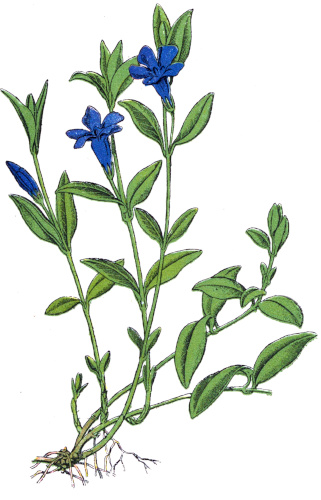
Lesser Periwinkle. Vinca minor. —Apocyneæ.—
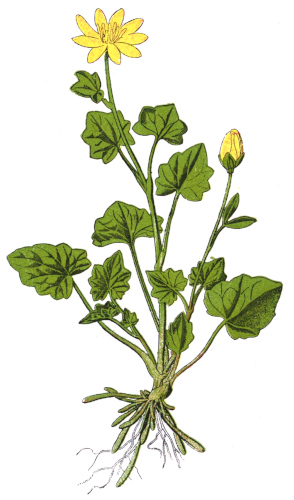
Lesser Celandine. Pilewort. Ranunculus ficaria. —Ranunculaceæ.—
The petals are united for half their length to form a tube, and the five free lobes are oblique. The structure and arrangement of the stamens and pistil are very curious, and evidently have relation to cross-fertilization by insects, for the throat of the corolla-tube is closely guarded by a fringe of silky hairs, impassable by the thrips that vainly haunt the mouth in quest of pollen. The plant rarely, if ever, produces seed in this country, and this indicates that the insects necessary to its fertilization are not British. Flowers, April and May, and sparingly throughout the year.
The Greater Periwinkle (Vinca major) is also naturalized in places. It is much larger in every respect than V. minor. The name of the genus is supposed to have been derived from the Latin Vincio, to bind or connect, in allusion to the manner in which its trailing stems thrust down a root from every node.