Marsh Marigold (Caltha palustris).
Reading edition
In marshes and river-meadows in spring this is the most conspicuous plant, and to acquire it the rambler will not hesitate to risk getting wet feet. What time the sallow first puts out her silvery “palm,” the Marigolds then “shine like fire in swamps and hollows grey” (Tennyson). In some districts it is the May-blob, Mare-blob, and Marybud. It has a thick, creeping rootstock, and broadly heart-shaped glossy leaves with very large stipules. After flowering the leaves increase in size considerably, and in some places they reach an enormous size for so small a plant. The flower has no petals, but the five sepals are enlarged and richly coloured, as with gold, and burnished. The centre of the cup is occupied by a number of carpels, which are surrounded by an indefinite crowd of stamens, and which develop after fertilization into as many follicles containing great store of seeds. The plant is poisonous. The flowering time lasts from April till August.
There is one other British species—some say it is a mere variety of the foregoing—Rooting Marsh Marigold (C. radicans), with triangular leaves and rooting stems. It occurs only in Forfarshire, and is very rare.
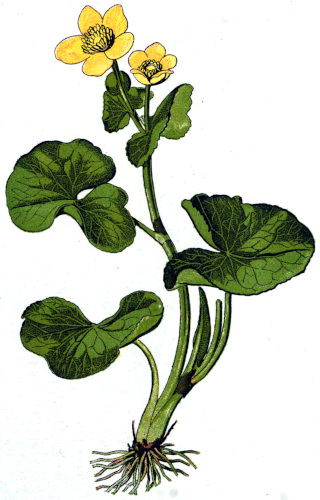
Marsh Marigold. Caltha palustris. —Ranunculaceæ.—
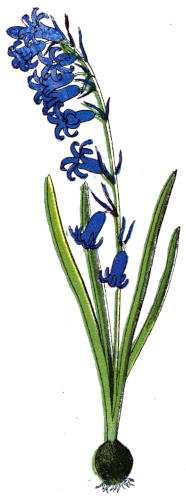
Wild Hyacinth. Blue-bell. Scilla nutans. —Liliaceæ.—
The name is derived from the Greek, Kalathos, a cup, in allusion to the form of the flower.