Along the Firing Line BY THE CIRCULATION MANAGER
Reading edition
There isn’t much to say this month about circulation work except that results have been highly satisfactory. We appreciate the loyalty and energy of our friends, and extend sincere thanks for their help. January was our best month, but at this writing (Feb. 8) the indications are that February will be still better. A great many subscriptions expired with the February number. Some weeks ago we sent out a postal card notice asking for renewal and one new subscriber. The prompt replies to this card made us throw up our hats and give three cheers for the Old Guard. Nearly every one who replied sent one to four new subscriptions with his renewal.
Remember that the subscription price is now $1.50, but as a favor to our present subscribers we will accept renewals and new subscriptions at the dollar rate until March 31. Get in before the time limit expires.
I made reference last month to Mr. Forrest’s advertisement and the results up to January 4—only a few days after the January number was placed on sale. Since then Mr. Forrest has received several thousand coupons, and more are coming in every mail. He writes me that the conference is assured, and that it will be a grand success. Mr. Bentley’s club organization movement is going right along and he expects to call a conference at St. Louis about May 1. I have suggested that he and Mr. Forrest join forces and hold but one conference. I can give no details of Mr. Bentley’s work, except that he is in touch with Populists in 1,800 counties out of some 2,800.
Organizations on a smaller scale are springing up all over the country. In Pennsylvania the Referendum Party is beginning active operations. A preliminary committee on organization has been appointed, consisting of the following gentlemen:
Clarence V. Tiers, chairman, Pittsburgh, Pa.,
Clement V. Horn, Wilkinsburg, Pa.,
H. F. Lea, Bellevue, Pa.,
H. W. Noren, Allegheny, Pa.,
Walter Becker, Allegheny, Pa.,
John C. Innes, Pittsburgh, Pa.,
George D. Porter, Philadelphia, Pa.,
John E. Joos, Allegheny, Pa.,
Nathaniel Green, Swissvale, Pa.,
J. Ludwig Koethen, Jr., Pittsburgh, Pa.,
Hon. W. F. Hill (Master State Grange), Chambersburg, Pa.,
James William Newlin (Member of Constitutional Convention 1873), Philadelphia, Pa.
Headquarters are located at Pittsburgh. Address communications to Lock Box 305, Pittsburgh, Pa. The Referendum Party requests the active co-operation and financial support of all who favor:
First.—The calling of a Constitutional Convention to revise the State Constitution;
Second.—Granting to the people the right to veto unjust laws or ordinances by direct vote; this right to be exercised only if a vote is demanded on any law or ordinance, by petition signed by two per centum of the voters of the State or locality affected.
Third.—Granting to the people the right to enact, by direct majority, needed laws which their Legislature fails or refuses to enact.
Regarding candidates it is announced that—
It is the intention of the Referendum Party to nominate for the election of November 6, 1906, a complete state ticket including candidates for the Legislature (Senators and Representatives) but the State Executive Committee suggest that, unless exceptionally strong, aggressive, independent candidates for either branch of the Legislature can be nominated, it would be advisable for local committees to indorse (by filing nomination papers) candidates of some other party who would pledge their support to the principles of the Referendum Party as stated above.
After the election the Referendum Party will be entitled to a regular place on official ballots in every district where it polled two per centum of the largest vote cast. For this reason it is most desirable that it nominate a candidate in every Legislative district within the State. The forming of local organizations in the Referendum Party should therefore begin at once.
The People’s Party State Central Committee of Kansas met at Topeka, February 2, and directed Chairman Babb and Secretary Fowler to call a State convention some time in July. Chairman Babb and some other members of the committee favored the organization of a voters’ league to question and secure pledges from candidates on the old party tickets, making no third party nominations—something on the plan devised by George H. Shibley, editor of the Referendum News, Washington, D. C. The committee was not, however, a unit on this point, several of the members insisting upon making straight People’s Party nominations. This, it seems likely, will be done.
“Union for the Common Good” is the name of a new organization just starting in Kansas. Rev. O. H. Truman, La Crosse, is one of the moving spirits. In the manifesto sent out by this new aspirant for political honors the committee say:
Whereas, undisputed proofs of corporate greed, unscrupulous and law-defying, have recently multiplied; and certainties that “Boss” domination has largely prevailed in city and state politics, frequently dictating to the people from low resorts, encouraging graft and other corruptions to fester and flourish; and also the great exchanges for disposing of stocks and bonds and grain have long displaced the law of supply and demand by their gambling methods, resulting in frequent failures, suicides, and loss to all but the unscrupulous few; and
Whereas, the people, at last aroused and indignant, are now demanding redress and prevention of further wrong;
Therefore, we deem it timely to organize into a society those having a strong definite purpose to reclaim all monetary, political, and other rights and interests from the greedy grasp of the few to the promotion of the Common Good.
Civilization advances by evolution and revolution. Evolution makes slow progress over a long period of time, while Revolution advances rapidly in a short space of time.
Revolutions are caused by giant evils which must be overthrown suddenly or not at all.
America has passed through two revolutions, and we are now entering a third, equal in importance and greater in character than either of the others.
The great evils that now threaten our existence are intemperance, trusts, and political corruption.
We are to choose between Socialism and Christian Government; nothing else is presented and nothing else is worthy of our attention.
Socialists have gathered much valuable information; but their leadership would dethrone God from our nation and overturn all our history.
Christian Government would fulfill prophecy in giving Christ the kingdom of this world, and would be in line with national experience.
Socialism is an ideal as yet untried, without a code of morals to preserve from corruption. In Christian Government the legislative, executive and judicial powers would be directly tested by the teachings of Christ.
The demands of complete Socialism are too radical for this crisis or for any single movement. Masses of men can be moved only so far at any one time; and revolutions are no exception to this universal rule. To attempt more is to cause reaction and loss.
Christian Government would accept the possible while striving for the Christ ideal of perfection.
Nearly all revolutions have resulted in war and we believe that complete Socialism for this crisis would be no exception to that rule.
The Christian and moral sentiment of the nation is now sufficiently strong, if aroused and united, to accomplish its work by the moral power of the ballot without resorting to war.
What measures do we propose for the present crisis, and what remedies do we suggest for existing evils?
American society may be roughly divided into three great classes: A small, wealthy class at the top; a great mass of laborers at the bottom; and a medium Christian and moral class in the middle. The church middle class thus holds the balance of power, and is responsible for safe leadership and moral results.
The Christian and moral forces of the nation must now be organized into a moral society for the express purpose of leading this reform movement and developing Christian Government.
At the outset of our organization we need consider only those remedial measures to which all research and all demands are now pointing; and our specialty as a society is to urge and aid the careful testing of the best means of relief from a dangerous condition, and also to aid in fullest adoption and application of measures approved after trial. The key phrases or watch words for our organization are these: “Thorough Testing” and “The Common Good.”
We favor a fair and safe trial of municipal and other Public Ownership, as it seems to be in harmony with the destiny of our country and the spirit of the age.
State incorporation having been tested and found wanting, we urge national incorporation instead, including reasonable restrictions, and also liability to forfeiture if lawless.
We favor the election of United States Senators by direct vote of the people; also a thorough test of the initiative and referendum and the imperative mandate.
Any person of good moral character may become a member of this society by accepting the constitution and paying one dollar a year to the national society, or a life membership fee of twenty dollars.
Each member of the society shall have a vote, by mail or otherwise, for all officers of the national society, and on all principles and policies adopted.
O. H. TRUMAN
J. M. McARTHUR
J. ORVILLE WALTON
BELLE FORD WALTON
E. H. H. GATES
Committee.
Men and women are requested to send names and fees for membership. The money will be used for organizing and reported to the society. Direct to
O. H. Truman, La Crosse, Kan.
Our Advertising Manager, Ted Flaacke, is one of the Old Guard greenbackers; but not until recently could I convince him that some advertisers would “turn him down” because of the politics of Watson’s Magazine. Even then I didn’t do the convincing—but Ted knows now that I was right. He tried to get an ad. from a certain baking powder concern that was mixed up in a scandal over in Missouri not so long ago. Its product is claimed to be “absolutely pure,” but the Missourians were “shown” that some of its agents couldn’t truthfully say as much of themselves or their concern.
I’m right glad Ted got the icy stare. We need the money, no doubt—but “alum baking powders” won’t seriously impair our digestion. And we’ll feel better not to have had the ad., after all.
“Why, Flaacke,” said the man who places the advertising, “if Watson’s Magazine had a million circulation and the rate was a dollar a page, I doubt if we would use it.”
Yet some poor, simple souls still think business men—big, brainy, successful business men—never mix politics and business. They do. And I trust our people will not forget it.
Ever notice how a late train keeps falling behind and getting later and later the farther she goes?
Well, we had an experience similar last month with the February number. A combination of circumstances made it certain that we should be a few days late—say two or three. But in our wildest dreams we never imagined being over two weeks late. One after another something new arose to still further delay us.
I can sympathize now with the railroad station agent who is obliged to tell passenger after passenger that “No. 23 is 40 minutes late.... Yes, she’s due here at 11:44.... Yes, that would bring her here about 12:24.” And so on and on and on. From Mr. Watson’s editorials, however, I take it that station agents on the Southern Railway give out no information regarding late trains. Maybe they will after Hon. Hoke Smith is inaugurated governor.
Anybody inquire why the February Watson’s didn’t come? My dear friend, you would think so if you could see the stacks of letters and postal cards which poured in—hundreds and hundreds; yes, thousands, I believe. It made us a great amount of additional work and worry, but—
On the whole, we’re rather glad the February number was late, because it gave us conclusive proof of the high esteem in which Watson’s Magazine is held. People don’t worry and write postal cards and letters about publications in which they are not interested, that’s a cinch.
A few of the Old Guard were frightened. They thought we’d suspended! I can’t blame them for that. It has always been a rocky road for any radical publication, and especially so if it advocates Populism. But Watson’s Magazine will be an exception. Nothing but the accomplishment of the reforms for which it stands could kill it. That might, by removing the necessity for such a magazine, but not necessarily. The discontent of the masses is too great now not to furnish a most fertile field for Mr. Watson’s teachings—and his influence is growing at a tremendous pace. Even his enemies admit that. And that means a pronounced success for Watson’s Magazine.
Thanks to the Old Guard, Watson’s Magazine gets subscribers at less cost than any other publication. Everywhere these old veterans are plugging away for subscribers and scarcely one of them will take a cent of commission for his work. Some of the other magazines are spending a fortune in newspaper advertising, and, of course, building up big lists; but we are well satisfied with a slower growth of subscriptions that will stay with us year after year. February is forging to the front in fine style and we shall more than double our list by the end of March.
“Figures won’t lie,” asserts the oracle. “Thet’s so,” retorts the plain, old, common-sense man, “but liars kin figger.” And the old fellow is right. Witness some of the stunts done by Carroll D. Wright as to the increased cost of living, and young Garfield’s showing of a net profit to the Beef Trust of a dollar, “marked down to 99 cents,” on each steer slaughtered.
My old colleague, T. H. Tibbles, Mr. Watson’s running mate in 1904, and now editor of a 25-cent-a-year Populist weekly at Omaha, Neb., The Investigator, was editor of the Nebraska Independent when young Garfield made that justly famous report. As I recollect, Tibbles figured that the Beef Trust must have a secret railroad (not a rebate) to Mars and had smuggled in countless thousands of beef cattle from that little, old red planet, contrary to the Dingley Bill “in such case made and provided,” because—
There weren’t enough beef steers on this old earth of ours—and haven’t been since the days when Christ drove the “System” out of the Temple—to account for the Beef Trust’s fortune at 99 cents per.
I have never examined Tibbles as to his proficiency in arithmetic, but I’m willing to bet a hat—a wide-brim “Cady” (Eugene Wood, please analyze)—that Tibbles either made a Sherlock Holmes “deduction” regarding that Martian railroad, or—
Perish the thought, that the martyred President’s son—well, had been doing some “figgerin’” and other things.
I’ve been doing some real hard figgerin’. The P. O. D., which means in proper spelling, Post Office Department, insists that because we change to Watson’s Magazine, dropping the “Tom,” that we must apply for a new entry as second-class matter. Of course, as a matter of fact, as our legal friends remark—no, I won’t say that, in view of what Abe Hummel did and what Jerome is failing to do—our lawyer friends, rather, we never have been “second-class.” That’s a way Madden has of irritating publishers. Tom Watson’s Magazine always was first-class—now, wasn’t it?
At any rate, we have to tell the P. O. D. how many subscribers we have; how many we sell at news-stands, etc. Of the subscribers, we must show how many came direct, how many took a premium, how many subscribed through an agent or a newspaper clubbing with us.
It’s a big job to get this correct, because right now we’re swamped with new subscriptions and renewals. I think I got it right, however, and as the figures may interest you, I shall give you an idea what each State is doing.
Georgia still keeps far in the lead. Texas, Alabama, Missouri, Nebraska, New York, Mississippi, Arkansas, Tennessee, Illinois and Kansas follow in the order named, ranging from two to fifteen per cent of the total.
Florida, North Carolina, California, Louisiana, Indiana, South Carolina, Ohio, Kentucky, Pennsylvania, Iowa and Oklahoma—in the order named—have less than two and one or more than one per cent. of the total.
Washington, Virginia, New Jersey, Minnesota, Michigan, Colorado, West Virginia, Montana, Massachusetts, Indian Territory, Idaho, Wisconsin, Oregon, North and South Dakota (tied), Connecticut, New Mexico, Maine, Arizona, Maryland, District of Columbia, Wyoming, Nevada, New Hampshire, Vermont, Canada and Rhode Island follow in the order named, each with one-tenth of one per cent. or more up to nine-tenths of one per cent.
And three-tenths of one per cent. of the total goes to Alaska, Cuba, Delaware, Hawaii, Mexico, Panama, Philippine Islands, Porto Rico, Utah and a number of European countries. Watson’s Magazine is not only national but international. Up in Nova Scotia, Manitoba, and Northwest Territory the radicals are enthusiastic over it. Uncle Sam’s soldiers and sailors are taking it in the far corners of the earth. The War Department has asked for subscription rates.
Yet Watson’s Magazine reaches more people in the Sunny Southland than most any other magazine, whether published south of Mason and Dixon’s line or north of it.
And it will bring business for the advertiser who wishes to break into the Southern field, because every subscriber and news stand buyer has confidence in Mr. Watson. Oh, dear, I forgot. Advertising isn’t my line at all. See Ted Flaacke about that. He knows. But I know I’m right, nevertheless.
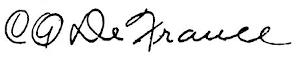
C. Q. de France