Front matter
Reading edition
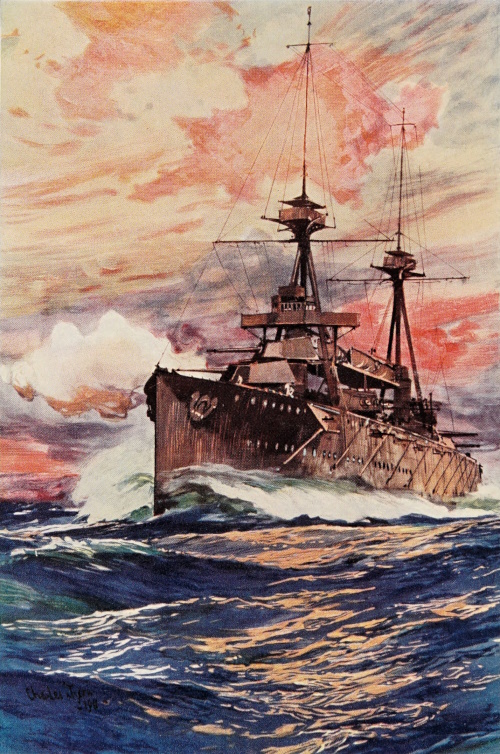
A COMING TYPE OF BATTLESHIP.
An interpretation of the funnel-less ship with internal combustion engines as suggested by Mr. J. McKechnie, M.I.N.A.
WARSHIPS AND THEIR STORY
Uniform with this Volume

STEAMSHIPS
AND
THEIR STORY
By E. Keble Chatterton
CASSELL & CO., LTD., LONDON, E.C.
WARSHIPS AND THEIR STORY
By
R. A. FLETCHER Author of “Steam-Ships and Their Story”
WITH COLOURED FRONTISPIECE BY CHARLES DIXON, R.I. AND 80 FULL-PAGE PLATES
CASSELL AND COMPANY, LTD.
London, New York, Toronto and Melbourne 1911
ALL RIGHTS RESERVED
PREFACE
To the people of a seafaring nation the story of the growth of the warship, from the primitive craft of our savage ancestors to the marvellous fighting machines of the present day, should prove of endless fascination. In this book I have sought to indicate somewhat of the lines upon which the development of the world’s warships has taken place. The amount of information available concerning warships is virtually inexhaustible, whether the ships are regarded structurally and comparisons are made of the forms of the hulls, the strains they may withstand, the speed of which they may permit, and their modes of propulsion; or whether, sociologically, as evidences of the stages of the progress of civilisation of the different peoples; or simply as aids to an appreciation of naval combat, of deeds afloat of individual and national heroism, of the rise and decline of maritime powers, and finally as implements in that tremendous struggle, which has made England what she is, for maritime supremacy. I have not written this book from any one of these aspects, but to describe in popular, not technical, language the more important types of warships favoured at different times in different parts of the world, to show, where possible, where type has succeeded type, and the main lines of divergence and development.
Reversing the usual practice of treating the warships as incidental to the naval battles, I have preferred to treat the naval battles as incidental to the warships. For that reason I have attempted no word pictures of the onset of contending fleets, no more or less imaginary accounts of famous engagements, no descriptions of weird manœuvres and impossible strategy. Even under the restrictions I have been compelled to observe, the abundance of material to be dealt with is so vast that I feel I have done no more than skim the surface, as it were, and have by no means collected all the cream. The task of deciding what to insert and what to omit has been no light one. Much that my readers and critics may think ought to have been included has, perforce, had to be left out, and the necessity of keeping the book within the limits of its present dimensions must be my excuse for the sins of omission of which I shall no doubt be found guilty.
So uneven, or erratic, has been the progress of warship construction, that in some of the world’s harbours, riding the waters almost side by side, one may see dug-outs and “Dreadnoughts,” sampans and submarines, canoes and cruisers, barges and battleships, the vessels of peace—though in times past they were not always vessels of peace—resting securely under the protection of the grim and terrible modern warships.
Every care has been taken to obtain accuracy, but I do not guarantee the absolute correctness of every detail given, for the simple reason that the authorities consulted are not themselves always in agreement, and this applies equally to the warships of the past as to those of the present time.
Every care, also, has been observed to give credit to other writers for the assistance derived from their books, and in this connection I would specially mention the “Encyclopædia Britannica,” Mr. Cecil Torr’s “Ancient Ships,” Sir W. Laird Clowes’ “History of the British Navy,” Mr. H. W. Wilson’s “Ironclads in Action,” “The Warships of Europe” by Chief Engineer J. W. King, U.S.A., “The New American Navy” by John D. Long, ex-Secretary of the Navy, U.S.A., “Maori Art” by A. Hamilton, “The New Zealanders” by George F. Angas, “History of Steam Navigation” by John Kennedy, “The Story of the Submarine” by Colonel C. Field, “Ancient and Modern Ships” by Sir George C. V. Holmes, “Submarines and Submersibles” by E. C. Given, M.Inst.C.E., “Canoes of the Solomon Islands” by C. M. Woodford, F.R.G.S., “Naval Architecture” by J. Fincham, “Rise and Progress of the Royal Navy” by Chas. Derrick, “Transactions of the Institution of Naval Architects,” Appleton’s Cyclopædia of American Biography, “History of the Marine Architecture of All Nations” by J. Charnock, “Our Ironclad Ships” by Sir E. J. Reed, “Cyclopedia of Antiquities” by Rev. F. D. Fosbroke, M.A., and the “Naval,” “Navy League,” and “Fleet” Annuals. A great deal of information has also been derived from the columns of Engineering, the Engineer, the Times, Illustrated London News, Marine Engineer, Scientific American, and other papers, to all of which I express my deep indebtedness. If it should be found that I have not acknowledged every item derived from these sources, I trust that this general admission will cover my shortcomings in this respect.
I have also to thank personally the Chief Librarian of the Colonial Office for assistance in dealing with some of the canoes; various officials of the British Museum for valuable suggestions they were kind enough to offer; Mr. A. J. Dudgeon, M.Inst.N.A. and M.I.M.E., for his kindness in again lending me his scrap-books; Mr. James A. Smith, M.Inst.N.A., for revising a portion of the proofs; the Secretaries of the Institution of Naval Architects and of the Institute of Marine Engineers for again placing the libraries of those organisations at my disposal; the Secretary of the Navy at Washington for illustrations of vessels which achieved fame at the time of the American Civil War; the Commissioners in this country of the Imperial Japanese Navy for pictures of the early Japanese warships; the Hon. J. G. Jenkins, formerly Agent-General in London for South Australia, for New Guinea illustrations; Mr. Harry J. Palmer, of Paterson, N.J., for information and assistance in regard to American ships; and many shipbuilders, both in this country and abroad, for supplying details and illustrations of the vessels they have constructed. I have also to thank Lord Dundonald for his courtesy in lending me a picture of the Rising Star, probably the first steam war vessel to be built in this country, which his ancestor, the famous Admiral Cochrane, commanded in the service of Chili.
On other pages will be found a list of the illustrations and the sources whence they have been derived or the names of the gentlemen who have been kind enough to supply them.
R. A. Fletcher.
CONTENTS
PAGE
Introduction XV
CHAPTER
1. From Ancient Egypt to the Introduction of Artillery 1
2. War Craft of the Far West, Central Africa, the Far South, the Pacific and the Far East 21
3. The Introduction of Artillery and the Development of Warships to the Application of Steam for Navigation 39
4. Steam and Warships 78
5. Iron Ships of War. From the Introduction of Iron Armour to Broadside and Turret Ships 105
6. Iron Ships of War (continued) 144
7. Armoured Ships in Action 197
8. Battleships and Cruisers 241
9. Guns, Projectiles, and Armour 265
10. Warships of the Twentieth Century 285
Index 333
LIST OF ILLUSTRATIONS
A Coming Type of Battleship (Colour) Frontispiece
Greek Bireme Facing page 6
Greek War Galleys ” ” 6
An Ancient Bireme from Basius ” ” 10
One of the Ancient Liburni or Galleys ” ” 10
Roman Galley ” ” 10
Viking Ship found at Gokstad ” ” 14
Fleet Attacking a Fortified Town ” ” 18
Galley of the Knights of Malta ” ” 20
Mediterranean Galley ” ” 20
War Canoes of Indians of the North-West ” ” 22
A “Dug-Out” Canoe of New Guinea ” ” 24
New Guinea Canoes ” ” 24
Stern-posts of Maori War Canoe ” ” 26
A Maori War Canoe ” ” 26
A Lakatoi nearly completed ” ” 28
A Lakatoi under Sail ” ” 28
Canoe from Shortland Island ” ” 30
Diagram of Shortland Island Canoe ” ” 30
War Canoe (Teste Island, New Guinea) ” ” 30
Head-Hunting Canoe from Ysabel ” ” 32
Head-Hunting Canoe from Ysabel: Detail of Bow ” ” 32
The Famous old Chinese Junk Whang Ho ” ” 34
Malay Pirate Proa ” ” 34
Pictures of War Galleys and a Protected Galley, Kikkosen ” ” 36
The Ataka Maru ” ” 36
Sixteenth Century French Ships ” ” 40
A Mediterranean War Galley ” ” 42
Ship of War, 1486-1520 ” ” 42
Embarkation of Henry VIII on the Great Harry ” ” 46
Breech-loading Gun recovered from the wreck of the Mary Rose ” ” 50
The Ark Royal ” ” 52
The Sovereign of the Seas ” ” 54
The Prince Royal ” ” 54
Line of Battleship, 1650 ” ” 58
The Dreadnought, 1748 ” ” 60
The Juno, 1757 ” ” 60
The Cornwallis, 1812 ” ” 64
Guns of the Fifteenth and Sixteenth Centuries ” ” 72
Ancient Double Gun ” ” 72
Carronade of Six Diameters ” ” 74
Carronade ” ” 74
Carronade and its Carriage ” ” 74
The Rising Star ” ” 86
The Trial of Screw v. Paddle—H.M. Sloops Rattler and Alert towing Stern to Stern ” ” 98
Sectional Model of Russian Man-of-War, 1854 ” ” 106
H.M.S. Centaur, Bulldog and Imperieuse engaged with six Russian Gunboats off Cronstadt, 1855 ” ” 106
H.M.S. Warrior ” ” 110
The Terror ” ” 110
H.M.S. Black Prince ” ” 122
The Bangor ” ” 122
The Merrimac before Conversion ” ” 126
The Merrimac as Converted into an Ironclad ” ” 126
The Monitor-Merrimac duel ” ” 130
The Monitor and Albemarle ” ” 134
Federal Gunboat St. Louis ” ” 134
Capture of New Orleans: Attack on Fort Phillip ” ” 142
The Prince Albert as Converted to a Turret Ship ” ” 146
H.M.S. Minotaur ” ” 146
The Foundering of the Affondatore in the Harbour of Ancona ” ” 152
The Wreck of the Captain ” ” 152
H.M.S. Devastation ” ” 162
The Old Dreadnought ” ” 170
The Big Guns of the Old Dreadnought ” ” 170
H.M.S. Inflexible ” ” 176
Russian Circular Monitor Novgorod ” ” 186
The French Iron-plated Ship Magenta ” ” 186
Duel between the Vesta and the Assar-I-Tewfik ” ” 214
Russian Torpedo Boats on the Danube in the Russo-Turkish War ” ” 214
U.S. Ram Katahdin ” ” 222
The U.S. Dynamite-Gun Boat Vesuvius ” ” 224
The Maine entering Havana Harbour ” ” 224
The Spanish Battleship Pelayo ” ” 230
U.S. Battleship Texas ” ” 232
U.S. Battleship Iowa ” ” 232
The Russian Battleship Tsarevitch after the Fight off Port Arthur ” ” 236
Effects of Japanese Shells on the Gromoboi ” ” 236
The Japanese Battleship Asahi ” ” 240
The Russian Battleship Navarin ” ” 240
H.M.S. Victoria, Firing 110-ton Gun ” ” 244
H.M.S. Victoria, Showing 110-ton Guns ” ” 244
H.M.S. Majestic ” ” 248
H.M.S. King Edward VII ” ” 250
H.M.S. Lord Nelson ” ” 250
The German Dreadnought Cruiser Von der Tann ” ” 254
Russian Cruiser Rurik ” ” 258
Russian Cruiser Rossia ” ” 258
H.M. Cruiser Indomitable ” ” 260
H.M.S. Liverpool ” ” 260
French Cruiser Ernest Renan ” ” 262
French Cruiser Danton ” ” 262
4-inch Breech-loading 40-Calibre Gun and Mounting for Torpedo Boat Destroyers ” ” 266
12½-pounder Quick-firing 50-Calibre Gun and Mounting ” ” 266
Heavy Gun unmounted ” ” 270
6-inch Breech-loading 50-Calibre Gun completed and with Mounting ” ” 270
Projectiles and Charges used in the British Navy ” ” 274
12-inch Breech Mechanism (Closed and Open) ” ” 278
Interior of a Barbette showing 12-inch Gun, H.M.S. Cæsar ” ” 278
The 12-inch Guns of H.M.S Neptune ” ” 282
A Torpedo, discharged from a Destroyer, travelling by its own Engines towards an Armoured Battleship ” ” 286
The Holland Submarine ” ” 290
The Goubet Submarine ” ” 290
British Submarine A.13 ” ” 296
The British Submarine C.22 ” ” 296
Submarine D.1 with Wireless Telegraph Mast ” ” 298
Launch of U.S. Submarine Narwhal ” ” 298
French Submarine “X” ” ” 298
The Transporter ” ” 300
U.S. Gunboat Paducah ” ” 300
First Torpedo Boat Built for the Norwegian Government ” ” 302
H.M. Torpedo Boat Lightning ” ” 302
H.M. Torpedo Boat No. 79, Built in 1886 ” ” 302
H.M.S. Vulcan ” ” 302
High Speed Sea-going Torpedo Boat Propelled by Internal Combustion Engines ” ” 304
U.S. Destroyer Lawrence ” ” 304
Stern View of H.M.S. Sylvia ” ” 306
H.M.S. Torpedo Boat Destroyer Swift ” ” 308
H.M.S. Wear ” ” 308
H.M.S. Torpedo Boat Destroyer Tartar ” ” 310
H.M. Torpedo Boat Destroyer Maori ” ” 310
U.S. Scout Salem ” ” 312
U.S.S. Maine ” ” 312
H.M.S. Dreadnought ” ” 314
H.M.S. Neptune ” ” 318
H.M. Super-Dreadnought Colossus ” ” 318
The Brazilian Battleship Minas Geraes ” ” 322
U.S.S. North Dakota ” ” 324