CAPTAIN SIR RICHARD F. BURTON, K.C.M.G. (continued 3)
Reading edition
The Prophet’s dress was neat and plain as a Quaker’s, of grey homespun, except the cravat and waistcoat. His coat was of antique cut and, like the pantaloons, baggy, and the buttons were black. A necktie of dark silk, with a large bow, was passed round a starchless collar. He wore a black satin waistcoat, and plain gold chain. Altogether, the Prophet’s appearance was that of a gentleman farmer in New England.
His manner was affable and impressive, and distinctly unpretentious. He showed no signs of dogmatism or bigotry, and never once entered, with me at least, on the subject of religion. He impressed me with a certain sense of power. It was commonly said there was only one chief in Great Salt Lake City, and that was “Brigham.” His temper was even, and his manner cold; in fact, like his face, somewhat bloodless. He had great powers of observation and judgment of character; if he disliked a stranger at the first interview, he never saw him again. He lived a most temperate and sober life, his favourite food being baked potatoes, with a little buttermilk, and his drink water; he disapproved, like all strict Mormons, of spirituous St. Paul of the New Dispensation; he gave point, energy, and consistency to the disjointed and turbulent fanaticism of Mr. Joseph Smith; and if he was not able to create, he was at least able to control circumstances.
Such was His Excellency, President Brigham Young, “painter and glazier”—his earliest craft—prophet, revelator, translator, and seer; the man who was revered as no king or kaiser, pope or pontiff, ever was; who, like the Old Man of the Mountain, by holding up his hand could cause the death of any one within his reach; who, governing as well as reigning, long stood up to fight with the sword of the Lord, and with his few hundred guerillas, against the mighty power of the United States; who outwitted all diplomacy opposed to him; and, finally, made a treaty of peace with the President of the great Republic as though he had wielded the combined power of France, Russia, and England.
The Prophet’s private office, where he was in the habit of transacting the greater part of his business, correcting his sermons, and conducting his correspondence, was a plain, neat room, with a large writing-table and money-safe. I remarked a pistol
After the first few words of greeting, I interpreted the Prophet’s look to mean that he would like to know my object in coming to the City of the Saints. I told him that, having read and heard much about Utah as it was said to be, I was anxious to see Utah as it was. He then touched upon agricultural and other subjects; but we carefully avoided anything to do with religion or his domestic peculiarities, on which, I was warned, he disliked to be questioned. After talking for about half an hour, the conversation began to flag, so we rose up, shook hands all round, as was the custom there, and took our leave.
The first impression left upon my mind, and subsequently confirmed, was that the Prophet was no common man, and that he had none of the weakness and vanity which characterise the common uncommon man. I also remarked the veneration shown to him by his followers, whose affection for him was equalled only by the confidence with which they entrusted to him their dearest interests in this world and in
The Prophet’s block was surrounded by a high wall and strengthened with semi-circular buttresses; it consisted of many houses. The Lion House was occupied by Mrs. Young and her family in the eastern part of the square. On the west of it lay the private office, in which we were received, and further west again was the public office, where the church and other business was transacted. Beyond this was the Bee House, so named from the sculptured bee-hive in front of it. The Bee House was a large building with long walls facing east and west. It was tenanted by the Prophet’s “plurality wives” and their families, who each had a bedroom, sitting-room, and closet, simply and similarly furnished. There was a Moslem air of retirement about the Bee House; the face of woman was rarely seen at the window, and her voice was never heard without. Anti-Mormons declared the Bee House to be like the State prison of Auburn, a self-supporting establishment, for not even the wives of the Prophet were allowed to live in idleness.
As I have said before, I was unwilling to add to those who had annoyed the Prophet by domestic allusions, and have, therefore, no direct knowledge of the extent to which he carried his polygamy; some Gentiles allowed him seventeen, others thirty-six, wives out of a household of seventy members, others an
The following Sunday I attended a Mormon service. I passed the morning in the painful but appropriate exercise of reading the books of Mormon and of Moroni the prophet. Some people had told me that it was the best imitation of the Old Testament existing; to me it seemed to emulate the sprightliness of Leviticus. Surely there never was a book so dull and heavy; it was as monotonous as a sage prairie. In Mormonism it holds the same place as the Bible in the more ignorant Roman Catholic countries, where religious reading is chiefly restricted to the Breviary, tales of miracles, of saints, and so forth. It was strictly proper, and did not contain a word about materialism and polygamy.
The early part of the morning passed. At 9.45 a.m. we entered “the Bowery”; it was
We took our seats on the benches, where we could see the congregation flocking in, a proceeding which was not over for half an hour. The people were all in their Sunday best, and many a pretty face peeped out from the sun-bonnet, though the “mushroom” and the “pork-pie” had found their way over the plains, and trim figures were clad in neat dresses, sometimes with a little faded finery. The men were decently attired; but the weather being hot, many of them had left their coats at home, and had come in their shirt sleeves. The custom, however, looked natural, and there was no want of cleanliness, such as sometimes lurks behind the bulwark of buttons. The elders and dignitaries on the platform affected coats of black broadcloth. All wore their hats till the address began, then all uncovered. The number of old people
At 10 a.m. the meeting opened with a spiritual song, and then a civilised-looking man, being called upon by the presiding Elder for the day, offered up prayer. The matter was good, but somewhat commonplace. The conclusion was an “Amen,” in which all hands joined. It reminded me of the historical practice of “humming” in the seventeenth century.
Next arose Bishop Abraham O. Smoot, second Mayor of Zion, who began with “Brethring,” and proceeded in a Methody tone of voice to praise the saints and pitch into the apostates. He made an undue use of the regular Wesleyan organ—the nose; but he appeared to speak excellent sense in execrable English. As he was in the midst of an allusion to the President, Brigham Young entered, and all turned their faces, even the old lady who was sleeping through the discourse.
The Prophet was dressed as usual in grey homespun and home-woven; he wore, like most of the elders, a tall, steeple-crowned straw hat, with a broad black ribbon, and he had the gentility of black kid gloves. He entered the tribune covered, and sat down. A man in a fit was carried out pumpwards. Bishop Smoot concluded with informing us that we should live for God. Another hymn was sung. Then a great silence, which told us that something was about to happen: that old man held his cough; that old that child ceased to squall. President Brigham Young removed his hat, advanced to the end of the tribune, expectorated into the spittoon, restored the balance of fluid by a glass of water from a decanter on a stand, and, leaning slightly forwards with both hands propped on the green baize of the tribune, addressed his followers.
The discourse began slowly, word crept titubantly after word, and the opening phrases were scarcely audible; but as the orator warmed, his voice rose high and sonorous, and a fluency so remarkable succeeded hesitation that the latter seemed to have been a work of art. The gestures were easy and rounded, except one of raising and shaking the forefinger, which struck me as threatening and bullying. The address was long. Mormonism was a great fact. Religion had made him, Brigham Young, the happiest of men. He was ready to dance like a Shaker. At this the Prophet, who was a good mimic and had much of humour, raised his right arm, and gave, to the amusement of the congregation, a droll imitation of the Shakers. A great deal of what followed contained topical allusions. The Saints had a glorious destiny before them, and their morality was remarkable as the beauty of the Promised Land. The soft breeze blowing over the Bowery, and the glorious sunshine outside, made the allusion highly appropriate. After a somewhat lengthy string of sentences concerning the great tribulation coming on earth—it had been coming for the last eighteen
Then arose Mr. Heber C. Kimball, the second President. He was the model of a Methodist, a tall, powerful man, with dark, piercing eyes and clean-shaven, blue face. He affected the Boanerges style, from a certain dislike to the Nonconformist rant and whine, and his manner of speech savoured rather of familiarity than of reverence. Several of his remarks were loudly laughed at by the congregation. His style of oratory was certainly startling; he reminded me of Luther’s description of Tetzel’s sermon, in which he used to shout the words “Bring! bring! bring!” with such a horrible bellowing that one would have said it was a mad bull rushing on the people and goring them with its horns.
After this worthy’s address, a list of names for whom letters were lying unclaimed was called from the platform. A missionary adjourned the meeting till two o’clock, delivered the prayer of dismissal, during which all stood up, and ended with the Benediction and “Amen.” The Sacrament was not administered on this occasion. It was often given, and reduced to the very elements of a ceremony; even water was used instead of wine, because the latter is of
That same evening when dining out, I had a lesson in Mormon modesty. The mistress of the house, a Gentile but not an anti-Mormon, was requested by a saintly visitor, who was also a widow, to instruct me that on no account I must propose to see her home. “Mormon ladies,” said my kind informant, “are very strict”; “Unnecessarily so on this occasion,” I could not help adding. Something similar occurred on another occasion: a very old lady, wishing to return home, surreptitiously left the room and sidled out of the garden gate, and my companion, an officer from Camp Floyd, at once recognised the object of the retreat—viz. to avoid our possible escort. I afterwards learned at dinner and elsewhere amongst the Mormons to abjure the Gentile practice of giving precedence to the fair sex. The lesson, however, was not new; I had been taught the same, in times past, amongst certain German missionaries, who assumed precedence over their wives upon a principle borrowed from St. Paul.
There was a certain monotony of life in Great Salt Lake City, a sameness from day to day, which does not render the subject favourable for a lively description; moreover, the Moslem gloom, the result of austere morals and manner, of the semi-seclusion of the sexes, and, in my case, the reserve arising towards a stranger who appeared in the train of Federal
To describe Great Salt Lake City in those days without some account of polygamy would be like seeing Hamlet with the part of the Prince of Denmark omitted. It is, I suppose, therefore necessary to supply a popular view of the peculiar institution which at once was the bane and the blessing of Mormonism—plurality. I approach the subject with a feeling of despair, so conflicting are opinions concerning it, and so difficult is it to naturalise in Europe A.D. with those of 1900 B.C. A return to the patriarchal ages must necessarily have its disadvantages.
I found that the marriage ceremony was performed in the Temple, or, if that was impossible, in Mr. Brigham Young’s office, properly speaking, by the Prophet, who, however, could depute any follower to act for him. When mutual consent was given, the parties were pronounced man and wife in the name of Jesus Christ; prayers followed, and there was a patriarchal feast of joy in the evening.
The first wife, as amongst polygamists generally, was the wife, and assumed the husband’s name and title. Her plurality partners were called sisters, such as Sister Anne, or Sister Maria, and were the “aunts” of her children. The first wife was married for time, the others were sealed for eternity. Girls rarely remained single past sixteen (in England the average marrying age is thirty), and they would have been the pity of the community if they had been doomed to a waste of youth so unnatural.
Divorce was rarely obtained by the man, who was ashamed to own that he could not keep his house in order. Some, such as the President, would grant it only in the case of adultery; and here I may say the two mortal sins in Mormonism are (1) adultery, and (2) shedding innocent blood. Wives, however, were allowed to claim it for cruelty, desertion, or neglect. Mormon women married to Gentiles were cut off from
There were rules and regulations of Mormonism. All sensuality in the married state was strictly forbidden beyond that necessary to procure progeny—the practice, in fact, of Adam and Abraham.
It is not necessary to go into the arguments which are adduced by the Mormons in favour of polygamy, nor to recount the arguments on the other side. I content myself here with stating facts as I saw them. It will be asked, What view did the softer sex take of this state of affairs? A few, mostly from the Old Country, lamented that Mr. Joseph Smith ever asked of the Creator that question which was answered in the affirmative. A very few, like the Curia Electa, Emma, the first wife of Mr. Joseph Smith—who said of her, by-the-bye, that she could not be contented in Heaven without rule—apostatised, and became Mrs. Brideman. But most of the women were even more in favour of polygamy than the men. For this attachment of the women of the Saints to the doctrine of plurality I found two reasons. The Mormon prophets expended all their arts upon this end, well knowing that without the hearty co-operation of mothers and wives, sisters and
Another curious effect may be noticed. When a man had four or five wives, with reasonable families by each, he was fixed for life; his interests, if not his affections, bound him irrevocably to his New Faith. But the bachelor, as well as the monogamic youth, was prone to backsliding and apostacy. This, when I was at Great Salt Lake City, was apparently so common that many of the new Saints formed a mere floating population. But without expressing any further opinions (those I have given so far are merely the opinions of others), I may say that the result of my investigations was to prove that Great Salt Lake City had been wonderfully successful in its colonisation. Physically speaking, there was no comparison between the Saints and the class from which they were mostly taken, and, in point of view of mere morality, the Mormon community was perhaps purer than any other of equal numbers.
My last evening was spent in the genial company of a few friends. I thanked Governor Cumming for his generous hospitality, and made my acknowledgments to the courtesy of his amiable wife. My adieux were on an extensive scale, and the next day, September 19th, in the morning, I left Great Salt Lake City, en route for the South.
The day was fine and wondrous clear, affording a splendid back view of the Happy Valley before it was finally shut out from sight, and the Utah Lake looked a very gem of beauty, a diamond in its setting of steelly blue mountains. It was with a feeling of real regret that I bade adieu to the City of the Saints.
A MISSION TO DAHOMÉ 1863
A MISSION TO DAHOMÉ
1863
IT is a long stride from Salt Lake City to Dahomé, from the Mormons to the Amazons, but I take my visit to the King of Dahomé as next in date. Before, however, beginning my journey to Dahomé let me touch briefly on that much-vexed and little-understood subject—the negro.
Central Intertropical Africa, lying between north latitude 10° and south latitude 20°, at that time contained eight considerable negro circles, which may be called kingdoms. Of these there were three on the west coast north of the Equator, namely:
1st. Ashanti, the land which exports the “Minas” negroes. This despotism has been well known to us since the beginning of the present century. The capital is Kumasi, nearly 133 direct miles from the coast. This empire may be said to rest on two pillars, blood and gold. Human sacrifice was excessive, and the “customs” mean the slaughter of fellow-creatures.
2nd. Benin, a kingdom well known to old travellers, and the place where Belzoni of the Pyramids died. green and white.
3rd. Dahomé. From the plain and unvarnished account of this tyranny, which I am about to relate, may be estimated the amount of hopeless misery which awaited the African in Africa. And as it is unsatisfactory to point out a disease without suggesting a remedy, I will propose my panacea at the end of this essay.
We now cross the Equator and find ourselves among the great South African family. Their common origin is proved by their speech. Briefly to characterise their language, the place of our genders are taken by personal and impersonal forms, and all changes of words are made at the beginning, not, as with us, at the end. The Kaffir (Caffre race in South-east Africa) is evidently a mixed breed, and it has nearly annihilated the Bushmen and the Hottentots—the original lords of the land. There is a curious resemblance between the Coptic, or Old Egyptian, and the Hottentot tongues, which suggests that in the prehistoric ages one language extended from the Nile Valley to the Cape of Good Hope. The true negroes, distinguished by their long, ape-like head and projecting jaws, bowed shins and elongated heels and forearms, are all the tribes of Intertropical Africa
And here we may stand to view the gleam of light which the future casts across the Dark Continent. Slowly but surely the wave of Moslem conquest rolls down towards the line. Every Moslem is a propagandist, and their traders, unlike ours, carry conversion with them. This fact European missionaries deny, because they do not like it: they would rather preach to heathens than to Moslems, whom Locke describes as unorthodox Christians. They even deny the superiority of El Islam, which forbids the pagan abominations of child-murder, human sacrifice, witch-burning, ordeal-poisons, and horrors innumerable. But we, who look forward to the advent of a higher law, of a nobler humanity, hail with infinite pleasure every sign of progress.
Philanthropists, whose heads are sometimes softer than their hearts, have summed up their opinion of slavery as the “sum of all villainies.” I look upon it as an evil, to the slaveholder even more than to the slave, but a necessary evil, or, rather, a condition of things essentially connected, like polygamy, with the progress of human society, especially in the tropics. The savage hunting tribes slave for themselves; they are at the bottom of the ladder. Advancing to agricultural and settled life, man must have assistants, hands, slaves. As population increases, commerce develops itself and free labour fills the markets; the slave and the serf are emancipated: they have done
And there is yet another point to be settled when speaking of the negro. In the United States every black man is a negro, or, to speak politely, a “cullard pussun.” Thus the noble races of Northern Africa and the half-Arab Moors, the Nubians and Abyssinians, and the fine Kaffir (Caffre) type of South-eastern Africa are confounded with the anthropoid of Sierra Leone, of the Guinea and of the Congo regions. The families first mentioned differ more from the true negro than they do from the white man.
My first visit to Gelele, then King of Dahomé, was in May and June, 1863. Already in 1861 I had proposed to restore those amicable relations which we had with his father Gezo; but my application was not accepted by the Government. On my return to the West African coast after a six weeks’ visit to England, the journey was made on my own responsibility, and it was not pleasant. I was alone—in
The human sacrifices called the “nago customs” had lately ended. Twelve men had lost their lives, and, dressed in various attire like reapers, dancers, and musicians, had been exposed on tall scaffolds of strong scantling. “C’est se moquer de l’humanité,” remarked to me the Principal of the French Mission at Whydah. But the corpses had been removed, and during my flying visit of five days nothing offensive was witnessed.
At Kana I met M. Jules Gerard, first “le chasseur,” then “le tueur des lions”: we had sailed together from Europe to Madeira, and he had been sea-sick during the whole voyage. Men who have spent their youth in the excitement of dangerous sport often lose their nerve in middle age. This was the case with the unfortunate lion-hunter; the sight of the “customs” threw him into a fever. Disappointment also weighed upon his spirits. He came to West Africa in the hope that his fame as a killer of lions had preceded him; but the only lion that can exist
M. Gerard proposed to himself a journey which would have severely tried the health of the strongest man in Europe. He resolved to make his way from the Gulf of Guinea through dangerous Timbuktu (Timbuctos) and the terrible Sahara to Algiers. I advised him to retire to Teneriffe or Madeira and recruit his energies. But he was game to the last. He made another departure through the malarious Sherbro country, south of pestilential Sierra Leone. The next thing we heard of him was when crossing the Jong River he had been drowned by the upsetting of a canoe. Somewhat later came the report that he had been foully murdered. I was rejoiced to hear that a subscription had been raised for his aged and bereaved mother.
Having reported that Dahomé was, under normal circumstances, as safe as most parts of Africa, I received
H.M.’s cruiser Antelope landed me at Whydah in December, the dry season, and the surf was not particularly dangerous. The beach is open; between it and Brazil rolls the broad Atlantic; and near the shore are an outer and inner sandbar with an interval forming a fine breeding-ground for sharks. A girl is occasionally thrown in as an offering to “Hu,” the sea-dog, and this does not diminish the evil.
We entered Whydah in state, paraded and surrounded by chiefs and soldiery in war dress, kilts and silver horns like the giraffe’s: their arms were long guns and short swords for decapitating the wounded. Each troop had its flag, its umbrella, its band of drums and tom-toms, its horns and cymbals. I especially remarked a gourd bottle full of, and covered with, cowries, or pebbles—in fact the celebrated “maraca” of Brazil, which, it has been conjectured, contributed towards the formation of the word America. Every five minutes the warriors halted to drink and dance. The drink is easily described—tafia or bad caxaca. But the dance! I defy mortal man to paint it in words. Let me briefly say that the arms are held up as though the owner were running, the elbows being jerked so as nearly to meet behind the back; the hands paddle like the
At Whydah I lodged at the English fort, a large double-storied building of “taipa,” tenanted by Wesleyan missionaries. It was once a strong place, as the ruined towers and burst guns show.
There were three other forts in the town. The Brazilian, which was nearest the sea, was held by Chico de Souza, the son of the late Francisco Fellis de Souza. This was a remarkable man. Born at Cachoeira, near Bahia, he emigrated to Africa, where by courage and conduct he became the Chacha, or Governor, of the Guild of Merchants, a kind of Board of Trade. He made an enormous fortune, and by his many wives he left about a hundred olive branches. Though a slave-dealer, he was a man of honour and honesty. The English had done him many an injury, yet he was invariably courteous and hospitable to every English traveller. He strongly opposed human sacrifice, and he saved many lives by curious contrivances. Of the same stamp was M. Domingos Martins of Bahia, once celebrated for enormous wealth. He died in the interval between my first and second visits. I regretted his death, for he had been most kind and attentive to me.
Le Vicariate Apostolique de Dahomé.” They kept a school, and they were apparently convinced that it was hopeless to attempt the conversion of adults. The superior, Father François Borghero, had several times been ill-treated by the barbarians, and his hatred of idolatry had exposed him to not a little danger. It is rare in those lands to find a highly educated and thoroughly gentlemanly man; and, looking back, I am not surprised that all my time not occupied by study or observation was spent in the Portuguese fort.
Lastly, there was the French fort, in far better condition than the others. It was held in my time by M. Marius Daumas, agent to M. Regis (aîné) of Marseilles, and faute de mieux he was buying and shipping palm oil.
Whydah was easily seen. The houses were red “taipa” with thick thatch, and each had its large and slovenly courtyard. The market-place was a long street of small booths open to the front, where everything from a needle to a moleque (small slave-boy) could be bought. The thoroughfares were studded with small round roofs of grass, which sheltered a hideous deity called Legba. He was made of muddy clay, with holes for eyes and cowries for teeth, and he squatted before a pot in which the faithful placed provisions, which were devoured by the urubu (vulture). The chief temple was dedicated to the danh, or snake, which here was the principal
At Whydah we complied with the custom of sending up a messenger to report our arrival. After three days came three officials from the palace, who presented their sticks and delivered to me a verbal invitation from their master. The sticks were white sticks, two feet long, adorned with plates of silver, cut into the shapes of lions, sharks, crocodiles, and other savage beasts. These batons served as visiting cards, and were signs of dignity. When the king made me honorary commandant of a corps of life-guardswomen, he sent me two sticks by way of commission or diploma.
We set out en route for the capital on December 13th, 1863. My little party consisted of Mr. George Rev. Mr. Bernasco, Wesleyan missionary and private friend of the king; two negro interpreters, thirty hammock men, and a troop of baggage porters. This made up a total of ninety-nine mouths, which were never idle except when asleep.
Between the seaboard and Kana, the “villegiatura,” or country capital, of the king, there were fifty-two to fifty-three direct miles. The country was here a campo, or rolling grassy prairie: there was a dense and magnificent forest. At every few miles there were settlements, now villages, once capitals which felt the weight of the Dahomé arm. The first was Savé, ancient metropolis of the Whydah kingdom, when the present Whydah, which was properly Gle-hwe, or the Garden House, was only a squalid port. The territory was only thirty miles by seven, but it mustered 200,000 fighting men. This, however, was easily explained. In Africa every male between the ages of seventeen and fifty carried arms: this would be about one-fifth of the population; consequently there was one million inhabitants in an area of two hundred square miles (4,762 souls to each mile).
After Savé came Tevé, also an ex-capital. It was a pretty little village commanded by a Dahoman “caboceer.” This frequently used word is a corruption of a Portuguese corruption, “caboceer,” or, rather, “caboceira,” and means a pillow, a headman, or a chief officer. The etiquette on arriving at such places is as follows. You alight from your hammock
On the fourth day we crossed the “Agrime Swamp,” which is hardly practicable in the wet season. The road then entered upon a true continent: we emerged from the false coast, which at one time was under water, and which is raised by secular upheaval. At the little town of Agrime we were delayed till the king, who was in his country capital, sent an escort and permission to advance.
On Friday, December 18th, we entered Kana, a large and scattered town, shaded by magnificent trees. It is about two hundred and seventy feet above sea-level, and the climate is a relief after Whydah. The morrow was fixed for our reception. It was Ember Day, and the date could hardly have been better chosen.
It is hardly possible to form an idea of the peine forte et dure attending the presentation in Africa. It is every negro’s object to keep the white man waiting as long as possible, and the visitor must be very firm and angry if he would not lose all his time.
cara feia), as children say—wrinkling the forehead, protruding the tongue, and clapping the jaws as apes do. They can tumble a little and “throw the cart wheel” neatly; they dance in a caricatured style, draw in the stomach to show that they are hungry, pretend to be deaf and dumb, smoke a bone by way of a pipe, and imitate my writing by scratching a sweet potato with a stick.
The review over, we made for the palace in a long procession; my men, wearing bright red caps and waist-cloths, carried the flag of St. George. The royal abodes are all on the same pattern: enclosures of “taipa” wall, four courses high, and pierced with eight or ten gates. The irregular square or oblong chevaux de frise of human jawbones. The floors were paved with the skulls of conquered chiefs, forming a descente de lit upon which Gelele had the daily pleasure of trampling.
The complicated reception was typical of the Dahoman military empire. We found, ranged in a line outside the gate, twenty-four umbrellas or brigades belonging to the highest male dignitaries. The army, or, what was here synonymous, the Court, was divided into two portions, male and female, or, rather, female and male, as the women troops took precedence. They occupied the inside of the palace, and they were the king’s bodyguard in peace or war. Each line had a right and a left wing, so called from their position relative to the throne. The former, which is the senior, was commanded by the “min-gau” who cumulated the offices of premier and head executioner. His lieutenant was the adanejan. Dahoman officials, for alter ego was styled the ben-wan-ton. Under these great men were smaller great men, and all were de facto as well as de jure slaves to the king.
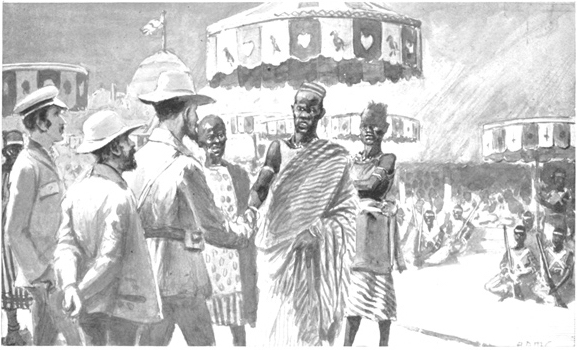
[See Page 213.
BURTON VISITS THE KING OF DAHOMÉ.
Presently we were summoned to enter the palace. We closed our umbrellas by order, walked hurriedly across a large yard, and halted at a circle of white sand spread upon the clayey ground. Here we bowed to a figure sitting under the shady thatch; and he returned, we were told, the compliment. The chief ministers who accompanied us fell flat upon the sand, kissed it, rolled in it, and threw it by handfuls over their heads and robes of satin and velvet. The ceremony is repeated at every possible opportunity; and when the king drinks, all the subjects turn their backs upon him and shout.
Then we advanced to the clay bench upon which King Gelele sat. After the usual quadruple bows and hand-wavings, he stood up, tucked in his toga, descended to the ground, and, aided by nimble feminine fingers, donned his sandals. He then greeted me with sundry vigorous wrings à la John Bull, and inquired after Queen Victoria, the Ministry, and the people of England, which country is supposed to be like Dahomé, but a little larger and richer.
Our chairs were then placed before the seat, to which he returned, and we drank the normal three
Gelele was then about forty-five years old, upwards of six feet high, olive complexioned, athletic and well made, with clear signs of African blood. His dress was simple to excess: a loose shirt of plain white stuff edged with green silk, a small smoking-cap, a few iron rings on his arms, and a human tooth strung round his neck. The only splendour was in his gold and scarlet sandals, here distinctive of royalty. They were studded with crosses, also royal emblems. He called himself a Christian, and he was a Moslem as well: like all barbarians, he would rather believe too much than too little, and he would give himself every chance in both worlds.
Under the thatch behind the king were his wives, known by their handsome dresses, silver hair studs, and the absence of weapons. They atoned for want of beauty by excessive devotion to their lord, who apparently did everything by proxy except smoke his long-stemmed clay pipe.
The inner court of the palace reflected the outer, and the women sat in the sun along the external wall of the royal shed with their musket-barrels bristling upwards. The right wing was commanded by a “premieress,” who executed all women; the left was also under the she “meu.” A semicircle of
I must here say a few words about the Amazons, or fighting women. The corps was a favourite with the late king, who thus checked the turbulence and treachery of his male subjects. The number was estimated at 10,000 to 12,000; I do not believe it exceeded 2,500. They were divided into blunderbuss-women, elephant-hunters, beheaders, who carry razors four feet long, and the line armed with muskets and short swords.
All the Amazons were ex-officio royal wives, and the first person who made the king a father was one of his soldieresses. It was high treason to touch them even accidentally; they lodged in the palace, and when they went abroad all men, even strangers, had to clear off the road. Gelele often made his visitors honorary commandants of his guard of Amazons (I was made one); but this did not entitle them to inspect companies.
Such a régime makes the Amazons, as might be expected, intolerably fierce. Their sole object in life is blood-spilling and head-snatching. They pride themselves upon not being men, and with reason. The soldiers blink and shrink when they fire their guns; the soldieresses do not. The men run away; the women fight to the bitter end. In the last
Dahomé thus presented the anomaly of an African kingdom in which women took precedence of men. Hence every employé of Government had to choose a “mother”—that is to say, some elderly Amazon officer who would look after his interests at headquarters. Often he had two, an “old mother,” dating from the days of the late king, and a “young mother,” belonging to the actual reign. He had to pay them well, or his affairs were inevitably bad. Thus there was also a Brazilian, an English, and a French “mother”; and visitors of those nations were expected to propitiate their fond and unpleasant parents with presents of cloth, jewelry, perfumes, and so forth.
The levée ended with a kind of parade. A few simple manœuvres and many furious decapitation dances were performed by a select company of the young Amazons. They were decently dressed in long sleeveless waistcoats, petticoats of various coloured cottons, secured at the waist by a sash and extending to the ankles, whilst narrow fillets of ribbon secured their hair and denoted their corps. Their arms were muskets and short swords, and all had belts, bullet bags, and cartridge boxes.
When the sun set a bottle of rum was sent to us. At this hint we rose and prepared to retire. Gelele again descended from his seat and accompanied
We lost no time in setting out for Agbomé, and were surprised to find an excellent carriage road, broad and smooth, between the two cities. Agbomé had no hotels, but we managed lodgings at the house of the bukono, a high officer who was doctor and wizard to the Court and curator of strangers, whom he fleeced pitilessly.
I will now touch briefly on the ill-famed “customs” of Dahomé. The word is taken from the Portuguese costume, and here means the royal sacrifices. Many travellers have witnessed them, but no one has attempted to inquire into their origin. I attribute these murderous customs not to love of bloodshed, but simply to filial piety.
The Dahoman, like the ancient Egyptian, holds this world to be his temporary lodging. His own home is Ku-to-men, or Deadman’s Land. It is not a place of rewards and punishments, but a Hades for ghosts, a region of shades, where the king will rule for ever and where the slave will always serve. The idea is ever present to the popular mind. When, for instance, sunshine accompanies rain the Dahoman says the spirits are marketing. In Brazil the fox is marrying; in England the devil is beating his wife.
A deceased king cannot, therefore, be sent to Ku-to-men
But destruction of life does not end here. All novelties, such as the arrival of an officer in uniform, must be reported to the dead by the living king. A captive or a criminal is summoned, and the message is given to him. He is made to swallow a bottle of rum, whose object is to keep him in a good humour, and his head is then and there struck off. Only on one occasion did the patient object to the journey, saying that he did not know the road to Ku-to-men. “You shall soon find it out!” cried the king, who at once decapitated the wretch without rum. If any portion of the message be forgotten, another victim must be despatched with it. A hard-hearted traveller calls this the postscript.
A Dahoman king neglecting these funeral rites would have been looked upon as the most impious of men, and a powerful priesthood would soon have sent him to Ku-to-men on his own account. It may now be understood how hopeless was my mission. It may be compared, without disrespect, to memorialising the Vatican against masses for the dead. The king’s sole and necessary answer was non possumus.
The description of a single “custom” will suffice. About midday of December 28th, when summoned to the palace, we passed through the market-place, and we found the victim-shed finished and furnished. This building was a long, wall-less barn one hundred feet long, the roof was a thatch covered with a striped cloth on a blood-red ground and supported by tree trunks. On the west was a two-storied tower, sixty feet high, with four posts in front of each floor. There were on this occasion twenty victims sitting on stools, each before his post, with his arms around it and his wrists lashed together outside it. The confinement was not cruel; each had a slave to flap away the flies, all were fed four times a day, and they were released at night. The dress was a long white nightcap and a calico shirt with blue and crimson patches and bindings. A white man would have tried to escape; these negroes are led like
Hardly were we seated when Gelele, protected by a gorgeous canopy umbrella, came forth from the palace with Amazons and courtiers in a dense, dark stream. Having visited his fetish gods, he greeted us and retired to his seat under the normal shed. As at Kana, his wives crowded together behind and the soldieresses ranged themselves in front. The ceremonies consisted of dancing, drumming, and distributing decorations—necklaces of red and yellow beads. There was fearful boasting about feats of past valour and bravery to come. About sunset the king suddenly approached us, and I thanked him for the spectacle. He then withdrew, and we lost no time in following his example.
Nothing could be poorer than this display: any petty Indian rajah can command more wealth and splendour. All was barren barbarism, and the only “sensation” was produced by a score of human beings condemned to death and enjoying the death show.
On the morrow I sent a message to the palace, officially objecting to be present at any human sacrifice, and declaring that if any murder took place before me I should retire to the coast. The reply was that few were to be executed, that the victims would only be
The catastrophe took place on what is called the “zan nya nyana,” or the evil night. At intervals we heard the boom of the death-drum announcing some horrible slaughter. It was reported that the king had with his own hand assisted the premier-executioner.
On the next morning we were summoned to the palace, whose approach was a horror. Four corpses, habited in the criminal shirts and nightcaps, sat as though in life upon the usual dwarf stools. The seats were supported upon a two-storied scaffold made of four rough beams, two upright and two horizontal, and about forty feet high. On a similar but smaller erection hard by were two victims, one above the other. Between these substantial erections was a tall gallows of thin posts, from which a single victim dangled by his heels. Lastly, another framework of the same kind was planted close to our path, and attached to the cross-bar, with fine cords round the ankles and above the knees, hung two corpses side by side and head
At the south-eastern gate of the palace we found freshly severed heads in two batches of six each, surrounded by a raised rim of ashes. The clean-cut necks were turned upwards, and the features were not visible. Within the entrance were two more heads; all the bodies had been removed, so as not to offend the king.
Thus on Gelele’s “evil night” twenty-three human beings had lost their lives. And this is but one act in the fatal drama called the “customs.” It is said that an equal number of women were slaughtered within the walls of the royal abode, and I had every reason to believe the report.
I was kept waiting more than a month in this den of abominations before the king could enter upon public affairs. He was discontented with the presents sent from England, and he was preparing to attack a huge Nago city—Abeokuta—where, by-the-bye, he was signally defeated.
When my last visit to him took place he stubbornly ignored, even in the least important matters, the wishes of H.M.’s Government. Filled with an exaggerated idea of his own importance, and flattered almost to madness by his courtiers, he proceeded to dictate his own terms. His next thought was an ignoble greed for presents. He bade me a friendly adieu, and asked me to visit him next year with an English carriage and horses, a large silk pavilion, and other such little gifts.
A TRIP UP THE CONGO 1863
A TRIP UP THE CONGO[7]
1863
BEFORE starting on an exploration into any part of Africa (especially the West Coast), it is essential that the traveller should be properly equipped with the necessary kit both for the inward and outward man. Clothing, blankets, and waterproofs of every description; tea, coffee, and sugar if they be desirable; a few bottles of real genuine cognac if come-at-able, or some ten years’ old Jamaica rum if attainable.
On the occasion of our starting from Fernando Po in August 1863, for the purpose of ascending the river Congo, our kit consisted of one bullock-trunk, one small portable canteen, one dressing-bag, two uniform-cases, one hat-box, one gun-case, one tin box, one deal case of bread, one package of tins of milk, one canteen of cooking utensils, one tin of green tea, one ditto coffee, one small box of medical comforts, etc., two striped bags, a white canvas bag containing newspapers, three guns, two walking St. Paul de Loanda we added two cases of gin, and at Point Banana twelve pieces of siamois, or fancy cloths, twenty pieces riscados, or blue and white stripe, and ten pieces satin stripe, besides six thousand five hundred beads, china, and imitation corals. To all this we afterwards received at Embomma fifteen kegs of gunpowder and ten demijohns of rum.
H.M.S. Torch took us down to Loango Bay, and there Captain Smith transferred us on board the sloop-of-war Zebra, Captain Hoskins, who in his turn took us to St. Paul’s and put us in the hands of Captain Perry, of H.M.S. Griffon, and this latter vessel took us into the Congo; and forthwith we commenced a start up the river on August 31st, 1863.
The usual mode of ascending the river up as far as Embomma is by means of small fore and aft schooners, generally from twenty to forty tons measurement, which are heavily sparred and well supplied with canvas. Our gear was taken by the Griffon’s boats and put on board the French schooner Esperance. We had a fine breeze that afternoon, and the Esperance sailed up the river most gallantly. The party on board consisted of myself, Captain Perry, Mr. Bigley, and Monsieur Pisseaux, a Frenchman; besides William Dean, boatswain, my servant, four French native soldiers, and the schooner’s crew.
Wednesday, September 2nd.—We breakfasted at a Portuguese factory, and soon after breakfast we weighed anchor and sailed up the river, arriving betimes at Porto da Lentra. In the afternoon we left Porto da Lentra, and proceeded. Passed several villages on the port hand. Boat got ashore several times after dark. About nine o’clock the Missolongis hailed and asked who we were. When I answered, they said they would pay us a visit during the night. We prepared to give them a warm reception. During the night we rounded Point Devil, a most dangerous place for navigation. Anchored at 10.30 p.m.
Thursday, September 3rd.—Arrived at Embomma at 1.30 p.m. Embomma contained a French factory and several Portuguese establishments. At 9.30 we got under weigh again, and in about an hour afterwards entered a part of the river where it assumes the appearance of an inland lake, some parts nearly two miles wide. The scenery here is varied, but principally hilly, the highest of the hills being about 1,500 feet above the level of the river. Here we met a native chief in his canoe. He came to levy contributions from us. His people, who were armed with guns and hatchets, made various warlike gestures and ordered us to stop. Monsieur Pisseaux being our guide and adviser, we were compelled to pay one bottle of rum and a piece of cloth twelve fathoms in length.
Captain Perry shot a fish-eagle, which was considered a fine achievement, as very few of that species can be shot on account of their inclination to fly high
Here was the farthest extent of Monsieur Pisseaux’s knowledge of the river, and, to our future sorrow, we landed in the banza, or district, of Nokki. We cooked some food on shore, and messengers were despatched with a bottle of gin to the king of Kayé.
Tuesday, September 8th.—We now left the river for the interior, and found the road excessively irksome and trying to our wind and legs; nothing but hills and dales, the descents and ascents very difficult, and stony withal, the soles of our feet receiving a most disagreeable grating on small quartz and schistus. Passing one or two fields of native beans, we arrived at the village of Kindemba.
After resting here for a short time we again
Not many minutes’ walk from this was the village of Kayé. On entering it we were marched off to see the king. We found him seated in state, dressed in a motley garb of European manufacture: a white shirt with collar turned down, a crimson velvet loin-cloth, fringed with gold and tied round the waist by means of a belt, and a beautifully mounted sheath-knife stuck in the belt. The handle of the knife was made of nickel silver, and very showily ornamented with imitation emeralds and ruby garnets. Over all he wore a red beadle’s cloak, and on his head a helmet somewhat resembling those worn by English Life Guardsmen, but it was evidently of French manufacture. The king was very young, apparently not more than twenty years of age, very smooth-faced, and looked quite shy when he came vis-à-vis with his illustrious visitors. When we were all seated, I on a chair, and the others on a covered table, the courtiers sat down on the ground at a respectful distance. The king’s old father was seated on the ground before his son.
The king’s name was Sudikil, and that of his father Gidi Mavonga, both of them very bright specimens of their race. After some compliments, Sudikil received his presents—one piece of fine fancy cloth and a
Wednesday, September 9th.—Early in the morning we received a visit from Gidi Mavonga and his son King Sudikil. They examined all our travelling-gear, whilst my servant kept sentry at the door to prevent their escort from going into the house. This consisted of ten men, four of whom carried matchlocks. After about half an hour’s palaver, everything was handed over to Gidi, who promised to start for the Congo in three days, and, in consideration of receiving the said goods, bound himself to take us there, bring
We later received a visit from Tetu Mayella, king of an adjacent village called Neprat. He was accompanied by about twenty followers, all of whom came to us for the express purpose of getting some rum. Tetu Mayella wrangled for two hours with Gidi and another half-hour with Sudikil about a bottle of grog, and ultimately despatched Nchama to plead with me for him. I referred him back to Gidi Mavonga, and, after a further consultation, Tetu received one bottle of gin, in return for which he came personally and presented us with two fowls. This was a godsend, as the day before we had nothing to eat but a few pieces of dry bread, and water to wash it down. A pig was then slaughtered with great ceremony. The carcass was cut up and divided according to custom, the king getting the lion’s share, and the other personages an allowance in accordance with their rank. We made ready to retire to rest after eating a good bush dinner and drinking plenty of palm wine. Gidi Mavonga paid us a visit late in the evening, and final arrangements were made with him to proceed first to Yellalla, or the Congo Cataracts, and afterwards to St. Salvador, or Great Gongo City.
Thursday, September 10th.—The direction of the Yellalla Cataracts from the village of Kayé was St. Salvador, or Congo, east-south-east. This morning we had dandelion coffee for the fourth time. It was a most excellent decoction, acting, when used judiciously, on the liver and kidneys. We found that the natives breakfasted on beans, ground nuts, fish, and beef when it can be had, and the second course is a good jorum of palm wine. At noon we began packing up, in order to start for Gidi Mavonga’s village. The natives of the Congo are divided into two classes only, the mfumo, or freeman, and the muleque, or slave. The mfumo marries amongst his own slaves, or, properly speaking, retainers, and the children born by him are in their turn mfumos, or freemen. The word slave is here quite improperly used, for the slave in reality is a freer man than the king himself. Everything the king possesses, except his wives, is literally at the disposal of the slave. Unquestionably the slave is the bodyguard of the mfumo, and, as regards work, he does what he likes, sleeps when he chooses, attends to his private affairs when he pleases, and if his master finds fault with his conduct, the chances are, if his own country be not too far away from the place of his thraldom, he will leave his master and make a bold effort to reach his native land.
Friday, September 11th.—Very early this morning we were astonished by hearing a yelling noise from a lot of women. To use a Scotch phrase, it was a regular “skirl.” It so happened that a woman
Gidi Mavonga came to take us to his village of Chingufu this morning. It was not a long journey, we found. Gidi’s house was a facsimile of the one we had left at Kayé: an oval building upheld by two upright posts, and the roof supported by a long stout beam laid on the top of, and tied to, the uprights. The hut boasted of three doors, one at each end and one at the side. Doubtless, fox-like, the suspicious native makes all these doors to serve as mediums of escape in case of war or a slave-hunt. There was a partition in the centre dividing the hut into two rooms, the first being a general room, and the second the sanctum sanctorum, accessible only to the husband and wife. The furniture was very simple, consisting of a native bed in each room. The walls and roof were composed of bamboos and grass very neatly tied together. There was no flooring but the clay bottom, and the whole looked very clean and simple.
Gidi appeared to be a great worshipper of the native fetish Ibamba, or Nzamba, a variation of the devil. The natives called him Masjinga, and he is a house-god, usually keeping guard at the bedsides. The idol in Gidi’s hut was a peculiarly droll-looking object. He was an image about three
About midday we had a visit from some neighbouring chiefs, all gaily attired. They wore red nightcaps on their heads, and this was the only head-dress I ever saw adopted by the men on great occasions, Sudikil’s military helmet excepted. The women always went bareheaded. I had often wondered where in the wide universe old clothes went to after they are purchased by the Jews in London. The mystery was here solved, for I found kings wearing second-hand livery suits, with the coronet and crest of a marquis on the button, and
About sunset we witnessed a native game, which certainly was one of the liveliest sights since our start up the river. A number of Gidi’s slaves assembled in a large open space between the houses, and, dividing themselves into two parties, began throwing a ball from one to another. Upwards of twenty were engaged in this game, and the fun consisted in the one side dodging about in all directions, and preventing its opponents from catching the ball by playing the game into each others’ hands. The ball was made of palm fibre tied round with a central fibre of the plantain leaf. After sunset there was a wild country-dance, which was kept up to a late hour.
Saturday, September 12th.—The chief Furano, who was expected from Embomma, arrived the next morning, and we started at once for the cataracts. After marching for a short time and passing two or
We were comfortably housed at Nelongo’s village, but Gidi and Nelongo were palavering all day, hammer and tongs. I noticed at Nelongo’s village, as I did in other places on the banks and neighbourhood of the Congo, that all the children were afraid of the white man, for when any person attempted to bring them in proximity with me, the little brats howled as if Satan from the infernal regions had got hold of them. Most of the women were of the same texture as their progeny.
Sunday, September 13th.—After coffee this morning all the great folks assembled in front of our house and recommenced the half-finished palaver of last evening. Council present: myself, Gida Mavonga, Nelongo, Furano, Siko Npamba, and Interpreter Nchama. All ended in talk, and Nchama threatened to resign. The native idea of the riches possessed by a white man is fabulous. Nelongo refused to believe that we had not sufficient cloth with us to answer his most exorbitant demands. We had a respectable present for him; but that did not satisfy his avarice, and he wanted more than we had taken with us for the whole road. As there was another prince to consult in the matter, it was agreed, at my suggestion, that the whole of our gear should be submitted to examination. The expected prince arrived, carried on a hammock, and, after a heavy palaver and a great deal of yelling from the women, he went away; and then we had another visit from Nelongo, who made some very noisy demonstrations, but as the noise was conducted in the language of the country, we were not able to understand a single syllable. Suffice it to say that the whole affair ended by his receiving an additional supply of cotton, not from us, but from Gidi Mavonga. This Nelongo handed to one of his armed slaves, and then went away; but he returned again in about five minutes and intimated that the palaver was all right, which caused Gidi and his men to make demonstrations of approval by jumping up and running some paces from the house and attacking
We were ready to start by twelve o’clock noon. The sun was very hot, and the thermometer stood at 90° in the shade; but we were glad to get out of a place which reminded us of Bedlam, and therefore set out in all haste, making a slight descent into a valley, and then ascending a peculiarly formed hill, the perpendicular height of which might be a hundred and fifty feet, and from whose summit we obtained a glorious view of the river, which was seen some eight hundred feet below us, flowing down rapidly and majestically to the sea. But the utter barrenness of the country in the vicinity of its banks carried away every association of fertility. This view of the country, however, is given at the end of the dry season, when almost every tree loses its leaves, and the green grass becomes withered and dried up.
From this point we began a decline down hill which beggars description. We had not walked above a quarter of a mile before we arrived at a part of our road where, without the least exaggeration, the path,
The distance from Nelongo’s village to the banks of the river was about five miles, and on reaching the water-side we found ourselves exactly at the junction of the Nomposo with the Congo River. The Nomposo, we were informed, extended all the way to St. Salvador, but was not navigable, even for canoes. There were some fishermen who followed their vocation at the mouth of this small river, whose services were soon brought into requisition to take us across the Nomposo and land us a little above its mouth, but on the bank of the great river. This landing was the place where the fishermen dried their fish, and was called Munyengi Asiko. Being heartily tired, we very gladly sat down, and ultimately got ourselves ready to pass the night in the open air, not for the first time. Just about sunset this evening we were visited by one of those nasty drizzling showers, commonly called a Scotch mist. In about an hour it increased to a smart shower; but, luckily, we were well provided with good waterproof sheets and coats, so that no harm happened to the gear or to ourselves.
Monday, September 14th.—Great excitement this morning, having on the previous night lost my tablets of daily memoranda. An offer of four fathoms of
Another row amongst the natives. It appears that some two days previously a man had supplied another with two jars of palm wine upon condition of his receiving some fish in return. The unlucky fisherman, after drinking the wine, did not succeed in catching fish for two days, and consequently was unable to pay his debt. Hence the high words and brandishing of hatchets on the part of the wine merchant and his people. But that was all; no blows were struck, for the dog that barks very loud seldom bites.
It is always advisable in travelling through Africa to keep guides and interpreters ignorant of your possessions, for they are sure to make some excuse or other to fleece you. This morning we had evidence of this. We had paid our guide everything that was necessary for the road, yet he sent the interpreter to ask us for a piece of fancy cloth which he knew I had. I had to grant his request, otherwise I might have had to give up the journey, for ten chances to one he would have left me in a huff.
At eight o’clock we crossed the river, the time occupied being a quarter of an hour. We reached the village of Vivi after half an hour’s march; distance, one and a half miles. Nesalla was the name of the king
About two o’clock Nesalla came with upwards of one hundred men and commenced a long palaver about our going on to Yellalla. Five or six persons spoke, and the conference lasted one hour. The conclusion showed that the cloth we had with us was not enough, and that the princes at Yellalla must get a different piece from that which was before the conference, and no division into two pieces must be made of it under any consideration whatever. As the whole affair was conducted in a most good-humoured manner, I agreed to the terms.
In the evening the inhabitants of the village had a dance. Those who have witnessed the Spanish cachucha need scarcely be told what this dance was. The cachucha is a very good dance in its way; but the Congo dance beats it hollow, because it has more pith in it than the cachucha. The fun was kept up till a late hour, every one, both great and small, young and old, joining in it, so that in the end, what
Tuesday, September 15th.—Early this morning we started for the Banza Nculu. The scenery along the road was varied and picturesque. The first view we had of the river was from an eminence about a mile from Vivi on the road to the Banza Nculu. Here we had a view of the Congo as it was flowing onwards, and round about in all directions were hills and dales adding a panoramic beauty to the scene. We had to descend from the summit of the first hill and ascend a second one much higher than the first, and from here we again obtained views of the Congo. One, the lower view, appeared like a lake, apparently shut in on all sides by hills, whose lofty summits stretched far and wide on every side, and some of them peered to the height of above a thousand feet into the heavens. Proceeding onwards, we ascended a third eminence, but by this time we had lost sight of the river, and our path became more level for a short distance.
We now commenced a gradual descent, but before
We now arrived at the summit of the hill of the Banza Nculu, and as the three kings and three interpreters could not be seen at once, in consequence of their having first to settle some palaver about fish, we were compelled to bivouac under a large tree in the environs of Nculu until their highnesses might condescend to give us an audience. We breakfasted under the large tree, and were amused before and after breakfast by a number of urchins (say eight or ten) who had undergone the ceremony of circumcision, and who delighted in making a churring noise—a ch-u-r-r decidedly intended to frighten us into hysterics. But
About two o’clock one of the three interpreters came to see us. He was dressed in a trade shirt and red nightcap, and was accompanied by a few men only, and had merely come to show us to a house.
At half-past three we heard the beating of a drum and cone, and, on looking out at the door, saw a procession making its way to the house in which we were lodged. I was already seated at the door, and, the whole cavalcade coming up, they seated themselves around the front of the house in a semicircle. Altogether there might have been about two hundred and fifty persons, including all sexes and sizes. Three ministers belonging to the three kings were the principal personages, and had come as ambassadors for their masters. One of them had already given his opinion in a refusal to permit me to pass on to Sundi, and it now remained for the whole council to arrive at the ultimate decision of Yes or No. The first conference assembled and broke up in a very short time. The beginning appeared favourable, for the ministers retired amidst
They went away, and the third conference took place at four o’clock. This was the Grand Council, and there were plenty who spoke, the upshot of the whole affair being that they ultimately demanded the moderate sum of £300 in cloth, beads, and liquor, giving us permission (on our agreeing to the foregoing terms) to go on to Sundi above the cataracts, a journey occupying only three days. “Impudence is better than modesty,” but we thought this was carrying impudence to a pitch. This sum was out of the question, and had we been possessed of enough to answer the demands of those bushmen, rather than acquiesce, we should certainly have preferred throwing the amount into the “Slough of Despond.”
Wednesday, September 16th.—This morning we went
All day Gidi Mavonga was very stubborn and irritable, and wished to start at once for Vivi and return home; but as I had to put up some botanical specimens, to finish two sketches of this part of the country, and besides, having sore feet from walking, I would not hear of starting. Gidi therefore started, after repeated palavers, and called his muleks to follow him: some followed; others begged off, but to no purpose. Off he went, and after proceeding a short distance, returned, and in very strong words expressed himself an injured man. This was taking high ground; I therefore told the interpreter to tell Gidi that he might go away, and, at the same time, to inform him that he must send certain properties belonging to me which had been left at his banza, and that in future no further communication would be held with his place by any Englishman.
Gidi said that the property belonged to him. I told him to take all, but, he might rely upon it,
Saturday, September 19th.—We found ourselves back again at Gidi Mavonga’s village, paying off all the extra hands who accompanied us to the rapids. The pay was made in cloth, beads, and liquors.
The heavy demands made by the bigwigs of Banza Nculu—viz. £300 for mere permission to pass to Sundi, beside the enormous expense of feeding ourselves and thirty-five followers—had compelled us to give up the project we had in view, especially as we had seen the principal rapids on the river—the rest of the falls, until reaching Sundi, being mere elevations, in themselves quite insignificant. My object had been to reach Sundi, and thence try to ascertain the course of the river, and to find out whether its source could be nearly reached by canoes, or entirely reached by carriers. But finding the demands of the chiefs beyond my power of compliance, I resolved to return. Our chief guide, Gidi Mavonga, was anxious to make a retrograde movement as quickly as possible, and urged upon us the necessity of packing up and starting after three o’clock on the afternoon of our return from visiting the rapids. But I declined to stir until the next morning, and after much trouble I gave him and his slaves one blanket cloth and a pair of razors, which quieted him a little. But it was soon evident that even this
I therefore quietly informed the wild old man that he was carrying matters too far, asked the meaning of it, and took out a six-barrelled Colt’s revolver, and placed it at my feet ready for use in case of need. This had the desired effect, for Gidi, after taking a long, covetous look at the bale of merchandise, turned round and stared at the leveller of six men at my feet, and having balanced the difference, he slunk out in perfect silence, followed by his two myrmidons, who had accompanied their master into the house to carry away anything that their lord might select. Outside the slaves still clamoured, and at last induced their master to beard me again when I was writing.
Thus for two days affairs progressed as hot as fire and as irritating as a wife’s bad temper, till at length,
The preliminaries of this arrangement occupied two days, and on the morning of the third day we were ready to start by half-past five o’clock, but no carriers had as yet made their appearance, and after they did come, it was with the same infernal noise that we managed to start them with the loads. But the moment they were en route they almost ran with the things, and shortly disappeared from our view. We followed as quickly as we could after them, and arriving at Kayé, a sentinel with a gun stopped us, and informed us that his Highness Prince Sudikil desired our presence. On reaching the house of our old landlord, we discovered the whole of our gear before his door, and the prince with his mother and some of his slaves standing in a circle round the things, whilst one disgusting-looking brute was about to open a box of beads. I at once walked up to the rascal and gave him a castigation with a stick. The fellow looked daggers; but on showing him a fine breech-loading Cooper’s rifle, he held down his head and slunk a little way back from the box and sat down.
And now commenced a palaver between the prince and myself, the substance of which was that the prince wished to exact more presents from me, but this time by force. The armed slaves began to come
At this suggestion the prince, his mother, some of the slaves, and even Nchama, our interpreter, commenced such a babel of tongues that we wished the whole bunch of them keeping company with Pharaoh at the bottom of the Red Sea. It was quite evident that they had perceived the absurdity and obstinacy of their covetous desires. The prince therefore walked away in a great rage, taking with him all his slaves, and nearly one-half of those who had brought our kit from his father’s house. Here, again, was another fix. We were standing pondering over the peculiar position in which we were placed, when luckily the few who remained at once resolved to carry each a double load, and this brought us to the waterside, and examining all our baggage, and seeing everything correct, I made a present of beads to the carriers and had breakfast.
By 9.45 a.m. we set off for Embomma with thankfulness, where we arrived at 5 p.m. on the same day, having run down with the current, slightly assisted by paddles, a distance of forty-five miles in seven hours and a quarter.
Wednesday, September 23rd.—John Clarke, being engaged to go with us to St. Salvador, started this afternoon with Nchama to bring carriers from Mambuka Prata. Chief Mambuka Prata had a few trading huts close to the French factory, where he flew a black and white flag on trading occasions. The district of Embomma may extend about eight or ten miles in length, and throughout the whole of it villages of from ten to twenty houses may be seen standing in all directions, and sometimes several miles apart from one another. The king’s residence may consist of sixty houses, and it is generally at the royal villages that the traveller finds a home during his sojourn.
Thursday, September 24th.—At Embomma. This day’s proceedings have been more annoying than any that have preceded it. The two messengers, John Clarke and Nchama, who had been sent on a mission to Mambuka Prata, returned without having accomplished a single order in connection with the mission entrusted to them. Nchama returned about six o’clock in the morning, perfectly drunk, and incapable of giving a single word of explanation as to his whereabouts and doings. John Clarke returned in the afternoon, and gave rather a tame version of his proceedings. He said that Mambuka Prata, being annoyed at not receiving a coat promised him by Monsieur Pisseaux, would not send any carriers to take us on to St. Salvador. What a Frenchman’s conduct had to do with an Englishman’s affairs I
Friday, September 25th.—We left Embomma, and arrived in Porto da Lentra at 1.15 on the morning of Saturday, September 26th. On the way down the canoemen made several attempts to land at various villages, but were forced to proceed for fear of Colt’s revolvers. They did very well, and received six bottles of rum.
We left Porto da Lentra for Point Banana at 4.15 on the morning of September 27th. We had exchanged our smaller but fine canoe for a large one, and started with six hands and captain, but had scarcely lost sight of Porto da Lentra when our canoemen went up a creek—they said to get extra clothing. We were detained more than half an hour waiting for them, until probably they had eaten their breakfast and drunk their palm wine. We got them to start with great difficulty; but at the very next creek they stopped again, and would have repeated the dose at
At the creek one man jumped on shore and we pushed off again; but a few yards down we were hailed by a Missolongi canoe, the river-pirates of this part of the Congo. This third time our canoemen stopped; and we were obliged to face them with cocked revolvers and compel them to go on. Down we glided, assisted more by the current than by our men. Another creek, and the canoemen requested to stop again to eat, which request was positively refused.
The river had been hitherto very calm, but at two o’clock the sea-breeze began to blow hard; the tide was also slightly against us, and this caused a swell in the river which wetted nearly all our things. I was surveying at the time, and, fearing that the instruments might get a soaking with salt water, I ordered the canoemen to put back and return to Point Banana by means of a creek on the right of the river. This appeared to the canoemen to be awfully hard work, although they had only to pull back for about a quarter of a mile. The Congoes are remarkable for their uselessness: they excel in eating, drinking, sleeping, and talking, in a word, in satisfying their sensual comforts, and what little sense they have is used for the purpose of annoying those with whom they come in contact. More than five times they were asked to make sail, and then gave a few strokes with their paddles, and stopped and chatted again, put
In this way nearly an hour passed away, and we never reached the end of the quarter-mile. They began to complain that the way by the creek was too far, whilst just a short time before that they told us the creek was the nearest. They now declared that they could proceed no farther, and pulled the canoe in shore. Seeing that the whole bevy of them, from the captain to the small boy, were all drunk from drinking some rum they had brought with them, we could do nothing but submit to this state of things, anything being preferable to trusting the canoe with a lot of drunken hands, and getting ourselves and gear saturated with salt water.
The crew were permitted to land. They lighted a fire, cooked, ate, drank, quarrelled, and went to sleep. The padron, or captain, took possession of the rum, and drank himself to sleep also; and when the wind abated a little and the water became calmer, we awakened the captain with difficulty, and he with greater difficulty his crew; but the tide had gone down, and the canoe was high and dry on the bank. All efforts to launch her into the water proved unavailing, especially as the rum was still hard at work, and what little sense the Congoes had was perfectly misapplied. In consequence we had to wait until the tide again served, which did not take place till two o’clock the following morning, when we tried again to start our hands, and with great
At six o’clock all our things were landed and comfortably housed within Monsieur Parrat’s factory. Thank God! we were now at a considerable distance from Yellalla and the triumvirate and avaricioua triple ministers of the Banza Nculu, far away from the Banza Vivi and its king, far away from the quarrelsome, covetous, gin-drinking, noisy, and licentious old Gidi Mavonga, far away from that senseless nincompoop the Prince Sudikil, and—praise be to Allah!—within hail of Her Majesty’s ship Griffon.
THE INTERIOR OF BRAZIL 1867
THE INTERIOR OF BRAZIL
1867
I HAD been in Brazil nearly two years, vegetating between Santos and São Paulo, varied by an occasional expedition afield or a trip to Rio de Janeiro, when I determined to put into action my long-cherished plan of prospecting the great and wealthy province of Minas Gerães in the interior, and then to go down the São Francisco, which is the Brazilian Mississippi, from Sabará to the sea, and to visit en route the Paulo Affonso rapids, the Niagara of Brazil. As my wife was very anxious to go, I took her with me.
We left Rio on June 12th, 1867, and sailed across the incomparable Bay, and then ascended to Petropolis. From Petropolis we made our real start in a large char-à-banc, which held eight, in two and two, and which was drawn by four mules. The mules started off in fine style; being fresh and frisky they simply galloped along the mountain side. It is not necessary for me to describe the first part of the journey, which, for a few days, travelled along a well-known road, through a splendid district of wooded mountains, broad rivers, and boulders of rock; the vegetation was especially fine, even tropical. At Juiz de Fora
I should weary if I were to describe the places we passed through until we came to Logão Duroda, where the railway was in process of making, and where they were just laying the first chain for the exploration of the mountains and for the prolongation of the Dom Pedro Secunda Railway. There was an inauguration ceremony, and my wife had the honour of giving the first blow to the stock and breaking a bottle of wine over it. After that we had a convivial gathering, and wound up with a dinner in the good old English fashion. Next day we started off again, and still riding through beautiful scenery, up and down mountains, through shallow rivers and bits of virgin forests, from day to day, we eventually arrived at Morro Velho, where we were most hospitably received by the superintendent of the São Goa d’el Rey Mining Company and Mrs. Gordon, and we spent some days in their most comfortable home. Morro Velho is the queen of the Minas Gerães mines, and a most interesting place, but, as we were going back to it, we determined to press on to Ouro Preto, which is the capital of the province, a most hilly town, for walking up and down the streets was as difficult as climbing up ladders. We stayed here two days, and then returned to Morro Velho. We had a long, muddy, rainy journey on the way back, slipping backward two steps for every one
Among other things we explored the mine, which had the reputation of being the largest, deepest, and richest gold-mine in Brazil. My wife determined to go with me, and Mrs. Gordon, who had never before ventured under grass, kindly consented to accompany her. Mr. Gordon and I went down first in a bucket, or kibble, which was suspended over the abyss. We found in it a rough wooden seat, comfortable enough. We were advised by the pitman not to look downwards, as the glimmer of the sparks and lights below was apt to cause giddiness and seasickness. I did look down and felt none the worse. We touched and tilted half over once against a cableway drum, but that was our only contretemps. I could not but wonder at the mighty timbering which met my eyes as it dilated in the darkness;—timber everywhere, all of the best and hardest wood. The mighty mass, it might hardly be said, was not without flaws, very palpable at second look. We made an easy descent down the shaft, and a bunch of lighted tow, tied to the bucket chain, showed us all its features. There was no “rattle his bones over the stones,” and the drop lasted fifteen minutes. At the bottom the kibble, or bucket, stood still, began to reel like a boat, and descended perpendicularly until we stepped out. Presently Mrs. Gordon and
Candle burning, the usual test, detected nothing abnormal in the atmosphere; the ventilation was excellent. Of course, our feet were wiped, and, physically speaking, they wanted wiping; the floor was wet, the mud was slippery, and locomotion somewhat like an ascent of the Pyramids, although the ground was pretty level.
It was a huge palace of darkness; the walls were either black as the grave, or reflected in the slender rays of light a watery surface, or were broken into monstrous projections, half revealing and half concealing cavernous recesses. Despite the lamps, the night pressed upon us, as it were, with a weight, and the only measure of distance was a spark here and there, glimmering like a single star. Distinctly nerve-testing was the gulf between the huge mountain sides, apparently threatening every moment to fall. Through this Inferno gnomes glided about in a ghostly fashion, half-naked figures enveloped by the mist. Here dark bodies hung by chains in what seemed frightful positions; there they swung like
Our visit to the mine amply repaid us; it was a place
Where thoughts were many, and words were few.
But the fact will remain on our mental retina as long as our brains will do their duty.
After a fortnight at Morro Velho I prepared to go to Sabará, there to embark en route to the coast. With a peculiar cat-like feeling I bade adieu to the Gordons, with whom we had found an English home in the Highlands of Brazil. My excellent compatriots, however, accompanied me to break the shock of departure; my wife also, though, as she had sprained her ankle badly, she was to return to Rio.
It was a long ride from Morro Velho and a tiring one, and we were glad to enter the picturesque city of Sabará, where we found tolerable lodgings. Here I completed my preparations for descending the Rio das Velhas, and had to seek the aid of a store-keeper, who turned out to be an extortioner. That, perhaps, was only to be expected; but I may justly complain when, in addition to his extortionate charges, he sent me down the river, a river like the Mississippi, in a raft whose starboard canoe had a leak scarcely stopped up with Sabará clay.
The next day we all walked down to the upper landing-place, where the ajojo, or raft, lay. I never
All the notables of the place witnessed the process of embarkation. A young English lady broke a bottle of wine with all possible grace upon the bows, and duly christened the craft the Eliza and two pairs of slippers were thrown at my head. Many vivas were given and returned, and all my party embarked for a trial trip of a couple of miles. When the fifteen souls came on board, they sank the raft some three palms, and deluged the upper platform, making the headman, or pilot, very nervous; already he began to predict swamping, “going down in a jiffey,” and being dashed to pieces by the rapids. We shot past a dangerous rock in mid-stream, and in a short time arrived at the little village of Santo Antonio da Roça Grande, where animals were waiting to carry home the non-voyagers, my wife included. They landed here, but stood as the setting sun sank behind the mountains and waved their farewells as they watched the raft turn the last corner and float off into the far mysterious unknown. I confess to having felt an unusual sense of loneliness as the kindly faces faded away in the distance, and, by way of distraction, I applied myself to a careful examination of my raft.
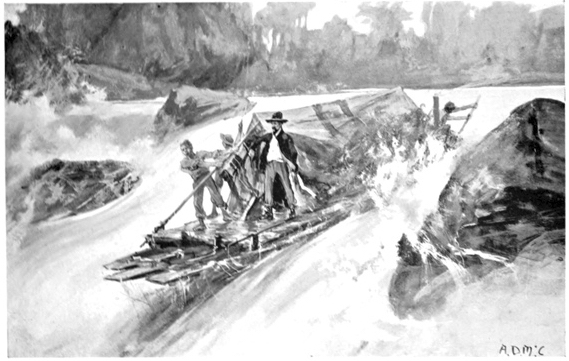
[See Page 266.
SHOOTING THE RAPIDS ON THE RIO DAS VELHAS.
My crew numbered three—old Vieira and his sons. Two stood in the bows with poles, which they preferred as being easier to use than paddles. The paddles used in deep waters vary in shape every few hundred miles. The men were mere landlubbers; they felt, or affected to feel, nervous at every obstacle. They had been rowing all their lives, and yet they knew not how to back water; curious to say, this was everywhere the case down stream. They pulled with all their might for a few minutes when the river was rapid, so as to incur possible risks, and when the water was almost dead, they lay upon their oars and lazily allowed themselves to be floated down. Thus, during the working day, between 7 a.m. and 5 p.m., very little way was made. They had no system, nor would they learn any. The only thing energetic about them was the way they performed upon the cow-horn, and with this they announced arrival, saluted those on the banks, and generally enjoyed the noise.
My first stage was between Sabará and Santa Lusia. The stream was deeply encased; the reaches were short,
At Jaguára the people cried, “You’ll never reach Trahiras,” deriding the Eliza. Indeed, we seemed likely to waste much time. However, we crept on surely, if slowly. As evening approached the weather waxed cool and clear, and the excessive evaporation gave the idea of great dryness; my books curled up, it was hardly possible to write, and it reminded me of the Persian Gulf, where water-colours cannot be used because the moisture is absorbed from the brush.
The first view of Santa Lusia was very pleasing; a tall ridge about a mile from the stream was capped with two double-towered churches, divided by fine, large, whitewashed houses and rich vegetation, with palms straggling down to the water. Here I landed and made my way to the hotel, which was a most tumble-down hole, and after supper inspected Santa
The next morning was delicious, and the face of Nature was as calm as if it could show no other expression. The sword-like rays of the sun, radiating from the unseen centre before it arose in its splendour, soon dispersed the thin mists that slept tranquilly upon the cool river-bed. We shot the Ponte Grande de Santa Lusia to Cruvello and the backwoods. The bridge was the usual long, crooked affair, with twelve trusses, or trestles, in the water and many outside, showing that the floods are here extensive. The girders are rarely raised high enough, and an exceptional inundation sweeps them away, leaving bare poles bristling in the bed and dangerous piles under water.
About two miles below Santa Lusia the water became deeper and the country changed. The right, or eastern, side was rough and hilly, with heights hugging the bed. Near the other bank the land was more level, and the soil showed a better complexion, by which both sugar-cane and timber profited. In another hour we sighted the first cotton plantation, and right well it looked. There was indeed a mine of neglected wealth in cotton and fish along, and in, this river, and the more I saw of it the richer I found it. The hills were clothed with thin brown-grey grass, looking in places as if they were frosty with hoar, and always profusely tasselled.
Presently another bend showed certain white lines between the river-fringe of trees, and this was the
We set out next morning at seven o’clock, and proceeded without much adventure all that day and night, finally arriving at Jaguára, at which hospitable place I spent pleasant days, whilst another crew was engaged and arrangments for my reaching Diamantina were being completed.
After a week at Jaguára I embarked again. There was very little to record day by day of the voyage from Jaguára to Diamantina. The river was ever changing: sometimes we passed picturesque cliffs; sometimes we went through gorgeous forests; with
The most dangerous experience was when we shot the rapids at Cachoeira Grande. People crowded down to the yellow bank to stare and to frighten us about them, and the dialogue was somewhat in this style:--
“Do you know the rapids?” we inquired.
“We know them!”
“Will you pilot us?”
“We will not pilot you!”
“For money?”
“Not for money!”
“And why?”
“Because we are afraid of them!”
This was spoken as the juniors ran along the bank like ostriches or the natives of Ugogo.
Luckily for us, for the Cachoeira Grande was no joke, we found, just before we came to the rapids, on the right bank a small crowd keeping holiday. The men carried guns in their hands, and wore pistols and daggers under their open jackets; the women were in full dress, brilliant as rainbows, with blood-red flowers in their glossy, crows’-wing hair. Of the dozen, not one was fairly white. Here we picked up a pilot or two who came on board. They were men of few words; they saluted us civilly and pushed off.
Eliza was forced over to the right, was swung round by main force of arm, and was allowed to descend, well in hand, to within a few feet of No. 4, which rises right in the front. Finally, leaving this wrecker to starboard, we hit the usual triangle-head, with plenty of water breaking off both arms. The descent occupied sixteen minutes.
After many congratulations our friends the pilots made a show of taking leave to do some important business, which proved on inquiry to mean “doing compliments.” As the dangers were not yet over, I produced a keg of restilo; it was tasted, and pronounced very hot in the mouth, and the Major—that is, myself—became so irresistible that they all swore they would accompany me to the Rio de São Francisco, or anywhere. The poles were twirled again
The end was the Cachoeira das Gallinhas, to which we presently came. We gave a wide berth to a rock well on the right bank and stuck to the left side. Here was a narrow gate, formed by two rock-piers projecting from the shores, and in such places “cordelling” was advisable. The men sprang into the water with loud cries, and pulled at the hawser till the current had put us in proper position. They then pushed off and sprang on board before we could make much way. The “Rapid of the Hens” occupied us nine minutes.
A second dram of the “wild stuff” was then given and our friends the pilots blessed us fervently; they prayed for us, and unintelligibly invoked for us the protection of the Virgin and all the saints. They landed with abundant tripping and stumbling, carrying with them many dollars and a bottle of the much-prized restilo. I had every reason to be grateful to them, for they saved me an immense amount of trouble; but, shortly afterwards, reports of certain “little deaths,” in which they had been actively concerned, showed me that they were not exactly lambs.
After this we proceeded easily down the river to Bom Successo, from which point I intended to visit Diamantina City. I had to land here and make my way to Diamantina on mule-back, not an easy journey, involving, as it did, a day and a night. Diamantina,
On the eleventh day I returned to Bom Successo with great regret, and at 9.30 a.m. on September 7th I dismissed my trooper and his mules, and pushed out of the creek down the river towards Coroa do Gallo. I met with several small troubles, such as low sandbanks, snags, and stones, but managed to push through to the Coroa do Gallo, where I spent the night. The previous day had been burning hot, but when we set forth the weather had become temperate, and, indeed, on all this journey there was nothing much to complain of on account of the climate. We drifted on day after day through a soft and balmy atmosphere, disturbed ever and anon by
I landed and stayed a day or two at Guaicuhy, but there was nothing very important to record. I was strongly advised to visit the rapids of the Pirapora, which are said to be, after the Casca d’Anta at the beginning and the Paulo Affonso at the end, the important feature upon the Rio de São Francisco. The word means a “fish leap,” and is applied to places on more than one Brazilian river. With a flush of joy I found myself upon this glorious stream of the future, whose dimensions here measure seven hundred feet. I had seen nothing to compare with it since my visit to the African Congo.
Two new men were hired to guide us in the “tender” canoe, as we wished to shoot the rapids. We eyed curiously the contrasts of the new stream with that which we had lately left. Here the water was of a transparent green; the river seemed to break even from the stiff clay, which was in places caving in. After nine hours of hard work we doubled a wooded projection from the left bank, and sighted the Cachoeira of the Pirapora. The Pirapora differed from anything I had yet viewed; it was, in fact, partly a true fall, divided into two sections, and we trembled to think what the Paulo Affonso might be. Glad