CAPTAIN SIR RICHARD F. BURTON, K.C.M.G. (continued 2)
Reading edition
Escaping this danger, we painfully endured the rocks and thorns of the mountains and wilds. The third march placed us at Halimalah, a sacred tree about half-way between this coast and our destination—Harar. It is a huge sycamore suggesting the hiero-sykaminon of Egypt. The Gallas are still tree-worshippers, and the Somali respect this venerable vegetable as do the English their Druidical mistletoe.
We were well received at the kers (the kraals or villages). They were fenced with large and terrible thorns, an effectual defence against barelegged men. The animals had a place apart—semi-circular beehives made of grass mats mounted on sticks. The furniture consisted of weapons, hides, wooden pillows and mats for beds, pots of woven fibre, and horse gear. We carried our own dates and rice, we bought meat and the people supplied us with milk gratis—to sell
We soon rose high above sea-level, as the cold nights and the burning suns told us. The eighth march placed us on the Ban Marar, a plain twenty-seven miles broad—at that season a waterless stubble, a yellow nap, dotted with thorny trees and bushes, and at all times infamous for robbery and murder. It was a glorious place for game: in places it was absolutely covered with antelopes, and every random shot must have told in the immense herds.
Here I had the distinction of being stalked by a lion. As night drew in we were urging our jaded mules over the western prairie towards a dusky line of hills. My men proceeded whilst I rode in rear with a double-barrelled gun at full cock across my knees. Suddenly my animal trembled and bolted forward with a sidelong glance of fear. I looked back and saw, within some twenty yards, the king of beasts creeping up silently as a cat. To fire both barrels in the direction of my stalker was the work of a second. I had no intention of hitting, as aim could not be taken in the gloaming, and to wound would have been fatal. The flame and the echoed roar from the hills made my friend slink away. Its intention was, doubtless, to crawl within springing distance and then by a bound on my neck to have finished my journey through Somaliland and through life. My companions shouted in horror “Libah! libah!”—“The
After crossing the desert prairie, we entered the hills of the agricultural Somali, the threshold of the South Abyssinian mountains. The pastoral scene now changed for waving crops of millet, birds in flights, and hedged lanes, where I saw with pleasure the dog-rose. Guided by a wild fellow called Altidon, we passed on to the Sagharah, the village of the Gerad, or chief, Adan. He had not a good name, and I was afterwards told he was my principal danger. But we never went anywhere without our weapons, and the shooting of a few vultures on the wing was considered a great feat where small shot is unknown. “He brings down birds from the sky!” exclaimed the people.
I must speak of the Gerad, however, as I found him—a civil and hospitable man, greedy, of course, suspicious, and of shortsighted policy.
His good and pretty wife Kayrah was very kind, and supplied me with abundance of honey wine, the merissa of Abyssinia. It tasted like champagne to a palate long condemned to total abstinence, without even tea.
We were now within thirty direct miles of Harar, and my escort made a great stand. The chief Adan wanted to monopolise us and our goods. My men, therefore, were threatened with smallpox, the bastinado, lifelong captivity in unlit dungeons, and similar amenities.
On June 2nd, 1855, sent for our mules. They
Now, however, we were talking reason, and I settled all difficulties by leaving a letter addressed to the Political Resident at Aden. Mohammed and Guled were chosen to accompany me, the rest remaining with the Gerad Adan. I must say for my companions that once in the saddle they shook off their fears; they were fatalists, and they believed in my star, whilst they had the fullest confidence in their pay or pension.
The country now became romantic and beautiful—a confusion of lofty stony mountains, plantations of the finest coffee, scatters of villages, forests of noble trees, with rivulets of the coolest and clearest water. We here stood some five thousand five hundred feet high, and although only nine degrees removed from the Line, the air was light and pleasant. It made me remember the climate of Aden, and hate it.
We slept en route, and on January 3rd we first sighted Harar City. On the crest of a hill distant two miles it appeared, a long sombre line strikingly contrasting with the whitewashed settlements of the more civilised East, and nothing broke the outline except the two grey and rudely shaped minarets of the Jami, or Maritz (cathedral). I almost grudged the exposure of three lives to win so paltry a prize. But of all Europeans who had attempted it before me not one had succeeded in entering that ugly pile of stones.
We then approached the city gate and sat there, as is the custom, till invited to enter. Presently we were ordered to the palace by a chamberlain, a man with loud and angry voice and eyes.
At the entrance of the palace we dismounted by command, and we were told to run across the court, which I refused to do. We were then placed under a tree in one corner of the yard and to the right of the palace. The latter is a huge, windowless barn of rough stone and red clay, without other insignia but a thin coat of whitewash over the doorway.
Presently we were beckoned in and told to doff our slippers. A curtain was raised, and we stood in the presence of the then Amir of Harar, Sultan Ahmed bin Sultan Abibaki.
The sight was savage, if not imposing. The hall of audience was a dark room, eighty to ninety feet long, and its whitewashed walls were hung with rusty fetters and bright matchlocks. At the further end, on
I entered with a loud “As ’salem alaykum”—“Peace be upon ye!”—and the normal answer was returned. A pair of chamberlains then led me forward to bow over the chief’s hand. He directed me to sit on a mat opposite to him, and with lowering brow and inquisitive glance he asked what might be my business in Harar. It was the crisis. I introduced myself as an Englishman from Aden coming to report that certain changes had taken place there, in the hope that the “cordial intent” might endure between the kingdoms of Harar and England.
The Amir smiled graciously. I must admit that the smile was a relief to me. It was a joy to my attendants, who sat on the ground behind their master, grey-brown with emotion, and mentally inquiring, “What next?”
The audience over, we were sent to one of the Amir’s houses, distant about one hundred paces from the palace. Here cakes of sour maize (fuba), soaked in curdled milk, and lumps of beef plenteously powdered with pepper, awaited us. Then we were directed to call upon Gerad Mohammed, Grand Vizier of Harar. He received us well, and we retired to rest not dissatisfied with the afternoon’s work. We had eaten the chief’s bread and salt.
During my ten days’ stay at Harar I carefully observed the place and its people. The city was walled and pierced with five large gates, flanked by towers, but was ignorant of cannon. The streets—narrow lanes strewed with rocks and rubbish—were formed by houses built of granite and sandstone from the adjacent mountains. The best abodes were double storied, long and flat roofed, with holes for windows placed jealously high up, and the doors were composed of a single plank. The women, I need hardly say, had separate apartments. The city abounded in mosques—plain buildings without minarets—and the graveyards were stuffed with tombs—oblongs formed by slabs placed edgeways in the ground.
The people, numbering about eight thousand souls, had a bad name among their neighbours. The Somali say that Harar is a “paradise inhabited by asses”; and “hard as the heart of Harar” is a byword. The junior members of the royal family were imprisoned till wanted for the throne. Amongst the men I did not see a handsome face or hear one
The women were beautiful by the side of their lords. They had small heads, regular profiles, straight noses, large eyes, mouths almost Caucasian, and light brown skins. The hair, parted in the centre and gathered into two large bunches behind the ears, was covered with dark blue muslin or network, whose ends were tied under the chin. Girls collected their locks, which were long, thick, and wavy—not wiry—into a knot à la Diane; a curtain of short close plaits escaping from the bunch fell upon the shoulders. The dress was a wide frock of chocolate or indigo-dyed cotton, girt round the middle with a sash; before and behind there was a triangle of scarlet with the point downwards. The ornaments were earrings and necklaces of black buffalo horn, the work of Western India. The bosom was tattooed with stars, the eyebrows were lengthened with dyes, the eyes were fringed with antimony, and the palms and soles were stained red. Those pretty faces had harsh voices, their manners were rude, and I regret to say that an indiscreet affection
At Harar was a university which supplied Somaliland with poor scholars and crazy priests. There were no endowments for students—learning was its own reward—and books (manuscripts) were rare and costly. Only theology was studied. Some of the graduates had made a name in the Holy Land of Arabia, where few ranked higher than my friend Shaykh Jami el Berteri. To be on the safer side he would never touch tobacco or coffee. I liked his conversation, but I eschewed his dinners.
Harar—called Gay or Harar Gay by her sons—is the capital of Hadiyah, a province of the ancient Zala empire, and her fierce Moslems nearly extirpated Christianity from Shoa and Amara. The local Attila Mohammed Gragne, or the “Left-Handed,” slew in 1540 David III., the last Ethiopian monarch who styled himself “King of Kings.”
David’s successor, Claudius, sent imploring messages to Europe, and D. Joao III. ordered the chivalrous Stephen and Christopher da Gama, sons of Vasco da Gama, to the rescue. The Portuguese could oppose only three hundred and fifty muskets and a rabble rout of Abyssinians to ten thousand Moslems. D. Christopher was wounded, taken prisoner, and decapitated. Good Father Lobo declares that “where the martyr’s head fell, a fountain sprung up of wonderful virtue, which cured many hopeless diseases.”
Eventually Gragne was shot by one Pedro Leao,
My days at Harar were dull enough. At first we were visited by all the few strangers of the city, but they soon thought it prudent to shun us. The report of my “English brethren” being on the coast made them look upon me as a mufsid, or dangerous man. The Somali, on the other hand, in compliment to my attendants, were most attentive. It was harvest home, and we had opportunity of seeing the revels of the threshers and reapers—a jovial race, slightly “dipsomaniac.”
Harar also was the great half-way house and resting place for slaves between Abyssinia and the coast. In making purchases, the adage was, “If you want a brother in battle, buy a Nubian; if you would be rich, an Abyssinian; if you require an ass, a negro.”
I sometimes called upon the learned and religious, but not willingly—these shaykhash, or reverend men, had proposed detaining me until duly converted and favoured with a “call.” Harar, like most African cities, was a prison on a large scale. “You enter it by your own will; you leave it by another’s,” is the pithy saw.
At length, when really anxious to depart, and when my two Somali had consulted their rosaries
After a pleasing interview with the Amir, who did his best to smile, we left Harar on January 13th, 1855. At Sagharah, where the villagers had prayed the death-prayer as we set out for the city, we were received with effusion. They now scattered over us handfuls of toasted grain, and they danced with delight, absorbing copious draughts of liquor. The “End of Time” wept crocodile’s tears, and the women were grateful that their charms had not been exposed to the terrible smallpox.
After a week’s rest we prepared to make the coast. I was desirous of striking Berbera, a port south of Zayla, where my friends awaited me. The escort consented to accompany me by the short direct road, on condition of travelling night and day. They warned me that they had a blood feud with all the
But if they could stand it, so could I. The weaker attendants, the women, and the camels were sent back by the old path, and I found myself en route on January 26th, accompanied by my two Somali and by a wild guide known as Dubayr—the “Donkey.” My provaunt for five days consisted of five biscuits, a few limes, and sundry lumps of sugar.
I will not deny that the ride was trying work. The sun was fearful, the nights were raw and damp. For twenty-four hours we did not taste water; our brains felt baked, our throats burned, the mirage mocked us at every turn, and the effect was a kind of monomania. At length a small bird showed us a well and prevented, I believe, our going mad. The scenery was uniform and uninteresting—horrid hills upon which withered aloes raised their spears; plains apparently rained upon by showers of fire and stones, and rolling ground rich only in “wait a bit” thorns, made to rend man’s skin and garment. We scrupulously avoided the kraals, and when on one occasion the wild people barred the way we were so intolerably fierce with hunger and thirst that they fled from us as though we were fiends. The immortal Ten Thousand certainly did not sight the cold waters of the Euxine with more delight than we felt when hailing the warm bay of Berbera. I ended that
* * * * *
And now to recount the most unpleasant part of my first adventure in East Africa.
Having paid a visit to Aden, I returned to Berbera in April, 1855, prepared to march upon the head waters of the Nile.
But Fate and the British authorities were against me. I had done too much—I had dared to make Berbera a rival port. They were not scrupulous at Aden, even to the taking of life.
My little party consisted of forty-two muskets, including three officers and myself. The men, however, were not to be trusted, but after repeated applications I could not obtain an escort of Somali policemen. Matters looked ugly, and the more so as there was no retreat.
The fair of Berbera, which had opened in early October, was breaking up, and the wild clansmen were retiring from the seaboard to their native hills. The harbour rapidly emptied; happily, however, for us, a single boat remained there.
We slept comfortably on April 18th, agreeing to have a final shot at the gazelles before marching. Between 2 a.m. and 3 a.m. we were roused by a rush of men like a roar of a stormy wind. I learned
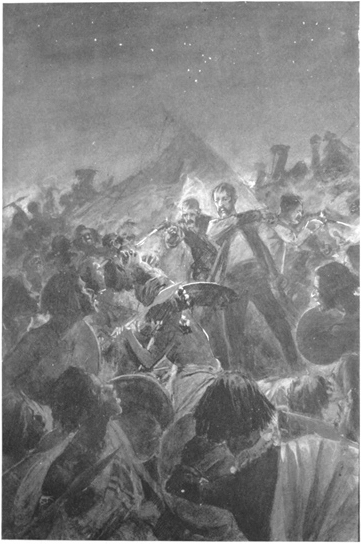
[See Page 96.
THE ATTACK ON THE CAMP AT BERBERA.
The unfortunate Lieutenant Stroyan was run through with a spear; he slept far from us, and we did not see him fall. Lieutenants Herne and Speke and I defended ourselves in our tent till the savages proceeded to beat it down. I then gave the word to sally, and cleared the way with my sabre. Lieutenant Herne accompanied me and—wonderful to relate—escaped without injury. Lieutenant Speke was seized and tied up; he had eleven spear-thrusts before he could free himself, and he escaped by a miracle. When outside the camp, I vainly tried once more to bring up our men to the fray. Finding me badly hurt they carried me on board the boat. Here I was joined by the survivors, who carried with them the corpse of our ill-fated friend.
Sad and dispirited, we returned to Aden. We had lost our property as well as our blood, and I knew too well that we should be rewarded with nothing but blame. The authorities held a Court of Inquiry in my absence, and facetiously found that we and not they were in fault. Lord Dalhousie, the admirable statesman then governing in general British India, declared that they were quite right. I have sometimes thought they were.
TO THE HEART OF AFRICA 1856-1859
I
THE JOURNEY
I HAD long wished to “unveil Isis”—in other words, to discover the sources of the Nile and the Lake regions of Central Africa—and to this end I left London in September, 1856, for Bombay. Here I applied for Captain Speke to accompany me as second in command, as he wished much to go. My subsequent dispute with Speke is well known, and I will not refer to it here. I took him with me out of pure good nature, for, as he had suffered with me in purse and person at Berbera the year before, I thought it only just to offer him the opportunity of renewing an attempt to penetrate to the unknown regions of Central Africa. I had no other reasons. He was not a linguist, nor a man of science, nor an astronomical observer, and during the expedition he acted in a subordinate capacity only. The Court of Directors refused him leave, but I obtained it from the local authorities in Bombay. I may here add that the Royal Geographical Society had given me a grant of £1,000, and that the Court of Directors of the East India Company had given me two years’ leave.
I landed at Zanzibar from Bombay on December 19th,
I wanted to engage one hundred and seventy porters, but could only get thirty-six, and thirty animals were found, which were all dead in six months, so I had to leave a part of my things behind, including a greater part of my ammunition and my iron boat. I paid various visits to the hippopotamus haunts, and had my boat uplifted from the water upon the points of two tusks, which made corresponding holes in the bottom. My escort were under the impression that nothing less than one hundred and fifty guns and several cannon would enable them to fight a way through the perils of the interior. I was warned that I must pass through savages who shot with poisoned arrows, that I must avoid trees—which was not easy in a land of forest—that the Wazaramo had forbidden white men to enter their country, that one rhinoceros had killed two hundred men, that armies of elephants would attack my camp by night, and that the hyena was more dangerous than the Bengal tiger—altogether, not a cheerful outlook.
Most of these difficulties were raised by a rascal named Ramji, who had his own ends in view. Being
“Will he ever reach it?” asked the native, meaning the Sea of Ujiji; to which Ramji replied:
“Of course not; what is he that he should pass through Ugogo?” (a province about half way).
So I remarked at once that I did intend to pass Ugogo and also reach the Sea of Ujiji, that I did know Cutchee, and that if he was up to any tricks, I should be equal to him.
On June 26th, 1857, I set out in earnest on a journey into the far interior.
On this journey I had several queer experiences. At Nzasa I was visited by three native chiefs, who came to ascertain whether I was bound on a peaceful errand. When I assured them of my unwarlike intentions, they told me I must halt on the morrow and send forth a message to the next chief, but as this plan invariably loses three days, I replied that I could not be bound by their rules, but was ready to pay for their infraction. During the debate upon this fascinating proposal for breaking the law, one of the most turbulent of the Baloch, who were native servants in my train, drew his sword upon an old woman because she refused to give up a basket of grain. She rushed, with the face of a black Medusa, into the assembly, and created a great disturbance. When that was allayed, the principal chief asked me what brought the white man into their country, and
“I am old,” he quoth pathetically, “and my beard is grey, yet I never beheld such a calamity as this.”
“These men,” replied my interpreter, “neither buy nor sell; they do not inquire into price, nor do they covet profit.”
An extravagant present—for at that time I was ignorant of the price I ought to pay—opened the chiefs’ hearts, and they appointed one of their body to accompany me as far as the western half of the Kingani valley. They also caused to be performed a dance of ceremony in my honour. A line of small, plump, chestnut-coloured women, with wild, beady eyes and thatch of clay-plastered hair, dressed in their loin-cloths, with a profusion of bead necklaces and other ornaments, and with their ample bosoms tightly corded down, advanced and retired in a convulsion of wriggle and contortion, whose fit expression was a long discordant howl. I threw them a few strings of green beads, and one of these falling to the ground, I was stooping to pick it up when Said, my interpreter whispered, in my ear, “Bend not; they will say ‘He will not bend even to take up beads.’”
In some places I found the attentions of the fair sex somewhat embarrassing, but when I entered the fine green fields that guarded the settlements of Muhoewee, I was met en masse by the ladies of the
“What would you think of these whites as husbands?” asked one of the crowd.
“With such things on their legs, not by any means!” was the unanimous reply, accompanied by peals of merriment.
On July 8th I fell into what my Arab called the “Valley of Death and the Home of Hunger,” a malarious level plain. Speke, whom I shall henceforth call my companion, was compelled by sickness to ride. The path, descending into a dense thicket of spear grass, bush, and thorny trees based on sand, was rough and uneven, but when I arrived at a ragged camping kraal, I found the water bad, and a smell of decay was emitted by the dark, dank ground. It was a most appalling day, and one I shall not lightly forget. From the black clouds driven before furious blasts pattered raindrops like musket bullets, splashing the already saturated ground. Tall, stiff trees groaned and bent before the gusts; birds screamed as they were driven from their resting-places; the asses stood with heads depressed, ears hung down, and shrinking tails turned to the wind; even the beasts of the wild seemed to have taken refuge in their dens.
Despite our increasing weakness, we marched on the following day, when we were interrupted by a body of about fifty Wazaramo, who called to us to halt. We bought them off with a small present of cloth and beads, and they stood aside to let us pass.
Though handicapped by a very inadequate force, in eighteen days we accomplished, despite sickness and every manner of difficulty, a march of one hundred and eighteen miles, and entered K’hutu, the safe rendezvous of foreign merchants, on July 14th. I found consolation in the thought that the expedition had passed without accident through the most dangerous part of the journey.
Resuming our march through the maritime region, on July 15th we penetrated into a thick and tangled jungle, with luxuriant and putrescent vegetation. Presently, however, the dense thicket opened out into a fine park country, peculiarly rich in game, where the giant trees of the seaboard gave way to mimosas, gums, and stunted thorns. Large gnus pranced about, pawing the ground and shaking their formidable manes; hartebeest and other antelopes clustered together on the plain. The homely cry of the partridge resounded from the brake, and the guinea-fowls looked like large bluebells upon the trees. Small land-crabs took refuge in pits and holes, which made the path a cause of frequent accidents, whilst ants of various kinds, crossing the road in close columns, attacked man and beast ferociously,
Despite the dangers of hyenas, leopards, and crocodiles, we were delayed by the torrents of rain in the depths of the mud at Kiruru. We then resumed our march under most unpromising conditions. Thick grass and the humid vegetation rendered the black earth greasy and slippery, and the road became worse as we advanced. In three places we crossed bogs from a hundred yards to a mile in length, and admitting a man up to the knee. The porters plunged through them like laden animals, and I was obliged to be held upon the ass. At last we reached Dut’humi, where we were detained nearly a week, for malaria had brought on attacks of marsh fever, which, in my case, thoroughly prostrated me. I had during the fever fit, and often for hours afterwards, a queer conviction of divided identity, never ceasing to be two persons that generally thwarted and opposed each other. The sleepless nights brought with them horrid visions, animals of grisliest form, and hag-like women and men.
On July 24th, feeling strong enough to advance, we passed out of the cultivation of Dut’humi. Beyond the cultivation the road plunged into a jungle, where the European traveller realised every preconceived idea of Africa’s aspect at once hideous and grotesque. The general appearance is a mingling of bush and forest, most monotonous to the eye. The black, greasy ground, veiled with thick shrubbery, supports in the more open spaces screens of tiger and spear grass twelve and thirteen feet high, with every blade a finger’s breadth; and the towering trees are often clothed with huge creepers, forming heavy columns of densest verdure. The earth, ever rain-drenched, emits the odour of sulphuretted hydrogen, and in some parts the traveller might fancy a corpse to be hidden behind every bush. That no feature of miasma might be wanting to complete the picture, filthy heaps of the meanest hovels sheltered their miserable inhabitants, whose frames are lean with constant intoxication, and whose limbs are distorted with ulcerous sores. Such a revolting scene is
After a long, long tramp the next day through rice swamps, we came to the nearest outposts of the Zungomero district. Here were several caravans, with pitched tents, piles of ivory, and crowds of porters. The march had occupied us over four weeks, about double the usual time, and a gang of thirty-six Wanyamwezi native porters whom I had sent on in advance to Zungomero naturally began to suspect accident.
Zungomero was not a pleasant place, and though the sea breeze was here strong, beyond its influence the atmosphere was sultry and oppressive. It was the great centre of traffic in the eastern regions. Lying upon the main trunk road, it must be traversed by the up and down caravans, and during the travelling season, between June and April, large bodies of some thousand men pass through it every week. It was, therefore, a very important station, and the daily expenditure of large caravans being considerable, there was a good deal of buying and selling.
The same attractions which draw caravans to Zungomero render it the great rendezvous of an army of touts, who, whilst watching the arrival of ivory traders, amuse themselves with plundering the country.
Zungomero is the end of the maritime region, and when I had reached it, I considered that the first stage of my journey was accomplished.
When we were ready to start from Zungomero, our whole party amounted to a total of one hundred and thirty-two souls, whom I need not, I think, describe in detail. We had plenty of cloth and beads for traffic with the natives, a good store of provisions, arms, and ammunition, a certain amount of camp furniture, instruments, such as chronometers, compasses, thermometers, etc., a stock of stationery, plenty of useful tools, clothing, bedding, and shoes, books and drawing materials, a portable domestic medicine chest, and a number of miscellaneous articles. As life at Zungomero was the acme of discomfort, I was glad enough to leave it.
On August 7th, 1857, our expedition left Zungomero
From Central Zungomero to the nearest ascent of the Usagara Mountains is a march of five hours; and, after a painful and troublesome journey, we arrived at the frontier of the first gradient of the Usagara Mountains. Here we found a tattered kraal, erected by the last passing caravan, and, spent with fatigue, we threw ourselves on the short grass to rest. We were now about three hundred feet above the plain level, and there was a wondrous change of climate. Strength and health returned as if by magic; the pure sweet mountain air, alternately soft and balmy, put new life into us. Our gipsy encampment was surrounded by trees, from which depended graceful creepers, and wood-apples large as melons. Monkeys played at hide-and-seek, chattering behind the bolls, as the iguana, with its painted scale-armour, issued forth; white-breasted ravens cawed, doves cooed on well-clothed boughs, and the field cricket chirped in the shady bush. By night the view disclosed a peaceful scene, the moonbeams lying like sheets of snow upon the ruddy highlands, and the stars shone like glow-lamps in the dome above. I never wearied of contemplating the scene, and contrasting it with the Slough of Despond,
All along our way we were saddened by the sight of clean-picked skeletons and here and there the swollen corpses of porters who had perished by the wayside. A single large body passed us one day, having lost fifty of their number by smallpox, and the sight of their deceased comrades made a terrible impression. Men staggered on, blinded by disease; mothers carried infants as loathsome as themselves. He who once fell never rose again. No village would admit a corpse into its precincts, and they had to lie there until their agony was ended by the vulture, the raven, and the hyena. Several of my party caught the infection, and must have thrown themselves into the jungle, for when they were missed they could not be found. The farther we went on, the more we found the corpses; it was a regular way of death. Our Moslems passed them with averted faces, and with the low “La haul” of disgust.
When we arrived at Rufutah, I found that nearly all our instruments had been spoilt or broken; and one discomfort followed another until we arrived at Zonhwe, which was the turning-point of our expedition’s difficulties.
As we went on, the path fell easily westwards through a long, grassy incline, cut by several water-courses. At noon I lay down fainting in the sandy bed of the Muhama, and, keeping two natives with
Our march presented curious contrasts of this strange African nature, which is ever in extremes. At one time a splendid view would charm me; above, a sky of purest azure, flecked with fleecy clouds. The plain was as a park in autumn, burnt tawny by the sun. A party was at work merrily, as if preparing for an English harvest home. Calabashes and clumps of evergreen trees were scattered over the scene, each stretching its lordly arms aloft. The dove, the peewit, and the guinea-fowl fluttered about. The most graceful of animals, the zebra and the antelope, browsed in the distance. Then suddenly the fair scene would vanish as if by enchantment. We suddenly turned into a tangled mass of tall, fœtid reeds, rank jungle, and forest. After the fiery sun and dry atmosphere of the plains, the sudden effect of the damp and clammy chill was overpowering. In such places one feels as if poisoned by miasma; a shudder runs through
So things went on until September 4th, which still found us on the march. We had reached the basin of Inenge, which lies at the foot of the Windy Pass, the third and westernmost range of the Usagara Mountains. The climate is ever in extremes; during the day a furnace, and at night a refrigerator. Here we halted. The villagers of the settlements overlooking the ravine flocked down to barter their animals and grain.
The halt was celebrated by abundant drumming and droning, which lasted half the night; it served to raise the spirits of the men, who had talked of nothing the whole day but the danger of being attacked by the Wahumba, a savage tribe. The next morning there arrived a caravan of about four hundred porters, marching to the coast under the command of some Arab merchants. We interchanged civilities, and I was allured into buying a few yards of rope and other things, and also some asses. One of my men had also increased his suite, unknown to me at first, by the addition of Zawada—the “Nice Gift.” She was a woman of about thirty, with black skin shining like a patent leather boot, a bulging brow, little red eyes, a wide mouth, which displayed a few long, scattered teeth, and a figure considerably too bulky for her thin legs. She was a patient and hardworking woman, and respectable enough in the acceptation of the term. She was
After Inenge we were in for a bad part of the journey, and great labour. Trembling with ague, with swimming heads, ears deafened by weakness, and limbs that would hardly support us, we contemplated with horrid despair the apparently perpendicular path
On September 10th we hardened our hearts and began to breast the Pass Terrible. After rounding in two places wall-like sheets of rock and crossing a bushy slope, we faced a long steep of loose white soil and rolling stones, up which we could see the porters swarming more like baboons than human beings, and the asses falling every few yards. As we moved slowly and painfully forward, compelled to lie down by cough, thirst, and fatigue, the sayhah, or war-cry, rang loud from hill to hill, and Indian files of archers and spearmen streamed like lines of black ants in all directions down the paths. The predatory Wahumba, awaiting the caravan’s departure, had seized the opportunity of driving the cattle and plundering the village of Inenge.
By resting every few yards, we reached, after about six hours, the summit of the Pass Terrible, and here we sat down amongst aromatic flowers and pretty shrubs to recover strength and breath.
On September 14th, our health much improved by the weather, we left the hilltop and began to descend the counterslope of the Usagara Mountains. For the first time since many days I had strength enough to muster the porters and inspect their loads. The outfit which had been expected to last a year had been half exhausted within three months. I summoned Said bin Salim, and told him my anxiety. Like a veritable Arab, he declared we had enough to last until
“How do you know?” I inquired.
“Allah is all-knowing,” said Said. “The caravan will come.”
As the fatalism was infectious, I ceased to think upon the subject.
The next day we sighted the plateau of Ugogo and its eastern desert. The spectacle was truly impressive. The first aspect was stern and wild—the rough nurse of rugged men. We went on the descent from day to day until September 18th, when a final march of four hours placed us on the plains of Ugogo. Before noon I sighted from a sharp turn in the bed of a river our tent pitched under a huge sycamore, on a level step. It was a pretty spot in the barren scene, grassy, and grown with green mimosas, and here we halted for a while. The second stage of our journey was accomplished.
After three days’ sojourn at Ugogo to recruit the party and lay in rations for four long desert marches, we set forth on our long march through the province of Ugogo. Our first day’s journey was over a grassy country, and we accomplished it in comparative comfort. The next day we toiled through the sunshine of the hot waste, crossing plains over paths where the slides of elephants’ feet upon the last year’s muddy clay showed that the land was not always dry. During this journey we suffered many discomforts and difficulties. The orb of day glowed like a fireball in our
At last we arrived at Ziwa, a place where caravans generally encamped, because they found water there. At Ziwa we had many troubles. One Marema, the Sultan of a new settlement, visited us on the day of our arrival, and reproved us for sitting in the jungle, pointing the way to his village. On my replying we were going to traverse Ugogo by another road, he demanded his customs, which we refused, as they were a form of blackmail. The Sultan threatened violence, whereupon the asses were brought in from grazing and ostentatiously loaded before his eyes. He then changed his tone from threats to beggary. I gave him two cloths and a few strings of beads, preferring this to the chance of a flight of arrows during the night.
When we resumed our journey, the heat was awful. The sun burnt like the breath of a bonfire, warm siroccos raised clouds of dust, and in front of us the horizon was so distant that, as the Arabs expressed themselves, a man might be seen three marches off.
in magnifico. He was the only chief who ever entered my tent in Ugogo—pride and a propensity for strong drink prevented such visits. He was much too great a man to call upon Arab merchants, but in our case curiosity mastered State considerations. Magomba was an old man, black and wrinkled, drivelling and decrepid. He wore a coating of castor-oil and a loin-cloth which grease and use had changed from blue to black. He chewed his quid, and expectorated without mercy; he asked many questions, and was all eyes to the main chance. He demanded, and received, five cloths, one coil of brass wire, and four blue cottons. In return he made me a present of the leanest of calves, and when it was driven into
We toiled on and on, suffering severely from the heat by day and sometimes the cold by night, and troubled much with mutinous porters and fears of desertion, until at last we reached the heart of the great desert, or elephant ground, known as Fiery Field. On October 20th we began the transit of this Fiery Field. The waste here appeared in its most horrid phase; a narrow goat-path serpentined in and out of a growth of poisonous thorny jungle, with thin, hard grass straw growing on a glaring white and rolling ground. The march was a severe trial, and we lost on it three boxes of ammunition. By-and-by we passed over the rolling ground, and plunged into a thorny jungle, which seemed interminable, but which gradually thinned out into a forest of thorns and gums, bush and underwood, which afforded a broad path and pleasanter travelling. Unfortunately, it did not last long, and we again had a very rough bit of ground to go over. Another forest to pass
The people swarmed from their abodes, young and old hustling one another for a better stare; the man forsook his loom and the girl her hoe, and we were welcomed and escorted into the village by a tail of screaming boys and shouting adults, the males almost nude, the women bare to the waist, and clothed only knee-deep in kilts. Leading the way, our guide, according to the immemorial custom of Unyamwezi, entered uninvited and sans cérémonie the nearest village; the long string of porters flocked in with bag and baggage, and we followed their example. We were placed under a wall-less roof, bounded on one side by the bars of the village palisade, and surrounded by a mob of starers, who relieved one another from morning to night, which made me feel like a wild beast in a menagerie.
We rested some days at Unyamwezi—the far-famed “Land of the Moon”—but I was urged to advance on the ground that the natives were a dangerous race, though they appeared to be a timid and ignoble people, dripping with castor and sesamum oil, and scantily attired in shreds of cotton or greasy goat-skins. The dangers of the road between Unyamwezi and Ujiji were declared to be great. I found afterwards
On November 7th, 1857, the one hundred and thirty-fourth day from the date of leaving the coast, we entered Kazeh, the principal village of Unyamwezi, much frequented by Arab merchants. I always got on well with the Arabs, and they gave me a most favourable reception. Striking indeed was the contrast between the open-handed hospitality and hearty goodwill of this truly noble race and the niggardliness of the savage and selfish Africans. Whatever I alluded to—onions, plantains, limes, vegetables, tamarinds, coffee, and other things, only to be found amongst the Arabs—were sent at once, and the very name of payment would have been an insult.
Kazeh is situated in Unyamyembe, the principal province of Unyamwezi, and is a great meeting-place of merchants and point of departure for caravans, which then radiate into the interior of Central Intertropical Africa. Here the Arab merchant from
I was detained at Kazeh from November 8th until December 14th, and the delay was one long trial of patience.
It is customary for stranger caravans proceeding towards Ujiji to remain six weeks or two months at Unyamyembe for repose and recovery from the labours which they have endured; moreover, they are expected to enjoy the pleasures of civilised society, and to accept the hospitality offered them by the resident Arabs. In Eastern Africa, I may mention, six weeks was the same as the three days’ visit in England.
The morning after our arrival at Kazeh a great number of our porters left us, and the rest of our party apparently considered that Unyamyembe, and not Ujiji, was the end of the exploration. Several of them were mutinous when I told them they would not be rewarded for safe-conduct until we had reached the end of the up march, which was not
I will not describe the details of our march, which went on without a break. Christmas Day found us still marching, and so on day after day, if I except an enforced halt of twelve days at Msene. On January 10th, 1858, I left Msene, with considerable difficulty through the mutiny of porters; and so we pressed on, more or less with difficulty, until at last a formidable obstacle to progress presented itself. I had been suffering for some days; the miasmatic airs of Sorora had sown the seeds of a fresh illness. On the afternoon of January 18th, 1858, I was seized with an attack of fever, and then paralysis set in from the feet upwards, and I was completely hors de combat. There seemed nothing left for me but to lie down and die. One of my chief porters declared that the case was beyond his skill: it was one of partial paralysis, brought on by malaria, and he called in an Arab, who looked at me also. The
We had now left the “Land of the Moon” behind us, and entered upon a new district. The road before us lay through a howling wilderness, and the march lay along the right bank of a malarial river, and the mosquitoes feasted right royally upon our bodies, even in the daytime. A good deal of the ground was very swampy, and it then stretched over jungly and wooded hill-spires, with steep ascents and descents. Everywhere was thick, fœtid, and putrescent vegetation. The heaviness of this march caused two of our porters to levant and another four to strike work. It was, therefore, necessary for me to again mount ass ten days after an attack of paralysis. So we dragged on for the next week, throughout the early days of February, a weary toil of fighting through tiger and spear grass, over broken and slippery paths, and through thick jungle. But these difficulties were lightly borne, for we felt that we must be nearing the end of our journey.
On February 13th we resumed our travel through
“What is that streak of light which lies below?” I inquired of Seedy Bombay, one of our porters.
“I am of opinion,” quoth Seedy, “that is the water.”
I gazed in dismay. The remains of my blindness, the veil of trees, and broad ray of sunshine illuminating but one reach of the lake, had shrunk its fair proportions. Prematurely I began to curse my folly in having risked life and health for so poor a prize, and even thought of proposing an immediate return with a view of exploring the Nyanza, or Northern Lake. Advancing, however, a few yards, the whole scene suddenly burst upon my view, filling me with wonder, admiration, and delight. My longing eyes beheld the Tanganyika Lake as it lay in the lap of the mountain, basking in the gorgeous tropical sunshine. Our journey had not been in vain.
II
THE LAKE REGIONS
I shall never forget my first glimpse of Tanganyika. Below and beyond a short foreground of rugged and precipitous hill-fold, down which the footpath zigzagged painfully, a narrow strip of emerald green shelved towards a ribbon of glistening yellow sand, here bordered by sedgy rushes, there cleanly cut by the breaking wavelets. Further in front stretched the waters, an expanse of soft blue, in breadth varying from thirty to thirty-five miles, and sprinkled by the crisp east wind with tiny crescents of snowy foam. The background in front was a high and broken wall of steel-coloured mountain. To the south, and opposite the long, low point, lay bluff headlands, and, as the eye dilated, it fell upon a cluster of outlying islets, speckling a sea horizon. Villages, cultivated lands, the frequent canoes of the fishermen on the waters, and, as we came nearer, the murmur of the waters breaking upon the shore, gave variety and movement to the landscape. The riant shores of this vast lake appeared doubly beautiful to me after the silent and spectral mangrove creeks on the East African seaboard, and the melancholy, mononotous
Arrived at Ukaranga I was disappointed to find there a few miserable grass huts that clustered around a single “tembe,” or inn, then occupied by its proprietor, an Arab trader. I found that that part of Ukaranga contained not a single native canoe, and there seemed no possibility of getting one, the innkeeper being determined that I should spend beads for rations and lodgings among him and his companions, and be heavily mulcted for a boat into the bargain. The latter manœuvre was frustrated by my securing a solid-built Arab craft for the morrow, capable of containing from thirty to thirty-five men. It belonged to an absent merchant, and in point of size it was second on Tanganyika, and, being too large for paddling, the crew rowed, instead of scooping up the water like the natives. I paid an exorbitant price for the hire of this boat.
Early in the morning of the following day, February 14th, we began coasting along the eastern shore of the lake in a north-westerly direction, towards the
We stepped ashore. Around the landing-place a few scattered huts represented the port-town. Advancing some hundred yards through a din of shouts and screams, tom-toms and trumpets, which defies description, and mobbed by a swarm of black beings whose eyes seemed about to start from their heads with surprise, I passed a relic of Arab civilisation, the bazaar. It was on a plot of higher ground, and there, between 10 a.m. and 3 p.m., weather permitting, a mass of standing and squatting negroes buy and sell, barter and exchange, offer and chaffer, with a hubbub heard for miles. The articles exposed for sale were sometimes goats and sheep and poultry, generally fish, vegetables, and a few fruits, and palm wine was a staple commodity. Occasionally an ivory or a slave was hawked about. Such was the little village of Kawele. The Tanganyika is ever seen to advantage
As the tembe was to be my home for a space, my first care was to purify the floor by pastilles of asafœtida and fumigations of gunpowder; the second to prepare the roof for the rainy season. Improvement, however, was slow, for the natives were too lazy to work, and the porters took the earliest opportunity of deserting. I, however, managed to provide a pair of cartels, with substitutes for chairs and tables. Benches of clay were built round the rooms, but they proved useless, being found regularly every morning occupied in force by a swarming, struggling colony of white ants. The roof, long overgrown with tall grass, was fortified with mud; it never ceased, however, to leak like a colander, and presently the floor was covered with deep puddles, then masses of earth dropped from the soft sides of the walls, and, at last, during the violent showers, half the building fell in.
On the second day of my arrival I was called upon by Kannena, the headman of Kawele. He was introduced, habited in silk turban and a broadcloth coat, which I afterwards heard he had borrowed from the Baloch. His aspect was truly ignoble; a short, squat, and broad-backed figure, and his apology for a nose much resembled the pug with which the ancients provided Silenus. On this, his first appearance,
At first the cold, damp climate of the lake regions did not agree with us; perhaps, too, the fish diet was over-rich and fat, and the abundance of vegetables led to little excesses. All energy seemed to have abandoned us. I lay for a fortnight upon the earth, too blind to read and write except at long intervals, too weak to ride, and too ill to talk. My companion,
But work remained undone, and it was necessary to awaken from my lethargy. Being determined to explore the northern extremity of the Tanganyika Lake, whence, according to several informants, issued a large river flowing northwards, I tried to hire from an Arab merchant the only dhow, or sailing boat, then in existence, since the wretched canoes of the people were quite unfit for a long cruise. I entrusted the mission first of all to my Arab, Said bin Salim, but he shirked it, and I therefore directed my companion to do his best. I got the dhow, and set about stocking it with provisions for a month’s cruise. I had great difficulty in obtaining sufficient provisions, the prices demanded were so exorbitant. After many delays I at last sent my companion away, supplied with an ample outfit, escorted by two Baloch, and attended by his men, across the Bay of Ukaranga. I was then left alone.
During my twenty-seven days of solitude the time sped quickly; it was chiefly spent in eating and drinking, dozing and smoking. Awaking at 2 a.m. or 3 a.m., I lay anxiously expecting the grey light creeping through the door chinks; the glad tidings of
Dinner was an alternation of fish and fowl, butchers’ meat being extremely rare at Ujiji. At evening I used to make an attempt to sit under the broad eaves of the tembe and enjoy the delicious spectacle of this virgin nature. I was still very weak.
At 7 p.m., as the last flush faded from the occident,
On March 29th the rattling of the matchlocks announced my companion’s return. I never saw a man so thoroughly moist and mildewed; he justified even the French phrase, “Wet to the bone.” His paraphernalia were in a similar state; his guns were grained with rust, and his fireproof powder magazine had admitted the monsoon rain. I was sorely disappointed; he had done literally nothing. I cannot explain where the mismanagement lay, but the result was that he had come back to me without boat or provisions to report ill-success.
It now became apparent that the rainy season was drawing to a close, and the time for navigation was beginning. After some preliminaries with Said bin Salim, Kannena, who had been preparing for a cruise northward, was summoned before me. He agreed to convey me; but when I asked him the conditions on which he would show me the mtoni, or river, he jumped up, discharged a volley of oaths, and sprang from the house like a baboon. I was resolved, however, at all costs, even if we were reduced to actual want, to visit this mysterious stream. I made other overtures to Kannena, made him many promises, and threw over his shoulders a six-feet length of scarlet broadcloth, which made him tremble with joy. I ultimately secured two large canoes and fifty-five men.
We touched at various stages about the lake, and anchored at Mzimu, but we left again at sunset; the waves began to rise, the wind also, and it rained in torrents. It was a doubt whether the cockleshell craft could live through a short, choppy sea in heavy weather. I sheltered myself in my mackintosh as best
On May 11th we paddled about a grassy inlet; on the 12th we paddled again, and the next day we spent in Bangwe Bay. We were too proud to sneak home in the dark; we had done the expedition, and we wanted to be looked at by the fair and howled at by the valiant.
The next morning we appeared at the entrance of Kawele, and had a triumphal entrance. The people of the whole country-side assembled to welcome us, and pressed waist-deep into the water. My companion and I were repeatedly called for, but true merit is always modest. We regained our old tembe, were salaamed to by everybody, and it felt like a return home. The upshot of it all was this—we had expended upwards of a month exploring the Tanganyika Lake.
I had explored it thoroughly. My health now began to improve, my strength increased; my feet were still swollen, but my hands lost their numbness, and I could again read and write. A relieved mind had helped on this recovery—the object of my expedition [6]
The rainy monsoon broke up after our return to Kawele, and the climate became most enjoyable, but it was accompanied by that inexplicable melancholy peculiar to tropical countries. I have never felt this sadness in Egypt and Arabia, but I was never without it in India and Zanzibar. We were expecting stores and provisions, but we got not one single word from the agents who were to forward our things, and want began to stare us in the face. Money was a necessity, or its equivalent. I had to engage porters for the hammocks, feed seventy-five mouths, to fee several chieftains, and to incur the heavy expenses of two hundred and sixty miles’ marching back to Unyamyembe, so I had to supplement the sum allowed me by the Royal Geographical Society with my own little patrimony. One thousand pounds does not go very far when it has to be divided amongst two hundred greedy savages in two and a half years.
On May 22nd our ears were gladdened by the sound of musket-shots announcing arrivals, and then, after a long silence of eleven months, there arrived a caravan with boxes, bales, porters, slaves, and a parcel of papers and letters from Europe, India, and Zanzibar. How we pounced upon them! Here we first knew of the Indian Mutiny. The caravan viâ the Nyassa Lake and Kilwa, as I had hoped to do.
On May 26th, 1858, we set out on our homeward journey, and left Kawele en route for Unyamyembe. I shall never forget my last sunrise look on Tanganyika. The mists, luminously fringed with purple, were cut by filmy rays; the living fire shot forth broad beams over the light blue waters of the lake, and a soft breeze, the breath of the morning, awoke the waves into life.
I had great difficulties in getting away, but at nine o’clock we departed with a full gang of porters, and advanced until the evening. Many troubles arose: a porter placed his burden upon the ground and levanted, and being cognac and vinegar it was deeply regretted; then the Unyamwezi guide, because his newly purchased slave girl had become footsore and unable to walk, cut her head off. All these disagreeables I was obliged to smooth down as best I could. Then there was a great dread of savage tribes, and there was also a fear of conflagration, a sort of prairie fire.
A sheet of flame, beginning with the size of a spark, would overspread the hillside, advancing on the wings
On October 4th, after a week of halts and snails’ marches, we at last reached Hanga, our former quarters in the western confines of the Unyamyembe district. Here my companion was taken seriously ill, and immediately after our arrival at this foul village, where we were lodged in a sort of cow-house, full of vermin and exposed directly to the fury of the cold gales, he complained, in addition to the deaf ear, an inflamed eye, and a swollen face, of a mysterious pain, which he knew not whether to attribute to the liver or the spleen. Shortly after this his mind began to wander, and then he underwent three fits of an epileptic description, which more closely resembled those of hydrophobia than any I have ever witnessed. He was haunted by a crowd of hideous devils, giants, and lion-headed demons, who were wrenching and stripping the sinews and tendons of his legs. He began to utter a barking noise, with a peculiar chopping motion of the mouth and tongue. When the third spasm was over, he called for pen and paper, and, fearing that increased weakness of mind and body might prevent any further
As we were threatened with want of water on the way, I prepared for that difficulty by packing a box with empty bottles, which, when occasion required, might be filled at the springs. The zemzemiyah, or travelling canteen of the East African, was everywhere a long-necked gourd, slung to the shoulder by a string. But it became offensive after some use, and could never be entrusted to a servant for a mile before its contents were exhausted.
We left Hanga, my companion being now better, on October 13th. Seven short marches between that place and Tura occupied fifteen days, a serious waste of time, caused by the craving of the porters for their homes.
The stages now appeared shorter, the sun cooler, the breeze warmer, for, after fourteen months of incessant fevers, we had become tolerably acclimatised; we were now loud in praise, as we had been in censure, of the water and air. Before re-entering the Fiery Field the hire for carrying hammocks became so exorbitant that I dismissed the bearers, drew on my jackboots, mounted the Zanzibar ass, and appeared once more as the mtongi of a caravan. My companion was also now able to ride.
At Eastern Tura, where we arrived on October 28th,
On November 3rd the caravan, issuing from Tura, plunged manfully into the Fiery Field, and after seven marches in as many days—we halted for breath and forage at the Round Stone—Jiwe la Mkoa. Here we procured a few rations, and resumed our way on November 12th, and in two days exchanged, with a sensible pleasure, the dull expanse of dry brown bush and brushwood for the fertile red plain of Mdaburn. At that point began our re-transit of Ugogo, where I had been taught to expect accidents; they resolved themselves into nothing more than the disappearance of cloth and beads in inordinate quantities. The Wanyamwezi porters seemed even more timid on the down journey than on the up march. They slank about like curs, and the fierce look of a Mgogo boy was enough to strike terror into their hearts. One of them would frequently indulge me in a dialogue like the following, which may serve as a specimen of our conversation in East Africa:—
“The state, Mdula?” (i.e., Abdullah, a word unpronounceable to negroid organs).
“The state is very! (well), and thy state?”
“The state is very! (well), and the state of Spikka?” (my companion).
“The state of Spikka is very! (well).”
“We have escaped, O my brother!”
“The Wagogo are bad!”
“They are bad!”
“The Wagogo are very bad!”
“They are very bad!”
“The Wagogo are not good!”
“They are not good!”
“The Wagogo are not at all good!”
“They are not at all good!”
“I greatly feared the Wagogo, who killed the Wanyamwezi!”
“Exactly so!”
“But now I don’t fear them. I call them ——s and ——s, and I would fight the whole tribe, white man O!”
“Truly so, O my brother!”
And so on for two mortal hours.
The transit of Ugogo occupied three weeks, from November 14th to December 5th. In Kanyenye we were joined by a large caravan of Wanyamwezi, carrying ivories. On December 6th we arrived at a halting place in the Ugogi Dhun, and were greeted by another caravan, freshly arrived, commanded by Hindus, who, after receiving and returning news with much solemnity, presently drew forth a packet of papers and letters, which as usual promised trouble, and the inevitable—to me—“official wigging.” I also received the following pleasant letter:--
Dear Burton,
Go ahead! Vogel and Macguire dead—murdered. Write often to
Yours truly,
N.S.
At Ugogo, which, it will be remembered, is considered the half-way station between Unyamyembe and the coast, we were detained a day through difficulties with porters, who declared there was a famine upon the road we had previously traversed, and also that a great chief, who was also a great extortioner, was likely to insist upon our calling upon him in person, which would involve a change of route. However, there was nothing to be done but to take the road. We loaded on December 7th, and began the passage of the Usagara Mountains, going this time by the Kiringawana route.
Travelling by a roundabout way, we arrived at the village of the chief Kiringawana on December 19th, and the next day proceeded to palaver. After abundant chaffering, the chief accepted from the expedition three expensive coloured cloths and other things, grumbling the while because we had neglected to reserve for him something more worthy his acceptance; he returned a fat bullock, which was instantly shot and devoured.
We resumed our march on December 22nd, which was almost entirely down-hill. We crossed in a blazing sun the fœtid plain, and after finding with some difficulty the jungly path, we struck into a
The dawn of Christmas Day, 1858, saw us toiling along the Kikoboga River, which we forded four times. The road presently turned up a rough rise, from whose crest began the descent of the Mabruki Pass. The descent was very steep and rough; the path, spanning rough ground at the hill base, led us to the plains of Uziraha in K’hutu.
We had reserved a bullock in honour of Christmas Day, but as he was lost, I ordered the purchase of half a dozen goats to celebrate it, but the porters were too lazy to collect them. My companion and I made good cheer upon a fat capon, which acted as roast beef, with a mess of ground-nuts sweetened with sugar-cane, which did duty as plum-pudding.
We started off again and entered Zungomero on December 29th. An army of black musketeers, in scanty but various and gaudy attire, came out to meet us, and with the usual shots and shouts conducted us to the headman’s house. They then stared at us, as usual, for half a dozen consecutive hours, which done, they retired to rest.
We stayed at Zungomero some time and celebrated the New Year there, but January 21st, 1859, enabled
As the mud near Dut’humi was throat-deep, we crossed it lower down—a weary trudge of several miles through thick, slabby mire, which admitted a man to his knees. In places, after toiling under a sickly sun, we crept under tunnels of thick jungle growth, the dank and fœtid cold causing a deadly sensation of faintness, which was only relieved by the glass of æther sherbet, a pipe or two of the strongest tobacco, and half an hour’s rest.
On January 30th our natives of Zanzibar screamed with delight at the sight of the monkey-tree, an old, familiar sight to them. On February 2nd we greeted, with doffed caps, and with three times three and one more, as Britons will do on such occasions, the kindly, smiling face of our father Neptune as he lay basking in the sunbeams between earth and air. February 3rd saw us winding through the poles decorated with skulls—a sort of negro Temple Bar—which pointed out the way into the little village of Konduchi.
Our return was attended with much ceremony: the war-men danced, shot, and shouted; a rabble of adults, youths, and boys crowded upon us; the fair sex lulliloo’d with vigour; and a general procession
We were detained at Konduchi for some days, and on February 9th the battela and the stores required for our trip arrived from Zanzibar, and the next day saw us rolling down the coast towards the Island of Zanzibar, where we landed on March 4th, 1859. I was taken ill there, and my companion went home alone—thereby hangs a tale. But I recovered after a while, and left Zanzibar for Aden to catch the homeward boat. I bade adieu to the “coal-hole of the East” on April 28th, 1859, and in due time arrived once more on the shores of Old England, after an absence of two years and eight months.
THE CITY OF THE MORMONS 1860
I
THE JOURNEY
I HAD long determined to add the last new name—Great Salt Lake City—to my list of Holy Cities; to visit the new rival, soi-disant, of Memphis, Benares, Jerusalem, Rome, and Meccah; and to observe the origin and working of a regular go-ahead Western revelation. Mingled with the wish of prospecting the city of the Mormons from a spiritual point of view was the mundane desire of enjoying a little skirmishing with the savages, who had lately been giving the “pale-faces” tough work to do.
The man was ready, the hour hardly appeared propitious for other than belligerent purposes. Throughout the summer of 1860 an Indian war was raging in Nebraska; the Comanches, Kiowas, and Cheyennes were “out”; the Federal Government had despatched three columns to the centres of confusion; intestine feuds amongst the aborigines were talked of; the Dakota, or Sioux, had threatened to “wipe out” their old foe the Pawnee. Both tribes were possessors of the soil over which the road to Great Salt Lake City ran. Horrible accounts of murdered post-boys and cannibal emigrants, grossly exaggerated you expect to escape?” But sagely reflecting that “dangers which loom large from afar generally lose size as one draws near,” and that even the Mormons might turn out less black than they were painted, I resolved to run the risk of the “red nightcap” from the bloodthirsty Indians and the poisoned bowie-dagger from the jealous Latter-Day Saints. I therefore applied myself to then audacious task of an expedition to the City of the Mormons.
There were three roads to be chosen from—the three main lines, perhaps, for a Pacific railway between the Mississippi and the Western Ocean—the northern, the central, and the southern. The first, or British, was not to be thought of, since it involved semi-starvation, a possible plundering by the Bedouins, and, what was far worse, five or six months of slow travel. The third, or southern, took twenty-four days and nights, and the journey was accompanied by excessive heat in a malarial climate, to say nothing of poisonous food. There remained only the central road, which has two branches; of these I chose the great emigrant road from Missouri to California. The mail coach on this line was not what one would call luxurious, and the hours of halting-places were badly selected. The schedule time from St. Joseph, Missouri, to Great Salt Lake City was twenty-one days; we accomplished St. Joseph, disrespectfully known as St. Jo, bought my ticket, and prepared to start.
An important part in my preparations was the kit, which in my case was represented as follows:—One India-rubber blanket, pierced in the centre for a poncho, and with buttons and elastic loops, which converted it into a carpet bag. I ought to have added a buffalo robe as a bed, but ignorance prevented. With one’s coat as a pillow, a buffalo robe, and a blanket, one might defy the dangerous “bunks” of the stations. For weapons I carried two revolvers. In those days, from the moment of leaving St. Joseph to the time of reaching Placerville or Sacramento, the pistol ought never to be absent from a man’s right hand, nor the bowie-knife from his left. Contingencies with Indians and others might happen, when the difference of an instant might save life. In dangerous places the revolver should be discharged and loaded every morning, both for the purpose of keeping the hand in and doing the weapon justice. A revolver is an admirable tool when properly used. Those, however, who are too idle or careless to attend to it had better carry a pair of “Derringers.” I took also some opium, which is invaluable on the prairie, and some other drugs against fever. The “holy weed, Nicotian,” was not forgotten, for cigars were most useful, as the driver either received or took the lion’s share. The prairie traveller was not very particular about his clothes; the easiest dress was a dark flannel shirt, worn over
Precisely at 8 a.m. on Tuesday, August 7th, 1860, there appeared in front of the Patee House, the Fifth Avenue Hotel of St. Joseph, the vehicle destined to be my home for the next three weeks. I scrutinised it curiously. It was what was known as a “concord coach,” a spring waggon, of which the body is shaped something like an English tax-cart considerably magnified. It paid no regard to appearances, but was safe, strong, and light. The wheels were five to six feet apart, affording security against capsizing; the tyres were of unusual thickness, and polished like steel by the hard, dry ground. The waggon bed was supported by iron bands, and the whole bed was covered with stout osnaburg, supported by strong bars of white oak. There was a sunshade, or hood, in front where
We were detained more than an hour before we started. Our “plunder,” as they called the luggage, was clapped on with little ceremony, and when all was packed away (and a good deal of the comfort of the journey depended on the packing), we rattled through the dusty roads of St. Jo, got on the steam ferry, which conveyed us from the right to the left bank of the Missouri River, and landed us in “bleeding” Kansas. We then fell at once into the emigrant road, as it was called, to the Far West, a great thoroughfare at this point, open, broad, and well worn as a European turnpike or a Roman military road, and undoubtedly the best and longest natural highway in the world.
At first the scene was one of a luxuriant vegetation; but after an hour of burning sun and sickly damp, the effects of the late storms, we emerged from the waste of vegetation on to the region of the Grand Prairie. Over the rolling surface, which rarely broke into hill or dale, lay a tapestry of thick grass, already turning to a ruddy yellow under the influence of
Passing through a few wretched shanties called Troy, in Syracuse, we arrived about three o’clock at Cold Springs, where we were allowed an hour’s halt to dine and change mules. The scene was the “rale” Far West. The widow body to whom the shanty of the station belonged lay sick with fever, and the aspect of her family was a “caution to snakes.” The ill-conditioned sons dawdled about, listless as Indians, in skin tunics, and the daughters, whose sole attire was apparently a calico morning wrapper, waited on us in a grudging way in the wretched log hut, which appeared ignorant of the duster and the broom. Myriads of flies disputed with us a dinner consisting of dough-nuts, suspicious eggs in a greasy fritter, and rusty bacon, intolerably fat. It was our first sight of squatter life, and, except in two cases, it was our worst.
We drove on all the afternoon and all the night, except for a halt for supper. The last part of our journey was performed under a heavy thunderstorm. Gusts of violent wind whizzed overhead, thunder crashed and rattled, and vivid lightning, flashing out of the murky depths around, made earth and air
It is not my purpose to describe the journey day by day, for it lasted nineteen days, and one day was often much like another. I shall therefore content myself with picking out the chief points of interest on the route.
Before long the prairies wore a burnt-up aspect. As far as the eye could see the tintage was that of the Arabian desert. It was still, however, too early for prairie fires, and I therefore did not witness this magnificent spectacle. In some parts, where the grass is tall and rank, and the roaring flames leap before the fire with the stride of a maddened horse, the danger is imminent, and the spectacle must be one of awful sublimity.
I said at first that the prairie scenery was monotonous, and so on the whole it was, but every now and then we came upon beautiful oases in the desert. Such was the valley of the Little Blue River, fringed with emerald-green oak groves, cotton wood, and long-leaved willow. As we got on to the tableland above this river, between that and the River Platte, the evening approached, and a smile from above lit up into perfect beauty the features of the world below. It was a glorious sunset. Stratum upon stratum of cloud banks, burnished to golden red in the vicinity of the setting sun, and polished to dazzling silvery white
When we came to the fork of the great River Platte we saw from time to time a line of Indian removes. This meant that these wild people were shifting their quarters for grass, and when it became a little colder they sought some winter abode on the banks of a stream which supplied fuel and where they could find meat, so that with warmth and food, song and talk, and smoke and sleep, they could while away the dull and dreary winter.
The remove of an Indian village presented an interesting sight. The animated and shifting scene of bucks and braves, squaws and papooses, ponies dwarfed by bad breeding and hard living, dogs and puppies—all straggled over the plains westward. In front, singly or in pairs, rode the men, as if born upon, and bred to become part of, the animal; some went bare-backed, others rode upon a saddle tree. In some cases the saddle was trimmed with bead hangings. Their long, lank, thick, brownish-black La belle savage of the party had large and languishing eyes, dentists’ teeth that glittered, and silky, long, black hair like the ears of a Blenheim spaniel. Her ears and neck were laden with tinsel ornaments, and she was very finely dressed. There was with the cavalcade a great company of boys and girls.
On the sixth day we crossed the Platte. We had spent most of the night in the waggon, most uncomfortably. At 3.15 a.m., hungry and thirsty, and by no means in the best of humours, we heard with joy the
One of the most notable points of our journey was Scott’s Bluffs, the last of the great marl formations which break the dull uniformity of the prairies. Before we came to them we passed the far-famed Chimney Rock, which lies two and a half miles from the south bank of the Platte. Viewed from the south-east, it was not unlike a gigantic jack-boot poised on a high pyramidal mound; I took a sketch of it. Scott’s Bluffs are far more striking and attractive objects; indeed, they excel the Castle Craig of Drachenfels or any of the beauties of the romantic Rhine. From the distance of a day’s march they appeared in the shape of a large blue mound. As you approached within four or five miles, a massive mediæval city gradually defined itself, clustering with wonderful fulness of detail round a colossal fortress, and crowned with a royal castle. It was indeed a beautiful castle on the rock, and that nothing may be wanting to the resemblance, the dashing rains and angry winds have cut the old line of road at its base into a regular moat with a semicircular sweep, which the mirage fills with
On our last day in the Platte Valley, just before we entered the Sioux territory, we came to Horseshoe station, which was impressed upon my memory by one thing, which I shall presently explain. We were struck by the aspect of the buildings, which were on an extensive scale; in fact, got up regardless of expense. An immense silence, however, reigned. At last, by hard knocking, we were admitted into a house with a Floridan verandah. By the pretensions of the room we were at once threatened with a “lady.” Our mishap was really worse than we expected, for in reality we were exposed to two “ladies,” and one of Punch around “our Mary Hanne.” The pantolettes of glazed brown calico, like the vest, tunic, blouse, shirt, or whatever they may call it, were in peg-top style, admirably setting off a pair of thin-soled, Frenchified, patent-leather bottines, with elastic sides, which contained feet as large, broad, and flat as a negro’s in Africa. The dear creature had a husband: it was hardly safe to look at her, and as for sketching her, I avoided it. The other “lady,” though more decently attired, was like women in this wild part of the world generally—cold and disagreeable, with a touch-me-not air, which reminded me of a certain
Miss Baxter, Who refused a man before he axed her.
Her husband was the renowned Slade, who had the
It was about the tenth day of our journey that the formation of the land began to warn us that we were approaching, as yet far off, the Rocky Mountains. We saw for the first time a train of Mormon waggons, twenty-four in number, slowly wending their way towards the Promised Land. The “captain” was young Brigham Young, a nephew of the Prophet—a fine fellow, with yellow hair and beard, an intelligent countenance, a six-shooter by his right, and a bowie-knife by his left side. It was impossible to mistake, even through the veil of freckles and sunburn with which a two months’ journey had invested them, the
The same day, a little later, we crossed a war party of Arapahos; they looked less like warriors than a band of horse-stealers, and though they had set out with the determination of bringing back some Utah scalps and fingers, they had not succeeded. The war party consisted of some dozen warriors, with a few limber, lithe lads. They had sundry lean, sorry-looking nags, which were presently turned out to graze. Dirty rags formed the dress of the band; their arms were the usual light lances, garnished with leather at the handles, with two cropped tufts and a long loose feather dangling from them. They carried mangy buffalo robes; and scattered upon the ground was a variety of belts, baldricks, and pouches, with split porcupine quills dyed a saffron yellow. I found them sulky and not disposed to be communicative, a fact which, no doubt, was accounted for by the ill-success of their expedition.
I have given some account of the “ladies” we met en route; in fairness one must reverse the shield, for, at a station forbiddingly known as the Devil’s
The evening of the next day, when we had reached Pacific Springs, the Wind River Mountains appeared in marvellous majesty. It was one of the sights of the journey. The huge purple hangings of rain-clouds in the northern sky set off their vast proportions, and gave prominence, as in a stereoscope, to their gigantic forms and their upper heights, hoar with the frosts of ages. The setting sun diffused a charming softness over their more rugged features, defining the folds and ravines with a distinctness which deceived every idea of distance. As the light sank beyond the far western horizon it travelled slowly up the mountain side, till, reaching the summit, it mingled its splendours with the snow. Nor was the scene less lovely in the morning hour, as the first effulgence of day fell upon the masses of dew-cloud, lit up the peaks, which gleamed like silver, and poured streams of light and warmth over the broad skirts reposing on the plain.
On August 25th, the nineteenth day of our journey, we set out at 7 a.m. to breast the Wasach, the last and highest chain of the mountain mass before we reached Great Salt Lake Valley, and to arrive at our
After a few minutes’ delay to stand and gaze, we resumed the footpath way, whilst the mail-waggon, with wheels rough-locked, descended what appeared to be an impracticable slope. Falling into the gorge of Big Kanyon Creek, we reached about midday a station, half stifled by the thick dust and the sun. We slaked our thirst with the cool water that trickled down the hill by the house side. Presently the station-master arrived; he was introduced to us as Mr. Eph Hanks. I had often heard of him as a Mormon desperado, leader of the dreaded Danite band, and
The road was now only a narrow shelf, and frequent fordings were rendered necessary by the capricious wanderings of the torrent. At one of the most ticklish turns our driver kindly pointed out a precipice where four of the mail passengers fell and broke their necks. He also entertained us with sundry other horrible tales. In due time, emerging from the gates and portals and deep serrations of the upper course, we descended into a lower level, and the valley presently lay full before our sight. At this place the pilgrim emigrants, like the hajis of Jerusalem and Meccah, were wont to give vent to the emotions pent up in their bosoms by sobs and tears, laughter and congratulations, psalms and hysterics. It is indeed no wonder that children danced, that strong men cheered and shouted, and that nervous women, broken with fatigue and hope deferred, screamed and fainted; that the ignorant fondly believed that the “Spirit of God” pervaded the very atmosphere, and that Zion on the tops of the mountains is nearer Heaven than the other parts of the earth. In good sooth, though uninfluenced by religious fervour—beyond the natural satisfaction of seeing a brand new Holy City—even
The hour was about 6 p.m., the atmosphere was touched with a dreamy haze, and a little bank of rose-coloured clouds, edged with flames of purple and gold, floated in the upper air, whilst the mellow radiance of an American autumn diffused its mild, soft lustre over the face of the earth. The sun was setting in a flood of heavenly light behind the bold, jagged outline of Antelope Island. At its feet, and then bounding the far horizon, lay, like a band of burnished silver, the Great Salt Lake, that innocent Dead Sea. South-westwards, and the Oquirrh Range sharply silhouetted against the depths of an evening sky.
The undulating valley-plain between us and the Oquirrh Range, once a howling wilderness given over to a few miserable savages, was now the site of a populous city. Truly the Mormon prophecy had been fulfilled; the desert had blossomed like the rose.
As we descended the Wasach Mountains we could look and enjoy the view of the Happy Valley, and the bench-land then attracted our attention. The eastern valley-bench, upon whose western declivity the city lies, may be traced on a clear day along the base of the mountains for a distance of twenty miles. As we advanced over the bench-ground, the city by slow degrees broke upon our sight. It showed, one may readily believe, to special advantage after a succession of Indian lodges, Canadian ranchos, and log-hut mail-stations of the prairies and the
The city was about two miles broad, running parallel with the right bank of the Jordan, which forms its western limit. As we approached, it lay stretched before us as upon a map; at a little distance the aspect was somewhat Oriental, and in some points it reminded me of modern Athens—without the Acropolis. None of the buildings, except the Prophet’s house, were whitewashed. The material, the thick, sun-dried adobe, common to all parts of the Eastern world, was here of a dull leaden blue, deepened by the atmosphere to a grey, like the shingles of the roofs. The number of gardens and compounds, the dark clumps of cottonwood, locust, or acacia, fruit trees—apples, peaches and vines—and, finally, the fields of long-eared maize, strengthened the similarity to an Asiatic rather than to an American settlement. But the difference presently became as marked. Farm houses strongly suggested the old country; moreover, domes and minarets, even churches and steeples, were
As we entered the suburbs, the houses were almost all of one pattern, a barn shape, and the diminutive casements showed that window glass was not yet made in the valley. The poorer houses are small, low, and hut-like; the others, single-storied buildings, somewhat like stables, with many entrances. The best houses resembled East Indian bungalows, with flat roofs and low, shady verandahs, well trellised, and supported by posts or pillars. I looked in vain for the outhouse-harems, in which certain romancers concerning things Mormon had told me that wives were kept, like other stock. I presently found this one of a multitude of delusions. The people came out to their doors to see the mail-coach, as if it were a “Derby dilly” of old, go by. I was struck by the English appearance of the colony, and the prodigious numbers of white-headed children.
Presently we turned into the main thoroughfare, the centre of population and business, where the houses of the principal Mormon dignitaries and the stores of the Gentile merchants combined to form the city’s only street, properly so called. We pulled up at the Salt Lake House, the principal if not the only establishment of the kind in New Zion. In the Far West one learns not to expect much of a hostelry, and I had not
Our journey had occupied nineteen days, from August 7th to 25th both included, and in that time we had accomplished not less than 1,136 statute miles.
II
THE CITY AND ITS PROPHET
Before giving any detailed account of the Mormons, I should like to say that I was twenty-four days at headquarters, and every opportunity was given me of surface observation; but there is in Mormondom, as in all other exclusive faiths, Jewish, Hindu, or other, an inner life, into which I cannot flatter myself to have penetrated. No Gentile, however long he may live in Salt Lake City, or how intimately he may be connected with the Mormons, can expect to see anything but the outside. The different accounts which have been given of life in the City of the Saints by anti-Mormons and apostates are venomous and misleading, whilst the writings of the faithful are necessarily untrustworthy. I therefore take the middle distance of the unprejudiced observer, and can only recount, honestly and truthfully, what I heard, felt, and saw.
The day after my arrival I went to see the Governor, the Hon. Alfred Cumming, who had been appointed by the President of the United States to assume the supreme executive authority at Great Salt Lake City. The conditions were that polygamy should
The leading feature of Great Salt Lake City was Main, otherwise Whiskey, Street. This broadway was 132 feet wide, including twenty sidewalks, and, like the rest of the principal avenues, was planted with locust and other trees. The whole city was divided up into wide streets, and planted with trees. The stores were far superior to the shops of an English country town; the public buildings were few and unimposing. I was disappointed with the Temple block, the only place of public and general worship in the city; when I was there it was unfinished, a mere waste. The Tabernacle, the principal building, required enlarging, and was quite unfitted for the temple of a new faith. It seemed hardly in accordance with the energy and devotedness of this new religion that such a building should represent the House of the Lord, while Mr. Brigham Young, the Prophet, thinking of his own comfort before the glory of God, was lodged, like Solomon of old, in what was comparatively a palace. Near the Tabernacle was the Endowment House, or place of great medicine. Many rites took place here in secret that were carefully concealed from Gentile eyes, and with a result that human sacrifices were said to be performed within its walls. Personally, I did not believe in these orgies; there
On the Monday after my arrival a smoke-like column towards the east announced that the emigrants were crossing the bench-land, and the people hurried from all sides to greet them. Of course, I went, too, as the arrival of these emigrants, or rather prilgrims, was one of the sights of the City of the Saints. Presently the carts came. All the new arrivals were in clean clothes, the men washed and shaved, and the girls were singing hymns, habited in Sunday dress. Except the very young and the very old, the company of pilgrims did not trouble the waggons. They marched through clouds of dust over the sandy road leading to the town, accompanied by crowds, some on foot, others on horseback, and a few in traps. A score of youths of rather rowdy appearance were mounted in all the tawdriness of Western trappings—Rocky Mountain hats, embroidered buckskin garments, red flannel shirts, gigantic spurs, pistols and knives stuck in red sashes with depending ends. By-and-by
I mingled freely among the crowd, and was introduced to many, whose names I did not remember. Indeed, the nomenclature of the Mormons was apt to be rather confusing, because, in order to distinguish children of different mothers, it was usual to prefix the maternal to the paternal parents’ name, suppressing the Christian name altogether. Thus, for instance, my sons, if I had any, by Miss Brown and Miss Jones and Miss Robinson respectively, would call themselves Brother Brown-Burton, Brother Jones-Burton, and En revanche, amongst the crowd there are as many colonels and majors, about ten being the proportion to one captain, as in the days when Mrs. Trollope set the Mississippi on fire. Sister is applied to women of all ages, whether married or single.
Many of the pilgrims were English, who had crossed over the plains, looking towards Mr. Brigham Young and Great Salt Lake City much as Roman Catholics regard the Pope and Rome. The arrangements for their convoy appeared to have been admirable, but many tales were told of mismangement. An old but favourite illustration of the trials of inexperienced travellers from the Mississippi to California was as follows. A man rode up to a standing waggon, and seeing a wretched-looking lad nursing a starving baby, asked him what the matter might be: “Wal now,” responded the youth, “guess I’m kinder streakt—ole dad’s drunk, ole marm’s in hy-sterics, brother Jim be playing poker with two gamblers, sister Sal’s down yonder a-courtin’ with an in-tire stranger, this ’ere baby’s got the diaree, the team’s clean guv out, the waggon’s broke down, it’s twenty miles to the next water. I don’t care a damn if I never see Californy!”
The dress of the fair sex in Great Salt Lake City biche and the grande dame, all meet for once in their lives pretty much on a par and on the same ground.
The sisters of Great Salt Lake City—at least, the native ones—were distinctly good-looking, with regular features, lofty brow, clear complexion, long, silky hair, and a bewitching soft smile. It would seem that polygamy had agreed with them. The belle of the city, so far as I could see, was a Miss Sally A——, daughter of a judge. Strict Mormons, however, rather wagged their heads at this pretty person. She was supposed to prefer Gentile and heathenish society, and it was whispered against her that she had actually vowed never to marry a saint.
The City of the Saints was not a dull city. In addition to the spiritual exercises, provision was also made for physical pastimes. The Social Hall was the usual scene of Mormon festivities, and here one could see the beauty and fashion of Great Salt en grande tenue. Good amateur acting took place here, and dancing seemed to be considered a most edifying exercise. The Prophet danced, the apostles danced, the bishops danced, the young and the old danced. There is high authority for perseverance in this practice: David danced, we are told, with all his might; and Scipio, according to Seneca, was wont thus to exercise his heroic limbs. The balls at the Social Hall were highly select, and conducted on an expensive scale; ten-dollar tickets admitted one lady with one gentleman, and for all extra ladies two dollars each had to be paid. Space was limited, and many a Jacob was shorn of his glory by having to appear with only Rachael in his train, and without a following of Leahs, Zilpahs, and Bilhahs.
An account of one of these balls might be of interest. The hall was tastefully decorated. At four o’clock in the afternoon the Prophet entered, and order was called. He ascended a kind of platform, and, with uplifted hands, blessed those present. He then descended to the boards and led off the first cotillon. At 8 p.m. supper was served; dancing was resumed with spirit; and finally the party ended as it began, with prayer and benediction, about five o’clock in the morning—thirteen successive mortal hours. I may mention that, in order to balance any disparity of the sexes, each gentleman was allowed to lead out two ladies and dance with them, either together or alternately. What an advantage this would be in many a London ball-room!
The “President of the Church of Jesus Christ of Latter Day Saints all over the World” was born at Whittingham, Vermont, on June 1st, 1801. He was, consequently, at the time I saw him, in 1860, fifty-nine years old; he looked about forty-five. I had expected to see a venerable-looking old man; but scarcely a grey thread appeared in his hair, which was parted on the side, light-coloured, and rather thick. His forehead was somewhat narrow, the eyebrows thin, the eyes between grey and blue, with a calm and somewhat reserved expression. A slight droop in the left lid made me think he had suffered from paralysis; I afterwards heard it was the result of a neuralgia, which long tormented him. The nose, which was fine and somewhat pointed, was bent a little to the left; the lips were like the