LOCOMOTIVE EXERCISES. (continued 2)
Reading edition
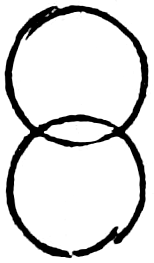
each circle being small, complete, and well-formed, before the foot is changed.
The Mercury figure is merely the outside and inside forward succeeding each other on the same leg alternately, by which a serpentine line is described, thus:

This is skated with the force and rapidity gained by a run. When the run is complete, and the skater on the outside edge, his person becomes quiescent, in the attitude of Mercury, having the right arm advanced and much raised, the face turned over the right shoulder, and the left foot off the ice, a short distance behind the other, turned out and pointed.
FIGURE OF THREE, OR INSIDE EDGE BACKWARDS.
This figure is formed by turning from the outside edge forward to the inside edge backward on the same foot. The head of the 3 is formed like the half circle, on the heel of the outside edge; but when the half circle is complete, the skater leans suddenly forward, and rests on the same toe inside, and a backward motion, making the tail of the 3, is the consequence. The figure described by the right leg should be nearly in the form of No. 1; and on the left leg should be reversed, and resemble No. 2.
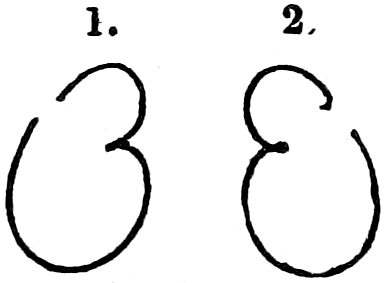
At first, the skater should not throw himself quite so hard as hitherto on the outside forward, in order that he may be able the more easily to change to the inside back. He may also be for some time contented with much less than a semicircle before he turns. Having done this, and brought the left leg nearly up to the other, he must not pass it on in advance, as he would to complete a circle, but throw it gently off sidewise, at the same moment turning the face from the right to the left shoulder, and giving the whole person a slight inclination to the left side. These motions throw the skater upon the inside of his skate; but as the first impulse should still retain most of its force, he continues to move on the inside back, in a direction so little different, that his first impulse loses little by the change. (Plate XIX. fig. 1.)
Plate XIX
Page 77.
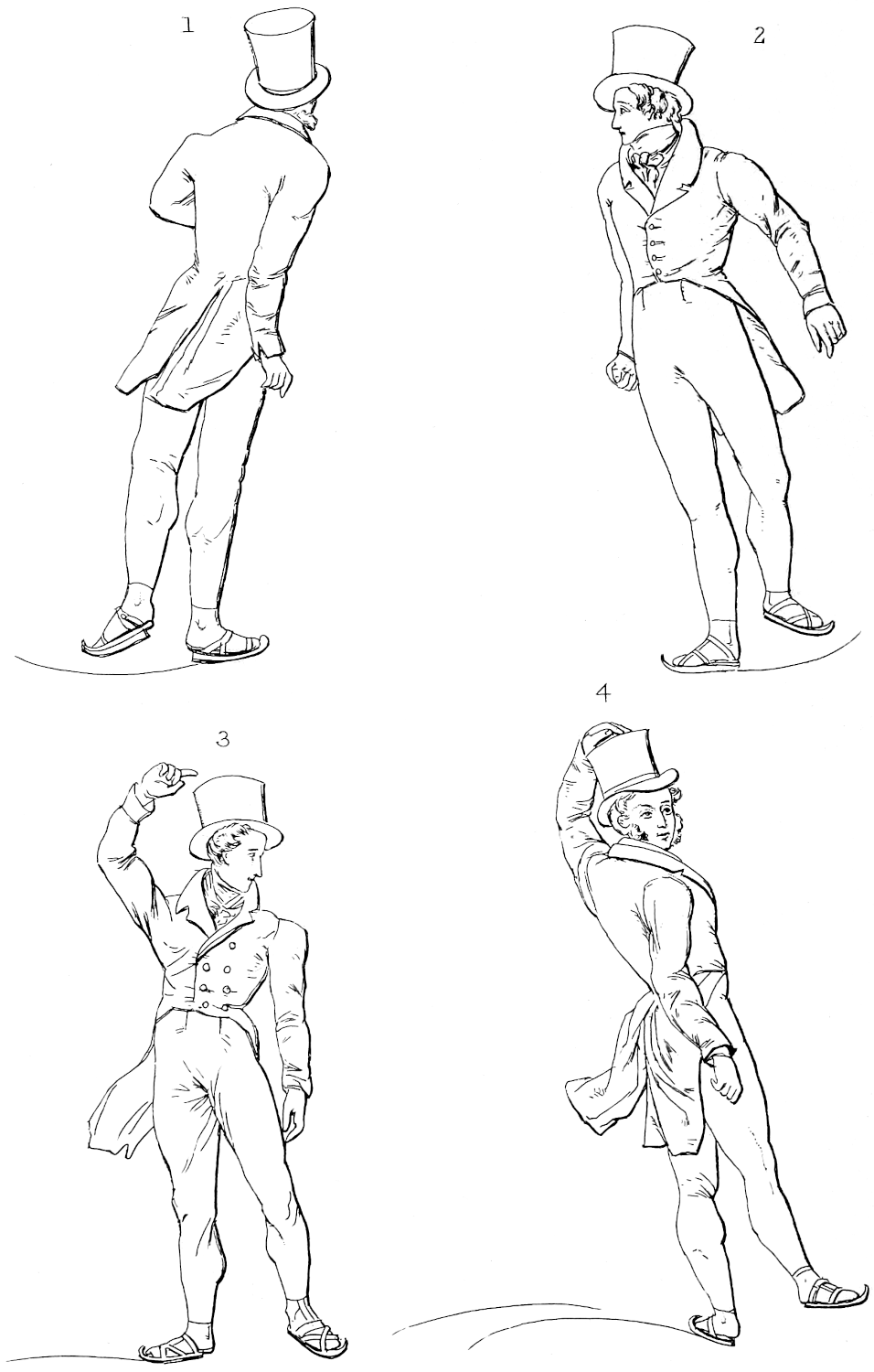
Skating.
If unable to change the edge by this method, the skater may assist himself by slightly and gently swinging the arm and leg outward, so as to incline the person to a rotatory motion. This swing, however, must be corrected as soon as the object is attained; and it must generally be observed that the change from edge to edge is to be effected merely by the inclination of the body, not by swinging.
When the skater is able to join the ends of the 3, so as to form one side of a circle, then, by striking off in the same manner, and completing another 3, with the left leg, the combination of the two 3’s will form an 8. In the first attempts, the 3 should not be made above two feet long, which he will acquire the power of doing almost imperceptibly. He may then gradually extend the size as he advances in the art.
Though, in this section, backward skating is spoken of, the term refers to the skate only, which in such case moves heel foremost, but the person of the skater moves sidewise, the face being always turned in the direction in which he is proceeding.
OUTSIDE EDGE BACKWARDS.
Here the skater, having completed the 3, and being carried on by the first impulse, still continues his progress in the same direction, but on the other foot, putting it down on its outside edge, and continuing to go backwards slowly.
To accomplish this, the skater, after making the 3, and placing the outside edge of his left foot on the ice, should at once turn his face over the right shoulder, raise his right foot from the ice, and throw back his right arm and shoulder. (Plate XIX. fig. 2.) If, for awhile, he is unable readily to raise that foot which has made the 3, and leave himself on the outside of the other skate, he may keep both down for some distance, putting himself, however, in attitude of being on the outside only of one skate, and gradually lifting the other off the ice as he acquires ability.
When finishing any figure, this use of both feet backward has great convenience and beauty.
Before venturing on the outside backward, the skater ought to take care that the ice is clear of stones, reeds, &c., and also be certain of the good quality of his irons. When going with great force backward, the course may be deflected, so as to stop by degrees; and, when moving slowly, the suspended foot may be put down in a cross direction to the path.
Such are the four movements of which alone the skate is capable: namely, the inside edge forward; the outside forward; the inside back; and the outside back; in which has been seen how the impulse for the first two is gained, and how the third flows from the second, and the fourth from the third. By the combination of these elements of skating, and the variations with which they succeed each other, are formed all the evolutions in this art.
The Double Three is that combination in which the skates are brought from the inside back of the first three, to the outside forward of the second. Here the skater, after having completed one 3, and being on the inside back, must bring the whole of the left side forward, particularly the leg, till it is thrown almost across the right, on which he is skating. This action brings him once more to the outside forward, from which he again turns to the inside back. While he is still in motion on the second inside back of the right leg, he must strike on the left, and repeat the same on that.
It is at first enough to do two 3’s perfectly and smoothly. Their number from one impulse may be increased as the skater gains steadiness and skill; the art of accomplishing this being to touch as lightly as possible on each side of the skate successively, so that the first impulse may be preserved and made the most of.
The Back Roll is a means of moving from one foot to another.
Suppose the skater to have put himself on the outside edge back of the left leg, with considerable impulse, by means of the 3 performed on the right,—not bearing hard on the edge, for the object is to change it, and take up the motion on the right foot,—this is effected by throwing the left arm and shoulder back, and turning the face to look over them; when, having brought the inside of his left skate to bear on the ice, he must immediately strike from it to the outside back of the other, by pressing it into the ice as forcibly as he can at the toe. Having thus been brought to the backward roll on the right foot, he repeats the same with it.
The Back Cross Roll is done by changing the balance of the body, to move from one foot to the other, in the same manner as for the back roll. The stroke is from the outside instead of the inside edge of the skate; the edge on which he is skating not being changed, but the right foot, which is off the ice, being crossed at the back of the left, and put down, and the stroke taken at the same moment, from the outside edge of the left skate, at the toe. As in the back roll of both forms, the strokes are but feeble, the skater may, from time to time, renew his impulse as he finds occasion, by commencing anew with the 3.
The large outside backward roll is attained by a run, when the skater, having gained all the impulse he can, strikes on the outside forward of the right leg, turns the 3, and immediately put down the left on the outside back. He then, without further effort, flies rapidly over the ice; the left arm being raised, the head turned over the right shoulder, and the right foot turned out and pointed.
It must be evident, that the elements described may be combined and varied infinitely. Hence waltz and quadrille skating, &c., which may be described as combinations of 3’s, outside backwards, &c. These are left to the judgment of the skater, and his skill in the art.
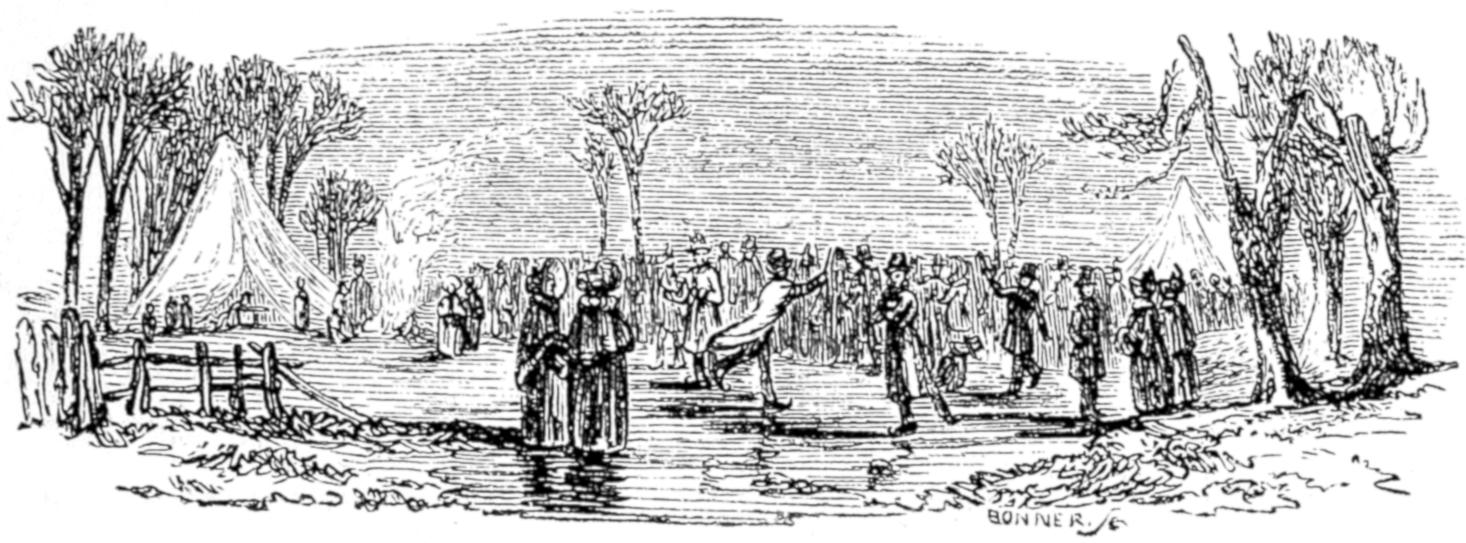
In the North it is common to travel in skates on the gulfs and rivers; and, with a favourable wind, they go faster than vessels. It is a kind of flight, for they only touch the ground in a very slight thin line. As to feats in skating, we are told, that the Frieslander, who is generally a skilful skater, often goes for a long time at the rate of fifteen miles an hour. In 1801, two young women, going thirty miles in two hours, won the prize in a skating race at Groningen. In 1821, a Lincolnshire man, for a wager of 100 guineas, skated one mile within two seconds of three minutes.
DANGERS IN SKATING.
If the chest be irritable, it is neither salutary nor easy to skate against the wind. In countries where these exercises are general, inflammations of the chest are very common in winter. Skating sometimes exposes to much danger. If the skater find that he cannot get away from rotten ice, he must crawl over it on his hands and knees, in order to reduce his weight on the supporting points. If he fall on it at length, he must roll away from it towards ice more firm. If he fall into a hole, he must extend his arms horizontally over the edges of the unbroken ice, and only tread water, till a ladder or a plank is pushed towards him, or a rope is thrown for his hold.
TREATMENT RECOMMENDED IN THE CASE OF DROWNED PERSONS.
Cautions.—1. Lose no time. 2. Avoid all rough usage. 3. Never hold the body up by the feet. 4. Nor roll the body on casks. 5. Nor rub the body with salt or spirits. 6. Nor inject tobacco-smoke or infusion of tobacco.
Restorative means if apparently drowned.—Send quickly for medical assistance; but do not delay the following means.
I. Convey the body carefully, with the head and shoulders supported in a raised position, to the nearest house.
II. Strip the body, and rub it dry; then wrap it in hot blankets, and place it in a warm bed in a warm chamber.
III. Wipe and cleanse the mouth and nostrils.
IV. In order to restore the natural warmth of the body:
1. Move a heated covered warming-pan over the back and spine.
2. Put bladders or bottles of hot water, or heated bricks, to the pit of the stomach, the arm-pits, between the thighs, and to the soles of the feet.
3. Foment the body with hot flannels; but, if possible,
4. Immerse the body in a warm bath, as hot as the hand can bear without pain, as this is preferable to the other means for restoring warmth.
5. Rub the body briskly with the hand; do not, however, suspend the use of the other means at the same time.
V. In order to restore breathing, introduce the pipe of a common bellows (where the apparatus of the Society is not at hand) into one nostril, carefully closing the other and the mouth: at the same time draw downwards and push gently backwards the upper part of the windpipe, to allow a more free admission of air: blow the bellows gently in order to inflate the lungs, till the breast be a little raised: the mouth and nostrils should then be set free, and a moderate pressure should be made with the hand upon the chest. Repeat this process till life appears.
VI. Electricity should be employed early by a medical assistant.
VII. Inject into the stomach, by means of an elastic tube and syringe, half a pint of warm brandy and water, or wine and water.
VIII. Apply sal-volatile or hartshorn to the nostrils.
If apparently dead from intense cold.—Rub the body with snow, ice, or cold water. Restore warmth by slow degrees; and after some time, if necessary, employ the means recommended for the drowned. In these accidents, it is highly dangerous to apply heat too early.