AQUATIC EXERCISES
Reading edition
SWIMMING.
Swimming, considered with regard to the movements that it requires, is useful in promoting great muscular strength; but the good effects are not solely the result of the exercise that the muscles receive, but partly of the medium in which the body is moved. Both the considerable increase of general force, and the tranquillizing of the nervous system produced by swimming, arise chiefly from this, that the movements, in consequence of the cold and dense medium in which they take place, occasion no loss.[8] It is easy to conceive of what utility swimming must be, where the very high state of the atmospheric temperature requires inactivity in consequence of the excessive loss caused by the slightest movement. It then becomes an exceedingly valuable resource, the only one, indeed, by which muscular weakness can be remedied, and the energy of the vital functions maintained. We must therefore regard swimming as one of the most beneficial exercises that can be taken in summer.
Plate XX
Page 83.
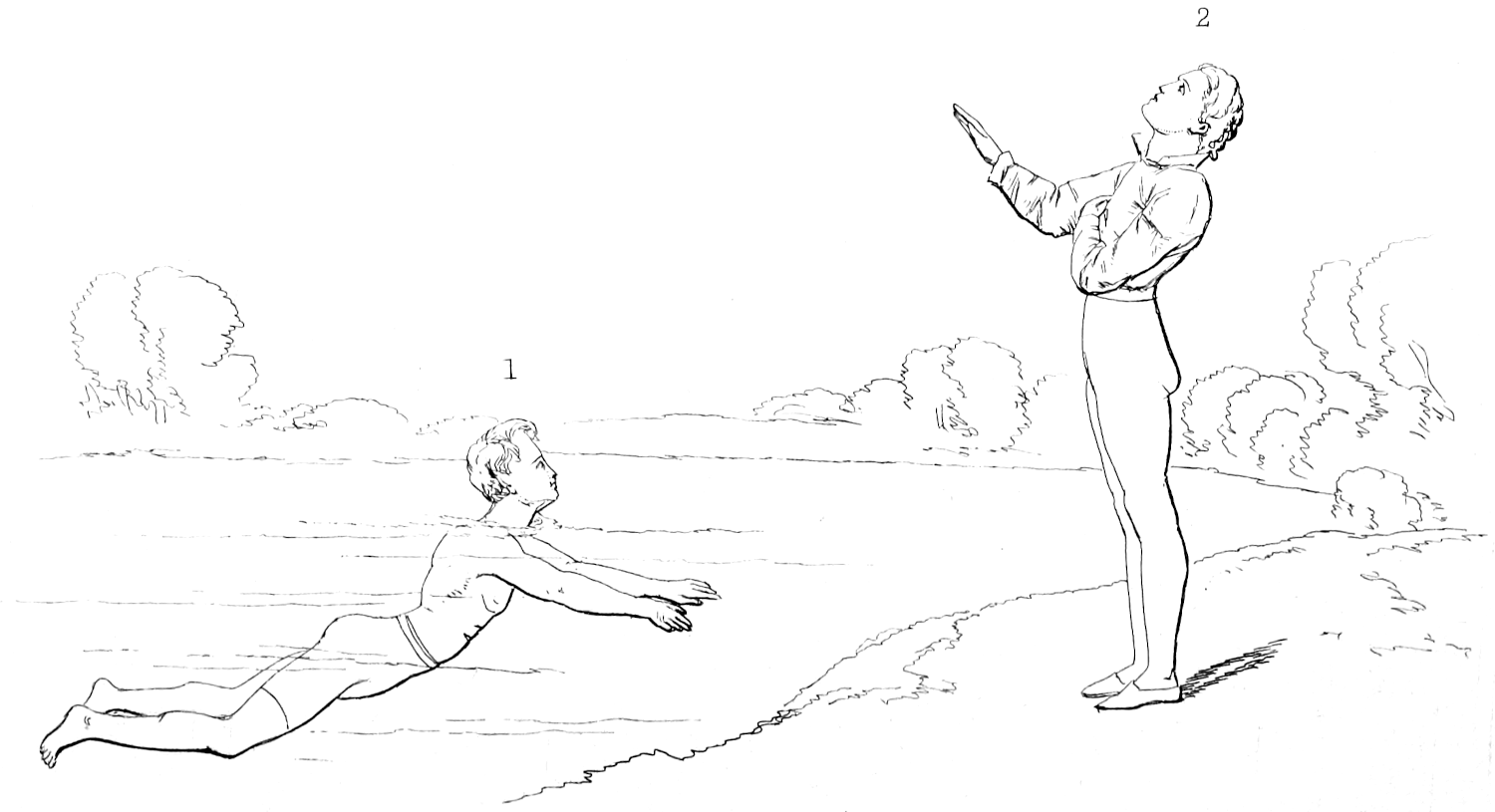
Swimming—Attitude.
The ancients, particularly the Athenians, regarded swimming as indispensable; and when they wished to designate a man who was fit for nothing, they used to say, “he cannot even swim,” or “he can neither read nor swim.” At many seaports, the art of swimming is almost indispensable; and the sailors’ children are as familiar with the water as with the air. Copenhagen is perhaps the only place where sailors are trained by rules of art; and there, this exercise is more general and in greater perfection than elsewhere. It may here be observed, that it is not fear alone that prevents a man swimming. Swimming is an art that must be learnt; and fear is only an obstacle to the learning.
PREPARATORY INSTRUCTIONS AS TO ATTITUDE AND ACTION IN SWIMMING.
As it is on the movements of the limbs, and a certain attitude of the body, that the power of swimming depends, its first principles may evidently be acquired out of the water.
Attitude.
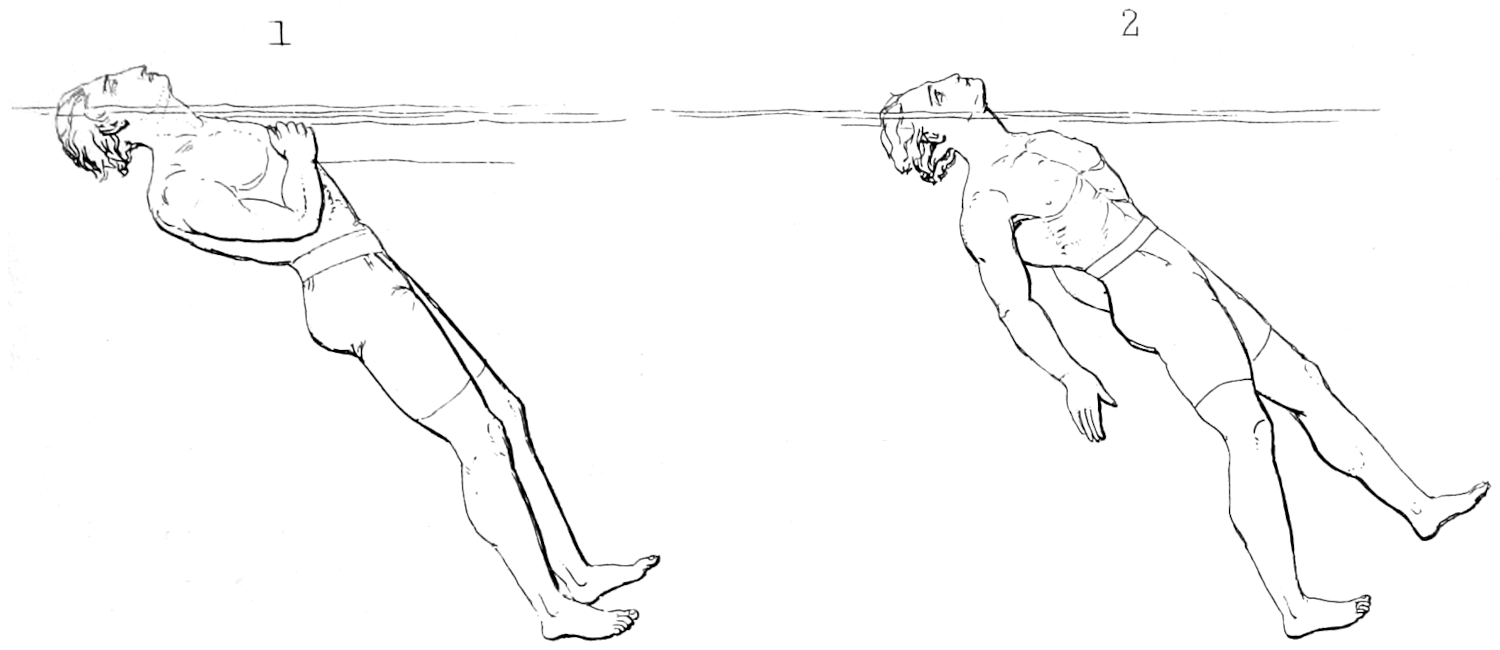
The head must be drawn back, and the chin elevated, the breast projected, and the back hollowed and kept steady. (Plate XX. figs. 1 and 2.) The head can scarcely be thrown too much back, or the back too much hollowed. Those who do otherwise, swim with their feet near the surface of the water, instead of having them two or three feet deep.
Action of the Hands.
In the proper position of the hands, the fingers must be kept close, with the thumbs by the edge of the fore-fingers; and the hands made concave on the inside, though not so much as to diminish their size and power in swimming. The hands, thus formed, should be placed just before the breast, the wrist touching it, and the fingers pointing forward. (Plate XXI. fig. 1.)
The first elevation is formed by raising the ends of the fingers three or four inches higher than the rest of the hands. The second, by raising the outer edge of the hand two or three inches higher than the inner edge.
The formation of the hands, their first position, and their two modes of elevation, being clearly understood, the forward stroke is next made, by projecting them in that direction to their utmost extent, employing therein their first elevation, in order to produce buoyancy, but taking care the fingers do not break the surface of the water. (Plate XXI. fig. 2.) In the outward stroke of the hands, the second elevation must be employed; and, in it, they must sweep downward and outward as low as, but at a distance from, the hips, both laterally and anteriorly. (Plate XXI. figs. 3 and 4.)
The retraction of the hands is effected by bringing the arms closer to the sides, bending the elbow joints upwards and the wrists downwards, so that the hands hang down, while the arms are raising them to the first position, the action of the hands being gentle and easy. In the three movements just described, one arm may be exercised at a time, until each is accustomed to the action.
Action of the Feet.
In drawing up the legs, the knees must be inclined inward, and the soles of the feet outward. (Plate XXII. fig. 1.) The throwing out the feet should be to the extent of the legs, as widely from each other as possible. (Plate XXII. fig. 2.) The bringing down the legs must be done briskly, until they come close together. In drawing up the legs, there is a loss of power; in throwing out the legs, there is a gain equal to that loss; and in bringing down the legs, there is an evident gain.
Plate XXI
Page 84.
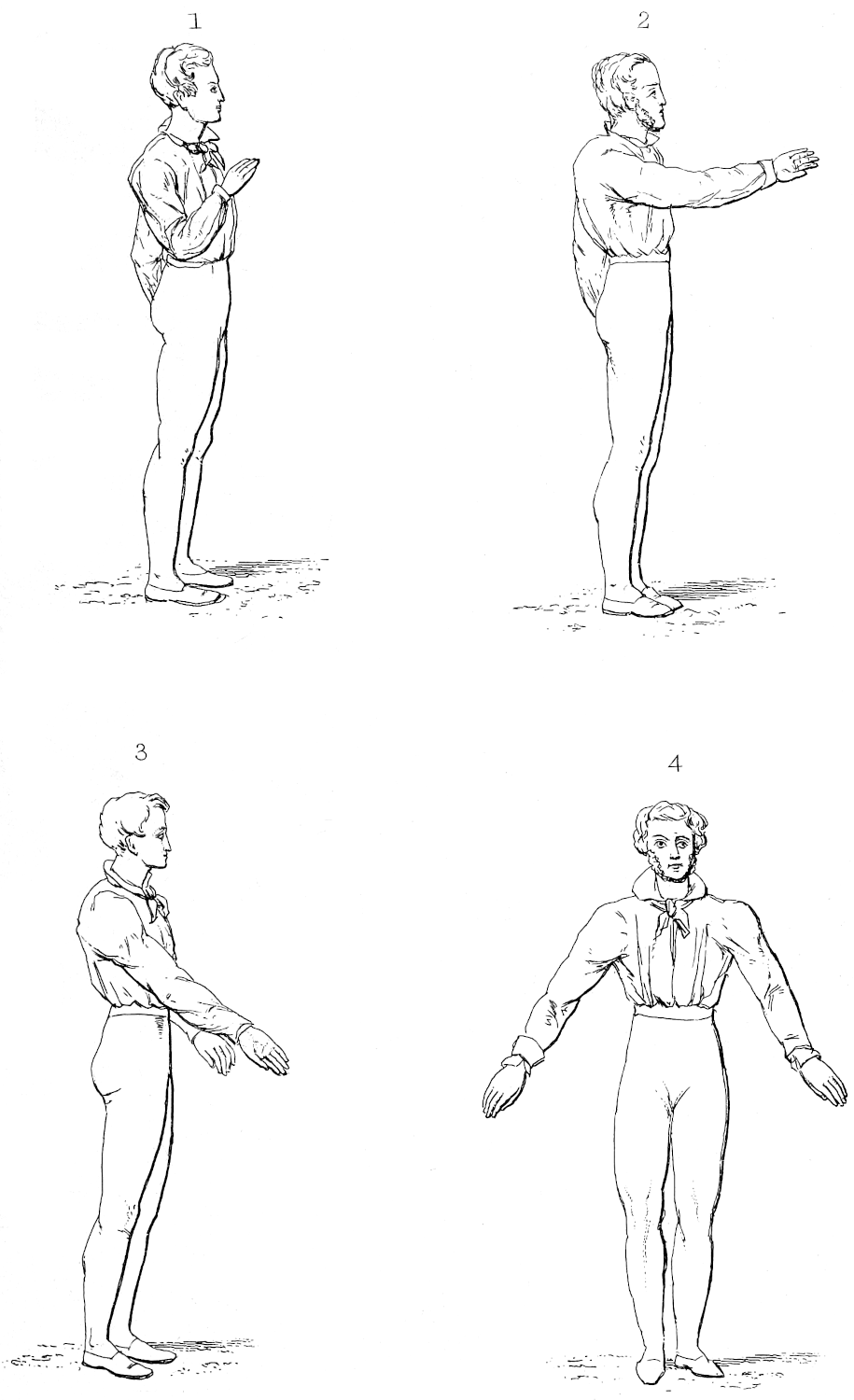
Swimming—Action of the Hands.
Plate XXII
Page 85.
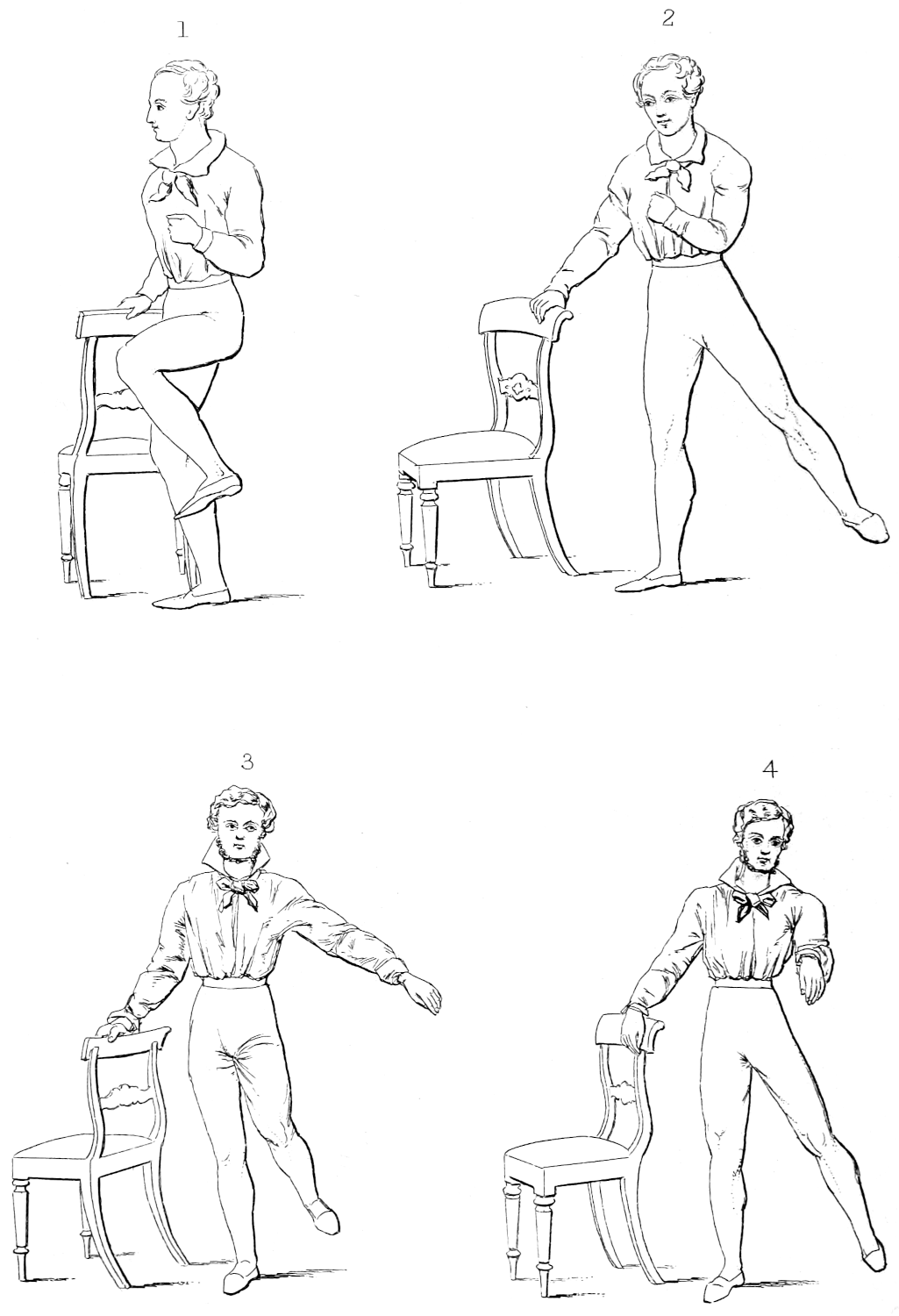
Swimming—Action of the Feet.
The arms and legs should act alternately; the arms descending while the legs are rising—(Plate XXII. fig. 3); and, oppositely, the arms rising while the legs are descending. (Plate XXII. fig. 4.) Thus the action of both is unceasingly interchanged; and, until great facility in this interchange is effected, no one can swim smoothly, or keep the body in one continued progressive motion. In practising the action of the legs, one hand may rest on the top of a chair, while the opposite leg is exercised. When both the arms and the legs are separately accustomed to the action, the arm and leg of the same side may be exercised together.
PLACE AND TIME OF SWIMMING.
Place.
Of all places for swimming, the sea is the best; running waters next; and ponds the worst. In these a particular spot should be chosen, where there is not much stream, and which is known to be safe.
The swimmer should make sure that the bottom is not out of his depth; and, on this subject, he cannot be too cautious when he has no one with him who knows the place. If capable of diving, he should ascertain if the water be sufficiently deep for that purpose, otherwise, he may injure himself against the bottom. The bottom should be of gravel, or smooth stones, and free from holes, so that he may be in no danger of sinking in the mud or wounding the feet. Of weeds he must beware; for if his feet get entangled among them, no aid, even if near, may be able to extricate him.
Time.
The best season of the year for swimming is during the months of May, June, July, and August. Morning before breakfast—that is to say, from seven till eight o’clock—is the time. In the evening, the hair is not perfectly dried, and coryza is sometimes the consequence. Bathing during rain is bad, for it chills the water, and, by wetting the clothes, endangers catching cold. In practising swimming during those hours of the day when the heat of the sun is felt most sensibly, if the hair be thick, it should be kept constantly wet; if the head be bald, it must be covered with a handkerchief, and frequently wetted.
It is advisable not to enter the water before digestion is finished. The danger in this case arises less from the violent movements which generally disorder digestion, than from the impression produced by the medium in which these movements are executed. It is not less so when very hot, or quite cold. It is wrong to enter the water in a perspiration, however trifling it may be. After violent exercises, it is better to wash and employ friction than to bathe. Persons of plethoric temperament, who are subject to periodical evacuations, such as hemorrhoids, or even to cutaneous eruptions, will do well to abstain from swimming during the appearance of these affections.
Dress.
Every swimmer should use short drawers, and might, in particular places, use canvass slippers. It is even of great importance to be able to swim in jacket and trousers.
Aids.
The aid of the hand is much preferable to corks or bladders, because it can be withdrawn gradually and insensibly. With this view, a grown-up person may take the learner in his arms, carry him into the water breast high, place him nearly flat upon it, support him by one hand under the breast, and direct him as to attitude and action. If the support of the hand be very gradually withdrawn, the swimmer will, in the course of the first ten days, find it quite unnecessary. When the aid of the hand cannot be obtained, inflated membranes or corks may be employed. The only argument for their use is, that attitude and action may be perfected while the body is thus supported; and that, with some contrivance, they also may gradually be laid aside, though by no means so easily as the hand.
The best mode of employing corks is to choose a piece about a foot long, and six or seven inches broad; to fasten a band across the middle of it; to place it on the back, so that the upper end may come between the shoulder-blades, where the edge may be rounded; and to tie the band over the breast. Over this, several other pieces of cork, each smaller than the preceding, may be fixed, so that, as the swimmer improves, he may leave them off one by one. Even with all these aids, the young swimmer should never venture out of his depth, if he cannot swim without them.
Cramp.
As to cramp, those chiefly are liable to it who plunge into the water when they are heated, who remain in it till they are benumbed with cold, or who exhaust themselves by violent exercise. Persons subject to this affection must be careful with regard to the selection of the place where they bathe, if they are not sufficiently skilful in swimming to vary their attitudes, and dispense instantly with the use of the limb attacked by cramp. Even when this does occur, the skilful swimmer knows how to reach the shore by the aid of the limbs which are unaffected, while the uninstructed one is liable to be drowned.
If attacked in this way in the leg, the swimmer must strike out the limb with all his strength, thrusting the heel downward and drawing the toes upward, notwithstanding the momentary pain it may occasion; or he may immediately turn flat on his back, and jerk out the affected limb in the air, taking care not to elevate it so high as greatly to disturb the balance of the body. If this does not succeed, he must paddle ashore with his hands, or keep himself afloat by their aid, until assistance reach him. Should he even be unable to float on his back, he must put himself in the upright position, and keep his head above the surface by merely striking the water downward with his hands at the hips, without any assistance from the legs.
PROCEDURE WHEN IN THE WATER, AND USUAL MODE OF FRONT SWIMMING.
Entering the Water.
Instructors should never force young swimmers reluctantly to leap into the water. It would be advisable for delicate persons, especially when they intend to plunge in, to put a little cotton steeped in oil, and afterwards pressed, in their ears, before entering the water. This precaution will prevent irritation of the organ of hearing. In entering, the head should be wetted first, either by plunging in head foremost, or by pouring water on it, in order to prevent the pressure of the water driving up the blood into it too quickly, and increasing congestion. The swimmer should next advance, by a clear shelving shore or bank, where he has ascertained the depth by plumbing or otherwise, till the water reaches his breast; should turn towards the place of entrance; and, having inflated his breast, lay it upon the water, suffering that to rise to his chin, the lips being closed.
Buoyancy in the Water.
The head alone is specifically heavier than salt water. Even the legs and arms are specifically lighter; and the trunk is still more so. Thus the body cannot sink in salt water, even if the lungs were filled, except owing to the excessive specific gravity of the head.
Not only the head, but the legs and arms, are specifically heavier than fresh water; but still the hollowness of the trunk renders the body altogether too light to sink wholly under water, so that some part remains above until the lungs become filled. In general, when the human body is immersed, one-eleventh of its weight remains above the surface in fresh water, and one-tenth in salt water.
In salt water, therefore, a person throwing himself on his back, and extending his arms, may easily lie so as to keep his mouth and nostrils free for breathing; and, by a small motion of the hand, may prevent turning, if he perceive any tendency to it. In fresh water, a man cannot long continue in that situation, except by the action of his hands; and if no such action be employed, the legs and lower part of the body will gradually sink into an upright position, the hollow of the breast keeping the head uppermost. If, however, in this position, the head be kept upright above the shoulders, as in standing on the ground, the immersion, owing to the weight of the part of the head out of the water, will reach above the mouth and nostrils, perhaps a little above the eyes. On the contrary, in the same position, if the head be leaned back, so that the face is turned upwards, the back part of the head has its weight supported by the water, and the face will rise an inch higher at every inspiration, and will sink as much at every expiration, but never so low that the water can come over the mouth.
For all these reasons, though the impetus given by the fall of the body into water occasions its sinking to a depth proportioned to the force of the descent, its natural buoyancy soon impels it again to the surface, where, after a few oscillations up and down, it settles with the head free.
Unfortunately, ignorant people stretch the arms out to grasp at anything or nothing, and thereby keep the head under; for the arms and head, together exceeding in weight one-tenth of the body, cannot remain above the surface at the same time. The buoyancy of the trunk, then and then only, occasions the head and shoulders to sink, the ridge of the bent back becoming the portion exposed; and, in this attitude, water is swallowed, by which the specific gravity is increased, and the body settles to the bottom. It is, therefore, most important to the safety of the inexperienced to be firmly convinced that the body naturally floats.
To satisfy the beginner of the truth of this, Dr. Franklin advises him to choose a place where clear water deepens gradually, to walk into it till it is up to his breast, to turn his face to the shore, and to throw an egg into the water between him and it—so deep that he cannot fetch it up but by diving. To encourage him to take it up, he must reflect that his progress will be from deep to shallow water, and that at any time he may, by bringing his legs under him, and standing on the bottom, raise his head far above the water. He must then plunge under it, having his eyes open, before as well as after going under; throw himself towards the egg, and endeavour, by the action of his hands and feet against the water, to get forward till within reach of it. In this attempt, he will find that the water brings him up against his inclination, that it is not so easy to sink as he imagined, and that he cannot, but by force, get down to the egg. Thus he feels the power of water to support him, and learns to confide in that power; while his endeavours to overcome it, and reach the egg, teach him the manner of acting on the water with his feet and hands, as he afterwards must in swimming, in order to support his head higher above the water, or to go forward through it.
If, then, any person, however unacquainted with swimming, will hold himself perfectly still and upright, as if standing with his head somewhat thrown back so as to rest on the surface, his face will remain above the water, and he will enjoy full freedom of breathing. To do this most effectually, the head must be so far thrown back that the chin is higher than the forehead, the breast inflated, the back quite hollow, and the hands and arms kept under water. If these directions be carefully observed, the face will float above the water, and the body will settle in a diagonal direction. (Plate XXIII. fig. 1.)
In this case, the only difficulty is to preserve the balance of the body. This is secured, as described by Bernardi, by extending the arms laterally under the surface of the water, with the legs separated, the one to the front and the other behind: thus presenting resistance to any tendency of the body to incline to either side, forward or backward. This posture may be preserved any length of time. (Plate XXIII. fig. 2.)
The Abbé Paul Moccia, who lived in Naples in 1760, perceived, at the age of fifty, that he could never entirely cover himself in the water. He weighed three hundred pounds (Italian weight), but being very fat, he lost at least thirty pounds in the water. Robertson had just made his experiments on the specific weight of man; and everybody was then occupied with the Abbé, who could walk in the water with nearly half his body out of it.
Plate XXIII
Page 90.
Swimming—Buoyancy in Water.
Swimming—Treading Water.
Attitude and Action in the Water.
The swimmer having, by all the preceding means, acquired confidence, may now practise the instructions already given on attitude and action in swimming: or he may first proceed with the system of Bernardi, which immediately follows. As the former have already been given in ample detail, there is nothing new here to be added respecting them, except that, while the attitude is correct, the limbs must be exercised calmly, and free from all hurry and trepidation, the breath being held, and the breast kept inflated, while a few strokes are made. In swimming in the usual way, there is, first, extension, flexion, abduction and adduction of the members; secondly, almost constant dilation of the chest, to diminish the mobility of the point of attachment of the muscles which are inserted in the elastic sides of this cavity, and to render the body specifically lighter; thirdly, constant action of the muscles of the back part of the neck, to raise the head, which is relatively very heavy, and to allow the air free entrance to the lungs.
Respiration in Swimming.
If the breath is drawn at the moment when the swimmer strikes out with the legs, instead of when the body is elevated by the hands descending towards the hips, the head partially sinks, the face is driven against the water, and the mouth becomes filled. If, on the contrary, the breath is drawn when the body is elevated by the hands descending towards the hips, when the progress of the body forward consequently ceases, when the face is no longer driven against the water, but is elevated above the surface,—then, not only cannot the water enter, but if the mouth were at other times even with, or partly under the surface, no water could enter it, as the air, at such times, driven outward between the lips, would effectually prevent it. The breath should accordingly be expired while the body, at the next stroke, is sent forward by the action of the legs.
Coming out of the Water.
Too much fatigue in the water weakens the strength and presence of mind necessary to avoid accidents. A person who is fatigued, and remains there without motion, soon becomes weak and chilly. As soon as he feels fatigued, chill, or numbed, he should quit the water, and dry and dress himself as quickly as possible. Friction, previous to dressing, drives the blood over every part of the body, creates an agreeable glow, and strengthens the joints and muscles.
UPRIGHT SWIMMING.
Bernardi’s System.
The principal reasons given by Bernardi for recommending the upright position in swimming are—its conformity to the accustomed movement of the limbs; the freedom it gives to the hands and arms, by which any impediment may be removed, or any offered aid readily laid hold of; vision all around; a much greater facility of breathing; and lastly, that much less of the body is exposed to the risk of being laid hold of by persons struggling in the water.
The less we alter our method of advancing in the water from what is habitual to us on shore, the more easy do we find a continued exercise of it. The most important consequence of this is, that, though a person swimming in an upright posture advances more slowly, he is able to continue his course much longer; and certainly nothing can be more beneficial to a swimmer than whatever tends to husband his strength, and to enable him to remain long in the water with safety.
Bernardi’s primary object is to enable the pupil to float in an upright posture, and to feel confidence in the buoyancy of his body. He accordingly supports the pupil under the shoulders until he floats tranquilly with the head and part of the neck above the surface, the arms being stretched out horizontally under water. From time to time, the supporting arm is removed, but again restored, so as never to suffer the head to sink, which would disturb the growing confidence, and give rise to efforts destructive of the success of the lesson. In this early stage, the unsteadiness of the body is the chief difficulty to be overcome.
The head is the great regulator of our movements in water. Its smallest inclination to either side instantly operates on the whole body; and, if not corrected, throws it into a horizontal posture. The pupil must, therefore, restore any disturbance of equilibrium by a cautious movement of the head alone in an opposite direction. This first lesson being familiarized by practice, he is taught the use of the legs and arms for balancing the body in the water. One leg being stretched forward, the other backward, and the arms laterally, he soon finds himself steadily sustained, and independent of further aid in floating.
When these first steps have been gained, the sweeping semicircular motion of the arms is shown. This is practised slowly, without motion forwards, until attained with precision. After this, a slight inclination of the body from the upright position occasions its advancing. The motion of striking with the legs is added in the same measured manner; so that the pupil is not perplexed by the acquisition of more than one thing at a time. In this method, the motions of both arms and legs differ from those we have so carefully described, only in so far as they are modified by a more upright position. It is optional, therefore, with the reader, to practise either method. The general principles of both are now before him.
The upright position a little inclined backwards, (which, like every other change of posture, must be done deliberately, by the corresponding movement of the head,) reversing in this case the motion of the arms, and striking the flat part of the foot down and a little forward, gives the motion backward, which is performed with greater ease than when the body is laid horizontally on the back. According to this system, Bernardi says, a swimmer ought at every stroke to urge himself forward a distance equal to the length of his body. A good swimmer ought to make about three miles an hour. A good day’s journey may thus be achieved, if the strength be used with due discretion, and the swimmer be familiar with the various means by which it may be recruited.
Of Bernardi’s successful practice, he says, “Having been appointed to instruct the youths of the Royal Naval Academy of Naples in the art of swimming, a trial of the proficiency of the pupils took place, under the inspection of a number of people assembled on the shore for that purpose, on the tenth day of their instruction. A twelve-oared boat attended the progress of the pupils, from motives of precaution. They swam so far out in the bay, that at length the heads of the young men could with difficulty be discerned with the naked eye; and the Major General of Marine, Forteguerri, for whose inspection the exhibition was intended, expressed serious apprehensions for their safety. Upon their return to the shore, the young men, however, assured him that they felt so little exhausted as to be willing immediately to repeat the exertion.” An official report on the subject has also been drawn up by commission (appointed by the Neapolitan government), after devoting a month to the investigation of Bernardi’s plan; and it states as follows:
“1st. It has been established by the experience of more than a hundred persons of different bodily constitutions, that the human body is lighter than water, and consequently will float by nature; but that the art of swimming must be acquired, to render that privilege useful.
“2dly. That Bernardi’s system is new, in so far as it is founded on the principle of husbanding the strength, and rendering the power of recruiting it easy. The speed, according to the new method, is no doubt diminished; but security is much more important than speed; and the new plan is not exclusive of the old, when occasions require great effort.
“3dly. That the new method is sooner learnt than the old, to the extent of advancing a pupil in one day as far as a month’s instruction on the old plan.”
Treading Water.
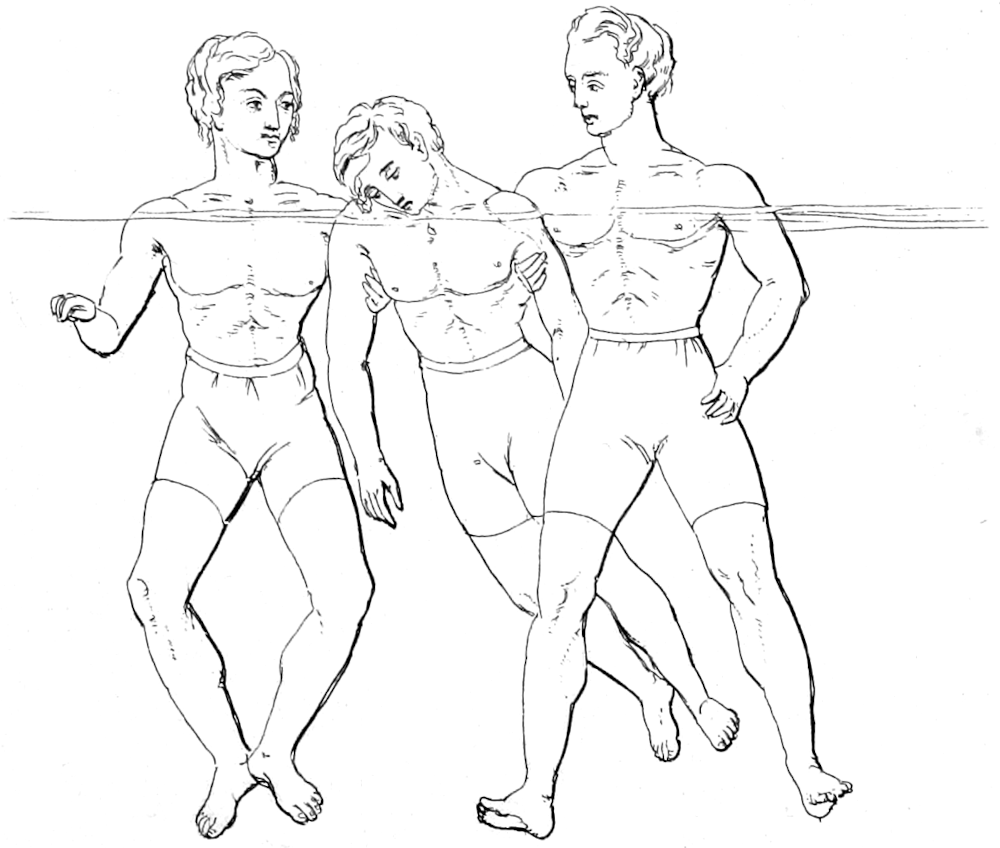
This differs little from the system just described. As in it, the position is upright; but progression is obtained by the action of the legs alone. There is little power in this method of swimming: but it may be very useful in rescuing drowning persons.
The arms should be folded across, below the breast, or compressed against the hips, and the legs employed as in front swimming, except as to time and extent. They should perform their action in half the usual time, or two strokes should be taken in the time of one; because, acting perpendicularly, each stroke would otherwise raise the swimmer too much, and he would sink too low between the strokes, were they not quickly to follow each other. They should also work in about two-thirds of the usual space, preserving the upper or stronger, and omitting the lower or weaker, part of the stroke.
There is, however, another mode of treading water, in which the thighs are separated, and the legs slightly bent, or curved together, as in a half-sitting posture. Here the legs are used alternately, so that, while one remains more contracted, the other, less so, describes a circle. By this method, the swimmer does not seem to hop in the water, but remains nearly at the same height. Pl XXIII. f. 3 represents both these methods, and shows their peculiar adaptation to relieve drowning persons.
BACK SWIMMING.
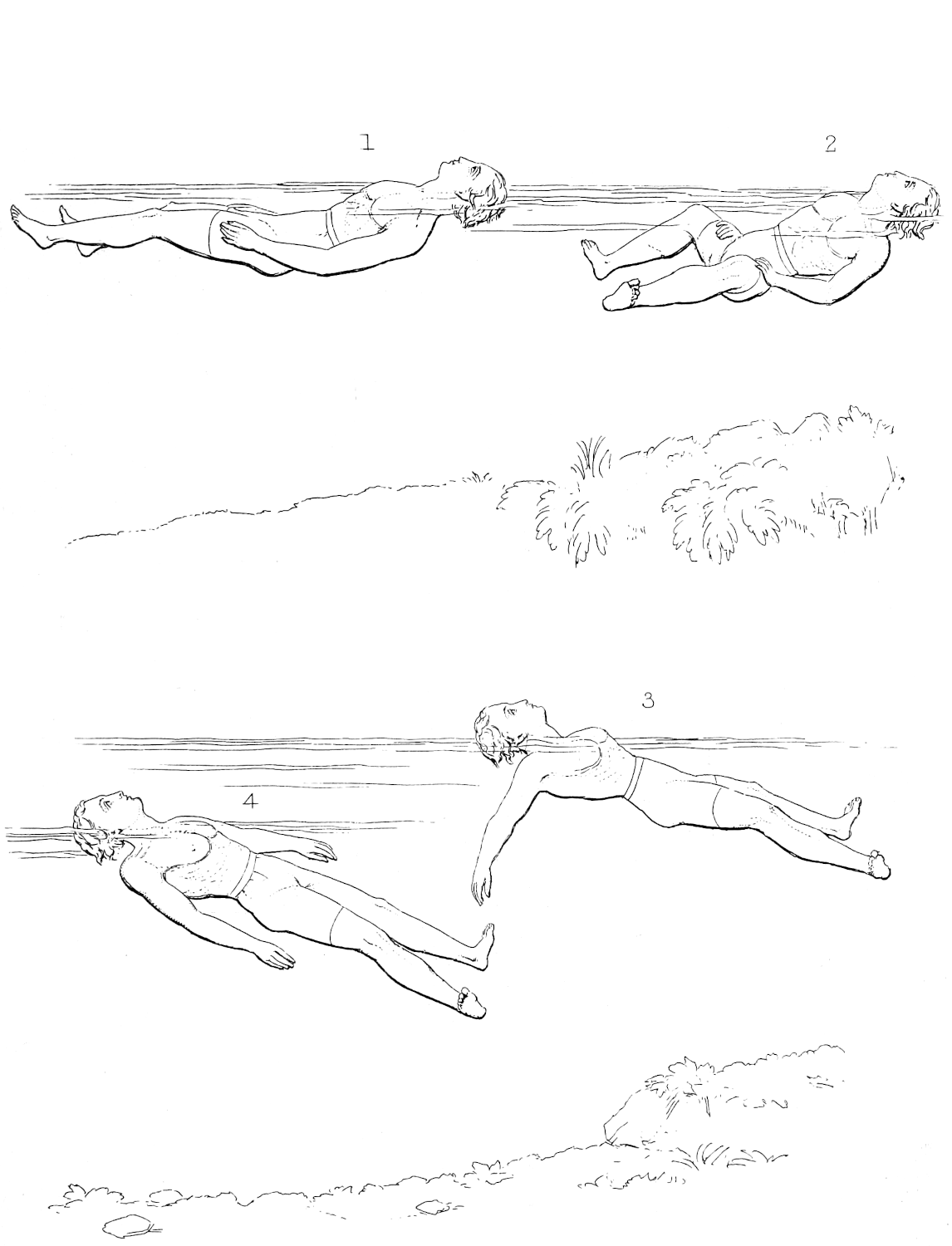
In swimming on the back, the action of the thoracic member is weaker, because the swimmer can support himself on the water without their assistance. The muscular contractions take place principally in the muscles of the abdominal members, and in those of the anterior part of the neck. Though little calculated for progression, it is the easiest of all methods, because, much of the head being immersed, little effort is required for support. For this purpose, the swimmer must lie down gently upon the water; the body extended; the head kept in a line with it, so that the back and much of the upper part of the head may be immersed; the head and breast must remain perfectly unagitated by the action of the legs; the hand laid on the thighs (Plate XXIV. fig. 1), and the legs employed as in front swimming, care being taken that the knees do not rise out of the water.—(Plate XXIV. fig. 2.) The arms may, however, be used in various ways in swimming on the back.
In the method called winging, the arms are extended till in a line with each other; they must then be struck down to the thighs, with the palms turned in that direction, and the thumbs inclining downward to increase the buoyancy, (Plate XXIV. fig. 3); the palms must then be moved edgewise, and the arms elevated as before (Plate XXIV. fig. 4); and so on, repeating the same actions. The legs should throughout make one stroke as the arms are struck down, and another as they are elevated. The other mode, called finning, differs from this only in the stroke of the arms being shorter, and made in the same time as that of the legs.
In back swimming, the body should be extended after each stroke, and long pauses made between these. The act of passing from front to back, or back to front swimming, must always be performed immediately after throwing out the feet. To turn from the breast to the back, the legs must be raised forward, and the head thrown backward, until the body is in a right position. To turn from the back to the breast, the legs must be dropped, and the body thrown forward on the breast.
FLOATING.
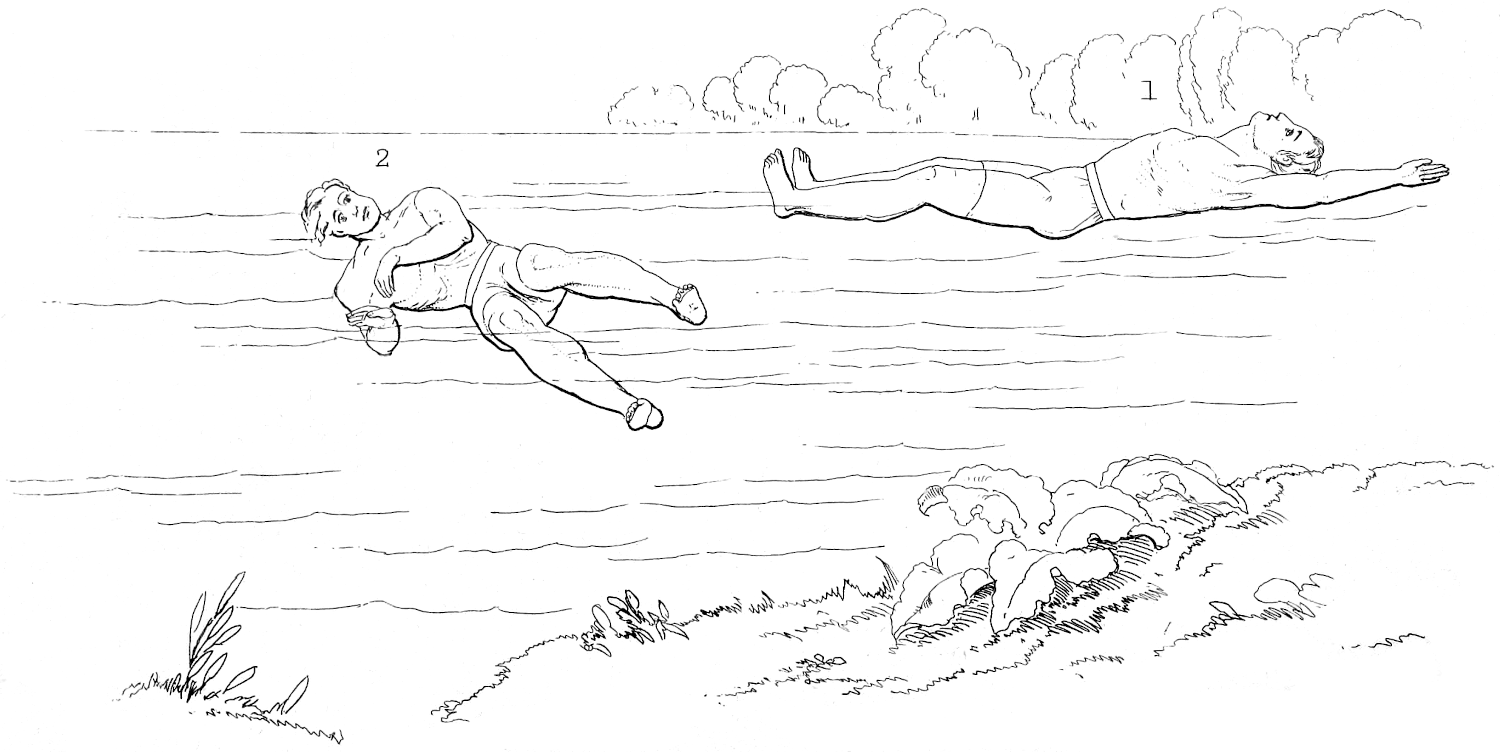
Floating is properly a transition from swimming on the back. To effect it, it is necessary, while the legs are gently exercising, to extend the arms as far as possible beyond the head, equidistant from, and parallel with its sides, but never rising above the surface; to immerse the head rather deeply, and elevate the chin more than the forehead; to inflate the chest while taking this position, and so to keep it as much as possible; and to cease the action of the legs, and put the feet together. (Plate XXV. fig. 1.) The swimmer will thus be able to float, rising a little with every inspiration, and falling with every expiration. Should the feet descend, the loins may be hollowed.
Plate XXIV
Page 96.
Swimming—Back Swimming.
Plate XXV
Page 97.
Side Swimming.
Floating.
SIDE SWIMMING.
For this purpose, the body may be turned either upon the right or left side: the feet must perform their usual motions: the arms also require peculiar guidance. In lowering the left, and elevating the right side, the swimmer must strike forward with the left hand, and sidewise with the right; the back of the latter being front instead of upward, and the thumb side of the hand downward to serve as an oar. In turning on the right side, the swimmer must strike out with the right hand, and use the left as an oar. In both cases, the lower arm stretches itself out quickly, at the same time that the feet are striking; and the upper arm strikes at the same time that the feet are impelling, the hand of the latter arm beginning its stroke on a level with the head. While this hand is again brought forward, and the feet are contracted, the lower hand is drawn back towards the breast, rather to sustain than to impel, (Plate XXV. fig. 2.) As side swimming presents to the water a smaller surface than front swimming, it is preferable when rapidity is necessary. But, though generally adopted when it is required to pass over a short distance with rapidity, it is much more fatiguing than the preceding methods.
PLUNGING.
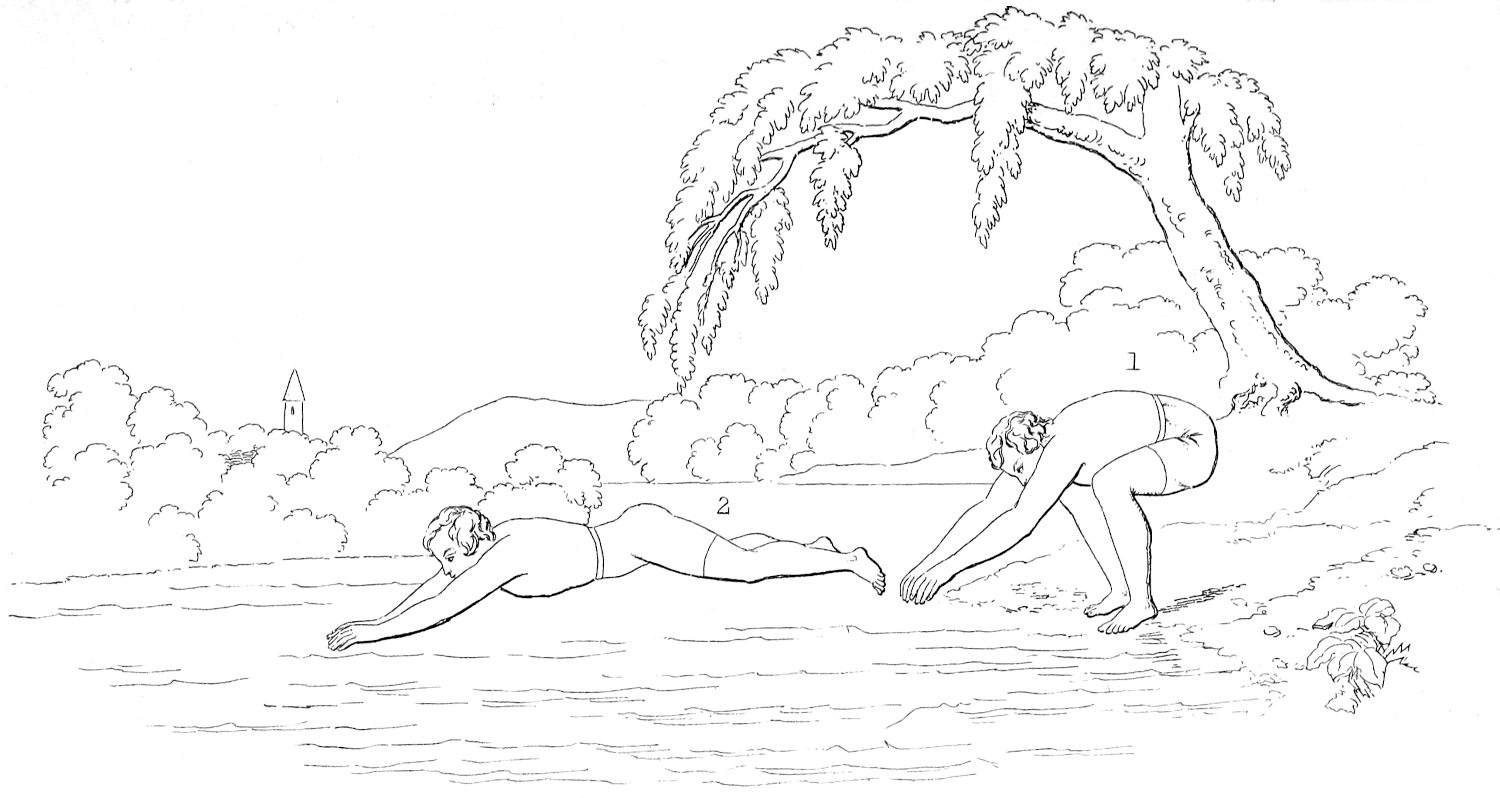
In the leap to plunge, the legs must be kept together, the arms close, and the plunge made either with the feet or the head foremost. With the feet foremost they must be kept together, and the body inclined backwards. With the head foremost, the methods vary.
In the deep plunge, which is used where it is known that there is depth of water, the swimmer has his arms outstretched, his knees bent, and his body leant forwards (Plate XXVI. fig. 1,) till the head descends nearly to the feet, when the spine and knees are extended. This plunge may be made without the slightest noise. When the swimmer rises to the surface, he must not open his mouth before previously repelling the water.
In the flat plunge, which is used in shallow water, or where the depth is unknown, and which can be made only from a small height, the swimmer must fling himself forwards, in order to extend the line of the plunge as much as possible under the surface of the water; and, as soon as he touches it, he must keep his head up, his back hollow, and his hands stretched forward, flat and inclined upward. He will thus dart forwards a considerable way close under the surface, so that his head will reach it before the impulse ceases to operate. (Plate XXVI. fig. 2.)
DIVING.
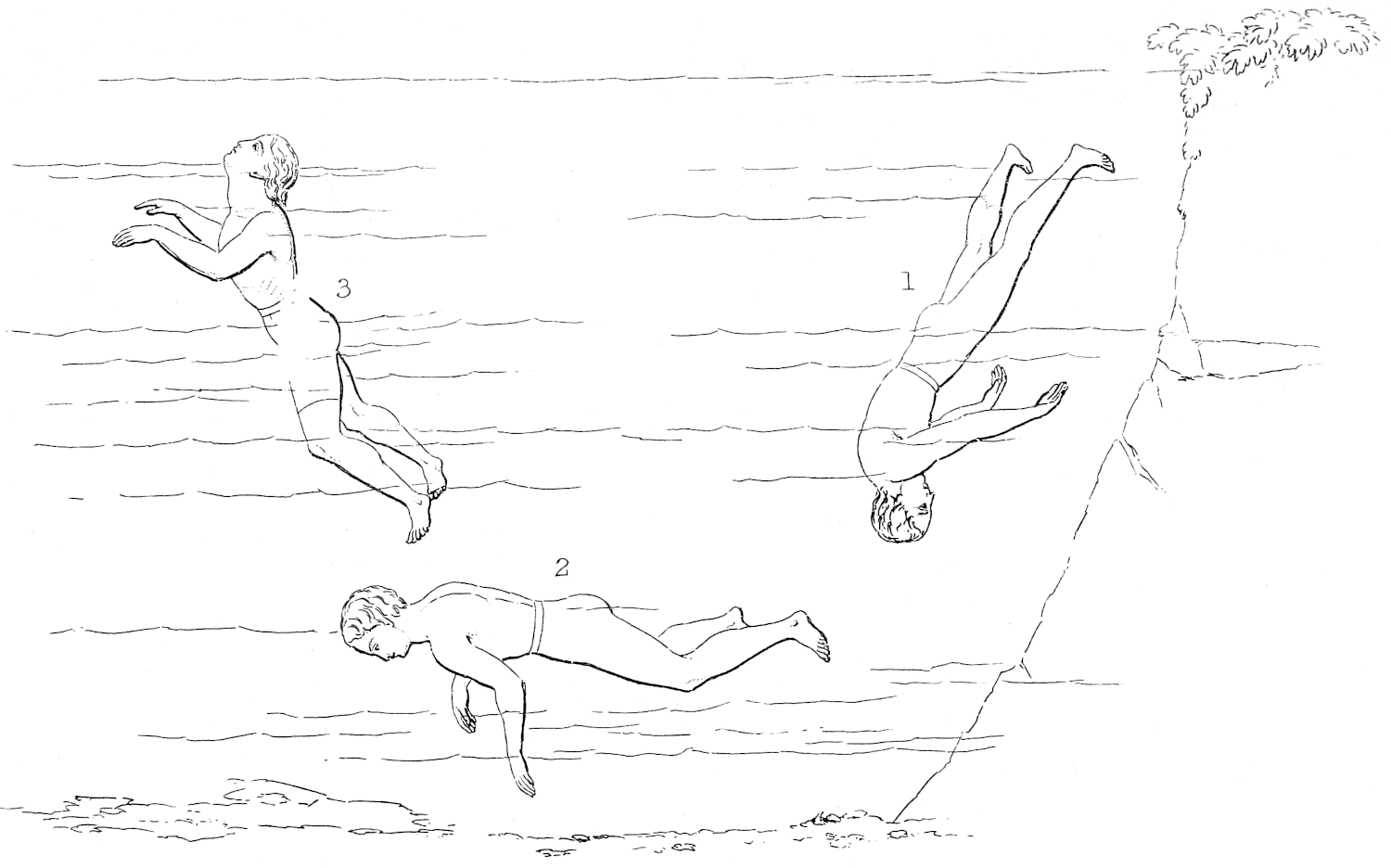
The swimmer may prepare for diving by taking a slow and full inspiration, letting himself sink gently into the water, and expelling the breath by degrees, when the heart begins to beat strongly. In order to descend in diving, the head must be bent forward upon the breast; the back made round; and the legs thrown out with greater vigour than usual; but the arms and hands, instead of being struck forward as in swimming, must move rather backward, or come out lower, and pass more behind. (Plate XXVII. fig. 1.) The eyes should, meanwhile, be kept open, as, if the water be clear, it enables the diver to ascertain its depth, and see whatever lies at the bottom; and, when he has obtained a perpendicular position, he should extend his hands like feelers.
To move forward, the head must be raised, and the back straightened a little. Still, in swimming between top and bottom, the head must be kept a little downward, and the feet be thrown out a little higher than when swimming on the surface (Plate XXVII. fig. 2); and if the swimmer thinks that he approaches too near the surface, he must press the palms upwards. To ascend, the chin must be held up, the back made concave, the hands struck out high, and brought briskly down. (Plate XXVII. fig. 3.)
Plate XXVI
Page 98.
Plunging
Plate XXVII
Page 98.
Swimming—Diving.
Plate XXVIII
Page 99.
Swimming—Thrusting.
THRUSTING.
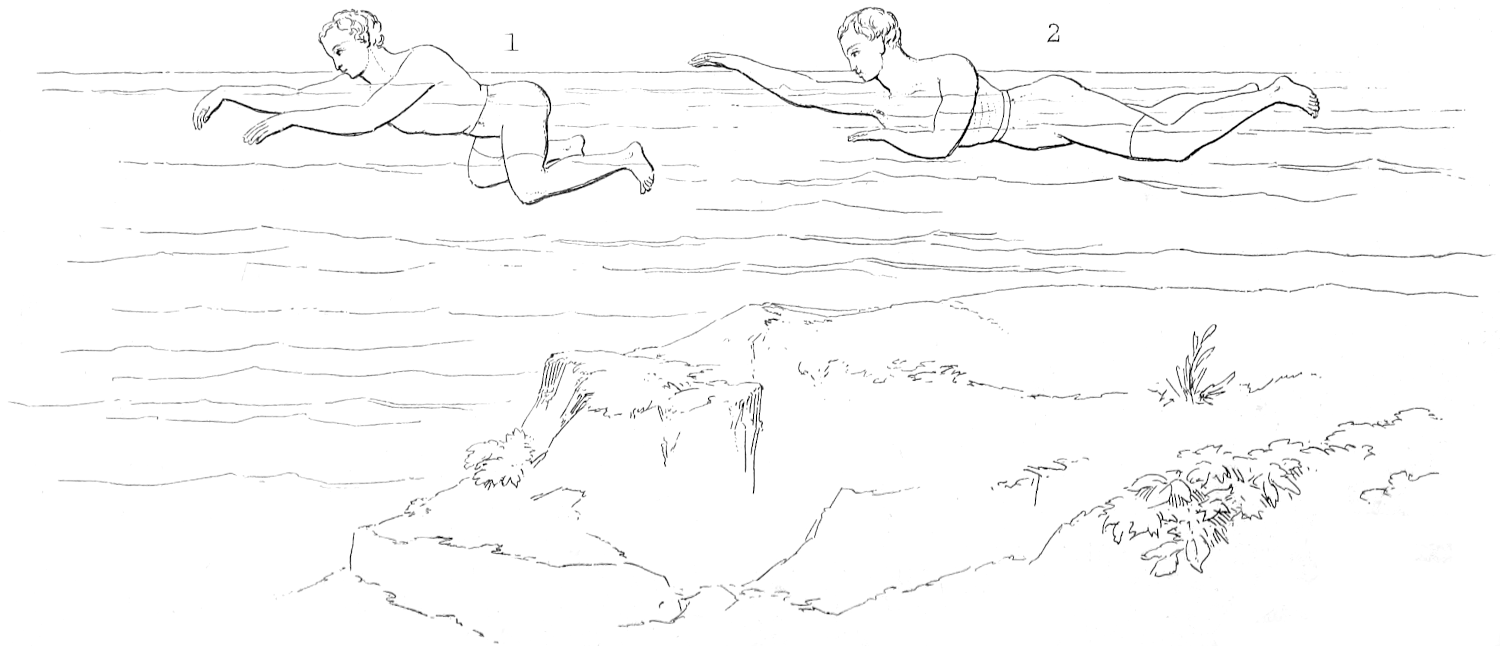
This is a transition from front swimming, in which the attitude and motions of the feet are still the same, but those of the hands very different. One arm, the right for instance, is lifted entirely out of the water, thrust forward as much as possible, and, when at the utmost stretch, let fall, with the hand hollowed, into the water, which it grasps or pulls towards the swimmer in its return transversely towards the opposite arm-pit. While the right arm is thus stretched forth, the left, with the hand expanded, describes a small circle to sustain the body (Plate XXVIII. fig. 1); and, while the right arm pulls towards the swimmer, the left, in a widely-described circle, is carried rapidly under the breast, towards the hip. (Plate XXVIII. fig. 2.)
When the left arm has completed these movements, it, in its turn, is lifted from the water, stretched forward, and pulled back,—the right arm describing first the smaller, then the larger circle. The feet make their movements during the describing of the larger circle. The thrust requires much practice; but, when well acquired, it not only relieves the swimmer, but enables him to make great advance in the water, and is applicable to cases where rapidity is required for a short distance.
SPRINGING.
Some swimmers, at every stroke, raise not only their neck and shoulders, but breast and body, out of the water. This, when habitual, exhausts without any useful purpose. As an occasional effort, however, it maybe useful in seizing objects above; and it may then best be performed by the swimmer drawing his feet as close as possible under his body, stretching his hands forward, and, with both feet and hands, striking the water strongly, so as to throw himself out of it as high as the hips.
ONE-ARM SWIMMING.
Here the swimmer must be more erect than usual, hold his head more backward, and use the legs and arm more quickly and powerfully. The arm, at its full extent, must be struck out rather across the body, and brought down before, and the breast kept inflated. This mode of swimming is best adapted for assisting persons who are drowning, and should be frequently practised—the learner carrying first under, then over the water, a weight of a few pounds.
In assisting drowning persons, however, great care should be taken to avoid being caught hold of by them. They should be approached from behind, and driven before, or drawn after the swimmer to the shore, by the intervention, if possible, of anything that may be at hand, and if nothing be at hand, by means of their hair; and they should, if possible, be got on their backs. Should they attempt to seize the swimmer, he must cast them loose immediately; and, if seized, drop them to the bottom, when they will endeavour to rise to the surface.
Two swimmers treading water may assist a drowning person by seizing him, one under each arm, and carrying him along with his head above water, and his body and limbs stretched out and motionless.
FEATS IN SWIMMING.
Men have been known to swim in their clothes a distance of 4000 feet.
Others have performed 2200 feet in twenty-nine minutes.
Some learn to dive and bring out of the water burdens as heavy as a man.
[This art, however, has made little if any progress from the earliest records that we possess of it. Leander’s feat of passing from Abydos to Sestos was the crack performance of antiquity; and it was the ultra achievement of Lord Byron, probably one of the best swimmers of our day.—Ed. Fifth Edition.]
ROWING.
RIVER ROWING,[9] WITH TWO SCULLS.
THE BOAT.
It may be laid down as a general rule, that, in calm weather, a light and sharp boat is preferable; and, in rough weather, a heavier and broader one. The learner, however, should not at first begin in too light a boat, nor should he practise in rough weather, until he gets acquainted with its management.
TO LEAVE THE LANDING-PLACE.
To leave the shore, the rower should, with the boat-hook, shove the boat off, head upon tide, or opposite to the current. To leave stairs, the rower must either shove the boat off with the boat-hook, or place the blade of the scull forward, and perform what the London watermen call belaying the boat’s head out from the shore, accordingly as there is deep or shallow water.
This being done, the rower sits down to his sculls. These he puts in the rullocks, and turns the concave front, or filling of the scull, towards the stern of the boat.
THE SEAT.
The rower must sit a-midships on the thwart or seat of the boat, else she will heel to the side on which he is sitting, and much of his labour will be lost. He should sit with ease to himself, having his feet on the middle of the stretcher, and his legs not quite extended; but his knees, as he rows, should be brought down, and his legs stretched.
THE PULL.
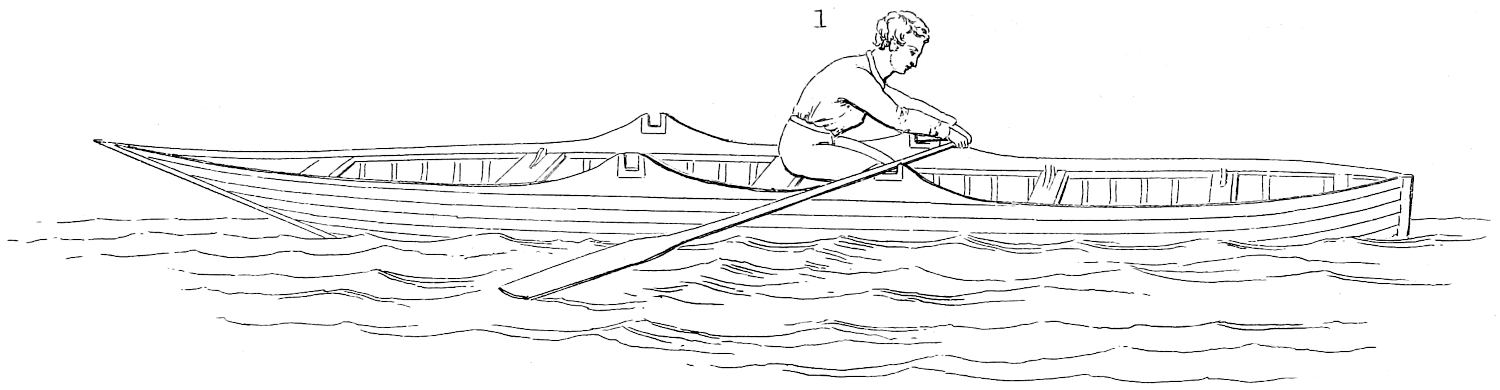
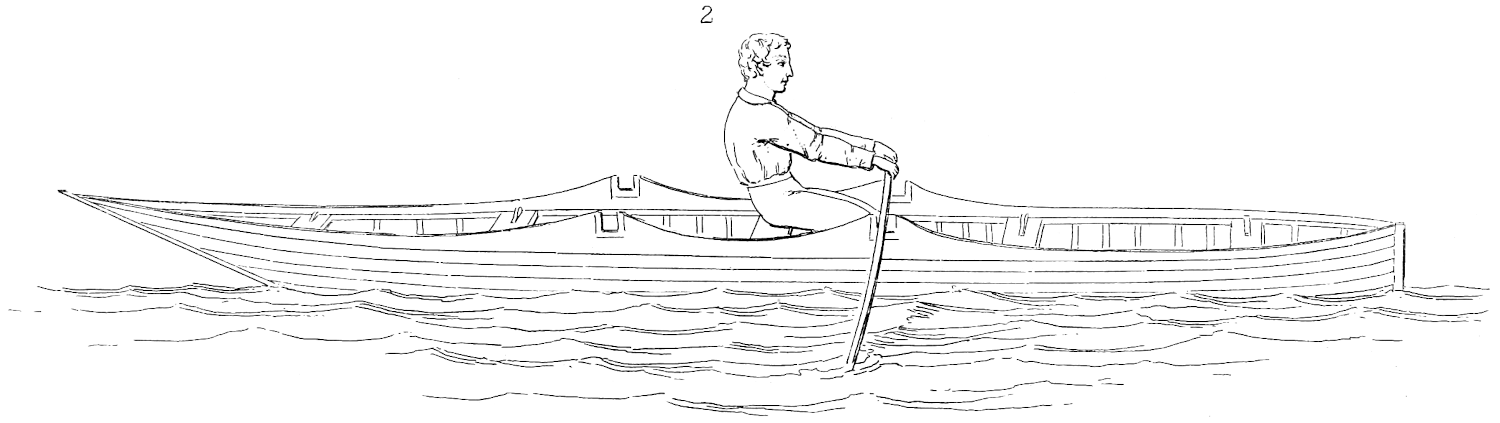
The rower should make long strokes in a heavy boat, and shorter and quicker strokes in a light boat. At the beginning of the pull, he must, in general, bend his body till his head is over his knees, and extend his arms as far aft as convenient, that the blades of the sculls may be thrown correspondingly forward. Plate XXIX. f. 1. With regard to the back in particular, some think that, if a short distance is to be rowed, it should be bent; and that, if a long distance, it is less fatiguing to keep it straight. When the arms are extended as far aft, and the blades of the sculls as far forward as convenient—which must never be so far as to jam in the rullocks—(Plate XXIX. f. 1) the rower must dip the sculls into the water, and pull towards him, by at once bending the arms and the body.
When in the middle of the pull, if the sculls are not short enough, or even if the head and body are slightly turned, one of the hands will go higher than the other; and, as the right is generally the stronger, it may go above, and the left below. It is often found difficult to keep one hand clear of the other in pulling a pair of sculls. This is so much the case, indeed, that the inexperienced frequently suffer more from the knocking and rubbing of the backs and sides of the hands against each other, than from the friction of the handles of the oars in the palms of the hands. This may be easily obviated by attending to the following advice:—
Having seated yourself in the centre of the thwart, with your feet close together against the centre of the stretcher, ship your sculls, but, before pulling a stroke, move your body three or four inches to the right hand, and still retain your feet in the centre: thus you will be sitting rather obliquely; this will throw your right shoulder more forward, and consequently the right hand; and thus the hands will work perfectly clear of each other. This rule, however, must be modified by the circumstances of river-rowing. A waterman writes us as follows:—“As to carrying one hand above the other, my way is, that if, for instance, I go from Greenwich to Blackwall against tide, I keep down on the Greenwich side, in general look toward the shore, and having my face over the left shoulder, my right hand is then above. If I go from Greenwich to London, my face is turned over the right shoulder, and the left hand is then uppermost.”
Plate XXIX
Page 102.
Beginning of the Pull.
Middle of the Pull.
Plate XXX
Page 103.
End of the Pull.
Return of the Sculls.
(The usual position in the middle of the pull is shown in Plate XXIX. fig. 2.)
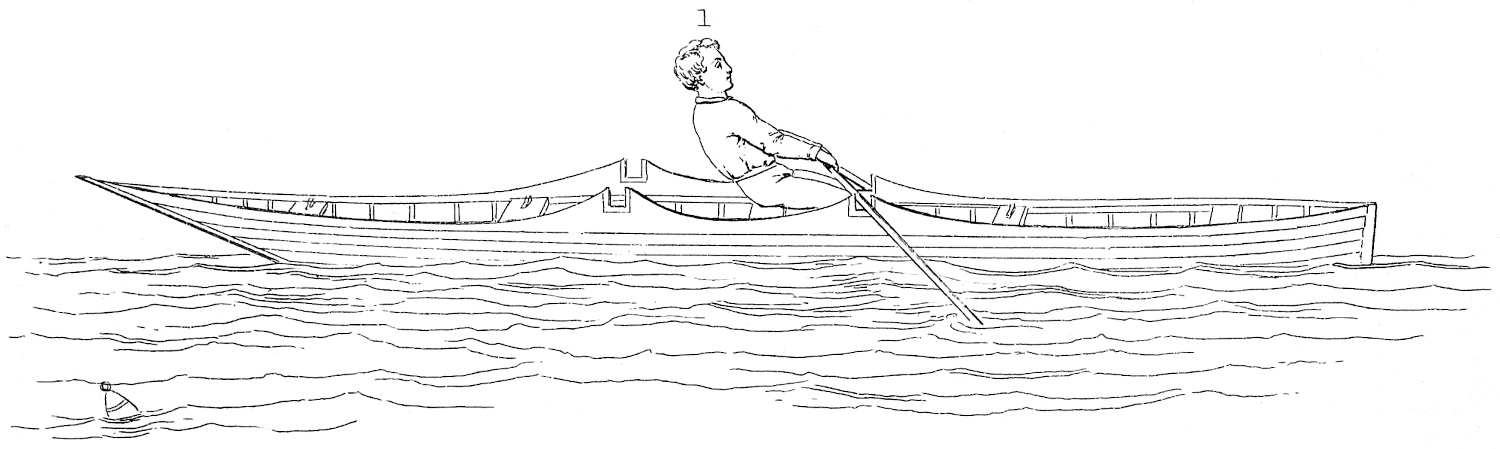
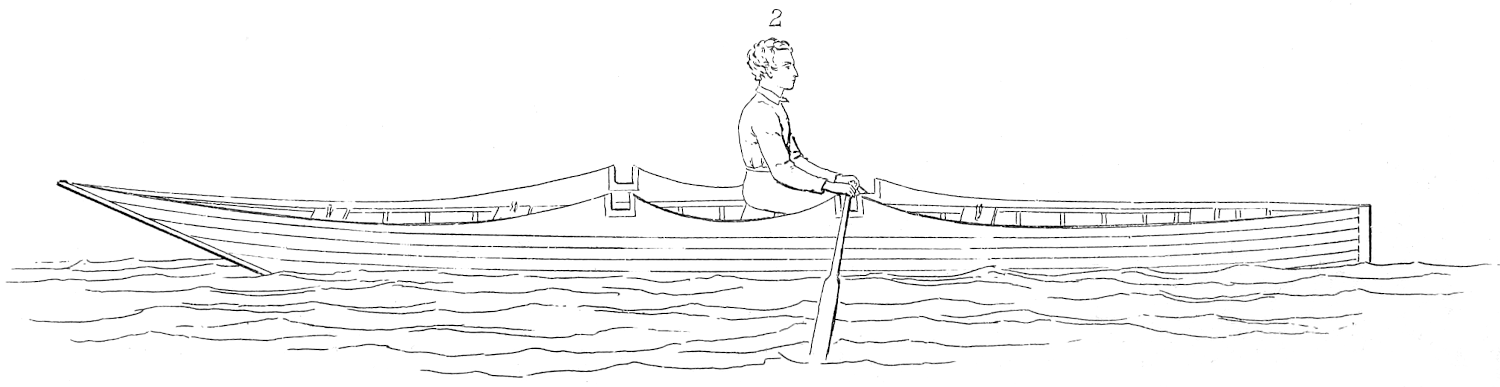
The end of the pull must not take place till the elbows have approached the tops of the hips, the hands are brought towards the chest, and the body is thrown well back. There would be a loss of power, however, if the hands were brought too near the chest; and the body should not be thrown further back than it may easily and quickly recover its first position for the next stroke.—(Plate XXX.) As the water is being delivered from the sculls, the elbows sink, the wrists are bent up, and the backs of the hands are turned towards the fore-arms, in order to feather the sculls.—(Plate XXX. fig. 1.)
In the return of the sculls, the hands must remain turned up until the sculls are put into the water.—(Plate XXX. f. 2.) In the middle of the return, if the sculls are not short, or if the head and body be turned, one of the hands also goes higher than the other.
As to the degree of the immersion of the sculls.—In the middle of the pull, the blades must be covered by the water. The learner in general dips them very deep; but that ought to be avoided, especially in calm weather. In the whole of the return, the tips should, in calm weather, be two or three inches above the water; and, in rough weather, they should be higher, in order to clear it, as represented in the preceding Plates. The head ought throughout to be very moveable—first to one side, then to the other, but generally turned towards the shore when against the tide. The same movements have only to be repeated, throughout the course.
THE TIDE OR CURRENT.
In river-rowing, when the tide or current is with the rower, a learner should in general take the middle of the stream. In rowing with the tide, however, watermen generally cut off the points, in order to keep a straight course. When the tide or current is against the rower, he should take the sides, preferring that side on which, owing to the course of the river, the current is least. As there is an eddy under the points, watermen generally, when rounding them, shoot the water to the next point, and so on.
TO TURN.
Back water with one scull, by putting the one on the side you wish to turn to into the water, with its concave front or filling towards you, and pushing against it; and at the same time pull strongly with the other scull, until the boat’s head is turned round.
MEETING OR PASSING.
In meeting, the boat which comes with the tide must get out of the way. In this case, both boats, if close, lay the blades of their sculls flat on the water, lift them out of the rullocks, and let them drift alongside. Each replaces them when the other has passed. In passing a boat, the rower who passes must take the outside, unless there is ample room within, and must also keep clear of the other’s sculls or oars. If one boat is crossing the water, and another coming with the tide, the one coming with tide must keep astern of the other, and have a good look-out ahead.
TO LAND.
Give the boat its proper direction, and keep its head inclining towards the tide, and its stern will turn up or down, as the tide runs; unship the sculls by the manœuvre directed above; but, instead of letting them drift alongside, lay them in the boat, the blades forward and the looms aft; seize the headfast; jump ashore; and take two half-hitches round the post or ring.
SEA-ROWING, OR ROWING IN A GALLEY ON THE RIVER.
In launching a boat from the sea-beach, when it is rough, and there is a heavy surf, the two bowmen must get into the boat with their oars run out; and the other rowers follow the boat quickly in her descent; but they should not jump in till she is quite afloat, lest their weight might fix her on the beach, and she might ship a sea.
It may happen, that immediately on the boat floating, a sea shall take the bow (before the rowers are sufficiently prepared with their oars to keep her head out), and place her broadside to the waves. In this situation, the boat is in danger of being swamped, and the lives of those on board are in peril. When thus situated, it is best for two of the rowers to go near the bow of the boat, and immediately force each his boat-hook or oar on the ground, on the shore side of the boat, as the most effectual, safe, and expeditious method of bringing her head again to the sea. Should there be more than a usual swell, both the rowers and the sitter, or steersman, cannot be too particular in keeping, throughout, the head of the boat to the swell, as lying broadside to a heavy sea is extremely dangerous.
In rowing, each man has in general a single oar, and sits on the opposite side of the galley from the rullock through which his oar passes. The oar must consequently cross the boat, and be held on its opposite side, so as to clear the back of the man before.
It should be neither held nor pulled obliquely to the side by twisting the body, as is practised by many, because the muscles in that case act disadvantageously, and are sooner fatigued. The stroke must be longer in sea than in river rowing. The oar must be thrown out with a heave, caused by the simultaneous extension of the body and the arms. It is still more essential to feather in sea than in river rowing.
The oar must be drawn back with great power, caused by the simultaneous contraction of the body and arms; time with the other rowers being accurately kept, and distinctly marked.
When the oars are delivered from the water, the time, until they go into it again, may be counted, one, two, three,—when they pass through the water. This time is kept by the strokesman, or sternmost man of the rowers.
In landing, the word is, “in bow,” when the bowman or foremost man gets the boat-hook ready to clear away for the shore, or the stairs. The next word is from the coxswain, “rowed off all,” or “well rowed;” when all the oars are laid in, with the blades forward, and the boat is made fast.
In landing on the sea-beach, when there is a surf, the rowers may watch for a smooth, and then give good way ashore, when the bowman should instantly jump out with the headfast or penter, and pull her up, to avoid shipping a sea. The distances run in this way are very great. We have known four men, in a short galley, row thirty miles in four hours, namely, from Dover to eight miles below Calais, or abreast of Gravelines, on the opposite coast. In such a row, a London waterman would have no skin left on his hands; and a member of the Funny Club would, we suppose, have no hands left on his arms!
SAILING.
BOATS, ETC.
Cutters, owing to their excellent sailing qualities, are much employed as packets[10], revenue cruisers, smugglers, privateers, and in all cases requiring despatch. The boats commonly employed in parties of pleasure, &c., are also cutters.
On the size of these vessels, however, it is necessary to remark, that a cutter under one hundred tons is sufficiently handy; but, when the size is equal to that of the larger yachts, a strong crew is necessary, as the spars are very heavy, and a number of men requisite to set or shorten sail. As a single-masted vessel, in the event of springing a spar, becomes helpless, even large cutters are used only in short voyages, or on the coast; for, in case of accident, they can always manage to reach some harbour or anchorage to repair any damage they may sustain. The peculiar qualities of beating well to windward, and working on short tacks, adapt cutters peculiarly for Channel cruising.
Although, some years back, large cutters were confined principally to the navy and revenue, the Royal Yacht Squadron, in theirs, have exceeded these not only in size, but in beauty and sailing qualities. Some of the finest and fastest cutters in the world are the property of this national club; and two of them, the Alarm (Mr. Weld’s), and the Arundel[11], (the Duke of Norfolk’s), measure 193 and 188 tons. The inconvenient size, however, of a cutter’s boom and mainsail has caused the very general introduction of a ketch rig, which, by the addition of a mizen, permits the boom to be dispensed with, and reduces the mainsail considerably. This rig, indeed, when the mizen stands well, is elegant; and, if a vessel is short-handed, it is very handy. As cutter-rigged vessels, instead of a regular mainsail, with its boom and gaff, have sometimes a mere spritsail, it is necessary we should observe, that the inferior convenience and safety of these preclude our noticing them here. It is also necessary that we should explain why, in the sequel, we do not even refer to lugger-rigged vessels.
Luggers are more difficult to work or manœuvre; they require a greater number of men; their spars are so heavy that they require all hands to move them: their decks are inevitably lumbered with spars, &c.; their canvass gets rotted from exposure; and their expense is much greater than that of cutters. They generally have two sets of lugs—large ones, which require dipping every time they tack, and small working lugs, which do not require dipping, the tack coming to the foot of the mast. The latter are generally used, except in making long reaches across the Channel, &c. A lugger, moreover, is seldom fit to be altered to any thing but a schooner, not having breadth enough for one mast, which, after all, is the best for beauty and speed.
Sailing men, indeed, are now so perfectly aware of the inferior speed of luggers, that we never see a lugger or schooner enter against a cutter at all near its tonnage. At sea, luggers would have a better chance; though even there many would prefer cutters, except in foul weather and a long reach. In short, these vessels suit only a few noblemen and gentlemen who have enough of patriotic ambition to desire to look like smugglers, enough of delicacy to disregard the being thought dirty lubbers by their own men—some of whom are not dirty from mere taste or choice, and enough of penetration not to discover, that on their landing with filthy clothes and tarry hands, every old sailor grins or laughs at their imagining, that it was they, and not the man at the helm, who had kept the canvass from cracking, or the sticks from going over the side. Our descriptions apply, therefore, to cutters alone; and the Plates at the end of this article illustrate the various parts therein referred to.
Upon the Thames, the sailing clubs comprise the Royal Sailing Society, the Royal Thames Yacht Club, the Loyal Victoria Yacht Club, the Clarence, British, Royal Yacht, and several minor associations. Several cups and prizes are annually given during the season; and the spirited contests between the beautiful small craft which form these fancy fleets, are highly interesting. The sailing matches on the river are of two sorts—one above, and the other below the bridges. The smaller yachts, of from six to twenty-six tons, are commonly entered for the former, and a larger class for the latter, which take place between Greenwich and Gravesend. These national amusements appear to be rapidly gaining the first place among fashionable recreations, and now occupy the season, from the period when hunting ends, till shooting begins.
The Royal Yacht Squadron has nearly six hundred persons on its lists, of which above one hundred are members, and about four hundred and fifty honorary members. The number of yachts is one hundred and nine[12]; of which eighty-seven are cutters, ten schooners, three brigs, four yawls, two ships, two ketches, and one lugger. The greater part of these vessels hail from Cowes or Southampton. The shipping belonging to the club amounts to 7250 tons. Now, a vessel of one hundred tons seldom perhaps stands the owner in less than from five to six thousand pounds, varying from that to ten, according to the profusion of ornamental parts, the internal fittings, and other contingencies. At this rate, the shipping of the club would have cost more than three millions and a half of money: but it is impossible to speak decisively on this point, as the first cost of the yachts varies much, and the numerous styles of rig are attended with expenses so widely different. At a moderate computation, each vessel belonging to the club carries ten men on an average: this gives the total number employed 1090. During the summer months, then, while regattas are celebrated, it may be said that the Royal Yacht Squadron alone employs more than 1100 men. These, with some few exceptions, are discharged on the approach of winter, and the yachts are laid up for the season, retaining the master and one man in pay. The crews thus discharged obtain employment in merchant-vessels, or otherwise, during the winter; and in the middle of spring, are generally re-shipped in the yachts in which they have previously served. On these conditions, active and industrious men of good character are generally sure of employment in the club; and many members justly pride themselves on the high discipline, manly bearing, and crack appearance of their crews. The situation of master, in particular, is one of much responsibility, and is on all accounts respectably filled. In some of the largest craft, junior officers of the navy are found to accept this office. The sailing regulations of the Royal Yacht Squadron are as follow;
First—Members entering their yachts must send the names of them to the secretary one week previous to the day of sailing, and pay two guineas entrance at the same time.
Second—All vessels starting or entering must be the bonâ fide property of members, as well as their spars, sails, boats, &c.
Third—Each member is allowed to enter one vessel only for all prizes given by the club.
Fourth—Cutters may carry four sails only, viz., mainsail, foresail, jib, and gaff top-sail; yawls, luggers, schooners, and all other vessels, in like proportion. No booming out allowed.
Fifth—No trimming with ballast, or shifting of ballast allowed; and all vessels to keep their platforms down, and bulkheads standing.
Sixth—Vessels on the larboard tack must invariably give way to those on the starboard tack; and in all cases where a doubt of the possibility of the vessel on the larboard tack weathering the one on the starboard tack shall exist, the vessel on the larboard tack shall give way; or, if the other vessel keep her course, and run into her, the owner of the vessel on the larboard tack shall be compelled to pay all damages, and forfeit his claim to the prize.
Seventh—Vessels running on shore shall be allowed to use their own anchors and boats actually on board to get them off, afterwards weighing anchor and hoisting the boat in; but, upon receiving assistance from any other vessel or vessels, boats, or anchors, shall forfeit all claim to the prize.
Eighth—That nothing but the hand-line be used for sounding.
Ninth—Any deviation from these rules shall subject the aggressor to forfeit all claim to the prize.
Tenth—If any objection be made with regard to the sailing of any other vessel in the race, such objection must be made to the stewards, within one hour after the vessel making the objection arrive at the starting-post.
Eleventh—No vessel shall be allowed to take in ballast, or take out, for twenty-four hours previous to starting; and no ballast shall be thrown overboard.
Twelfth—Vessels shall start from moorings laid down at a cable-length distance, with their sails set; and every vessel not exceeding one hundred tons shall carry a boat not less than ten feet long; and vessels exceeding one hundred tons, a boat not less than fourteen feet long.
Thirteenth—There shall be a member, or honorary member, on board each vessel.
Fourteenth—The time of starting may be altered by the stewards; and all disputes that may arise are to be decided by them, or such persons as they shall appoint.
The Northern Yacht Club is a highly interesting society, although its plan is not so extensive as that of the Royal Club. It contains about three hundred and fifty members. The documents for 1830 comprise ninety-two in the Scottish, and ninety in the Irish division, with fifty-two honorary members, in addition to ninety-three members of the Cork Yacht Club, who are also entered on the honorary lists. It had, in 1830, sixty yachts, not equal in proportion to the tonnage of the Cowes Club, as smaller vessels are admitted. Many R. Y. S. men are found in the Northern Club. There are many fine vessels in this club. Cutters, as usual, excel in number.
At the lowest computation, the number of vessels at present employed for pleasure in this country cannot be less than from three to four hundred, ranging in bulk from ten to three hundred and fifty tons. These are variously distributed along our shores, carrying their opulence into every port and harbour. But there is another advantage arising from yacht clubs—namely, that national spirit, which, to a maritime people, is above all in worth. The yacht clubs keep alive this feeling in an eminent degree.
COURSES, ETC.
Even in describing the elementary nautical operations which such boats require, it is necessary to lay down a position for the HARBOUR, direction for the WIND, and trip for the VESSEL.
Let us suppose, then, that the mouth of the harbour lies towards the south; that the wind blows from the north, with a little inclination to east, and that we wish first to sail due south to get out of the harbour, next direct our course eastward, then return westward till we get abreast the mouth of the harbour, and lastly, northward, to enter the harbour and come to our moorings.
These courses will, with variations in the force of the wind, illustrate every common and useful manœuvre.
GETTING UNDER WAY.
Bend[18] and haul the jib out to the bowsprit end.
Hoist the jib, and bowse it well up.
Hoist the foresail ready to cast[24] her when the moorings are let go.
Send a hand to the helm.[25]
Overhaul the main-sheet[26], and the lee[27] runner and tackle[28]; lower the throat, and hoist the peak of the mainsail taut[29] up.
Hoist the gaff topsail[30], keeping the tack[31] to windward[32] of the peak halyards[33], and hauling the slack of the sheet out before you hoist the sail taut up.
Set the tack, and heave the sheet well taut.
In managing the helm, be careful not to jibe the mainsail.
When a vessel is going large[36], the helmsman should always place himself on the weather side of the tiller, or the side opposite to that which the main boom is over, as his view of the vessel’s head will then be unobstructed by the sails. The boat now running before the wind, haul the tack of mainsail up. If the wind come dead aft, you may flatten aft the jib and foresail sheets[37], or haul the foresail down to prevent chafing. If the wind come at all round on the starboard quarter[38], slack off the boom guy[39]; haul in the main-sheet till you get the boom a-midships[40], or nearly so; port[41] the helm, and jibe the mainsail; slack off the main-sheet again, and hook the guy on the larboard side; haul taut the starboard runner and tackle, and overhaul the larboard one; the same with the topping-lift[42]; hoist the head sails[43], and shift the sheets over.
N.B. If you are obliged to jibe as above, you must, in the following directions for bringing the wind on your beam, read larboard for starboard, and vice versâ.
BRINGING THE VESSEL WITH THE WIND ON THE LARBOARD BEAM.[44]
Supposing that you have not jibed, starboard the helm a little, and let the vessel spring her luff[45] with her head to the northward. Slack the boom guy, and haul in the main-sheet. Haul aft[46] the jib-sheet, and bowline[47] the foresail.
If she come up fast, port the helm[48] a little, and meet her, then right[49] it when she lays her proper course.
Hook and haul taut the lee runner and tackle. You will now find it necessary to carry the helm a little a-port or a-weather.
If, instead of directing our course eastward, we had preferred doing so westward, we must have jibed previous to bringing the wind on the beam, and then the preceding operations would necessarily have been, to a corresponding extent, reversed.
CLOSE-HAULING THE VESSEL.[50]
To haul the vessel to the wind, ease the helm down[51] a little. Haul in the main-sheet upon the proper mark. Bowse the foresheet, and haul the jib-sheet well aft. Bowse the runner and tackle well taut.
The vessel is now on the wind, plies to windward, or is close-hauled.[52]
Being now apt to gripe, or come up into the wind with a sudden jerk, now and again, she wall carry her helm more or less a-weather. The helmsman must watch the weather-leach of the mainsail, to prevent the vessel getting her head in the wind.
TACKING.[53]
Having got abreast or opposite the mouth of the harbour, haul the fore bowline. “Ready about.”[54] Put your helm up, or to windward a little, and let the vessel go rather off the wind, to get good way on her; then gently down or to leeward with it, which is announced by the helmsman calling “Helm’s a-lee.” Let fly the jib-sheet: this takes off the balance of wind from her head, and acts in concert with the helm in sweeping her stern to leeward, or rather in allowing her head to come quicker up into the wind.
The man who attends the jib-sheet must carefully gather in the slack[55] of the one opposite to that which he let go. When the jib comes over the larboard side of the stay[56], haul the larboard jib-sheet well aft. When the mainsail is filled, let draw the foresail.[57] Right the helm, and shift over the tack of the mainsail.
One hand should attend the main-sheet, to gather in the slack till the boom is a-midships, and then ease it off as the sail fills, and the vessel lays over to port. When the vessel is in stays, and it is doubtful whether she will come round, or, in order to make her come round when she gathers stern-way, shift the helm to the opposite side. She is now about upon the starboard tack.
REEFING, TAKING IN SAIL, ETC.
Haul the fore-sheet up to windward; bowline it there, and heave her to. Keep the tiller shipped, and lash it a-lee. In gaff topsail; lower the halyards; and haul down. Send a hand aloft to unbend the sheet from the sail, and make it fast to the main halyard bolt; and unlash the gaff topsail, and send it down. Lower the main halyards and peak to the second reef cringle, and reef the mainsail.
Hook the reef tackle[58] to the first earing[59]; haul upon it till the cringle[60] is close down upon the boom; and belay the tackle. Pass a small gasket[61] through the tack and the first reef cringle, and lash the two firmly together, taking care to gather in snug the luff of the sail, so that the leach rope belonging to it forms a sort of snake near the mast. Haul up the tack, and bowse upon the weather peak line, keeping the other part fast a-midships of the boom. This will hold the belly of the sail partly to windward, and make it easier to tie the reef-points. Observe to keep the foot-rope outside and under the sail.
Let one man jump upon the boom to tie the outer points so far that the rest can be tied on board. Let go the tack and peak line, always keeping the ends of this fast under the boom. Hoist the sail taut up; and set taut the tack tackle. Shift the jib to No. 2. Overhaul the jib purchase; let go the outhaul; haul the jib down; unhook the tack; unbend the sheets; and send the sail down below.
You have now got one reef in the mainsail. If it come on to blow harder, and you want a second reef, lower the sail, and haul on the peak line as before; nipper the first reef-earing so as to hold it a short time; let go the reef tackle, and unhook it from the earing, which make fast with its lanyard round the boom.
You have now got the tackle to use for the second reef. Proceed as for the first reef. Shift the jib to No. 3, and proceed as before. If third, the same, after rigging the bowsprit. Take the fid[62] or bolt out of the heel of the bowsprit, and rig the bowsprit in about one fid hole. Haul taut the topmast stay and bowsprit rigging. Bend and set the small jib in the same way as any other.
You may want to stow the mainsail, set the trysail, and make her otherwise snug in proportion. Sway away upon the top rope; lift the mast a little to let the man unfid it; and lower topmast down in the slings. Lower the fore halyards, and reef the foresail. Gather the luff of the sail up; make the foremost reef-earing cringle fast to the tack; shift the sheet from the clue of the sail to the after reef cringle; and tie the points. If the weather is very heavy, haul down the stay-sail, and tend the vessel with a tackle upon the weather jib-sheet.
When it comes fine weather again, make sail in precisely the reverse order to that in which you shorten it. Continue to tack in the wind’s eye till you are to windward of the harbour.
Plate XXXI
Page 119.
The Mariner’s Compass.
Plan of the Deck.
PASSING OTHER VESSELS.
All vessels sailing before the wind keep out of the way of those upon the wind. In the river Thames, vessels which sail with the larboard tack aboard, keep away for those with the starboard tack aboard.
BRINGING THE VESSEL INTO HARBOUR.
Lower and haul down the gaff topsail. Let go the jib tack or outhaul[63]; lower the jib; and pull on the down-hauler, to bring the traveller in. Haul the tack of the mainsail up; and lower the peak. Down foresail.
Let a small boat run away the wrap to the quay. Lower, and stow the mainsail. Unbend the jib, and stow it below if dry and not immediately wanted, and hook the halyards to the traveller, close in by the stem. If otherwise, hoist upon the halyards, and let it hang to dry if it require it, or stop it up and down the foremost shroud. Haul the vessel to the moorings, and moor properly, putting fenders over to keep her from the quay.
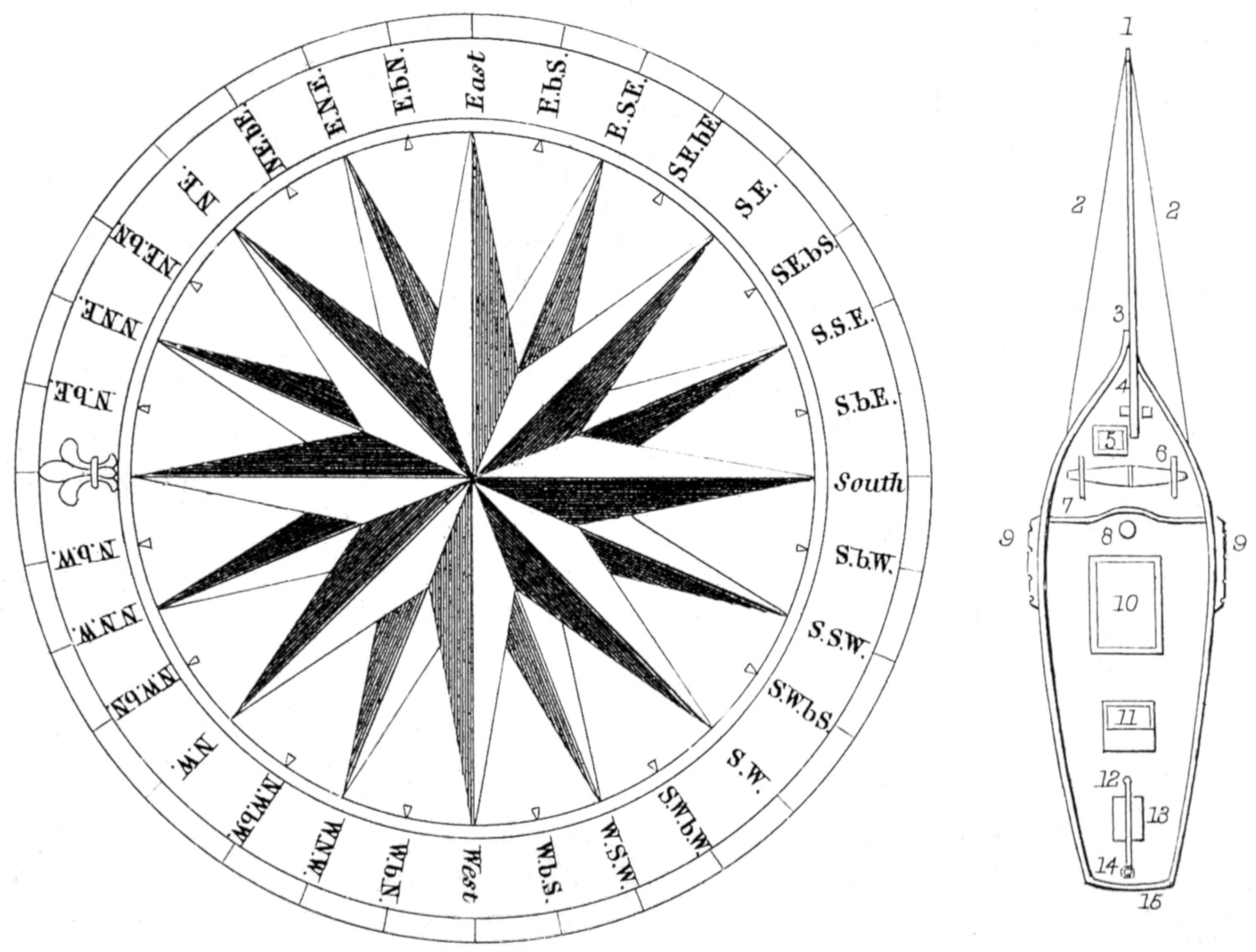
DESCRIPTION OF PLATE XXXI.
Fig. 1.
The mariner’s compass.
Fig. 2.
Plan of the deck, with the bowsprit rigged out, &c.
1. Bowsprit.
2. 2. Bowsprit shrouds.
3. Stem head.
4. Bowsprit bitts.
5. Fore hatchway.
6. Windlass and bitts.
7. Fore-sheet horse.
8. Place of the mast.
9. 9. Channels.
10. Main hatchway.
11. Companion and binnacle.
12. Tiller.
13. Cabin skylight.
14. Rudder-head and case.
15. Taffrail.
PLATE XXXII. fig. 1.
Pleasure boat, cutter-rigged, lying at anchor; foresail and mainsail bent and stowed.
1. Vane and spindle.
2. Truck.
3. Topmast.
4. Cap.
5. Trussel trees.
6. Lower mast.
7. 7. Cross trees.
8. Bowsprit.
9. Gaff, with mainsail furled.
10. Main boom.
11. Tiller.
12. Rudder.
13. Stem.
14. 14. Topmast shrouds.
15. Topmast backstay.
16. Topmast stay.
17. Runner and tackle.
18. Traveller.
19. Channel.
20. Forestay with the foresail furled to it.
21. Bobstay.
22. Topping-lifts.
23. Topping-lift blocks.
24. Main-sheet.
25. 25. Peak halyards.
26. Jib halyards.
27. Cable.
28. Fore-sheet.
PLATE XXXII. fig. 2.
The vessel going down the harbour with all sails set, steering south, before a light breeze.
1. Gaff topsail.
2. Foresail.
3. Mainsail.
4. Tack tricing line.
5. Peak line, or signal halyards.
6. 7. 8. The 1st, 2nd, and 3rd reefs.
9. 9. 9. Reef-earings.
10. 10. 10. Cringles.
11. Balance reef.
12. Anchor stock.
13. Windlass.
14. Foresheet horse.
15. Main hatch.
16. Companion and binnacle.
PLATE XXXIII. fig. 1.
The vessel outside the harbour, steering east, with a smart breeze on the larboard beam.
1. Jib.
2. Foresail.
3. Anchor.
4. Eyebolt of the bowsprit shrouds.
PLATE XXXIII. fig. 2.
The vessel trying for the harbour in a heavy gale, close to the wind as she can lay, on the starboard tack, under a reefed mainsail and foresail, bowsprit reefed, and topmast lowered.
Plate XXXII
Page 120.
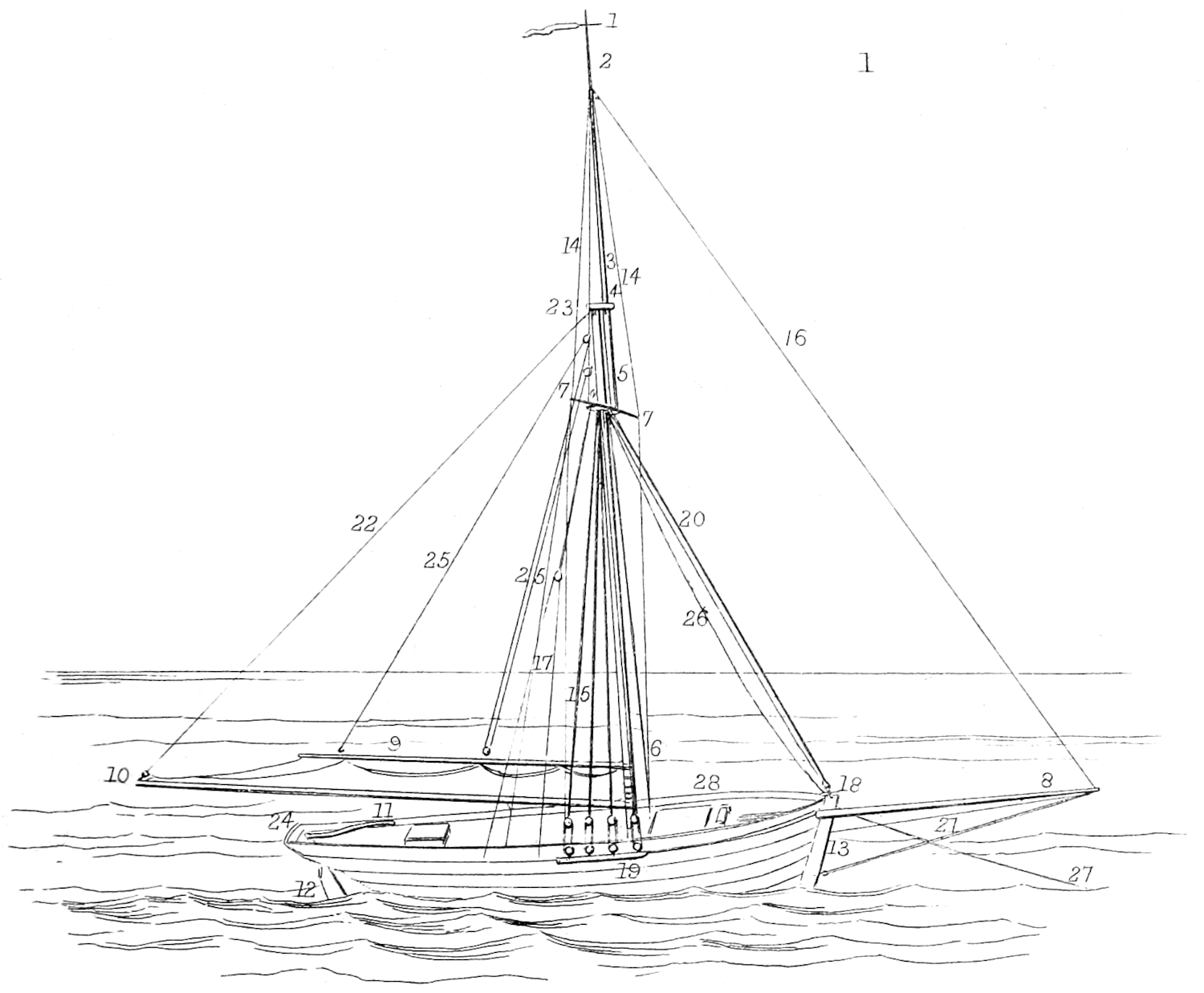
Parts in Pleasure Boat at Anchor.
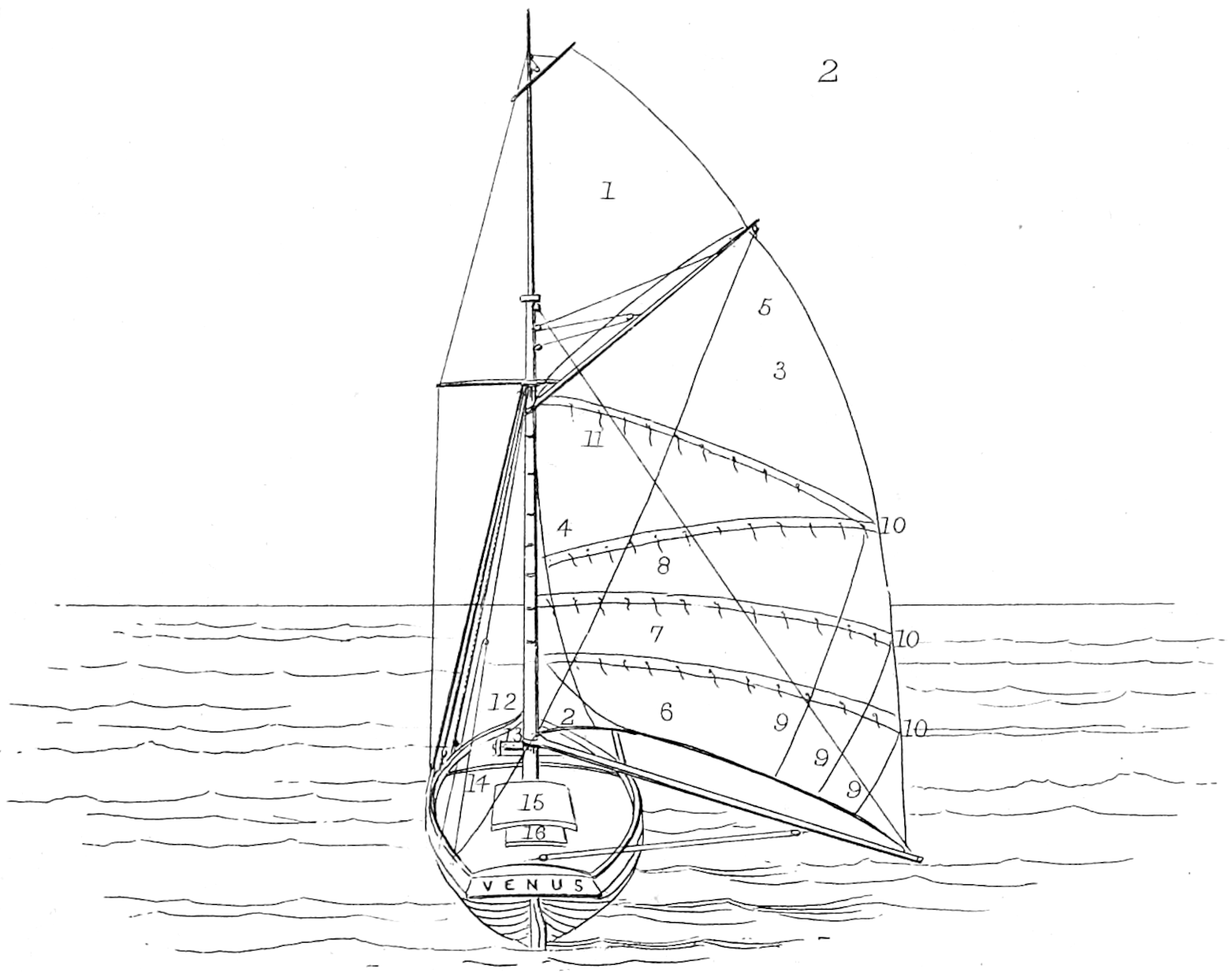
Boat before a light breeze.
Plate XXXIII
Page 120.
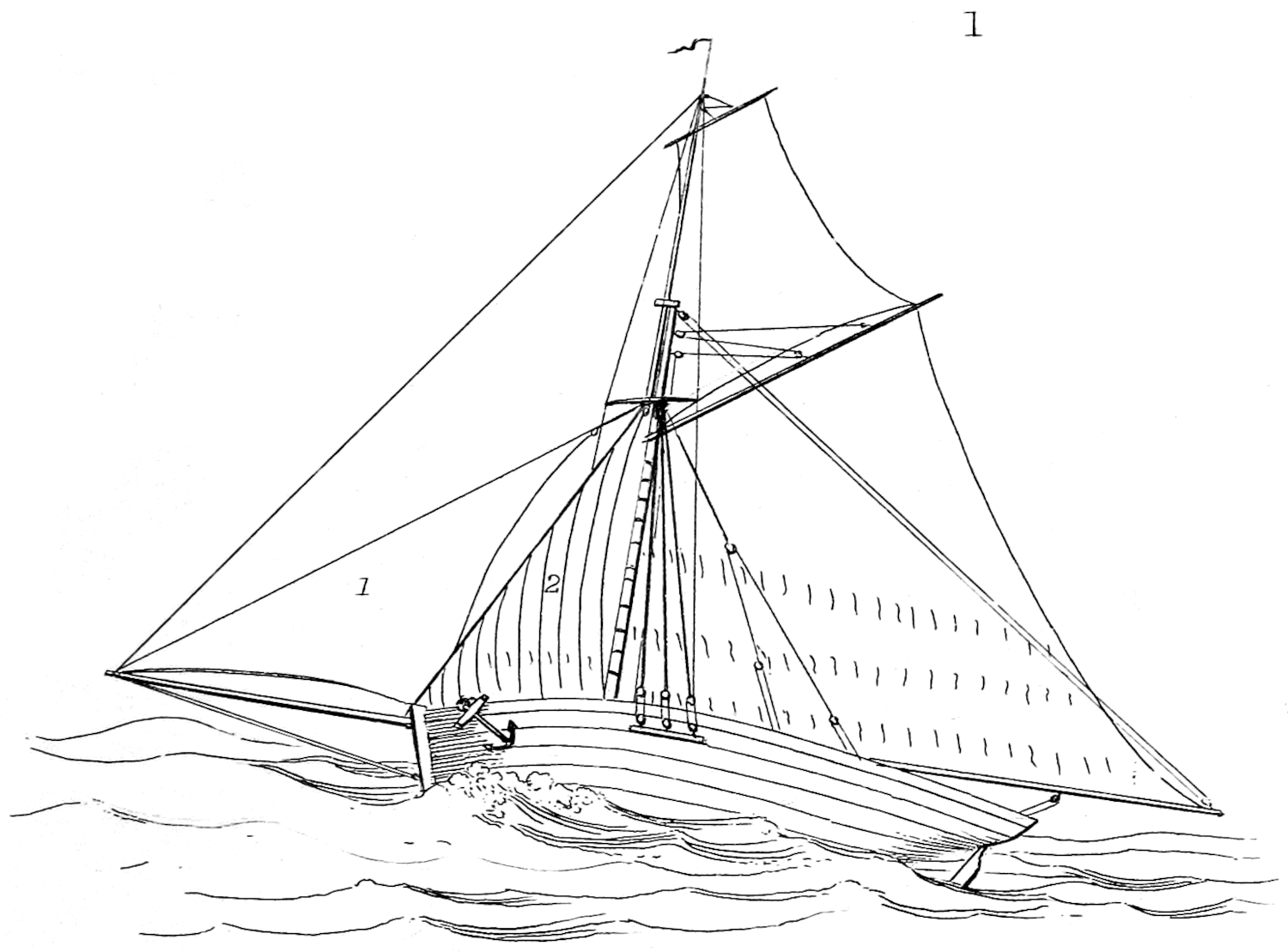
Boat with a breeze on the larboard beam.
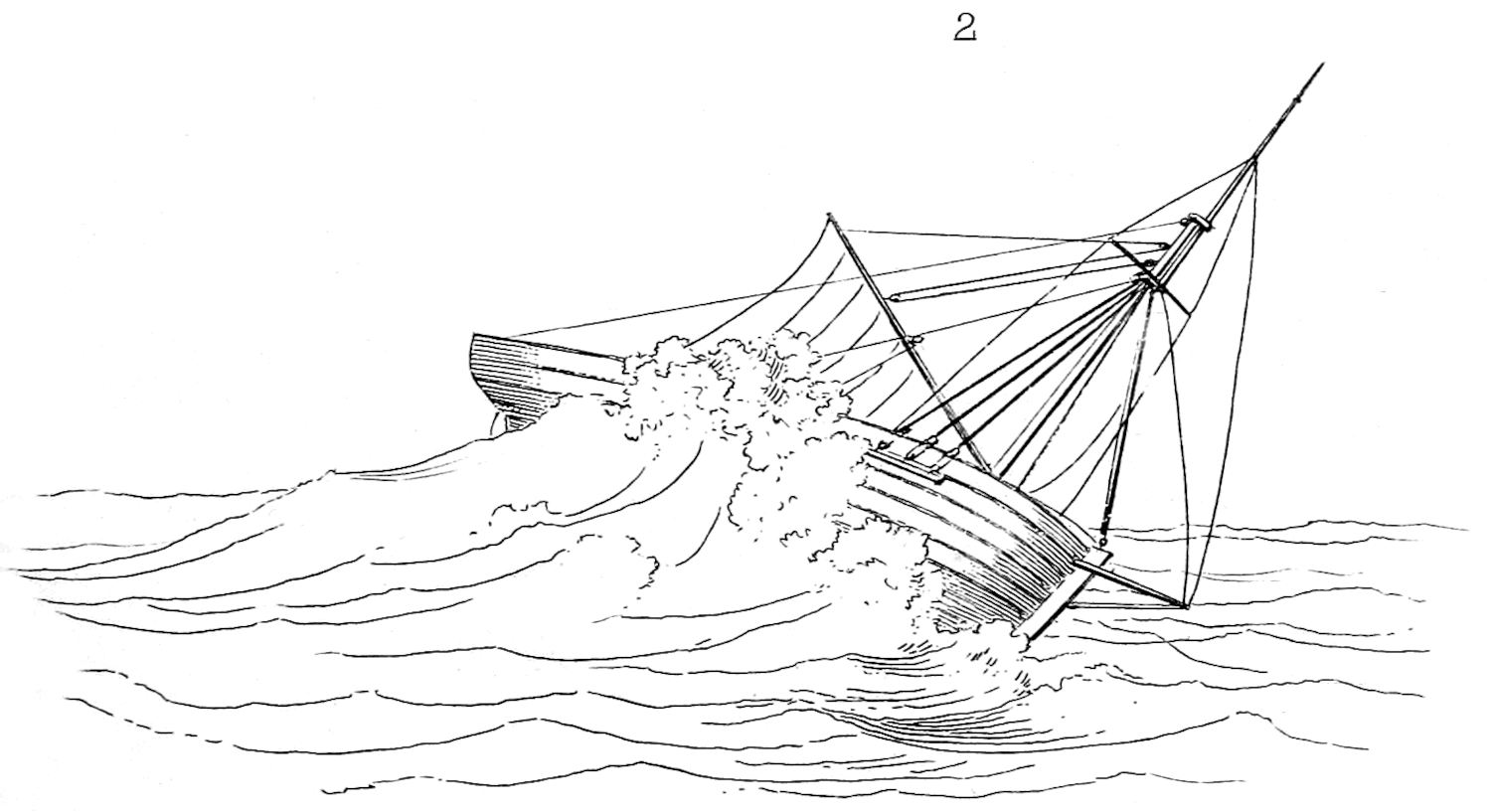
Boat close to the wind on the Starboard tack.