JUDITH GAUTIER (continued 3)
Effie Dunreith Massie translation
We were all carried away by enthusiasm when the Gods, walking across the valley on the rainbow, entered Walhalla and the curtain fell. Richter, flushed with emotion, was surrounded, acclaimed. Liszt embraced and complimented him warmly. The singers were also praised, and the musicians of the orchestra who had so admirably fulfilled their glorious task.
After having escorted Liszt to his carriage, still filled with elation that was not to be calmed we set out, all together, to take possession of the Café Maximilian. Instead of ordering supper, we asked for pens and paper, and each one of us wrote to Richard Wagner, expressing to him all the admiration and delight which his new masterpiece had inspired in us, and thanking him for having accorded us the great favour of hearing it before the general public, and even alas, before he himself had heard it.
XV
It was the 25th of August, anniversary day of the birth of King Ludwig II. Munich was adorned with flags, and its regiments marched in full dress uniforms of sky blue. We had heard one of their bands play before the Royal Palace the very "Huldigung-Marsch"—which I had so laboriously deciphered at four hands with Wagner. The King was not in Munich, but would come in time to be present at the dress rehearsal of the Rheingold, which was to take place on Friday the 27th of August—two days later.
Ludwig II., who was adored by his people, did not seek for ovations. On the contrary, he avoided them as often as possible, and thereby greatly disappointed the Bavarian people, who were always eager to see him and were so rarely gratified!
It appeared indeed, that all the young girls of the kingdom, and even perhaps, all the women, were in love with their youthful and charming sovereign; but he was haughty and reserved by nature, and in the wonderful locations which he had chosen for his castles he lived almost alone, surrounded by the splendours of art and the beauties of Nature.
This, however, did not prevent him from fulfilling his duties as king; he had according to custom inaugurated the International Exposition of Painting, and had left the city the same day. Very few would have the opportunity of seeing him when he should return to hear the work of his great friend.
I, too, was born on the 25th of August, the day of St Ludwig the king, so it was also my fête-day. I had told Cosima this fact because of my vain-glory in possessing something in common with the royal archangel. To my great surprise, she remembered it and sent me a charming parasol, of a new model, which they called, "Sea-side parasol," the novelty consisting in the fact that it could also be used as a cane. So, in promenading through Maximilianstrasse, I liked better to lean upon my parasol than to open it and shelter myself from the sun.
Many pilgrims were to be seen in Munich, come from all sides to hear the Rheingold. Among them were pointed out to us, Madame Pauline Viardot, Saint-Saëns, Tourguenef, Baron von Leon, manager of the theatre at Weimar, and many others whom I have forgotten.
We were all very nervous and excited. Only two days more! Would everything be ready? Hans Richter could not conceal his disquietude, so many things about the conduct of the manager seemed to him to be ambiguous.
"Perfall will not allow anything to be seen of his stage arrangements," said he, "but he has the expression of a traitor."
"Perfall, Perfide!"
One would have said that the labours of the Cyclops were taking place behind the walls of the long closed theatre. There were rumours of steam engines, hoisted upon the stage by means of lifting machines and pulleys. For what purpose? Truly it was very terrifying; what would come of all this mystery?
In any case Richter was sure of his orchestra. It was he, who like St Christoper with the child Jesus, would bear the whole weight of the undertaking upon his robust shoulders.
XVI
At last it was the 27th of August and we entered the theatre.
A crowd of spectators were gathered about the entrance and before the Royal Palace. They must have known that the apartments in the palace communicated directly with the royal box, and that no one could see the King pass or know when he entered the theatre, so it could only have been the irresistible attraction of walls behind which something is happening, that held all those loungers there.
The theatre was brilliantly lighted, although nearly empty. The hundred or so persons whom the King had seen fit to invite were scattered through the house and were hardly noticeable. The side boxes and a few rows of the orchestra chairs were to be used on this occasion. The dress circle and the boxes facing the stage, in the midst of which the royal box filled so large a space, were shut off.
I gazed at the sumptuous decorations of that loge, the frame to which the picture was as yet lacking, but which would hold in a few moments the so longed-for figure of the young sovereign. It would be our first glimpse of him, of that being who inspired in us such a profound sympathy, of him who radiated the glory of having been able to correct an error of destiny, and diminish the shame that humanity would endure for having failed to recognise Genius.
The blue velvet draperies with their rich folds held back by cords of gold, the crown and coat of arms, lozenged in blue and silver, and borne by the rampant lions, which signified in the language of heraldry "up and ready," these only caught the light, and the royal box itself was like a grotto of darkness.
All of a sudden the King was there, sparkling in the obscurity like a star emerged from the mist. His youthful visage gave us a delightful surprise. We had not imagined him like that, at once feminine and headstrong, ingenuous and arrogant. In contrast to the very black locks of his hair, which, standing up from his forehead, seemed to guard him like a wave of flame, his skin was of a warm, almost, dusky pallor, and a singular expression of energy contrasted strongly with the delicate modelling of his features; but one was instantly fascinated by the extraordinary splendour of those eyes, blue-green as the sea, fringed with long black lashes, eyes profound, ecstatic.... "Nothing is able to give any idea of the magic of that glance," said the Master.
The king advanced to the front of the box. His tall form dominated the house for an instant: then he seated himself. Very soon the lights were turned down and the vision vanished. But Hans Richter did not yet give the signal to the orchestra. The footlights were lighted, but before the curtain was drawn a man slipped out before it from a corner of the stage.
Perfall, the manager! What could he wish to say?
After many bowings and scrapings, with his hand on his heart he spoke, he implored "the indulgence of the select public before whom he had the honour.... In spite of the best will in the world, of long conscientious efforts ... insurmountable difficulties of scenery ... effects impossible to realise.... It had been necessary to give up the idea of attaining perfection, and to be content with what could be done, regret, chagrin ... but there is no flying without wings....
The presence of the king kept back all marked demonstration: yet even that could not stifle the indignant murmur that followed Perfall, when, after fresh cringings, he disappeared behind the curtain.
Richter struck angrily upon his desk, as if he were hitting the back of the traitor. The low note began its muffled vibration, the prelude commenced: but we no longer listened in the religious absorption of the other day, we were afraid to see the curtain drawn aside ... and at that moment it was drawn.
One was disappointed at the very first glance; no sign of the green shadows, of the humid and troubled depths which we had expected to see, only very dry rocks of moulded paper, resting without mystery, upon the boards of the stage. A frightful oil lamp, suspended from the highest moulding was supposed to represent "the gold of the Rhine." It only recalled the lantern which is placed, by night, at the top of a street obstruction.... The crystalline voice unrolled its clear melody, but at this point, a mannikin with dangling arms and hair hanging before its face, intended for an undine, was precipitated, head first, from above and, half way down, remained suspended, balancing from the end of a string. At the moment when the other voices were heard, other images of the same nature fell from above and oscillated in the deplorable attitudes of the drowned. Soon after, the mannikins were drawn back, and the true singers, standing upon supports, half concealed by the jutting out of the paper rocks, appeared and agitated their arms to represent swimming. Then they went away, and the puppet Rhine maidens returned and capered desperately about the smoking lamp.
What absurdity! They would not dare to present anything so bad at the Punch and Judy show of the Champs-Elysées.
After the scene-shifting, of an unbelievable awkwardness, a very little Walhalla, like a castle of cards, was to be seen upon a miniature mountain. Wotan had the appearance of a wayfarer who sleeps in the open air. As soon as he began to sing however, the magnificent voice of Betz made one willing to forget all else, one no longer saw the ridiculous landscape, and as the mechanical difficulties were over for the time, one could listen to the scenes that followed up to the moment of the descent to the Nibelheim.
At that point the management took its revenge.
A frightful and continuous hissing suddenly drowned both the voices and the orchestra. What in the world could it be? At first one was terrified, but heavy clouds of white vapour soon enveloped the scene and all was explained: the famous machines! A red Bengal fire, lighted too late, coloured those clouds, which were supposed to escape from the subterranean kingdom of the Nibelungen forgers.
When, a little later, Alberich should have donned the magic helmet in order to take the form of the dragon, he very simply walked off at the wings and the dragon entered by the same path, then the dragon went back, and the man returned.
The steam engine was not employed in the last scene; at the moment when Donner assembled the clouds and let loose the storm, the hissing might have helped to represent the whistlings of the tempest. At that time, however, what seemed to be blocks of granite descended from the freize and moved to the right and the left without knowing where to stop. The Gods climbed painfully up after the storm, and beheld, added to the scenery of before, a large bridge in white linen, which crossed the valley and reached to the other side, erasing and overwhelming the tiny Walhalla.
Toward this whiteness the Gods direct their steps. Then that must be the rainbow over which they are to pass. Yes, of course it is, for now a prismatic light, thrown from a lantern, runs distractedly over the lower end of the linen, onto Wotan's nose, everywhere it ought not to be, and never reaches the bridge, massive and white, for which it is intended.
At length the curtain falls, the orchestra is silent. Richter, red with wrath, throws down his baton; the usually amiable Richter looks positively fierce.
"I will not direct such a Rheingold" cried he, "it is war between you and me, Herr Manager!" And to us he said, "Wait for me at the Café Maximilian, we must join together in forewarning the Master."
XVII
The first presentation of the Rheingold was billed for Sunday, the 29th August, two days later. Under the circumstances, it must be prevented from taking place.
If the stage settings had been simply mediocre, it might have been possible to resign oneself and count upon the splendour of the work to make one forget the inadequacy of its plastic realisation: but here there was too much of the grotesque, too many things that made one laugh, the bad faith and malevolence were too evident: there must be a protest so violent as to prevent the accomplishment of the sacrilege.
After we were all reunited in our usual place at the Café Maximilian, the conference was not a long one. Richter had had a stormy interview with Perfall.
"Postpone the representation," said Richter.
"The representation will take place on Sunday," replied Perfall.
"We shall see!"
"We shall see!"
"And he will see," added Richter. "My resolution is taken, but I did not wish to announce it before asking Wagner's advice. Quick. Let us get to business!"
He wrote a dispatch in German, and we wrote the following in French:
"Master, the orchestra, under the direction of Hans Richter, was admirable. The singers deserve the highest praise. The scenery and the stage mechanism are absurd, ridiculous, impossible." And, while someone hurried off with the telegrams, I wrote a long letter to Wagner, giving him a detailed account of the spectacle at which we had just been present and concerning which we were still trembling with indignation.
Betz also wrote to the Master, who would receive the dispatches the same evening and the letters the following morning.
We awaited the replies in the greatest impatience.
The first telegram which arrived the next day was for Richter:
"Will they really offer me such an insult as to give my work to-morrow?"
At the theatre the Rheingold was still announced. Richter showed Wagner's dispatch to Perfall, but he paid no attention to it, and persisted in his determination to give the work upon the date for which it was billed.
I received a letter from Tribschen in which Wagner said that he thanked me for the vivid description I had sent him of this disaster, that he had telegraphed to the King asking him to suspend the representations, that he had telegraphed to Betz begging him to refuse to sing under such conditions.
On Sunday morning Richter went for a last time to see the Director, and said to him:
"The representation of the Rheingold will not take place this evening, because I will not conduct the work against the wish of its author."
"You will not conduct it this evening, nor any other evening," cried Perfall—"as you are no longer Capellmeister to the Royal Theatre."
And pale with rage, he signed the dismissal of Hans Richter.
But at least they could not play the Rheingold that evening. Better that the sea should swallow one man than the whole ship.
A strip was pasted across the bills, postponing the performance to the following Thursday. The management sought for a new leader of orchestra, there was a mad rush about Munich, where many Capellmeisters had come to hear the Rheingold.
All those whom they solicited, stole away, leaving the city precipitately; not one of them cared to incur the disapproval of the composer by conducting the work against his will.
On Monday another letter brought the news that Wagner had written at length to the King, explaining to him in all its details, the affair of the Rheingold and begging him to postpone again the performance announced for Thursday to the following Sunday. If it were in accordance with the King's wishes, Wagner would himself go to Munich to re-instal Richter at the desk and to reorganize the scenes as much as possible.
The Master had submitted the same conditions to the management of the theatre the day before, and had received a telegram, come out of the Counsellor's hump, to the effect that the conditions were granted and that they only prayed him to allow them to give the representation on Thursday.
Wagner telegraphed in answer to that:—
"I await a response from the King to a letter sent off to-day."
But on this same evening of Monday, the 30th August, Richter received a dispatch from Wagner which announced his own arrival for the following day. He had not the patience to wait for the King's answer. He would come in the strictest secrecy, no one was to know where he would stay, and, we must understand, it was necessary to guard the secret most carefully.
XVIII
"Alte Pferdestrasse, Wagner, who has just arrived in Munich, is there, come to-night, after dark."
We had all gathered at Franz Servais' house to await the news, when this note was brought to me and put into "the right hands" with much mystery. It was not signed, but Richter had written it.
"Richard Wagner here!" We expected him, yet now we were surprised and troubled that he had come, even though in answer to our call.... What if some misfortune should grow out of this incident!... On the contrary, all would come right now that the Master was here, his presence would work miracles.
"Alte Pferdestrasse," said Servais, "Wagner has gone to Scheffer's home: what an honour!"
"Who is this Scheffer, then?" asked Villiers, "always so silent and buried in his beard? One cannot make him out at all."
"He is correspondent of some small German papers, according to his own account, but, I believe also an office-holder. Certainly he is a good Wagnerian, and that ought to suffice for us."
"His dog is also that," replied Villiers, "for he only comes when one whistles the serenade of Beckmesser."
"Where is the Alte Pferdestrasse?" I asked.
"In a very quiet part of the city, but it is not easy to find—" said Servais. "We will take you there and wait for you, since you only are invited to see the Master...."
It was still daylight when we left Servais' house and sauntered slowly along, in order not to have the air of conspirators. We asked ourselves if Wagner really ran any risks, in coming to Munich. He was not really exiled, only morally so, by his own resolution not to go there. What had he to fear? The public was eager for his works: the price of seats in the theatre doubled when they were played, and the house was always full. Were his enemies still so implacable, and what could they do?
We stopped before the theatre to read the posters and wonder what Perfall was plotting. The Rheingold was announced for Thursday, two days later. The management was stubborn: nevertheless it would have to concede one point; who would conduct the orchestra, if not Richter?
We went on, and were nearly lost in a labyrinth of small deserted streets with grass growing between the pavingstones, with little, low houses and small gardens.
"Alte Pferdestrasse." At last we found it; my companions stopped at the corner of the street and Franz Servais pointed out the house of the greatly envied Scheffer. The entrance door was closed and I knew that porters were not usual in the Munich houses. I could see the shining brass of three little bells, but it had grown very dark, and I could not succeed in making out the name of the resident or the number of the floor engraved under each. Leaving it to chance, I rang the middle one! Chance served me this time, for Scheffer himself came to let me in. We mounted a narrow dimly-lighted staircase to the first floor.
As soon as we passed the threshold, I saw Wagner, at the end of the second room, seated on an old sofa.
Then I suddenly remembered Tribschen, the superb frame which seemed so fitting a place for the Master. I thought how at this hour, between the high mountains, deep shadows brooded over the dear home, which no longer held his presence, and anxiety possessed the heart of her, who in spirit followed the absent one.
How strange it was to find Wagner in this narrow and shabby setting! Yet, because it held him, one was no longer conscious of the restrictions: he transformed all that surrounded him.
"Well, dear friend," he said to me, "here are the Misérabilités in full force! I do not regret that you should have been a witness of the occurrence that has brought me here, for there are some things that one could never believe, unless one had seen them."
"But the King, what does the King say?"
"Ah, I imagine that he feigns to ignore the fiasco, and does not wish to be drawn into it. They have probably persuaded him that it is impossible to do better, or to make the stage effects realistic: he wishes to enjoy again the pleasure he had in hearing the music and probably said to his subordinates:
"'Arrange as well as you can, but give me another representation of the Rheingold as soon as possible.'"
"How could he understand, after having put at the disposition of the Director the enormous sum of sixty thousand florins, and commanding him not to spare time in obtaining a perfect result, how could he imagine such bad will and malevolence in those whom he employs?"
"But now that you are here, Master, all will be different."
"No, alas! The first representation is still billed for Thursday. The King wishes it and I am not willing to oppose him. You know that all my new works belong to him, in exchange for the yearly indemnity which he grants me. As soon as any score is completed, I send it to him and he has the right to dispose of it as he pleases. This time, I am protesting inwardly, but mutely, against the fragmentary representations of the Tetralogy. But how can I feel any ill-will toward the King for his impatience? Toward him who has endeavoured in every way to put through the theatre project which would have permitted the bringing out of my work as a whole? He cannot resign himself to waiting, as I should have liked to have him wait, for the better times, and he wishes to see, at least, the representations of parts of my work. I can only submit myself. And all this creates rather a delicate situation. He is vexed that I do not accept the situation as he has done, and that I refuse to direct the studies of the Rheingold, and I am grieved that he exercises his right to have them represented. But, like my mute protestation, so his blame is unspoken. Nothing greater than that could come to trouble a friendship such as ours; it is only a squall, which dulls for a moment the surface of a beautiful lake."
"Then Master, what will you be able to do here before Thursday?"
"First and above all, I wish to re-instal Richter at the desk and I have asked for a rehearsal to-morrow, for myself alone, when I shall endeavour to improve whatever I can, to correct the greatest faults, if it is possible to do it. I owe this effort to my honour as an artist, to the devotion of our matchless Richter and of my interpreters; I owe it to my friends; this conviction has made me break the promise that I made to myself, not to come here, or mix in any way in the affair."
Richter, in Wagner's presence, preserved the ecstatic expression of a priest before a holy apparition. Standing at a little distance he listened to the Master thoughtfully, his steady eyes shining behind his glasses, in the midst of the abundant gold of his beard and his hair. He seemed to have lost the power of speech. As for Scheffer, seated in a corner, he pulled softly at the ears of the dog crouched between his knees, and watched his glorious guest with a devout air.
Wagner endured, or seemed to endure, these fresh trials with an admirable serenity; he had, as it were, an armour of happiness which the blows of fate would henceforth hit without piercing, and this group of disciples zealous for the faith, seemed to form a rampart about his heart.
Very cheerfully he gave me the news of Tribschen and of the vexations that the Munich events had caused there. The day after the dress rehearsal chanced to be a day of many visitors. "One of his sisters with her husband and daughter; an eminent student of Sanscrit, professor at the University of Leipzig; a philologist of Basle "—that was Nietzsche—so they had a number of people with them at two o'clock dinner. This dinner was interrupted ten times by the arrival of telegrams; the Master left the table in order to write a reply; no sooner had he returned and taken his place, than another message was brought to him and he was forced to absent himself again. All those good people were amazed and could not believe that, ordinarily, in that dear retreat of Tribschen, one saw and heard nothing of the outside world.
By the questions that Wagner asked of Richter concerning certain passages from the score of the Rheingold, the effect that they produced, and the sound of new combinations, I comprehended that hardest of all for the composer, in the sacrifice upon which he had determined, was to deny himself from hearing his orchestra: and that without admitting it to himself, perhaps, he believed he should find a balm for this intense desire, in the rehearsal which he had solicited for the following day. Truly, there would be very little opportunity in such a short time, of materially improving the deplorable scenic arrangements. It was evident that the Master had, above all, two things most at heart: to hear his work once, as if by stealth—and to restore Richter, who was without means, to his high position of Capellmeister to the Royal Theatre.
We should see what to-morrow would bring! Wagner ought to make the attempt, if not to sleep, at least to rest; Richter and I took leave of him, and left him to the care of the glorified Reinhard Scheffer.
XIX
A brougham drawn by two horses stood before the house in Alte Pferdestrasse, when I went to learn the news the next day.
Feeling that it was sure to be some one from the Court who was in conference with the Master, I did not enter at once, but sauntered away for some little distance, waiting till the interview should be over.
It lasted a long time. Finally I saw Düfflipp, the Court Counsellor, come out, followed by the Director, Perfall. The swarthy and saccharine face of the king's secretary was all shining with perspiration. He wore a suit of chestnut-coloured cloth. His big awkward shoulders disappeared into the carriage, and Perfall, very red and very much given to obsequious bowings, closed the door. The horses reared, stamping noisily on the pavingstones, then pranced off at a great pace, while the Director walked rapidly away.
They both had the aspect of rogues. I hurried up the stairs to Scheffer's floor, urged by anxiety and the desire to know what had happened.
I found Wagner in a peculiar state of mind, ironically gay, satirical, full of jokes, but calm, without any trace of anger.
"Do you recall that sentence of King Lear," he asked me, "'The worst is not yet,' when they had said: 'this is the worst'? To-day surpasses yesterday. Tartufflipp is just gone and the measure is full. Not only do they refuse me the only rehearsal I asked for, and reject Richter (who has failed in the obedience and respect which he owed to such a director as Perfall) forever, but again they drive me away from Munich. I am, it appears, a public menace and my life is in danger. It is terrible! The poor counsellor was quite distracted about it, his hump shivered with disquietude.... Truly, if he worries so about me, his health will be affected and, in order to prevent such a misfortune, I must go away at once."
"Oh! without seeing even one rehearsal of your work?"
"But the theatre would be quite likely to collapse upon me if I passed its threshold! Do you not understand? Tartufflipp comprehends it all very well; with the greatest solicitude and tenderness he incited me to a prompt flight! To all that I attempted to say to him, he made the same reply—'But that is not the question, do not remain here, you must not stay, how terrible if anything were to happen to you!'"
"Did he speak in the name of his Master?"
"Not at all! The King is undoubtedly ignorant of the fact that I am here. I tried to see him, this morning, at his Castle of Berg; but they told me he had gone on an excursion. There is a guard all about him in order to prevent my approaching him. But I foresee in all this a cause for recriminations which might do harm to the royal person, and in the endeavour to spare him all annoyance I take myself off, without protest. You may be sure that the enormous sum the King has put at the disposal of the theatre has given rise to wrath among the ministers. The fact that this sum has been misused, squandered without profit, through the incapacity and the knavery of those to whom it was confided, does not lessen the complaint against the King. Then let us accept the situation. We will let people imagine if they can that the stage arrangements of the Rheingold are superb; if mincemeat must be made of my work, I submit to it, if only they will not incriminate the King, and will leave me alone."
At that moment Richter arrived.
"Master," said he, "I have said my good-byes to the musicians of the orchestra; they replied by a very touching ovation to me, and they begged me to assure you of their most enthusiastic loyalty."
"My poor friend," said Wagner, "you are the real victim of this deplorable fiasco."
But Richter, his eyes sparkling with joy, replied: "I am happy!"
Wagner reached out his arms and embraced him warmly.
"Ah! Here is Wotan!" said I—as Betz, the singer, entered.
"They are pasting up new posters!" cried he. "'The orchestra will be conducted by Herr Wülner, the rôle of Wotan will be sung by Herr Betz!' Ha! ha! do they really believe so? Well, the Rheingold will neither be given on this Thursday, nor yet on Sunday, because I have to tender my farewell to you, Master; instead of signing my new engagement with the Royal Theatre of Bavaria, I am going this evening to Berlin, without even forewarning that wretch of a Perfall."
XX
The carriage which was to take Wagner to the railway station, on that Thursday the 2nd September, was to come for me before going to the "Old street of horses," and that before daylight, as the train left at 5.15 in the morning.
This time, all the disciples were to be permitted to see the Master—if only they waked early enough—and it was arranged that they should bid him farewell at the station where, in order not to attract attention, each one was to go singly.
The sun was hardly up and it was still chilly in spite of the season, on that high plateau where Munich is situated, when the old hackney coach, driven by a young coachman in blue and with a Tyrolean hat, carried me through the deserted city streets.
At the sound of the little bells and the wheels of the coach, Richter came down with the handbag; then came Wagner followed by Scheffer.
The Master looked very well, and the serenity of his humour seemed to have increased since the day before.
After we had started, I complimented him upon the strength of mind which sustained him in the face of this disaster, upon his magnanimous resignation, or perhaps, his Olympian scorn.
"Neither the one nor the other!" said he. "I have found my force in the belief that nothing essential, nothing of that which is closest to me, is hurt by this contention. My work, after the impression which it has made upon all of you, who understand me so intimately, must be just what I wished for it, and it soars away intact and free, from amidst the tawdry rubbish with which they try to disguise it.
"There is still another thing; it is that human malignity is no longer able to reach or hurt me deeply across the warm affection and the devotion which surround me. This certainty has comforted me. You see that even here, as I go away, I leave friends. You also know with what anxious tenderness they watch for my arrival at home! Truly, when I think of the past and the despair into which such circumstances as these would have plunged me then, when I had to bear my pain alone, I am able to feel almost joyous. Stop, look at the excellent Richter!" added he with a laugh, "he feels as I do, at twenty-eight he loses a position that a mature man would find it difficult to obtain, and, in place of the downcast countenance he ought to have, he shows us a sincere expression of the most complete satisfaction."
As a matter of fact, sitting opposite the Master, Richter, the golden, gazed at him with an air of utter beatitude.
"It is because Richter, he also," say I, "soars above the 'misérabilités,' he even carries a glorious palm, and, like the martyrs of the Coliseum, he sings thanksgivings while the lions are eating him."
"Verily," cried Richter, "I go, like them, straight to Heaven!"
That was true, for Wagner had "commanded" Richter to go and instal himself at Tribschen and await events there.
As we passed through the Maximilian Square, the Master called attention to a statue with which he was unfamiliar.
"Who is that?" asked he.
"It is Goethe, by Widnmann," responded Scheffer.
Wagner lifted his soft felt hat and said;
"It is a striking likeness!"
Then he added:
"I said that for fun, but I could very well have known Goethe, I must have been about fifteen when he died. However I should be pleased to make you believe that I am younger than Richter!'
"You are younger, Master; the Immortals have no age."
At the station we were all reunited. There were Villiers, Schuré, Servais and others. Wagner took them all cordially by the hand and Richter presented to him Franz Servais, whom he did not yet know, but of whom Liszt had often spoken to him.
The train was in readiness, the compartment chosen, some one arranged the luggage.
The Master, in a boyish humour, sat on the floor of the carriage, in the opening of the door, the step serving for his footstool. We ranged ourselves in a circle, which formed a rampart about him.
I always remember him so under his big gray felt hat, with his luminous blue eyes, his laughing mouth, so finely cut above the prominence of the wilful chin, and the neckerchief of yellow satin which he had crossed over his throat because of the chilly morning air.
He reminded us of our promise to go again and greet him at Tribschen on our way back to Paris. He also invited Servais to go when we did.
"Since they have chased me out of Munich," said Wagner "those who love me have nothing further to keep them here."
"We shall remain only a few days," said I, "to keep an eye on the enemy and to see whether, furious at his defeat, he may not prepare some vengeance."
"Bah! the conqueror saves himself and will be out of reach of his blows. But let it be well understood that I triumph in spite of myself, thanks to the generous defection of Betz, that I did not wish in any case to oppose the will of the King nor to prevent the representation. As for you, Richter, do not forget that I only give you time to go and embrace your mother and to strap your trunks ... and then you must come as fast as possible to Tribschen, where your room is prepared."
Without responding, Richter seized the Master's hand and kissed it.
The heartless whistle of the train interrupted us. We must separate. Wagner rose and stepped into the carriage; the door was closed. Still leaning from the window, he waved his grey hat; the wind scattered the locks of his hair about his splendid forehead, and, as long as the train remained in sight, we continued to signal with our handkerchiefs our latest farewell.
XXI
Richter's mother lived in a little village somewhere in the neighbourhood of Munich. He had planned to pass two or three days with her before his departure for Lucerne and had asked us to go with him; he would show us the country and we should be able to return to Munich the same day before the evening meal.
Villiers and Servais were of the party. We passed through pleasant and hilly country, picturesque with the villages of the suburban residents.
Frau Richter was a professor of singing, and it was the lesson hour when we entered the little house where she lived. Scales and trills of remarkable shrillness struck our ears, while we waited on the ground floor for the lesson to be over. The pupils passed us on their way out, and Richter conducted us up to the first floor and into the drawing-room, which was well furnished in a homelike and very German fashion.
Frau Richter was still a young woman, of attractive presence and manner. She spoke very regretfully of the events which had led to the dismissal of her son and she seemed to fear that he would never again find so good a position.
They brought us beer and bretzels. The talk languished a little at first, but when Richter told us that his mother had invented a method of singing which increased the power of the voice five-fold, she at once became interested and animated.
In fact, the pupils we had heard just before, had seemed to us to have a very unusual volume of tone.
Frau Richter's method consisted in throwing the sound, when singing, against the vault of the palate, which then forms a sort of drum increasing the resonance and the force of the tone to an astonishing degree.
Richter sat down at the piano and sang according to this method. His voice came out in tremendous volume, making the little house tremble to its foundation.
"One would say that his palate was made of tin," cried Villiers.
Our amiable hostess explained her discovery in detail, illustrating meanwhile in a voice that sounded like a bell.
Servais was the first one to grasp the idea, he tried it and produced some very wonderful bellowings.
"The curious thing about it," said Richter, "is that this system which my mother has found, does away with all fatigue. One is able to use the voice indefinitely in this way."
And Richter, to prove the truth of his assertion, sang us the entire third scene from the Rheingold.
When we had taken leave of our hosts, and were established in our railway carriage, we made our very best endeavours to sing from the palate, and the result was a scandalous cacophony.
XXII
In governmental circles, the intrigues continued around the incidents occasioned by the Rheingold, and the journalists who took their cue from there, did not cease to expend their servile ink in writing calumnious articles.
Finally Wagner was constrained to break the silence he had wished to keep, by publishing a short article in the Allgemeine Zeitung of Augsburg. He asserted once again in this article that he had never offered any opposition to the execution of his work. "I should certainly be very glad," he wrote, "if they would give up the idea of playing it under such deplorable conditions; but if they have decided to do so, I am entirely resigned and I have no intention of hindering the representations."
The news from Tribschen informed me that the Master was in good health, but the persistence of this animosity toward him had made even his strength of mind waver for a moment. Cosima had surprised him, one day, alone in his room, seated on a low chair and sobbing. But serenity and cheerfulness soon came back, he applied himself again regularly to the work which he had given up during those days of trouble, and then all went well.
At the theatre, Kindermann—"the singing gun"—as Villiers called him, because of his thundering voice—who interpreted the rôle of one of the giants, studied also that of Wotan, abandoned by Betz.
They had sent to Darmstadt in all haste, for the very skilful decorator, Brandt, and had requested him to patch up the scenery a little if possible, but he fled away more quickly than he came, declaring that he could not do anything with such horrors, that all would have to be remade.
The management did not give up, however, for the Rheingold was announced for the 22nd September.
All the visitors who had come to Munich from different countries went away again, one after another. Liszt was the first to go. Without doubt he went secretly to Lucerne to see his daughter. Madame Muchanoff paid us a farewell visit. She herself would pass through Lucerne and make a visit to Wagner. Richter was already at Tribschen and Schuré would also go there.
We were the last to leave Munich, in spite of the anonymous letters which we daily received, threatening us with all sorts of retribution unless we went at once. "It is you who have prevented the theatre from carrying out the King's orders; you are the servants of a traitor, traitors yourselves.... It is not to be endured much longer etc...." But we were not in the least disturbed.
Cosima told me that at one time in Munich she had received each day as many as four or five letters, in which they swore that she should die and called her "Prussian spy."
We remained, chiefly, to give time for the crowd of visitors then at Tribschen to leave, in order that we should not encumber that delicious retreat. Finally they called us back there with such a charming and affectionate insistence, assuring us that there was no longer any one there, that we suddenly decided to go.
And, face to the enemy, we quitted Munich, without resentment against that pretty city, where we had received from all those who were not in league with the Court faction, the most sympathetic and cordial welcome.
XXIII
This time, we arrived at Tribschen without being expected.
What joy to know and to return! to leap from the boat to the landing with its familiar little shed! to see again with our real eyes, the garden, the house, the lovely verdure, the air so blue....
Servais, who saw it all for the first time, was deeply moved. Villiers exulted.
I ran across the lawn, to be the first to arrive, Russ discovered us, he bounded forward, recognised me and greeted me with loud barks.
Then the children ran with cries of delight. In the salon, the sound of the piano, which I had heard, suddenly ceased. Wagner appeared at the top of the steps and Cosima followed him.
"Ah! there you are at last!" cried he, hurrying down the steps. "Without knowing any thing about it, I expected you to-day!"
And they embraced us, "Not," as Cosima declared, "like people of the world, but like peasants."
How much they had to tell us, and to re-tell chiefly about the nightmare of the Rheingold, which started up again when they thought it had subsided and was not yet at an end!
"You can imagine," Cosima said to me, "the mixture of terror and of joy that overwhelmed me, when, two days after the Master's departure, I received the dispatch announcing his sudden return. I waited for him at the station with the four children and the two dogs. At the sight of his radiant expression I was at once reassured, and the thought that I have something to do with the serenity he is able to preserve through all this trouble, makes me feel as happy as it makes me proud. The moments of weakness and discouragement which he passed through will not come any more, and Tribschen will remain the paradise that you know."
They had had one satisfaction all through these troubled days: the reconciliation with Liszt, or rather the end of the misunderstanding. Cosima confessed, in a low voice, that her father had come one evening, secretly; that he had passed a night at Tribschen, and that this had been a very sweet consolation. Now they had cut off all relation with the outer world again, and they lived for noble labour and domestic joys.
"Do you know how we were occupied when you arrived?" the Master asked me.
"You were making music, but it did not seem to me to be from Wagner."
"We were playing, Cosima and I, some of Haydn's symphonies, arranged for four hands, and that with the greatest pleasure. We have chosen the twelve English Symphonies, which Haydn wrote after the death of Mozart. For some time we have been following this study and it has given us some delightful hours."
Richter who had been at Tribschen for several days, had undoubtedly heard us arrive. He slipped into the drawing-room almost furtively, and saluted us with a restrained affection. In Wagner's presence, he always seemed ecstatic and overwhelmed. Cosima assured me that he had been so since his arrival. "One can hardly make him speak. He stays out of sight, for fear of being in the way, renders all sorts of services, goes to bathe the dogs, and, when he is present he stands off in a corner, where he listens and admires. Sometimes he starts away, suddenly, and one can hear him going down to the kitchen. Curious to know what he wanted to do there, one evening some one followed without his suspecting it, and heard him relating to the servants who listened to him open-mouthed, as to a sermon, all the beautiful things that Wagner had said!"
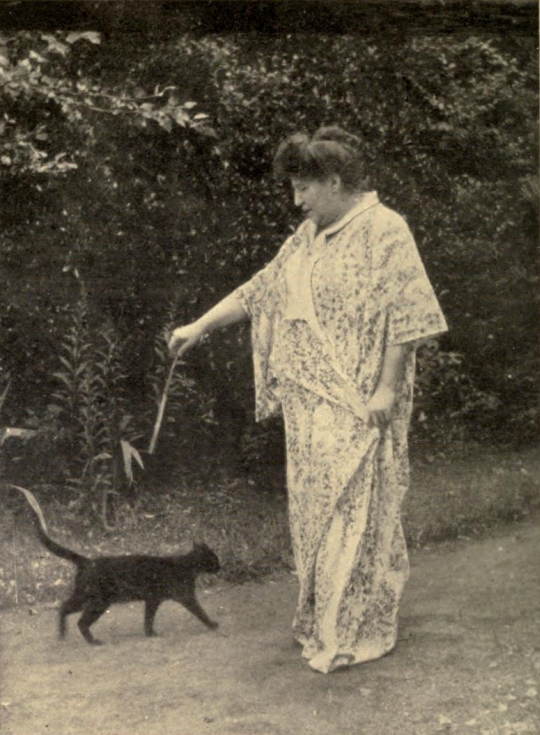
JUDITH GAUTIER IN HER GARDEN AT SAINT EUOGAT.
XXIV
To-day they presented to me Siegfried,—familiarly called "Fidi." He is a splendid baby, who weighs down the arms of his nurse. He does not talk yet, but he understands what is said to him. They ask him:
"Fidi, wie gross bist du?"
("Fidi, how big are you?")
He holds up his arms and shows, with a laugh full of dimples, that he is as high as the ceiling.
"Here," said I, "is a little being who has a very exceptional origin: descendant of Wagner and Liszt! What plans of future glory have they already formed for him?"
"That is all very vague," said the mother, laughing. "I have the ambition, first of all, to assure him a modest income, so he may always be sheltered from those terrible material worries, those shameful 'little miseries' from which I have suffered so cruelly. Then I should like to have him know something of surgery, so he could give help to anyone who was wounded, make a first dressing. I have so often been grieved by my own helplessness, when an accident has happened near me, that I wish to spare him that pain. Otherwise I shall leave him quite free. I should be glad, however, if he were to develop a taste for architecture."
"While we are waiting," added Cosima to me, "for the future architect to declare himself, do you feel yourself worthy, dear friend, of fulfilling a mission of confidence on his behalf? The nurse is just going to her dinner, which is served before ours; as for me, I have a bath ready which the sun has warmed; water heated in that way is very hygienic; I should like to take my plunge right away, in order not to be late for dinner. Now, this is the hour when Fidi is in the-habit of sucking a biscuit soaked in madeira; and there is no one to give it to him but you."
"Madeira at his age?" I am very much surprised, but I make no objection, being also very conscious of my own incompetence.
So here I am installed in the garden, near a little iron table, on the other side of the curtain of shrubbery which conceals Cosima's bath. Fidi is on my knees. Penetrated by the importance of my task, I soak the biscuit in the madeira, neither too much nor too little, and I am very careful not to soil the pretty embroideries of the robe. The baby eagerly sucks the golden wine and swallows the biscuit, without coughing or choking. I am not able to see, but behind the leaves I hear the splashing of the water and Cosima's voice encouraging me. All goes well, as long as the madeira and the biscuit last. But when there is nothing more, Fidi gives manifest signs of impatience. He twists himself about, in order to escape and slide to the ground. Shall I let him go? Never! I am not authorised. I do not even know if he can walk by himself. But he is quite determined to get down, kicks vigorously, and looks at me with frowning brows, as though he were astonished that I do not understand.
"Do hurry, Cosima, Fidi detests me and wishes to get away."
"No indeed, he loves you very much," cried the bather, "hold him tight."
So I hold him tight, but he has incredible strength and a persevering will. The struggle is painful and long ... finally, when they come to my aid, it becomes evident, too late, that the baby had serious reasons for his determination to get down.
XXV
This morning, Richard Wagner received a letter from the celebrated Pasdeloup....
It will be remembered, perhaps, that at this time, Pasdeloup had been director of the Theatre Lyrique for rather more than a year. He had, as a matter of course, produced at his theatre, first of all, one of Wagner's operas, and as he intended to play them all in succession he had begun with Rienzi, the first as to date. The work had been brilliantly mounted and well received, and the tenor, Monjauze, really remarkable in the rôle of the Tribune, had had a very decided success.
In his letter of to-day, Pasdeloup wrote that Rienzi was to be given again at the re-opening of the theatre, but without Monjauze, who had unfortunately broken his arm.
They begrudged Monjauze and regretted exceedingly that it was necessary to replace him, for he alone, in that work, was equal to his part. Pasdeloup did not say who would take his place.
It was on the occasion of that first representation of Rienzi at Paris, that, urged by Pasdeloup, I had written again to Wagner,—after the sending of the famous articles which had brought me the beautiful response from the Master, in which he explained to me certain scenes from the Meistersinger—I wrote this time, to ask if he would not like to come to Paris to stage and direct this work. He replied to me with a second letter, equally beautiful and very dignified, intended for publication and which appeared in La Liberté.
"Now that I know your writing," said I to Cosima, "I realise that the letter was by your own hand."
"That is true, Wagner wrote it first in German. I translated it into French, then we re-read it and corrected it together, and finally I copied it again."
"How wrong of us to have given you all that trouble! Pasdeloup was over-confident. If I had known about this retreat of Tribschen, how sacrilegious would have seemed to me the idea of asking the Master to leave it in order to please a Theatre Director!"
"You have seen by the affair of the Rheingold, that it is much better for Wagner not to mingle with the theatrical world. His first duty is to keep his creative faculty intact, but he is a 'fighter,' and is always tempted to throw himself into the fray."
"Now that I have the joy of knowing him, he will never again be called to battle by me!"
"He will return of himself, only too soon, for repose is not for him," added Cosima, sighing:
"I am curious to read again that letter that you wrote, you two, when you believed me to be a very serious old lady.... Do you remember your surprise, the first time you saw me to find me so different from what you had imagined? You would not be able to write in the same tone now."
"Certainly, the style of your articles does not at all resemble you, and we did not in the least foresee the gamin that you are ... sometimes!"
"Neither could I have known that Wagner climbed trees...."
"But in any case the letter had nothing private in it; it was written to be published."
Cosima had kept a copy of the text, which she found, and we read it together:—
"MADAME,
"You are kind enough to ask me for some details relating to the time of my first stay in France, with the kindly intention of writing an article by their aid, the publication of which shall coincide with my arrival in Paris, which you believe to be near. While thanking you for the interest which you are so kind as to feel for me, permit me to say, Madame, that it is not my intention to go to Paris. I know that I have excellent friends, indeed, even numerous friends there, and I hope I do not need to assure you that I am capable of appreciating the value and the importance of the testimonies of sympathy of which I am the object. Nevertheless my presence and my participation in the representation that is being prepared might very well give rise to a misunderstanding. It would appear as though I were putting myself at the head of a theatrical enterprise with the intention of regaining by Rienzi that which I have lost by Tannhäuser. At least it would undoubtedly be in this way that the Press would interpret my going. Whereas the stage setting of Rienzi at the Théâtre Lyrique has only been an entirely personal question between M. Pasdeloup and me.
"After the production of the Meistersinger at Munich, and the attention it attracted, many propositions were made to me. At first they spoke of sending a German troupe, to give my six operas, one after another, in Paris; then some one wished to attempt Lohengrin in Italian, then again Lohengrin in French, and so on. In short, there were no less than five projects that summer, concerning the representations of my works in Paris. Yet I did not encourage any one of them. When M. Pasdeloup told me that he had accepted the directorship of the Théâtre Lyrique with the intention of giving several of my works, I did not feel that I could refuse to this zealous and capable friend, the authorisation for bringing them out; and, as he desired to begin with Rienzi, I said to him that, in fact, of all my operas, that one had always seemed to me best adapted to the French stage. Written, thirty years ago, with a view to Grand Opera, Rienzi does not present so many difficulties to the singers, nor will it offer to the Parisian public so much that is unusual as the works which have followed it. Both in subject and in musical form, it is closely related to the operas that have been popular in Paris for a long time, and I still believe that, if it is richly mounted and given with spirit, it has a chance of success. That success I wish for it with all my heart, and still more success to my friend M. Pasdeloup, who, of his own free will, has valiantly and energetically upheld my cause for a number of years. But I should be unwise to wish to contribute to that success by my presence. My nature as well as my destiny have decreed for me the concentration and the solitude of work, and I feel myself to be absolutely unfit for any exterior enterprise. Either Rienzi will make its way without me, or, if it is not capable of doing so, my assistance cannot help it and we can only suppose that the conditions are unfavourable.
"Such is, in a few words, my point of view and the line of conduct which I have decided, or rather, which I am called upon to follow, with regard to the representation of my works in Paris, whichever they may be. And please, Madame, do not see in this reserve any sign of unreasonable disdain, which could be assumed to mask a deeper feeling of rancour. I am very far from pooh-poohing a Paris success, and I even assure you that I have always considered it one of the numerous ironies of my fate that Rienzi, composed within sight of Paris, was not given there long ago, when that work of my youth still held for me all its freshness. But, since you speak of the renown that I have acquired in Germany, permit me to tell you, Madame, that all such renown has come without my personal participation, with the help only of a few friends, in the midst of the howls of the entire Press of the North and of the South. It has come because of my works alone, and in spite of the obstacles that my political situation opposed to the extended knowledge of my operas. It is in the same way that I wish to succeed in Paris, where I have found very devoted friends, who are too intelligent for me to fear to leave the fate of my works in their hands. If you were to say to me, Madame, that a representation ought to conform to my intentions, and therefore my presence at the rehearsals would be above all necessary to the success of the enterprise, I should reply to you that Tannhäuser and Lohengrin have been mutilated by the greater number of German Capellmeisters, in a way that could not be exceeded upon the worst French stage, and that is only since the King of Bavaria has accorded me his protection that it has been possible for me to make my dramatic and musical intentions known in an important theatre.
"Believe me, Madame, things being as they are, there is nothing for me to do but devote myself entirely to the writing of my operas, and as to their fate, in my own country as well as abroad, to leave it to their guiding star and to my friends. I am not the man for compromises, and yet these compromises are sometimes indispensable.
"I keep out, then, in order not to render more difficult to my French friends the rugged path they have chosen in attempting to naturalise in France an essentially Germanic individuality. If this naturalisation is possible, it will be accomplished by them without my help; if it is not possible, I shall deplore their pains, at the same time consoling myself in the thought that they as well as I have drawn their forces elsewhere than from the idea of a success, and that their conviction, like mine, renders them independent of good or of bad fortune.
"Pray, Madame, pardon the length of this explanation, and believe me gratefully and respectfully yours,
"RICHARD WAGNER."
"The Master was nevertheless, very well satisfied with the success of the piece," said Cosima, "and above all, with the expressions of appreciation that it won for him from unknown friends. Then too, in order to celebrate his birthday, the 22nd May—inspired by one of the most popular scenes in the opera—I dressed the children as 'Messengers of Peace' and while an invisible choir sang for them, the little girls, all four of them, marched, keeping step with one another, into the drawing-room with travelling staffs in their hands. Wagner thought it a very pretty idea."
"Eva as a messenger of peace must have been delicious...."
"I also preserved your father's article about Rienzi,[1] which was very good," said Cosima. "Wagner ought to have written to thank him."
"If they represent Rienzi again," said I, "we shall also faithfully renew our pilgrimage to the theatre. Think of us then, two and a half weeks from now, as going every day from the heart of Neuilly to the Théâtre Lyrique, and never failing to be in our places in time for the Overture!"
ARTICLE PUBLISHED IN THE "JOURNAL OFFICIEL"
Rarely has Parisian curiosity been more vividly excited than by the following simple words inscribed upon the placards of the "Théâtre-Lyrique."
Tuesday, first representation of Rienzi, Opera in five Acts, by Richard Wagner.
In an age when the general interest is certainly not with works of art, Wagner has the gift of stimulating the public, of calling forth frantic enthusiasms and provoking violent repulsions.
The mere mention of his name assembles clouds in the most serene heavens, clouds which soon grow into a storm, lightning breaks out in intermittent flashes, thunder mutters and growls above the sound of the rain, the wind and the hail. In all this tumult no one remains indifferent, the universe seems about to collapse and each person hurries toward the altar of his own menaced deity.
The rival choruses of detractors and admirers insult each other as at the taking of Messina and are ready to tear each other to pieces. There is an excitement,—a tumult—a fury, which recalls the great romantic struggles of 1830, when the young followers of Hernani broke into the theatre with their password, and tore away the classic masks and headgear—proclaiming the liberty and independence of art.
If we had never heard a note of Richard Wagner, all this uproar would have assured us of his superiority. He troubled all the musical world too profoundly not to be a genius, a hero, in accordance with the meaning of Emerson and Carlyle. From whatever point of view one considers him, he always produces a new sensation, it may be a little prematurely, but one is conscious even now that he will become the sovereign master and that nothing can prevent his future greatness. Very soon his victorious banner will float from the highest turret of the citadel, gilded by the sun and caressed by the very wind which before had twisted and torn it.
Young musicians, not yet established, regard Wagner either as a God or as a tempting demon. It is Wagner who preoccupies the thoughts of the older masters already secure in their own glory, and in every contemporaneous work it is not difficult to find some reflections, or at least traces of the secret study of this powerful originator.
A chance of travel led to my being present at a production of Tannhäuser in the theatre at Wiesbaden, at a time, already long past, when the name of Richard Wagner was hardly mentioned in France. This music, strikingly novel to us who knew absolutely nothing of the composer, made an impression upon us at the same time strange and delicious. We had heard for the first time the true music of romance, such as poets might conceive it. The opera reproduced, with most unaffected fidelity, the legend of the good knight Tannhäuser and Madame Venus, living happily together on the heights of Venusberg —until at last the noble German, who was a good Catholic at heart, became suspicious of some witchcraft and said to his mythological companion:
"Venus, my beautiful Goddess, Thou art in truth a demon."
That which most impressed us in the score of the Teutonic Master was the extreme dearness of the musical manner of translating the spoken phrase by means of a continuous melody, without elaboration, without superfluous flourish, the orchestra providing the commentary, and, sustaining with its own fulness the simplicity of the vocal design. We sent from Wiesbaden either to the "Moniteur" or the "Artiste," we no longer remember which, an appreciative article which ended in expressing astonishment that an opera so original and unusual had not yet passed beyond the limits of the Rhine. Our astonishment was also great when, some years later, this same Tannhäuser—so easily given at the theatre of Wiesbaden, by singers and an orchestra which were probably not the first in Germany—having been produced here at the Opera, was declared impossible, foolish, absurd, outside all the possibilities of the theatre, and was smothered under a storm of hisses. They muffled Wagner's music in derisive purple, under the pleasantry "Music of the Future," but the wag who invented the phrase had no idea that he spoke so truly. In fact its time has come, and the music of the future is very near to being the music of to-day. The fall of Tannhäuser in no way unsettled our convictions. Critics are stubborn, and even though they are not dealing with the old romantic poets, they know very well that hisses do not kill a work of genius.
They said of the dramatic verses of Victor Hugo precisely what they say of the musical phrases of Wagner. Accusing them conclusively of not being verse at all, yet to-day it is a common argument of advance that the author of "Ruy-Blas" and the "Légende des Siècles" is the greatest master of metrical form of our time.
But to return to Rienzi, the production of which at the Théâtre-Lyrique accomplished an old-time project of the Master's. One of Wagner's letters makes that clear—"Written about thirty years ago, with a view to grand opera, Rienzi presents no difficulties for the singers to overcome, and offers to the Parisian public none of the problems of my later works. Both in subject and in musical form it is closely related to the operas that have long been popular in Paris, and I still believe that if it is brilliantly mounted and given with spirit it has a chance of success."
For serious works, time is required in which to bring them a full acknowledgment, but it comes at last, and the Master's own judgment of his work was most triumphantly confirmed the other evening. Rienzi has not literally arrived at the Grand Opera, but at the Théâtre-Lyrique it met with a zeal, an ardour of conviction and a passionate devotion which ought to banish from his mind any possible regret. Pasdeloup has splendidly welcomed the illustrious guest that he endeavours to introduce and to naturalize in France.
A few words upon the libretto translated from Wagner's poem by Messrs Mutter and Guillaume. One need not seek there for the learned complications of our own lyric dramas. It is the history of Rienzi very simply told just as it happened in reality. Cola Gabrino, called "Rienzi" or "Rienzo," was the son of an Innkeeper. He received a good education, bound himself in friendship with Petrarch and, in studying antiquity, became enamoured of the ideas of liberty and a republic. The sojourn of the Popes at Avignon delivered Rome over to the most troublesome disorders. Rienzi harangued the people, succeeded in making himself Tribune, drove out the Barons and re-established the old and good government. His rule at first was wise, but intoxicated by too great power after having been liberator he became the oppressor of Rome. Driven out of the city once, he returned and was killed in a riot, by a servitor of the house of Colonna. Beginning like Brutus, he ended like Masaniello or Jean de Leyde.
Rienzi, Wagner's first lyric drama, shows already an immense talent. Here is not yet revealed the Wagner of the Flying Dutchman, but a man, nevertheless, untrammelled by precedent. Excepting the Cavatinas in the Italian style, inserted here and there to please the public, the opera resembles no other, the impression is unique. It is all a great tumult, a rising of the people. There are in fact only two characters, Rienzi and the populace. It is more like a magnificent symphony with choruses than like an opera as ordinarily heard. The orchestra has become the great power, the science of which the composer fully understands and controls.
In the first act, the call to arms—
"When the trumpet shall have sounded thrice,"
is marked by a proud enthusiasm which extends to the chorus, whose voices carry on the theme swelling and augmenting it to a superb crescendo. The trio which follows is intermingled with an adorable accompaniment. In the second act the aria sung by the first of the messengers of peace, felicitating Rienzi, was warmly and insistently applauded. Nothing could be more sweet, more tender or more delicate than this melody, admirably sung by Mlle. Priolat, from whom the entire audience demanded its repetition.
The chorus of conspiring patricians is also very fine; under the dull murmurs one divines the revolt of injured pride and the muttering of an, as yet, powerless hatred. The entrance and the grief of Adriano, are expressed in the orchestra by two notes of the hautboys which are like the sigh of a broken heart. This pure and charming detail foretells the later Wagner whose orchestra is able to reveal all things and to make one experience all emotion. The septet and the final chorus are fragments of such power and grandeur that you feel as though you were floating upon wings. In the third act, we especially noted the military march with its firm and warlike rhythm; and the prayer of the women, augmented in its fervour and its terror by the intermittent sounds of battle. In the fourth act, the march of peace and the magnificently dramatic situation of Rienzi, accursed, excommunicated, deserted, alone upon the steps of the church. In the fifth act, the prayer of Rienzi, admirable in its sadness and its fervour.
"Rise, O Sun, and make the light of liberty to shine upon the world."
In this part one again sees the powerful Wagner of to-day, and the entrance of the Sister of the Tribune, who consoles him by her devoted love, is like a vista through which one catches a brief glimpse of the angels with fluttering wings of the prelude to Lohengrin. One must congratulate M. Pasdeloup, the new director of the Théâtre-Lyrique, who has already done so much for art by means of his popular concerts, for having pro-produced Rienzi. The notable success of the first representation, a success which will, undoubtedly, continue, allows us to hope that we may also have before very long, The Flying Dutchman, Tannhäuser, Lohengrin, Tristan and Isolde, Die Meistersinger, and all that unknown repertory, rich casket of new treasure.
Rienzi is sumptuously mounted, the costumes and decorations are rich and appropriate; the choruses well arranged and the whole forms a splendid spectacle. The final tableau of the death of Rienzi on his balcony is presented in a highly dramatic manner.
Montjauze, in his impersonation of Rienzi, surpasses all one's expectations, he is transfigured into a singer and an actor of the first rank. This role is for him what William Tell was for Duprez. He sustains with wonderful ease the continuous dialogue with the chorus. His voice dominates those great, those formidable crowds, and with a gesture he restrains the flood of people pressing about him in a transport of eagerness and joy. He wears with artistic grace and majesty the splendid white draperies, richly embroidered in gold, with which the Tribune clothed himself in his vanity as a parvenu whose head was turned at the summit of his grandeur. One could not imagine a more perfect incarnation of the type of Rienzi.
Mme. Borghese sings with warmth the rather thin arias of Adriano, lover of the Tribune's sister, who is herself very gracefully represented by Mdlle. Steinberg. But this poor little love episode is tossed about, in all senses, like a drowned flower by the tumultuous foaming upheaval of this great tragic drama, which begins with a battle and ends with a riot.
The choruses are excellent, and the orchestra executes with splendid spirit that overture of Rienzi, already popular long before the opera itself was known.
THÉOPHILE GAUTIER.
XXVI
As Cosima and I, seated on a garden bench, were peacefully talking, Jacob came to us bearing a telegram.
One always trembles before opening a message of this kind.
"It is nothing! Only rather a bore!" said Cosima, after reading it. "Two elderly people, named Schott, husband and wife, announce that they will visit us this evening after supper. They are very worthy people, but he, at one time, did Wagner a serious wrong, and Wagner, without exactly holding resentment, yet has not been able to forget. Moreover, these good people are very narrow and stiff, not at all talkative: we shall not know what to do, it will be dull, and all our pleasant, sympathetic atmosphere will be disturbed."
"It might be possible," said I, "to think of something collective that would lessen the necessity for talking during this evening."
"True enough, but what?"
"You might have some music."
"Wagner would not feel like it, I know him: under such circumstances he does not know at all how to dominate, but he grows listless and loses his good humour."
"That mustn't be!" I exclaimed. "It is absolutely necessary to think of something!"
"Ah yes! Do help us out of it if possible, but do not count upon me, I feel utterly incapable of an idea that would be in the least amusing."
I saw Servais in the distance with Richter, they were by the edge of the lake, under the little landing shed, and were throwing bits of wood into the water, to induce Russ and Cos to take their bath.
"I believe a light is dawning in my mind," said I to Cosima. "Wait for me where you are." And I ran down to join the two young men at the edge of the lake.
"My friends," I said to them, "in the face of a delicate situation do you feel the moral force to do something unusual, grand, heroic?"
"Not at all, not at all," replied Servais. "I don't feel equal to anything of the kind."
"Not in the service of the Master?"
"One can always try," said Richter.
"That is something like! Now you see, Servais, you can't get out of it. We must improvise a first class charade for this evening."
"A charade! Before Wagner, we two alone?"
"With Richter at the piano."
"But we shall be absurd! We shall be speechless, like idiots."
"On the other hand the presence of the Master will inspire us. Moreover, we have had experience at your house in Munich, and it is very certain that only we two (you especially) have shown any talent of this kind."
"It is foolish, impossible, abominable," groaned Servais, in the depths of dismay. "I would rather throw myself into the lake."
"It is not a drama that they want of us, but a farce.. .. Oh, come, they will not be critical, and perhaps we shall have the glory of amusing the Master."
He raised his head abruptly, tucking his pale yellow locks behind his ears:
"Very well, so be it. Let us play a charade!"
"Ah, good! We must have everything arranged before supper. Let me tell the good news to Madam Cosima, and then we must get to work!"
"I see that you have thought of something," said Cosima, when I returned to her.
"Yes, we will play a charade."
"A charade? Splendid! I do not know exactly what that is, but I am sure that it is something good."
"As to that, you must risk the pillage of your wardrobe."
"I risk it. They shall open the cupboards and the drawers for you. Take anything you like, except, perhaps, my India shawl, which I cherish very much.... But you must tell me exactly what you are going to do, so I can explain it all to Wagner; otherwise he would torture his mind in the effort to comprehend.... I am sure that he hasn't the slightest idea what a charade may be!"
The drawing-room was deserted, so it was possible for Richter, Servais and me to gather round the piano, and with the greatest secrecy to think out, to discuss and to arrange our foolishness.
The music would be a great help to us in representing characters, crowds, uproars and riots. Therefore Richter's rôle was very important, and as, once the charade had commenced, he would be separated from us, we agreed upon certain signals that we should all recognise.
The gallery, with its large opening into the drawing-room, was chosen for our stage: its heavy portières, drawn back or dropped, formed the curtain. All was arranged, the lamps disposed in the right places, the accessories gathered together. Our greatest difficulty was to induce the servants to let us have a kettle and a broom from the kitchen, two objects that were indispensable to our stage setting. The cook, throwing up her arms, cried that it was not at all suitable to take such things to the drawingroom, so we were obliged to take them by main force.
XXVII
We had hardly finished supper and were still at table when Herr and Frau Schott were announced.
Wagner made a droll face, got up, and offered me his arm to pass to the drawing-room.
But just outside the door I slipped away, and with Servais I climbed to the first floor, where Cosima's maid was waiting to help us do the best we could with our costumes.
When we were ready Jacob lighted the stage lamps; and drawing the curtains a little, we peeped into the drawing-room.
There they are, seated in rows, the two new guests in the front row. They appear to us very solemn and terrifying: two portraits by Franz Hals—a Franz Hals who would have lived under Louis Philippe—tall, straight, all clothed in black; he, in a frock coat and high satin cravat; she, in a dull, lifeless frock, with hardly a line of white at the neck; thin figures and sallow skins; nothing playful about them. We are a little disconcerted. Pshaw! The Master's voice sounds laughingly: he is in a good humour, all goes well. Courage!
Dum! Dum! Dum!
Richter at the piano begins a fanciful overture where the motifs of Tristan and Isolde mingle with foreign airs. The curtain is drawn.
A young Chinese lady embroiders under the lamp; but this virtuous occupation and tranquil appearance are deceitful: violent passions agitate her soul. She is married to a man whom she detests, first, just because she detests him, and then because he belongs to a conquering race. He is a Tartar. She waits for her lover, whom she adores, and who himself is a true Chinaman.
The husband is asleep, the night dark; the lover watches in the shadow. Now the hour has come for the signal: she opens the window and waves her scarf. From the piano comes the second act of Tristan.
The lover enters impetuously.
"My beloved?"
"My darling, art thou truly mine?"
"Dost thou still belong to me?"
"Are these thine eyes?"
"Is this thy mouth?"
"Thy heart?"
"Sweetheart!"
"Stem of the Lotus!"
"Duck of a Mandarin!"
The music changes. It is now from the fifth scene of Die Walküre; enter Sieglinde and Siegmund.
"Is he asleep?"
"Ah, he sleeps profoundly. I prepared for him an intoxicating drink."
"His sleep is not yet profound enough. Let us finish what thou hast begun: that he may never waken again."
They decide then to assassinate the Tartar, and to conceal his body.
The lover steals into the next room, from which cries are very soon heard, and the sound of a struggle; then the murderer returns, dragging after him an inanimate body.
They must dispose of it, throw it into the river, and the lover tries to pull the dead man onto his back. But this Tartar, who was a man of importance with the rank of Mandarin, had been altogether too well fed and he is horribly heavy, so that the Chinaman is doubled up under his great bulk, and try as he may he cannot carry the unwieldy corpse.
"Ah well, cut him in two!"
Then, by the aid of a great sabre and their own tremendous efforts, they hack the Tartar in two—not very difficult really, considering the cushions of which he is formed. When this has been accomplished the lover wraps one of the halves in a rug and carries it off. He will come back for the remainder the next night.... Villiers, in the drawing-room, has already guessed that this first syllable which we have acted ought to be "Tar"—the half of a Tartar!
The next thing to do is to make them recognise the illustrious Pasdeloup directing a "popular concert" and that difficult task falls to my lot. I have made myself a beard with skeins of yellow silk, and donned an evening coat of Wagner's. Servais has to multiply himself to represent the public, the police, etc., while Richter in the distance is the orchestra.
All join in giving the "la"[1] with especial significance: then they begin the prelude to Lohengrin. Pasdeloup, according to his custom, rounds his back, wrinkles his good-natured face, extends his arms with gestures half supplicating, half soothing, in order to secure "Pianissimi" full of mystery, and the orchestra does his best to obey. But all is not in harmony in the audience. Murmurs arise, are hushed down, then an altercation follows, with a sound of slaps, and swells to an uproar—as it had so often done during those days at "The Cirque d'Hiver."[2]—
The orchestra stops, the guard drags out the roysterers, and Pasdeloup makes a speech to the public.
And that, both good and bad, represents the syllable "La."
All the servants at Tribschen are crowded at the doors, and they watch this unprecedented sight with devout amazement. At the third scene their attention redoubles, for the kettle and the broom are about to play their part, to the great horror of the cook.
"If it had only been a nice hair broom! But that ugly old one used to sweep the court!"
In reality the broom is not exactly the right thing, but as there is only one of me to personate the three witches of Macbeth, I feel that this classic mount will aid the illusion. With my hair concealed under a grey veil, I bestride the diabolical steed, which then proceeds to prance.
"Round about the cauldron go; In the poison'd entrails throw Toad, that under cold stone, Days and nights hast thirty-one Swelter'd venom sleeping got, Boil thou first i' the charméd pot. Double, double, toil and trouble; Fire, burn: and, cauldron, bubble. Fillet of a fenny snake, In the cauldron boil and bake; Eye of newt, and toe of frog, Wool of bat, and tongue of dog, Adder's fork, and blind-worm's sting, Lizard's leg, and owlet's wing, For a charm of powerful trouble, Like a hell-broth boil and bubble."
Then comes Macbeth: he is welcomed by the prophetic words:
"All hail, Macbeth, hail to thee thane of Glamis!"
"Hail to thee, thane of Cawdor!"
"All hail, Macbeth, that shalt be king hereafter." And the audience is supposed to understand that the third syllable is "Tane."
We are very successful up to this point. Wagner, who is standing behind an easy chair, leaning his elbows on the back, looks and listens with extreme attention, he is greatly interested and laughs heartily.
Now we must give the entire word: "Tarlatane." The public approbation encourages us, so we are no longer nervous about our effects.
Richter plays a waltz.
A lady comes home at midnight from a ball, in a tarlatan frock. Standing before her mirror she begins to remove her jewels, to take the flowers from her hair, meanwhile thinking over the incidents of the evening, the compliments, the scandals, the toilettes more or less pretty, the little absurdities of her friends, which are still amusing her.
As she has danced all the evening, she is very tired, and rejoices at the idea of retiring.
But suddenly there is a ring at the bell. The lady starts:
"Who can be ringing at my house at such an hour?"
The domestics are in bed. At first she dares not open the door: but she must, for perhaps some one of her neighbours is ill and in need of her.
On the threshold appears a strange young man, tall, thin, with weeping willow locks, and an awkward and conceited air.
"You are no doubt mistaken in the floor, sir, as I have not the honour of your acquaintance."
"How, Madam, you do not remember me! You know me very well, nevertheless. We have met in society, and I came here once to a Soirée at your house. Let me give you my card!"
"Ah, yes, I do seem to remember, you are not altogether a stranger.... But what serious thing can have happened to bring you to my house so late?"
"Oh, do not be disturbed, there is nothing serious, nothing at all. I was passing your house by chance; happening to look up, I saw a light in your window. I said to myself: 'Stay! I owe this lady a visit, a very much delayed visit, which must not be put off any longer.... What a good opportunity! Certainly, I am not sleepy, and, since she is awake she is not sleepy either. She will be pleased to see me and to pass a few hours in intellectual conversation with me.'"
"A few hours!"
"But, I beg you, do not inconvenience yourself for me! do not remain standing; let us be seated; one can talk so much better sitting down."
"But don't you understand, sir, it is very late!"
"Oh! do not be disturbed about that, I am not in the slightest hurry."
And the intruder enters upon a trifling and endless gabble in spite of the impatience of the lady, who does not attempt to conceal her ill-humour, and replies ironically and as briefly as possible. Finally she declares:
"I truly believe that you have lost your common-sense."
"What, do you imagine that I am intoxicated? Ah well, you will see that is quite impossible when I tell you that I have dined at home: a plain and frugal dinner, of which I retain a very unpleasant memory, and while we are on that subject, I beg of you to be good enough to give me a tooth-pick."
"A tooth-pick!"
"Yes, exactly, you will in that way do me a favour, because, at that dinner, I partook of veal, and I should very much like a tooth-pick. You see it was paternal veal, stringy, tough and salted.... Ah, so salt that I am dying of thirst, and it would be so kind of you if you would have some drinks served."
During the last intermission, some champagne had been uncorked. Wagner, who was as amused as a child, interrupted the scene at this point, crying out:
"Here it is! Here it is!"
And he poured the sparkling wine for us himself!
Then Servais became epic.
"It is very curious, Madam, but you have a butler who has a marvellous resemblance to a composer of whom they have been talking very much of late, a certain Richard Wagner. He is an extravagant person, a madman, who makes terrible music, full of discords that are worthy of cannibals and calls it 'the music of the future.'"
And he retailed, without trembling, all the venomous imbecilities that were current, and finally:...
"And it appears that this music has no airs, yet, apropos of this, something surprises me very much: this composer has brought out in Paris a so-called opera, which naturally was finely hissed, and which furnished a subject for endless witticisms: one, among others, you might, perhaps, be able to explain to me. Some one said, 'He bores me with his recitatives and wearies me with his airs'—(il me tanne aux airs).[3] But since there are no airs? and then 'tanne.' What can that word mean?"
Then the lady's wrath broke forth:
"Sir, 'tanner' is a slang word, which means 'to annoy, to bore, to exasperate' in polite speech. It is, for example, what you are doing here at this moment. I have given proof of extraordinary patience because I am a gentlewoman, but now that you dare to speak offensively of a man whom I believe to be the greatest genius that ever existed, that I will not endure. You have wounded my dearest convictions. You are an idiot and a ruffian, and I have the pleasure of showing you the door, and of charging you never to come to my house again."
Wagner laughed till he cried.
It was necessary to explain, in the midst of the bravos and the recalls, that the word of the charade was "Tarlatane": A lady in a tarlatane dress ... a man who "tard la tanne," "stays late and bores."
XXVIII
After having resumed our usual clothing, we went down again to the drawing-room. The Master came to meet us, and pretending not to have recognised us through our disguises, he cried:
"Heavens! where have you been? Why are you so late? We had here a troupe of wonderful comedians, who played the drollest possible piece.... How unfortunate that you missed them! You will never see anything like it again!"
As to the worthy visitors, the prime cause of this unique representation, sober, imperturbable, upright in their chairs, in their severe costumes, they sat without moving, listening intently, watching with all their eyes, but probably understanding very little.
I feel sure that they remained forever convinced that it was all from some new work of the Master—some unpublished fragment, perhaps from the Ring of the Nibelung!
And now again it was the farewell evening.
In order to soften the bitterness, Wagner took a score and went to the piano.
"To-day," said he, "let us make peace with the Meistersinger."
The Master believed, in spite of my efforts to convince him to the contrary, that I did not care for the Meistersinger. The truth is, that all I had heard of the opera was a few fragments played at the popular concerts or at the piano. All that I knew delighted me, but Wagner would not believe it.
"I do not want you to misunderstand this work," said he, as he opened the book.
And, for several hours he went through the score, playing, explaining, commenting with wonderful kindness.
The music of the Meistersinger is especially difficult to render at the piano and Wagner was not a very skilful performer—Richter knew that, so he was very restless and followed the Master's playing, note by note, with the greatest anxiety. He knew it all, even the most uninteresting passages; he touched the notes that the hand of the Master was too small to include. From time to time he was carried out of himself, and struck the piano hurriedly, saving an effect which was in danger of being lost, completing a harmony, or striking a chord between the Master's hesitating fingers.
I am not sure that Wagner was not a little irritated by this infringement upon his territory. It was quite useless, moreover, for no virtuoso could have been able to render the deep meaning and secret tenderness of the work as well as its author. How grateful we were! How completely the Meistersinger was absolved. On that point Wagner had no longer any doubts.
XXIX
Then they sketched out some new projects. Servais was in friendly relations with the director of the "Theâtre de la Monnaie" at Brussels, and also with Brassin, director of the Conservatory, who was a Wagnerian fanatic: they wished, with the Master's permission, to try to arrange for the production of Lohengrin at Brussels, with Richter as chief of the orchestra.
"If Richter is able to make any money out of the affair, and in that way to repay himself for what he has lost through me, I agree to it," said Wagner, "but only on that condition."
They gave us some commissions for Paris. Cosima wanted some preserves "such as one finds in the Paris grocers' shops." She also wished me to take a subscription to the journal called La Poupée Modèle, for Senta.
Wagner had been for a long time searching for a particularly delicious snuff, which could, no doubt, be found at "La Civette."
"For," said he, "while it is true that I smoke, I also take snuff sometimes, from a beautiful golden snuff box, like an ancient Marquis.... So you see, I have all the vices, but in moderation."
We tried not to be sad. We had gathered a bountiful harvest of memories, and we were consoled by our just pride in such a wonderful friendship.
Moreover they promised us frequent news. Cosima, "who writes letters like Madame de Sévigné," would be punctual and faithful, "provided always that one replied to her as faithfully." We would continue then to hold firmly on high the banner of Art, to fight the good fight, up to the final triumph of our cause.
And, after the farewell kiss, we went away, stoical, bearing with us much happiness:
Aux pèlerins d'amour La vision du dieu parfume le retour!
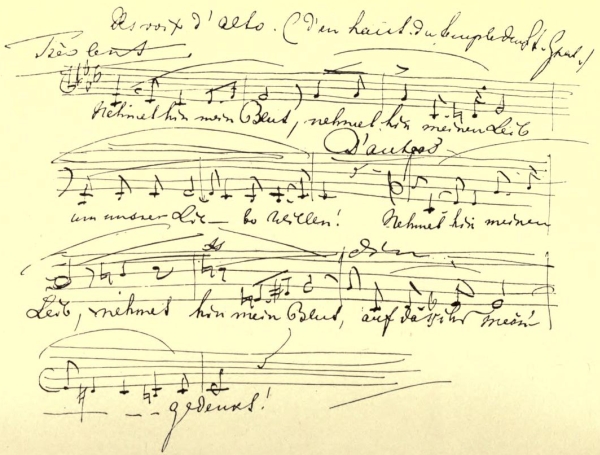
EXTRACT FROM ONE OF WAGNER'S LETTERS TO MADAME GAUTIER, SHOWING PART OF SCORE OF THE FIRST ACT IN "PARSIFAL."
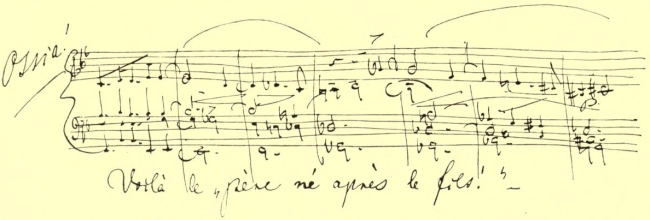
EXTRACT FROM ONE OF WAGNER'S LETTERS TO MADAME GAUTIER, SHOWING PART OF SCORE OF THE SECOND ACT OF "PARSIFAL."
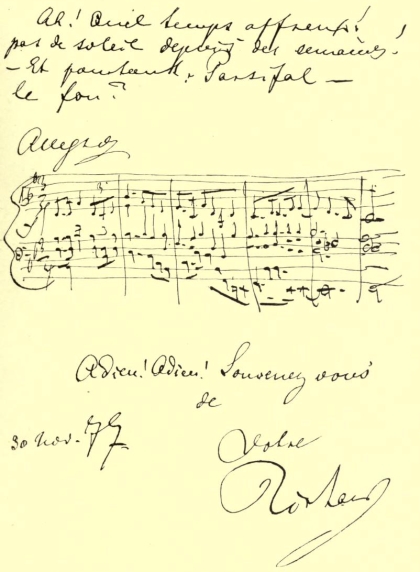
EXTRACT FROM ONE OF WAGNER'S LETTERS TO MADAME GAUTIER, SHOWING PART OF SCORE OF THE LAST ACT OF "PARSIFAL."