JUDITH GAUTIER (continued 2)
Effie Dunreith Massie translation
"The days of these representations and the dress rehearsal before the King were, without doubt, for Wagner the culminating point in his destiny as composer: they included those ineffable hours that repay for a whole lifetime of efforts, of disappointments, of miseries—his 'ideal realised,' the splendour of his genius shining before his own eyes and penetrating his very being with a glorious certainty.
"And what a magnificent trinity, Richard Wagner, Ludwig II. and the incarnation of Tristan! What a noble joy animated them all! 'How I bless those hours!' cried Schnorr, in a burst of enthusiasm. 'O Master, with your help and the help of this divine king, I also must accomplish something great and glorious!'
"A most unusual interruption brought this splendid manifestation of art to an unforeseen conclusion after the fourth representation. From the first, Wagner had felt for Schnorr's prodigious achievement an astonishment full of respect, which increased to dread and finally became an actual terror. It was unbelievable that the singer could repeat this performance day after day, after the custom of the theatre. The Master felt that it would be a crime, and he therefore declared that this fourth representation of Tristan should be the last; that he would not permit another. So the work was not given again.
"'I feel that I have no right to inflict such a condition of trouble upon a human being,' said Wagner.
"It was not a question of physical fatigue—Schnorr did not experience any: but to live Tristan, to burn with his passions, to suffer his agonies, to thrill with his ecstasies, to die his death!—such superhuman exaltation, such emotion and fever of the soul, all this the Master could not permit again. So the success was interrupted, the big receipts were cut off, for such secondary considerations as these did not concern those generous minds for an instant.
"Then a very great project began to take shape in Wagner's brain.
"'With the certainty of the unspeakable importance of Schnorr for my musical creations, a new springtide of hope entered into my life. The medium was at last found through which my creative power could link itself to the present. The moment was come in which to teach and to make clear. That which had been universally misunderstood, denounced as unplayable, mocked at, covered with contempt, was about to be proved an undeniable artistic reality. To create a German style for representing works of German genius—this was our watchword. And with this consoling hope I found it easier to oppose, for the time, any further productions of Tristan. This work and these representations were so different from the usual performances that they would necessitate too sudden a leap into the unknown; the precipices and chasms yawning before it must be approached deliberately. We must begin by carefully roofing them over, by paving the way toward ourselves, the isolated artists, up to our summit, for those associates that were indispensable to us. So then, Schnorr being ours, it was determined to found a Royal College of Music and Dramatic Art.'
"Alas! how many obstacles, how many fresh struggles, and before the work could be achieved, how cruel the death that struck down the hero, in the fulness of youth, in the fulness of beauty!"
And now, when in the gallery I pass before the superb likeness of Schnorr von Karolsfeld, I in my turn feel my heart contract, and I stifle a cry of anger, of revolt, against so blind and imbecile a destiny.
XXVIII
To-day it happened that when we entered the drawing-room at Tribschen we found our host there entertaining strangers, visitors! A gentleman and a lady, both very small in figure and rather dull in aspect, were sitting with an air of constraint, only one of them speaking.
The Master presented them.
"His Excellency The Counsellor Isérof and Madame Isérof, who have come from Russia to see me."
We exchanged some rather cold salutations.
It was evident that our presence displeased the newcomers as much as theirs disturbed us. They felt that we were more intimate than they in the household; they saw that we were received very cordially, that Russ and Cos did not bark, but gave evidence of pleasure in our arrival. Yet these people were much older acquaintances of Wagner's than were we; they certainly would have preferred to have the Master to themselves. Ah! how well we could comprehend what they felt!
Madam Cosima followed me out on to the steps. We both leaned against the iron railing, and she told me about the visitors.
"Counsellor Isérof is a composer well thought of in Russia, who is worthy of being admitted into the free-masonry of the brotherhood if only to uphold firmly the Wagnerian standard at Petersburg. Of his wife there is not much to say. She seems to be rather in the background. They are going, as you are, to Munich, to be present at the production of the Rheingold."
"Well, between soldiers of the same army there must be good understanding."
"Indeed yes. The Master will undoubtedly keep them to supper."
"Very well. We must be very amiable to Isérofitus and Isérofita!"
XXIX
As the weather was beautiful and very warm, Madam Cosima bathed in the lake nearly every day with her little girls, and I was invited to join in this cool recreation.
Under the shadow cast by the little shed of the landing-place, which deepened the blue of the limpid water, we very prudently disported ourselves. Madam Cosima and the children wore long white dressing-gowns; she, with her blond hair hanging in braids, seemed like a saint surrounded by cherubs, or even a swan guiding her brood. I, myself, was in a bathing costume, and so I ventured beyond the prescribed limits into the clearer blue and the sunlight, cutting capers, and feeling very flattered by the admiration which my ease and audacity as a swimmer aroused among those who could not leave the shelter. But, when I had gone a little too far away, and a chorus of clear, sweet voices called me back with cries and supplications, then I returned very obediently and stood again in shallow water, and joined with the merry circle in madly splashing the water into the air, laughing with them as it fell again in showers of pearls.
XXX
Alas! we had only a few more days to remain in Lucerne. The opening of the Exposition of Painting was announced and we must be there, in order to fulfil our engagements with the journals to which we had promised our letters.
On one of these last days the weather was dull and stormy, and Madam Cosima and I had stayed under the great pine that the Master was so agile in climbing.
He had gone to his room to work for a time on his study of Beethoven. Madam Cosima was giving me information about Munich, telling me what was best to see there: among other things the gallery of Count von Schack, an original character even more interesting, perhaps, than his collection, which contained, among many daubs, a few fine paintings.
"You will also see my father, and someone who is very dear to him," added she.
As she spoke these words an expression of sadness passed quickly over her face and as quickly disappeared.
"I feel sure," she continued, "that you have no idea for whom your father wrote the 'Symphonie en blanc majeur.' You do not know 'La femme Cygne,' 'La neige Vierge,' 'L'Hostie,' 'La moelle de Roseau,' or who was the original of those delightful portraitures."
"Then there was an original?"
"Yes, madame; before you were born that original inspired the poet who was your father, and at that time, it appears, his description was very like her."
"Do you know who she was?"
"The very person about whom I spoke a moment ago, and who, I am certain, will be curious to see you. She was born a Nesselrode, then became Madam Kalergic, and is to-day the Countess Muchanoff. Very enthusiastic about Wagner, she has been for a long time devoted to his cause. Intelligent, cultured, a musician! My father asserts that no one interprets Chopin as well as she does."
"Then there is a connection between you?"
"Yes."
"What bitterness in that 'Yes!' What has she done to you?"
"I believed that I could count upon her friendship, and she failed me at the moment when I had most need of it. Last winter she overwhelmed me with reproaches because I did not take her into my confidence regarding the distractions of my inner life. I replied quietly that I had nothing to confide, nothing to conceal. 'The painful situation in which I am placed will disentangle itself very naturally, since Herr von Bülow and I are agreed upon the divorce.' But my father, with whom I am no longer in touch, struck the last blow at me, in dissuading Herr von Bülow from this project. I wrote at once to Madam Muchanoff, begging her to use her influence with my father. I besought her to prevent him from influencing Herr von Bülow in a way so contrary to my interest and my dearest wishes. She has done nothing. Her reply was confused, without sympathy and without frankness. Ah! how I regret having broken through my reserve with her, and, above all, having allowed Wagner to write to her as he has done, so open-heartedly and with so much enthusiasm! But, hush! here he comes again. I do not want him to see that I am sad."
XXXI
Behind the house, in that court which formed a part of the garden, and from which the carriage-drive started, there was a high swing, which the children were allowed to use very carefully, and with which the older people sometimes amused themselves. One day Madam Cosima was sitting on the narrow board. Wagner offered to start the swing and give her a good flight through the air.
All went well for a time, but, little by little, the motion became more rapid; higher and still higher went the swing! In vain Madam Cosima begged for mercy. Carried away by a kind of frenzy, the Master paid no attention, and the incident began to have a terrifying aspect.
Cosima grew white; her hold relaxed, and she was about to fall.
"Do you not see that she is fainting?" I cried, throwing myself toward Wagner.
He grew pale, in his turn, and the danger was quickly averted. But, as the poor woman continued to be dizzy and trembling, the Master concluded it would be wise to create a diversion. He ran rapidly toward the house, and by the aid of the shutters, the mouldings and projections of the stones, he climbed nimbly up the side, and reaching the balcony of the floor above, leaped over it.
He had obtained the desired effect, but in replacing one evil by another. Trembling with anxiety, Cosima turned to me, saying under her breath:
"Above all things, do not notice him; do not look surprised, or you can never tell where he will end."
XXXII
"While you are in Munich," Wagner said to me, "try to induce them to show you the model of a theatre that the great architect Semper constructed for me. I warn you that this will not be easy, even with the introductions that I shall be able to give you. They have consigned this model to some out-of-the-way corner of the palace, and they are not fond of bringing it to light. They strongly suspect that I have not altogether given up the hope that one day I may see my buried project come to life again, and this presentiment is a real nightmare for my enemies."
A little later Madam Cosima drew me to one side, and said:—
"If you should be able, in connection with the approaching representation of the Rheingold, to bring before the public the history of that theatre project, which the Master told you about, I do not believe that I can be mistaken in saying that you would give him a real and profound satisfaction; for the truth about those events has been so completely disfigured by envy, incapacity, and spite as to be hardly recognisable."
"You may be very sure that I will gladly do what I can."
"It is just because I am sure of your devotion to this noble cause that I make my petition to you."
"But I know nothing about the project. Adhere can I get the information necessary in order not to be misleading?"
"Of course I will tell you all about it, as briefly and dearly as I can. Come upstairs with me to my dressing-room; there you can take notes."
This boudoir, on the first floor, was a little room, with wall coverings and draperies of green silk, and situated in a corner of the house. It overlooked the garden and, through the trees, one could see the blue of the lake and the violet shadows of the mountains. I had already passed many hours in this room, Madam Cosima having had the kindness to read to me there the Hindoo history of Nal and Damayanti, translating it from the German. I was searching just then for biographies of illustrious lovers of all countries, having promised to contribute a series of portraitures for the publication contemplated by the Editor Lecroix, and entitled "Les Grandes Amoureuses." Jean Richepin, Zola, and others collaborated in this work, which, for some reason, was never completed. A few portraitures only appeared in print, but not in the order of succession, and the greater number of the manuscripts were scattered.
I installed myself in my accustomed place on a little divan fitted into the corner. Madam Cosima seated herself in front of me, her elbows resting on the table. She was charming so, in the full light, and with her crown of heavy blond hair. Her soft blue eyes shone with a tender light; a pleased smile half disclosed her pretty teeth. We were both delighted at the idea of planning something which might give pleasure to the Master!
I took a pencil and paper, and listened with all my ears.
"Perhaps you do not know," said she, "that Wagner was condemned to death in Saxony, for having taken part in the revolution of '49. As he fled, in company with others, he owed his escape to a singular chance. In a village near the frontier, his companions were seized, but they did not see Wagner, who was asleep in an out-of-the-way corner of the hall of the inn."
"Wagner condemned to death!"
"It is incredible, is it not? But you must not imagine that he was a very fierce democrat. He was occupied only with questions of art, and, like Walther of the Meistersinger, he was chiefly in revolt against the tyranny of routine. He sincerely believed that a political upheaval would lead to an artistic reform; he has paid for that error by twelve years of exile. Defeated as the insurrection was, he still clung to the illusion that better times would surely come for his country and for art. So then it was that, alone, cut off from the world, with nothing to live for, he conceived, in view of those better times, the plan of his tetralogy, of a great national drama, which should make to live before the regenerated German people the gods and heroes of ancient Germanic mythology. Years passed; the better times never came, and the life of the exile grew more and more bitter. Yet, beyond any doubt, Richard Wagner became a celebrated and popular composer throughout all Germany. Thanks to the intervention of my father, Tannhäuser and Lohengrin had been given in Weimar, and also in other capital cities. The exigencies of his life would not permit of his disdaining the situation which now offered itself. The Master was aware that he would have to come down from the heights of his dream and follow this more accessible path which opened before him. In 1857, therefore, he interrupted the composition of the Ring of the Nibelungen, of which the Rheingold, the Valkyrie and two acts of Siegfried were completed."
"What! was he already so far advanced in that tremendous work?"
"Yes. And then Wagner performed another miracle: he composed Tristan and Isolde! When the amnesty was finally granted to him, he went back to Germany. He saw what was happening there with regard to matters of art, and that he could not dream of producing his tetralogy. However, he published the poems from it, preceded by a preface wherein he pointed out in a supremely able way the steps that ought to be taken to attain to the creation of a great National Art. Then he applied himself to the composition of his Meistersinger. When the King of Bavaria summoned Wagner, he had read this preface, and the first thing he said to him was, 'Finish your Nibelungen. I feel that I am called to help you realise your vision.'
"And so it was decided to build a theatre that should be absolutely independent of daily representations and of change of programme. A theatre the opening of which, occurring only once a year, should be an artistic consecration. But what architect would be capable of constructing this monument according to the ideas of the Master? None other than Semper, the designer of the Dresden Museum and theatre, an artist of the first rank, whose talents were unquestioned. The King gave him the command to draw up the plans. Just at this time a formidable intrigue was organised, which revealed itself in a succession of spiteful acts, outrages, and furious onslaughts against him whose only dream was to endow his country with a superior art. This reached such a point that Wagner, fearing for his royal friend, withdrew from Munich. But Ludwig II. would not let go his prize. He banished the principal promoters of these villainies, among others the Minister Pforten, to a distance; and the negotiations with Semper on the subject of the theatre were continued.
"The enemies were conquered only in appearance. They broke loose again and, after an exhausting struggle, too long to recount, it was found necessary to give up the building of the theatre. Once more Wagner retired. He came to Tribschen, and again took up his interrupted work, after an interval of ten years.
"The King only asks of him the completion of this tetralogy, and it is his wish to produce the different parts of it, from year to year, in his own theatre, since the foolishness and malignity of those about him will not allow of the carrying out of Semper's plans. But Wagner has sworn that he will not be present at any of these fragmentary representations of his work. He considers himself as virtually exiled from Bavaria. So, for the second time, Destiny has reserved for him the trial of not being present at the performances of his own works, and of not hearing the resounding music of his immense orchestra. That is the fate imposed upon him to-day, by his artistic conscience.
"There, dear friend, is the history of the defeat of a man of genius by a horde of envious imbeciles. I am sure that Wagner will be glad if you reestablish the truth about this affair which has been so abominably misrepresented.
"And now let us hurry down. They have probably already noticed our absence."
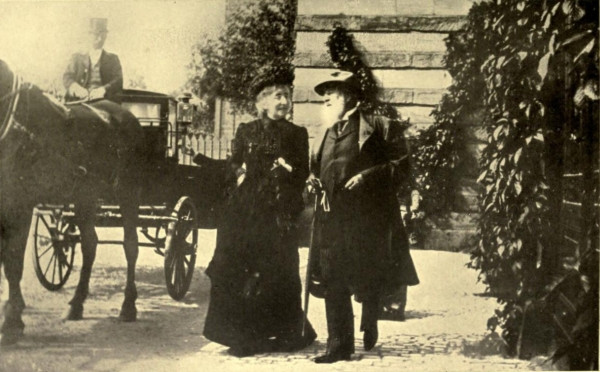
MADAME COSIMA WAGNER.
XXXIII
Villiers had promised Wagner to read him his one-act play La Révolte, which the younger Dumas, who admired it very much, had caused to be accepted at "The Vaudeville," the plan being to produce it the following winter. Villiers had always postponed this serious reading. But finally on the evening before the last day of our stay, as we were saying good-night, they called out to him not to forget to bring the manuscript when we should return on the morrow.
Villiers was ambitious to be a great actor—perhaps he was one; for a long time his mind was possessed by a single idea, that of learning the rôle of Hamlet and interpreting it better than anyone else had ever done. He had even expended very considerable sums on the preparation of a suitable costume, of black velvet and jet, which he often put on and, standing before a mirror, passed whole nights in trying different effects. At this time a pair of padded tights was all that remained of the costume, and Villiers sometimes wore them on social occasions, when he wished to have beautiful legs.
The reading of La Révolte, at Tribschen, was a glorious moment for the author of that work.
When he read or declaimed, there was no longer any question of inarticulate speech or broken phrasing. He enunciated the text in a clear and resonant voice, and with such perfect art that both the characters and the sentiments were wonderfully distinct.
He was listened to in a religious silence, with extreme attention and an increasing interest.
It is certain that if the play fell, in "The Vaudeville," before the Philistines whom it scourged, it was avenged in advance on this evening, when it went off with shining success.
"You are a true poet," said Wagner to the author, who was greatly elated, "and I should like to see you turn upon the ideal world, more important than the real for artists like us, the same searching gaze with which you have penetrated the material world. I should like to see you draw forth from there types as living as those which you have just evoked."
Villiers explained, very clearly this time, that it was in defence of the ideal that he had created this character—a woman haunted by lofty aspirations, yet married to a man who was of the earth earthy, utterly incapable of understanding her, and constantly torturing her without knowing it.
"A feminine Prometheus," concluded he, "whose vitals are devoured by a goose!"
The evening was prolonged as much as possible, but the time came, all the same, for the farewells and separation. It was agreed upon that we should pass a few more days here on our return from Munich, as the shortest route back to Paris is certainly by way of Tribschen.
A last time, then, we drove in Wagner's carriage along the dark roads, and after it had left us at the hotel, we listened for a long time to the sound of the wheels and the beating of the horses' hoofs, becoming gradually fainter and fading away, little by little, into the night....
Early next morning, when we came out of the Hôtel du Lac to go to the station, whom should we find waiting for us, but Russ, the beautiful Newfoundland!
He sometimes came alone to see us in this way, but on this especial day and at such an hour it was truly very singular! Was it because he had an intimation of some change, or had they sent him to bear us a last salute?
Very gratified and very much touched, we responded to his caresses, and it was upon his great, kind head that, with sincere emotion, we pressed the kiss of farewell.
PART SECOND
I
A heavy sky, a foggy atmosphere and the warm rain that falls without a sound: the weather is entirely in unison with our sentiments! No more blue sky, no more sun: all is gray around us as within us. The lake of Constance, upon which we sail to reach Bavaria, appears quite ugly under the mist, after the lake of Lucerne which was for us so blue and limpid! Yet this water which bears us, and which, alas! is not the same that bathes the dear promontory with its tall poplars, bears us nevertheless toward a predestined country, toward the Theatre-Temple where the rites of our religion are fulfilled.
But this melancholy must be driven away, and it is Villiers who makes the charge. Still full of pride over his success of the evening before, he is unable to stop thinking and speaking of it.
"Hein! How he listened! What a public! How pleased I was!"
And again his laugh rings out: his spirit kindles through the obscurities of his speech.
During breakfast we install ourselves upon the deck under the shelter of a dripping canvas. And what a breakfast! An omelet harder than a pancake, and filled with a stuffing the nature of which defies all speculation.
"Yellow turnips!" hazards Villiers.
"It can't be yellow turnips. It is more like bits of raw pumpkin."
We consult the Speisekarte and find "Omelet with Apricots." Quarters of unripe apricot in an overcooked omelet—what an infernal combination! O Shade of Brillat-Savarin![1] Our delicate French epicurism is doubtless about to be put to a rude test by the barbarously heavy German cooking.
But even so! Is not the drinking horn of the pilgrim still hanging from our shoulders? Does not the staff still burden our hands? Roots torn from the earth, muddy water from the brooks, even these things ought to content us.
True! And surely one can see that it is only in the sincerest charity, in order to give them a pleasure, that we bestow upon the fishes of the lake that "Omelet with Apricots."
At Lindau the boat stops and we enter Bavaria. And here we are stirred by a new emotion at the thought of treading this soil, of being in the land of Ludwig II., the young king of the Graal, whom we ourselves have also chosen for our King. Here all speaks of him, all things bear his colours and his crest: the time-tables, the gates, the letter-boxes are painted in white and blue: the royal crown in chiselled bronze is everywhere to be seen, surmounting the coat of arms with its lozenge of blue and silver, which upholds the Hons rampant; "Königreich Bayern,"[2] these words are on all sides, on the façades, on the arch of the station, on the railway carriages.
During the journey to Munich we try to recall everything that Wagner has told us about the king: best of all is Wagner's first interview with the messenger whom the king had sent, and who, after searching vainly for a long time, finally discovered the unfindable great man.
This was at Stuttgart: Wagner had stopped there after fleeing from Vienna. During many months, in the Opera-house of that city, he had directed the rehearsals of "Tristan and Isolde." His hotel-keeper—having long since presented his bill, was kept patient by expectations of the fruitful receipts of the first night.
But after seventy rehearsals, and a very few representations, by reason of disaffection and intrigue the work was declared impossible and the company broke up. The danger of detention for debt still existed; Wagner dreaded this above all things, he had not sufficient resources with which to satisfy his creditors, but falling back upon a project for a series of concerts in Russia, he had left Vienna. That plan also fell through.
Discouragement and bitter despair again overcame him, and he believed that from that hour he should no longer have the force to retrieve himself. In the most sombre humour, he was making his preparations to leave Stuttgart when an attendant of the hotel where he was staying brought to him a visiting card upon which he read: "Von Pfistermeister, Aulic Secretary to His Majesty the King of Bavaria."
How could he foresee that this little slip of paper marked the end of all his troubles, and that happiness was in store for him?
Wagner suspected that it might be some creditor in disguise, and refused to receive the unknown person. But the visitor insisted, saying that King Ludwig had sent him and that he could not be denied.
When the announcer of miracles appeared he at once put in the Master's hand the King's portrait, and a diamond ring. Ludwig II. wished to declare himself a most fervent admirer of the genius of Wagner, and offered to use all his power to aid him to finish his work and to realize his dreams. The messenger had received orders not to return without Richard Wagner.
Stirred by deep emotion, his face streaming with tears that he could not check, Wagner comprehended that misfortune was finally overcome, and that a treaty of sublime alliance was about to be made between himself and the royal disciple so suddenly revealed to him.
The first act of this eighteen-year-old king, who had ascended the throne less than a month before, was to render homage to an artist of genius, and to reach out to him a fraternal hand.
While Ludwig II., in his palace at Munich, awaited the arrival of Wagner with joyful impatience, a courtier wishing to flatter the sovereign, said to him:
"Men of genius equal to that of Wagner re-visit the earth only once in a thousand years."
"A man with genius equal to that of Wagner," responded the king, "has never before come to this world, and he will never come again."
And Ludwig II., to the great scandal of his Court, ran hastily down the staircase of honour, to greet Richard Wagner.
That meeting was perhaps one of the most touching and memorable incidents of history.
Wagner retains a magical impression of it.
"The king is so comely, his thoughts are so elevated and his soul so noble," said he, "that I am afraid his life may pass athwart this vulgar world like a dream of the Gods.
"He knows and understands me like my own soul. He longs to remove all my troubles and embarrassments, and help me to accomplish my work!"
We now know that in spite of his power and his good will, the king was not able to attain to the realization of all his desires.
The Archangel could not subdue the dragon, so covered by the impenetrable breastplate formed of human imbecility.
The sword dulled itself against that thick shell, the crown narrowly escaped being shattered thereon: the hatred and fury of the Philistines against an artist of genius increased this time to the point of riot. They howled in the streets, they broke the windows of the Master's house, until at last, fearing some misfortune for the royal friend who persisted in defending him, he feigned to separate himself from him, and quitted Munich.
If the king as chief of the State was unhappily forced to give way before the popular tempest, as friend he did not concede a single point, and remained true to his faith.
In that dear retreat of Tribschen which Wagner then found, forever delivered, thanks to the royal friend, from the sordid troubles which bedim the spirit, he had no longer any but lofty cares, and, in retirement and peace, he finished the "Meistersinger" and recommenced work on the "Ring of the Nibelung."
II
The train puffed and panted as it laboured up the slope which rises without interruption from Lindau to Munich. We were' already very high up, for occasional mists of cloud drifted across our carriage. Wonderful landscapes opened before us; far away peaks tearing the mist into ribbons, glimpses of deep valleys soon lost to sight, forests of pines, hills of a fresh velvety green which undulated to the sky, and at the stations of the infrequent hamlets and villages which we passed, the blue and white of the royal escutcheons always reappeared upon the gates and arches.
"Königreich Bayern!" How happy we were to be in the domain of King Charming! We thought and spoke only of him.
This same route, by which we were coming, he once travelled in the opposite direction, alone and in secret, in order to go and surprise the Master at Tribschen and, "to experience again during a few wonderful hours the joy of being with him."
Wagner had told us the story of this journey of the King.
"It was the 22nd of May, 1866, on the fifty-third anniversary of my birth. Early in the morning the king had started out alone from the castle of Starnberg, riding his horse to Biesenhofen where he had taken the train to Lindau; there he disembarked, and to my profound astonishment, arrived that same afternoon at Tribschen. They set up a camp-bed for him in my study. He begged me to return with him to Bavaria, but, for his own sake, I felt that I must refuse.
"In the following year, Ludwig II. was affianced to his cousin, the Archduchess Sophie, sister to the Empress of Austria, and, in order to add to the significance of the marriage ceremonies, fixed for the 12th October, they reserved for this date the first representation of "Die Meistersinger." But, before that time arrived, one evening when "Tristan" was being given at the Royal Theatre, the prospective bride appeared in a box in an unceremonious toilet; she listened to the work with an absent air, and without attempting to disguise the fact that she was bored. She was not Wagnerian in her tastes! The discovery abruptly broke the spell: the King judged that a person who shared so little in his faith and his enthusiasm ought not to be his wife, and he closed his heart against her.
"We admired him for that, and Villiers declared that if he understood German better he would compose a poem in which he would say magnificent things, and would send it to Ludwig II."
This idea led us back to the dedication printed at the beginning of the score of "Die Walküre," those well-known stanzas that Wagner addressed "To the royal friend," consecrating him in this way to an ever glorious immortality.
The verses are reputed to be untranslatable into French, and that fact naturally incited us to make the attempt. One of our number was thoroughly conversant with the language of Goethe, and for some time back we had been working at the translation. What a good chance to go on with it, during these hours of the journey!
In the original, Wagner's poem is very beautiful, with an unusual grace and exquisite subtlety of expression.
What would it be in French?
Here is our attempt at a translation:
AU ROYAL AMI. "O roi, doux seigneur qui protèges ma vie! Toi qui révélés la suprême bonté, Combien, arrivé au but de mes efforts, je m'efforce De trouver le mot juste qui t'exprimerait ma gratitude! Pour le dire ou l'écrire, comme je la cherche en vain! Et pourtant, de plus en plus impérieux, m'entraîne le désir De trouver ce mot qui exprimerait Le sentiment de reconnaissance que je porte dans mon coeur. Ce que tu es pour moi, je ne puis, émerveillé, m'en rendre compte Qu'en évoquant ce que je fus sans toi... Pas une étoile ne se leva pour moi, que je ne la visse pâlir; Pas un espoir que je n'eusse perdu. Livré au bon plaisir, à la faveur du monde, Aux jeux du gain et du risque, Tout ce qui en moi luttait pour l'émancipation de l'art Se vit trahi par le sort, sombra dans la bassesse. Celui qui, jadis, commanda à la branche desséchée De reverdir dans la main du prêtre, Bien qu'il m'eût ravi tout espoir de salut Et que la dernière illusion consolante se fût évanouie, Fortifia en mon sein cette foi En moi que je puisais en moi-même; Comme je lui demeurais fidèle, Il fit refleurir pour moi la branche desséchée. Ce que solitaire et muet je gardais au fond de moi Vivait aussi dans le sein d'un autre; Ce qui agitait profondément et douloureusement l'esprit d'un homme Emplissait d'un joie sacrée un coeur d'adolescent; Ce qui nous entraînait dans une ardeur printanière Vers un même but,—conscient... inconscient... Devait s'épancher comme une joie du printemps: Double foi, faisant naître une frondaison nouvelle. Tu es le doux printemps qui m'as paré à nouveau, Qui as rajeuni la sève de mes branches et de mes ramures; C'est ton appel qui m'a fait sortit de la nuit, De la nuit hivernale qui tenait inerte ma force; Ton altier salut, qui m'a charmé, M'arrache à la souffrance dans une joie soudaine Et je marche, à présent, fier et heureux, par de nouveaux sentiers, Dans le royaume estival de la grâce.... Quel mot pourrait donc te faire comprendre Tout ce que tu es pour moi? Si je peux à peine exprimer le peu que je suis, Toi, au contraire, tu es roi en tout. Aussi la lignée de mes oeuvres repose-t-elle en toi, Dans une paix bien heureuse. Et puisque tu as comblé tous mes espoirs, Délicieusement j'ai renoncé à l'espoir. Donc je suis pauvre, je ne garde qu'une chose, La foi à laquelle s'unit la tienne: C'est elle, la puissance qui fait que je me montre fier, C'est elle qui saintement trempe mon amour. Mais si, partagée, cette foi est encore à moitié mienne Elle sérait tout entière perdu pour moi si elle venait à te manquer: Ainsi, c'est toi seul qui me donnes la force de te remercier Grâce à ta foi royale et sans défaillance."
We had great difficulty in making this translation and were far from satisfied with it. But there was no more time, the train was already slowing up to the station, we had reached. Munich—München!
Outside the station, the omnibus which we took for the hotel of "Trois Rois Mages," after going a short distance was obliged to stop before a military orchestra. Fine looking, fair-haired soldiers in sky-blue uniforms, were grouped about their leader, and were playing nothing else than the religious march from "Lohengrin!"
Later on, Wagner, in fun, tried to make us believe that we owed it to him that we had been "so religiously received."
III
What an amusing city is Munich, with its architectural follies! I do not know another outside of France which seems to me so attractive. Ludwig I. probably had a great love for memorials, and certainly, he hesitated at nothing. It was he who wished to reproduce and bring together in his capital, all the edifices which he had admired in the course of his travels; so this pretty city resembles the "Rue des Nations" of some universal exposition.
Do you love the Florentine style? Here is the library and its majestic marble staircase leading to the "loggia dei Lanzi," copied exactly from that of Florence; a little farther on, under the name of Königbau you will see a reproduction of the famous Pitti Palace. If you prefer Roman art, the arch of Constantine is close at hand, and you will also come across a fifteenth-century dome. If it is Greek art that attracts you, you may see the Propylæum of Athens, the Glyptothek in the Ionic style, or the palace of Fine Arts in the Corinthian style: or better still, near a consecrated wood, the Hall of Fame. If you dream of Venice, you have only to listen to the fluttering wings of the pigeons of Saint Mark's, who have, evidently, all migrated to Munich!
There are some buildings like cathedrals, high and loaded down with sculptures, but they are of moulded terra-cotta. The Renaissance style is well represented, the rococo abounds, Egyptian art, even, is not forgotten. In order to commemorate a noble feat of arms, they have erected a metal obelisk, modelled upon the monolith of Luxor, but this one has not the merit of being a single casting of bronze.
The International Exposition of Painting, ostensible reason for our journey, was, I think, very remarkable; it did honour to the group of artists who organized it and brought into prominence the Bavarian school of painting. But I am forced to admit that in spite of the very conscientious accounts that I published in I cannot remember how many journals, I recall only very confused memories of them. But I do remember one painter, perhaps forgotten today, who was then at the beginning of his career and was much talked of: Gabriel Max—I can still see in my mind his lovely martyr, who, in the whiteness of death seemed to sleep so easily upon the cross.
On the other hand, a visit to the Pinakothek made an ineffaceable impression upon me. The Rubens collection above all seemed to me superb: the artist triumphs there in all his fleshly glory—he is jubilant, dazzling!
And what perfect taste was shown in the placing of the canvases! What a sensible arrangement! As far as possible, each room held the works of a single master grouped upon a favourable background and under a well managed lighting. In this way the intensity of effect was doubled. One experienced to the full the painter's charm, and the contrast between one master and another was startling. For instance in the hall of Van Dyck, as one entered after viewing the resplendent walls of the hall of Rubens, the subdued colouring gave the impression of restful and mysterious shadows, out of which seemed to steal wonderful white masks of a distinction that is without equal. Then, too, the catalogue, translated into French, did not lack amusement for us: one read such things as these:
"The Virgin is seated at evening before an edifice: at her knee the little Jesus seizes with the right hand the lung border of her robe."
"Vanity under the guise of a beautiful woman of luxurious form, supporting herself with the left hand which holds a dying candle, upon a round mirror."
"A wolf devours a lamb while a fox also enters there."
"A woman seated beside an ass which brays on the ground nursing her infant."
"Two dogs quarrel with a calf's head."
"Portrait of the Elector Maximilian fully braced."
"St Martin on white horseback."
"The Christ, after having suffered death, receives graciously the four repentant sinners."
It is a good thing to laugh a little!
IV
Each morning bills were posted, giving the programmes of the music to be played in the different beer-gardens of Munich during the two o'clock dinner-hour. Numerous selections from the Wagner operas appeared in these programmes, and so we decided to leave the hotel of the "Trois Rois Mages" and its commonplace table d'hôte in order to take furnished apartments and be free to choose the place for our meals according to the musical menu. Behold us then, our resolution taken, rushing from one end of the city to the other in search of the appointed restaurant, and, once there, hobnobbing with its population, whether turbulent students, or middle-class families who love to dine to the sound of fiddles.
To us, who were so unaccustomed to them, these restaurant orchestras seemed excellent, and we had great pleasure in listening to the fragments which we so rarely had the opportunity to hear at home. We were delighted to notice that the dining public always gave an especially warm reception to the selections from Wagner.
One day we went to a very distant restaurant where the overture of "Die Meistersinger" was to be played. The orchestra was disposed in a most extraordinary fashion. In default of a better place they had installed it upon the outside gallery of a châlet which was in the midst of the garden, a narrow balcony where two musicians could with difficulty sit abreast, so that the whole number of the players extended from one end to the other of the façade and the double-basses were a long distance from the brass instruments. We left the table where we had dined to find seats in the enclosure so that the sounds should be less scattered, and took our places in front of the balcony facing the leader, who occupied the very centre.
Not far from us were seated three young men who had also drawn near to the musicians, and who scrutinised us secretly and persistently. One of them, a very fair blond, tall and slight, seemed to me the perfect type of the German student; he had long hair, straight as a poker, of a colour lighter than his face, and his delicate profile recalled the portraits of Schiller. One of his companions, whose golden beard and gold-rimmed eye-glasses glistened in the sun, had an expressive face which fairly radiated happiness and enthusiasm. The third was rather small, and one could hardly see his features through the disordered profusion of his brown hair, his eyebrows and his beard. A white dog stayed close by his side.
Suddenly I heard the young man with the golden beard say, in a very audible voice, as he looked at us.
"I'll wager it is they."
After the last notes of the overture of "Die Meistersinger," as we applauded with all our might, the group of strangers came nearer.
"No longer any doubt," one of them said, "since they applauded."
And the young man with the golden beard advanced without hesitation.
"I am Hans Richter—" said he as he saluted us—"and you certainly must be the friends who have just been visiting Richard Wagner. The Master wrote me to put myself at your service and to act as your guide about Munich, but he did not tell me where to find you."
Hans Richter, the chief of 'Orchestra of the Royal Theatre, who would have the honour of conducting the "Rheingold!"
After cordial greetings Richter presented his friends, first the heavily bearded man, then the other.
"Herr Scheffer, a Wagnerian fanatic. Herr Franz Servais, son of the celebrated Belgian violinist; he has just come from Brussels to hear the "Rheingold"."
So the man who had appeared to be the personification of a German student was a Belgian composer!
All seated at the same table with foaming bocks before us, we quickly became acquainted, and found each other very congenial, since we served under the same banner. It appeared that they had been searching for us all over Munich. Our passage to the hotel of the Three Kings had been traced, but we had gone from there without leaving any address, and from that point they could find no clue. Herr Scheffer had been very keen to find us before this especial day was over, and had applied to the police, but chance had forestalled them.
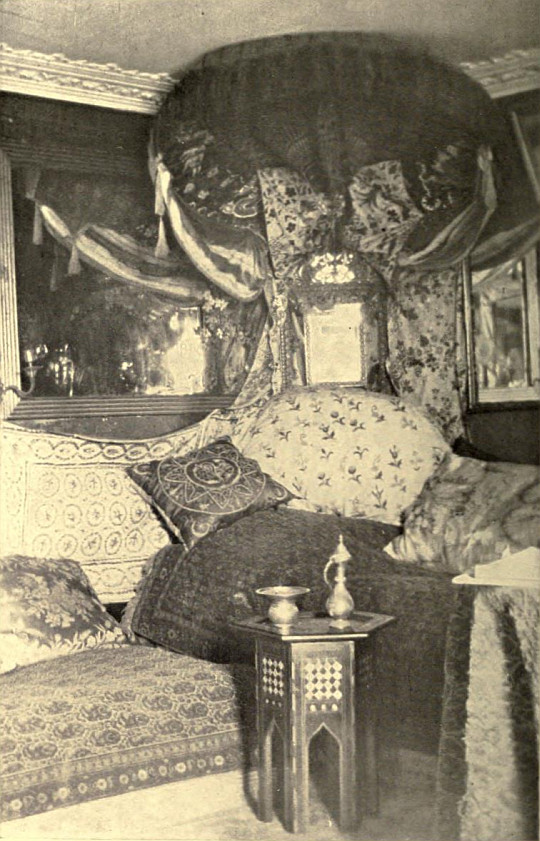
CORNER OF JUDITH GAUTIER'S SALON.
"We had promised," said Richter, "to conduct you to a reunion this evening, at the house of the Countess of Schleinitz. We shall all be there."
"Liszt will be there," exclaimed Servais, "he arrived in Munich yesterday, and you will also see the Countess Muchanoff."
"Liszt!"
I thought of Cosima, and her sorrow at being disapproved of by her father: I felt I would rather not see him. But my companions had already joyfully accepted, and had arranged a meeting place for the evening, at eight o'clock.
V
The Countess of Schleinitz, wife of the minister of the royal house of Prussia, at whose house we met, was an extremely gracious little person, very small and delicate, even fragile. She spoke French like a Parisian, a French sparkling with wit and drollery, and in her glance there was a gleam of passion. One could have said:—
"Le Caprice a taillé son petit nez charmant...."
A little snub nose tip-tilted with an elegant impertinence. The charm of her smile was trebled by the dimples it made in her cheeks.
They did not fail to introduce me to a great number of people, whose names, few of them easy to remember, have escaped me. I recall that of Lenbach, the already illustrious painter, and I remember the beautiful head of Edward Schuré, with its inspired and slightly "absent" air.
The appearance of Franz Liszt astonished me.
I was evidently out of the running, I was ignorant of everything: why that long black cassock? Was he a priest? With that smooth-shaven face, had he also a tonsure in the locks that fell long and straight to his shoulders? But what eyes, like a lion, what burning glances under the shaggy eyebrows! What overmastering irony in the curves of the large mouth with its thin lips! In the whole attitude what majesty, tempered with benevolence.
The entrance of Liszt caused an extreme excitement in the assemblage, and I became more and more surprised. Could it be that he was a saint? They showed such an extraordinary veneration for him, especially the women. They hurried toward him, and almost kneeling, kissed his hands, raising looks of ecstasy to his face.
But my attention was suddenly drawn to a woman who had arrived at the same moment—surely this must be she, the mysterious beauty who came from the north, in a whirlwind of snow, and herself whiter than the snow. The lady with eyes like Parma violets, whom the poets have sung with such longing, the Countess of Kalergis, now Countess Muchanoff. La Symphonie en blanc majeur herself in fact! As yet she was standing with her back to me, at the other side of the grand piano. People were crowding about her as she took their outstretched hands. She was tall, a muslin scarf covered her shoulders, her pale blond hair curled at the nape of her neck. I repeated under my breath some words from the well-known poem which she had inspired my father to write, so long ago:—
"Conviant la vue enivrée De sa boréale fraîcheur A des régals de chair nacrée, A des débauches de blancheur. Son sein, neige moulée en globe, Contre les camélias blancs Et le blanc satin de sa robe Soutient des combats insolents. Dans ces grandes batailles blanches, Satins et fleurs ont le dessous, Et, sans demander leurs revanches, Jaunissent comme des jaloux. * * * * * * * * De quel mica de neige vierge, De quelle moelle de roseau, De quelle hostie et de quel cierge A-t-on fait le blanc de sa peau?..."
Alfred de Musset was also a fervent admirer of this white idol, and later, Heinrich Heine paraphrased, in honour of her whom he called, "The Cathedral of the God Love," the verses of Théophile Gautier:
"Auprès d'elle la neige de l'Himalaya Paraît grise comme la cendre; Le lis que sa main saisit, aussitôt, par le contraste Ou par jalousie, devient couleur de rouille..."
I really dreaded the moment when she would turn, and, as she made a movement to do so, I closed my eyes, to keep for a little longer the illusion of the past.
Almost at once I hear the rustling of silk close beside me; a clear musical voice addresses me, sweetly modulated, with a slight Russian accent. The Countess Muchanoff seats herself beside me and presses my hand, as she assures me that there is no need for an introduction, for she has recognised me without hearing my name, and that having the same admirations, the same ardent beliefs, we must belong to the same ideal family and should love even before we know each other.
She seems a very great lady, very sure of herself, intelligent, and filled with a passionate love of art. I look for the white camellias near the snow of her breast—very marble-like, in truth, but with the help, perhaps, of pearl white and a touch of rice powder. Her face is regular, pale under the fair hair so cleverly arranged. Although they believe her to be too superior to linger over any artifices of coquetry, she undoubtedly seeks to retain and to prolong a beauty so celebrated, but she depends still more upon the graces of her mind, which time does not affect, upon her intellectual culture and her musical talent.
With a coaxing familiarity she makes a strong effort to win me, to inspire me with confidence, but I am haunted by the idea that she is prejudiced against Cosima, that she has betrayed her friendship, and I find it an effort to respond to her friendly advances, or to abandon my reserve.
Liszt in his turn approaches me; he speaks of my father, whom he knew; he has seen me as a child and remembers me, although I have no memory of him. I find that he has the very suave manners of a priest—but how can he be a priest, and why are all these women so taken with him? Just now they are greatly perturbed at seeing him occupied with one who has made no advances, and so they cluster about him again, begging him to play something, teasing him to sit down at the piano. This he refuses to do and repulses them rather rudely, declaring that it is Madame Muchanoff who ought to play, that he himself has too much pleasure in listening to her to seat himself at the piano when she is present.
The Countess rises, nonchalant and disdainful, she draws off her gloves slowly, and her smile says plainly enough that she devotes herself only to spare Liszt a drudgery, and that she is amused, to the point of derision, at the jealous rage of all those who will be forced to applaud her.
"L'ivoire, où ses mains ont des ailes, Et, comme des papillons blancs, Sur la pointe des notes frêles Suspendent leurs baisers tremblants..."
These lines mingle, in my mind, with the phrases of the nocturne that the Countess plays. She is certainly talented; but it seems to me that her playing lacks restraint, that she exaggerates and plays with too much abandonment.
After she had stopped playing Liszt offered me his arm to conduct me to the refreshment table, in the face of the envious and uncomprehending glances of the greater number of the women. He allowed every one else to pass before us, with the idea, no doubt, of withdrawing with me a little to one side. In fact, as soon as we were alone, he said to me in a low voice:—
"You have seen Cosima?"
I had none of that sentiment which the high personality of Liszt evoked among his intimates. I was absolutely ignorant of the beauty of his compositions, which I was to admire so much in the future, and of the incomparable loftiness of his character. I considered him only as a very celebrated pianist. So I was not in the least intimidated, and, believing him to be hostile to the best interests of his daughter, it was with a decided vehemence that I replied to him:—
"I beg of you, do not say anything against your daughter to me. I am her partisan to such an extent that I cannot admit any blame. In the face of a personality so superhuman as Richard Wagner's, the prejudices and even the laws of men cannot prevail. Who would not feel the fascination and submit joyfully to the supremacy of such a genius? In Cosima's place, you would do as she does, and it is your duty as a father not to put any obstacle in the way of the realization of the great event to which she has the right to look forward."
Liszt grasped me warmly by the arm.
"I am entirely of your opinion, but I may not express it," said he in a still lower voice. "The habit which I wear imposes certain opinions which I cannot openly deny. I know the temptations of the heart too well to judge severely: conventions force me to be silent, but within myself, I desire more than anyone else for a legal solution of this painful affair. I can do nothing to hasten it; as to retarding it in any way whatever, I have never had such a thought."
Greatly surprised and relieved I cried out, impulsively—
"Will you authorise me to write that to Cosima?"
"Certainly," he replied. "I wished to ask you to do so. Assure her that there is no need of a rupture between us, that my heart is with her, but that she ought to comprehend my reserve, and to show, before the world, a certain consideration with respect to me, until the new order of things is established."
"I will write this very evening. If you could know what relief and what happiness this news will give them."
"I am very glad of that. You see how I have seized the first opportunity that has offered to make known to my daughter, secretly, my innermost thought. I have sought for such an opportunity without finding it. In whom could I confide? Envy and hypocrisy find a place in all human hearts. Very few have your frankness and your beautiful, unrestrained enthusiasm.... But let us go in. I believe that we are watched, and that people are already surprised by our long conversation."
In fact many anxious and irritated looks were directed toward us, and, if the eyes of the women clustered there, had been daggers, I should never have passed the threshold of the dining-room alive.
During the refreshment hour Villiers de l'Isle-Adam talked with the Countess Muchanoff, who appeared to be struck with amazement. He had pinned upon his evening coat the decoration of the Knights of Malta, a little cross set with white enamel, and he explained to her that he was Grand Master of that order, which had been bestowed upon one of his ancestors in 1520. France not recognizing the knighthood of Malta, he could only wear the insignia when abroad. Then, at least, he could wear them conscientiously.
Villiers then proceeded to recount the complicated and confused history of his incontestable claims to the throne of Greece, by reason of this Grand-mastership. He had even, once upon a time, presented his claim as a candidate for the royal succession, and had had a memorable campaign in the effort to maintain it.
From heraldic fantasies and aristocratic vanities, Villiers passed, happily, to the more reasonable pride of the poet: he narrated his reading at Wagner's house and his glorious success, and, when they separated, he had promised the Countess Muchanoff to give, at the Hôtel des Quatre Saisons, on any evening which she should be pleased to name, a second reading of La Révolte.
VI
We very soon became intimate with Franz Servais, and grew to regard him as our good friend. It was through him that I tried to penetrate some of the mysteries that seemed to me to envelope the life of Liszt, and first of all I asked how, and why, he was a priest?
"It was only four years ago that he took the orders," said Servais to me, "and became the Abbé Liszt."
"In what way, and why?"
"No one knows! On his return from a journey to Rome, he was a priest. Perhaps he wished, in this way, to explain to the world, which had been in a state of excitement over his projects of marriage with the Princess Wittgenstein, that they were definitely abandoned. I believe also that he was relieved at being able to take away from all the women who adored him, the hope of obtaining his hand."
"But as a matter of fact, all the women seem, even now, to quarrel over him quite openly. Does not his habit make a difference to them?"
"No, on the contrary, it inflames them the more, it has all the fascination of forbidden fruit! Liszt exercises, moreover, an extraordinary influence over the women and even the men who understand and admire him. I am able to speak of this with knowledge, because I submit to it myself without attempting to defend myself, and I am proud to be one of his pupils. But some of the women undoubtedly go too far. It leads them into a sort of idolatry, of fetichism. They dispute over a flower that he has touched, they gather up the ends of his cigars, and those who are sufficiently independent, and are able to do so, follow him from city to city, all through the year."
"And does not that exasperate him?"
"On the contrary, he would be very unhappy without the atmosphere of adoration which surrounds him. He loves the incense of these excessive flatteries. He feels the need of this mystical kingdom, and in order to hold it together, he distributes his favours, very simply, according to the merits of the recipients, or in the order of his own preferences."
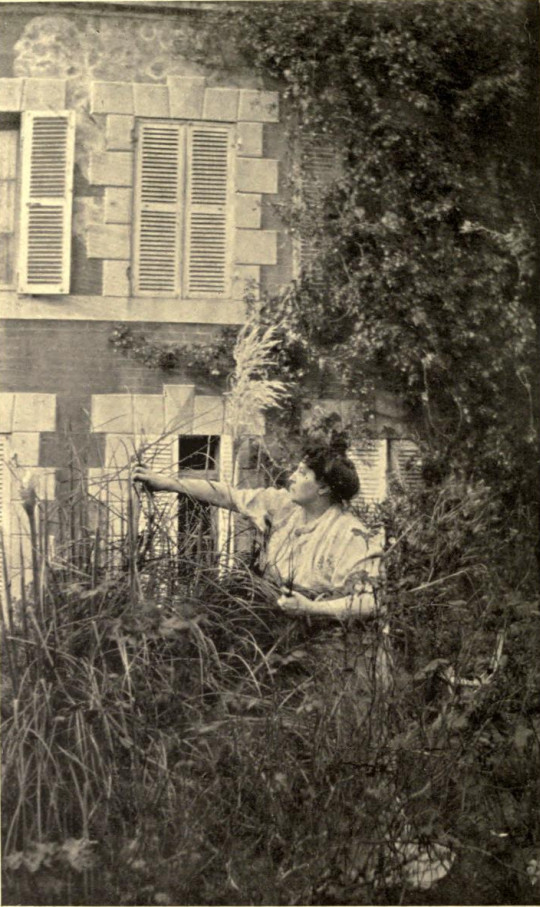
JUDITH GAUTIER IN BRITTANY.
"But how is he able to maintain order and harmony in his harem, and to keep down jealousy and rivalry?"
"That is the most wonderful thing about it all," said Servais; "he succeeds in keeping peace amongst all his votaries, he even makes them accept and respect a favourite. When you express astonishment at an abnegation so unusual among women, he makes to you this unexpected announcement, 'They love themselves in me.'"
VII
Wagner had telegraphed from Tribschen to the king, to tell him that some French friends, who had arrived in Munich, would be happy to see representations of Lohengrin, Tannhäuser etc., while they waited for the Rheingold. Lohengrin had already been announced. But, further than that, a servant in blue and gold livery brought us, each morning, admissions to the galerie noble, sometimes for the Royal Opera, sometimes for the Théâtre de la Résidence; it was by order of the king that we were accorded this favour, and we had the great pleasure, alas! for the French alone a rare one, of being present nearly every evening at productions of the tragedies and comedies of Shakespeare, alternating with operas of Wagner.
In its relation to the theatre, the love which the Bavarians feel for reconstruction and imitation produces the best of results: the plays are very carefully mounted, and the scenic effects very fine and exact. We had the pleasure of seeing, in the space of a few weeks, Richard III., A Winter's Tale, As You Like It, Twelfth Night, Two Gentlemen of Verona, Lohengrin, The Flying Dutchman, Tannhäuser, and The Mastersingers.
VIII
I was very glad to meet Liszt again at the soirée given for Villiers de l'Isle-Adam by the Countess Muchanoff. Very soon after my entrance I recognized that he, also, was impatient to speak to me, for he threw me a questioning look, and as soon as we could draw a little away from the others he said to me:—
"Well, what news?"
Then I told him how my letter, repeating his words, had caused a commotion of joy at Tribschen, had given them a blessed release from harrowing cares, and the consolation of knowing that the affection of a heart so dear was not lost. From that certainty they could draw strength for the struggle to come! As for me, simply the messenger, the master had sent me his blessing.
Liszt, his eyes shining with tears quickly dried, seized my hand and rapidly whispered to me:
"Guard well the secret that I confide to you; I will do my best on my return to Italy, to stop a few hours at Lucerne in order to embrace my daughter and my grandchildren."
And then he, who always refused to play, went to the piano, lifted the cover with a quick movement, and ran his masterful fingers over the keys in an impetuous, thrilling and passionate improvisation.
The ovation which this called forth approached delirium, but he hardly noticed it.
It was now the turn of Villiers to charm the audience. Well curled, his Maltese cross in the right place on his left side, he looked very magnificent. Yet he appeared to me a little nervous and disturbed.... Was it possible that the vast ornate drawing-room of the mansion overwhelmed him, and that this gathering of noble, well-dressed ladies, of high functionaries, of artists, forming a half circle as in a theatre, and staring at him in silent attention, abashed him more than the Olympian intimacy of Tribschen? In full light, standing at the end of the grand piano, he seemed to hesitate, he did not speak. But at last, with a proud toss of his head, he threw back his waving hair and began to read in a firm, clear voice.
I was reassured; Villiers, very certain of himself, was taking plenty of time and managing his effects; the audience was interested, a flattering murmur followed certain passages, they applauded; then again, the respectful silence was renewed, and they listened intently.
But, alas! What is happening? Suddenly Villiers is silent, he drops his manuscript and looks at his audience with wide open eyes filled with fright. With an hysterical gesture he un-hooks the belt of his trousers, then he takes off his shoes and seats himself on the top of the piano. Oh, horror! What can he mean? Is that in the play? A mystification? A wager? In any case it is in very bad taste! There is a mocking uproar and everyone rises; they come to me; they question me.
What can I say? How can I make them understand that Villiers believes himself in danger of death, and that therefore he has done what he thinks is best for himself, irrespective of propriety. He has had, without doubt, a little nervous spasm of the heart; some physician, chaffing him, perhaps, once told him that if anything of the kind happened, he must loosen his clothing quickly, take off his shoes and stockings, and seat himself high up so that his feet would hang. And now they can see that the invalid has conformed to this order in every particular.
Much laughter was stifled behind fans. They pretended to forget the incident.
Villiers had fled, bearing his shoes with him, while our little group, not daring to follow him in beating a retreat, remained feeling very much embarrassed, and experiencing the isolation of the vanquished.
Franz Servais was filled with consternation; he walked about feverishly, his hands in his pockets, the long pale wisps of his hair hanging and almost meeting again in his mouth, which constantly opened to give vent to vehement recriminations.
"There is only one thing that can save the situation," cried he. "There is only one excuse that Villiers can make. Death! Yes, yes, for the honour of us all he must die!"
IX
We had taken furnished apartments in Maximilianstrasse, a remarkably wide street, very gay and attractive with its rows of fine shops and fascinating shop-windows. It begins in the heart of Munich, dose to the Royal Theatre, and, extending for over a mile, ends at the Isar, a very impetuous river, running madly over enormous stones, which appear to have been artificially cut. These stones, by their sharp angles, form giant steps over which the water dashes in cascades. We did not imagine this torrent to be navigable, but one day an unexpected sight proved to us that it was so.
On this very warm day, we slowly sauntered toward the Isar, hoping to find a little freshness in the gardens, which on the other side of the river, extend the whole length of the wide banks. Having stopped in the middle of the bridge, above a dizzying tumult of waters, we suddenly beheld in the distance four or five rafts loaded with men, which seemed to be at the mercy of the current, but were, on the contrary, very skilfully guided as they swept along.
"Savages! Pirogues!" cried Villiers.
And in fact it was a spectacle that suggested only adventurous savages shooting the rapids in canoes made from the bark of trees.
The shallowness of the water as it ran over the rocks added to the danger of being drowned that of being crushed to pieces at the slightest error in the difficult manoeuvring. We had scarcely time to tremble for these men, or even to distinguish them, standing on the rafts and leaning on their short poles, before they had passed under the bridge, and flying from the other side had disappeared from sight.
"The true course to the Abyss!" cried Villiers.
"Where do these beings come from?" I demanded, "and whither do they go?"
"Ah, it is better not to know. It is never good to investigate too deeply. We have seen a vision, have we not, of ferocious warriors descending the Ogowe, in the pursuit of a rival tribe: why should we try to convince ourselves that we have only seen worthy peasants going to the nearest market, for the very prosaic purpose of selling some vulgar product of the soil?"
"In any case they are brave as well as worthy peasants!"
But Villiers was no longer listening: his imagination had followed the warriors of the Ogowe and was wandering far away, and the part of the man that was left with us expressed itself in a confused monotone, mingled with laughter. He toyed with his ideas, as one amuses oneself at the seashore, by letting the sand fall in cascades between the fingers. But I well knew that there were some precious stones in the sand that Villiers sifted, and I lay in wait for these.
When we were finally seated on grassy hillocks in the shadows of the great trees of the English Garden, where we could look out over the fresh meadows starred with saffron blossoms like thousands of goblin fires, and the nearer willows, of a vivid green, with long strands trailing in the Isar, then at last I began to distinguish some light amid the obscurities of the discourse of Villiers.
"I have a glimpse of a misty sea, a dreamlike twilight around an unknown isle, then, in a luminous eddy, a great sphinx emerges from the waves and swims toward the bank. Across her back a violet banner is floating, and on the banner in letters of gold gleams the word: Inviolata!"
"And that is all," said Villiers; "it will never connect itself with anything and will never be explained. The intense impression, the charm, the mystery, the disquieting strangeness, are all in the picture itself, seen through an opening in the clouds, and never more to be forgotten."
"And there are some poems," added he, "which should have but a single stanza: this one for example:—
'La lourde clé du rêve à ma ceinture sonne....[1]
Isn't that complete enough? Isn't that magnificent? What could one add to that? In my foolishness and desire to make a poem I once tried—impossible! There is nothing to add. Nor is there to this other line:—
'O pasteur, Hespérus à l'occident s'allume!'[2]
The melancholy of the hour, the clear evening, the shining star and the pastoral life, it is all there; why seek for anything further?"
"It is true," said I, "that that kind of stanza, the single stanza in which a whole poem seems to be condensed, is sufficient unto itself and disdains rhyme. I have composed one myself, very absurd, but who could find a rhyme to add to it?
'Je suis le nautonier des océans lunaires!'[3]
The Italian poet, Gualdo, has quoted this line somewhere as an epigraph, in order to silence his contemporaries and make them search for its origin."
Villiers suddenly began to rummage in his pockets, and, after an agitated search, he drew out some very crumpled sheets of paper.
"Let us be serious again," said he, "let us be practical and prosaic. Here is my article upon the exposition: it is finished."
"What!" cried I, "have you not sent it yet? It will be too late: the opening of the exposition is an old story now: they will not wish to publish it."
"Oh, if you could see with what fine little touches it has all been refreshed! In the first place, I have changed the title, which is now: 'Munich during the Exposition.' Really the article isn't bad, listen to this:"
And he read:—
"The halls of the Crystal Palace are filled to overflowing, the French envoys are rudely bumped by the enormous boxes. At the exposition the paintings reach to the very cornices, and there is even talk of hanging some delayed canvases in the restaurant opposite, notably the Casseur de Pierres of Courbet. We must add, however, that Courbet has also sent here a magnificent landscape, in which the water is so natural and so deep that it makes one dream dreams. That, and the Fauconnier of Couture, are the pictures that we love best in the French salon, in spite of our lack of sympathy for the realistic school.
"The Germans, when they see Courbet's paintings, say, 'A painter as good as he is rough, he sees like a peasant and paints like a professor, which is saying a great deal,' they add laughing."
"Here I interpolate a sentence," said Villiers. "'It is late to speak of the exposition,' and then I go on to speak of it all the same:
"One must also mention some exquisite grisailles of Ramberg, the Saint Joseph of Gysis, portraits by Lenbach, landscapes by Zwangauer, the German Daubigny, some academic sepias of Kaulbach on subjects drawn from Wagner's operas, and The woman in the velvet Gown, of Herr Canon, a young Austrian painter of incomparable talent. It is thought that The Banquet of Phaton of Herr Anselm Feuerbach, will have the medal of honour. It is great work, truly, and since Peter Cornelius, nothing better has been done in Germany. So art is in a flourishing condition.
"I am going to slip a new sentence in there," said Villiers. "'Let us now leave the exposition, with its already old news, and take a promenade through the city.'"
And he continued his reading:—
"We love Munich, but not everyone is of our opinion. It is true that Munich is rather lacking in police officers, that Les Pompiers de Nanterre is not sung here, that we notice an absence of assaults, swindlings and murders that is truly desolating for the future of this capital. On the other hand, we have seen magnificent theatres where Goethe is played, we have visited museums which contain treasures of art and of genius, we have seen monuments in the purest Greek style, great gardens like the Bois de Boulogne, immense cafés where one is served by pretty girls whom no one dreams of chaffing beyond reason, except, perhaps, some passing wags who have only their trouble for their pains.
"We have climbed up inside 'The Bavaria,' the enormous bronze statue which towers above the city, and through the eyes of which six people are able to see before them the sweep of land extending to the mountains of the Tyrol. We have visited the hall of the portraits of beautiful women of the country, where one imagines oneself in a sort of Montyon Gallery of love, and where, if her nose be of an heroic cast, the daughter of a shoemaker may find herself side by side with the daughter of a princess. The king, Ludwig I., who lodged in his palace this ingenuous display of Germanic beauty, loved all pretty women; and the good Bavarians recount that at his death the following scene must have taken place at the gate of Heaven:
"Rap! Rap!"
"'Who is there?' asks St Peter.'
"'It is I, Ludwig, King of Bavaria!'
"'One moment,' replies the blessed Apostle. Then he shouts in a voice of thunder: 'Get the eleven thousand virgins out of the way quick! Here is Ludwig of Bavaria just arriving!"
"But we must not laugh too much about that king who, in the place of military glory, has bequeathed to his people schools where the children are taught to develop a lofty and noble character."
"That is very good, Villiers, but you must not read any more," cried I, interrupting him. "Let us hurry to the post, there is still time before the evening collection. Let us send the article at once, the more you allow the time to pass, the less chance there is of its being published, for, in spite of your conciliatory sentence, present time does not wait."
X
After the tiresome incident of the Hôtel des Quatre Saisons, when Villiers had removed his shoes before a noble audience, we sulked at the social world, refused its invitations, and when there was nothing very interesting at the theatres, we loved to gather in the evening at the house of Franz Servais.
Servais, who made very frequent visits to Munich, had there a large apartment on the ground floor, in a quarter a little away from the centre. He possessed a piano, around which we passed many delightful hours, thanks to the unwearied kindness of Hans Richter, who played us fragments from the Rheingold to initiate us a little into the work which we were so soon to have the happiness of seeing represented.
Servais had not held any resentment against Villiers; he quite understood now that he had done what he believed was necessary, and they had become good companions and were on the best of terms.
Sometimes we amused ourselves by playing charades. It was undoubtedly I who proposed this kind of diversion, of which I was very fond. It was a pastime that had pleased my father, and with which, at Neuilly, he had often enlivened the Thursdays at home of the Rue de Longchamp.
From the first, Servais showed a remarkable aptitude. He was always ready with something opportune, something unexpected, and he was never deterred by the fear of producing comical effects. Villiers, great actor as he was! declared himself to be incapable of improvising two sentences, so reserved for himself the honour of guessing the word of the charade. Schuré requested to be allowed to hold the office of the public—a rather abstracted public—while Scheffer and his dog, which never left him, were both very attentive. As for Richter, he consented to appear in the rôle of a mute personage, so mute even, that upon one occasion when representing a sick man, he allowed the brilliantine to be poured into his mouth without a protest, in order not to spoil the effect.
How did the lady of many names, who ought to have had something else to do, take it into her head to announce to the whole city the way in which we passed our evenings? It always seemed to be known. One evening when we had had supper at the Café Maximilian, just as we started to go out, we saw several carriages roll up and stop one after the other in front of the Café. Before we had time to think about it, the Countess Muchanoff alighted from the first coach and entered hastily.
"At last you are found!" cried she, "you have become very elusive, you are never at your apartments, you never come when one invites you, so we decided to look for you everywhere. For the last hour we have been going to all the beer-gardens, all the restaurants in Munich; this is the very last one."
We were a little disconcerted. Villiers had made a show of running away, but the retreat was cut off, the doors of the other carriages opened, ladies and gentlemen, who figured in the elegant society which had been present at the disastrous fête, spread out over the much be-glorified side-walk.
"It is very wrong of you to be so exclusive," continued Madame Muchanoff, "to organise charming evening parties, without letting anyone know! Now that we have discovered you, we shall take you all away with us. Come, come, you must do some charades, we are all so curious to see that!"
"Charades!"
How did they know?... and did they really imagine that we would proceed to play at charades in the city?
"But, dear lady——" said I to her, "it was only
among ourselves and as one would play at children's games, that we amused ourselves so; we should lose all our spontaneity if we undertook to be serious about it."
They begged and they insisted, but we remained firm and unmoved. We asserted that we considered them all as our guests, that we ought to receive and entertain them, and that they must excuse us for not being able to do it in a Café.
At this moment someone opened for us an empty room, turned on the lights, and all these gay people, very much pleased, went in there, followed by the surprised and admiring gaze of the public. The ladies loosened their evening wraps and revealed their bare shoulders and light costumes. The men were in evening coats.
Many of the persons present we hardly knew, and at first we were a little ill at ease. But someone ordered tea, someone else champagne, the women lighted their Russian cigarettes, as slender as toothpicks, and the momentary awkwardness vanished. Count von Berghem, a man with very fascinating manners, of whom I know nothing more than his name, entered into a discussion with Schuré and Servais upon the analogies which exist between the Gods of Edda, from whom Wagner has taken his heroes, and the Gods of Olympus, between Wotan and Jupiter.
The Countess Muchanoff seemed determined to reconquer Villiers, who escaped from her as long as possible, but she made such gracious advances to him, she expressed such a lively admiration for his talent and his mind, that he regained all his assurance.
In fact, this rather unusual overture, this unexpected invasion, became a very charming and cordial event. The conclusion of the episode revealed Villiers' character: he was no longer crestfallen at having seated himself upon the piano and allowed his feet to dangle, he only regretted that he did not have his Maltese cross in his pocket on this occasion, so that he could pin it to his waistcoat.
XI
Our friends wished very much to show us the model of the Semper theatre that Wagner had charged us to go and see, and which was very seldom shown. A sort of basement in the Royal Residence served as a place of concealment for this very pretty miniature theatre—modelled in plaster, and standing upon a large table of white wood. Greatly interested, we circled about the little edifice, the plan of which is so rational and so well adapted to its purpose—and it saddened us to think of Wagner's frustrated hopes and bitter disappointment at having to give up his plan for constructing a model theatre.
Who could have foretold that, seven years later, thanks to the unflagging faith of the royal friend, we should see it rise up, triumphant, upon the hill at Bayreuth?
XII
Richard Wagner, while in Munich, had been for a long time the neighbour of Count Friedrich von Schack, and there was a warm friendship between them. I was commissioned to remind Richter not to forget to invite the Count to the dress rehearsal of the Rheingold, and I had promised, also, to pay a visit to his famous collection of paintings.
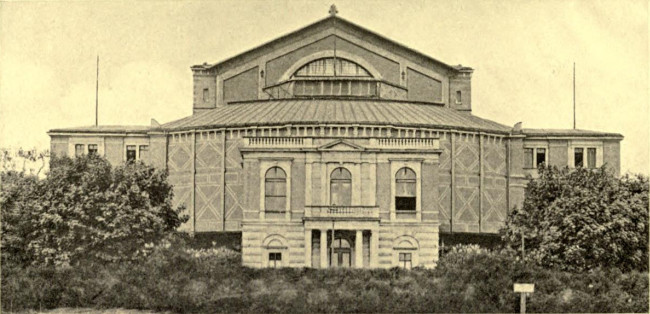
WAGNER'S THEATRE AT BAYREUTH.
This Count von Schack was a writer of some celebrity—his "History of Literature and Dramatic Art in Spain" Wagner esteemed very highly; he knew Arabic, Persian, Sanscrit, and had translated, among others, the "Book of the Kings" of Ferdousi. At one time the Master contemplated a musical drama founded upon one of the episodes of this work; he was also tempted by a legend contained in "The Voices of the Ganges," a collection also translated by Schack.
As to his museum, the public reviled more than they praised it; they even went so far as to call it the "Krausteum" (so true it is that philanthropy engenders ingratitude)—because of the things gathered in by this millionaire, who believed himself to be doing right in ordering pictures from poor artists from whom no one else had ever ordered!
As a matter of fact, the collection included not a few horrors and some very beautiful works.
The copies of the great masters, from Lenbach's brush, for example, seemed to me very remarkable. They recalled to me a commission for this artist, with which Cosima had charged me, and I decided to go at once to his studio, which was near the Schack gallery.
Lenbach had a delicate, rather crafty face, the sharp look of the hunter, a short, red-brown beard and a one-sided smile.
He showed me some delicious portraits of children which he was just finishing, he made me admire some authentic and very beautiful canvases of the old masters which were in his possession, among others, a sketch by Rubens and a splendid portrait of Francis I. by Titian.
This is what I had come to say to him:—
"It is absolutely necessary that you should paint the portrait of Richard Wagner, it is a disgrace to Germany that no artist of worth has yet attempted it. Madame Cosima sends the order to you, and leaves you free to fix your own price."
"I will undertake the work with the greatest pleasure," said Lenbach, "and I wish no further payment than the honour of having done it if I should succeed."
"That is indeed worthy of you," said I, holding out my hand to him, "but Cosima will doubtless feel differently, you must discuss that question with her."
"There is another portrait which I should also very much love to do, and it is yours."
"My portrait! You could find time for that?"
"I could do it at once, I beg you to allow me to do it."
O, careless youth! Many times Lenbach spoke again of this portrait, but the idea of posing wearied me and I evaded the appointments. The poignant regret that I now feel is surely a sufficient punishment.
XIII
The rehearsals of the Rheingold with orchestra had commenced! Wagner had made it a point that his friends should be allowed to be present at the last one before the dress rehearsal. This prospect filled us with joy.
Richter, however, seemed to be anxious. Could anything be going wrong? The singers were of the first rank and full of enthusiasm, the members of the orchestra were, without a doubt, the best in the world,—but there was also the management of the theatre, which laboured secretly at the staging of the work. What would this staging be like, without the suggestions of the Master, carried on by a management that was hostile to him, and looking out only for itself? Incredible as it may appear, it is true that the men who directed and managed the theatre, to which Wagner brought glory and profit, were hostile to Wagner.
And yet the manager, Perfall, had been appointed solely at the recommendation of the Master, whom he had solicited with a servile insistence, swearing that he would have no other object except to devote himself to him and to his interests, with all his heart and all his ability. As soon as he was appointed, with an unparalleled treachery, he had betrayed the one to whom he owed his position, and hindered in a thousand ways the production of the Meistersinger.
Nor could one depend very much more upon the Court Counsellor, Lorenz von Düfflipp, intermediary between the Palace and the theatre, who, in spite of his obsequious flatteries of Wagner, was secretly adverse to him, and hand in hand with the management.
Fruitless reprisals indeed, but we called him "Tartufflipp,"[1] and his title of "Hofrath" changed itself for us into "Chaussetrappe."[2]
This counsellor, secretary to the king, had replaced Pfistmeister, the messenger who had carried the good news to Wagner from Ludwig II., and who was now, also, one of his most implacable adversaries.
"Tartufflipp," with his prepossessing face, was badly built, high-shouldered, even hump-backed—and the report ran that his hump was greatly increased by the Wagnerian theatre project, which having juggled away, he had concealed there.
What could result from all these artful under-hand dealings? Already they had written me from Tribschen that the costumes, according to the sketches sent to the Master, were hideous and would have to be re-made. Someone had conceived the idea of building up great scaffolds of gold upon the heads of the Gods, without remembering that in this opera, where gold is discovered, it ought not to appear until after Alberich had plundered and forged it. Would attention be paid to the author's suggestions? In that which pertained to the staging was there not all to be feared, considering that the only beings upon whom it depended were spiteful and incapable?
Decidedly, Richter's anxiety explained itself and extended to us.
XIV
At last the time had come! The last rehearsal but one was about to begin. How mysterious and imposing was the empty and dimly lighted theatre! It appeared immense, almost like a cathedral, the stage all bathed in a blue haze, produced, no doubt, by some reflection of the outside daylight, for it was then three o'clock in the afternoon.
Only a very few had been accorded the favour of being present at this rehearsal, which was without stage scenery or costumes.
Liszt was there. His tall dark silhouette loomed up from the orchestra stalls. I hastened to salute the Great Man, now become the friend, and I asked if he would permit me to remain near him during the rehearsal, that he might explain to me some things in the opera, the score of which I did not sufficiently know. The permission was very graciously accorded.
Now the musicians began to arrive and to take their places! How solemn and almost religious was the emotion we felt!
"For very many years I have waited for this moment," said Liszt, "and I have feared, indeed, that it would never come.... If you but knew the miseries, the wrecked and perished hopes despite which this work has germed and flowered! I have seen it all and I have suffered too because of it. I do not know how Wagner has been able to preserve his divine inspiration intact. He seems to me like a traveller who bore a cup full of water through the midst of a whirlwind without being forced to spill a single drop. But even in harbour, you see, he finds no shelter.... Dining his exile he was for many years the only German who had not heard Lohengrin. To-day, the tones of his great orchestra revealing his new work to the world, will sound for the first time and he will not hear them. Ah, what a ransom ought to be paid to genius!"
Now came Richter, pale and grave, and mounted to his desk.
We were hardly a dozen listeners in the dark audience hall. I caught a glimpse of the blond, almost white locks of Servais, and I divined the form of Edouard Schuré beside him. I also saw a shadow, climbing over the orchestra chairs: it was Villiers hastening to seat himself farther back, in order to be quite alone, quite undistracted.
They drew the curtain before the stage. Richter gave two or three quick blows on the desk, then with a serious and proud gesture raised his baton.
And now a deep, muffled tone rises from the orchestra, it vibrates almost imperceptibly in the lowest depths of the scale, indistinct, without form, it trembles in a limpid motion, then seems to dilate, to spread out, a slow sweet gliding movement floats up and loses itself, soon another ripples up along the same path and floats away, as one wave follows another.
Very soon these musical waves swell out and follow each other continuously upward; from above spheres of light seem to fall, spreading and diffusing like drops of milk in clear water. The curtain is drawn to reveal mysterious abysses seen through the blue transparency of the Rhine. On the stage there is nothing but a confused shadow, but how clearly the imagination inspired by the music, evokes the picture! Better, perhaps, than could the scenery itself.
Now a gentle undulation sways the tranquil water and suddenly a crystal voice resounds through the crystal fluid, a nymph glides from the heights and swims below, stirring the water to new motion. The words of her song form sliding syllables:
Weïa! Waga! Woge, du Welle, Walle zur Wiege! Wagala Weïa Wallala Weiala Weïa!
And she sways about the reef, at the summit of which dimly gleams the vein of gold; then another daughter of the Rhine plunges from the heights and joyously pursues her flying sister. But the voice of a third undine chides them both as she, laughing, sings:
Heila Weïa! Wildes Geschwister! Des Goldes Schlaf Hütet ihr schlecht; Besser bewacht Des schlummemden Bett Sonst büsst ihr beide das Spiel!
Then she in her turn dives below, and these gracious dwellers of the Rhine swim and frolic, upborne by the harmonious waves of music, around the prophetic rock where sleeps the imprisoned gold, untouched and virgin still.
On this occasion the Rhine maidens are standing quietly upon the platform in walking costumes and straw hats, but they can hardly be seen in the obscurity and, without interfering with our imaginings they lend their fresh and limpid voices to the forms the poet has created.
Now comes a heavy and jarring rhythm, and from the most obscure depths of the river, slowly emerges a strange dwarf, with white hair and long white beard braided into one strand. He climbs along the slippery rocks. The music expresses his struggles, as he complains of the painful ascent, alliterating his words:
Garstig glatter Glitschriger Glimmer! Wie gleit ich aus!
His eager look follows the undines in their charming play, and, unable to reach them, he calls to them:
He, He! Ihr Nicker! Wie seid ihr niedlich Neidliches Volk! Aus Nibelheim's Nacht Naht' ich euch gern, Neigtet ihr euch zu mir.
The Rhine maidens, frightened, cluster about the rock:
"Hütet das Gold! Vater warnte Von solchem Feind."
"What dost thou seek, thou who comest up from below?"
"Wie scheint im Schimmer Ihr hell und schön Wie gern umschlänge Der schlanken eine mein Arm Schlüpfte hold sie herab!" "Nun lach ich der Furcht Der Feind ist verliebt."
And the frolicsome undines dive from the rocks, pursuing, enticing, tempting the ardent dwarf, who, in a passionate fury, leaps from rock to rock, trying to catch one or another. But the elusive maidens always evade him, slipping away, and as he falls back, breathless and angry, the clear notes of their mocking laughter float back to him.
But to-day, in the pleasure of reviving these memories, I must not fall into the error of describing the Rheingold. When I first heard it in Munich in the solemn stillness of the dark theatre, it was like the virgin metal gleaming in the sunlight at the summit, of the rock, for the first time revealed to the world, while now, like gold which has passed through the mint, it is known to all.
This first part of the Tetralogy, which is the prologue, was not divided into acts. Its four tableaux were given without interruption. The scenes were shifted in full view of the audience to the accompaniment of the orchestra. The performance lasted for more than two hours, and yet, even at this first hearing when all the faculties of attention were taxed to the utmost, one did not experience any fatigue; the architectural outline of the drama was so simple and clear cut, the music evoked with so much certainty the different phases, or so to speak, the elementaries of the work, and individualized them in themes and rhythms of such extraordinary beauty.
Only one passage seemed to me difficult to understand, the one where Wotan, in the face of the treasure forged by the Nibelungen which he has just ravished from them, is, according to the text, "struck by a high thought." At this moment is heard for the first and only time, the "Leit-motif" of the sword, that sword called "Nothung" which is to play such an important role in the following works, but which, when the theme enters which symbolises it, is not designated by any phrase or gesture. Liszt, whom I questioned about it, agreed with me that here was an obscurity, and that Wagner would have noticed it if he had been present at the rehearsals. Later, I spoke to the Master himself with regard to this point, and he remarked that the observation was a very just one, and that he would take advantage of it. After that, a sword was added to the treasure of the Nibelungen; Wotan discovered and brandished it at the moment when the theme was introduced.