CHAPTER 9 FOUR NEW WORLDS
Reading edition
Jupiter’s Satellite System
In a sense, the Voyager Mission revealed a new planetary system. Astronomers had long been fascinated by the large Galilean satellites of Jupiter, but they had only looked from afar, watching the dancing points of light in their telescopes, and, occasionally, as the atmosphere steadied, seeing these points resolve themselves into tiny disks before dissolving again in the turbulence of the terrestrial atmosphere. Much had been learned from telescopic studies, but not until the Voyager flights had we truly seen the Galilean satellites. The historic hours as Voyager 1 cruised past each satellite on March 5 and 6, 1979, fundamentally altered our perspective. Four new worlds were revealed, as diverse and fascinating as the more familiar terrestrial planets. Although not yet household words, the names Io, Europa, Ganymede and Callisto have now been added to Mercury, Venus, Moon, and Mars in the lexicon of important “Earth-sized” bodies in the solar system.
Jupiter has fifteen known satellites, counting the two new satellites discovered by Voyager. These moons vary greatly in size, composition, and orbit. The four outermost satellites, Sinope, Pasiphae, Carme, and Ananke, circle the planet in retrograde orbits of high inclination; their distances from Jupiter vary between 20 and 24 million kilometers (290 RJ to 333 RJ). These small bodies, none more than 50 kilometers in diameter, require nearly two years for each orbit of Jupiter. It is possible that they are captured asteroids, but so little is known about them that astronomers cannot tell if their surface properties resemble those of asteroids, or if these four satellites are even similar to each other.
The next group of Jovian satellites consists of four small difficult-to-observe objects. These are Lysithea, Elara, Himalia, and Leda, the latter discovered by Charles Kowal of Hale Observatories in 1974. They have similar orbits, varying in distance from Jupiter between 11 and 12 million kilometers (about 160 RJ). Like the outer group, these satellites have orbits of high inclination; unlike the outer group, they move in the proper, prograde direction around Jupiter. The largest, Himalia (170 kilometers in diameter) and Elara (80 kilometers diameter), are known to be very dark, rocky objects, and it seems probable that the others are similar. It is unlikely that the census of the outer groups of irregular satellites is complete, and new satellites less than 10 kilometers in diameter will probably be discovered.
The Jovian system is dominated, of course, by the large Galilean satellites, which vary in size from just smaller than the Moon (Europa) to nearly as large as Mars (Ganymede). These satellites are in regular, nearly circular orbits in the same plane as the equator of Jupiter, and all four lie within the inner magnetosphere of Jupiter, where they interact strongly with energetic charged particles and plasma. Most of this chapter will be devoted to a discussion of these fascinating worlds.
We now know of three additional small satellites inside the orbit of Io, orbiting close to Jupiter. The first, Amalthea, was discovered in 1892; it orbits Jupiter in just twelve hours at a distance of 181 000 kilometers (2.55 RJ). A smaller object, Adrastea (officially 1979J1 for the first new satellite of Jupiter discovered in 1979), is much closer, at 134 000 kilometers (1.76 RJ). As described in Chapter 7, it skirts the outer edge of the ring, circling Jupiter in just over seven hours. The inner satellite moves faster than Jupiter’s rotation; seen from the planet, it would rise in the west and set in the east. Both Amalthea and Adrastea are buried deep within the inner magnetosphere where they are continually bombarded by energetic electrons, protons, and ions. Depletion of the Jovian radiation belt particles was observed at the orbits of both satellites by Pioneer 11, which went much closer to Jupiter than the Voyagers, testifying to the intensity of the interaction between these objects and their surroundings.
140
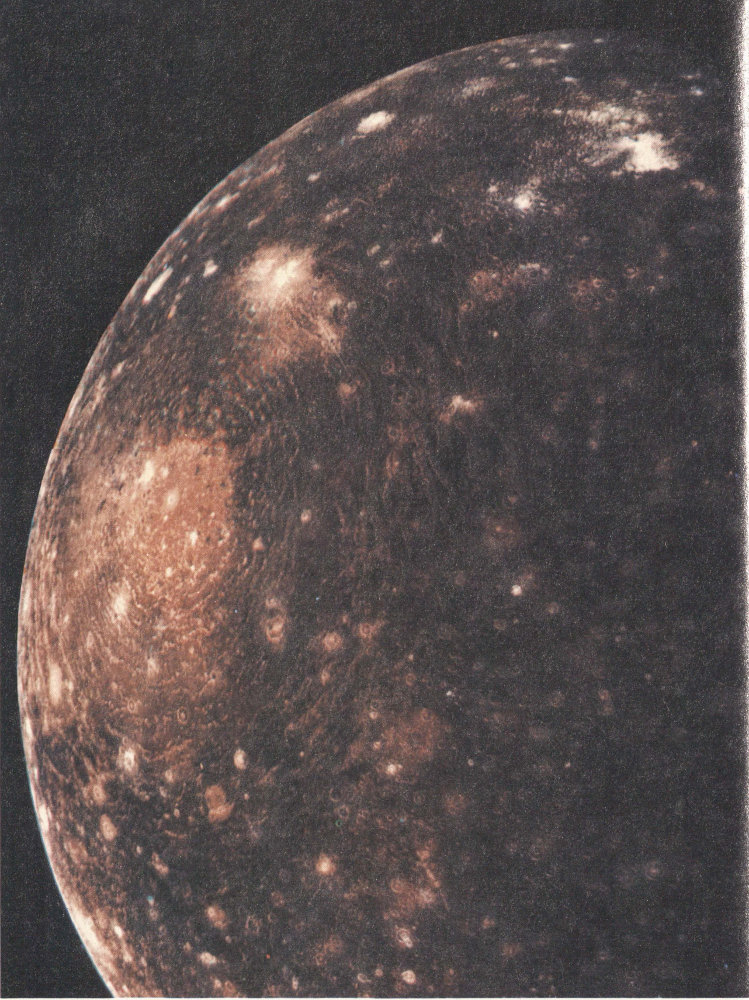
Callisto was revealed by the Voyager cameras to be a heavily cratered and hence geologically inactive world. This mosaic of Voyager 1 images, obtained on March 6 from a distance of about 400 000 kilometers, shows surface detail as small as 10 kilometers across. The prominent old impact feature Valhalla has a central bright spot about 600 kilometers across, probably representing the original impact basin. The concentric bright rings extend outward about 1500 kilometers from the impact center. [260-450]
141
SATELLITES OF JUPITER
Distance From Jupiter
Name 10³ kilometers Jupiter Radii Period (days) Year of Discovery
Adrastea J14 134 1.76 0.30 1979
Amalthea J5 181 2.55 0.49 1892
1979J2 J15 222 3.11 0.67 1980
Io J1 422 5.95 1.77 1610
Europa J2 671 9.47 3.55 1610
Ganymede J3 1070 15.10 7.15 1610
Callisto J4 1880 26.60 16.70 1610
Leda J13 11 110 156 240 1974
Himalia J6 11 470 161 251 1904
Lysithea J10 11 710 164 260 1938
Elara J7 11 740 165 260 1904
Ananke J12 20 700 291 617 1951
Carme J11 22 350 314 692 1938
Pasiphae J8 23 300 327 735 1908
Sinope J9 23 700 333 758 1914
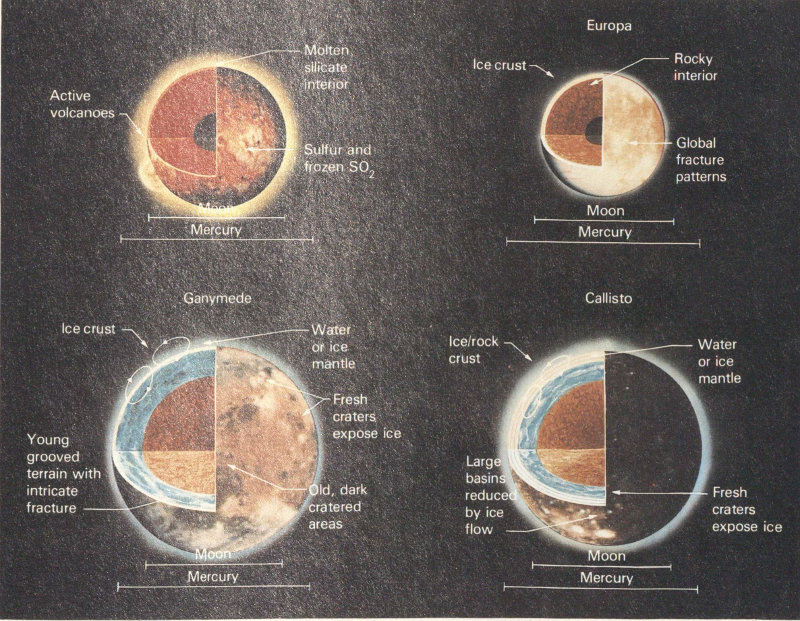
The state of the interiors of the Galilean satellites can be judged from their sizes and densities. These cross-sectional views represent the best guess following the Voyager flybys as to the composition and structure of the objects. Io, with a density equal to that of the Moon and a long history of volcanic activity, is a dry, rocky object. Europa is less dense, and it probably has a global ocean of ice as much as 100 kilometers thick over a rocky interior. Ganymede and Callisto both have densities near 2 grams per cubic centimeter, suggesting a composition about half water and half rock. There is probably a rocky core surrounded by an icy mantle.
Io
Active volcanoes
Sulfur and frozen SO₂
Molten silicate interior
Europa
Global fracture patterns
Ice crust
Rocky interior
Ganymede
Fresh craters expose ice
Young grooved terrain with intricate fracture
Old, dark cratered areas
Ice crust
Water or ice mantle
Callisto
Large basins reduced by ice flow
Fresh craters expose ice
Ice/rock crust
Water or ice mantle
Moon
Mercury
142
Long after the flybys of Jupiter, continued analysis of Voyager images revealed another new satellite, Jupiter’s fifteenth. Initially designated 1979J2, the unexpected new satellite orbits the planet at 3.17 RJ, between Io and Amalthea. Stephen Synnott of the JPL Optical Navigation Team discovered the satellite on pictures taken during the Voyager 1 events on March 5, 1979, while searching for additional images of satellite 1979J1. It is about 75 kilometers in diameter, but nothing else is known about its physical properties.
Together, the 15 satellites circling giant Jupiter form a mini-solar system. Perhaps the outer, irregular satellites were captured or resulted from the catastrophic collisions of one or more larger satellites with passing asteroids. The inner seven satellites constitute a coherent system, almost certainly formed together with Jupiter and sharing a common 4.5-billion-year history. They are fascinating as individual worlds, and also as brothers and sisters, and the study of their interrelationships undoubtedly will provide insights into the general problems of planetary formation and evolution.
SIZES AND DENSITIES OF THE GALILEAN SATELLITES
Name Diameter (kilometers) Density (grams per cubic centimeter)
Io 3640 3.5
Europa 3130 3.0
Ganymede 5270 1.9
Callisto 4840 1.8
Callisto
Callisto is the least active geologically of the Galilean satellites. Basically a dead world, it bears the scars of innumerable meteoric impacts, with virtually no sign of major internal activity. Callisto is a world of craters, and to understand it we must explore the role that cratering plays in molding planetary surfaces.
The space between the planets is filled with debris, ranging from the larger asteroids, hundreds of kilometers in size, down to microscopic grains of dust. Inevitably, each planet collides with some of these fragments. The smaller particles do little damage; in the case of a planet with an atmosphere, like Earth, they burn up as meteors before reaching the surface, whereas on an airless planet, they erode the surface by sandblasting the exposed rock. The larger impacts are another matter, and the craters they produce can be the dominant features on the surface of a planet.
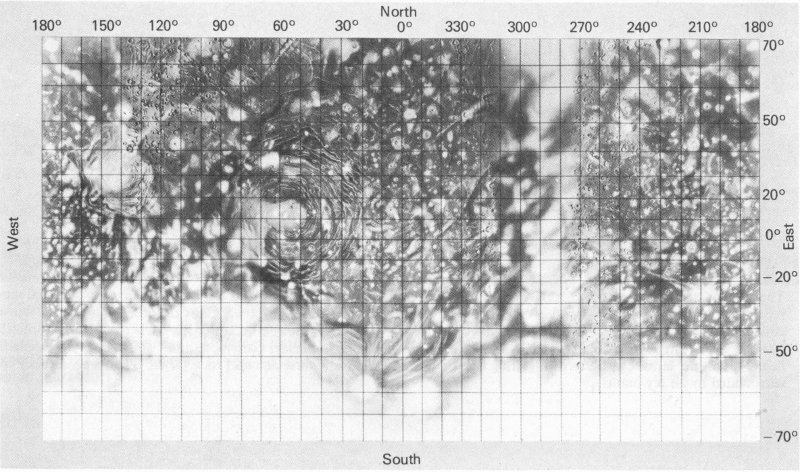
Voyagers 1 and 2 photographed most of the surface of Callisto at resolutions of a few kilometers or better. Shown here is a preliminary shaded relief map. Additional measurements will improve the accuracy of the coordinate system. [260-672]
143
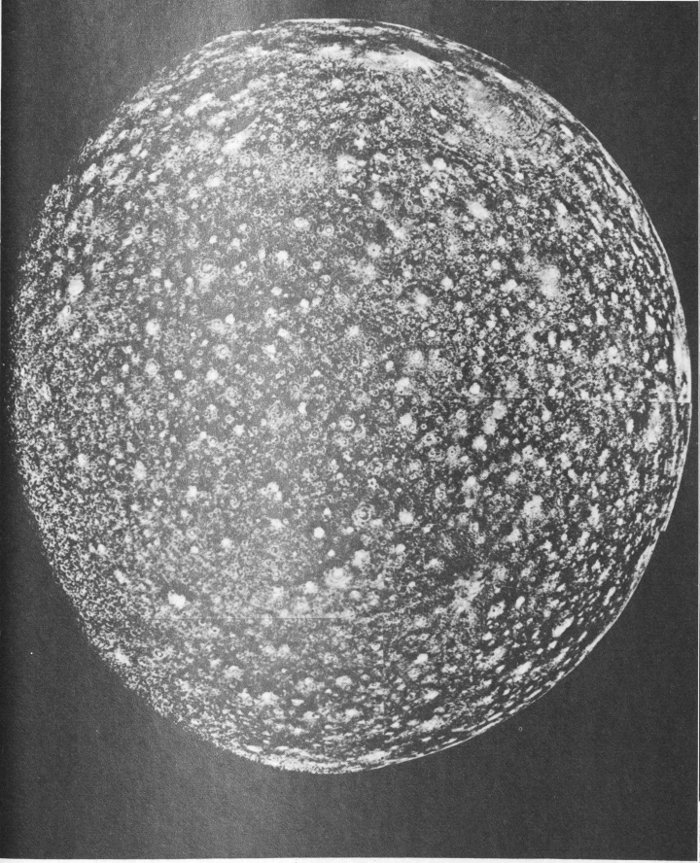
Callisto is a world of craters, as is well shown in this Voyager 2 photomosaic taken from a distance of 400 000 kilometers. Craters about 100 kilometers in diameter cover the surface uniformly. Many have bright rims, perhaps composed of exposed water-ice. There are very few craters larger than 150 kilometers in diameter, however, indicating that the scars of very large impacts do not survive on the surface of Callisto. [P-21746B/W]
144
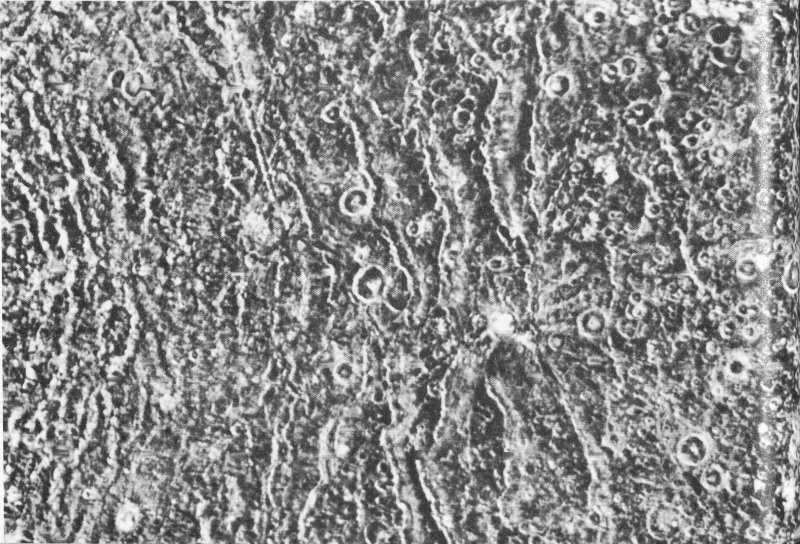
The concentric rings surrounding Valhalla are perhaps the most distinctive geological feature on Callisto. This Voyager 1 close-up shows a segment of the ridged terrain. The presence of superposed impact craters shows that the rings formed early in Callisto’s history; however, the density of craters is less here than on other parts of the satellite, where the surface is older. [P-22194]
We who live on Earth tend not to realize the importance of cratering, for the simple reason that our planet has very few craters, and these are frequently of volcanic rather than meteoric origin. Why are we so favored? Is there an invisible shield to protect us from the cosmic shooting gallery? Clearly not; the Earth has experienced just as many cratering impacts as has the Moon or other planets. The difference is not that craters are formed less often, but that the great geological activity of Earth—erosion, volcanism, mountain building, continental drift, etc.—erases craters as fast as they are formed. On the average, a 10-kilometer-wide crater is formed on Earth about once every million years, but all those older than a few million years have been eroded away, filled in, or crushed beyond recognition by crustal motion.
If a planet lacks great internal geologic forces, large craters can survive almost indefinitely. Such is the case for the Moon. Most of the volcanism and other activity on the Moon ceased 3½ billion years ago, as the dating of lunar samples obtained by the Apollo astronauts showed. Since that time, the lunar surface has been passively accumulating impact scars. The longer any particular surface area has been exposed, the more densely packed are the craters. Thus crater density is the first thing a planetary geologist looks for in photos of a new world. Craters are the touchstone of this field, revealing the degree of internal activity and allowing the determination of the relative ages of different surface units.
On Callisto the density of craters is very high. In some places they are packed as closely as one can imagine, particularly for craters several tens of kilometers in diameter. Although no one knows the exact rate of formation of impact craters on the Jovian satellites, geologists on the Voyager Imaging Team estimate that it would require several billion years to accumulate the number of craters found on Callisto. They therefore conclude that Callisto has been geologically inactive almost since the time of its formation.
Although superficially similar to the heavily cratered surfaces of the Moon and Mercury, Callisto is far from identical to these rocky worlds. One of the most obvious differences is a lack of craters larger than about 150 kilometers on Callisto, together with a tendency for large craters to have much shallower depths. 145 Apparently the ice-rock composition of Callisto alters the ability of the crust to retain large craters. Geologists speculate that the ice flows over many millions of years, filling in crater floors and gradually obliterating the largest craters. There is also a conspicuous absence of mountains on Callisto, again suggestive of a weak, icy crust.
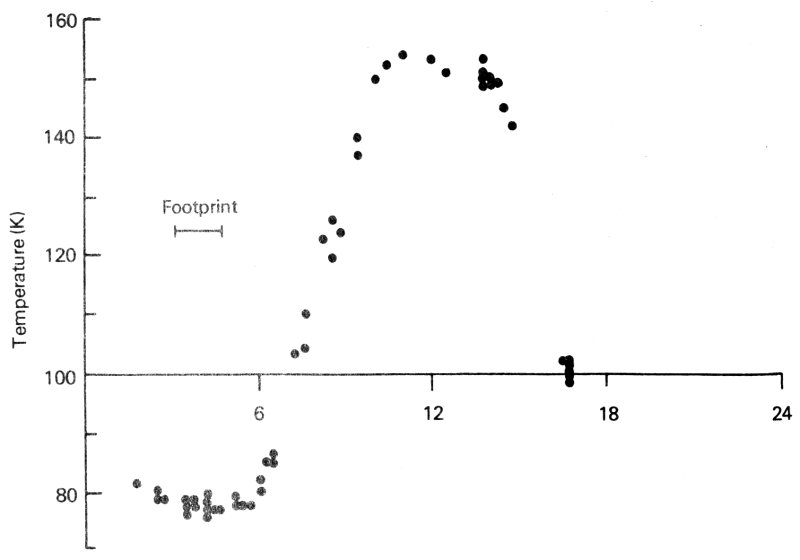
The IRIS instrument measured the temperature of spots on the surface of Callisto as each Voyager sped past. The measurements shown here were all made at equatorial latitudes (between -10° and 25°). Shown are very low predawn temperatures (-190° C) followed by an increase to a noon-time maximum of about -120° C, and then a drop again as the Sun sets. [260-735]
The most prominent features in the Voyager pictures are the ghost remnants of what must have been immense impact basins. The largest of these, the “bullseye” of the Voyager 1 images, has been named Valhalla, for the home of the Norse gods. These ghost basins have lost nearly all their vertical relief. What remains is a central, light-colored zone (probably the location of the original crater), surrounded by numerous concentric rings of subdued, bright ridges. Such features had never been seen before on any planet, and they appear to be the characteristic geologic feature of an ice-rock planet.
Little is known about the composition of Callisto’s surface, the material from which sunlight is reflected. It appears to be primarily dark rock or soil, but it lacks diagnostic spectral features, except for one infrared band due to water molecules bound in the soil. The many lighter spots and arcs that outline craters in the high-resolution pictures may be regions in which the ice is showing through, but these cover only a very small fraction of the exposed surface. (It should be noted that, although Callisto is the darkest of the Galilean satellites, the term “dark” is relative, for even Callisto is brighter than Earth’s moon.)
The daytime surface temperature of Callisto, observed both from the ground and by Voyager, is about -118° C. The Voyager infrared interferometer spectrometer also determined the minimum temperature, reached just before dawn, of -193° C. No atmosphere is expected at these cold temperatures, and none was seen.
Analysis of Voyager images provided an improved diameter for Callisto of 4840 kilometers, yielding an average density of 1.8 grams per cubic centimeter. As noted previously, it is this low density that leads to the conclusion that ice or water is an important component of the interior of Callisto. The ice has never been detected directly, but the peculiar nature of the craters seen by Voyager adds strong circumstantial support to this conclusion.
Callisto, with its heavy cratering, is the most familiar-looking of the Galilean satellites; if all of them had turned out to be as geologically dead as Callisto, planetary geologists would certainly have been disappointed. However, each satellite, progressing in toward Jupiter, presents increasing evidence of internal activity.
146
Ganymede
The largest of the Galilean satellites (5270 kilometers in diameter), Ganymede was expected to be similar to Callisto in many ways. Both have low densities (for Ganymede, 1.9 grams per cubic centimeter), indicating a bulk composition of about half rocky materials and half water. In addition, their diameters differ by only eight percent, and both are far enough from Jupiter to escape the severe pounding Io receives from magnetospheric charged particles. Thus it was with great interest that Voyager scientists looked at the differences that emerged between these two satellites.
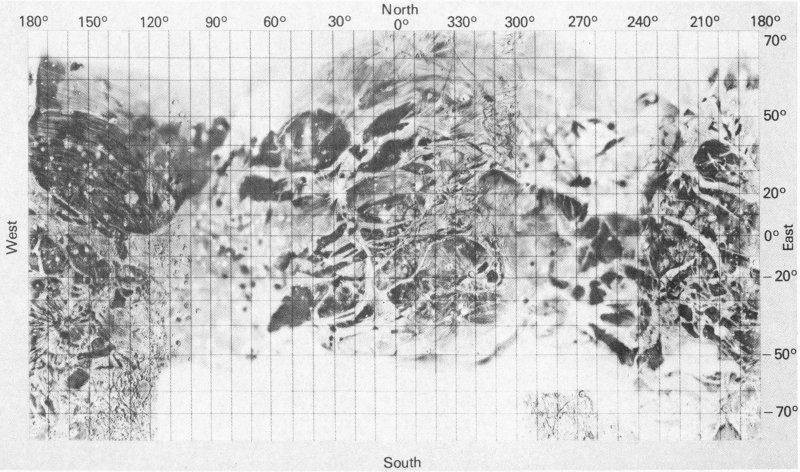
Shaded relief map of Ganymede. [260-673]
The surface of Ganymede as revealed by the Voyager cameras is one of great diversity, indicating differing periods of geologic activity. At one extreme there are numerous dark areas that resemble the surface of Callisto in both albedo (reflectivity) and crater density. The largest of these, Regio Galileo, stretches from the equator to latitude +45° and is 4000 kilometers across, nearly as large as the continental United States. This ancient terrain even preserves the remnants of a Callisto-type impact basin in the form of a system of parallel, curving, subdued ridges about 10 kilometers wide, 100 meters high, and spaced about 50 kilometers apart. The central part of this ghost basin is missing, however; it was presumably destroyed by subsequent geologic activity.
Other regions of the surface of Ganymede are clearly the product of intense internal geologic activity. Generally, these regions are of higher albedo and consist of many straight parallel lines of mountains and valleys. The Voyager geologists call these the grooved terrain because of their appearance from a great distance. Typically, these mountain ridges are 10-15 kilometers across and about 1000 meters high, similar in scale to some sections of the Appalachian Mountains in the Eastern United States. No higher relief exists, presumably for the same reason it is absent on Callisto. In many places the grooved terrain forms between areas of the older, darker surface, giving the appearance of mountains extruded between separating plates of ancient crust. In other areas the relationships are much more complex, with curved systems of grooves and ridges overlying each other, displaying intricate crosscutting relationships. Apparently Ganymede has experienced a series of mountain-building events.
The grooved terrains show a substantial range in age, as indicated by the crater densities. The oldest have nearly the same density as the ancient, dark plains, suggesting that formation of the grooved terrain began early, perhaps 4 billion years ago. The youngest grooved terrain has only about one-tenth as many craters, but this is still as many as are seen in the 3.5-billion-year-old lunar plains. The Voyager geologists believe that even in these areas geologic activity ceased billions of years ago.
147
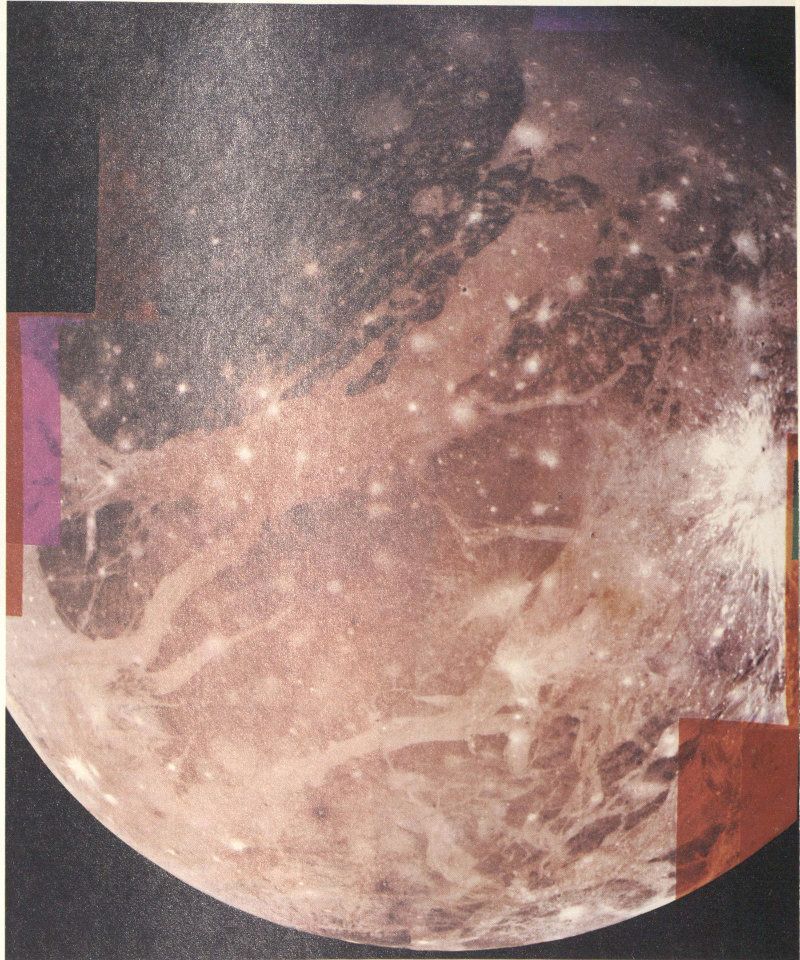
The hemisphere of Ganymede that faces away from the Sun displays a great variety of terrain. In this Voyager 2 mosaic, photographed at a range of 300 000 kilometers, the ancient dark area of Regio Galileo lies at the upper left. Below it, the lighter grooved terrain forms bands of varying width, separating older surface units. On the right edge, a prominent crater ray system is probably caused by water-ice splashed out in a relatively recent impact. [260-671]
148
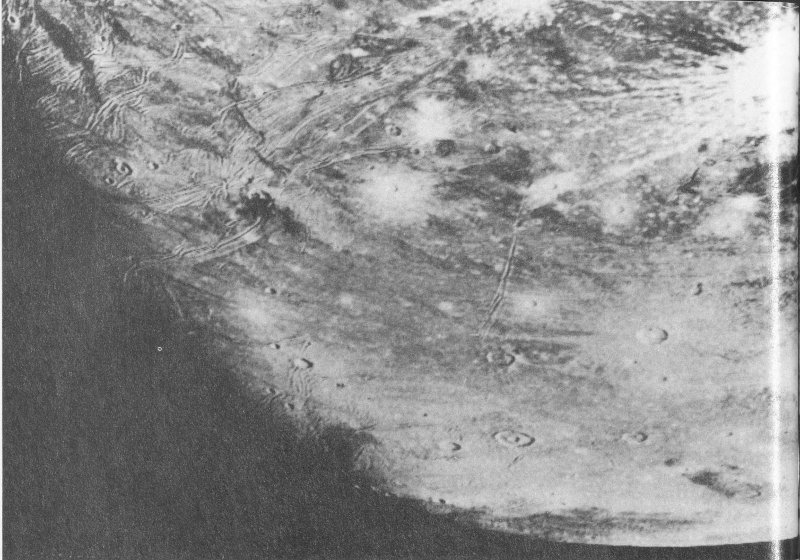
The sinuous nature of some of the narrower Ganymede groove systems can be seen in this oblique view, obtained on March 5 by Voyager 1. The area shown is about the size of California, with features visible as small as 5 kilometers across. The ridges appear to be the result of deformation of the crust of Ganymede. [P-21235]
Other types of surfaces are seen on Ganymede. Some regions are lightly cratered and smooth, with no indication of mountain building. In one place, there is a rough mountainous area that looks more like the jumbled lunar mountains than the long ridges and valleys of the rest of Ganymede. Many of the larger craters are distinguished by brilliant white halos and rays that suggest that impacts may have splashed large quantities of water or ice over the surface.
Many of the geologic features seen on Ganymede appear to have been caused by breaking, faulting, or spreading of the crust. In a few cases, there even seem to be indications of transverse, or sideways, motion along faults. This evidence is extremely exciting to geologists, since similar crustal motion on Earth is associated with the drift of continental plates, drawn by convection currents deep in the mantle. Such activity has never been seen before on another planet.
Astronomers on Earth had known since 1971 that about half the surface of Ganymede was covered with exposed water ice and about half with darker rock. An examination of the albedo variations in the Voyager pictures suggests that the ice is exposed near large craters and, to a lesser extent, in the grooved terrain, but no direct measurements were made by Voyager of the composition of different parts of the surface.
The presence of ice on the surface suggested to many astronomers that Ganymede 149 might have a very tenuous atmosphere of water vapor or oxygen, which might be released by the breakdown of water vapor by sunlight. During the Voyager 1 flyby, a sensitive test for an atmosphere was made by the ultraviolet instrument from observations of the star Kappa Centauri as it was occulted by Ganymede. No dimming of the starlight was seen, yielding an upper limit for the surface pressure of the gases oxygen, water vapor, or carbon dioxide of 10⁻¹¹ bar, or one hundred-billionth the atmospheric pressure at Earth.
The differences between the geologic histories of Ganymede and Callisto are surprisingly large. No one knows the reason. Perhaps only a small increase in internal temperature is necessary to initiate geologic activity in an icy planet, and for some reason Ganymede crossed this threshold for a part of its history, whereas Callisto did not.
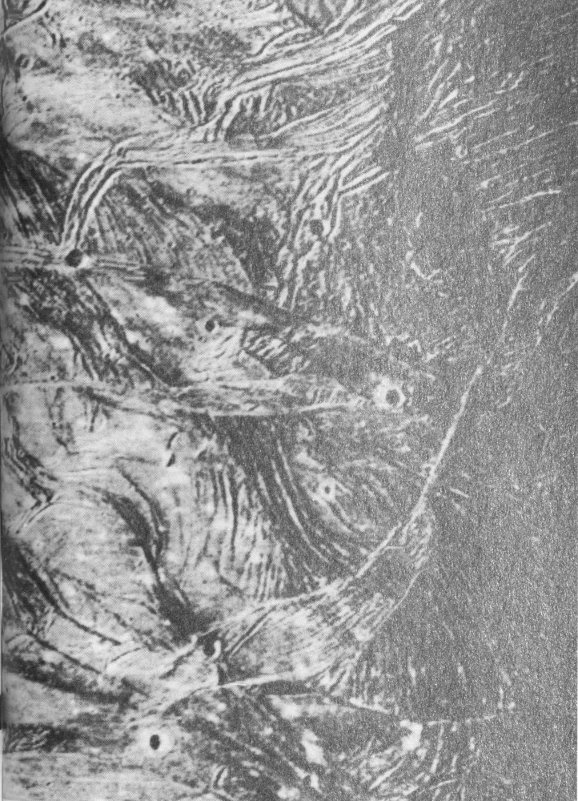
The complex patterns of the grooved terrain on Ganymede are apparent in high-resolution images. This picture, taken by Voyager 1 on March 5, has a resolution of about 3 kilometers and shows a region about the size of the state of Pennsylvania. The mountain ridges are spaced about 10 to 15 kilometers apart and rise about 1000 meters, similar to many of the mountains of Pennsylvania. The transections of different mountain systems indicate that they formed at different times. A degraded crater near the left center of the picture is crossed by ridges, indicating that it predated the period of crustal deformation and mountain building. [P-21279]
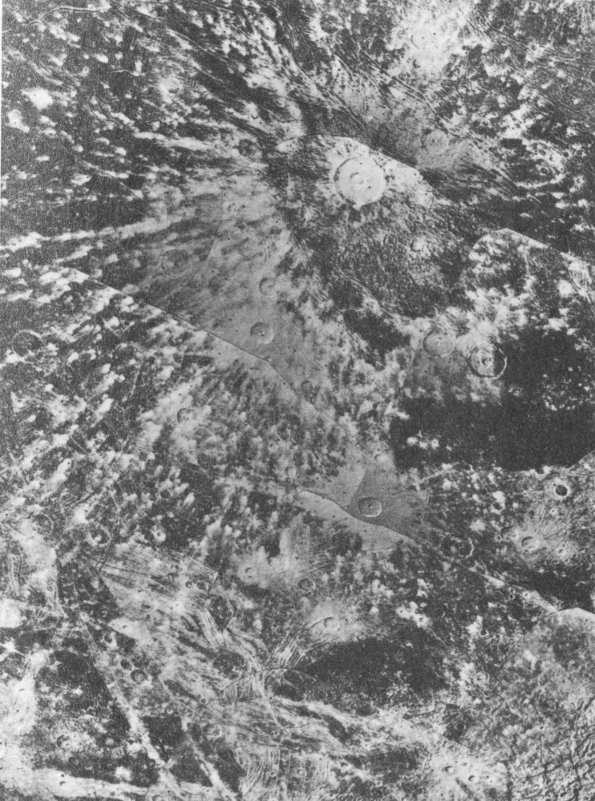
Ray systems of exposed water-ice are visible in this high-resolution mosaic of Ganymede, obtained by Voyager 2 on July 9 at a range of about 100 000 kilometers. The rough mountainous terrain at lower right is the outer portion of a large fresh impact basin that postdates most of the other terrain. At the bottom, portions of grooved terrain transect other portions, indicating an age sequence. The dark patches of heavily cratered terrain (right center) are probably ancient icy material formed prior to the grooved terrain. The large rayed crater at upper center is about 150 kilometers in diameter. [P-21770B/W]
150
The many variants of smooth and grooved terrain on Ganymede suggest a complex geologic history for this satellite. Four high-resolution views by Voyager 2 are grouped together. [260-678A]
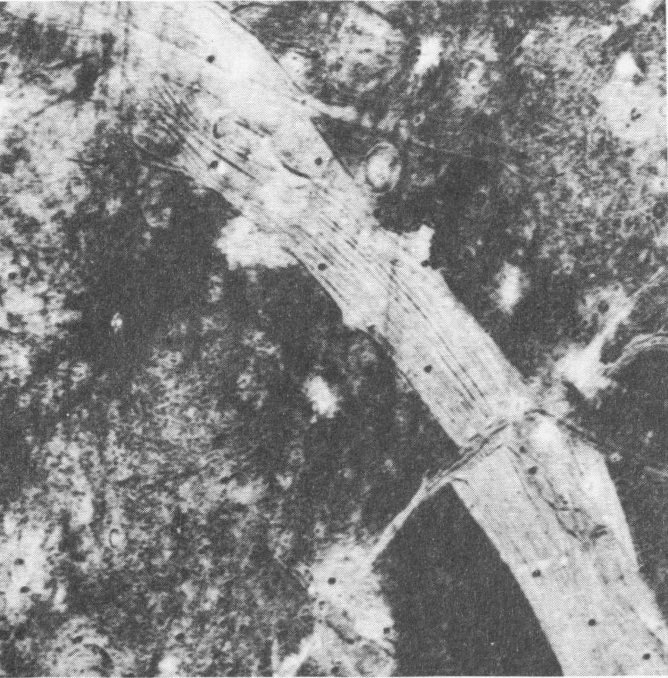
A band of low mountain ridges has apparently been cut and offset by a fault.
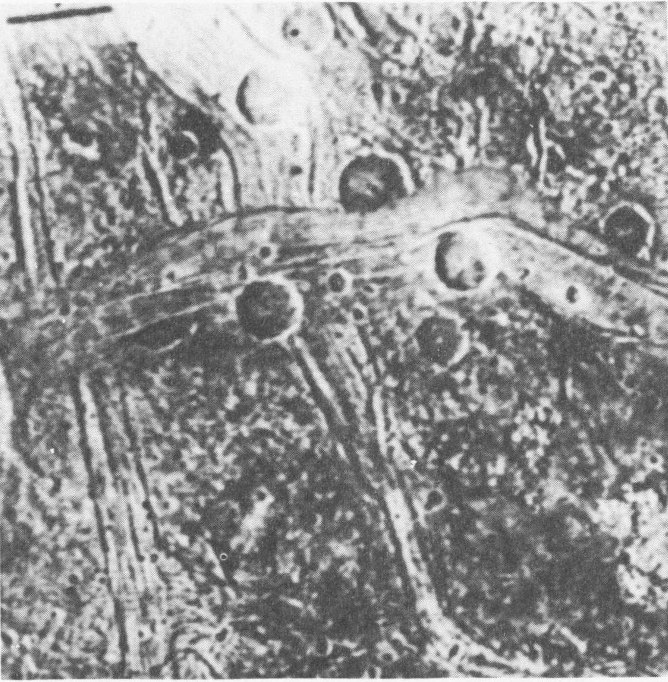
Multiple sets of mountain ridges transect at nearly right angles. Some impact craters were formed before, and some after, the grooved terrain.
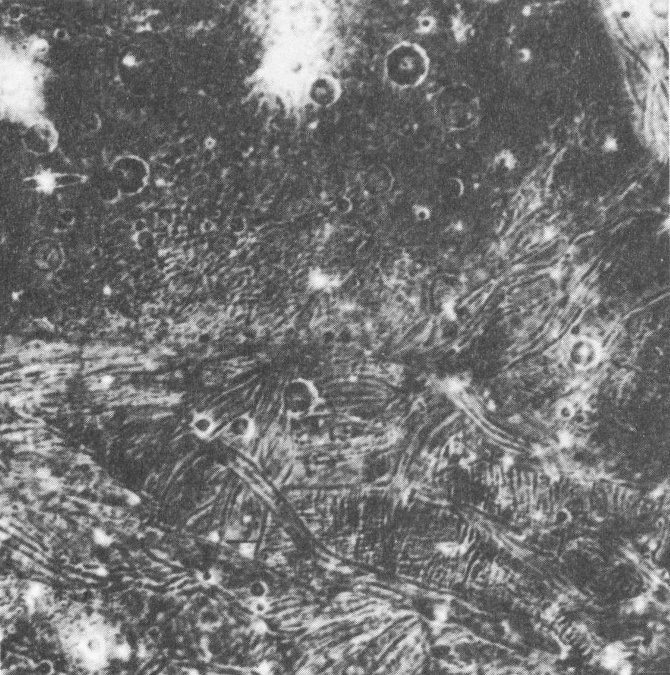
Many short parallel ridges butt into each other, making a crazy-quilt pattern.
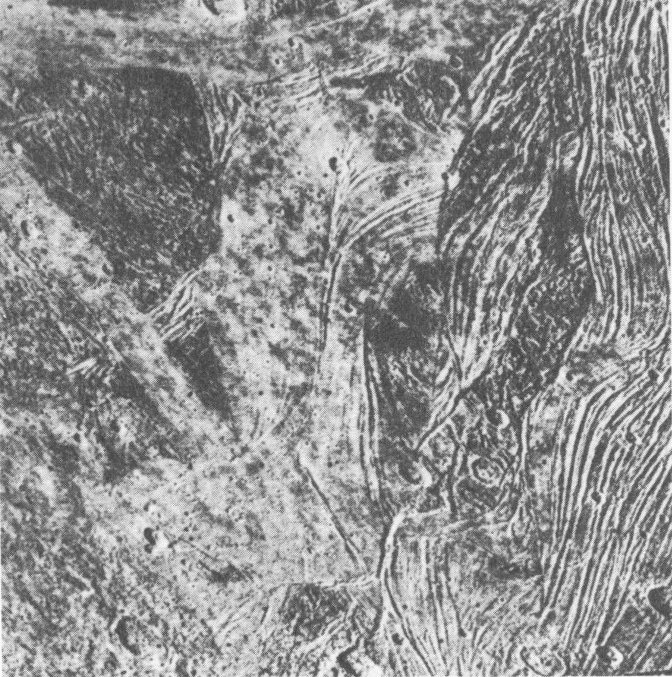
In the center of this frame is an unusual smooth area, perhaps the result of flooding of the surface by material that filled in the grooves.
Europa
As one proceeds inward through the Galilean satellites, these worlds become less and less familiar to the planetary geologist. This was an unexpected effect. Callisto and Ganymede were expected to have unusual properties as a result of their large percentage of ice. The densities of Europa and Io are more normal for the smaller, terrestrial-type planets, and before Voyager many scientists expected these two satellites might look much like the Moon, which they resemble in size.
Europa, with a diameter of 3130 kilometers, is about 15 percent smaller than the Moon. Its density is 3.0 grams per cubic centimeter, indicating a basically rocky composition. However, cosmic mixtures of rocky and metallic materials are often a bit denser than this, leaving room for a substantial component of ice or water. Calculations indicate that if all 151 the ice were at the surface, it might form a crust up to 100 kilometers thick.
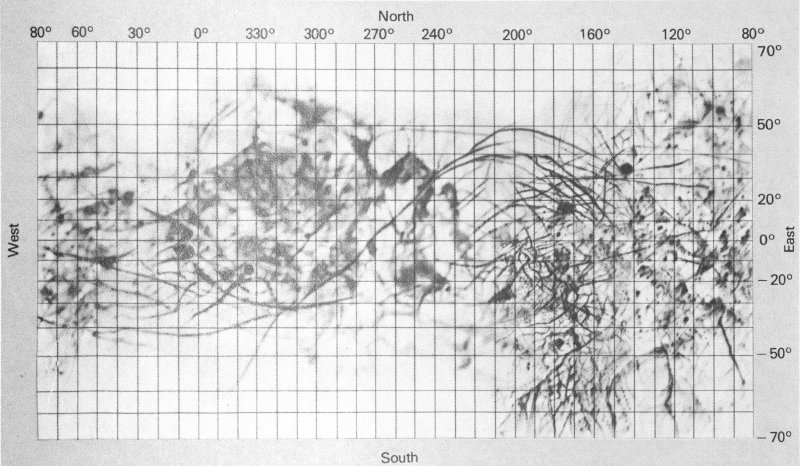
Shaded relief map of Europa. [260-659]
Telescopic observations of Europa demonstrated long before Voyager that this satellite is almost completely covered with ice. It is a white, highly reflecting body, looking, from a great distance, like a giant snowball. In the early Voyager pictures, Europa always showed a bland, white disk, in striking contrast to the spottiness of Ganymede or the brilliant colors of Io.
Voyager 1 never got closer to Europa than 734 000 kilometers, and at that distance it remained a nearly featureless planet, with no obvious impact craters or other familiar geologic structures. What did show in the Voyager 1 pictures, however, were numerous thin, straight dark lines crisscrossing the surface, some extending up to 3000 kilometers in length. To the members of the Imaging Team, these features were “strongly suggestive of global-scale tectonic processes, induced either externally (as by tidal despinning) or internally (as by convection).” It was with the greatest interest that the Voyager 2 images, taken from about four times closer, were anticipated.
The spectacular pictures obtained of the satellite in July were perhaps more confusing than clarifying. Europa is entirely covered with dark streaks that vary in width from several kilometers to approximately 70 kilometers and in length from several hundred to several thousand kilometers. Most streaks are straight, but others are curved or irregular. The streaks lie on otherwise smooth, bright terrain, featureless except for numerous random dark spots, most less than 10 kilometers in diameter.
Voyager 2 photos showed, in addition to the smooth terrain with its dark streaks, regions of darker, mottled terrain. This mottled terrain appears rough on a small scale, and it may contain small craters just on the limit of resolution (about 4 kilometers). Only three definite impact craters have been identified, each about 20 kilometers across. This small number of craters suggests either that the surface is relatively young or that craters are not preserved for long in the icy crust.
Although the dark streaks give Europa a cracked appearance, the streaks themselves are not obviously cracks. They are not depressed below their surroundings; in fact, they have no topographic structure whatever. Europa is extraordinarily smooth, and the dark streaks look rather like marks made with a felt-tipped pen on a white billiard ball. The streaks are not even very dark; the contrast with adjacent smooth terrain is only about 10 percent.
One of the most remarkable geologic phenomena discovered by Voyager is the light 152 streaks that appear on Europa. These are smaller than the dark streaks, only about 10 kilometers in width, but much more uniform. Seen at low Sun angle, they also show vertical relief of less than a few hundred meters. These light ridges are seen best at low Sun and tend to be invisible at higher illumination angles.
The most amazing thing about the light ridges is their form. Instead of being straight, they form scallops or cusps, with smooth curves that repeat regularly on a scale of 100 to a few hundred kilometers. In some of the low-Sun-angle pictures, the surface of Europa seems to be covered with a beautiful network of these regular curving lines. The impression is so bizarre that one tends not to believe the reality of what is seen. Nothing remotely like it has ever been seen on any other planet.
At present the geology of Europa remains beyond our understanding. Presumably there is a thick ice crust, perhaps floating on a liquid water ocean. Presumably there is sufficient heat coming from the interior to have produced cracking or motion in the ice crust, and the light and dark streaks preserve a pattern in some way related to this internal activity. However, the actual mechanisms for producing the observed features so lightly traced on this smooth white world remain for scientists to decipher.
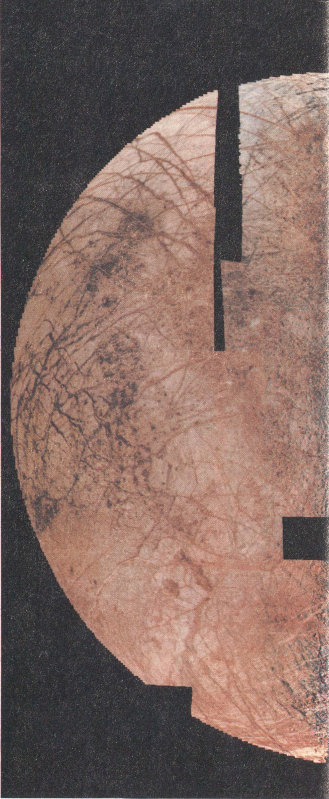
Europa looks like a cracked egg in this computer mosaic of the best Voyager 2 images. In this presentation, the variation of surface brightness due to the angle of the Sun has been removed by computer processing, so that surface features can be seen equally well at all places. The many broad dark streaks show up well, but this presentation does not bring out the much fainter and more enigmatic light streaks. These pictures were taken from a distance of about 250 000 kilometers and show features as small as 5 kilometers across. [260-686]
Io
The most spectacular of the Galilean satellites is Io. Even in low-resolution images, its brilliant colors of red, orange, yellow, and white set it apart from any other planet. The dramatic scale of its volcanic activity confirms that Io is in a class by itself as the most geologically active planetary body in the solar system.
The diameter of Io is 3640 kilometers, and its density is 3.5 grams per cubic centimeter. Both values are nearly identical to those of our Moon. Were it not for Io’s proximity to Jupiter, it would probably be a dead, rocky world much like Earth’s satellite.
Careful examination of all the Voyager images of Io, some of which have resolutions as good as 1 kilometer, has failed to reveal a single impact crater. Yet the flux of crater-producing impacts at Io must be even greater than for the other Galilean satellites, because of the focusing effect of Jupiter’s gravity. The absence of craters alone would indicate that Io has an extremely young and dynamic planetary surface, even without the observation of active volcanoes. Calculations indicate that craters on Io must be filled in or otherwise obliterated at a rate corresponding to the deposition of at least 100 meters per million years, and quite probably a factor of ten greater, or 1 meter every thousand years.
153
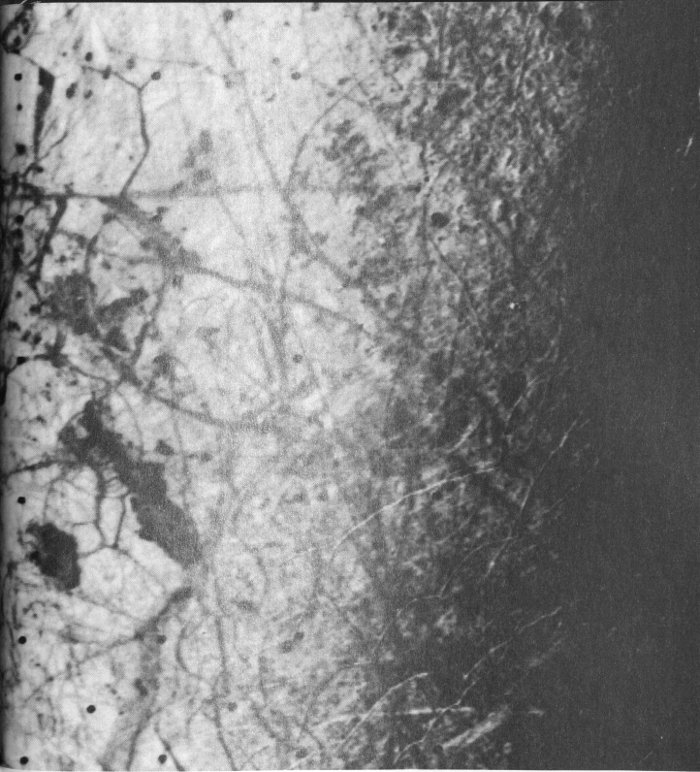
One of the most remarkable of all the Voyager discoveries was the arcuate white ridges on Europa. Visible only at very low Sun angle, these curved bright streaks are 5 to 10 kilometers wide and rise at most a few hundred meters above the surface. Their graceful scalloped pattern is unique to this planet and has defied explanation. Also visible in this view, taken by Voyager 2 on July 9 at a range of 225 000 kilometers, are dark bands, more diffuse than the light ridges, typically 20 to 40 kilometers wide and hundreds to thousands of kilometers long. [P-21766]
154
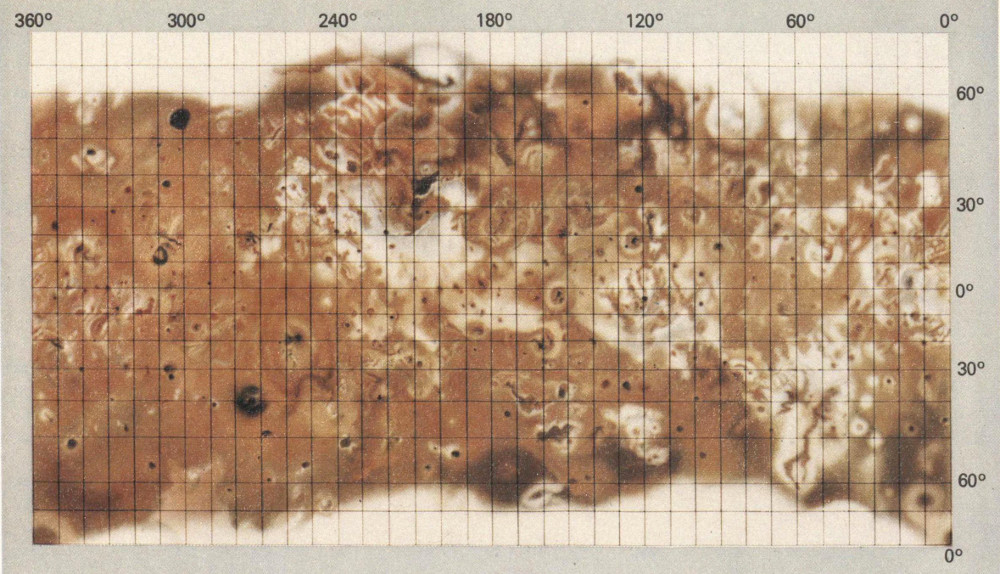
Shaded relief map of Io as it appeared in early March 1979. [260-634BC]
The great erupting volcanoes on Io produce distinctive surface markings. These are three views of Prometheus (P₃). The bright ring on the surface rims the areas of fallout from the plume, and it is probably an area in which sulfur dioxide frost is being deposited on the surface. [260-451]
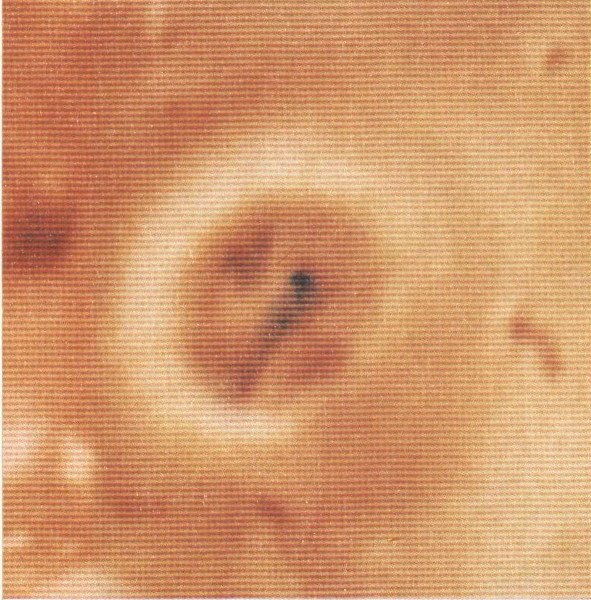
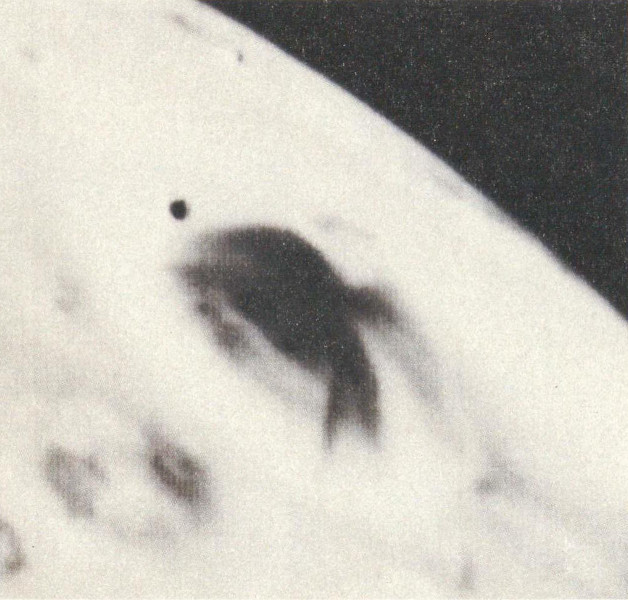

These views are of Loki (P₂) as seen by Voyager 1. [260-451]
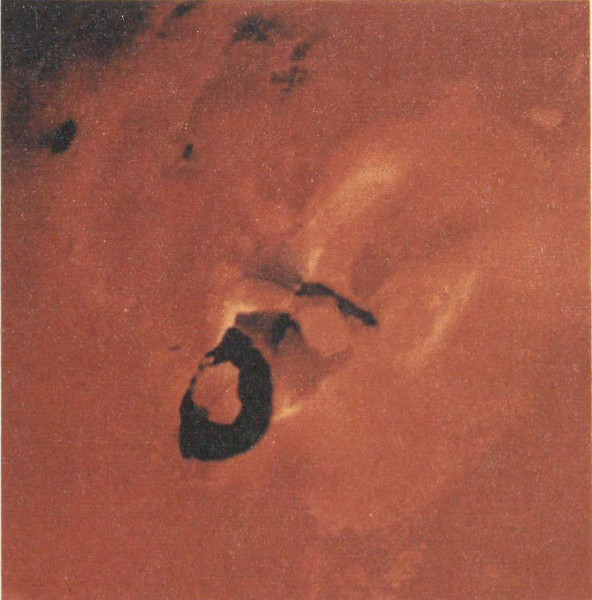
The asymmetric structure of the plume can be seen.
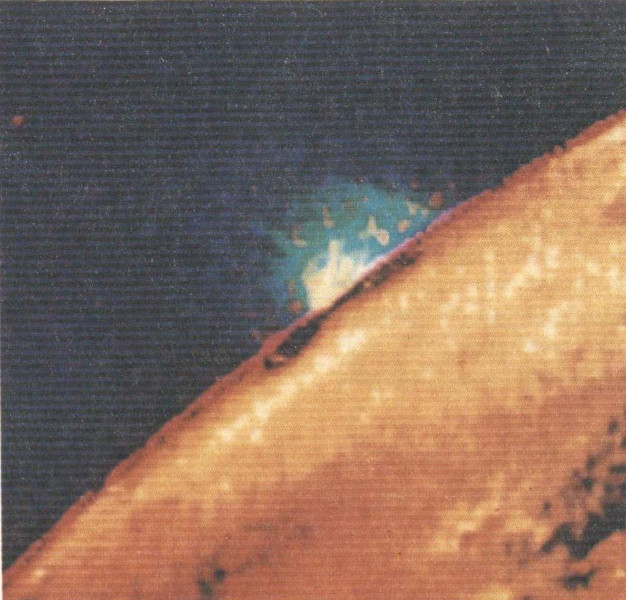
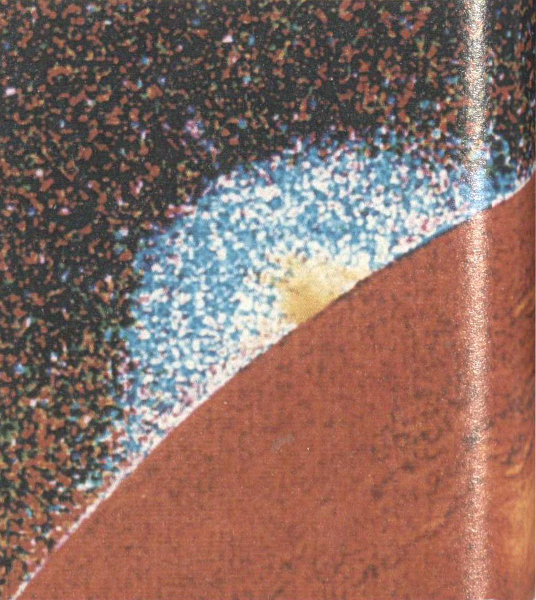
An ultraviolet image has been used to produce a false-color composite; the large ultraviolet halo above the visible-light plume may be due to scattering from sulfur dioxide gas rather than solid particles.
155
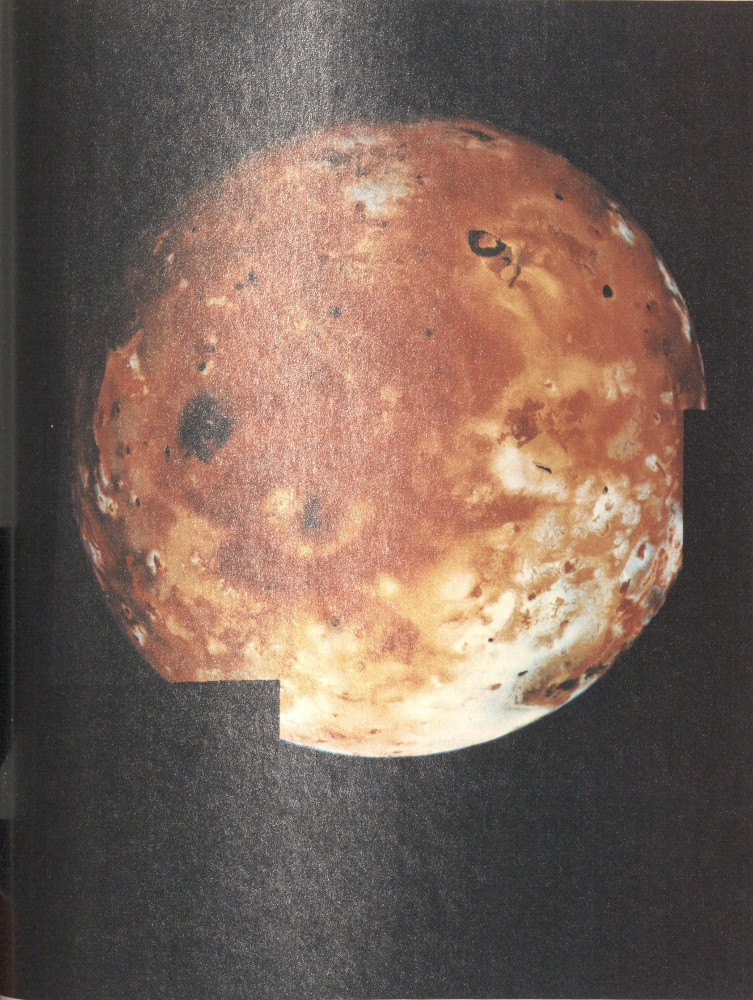
Perhaps the most spectacular of all the Voyager photos of Io is this mosaic obtained by Voyager 1 on March 5 at a range of 400 000 kilometers. A great variety of color and albedo is seen on the surface, now thought to be the result of surface deposits of various forms of sulfur and sulfur dioxide. The two great volcanoes Pele and Loki (upper left) are prominent. [260-464]
156
In place of impact craters, the surface of Io has a great many volcanic centers, which generally take the form of black spots a few tens of kilometers across. In a few cases, high-resolution pictures show the characteristic shapes associated with volcanic calderas on Earth and Mars, and, if the other volcanic centers are similar, about 5 percent of the entire surface of Io is occupied by calderas. These are extremely black, reflecting less than 5 percent of the sunlight; often they are surrounded by irregular, diffuse halos nearly as black as the central spot. The calderas seem more like the Valles caldera in New Mexico, which is associated with vents that produced large quantities of ash, than with those of Hawaiian-type shield volcanic mountains.
There is evidence in many of the Voyager photos of extensive surface flows on Io. These originate in dark volcanic centers and either spread to fan shapes, typically 100 kilometers across, or else snake out in long, twisting tentacles. Some of the flows are lighter than the background and some are darker. Most are red or orange in color, often outlined by fringes of contrasting albedo.
The equatorial regions of Io are quite flat, with no vertical relief greater than about 1 kilometer high; indeed, many of the volcanic centers do not appear to correspond to mountains or domes at all. There are, however, a number of long, curvilinear cliffs or scarps and narrow, straight-walled valleys a few hundred meters deep. These appear to be places in which the crust has broken under tension, somewhat similar to terrestrial faults and the valleys called graben. A few rugged mountains of uncertain origin are visible in low Sun elevation pictures.
Near the poles of Io the terrain is more irregular. There are few volcanic centers, but more mountains, some with heights of several kilometers. In addition, there are regions that appear to be made of stacked layers of material. These so-called layered terrains are revealed when erosion cuts into them, exposing the layers along the cliff or scarp. The largest such plateau or mesa has an area of about 100 000 square kilometers. The scarps sometimes intersect each other, suggesting a complex history of deposition, faulting, and erosion. Voyager geologists believe that these scarps may be areas in which the release of liquid sulfur or sulfur dioxide has undercut cliffs, analogous to internal sapping by groundwater at similar scarps on Earth.
Perhaps the most distinctive surface features on Io are the circular or oval albedo markings that surround the great volcanoes. The first of these to be seen was the 300-kilometer-wide white donut of Prometheus, on the equator at longitude 150°. Much more spectacular is the hoofprint of Pele, about 700 by 1000 kilometers. These symmetric rings mark the locations of the kinds of eruptions that generate large fountains or plumes, and may be produced by condensible sulfur or sulfur dioxide raining down from the volcanic fountain. At least one new ring appeared during the four months between the Voyager encounters, centered at longitude 330°, latitude +20°, but by the time Voyager 2 photographed this area, no plume remained active.
During the Voyager 1 flyby, temperature scans of the surface of Io were made with the infrared interferometer spectrometer (IRIS). A number of localized warm regions were found, the most dramatic being just south of the volcano Loki. Here the images showed a strange, U-shaped black feature about 200 kilometers across. The IRIS team interpreted its data to indicate a temperature for the black feature of 17° C (or room temperature), in contrast to the surrounding surface at -146° C. Perhaps the dark feature was some sort of lava lake, either of molten rock or molten sulfur. The melting point of sulfur is 112° C. If there were a scum of solidifying sulfur on top of the “lake,” this interpretation might well be the correct one.
The brilliant reds and yellows of the surface of Io immediately suggest the presence of sulfur. When heated to different temperatures and suddenly cooled, sulfur can assume many colors, ranging from black through various shades of red to its normal light-yellow appearance.
Even before Voyager, laboratory studies had shown that sulfur matches the overall properties of the spectrum of Io, including the low albedo in the ultraviolet and the high reflectivity throughout the infrared. Contemporary with the Voyager flybys, additional telescopic observations and laboratory studies by Fraser Fanale at JPL and Dale Cruikshank at the University of Hawaii identified another component on Io, sulfur dioxide. Sulfur dioxide is an acrid gas released from terrestrial volcanoes, where it combines with water in the Earth’s atmosphere 157 to produce sulfuric acid. At the temperature of the surface of Io, sulfur dioxide is a white solid. Researchers guessed that the extensive bright white areas in the Voyager pictures of Io might be covered with sulfur dioxide frost or snow. The presence of this material on Io was confirmed when the infrared IRIS instrument obtained a spectrum of sulfur dioxide gas over the erupting volcano Loki during the Voyager 1 encounter.
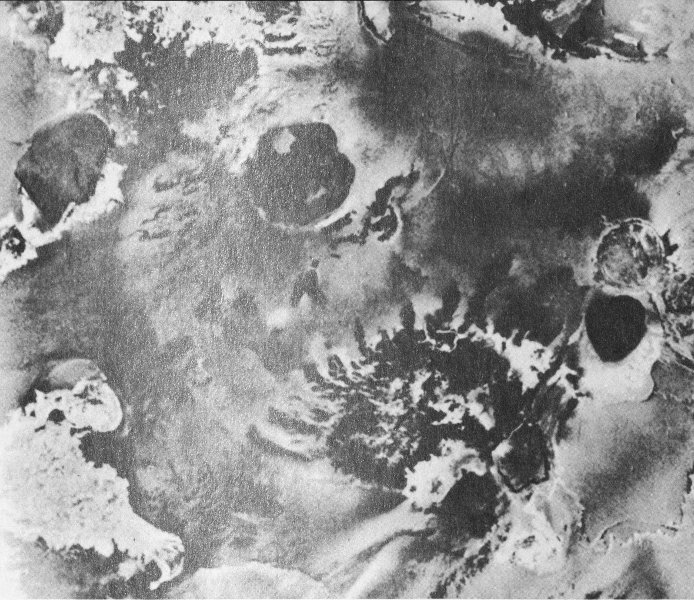
Close-ups of Io reveal a wide variety of volcanic phenomena. This Voyager 1 view of an equatorial region near longitude 300° shows several large surface flows that originate in volcanic craters or calderas. At the right edge is a light flow about 250 kilometers long. Another dark, lobate flow with bright edges is just left of center, with an exceedingly dark caldera to its left. [260-468A]
The discovery of the ongoing eruptions on Io, made shortly after the Voyager 1 flyby, did much to clarify the confused evidence pouring in concerning the apparent youth of Io’s surface. Here, under the very eyes of Voyager, eruptions were taking place on a scale that dwarfed anything ever seen before. The discovery picture alone, taken from a distance of 4 million kilometers, showed two eruptions (Pele and Loki), each of which was much larger than the most violent volcanic eruption ever recorded on Earth.
Voyager 1 found eight giant eruptions, with fountains or plumes rising to heights of between 70 and 280 kilometers. To reach these altitudes, the material must have been ejected from the vents at speeds of between 300 and 1000 meters per second, several times greater than the highest ejection velocities from terrestrial volcanoes. Although widely spaced in longitude, these volcanoes were concentrated toward the equator; seven of the eight were at latitudes between +30° and -30°, and the eighth at -44°.
When Voyager 2 arrived four months later, it was able to reobserve seven of the eight volcanoes. (To be identified reliably, the volcanic plumes must be silhouetted against dark space at the edge of the disk.) Six of these were still erupting; one, Pele, the largest plume seen by Voyager 1, had ceased activity. The plume associated with Loki had also changed markedly, increasing in height from 100 to 210 kilometers in visible light. (All the plumes appear larger when viewed in the ultraviolet.) Loki had developed a more complex structure; in March it appeared to originate near the south end of a 250-kilometer-long dark feature, but in July there was a double plume, with activity at both ends of the dark feature.
158
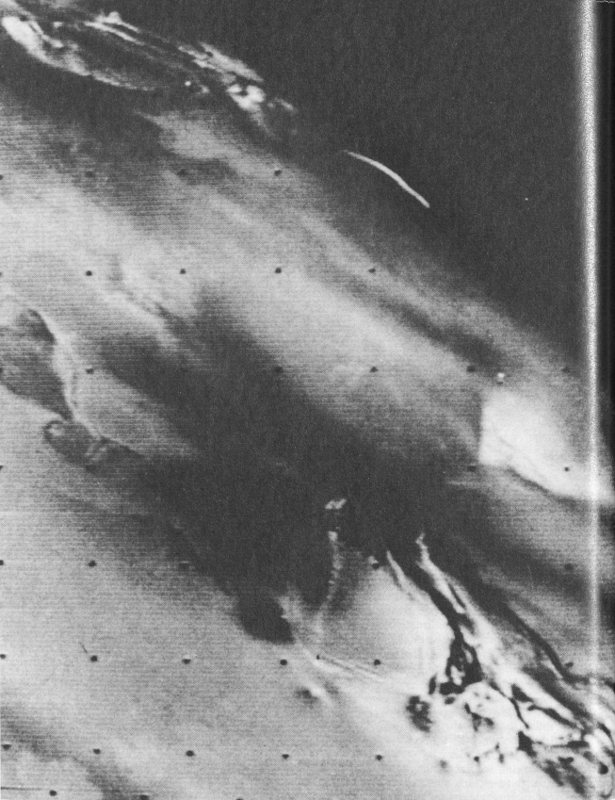
Differences in surface elevation can clearly be seen in a few of the Io close-ups from Voyager 1. This remarkable picture is of the center of the great volcano Pele, at latitude 15°S and longitude 224°. A low mountain with flow features can be seen. In the background, there are several large irregular depressions with flat floors that appear to be the result of collapse. The diffuse dark features in the center are probably the ejecta plumes being erupted from the Pele vent. [P-21220B/W]
159
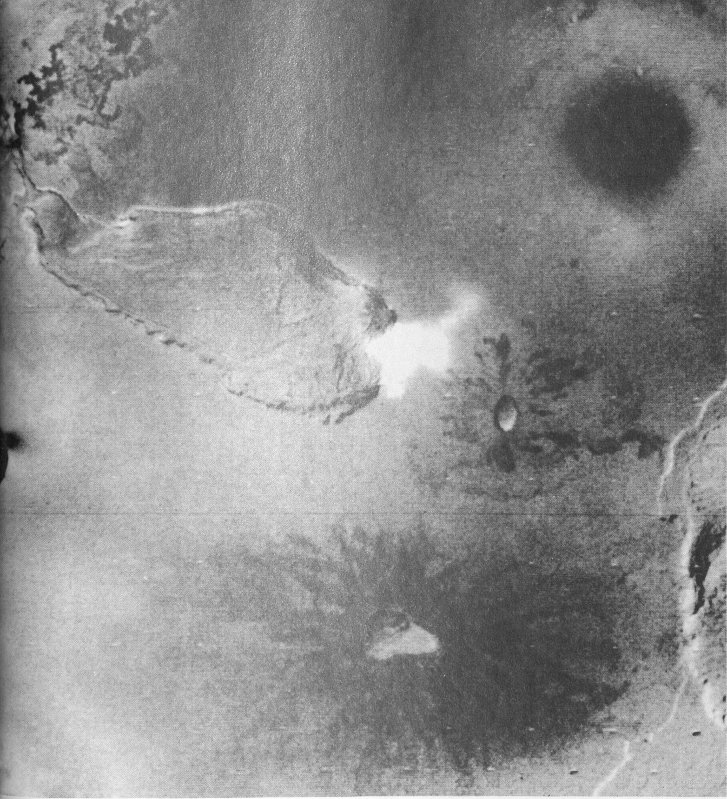
At the highest resolution obtained by the Voyager cameras, Io revealed some landscapes that looked familiar to terrestrial geologists. This picture, taken by Voyager 1 at a range of only 31 000 kilometers, shows a region about the size of the state of Maryland at a resolution of 300 meters. Clearly seen is a volcano not too different from some of those on the Earth or Mars. At the center is an irregular composite crater or caldera about 50 kilometers in diameter with dark flows radiating from its rim. The style of volcanism illustrated here is quite different from the explosive plumes or fountains with their associated rings of bright material deposited on the surface. This volcano is located at about longitude 330°, latitude 70°S. [260-502]
160
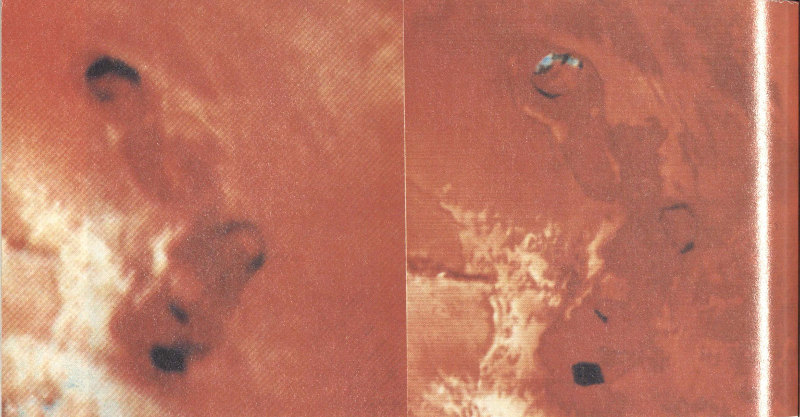
In addition to its giant volcanic plumes or fountains, Io possesses other indications of current volcanic activity. One of these takes the form of intermittent blue-white patches that may be caused by gas venting from the interior. In this pair of photographs, the same region of the surface is shown about six hours apart. On the right, there is an arcuate bright gas cloud; on the left the same region is black. It is believed that the venting gas is sulfur dioxide, and that the condensation of this gas produces fine particles of “snow” that look blue. [260-508]
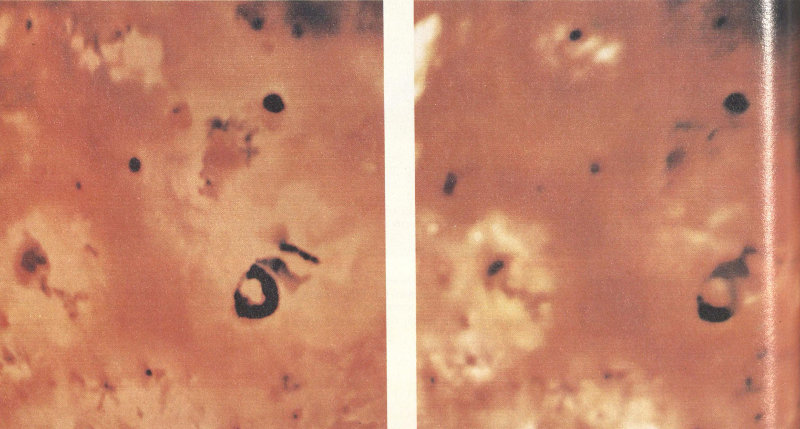
Some of the most dramatic changes in the surface of Io between March and July took place in the vicinity of the volcano Loki, at longitude 310° and latitude 15°N. On the left is a Voyager 1 view; on the right, one from Voyager 2. The “lava lake” associated with Loki has become less distinct, apparently as a result of deposits that fell on the northern part of the dark U-shaped feature. Perhaps the surface had also cooled between these photos. In the upper left center, a new dark volcanic caldera with bright spots near it and a large, faint bright ring had appeared by July, although it was not active at the time Voyager 2 flew by. [260-687AC]
161
No new eruptions were seen by Voyager 2; between them, the two spacecraft effectively surveyed the whole surface of Io for plumes down to 40 kilometers height. Interestingly, the smallest plume seen was 70 kilometers high; there appeared to be a real absence of smaller eruptions.
From the number and size of the observed eruptions, it is possible to calculate the resurfacing rate for Io due to these plumes. The result is that each plume is erupting about 10 000 tons of material per second, or more than 100 billion tons per year. This quantity corresponds to about 10 meters of deposition over the whole surface in a million years. When additional note is taken of surface flows, the deposition rate could easily be ten times higher, or 100 meters per million years, in agreement with the rate estimated from the absence of impact craters.
Energy for the Io Volcanoes
Clearly, something extraordinary is happening to Io to generate the observed level of volcanism. The primary heat source for the interiors of the terrestrial planets is the decay of the long-lived radioactive elements thorium and uranium. But Io would have to be supplied with a hundred times its quota of these elements to explain the observed activity.
A way out of this difficulty was provided by a theoretical investigation carried out by Stanton Peale of the University of California at Santa Barbara and Pat Cassen and Ray Reynolds at the NASA Ames Research Laboratory. Working in the months before the first Voyager flyby, they calculated that the tidal effects of Jupiter on Io could generate large-scale heating of the satellite. Io is about the same distance from Jupiter as the Moon from Earth, but the much greater mass of Jupiter raises enormous tides in its satellite. These tides distort its shape, but no other effect would be present if Io remained at a constant distance from Jupiter. What Peale, Cassen, and Reynolds realized was that the distance of Io from Jupiter varies as the result of small gravitational perturbations from the other Galilean satellites. Therefore the tidal distortions also vary, in effect squeezing and unsqueezing Io each orbit. Such flexing pumps energy into the interior of Io in the form of heat; theorists calculated that the heat supplied could be as high as 10¹³ watts. They predicted, in a paper published just three days before the Voyager flyby of Io, that “widespread and recurrent surface volcanism might occur,” and that “consequences of a largely molten interior may be evident in pictures of Io’s surface returned by Voyager.”
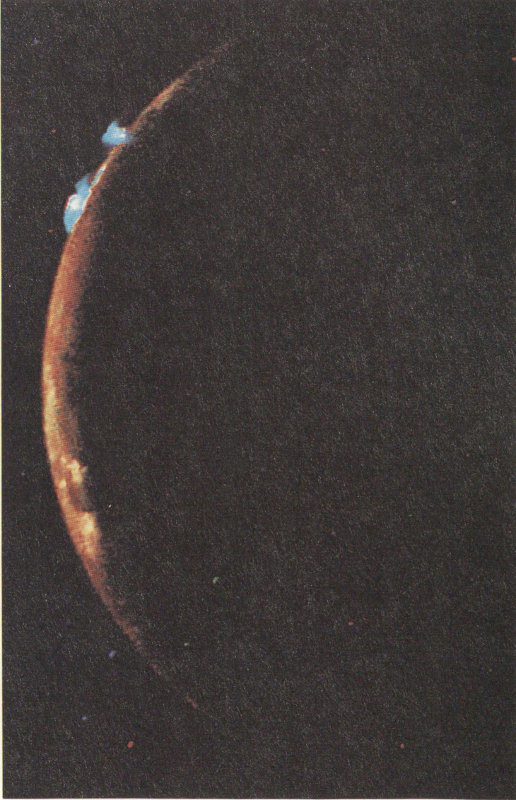
Voyager 2 obtained beautiful views of the volcanic eruptions during its ten-hour Io volcano watch on July 9. On the edge of the crescent image are the volcanoes Amirani (P₅) and below it Maui (P₆), each sending up fountains about 100 kilometers above the surface. The blue color is probably the result of sunlight scattered by tiny particles of sulfur dioxide snow condensing in the erupting plume. [P-21780]
162
VOLCANIC ERUPTIONS ON IO
Plume Number Name Location (latitude/longitude) Height During Voyager 1 Flyby (kilometers) Activity During Voyager 2 Flyby
1 Pele -20°/255° 280 ceased
2 Loki +20°/300° 100 increased
3 Prometheus -5°/155° 70 increased
4 Volund +20°/175° 95 no data
5 Amirani +25°/120° 80 similar
6 Maui +20°/120° 80 similar
7 Marduk -25°/210° 120 similar
8 Masubi -40°/ 50° 70 similar
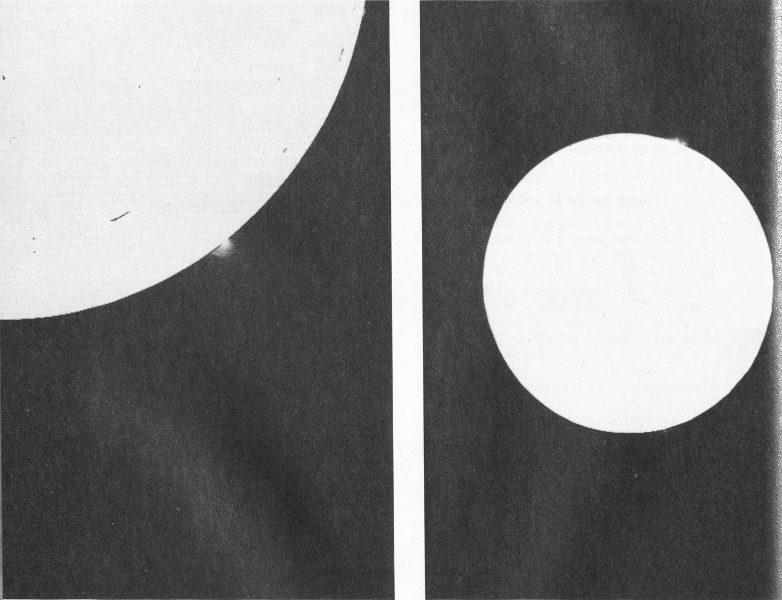
Between the two encounters, the volcanic eruption at Loki (P₂) changed character. The single plume emanating from the western end of an apparent dark fissure seen in March was joined by a second fountain of similar size about 100 kilometers to the east. The plume also increased in height, from about 120 kilometers in the Voyager 1 image (left) to 175 kilometers in the Voyager 2 image (right). [260-662A and B]
163
The detailed structure near the volcano Loki is like nothing seen elsewhere on Io. [260-642B]
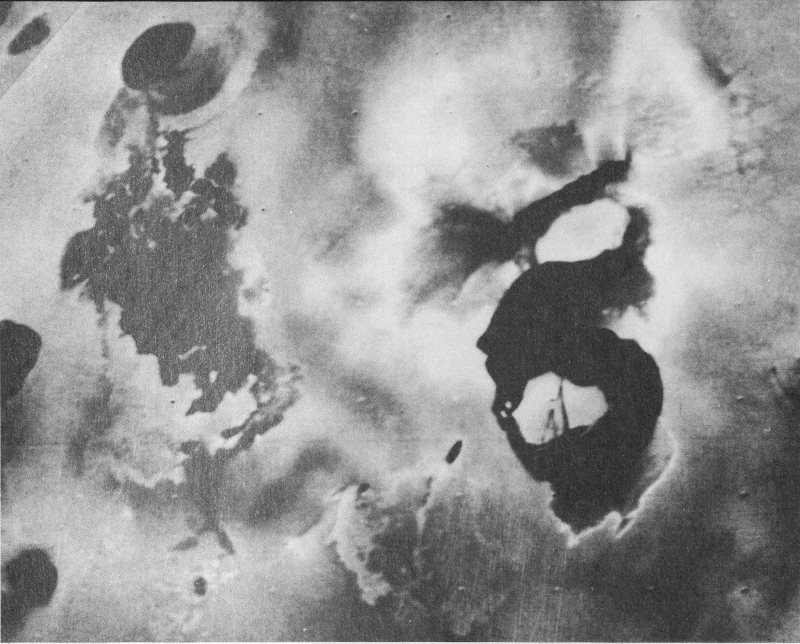
When this Voyager 1 picture was taken, the main eruptive activity (P₂) came from the lower left of the dark linear feature (perhaps a rift) in the center. Below it is the “lava lake,” a U-shaped dark area about 200 kilometers across. In this specially processed image, detail can be seen in the dark surface of this feature, possibly due to “icebergs” of solid sulfur in a liquid sulfur lake.
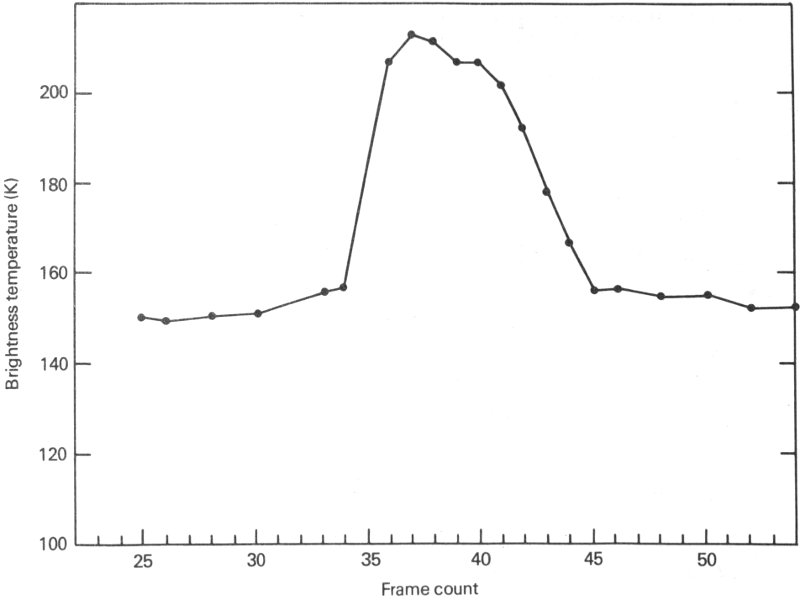
(Bottom) The IRIS on Voyager 1 found this “lava lake” to be the hottest region on Io, with a temperature about 150° C higher than that of the surrounding area.
164
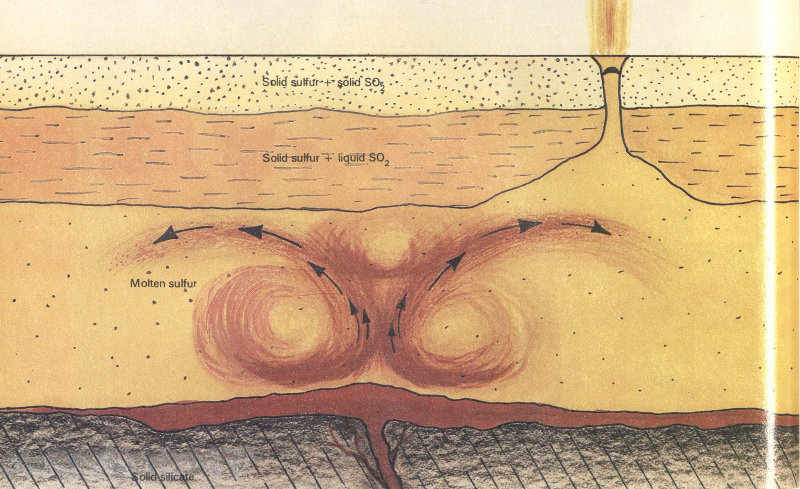
One model for the structure of Io indicates that an ocean of liquid sulfur with a solid sulfur crust covers most of the satellite. Heat escapes from the interior in the form of lava, which erupts beneath the sulfur ocean. Secondary eruptions in the sulfur ocean heat liquid sulfur dioxide, which is mixed with solid sulfur in the crust. The rapid expansion of sulfur dioxide gas then produces the great eruptive plumes, which consist of a mixture of solid sulfur, sulfur dioxide gas, and sulfur dioxide snow.
Solid sulfur + solid SO₂
Solid sulfur + liquid SO₂
Molten sulfur
Solid silicate
The Voyager observations appear to confirm the theoretical calculations. The tidal heat source has presumably been acting since Io was formed more than 4 billion years ago. With a totally molten interior and continuing large-scale volcanism, Io has had an opportunity to thoroughly sort out its composition. In the process it would have lost all the volatile gases such as water and carbon dioxide, explaining why Io now has no appreciable atmosphere in spite of the outpouring of material from the interior. In addition, most of the sulfur from the interior could have risen to the surface, where it would be constantly recycled through volcanic activity.
The presence of large amounts of sulfur on the surface may help explain the extraordinary nature of the Io volcanoes. One model considered for the satellite postulates that it is covered by a sea of liquid sulfur several kilometers deep, with a crust of solid sulfur and, below the surface, liquid sulfur dioxide. Calculations by Sue Kieffer of the U.S. Geological Survey and others indicate that the expansion of the sulfur dioxide in such a model can explain the observed eruption velocities of up to a kilometer per second.
The volcanic plumes on Io appear to be made primarily of sulfur and sulfur dioxide. Both are molten as they emerge from the vent, but they quickly cool as the plume rises 100 or more kilometers into the near vacuum of space. Unlike terrestrial volcanoes, there is almost no gas in the plumes. It requires about half an hour for the fine particles of solidified sulfur and sulfur dioxide snow to fall back to the surface, where they form the colorful rings that mark the major eruptive sites.
Almost all the roughly 100 000 tons of material erupted each second by the Io volcanoes 165 snows back to the surface. But apparently a part—perhaps 10 tons per second—escapes from Io and is captured by the Jovian magnetosphere. Another part contributes to an ionosphere—a tenuous atmosphere of electrons and ions—that surrounds Io. The injection of several tons of particles each second into the magnetosphere has dramatic consequences that can be seen even from Earth.
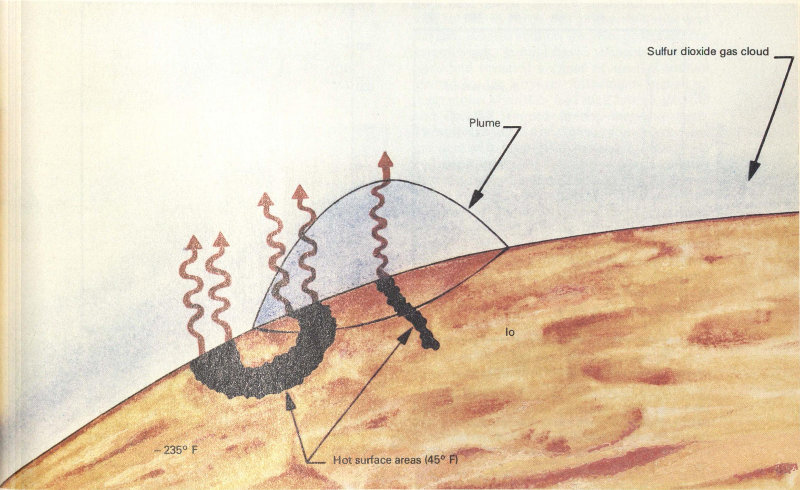
Direct evidence of an atmosphere on Io was obtained during the Voyager 1 flyby by the IRIS. In the region near the volcano Loki and its associated “lava lake,” infrared spectra clearly showed the signature of sulfur dioxide gas. It is not known whether this gas was a temporary feature associated with the eruption of Loki or if it might be present on Io more generally. Other evidence, however, points to the sulfur dioxide atmosphere as a transient feature. A small amount of the sulfur dioxide escapes and is broken apart by sunlight to provide the oxygen and sulfur ions observed in the Io torus.
Sulfur dioxide gas cloud
Plume
-235° F
Hot surface areas (45° F)
The Io Torus
Surrounding Jupiter at the distance of Io is a donut-shaped volume, or torus, of plasma that originates at the satellite. At first, the atoms escaping from Io expand outward as a gas, but soon they are stripped of electrons and become electrically charged. Some of these gases, such as sulfur dioxide, apparently originate in the large volcanic eruptions; other, such as the sodium cloud being studied with Earth-based telescopes, result from sputtering of surface materials by energetic particles in the magnetosphere. After they are ionized by the loss of one or more electrons, the atoms are caught by the spinning magnetic field of Jupiter and become a part of what is called a co-rotating plasma, spinning at 74 kilometers per second with the same ten-hour period as Jupiter itself.
The Io torus was easily detected on Voyager by the ultraviolet spectrometer, even from a distance of 150 million kilometers. The strongest ultraviolet radiation comes from twice-ionized sulfur (atoms that have lost two electrons) (S III), emitting a wavelength of 69 nanometers or about one-eighth the wavelength of visible light. The spectrometer also detected glows from atoms of triply ionized sulfur (S IV) and twice-ionized oxygen (O III).
166
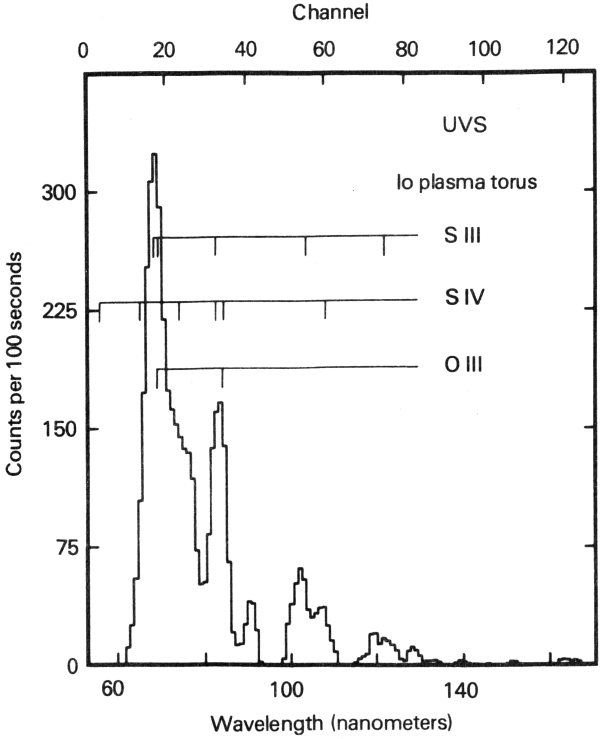
At the time of the Voyager 1 encounter, the most abundant heavy ions in the Jovian magnetosphere were sulfur and oxygen. Multiply ionized sulfur and oxygen both emit strongly in the ultraviolet, where they could be observed by the ultraviolet spectrometer. This spectrum of the Io torus registers the tremendous amount of ultraviolet energy (about a million million watts) being radiated. To emit so strongly, the temperatures in the torus must be near 100 000 K.
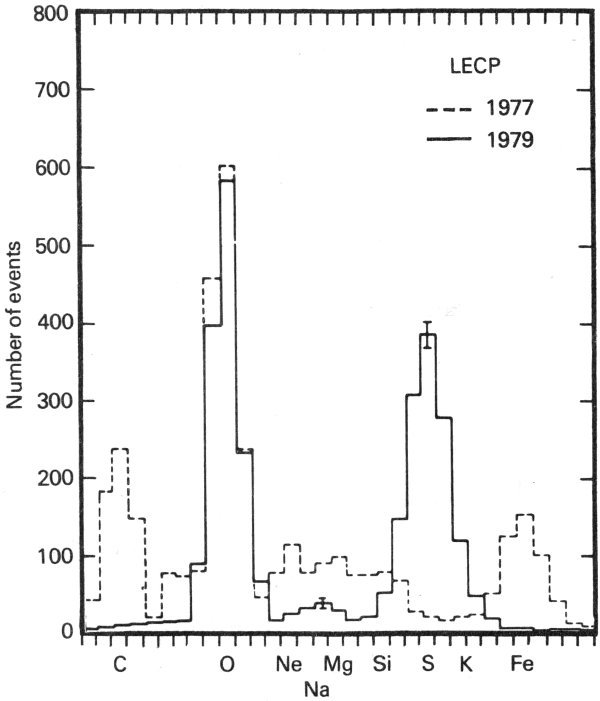
Direct measurement of the heavy ions associated with the Io torus were made by the Voyager 1 LECP instrument. Here the amounts of various elements are shown for two cases: the Jovian inner magnetosphere (solid line) and a typical solar event. Both the Jovian and the solar particles have been scaled to show similar amounts of oxygen, but the solar particles are also rich in carbon and iron, whereas Jupiter has a great deal of sulfur. Evidence such as this demonstrates that the sulfur does not come from the Sun; rather, the sulfur and most of the oxygen appear to be the product of the Io sulfur dioxide volcanic eruptions.
Scans across the torus showed that it had a thickness of 1.0 RJ and was centered at a distance of 5.9 RJ from Jupiter. The torus is centered on the magnetic, rather than the rotational, equator of the planet. To produce the intense glow observed, the electron temperatures in the torus must be 100 000 K, with an electron density of about 1000 per cubic centimeter. The brightness in the ultraviolet corresponds to a radiated power of more than a million million (10¹²) watts. This enormous amount of energy must be continuously supplied by the magnetosphere.
The ultraviolet emissions from the Io torus seen by Voyager were dramatically different from those seen in 1973 and 1974 with the simpler ultraviolet instrument on board Pioneers 10 and 11. These changes correspond to more than a factor of 10 in brightness. As noted by the Voyager Team, “Because of the remarkable differences we conclude that the Jupiter-Io environment has changed significantly since December 1973. The observed differences are so spectacularly large that this conclusion does not depend on a detailed comparison of the two instruments, their calibrations, or the observing geometry.” The reason for this change, or the degree to which it reflects a large-scale variation in the volcanic activity of Io, is one of the major questions arising from the Voyager mission.
The Io torus can also be observed from the ground. In 1976, spectra showed the glow of singly ionized sulfur (S II), and in 1979 singly ionized oxygen (O II) was detected. The observations of S II and O II are particularly interesting because they provide a measure of the density and temperature of the plasma. In April 1979, between the two Voyager flybys, Carl Pilcher of the University of Hawaii succeeded in obtaining a telescopic image of the torus in the light of S II. He measured nearly the same ring diameter (5.3-5.7 RJ) as had Voyager; interestingly, 167 both agree that the sulfur torus is centered slightly inside the orbit of Io (6.0 RJ).
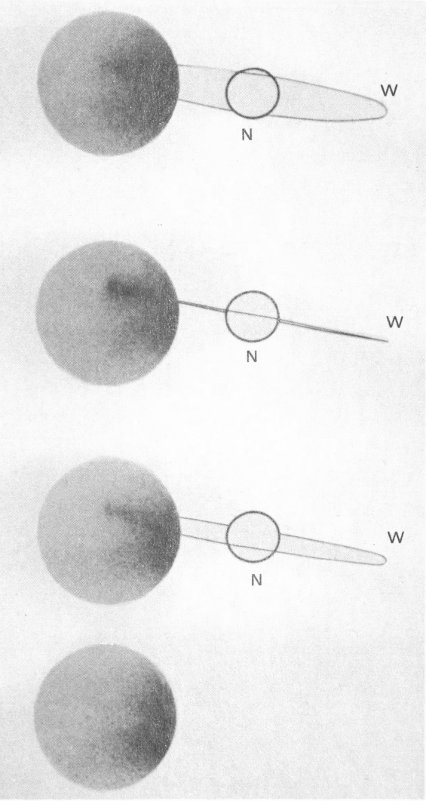
The emission of light from sulfur ions in the Io torus is so strong it can be measured from the Earth. In these pictures, University of Hawaii astronomer Carl Pilcher photographed the torus in the light of ionized sulfur on the night of April 9, 1979. As the planet rotates, the torus is seen first partly opened, then edge-on, and again opened in the opposite direction. The dark band on the right of each image is due to light from Jupiter scattered in the telescope, as shown in the bottom picture, which contains the scattered light only.
Direct measurements of the torus were made from Voyager 1 as the spacecraft passed twice through this region, once inbound and once outbound. The low energy charged particle instrument and the cosmic ray instrument both determined that the composition of the ions in the Io torus was primarily sulfur and oxygen. Ionized sodium was also observed. For several years, ground-based telescope observations had revealed a cloud of neutral sodium around Io; the Voyager instruments picked up these atoms after they had each lost an electron and become trapped in the magnetosphere. These instruments also derived the electron and ion density (about 1000 per cubic centimeter) and confirmed that the ions were co-rotating with the inner magnetosphere.
Another Io-associated phenomenon searched for by Voyager was the Io flux tube. As a conductor moving through the Jovian magnetic field, Io generates an electric current, estimated to have a strength of about 10 million (10⁷) amperes and a power of the order of a million million (10¹²) watts. The region of space through which this current flows from the satellite to Jupiter is called the flux tube.
Voyager 1 was targeted to fly through the Io flux tube. This was an important decision, since this option precluded the possibility of obtaining occultations by either Io or Ganymede. The event was to take place on March 5, just after closest approach to Io. The effects of the flux tube were clearly observed by the magnetometer, the LECP instrument, and other particle and field instruments; however, subsequent analysis indicated that the spacecraft had not penetrated the region of maximum current flow; it probably missed the center of the flux tube between 5000 and 10 000 kilometers.
The flux tube is not the only connection between Io and Jupiter. Radio emissions from the atmosphere are triggered by Io’s orbital position, and the aurorae that illuminate Jupiter’s polar regions are the result of charged particles falling into the planet from the Io torus. Other charged particles can occasionally escape outward and be detected as far away as Earth.
Io is unquestionably a remarkable world. The only planetary body known to be geologically more active than the Earth, it provides many extreme examples to test the theories of geoscientists. Its intimate interconnections with the Jovian magnetosphere and the planet itself provide a unifying theme to the complex processes taking place in the inner parts of the Jovian system.
168

The Galileo Probe will make a fiery entry into the Jovian atmosphere, carrying a payload of scientific instruments for the first direct sampling of the atmosphere of a giant planet. Shown here is the moment, at a pressure level of about 0.1 bar, when the parachute is deployed and the still-glowing heatshield drops free from the Probe.
169