WESLEY MILLS, M.A., M.D., F.R.S.C.
Reading edition
EMERITUS PROFESSOR OF PHYSIOLOGY IN McGILL UNIVERSITY, AND LECTURER ON VOCAL PHYSIOLOGY AND HYGIENE IN THE McGILL UNIVERSITY CONSERVATORIUM OF MUSIC, MONTREAL, CANADA
FOURTH EDITION, REVISED AND ENLARGED
CONTENTS

PHILADELPHIA & LONDON J.B. LIPPINCOTT COMPANY Copyright, 1906, By J.B. Lippincott Company The Rights of Translation and all other Rights Reserved Copyright, 1913, By J.B. Lippincott Company Electrotyped and Printed by J.B. Lippincott Company, Philadelphia, U.S.A.
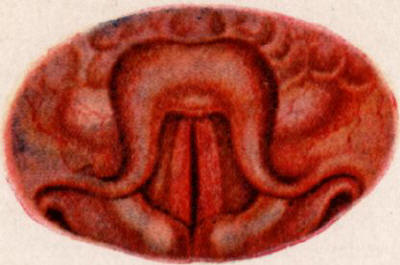
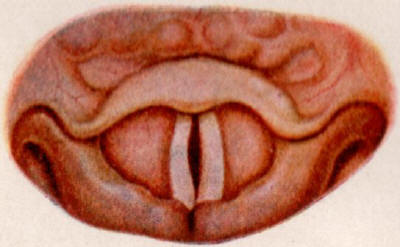
Illustrations of the appearance of the larynx during phonation in two special cases. (Grünwald.)
EXPLANATION OF THE COLORED ILLUSTRATIONS.
They contrast with each other in that the one (upper) is too red; the other, too pale. The upper represents appearances such as one gets with the laryngoscope when the subject has a very severe cold, or even inflammation of the larynx, including the central vocal bands. In this particular case, a young woman of twenty-five years of age, there was inflammation with a certain amount of weakness of the internal thyro-arytenoid muscles. Speaking was almost impossible, and such voice as was produced was of a very rough character. In the lower illustration we have the appearances presented in a man affected with tuberculosis of the lungs and larynx. The pallor of the larynx is characteristic. There is weakness of the internal thyro-arytenoid muscle on the right side, which results in imperfect tension of the vocal band on that side, so that the voice is uncertain and harsh. Such illustrations are introduced to impress the normal by contrast. The reader is strongly advised to compare these figures with others in the body of the work, especially those of Chapter VII.