NOTE (continued 3)
Reading edition
“This is hardly worth giving,” he said, as he placed the china shell on the corner of my desk, where it stands to this day. “But it is quaint and it caught my fancy. Besides, I’ve a notion that it is the tune of one of Heine’s lyrics set by Schubert that the fellow is trying to play. And then I’ve a certain satisfaction in thinking that I shall be represented here by a performer of marvelous force of lung, since you seem to think my lungs are weak.”
A severe cough seized him then, but, when he had recovered his breath, he laughed lightly, and said: "That’s the worst one I’ve had this week. However, when the spring warms me up again I shall be all right once more. It wasn’t on me that the spring poet wrote the epitaph:
'It was a cough That carried him off; It was a coffin They carried him off in.'"
“You ought to go away for a month at least,” I urged. “Take a run down South and fill your lungs with the balsam of the pines.”
“That’s what my mother wants me to do,” he admitted; “and I’ve half promised to do it. If I go to Florida for January, can you go with me?”
I knew how needful it was for him to escape from the bleakness of our New York winter, so I made a hasty mental review of my engagements. “Yes,” I said, “I will go with you.”
He held out his hand and clasped mine firmly. “We’ll have a good time,” he responded, “just we two. But you must promise not to object if I insist on talking about her all the time.”
"I WENT TO SEE THE WOMAN MY FRIEND LOVED"
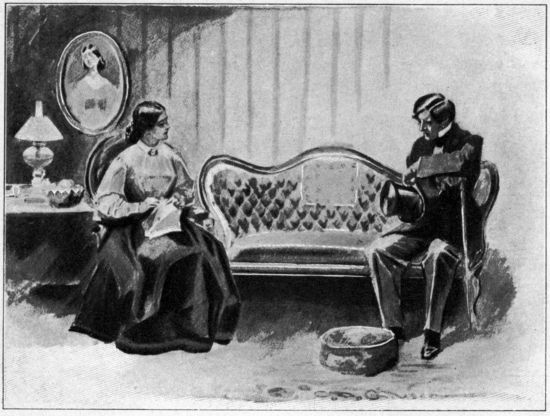
As it turned out, I was able to keep all my engagements, for we never went away together. Before the new year came there was a change in my friend’s fortunes. The man who had pretended to invest for them the proceeds of his father’s life-insurance policy absconded, leaving nothing behind but debts. For the support of his mother and himself my friend had only his own small salary. A vacation, however necessary, became impossible, and the marriage, which had been fixed for the spring, was postponed indefinitely. He offered to release the girl, but she refused.
Through a classmate of ours I was able to get my friend a place in the law department of the Denver office of a great insurance company. In the elevated air of Colorado he might regain his strength, and in a new city like Denver he might find a way to mend his fortunes. His mother went with him, of course, and it was beautiful to see her devotion to him. I saw them off.
“She bore the parting very bravely,” he said to me. “She is braver than I am, and better in every way. I wish I were more worthy of her. You will go and see her, won’t you? There’s a good fellow and a good friend. Go and see her now and then, and write and tell me all about her—how she looks and what she says.”
I promised, of course, and about once a month I went to see the woman my friend loved. He wrote me every fortnight, but it was often from her that I got the latest news. His health was improving; his cough had gone; Denver agreed with him, and he liked it. He was working hard, and he saw the prospect of advancement close before him. Within two years he hoped to take a month off, and return to New York and marry her, and bear his bride back to Colorado with him.
When I returned to town the next October I expected to find two or three letters from my friend awaiting me. I found only one, a brief note, telling me that he had been too busy to write the month before, and that he was now too tired with overwork to be able to do more than say how glad he was that I was back again in America, adding that a friend at hand might be farther away than one who was on the other side of the Atlantic. The letter seemed to me not a little constrained in manner. I did not understand it; and with the hope of getting some light by which to interpret its strangeness, I went to call on her. She refused to see me, pleading a headache.
It was a month before I had a reply to my answer to his note, and the reply was as short as the note, and quite as constrained. He told me that he was well enough himself, but that his mother’s health worried him, since Denver did not agree with her, and she was pining to be back in New York. He added a postscript, in which he told me that he had dined a few nights before with the local manager of the insurance company, and that he had met the manager’s sister, a wealthy widow from California, a most attractive woman, indeed. With needless emphasis he declared that he liked a woman of the world old enough to talk sensibly.
Another month passed before I heard from him again, and Christmas had gone and the new year had almost come. The contents of this letter, written on Christmas eve, when the frog that played the trombone had been sitting on the corner of my desk for just a year, was as startling as its manner was strange. He told me that his engagement was broken off irrevocably.
If my own affairs had permitted it, I should have taken the first train to Denver to discover what had happened. As it was I went again to call on the landlady’s daughter. But she refused to see me again. Word was brought me that she was engaged, and begged to be excused.
About a fortnight later I chanced to meet on a street corner the classmate who had got my friend the Denver appointment. I asked if there was any news.
“Isn’t there!” was the response. “I should think there was, and lots of it! You know our friend in Denver? Well, we have a telegram this morning: his health is shaky, and so he has resigned his position.”
“Resigned his position!” I echoed. “What does that mean?”
“That’s what we wanted to know,” replied my classmate, “so we telegraphed to our local manager, and he gave us an explanation right off the reel. The manager has a sister who is the widow of a California millionaire, and she has been in Denver for the winter, and she has met our friend; and for all she is a good ten years older than he is, she has been fascinated by him—you know what a handsome fellow he is—and she’s going to marry him next week, and take him to Egypt for his health.”
“He’s going to marry the California widow?” I asked, in astonishment. “Why, he’s enga—” Then I suddenly held my peace.
“He’s going to marry the California widow,” was the answer,—“or she’s going to marry him; it’s all the same, I suppose.”
Two days later I had a letter from Denver confirming this report. He wrote that he was to be married in ten days to a most estimable lady, and that they were to leave his mother in New York as they passed through. Fortunately he had been able to make arrangements whereby his mother would be able to live hereafter where she pleased, and in comfort. He invited me to come out to Colorado for the wedding, but hardly hoped to persuade me, he said, knowing how pressing my engagements were. But as their steamer sailed on Saturday week they would be at a New York hotel on the Friday night, and he counted on seeing me then.
I went to see him then, and I was shocked by his appearance. He was thin, and his chest was hollower than ever. There were dark lines below his liquid eyes, brighter then than I had ever seen them before. There were two blazing spots on his high cheek-bones. He coughed oftener than I had ever known him, and the spasms were longer and more violent. His hand was feverishly hot. His manner, too, was restless. To my surprise, he seemed to try to avoid being alone with me. He introduced me to his wife, a dignified, matronly woman with a full figure and a cheerful smile. She had a most motherly manner of looking after him and of anticipating his wants; twice she jumped up to close a door which had been left open behind him. He accepted her devotion as a matter of course, apparently. Once, when she was telling me of their projects—how they were going direct to Egypt to remain till late in the spring, and then to return to Paris for the summer, with a possible run over to London before the season was over—he interrupted her to say that it mattered little where he went or what he did—one place was as good as another.
When I rose to go he came with me out into the hotel corridor, despite his wife’s suggestion that there was sure to be a draught there.
He thrust into my hand a note-book. “There,” he said, “take that; it’s a journal I started to keep, and never did. Of course you can read it if you like. In the pocket you will find a check. I want you to get some things for me after I’ve gone; I’ve written down everything. You will do that for me, I know.”
I promised to carry out his instructions to the letter.
“Then that’s all right,” he answered.
At that moment his wife came to the door of their parlor. “I know it must be chilly out in the hall there,” she said.
“Oh, I’m coming,” he responded.
Then he grasped my fingers firmly in his hot hand. “Good-by, old man,” he whispered. “You remember how I used to think the frog that played the trombone was trying to execute a Heine-Schubert song? Well, perhaps it is—I don’t know; but what I do know is that it has played a wedding march, after all. And now good-by. God bless you! Go and see my mother as often as you can.”
He gave my hand a hearty shake, and went back into the parlor, and his wife shut the door after him.
I had intended to go down to the boat and see him off the next morning, but at breakfast I received a letter from his wife saying that he had passed a very restless night, and that she thought it would excite him still more if I saw him again, and begging me, therefore, not to come to the steamer if such had been my intention. And so it was that he sailed away and I never saw him again.
In the note-book I found a check for five hundred dollars, and a list of the things he wished me to get and to pay for. They were for his mother mostly, but one was a seal-ring for myself. And there was with the check a jeweler’s bill, “To articles sent as directed,” which I was also requested to pay.
The note-book itself I guarded with care. It was a pocket-journal, and my friend had tried to make it a record of his life for the preceding year. There were entries of letters received and sent, of money earned and spent, of acquaintances made, of business appointments, of dinner engagements, and of visits to the doctor. Evidently his health had been failing fast, and he had been struggling hard to keep the knowledge not only from his mother, but even from himself. While he had set down these outward facts of his life, he had also used the note-book as the record of his inward feelings. To an extent that he little understood, that journal, with its fragmentary entries and its stray thoughts, told the story of his spiritual experience.
Many of the entries were personal, but many were not; they were merely condensations of the thought of the moment as it passed through his mind. Here are two specimens:
“We judge others by the facts of life—by what we hear them say and see them do. We judge ourselves rather by our own feelings—by what we intend and desire and hope to do some day in the future. Thus a poor man may glow with inward satisfaction at the thought of the hospital he is going to build when he gets rich. And a wealthy man can at least pride himself on the fortitude with which he would, if need be, bear the deprivations of poverty.”
“To pardon is the best and the bitterest vengeance.”
Toward the end of the year the business entries became fewer and fewer, as though he had tired of keeping the record of his doings. But the later pages were far fuller than the earlier of his reflections—sometimes a true thought happily expressed, sometimes, more often than not perhaps, a mere verbal antithesis, such as have furnished forth many an aphorism long before my friend was born. And these later sentiments had a tinge of bitterness lacking in the earlier.
“There are few houses,” he wrote, in October, apparently, “where happiness is a permanent boarder; generally it is but a transient guest; and sometimes, indeed, it is only a tramp that knocks at the side door and is refused admittance.”
“Many a man forgets his evil deeds so swiftly that he is honestly surprised when any one else recalls them.”
Except the directions to me for the expenditure of the five hundred dollars, the last two entries in the book were written on Christmas morning. One of these was the passage which smote me most when I first read it, for it struck me as sadness itself when written by a young man not yet twenty-five:
“If we had nothing else to wish, we should at least wish to die.”
At the time I did not seize the full significance of the other passage, longer than this, and far sadder when its meaning was finally grasped.
“The love our parents gave us we do not pay back, nor a tithe of it, even. We may bestow it to our children, but we never render it again to our father and our mother. And what can equal the love of a woman for the son she has borne? No peak is as lofty, and no ocean is as wide; it is fathomless, boundless, immeasurable; it is poured without stint, unceasing and unfailing. And how do we men meet it? We do not even make a pretense of repaying it, most of us. Now and again there may be a son here and there who does what he can for his mother, little as it is, and much as he may despise himself for doing it: and why not? Are there not seven swords in the heart of the Mater Dolorosa? And what sort of a son is he who would add another?”
Although I had already begun to guess at the secret of my friend’s conduct, a mystery to all others, it was the first of these two final entries in his note-book which came flashing back into my memory one evening toward the end of March, ten weeks or so after he had bidden me good-by and had gone away to Egypt. I was seated in my library, smoking, when there came a ring at the door, and a telegram was handed to me. I laid my cigar down on the brownish-yellow shell, at the crinkled edge of which the green frog was sitting, reaching out his broken arms for the trombone whereon he had played in happier days. I saw that the despatch had come by the cable under the ocean, and I wondered who on the other side of the Atlantic had news for me that would not keep till a letter could reach me.
I tore open the envelope. The message was dated Alexandria, Egypt, and it was signed by my friend’s widow. He had died that morning, and I was asked to break the news to his mother.
(1893)
HE ambulance clanged along, now under the elevated railroad, and now wrenching itself outside to get ahead of a cable-car.

With his little bag in his hand, the young doctor sat wondering whether he would know just what to do when the time came. This was his first day of duty as ambulance surgeon, and now he was going to his first call. It was three in the afternoon of an August day, when the hot spell had lasted a week already, and yet the young physician was chill with apprehension as he took stock of himself, and as he had a realizing sense of his own inexperience.
The bullet-headed Irishman who was driving the ambulance as skilfully as became the former owner of a night-hawk cab glanced back at the doctor and sized up the situation.
“There’s no knowin’ what it is we’ll find when we get there,” he began. “There’s times when it’s no aisy job the doctor has. Say you give the man ether, now, or whatever it is you make him sniff, and maybe he’s dead when he comes out of it. Where are you then?”
The young man decided instantly that if anything of that sort should happen to him that afternoon, he would go back to Georgia at once and try for a place in the country store.
“But nothing ever fazed Dr. Chandler,” the driver went on. “It’s Dr. Chandler’s place you’re takin’ now, ye know that?”
It seemed to the surgeon that the Irishman was making ready to patronize him, or at least to insinuate the new-comer’s inferiority to his predecessor, whereupon his sense of humor came to his rescue, and a smile relieved the tension of his nerves as he declared that Dr. Chandler was an honor to his profession.
“He is that!” the driver returned, emphatically, as with a dextrous jerk he swung the ambulance just in front of a cable-car, to the sputtering disgust of the gripman. “An’ it’s many a dangerous case we’ve had to handle together, him and me.”
“I don’t doubt that you were of great assistance,” the young Southerner suggested.
“Many’s the time he’s tould me he never knew what he’d ha’ done without me,” the Irishman responded. "There was that night, now—the night when the big sailor come off the Roosian ship up in the North River there, an’ he got full, an’ he fell down the steps of a barber shop, an’ he bruck his leg into three paces, so he did; an’ that made him mad, the pain of it, an’ he was just wild when the ambulance come. Oh, it was a lovely jag he had on him, that Roosian—a lovely jag! An’ it was a daisy scrap we had wid him!”
“What did he do?” asked the surgeon.
“What didn’t he do?” the driver replied, laughing at the memory of the scene. “He tried to do the doctor—Dr. Chandler it was, as I tould you. He’d a big knife—it’s mortial long knives, too, them Roosians carry—an’ he was so full he thought it was Dr. Chandler that was hurtin’ him, and he med offer to put his knife in him, when, begorra, I kicked it out of his hand.”
“I have often heard Dr. Chandler speak of you,” said the doctor, with an involuntary smile, as he recalled several of the good stories that his predecessor had told him of the driver’s peculiarities.
“An’ why w’u’dn’t he?” the Irishman replied. “It’s more nor wanst I had to help him out of trouble. An’ never a worrd we had in all the months he drove out wid me. But it ’sll be some aisy little job we’ll have now, I’m thinkin‘s—a sun-stroke, maybe, or a kid that’s got knocked down by a scorcher, or a thrifle of that kind; you’ll be able to attend to that yourself aisy enough, no doubt.”
To this the young Southerner made no response, for his mind was busy in going over the antidotes for various poisons. Then he aroused himself and shook his shoulders, and laughed at his own preoccupation.
The Irishman did not approve of this. “An’ of coorse," he continued, “it may be a scrap 'twixt a ginny and a Polander; or maybe, now, a coon has gone for a chink wid a razzer, and sliced him most in two, I dunno'.”
Then he clanged the bell unexpectedly, and swerved off the track and down a side street toward the river.
The doctor soon found a curious crowd flattening their noses against the windows of a drug-store on a corner of the Boulevard. He sprang off as the driver slowed down to turn and back up.
A policeman stood in the doorway of the pharmacist’s, swinging his club by its string as he kept the children outside. He drew back to let the young surgeon pass, saying, as he did so: “It’s no use now, I think, Doctor. You are too late.”
The body of the man lay flat on the tile pavement of the shop. He was decently dressed, but his shoes were worn and patched. He was a very large man, too, stout even for his length. His cravat had been untied and his collar had been opened. His face was covered with a torn handkerchief.
As the doctor dropped on his knees by the side of the body, the druggist’s clerk came from behind the prescription counter—a thin, undersized, freckled youngster, with short red hair and a trembling voice.
“He’s dead, ain’t he?” asked this apparition.
The doctor finished his examination of the man on the floor, and then he answered, as he rose to his feet: “Yes, he’s dead. How did it happen?”
The delivery of the young druggist was hesitating and broken. “Well, it was this way, you see. The boss was out, and I was in charge here, and there wasn’t anything doing except at the fountain. Then this man came in; he was in a hurry, and he told me he was feeling faint—kind of suffocated, so he said—and couldn’t I give him something. Well, I’m a graduate in pharmacy, you know, and so I fixed him up a little aromatic spirits of ammonia in a glass of soda-water. You know that won’t hurt anybody. But just as he took the glass out of my hand his knees gave way and he squashed down on the floor there. The glass broke, and he hadn’t paid for the spirits of ammonia, either; and when I got round to him he was dead—at least I thought so, but I rang you up to make sure.”
“Yes,” the doctor returned, “apparently he died at once—heart failure. Probably he had fatty degeneration, and this heat has been too much for him.”
“I don’t think any man has a right to come in here and die like that without warning, heart failure or no heart failure, do you?” asked the red-headed assistant. “I don’t know what the boss will say. That’s the kind of thing that spoils trade, and it ain’t any too good here, anyway, with a drug-store 'most every block.”
“Do you know who he is?” the doctor inquired.
“I went through his pockets, but he hadn’t any watch nor any letters," the druggist answered; “but he’s got about a dollar in change in his pants.”
The doctor looked around the shop. The policeman was still in the doorway, and a group of boys and girls blocked the entrance.
“Does anybody here know this man?” asked the surgeon.
A small boy twisted himself under the policeman’s arm and slipped into the store. “I know him,” he cried, eagerly. “I see him come in. I was here all the time, and I see it all. He’s Tim McEcchran.”
“Where does he live?” the doctor asked, only to correct himself swiftly—“where did he live?”
“I thought he was dead when I saw him go down like he was sandbagged,” said the boy. “He lives just around the corner in Amsterdam Avenue—at least his wife lives there.”
The doctor took the address, and with the aid of the policeman he put the body on the stretcher and lifted it into the ambulance. The driver protested against this as unprecedented.
“Sure it’s none of our business to take a stiff home!” he declared. “That’s no work at all, at all, for an ambulance. Dr. Chandler never done the like in all the months him an’ me was together. Begob, I never contracted to drive hearses.”
The young Southerner explained that this procedure might not be regular, but it revolted him to leave the body of a fellow-mortal lying where it had fallen on the floor of a shop. The least he could do, so it seemed to him, was to take it to the dead man’s widow, especially since this was scarcely a block out of their way as they returned to the hospital.
The driver kept on grumbling as they drove off. “Sure he give ye no chance at all, at all, Doctor, to go and croak afore iver ye got at him, and you only beginnin’ yer work! Dr. Chandler, now, he’d get ‘em into the wagon ennyway, an’ take chances of there bein’ breath in ‘em. Three times, divil a less, they died on us on the stretcher there, an’ me whippin' like the divil to get ’sem into the hospital ennyhow, where it was their own consarn whether they lived or died. That’s the place for ‘em to die in, an’ not in the wagon; but the wagon’s better than dyin‘s before we can get to ‘em, an’ the divil thank the begrudgers! It’s unlucky, so it is; an’ by the same token, to-day’s Friday, so it is!”
The small boy who had identified the dead man ran alongside of them, accompanied by his admiring mates; and when the ambulance backed up again before a pretentious tenement-house with a brownstone front and beveled plate-glass doors, the small boy rang Mrs. McEcchran’s bell.
“It’s the third floor she lives on,” he declared.
The janitor came up from the basement and he and the driver carried the stretcher up to Mrs. McEcchran’s landing.
The doctor went up before them, and found an insignificant little old woman waiting for him on the landing.
“Is this Mrs. McEcchran?” he asked.
“Yes,” she answered; then, as she saw the burden the men were carrying, she cried: “My God! What’s that? What are they bringing it here for?”
The young Southerner managed to withdraw her into the front room of the flat, and he noticed that it was very clean and very tidy.
“I am a doctor,” he began, soothingly, “and I am sorry to say that there has been an accident—”
“An accident?” she repeated. “Oh, my God! And is it Tim?”
“You must summon all your courage, Mrs. McEcchran,” the doctor returned. “This is a serious matter—a very serious matter.”
“Is he hurt very bad?” she cried. “Is it dangerous?”
“I may as well tell you the truth, Mrs. McEcchran,” said the physician. “I cannot say that your husband will ever be able to be out again.”
By that time the stretcher had been brought into the room, with the body on it entirely covered by a blanket.
“You don’t mean to tell me that he is going to die?” she shrieked, wringing her hands. “Don’t say that, Doctor! don’t say that!”
The bearers set the stretcher down, and the woman threw herself on her knees beside it.
“Tim!” she cried. “Speak to me, Tim!”
Getting no response, she got to her feet and turned to the surgeon. “You don’t mean he’s dead?” And the last word died away in a wail.
“I’m afraid there is no hope for him,” the doctor replied.
“He’s dead! Tim’s dead! Oh, my God!” she said, and then she dropped into a chair and threw her apron over her head and rocked to and fro, sobbing and mourning.
The young Southerner was not yet hardened to such sights, and his heart was sore with sympathy. Yet it seemed to him that the woman’s emotion was so violent that it would not last long.
While he was getting ready to have the body removed from the stretcher to a bed in one of the other rooms, Mrs. McEcchran unexpectedly pulled the apron from her head.
“Can I look at him?” she asked, as she slipped to the side of the body and stealthily lifted a corner of the covering to peek in. Suddenly she pulled it back abruptly. “Why, this ain’t Tim!” she cried.
“That is not your husband?” asked the doctor, in astonishment. “Are you sure?”
“Of course I’m sure!” she answered, laughing hysterically. “Of course I’m sure! As if I didn’t know Tim, the father of my children! Why, this ain’t even like him!”
The doctor did not know what to say. “Allow me to congratulate you, madam," he began. “No doubt Mr. McEcchran is still alive and well; no doubt he will return to you. But if this is not your husband, whose husband is he?”
The room had filled with the neighbors, and in the crowd the small boy who had brought them there made his escape.
“Can any one tell me who this is?” the surgeon asked.
“I knew that weren’t Mr. McEcchran as soon as I see him,” said another boy. “That’s Mr. Carroll.”
“And where does—did Mr. Carroll live?” the doctor pursued, repenting already of his zeal as he foresaw a repetition of the same painful scene in some other tenement-house.
“It’s only two blocks off—on the Boulevard,” explained the second boy. “It’s over a saloon on the corner. I’ll show you if I can ride on the wagon.”
“Very well,” agreed the doctor; and the body was carried down and placed again in the ambulance.
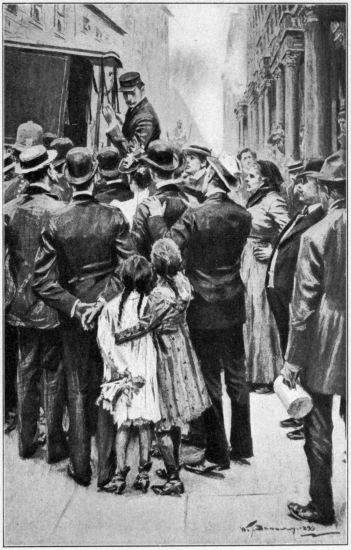
As the ambulance started he overheard one little girl say to another: “He was killed in a blast! My! ain’t it awful? It blew his legs off!”
To which the other little girl answered, “But I saw both his boots as they carried him out.”
And the first little girl then explained: “Oh, I guess they put his legs back in place so as not to hurt his wife’s feelings. Turrible, ain’t it?”
"MY! AIN'T IT AWFUL? IT BLEW HIS LEGS OFF!"
When the ambulance started, the driver began grumbling again: “It’s not Dr. Chandler that ‘ud have a thing like this happen to him. Him an’ me never went traipsing round wid a corp that didn’t belong to nobody. We knew enough to take it where the wake was waitin'.”
The boy on the box with the driver guided the ambulance to a two-story wooden shanty with a rickety stairway outside leading up to the second floor.
He sprang down as the ambulance backed up, and he pointed out to the doctor the sign at the foot of these external steps—“Martin Carroll, Photographer.”
“That’s where he belongs,” the boy explained. “He sleeps in the gallery up there. The saloon belongs to a Dutchman that married his sister. This is the place all right, if it really is Mr. Carroll.”
“What do you mean by that?” shouted the doctor. “Are you not sure about it?”
“I ain’t certain sure,” the fellow replied. “I ain’t as sure as I was first off. But I think it’s Mr. Carroll. Leastways, if it ain’t, it looks like him!”
It was with much dissatisfaction at this doubtfulness of his guide that the doctor helped the driver slide out the stretcher.
Then the side door of the saloon under the landing of the outside stairs opened and a stocky little German came out.
“What’s this? What’s this?” he asked.
The young surgeon began his explanation again. “This is where Mr. Carroll lived, isn’t it? Well, I am sorry to say there has been an accident, and—”
“Is that Martin there?” interrupted the German.
“Yes,” the Southerner replied, “and I’m afraid it is a serious case—a pretty serious case—”
“Is he dead?” broke in the saloon-keeper again.
“He is dead,” the doctor answered.
“Then why didn’t you say so?” asked the short man harshly. “Why waste all that time talking if he’s dead?”
The Southerner was inclined to resent this rudeness, but he checked himself.
“I understand that you are Mr. Carroll’s brother-in-law,” he began again, “so I suppose I can leave the body in your charge—”
The German went over to the stretcher and turned down the blanket.
“No, you don’t leave him here,” he declared. “I’m not going to take him. This ain’t my sister’s husband!”
“This is not Mr. Carroll?” and this time the doctor looked around for the boy who had misinformed him. “I was told it was.”
“The man who told you was a liar, that’s all. This ain’t Martin Carroll, and the sooner you take him away the better. That’s what I say,” declared the saloon-keeper, going back to his work.
The doctor looked around in disgust. What he had to do now was to take the body to the morgue, and that revolted him. It seemed to him an insult to the dead and an outrage toward the dead man’s family. Yet he had no other course of action open to him, and he was beginning to be impatient to have done with the thing. The week of hot weather had worn on his nerves also, and he wanted to be back again in the cool hospital out of the oven of the streets.
As he and the driver were about to lift up the stretcher again, a man in overalls stepped up to the body and looked at it attentively.
“It’s Dick O’Donough!” he said at once. “Poor old Dick! It’s a sad day for her—and her that excitable!”
“Do you know him?” asked the doctor.
“Don’t I?” returned the man in overalls, a thin, elderly man, with wisps of hair beneath his chin and a shrewd, weazened face. “It’s Dick O’Donough!”
“But are you sure of it?” the young surgeon insisted. “We’ve had two mistakes already.”
“Sure of it?” repeated the other. “Of course I’m sure of it! Didn’t I work alongside of him for five years? And isn’t that the scar on him he got when the wheel broke?” And he lifted the dead man’s hair and showed a cicatrix on the temple.
“Very well,” said the doctor. “If you are sure, where did he live?”
“It’s only a little way.”
“I’m glad of that. Can you show us?”
“I can that,” replied the man in overalls.
“Then jump in front,” said the doctor.
As they started again, the driver grumbled once more. “Begorra, April Day’s a fool to ye,” he began. “Them parvarse gossoons, now, if I got howld of 'em, they’d know what it was hurt 'em, I’m thinkin'.”
The man in overalls directed them to a shabby double tenement in a side street swarming with children. There was a Chinese laundry on one side of the doorway, and on the other side a bakery. The door stood open, and the hallway was dark and dirty.
“It’s a sad day it’ll be for Mrs. O’Donough,” sighed the man in overalls. “I don’t know what it is she’s got, but she’s very queer, now, very queer.”
He went into the bakery and got a man to help the driver carry up the stretcher. Women came out of the shops on both sides of the street, and leaned out of their windows with babies in their arms, and stepped out on the fire-escapes. There were banana peelings and crumpled newspapers and rubbish of one sort or another scattered in the street, and the savor of it all was unpleasant even to a man who was no stranger to the casual ward of a hospital.
The man in overalls went up-stairs with the doctor, warning him where a step was broken or where a bit of the hand-rail was missing. They groped their way along the passage on the first floor and knocked.
The door opened suddenly, and they saw an ill-furnished room, glaring with the sun reflected from its white walls. Two women stood just within the door. One was tall and spare, with gray streaks in her coal-black hair, and with piercing black eyes; the other was a comfortable body with a cheerful smile.
“That’s Mrs. O’Donough,” said the doctor’s guide—“the tall one. See the eyes of her now! The other’s a neighbor woman, who’s with her a good deal, she’s that excitable.”
The doctor stepped into the room, and began once more to break the news. “This is Mrs. O’Donough, is it not?” he said. “I’m a doctor, and I am sorry to have to say there has been an accident, and Mr. O’Donough is—is under treatment.”
Here the driver and the man from the bakery brought in the stretcher.
When the tall woman saw this she gripped the arm of the other and hissed out, “Is it it?” Then she turned her back on the body and sank her head on her friend’s shoulder.
The other woman made signs to the doctor to say little or nothing.
The driver and the baker took a thin counterpane off the bed, which stood against the wall. Then they lifted the body from the stretcher to the bed, and covered it with the counterpane.
The doctor did not know what to say in the face of the signals he was receiving from the widow’s friend.
“In case I can be of any assistance at any time,” he suggested—and then Mrs. O’Donough lifted her head and looked at him with her burning eyes—“if I can be of service, do not hesitate to call on me. Here is my card.”
As he felt his way down-stairs again he heard a hand-organ break out suddenly into a strident waltz.
When he came out into the street a few little children were dancing in couples, although most of them stood around the ambulance, gazing with morbid curiosity at the driver as he replaced the stretcher. At the door of the baker’s shop stood a knot of women talking it over; but in the Chinese laundry the irons went back and forth steadily, with no interest in what might happen in the street outside.
As the doctor took his seat in the vehicle a shriek came from the room he had just left—a shuddering, heartrending wail—then another—and then there was silence.
The ambulance started forward, the bell clanged to clear the way, the horse broke into a trot, and in a minute or two they turned into the broad avenue.
Then the driver looked at the doctor. “The widdy’s takin’ it harrd, I’m thinkin’, but she’ll get over it before the wake,” he said. “An’ it’s good lungs she has, ennyhow.”
(1898)

T was about noon of a dark day late in September, and a long-threatened drizzle of hail chilled the air, as Harry Brackett came out of the Apollo House and stood on the corner of Fourth Avenue, waiting for a cross-town car. He was going down-town to the office of the Gotham Gazette to write up an interview he had just had with the latest British invader of these United States, Lady Smith-Smith, the fair authoress of the very popular novel Smile and be a Villain Still, five rival editions of which were then for sale everywhere in New York. Harry Brackett intended to ride past Union Square to Sixth Avenue in the cross-town car, and then to go to the Gotham Gazette by the elevated railway, so he transferred ten cents for the fare of the latter and five cents for the fare of the former from his waistcoat pocket to a little pocket in his overcoat. Then he buttoned the overcoat tightly about him, as the raw wind blew harshly across the city from river to river. He looked down the street for the car; it was afar off, on the other side of Third Avenue, and he was standing on the corner of Fourth Avenue.

“A bob-tail car,” said Harry Brackett to himself, "is like a policeman: it is never here just when it is wanted. And yet it is a necessary evil—like the policeman again. Perhaps there is here a philosophical thought that might be worked up as a comic editorial article for the fifth column. ‘The Bob-tail Car’—why, the very name is humorous. And there are lots of things to be said about it. For instance, I can get something out of the suggestion that the heart of a coquette is like a bob-tail car, there is always room for one more; but I suppose I must not venture on any pun about ‘ringing the belle.’ Then I can say that the bob-tail car is a one-horse concern, and is therefore a victim of the healthy American hatred of one-horse concerns. It has no past; no gentleman of the road ever robbed its passengers; no road-agent nowadays would think of ‘holding it up.’ Perhaps that’s why there is no poetry about a bob-tail car, as there is about a stage-coach. Even Rudolph Vernon, the most modern of professional poets, wouldn’t dream of writing verses on ‘Riding in a Bob-tail Car.’ Wasn’t it Heine who said that the monks of the Middle Ages thought that Greek was a personal invention of the devil, and that he agreed with them? That’s what the bob-tail car is—a personal invention of the devil. The stove-pipe hat, the frying-pan, the tenement-house, and the bob-tail car—these are the choicest and the chief of the devil’s gifts to New York. Why doesn’t that car come? confound it! Although it cannot swear itself, it is the cause of much swearing!"
Just then the car came lumbering along and bumping with a repeated jar as its track crossed the tracks on Fourth Avenue. Harry Brackett jumped on it as it passed the corner where he stood. His example was followed by a stranger, who took the seat opposite to him.
As the car sped along toward Broadway, Harry Brackett mechanically read, as he had read a dozen times before, the printed request to place the exact fare in the box. “Suppose I don’t put it in?” he mused; “what will happen? The driver will ask for it—if he has time and happens to think of it. This is very tempting to a man who wants to try the Virginian plan of readjusting his debts. Here is just the opportunity for any one addicted to petty larceny. I think I shall call that article ‘The Bob-tail Car as a Demoralizer.’ It is most demoralizing for a man to feel that he can probably evade the payment of his fare, since there is no conductor to ask for it. However, I suppose the main reliance of the company is on the honesty of the individual citizen who would rather pay his debts than not. I doubt if there is any need to dun the average American for five cents.”
Harry Brackett lowered his eyes from the printed notice at which he had been staring unconsciously for a minute, and they fell on the man sitting opposite to him—the man who had entered the car as he did.
“I wonder if he is the average American?” thought Brackett. “He hasn’t paid his fare yet. I wonder if he will? It isn’t my business to dun him for it, and yet I’d like to know whether his intentions are honorable or not.”
The car turned sharply into Broadway, and then came to a halt to allow two young ladies to enter. A third young lady escorted them to the car, and kissed them affectionately, and said:
“Good-by! You will be sure to come again! I have enjoyed your visit so much.”
Then the two young ladies kissed her, and they said, both speaking at once, and very rapidly:
“Oh yes. We’ve had such a good time! We’ll write you! And you must come out to Orange and see us soon! Good-by! Good-by! Remember us to your mother! Good-by!”
At last the sweet sorrow of this parting was over; the third young lady withdrew to the sidewalk; the two young ladies came inside the car; the other passengers breathed more freely; the man opposite to Harry Brackett winked at him slyly, and the car went on again.
There was a vacant seat on the side of the car opposite to Harry Brackett—or, at least, there would have been one if the ladies on that side had not, with characteristic coolness, spread out their skirts so as to occupy the whole space. The two young ladies stood for a moment after they had entered the car; they looked for a seat, but no one of the other ladies made a sign of moving to make room for them. The man opposite to Harry Brackett rose and proffered his seat. They did not thank him, or even so much as look at him.
“You take it, Nelly,” said one.
“I sha’n’t do anything of the sort. I’m not a bit tired!” returned the other. “I insist on your sitting down!”
“But I’m not tired now.”
“Louise Valeria Munson,” her friend declared, with humorous emphasis, “if you don’t sit right down, I’ll call a policeman!”
“Well, I guess there’s room for us both,” said Louise Valeria Munson; “I’m sure there ought to be.”
By this time some of the other ladies on the seat had discovered that they were perhaps taking up a little more than their fair share of space, and there was a readjustment of frontier. The vacancy was slightly broadened, and both young ladies sat down.
The man who had got in just after Harry Brackett and who had given up his seat stood in the center of the car with his hand through a strap. But he made no effort to pay his fare. The driver rang his bell, the passengers looked at each other inquiringly, and one of the two young ladies who had just seated themselves produced a dime, which was passed along and dropped into the fare-box in accordance with the printed instructions of the company.
Three ladies left the car just before it turned into Fourteenth Street; and after it had rounded the curve two elderly gentlemen entered and sat down by the side of Harry Brackett. The man who had not paid his fare kindly volunteered to drop their money into the box, but did not put in any of his own. Harry Brackett was certain of this, for he had watched him closely.
The two elderly gentlemen continued a conversation began before they entered the car. “I’ll tell you,” said one of them, so loudly that Harry Brackett could not help overhearing, “the most remarkable thing that man Skinner ever did. One day he got caught in one of his amusing little swindles; by some slip-up of his ingenuity he did not allow himself quite rope enough, and so he was brought up with a round turn in the Tombs. He got two years in Sing Sing, but he never went up at all—he served his time by substitute!”
“What?” cried his companion, in surprise.
“He did!” answered the first speaker. “That’s just what he did! He had a substitute to go to State’s Prison for him, while he went up to Albany to work for his own pardon!”
“How did he manage that?” asked the other, in involuntary admiration before so splendid an audacity.
“You’ve no idea how fertile Skinner was in devices of all kinds,” replied the gentleman who was telling the story. “He got out on bail, and he arranged for a light sentence if he pleaded guilty. Then one day, suddenly, a man came into court, giving himself up as Skinner, pleading guilty, and asking for immediate sentence. Of course, nobody inquired too curiously into the identity of a self-surrendered prisoner who wanted to go to Sing Sing. Well—”
The car stopped at the corner of Fifth Avenue, several passengers alighted, and a party of three ladies came in. There were two vacant seats by the side of Harry Brackett, and as he thought these three ladies wished to sit together, he gave up his place and took another farther down the car. Here he found himself again opposite the man who had entered the car almost simultaneously with him, and who had not yet paid his fare. Harry Brackett wondered whether this attempt to steal a ride was intentional or whether it was merely inadvertent. His consideration of this metaphysical problem was interrupted by another conversation. His right-hand neighbor, who was apparently a physician, was telling the friend next to him of the strange desires of convalescents.
“I think,” said he, “that the queerest request I ever heard was down in Connecticut. There was a man there, a day-laborer, but a fine young fellow, who had a crowbar driven clean through his head by a forgotten blast. Well, I happened to be the first doctor on the spot, and it was nip-and-tuck whether anything could be done for him; it was a most interesting case. But he was in glorious condition physically. I found out afterward that he was the champion sprint-runner of the place. I got him into the nearest hotel, and in time I managed to patch him up as best I could. At last we pulled him through, and the day came when I was able to tell him that I thought he would recover, and that he was quite out of danger, and that all he had to do was to get his strength back again as fast as he could, and he would be all right again soon. He was lying in bed, emaciated and speechless, when I said this, and when I added that he could have anything to eat he might fancy, his eyes brightened and his lips moved. ‘Is there anything in particular you would prefer?’ I asked him, and his lips moved again as though he had a wish to express. You see, he hadn’t spoken once since the accident, but he seemed to be trying to find his tongue; so I bent over the bed and put my head over his mouth, and finally I heard a faint voice saying, ‘Quail on toast!’ and as I drew back in surprise, he gave me a wink. Feeble as his tones were, there was infinite gusto in the way he said the words. I suppose he had never had quail on toast in all his life; probably he had dreamed of it as an unattainable luxury.”
“Did he get it?” asked the doctor’s friend.
“He got it every day,” answered the doctor, “until he said he didn’t want any more. I remember another man who—”
But now, with many a jolt and jar, the car was rattling noisily across Sixth Avenue under the dripping shadow of the station of the elevated railway. Harry Brackett rose to his feet, and as he did so he glanced again at the man opposite to him, to see if, even then, at the eleventh hour, he did intend to pay his fare. But the man caught Harry Brackett’s eye hardily, and looked him in the face, with a curiously knowing smile.
There was something very odd about the expression of the man’s face, so Harry Brackett thought, as he left the car and began to mount the steps which led to the station of the elevated railroad. He could not help thinking that there was a queer suggestion in that smile—a suggestion of a certain complicity on his part: it was as though the owner of the smile had ventured to hint that they were birds of a feather.
“Confound his impudence!” said Harry Brackett to himself, as he stood before the window of the ticket-agent.
Then he put his fingers into the little pocket in his overcoat and took from it a ten-cent piece and a five-cent piece. And he knew at once why the man opposite had smiled so impertinently—it was the smile of the pot at the kettle.
(1886)

UDDENLY he found himself wide awake. He had been lost in sleep, dreamless and spaceless; and now, without warning, his slumber had left him abruptly and for no reason that he could guess. Although he strained his ear, he caught the echo of no unusual sound. He listened in vague doubt whether there might not be some one moving about in the apartment; but he could hear nothing except the shrill creak of the brakes of a train on the elevated railroad nearly a block away. Wilson Carpenter was in the habit of observing his own feelings, and he was surprised to note that he did not really expect to detect any physical cause for his unexpected awakening. Sleep had left him as inexplicably as it had swiftly.

He lay there in bed with no restlessness; he heard the regular breathing of his wife, who was sleeping at his side; he saw the faint illumination from the door open into the next room where the baby was also asleep. He looked toward the window, but no ray of light was yet visible; and he guessed it to be about four o’clock in the morning, perhaps a little earlier. In that case he had not been in bed more than two or three hours at the most. He wondered why he had waked thus unexpectedly, since he had had a fatiguing day. Perhaps it was the excitement—there was no doubt that he had had his full share of excitement that evening—and he thrilled again as he recalled the delicious sensation of dull dread yielding at last to the certainty of success.
He had played for a heavy stake and he had won. That was just what he had been doing—gambling with fate, throwing dice with fortune itself. That was what every dramatic author had to do every time he brought out a new play. The production of a piece at an important New York theater was a venture as aleatory almost as cutting a pack of cards, and the odds were always against the dramatist. And as the young man quietly recalled the events of the evening it seemed to him that the excitement of those who engineer corners in Wall Street must be like his own anxiety while the future of his drama hung in the balance, only theirs could not but be less keen than his, less poignant, for he was playing his game with men and women, while what they touched were but inanimate stocks. His winning depended upon the actors and actresses who had bodied forth his conception. A single lapse of memory or a single slip of the tongue, and the very sceptical audience of the first night might laugh in the wrong place, and so cut themselves off from sympathy; and all his labor would shrivel before his eyes. Of a truth it is the ordeal by fire that the dramatist must undergo; and there had been moments that long, swift evening when he had felt as though he were tied to the stake and awaiting only the haggard squaw who was to apply the torch.
Now the trial was over and the cause was gained. There had been too many war-pieces of late, so the croakers urged, and the public would not stand another drama of the Rebellion. But he had not been greatly discouraged, for in his play the military scenes were but the setting for a story of everyday heroism, of human conflict, of man’s conquest of himself. It was the simple strength of this story that had caught the spectators before the first act was half over and held them breathless as situation followed situation. At the adroitly spaced comic scenes the audience had gladly relaxed, joyously relieving the emotional strain with welcome laughter. The future of the play was beyond all question; of that the author felt assured, judging not so much by the mere applause as by the tensity of the interest aroused, and by the long-drawn sigh of suspense he had heard so often in the course of the evening. He did not dread the acrid criticisms he knew he should find in some of the morning papers, the writers of which would be bitterer than usual, since the writer of the new play had been a newspaper man himself.
The author of A Bold Stroke knew what its success meant to him. It meant a fortune. The play would perhaps run the season out in New York, and this was only the middle of October. With matinées on Wednesday as well as on Saturday, two hundred performances in the city were not impossible. Then next season there would be at least two companies on the road. He ought to make $25,000 by the piece, and perhaps more. The long struggle just to keep his head above water, just to get his daily bread, just to make both ends meet—that was over forever. He could move out of the little Harlem flat to which he had brought his bride two years before; and he could soon get her the house she was longing for somewhere in the country, near New York, where the baby could grow up under the trees.
The success of the play meant more than mere money, so the ambitious young author was thinking as he lay there sleepless. It meant praise, too—and praise was pleasant. It meant recognition—and recognition was better than praise, for it would open other opportunities. The money he made by the play would give him a home, and also leisure for thought and for adequate preparation before he began his next piece. He had done his best in writing the war-drama; he had spared no pains and neglected no possibility of improvement; it was as good as he could make it. But there were other plays he had in mind, making a different appeal, quieter than his military piece, subtler; and these he could now risk writing, since the managers would believe in him after the triumph of A Bold Stroke.
It would be possible for him hereafter to do what he wanted to do and what he believed himself best fitted to do. It had always seemed to him that New York opened an infinity of vistas to the dramatist. He intended to seize some of this opulent material and to set on the stage the life of the great city as he had seen it during his five years of journalism. He knew that it did a man good to be a reporter for a little while, if he had the courage to cut himself loose before it was too late, before journalism had corroded its stigma. His reporting had taken him into strange places now and again; but it had also taken him into the homes of the plain people who make New York what it is. Society, as Society was described in the Sunday papers, he knew little about, and he cared less; he was not a snob, if he knew himself. But humanity was unfailingly interesting and unendingly instructive; and it was more interesting and more instructive in the factories and in the tenements than it was in the immense mansions on Lenox Hill.
His work as a reporter had not only sharpened his eyes and broadened his sympathies; it had led him to see things that made him think. He had not inherited his New England conscience for nothing; and his college studies in sociology, that seemed so bare to him as an undergraduate, had taken on a new aspect since he had seen for himself the actual working of the inexorable laws of life. To sneer at the reformers who were endeavoring to make the world better had not been easy for him, even when he was straining to achieve the false brilliance of the star reporter; and now that he was free to say what he thought, he was going to seize the first opportunity to help along the good cause, to show those rich enough to sit in the good seat in the theater that the boy perched up in the gallery in his shirt-sleeves was also a man and a brother.
The young playwright held that a play ought to be amusing, of course, but he held also that it might give the spectators something to think about after they got home. He was going to utilize his opportunity to show how many failures there are, and how many there must be if the fittest is to survive, and how hard it is to fail, how bitter, how pitiful! With an effort he refrained from saying out loud enough to waken his wife the quotation that floated back to his memory:
Whether at Naishápúr or Babylon, Whether the Cup with sweet or bitter run, The Wine of Life keeps oozing drop by drop, The Leaves of Life keep falling one by one.
His own success, now it had come, found him wondering at it. He was a modest young fellow at bottom, and he really did not know why he had attained the prize so many were striving to grasp. Probably it was due to the sturdiness of the stock he came from; and he was glad that his ancestors had lived cleanly and had left him a healthy body and a sober mind. His father and his mother had survived long enough to see him through college and started in newspaper work in New York. They had been old-fashioned in their ways, and he was aware that they might not have approved altogether of his choice of a profession, since it would have seemed very strange to them that a son of theirs should earn his living by writing plays. Yet he grieved that they had gone before he was able to repay any of the sacrifices they had made for him; it was the one blot on his good-fortune that he could not share it with them in the future.
The future! Yes, the future was in his power at last. As he lay there in the darkness he said to himself that all his ambitions were now almost within his grasp. He was young and well educated; he had proved ability and true courage; he had friends; he had a wife whom he loved and who loved him; his first-born was a son, already almost able to walk. Never before had his prospects appeared so smiling, and never before had he foreseen how his hopes might be fulfilled. And yet now, as he thought of the future, for the first time his pulse did not beat faster. When it was plain to him that he might soon have the most of the things he cared for, he found himself asking whether, after all, he really did care for them so much. He was happy, but just then his happiness was passive. The future might be left to take care of itself all in good time. He was wide awake, yet he had almost the languor of slumber; it surprised him to find himself thus unenergetic and not wanting to be roused to battle, even if the enemy were in sight. He thought of the Nirvana that the Oriental philosophers sought to gain as the final good; and he asked himself if perhaps the West had not still something to learn from the East.
Afar, in the silence of the night, he heard the faint clang of an ambulance-bell, and he began to think of the huge city now sunk in slumber all around him. He had nearly four million fellow-citizens; and in an hour or two or three they would awaken and go forth to labor. They would fill the day with struggle, vying one with another, each trying to make his footing secure; and now and again one of them would fall and be crushed to the ground. They would go to bed again at night, wearied out, and they would sleep again, and waken again, and begin the battle again. Most of them would take part in the combat all in vain, since only a few of them could hope to escape from the fight unvanquished. Most of them would fall by the wayside or be trampled under foot on the highroad. Most of them would be beaten in the battle and would drop out of the fight, wounded unto death. And for the first time all this ceaseless turmoil and unending warfare seemed to him futile and purposeless.
What was victory but a chance to engage again in the combat? To win to-day was but to have a right to enter the fray again to-morrow. His triumph that evening in the theater only opened the door for him; and if he was to hold his own he must make ready to wrestle again and again. Each time the effort would be harder than the last. And at the end, what? He would be richer in money, perhaps, but just then money seemed to have no absolute value. He would do good, perhaps; but perhaps also he might do harm, for he knew himself not to be infallible. He would not be more contented, he feared, for he had discovered already that although success is less bitter than failure, it rarely brings complete satisfaction. If it were contentment that he really was seeking, why not be satisfied now with what he had won? Why not quit? Why not step out of the ranks and throw down his musket and get out of the way and leave the fighting to those who had a stomach for it?
As he asked himself these questions a gray shroud of melancholy was wrapped about him and all the brightness of youth was quenched in him. Probably this was the inevitable reaction after the strain of his long effort. But none the less it left him looking forward to the end of his life, and he saw himself withered and racked with pain; he saw his young wife worn and ugly, perhaps dead—and the ghastly vision of the grave glimpsed before him; he saw his boy dead also, dead in youth; and he saw himself left alone and lonely in his old age, and still struggling, struggling, struggling in vain and forever.
Then he became morbid even, and he felt he was truly alone now, as every one of us must be always. He loved his wife and she loved him, and there was sympathy and understanding between them; but he doubted if he really knew her, for he felt sure she did not really know him. There were thoughts in his heart sometimes that he was glad she did not guess; and no doubt she had emotions and sentiments she did not reveal to him. After all, every human being must be a self-contained and repellent entity; and no two of them can ever feel alike or think alike. He and his wife came of different stocks, with a different training, with a different experience of life, with different ideals; and although they were united in love, they could not but be separate and distinct to all eternity. And as his wife was of another sex from his, so his boy was of another generation, certain to grow up with other tastes and other aspirations.
Wilson Carpenter’s marriage had been happy, and his boy was all he could wish,—and yet—and yet—Is this all that life can give a man? A little joy for the few who are fortunate, a little pleasure, and then—and then—For the first time he understood how it was that a happy man sometimes commits suicide. And he smiled as he thought that if he wished to choose death at the instant of life when the outsider would suppose his future to be brightest, now was the moment. He knew that there ought to be a revolver in the upper drawer of the table at the side of the bed. He turned gently; and then he lay back again, smiling bitterly at his own foolishness.
A heavy wagon rumbled along down the next street, and he heard also the whistle of a train on the river-front. These signs of returning day did not interest him at that moment when—so it seemed to him, although he was aware this was perfectly unreasonable—when he was at a crisis in his life.
Then there came to him another quatrain of Omar’s, a quatrain he had often quoted with joy in its stern vigor and its lofty resolve:
So when the Angel of the darker Drink At last shall find you by the river-brink, And, offering his Cup, invite your Soul Forth to your Lips to quaff—you shall not shrink.
And youth came to his rescue again, and hope rose within him once more; and his interest in the eternal conflict of humanity sprang up as keen as ever.
The mood of craven surrender passed from him as abruptly as it had come, leaving him older, and with a vague impression as though he had had a strange and unnatural experience. He knew again that life is infinitely various, and that it is worth while for its own sake; and he wondered how it was that he had ever doubted it. Even if struggle is the rule of our existence in this world, the fight is its own reward; it brings its own guerdon; it gives a zest to life; and sometimes it even takes the sting from defeat. The ardor of the combat is bracing; and fate is a foeman worthy of every man’s steel.
So long as a man does his best always, his pay is secure; and the ultimate success or failure matters little after all, for, though he be the sport of circumstance, he is the master of himself. To be alone—in youth or in age—is not the worst thing that can befall, if the man is not ashamed of the companionship of his own soul. If his spirit is unafraid and ready to brave the bludgeon of chance, then has man a stanch friend in himself, and he can boldly front whatever the future has in store for him. Only a thin-blooded weakling casts down his weapons for nothing and flees around the arena; the least that a man of even ordinary courage can do is to stand to his arms and to fight for his life to the end.
Wilson Carpenter had no idea how long it was that he had been lying awake motionless, staring at the ceiling. There were signs of dawn now, and he heard a cart rattle briskly up to the house next door.
Perhaps his wife heard this also, for she turned and put out one arm caressingly, smiling at him in her sleep. He took her hand in his gently and held it. Peace descended upon him, and his brain ceased to torment itself with the future or with the present or with the past.
He was conscious of no effort not to think, nor indeed of any unfulfilled desire on his part. It seemed to him that he was floating lazily on a summer sea, not becalmed, but bound for no destination. And before he knew it, he was again asleep.
(1899)
HE was gayly humming a lilting tune as she flitted about the spacious sitting-room, warm with the mellow sunshine of the fall. From the broad bow-window she looked down on the reddened maples in Gramercy Park, where a few lingering leaves were dancing in the fitful autumn breeze. Turning away with a graceful, bird-like movement, she floated across to the corner and glanced again into a tall and narrow mirror set in the door of a huge wardrobe. She smiled back at the pretty face she saw there reflected. Then she laughed out merrily, that she had caught herself again at her old trick. Yet she did not turn away until she had captured two or three vagrant wisps of her pale-gold hair, twisting them back into conformity with their fellows. When at last she glided off with a smile still lingering on her dainty little mouth, the whole room seemed to be illuminated by her exuberant happiness.

And this was strong testimony to the brightness of the bride herself, for there was nothing else attractive in that sitting-room or in the rest of the house. The furniture was stiff and old-fashioned throughout, and the hangings were everywhere heavy and somber. The mantelpiece was of staring white marble; and on each side of this was a tall bookcase of solid black walnut highly varnished and overladen with misplaced ornament. The rectangular chairs were covered with faded maroon reps. The window curtains were of raw silk, thickly lined and held back by cords with black-walnut tassels. The least forbidding object in the room was a shabby little desk, of which the scratched white paint contrasted sharply with the dull decorum of the other furniture.
The bride had brought this desk from the home of her youth to her husband’s house, and she cherished it as a possession of her girlhood. By the side of it was a low, cane-backed rocking-chair, and in this she sat herself down at last. A small rectangular package was almost under her hand on the corner of the desk; and she opened it eagerly and blushed prettily as she discovered it to contain her new visiting-cards—“Mrs. John Blackstock.” She repeated the name to herself with satisfaction at its sonorous dignity. John Blackstock seemed to her exactly the name that suited her husband, with his gentleness and his strength. Next to the cards was another package, a belated present from a schoolmate; it contained a silver-mounted calendar. She held it in her hand and counted back the days to her wedding—just twenty, and it seemed to her hardly a week. Then she remarked that in less than a fortnight it would be Thanksgiving; and she thought at once of the many blessings she would have to give thanks for this year, many more than ever before—above all, for John!
Suddenly it struck her that a year could make startling changes in a woman’s life—or even half a year. Twelve months ago in the New England mill-town where her parents lived she had no thought of ever coming to New York to stay or of marrying soon. Last Thanksgiving she had never seen John; and indeed, it was not till long after Decoration Day that she had first heard his name; and now there was a plain gold ring on her finger, and John and she were man and wife. If she had not accepted Mary Morton’s invitation she might never have met John! She shuddered at the fatal possibility; and she marveled how the long happiness of a woman’s life might hang on a mere chance. When the Mortons had asked her to go to Saratoga with them to spend the Fourth of July she had hesitated, and she came near refusing after Mary had said that Mr. Blackstock was going to be there, and that he was a widower now, and that there was a chance for her. She detested that kind of talk and thought it was always in bad taste. But then Mary Morton was a dear, good girl; and it was natural that Mr. Morton should be interested in Mr. Blackstock, since Mr. Blackstock was the head of the New York house that took all the output of the Morton mills. She had decided to go to Saratoga at last, partly because her father thought it would amuse her, and partly just to show Mary Morton that she was not the kind of girl to be thrown at a man’s head.
The morning after their arrival in Saratoga, when they were walking in Congress Park, Mary had pointed out John to her, and she remembered that he had seemed to her very old. Of course, he was not really old; she knew now that he was just forty; but she was only twenty herself, and at first sight he had impressed her as an elderly man. That evening he came over to their hotel to call on Mr. Morton, and he was presented to her. Mary had been telling her how his wife had died the summer before, and how he had been inconsolable; and so she could not help sympathizing with him, nor could she deny that he had seemed to be taken with her from the beginning. Instead of talking to Mr. Morton or to Mary, he kept turning to her and asking her opinion. Before he got up to go he had invited them all to go down to the lake with him the next day for a fish dinner. Twenty-four hours later he had asked her to drive with him alone, and while she was wavering Mary had accepted for her; and really she did not see why she should not go with him. She had liked him from the first, he was so quiet and reserved, and then he had been so lonely since the death of his wife. On Sunday he had taken her to church; and the next morning he had moved over to their hotel. She had been afraid that Mary might tease her; but she did not care, for she was getting to like to have him attentive to her. She had made up her mind not to pay any regard to anything Mary might say. What Mary did say was to ask her to stay on another fortnight. She wondered now what would have happened if her father had refused his permission. As it was, she remained in Saratoga two weeks longer—and so did John, though Mr. Morton said that the senior partner of Blackstock, Rawlings & Cameron had lots of things to do in New York. Then Mary used to smile and to tell her husband that Mr. Blackstock had more pressing business on hand in Saratoga than in New York.
At last they all started for home again, and John had come with them as far as Albany. When he held her hand just as the car was going and said good-by, it was rather abruptly that he asked her if he might come and see her at Norwich—and he had blushed as he explained that he might be called there soon on important business.
As the picture of this scene rose before the eyes of the young bride she smiled again. She knew now what she had guessed then—that she was the important business that was bringing the senior partner of Blackstock, Rawlings & Cameron to Norwich. When he came up the next Saturday and had made the acquaintance of her father and mother she began to think that perhaps he was really interested in her. She spent the next twenty-four hours in a strange dream of ecstasy; and when he walked home with her after the evening service she knew that she had found her fate most unexpectedly. As they neared her father’s door he had asked her if she were willing to trust her future to him, and she had answered solemnly that she was his whenever he might choose to claim her.
Although she had said this, she was taken aback when he had wished her to be married early in September. She had had to beg to have the wedding postponed till the end of October, assuring him that she could not be ready before then. Now, as she sat there rocking silently in the sitting-room of his house in New York, with a smile of happiness curving her lips, and as she recalled the swiftness of time’s flight during the few weeks of her engagement, she did not regret that his neglected business would keep him in town all winter and that the promised trip to Europe was postponed until next summer. They had gone on their brief wedding journey to Niagara and Montreal and Quebec; and they had returned only the day before. Last night for the first time had she sat at the head of his table as the mistress of his house. For the first time that morning had she poured out his coffee in their future home, smiling at him across the broad table in the dingy dining-room with its black horsehair chairs.
Then he had sent for a cab, and he had insisted on her coming down to the office with him. It was the first time that she had seen the immense building occupied by Blackstock, Rawlings & Cameron, with the packing-cases piled high on the sidewalk and with half a dozen drays unloading the goods just received from Europe. Although two or three of the clerks were looking at him when he got out of the cab, he had kissed her; and although she supposed she must have blushed, she did not really object. She was John’s wife now, and it did not matter who knew it. He had called to the driver to come back so that he might tell her to stop anywhere she pleased on her way up-town and to buy anything she fancied. She had come straight home without buying anything, for, of course, she was not going to waste John’s money.
All the same the house was very old-fashioned, and it sadly needed to be refurnished. John was rich, and John was generous with his money; and she felt sure he would let her do over the house just as she pleased. Then her thoughts went back to the days when she had been sent to a boarding-school in New York to finish her education and to the afternoon walks when she and the other girls, two by two, had again and again passed in front of that very house; and now it was her home for the rest of her life. It was hers to brighten and to beautify and to make over to suit herself. She did not want to say a word against John’s first wife, but it did seem to her that the elder woman had lacked taste at least. The wall-papers and the hangings were all hopeless, and the furniture was simply prehistoric. The drawing-room looked as though nobody had ever dared to sit in it; and it was so repellent that she did not wonder everybody kept out of it.
Probably his first wife was a plain sort of person who did not care to entertain at all; perhaps she was satisfied with the narrow circle of church work. The young woman remarked how her mind kept on returning to her predecessor. She was ready to confess that this was natural enough, and yet it made her a little impatient nevertheless. Her eyes filled with tears when she thought of the swiftness with which a woman is forgotten when once she is dead.
She went to the window of the sitting-room and looked down on Gramercy Park again. The November twilight was settling down, and the rays of the setting sun were obscured by a heavy bank of gray clouds. The wind had risen and was whirling the dead leaves in erratic circles. Rain was threatened and might come at any minute. The day that had begun in glorious sunshine was about to end in gloom. The young bride was conscious of a vague feeling of loneliness and homesickness; she found herself longing for John’s return.
As she turned away she heard the front door close heavily. With the swift hope that her husband might have come home earlier than he had promised, she flew to the head of the stairs. She was in time to see the butler gravely bowing an elderly gentleman into the drawing-room.
Disappointed that it was not John, she went back to the sitting-room and dropped into the rocking-chair by her old desk. She wondered who it was that hastened to call on her the day after her home-coming.
A minute later the butler was standing before her with the salver in his hand and a card on it.
She took it with keen curiosity.
“Dr. Thurston!” she cried. “Did you tell him Mr. Blackstock was not home yet?”
“Yes, m’am,” the butler responded; “and he said it was Mrs. Blackstock he wished to see particularly.”
“Oh, very well,” she returned. “Say I will be down in a minute.”
When the butler had gone, she ran to the tall mirror and readjusted her hair once more and felt to make sure that her belt was in position on her lithe young waist. She was glad that she happened to have on a presentable dress, so that she need not keep the minister waiting.
As she slowly went down-stairs she tried in vain to guess why it was that Dr. Thurston wanted to see her particularly. She knew that John had had a pew in Dr. Thurston’s church for years and that he was accustomed to give liberally to all its charities. She had heard of the beautiful sermon the doctor had preached when John was left a widower, and so she almost dreaded meeting the minister for the first time all alone. She lost a little of her habitual buoyancy at the fear lest he should not like her. When she entered the drawing-room—which seemed so ugly in her eyes then that she was ready to apologize for it—the minister greeted her with a reserved smile.
“I trust you will pardon this early visit, Mrs. Blackstock—” he began.
“It is very good of you to come and see me so soon, Dr. Thurston,” she interrupted, a little nervously, as she dropped into a chair.
“It is a privilege no less than a duty, my dear young lady,” he returned, affably, resuming his own seat, “for me to be one of the first to welcome to her new home the wife of an old friend. There is no man in all my congregation for whom I have a higher regard than I have for John Blackstock.”
The young wife did not quite like to have her husband patronized even by the minister of his church, but smiled sweetly as she replied, “It is so kind of you to say that—and I am sure that there is no one whose friendship John values more than he does yours, Doctor.”
The minister continued gravely, as though putting this compliment aside. “Yes, I think I have a right to call your husband an old friend. He joined my church only a few months after I was called to New York, and that is nearly fifteen years ago—a large part of a man’s life. I have observed him under circumstances of unusual trial, and I can bear witness that he is made of sterling stuff. I was with him when he had to call upon all his fortitude to bear what is perhaps the hardest blow any man is required to submit to—the unexpected loss of the beloved companion of his youth.”
Dr. Thurston paused here; and the bride did not know just what to say. She could not see why the minister should find it necessary to talk to her of the dead woman, who had been in her thoughts all the afternoon.
“Perhaps it may seem strange to you, Mrs. Blackstock,” he went on, after an awkward silence, “that I should at this first visit and at this earliest opportunity of speech with you—that I should speak to you of the saintly woman who was John Blackstock’s first wife. I trust that you will acquit me of any intention of offending you, and I beg that you will believe that I have mentioned her only because I have a solemn duty before me.”
With wide-open eyes the bride sat still before him. She could not understand what these words might mean. When her visitor paused for a moment, all she could say was, “Certainly—certainly,” and she would have been greatly puzzled to explain just what it was she wished to convey by the word. A vague apprehension thrilled her, for which she could give no reason.
“I will be brief,” the doctor began again. “Perhaps you are aware that the late Mrs. Blackstock died of heart failure?”
The bride nodded and answered, “Yes, yes.” She wanted to say “What of it? And what have I to do with her now? She is dead and gone; and I am alive. Why cannot she leave me alone?”
“But it may be you do not know,” Dr. Thurston continued, “that she herself was aware of the nature of her disease? She learned the fatal truth two or three years before she died. She kept it a secret from her husband, and to him she was always cheerful and hopeful. But she made ready for death, not knowing when it might come, but feeling assured that it could not long delay its call. She was a brave woman and a devout Christian; and she could face the future fearlessly. Then, as ever, her first thought was for her husband, and she grieved at leaving him alone and lonely whom she had cared for so many years. If she were to die soon her husband would not be an old man, and perhaps he might take another wife. This suggestion was possibly repugnant to her at first; but in time she became reconciled to it.”
The bride was glad to hear this. Somehow this seemed a little to lighten the gloom which had been settling down upon her.
“Then it was that the late Mrs. Blackstock, dwelling upon her husband’s second marriage, decided to write a letter to you,” and as the minister said this he took an envelope from his coat pocket.
“To me?” cried the young wife, springing to her feet, as though in self-defense. Her first fear was that she was about to learn some dread mystery.
“To you,” Dr. Thurston answered calmly—“at least to the woman, whoever she might be, whom John Blackstock should take to wife.”
“Why—” began the bride, with a little hysteric laugh, “why, what could she possibly have to say to me?” And her heart was chilled within her.
“That I cannot tell you,” the minister answered; “she did not read the letter to me. She brought it to me one dark day the winter before last; and she besought me to take it and to say nothing about it to her husband; and to hand it myself to John Blackstock’s new wife whenever they should return from their wedding trip and settle down in this house.”
Then Dr. Thurston rose to his feet and tendered her the envelope.
“You want me to read that?” the bride asked, in a hard voice, fearful that the dead hand might be going to snatch at her young happiness.
“I have fulfilled my promise in delivering the letter to you,” the minister responded. “But if you ask my advice, I should certainly recommend you to read it. The writer was a good woman, a saintly woman; and whatever the message she has sent you from beyond the grave, as it were, I think it would be well for you to read it.”
The young wife took the envelope. “Very well,” she answered, “since I must read it, I will.”
“I am conscious that this interview cannot but have been somewhat painful to you, Mrs. Blackstock,” said the minister, moving toward the door. “Certainly the situation is strangely unconventional. But I trust you will forgive me for my share in the matter—”
“Forgive you?” she rejoined, finding phrases with difficulty. “Oh yes—yes, I forgive you, of course.”
“Then I will bid you good afternoon,” he returned.
“Good afternoon,” she answered, automatically.
“I beg that you will give my regards to your husband.”
“To my husband?” she repeated. “Of course, of course.”
When Dr. Thurston had gone at last, the bride stood still in the center of the drawing-room with the envelope gripped in her hand. Taking a long breath, she tore it open with a single motion and took out the half-dozen sheets that were folded within it. She turned it about and shook it suspiciously, but nothing fell from it. This relieved her dread a little, for she feared that there might be some inclosure—something that she would be sorry to have seen.
With the letter in her hand at last, she hesitated no longer; she unfolded it and began to read.
The ink was already faded a little, for the date was nearly two years old. The handwriting was firm but girlishly old-fashioned; it was perfectly legible, however. This is what the bride read:
"My Dear Young Friend,—I must begin by begging your pardon for writing you this letter. I hope you will forgive it as the strange act of a foolish old woman who wants to tell you some of the things her heart is full of.
“You do not know me—at least, I think it most likely you do not, although I cannot be sure of this, for you may be one of the girls I have seen growing up. And I do not know you for sure; but all the same I have been thinking of you very often in the past few weeks. I have thought about you so often that at last I have made up my mind to write you this letter. When I first had the idea, I did not want to, but now I have brooded over it so long that I simply must.
“I have been wondering how you will take it, but I can’t help that now. I have something to say, and I am going to say it. I have been wondering, too, what you will be like. I suppose that you are young, very young perhaps, for John has always been fond of young people. You are a good woman, I am sure, for John could never have anything to do with a woman who was not good. Young and good I feel sure you will be; and that is all I know about you.
“I cannot even guess how you have been brought up or what your principles are or your ideas of duty. I wish I could. I am very old-fashioned myself, I find, and so very few young people nowadays seem to have the same opinion about serious things that I have. I wish I could be sure you were a sincere Christian. I wish I were certain you held fast to the old ideas of duty and self-sacrifice that have been the honor and the glory of the good women of the past. But I have no right to expect that you will think about all these things just as I do. And I know only too well how weak I am myself and how neglectful I have been in improving my own opportunities. The most I can do is to hope that you will do what I have always tried to do ever since I married John—and long before, too—and that is to make him happy and to watch over him.