NOTE (continued 2)
Reading edition
The hotel was full, so they said, and it held a thousand souls and more; and as she walked aimlessly to and fro within her narrow space, she wondered whether any one of the thousand felt as detached and as solitary as she did then—as she had felt so often during the long winter. She paused at the window again, and gazed at the houses far down below her on the other side of the narrow street; they were at least homes, and the women who dwelt there had husbands or sons or fathers—had each of them a man of some sort for her to lean on, for her to cling to, for her to love, for her to devote herself to, and for her to sacrifice herself for.
Sometimes she had delighted in the loftiness of her position, lifted high in air; she had fancied almost that she was on another plane from the people in the thick of the struggle down below. Now as she pressed her forehead against the chill pane and peered down to watch the umbrellas that crawled here and there on the sidewalk, more than a hundred feet beneath her, she had a fleeting vision of her own mangled body lying down there on the stones, if she should ever yield to the temptation that came to her in these moments of depression. She shuddered at the sight, and turned away impetuously, while the rain again rattled against the window, as though demanding instant admission.
An observer would have declared that this woman, weary as she might be with solitude, was far too young for life already to have lost its savor. Her figure was slight and girlish yet. Her walk was brisk and youthful. Her thick, brown hair was abundant, and untouched by gray. Her dark-brown eyes kept their freshness still, although they were older than they might seem at first. She was perhaps a scant thirty years of age, although it might well be that she was three or four years younger. No doubt the observer would have found her ill at ease and restless, as though making ready for an ordeal that she was anxious to pass through as soon as possible.
The clock on the mantelpiece began to strike, and she looked up eagerly; but when she saw that it was only three, she turned away petulantly, almost like a spoiled child who cannot bear to wait.
Her eye fell on the desk with an unfinished letter lying on it. With her usual impulsive swiftness she sat herself down and hastily ran over what she had written.
“Dear Margaret,” the letter began, “it was a surprise, of course, to hear from you again, for it must be three or four years since last we corresponded. But your kindly inquiries were very welcome, and it did me good to feel that there was a woman really interested in me, even though she was thousands of miles away. It is with a glow of gratitude that I think of you and your goodness to me when I was suddenly widowed. You took pity on my loneliness then, and you can’t guess how often I have longed for a friend like you in these last years of bitter solitude—a friend I could go to for sympathy, a friend I could unburden my heart to.”
Having read this almost at a glance, she seized her pen and continued:
“I feel as if I simply must talk out to somebody—and so I’m going to write to you, sure you will not misunderstand me, for your insight and your perceptions were always as kindly as they were keen.
“You ask me what I am going to do. And I answer you frankly. I am going to marry a man I don’t love—and who doesn’t love me. So we shall swindle each other!
“I can see your shocked look as you read this—but you don’t know what has brought me to it. I’ve come to the end of my tether at last. My money has nearly all gone. I don’t know how I can support myself—and so I’m going to let somebody support me, that’s all!
“The settlement of poor George’s affairs has dragged along all these years, and it was only last December that I got the few hundred dollars that were coming to me. I took the cash and I came here to New York to see if something wouldn’t turn up. What—well, I didn’t know and I didn’t care. I just hoped that the luck might change at last—and perhaps I did dream of a Prince Charming at the end of the perspective; not a mere boy, of course, not the pretty little puppet Cinderella married, but a Prince Charming of middle age, with his hair dashed with gray at the temples, a man of position and sound judgment and good taste, who might still find his ideal in a thin little widow like me. Of course the dream hasn’t come true; it’s only the nightmares that are realized. I haven’t seen any Prince Charmings, either pretty little puppets or mature men of the world. I guess the race is extinct, like the dodo. At any rate, nothing has turned up, and the winter is over, and my money is nearly all gone.
“But I don’t regret the past few months. New York is very interesting, and I’d dearly love to talk it over with you. It is a sort of a stock-pot; everything goes in—good meat, and bones, and scraps of all sorts—and you never know just what the flavor will be like, but it’s sure to be rich and stimulating and unexpected. I’ve been to very exclusive houses here sometimes, and I enjoyed that immensely; I think I could learn easily to live up to any income, no matter how big it was. I’ve been mostly in the society absurdly called the Four Hundred; it used to be called the Upper Ten Thousand; there are pleasant men and women there, and dull ones too, just as there are everywhere else, I suppose. And I’ve even gone a little into artistic and literary circles—but I don’t really like untidy people.
“You see, I am here at the newest and swellest hotel. It’s true I have only a tiny little parlor and a teeny little bedroom, 'way up near the top of the house, with a room in the attic somewhere for my maid Jemima—you remember Jemima? Well, she’s watching over me still, and she’s the only real friend I have in all New York! She’d give me all her savings gladly if I was mean enough to take them; but I couldn’t live on that pittance, could I?
“I brought very good letters, and I had very good advice from an old maid who knew George’s father when he was a boy—Miss Marlenspuyk; dear old soul she is. Then, as it happened, somebody remembered that poor George had been interested in that strike in Grass Valley, and had received one-third of the stock when the Belinda and the Lone Star were consolidated. I’ve got that stock still, and I could paper a house with it—if I had one. At any rate, somebody started the story that I was immensely rich, and of course I didn’t contradict it, I hope I’ve too much tact to refuse any help that chance throws in my way. I don’t know whether it was the reported wealth, or the excellent letters I brought, or Miss Marlenspuyk’s good advice, or even my own personal attractiveness—but, whatever the cause, I just walked into Society here almost without an effort; so easily, indeed, that the social strugglers who have seen doors open wide for me where they have been knocking in vain for years—well, they are mad enough to die! It’s enough to make us despise ourselves even more than we do when we see the weeping and wailing and gnashing of teeth there is among the outsiders who are peeking over the barbed-wire fence of Society! I’m afraid I’ve been horrid enough to get a good deal of satisfaction out of the envy of those outside the pale.
“And I’ve enjoyed the thing for its own sake, too. I like to give a little dinner here to a woman from whom I expect favors and to a couple of agreeable men. I like to go to other people’s dinners, and to a ball now and then. Why is it I haven’t really the half-million or more that they think I have? I’m sure I could spend it better than most of those I know who have it. As it is, I’ve about enough money left in the bank at the corner to carry me another month—and then? And then I wonder sometimes whether I hadn’t better take the last half-dollar for a poison of some sort—painless, of course. Jemima would see me decently buried. But of course I sha’n’t do anything of the sort; I’m too big a coward!
“And the winter has almost gone, and nothing has turned up. Oh yes, I forgot—poor George’s brother, who doesn’t like me, and never did; he knows how poor I am, and he wouldn’t give me a dollar out of his own pocket. But he wrote me last week, asking if I would like a place as matron in a girl’s boarding-school in Milwaukee. Of course I haven’t answered him! I don’t exactly see myself as a matron. What a hideous word it is!
”Mais il faut faire un fin, and my end is matrimony, I suppose. There’s a man here called Stone; he’s a lieutenant-commander in the navy, and I think he’s going to ask me to marry him—and I’m going to accept the proposal promptly!
“He’s not the mature Prince Charming of my dreams, but he is really not ill-looking. He’s a manly fellow, and I confess I thought he was rather nice, until I discovered that he was after me for my money—which was a shock to my vanity, too. Little Mat Hitchcock—you must remember that withered little old beau? Well, he is still extant, and as detestable as ever; he told me that John Stone had proposed to half the wealthy girls in New York. Of course, I don’t believe that, but I thought it was very suspicious when he took me in to dinner a month ago and tried to question me about my stock in the Belinda and Lone Star. I told him I had the stock—and I have, indeed!—and I let him believe that it was worth anything you please. It wasn’t what I said, of course, for I was careful not to commit myself; but I guess he got the right impression. And since then he has been very attentive; so it must be the money he is after and not me. I rather liked him, till I began to suspect; and even now I find it hard to have the thorough contempt I ought to have for a fortune-hunter.
“Why is it that we think a man despicable who marries for money, and yet it is what we expect a woman to do? I’ve asked Miss Marlenspuyk about Mr. Stone, and she knows all about him, as she does about everybody else. She says he has three or four or five thousand dollars a year besides his pay—and yet he wants to marry me for my money! It will just serve him right if I marry him for his. He’s at the Brooklyn Navy-Yard for a few months more, and then his shore duty will be up; so that if we are married, he’ll be ordered to sea soon, and I shall be free from him for three years. When I write like that I don’t know whether I have a greater contempt for him or for myself. Mais il faut vivre, n’est-ce pas? And what am I to live on next month? I can’t be a matron in Milwaukee, can I? The world owes me a living, after all, and I’ve simply got to collect the debt from a man. And how I hate myself for doing it!
“He sent me flowers this morning—a big bunch of violets—and of course he will come in this afternoon to get thanked. If I am engaged before dinner I’ll put in a postscript to tell you—so that you can get your wedding-present ready!”
As she wrote this last sentence she gave a hard little laugh.
Then she heard a brisk rattle from the telephone-box near the door.
She dropped her pen and went across the room and put the receiver to her ear.
“Yes—I’m Mrs. Randolph,” she said. “Yes—I’m at home. Yes. Have Mr. Stone shown up to my parlor.”
Then she replaced the receiver and stood for a moment in thought. She went back to the desk and closed her portfolio, with the unfinished letter inside. She changed the position of the bowl of violets and brought it into the full light. She glanced about the room to see if it was in order; and she crossed to the fireplace and looked at herself in the mirror above.
“I do wish I had slept better last night,” she said to herself. “I always show it so round the eyes.”
She crossed swiftly to the door which opened into the next room.
“Jemima!” she called.
“Yes, Miss Evelyn,” responded a voice from within.
“Mr. Stone is coming up—and my hair is all wrong. I simply must do it over. You tell him I’ll be here in a minute.”
“Yes, Miss Evelyn,” was the answer.
“And after Mr. Stone comes you get the water ready for the tea,” said Mrs. Randolph, as she went into the bedroom. “Be sure that you have a fresh lemon. The last time Mr. Stone was here his slice was all dried up—and men don’t like that sort of thing.”
A minute or two after she had disappeared there was a rap at the door, and Jemima came from the bedroom and admitted Mr. Stone. She told him that Mrs. Randolph would see him at once, and then she went back to her mistress, after giving him a curiously inquisitive look.
Mr. Stone had the walk of a sailor, but he carried himself like a soldier. His eyes were blue and penetrating; his ashen mustache curled over a firm mouth; his clean-shaven chin was square and resolute.
He stood near the door for a moment, and then he went toward the window. The rain had dwindled, and as he looked out he thought he saw a break in the clouds.
It was full five minutes before Mrs. Randolph returned.
“Oh, Mr. Stone,” she began, in voluble apology, “it’s a shame to keep you waiting so, but honestly I couldn’t help it. You took me by surprise so, I really wasn’t fit to be seen!”
Mr. Stone gallantly expressed a doubt as to this last statement of hers.
“It’s very good of you to think that,” she responded, “but I hardly hoped to see any one this afternoon, in this awful weather. How did you ever have the courage to venture out? It’s so kind of you to come and visit a lonely woman, for it has been such a long day!”
Mr. Stone informed her that it looked as though it was about to clear up.
“Of course you sailors have to know all about the weather, don’t you?” she replied. “That’s the advantage of being a man—you can do things. Now a woman can’t do anything—she can’t even go out in the rain for fear of getting her skirts wet!”
In her own ears her voice did not ring quite true. She knew that her liveliness was a little factitious. She wondered whether he had detected it. She looked up at him, and found that he was gazing full at her. She had never before recognized how clear his eyes were and how piercing.
“I haven’t thanked you yet for those lovely violets,” she began again, hastily. “They are exquisite! But then you have always such good taste in flowers. They have made the day less dreary for me—really they have. They were company in my loneliness.”
He looked at her in surprise. “You lonely?” he asked. “How can that be?”
“Why not?” she returned.
“You have made yourself a home here,” he answered, looking about the room. “You have hosts of friends in New York. Whenever I see you in society you are surrounded by admirers. How can you be lonely?”
She was about to make an impetuous reply, but she checked herself.
“I am not really a New-Yorker, you know,” she said at last. “I am a stranger in a strange city. You don’t know what that means.”
“I think I do,” he responded. “The city is even stranger to me than it can be to you.”
“I doubt it,” she responded.
“I was once at sea alone in an open boat for three days,” he went on, “and—it must seem absurd to you, very absurd, I suppose—but I was not as lonely as I am, now and then, in the midst of the millions of people here in New York.”
“So you have felt that way too, have you?” she asked. “You have been overwhelmed by the immensity of the metropolis? You have known what it is to sink into the multitude, knowing that nobody cares who you are, or where you are going, or what you are doing, or what hopes and desires and dreams fill your head? You have found out that it is only in a great city that one can be really isolated—for in a village nobody is ever allowed to be alone. But in a human whirlpool like this you can be sucked down to death and nobody will answer your outcry.”
He gave her another of his penetrating glances. “It surprises me that you can have such feelings—or even that you can know what such feelings are,” he said, “you who lead so brilliant a life, with dinners every day, and parties, and—”
“Yes,” she interrupted, with a hard little laugh, “but I have been lonely even at a dinner of twenty-four. I go to all these things, as you say—I’ve had my share of gaiety this winter, I’ll admit—and then I come back here to this hideous hotel, where I don’t know a single soul. Why, I haven’t a real friend—not what I call a friend—in all New York.”
She saw that he had listened to her as though somewhat surprised, not only by what she was saying, but also by the tone in which she said it. She observed that her last remark struck him as offering an opening for the proposal which she felt certain he had come to make that afternoon.
“You must not say that, Mrs. Randolph,” he began. “Surely you know that I—”
Then he broke off suddenly as the door of the next room opened and Jemima entered with a tray in her hands.
“You will let me give you a cup of tea, won’t you?” the widow asked, as Jemima poured out the steaming water.
“Thank you,” the sailor answered. “Your tea is always delicious.”
Jemima lighted the lamp under the silver kettle. Then she left the room, silently, and Stone was about to take up the conversation where she had interrupted it, when she came back with a plate of thin bread-and-butter, and a little glass dish with slices of lemon.
He checked himself again, not wanting to talk before the servant. Jemima stole a curious glance at him, as though wondering what manner of man he was. Then she turned down the flame of the little lamp and left the room.
Mrs. Randolph was glad that the conversation had been interrupted at that point. She had made up her mind to accept Stone’s offer when he should ask her to marry him, but her immediate impulse was to procrastinate. She did not doubt that he would propose before he left her that afternoon, and yet she wanted to keep him at arm’s-length as long as she could. There were imperative reasons, she thought, why she should marry him; but she knew she would bitterly regret having to give up her liberty—having to surrender the control of herself.
“You don’t take sugar, I remember,” she said, as she poured out his cup of tea. “And only one slice of lemon, isn’t it?”
“Only one,” he answered, as he took the cup. “Thank you.”
There was a change of tone in his voice, and she knew that it was hopeless for her to try to postpone what he had to say. But she could not help making the effort.
“I’m so glad you like this tea,” she said, hastily. “It is part of a chest Miss Marlenspuyk had sent to her from Japan, and she let me have two or three pounds. Wasn’t it nice of her?”
But the attempt failed. The sailor had gulped his tea, and now he set the cup down.
“Mrs. Randolph—” he began, with a break in his voice.
“Mr. Stone!” she answered, laughingly; “that’s a solemn way of addressing me, isn’t it? At least it’s serious, if it isn’t solemn.”
“Mrs. Randolph,” he repeated, “what I have to say is serious—very serious to me, at least.”
Then she knew that it was idle to try to delay matters. She drew a long breath and responded as lightly as she could:
“Yes?”
“I hope I am not going to take you by surprise, Mrs. Randolph,” he went on. “You are so bright and so quick that you must have seen that I admired you.”
He waited for her response, and she was forced to say something. Even though the man was trying to marry her for the money he thought she had, he was at least exhibiting a most becoming ardor.
“Well,” she declared, “I didn’t suppose you were very much bored in my society.”
“I have never before seen a woman in whose society I have taken so much pleasure,” he answered. "You cannot imagine how great a joy it has been for me to know you, and how much I have enjoyed the privilege of coming to see you here in your charming home.”
She glanced at the commonplace parlor of the hotel she hated, but she said nothing.
“You spoke just now of loneliness,” he continued. “I hope you don’t know what that really is—at least that you don’t know it as I know it. But if you have felt it at all, I shall have the less hesitation in asking if you—if you are willing to consider what it would mean to me if you could put an end to my loneliness.”
“Mr. Stone!” she said, as she dropped her eyes.
“It is not your beauty alone that has drawn me to you,” he urged, “not your charm, although I have felt that from the first day I met you. No; it is more than that, I think—it is your goodness, your gentleness, your kindness, your womanliness. I don’t know how to find words for what I want to say, but you must know what I mean. I mean that I love you, and I beg you to be my wife.”
“This is very sudden, Mr. Stone,” she replied.
“Is it?” he asked, honestly. “I thought everybody must have seen how I felt toward you.”
“Oh, I supposed you liked me a little,” she went on.
“I love you with all my heart,” he said, and she wondered at the sincerity with which he said it. She wished she had never heard that little Mat Hitchcock talk against him.
“Of course, I can’t expect that you should love me all at once,” he continued; “no; that’s too much to hope. But if you only like me a little now, and if you will only let me love you, I shall be satisfied.” And he leaned forward and took her hand.
“I do like you, Mr. Stone,” she forced herself to answer. She thrilled a little at his fervor, doubtful as she was as to the reason for his wooing. And as his eyes were fixed on her she thought that she had never before done justice to his looks. He was a strong figure of a man. His mouth was masterful; but the woman who yielded herself to him was likely to have a satisfactory defender.
“Well,” he asked, when she said nothing, “is it to be yes or no?” And his voice trembled.
“Will you be satisfied if I do not say ‘no’—even if I do not say ‘yes,’ all at once?” she returned.
“I shall have to be, I suppose,” he answered, and there was a ring of triumph in his voice. “But I shall never let go of you till I get you to say ‘yes.’” And he raised her hand to his lips and kissed it.
She made no resistance; she would have made none had he clasped her in his arms; she was even a little surprised that he did not. She was irritatingly conscious that his warmth was not displeasing to her—that she seemed not to resent his making love to her although she suspected him of a base motive.
For a moment or more nothing was said. He still held her hand firmly clasped in his.
At last he spoke: “You have granted me so much that I have no right to ask for more. But I have not a great deal of time now to persuade you to marry me. Some day this summer I expect to be ordered to sea again—some day in July or August; and I want to have you for my wife before I go.”
“Oh, Mr. Stone,” she cried, “that is very soon!”
“Can’t you call me John?” he asked, following up his advantage. “Can’t I call you Evelyn?”
She smiled, and did not deny him, and he kissed her hand again. He kept hold of it now as though he felt sure of it. She acknowledged to herself that he was making progress.
They talked for a while about his term of sea service. He thought that he might be assigned to the Mediterranean squadron, and, if he were, she could come to Europe to him and spend the next winter at Villefranche. Then they discussed travel in France and in Italy, and the places they had visited.
With her delicate feminine perceptions she soon discovered that there was something he wished to say but did not know how to lead up to. Curious to learn what this might be, she let the conversation drop, so that he could make a fresh start in his blunt fashion.
Finally he came to the point. “Evelyn,” he began, abruptly, “do you know the Pixleys in San Francisco—Tom Pixley, I mean?”
“I think I have met him,” she answered, wondering what this might lead to.
“He is an old friend of mine,” Stone continued. “He was here a fortnight ago, and I had a long talk with him. He knows all about those Grass Valley mines.”
She smiled a little bitterly and withdrew her hand. She thought that perhaps the stock was worth more than she had supposed, and that Stone had been told so by Pixley. All her contempt for a man who could marry a woman for money rose hot within her.
“Does he?” she asked, carelessly, not trusting herself to say more.
“You have—it’s not my business, I know,” urged the sailor, “but I don’t mind, if I can spare you any worry in the future—you have a lot of stock in the Belinda and Lone Star, haven’t you?”
“Yes,” she replied.
“It does not pay at all, does it?” he asked.
She looked at him coldly as she responded, “I have not received any dividends this year.”
“But you spoke to me once as if you counted on this stock,” he returned—“as if you thought that the dividends were only deferred.”
“Did I?” she said, distantly, as though the matter interested her very little.
“That was why I took the liberty of getting the facts out of Tom Pixley,” Stone continued. “It wasn’t my business, I know, but, loving you as I did, I was afraid you might be bitterly disappointed.”
“No,” she interrupted, “I am not likely to be bitterly disappointed.”
“Then you were aware already that the Belinda and Lone Star is a failure?” he asked. “I am very glad you were, for I was afraid I might be the bearer of bad news.”
She gazed at him in intense astonishment. “Do you mean to say that my stock is worthless?” she inquired.
“I fear it is worth very little,” he answered. “Tom Pixley told me he believed that they were going to abandon the workings, and that the interest on the mortgage had not been paid for two years.”
“So you knew all along that I was poor?” she asked. “Then why did you ask me to marry you?”
John Stone looked at her for a moment in amazement, while his cheeks flamed. Then he rose to his feet and stood before her.
“Did you suppose that I wanted to marry you for your money?” he said, making an obvious effort for self-control.
“Yes,” she answered, lowering her eyes. “And that is why I was going to accept you.”
She felt that the man was still staring at her, wholly unable to understand.
“I am poor, very poor,” she went on, hurriedly. "I don’t know how I am going to live next month. I believed that you thought I was wealthy. It seemed to me a mean thing for a man to do, to marry a woman for her money, so I didn’t mind deceiving you.”
He stood silently gazing at her for a minute, and she could not but think that a man was very slow to understand.
Then he sat down again, and took her hand once more, and petted it.
“You must have been sadly tried if you were willing to do a thing like that,” he said, with infinite pity in his voice. “You poor child!”
It was her turn then to be astonished, but she was swifter of comprehension.
“Do you mean to say that you still want to marry me,” she asked, looking him full in the face, “even after I have insulted you?”
“Yes,” he answered. “I want to marry you—and more than ever now, so that you may never again be exposed to a temptation like this.”
“But now I refuse to marry you,” she returned, forcibly, as she withdrew her hand. “I say ‘no’ now—without hesitation this time.”
“Why?” he asked.
“Because it isn’t fair now,” she responded.
“Fair?” he repeated, puzzled.
“I couldn’t do it now; it would be too mean for anything,” she explained. “As long as I supposed you thought I was rich and were going to marry me for my money, I didn’t mind cheating you. I could let you marry me even if I didn’t love you, and it would only be serving you right. But now!—now I couldn’t! It wouldn’t be fair to you. I am pretty mean, I confess, but I’m not mean enough for that, I hope.”
Again he took a moment to think before he spoke.
“I don’t know what to make of you,” he began. “Am I to understand that you were going to marry me, though you did not love me, so long as you thought I did not love you, but that now, when you know that I really do love you, for that very reason you refuse to marry me?”
“That’s it,” she cried. “You must see how I feel about it. It wouldn’t be fair to marry you now I know you are in earnest, would it?”
“But if I am willing,” he urged; “if I want you as much as ever; if I feel confident that I can get you to love me a little in time; if you will only let me hope—”
“Oh, I couldn’t,” she answered. “I couldn’t cheat you now I really know you—now that I like you a great deal better than I did.”
He was about to protest again, when she interrupted him.
“Don’t let’s talk about it any more,” she said, impetuously; “it has given me a headache already.”
Forbidden to speak upon the one subject about which he had something to say, the man said nothing, and for a minute or more there was silence.
They could hear the patter of the rain as it pelted against the window near which they were sitting. Then there was a slight flash of lightning, followed by a distant growl of thunder.
A shiver ran through Mrs. Randolph, and she gave a little nervous laugh.
“I hate lightning,” she explained, “and I detest a storm—don’t you? I don’t see how any one can ever choose to be a sailor.”
He smiled grimly. “I am a sailor,” he said.
“And are you going to sea again soon?” she returned. “I shall miss you dreadfully. I’m glad I sha’n’t be here in New York when you are gone. Perhaps I shall leave first.”
“Where are you going?” he asked, eagerly.
“I’ve got to go somewhere,” she answered, “now that I’ve had to change all my plans. I’m going to Milwaukee.”
“To Milwaukee?” he repeated. “I did not know you had any friends there.”
“I haven’t,” she answered, with a repetition of the hard little laugh. “Not a friend in Milwaukee, and not a friend in New York.”
“Then why are you going?”
“I must earn my living, somehow,” she responded, "and I can’t paint, and I can’t embroider, and I can’t teach whist, and I’m not young enough to go on the stage—so I’m to settle down as the matron of a girl’s school in Milwaukee. The place has been offered to me, and I intend to accept it.”
“When must you be there?” he inquired.
“Oh, I don’t know,” she answered. “Next week some time, or perhaps not till next month. I’m not sure when.”
John Stone rose to go. “Then I may come to see you again—Evelyn?” he asked.
Her heart throbbed a little as she heard her name from his lips.
“Oh yes,” she replied, cordially. “Come and see me as often as you can. I hate to be as lonely as I was this afternoon.”
And she held out her hand.
“Good-by, then,” he responded, and he raised her hand again and kissed it.
When he had gone she walked restlessly to and fro for several minutes. At last she opened her desk and took out the unfinished letter and tore it up impatiently. Then she went to the window and peered out.
Twilight was settling down over the city, but the sky was leaden, with not a gleam of sunset along the horizon. Lights were already twinkling here and there over the vast expanse of irregular roofs across which she was looking. The rain was heavier than ever, and it fell in sheets, now, as though it would never cease.
Yet the solitary woman looking out at the dreary prospect did not feel so lonely as she had felt two hours earlier. She had meant to accept John Stone, and she had rejected him. But it was a comfort to her to know that somewhere in the immense city that spread out before her there was a man who really loved her.
(1898)

T was nearly five o’clock on an afternoon early in May when Dr. Richard Demarest bicycled up Fifth Avenue and into Central Park. He looked at his watch to make sure of the hour, and then he dismounted on the western side of the broad drive, whence he could see everybody who might seek to enter the Park long before they were likely to discover him. He had reason to believe that Miss Minnie Contoit, who had refused to marry him only a fortnight before, and whom he had not seen since, was going to take a little turn on her wheel in the Park that afternoon.

As it had happened, he had gone into the club to lunch that morning, and he had met her only brother, with whom he had always carefully maintained the most pleasant relations. By ingeniously pumping Ralph Contoit he had ascertained that the girl he loved was going out at five with her father and her grandfather. The brother had been even franker than brothers usually are.
“I say,” he had declared, “I don’t know what has come over Minnie this last ten days; she’s been as cross as two sticks, and generally she’s pretty even-tempered for a girl, you know. But she’s been so touchy lately; she nearly took my head off this morning! I guess you had better have Dr. Cheever come around and prescribe for her. Cocaine for a bad temper is what she needs now, I can tell you!”
Although he was a rejected lover, he was not melancholy. In the springtime youth feels the joy of living, and Richard Demarest took delight in the beauty of the day. The foliage was everywhere fresh and vigorous after the persistent rains of April, and a scent of young blossoms came to him from a clump of bushes behind the path. A group of half a dozen girls flashed past him on their wheels, laughing lightly as they sped along home, each of them with a bunch of fragrant lilacs lashed to her handle-bar.
He followed them with his eye till they turned out of the Park; and then at the entrance he saw the girl he was waiting for riding her bicycle carefully across the car-tracks in Fifty-ninth Street. Her father and grandfather were with her, one on each side.
Dr. Demarest sprang on his wheel and sped on ahead. When he came to the foot of the Mall he swerved to the westward. Then he turned and retraced his path, reaching the branching of the ways just as General Contoit with his son and granddaughter arrived there.
The General was nearly seventy, but he sat his wheel with a military stiffness, holding himself far more carefully than his son, the Professor. Between them came Miss Minnie Contoit, a slim slip of a girl, in a light-brown cloth suit, with her pale, blond hair coiled tightly under a brown alpine hat. They had just come up a hill, and the General’s face was ruddy, but the girl’s was as colorless as ever. Demarest had often wondered why it was that no exercise ever brought a flush to her ivory cheeks.
He watched her now as her grandfather caught sight of him, and cried out: “Hello, Doctor! Out for a spin?”
He saw her look up, and then she glanced away swiftly, as though to choose her course of conduct before she acknowledged his greeting.
“Good afternoon, General; how well you are looking this spring!” said Demarest. “Good afternoon, Professor. And you, too, Miss Contoit. Going round the Park, are you? May I join you?” He looked at her as he asked the question.
It was her grandfather who answered: “Come along, come along! We shall be delighted to have you!”
She said nothing. They were all four going up on the east side of the Mall, and they had already left behind them the bronze mass-meeting of misshapen celebrities which disfigures that broad plateau. A Park omnibus was loitering in front of them, and they could not pass it four abreast.
“Come on, papa,” cried the girl; “let’s leave grandpa and Dr. Demarest to take care of each other! We had better go ahead and show them the way!”
It struck Dr. Demarest that she was glad to get away from him, as though her sudden flight was an instinctive shrinking from his wooing. He smiled and held this for a good sign. He was in no hurry to have his talk out with her, and he did not mean to begin it until a proper opportunity presented itself. He was glad to have her in front of him, where he could follow her movements and get delight out of the play of the sunshine through the branches as it fell molten on her fine, light hair. It pleased him to watch her firm strokes as they came to a hill and to see that she rode with no waste of energy.
The General had done his duty in the long years of the war, and he liked to talk about what he had seen. Dr. Demarest was a good listener, and perhaps this was one reason why the old soldier was always glad of his company. The young doctor was considerate, also, and he never increased his pace beyond the gait most comfortable for his elder companion; and as they drew near to the Metropolitan Museum he guided the General away to the Fifth Avenue entrance and thence back to the main road, by which excursion they avoided the long and steep hill at the top of which stands Cleopatra’s Needle. And as they had ridden on the level rather rapidly they almost caught up with the General’s son and granddaughter.
"I'M SURE HE'D RATHER TALK TO YOU, MY DEAR, SO YOU CAN RUNALONG TOGETHER"
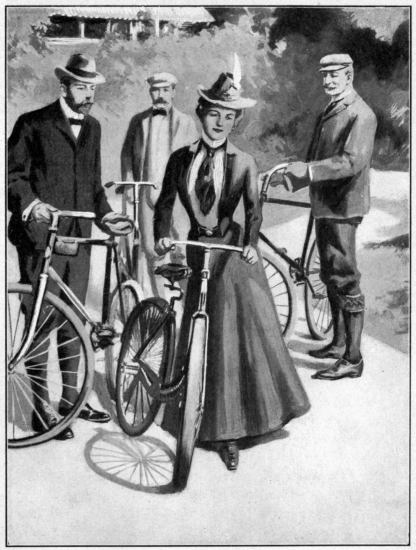
The two couples were close to each other as they went around the reservoir, along the shaded road on the edge of the Park, with the sidewalk of Fifth Avenue down below. Everywhere the grass was fresh and fragrant; and everywhere the squirrels were frequent and impertinent, cutting across the road almost under the wheels, or sitting up on the narrow sward in impudent expectation of the nuts gently thrown to them from the carriages.
When they came to McGowan’s Pass he saw the Professor suddenly dismount, and he thought that Minnie was going on alone and that her father had to call her back.
“Shall we rest here for a while, father?” asked the Professor, as the General and the Doctor dismounted.
“Just as you say,” the old soldier answered; “just as you say. I’m not at all fatigued, not at all. But don’t let us old fogies keep you young folks from your exercise. Minnie, you and the Doctor can ride on—”
“But, grandpa—” she began, in protest.
“I’ll stay here a minute or two with your father,” the General continued. “The Doctor is very kind to let me talk to him, but I’m sure he’d rather talk to you, my dear; so you two can run along together.”
“I shall be delighted to accompany Miss Contoit if she cares to have a little spin,” said Dr. Demarest, turning to her.
“Oh, well,” she answered, a little ungraciously; then she smiled swiftly, and added: “I always do what grandpa wants. Don’t you think I’m a very good little girl?” And with that she started forward, springing lightly to her seat after her bicycle was in motion.
Demarest was jumping on his wheel to follow, when her father called out, “Don’t let her ride up-hill too fast, Doctor!”
“Isn’t papa absurd?” she asked, laughing; “and grandpa, too? They are always wanting me to take care of myself, just as if I didn’t!”
They overtook and passed a woman weighing two hundred pounds and full forty years of age, who was toiling along on a bicycle, dressed in a white skirt, a pink shirt-waist, and a straw sailor-hat. The Doctor turned and bowed to this strange apparition, but the plump lady was too fully occupied in her arduous task to be able to do more than gasp out: “Good—after—noon—Doctor.”
When they had gone one hundred yards ahead the Doctor’s companion expressed her surprise. “You do know the funniest people!” she cried. “Who on earth was that?”
“That?” he echoed. “Oh, that’s a patient of Dr. Cheever’s. He advised her to get a bicycle if she wanted to be thinner—”
“And he told me to get one if I wanted to be a little fatter!” the girl interrupted. “Isn’t that inconsistent?”
“I don’t think so,” the young man answered, glad that the conversation had taken this impersonal turn, and yet wondering how he could twist it to the point where he wanted it. “Outdoor exercise helps people to health, you see, and if they are unhealthily fat it tends to thin them down, and if they are very thin it helps them to put on flesh.”
“I’d bike fourteen hours a day if I was a porpoise like that,” said the girl, glancing back at the plump struggler behind them.
Just then a horn tooted and a coach came around the next turn. There were on it three or four girls in gay spring costumes, and two of them bowed to Dr. Demarest.
Behind the four-in-hand followed a stylish victoria, in which sat a handsome young woman alone. She was in black. Her somber face lighted with a smile as she acknowledged the young doctor’s bow.
“I’ve seen her somewhere,” said the girl by his side. “Who is she?”
“That’s Mrs. Cyrus Poole,” he answered; “the widow of the Wall Street operator who died two years ago.”
“What lots of people you know,” she commented.
“How is a young doctor to get on unless he knows lots of people?” was his answer.
She said nothing for a minute or two, as they threaded their way through a tangle of vehicles stretching along the northernmost drive of the Park.
Then she asked: “Why is it that most of the women we have passed this afternoon sitting back in their carriages look bored to death?”
“I suppose it’s because they’ve got all they want,” the Doctor responded. “They have nothing left to live for; they have had everything. That’s what makes them so useful to our profession. They send for us because they are bored, and they want sympathy. I suppose everybody likes to talk about himself, especially when he’s out of sorts; now, you see, the family doctor can always be sent for, and it’s his business to listen to your account of your symptoms. That’s what he’s paid for.”
“I don’t think that’s a nice way of earning a living, do you?” returned the girl.
“Oh, I don’t know,” he answered. “Why not? It’s our duty to relieve suffering, and these women are just suffering for a chance to describe all their imaginary ailments.”
“Women?” she cried, indignantly. “Are all these old fools women?”
“There must be men sometimes, I suppose,” he replied; “but most of a family physician’s work is with the women, of course.”
Then it seemed to him that he saw before him the opportunity he had been awaiting. They were now climbing the hill at the northwestern corner of the Park. He slowed up so that she should not be tempted to overexert herself. He even went so far as to lag a little behind. When they began to go down again gently, he came alongside.
“By the way,” he began, “speaking of what a family physician has to do reminds me that I want to ask your advice.”
“My advice?” she echoed, with the light little laugh that thrilled through him always. “Why, I don’t know anything about medicine.”
“It isn’t a professional consultation I want,” he answered, laughing himself, “it’s friendly counsel. Don’t you remember that when you told me you couldn’t love me you went on to say you hoped we should always be good friends?”
“Yes,” she responded, calmly, “I remember that. And I hope that if I can really show any friendliness in any way, you will let me.”
“That’s what I am coming to,” he returned. “You know, I’ve been helping Dr. Cheever as a sort of third man while Dr. Aspinwall has been ill? Well, Dr. Aspinwall isn’t getting any better, and he’s got to quit for a year, anyhow. So Dr. Cheever is going to take me with him—”
“Oh, I’m so glad!” she broke in, heartily. “That’s splendid for you, isn’t it?”
“It will be splendid for me if I can keep the place and do the work to his satisfaction,” he answered.
“Oh, I guess Dr. Cheever knows what he is about,” retorted the girl, gaily. “He knows how clever you are.”
“Thank you,” the young man returned. “I felt sure you would be pleased, because you have always been so kind to me.”
He hesitated for a moment, and then continued: “I feel as if I owe you an apology—”
“What for?” she asked, in surprise.
“For the way I behaved last time we—we had a talk,” he answered.
“Oh, then,” she commented; and it seemed to him that she had almost made an effort to retain the non-committal expression she was affecting.
“You may remember,” he went on, “that I asked you to marry me, and that you refused, and that you told me you didn’t love me at all, but you did like me—”
“What’s the use of going over all that again?” she asked.
“I must make myself right with you, Miss Minnie,” he urged. “You said we could be friends, and I was all broke up then, and I didn’t know just what I was saying, and I told you friendship wasn’t any good to me, and if I couldn’t have you there wasn’t anything else I wanted. I must have been rude, indeed, and it has worried me ever since.”
“I’ll forgive you, if that’s what you mean,” she responded. “I hadn’t really thought about it twice. It isn’t of any consequence.”
“It is to me,” he returned. “Now I’ve changed my mind, and if you will offer the friendship again I’ll accept it gladly.”
“Why, Dr. Demarest!” she said, smiling, but with a flash in her gray eyes, “of course we can be good friends, just as we have always been. And now you needn’t talk any more about this foolish misunderstanding.”
So saying she started ahead. They had been climbing a hill, and now they had on their left a broad meadow, gay with groups of tennis-players. At an opening on the right a mounted policeman sat his horse as immovable as an equestrian statue. Just before them were two gentlemen with impatient trotters trying to get a clear space; and there was also a double file of young men and girls from some riding-school, under the charge of a robust German riding-master.
It was not for two or three minutes that Dr. Demarest was able to resume his position by the side of Miss Contoit.
“I had to set myself right,” he began, abruptly, “because if we really are friends I want you to help me.”
“I shall be very glad, I’m sure,” she replied. “I’ve told you so already.”
“But what I want is something very serious,” he continued.
“What is it?” she asked, drawing away from him a little.
“It’s advice,” he explained.
She gave a light laugh of relief. “Oh, advice,” she repeated; “anybody can give advice.”
“Not the advice I want,” he responded, gravely. “It’s a very solemn thing for me, I can assure you.”
“And what is this very solemn thing?” she inquired, airily.
“It’s marriage,” he answered. “I’ve got to get married, and—and—”
“Don’t let’s go back to that again,” she said, with frank impatience. “I thought we had settled that once for all.”
“Oh, I didn’t mean you,” he returned, apologetically.
“You didn’t mean me?” she repeated, in amazement. “Why, I thought—well, it’s no matter what I thought, of course.”
“I’m afraid I’m getting things all mixed up,” he said, calmly. “Of course, you are the only woman I love, and the only woman I ever shall love. I told you that the last time we met, and you told me that you didn’t love me—so that settled it.”
“Well?” she interrogated.
“Well, if I can’t have what I want,” he explained, “I’d better get what I need.”
“I confess I do not know what you are talking about,” she declared.
“It’s simple enough,” he returned. “I’m a doctor, and I’m young—I’m only thirty—and I haven’t a bald spot yet, so people think I’m even younger than I am, and they haven’t confidence in it. So I’ve got to get married.”
The girl laughed out merrily. “Can’t you get a bald spot any other way?” she asked.
“If I have a wife I don’t need a bald spot,” he responded. “A wife is a warrant of respectability. Every doctor will tell you that’s the way patients feel. I’m tired of going to see some old woman for Dr. Cheever, and sending up my card and overhearing her say: ‘I won’t see him! I don’t want Dr. Demarest! I sent for Dr. Cheever, and it’s Dr. Cheever I want to see!’ That has happened to me, and not only once or twice, either.”
“How could any woman be so unlady-like?” the girl asked, indignantly. “She must have been a vulgar old thing!”
“There’s more than one of her in New York,” the young doctor asserted, “and that’s one reason why I’ve got to get married. And between you and me, I think my chance of staying with Dr. Cheever would be better if I had a wife. Of course, he doesn’t say so, but I can’t help knowing what he thinks.”
The girl made no comment on this, and they rode along side by side. They were now on the crest of a hill, and they overlooked the broad expanse of the reservoir. The almost level rays of the sinking sun thrust themselves through the leafy branches and made a rosy halo about her fair head.
“So that’s why I’ve come to you for advice,” he began again.
“But I don’t see what good my advice will be to you,” she returned. “You don’t expect me to pick out a wife for you, do you?”
“Well, that’s about it!” he admitted.
“The idea!” she retorted. “Why, it’s perfectly absurd!”
“So long as I cannot get the girl I love, marriage ceases to be a matter of sentiment with me,” he went on, stolidly. “I come to you as a friend who knows girls—knows them in a way no man can ever know them. I want your help in selecting a woman who will make a good wife for a doctor.”
“How do you know she will have you?” she thrust at him.
“Of course, I don’t know,” he admitted. “I can’t know till I try, can I? And if at first I don’t succeed I must try, try again. If the one you pick out refuses me I’ll have to get you to pick out another.”
“So it’s a mere marriage of convenience you are after?” the girl asked. “That’s all very well for you, no doubt; but how about the woman who marries you? I don’t think it’s a very nice lookout for her, do you? That’s just the way with you men always! You never think about the woman’s feelings!”
“I’ll do my duty to her,” he answered.
“Your duty!” sniffed the girl, indignantly.
“I’ll be so attentive to her that she will never guess my heart is given to another,” he went on.
“Don’t be too sure of that,” she returned. “Women have very sharp eyes—sharper than you men think—especially about a thing like that!”
“I am not going to borrow trouble,” the Doctor declared, suavely. “I shall always be as nice to her as I can, and if it is in my power to make her happy, then she will be happy. But we needn’t anticipate. What I want you to do now is to help me to find the right woman. It will be my business to take care of her afterward.”
“Oh, very well,” said the girl, rather sharply. “Have you anybody in particular in view?”
“I haven’t really fixed on anybody yet,” he explained. “I wanted your advice first, for I’m going to rely on that. I feel sure you won’t let me make a mistake about a matter so important to me.”
“Then don’t let’s waste any time!” she cried, peremptorily.
“Really,” he declared, “it’s astonishing how a little bit of a thing like you can be so bossy.” She looked at him fiercely, so he made haste to add, “But I like it—I like it!”
The girl laughed, but with a certain constraint, so it seemed to him.
“Come, now,” she said, “if I must help you, let me see your list of proposed victims!”
“Do you know Dr. Pennington, the rector of St. Boniface’s, in Philadelphia?” he began. “Well, he has two daughters—nice girls, both of them—”
“Which one do you want?” asked the girl. “The tall one who squints, or the fat one with red hair?”
“Come, now,” he returned, “she doesn’t really squint, you know.”
“Call it a cast in her eye if you like; I don’t mind. It isn’t anything to me,” she asserted. “Is it the tall one you want?”
“I don’t care,” he answered.
“You don’t care?” she repeated.
“No,” he returned; “that’s why I’ve come to you. I don’t care. Which one do you recommend?”
“I don’t recommend either of them!” she responded, promptly. “I shouldn’t be a true friend if I let you throw yourself away on one of those frights!”
“I’ll give them up, if you say so,” said he; “but I’ve always heard that they are good, quiet girls—domesticated, you know—and—”
“Who is next?” she pursued, with a return of her arbitrary manner.
“Well,” he suggested, bashfully, “I haven’t any reason to suppose she would look at me, and it sounds so conceited in me to suggest that such a handsome woman—and so rich, too—would listen to me, but—”
“Who is this paragon?” his companion demanded.
“Didn’t I mention her name?” he responded. “I thought I had. We passed her only a little while ago—Mrs. Poole.”
“Mrs. Poole?” the girl replied. “That was the sick-looking creature in black lolling back in a victoria, wasn’t it?”
“She isn’t sick, really,” he retorted; “but I don’t think mourning is becoming to her. Of course, if we are married she will wear colors and—”
“I didn’t know you were willing to take up with a widow!” she interrupted, with a slight touch of acerbity. “I thought it was a girl you were looking for!”
“It was a wife of some sort,” he replied. “I don’t know myself what would suit me best. That’s why I am consulting you. I’m going to rely on your judgment—”
“But you mustn’t do that!” she cried.
“It is just what I’ve got to do!” he insisted. “And if you think it would be a mistake for me to marry a widow, why—it’s for you to say.”
“I must say that I think it would be a great mistake for a doctor to marry a woman who looks as if she couldn’t live through the week,” she responded. “I should suppose it would ruin any physician’s practice to have a wife as woebegone as that Mrs. Poole! Of course, I don’t know her, and I’ve nothing to say against her, and she may be as beautiful and as charming as you say she is.”
“I give her up at once,” he declared, laughing. “She shall never even know how near she came to having a chance to reject me.”
“Is that all?” the girl asked, a little spitefully. “Have you anybody else on your list?”
“I have only just one more,” he replied.
“Who is she?” was the girl’s quick question.
“I’m not sure that you have met her,” he returned. “She’s from the South somewhere, or the Southwest, I don’t know—”
“What’s her name?” was the impatient query.
“Chubb,” he answered. “It’s not a pretty name, is it? But that doesn’t matter if I’m to persuade her to change it.”
“Chubb?” the girl repeated, as though trying to recall the name. “Chubb? Not Virgie Chubb?”
“Her name is Virginia,” he admitted.
The girl by his side laughed a little shrilly. “Virgie Chubb?” she cried. “That scrawny thing?”
The Doctor confessed that Miss Chubb was not exactly plump.
“Not plump? I should think not, indeed,” the girl declared. “Do you know what Miss Marlenspuyk said about her? She said that Virgie Chubb looked like a death’s-head on a toothpick! That’s what she said!”
They were approaching the Mall, and the Doctor knew that his time was now very brief. They had to slow up just then, as a policeman was conveying across the broad road three or four nurses with a baby-carriage or two, and then they had to steer clear of half a dozen working-men going home across the Park, with pipes in their mouths and dinner-pails swinging in their hands.
“So you don’t think Miss Chubb would be a good wife for me?” he inquired.
“I have nothing to say at all! It isn’t really any of my business!” she replied. “It is simply absurd of you to ask me!”
“But you must help me out,” he urged. “So far you have only told me that I mustn’t marry any of the girls I had on my list.”
“I don’t want to see you throw yourself away,” she returned. “A pretty kind of a friend I should be if I encouraged you to marry your Virgie Chubb and your Widow Poole!”
“That’s it, precisely,” he asserted; “that’s why I’ve come to you. Of course, I don’t want to throw myself away. Your advice has been invaluable to me—simply invaluable. But so far you have only shown me how it is that none of these girls will suit. That brings me no nearer my object. I’ve simply got to have a wife.”
“I don’t see why you need be in such a hurry,” she replied.
“I must, I must!” he retorted. “And there’s one more girl I haven’t mentioned so far—”
“You’ve kept her to the last!” she snapped.
“Yes, I’ve kept her to the last, because I haven’t any right even to hope that she would have me. She is not a widow, and she hasn’t a cast in her eye, and she is neither fat nor scrawny; she is just a lovely young girl—”
“You speak of her with more enthusiasm than you did of any of the others,” she broke in. “Do I know her?”
“You ought to know her,” he answered; “but I doubt if you think as well of her as I do.”
“Who is she?” was her swift question.
“You won’t be offended?” he asked.
“Of course not! How absurd! Why should I be offended?” she responded. “Who is she? Who is she?”
The Doctor answered seriously, and with a quaver of emotion in his voice, “She is the girl I have loved for a long time, and her name is Minnie Contoit!”
The girl did not say anything. Her face was as pale as ever, but there was a light in the depths of her cool gray eyes.
“Listen to me once more, Minnie!” implored the young fellow by her side. “You say that none of these other girls will suit me, and I knew that before you said it. I knew that you are the only girl I ever wanted. You promised me your friendship the last time we talked this over, and now I’ve had a chance to tell you how much I need a wife I have hoped you would look at the matter in a clearer light.”
She said nothing. He gave a hasty glance backward and he saw that her father and her grandfather were only a hundred yards or so behind them. The reddening sunset on their right cast lengthening shadows across the road. The spring day was drawing to an end, and the hour had come when he was to learn his fate forever.
“Minnie,” he urged once more, “don’t you think it is your duty—as a friend, you know—to give me the wife I ought to have?”
She looked at him, and laughed nervously, and then dropped her eyes.
“Oh, well,” she said at last, “if I must!”
(1900)
HERE were two men in the cab as it turned into Fifth Avenue and began to skirt the Park on its way down-town. One of them was perhaps fifty; he had grizzled hair, cold, gray eyes, and a square jaw. The other appeared to be scant thirty; he had soft brown eyes, and a soft brown mustache drooped over his rather irresolute mouth. The younger man was the better-looking of the two, and the better dressed; and he seemed also to be more at home in New York, while the elder was probably a stranger in the city—very likely a Westerner, if the black slouch hat was a true witness.

They sat side by side in silence, having nothing to say, the one to the other. The shadows that were slowly stretching themselves across the broad walk on the Park side of the Avenue shivered as the spring breeze played with the tender foliage of the trees that spread their ample branches almost over the wall. The languid scent of blossoming bushes was borne fitfully beyond the border of the Park. To the eyes of the younger of the two men in the hansom the quivering play of light and shade brought no pleasure; and he had no delight in the fragrance of the springtime—although in former years he had been wont to thrill with unspoken joy at the promise of summer.
The elder of the two took no thought of such things; it was as though he had no time to waste. Of course, he was aware that winter followed the fall, and that summer had come in its turn; but this was all in the day’s work. He had the reputation of being a good man in his business; and although the spring had brought no smile to his firm lips, he was satisfied with his success in the latest task intrusted to him. He had in his pocket a folded paper, signed by the Governor of a State in the Mississippi Valley, and sealed with the seal of that commonwealth; and in the little bag on his knees he carried a pair of handcuffs.
As the hansom approached the Plaza at the entrance to the Park, the gray-eyed Westerner caught sight of the thickening crowd, and of the apparent confusion in which men and women and children were mixed, bicycles and electric cabs, carriages and cross-town cars, all weltering together; and he wondered for a moment whether he had done wisely in allowing so much apparent freedom to his prisoner. He looked right and left swiftly, as though sizing up the chances of escape, and then he glanced down at the bag on his knees.
“You needn’t be afraid of my trying to run,” said the younger man. “What good would it do me? You’ve caught me once, and I don’t doubt you could do it again.”
“That’s so,” returned the other, with just a tinge of self-satisfaction in his chilly smile. “I shouldn’t wonder if I could.”
“Besides, I don’t want to get away now,” insisted the first speaker. “I’ve got to face the music sooner or later, and I don’t care how quick the brass band strikes up. I want to take my punishment and have it over. That’s what I want. I’m going to plead guilty and save the State the trouble of trying me, and the expense, too. That ought to count in cutting down the sentence, oughtn’t it? And then I shall study the rules of—of that place, and I mean to learn them by heart. There won’t be anybody there in a greater hurry to get out than I, and so I’m going to be a model of good conduct.”
“It ain’t every fellow that talks like that who’s able to keep it up,” commented the officer of the law.
“I guess I can, anyhow,” replied his prisoner. “I’ve made up my mind to get this thing over as soon as possible, and to have a little life left for me when I’m let out.”
The elder man made no answer. He thought that his companion was sincere and that there would be no attempt to escape, whatever the opportunity. But his experience trained him to take no chances, and he did not relax his vigilance.
A horn sounded behind him; and a minute later a four-in-hand passed with tinkling chains and rumbling wheels. The top of the coach was filled with elaborately attired men and with girls in all the gayety of their spring gowns; and they seemed to be having a good time. They did not mean to hurt the younger of the two men in the hansom; they did not know, of course; but just then their mirth smote him to the heart.
Fifth Avenue is an alluring spectacle late in the afternoon of the first Saturday in June; and when the hansom-cab topped the crest of a hill, the two men could see far down the vista of the broad street. The roadway was a solid mass of vehicles in ceaseless motion; and the sidewalks were filled with humanity. To the man who was being taken to his trial the bright color and the brisk joyousness of the scene were actually painful. Of the countless men and women scattered up and down the Avenue in the glaring sunshine, how many knew him to call him by name and to take him by the hand? More than a hundred, no doubt, for he had been popular. And how many of them would give him a second thought after they had read of his arrest and of his trial and his sentence?
How many of them would miss him?—would be conscious even of his absence? And he recalled the disgust of a friend who had gone around the world, and had come back after a year or more with picturesque stories of his wanderings in far countries, only to have the first man he met in his club ask him casually where he’d been “for the last week or so.”
THIS YEAR THE GIRLS WERE PRETTIER THAN USUAL
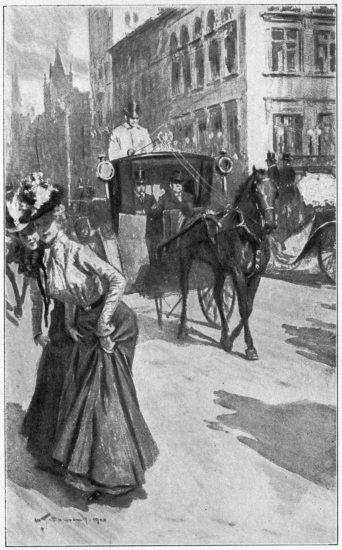
And now he, too, was going to a strange land; and he foresaw that when he returned—if he ever got back alive!—he would not know what to answer if any one should inquire where he had been for the last week or so. The world was a bitterly selfish place where men had no time to think except of themselves. If a fellow could not keep up with the procession, he had to drop out of the ranks and be glad if the rest of them did not tramp over him. He knew how hard he had tried not to be left behind, and how little the effort had profited him.
With an aggressive movement that made his companion even more alert than usual, the brown-eyed young man shook himself erect, as though to cast behind him these evil thoughts. It was a beautiful day, and flowers blazed in the broad windows of the florists—roses and carnations and lilacs. There were lilacs also in the arbitrary hats the women were wearing, and the same tint was often echoed in their costumes. He had always been attentive to the changes of fashion—always subject to the charm of woman. As he was borne down the Avenue by the side of the man in whose custody he was, it struck him that this year the girls were prettier than usual—younger, more graceful, more fascinating, more desirable. He followed with his eyes first one and then another, noting the sweep of the skirt, the curve of the bodice, the grace of gesture, the straggling tendril of hair that had escaped upon the neck. For a brief moment the pleasure of his eye took his thoughts away from his future; and then swiftly his mind leaped forward to the next spring, when no woman’s face would chance within the range of his vision, and when the unseen blossoming of nature would bring only impotent desire. What zest could there be in life when life was bounded in a whitewashed cell?
At Thirty-fourth Street the hansom was halted to let a funeral cross the current of the Avenue. An open carriage came first, its seats covered with flowers, tortured into stiff set pieces; the white hearse followed, with a satin-covered coffin visible through its plate-glass sides; and then half a dozen carriages trailed after. The prisoner in the hansom noticed that the shades were drawn in the one that followed the hearse; it bore a grief too sacred for observation—a mother’s, no doubt. He was suddenly glad that his parents had both died when he was yet a boy. To be alone in the world, with no family to keep him warm with tolerant affection—this had often saddened him; now at last he rejoiced at it. When a man is on his way to prison to serve a term of years, the fewer those who cherish him, the luckier for them. That he loved a woman—that, indeed, he was going to jail because of his love for her—this might add poignancy to his pain; but he felt himself manly for once in trying to believe it was better now that she did not love him, that she did not even know of his love for her.
In time the hansom turned from Fifth Avenue into Broadway; it went on down-town past Union Square, with its broad trees, and past Grace Church, with its grateful greenery; but the younger of the two men was no longer taking note of what sped before his gaze. He was wondering what the woman he loved would think when she would hear of his going to prison—whether she would care very much—whether she would suspect that his crime was due to his passion for her. That, of course, she could not guess—that he had yielded to the temptation to lay hands on what was not his, solely because he wanted more money to place at her feet. For himself, he had been making enough; but for her he must have more. He could not have ventured to invite her to give up anything for his sake. He wanted to be able to offer her all she had been accustomed to have—and more too, were that possible. He was conceited enough ordinarily, he feared; and yet when he thought of her he felt so humble that he had never dared to dream of going to her empty-handed—of asking her to make any sacrifice in loving him. He had never told her of his love, and perhaps she did not even guess it; and yet women are swift to discover a thing like that. It might be that she had seen it; and that when others should speak of him as he knew he deserved to be spoken of, she might come to his defence and find some word of extenuation for his misdeed. This possibility, remote as it was, gave him pleasure; and he smiled at the suggestion as it came to him.
From this day-dream he was aroused as the driver of the hansom jerked the horse back on his haunches to avoid running down a little old woman who was trying to cross Broadway with a bundle of sticks balanced on her head. As the animal almost touched her she looked up, and her glance crossed that of the prisoner. He perceived instantly that she was an Italian, that she was not so old as she looked, and that she had been beautiful not so long ago. Then he wondered whether any man had done wrong for her sake—whether or not two of her lovers had fought in the soft Sicilian moonlight and one had done the other to death. Well, why not? There were worse things than death, after all.
As they went on farther and farther down-town, Broadway began to seem emptier. It was the first Saturday in June, and most of the stores were closed. When they drew near to the City Hall, the great street, although not so desolate as it is on a Sunday, lacked not a little of its week-day activity. It was as though a truce had been proclaimed in the battle of business; but the forts were guarded, and the fight would begin again on the Monday morning.
After the hansom passed the Post Office the buildings on the right and the left raised themselves higher and higher, until the cab was at last rolling along what might be the bottom of a canyon. And it seemed to him that the cliff-dwellers who inhabited the terraces of this man-made gorge, and who spent the best part of their lives a hundred feet above the level of the sidewalk, were no peaceable folk withdrawn from the strife of the plains; they were relentless savages ever on the war-path, and always eager to torture every chance captive. Wars may be less frequent than they were and less cruel, but the struggle for existence is bitterer than ever, and as meanly waged as any Apache raid.
The young man in the hansom felt his hatred hot within him for those with whom he had meant to match himself. He had been beaten in the first skirmish, and yet—but for the one thing—he could hold himself as good as the best of them. How many of the men under the shadow of Trinity were more honest than he? Some of them, no doubt—but how many? How many names now honorable would be disgraced if the truth were suddenly made known? How many of those who thought themselves honest, and who were honest now, had in the past yielded to a temptation once, as he had done, and having been luckier than he in escaping detection then, had never again risked it? That was what he had intended to do; he knew himself not to be dishonest, although the alluring opportunity had been too much for him. If only he could have held on for another day, all would have been well—no one would have had cause ever to suspect him; and never again would he have stepped aside from the narrow path of rectitude.
There was no use in repining. Luck had been against him, that was all. Some men had been guilty of what he had done, and they had been able to bluff it out. His bluff had been called, and he was now going to jail to pay his debt of honor. Perhaps the copy-book was right when it declared honesty to be the best policy. And yet he could not help feeling that fate had played him a mean trick. To put in his possession at the same moment a large sum of money and the information that the most powerful group of capitalists in America had determined to take hold of a certain railroad and re-establish it, and to have thus the possibility put before him at the very hour when he had discovered that perhaps he had a chance to win the woman he loved, if only he could approach her on an equality of fortune—this temptation just then was too great to withstand. He had yielded, and for a little while it had seemed as though he was about to succeed. Twenty-four hours more and he could have put back the money he had borrowed—for so he liked to look on his act. That money once restored, he would have waited patiently for the rest of his profit. Thereafter he could have afforded to be honest; he was resolved never to overstep the law again; he would have kept the letter of it vigorously—if only he had escaped detection that once.
But blind chance smote him down from behind. Suddenly, without an hour’s warning, the leader of the group of sustaining capitalists dropped dead; his heart had failed, worn out by the friction and the strain. The market broke; and all who had bought stocks on a margin were sold out instantly and inexorably. Then the supporting orders came in and prices were pushed up again; but it was too late. Two days before, or a day after, that capitalist might have died without having by his death unwittingly caused an arrest. And as the hansom rolled on toward the Battery the prisoner had again a resentment against the capitalist for choosing so unfortunate a day to die.
Now the end had come; of course, he had been unable to replace the money he had taken, and there was nothing for him to do but to fly. But instead of going to Canada, and hiding his trail, and then slipping across to Europe, he had been foolish enough to come here to New York to have another glimpse of the woman for the love of whom he had become a thief. Once more luck had been against him; as it happened, she had gone out of town for Decoration Day; and instead of taking ship to Europe, he had waited. Only that Saturday morning he had met her brother and had been told of her return to town. But when he was about to call on her that afternoon, the gray-eyed man had called on him; and here he was on his way to his trial, and he had not seen her, after all.
Then he went back to the last time he had had speech with her. It was during one of his frequent visits to New York, and he had dined at the club with her brother, who had told him that she was going to the play that night with her mother. So he had betaken himself to the theater also, and he had gazed at her across the house; and then he had put her and her mother into their carriage, and the old lady had asked him to dinner the next evening. He had supposed it was an eleventh-hour invitation and that he was to fill the seat of some man who had unexpectedly backed out; but none the less he had accepted with obvious pleasure. And it was from a few casual words of her father’s, after dinner, that he got the first inkling of the railroad deal; and then, before the time came for him to go, he had been fortunate enough to have her to himself for a quarter of an hour. She had been graciousness itself, and for the first time he had begun to have hope. He could not recall what he had said, but his memory was clear as to how she had looked. He could not remember whether he had allowed her even a glimpse of his deep passion. It might be that she had guessed it, although she had made no sign; he knew that women were as keen as they were inscrutable.
The hansom was at last under the ugly framework of the Elevated almost at the South Ferry gate. The tide was coming in strongly, and there was a salt savor in the breeze that blew up from the lower bay. The prisoner relished it as he filled his lungs with the fresh air; and then he asked himself how long it would be before that saline taste would touch his nostrils again.
As the cab drew up, the elder of the two men in it laid his hand on the arm of the younger.
“I can trust you without the wristlets, can’t I?” he asked.
The other flushed. “Put them on if you want,” he answered, “but you needn’t. I’m not going to make a fool of myself again. I’ve told you I’m going to plead guilty and do everything else I can to get the thing over as soon as possible.”
The gray-eyed man looked at him firmly.
“You’re talking sense,” he declared. “I’ll trust you.”
As they were about to step out, their horse was somewhat startled by an electric automobile that rolled past clumsily and drew up immediately in front of them.
The prisoner stood stock-still, with his foot vainly reaching out for the sidewalk, as he saw the brother of the woman he loved help her out of the vehicle. Then the brother asked a newsboy to point the way to the boat for Governors Island; and she went with him as the urchin eagerly guided them. She did not look around; she never saw the man who loved her; and in a minute she turned the corner and was out of sight.
The officer of the law tapped his prisoner on the arm again.
“Come on,” he said. “What’s the matter with you? Have you seen a ghost?”
(1899)
N a corner of my desk there stands a china shell; its flat and oval basin is about as broad as the palm of my hand; it is a spotted brownish-yellow on the outside, and a purply-pinkish white on the inside; and on the crinkled edge of one end there sits a green frog with his china mouth wide open, thus revealing the ruddy hollow of his interior. At the opposite end of the shell there is a page of china music, purporting to be the first four bars of a song by Schubert. Time was when the frog held in his long greenish-yellow arms a still longer trombone made of bright brass wire, bent into shape, and tipped with a flaring disk of gilded porcelain. In the days when the china frog was young he pretended to be playing on the brass trombone. Despite its musical assertiveness, the function of the frog that played the trombone was humble enough: the shell was designed to serve as a receiver for the ashes of cigars and cigarettes. But it is a score of years at least since the china frog has held the brass trombone to its open lips. Only a few months after he gave his first mute concert on the corner of my table the carelessness of a chance visitor toppled him over on the floor, and broke off both his arms and so bent the trombone that even the barren pretense of his solo became an impossibility. A week or two later the battered musical instrument disappeared; and ever since then the gaping mouth of the frog has seemed to suggest that he was trying to sing Schubert’s song. His open countenance, I am sorry to say, has often tempted my friends to make sport of him. They have filled the red emptiness of his body with the gray ashes of their cigars; they have even gone so far as to put the stump of a half-smoked cigarette between his lips, as though he were solacing himself thus for the loss of his voice.

Although the frog is no longer playing an inaudible tune on an immovable instrument, I keep it on a corner of my desk, where it has been for nearly twenty years. Sometimes of a winter’s night, when I take my seat at the desk before the crackling and cheerful hickory fire, the frog that played the trombone catches my eye, and I go back in memory to the evening when it performed its first solo in my presence, and I see again the beautiful liquid eyes of the friend who brought it to me. We were very young then, both of us, that night before Christmas, and our hearts kept time with the lilt of the tune that the frog played silently on his trombone. Now I am young no longer, I am even getting old, and my friend has been dead this many a year. Sometimes, as I look at the gaping frog, I know that if I could hear the song he is trying to sing I should hate it for the memories it would recall.
He who gave it to me was not a school fellow, a companion of my boyhood, but he was the friend of my youth and a classmate in college. It was in our Junior year that he joined us, bringing a good report from the fresh-water college where he had been for two years. I can recall his shy attitude the first morning in chapel when we were wondering what sort of a fellow the tall, dark, handsome new-comer might be. The accidents of the alphabet put us side by side in certain class-rooms, and I soon learned to know him, and to like him more and more with increasing knowledge. He was courteous, gentle, kindly, ever ready to do a favor, ever grateful for help given him, and if he had a fault it was this, that he was jealous of his friends. Although his nature was healthy and manly, he had a feminine craving for affection, and an almost womanly unreason in the exactions he made on his friends. Yet he was ever ready to spend himself for others, and to do to all as he would be done by.
Although fond of out-door sports, his health was not robust. He lacked stamina. There was more than a hint of consumption in the brightness of his eye, in the spot of color on his cheek, in the hollowness of his chest, and in the cough which sometimes seized him in the middle of a recitation. Toward the end of our senior year he broke down once, and was kept from college a week; but the spring came early, and with the returning warmth of the sunshine he made an effort and took his place with us again. He was a good scholar, but not one of the best in the class. He did his work faithfully in the main, having no relish for science, but enjoying the flavor of the classics. He studied German that year, and he used to come to me reciting Heine’s poems with enthusiasm, carried away by their sentiment, but shocked by the witty cynicism which served as its corrective. He wrote a little verse now and then, as young men do, immature, of course, and individual only in so far as it was morbid. I think that he would have liked to devote himself to literature as a career, but it had been decided that he was to study law.
After Class Day and Commencement the class scattered forever. In September, when I returned to New York and settled down to my profession, I found my friend at the Columbia Law School. His father had died during the summer, leaving nothing but a life-insurance policy, on the income of which the mother and son could live modestly until he could get into a law office and begin to make his way in the world. They had taken a floor in a little boarding-house in a side street, and they were very comfortable; their money had been invested for them by one of his father’s business associates, who had so arranged matters that their income was much larger than they had expected. In this modest home he and his mother lived happily. I guessed that the father had been hard and unbending, and that my friend and his mother had been drawn closer together. Of a certainty I never saw a man more devoted than he was to her, or more tender, and she was worthy of the affection he lavished on her.
In those days the Law School course extended over two years only, and it did not call for very hard work on the part of the student, so he was free to pass frequent evenings in my library. I used to go and see him often, for I liked his mother, and I liked to see them sitting side by side, he holding her hand often as he debated vehemently with me the insoluble questions which interested us then. During the second winter I sometimes saw there a brown-eyed girl of perhaps twenty, pretty enough, but with a sharp, nervous manner I did not care for. This was the daughter of the lady who kept the boarding-house; and my friend was polite to her, as he was to all women; he was attentive even, as a young man is wont to be toward a quick-witted girl. But nothing in the manner led me to suppose that he was interested in her more than in any other woman. I did not like her myself, for she struck me as sharp-tongued.
It is true that I saw less of my friend that second winter, being hard at work myself. It was in the spring, two years after our graduation, that I received a letter from him announcing his engagement to the young lady I had seen him with, his landlady’s daughter. My first thought, I remember, was to wonder how his mother would feel at the prospect of another woman’s coming between them. His letter was a long dithyramb, and it declared that never had there been a man so happy, and that great as was his present joy, it was as nothing compared with the delight in store for him. He wrote me that each had loved the other from the first, and each had thought the other did not care, until at last he could bear it no longer; so he had asked her, and got his answer. “You cannot know,” he wrote, “what this is to me. It is my life—it is the making of my life; and if I should die to-night, I should not have lived in vain, for I have tasted joy, and death cannot rob me of that.”
Of course the engagement must needs be long, because he was as yet in no position to support a wife; but he had been admitted to the bar, and he could soon make his way, with the stimulus he had now.
I was called out of town suddenly about that time, and I saw him for a few minutes only before I left New York. He was overflowing with happiness, and he could talk about nothing but the woman he loved—how beautiful she was! how clever! how accomplished! how devoted to his mother! In the midst of his rhapsody he was seized by a fit of violent coughing, and I saw the same danger signal in his cheeks which had preceded the break-down in his senior year. I begged him to take care of himself. With a light laugh he answered that he intended to do so—it was his duty to do so, now that he did not belong to himself.
In the fall, when I came back to the city, I found him in the office of a law firm, the head of which had been an intimate of his father’s. The girl he was to marry went one night a week to dine with her grandmother, and he came to me that evening and talked about her. As the cold weather stiffened, his cough became more frequent, and long before Christmas I was greatly alarmed by it. He consulted a distinguished doctor, who told him that he ought to spend the winter in a drier climate—in Colorado, for example.
It was on Christmas eve that year that he brought me the frog that played the trombone. Ever since the first Christmas of our friendship we had made each other little presents.