The Siege of Vicksburg
Reading edition
THE CONFEDERATE DEFENSE LINE.
From his assumption of command 7 months before, Pemberton had put his engineers to work constructing a fortified line which would protect Vicksburg against an attack from the rear. A strong line of works had been thrown up along the crest of a ridge which was fronted by a deep ravine. The defense line began on the river 2 miles above Vicksburg and curved for 9 miles along the ridge to the river below, thus enclosing the city within its arc. So long as this line could be held, the river batteries denied to the North control of the Mississippi River.
At salient and commanding points along the line, artillery positions and forts (lunettes, redans, and redoubts) had been constructed. The earth walls of the forts were up to 20 feet thick. In front of these was dug a deep, wide ditch so that assaulting troops which climbed the steep ridge slope and reached the ditch would still have a high vertical wall to climb in order to gain entrance into the fort. Between the strong points, which were located every few hundred yards, was constructed a line of rifle pits and entrenchments, for the most part protected by parapets and ditches. Where spurs jutted out from the main ridge, advanced batteries were constructed which provided a deadly crossfire against attacking lines. The Confederates had mounted 128 artillery 34 pieces in these works, of which 36 were heavy siege guns; the remainder, field pieces.
Greatly strengthening the Confederate position was the irregular topography which resulted from the peculiar characteristics of the region’s loess soil. Possessing an unusual tenacity, except when eroded by the action of running water, the loess had over the centuries been cut into deep gullies and ravines with abrupt faces separated by narrow, twisting ridges. This resulted in a broken and complicated terrain which would seriously obstruct the Union movement. To permit a clear field of fire and to hinder advancing troops, all the trees fronting the Confederate line were cut down. Several hundred yards away from the Confederate position and roughly parallel to it was a ridge system not so continuous and more broken than that occupied by Pemberton’s Army. Along this line, the Union Army took position and began its siege operations.
On the scattered natural bridges of high ground, which spanned the ravines and provided approaches to Vicksburg, were located the six roads and one railroad leading into that city. Nine forts had been constructed overlooking each of these routes into Vicksburg, their guns completely commanding the approaches—Fort Hill on the river north of the city, Stockade Redan, Third Louisiana Redan, Great Redoubt, Second Texas Lunette, Railroad Redoubt, Fort Garrott (also known as Square Fort), Salient Works, and South Fort on the river below Vicksburg. (All but two of these works are well preserved today.) The Confederate divisions, left to right, were commanded by Maj. Gen. M. L. Smith, General Bowen, Maj. Gen. John H. Forney, and General Stevenson. The Army of Vicksburg, at the beginning of the siege, numbered about 31,000 men, of which Pemberton listed 18,500 effectives as available to man his defense line. Grant gave his strength, shortly after the siege began, as 50,000 effectives; his army was steadily enlarged during the siege by reinforcements from Memphis.
THE ASSAULT OF MAY 19.
By midday of May 19, Grant had completed his investment of the city. In the north, Sherman’s Corps was in position opposite the Confederate left from the river (at the present location of the national cemetery) to the Graveyard Road, at an average distance of about 500 yards. McPherson’s Corps took position on Sherman’s left from the Graveyard Road to near the Baldwin’s Ferry Road; the front of McClernand’s Corps extended from the Baldwin’s Ferry Road southward.
Considerable skirmishing had preceded the Union approach, as the Confederate pickets fell slowly back inside the defenses, thus preventing a close inspection of the Confederate fortifications. Grant determined, however, to attack immediately, before Pemberton had time to post his defenses strongly. The Union general ordered an assault 35 at 2 p. m. on the 19th. Sherman’s troops, whose early arrival had enabled them better to prepare for attack, moved under heavy fire against the Confederate left. Although they succeeded in making a close lodgment against the walls of the Stockade Redan, they failed to breach the works and were repulsed. McPherson and McClernand, not yet in good position for attack, were unable to do more than advance several hundred yards closer to the siege line. Grant lost 1,000 men testing the Vicksburg defenses and discovered an unyielding army manning the works. Confederate losses were slight.
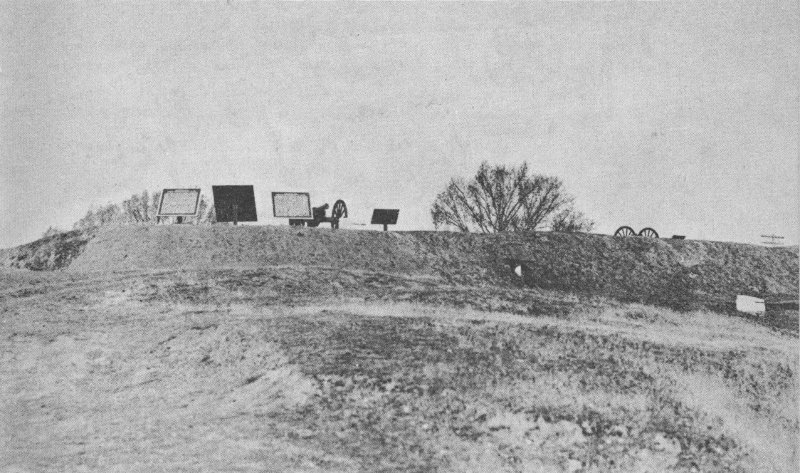
Confederate Railroad Redoubt. Plaques mark angle where fort wall was breached and entered by Union troops during the assault of May 22, 1863.
THE ASSAULT OF MAY 22.
While the probing operation of the 19th had failed, Grant further considered the important results which a successful assault would achieve. Such a move, however costly, would save a long siege. In the end, fewer men might be lost, and a growing threat to the Union rear—General Johnston raising troops near Jackson for the relief of Vicksburg—could be eliminated by quickly capturing Vicksburg and throwing the entire Union strength against Johnston. In addition, the Federal troops, spirited by recent victories and impatient to seize the prize for which they had campaigned so long, would not work so zealously in the trenches with pick and shovel unless 36 assault had failed. On the 21st, Grant issued orders for a general assault against Vicksburg the following day.
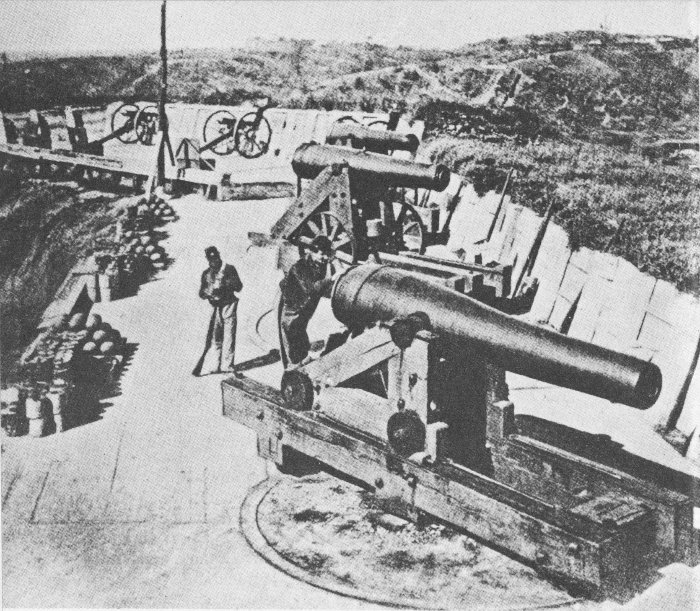
The heavy guns of this Union siege battery were borrowed from the Federal gunboats and used against the Confederate siege defenses. From Photographic History of the Civil War.
The Union assault of May 22 was delivered against the center of the Confederate siege line along a 3-mile front from Stockade Redan to Fort Garrott. The felled trees and thick undergrowth, as well as the precipitous faces of the ravines, restricted the scope of Union maneuver. Only a portion of Grant’s full strength could be brought into action, reserves being posted to exploit a breakthrough. Careful preparations preceded the attack: field batteries were run forward and emplaced to provide a covering fire for the infantry, and troops were advanced into concealed positions—in places, within 200 yards of their objective. Watches of all Union commanders were synchronized, the attack to begin simultaneously at 10 a. m. in order to prevent Pemberton from shifting his forces from one threatened point to another.
37
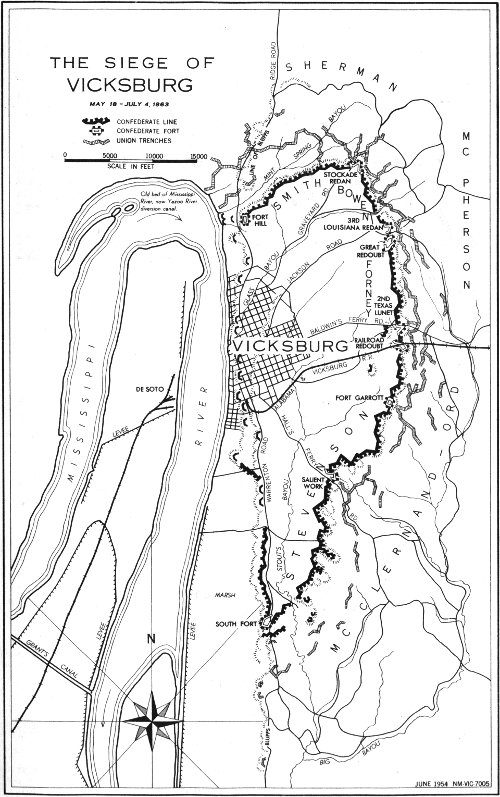
THE SIEGE OF VICKSBURG MAY 18-JULY 4, 1863
38
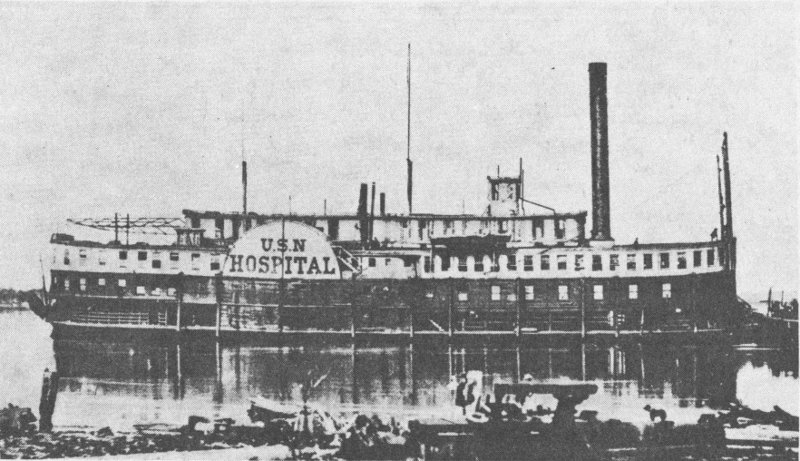
This hospital ship provided medical care for the sick and wounded of Grant’s Army during the Vicksburg operations. From Photographic History of the Civil War.
Of the six forts in the area of the grand assault, the Stockade Redan, under attack by Maj. Gen. Frank Blair’s Division of Sherman’s Corps, exemplified the day’s action in method and result. Blair’s men were faced with two formidable obstacles: the fort could be reached only by way of the Graveyard Road because of the deep ravines bordering the road, and the road was completely covered by the guns of the fort. In front of the fort was a deep ditch which protected it from attempts to climb the wall and enter the works. The night before, Sherman had decided that a bridge would be needed by his men to span the ditch. Only one source of lumber could be found—a frame house in which General Grant was sleeping. Informed of the need, Grant dressed and watched the house quickly torn down for bridging materials.
At the stroke of 10, the artillery bombardment of the fort ceased and the “Forlorn Hope”—a volunteer company of 150 men—raced from their position over the Graveyard Road toward the Stockade Redan, carrying the planks to bridge the ditch for the regiments to follow. Until the Federal troops almost reached the Confederate line, there was no sign of its defenders. Then the Southern soldiers “rose from their reclining position behind the works, and gave them such a terrible volley of musketry” that the road soon was nearly obstructed by the bodies of the killed and wounded, “the very sticks and chips, scattered over the ground jumping under the hot shower of Rebel bullets.”
Although two color-bearers climbed the wall of the fort and planted their flags near the crest, the remnants of regiments which reached 39 the ditch were unable to storm the walls and enter the redan. Attempting to prevent the fort garrison from firing down into the ditch, the Federal infantry swept the top of the wall with rifle fire. The toll was costly among the Confederate defenders, who fought back, using artillery shells as hand grenades and rolling them down among the Union troops in the ditch. After 4 hours of fighting, the attack was stalemated at Stockade Redan.
Union flags were placed also on the walls of the Great Redoubt and Second Texas Lunette, but it was at the Railroad Redoubt that a momentary breach was made in the Confederate defenses. Here, McClernand’s men reached the fort in force, and Sgt. Joseph E. Griffith and several comrades of the 22nd Iowa crawled through a gap in the wall, which had been blasted by Union artillery, and entered the outer works. All were shot down but Griffith. He was able to back out through the opening, bringing a dozen prisoners with him. When the Union assault threatened to engulf the fort, there was a call for Confederate volunteers to regain the lost ground. A volunteer company from the Texas Legion counterattacked and drove the Union troops from the outer defenses.
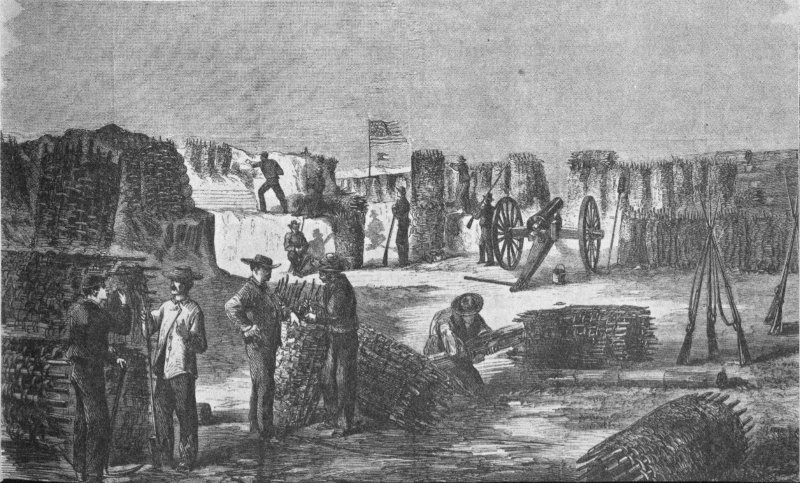
Union Battery Hickenlooper during the siege, within 100 yards of the Confederate line. From a wartime sketch.
Encouraged by his partial success, McClernand asked Grant for reinforcements and a renewal of the attack which, he felt, would enable his men to break the Confederate line. Grant ordered Sherman and McPherson to commit their reserves and create a diversion in McClernand’s favor. The renewed assault was shattered by the resolute Confederate defense. It served only to increase Union losses and to 40 intensify an already bitter controversy over McClernand’s military ability, which eventually resulted in his removal from command and the appointment of Maj. Gen. Edward Ord to head the XIII Corps. More than 3,000 Union soldiers lay dead or wounded in the ditches and on the slopes of the ridge. It was the last assault against Vicksburg.
UNION SIEGE OPERATIONS.
To bring the Union Army close against the Confederate defense line, construction of protected approaches was begun. As the siege progressed, “saps” or “approach trenches,” deep enough to conceal troops, zigzagged their way toward the works protecting Vicksburg. Ten major approaches were carried forward by pick and shovel details, each with a network of parallels, bomb proofs, and artillery emplacements. Over 60,000 feet of trenches and 89 artillery positions, mounting 220 guns, were completed. In the siege of Vicksburg “Spades were trumps.”
A Federal infantryman was later to recall that
Every man in the investing line became an army engineer day and night. The soldiers worked at digging narrow, zigzag approaches to the rebel works. Entrenchments, rifle pits, and dirt caves were made in every conceivable direction. When entrenchments were safe and finished, still others, yet farther in advance were made, as if by magic, in a single night. Other zigzag underground saps and mines were made for explosion under forts. Every day the regiments foot by foot, yard by yard, approached nearer the strongly armed rebel works. The soldiers got so they bored like gophers and beavers, with a spade in one hand and a gun in the other.
With an almost limitless ammunition supply, Federal sharpshooters and artillerymen kept up a relentless fire, giving the Confederates little opportunity to pick off the work parties which continued digging operations during the day. Pemberton’s ammunition supply dwindled each day. Considering the possible duration of the siege until an effective relief army might be assembled, the Confederate commander considered it “a matter of vital importance that every charge of ammunition on hand should be hoarded with the most jealous care.” He therefore issued strict orders that both rifle and cannon should be fired only when absolutely necessary. This prevented the Confederates from keeping up the steady, harassing fire needed to hold in check the Union siege activities.
Trench life for Grant’s soldiers was not so rigorous or dangerous as for the Vicksburg defenders. Food supplies were ample, although lack of pure water was a problem for both armies and resulted in considerable disease. The burning sun and frequent rains made life miserable for both “Yank” and “Reb.” Particularly as a result of the low ammunition stores of the Vicksburg army, Union losses during the siege, after the assaults of May 19 and 22, were comparatively light.
41
After the unsuccessful assault of May 22, only two attempts were made to break through the Confederate defenses, neither of which succeeded. Sherman, holding the Union right opposite the strong Fort Hill position, determined to reduce the fort with naval aid, and on May 27 the gunboat Cincinnati, protected by logs and bales of hay, moved into position and engaged the several batteries of that sector. Subjected to a deadly plunging fire which “went entirely through our protection—hay, wood, and iron,” the Cincinnati went down with her colors nailed to the stump of a mast.
The other attempt to pierce the defense line was by exploding a mine under the Third Louisiana Redan. Logan’s approach trench had reached the fort walls and from here a shaft was sunk under the fort and a powder charge prepared for its demolition. The Confederate garrison, hearing the miners’ picks at work beneath the fort, began countermines in a grim race for survival. On June 25, as the entire Union line opened fire to prevent shifting of reinforcements, a charge of 2,200 pounds of powder was exploded beneath the Third Louisiana Redan, creating a large crater into which elements of the 23rd Indiana and 45th Illinois raced from the approach trench. Anticipating this result, General Forney had prepared a second line of works in the rear of the fort where survivors of the blast and supporting regiments met the Union attack and drove it back. Still other mines were also being prepared by Union engineers at the time of the surrender.
CONFEDERATE TRENCH LIFE.
Siege life for the Confederate soldier was a hazardous ordeal; nearly 3,500 were killed or wounded. Because of the limited number of effective troops available to Pemberton, almost the entire Vicksburg Army had to be placed in the trenches; sufficient numbers were not available to rotate frontline duty as was done by the Federal Army. Never knowing when an attempt might be made to assault the defense line, it was necessary for them to be on guard at all times, enduring sun, rain, mud, poor and inadequate food, as well as the bullets and shells of the Union Army for 47 days and nights. The unending barrage of small arms and artillery fire, one Confederate exclaimed, “can be compared to men clearing land—the report of musketry is like the chopping of axes and that of the cannon like the felling of trees.”
Rations were generally prepared by details of soldiers behind the lines and carried to the troops at the breastworks. Coffee, the soldier’s staple, was soon unobtainable and an ersatz beverage introduced, the somewhat questionable ingredients of which included sweet potatoes, blackberry leaves, and sassafras. To replace the exhausted flour supply, a substitute was devised from ground peas and cornmeal. When this was baked over a fire, one soldier complained, “it made a 42 nauseous composition, as the corn-meal cooked in half the time the peas-meal did, so this stuff was half raw.... It had the properties of india-rubber and was worse than leather to digest.” Its effect on the digestive systems of the Confederate soldiers was possibly the equivalent of a secret Yankee weapon. A more famous, although not necessarily a more palatable, item of the besieged soldiers’ diet was the mule meat introduced late in the siege. General Pemberton heartily approved of its appearance, observing that mule proved “not only nutritious, but very palatable, in every way preferable to poor beef.”
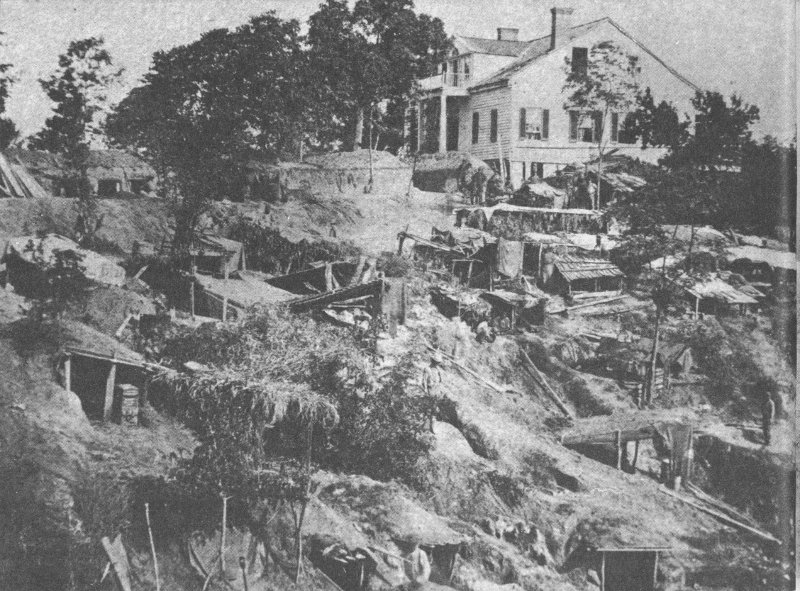
Bombproofs of the 45th Illinois in Union siege line. Shirley House in background is only surviving wartime building in the park. From Photographic History of the Civil War.
For protection against artillery fire, the Confederate troops dug bombproofs in the reverse slope of their fortified ridge. From these dugouts, bulwarked by heavy timbers, trenches connected with the fortifications, affording the besieged some degree of relaxation in reading or playing cards a few yards from the front line. To defend against surprise night attacks, they were forced to sleep on their arms in the trenches.
At night the unending bombardment from Porter’s fleet provided the troops of both armies with an awesome pyrotechnic display. Especially popular with the pickets were the giant 13-inch mortar shells whose sputtering fuses described a tremendously high arc in the blackness before disappearing into the city. It was a “wonderful spectacle,” one soldier remembered, “to see the fuse from the shells—and you could see them plainly—the comet or star-like streams of fire and then hear them coming down into the doomed city. We used to watch them while on picket at night.”
43
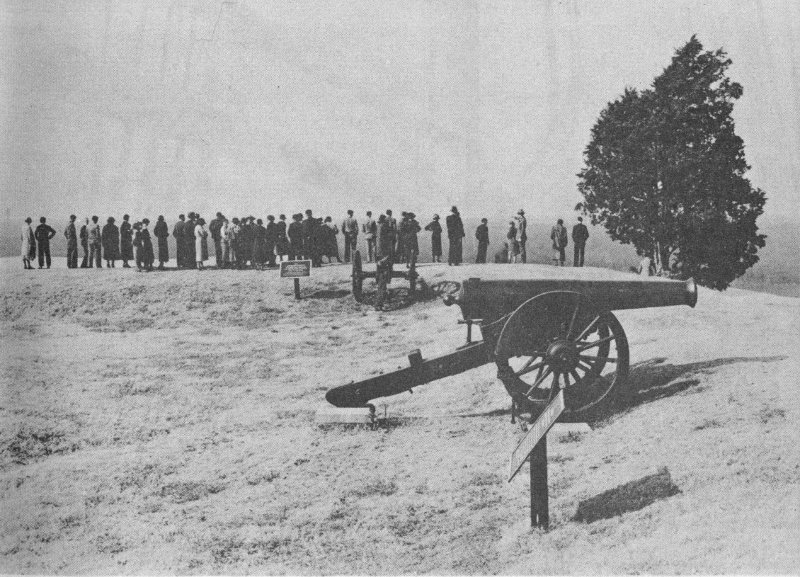
Fort Hill, on the Confederate left flank above Vicksburg, commanding the bend of the Mississippi.
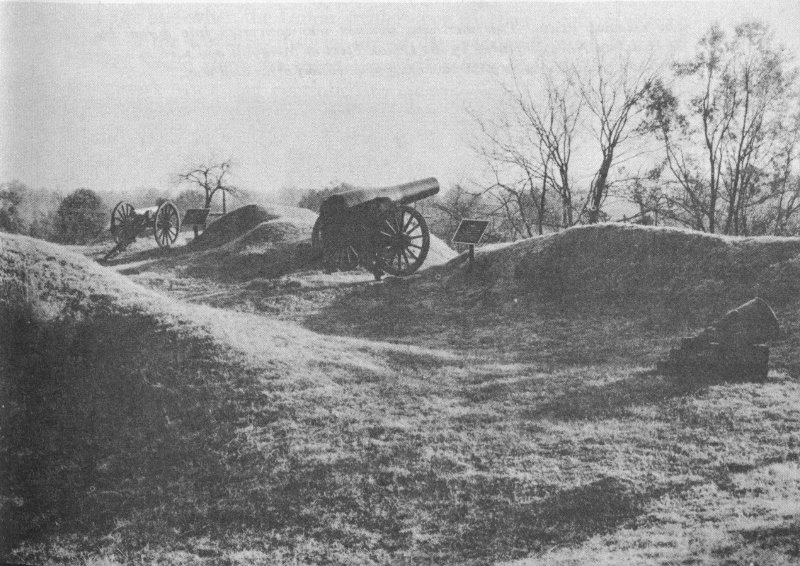
South Fort, on the Confederate right flank below Vicksburg, overlooking the Mississippi.
44
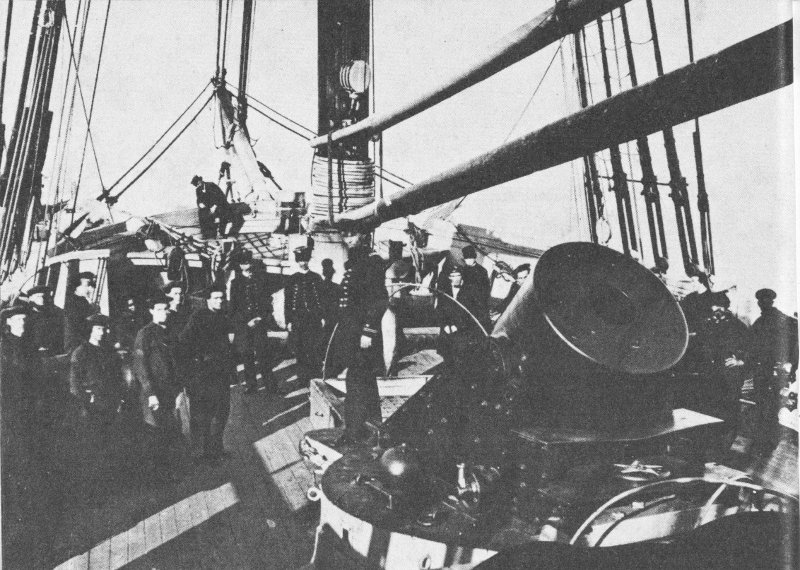
Each of Porter’s mortar boats carried one of these giant 17,000-pound mortars which hurled 200-pound shells into Vicksburg throughout the campaign and siege. Courtesy National Archives.
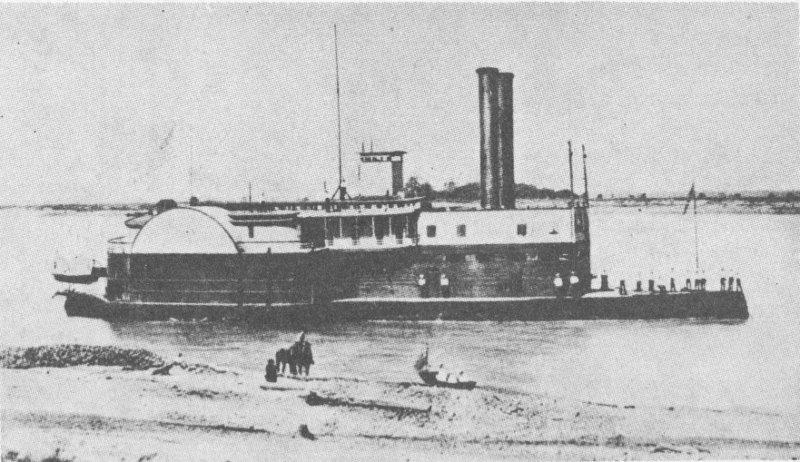
The General Price. This merchant steamer was converted into a ram by the Confederate Navy, captured by the Union Fleet at Memphis and used as a Federal gunboat against Vicksburg. From Photographic History of the Civil War.
45
Only when the Union trenches approached close to the defensive works were determined efforts made to halt the Union threat. Then the Union sap rollers (woven cane cylinders filled with earth or cotton rolled in front of the open end of the trench to protect the work party) became targets for destruction. Fuses were set on artillery shells which were then rolled down against the sap rollers, or they were ignited by Minié balls dipped in turpentine. Occasional night sallies succeeded temporarily in driving off Union work parties and filling up trenches, but no daylight forays were attempted by the Confederates.
CIVILIAN LIFE IN VICKSBURG DURING THE SIEGE.
For the civilian population of Vicksburg, the siege was a grim and harrowing experience. Ordered to evacuate the city or prepare to face siege, many of the townspeople preferred to remain and share the fate of the army. They were joined by refugees accompanying the Confederate retreat into the city. Vicksburg had been subjected to periodic naval bombardment during the year of preliminary action and continuously during the siege. For relief and protection against shellfire, many of the townspeople occupied caves dug into the city’s plentiful hillsides.
To the civilians, as to the Confederate soldiers, there seemed only three intervals during the day when the shelling ceased—8 a. m., noon, and 8 p. m.—when the Union artillerymen ate their meals. However, much of the accustomed social life of the town continued. Men and women passed along the streets despite frequent shell explosions, and the town’s newspaper continued to appear—finally printed on wallpaper. Despite the artillery fire, few civilians were killed, although many dwellings were destroyed or badly damaged. Over more and more buildings, as the siege progressed, the yellow hospital flags floated. Thousands of Confederate sick and wounded were brought into the city, many being cared for by the women of Vicksburg. In the latter stages of the siege the food stores of the city were badly depleted, placing the people of Vicksburg on extremely short rations.
FRATERNIZATION.
A unique feature of the American Civil War was the inclination of the private soldier—Union and Confederate—to fight with unrelenting ferocity during the engagements of the war and yet to engage in friendly intercourse with each other once the battle had ended, or even during lulls in the fighting. Swapping of Northern coffee for Southern tobacco was a commonplace picket activity in all 46 theaters of the war. In the long, weary siege of Vicksburg, the monotony was often lightened by jeers and pleasantries exchanged between lines. Many examples of soldier humor were recorded. The Confederates, taking grim delight in their ability to withstand the onslaughts of a steadily increasing Federal Army, would shout “When are you coming in Vicksburg for a visit?” To which a grimy, sweating Federal private would yell, “Not till you show better manners to strangers.”
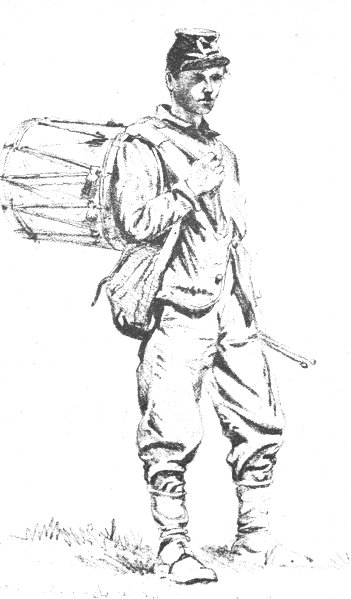
A Civil War drummer boy. From a wartime sketch.
To prevent surprise attacks, both armies posted pickets in advance of their lines at night. With the lines so close in the latter stages of the siege, pickets would often stand within a few feet of one another, or even side by side. Discussions of good shots and bad officers, or vice versa, helped to pass the long night watches. By common agreement, out of respect for the exposed and unprotected position of the sentinels, there was no firing at men on picket duty.
One Union veteran best remembered the siege of Vicksburg for 47 the nightly verbal exchanges with the “Rebs” when “we used to talk to each other after fighting all day.”
In the evening when everything had stopped for the day, some of our men or some of the Johnnies would yell, “hello Johnnie” or “hello Yank” “how did you enjoy the day?” The other would say “Fine;” then some one would say, “Johnnie, how do you like mule meat?” and they answer “Fine;” then “How do you like beef dried on the bone?” to which they would reply “Not so well; it is too close to the bone to be good.” Then some one would say, “Come over and we will give you some ‘sow belly’ to fry it in.” They would reply, “We can’t eat meat alone;” then the reply was, “We will give you some hardtack.” Then they would reply, “The tack you sent over today was so hard we could not chew it.” So you see how soon those on both sides forgot their troubles when night came, but in the morning about daylight, when the business of the day was about to open, we would say, “Watch out Johnnie, and hunt your hole,” and things were on in earnest for the day.
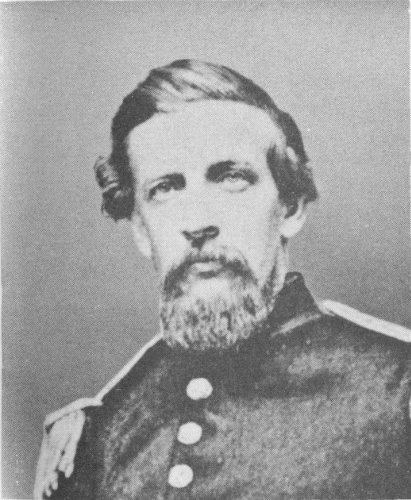
Maj. Gen. John S. Bowen, commanding the Confederate troops at the battle of Port Gibson. Courtesy Confederate Museum, Richmond.
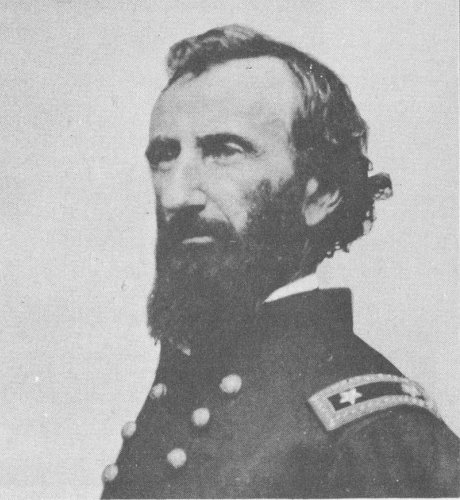
Maj. Gen. John A. McClernand, commanding the Union XIII Corps. Courtesy National Archives.
JOHNSTON’S DILEMMA.
Pemberton’s foremost objective in prolonging the siege had been to afford Johnston and the Confederate government time to collect sufficient troops to raise the siege. But shortly after Grant had invested the city, Gen. Robert E. Lee’s Army of Northern 48 Virginia began its invasion of the North, which ended on the field of Gettysburg. No troops could be spared from that point. To have removed troops from Lt. Gen. Braxton Bragg’s army in Tennessee would have dangerously weakened that place in a desperate attempt to save the Mississippi. Johnston wired Secretary of War James A. Seddon “We cannot hold both.”
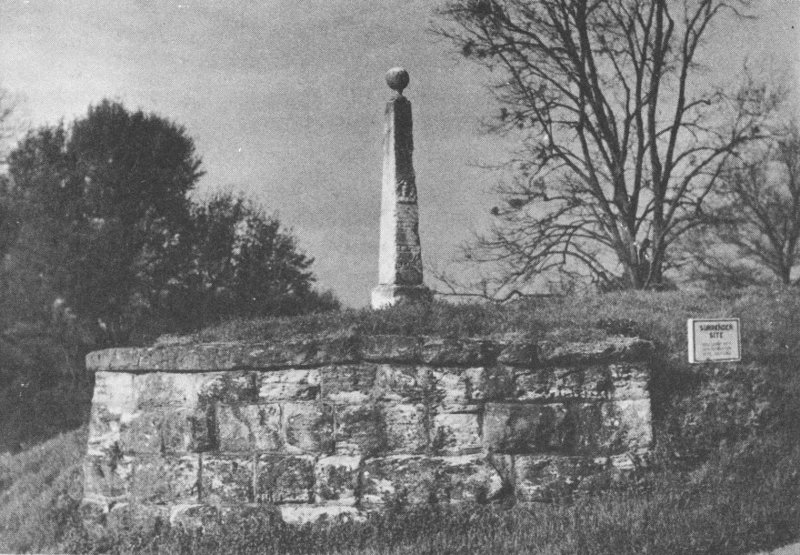
The Surrender Site. The monument was erected and inscribed by Union soldiers on spot where Grant and Pemberton met.
During June, General Johnston had succeeded in increasing his force to about 30,000, many of whom were green troops, but efforts to secure adequate weapons, ammunition and wagons to equip the regiments had been only partly successful. Preparing to encounter an expected move by Johnston against his rear, Grant used reinforcements arriving from Memphis to construct and man a strong outer defense line facing Johnston’s line of advance. Grant then had two lines of works, one to hold Pemberton in, the other to hold Johnston out. While Seddon notified Johnston “Rely upon it, the eyes and hopes of the whole Confederacy are upon you, with the full confidence that you will act, and with the sentiment that it is better to fail nobly daring, than, through prudence even, to be inactive,” Johnston notified his government on June 15 “I consider saving Vicksburg hopeless.”
On July 1, Johnston moved his army of 4 infantry and 1 cavalry divisions to the east bank of the Big Black River, seeking a vulnerable place to attack Grant’s outer defenses. His reconnaissance during the 49 next 3 days convinced him that no move against the Federal position was practicable. Receiving word of the surrender on July 4, he withdrew to Jackson.
THE SURRENDER OF VICKSBURG.
By July, the Army of Vicksburg had held the line for 6 weeks, but its unyielding defense had been a costly one. Pemberton reported 10,000 of his men so debilitated by wounds and sickness as to be no longer able to man the works, and the list of ineffectives swelled daily from the twin afflictions of insufficient rations and the searching fire of Union sharpshooters. Each day the constricting Union line pushed closer against the Vicksburg defenses, and there were indications that Grant might soon launch another great assault which, even if repulsed, must certainly result in a severe toll of the garrison. (Grant had actually ordered a general assault for July 6, 2 days after the surrender.)
General Pemberton, faced with dwindling stores and no help from the outside, saw only two eventualities, “either to evacuate the city and cut my way out or to capitulate upon the best attainable terms.” Contemplating the former possibility, he asked his division commanders on July 1 to report whether the physical condition of the troops would favor such a hazardous stroke. His lieutenants were unanimous in their replies that siege conditions had physically distressed so large a number of the defending army that an attempt to cut through the Union line would be disastrous. Pemberton’s only alternative, then, was surrender.
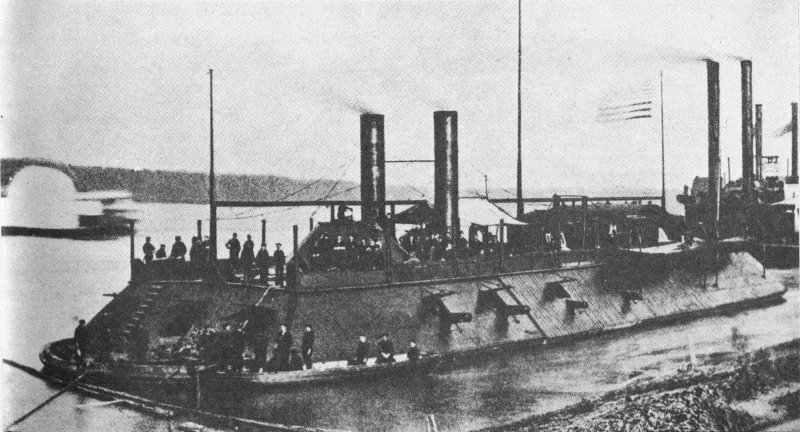
The Union ironclad gunboat Cairo, sunk by a Confederate “torpedo” (mine) near Vicksburg. From Photographic History of the Civil War.
50
David and Goliath of the Union fleet, photographed at Vicksburg after the surrender:
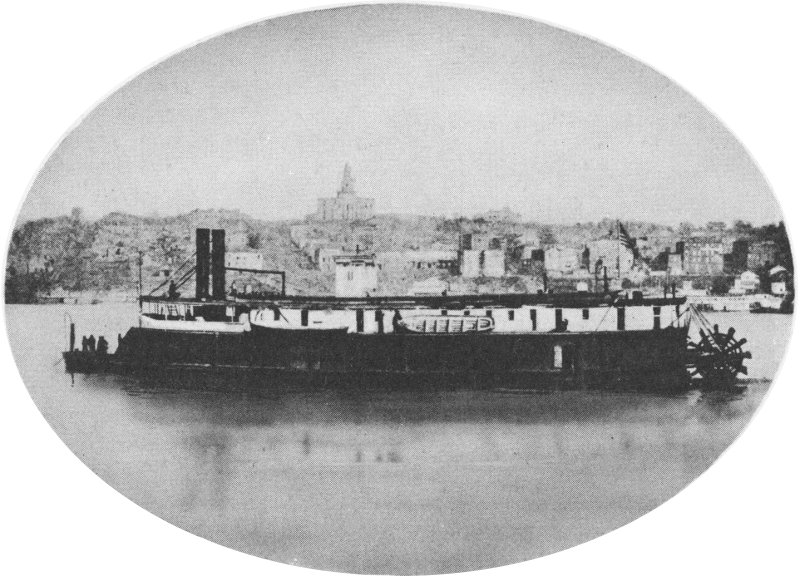
A patrol boat, the “tinclad” Silver Lake.
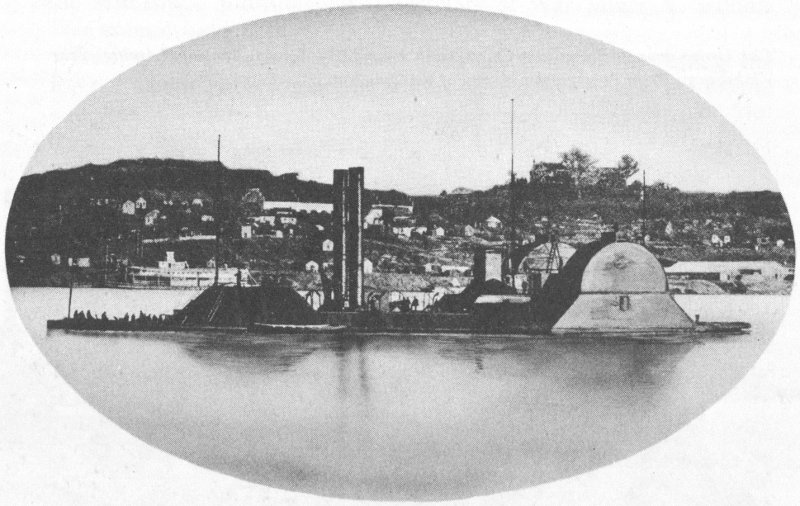
The powerful ironclad ram Choctaw. From Photographic History of the Civil War.
51
Although not requested, Pemberton also received the verdict of his army in a message from an unknown private, signed “Many Soldiers.” Taking pride in the gallant conduct of his fellow soldiers “in repulsing the enemy at every assault, and bearing with patient endurance all the privations and hardships,” the writer requested his commanding general if he would “Just think of one small biscuit and one or two mouthfuls of bacon per day,” concluding with the irrefutable logic of an enlisted man, “If you can’t feed us, you had better surrender us, horrible as the idea is.”
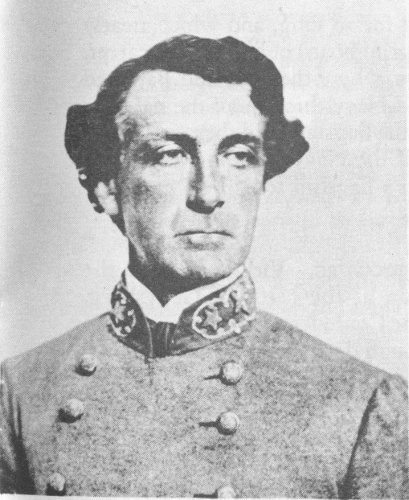
Maj. Gen. M. L. Smith, commanding the Confederate left at Vicksburg. Courtesy Library of Congress.
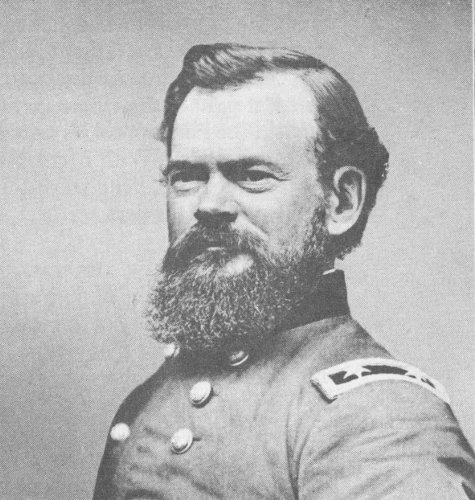
Maj. Gen. James B. McPherson, commanding the Union XVII Corps. Courtesy Library of Congress.
On July 3, white truce flags appeared along the center of the Confederate works. A few hours later, Grant and Pemberton met beneath an oak tree, on a slope between the lines, to arrange for the capitulation of Vicksburg and its army of 29,500. It had been 14 months since Farragut’s warships had first engaged the Vicksburg batteries, 7 months since Grant’s first expedition against the city, and 47 days since the beginning of the siege. On the morning of July 4, 1863, while Northern cities celebrated Independence Day, Vicksburg was formally surrendered. The Confederate troops marched out from their defenses and stacked their rifles, cartridge boxes, and flags before a hushed Union Army which witnessed the historic event without cheering—a testimonial of their respect for the courageous defenders of Vicksburg, whose line was never broken.
52
Into the city which had defied him for so long, and which nearly proved the graveyard rather than the springboard of his military career, rode General Grant. At the courthouse, where the Stars and Bars had floated in sight of the Union Army and Navy throughout the siege, he watched the national colors raised on the flagstaff, and then proceeded to the waterfront. With every vessel of the Navy sounding its whistle in celebration, he went aboard Porter’s flagship to express gratitude for the work of the fleet.
THE SIGNIFICANCE OF THE FALL OF VICKSBURG.
Vicksburg, and the simultaneous repulse of Lee’s invasion at the battle of Gettysburg, marked the beginning of the end for the Confederacy. Previously, there had been confidence that victory, although demanding desperate measures, could yet be achieved. Afterward, there was only the hope that the North might sicken of the frightful cost of continuing the war and terminate hostilities. The great objective of the war in the West—the opening of the Mississippi River and the severing of the Confederacy—had been realized with the fall of Vicksburg. While in the East the Union armies battled on in bloody stalemate before Richmond, the armies of the West would now launch their columns deep into the vitals of the Confederacy.
Grant emerged from the Vicksburg campaign with a hard-won reputation as a master strategist, which prompted President Lincoln to place him in supreme command of all the armies of the United States. From this position he was destined to direct the final campaigns of the Civil War and to receive Lee’s surrender at Appomattox. As for Pemberton, the fall of Vicksburg subjected him to painful criticism from those who held that a more resourceful defense might have saved the city, or his army, or both. Essentially, both commanders had disobeyed orders in like manner—Grant in striking behind Vicksburg alone rather than waiting to combine forces with Banks; Pemberton in deciding to protect Vicksburg at all cost rather than joining Johnston and risking loss of the city. But Grant’s gamble had succeeded and Pemberton’s had failed; and in war, as a leading Confederate commander had soberly remarked, the people measure a general’s merit by his success. “I thought and still think that you did right to risk an army for the purpose of keeping command of even a section of the Mississippi River,” President Davis wrote to General Pemberton after the fall of Vicksburg. “Had you succeeded none would have blamed, had you not made the attempt few if any would have defended your course.”
In the Confederate capital, Gen. Josiah Gorgas, one of the most able of Southern leaders, confided to his diary the implications of the calamitous change in fortune to the South attending the twin disasters of Gettysburg and Vicksburg:
53
Events have succeeded one another with disastrous rapidity. One brief month ago we were apparently at the point of success. Lee was in Pennsylvania threatening Harrisburgh, and even Philadelphia. Vicksburgh seemed to laugh all Grant’s efforts to scorn.... All looked bright. Now the picture is just as somber as it was bright then. Lee failed at Gettysburgh.... Vicksburgh and Port Hudson capitulated, surrendering thirty-five thousand men and forty-five thousand arms. It seems incredible that human power could effect such a change in so brief a space. Yesterday we rode on the pinnacle of success—today absolute ruin seems to be our portion. The Confederacy totters to its destruction.
In Washington, a grateful President sat at his desk seeking words to express appreciation to Grant “for the almost inestimable service you have done the country.” Explaining the fear he had entertained that the Union Army might be destroyed during its daring thrust in the rear of Vicksburg, which he believed at the time to be “a mistake,” Lincoln wrote to Grant, “I wish now to make the personal acknowledgement that you were right and I was wrong.”
On July 9, the Confederate commander at Port Hudson, upon learning of the fall of Vicksburg, surrendered his garrison of 6,000 men. One week later the merchant steamboat Imperial tied up at the wharf at New Orleans, completing the 1,000-mile passage from St. Louis undisturbed by hostile guns. After 2 years of land and naval warfare, the Mississippi River was open, the grip of the South had been broken, and merchant and military traffic had now a safe avenue to the gulf. In the words of Lincoln, “The Father of Waters again goes unvexed to the sea.”
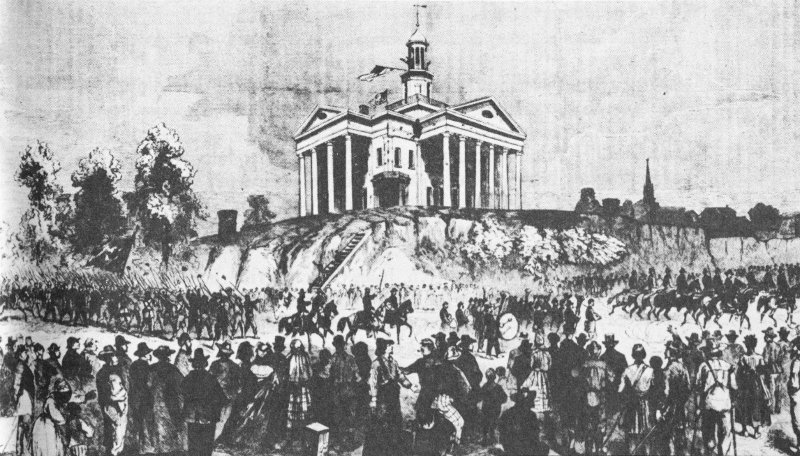
The Union Army passing the courthouse as it took possession of Vicksburg on July 4, 1863. From a wartime sketch.
54