The Bayou Expeditions: Grant Moves Against Vicksburg—and Fails
Reading edition
By the end of January, Grant had arrived at the Union encampment at Milliken’s Bend, 30 miles north of Vicksburg, and assumed leadership of the operations against Vicksburg. His army, numbering about 45,000, was divided into three corps under General Sherman, Maj. Gen. John McClernand, and Maj. Gen. James Birdseye McPherson. Cooperating with the army, and providing aid without which the bayou expeditions would not have been possible, was the Western Flotilla under Porter. This fleet consisted of 11 ironclads, 38 wooden gunboats, rams, and sundry auxiliary craft mounting over 300 guns and carrying a complement of 5,500. The war in the West now hinged upon the effectiveness of this combined land and naval force. Under Grant’s direction it maneuvered over hundreds of miles of river and bayou seeking to outflank Vicksburg. The capture of the city would result not from great battles but from a war of movement.
THE GEOGRAPHICAL PROBLEM OF VICKSBURG.
The capture of Vicksburg proved difficult partly because of the topography of the area, which so favored defense of the city as to render the fortress almost impregnable 9 to attack. To move against the city it was necessary to reach the bluffs which extended north and south and on which Vicksburg had been built. Behind the bluffs, to the east, lay dry ground on which an army might maneuver; below the bluffs, on both sides of the river, flooded swamplands prevented ground movements. With his army behind the bluffs, either above or below, Grant might come to grips with Pemberton’s Army of Vicksburg. Unless he reached the bluffs, capture of the city would be impossible; it could not be assaulted from the river.
The line of bluffs which marks the eastern boundary of the Mississippi Valley leaves the river at Memphis, curves in a great 250-mile arc away from the river, and then swings back to reach the river again at Vicksburg. Enclosed between the bluffs and the river is the “Delta”—a strip of land averaging some 60 miles in width, which is now a fertile, well-drained, cotton-growing region. In 1863, it was a swampy bottom land containing numerous rivers and bayous, subject to incessant floods. It was covered with thick forests and dense undergrowth, a condition, which, according to Grant’s engineer officer, “renders the country almost impassable in summer, and entirely so, except by boats, in winter.” This impenetrable swampland, lying before the bluffs, effectively guarded Vicksburg’s right flank. Unless the waterways of the Delta might provide a passage to the bluffs, operations against Vicksburg to the north were hopeless.
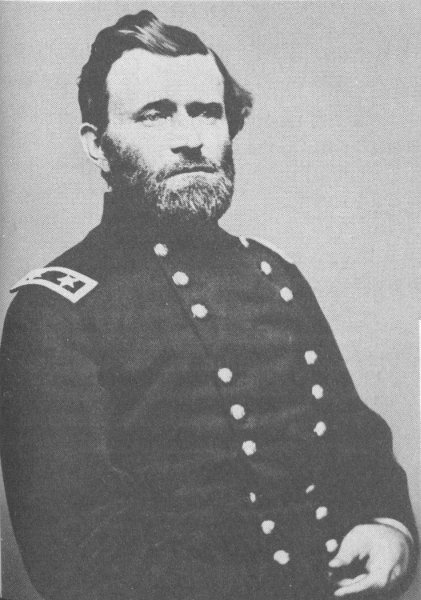
Maj. Gen. U. S. Grant, commanding the Union Army of the Tennessee. Courtesy National Archives.
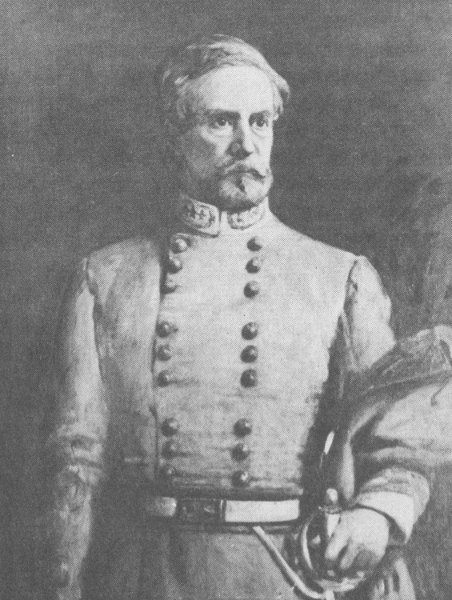
Lt. Gen. John C. Pemberton, commanding the Confederate Army of Vicksburg. Courtesy Flohr Studio, Vicksburg.
10
South of Vicksburg the prospect for the Union Army was equally dismal. After meeting the river at Vicksburg, the bluffs follow the river course closely to the south and were accessible, therefore, to troops from the Mississippi River. But the river batteries of the city prevented passage of transports to the river below; for troops to get below the city it was necessary to move through the Louisiana lowlands west of the river. This region was like the Delta north of Vicksburg—flooded bottom lands interspersed with bayous, rivers, and lakes. It would prove equally obstinate to land movements.
To increase Grant’s difficulties, his campaign against Vicksburg was begun during the wet season when streams were overflowing and lowlands impassable. The winter of 1862-63 was a period of unusually high water, the Mississippi cresting higher than its natural banks from December until April. Had Grant reached Vicksburg during the dry season, his problem would have been less formidable.
Until the bottoms were dry enough to permit land movements, the Union commander felt himself compelled to keep the army active. Even if success along the water routes seemed unlikely, he reasoned that prolonged idleness would be injurious to the health and morale of his troops. Grant had come to believe that military success was won by the aggressive. To Grant’s critics, who demanded that he open the Mississippi without delay or be replaced by someone who could, Lincoln replied, “I can’t spare this man; he fights.”
As Pemberton prepared to defend Vicksburg he was beset by difficulties rivaling those of his opponent, despite the topography which was friendly to his defensive purpose. Vicksburg would be secure only so long as the Confederate Army could prevent Grant from achieving a foothold on the high ground above or below the city. Yet, to prevent such a lodgment, it was necessary for Pemberton to defend a wide front extending 200 miles above and below Vicksburg, at any point along which Grant might strike. To cover this large area the Confederate commander would have to disperse his limited garrison dangerously and at the same time retain sufficient troops to protect the city—his primary responsibility. Under such conditions it was essential for Pemberton to receive information of Federal movements in order to concentrate his troops rapidly to meet the advance. Yet Pemberton was almost wholly lacking in cavalry and had no navy to interfere with and report Union progress through the rivers and bayous. Both Pemberton and Grant faced exacting problems in command during the Vicksburg operations.
GRANT’S CANAL.
Vicksburg’s location on the horseshoe bend of the river had suggested a solution to the Vicksburg problem the previous summer. By digging a canal across the peninsula below Vicksburg and diverting the river through it, unarmored transports could bypass the city batteries and deliver troops safely to the bluffs below. In January, Sherman’s Corps, assisted by dredging machines, began excavation of the mile-long canal. This project continued until March when a sudden rise in the river flooded the peninsula, driving the troops to the levees, and destroying much of their work.
11
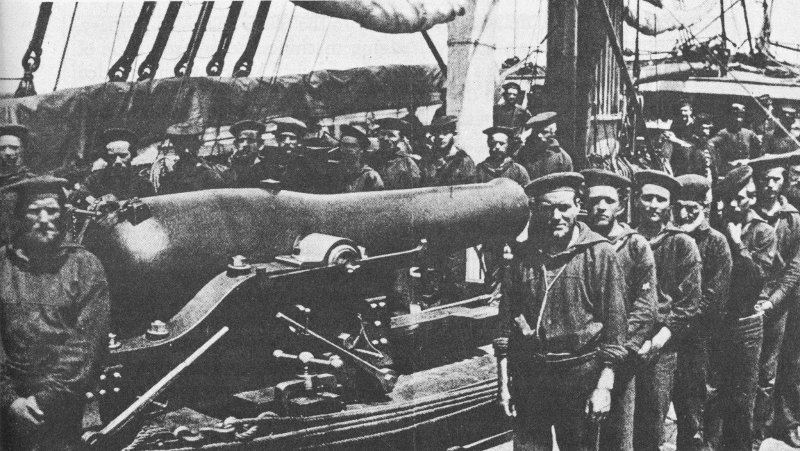
Pivot-gun and crew of the Union warship Wissahickon, which fought the Vicksburg batteries. From Photographic History of the Civil War.
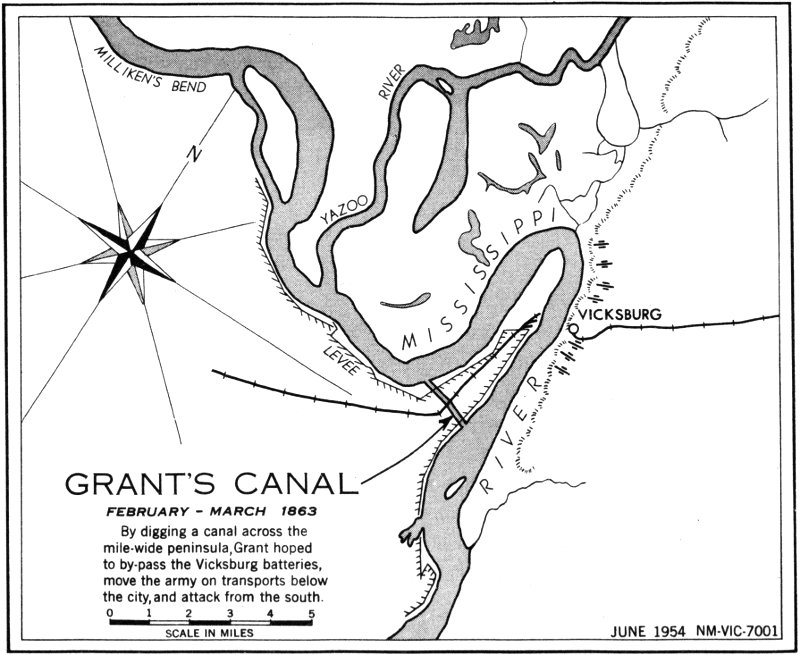
GRANT’S CANAL FEBRUARY-MARCH 1863
By digging a canal across the mile-wide peninsula, Grant hoped to by-pass the Vicksburg batteries, move the army on transports below the city, and attack from the south.
12
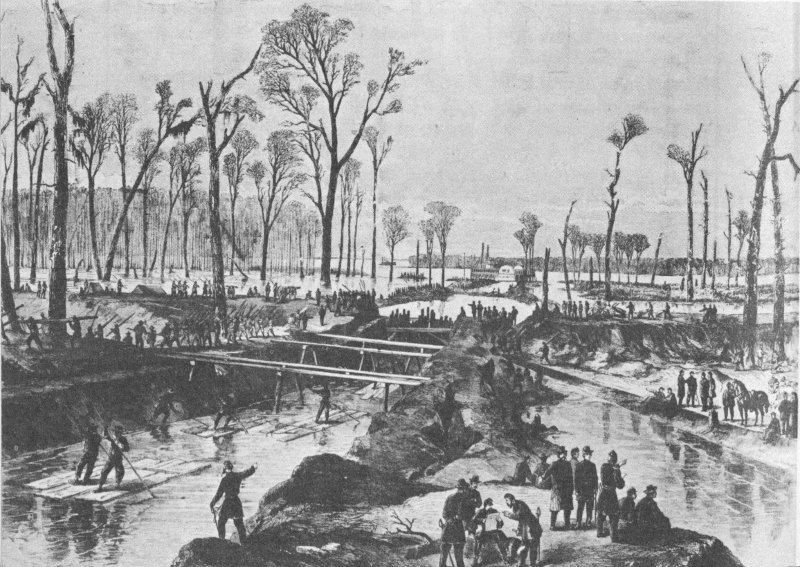
Union soldiers at work on Grant’s canal opposite Vicksburg. From a wartime sketch.
DUCKPORT CANAL.
A similar effort to turn Vicksburg’s left flank was essayed by cutting a canal at Duckport, between Milliken’s Bend and Vicksburg. By this avenue it was hoped vessels might leave the Mississippi above Vicksburg, pass through a series of circuitous bayous and emerge again on the Mississippi 20 miles below the city. The route was laboriously opened for navigation and one small steamer safely passed to the river below. Then the level of the river fell and blocked the Duckport attempt.
LAKE PROVIDENCE EXPEDITION.
While the canal work was in progress, McPherson’s Corps was assigned the opening of the Lake Providence route. The objective of this activity was the turning of Vicksburg’s left flank by passing southward through the Louisiana waterways to reach the bluffs below the city. A canal was cut to provide entrance from the Mississippi into Lake Providence, 75 miles above Vicksburg. From Lake Providence a route was surveyed through the labyrinth of bayous, lakes, and rivers by which a fleet might emerge again on the Mississippi 200 miles below the city and move on Vicksburg from the south. While presenting great difficulties to navigation, the entire 400 miles would be safe from enemy action. By the end of March 1863, McPherson’s men had almost cleared the route for navigation. The dredging of shoals and the sawing off of trees far enough below the water to permit passage of the transports proved the most severe obstacles. Before this long and extremely difficult route could be completed, however, other, more likely, plans were formulated, and the Lake Providence expedition was recalled.
13
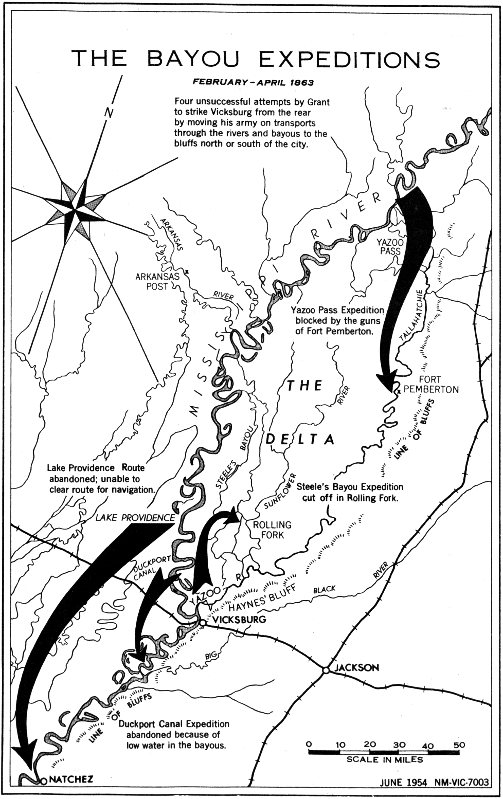
THE BAYOU EXPEDITIONS FEBRUARY-APRIL 1863
Four unsuccessful attempts by Grant to strike Vicksburg from the rear by moving his army on transports through the rivers and bayous to the bluffs north or south of the city.
Yazoo Pass Expedition blocked by the guns of Fort Pemberton.
Lake Providence Route abandoned; unable to clear route for navigation.
Steele’s Bayou Expedition cut off in Rolling Fork.
Duckport Canal Expedition abandoned because of low water in the bayous.
14
THE YAZOO PASS EXPEDITION.
The Yazoo Pass project, which sought to turn the right flank of Vicksburg by sending an expedition through the Delta waterways to the bluffs north of the city, was for a time the most promising of the bayou attempts. By exploding a mine in the Yazoo Pass, 325 river miles north of Vicksburg, access from the Mississippi into the rivers of the Delta was secured. With paddle wheels reversed against the roaring current which surged through the crevasse, and suffering extensive damage in collisions with trees and floating debris, the gunboats and transports carrying a division of infantry began the hazardous journey. Almost a month was required to reach the calmer waters of the Coldwater River.
Notified of the threat, Pemberton dispatched Maj. Gen. W. W. Loring’s Division to halt the Union advance. Fort Pemberton, overlooking the Yalabusha River 90 miles north of Vicksburg, was quickly constructed of earth and cotton bales. The land surrounding the fort was completely flooded, permitting approach by water only. On March 11, the Union gunboats began an artillery bombardment and were promptly greeted by a heavy return fire as “Old Blizzards” Loring gained his nickname by pacing the parapet and urging his gunners to, “Give them blizzards, boys! Give them blizzards!” Grant had planned to send 30,000 men through the Yazoo Pass; but Loring’s gunners blasted back every attempt to pass the fort, forcing the fleet to withdraw. The Yazoo Pass expedition was one of the great flanking attempts of the war—the route from Milliken’s Bend to the rear of Vicksburg through the pass was over 700 miles, yet it was only 30 miles direct from Milliken’s Bend to Vicksburg.
THE STEELE’S BAYOU EXPEDITION.
The last and most extraordinary of Grant’s unsuccessful attempts to reach Vicksburg was the Steele’s Bayou expedition through 200 miles of narrow, twisting bayous north of Vicksburg. Like the Yazoo Pass operation, it was an effort to turn the city’s right flank. This shorter route had been originally scouted in order to send aid to the Yazoo Pass expedition when that column seemed in great danger of being cut off and captured. Further exploration 15 suggested the route to the bluffs by way of Steele’s Bayou might prove the best of all possible approaches to Vicksburg, and Porter himself commanded the squadron of 11 vessels which entered Steele’s Bayou from the Yazoo River on March 16.
The route was heavily obstructed by natural hazards, but Porter, warned by apprehensive officers who feared that superstructures would be carried away in crashing through the closely overhung waterways, answered with the declaration, “All I need is an engine, guns, and a hull to float them.” Progress was slow through winding streams barely wide enough to admit passage of the gunboats. This time alert Confederates, aided by treacherous obstructions in the mouth of the Rolling Fork, nearly succeeded in shutting up and capturing the entire fleet by felling huge trees across the bayou to block Porter’s retreat.
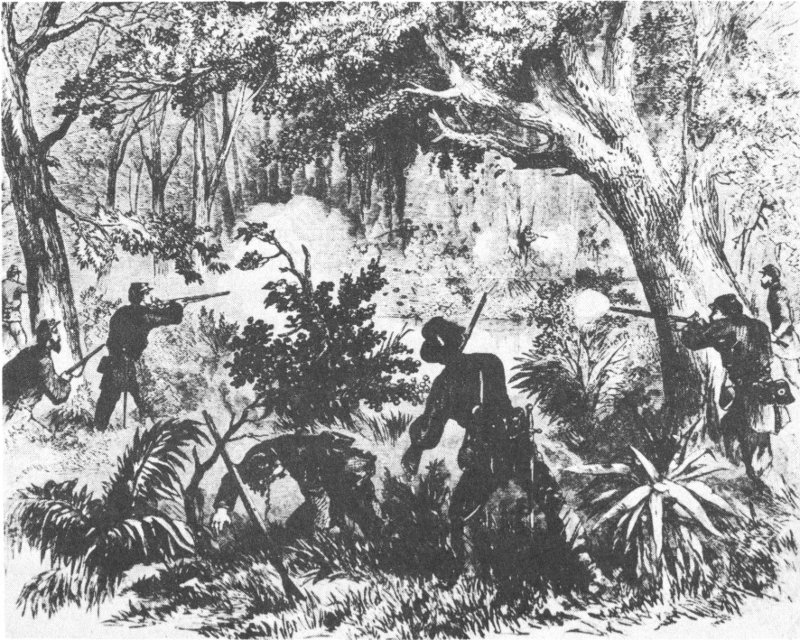
Skirmishing in the heavily wooded and flooded bottom lands during the bayou expeditions. From a wartime sketch.
Sherman, following behind the fleet with infantry, received word of Porter’s danger, and an eerie night march ensued. By the flaring light of candles held in the muzzles of their rifles, the Federal soldiers splashed through the canebrake hip deep in water and arrived in time to drive off the Confederates who had moved in behind the Union fleet. Three days were required to back the fleet to safety on the Mississippi, which was reached late in March. Grant had now tested 16 all possible approaches to Vicksburg as he attempted to swing wide around its flanks to the north and south. Every effort had failed. In April, the Union Army was no closer to Vicksburg than it had been in December. The Southern bastion on the Mississippi had successfully withstood Union land and naval attacks for almost a year.