VERDUN DURING THE BATTLE OF THE MARNE
Reading edition
After the French manœuvre at the frontiers was checked and with the threat of a German envelopment in the West, General Joffre steadfastly withdrew from the battle and ordered a general retreat until the moment when the French troops were reunited. As soon as a favourable moment offered, it would be possible to take up a position and then to drive back the enemy.
The plan was as follows: to carry out on the left a mass movement (6th Army under Maunoury) to outflank, at the propitious moment, the German right, while a general attack or at any rate a desperate resistance should take place on all the rest of the front, from Paris to the Vosges.
The enemy's objective was first of all to wipe out the allied forces, the right having instructions to pursue the French left and the English army, before turning upon Paris which was to be seized like a plum ready to be picked! In the centre, the Crown Prince was in command of the pursuit: he saw his fourth cavalry corps pushing out their scouts towards the line, Dijon-Besançon-Belfort.
Here were dreams of triumph destined to give place to surprise, then doubt and finally the bitterness of defeat.
On September 5th, Gallieni reported the Germans creeping towards the South-East. The moment for the French manœuvre had arrived and Joffre launched the general offensive.
On September 6th-7th, the Sixth Army attacked the German right wing. To guard himself against this flank menace, Von Kluck brought up three army corps in succession from his frontal attack.
September 7th-8th. This diminution of strength allowed the English Army and the second French Army under Franchet d'Esperey to advance.
September 9th-10th. The Second Army threatened to cut off the contact between the First and Second German Armies and to take them in rear. Under this threat they determined upon a hasty retreat the effect of which made itself gradually felt along the whole of the German front (September 10th-13th).
The part played by Verdun in the defence and by the Third Army in the battle.
After the battle of the Frontiers, the Third Army likewise beat a retreat. Having reached the left bank of the Meuse, the army pivoted on its right which rested on the fortress of Verdun, stopping frequently to delay the pursuit of the Crown Prince's army.
September 6th, 7th and 8th. While the Duke of Wurtemburg pressed heavily upon the right of the Fourth Army (under Langle de Cary), the Crown Prince vigorously set upon the left of Sarrail in an attempt to break completely through the pivot by Trouée de Revigny, valleys of Ornain and Saulx. He hoped to cut off Sarrail who, when attacked at the same time in rear on the Heights of the Meuse, would find himself surrounded and forced to surrender. But these ambitious plans were thwarted by the vigorous action of the left of the Fifth Corps and the Fifteenth which was withdrawn en masse from the Army of Lorraine (under Castelnau).
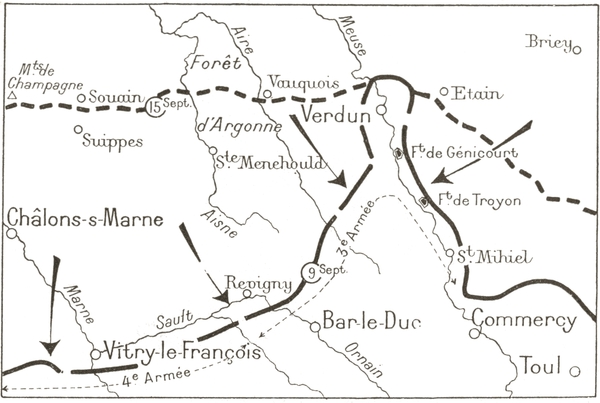
The Battle of the Marne.—The Third Army in front of Verdun.
September 9th. On its left the Third Army continued to engage the Germans on the flank, while the right wing, though vigorously holding its ground before frontal attacks, remained in a precarious position owing to the standing menace of the German forces in rear on the Hauts-de-Meuse. Sarrail received permission from the General-in-Chief to withdraw his right, if need be, and to leave the permanent garrison of Verdun to secure the defence of the Fortress. But the General of the Third Army held fast with heroic determination and would not give up his entrenched position as long as the Meuse was not liberated and while a ray of hope appeared.
September 10th. The forts of Troyon and Genicourt, on the Hauts-de-Meuse, continued to hold out against heavy artillery bombardment. The barrier of the Meuse was not cleared but, to guard against any eventuality, Sarrail transferred two divisions to the West of Saint-Mihiel.
September 11th, 12th, 13th, 14th. Coming from the German right, the advancing wave gradually overtook the armies of the Prince of Wurtemburg and the Crown Prince. The two latter, mad with rage, were forced to withdraw their forces in echelon, while Sarrail's army pivoting round Verdun harassed the enemy as far as Argonne. Thus the battle of the Marne was won by the same troops who had just undergone the repulse of the battle of the Frontiers and, when overwrought with fatigue, had successfully accomplished a retreat unprecedented in history. The undaunted spirit of Commander-in-Chief Joffre, the well-defined and masterful strategy which he planned and carried out in strict collaboration with his highly courageous army commanders, above all the superhuman bravery of the rank and file, to these factors is due what to-day we call "The Miracle of the Marne".
"The fate of the War was settled at its commencement, in 1914, on the Marne, where the French General indeed saved France against the fierce onslaught of a whole nation."
So wrote the Berliner Tageblatt after the War.
AFTER THE MARNE, THE BATTLE FOR VERDUN
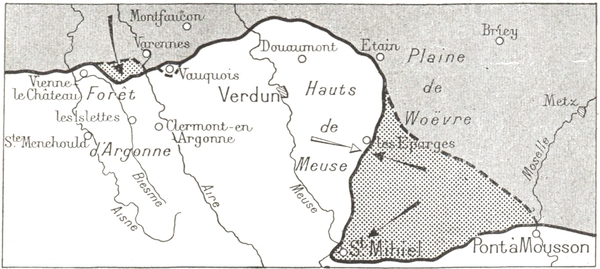
October 1914-August 1915.—The enemy strove to cut off Verdun. On the East, the Salient of Saint-Mihiel. On the West, the battle of Argonne.
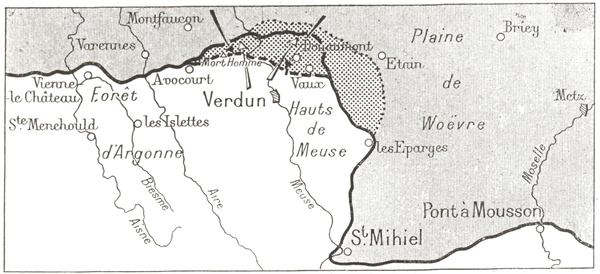
February 1916-August 1916.—In a terrific and desperate encounter the enemy threw themselves at Verdun. They were hurled back by a magnificent defence.
October 1916-August 1917.—Three French attacks drove the enemy back to their original attacking positions.
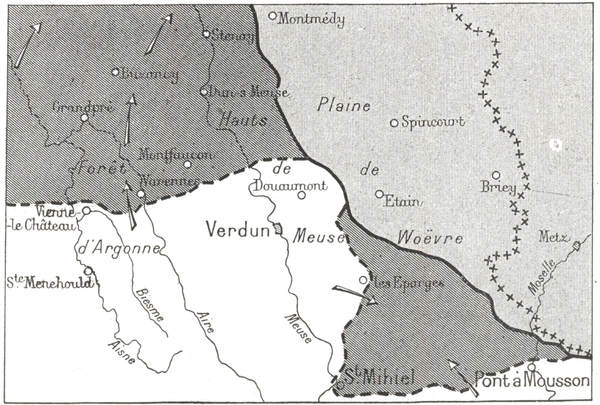
September-November 1918. The Salient of Saint-Mihiel was straightened during the great final offensive when Verdun was completely liberated by the French-American forces.
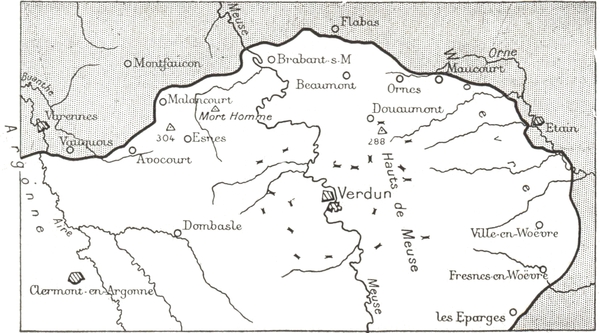
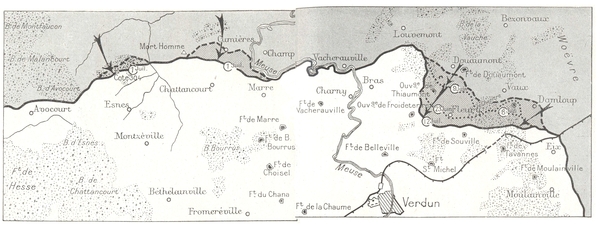
The line in front of Verdun, as it was in February 1916.
THE STABILISATION OF THE FRONT BEFORE VERDUN (September-October 1914) The formation of the Saint-Mihiel salient.
After the battle of the Marne, the Crown Prince established his lines of resistance north of the fortress, on the line Avocourt-Melancourt-Brabant-Ornes.
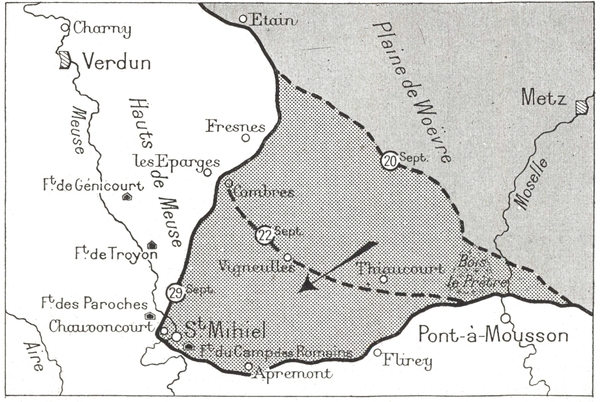
The formation of the Saint-Mihiel Salient (September 1914).
On September 20th, the third Bavarian Corps attacked the 75th reserve division, advanced rapidly on the 22nd as far as the line Combres-Vigneulles-Thiaucourt and bombarded the forts of the Hauts-de-Meuse. This line was defended by mobile troops outnumbered by two to one.
On the 25th, the Germans succeeded in getting a footing on the Hauts-de-Meuse in the region of Vigneulles. From there they pushed on to Saint-Mihiel and entered the town, without however being able to cross the Meuse. But on the following day, the river which was only defended at this point by a battalion of territorials was cleared, and the Germans started to climb again towards the valley of Aire, in the direction of Verdun. At this dangerous moment, the sixteenth corps which had left Nancy met the German forces, harassing them and forcing them to fall back on the suburbs of Saint-Mihiel. It did not, however, succeed in forcing them to withdraw on the right bank of the Meuse. On September 29th the line ran through Combres, Chauvoncourt, Apremont, Flirey, Le Bois le Prêtre.
The salient was made.
The enemy were attacked without cessation during the months of October, November and December. Towards Saint-Mihiel the enemy held their position on the left bank of the stream.
The crest of Les Éparges, after being held firmly by the enemy from September 1914, was strongly attacked on April 6th by the twelfth Infantry Division who struggled obstinately for over a month before they wrested from the Germans the observation posts which from this crest, gave near views towards the North. This brilliant action was followed by counter-attacks by the Fifth German Corps, which were particularly violent during the day-time of April 24th and May 5th. Starting from this moment, the struggle assumed a less stubborn character, but none the less keen and murderous. (See page 129.)
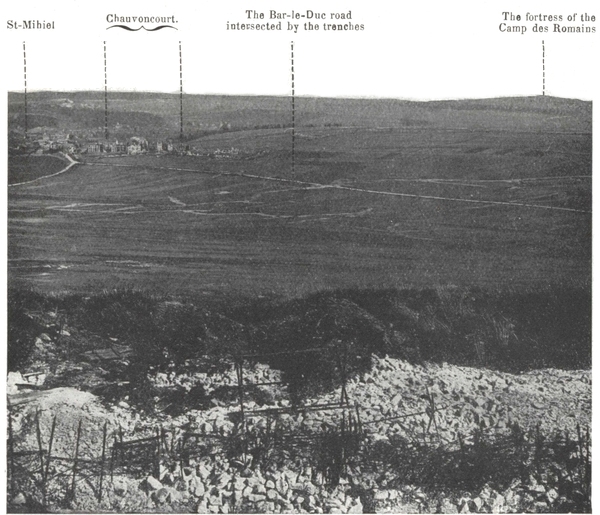
The extremity of the Saint-Mihiel Salient seen from the Fort des Paroches.
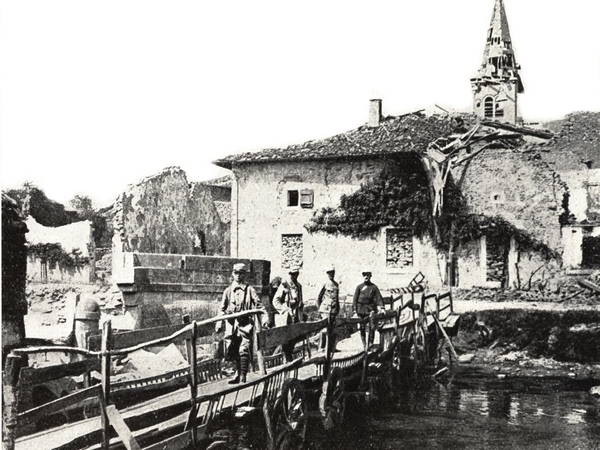
The village of Forges in 1915.
A footbridge of wagons crossing the stream of Forges.
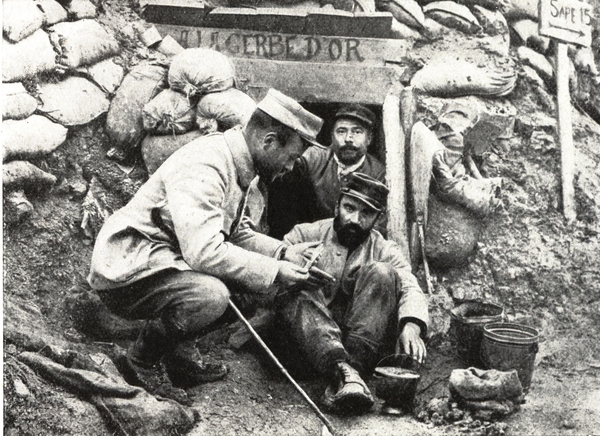
Les Éparges in 1915.
During a period of quiet, a plant for making rings has been installed at the entrance of a dug-out.
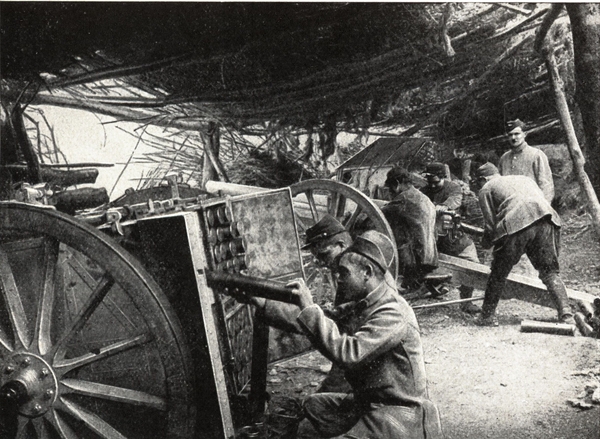
In April 1915, a 75 gun firing on the crest of Les Éparges.
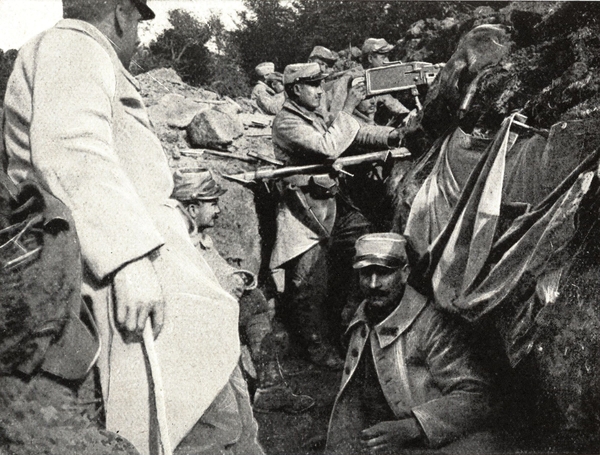
Machine gun in position in a front line trench. Sector of Les Éparges, February 1915.
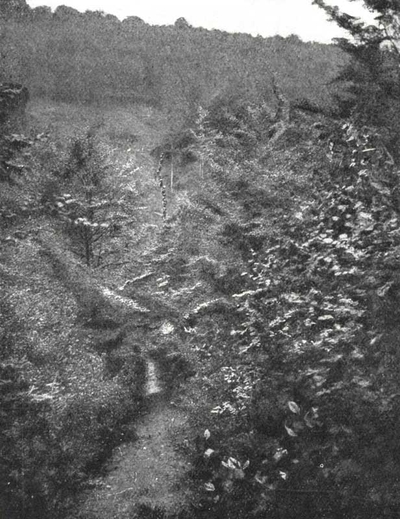
A ravine in the luxuriant forest of Argonne.
In the middle a company in Indian file is going up to the line.
THE STRUGGLE IN ARGONNE The battle in the forest (October 1914-October 1915).
The stationary warfare assumed a special character in the Argonne. Lanes and footpaths formed the only breaks in the impenetrable thickets. There were no gentle slopes, no convenient firing positions for the infantry, no observation posts for the artillery—everything was concealed by the thick foliage.
Springs rose everywhere and rivulets ran over the clayey soil. Mud made the paths impassable, and filled up the trenches as soon as they were made. French and German trenches intersected. Firing was continuous, snipers perched here and there in trees taking careful aim, while at night rifle and machine gun fire at random continued uninterruptedly, sweeping the forest in order to prevent surprise and to make movement dangerous. But the rifle was merely an auxiliary weapon, as each army rained showers of grenades and bombs upon the other all day long.
Apart from actual battles, there were hundreds of casualties, killed and wounded, every day. In the attack or defence of a trench, the fighting immediately became a hand-to-hand struggle, with knives and revolvers. Underground there was a continuous digging of saps and mines; it was a contest of speed and skill between the opposing sappers. It was a case of blowing up the enemy first or being blown up by him. Over the wrecked trenches, destroyed by mines, through smoke and under a rain of earth thrown up by the explosions, the soldiers dashed forward to occupy the crater or to fight for it if the enemy had reached it first.
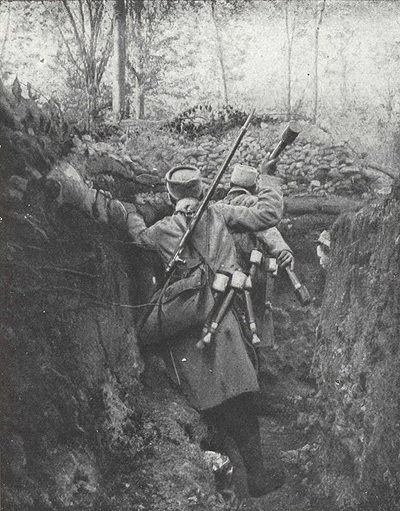
A fight with bombs.
French foot-soldiers throwing back at the enemy bombs which they have captured from them.
During the first three months of 1915, between Four-de-Paris and the valley of the Aire, the French sappers excavated over 3,000 metres of mine galleries and fired 52 mine chambers, using nearly 16,000 lbs of explosives.
Later on, the mine warfare developed considerably in other directions, and mine-chambers charged with more than 130,000 lbs of explosives were fired.
The German pushes towards Four-de-Paris (October 1914-May 1915).
The enemy wanted to reach the valley of the Biesme across the wood of Grurie and Bolante.
In October, advancing to the sap, the Germans of von Mudra's army corps took Bagatelle and Saint-Hubert. At the end of November the Four-de-Paris—Varennes road was abandoned by the French.
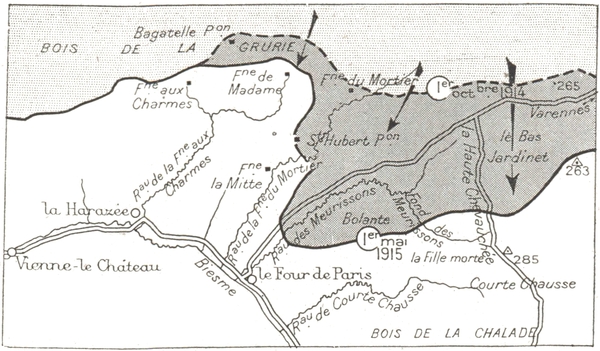
The German pushes towards Four-de-Paris (October 1914-May 1915).
At the end of December, the Second French Corps cleared Four-de-Paris.
In January, the Garibaldians (Italian volunteers) attacked in the direction of Bolante.
On January 8th, the Germans hurled themselves upon the outskirts of Bolante. For three whole days the foot soldiers of the 31st, 46th, 76th and 89th regiments as well as the Garibaldians were at close grips with the Silesian and Hessian chasseurs, fierce struggles taking place.
In spite of all their furious attacks, the enemy could not get to the Biesme, but they succeeded in driving a deep and narrow wedge in the French lines in the direction of Four-de-Paris.
French attacks in the valley of the Aire.
While these obstinate encounters were going on in the forest of Argonne, the 9th and 10th French Divisions (5th Corps) attacked in the valley of the Aire and set out to storm Vauquois, a village perched on a mound commanding all the valley, which the enemy had constituted a defensive centre and a first class observation post.
From December to February, on ground that was transformed into a sea of mud, attacks on Boureuilles carried the French lines to 250 metres from the village.
From October 28th 1914 to March 1st 1915, four attacks were launched against Vauquois, the summit of which was reached by the French troops of the 10th Division. The struggle extended around the mine craters until 1916. (See page 144.)
The big German attacks (June-July 1915).
In June and July 1915, the German commander gave up local attacks and had recourse to massed attacks of men and material on fronts of 3 to 4 kilometres.
The first attack (on June 20th) was on the North side and then (July 2nd) on the East side of the salient of Fontaine-Madame.
On June 20th in the morning, after a violent bombardment of gas shells, two Prussian and Wurtemburg divisions attacked in the wood of Grurie. The foot-soldiers of the 32nd Corps, though gassed and almost buried in their trenches, put up a fierce resistance. Their positions were subjected to a veritable siege. The enemy, however, captured Fontaine-aux-Charmes.
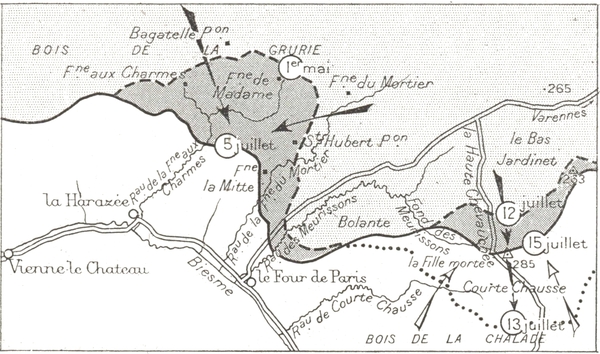
The big German Attacks (May-July 1915).
Up to June 28th, French counter-attacks succeeded in recapturing part of the lost ground.
On June 30th, the Germans extended their attack up to the north of Four-de-Paris. The enemy advanced to within 8 kilometres of their objective, the railway station of Les Islettes. The fire of the 75's, however, barred the road and the French reserves counter-attacked.
On July 2nd, there was an artillery bombardment of even greater violence.
The famous 42nd Division of Fère-Champenoise and the Yser withstood the attack with a heroism that won admiration even from the enemy.
The Germans could not capture the valley of the Biesme, in spite of their terrific efforts and heavy sacrifices.
In July 1915, the French front in the sectors of Bolante and Fille-Morte, followed the ridge which dominates the ravine of the Meurrissons, and passed over perpendicularly the Haute-Chevauchée road, comprising the dominating hills 285 and further to the East 263.
From this line which was provided with good observation posts, a French attack could take in rear the German lines that were established in front of Four-de-Paris.
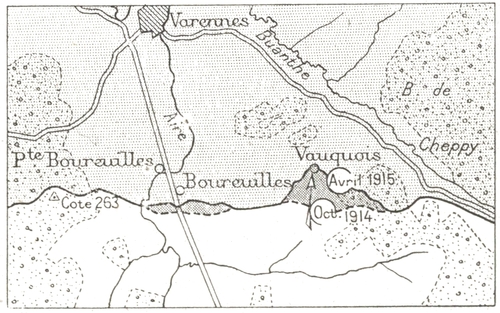
The French Attacks in the valley of the Aire (October 1914-April 1915).
This attack after being fixed for July 11th was postponed to July 14th. The enemy, however, forestalled it by himself attacking on July 13th.
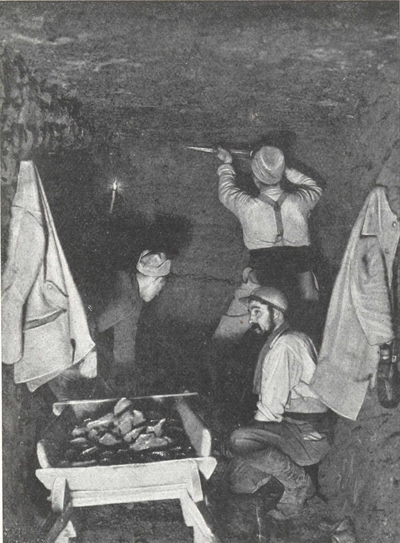
Sappers excavating a mine gallery.
After a bombardment of exceptional ferocity (nearly 50,000 shells) and the blowing up of several mines, 5 regiments of the Metz army attacked. They came out from saps which had been run up to within a short distance of shell-shattered French trenches.
The enemy crept in by small columns and surrounded the front lines. Under an avalanche of heavy shells, which annihilated a large number of men in their dug-outs, the French gave ground, to avoid being overwhelmed or outflanked. The enemy patrols then crossed the second French line.
The reserves of the 5th Corps, 131st, 82nd, 89th Infantry Regiments and the 66th battalion of chasseurs were brought up along ravines infested with gas, to the counter-attack. Without artillery preparation, they deployed under heavy rifle fire and then proceeded to clear the forest at the point of the bayonet and retook part of the first position.
From October 1915 to September 1918.
In October the Argonne front suddenly became as calm as it had previously been active. The Germans were content with a defensive policy. The struggle for the saps was renewed, trenches were blown up by mines and the mine craters were disputed by short bombing engagements.
In 1916, during the battle of Verdun, the Argonne was especially the scene of artillery duels and of mine warfare on the plateau of Bolante, at Hill 285 and at Vauquois.
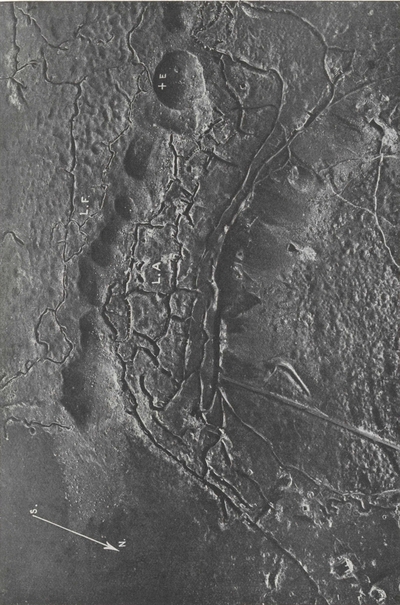
The Mound of Vauquois hollowed out by mine craters.
(View from the air, May 1917).
E. Site of the church.—L. F. French lines.—L. A. German lines.
The German mine opposite the church had been charged with 60 tons of explosives. Notice on the German side, the entrances to the galleries excavated under the mound.
—1916— THE BATTLE OF VERDUN
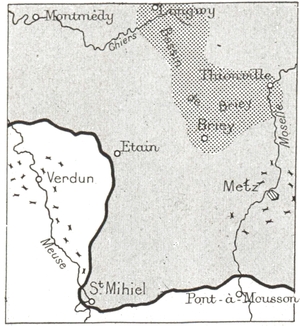
The fortress of Verdun, the basin of Briey, the fortress of Metz.
During 1915, Germany was particularly on the defensive, in Artois (May-June) and in Champagne (September-October). Her successes in Serbia and Russia had not brought the final victory which could only be won on the Western front.
Germany feared an allied offensive and was anxious over the continual increase of their forces in men and material. To forestall this offensive would cause it to miscarry and keep the initiative in her own hands.
The Germans wanted too, to make an impression on the world at large which began to have doubts about her ultimate victory. Finally they were influenced by political considerations at home. The rationing of the population had lowered the general morale, and the prestige of the Crown Prince had slumped heavily on account of his failure in Argonne. A grand victory was necessary to strengthen the German morale, to appease dissension and to rehabilitate the prestige of the Imperial family. The German High Command chose Verdun. Was this choice of ground as paradoxical as it has been said?
"Verdun in all the war is the hinge of the door which swings open sometimes on France, sometimes on Germany". (L. Gillet.)
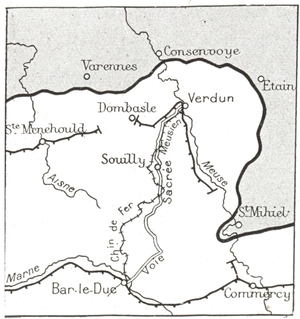
The only communication between Verdun and the rear was by the Meusian railway and the "Sacred Way". The Verdun-Commercy railway was cut by the Saint-Mihiel salient and the Verdun-Sainte-Menehould railway would be cut by shell fire at the very outset of the battle.
To capture Verdun was to threaten the whole French right wing, to gain an important stake, a stronghold fronting the rich basin of Briey, and to get the benefit of a great moral effect.
The Verdun salient lent itself to converging enemy attacks and concentrated fire. On the right bank the defenders of Verdun would be fighting with their backs to the Meuse. The neighbourhood of Verdun with its valleys and woods, facilitated the moving of troops and the concentration of artillery screened from view.
The enemy too had fourteen railways at his disposal and Metz close at hand from which to bring up troops and supplies.
On the French side, there was only one broad gauge railway connecting Verdun, via Saint-Menehould, with the rest of France. This railway, too, was always liable to be cut off by shell-fire. (See illustration opposite).
Geographical Sketch.
The table-lands of Verdun where the battle was to be fought are the last of the series of heights which form the top of the basin in which Paris lies. The Meuse which often overflows in winter divides them from North to South.
The terrace of the table-lands of the right bank, for some ten kilometres in width, separates the valley of the Meuse from the marshy plain of the Woëvre.
Numerous streams flow at a depth of more than a hundred metres for a very short distance, thus hollowing out deep ravines which give to the hills of the Meuse a contour "jagged, cut in festoons, as though it was hand-modelled in a clay substance". The summit line, where not indented, contains the highest points (388 m.), keys to the battle field.
"All this country with its partitions and compartments seemed built like a natural fortress. The sheltered ways and ravines provided covered approaches and first-rate artillery positions. Every wood and copse could be converted into a redoubt.
"If the branching off of the valleys and their innumerable ramifications added to the dangers of movement or manœuvre or facilitated surprise attacks, the ridges, on the other hand, made marvellous observation posts. On all sides were the very slopes, banks and flank protection which engineers could desire." (L. Gillet: La Bataille de Verdun).
German plans for a decisive attack.
Following the lesson of the offensives in Artois (May 1915) and Champagne (September 1915), the German commander intended to put into practice the French offensive methods but to add, by means of artillery fire, an unparalleled ferocity. To concentrate masses of artillery, to cut by shell fire the only broad-gauge railway that connected Verdun with France (see plan p. 18), to flatten out the French defences, to isolate the occupants by barrages of heavy shells, then to rush headlong on the town and crush the last resistance, at the same time sending forward overwhelming masses of troops, without regard to losses: such was the plan which the Germans carried out on February 21st, 1916.
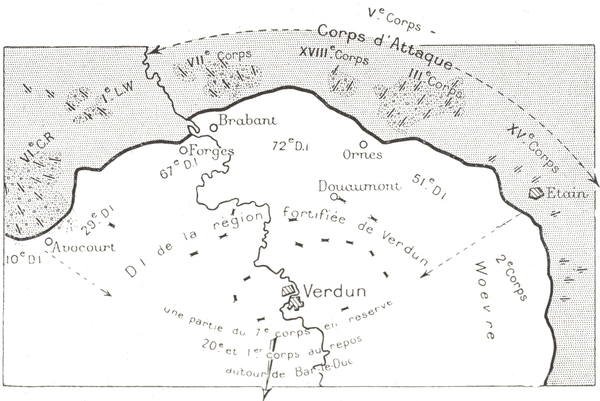
Troops in position on February 21st, 1916.
The enemy concentration round the fortress of Verdun.
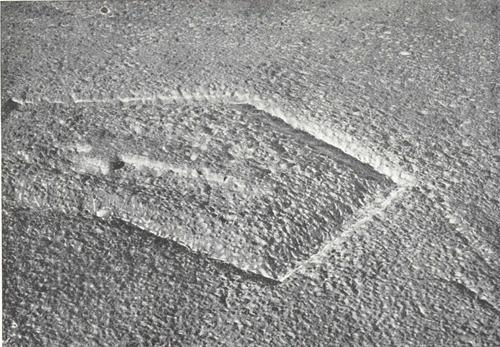
The battered fort of Douaumont (August 1916).
Character of the battle of Verdun
The battle of Verdun was a battle of annihilation, mutual annihilation. The method was to concentrate the fire of all the guns, not over a line but on a zone, and not only on the position to be captured but also as far as possible in rear on everything that could support the position. The simile that best expresses it is no longer that of a battering ram striking against a wall, but that of a rammer falling perpendicularly and hammering an encircled zone. The encircled zone was the part where the old territorials who were screening from observation a road behind the lines, ran almost as great a danger as men in other battles did in an attacking wave. Here, while the shells continued to fall, no fatigue party of men or munitions could go three hundred metres without being wiped out entirely. Here the wounded in deep-dug aid-posts went mad from lack of air. Here often a mug of water meant life or death to a man. This encircled zone was bounded by a narrow stretch of ground which the opposing artilleries tried to spare because the infantry were fighting there hand to hand, with bombs, machine guns, and flame-throwers; every square yard of ground being hotly disputed.
"In front of Verdun, one day, the O. C. of a new force asks the officer of the chasseurs whom he has just relieved: "Where does our line run here?—I'll show you. There where you will find on the ground my dead chasseurs, lying side by side, that is where our line runs".
"In front of Verdun, one day, a battalion commander being completely cut off sends twenty runners one after another, to the Colonel's headquarters. These runners are bound to follow a certain track to go and another to return. Not one comes back and on the next day he finds the bodies of all twenty, ten lying on the path there and ten on the path back.
"In front of Verdun, one day, at nightfall, a battalion commander goes up towards the front line to see his men and cheer them on. The front line is a string of shell holes and in these holes, one by one, the men are crouched. He leans over one of these pits of darkness, for the night was pitch black, and in a low voice so that the enemy may not hear asks: "How goes it?". There is no movement but a voice replies in muffled tones as though telling a secret: "All well, Colonel, they shall not pass". He goes on his way continuing his rounds "How goes it?" and from each dark shell-hole rises the same secret whisper.
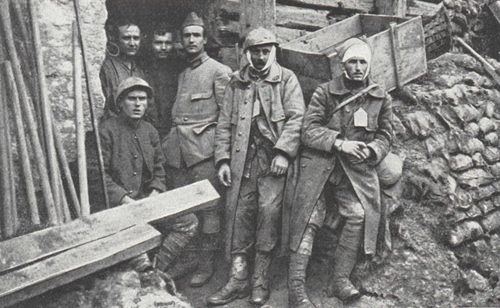
At the aid post of the fort or Tavannes, two wounded men and a runner leaving the "furnace".
Their privations and sufferings are written on their wan faces.
"Where was that? At Mort-Homme or Froideterre? At Haudromont farm or Chapelle Sainte-Fine? It makes no difference! It was "in front of Verdun, one day" any day you like in this battle, in which so many days were alike, and these innumerable stories, so magnificent that no poet could have had the genius to invent one of them, these stories—each one so immortal—are all as alike in their essentials as were the countless actions in this "battle of annihilation" (Joseph Bédier: L'Effort français).
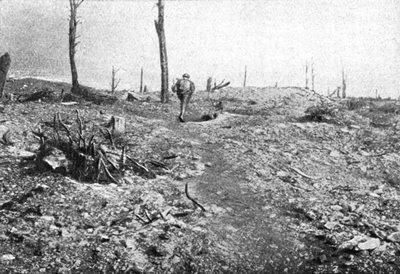
In the wood of Les Fosses. A runner on a track.
THE IMPORTANT PHASES OF THE BATTLE OF VERDUN
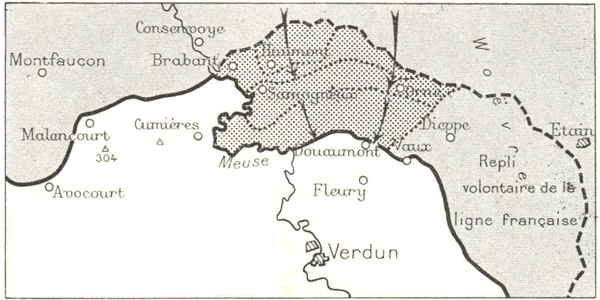
February 21st-25th 1916.—The central attack.
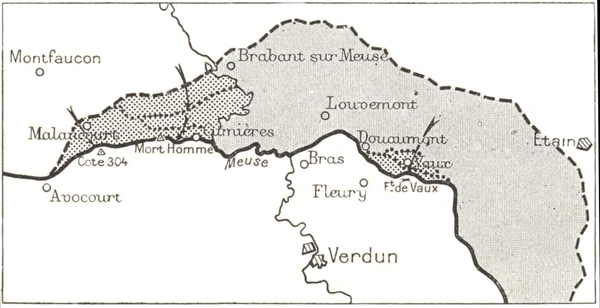
March-April 1916.—The attack on the flanks.
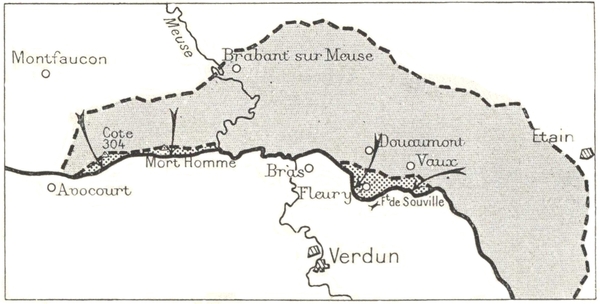
May-September 1916.—The battle of attrition.
The central attack (February 21st-25th) endangered the position of Verdun but the arrival of the first French reinforcements saved the place.
The enemy widened his attacking front, but his effort to outflank the position was a failure.
The defence was reorganised, road and rail taking their part in the battle. The enemy's attempts at attrition on the spot were a failure.
On July 1st the allied offensive was launched on the Somme.
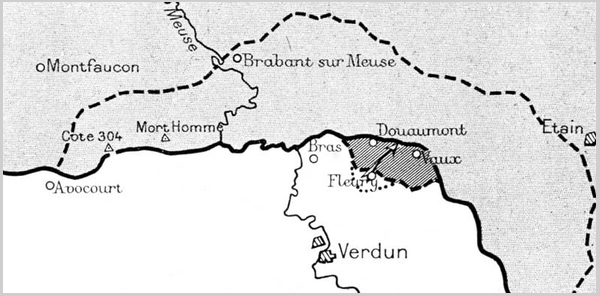
October 24th 1916.—The Battle of Douaumont-Vaux.
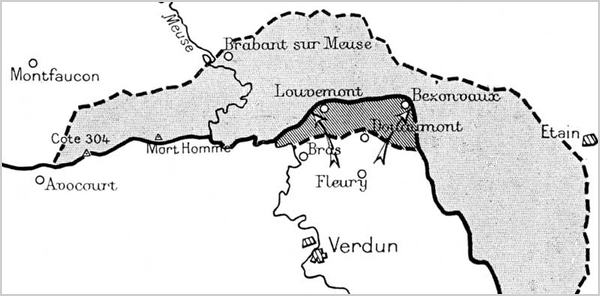
December 15th 1916.—The Battle of Louvemont-Bezonvaux.
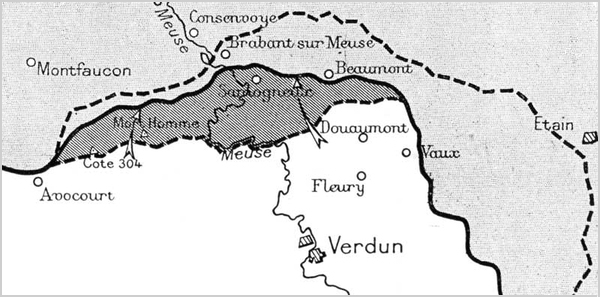
August 20th 1917.—The Battle of Hill 304 and Mort-Homme.
As soon as this new engagement allowed him, the French Commander intended to turn the enemy's failure before Verdun into defeat.
Three operations were prepared with the greatest skill and most energetically carried out, by which the enemy were driven out of the positions they had captured. These were the three victories of October 24th 1916 (Douaumont-Vaux), December 15th 1916 (Louvemont-Bezonvaux) and finally August 20th, 1917 (Samogneux-Mort-Homme, Hill 304).
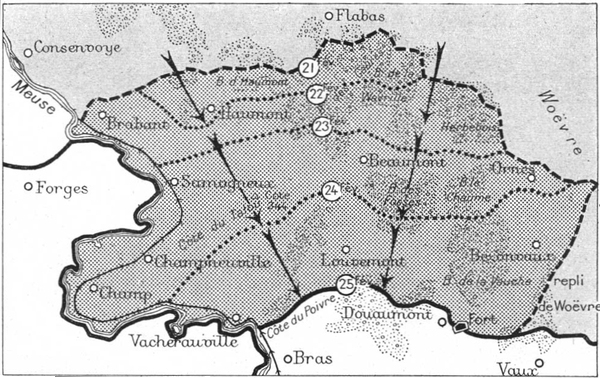
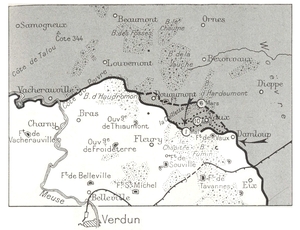
The central attack (February 21st-26th 1916).
This attack was carried on from February 21st to 26th on the right bank of the Meuse and narrowed its front as it advanced, finally stopping on the sixth day at Poivre Hill and Douaumont.
THE GERMAN OFFENSIVE (February-August 1916).
1. The central attack.
On February 21st 1916, at 7.15 a.m., the enemy opened fire on the two banks of the Meuse, over a front of 40 kilometres. Simultaneously Verdun was systematically bombarded, the last residents being evacuated by the military authority at midday on the 25th.
For nine hours, all the enemy guns and trench mortars kept up a running fire without intermission. In all the woods adjoining the front it was a regular fire-work display. A feature of this overwhelming bombardment was the enormous proportion of heavy calibre shells, 150's and 210's coming over like hailstones.
Under this deluge of projectiles all trenches were levelled, the woods became a twisted mass of trunks and branches, and villages collapsed and were blotted out.
The infantry attack was launched at 4.15 p.m. just before dusk, from the Haumont-Ornes wood.
Three army corps, the 7th, 18th and 3rd advanced. They thought that they had only to march, with their rifles slung, over ground like a ploughed field.
The 51st (Boulengé) and 72nd Divisions (Bapst) of the 30th Corps (Chrétien) sustained the first shock and for three days covered the arrival of French reinforcements.
A heroic combat followed the most formidable artillery preparation hitherto known. The chasseurs of Colonel Driant resisted the attack, inch by inch, in the wood of Caures. By nightfall the advance of the enemy was insignificant compared with their losses. They succeeded, however, in capturing the wood of Haumont.
On the 22nd, with snow falling, the bombardment was resumed with, if possible, greater intensity. Colonel Driant in the wood of Caures was outflanked on both sides and died fighting, after first evacuating his chasseurs to Beaumont.
Meanwhile the sectors of Woëvre and the left bank of the Meuse were subjected to violent bombardment.
The fighting on the 23rd was even more furious. Brabant fell into the hands of the enemy after a fierce resistance by the 351st Infantry Regiment, which clung desperately to the ruins of Samogneux until nightfall. Further east the battle raged fiercely. The French counter-attacked unsuccessfully at Caures Wood and were attacked at Herbebois. The 51st Infantry Division, fell back, making the enemy pay dearly for his progress towards Fosses Wood. In the evening, the front extended along the Samogneux-Beaumont-Ornes line. Samogneux was captured by the enemy during the night. The situation was very critical.
On the 24th, the enemy brought up fresh storm troops and, although harassed by the French artillery on the left bank of the Meuse, they succeeded in taking Hill 344 to the East of Samogneux, Fosses Wood and the village of Ornes. But on the same day French reinforcements arrived, namely the 37th Infantry Division of the 7th Corps, the 31st and 306th Brigades of the 20th Corps under General Balfourier who provisionally took charge from the Meuse to the Woëvre. At the same time also General Pétain took over the command of the army of Verdun from General de Castelnau.
On the 25th, the 37th Infantry Division, with orders to defend Talou Hill and Louvemont village, resisted for a long time against incredibly furious attacks, but on their right the enemy succeeded in capturing Vauche Wood and, advancing towards Douaumont, carried the fort by surprise (see page 88). However, their efforts to take the village failed before the heroic tenacity of the 31st Brigade, while the 94th Infantry Division, covered itself with glory. The enemy advance from this side had the effect of compelling the 31st Infantry Division to abandon Talou Hill.
During this time, in Woëvre, the front which was a dangerous salient and only very lightly held, was withdrawn to the foot of the Meuse Hills. This falling back was carefully cloaked and under cover of a rearguard action a new front was organised.
Taking over the command on the night of the 25th, General Pétain at once divided the battle-line into four sectors, officered as follows: General Bazelaire, on the left bank, from Avocourt to the river; General Guillaumat, from the Meuse to Douaumont; General Balfourier, from this point to the Woëvre; General Duchesne, on the Meuse Heights.
There were no trenches, but he ordered that the forts should at least be connected by a continuous line of entrenchments to be made while the battle was at its height and which the "poilus", in their disdain for the shovel and pick, called the "Panic Line". The entire 59th Division was told off to build the earthworks on the second and third lines. Thirteen battalions kept in repair the road from Bar-le-Duc to Verdun, via Souilly (the Sacred Way), which became the main artery for re-victualling the place in men and munitions, and along which 1,700 motor lorries passed each way daily. Lastly, General Pétain managed to imbue all ranks with his energy and faith, and the enemy's drive was stopped.
Indeed, during the day of the 26th, the 39th Division (Nourisson), which had relieved the 37th, repulsed all attacks on Poivre Hill, while the 31st Brigade continued to hold Douaumont until relieved in the evening by the 2nd Division (Guignabaudet).
On the following days the fighting continued about and in the streets of Douaumont, which the enemy finally captured on March 4th. The Germans now began to show signs of weakening. Their effort on the right bank had failed. Checked at Douaumont, they were taken in the rear by the French positions on the left bank, and were obliged to modify their plans. From that time they operated simultaneously or successively on both banks.
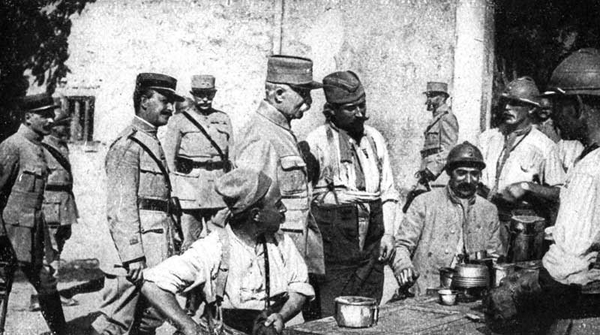
General Pétain among the soldiers.
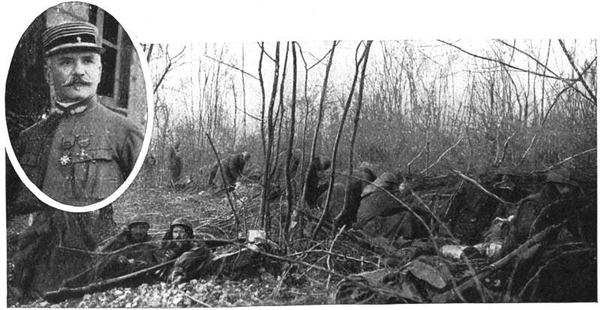
In Caures Wood a company of chasseurs manning a trench.—Colonel Driant.
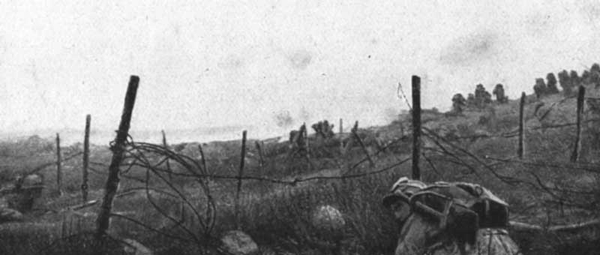
West of Douaumont, starting out on a counter-attack (March 1916).
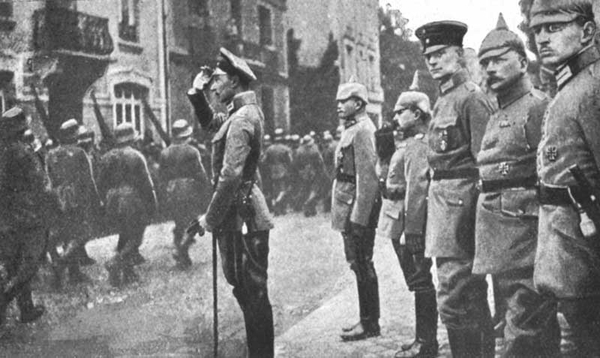
The Crown Prince reviewing his men at Charleville.
On the "Sacred Way" (March 1916).
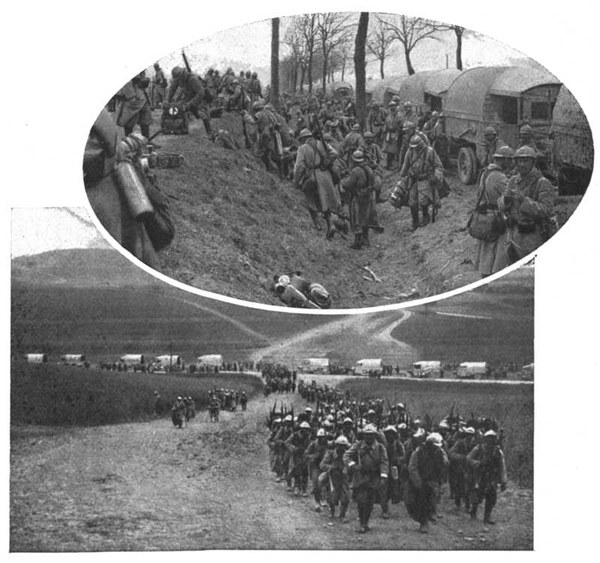
Reinforcements arriving on the "Sacred Way" (March 1916).
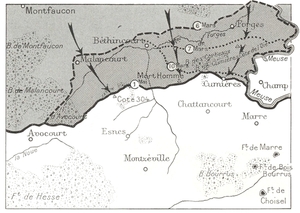
Second stage.—The German attack on the two flanks (March-April 1916).
The central attack which was to capture Verdun and force back the French wings failed before it came to a head. The Germans, caught on the flank by the French artillery on the left bank of the Meuse attacked all at once, then alternately on both banks.
2.—The battle on the flanks (March-April 1916).
The German offensive was unable on the right bank of the Meuse to yield the expected results. The enemy intended to combine operations on both banks.
On March 6th, two German divisions attacked from Bethincourt to Forges, where the French front was held by the 67th Division (Aimé) and succeeded in taking Forges and Regnéville, but were checked by the positions on Oie Hill.
Continuing their advance, on the 7th, they succeeded in capturing these positions, as well as Corbeaux Wood. The village of Cumières was the scene of terrible fighting, but remained in the hands of the French, while further to the west the enemy's attacks broke down at Mort-Homme (See page 112).
On March 8th, while on the left bank French troops retook Corbeaux, on the right bank the Germans brought into line units of five army corps and began a general attack, which failed with very heavy losses, their only gain being the capture of part of Vaux village.
On the 9th, they succeeded in getting a footing on the slopes of Mort-Homme, but at the other end of the battle-line their attack on Vaux Fort failed. Their radiograms announcing the capture of the fort were untrue (See page 68).
On the 10th, Corbeaux Wood was taken by the Germans and the French withdrew to the line Bethincourt-Mort-Homme, south of the Corbeaux and Cumières Woods. The battle continued in the village and in front of Vaux Fort, strongly held by the French. The enemy temporarily ceased his massed attacks. In reality his offensive had failed.
On March 10th, Joffre was able to say to the soldiers of Verdun:
"For three weeks you have withstood the most formidable attack which the enemy has yet made. Germany counted on the success of this effort, which she believed would prove irresistible, and for which she used her best troops and most powerful artillery. She hoped by the capture of Verdun to strengthen the courage of her Allies and convince neutrals of German superiority. But she reckoned without you! The eyes of the country are on you. You belong to those of whom it will be said: "They barred the road to Verdun!"
From March 11th to April 9th the aspect of the battle changed. Wide front attacks gave place to local actions, short, violent and limited in scope. On March 14th the enemy captured, from the 75th Brigade, Hill 265 forming the Western portion of Mort-Homme, but they failed to take the Eastern portion. On the 20th, Avocourt and Malancourt Woods fell into the hands of the Bavarians, and after a fierce struggle the village of Malancourt was lost, and then Bethincourt on April 8th. On the right bank, after powerful attacks near Vaux, the enemy reached Caillette Wood and the Vaux-Fleury railway, only to be driven back by the 5th Division (Mangin).
A furious attack was made along both banks by the Germans at noon on April 9th; on the left bank, five divisions were engaged, failing everywhere except at the Mort-Homme, where, despite the heroic resistance of the 42nd Division (Deville), they gained a footing on the N. E. slopes; on the right bank, Poivre Hill was attacked but remained in French hands.
On the following day in his order of the day, General Pétain promulgated his famous message "Courage ... we shall beat them!" (Reproduction page 30).
On April 30th, General Nivelle superseded in supreme command of the Verdun forces General Pétain who had been appointed to the command of the central army group.
"April 9th was a glorious day for our armies", General Pétain declared in his order of the day dated the 10th, "the furious attacks of the soldiers of the Crown Prince broke down everywhere. The infantry, artillery, sappers and aviators of the 2nd Army vied with one another in valour.
"Honour to all.
"No doubt the Germans will attack again. Let all work and watch, that yesterday's success be continued.
"Courage! We shall beat them!"
Ch. Pétain
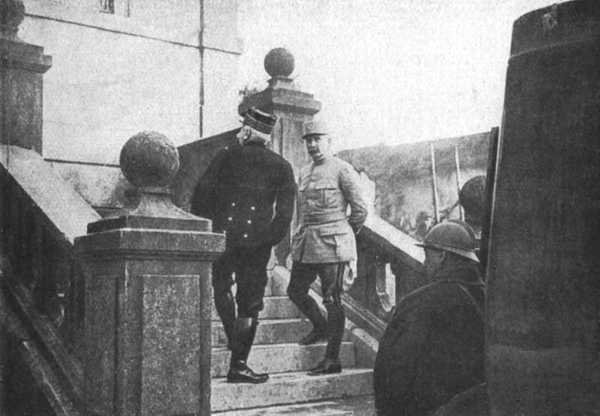
General Joffre and General Pétain at the 2nd Army Headquarters at Souilly.
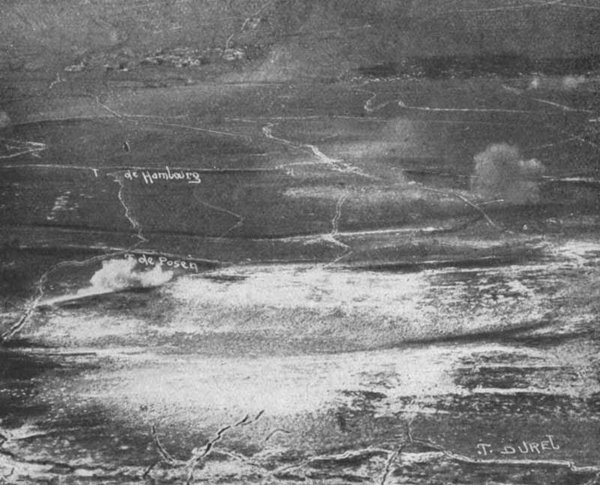
Mort-Homme.—Hills 286 and 295.
In the background, the valley of the Forges stream, Bethincourt on the left, Forges wood on the right.
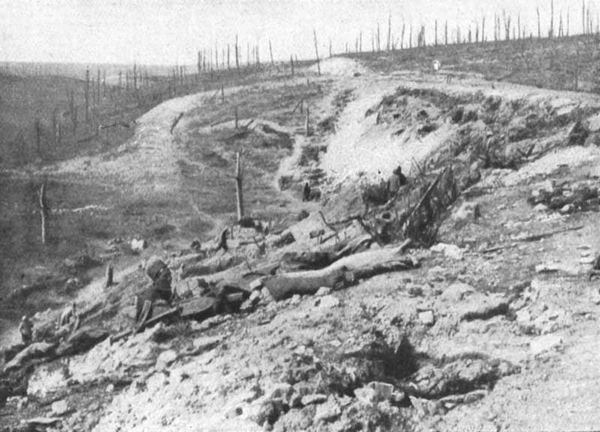
Between Douaumont and Vaux, the ravine of Fausse-Côte.
Third Phase.—The Battle of Attrition (May-September 1916).
The struggle continued obstinately and without interruption on the two banks of the Meuse. The attempt of the enemy to wear down the French forces was in vain, the latter re-organising their defences. Division succeeded division in the defence of Verdun but then were relieved before they were exhausted, so that they came out of the furnace better able to stand its hardships.
3. The battle of attrition (May-August 1916).
In May the enemy attacked on the left bank of the Meuse with an assault upon Mort-Homme. Then, widening their attacking front in a Westerly direction, they turned upon Hill 304, a strong key position and valuable observation post. The French lost this Hill on May 23rd but retook it the following day. A further month's bitter fighting only gained for the enemy the crest of Mort-Homme and the north slopes of Hill 304.
On May 22nd, with the object of clearing the left bank of the Meuse where the enemy were pressing, the 5th Division (Mangin) attacked on the right bank, in the direction of Douaumont. The central attack alone was successful, the enemy holding their ground inside the fort; their numerous reserves, among them the 1st Bavarian Corps, succeeded in dislodging the attackers on May 24th (See page 90).
Even though Douaumont remained in the enemy's hands, this attack was successful in freeing the left bank by drawing upon the German reserves. The struggle continued without respite or quarter. The Germans, alarmed by the preparations for the Franco-British offensive on the Somme, wished to be finished with Verdun. They, therefore, launched attack after attack but every time they were met by the irresistible will of the French.
The enemy, who in April had captured the village of Vaux, next furiously attacked the fort, and though on June 2nd they occupied the superstructure, it took them five days to subdue the garrison (See page 71).
At the same time they advanced from Douaumont towards Froideterre. On June 9th, Thiaumont Farm was captured, but the redoubt still held out. On the left bank, the enemy resumed their attacks. On May 31st, they outflanked Mort-Homme by the Meuse valley and reached Chattancourt station, but were driven back by a counter attack as far as Cumières. Even if they captured the summit of Hill 304, they could not conquer the South slopes, and they were still far from the fortified barrier of Bois Bourrus.
On the right bank, on the other hand, by holding Douaumont and Vaux the enemy were at hand to break through the barrier of Souville and had within view the basin of Verdun. Here it was that the enemy were going to work for the supreme decision.
On June 23rd, 70,000 men attacked on the front Thiaumont-Fleury-Vaux. Thiaumont redoubt was captured, waves of attackers being hurled upon the Froideterre redoubt. A counter-attack, however, cleared the plain as far as Thiaumont. In the centre, the enemy by outflanking Fleury on both sides gained a footing there, but in front of Souville they failed utterly (See page 77).
On July 11th, the enemy narrowed their attacking front, from Fleury to Damloup. Putting 40,000 men into the attack, they went through Fleury and crept round by the ravine to the west of the village. They gained a temporary footing in Souville fort from which they were almost immediately ejected (See page 80).
In spite of partial successes, the enemy had failed in their main objectives. Their losses had been enormous and the Franco-British offensive, launched on the Somme on July 1st, took up their reinforcements.
After nearly five month's siege, Verdun was safe. Still bitter fighting raged right on until the middle of August, centreing chiefly round Thiaumont redoubt which changed hands 16 times, Fleury village, recaptured on August 18th after many attempts, and in the woods south of Vaux where the enemy endeavoured to outflank Souville.
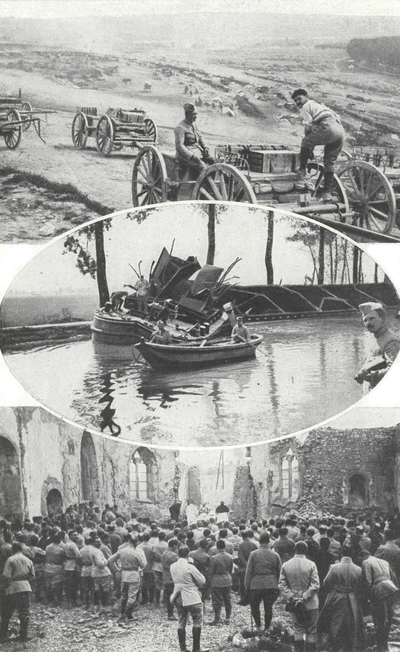
In rear of the battlefield.
Echelons of artillery on the slope of Houdainville.
A pinnace, used as a rest billet, hit by a 380.
Mass being celebrated in the church of Vaubecourt which had been burnt by bombs from aeroplanes.
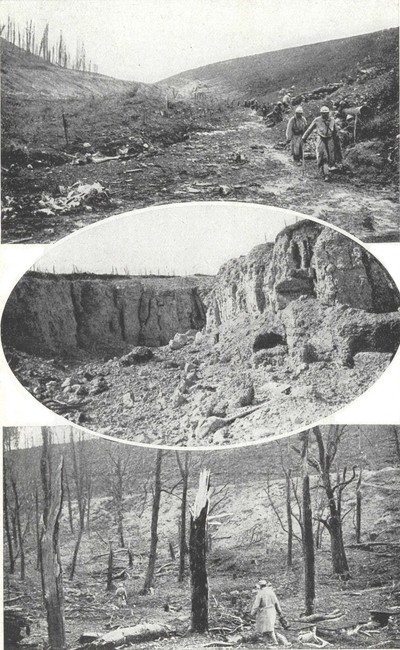
In the Vaux sector.
A fatigue party coming from Tavannes tunnel.—Trenches of the Laufée redoubt (June 1916).—Soldiers going to fetch water from shell-holes in the ravine of Tavannes.
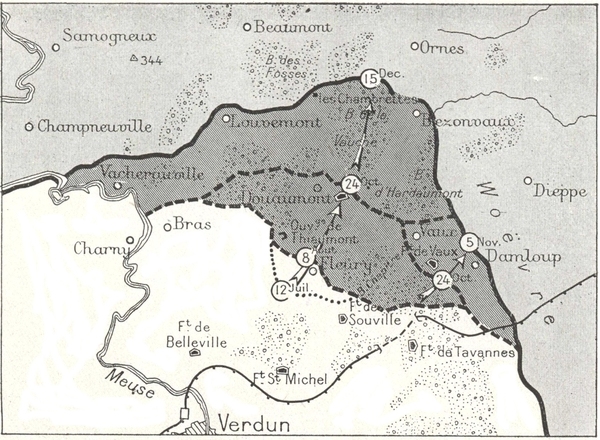
Clearing Verdun on the right bank of the Meuse.
The French offensives of October 24th and December 15th 1916.
FRENCH COUNTER-OFFENSIVES AND THE CLEARING OF VERDUN
The French offensive of October 24th 1916.
In August 1916, the battle of Verdun was a severe check to Germany. It was about to turn into a French victory.
The object was to link up once again the unbroken line of fortresses round Verdun. The time for small attacks aiming at the recapture of a few hundred yards was past. After having first straightened out the salients which the enemy had driven into the French line during June and July, it was only by a complete and simultaneous forward movement that they could make a really useful gain of ground.
To carry the operations to success, Generals Nivelle and Mangin had a powerful artillery force at their command, consisting of 290 field-guns and over 300 heavy guns. Three picked divisions were to form the front attacking line, the 38th (Guyot de Salins) reinforced on the left by the 11th Line Regiment, the 133rd (Passaga), known as "La Gauloise" and the 74th (de Lardemelle). The front line of the enemy consisted of seven divisions.
The French commander intended to win the day not only by the superiority of the troops under his command, but by giving them training and carrying out with precision a new tactical method of attack. The liaison which is so difficult between artillery and infantry was perfectly arranged, following a carefully pre-arranged time-table.
The attacking waves kept just behind a running barrage which slowly lifted forward according to programme.
The attack was made with a double line, and a halt was arranged to allow the units engaged to reorganise.
On October 21st, the artillery preparation started, and was carefully controlled and regulated day by day. On the 23rd a fire broke out in Douaumont fort. On the same day a feint attack gave away the position of new enemy batteries which were at once silenced. This feint deceived the Germans, the Crown Prince being actually deluded into announcing that he had broken up a strong French attack.
The enemy were on their guard; on the 23rd, a German officer taken prisoner said positively: "We shall not capture Verdun any more than you will retake Douaumont".
At 11 a.m. on the 24th, in a thick fog, the attack succeeded brilliantly, giving the French the Haudromont quarries, Thiaumont redoubts and farm, Douaumont fort and village (see page 92), the northern edge of Caillette wood, right up to Vaux pond, the edge of Fumin wood and Damloup battery. On the 24th and 25th more than 6,000 prisoners were taken and 15 guns. On November 2nd, when they re-entered Vaux fort which the enemy had abandoned, the French were practically on their line of February 25th.
On December 12th, General Nivelle took over supreme command. General Guillaumat took his place in command of the Verdun army.
The French offensive of December 15th, 1916.
To completely clear Verdun to the east of the Meuse and give greater freedom to the reconquered forts of Vaux and Douaumont, General Mangin organised a new attack. A great amount of preparatory work was done by the army of Verdun, who constructed about eighteen miles of road including one of logs laid transversely for the artillery, besides more than 6 miles of narrow-gauge railway, together with out-going and incoming trenches, and depots for munitions, bombs and material generally. As soon as these very considerable preparations, often carried out under heavy enemy shell-fire, were finished, the attacking troops took up their positions; the 126th Infantry Division (Muteau), 38th Infantry Division (Guyot de Salins), 37th Infantry Division (Garnier-Duplessis) and 133rd Infantry Division (Passaga), with the 123rd, 128th, 21st and 6th Infantry Divisions as reserves. Two lines of artillery prepared and supported the attack. The six-mile German front from Vacherauville to Bezonvaux was held by 5 divisions in the first line with 4 divisions in reserve.
At 10 a.m., on December 15th, when Germany was proposing that France should sue for peace, the attacking waves were launched, protected by a moving curtain of artillery fire. Several of the objectives, including Vacherauville, the first and second lines before Louvemont, were reached in a few minutes at a single bound. The woods and ravines before Douaumont took longer to capture, while Vauche wood was carried at the point of the bayonet. Les Chambrettes and Bezonvaux were taken on the following days. The success was considerable, more than 11,000 prisoners, including 300 officers, 115 guns, several hundred machine-guns and important depots of munitions and material, being captured. The enemy who, in July, had been within a few hundred yards of Souville Fort, was now more than three miles away. In June, the Frankfort Gazette, celebrating the German successes at Verdun, declared: "We have clinched our victory and none can take it from us", but on December 18th they had lost all the ground it had taken five months and enormous sacrifices to conquer.
In congratulating the troops General Mangin reminded them that Germany had just invited France to sue for peace, adding that they had been "the true ambassadors of the Republic".
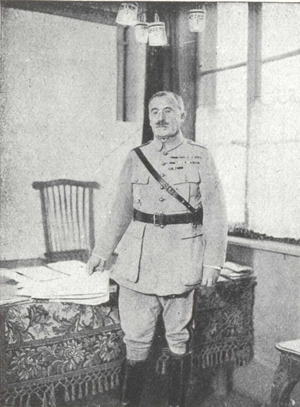
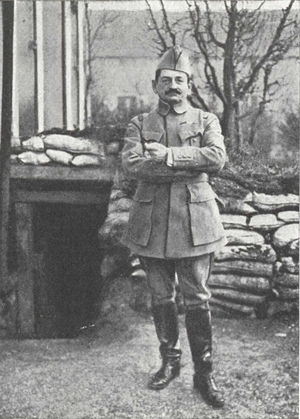
General Nivelle. General Mangin.
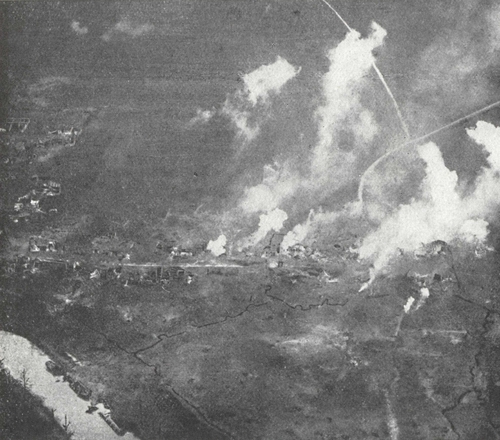
The bombardment of Vacherauville on the morning of December 15th 1916.
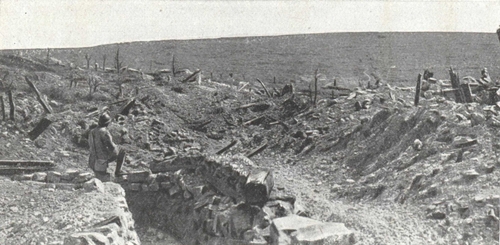
Louvemont after its capture.
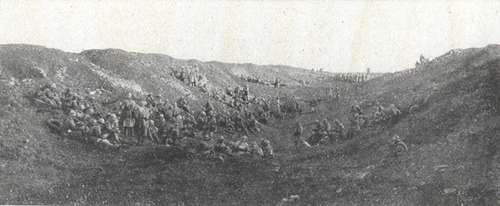
In the great quarries (500 yards west of Vaux fort).
Troops in reserve waiting for the time to move off.
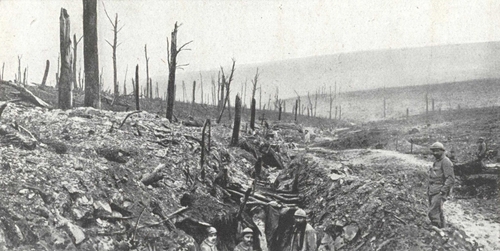
Chauffour Wood (1,500 yards north-west of Douaumont).
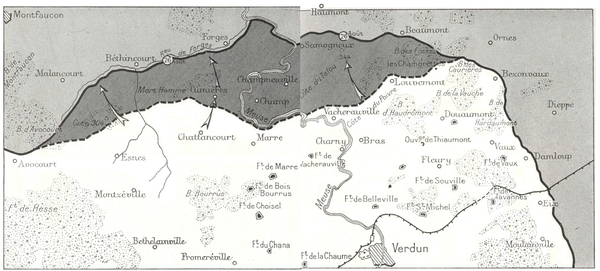
The French offensive of August 20th 1917 on the two banks of the Meuse.
The French offensive of August 20th 1917.
For several months Verdun again became almost quiet, the battle area shifting to the Chemin des Dames, Flanders and the Isonzo. General Pétain decided to shatter the enemy on the Verdun front.
The victory of Louvemont-Bezonvaux, while completely clearing Douaumont, had left the observation posts on Talou Hill in the hands of the enemy, who still held, on the left bank, the excellent positions of Hill 304 and Mort-Homme.
These they had had plenty of time to fortify, and the troops were housed in deep tunnels and properly connected up positions. The enemy had noticed the French preparations for this new offensive and had accordingly considerably strengthened their artillery (to nearly 400 batteries) and their fighting effectives (to nine divisions on the Avocourt-Woëvre line, with five in reserve).
On the French side, the ground had been for several months prepared for the battle. Across the battlefield which had been shockingly cut up by fire, roads had been prepared, liaison strengthened and the question of supplies studied for a long while. Artillery preparations included 2,500 guns of all kinds.
In this battle, artillery was to play the most important part. An army corps of 20,000 infantrymen was to be supported by 40,000 artillerymen. Four corps, 13th (Linder), 16th (Corvisart), 15th (de Fontclare), 32nd (Passaga) comprising 8 divisions in the line and 2 in reserve, took part in this offensive.
The artillery bombardment started on August 13th and systematically flattened out the German positions. On August 20th, at dawn, under the eyes of the officers of the new American Army who from various observation posts followed the course of the battle, 8 divisions attacked. Mort-Homme, Oie Hill and Talou Hill were captured, Hill 304 alone remaining in enemy hands. There was a stream of prisoners and munitions, in the tunnels of Mort-Homme over 1,000 men being unable to escape. On the following day Samogneux and Regnéville fell, and a systematic attack led to the capture of Hill 304 on August 24th.
The booty from August 20th to 26th comprised 9,500 prisoners, 39 guns, 100 trench mortars and 242 machine guns.
On the left bank, the French line was advanced as far as the Forges stream.
On the right bank, the enemy unsuccessfully endeavoured, by strong counter-attacks, over a period of nearly two months, to recapture the lost ground.
Verdun was completely cleared and the first French lines were advanced to approximately 7 miles to the north.
Thus in 3 battles, October 24th, December 15th, August 20-21st, the Germans were driven out of all the positions which they had held since the third day of the battle. There was left in their hands only what had formed, in February 1916, the advance line of the French defence, where, during the first two days of the battle, the covering divisions had been sacrificed.
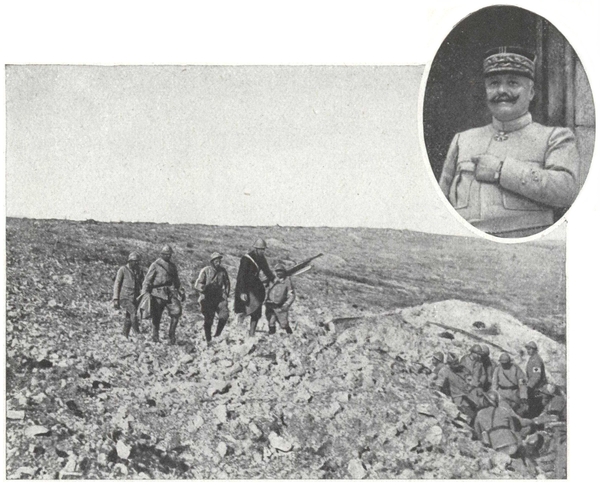
Hill 304.—Removing the dead after the battle (August 25th 1917). General Guillaumat.
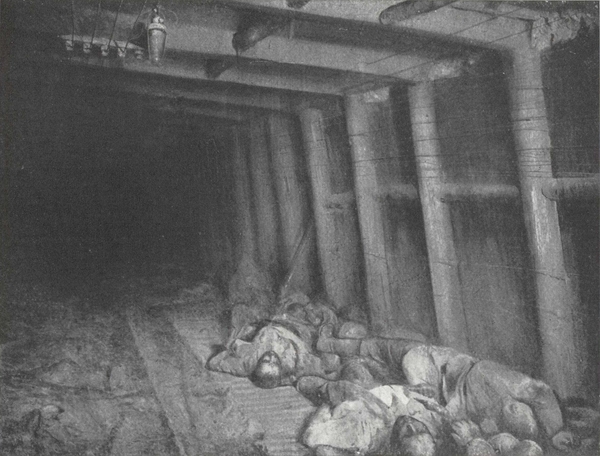
The Gallwitz tunnel, one of the Mort-Homme tunnels after its capture (August 20th 1917).
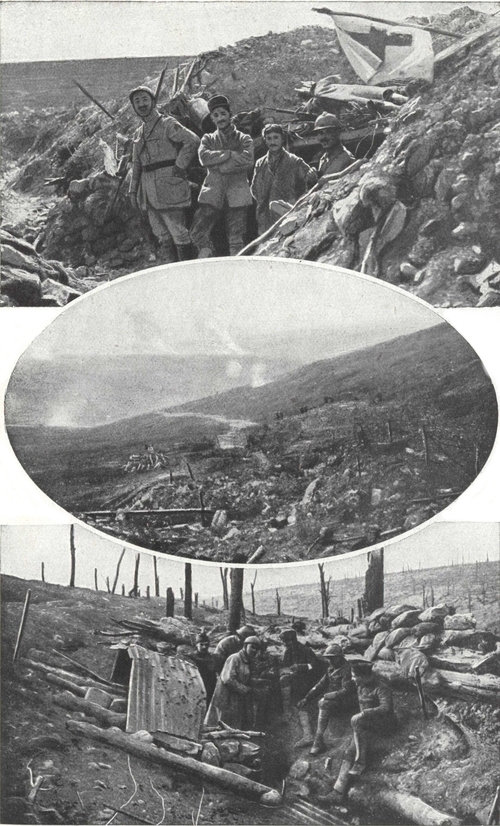
On the reconquered hill 304: An aid post (August 22nd 1917). At the foot of the reconquered hill 304: Bombardment by gas shells. South of Beaumont: Caurettes Wood.
CONCLUSION
The Battle of Verdun was not merely one of the hardest of the War's many battles, it was also one of the most serious checks received by the Germans. The enemy High Command had foreseen neither its amplitude nor its long duration. Whereas, "according to plan", Verdun—"Heart of France"—was speedily to be overpowered by a carefully prepared mass attack, the Germans found themselves involved in a formidable struggle, without being able either to obtain a decisive advantage or keep the relatively small advantages obtained at the beginning of the battle.
The battle did not develop "according to plan", its successive phases being determined by circumstances. The huge reinforcements which the Germans were compelled to call upon bring out very clearly the immensity of the enemy effort.
From February 21st 1916 to February 1st 1917 the Germans made use of fifty-six and a half divisions, i.e. 567 battalions, in front of Verdun. Of these fifty-six and a half divisions, six divisions appeared successively on both banks of the Meuse, eight others being also engaged twice and six three times. In reality, in the course of eleven months, eighty-two and a half German divisions (nearly 1,800,000 men), took part in the attacks on Verdun, which they had expected to crush in a few days with ten to twelve divisions. The contrast between this formidable effort and the meagre results obtained is striking, and is a splendid testimony to the courage and tenacity of the defenders.
This battle, by using up the best troops the Germans could put into the field, had serious strategic results for the enemy.
Hindenburg in his Memoirs states "This battle exhausted our forces like a wound that never heals."
"At Verdun France learnt to know herself", writes L. Gillet in his wonderful book The Battle of Verdun.
"The Marne was not enough to show France what she really was. A day of inspiration, a few hours of frenzy, a burst of enthusiasm, a sudden glow of rage and passion with Marseillaises sounding on all sides, the world knew us to be capable of flashes like these. But the world did not know—nor did we ourselves—our own sterling virtue.
"We were the country of improvisation, the country of laughing nonchalance, varied with attacks of fever: we had forgotten our strength of continuity. Thanks to the length of the battle, France was able to measure her reserves of endurance. In this continuous struggle which brought, one after another, men of every village to the same tragic scene, each was inspired with the determination to do at least as well as those who had preceded him. Then, when their turn had come to be relieved, after unheard of ordeals, they read again and again, in the communiqué's, the names of the same hills and awful woods where they had held the line, and learnt that others in their turn kept holding on....
"Instead of a succession of isolated deeds of valour, Verdun was for the whole French Army an heroic exploit in which all shared alike. France bled soldiers from all her wounds. At Verdun she was inspired with something solemn, sacred and unanimous, like the spirit of a religious crusade."
As President Poincaré declared on September 13th 1916, when he handed to the Mayor of Verdun the decorations conferred upon the town by the Allied Nations, it was before the walls of Verdun that "the highest hopes of Imperial Germany were crushed". At Verdun, Germany had sought to achieve an overwhelming spectacular success, and it was there that France had replied quietly but firmly "They shall never pass".
"For centuries to come, in all parts of the world the name of Verdun would continue to ring like a cry of victory and a sound of joy uttered by a people delivered from tyranny."
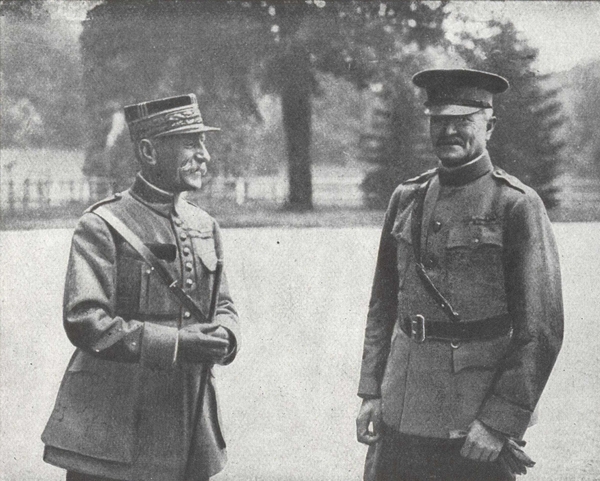
Marshal Foch and General Pershing.
VERDUN AND THE ARGONNE IN 1918
During the winter 1917-1918 the Verdun-Argonne front remained quiet, but the year 1918 opened with ill omens.
Russia gave in and Rumania, left to struggle alone, was forced to terms.
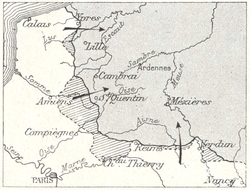
After the straightening out of the Château-Thierry and Amiens salients (July-August 1918).
The General Attack (October-November 1918.)
The Germans reckoned in 1918 to make an end of the Allies. They attacked successively in Picardy, on the Chemin des Dames, in front of Compiègne in Champagne. But whenever these attacks succeeded in driving small salients in the line, the front was at once reunited and the enemy fell short of victory. On July 18th, a decisive move was reached when the Allies in their turn took the initiative.
After the counter-attack of July, which drove the Germans from the Marne to the Vesle, the battle shifted to the flanks. Offensive followed offensive with unfailing regularity, first on the left (the Franco-British offensive of August 8th), then in Artois (the offensive of August 20th) and lastly against the whole of the Hindenburg line which the Allies attacked on September 1st.
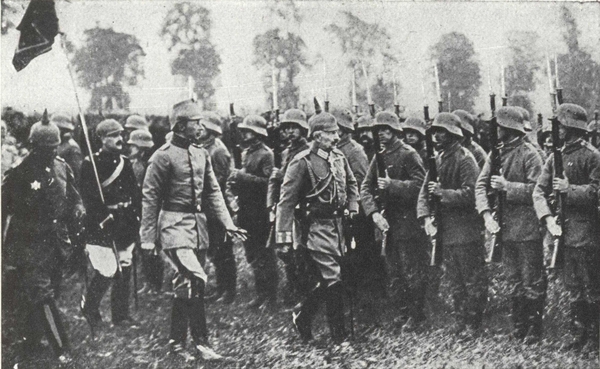
The Kaiser and the Crown Prince at a review.
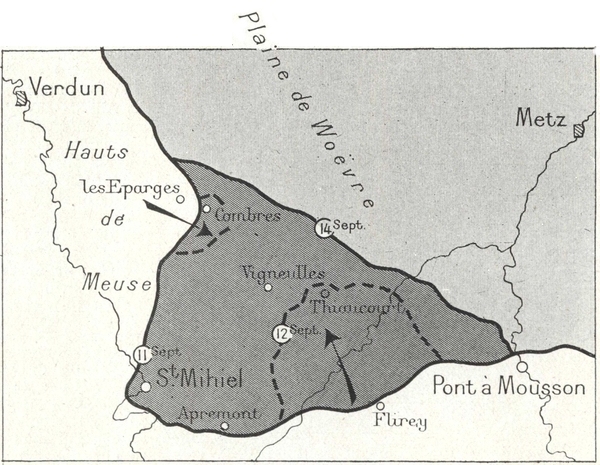
The straightening of the Saint-Mihiel Salient.
Franco-American offensive (September 1918).
The Germans were already greatly shaken but Marshal Foch gave them no respite, and to prevent their recovery he redoubled his attacks.
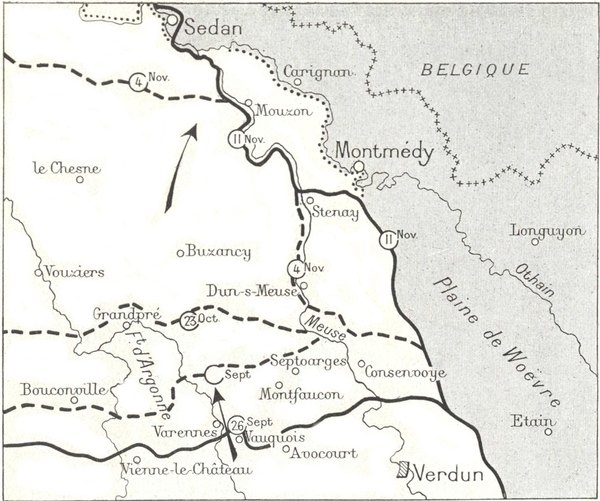
Clearing the Argonne and Verdun.
Franco-American offensive (September-October 1918).
Three simultaneous offensives were envisaged, on the left wing, in Flanders, the combined Belgian, French and British Armies under King Albert; in the centre the 3rd and 4th British Armies and the 1st French Army; on the right wing, in Champagne and in Argonne, the 4th French Army (Gouraud) and the 1st American Army (Pershing).
The Franco-American offensive of September 26th, 1918.
As a prelude to taking its place in the line for the great offensive, the American Army had already fought the brilliant action of September 12th-14th which reduced the Saint-Mihiel salient.
On September 26th, at the same time as the 4th French Army (General Gouraud) attacked the enemy in Champagne, the American Army under the command of General Pershing, took the offensive between the Argonne and the Meuse.
The artillery preparation was terrific but of short duration, lasting only three hours.
At 5.30 a.m. the Americans furiously assaulted the strong German positions on the left bank of the Meuse and captured the whole line from Avocourt to Forges right away. The artillery, keeping in close support, cleared the stream of Forges during the morning.
The woods which were strongly held were also cleared and by midday the Americans reached the south of Montfaucon.
During the afternoon a stubborn encounter took place on the positions covering Montfaucon, a formidable peak and the most valuable enemy observation post in the neighbourhood of Verdun.
The Americans wisely outflanked the peak on the right and advanced to Septsarges, so that by nightfall Montfaucon was encircled.
On the 27th and 28th, the advance was slower and continued westerly in spite of enemy counter-attacks; Montfaucon was captured.
The American spoils included 8,000 prisoners and 100 guns.
On October 4th, Pershing launched an attack on his whole army front. But the enemy stiffened their resistance by bringing up numerous reinforcements. On the right bank of the Meuse, the 17th French Army Corps (Claudel) and two American Divisions were then brought into the fray, reaching and quickly passing the famous line from which the Crown Prince, in February 1916, had launched his attack upon Verdun.
On October 14th a general attack was launched.
The Germans resisted desperately but could not regain any advantage. Their resources were diminishing and battalions were withdrawn to be hastily reorganised in rear and then put in the line again at once.
Round Grandpré a furious fight raged.
By the end of October the Germans had lost, on the two banks of the Meuse, since September 26th, 20,000 prisoners, 150 guns, 1,000 trench mortars, and 6,000 machine guns.
November 1st-11th 1918.
In the North, the Belgians had just cleared their coast-line, and were menacing the enemy by an advance into the very heart of Belgium. The British had occupied Lille and broken down the defences of the Hindenburg Line. Meanwhile, the French, relentlessly driving back the retreating enemy, had entered Laon, after forcing the formidable bastion of the Saint-Gobain Forest.
On November 1st, a new offensive was opened up by Gouraud's Army and the 1st American Army, resulting in a gain of several kilometres. The enemy fell back on the great Sedan-Metz highway, the approaches to which they wanted to defend at all cost.
On November 4th, the 3rd American Corps reached the Meuse between Mouzon and Stenay.
The Germans withdrew on the right bank.
On the 8th, the French entered Sedan and, on the 9th, Mézières.
On the 10th, the enemy was driven back on the extreme right, to the foot of the Meuse Heights and South of Stenay by the 17th French Army Corps.
On November 11th, with the threat of a fresh offensive in Lorraine, the Germans surrendered in open country to save themselves from complete destruction.
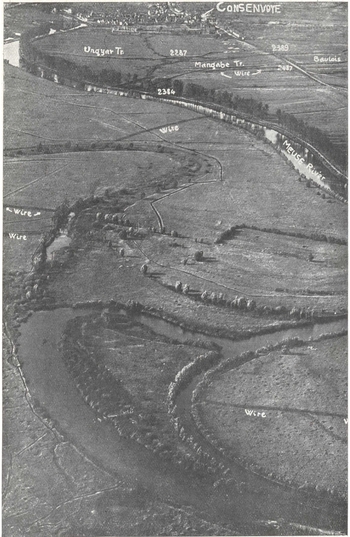
The valley of the Meuse to the south of Consenvoye.
A French photograph used in the preparation of the American offensive on the banks of the Meuse in September 1918.
The barbed-wire entanglements and trenches are plainly indicated.
THE FINAL ALLIED OFFENSIVE FROM JULY 15TH 1918 TO NOVEMBER 2ND, 1918
Nine days before the German capitulation in open country on November 11th 1918.
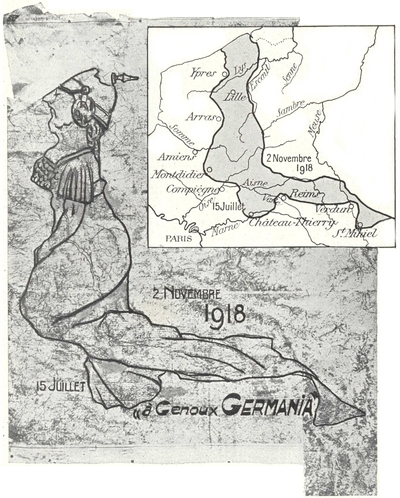
This sketch represents a set of maps scale 1/200,000 on which the Staff-major of the 20th Corps used to trace the line each day.
By strengthening the two lines of July 15th and November 2nd, which are accurately reproduced, and by adding a few lines inside and the point of the helmet, a draughtsman of the Staff-major obtained this curious figure of Germany brought to her knees.
From the plan one can easily recognise the salients of Ypres and Arras, the indentation of Montdidier, and that of Château-Thierry intersecting the Vesle, the salients of Reims and Verdun and the break through at Saint-Mihiel.
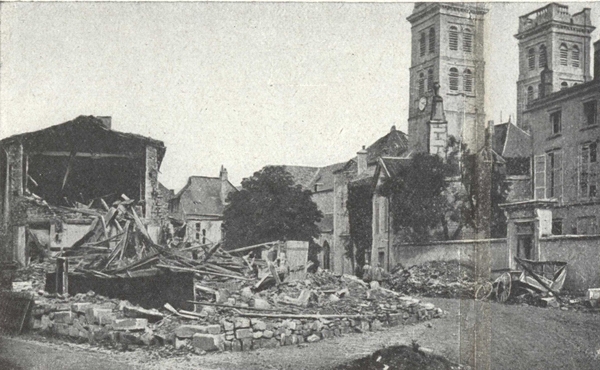
In 1919, Rue De La Belle-Vierge, near the Cathedral.
A VISIT TO THE CITY OF VERDUN
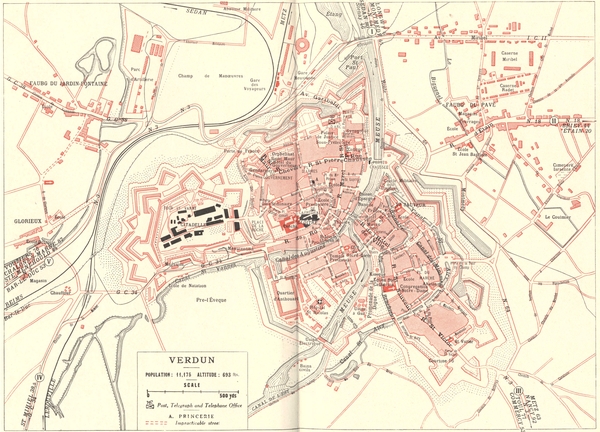
The motorist coming either from Sainte-Menehould or Bar-le-Duc, via the "Sacred Way" enters Verdun by the Porte de France, and reaches the cathedral by the Rues: Saint-Maur, Chevert, and la Belle-Vierge.
The tourist coming from the station by the Porte Saint-Paul, reaches the Cathedral by the Rues: Saint-Paul, Saint-Pierre and la Belle-Vierge.
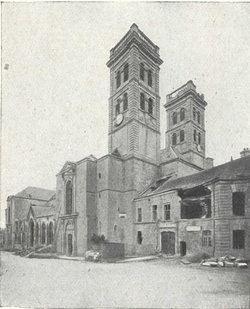
The Cathedral.
The Cathedral.
The tourist, arriving at the Place de la Cathédrale, via the Rue de la Belle-Vierge, finds himself in front of the North Façade (photo opposite).
In the middle is the entrance porch; on the right, the Western transept and the towers enclosing the remarkable, square-shaped old Choir, on the left, the Eastern transept and the polygonal apse of the Great Choir with the Roman basement and Gothic buttresses (photo p. 52).
In front of the towers and on the right, in the photograph opposite, is the entrance to Margueritte College leading to the Bishop's Palace and the Cloister.
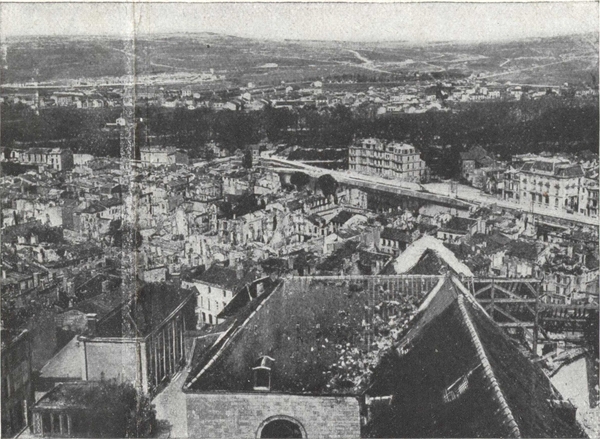
Verdun seen from one of the Cathedral Towers.
In the foreground: Roof of nave, transept and great choir of the Cathedral. In the middle-ground, The Meuse: on the left, the Porte Chaussée in the middle: Military Club. In the background: Line of trees marking the ramparts; behind Belleville Village (on the left) and the Faubourg Pavé. On the horizon: Belleville Hills.
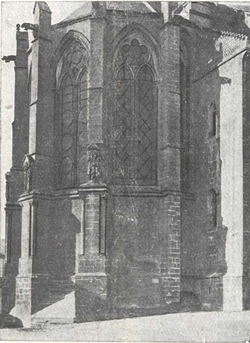
The Apse of the Great Choir which can be seen from the banks of the Meuse.
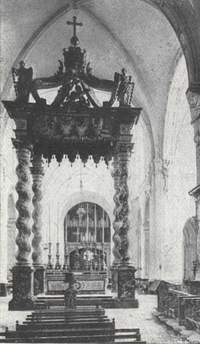
The Canopy (Ciborium) and the altar of the Great Choir.
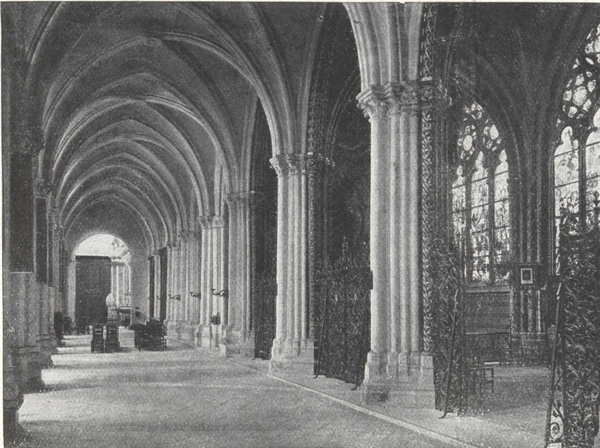
The South Aisle and Blessed Sacrament Chapel.
On entering the Cathedral by the central porch of the north façade, the old choir is on the right and on the left the great choir.
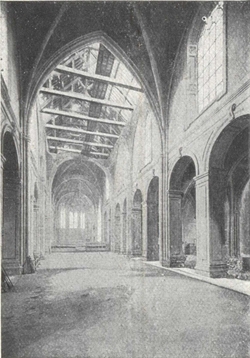
The Nave of the Great Choir in 1918.
In the background, the old choir and the organ platform.
The old square choir is intersected by the great organ.
In the great choir, notice the elegant panelling of Rococo-style and the ciborium with canopy supported by twisted columns of grey marble.
The numerous side-chapels are 14th, 15th and 16th century.
The most interesting is in the South Aisle, that of the Blessed Sacrament, Radial-Gothic in style (photo above).
The door of Margueritte College (see photo page 51) leads to the courtyard of the Bishop's Palace (18th century) and thence to the Cloister (historical monument of the 13th and 14th centuries, photos p. 54.)
From the Bishop's palace, go along the Rue Chatel to the Place Chatel, then down the Rue des Hauts-Fins, and cross the Esplanade to the Citadelle.
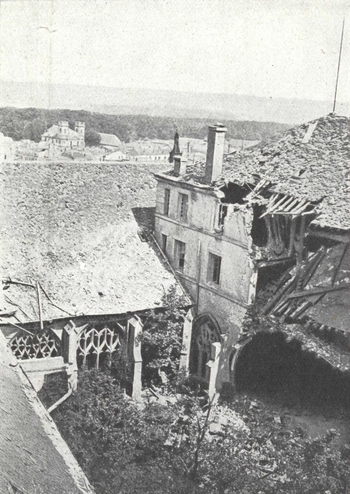
The Cloister seen from one of the Cathedral Towers.
In the background: the East Gallery.—On the right: the ruins of the South Gallery.—In the town can be seen the church of Saint-Sauveur against the green background of the fortifications.
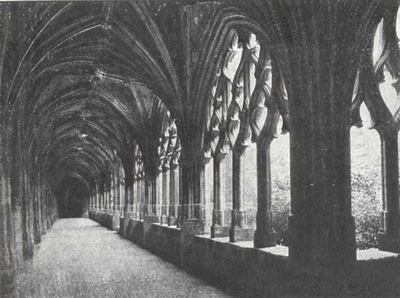
The South Gallery of the Cloister before the War.
See above (on the right) its state after the War.
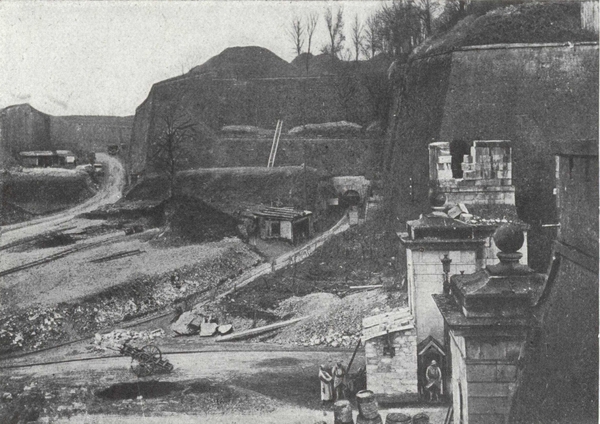
The Ramparts of the Citadelle and the Porte Neuve.
The Citadelle.
The Citadelle occupies the site of the ancient abbeys or churches of Sainte-Vanne, erected in the Merovingian period and the 15th century.
The first Citadelle was completed under Henry IV. The second was the work of Vauban. The church of Sainte-Vanne which had survived was pulled down in 1831. During the war, the deep underground caves were a safe place of refuge for the inhabitants before their departure and for relief troops during the battle.
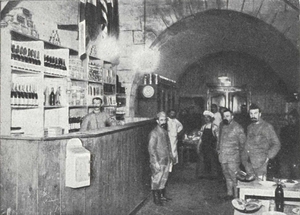
A Canteen installed in the Citadelle.
On leaving the Citadelle, turn right and go down the slope towards the Meuse and the Rue de Rû, keeping to the right. Go by the stores and then the octroi where the shops are located, and enter the Citadelle by No. 4 listening-post, to visit some of the caverns fitted up as they were in the war.
Here can be seen in particular, under a military guide, the chamber of honour where were laid to rest in November 1920 the bodies of 8 unknown soldiers, from among whom was taken the Unknown Warrior who rests in Paris beneath the Arc de Triomphe.
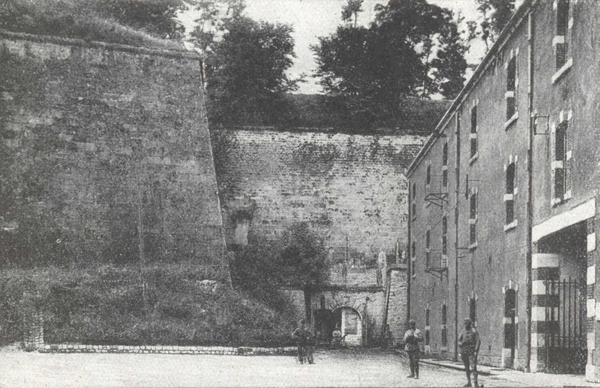
The Citadelle: the entrance to No. 4 listening-post.
(Photo Sommer.)
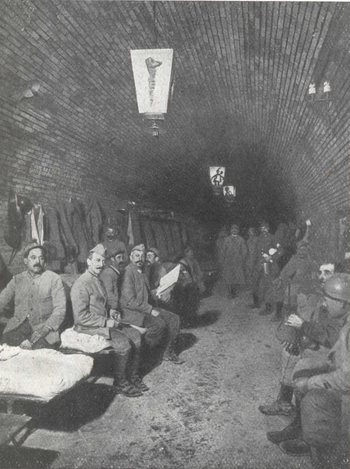
A Dormitory in the Casemates during the War.
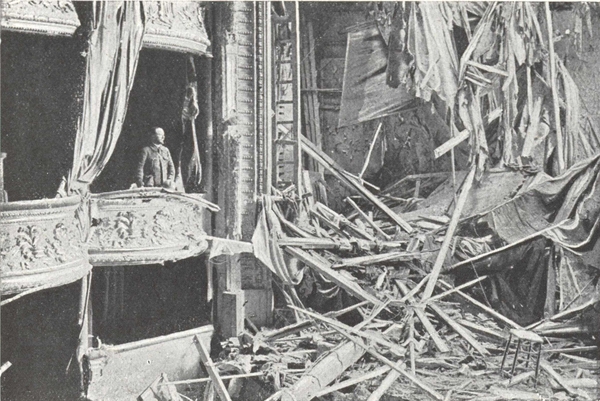
Verdun Theatre in June 1916.
Return from the Citadelle by the Rue de Rû, passing the theatre. Continue along the Rue Mazel to the site of the monument "Aux morts de Verdun" (see next page), return to the Place Mazel, turn right, cross the Meuse, and the Place Chevert is reached.
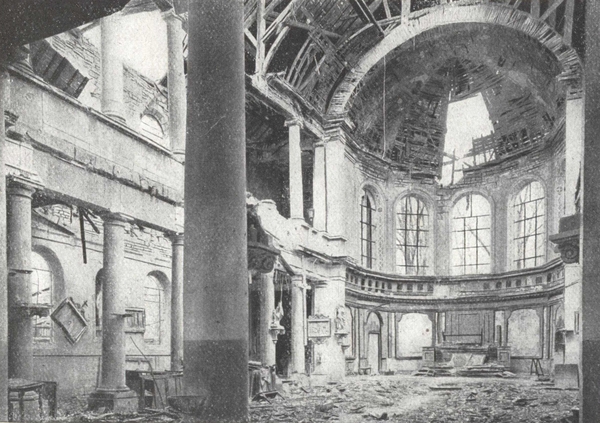
The interior of the church of Saint-Sauveur in August 1916.
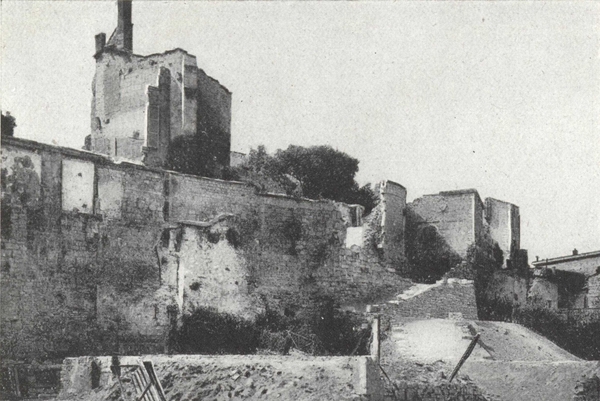
The Rue Mazel. The Old Ramparts in 1924.
Site of the War Memorial shown below.
(Photo Sommer.)
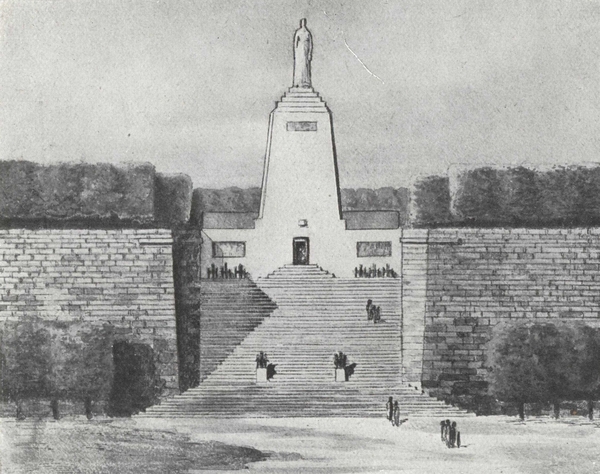
The Monument to the Soldiers of Verdun, erected by national subscription. (L. Chesnay, architect).
A crypt will be opened in the base of the monument where will be laid to rest the 7 Unknown Soldiers, a touching symbol of the sacrifice of the soldiers of Verdun (April 1925).
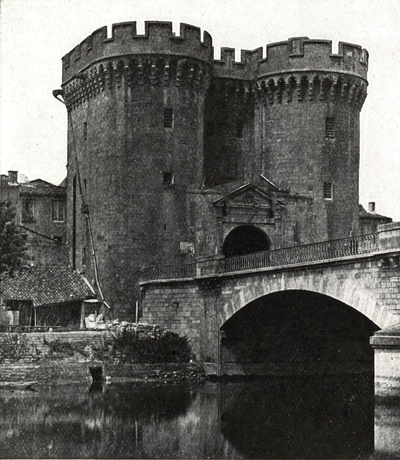
The Porte Chaussée (before the war).
From the Place Chevert, follow the Meuse to the right to the Porte Chaussée.
The Porte Chaussée
Its architecture is reminiscent of the Bastille. Half of the left tower, on the river, was rebuilt in 1690 on exactly the same lines and with stones of the old tower: the semi-circular arcade and the pediment facing the bridge are of the same date.
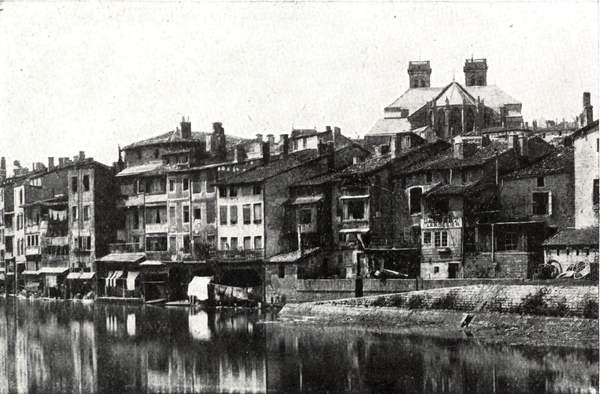
The Banks of the Meuse and the Cathedral before the War.
ROUTES FOR VISITING THE BATTLE-FIELDS OF VERDUN.
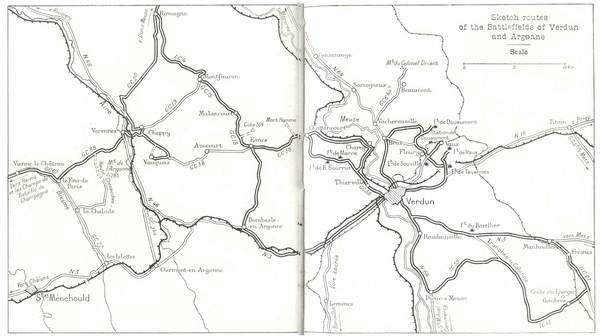
Four hundred thousand Frenchmen died for their Country on the battlefields of Verdun.
It is with feelings of deep respect that tourists visit the sacred ground and thus pay tribute to the heroes who there laid down their lives.
Four routes starting from Verdun lead to the most famous battle areas.
1st Route. The right bank of the Meuse and the forts of Tavannes, Vaux, Souville and Douaumont.
2nd Route. The left bank of the Meuse, Cumières, Mort-Homme, Hill 304 and the "Sacred Way".
3rd Route. Calonne Trenches, Éparges Ridge and the Woëvre plain.
The battlefields of the Argonne adjoin on the West those of Verdun. We pick up at Esnes the route that leads to this region (2nd route opposite).
4th Route. Montfaucon, Romagne, Vauquois mound, Varennes, the forest of Argonne, Haute Chevauchée and the valley of the Biesme.
This volume ends with the visit to Metz, the Cathedral and the Place d'Armes, the Esplanade, and the new and old quarters.
1st Route
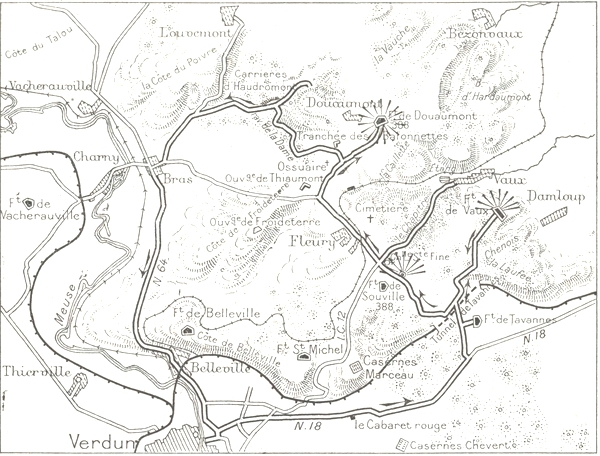
The Right Bank of the Meuse, Circular Tour of the Forts.
Leave Verdun by the porte Chaussée, cross the Meuse, and the fortified enclosure and turn left along the Rue d'Étain (N. 18).
This takes one up the Faubourg Pavé used by relief troops holding the Vaux and Douaumont sectors.
The bombardment of this suburb was incessant until after Verdun was completely cleared in December 1916.
On the left, the tricolor floats over a military cemetery containing over 6,000 graves. This is the Faubourg Pavé cemetery.
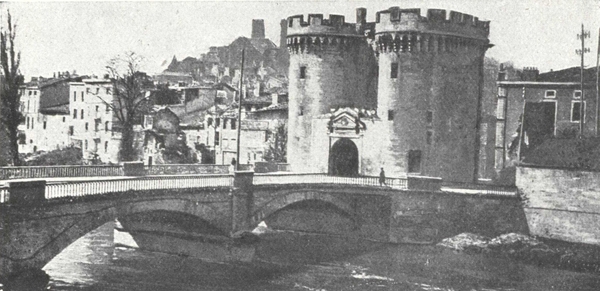
Leaving Verdun by the Porte Chaussée.
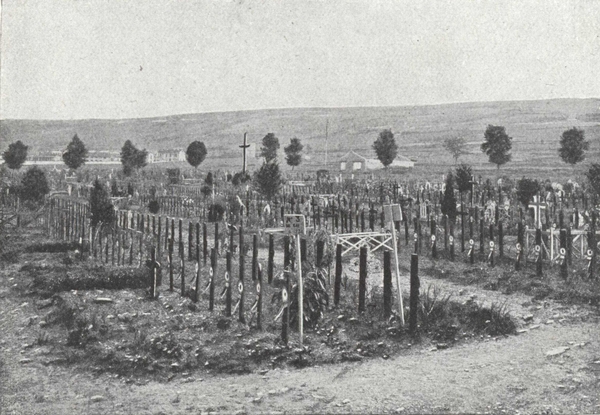
The Faubourg Pavé Military Cemetery.—On the horizon the Hills of Belleville.
On the crest of the hills, on the left, are the forts of Belleville, Saint-Michel and the Marceau barracks which were utterly destroyed. Here started the rear of the battlefield. Behind this crest the field kitchens of the units in the line were concealed. Every night, the fatigue parties, known as "cuistots", facing a thousand dangers started from here to take up food to the men in the line.
Follow the Route Nationale for about 6 km.; beyond the Cabaret Rouge Inn on the right, and the Valteline ravine on the left, the road ascends. Go past the cross-road at Bellevue farm and then turn left by the road leading to Tavannes fort.
The road runs downhill and then rises across the shattered Hospices Wood.
Take the metalled road on the right leading to Tavannes fort.
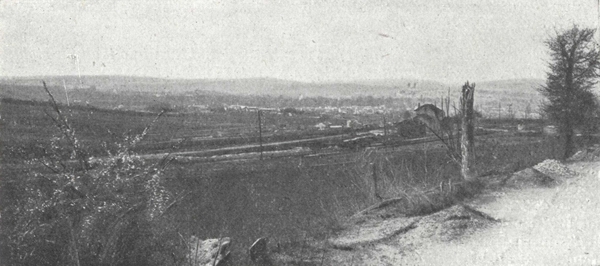
Looking towards Verdun from Saint-Michel Hill.
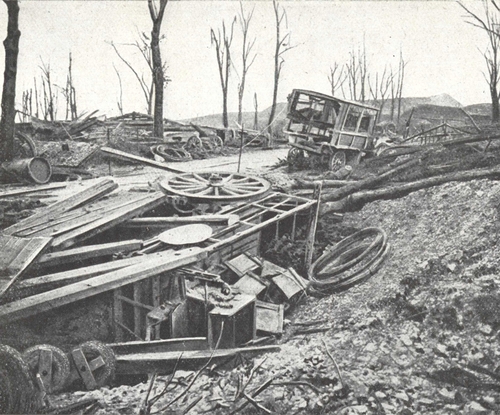
The Route du Fort Tavannes in June 1916.
Tavannes Fort.
Built of stone about 1880 it was never concreted, like Vaux and Douaumont forts. Tavannes fort dominates the ground behind the Vaux-Souville line and the Étain-Verdun road. The Germans, in their effort to reach Souville, sought by frequent bombardments to destroy the fort which resisted stubbornly, but on May 7th a 17-inch shell destroyed one of the arches and caused serious damage. Looking westwards, the horizon is bounded by the long straight line of plateaux. There are three elevations on this line, three points which mark the tragic battlefield of Verdun; on the left the Saint-Michel fort which immediately dominates the basin of Verdun; in the centre nearer still, Souville fort; and finally, further away, on the right, Douaumont.
Return to the road by which the fort was reached and turn into it on the right, following it for about 300 metres until you come to the fork.
At this fork the road passes above Tavannes tunnel. By following to the left the line of telegraph poles the West entrance is reached.
Although the entrances were constantly shelled by enemy artillery, this tunnel was used as a shelter for the reserves of the Vaux-Souville sector and as a munitions depot. Bunks were fitted up in three superimposed rows, 300 to 450 feet in length, and separated by spaces, where those who could not find bunks slept as they could on the ground. Despite the ventilating shafts in this tunnel 1,500 metres long, the air remained foul owing to the stenches of all kinds. On the night of September 4th-5th a grenade depot blew up, causing many victims.
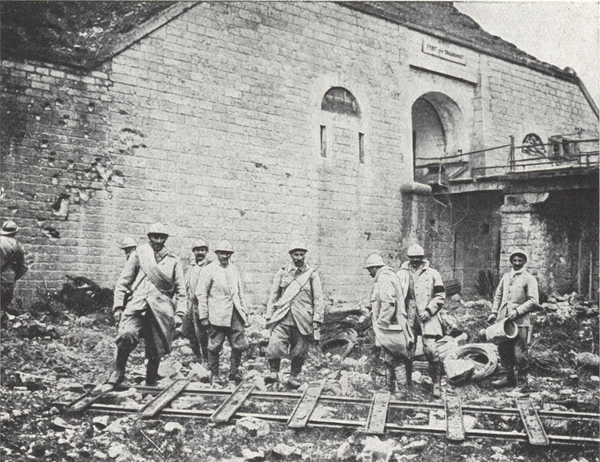
The southern moat and entrance to Tavannes Fort in June 1916.
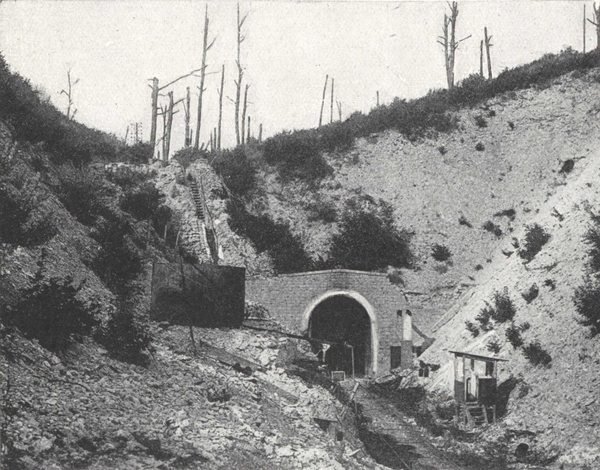
The Tavannes Tunnel (Verdun side entrance) in 1920.
(Photo Martin Collardelle, Verdun.)
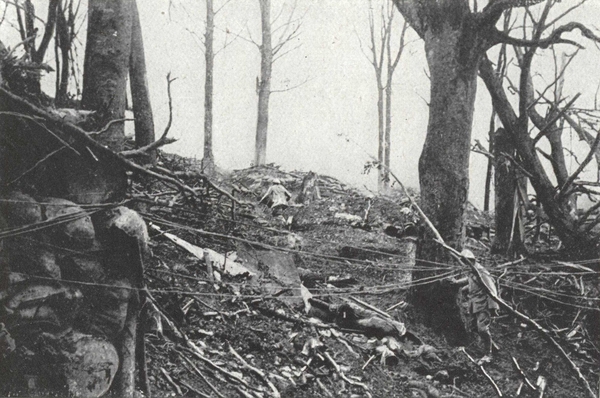
In the Tavannes Ravine in June 1916.—A shell has just smashed in a dug-out.
At the fork, take the road on the right to Vaux Fort. At a sharp bend on this road, the Tavannes ravine, where the railway from Verdun to Metz runs, dips down to the plain of the Woëvre.
The road rises to a plateau formerly wooded but now only a kind of brownish moorland, dotted with tree stumps. On the left can be seen what remains of Vaux-Chapitre Wood and, on the right, the remnants of Laufée and Chênois woods.
By crossing Horgne ravine an open plateau is reached, at the end of which is silhouetted a kind of rock, rugged and uneven "like sandbanks thrown up by a mighty sea over the ages". This rock is Vaux fort.
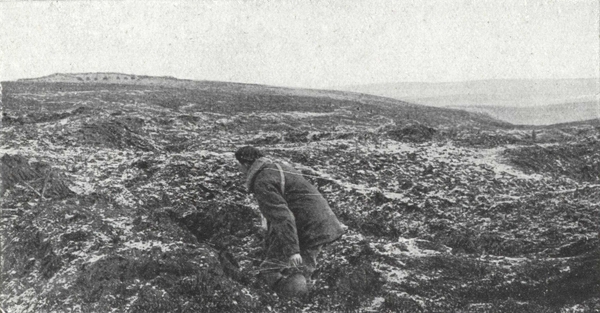
Chênois Wood in 1917.—In the background, Vaux Fort.
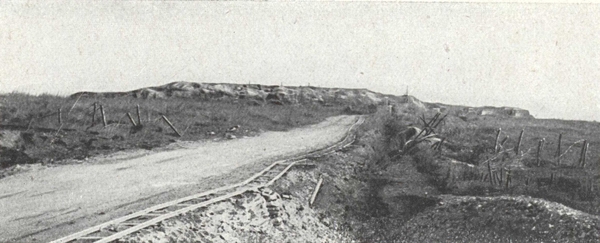
The road to Vaux Fort.—In the background, the Fort.
Vaux Fort.
Built of masonry about 1880 and afterwards reconstructed in reinforced concrete, the fort was only completed in 1911. Smaller and less powerful than Douaumont fort, it dominates the plateau to the south of Vaux ravine and the reverse side of Douaumont plateau. Hence its importance.
To follow the battles which were unfolded round Vaux fort, let us climb on to the superstructure of the fort. From there a huge panorama lies before our eyes.
To the north is seen a deep ravine, Bazil ravine, at the bottom of which glistens Vaux pool. Vaux village, situated more to the right, has totally disappeared, Meusien station has been rebuilt there, its red-tiled roof shewing vividly against the dark mass of Hardaumont Ridge.
On the left, the ground rises towards a crest, forming the slopes of Fausse-Côte and Caillette woods. The projection on the crest is Douaumont fort.
On the right, the Woëvre plain extends to the horizon: in clear weather the blue line of the Moselle Heights is visible. The plain is overlooked by hills, on the nearest of which was the site of the Damloup battery. At the foot are the ruins of Damloup village where the Horgne ravine starts.
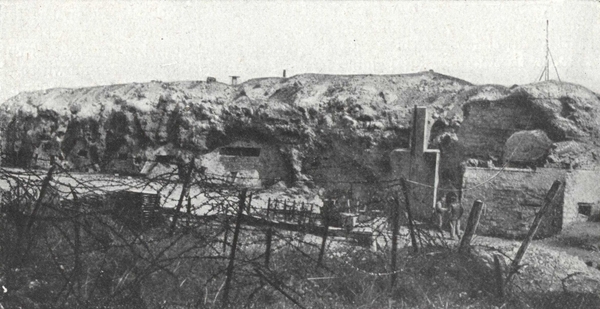
Vaux Fort.—The Casemates of the Gorge of the Fort. The moat has been filled up by the bombardment.
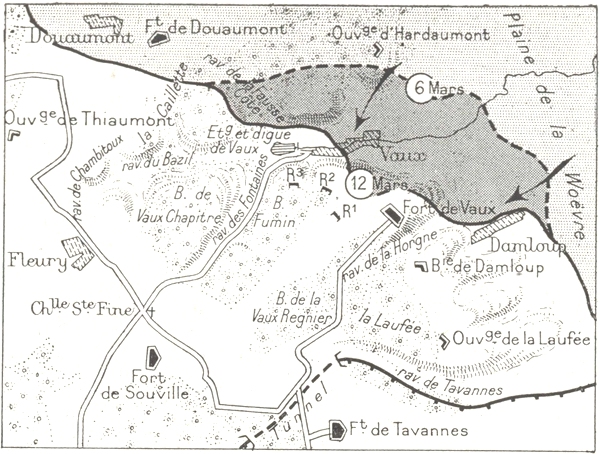
The battle round Vaux. Attacks of March and April 1916.
During the early days of March 1916, the Germans reached the crest on the horizon, to the north of Vaux fort, from Douaumont to Hardaumont redoubt.
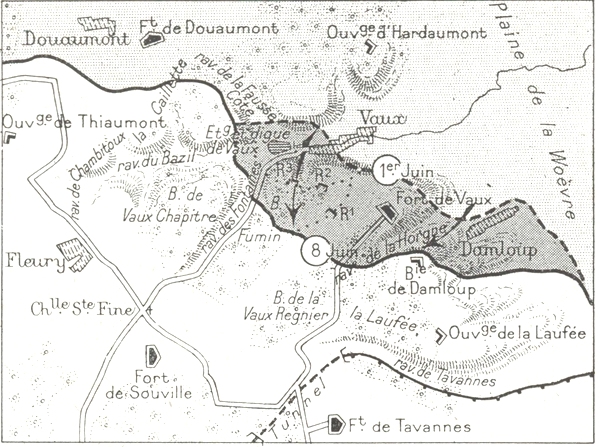
To storm the entrance to Bazil ravine by capturing the village and Vaux pool, then to outflank the fort by the ravine at the same time as they delivered a frontal attack, such was the manœuvre which the enemy intended to attempt in March and April.
On March 1st, in front of Vaux village and fort, the French front was held by the 303rd Brigade (Naulin), 408th and 409th Regiments, which were going to be reinforced by the arrival of the 1st, 3rd and 31st Battalions of chasseurs and parts of the 38th, 86th, 158th, 149th infantry Regiments and the 71st territorial Regiment.
From March 6th to 11th the enemy, regardless of sacrifices, attacked madly in mass.
They reached the western edge of the village but were driven back at the point of the bayonet. Barricades blocked the main street of the village which was defended at all costs.
The enemy were so eager that they made a direct attack on the fort. The attacking waves climbed the brow. The slopes, which are very steep to start with, concealed them and gave them protection, but as soon as they reached the more gradual slopes leading to the fort, they were mown to the ground and fled back in disorder, leaving more than 200 corpses in front of the barbed wire.
The attack of March 9th was made with such confidence in their victory that the German commander announced in his communiqué: "Vaux village and fort, after a strong artillery preparation, were captured in a brilliant night attack by the 6th and 19th Posen Regiments".
On the next day, to justify this lying message, a new attack was ordered, which failed in spite of a deluge of fire rained upon the shell of the fort.
Colonel Naulin, commanding the 303rd Brigade, wrote in his report: "This period is particularly trying, especially from March 9th onwards. The iron rations have been eaten up: food supplies no longer reach us and we are out of water: on the 10th and 11th the garrison is reduced to drinking melted snow. In spite of everything, the morale has never been better. The men realise that the sacrifices cheerfully made have not been in vain and that behind them, Vaux fort though battered beyond recognition is still ours...."
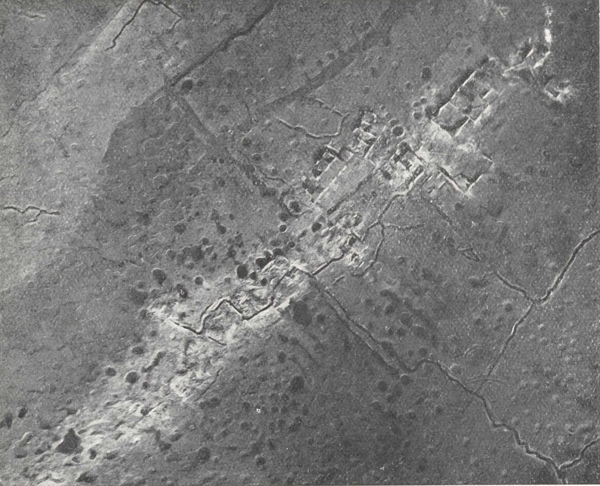
The South-West edges of Vaux in May 1916.
On the left, Bazil ravine and the tip of Vaux pool.
In the centre, the village ranging along the northern slopes of hill containing Vaux fort.
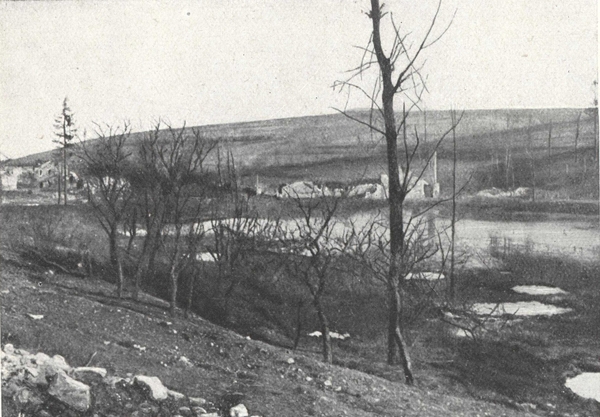
The village and pool of Vaux in April 1916 viewed from Hardaumont crest.
In the background, the hill where Vaux fort is situated.
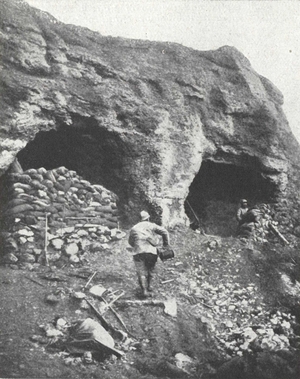
Casemates of Vaux Fort in November 1916.
A signaler reaches the fort.
Losses were however, heavy on both sides, the 303rd Brigade when relieved having lost 2,500 men and 65 officers.
On the 31st, fighting broke out afresh. In the village of Vaux, the attackers surrounded the garrison which made its escape and clung to the Western outskirts.
On April 2nd, a fresh enemy division swarmed down the southern slopes of Caillette wood and reached Bazil ravine. It was a serious moment. Douaumont was outflanked to the South, and Vaux to the West.
The 3rd Corps (Nivelle) was rushed to the relief, the 5th Division (Mangin) at the head; Mangin had only the 74th Regiment available at the moment. There was no time to lose. Mangin reached Souville where he turned and said to the colonel of the 74th who accompanied him: "My friend, no half-measures here but get to close quarters with the Boches and get after them with bombs".
The 74th and then the whole 9th Brigade crossed Bazil ravine, which was filled with gas, cleared Caillette wood with bombs and at the point of the bayonet, and held fast to the recaptured line, repelling all counter-attack.
On April 9th and 10th the enemy again attacked unsuccessfully in front of the fort but captured Vaux village.
The June attacks.
At the beginning of June the enemy planned to make violent attacks upon Vaux fort.
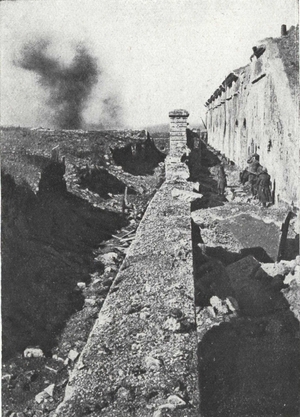
The south moat of Vaux Fort in May 1916.
Occupying the village, they held the head of Bazil ravine. Their plan was to outflank the fort simultaneously on the West by Fumin ravine and wood and on the South-East by Horgne ravine.
On June 1st, in front of Damloup, their attack failed, but in the centre the bombardment overwhelmed and almost buried the 6th French Division which barred the Bazil ravine.
Deploying from the ravine the enemy advanced through Fumin wood.
On June 2nd, after the fall of Damloup, the enemy progressed through Horgne ravine. The fort, pounded by a storm of 210, 380, and 420 shells was threatened simultaneously from 3 sides, and closely besieged. Survivors from the trenches at hand took refuge in the fort. In the redoubt to the west of the fort a handful of foot-soldiers of the 101st died fighting to the last man.
The Germans reorganised on the flanks of the hill and repulsed all counter-attacks.
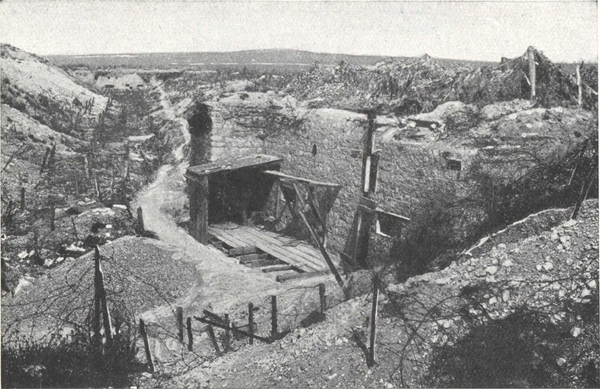
Vaux Fort: the north moat has been half filled in; the casemates which guard it.
On the horizon, Douaumont fort.
(Photo Martin Collardelle.)
The capture of the Fort (June 3rd-8th).
On June 3rd, at dawn, a wave of German pioneers crept through the fog and smoke, eluding the look-out men at the fort, captured the Casemates on the North Moat (Photo above), then got down into the half-filled moat, and crept stealthily along the funnels on to the superstructure of the fort, where they put their machine guns in position.
Since March, the fort and its surroundings had received no less than 8,000 heavy shells every day. The Commandant Raynal, who was O. C. of the fort, was imprisoned underground with his men. The garrison, regularly composed of the 6th company, a company of machine guns of the 142nd and about 40 artillery men and sappers was augmented by two companies of the 142nd, a company of the 101st and a company of machine guns of the 53rd who had taken refuge there.
To economise food and water, the surplus contingents were ordered by Commandant Raynal to leave the fort. On the night of the 4th-5th, a first detachment of the 142nd made its escape under the direction of Lieutenant Buffet, who returned next evening to the fort bringing orders. On the night of the 5th a hundred more men managed to get away. Carrier pigeons and optical signals soon furnished the only means of communication.
On the afternoon of the 4th, the last pigeon was released. On the morning of the 5th, thanks to two signalmen who volunteered to change a signal post which the Commandant had difficulty in observing, communications were maintained.
On the evening of the 5th, Commandant Raynal sent his last message that could be read in its entirety, and which ended: "We have reached the limit, officers and soldiers have done their duty. Long live France". Nevertheless, the fort continued to hold out and refused to surrender.
On the night of the 6th, 7th, reinforcements tried to relieve it and reached the moat, but after losing nearly all their officers they were compelled to fall back.
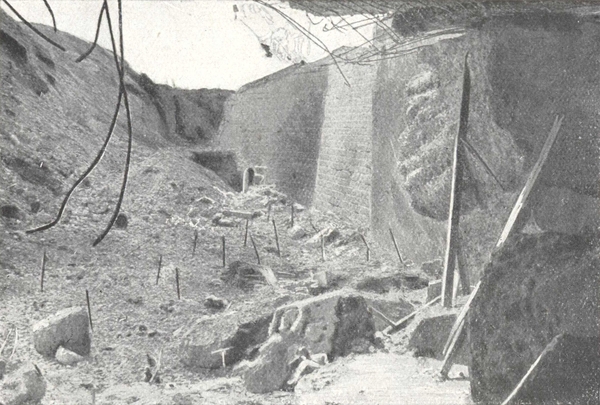
The north-east moat of Vaux Fort in April 1916.
View of the north casemate demolished by the bombardment.
The Germans who had gained a footing in the ruins of the superstructure, were only able to drive the French out of the casemates by lowering baskets of grenades with time fuses and by spurting liquid fire and asphyxiating gas.
Driven back in the underground passages, the defenders continued the fight with grenades and bayonets. The sand bags which were used to barricade the passages were thrown into the air by the rending explosions. Attackers ran at every turn against machine guns or bombers.
"Captain Tabourot, who was defending the north-east gate, lies writhing in agony, wounded in the stomach and with broken legs. The aid post is a hell where hundreds of wounded lie parched with thirst in the stinking darkness of paraffin lamps. Water is unobtainable. The stench increases, in the atmosphere of smoke and gas it is impossible to breathe. On the 7th, at 3.50 a.m. the fort signals again, and these are the only words that are read "... at the bitter end.... Vive la France!" (L. Gillet).
The 2nd regiment of Zouaves and the Colonial regiment of Morocco made a last effort on the morning of the 8th to relieve the garrison. They reached the approaches of the fort, from which clouds of thick black smoke, caused by a violent explosion in one of the casemates, were pouring. Exposed to the fire of the enemy machine-guns installed in the superstructure of the fort and attacked by constantly increasing reinforcements, they were unable to hold their ground.
On the 8th, at 4 p.m. when the German communiqué announced the capture of the fort, the heroic defenders were at last overpowered, the unwounded among them not having tasted a drop of water for two days.
By winning the admiration of the enemy, the Commandant Raynal was allowed to keep his sword in captivity and his heroic men were accorded special treatment.
Five months later, on November 2nd, after the victory of Douaumont, the Germans hurriedly evacuated the fort.
Under the escort of one of the garrison the interior of the fort may be viewed.
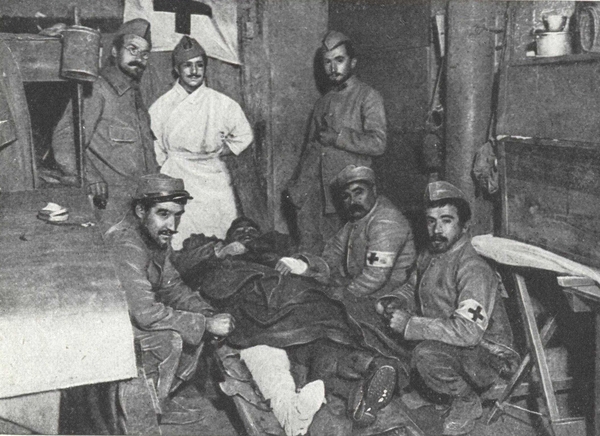
The aid post at Vaux Fort, in November 1916.
Notice in the passages the marks made by bursting bombs. The dummy barricades with loop holes which obstruct the passages were built by the French in 1917, after the recapture of the fort, they replace the walls of sandbags which Commandant Raynal's heroic garrison had put up.
On leaving Vaux fort, return along the same road to the fork of Tavannes tunnel.
A hundred metres beyond the first bend on this road, the furthest line reached by the Germans in September 1916 is crossed: this line then runs down to the left to Woëvre, passing between Damloup battery, captured on July 11th 1916, and Laufée redoubt.
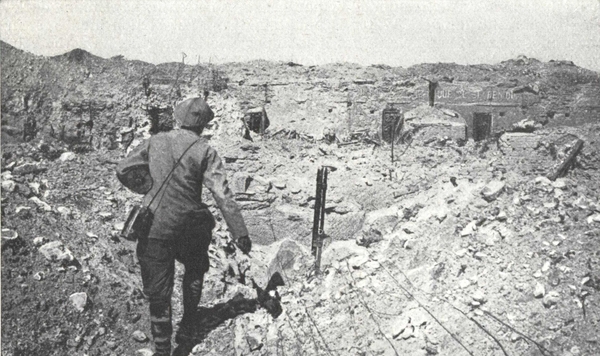
Laufée Redoubt.—The inside court.
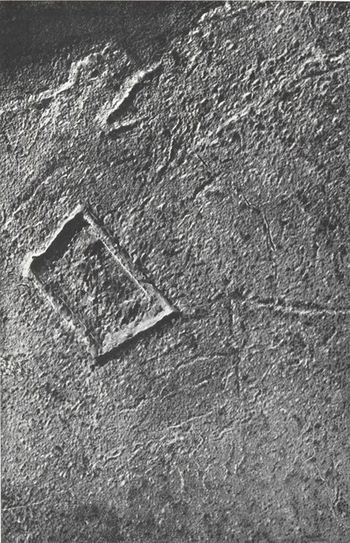
Vaux Fort and its Approaches in August 1916.
The whole field of battle is entirely pounded up. A few rudimentary trenches can only be discerned with difficulty here and there.
The woods which used to cover the plateau of Vaux fort and the slopes of Horgne ravine have disappeared.—The much worn surface looks like a sponge.
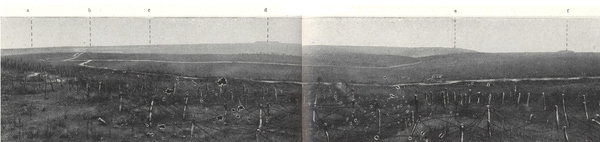
Panorama view of the north slopes of Souville.
a. Froideterre Hill.—b. Thiaumont Redoubt.—c. Douaumont Mortuary.—d. Douaumont Fort.—e. Hardaumont Crest.—f. Vaux Fort.
The panorama from Souville fort.
At the fork at Tavannes tunnel, turn right towards Souville fort seen immediately in front.
On the right, the ruins of Tunnel and Hôpital batteries; on the left, the ravine of Hôpital wood, with trees denuded of branches. This ravine was crammed with artillery batteries which were daily subjected to fire and deluged with poison gas.
The road turns to the right, at the foot of the escarpments of Souville fort, the shapeless mass of which dominates the ridge. After passing the ridge, the vast panorama of the Souville-Douaumont battlefield unfolds itself. This was "the supreme arena, captured and recaptured, the holy of holies of this sacred ground" where the soil has been ploughed and blistered with thousands of furrows like as it were to a cataclysm unprecedented in nature. No one can regard unaffectedly this battlefield, unique in the world, the furnace where for ten months millions of men fought face to face and nearly 700,000 laid down their lives.
To understand properly the battle which look place before Souville in June and July 1916, let us examine from left to right the vast panorama reproduced above.
On the left the horizon is bounded by the long Froideterre hill. (It was on this crest that the mortuary of Douaumont was afterwards built). On this straight line stand out conspicuously Froideterre and Thiaumont redoubts, then the ridge rises appreciably towards Douaumont fort which crowns the highest point, 388 metres.
Between Thiaumont and Douaumont a tricolor floats above the temporary mortuary of Douaumont. Lower the cemetery of Fleury is conspicuous by a big white patch, and the site of the village is a little more to the left on the reverse of a slight slope encircled, from East to West, by the ravines of Poudrière and Vignes. Nearer, at the cross-roads, is the site of Chapelle-Sainte-Fine; the road which branches off to the right plunges into Fontaines ravine and leads to Vaux.
To the right of Douaumont, the ridge drops slowly towards Hardaumont hill, separated from Vaux Fort hill by Bazil ravine.
Between Souville and Vaux stretch the old woods of Vaux-Chapitre, Fumin and Chênois.
The battle in front of Souville (June 1916).
Thiaumont redoubt, Froideterre hill, Fleury and Souville fort formed the last powerful barrier which the enemy, in June 1916, wanted to break through in order to get an uninterrupted view of the basin of Verdun.
With Souville captured, the enemy dominated the town at a distance of hardly two miles, while the defenders in acute danger were driven back upon the last zone Belleville, Saint-Michel, with the Meuse immediately behind.
Time was getting on and the enemy felt themselves menaced on the Somme and the eastern front. This is the time for success the Kaiser announced. A German officer, taken prisoner before the attack, was reported to have said "The capture of Verdun was anticipated in four days". A curious map distributed to each one of the attackers and later found on the prisoners showed the various stages to Verdun and with false figures of distances the road from Verdun to Paris.
From Froideterre to Vaux fort the French line was held by the 11th and 6th Corps (Mangin and Paulinie).
From the 21st, an unprecedented bombardment was directed upon the zone Froideterre-Fleury-Souville-Tavannes. The ridges were set on fire, smoking like volcanoes and black and yellow smoke clouds rose from all the ravines. It was a continuous bombardment, marked every now and then by the terrific bursts of enormous shells of 380 and 420 calibre which deluged down upon Froideterre, Souville and Tavannes.
On the evening of the 22nd, the enemy, to complete his task of annihilation, poured down upon the plateau of Souville, the ravines, the battery emplacements, and the tracks nearly 200,000 gas shells. The atmosphere became unbearable to the point of suffocation. The enemy expected to meet with no further resistance, so certain were they of having annihilated artillery, food and supply convoys, and supports.
Nevertheless, reinforcements proceeded up to the "furnace", under the protection of gas masks, stooping under the weight of their packs, stumbling in shell-holes, while shells were falling about them on all sides.
"All night long, the troops climbed this Calvary. In the morning, tired out, they would withstand the shock of the attacking infantry."
At daybreak on the 23rd, the bombardment reached an intensive fury.
"Masked, blinded, half-suffocated and half-buried in the earth thrown up by the incessant shell-fire, the troops in the line of the Garbit, Toulorge Giraudun Divisions knew perfectly that, when the tornado lifts, that moment would be the signal for the attack. They waited (and what a waiting that was!) on ground churned up by fire, listening to the pitiful cries of the wounded, and with the dead to keep them company. They waited, controlling their nerves, all on edge but strung towards one object, one idea, never to give ground but to fight and hold on. The sentries wiped with their benumbed fingers the glasses of their periscopes, and peered into the smoking horizon. The barrage lifts, the enemy are leaving their trenches, Ah! here they come!" (H. Bordeaux: La Bataille devant Souville).
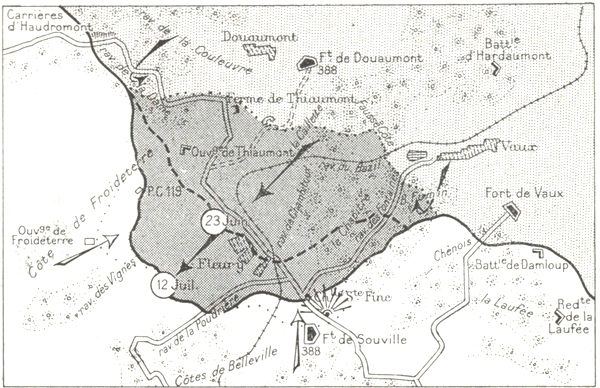
The Battle in front of Souville (June 23rd and July 12th 1916).
It was 7 a.m. when across the hills and by all the ravines converging on the plateau, Couleuvre and Dame ravines which lead to Froideterre, Caillette and Bazil ravines which lead to Fleury, Fontaines ravine which extends from Vaux towards Souville, the thin columns wended their way, 80,000 "feldgrau": Bavarians, chasseurs of the Alpine Corps, troops inured to hardship, advanced on the 5 kilometre front.
In the first line, the storm battalions marched in mass formation, preceded by an extended line of bombers who held the handle of their bombs and leapt from hole to hole. In the rear, supporting troops assembled in the ravines. The French batteries kept up an incessant barrage, harrying these ravines which became charnel-houses of blood, poisoned with gas fumes.
On Froideterre hill, Thiaumont redoubt was forced to capitulate with its garrison. Attacked from front and flank, the chasseurs of the 121st Battalion struggled, outnumbered ten to one, and hand-to-hand fighting took place along the whole front of the battalion which was encircled, only sixty chasseurs being able to escape with their lives from the encounter. Through this breach in the line 4 Bavarian companies burst through as far as Froideterre redoubt. But the obstinate defence of Thiaumont enabled the 114th Battalion of chasseurs to come up, who then deployed, "as though on parade" and by a dashing display with bayonet and grenade harassed and overwhelmed the Bavarians who, for a moment, had got possession of Froideterre redoubt.
In the centre, Fleury village was outflanked. A battalion of the Alpine corps who had succeeded in crossing Bazil ravine before the lifting of the French barrage, hurled themselves against Fleury and gained a footing in the western outskirts.
Before Souville, fortunately, the main German attack was broken by the 307th Brigade (Colonel Bordeaux). The 407th Infantry Regiment held the line on the wooded slopes of Vaux-Chapitre. The right held on without giving way, but on the left contact was broken through a gap being made: this enabled the Germans to fall upon the defenders in rear. It was a critical moment, saved by the Colonel of the 407th who had posted several machine gun batteries near his headquarters, and was able to slow down the attacking waves. At the same time he improvised a force of reserves, adding telephonists, stretcher-bearers, pioneers, orderlies and cooks, and with these he attacked the enemy who were surprised and fell back.
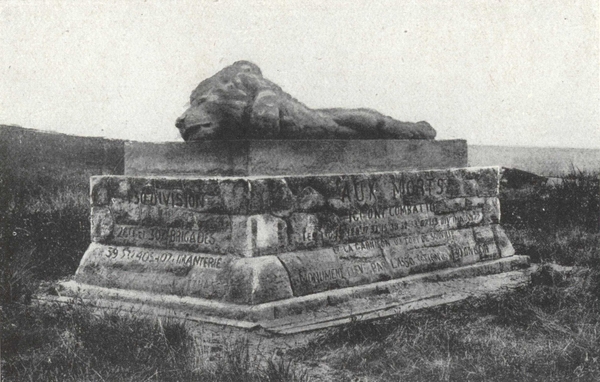
The War Memorial of Chapelle Sainte-Fine.
(Photo Sommer.)
The Souville road was still barred. The fort, where so many heroic artillery observers had been buried or blown to pieces by the bombardment, continued to remain the ever-alert sentinel of the battlefield.
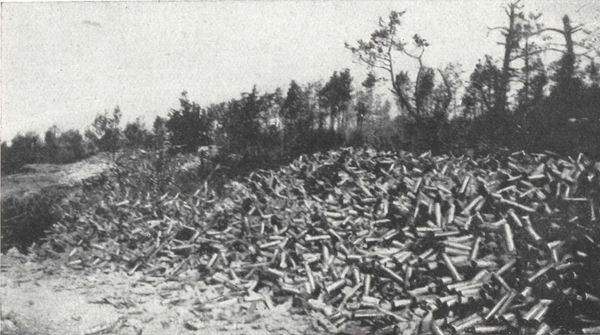
The heap of shell cases fired (45,000 in 3 days) by 8 guns, during the battle in front of Souville (June 1916).
The flags of the attacking German regiments, which had been sent up from the depots to the front to be unfurled in captured Verdun, were sent back to the rear by higher orders.
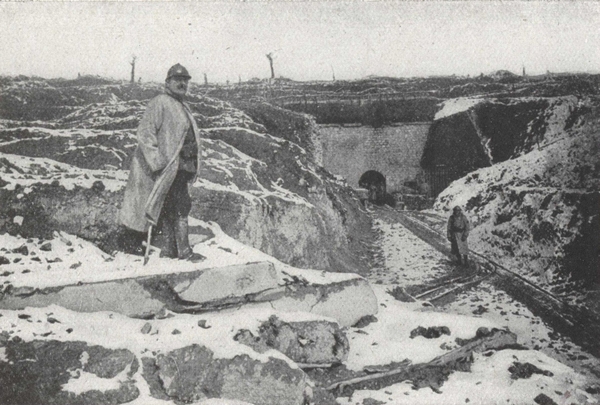
In Souville Fort (March 23rd 1917).—General Corvisart.
But the enemy had not yet finished his attempts to force the barrier. They captured Thiaumont and Fleury, and on July 11th they intended to try, by way of Poudrière and Vignes ravines, to outflank Souville fort on the West while at the same time making a direct attack upon the north slopes (Plan p. 78).
In front of Souville, the line was held by the 131st Infantry Division (Duport) and in front of Vaux fort by the 79th (Mordrelle), reinforced by the 128th Infantry Division (Riberpray).
In the Vaux sector the attack failed.
But on the left of the battle, the enemy passed Fleury and penetrated into Poudrière and Vignes ravines. On the 12th, at daybreak, they captured Chapelle Sainte-Fine, thereby threatening Souville fort. The enemy quickened his pace and climbed the slopes of the fort, with the French barrage playing right on them. Under this rain of fire the attackers swerved and a final headlong rush carried 150 Germans to the summit of the fort, "like the edges of foam from a packet steamer which dissolves into spray". All were captured or killed in an instant in the moats. The Germans could not take Souville.
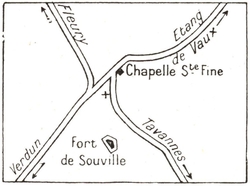
From the slopes of Souville, go down to the cross roads of Chapelle Sainte-Fine, where the memorial (page 79) marks the limit of the German advance before Verdun.
From Chapelle Sainte-Fine, Vaux pool may be reached on the right by following the famous Fontaines ravine, between the stumps and the brushwood of Vaux-Chapitre wood and Fumin wood.
Five hundred metres from the cross roads of Chapelle Sainte-Fine, on the right, is Haie Renard, the scene of one of those undying exploits which contributed to the safety of Verdun. On August 1st 1916 the Germans had progressed as far as this crest which dominates the head of Fontaines ravine.
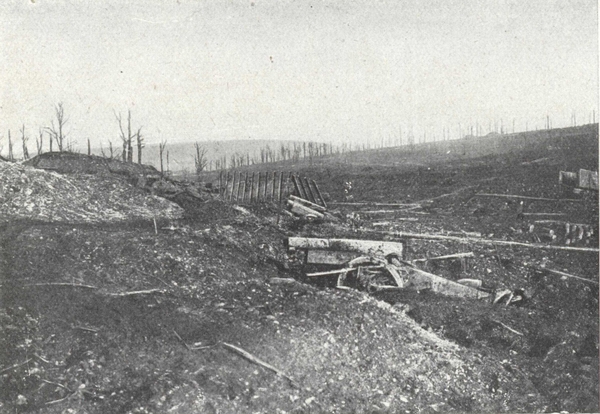
Fontaines Ravine in February 1917.—A demolished French battery.
On August 5th, the enemy by a hustling attack on the 10th Regiment and the left of the 56th, forced a new indentation in the line whereby the position of the 4th Zouaves was threatened, more to the west. The colonel realising the danger decided to counter-attack in the neighbouring sector, but his whole reserve only numbered 24 zouaves, a pioneer section commanded by Lieutenant Charles.
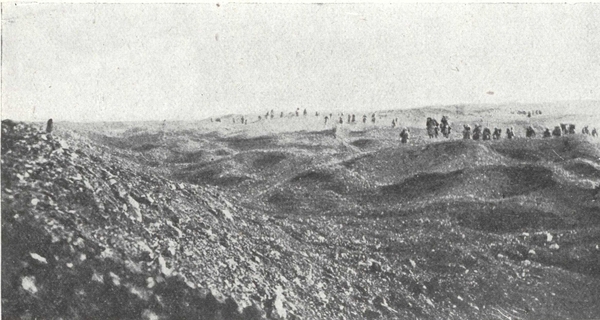
Attacking waves crossing Fumin wood (October 1916).
The position was acute: on the other side of the ravine the Germans were continually advancing. The Colonel sent his section into action. The men fell to the bottom of the ravine which was beaten down by 150's, then crossed the road, and climbed up in the face of the enemy's fire. Lieutenant Charles calmly reorganised the line. This little band lay on the ground and fired full at the enemy.
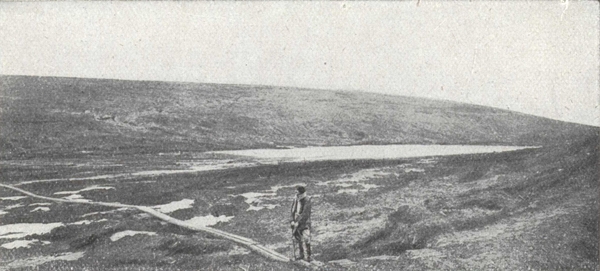
Vaux Pool (March 4th 1917).
Presently the order to charge with the bayonet was given: every man got ready. The leader rose and with a cry of "Advance" the Zouaves leapt forward. Disconcerted and wavering the Germans turned tail and raised their arms: those who resisted were run through and forty prisoners were sent back to the rear under charge of one man, for by this time Lieutenant Charles had only 7 Zouaves left. With his 7 Zouaves, 2 men and one sergeant of the 56th Lieutenant Charles held the recaptured line. In the middle of the night this handful of heroes was relieved by an entire battalion.
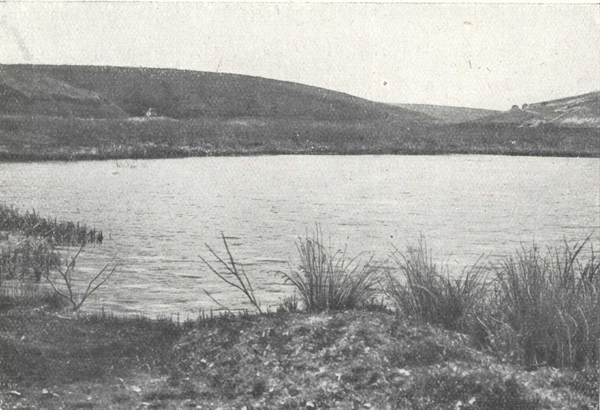
Vaux Pool (May 1921).
On the right, Bazil ravine; on the left, Fontaines ravine.
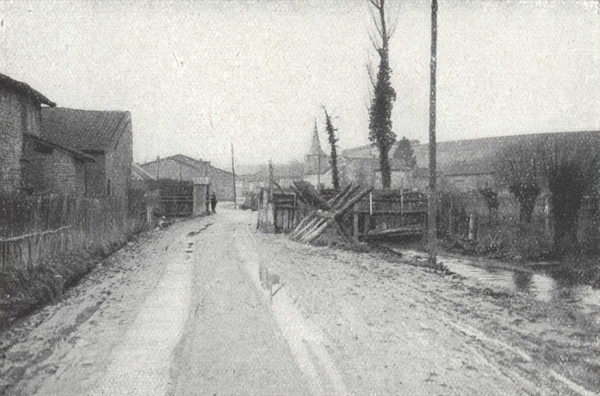
Defence works in Vaux village (January 14th 1916).
Continue towards Vaux pool and stop a hundred metres from the pool.
Make your way to Vaux pool on foot between the crests of Hardaumont and of Vaux fort.
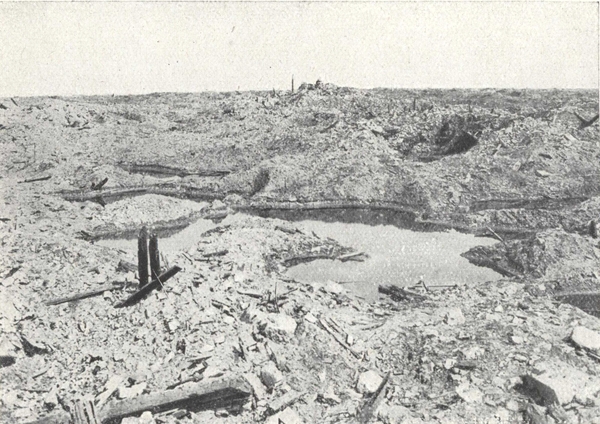
Where Vaux village was (April 26th 1917).
Make a half turn and come back by the same road as far as the Chapelle Sainte-Fine cross roads. Then continue some 40 metres, taking the turn on the right to Douaumont.
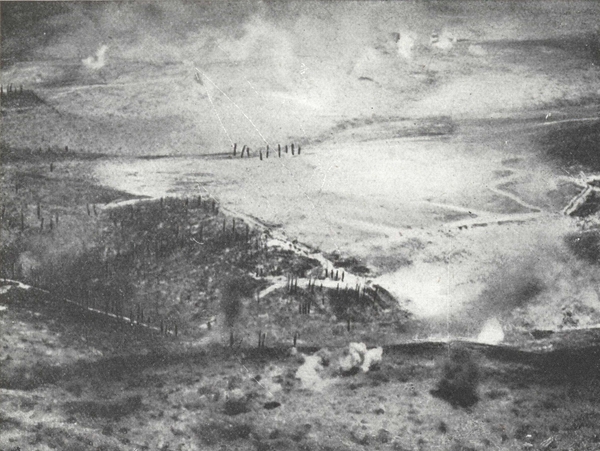
The Bombardment of the Fleury-Thiaumont sector seen from an aeroplane (August 1916).
In the foreground, on the crest, big calibre shells bursting. Then just behind, Poudrière ravine. The first white blot in the middle of the photograph is the Fleury sector. In the background, amid the smoke of exploding shells, Froideterre Hill and Thiaumont.
About 500 metres from the cross-roads is the site, on the left, of Fleury village. A slight raising of the soil is the only sign that is left that a village once existed. Captured on June 23rd, 1916, Fleury village was not definitely freed until August 18th, after two month's incessant fighting.
On June 26th, the 114th Battalion of chasseurs clung to the borders south and west of the village. On July 15th, in an attack made by the 3rd Zouaves, one battalion lost all its officers. On August 2nd, the 56th and 10th Infantry Regiments captured the station to the south of the village, with 350 prisoners and 11 machine guns. Next day, some units of the 207th crossed the village but they ran short of ammunition so that after a close combat somewhat ill-matched, they had to withdraw to their original line. On August 4th, the 134th Infantry Regiment captured some buildings, as also did the 8th Tirailleurs four days later.
On August 10th, at length, the colonial regiment of Morocco planned a systematic capture of the village. From the 10th to the 16th, they advanced to the sap and organised their starting points. On August 18th, supported by a battalion of the 8th Tirailleurs, the colonials attacked singing the Marseillaise and the Anthem of the Marines. Two battalions encircled the village, but in the centre each shell-hole and every hollow had become a miniature fort to be stormed in the teeth of machine gun fire. Next day was a fight of knives and bombs. At night a hundred surviving Germans gave themselves up. After the capture of the village the enemy concentrated a terrific artillery fire on it, and up to September they endeavoured to retake the ruins.
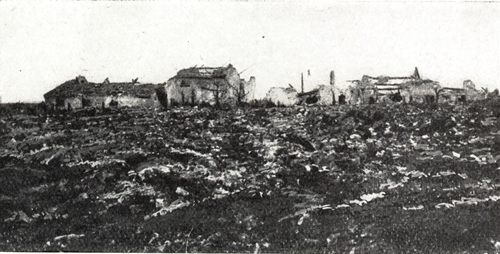
The Southern edges of Fleury, in July 1916.
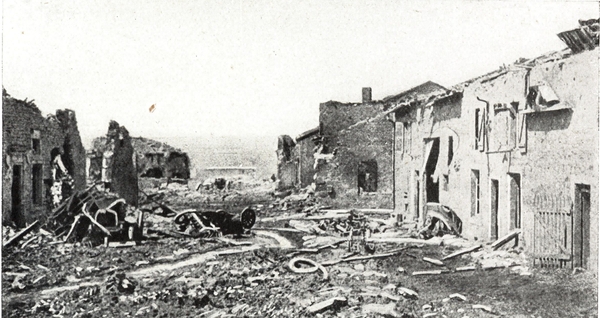
The Main Street of Fleury, in July 1916.
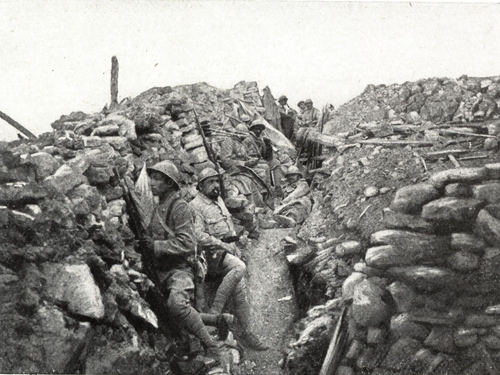
A trench in the ruins of Fleury, in October 1916.
Fleury during the Battle of Verdun.
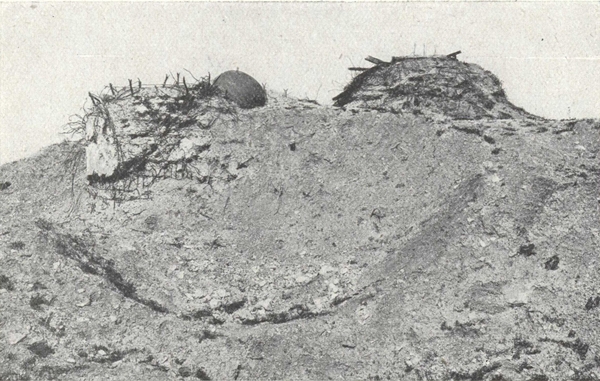
Thiaumont Redoubt in 1920.
(Photo Martin Collardelle.)
One kilometre beyond the ruins of Fleury, the road divides; the left fork leads straight to Bras, but take the right hand one as far as the road to Douaumont fort, 300 metres to the right.