VERDUN DURING THE BATTLE OF THE MARNE (continued 3)
Reading edition
Speaking French became a provocation.
To say "Merci, Monsieur" and "Bonjour, Madame" were court-martial offences at the courts—ordinary and extra-ordinary—which sat permanently at Metz. Sentences never stopped. All the French newspapers were suppressed and only the official German papers were allowed.
The German authorities instituted an organ, La Gazette de Lorraine, to be modelled on the infamous Gazette des Ardennes and to further the same purpose, the demoralisation of the French nation. In this gazette, the Germans carefully published, in the first issues all the sentences pronounced by the courts-martial, in the hope of terrifying and cowing the inhabitants of Metz. It was a vain hope: it had the opposite effect of strengthening their resistance. The system of spies and informers was widespread under official orders.
A young girl, slily exhibiting surprise at seeing a squadron of French aeroplanes pass overhead, shouted in front of her house: "Oh Kolossal!" Denounced by a loyal German woman, she was called before the court-martial (the first of three appearances).
To the military judges who tried to force her to admit to her anti-German sentiments, she replied: "My father who was imprisoned in a fortress is exiled with my mother in Prussia. My two brothers, French officers, are no doubt dead by this time, and I cannot yet love Germany". She was set free this time, but a stricter watch was kept on her.
Orders were given to celebrate the "great German victories". The "Mutte" of the Cathedral was rung. The Germans noisily showed their delight on the Esplanade round the statues of the "idols". The mayor, a noted German naturally, read the bulletin of victory from a window of the Hôtel de Ville decorated and illuminated.
The inhabitants shut themselves up in their homes. "Though we live side by side we shall never meet one another", they said. When forced to fly flags, they hoisted, as far as they could, the decorated emblem of the cross of Lorraine.
The bombardment of Verdun was audible at Metz and caused much anxiety. But the people of Metz saw the return of the "feldgrau" who, once mad with enthusiasm, now had fear in their eyes at the mention of Verdun.
Russia succumbed. Could they still hope? The most obstinate did not give up hope and they buoyed up the falling spirits. Pious families prayed in the churches.
1918.—The inhabitants of Metz felt that the end was near. Hunger held the German population in its grip, though the natives of Metz managed, by every known and unknown ruse, to conceal food which their friends in the country obtained for them almost under the noses of the police. The allied squadrons of aeroplanes came every night to bombard the station of Metz-Sablons. Forts thundered, bombs burst, and munition trains blew up. The Germans proclaimed with loud shouts the offensive that was to bring peace. At the end of July the newspapers, which had been extolling the German attack, started talking about defending themselves.
The people of Metz knew that they were certain of becoming French again. And now the battle drew near the fortress. With feverish haste the Germans manned and equipped the forts. Were they to undergo the devastation of a bombardment? Already American shells were falling on the south suburb of the town. "At what price shall we buy our liberty" was the feeling in every heart. Events moved swiftly and at the same time the iron discipline of the imperial army crumbled. In the numerous barracks soldiers grumbled, argued and refused to obey orders.
Threatened with an offensive in Lorraine, the Germans ceased holding some of the defences of the fortress.
The catastrophe was quite near. Mutiny broke out, and lead by the insurgent sailors who had come from Kiel, a howling mob of soldiers rushed headlong through the streets, seizing their officers, tearing their ensigns and smashing their rifles. Council of workmen and soldiers drove out the imperial government, proclaimed a republic and hoisted the red flag. The men of Lorraine who had been brigaded in the German army demobilised themselves and returned to their homes.
The Germans were reduced by all this to a standstill and signed the armistice. The inhabitants of Metz waited with silent pent up feelings for their deliverers.
The sad hours were finished and done with: the "wonderful hours of Freedom" sounded.
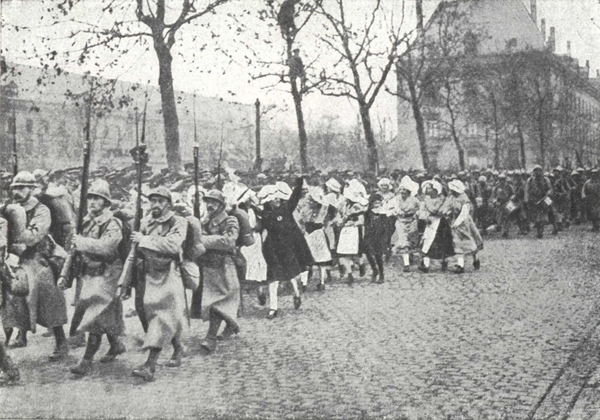
After the Armistice, the triumphal entry of the French Troops. (November 19th 1918).
THE LIBERATION Metz after the signing of the Armistice.
When the Armistice was signed on November 11th, the American artillery was within range of the forts of Metz which they had already bombarded several times, and the troops were all in position for the offensive fixed for November 16th.
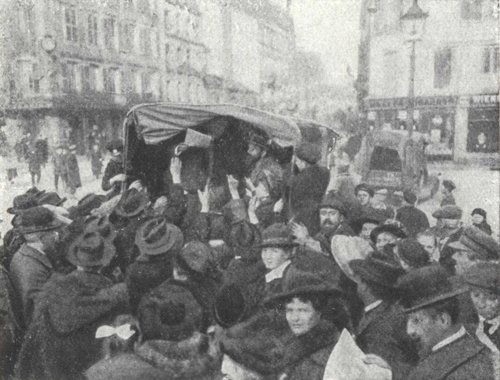
Distribution of the first French newspapers on November 19th, 1918.
The Place de la République and the corner of the Rue Serpenoise.
(Cliché Prillot, Metz.)
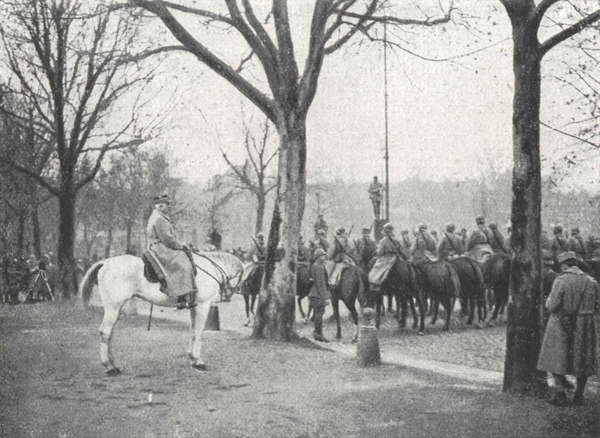
The troops march past Marshal Pétain (November 19th, 1918).
By the terms of the Armistice, invaded countries, including Alsace and Lorraine, had to be evacuated by the 26th. So on Tuesday November 19th 1918 the French troops made their solemn entry into Metz, evacuated by the German soldiery, amid scenes of indescribable enthusiasm.
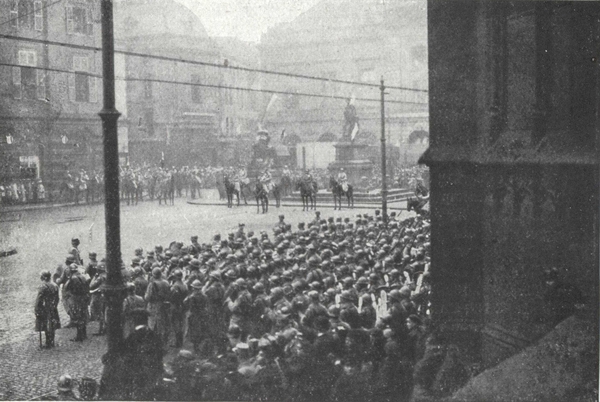
The Place d'Armes: the entry of Marshal Foch.
In the background, the statue of Marshal Fabert; on the right, the Cathedral.
(Cl. Prillot, Metz.)
Then the march past took place on the Esplanade in front of General Pétain who was appointed Marshal the same morning.
On a white horse and in his large blue cloak he took up his position in front of the statue of Marshal Ney: he was supported by General Fayolle, commanding an army group and General Buat, major-general.
General Mangin, commanding the 10th army, owing to an accident on his horse, was unable to be present, his place being taken by General Leconte for the parade. On the same day there took place the induction of M. Mirman, commissary of the Republic, who was received by General de Maud'huy, governor of Metz.
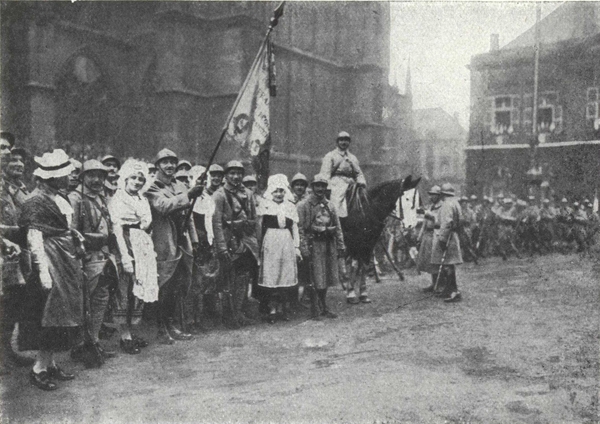
The people of Lorraine surrounding the French flag.
On the Place d'Armes, in front of the Cathedral.
(Cl. Prillot, Metz.)
Salvos of guns and the sounding of the "Mutte" in the Cathedral heralded this festal day.
On the following Sunday, November 24th, the chief men of Metz appointed the new municipal council and decided that the streets should revert to the names they held before 1870 and that the new streets should be named after generals and great men who had distinguished themselves during the War. The list was settled by a by-law on December 7th.
On Sunday, December 8th, President Poincaré, with a retinue consisting of the Minister for War, the President of the Council, G. Clemenceau, the Presidents of the Chambers, Ministers, Marshals and French and Allied Generals came to announce the definite restoration to France of the lost provinces.
It was an unforgettable day. Girls in Lorraine costume lined the streets and flowers were thrown from windows on to the procession. The review took place in the morning on the Esplanade, and also the presentation of the star-studded baton to Marshal Pétain. The ceremony was opened with a speech by the President. Then followed a touching scene, when M. Poincaré and M. Clemenceau approached each other and joined in a long embrace.
In the afternoon there was a reception at the Hôtel de Ville when President Poincaré conjured up all the history of Metz concluding thus:
"The years have passed on Metz, and Metz has not changed.
"The protests which her great Bishop, Mgr Dupont des Loges, used formerly to carry to the Reichstag in the name of all the people of Metz, in the name of all the inhabitants of Lorraine, have continued after his death with the same quiet firmness, you, inhabitants of Metz, have repealed them, year by year, in your pilgrimages to Mars-la-Tour, in your visits to the cemeteries, in your worship of the memory of France.
"Beloved town of Metz, your nightmare is past, here is France back again opening her arms to you".
The procession was then received with great ceremony by Mgr Fell at the Cathedral and visited the cemetery of Chambière to pay homage to the dead of 1870.
On October 27th, 1919, the Croix de Chevalier de la Légion d'Honneur was bestowed on the town of Metz with the following inscription:
Town whose persistent loyally to France never faltered during a captivity of 48 years;
Rich in a past glorious and without stain, unsullied by her misfortunes, exposed for centuries to the covetousness of a near enemy, she has richly deserved to be honoured because she has suffered so long.
She symbolises, in her deep affection for her Mother country, Lorraine, at last wholly restored as a French province.
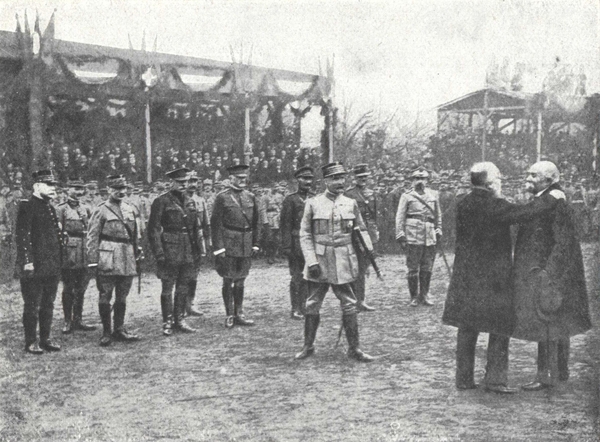
The embrace of the two Presidents after the presentation of the "Bâton de Commandement" to Marshal Pétain (December 8th, 1918).
Behind Marshal Pétain, from left to right: Marshal Joffre, Marshal Foch, Marshal Douglas Haig, General Pershing, General Gillain, General Albricci, and General Haller.
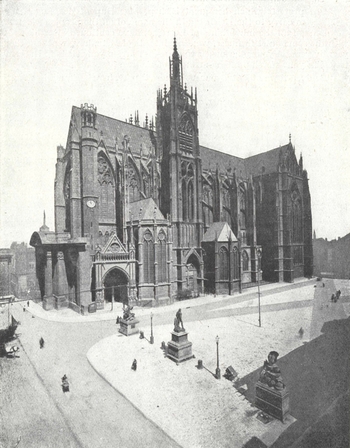
Metz Cathedral as it was before the German occupation.
The cathedral used to finish, on the left, with a Doric porch erected in the 18th century by Blondel who had in mind a similar style of architecture for the whole Place d'Armes. The Germans destroyed this porch in 1903 (See p. 179) and erected in its place a pseudo-Gothic construction which would undoubtedly have been better in keeping with the rest of the edifice, had it not been carried out in a stilted and unskilful manner.
VISIT TO METZ The Place d'Armes.
The Place d'Armes, on to which the Cathedral and the Hôtel de Ville look, is adorned with fine buildings. On this site the cloister of the Cathedral, the musicians' quarters, several chapels and private houses used to stand.
In 1753 the Marshal de Belle-Isle, governor, decided that a "Place" should be made on this spot and that a West door giving access from the Cathedral to the Place should be constructed.
The plans of the architect Blondel necessitated a lowering of the ground level.
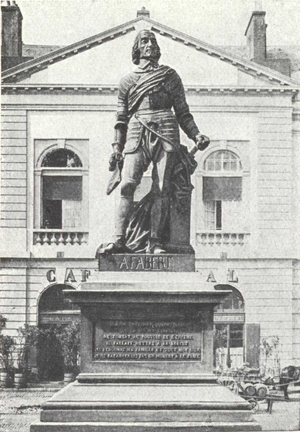
The statue of Marshal Fabert,
on the Place d'Armes.
(Cliché LL.)
For months and years the canons and sheriffs set themselves against the work or held it up. During the night of August 9th 1755, M. de Belle-Isle called together the garrison and by the light of torches, had the whole work completed: by the morning the excavations were finished.
On the Place d'Armes the statue of Marshal Fabert, by Etex (1840), stands between military trophies.
The statue of the great Metz captain (1599-1662) who was governor of Sedan, has only the following words as his inscription:
"If, to prevent a place which the king has entrusted to me falling into the enemy's hands, I had to throw myself, my family, and all my possessions into the breach, I would not hesitate for a moment to do so".
Marshal Fabert, who was as clever an administrator as he was a magnificent soldier, restored agriculture and commerce in Champagne, and established at Sedan the manufacture of broadcloth, which till then belonged to Flanders and the Pays-Bas. King Louis XIV held him in very high esteem.
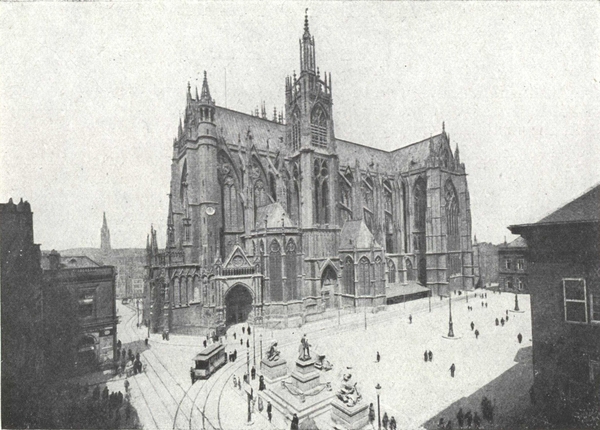
The Cathedral and the Place d'Armes.
On the left extremity of the cathedral is the pseudo-Gothic porch built by the Germans (see photograph on p. 179) in the decoration of which William II is represented as the prophet Daniel (Photo p. 178).
In the foreground, on the Place, the statue of Marshal Fabert.
(Cliché LL.)
THE CATHEDRAL
All one side of the Place d'Armes is occupied by the Cathedral Saint-Étienne, a masterpiece of the pointed style. The fabric recalls Amiens and Beauvais. If from the outside it may seem curtailed, the interior (121 m. long, 22 wide and 43 high), with its resplendent stained windows, is vast and altogether beautiful.
The most ancient parts of the cathedral do not date back beyond the 13th century.
The nave has eight bays—it was completed in the 14th century; at the top of the fourth bay it is flanked by two square towers.
The north tower is the tower of the Mutte, so called from the municipal bell hung there. It is topped with a beautiful spire which forms an excellent observation post over the surrounding country.
Here was the post of the look-out man who had to report fires. On the other side of the nave rises the tower of the Chapter which was finished in 1839. A monumental door opens at the base of each of these towers.
Another tower, polygonal and smaller, called the Tour de l'Horloge, is added to the south aisle. On each side of the choir, where the branches of the transept meet, rise the two small towers of Charlemagne, so called in memory of those which stood in the Roman building. They lead by spiral staircases to the outside terraces which run along the cathedral.
While the nave is 13th century, the transept dates from the 15th, and the choir, built over a huge sepulchral crypt, is contemporaneous with the last period of Gothic art.
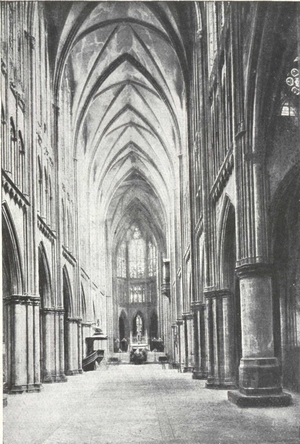
The interior of the Cathedral.
(Cliché LL.)
Although completed in 1546, the Cathedral had still to undergo numerous modifications. Fires caused repairs to be made and then in 1753, by the Governor's orders, Marshal de Belle-Isle, the making of a "Place" in front of the cathedral necessitated the demolition of the Bishop's quarters and the construction of a west door.
The ground level was lowered from 8 to 9 feet and the architect J. B. Blondel was instructed to make out elaborate plans.
They were worked out from 1761 to 1764 and were at once put into execution and continued with till 1771. While endeavouring to have regard to the ancient structure, Blondel strove not to make a west door to the Cathedral but rather to create in front of the cathedral an independent door, the classic lines of which would blend happily with the buildings of the "Place" but would contrast with the style of the edifice (See page 174).
In 1791 other alterations were made: following the plans of Gardeur-Lebrun the rood-loft was done away with, and likewise the ancient altars and the vaults. Finally the roof which was burnt on the night of May 6-7th 1877—the day of the entry of William I into Metz—was replaced in 1880-1882 by a copper roof, raised several metres.
The Doric fore-part of Blondel's design was pulled down in 1903 by the Germans, to make way for a west door conceived in the style of the rest of the church. It was not, however, a very happy effort. At the corners were sculptured statues of the prophets. One of these statues, that of Daniel, had the face of William II. The inhabitants of Metz, who had always resented the presence of this effigy at the entrance to their Cathedral, before the arrival of the French troops, fastened to its hands a chain from which hung a small board bearing the words: Sic transit gloria mundi.
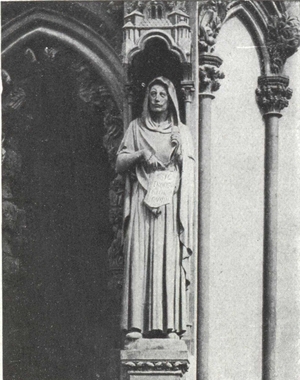
William II as the prophet Daniel over the porch erected by the Germans with The board in his hands commemorating his downfall:
"Sic transit gloria mundi".
It will be replaced by a work of Hanaux, a sculptor of Metz, who was responsible for the French monument of Noisseville.
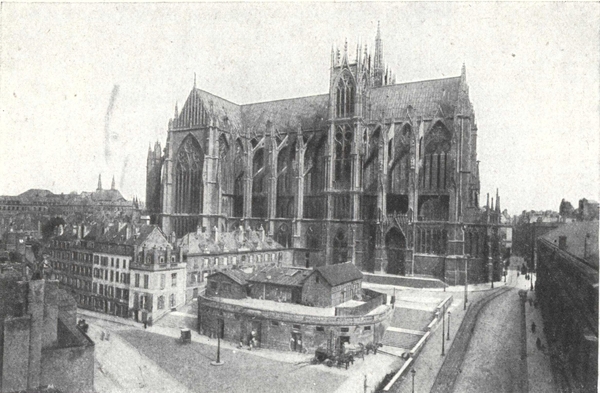
The Cathedral.—Western façade.
(Cliché LL.)
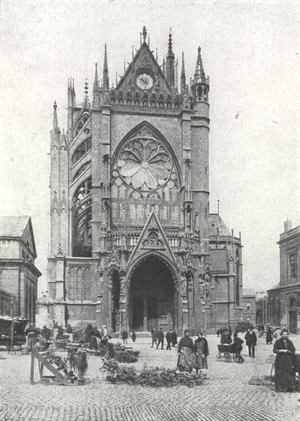
The Cathedral.—The Modern Door and the South Façade.
(Cliché LL.)
There is no church which has so much space open to the light. In the transept and choir it has been calculated that there are 4,071 square metres of window and it is no exaggeration to say that the whole structure is like a huge stained-glass window.
Some of these windows date back to the 13th century. The large rose-window, at the bottom of the nave, which dates from the 16th century, is the work of the master glass worker Hermann. The windows of the north transept date from the 15th century. Those of the south transept, of the choir and the apse, are 16th century.
The bell named "La Mutte", which is in the tower of the same name, did not belong to the church but to the town. The existing bell, which is rung on all great occasions, was cast in 1505. It weighs 13,000 kilos, so that when it is put in motion, a perceptible swaying can be fell in the large spire and in the small spires. It bears the following inscription:
Dame Mutte suis baptisée, De par la Cité ci-posée Pour servir à la Cité Aux jours de grandes solennités; Et aussi pour crier justice, Prendre ban de bonne police; Les contredire quand bon me semble Et pour convoquer gens ensemble.
From the top of the Cathedral tower the best general view is obtainable of Metz and the country round. One can realise the importance of its forts round which the Moselle seems to be an immense moat. On the left bank, the hills fall sheer and are a natural defence: on the right, the hills are not so high but are strengthened by a line of forts. Likewise, by seeing them glistening in the distance, a better idea is gained of the many streams which encompass or pass through Metz: the Seille and the stream of Saint-Pierre, the stream of Noisseville, the stream of Châtel-Saint-Germain—the Moselle which the canal doubles and which is itself divided, forming in front of Metz the large island Saint-Symphorien, then, near the dam called Wadrineau, the smaller island of Saulcy. At the foot of old Metz flows yet another branch of the Moselle which divides in two to isolate on an island the Préfecture and the Theatre. Beyond is the large island Chambière, recognisable by its drill ground and its cemeteries.
The Hôtel de Ville.
After leaving the Cathedral, the Hôtel de Ville is also to be found in the Place d'Armes. It was started in 1766 and finished in 1771. Its style is simple, the façade being ornamented with two pediments and fine grilles. A porch leads to a beautiful staircase. Opposite the stairs is to be seen a bas-relief in white marble on which are engraved the famous line of Ausonius:
"Salve magna parens frugumque virumque Mosella" ... Hail, Moselle, illustrious mother of crops and men!
Inside there are vast banqueting halls where the public sessions of the Academy are held. The Academy of Metz was founded in 1760 by Marshal de Belle-Isle under the title of Royal Society of Letters, Sciences and Arts and endowed with a sum of £60,000.
It was suppressed at the Revolution and re-formed on March 14th, 1819 with the motto "l'Utile" and obtained from Charles X, on September 5th 1828, the title of Royal Academy. It consists of 36 titular members and 18 resident members, in addition to 4 honorary members, correspondents and associates.
The Academy has been largely instrumental in maintaining French culture in Lorraine during the years of annexation.
On the grand staircase are to be seen three stained-glass windows put up in 1582: the middle one is the Duc de Guise after the siege of Metz; the right, the Metz bishop Bertram; the left, the sheriff Pierre Baudoche.
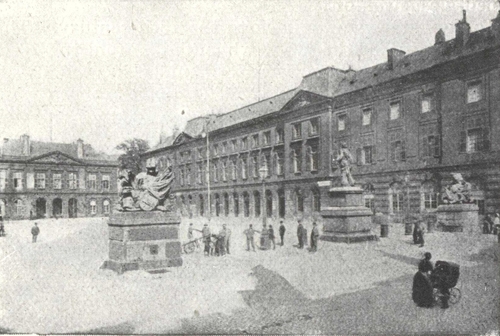
The Place d'Armes and the Hôtel de Ville.
(Cliché LL.)
The flag which floats on its façade is the one previously used in 1870. Carefully preserved in the Carnavalet Museum at Paris, it was returned to the Mayor by the vice-president of the Paris municipal council on December 25th, 1918.
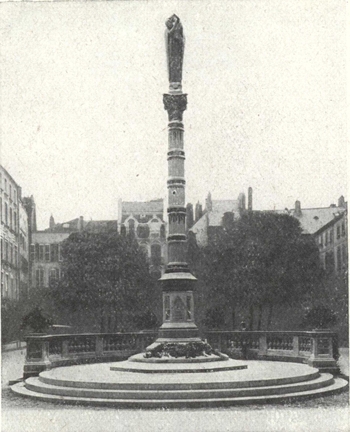
Statue of the Virgin
T. Martin, Sculptor.
(Photo. Prillot, Metz.)
On leaving the Hôtel de Ville, take, to the left of the Place d'Armes, the Rue Fabert (see, on left, the statue of the Virgin), then the Rue des Clercs which is a continuation of it. Coming to the bottom of the Rue des Clercs, on the left is the Place de la République, and on the right the Esplanade.
The magnificent space of the Esplanade was used as a parade ground for the garrison troops.
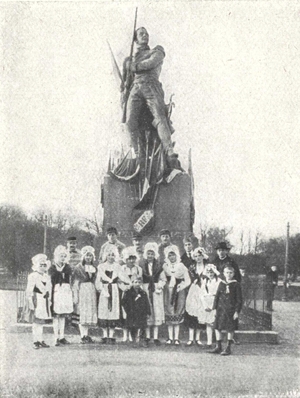
On the Esplanade, a pretty group at the foot of the Statue of Marshal Ney.
(Cliché Prillot, Metz.)
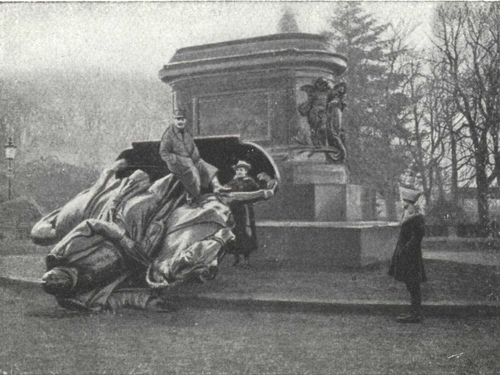
William I knocked off his pedestal by the people of Metz and replaced by the statue of the "Poilu".
Ney, Duc d'Elchingen, prince of the Moskwa, was born at Sarrelouis. He is depicted with his rifle in his hand, ready to fire (Photo p. 181).
Next, go to the end of the Esplanade, beyond the music kiosk, on the terrace: there is a magnificent view over Saint-Quentin Hill and Fort, Plappeville fort and the Moselle. The Island of Saulcy and Poudrière exactly opposite will also be seen.
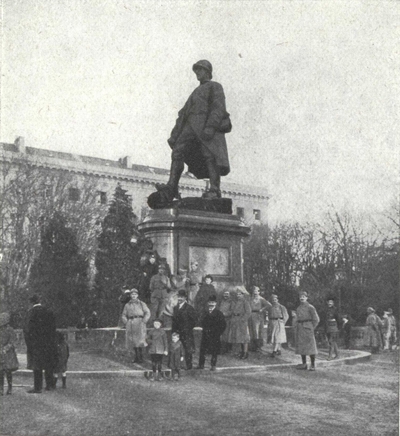
The Statue of the "Poilu" in 1918,
erected on the pedestal on which William I used to stand.
(Cliché Prillot, Metz.)
On this terrace used to stand the bronze statue of William I on horseback (1892). The inscription on the pedestal used to state that the statue had been erected to the Emperor "by his grateful people". The conqueror pointed with his finger to Moselle and the powerful forts of Plappeville and Saint-Quentin which protect the town. William I was knocked down headlong some days before the entry of the French (Photo opposite).
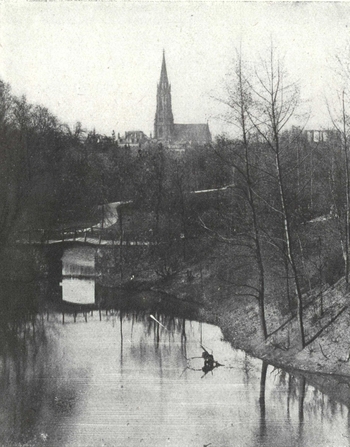
The Walk along the Moselle.
(Cliché LL.)
In place of William, a statue "to the victorious poilu" was erected during the night of January 6-7th with the inscription: "We've beaten them". This was done as a pleasant surprise for Marshal Pétain who was coming on the following day to present colours to 16 regiments, and to confer decorations on several officers and men. This statue was made in seven days in a workshop of Metz by the sculptor Bouchard.
The Palais de Justice, built in 1776, looks out on to the Esplanade. On its site formerly rose the Hôtel de la Haute-Pierre, which belonged to the Duke of Suffolk, lover of Queen Mary of England. He had it pulled down, and built, in a year and six months, the beautiful "Hôtel de Suffolk", which for a long while was used as the town hall. Finally, in 1776, Clairisseaux built the existing palace. The following should be seen: the iron banisters of the great staircase, and, in the interior court, two bas-reliefs, one commemorating the humanity of the Duc de Guise in assisting the soldiers of the Duc d'Albe after the siege had been raised; the other commemorating the peace of 1783 concluded between England, France, Spain, United States of America and Holland. Behind the Palais de Justice stands the beautiful equestrian statue of Lafayette.
Return to the Place de la République and turn right along the Avenue de la Citadelle which separates the Esplanade from the Place de la République. Follow this road, which presently passes, on the left, the Engineers' barracks and then a garden.
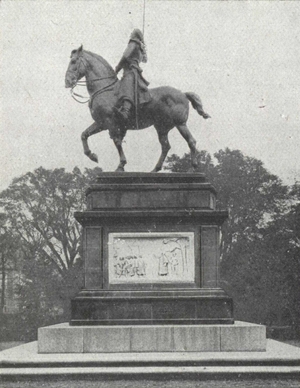
Statue of Lafayette
(Cliché Prillot.)
After passing the garden, turn left into the Avenue du Maréchal-Joffre which leads to the Place du Roi-George (in front of the former station).
Not far from the Place, a round tower is visible, the remains of ramparts of the Middle Ages. Leave the old station behind you and go alongside the gardens by the Avenue Serpenoise which follows the tramway; immediately to the left is the Porte Serpenoise (1852).
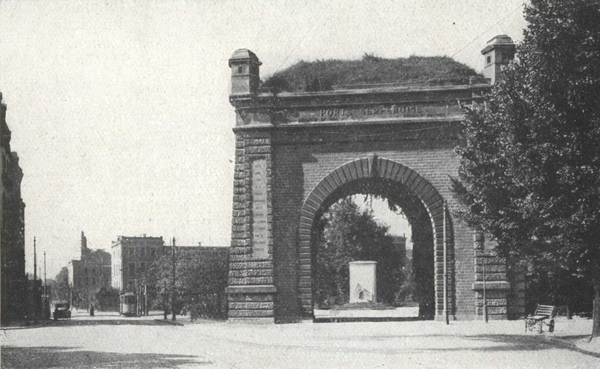
The Porte Serpenoise.
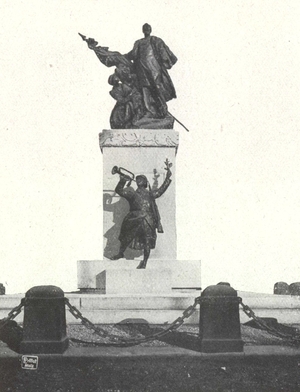
The Monument of Déroulède.
On the right of the Porte Serpenoise stands the statue of Déroulède. To the right extend the modern quarters, with the General Post Office and the Station of Neo-Roman style in very questionable taste.
(Cliché Prillot.)
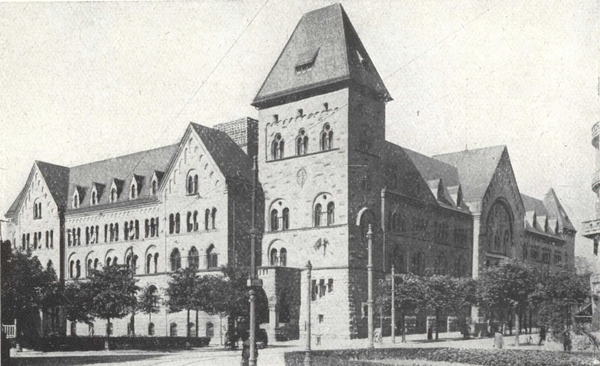
The General Post Office.
(Cliché Prillot.)
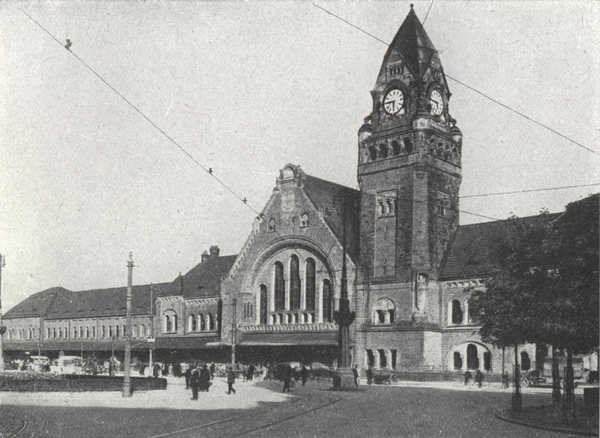
The Central Station.
(Cliché Prillot.)
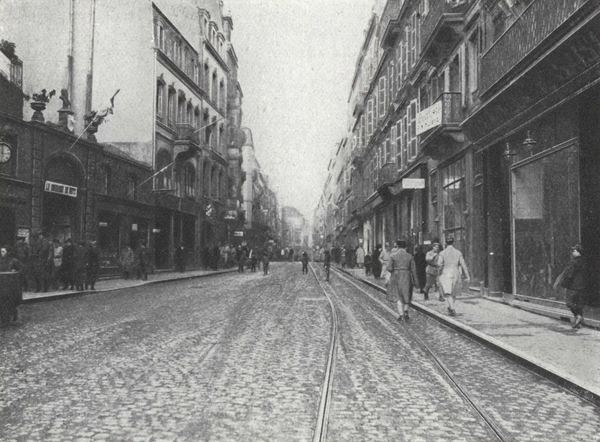
The Rue Serpenoise.
(Cliché Prillot.)
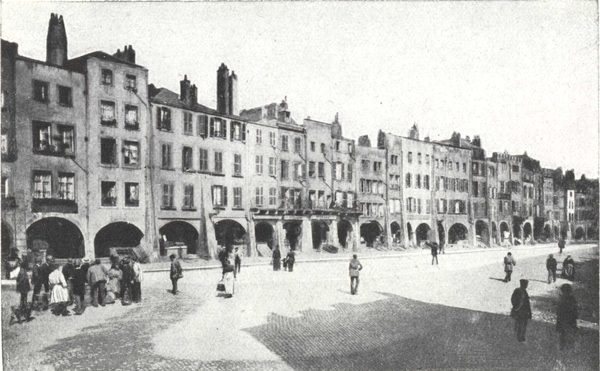
The Place Saint-Louis and the Arcades.
(Cliché LL.)
Beyond the Place de la République, follow the Rue Serpenoise which is a continuation of the avenue. It is the busiest street in Metz. It is further continued by the Rue Ladoucette which leads to the Rue Fournirue.
Keep right along the Rue Fournirue and then still right along the Rue du Change to reach the Place Saint-Louis.
The Place Saint-Louis or du Change was formerly occupied by sixty stalls of money-changers. Some of the houses in the "Place" have preserved their battlements, their pointed or semi-circular arches and their three-cusped casements as well as some Renaissance balconies. This name of Saint-Louis comes from a statue of Louis XIII, found in the ruins of the citadel and converted by the priest of Saint-Simplice into a Louis IX. Mystery plays were acted in the "Place". It was then used for the executions of criminals and after that a corn market.
At the far end of the "Place" take the Rue Royale and then turn left into the Rue Coislin which runs alongside the Coislin barracks (plan below).
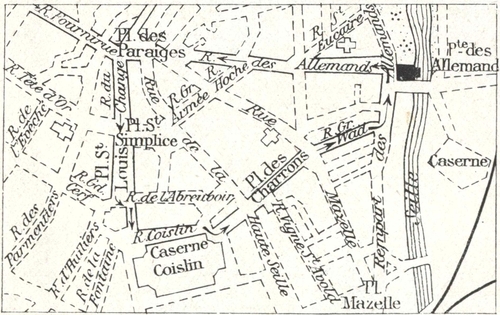
The Place Saint-Louis and the Porte des Allemands.
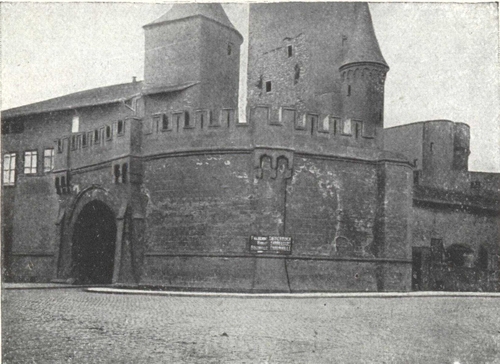
The Porte des Allemands.
View taken from the Quai des Allemands.
At the bottom of the Rue Coislin take the Rue Pont-à-Seille which leads to the Place des Charrons, then at the end of the Place, the Rue du Grand-Wad leading to the Rampart des Allemands and continue left as far as the Porte des Allemands.
The Porte des Allemands, on the Seille, is a remarkable edifice.
It is mentioned as far back as 1324. In the 15th century it was entirely restored by the architect Henri de Banceval.
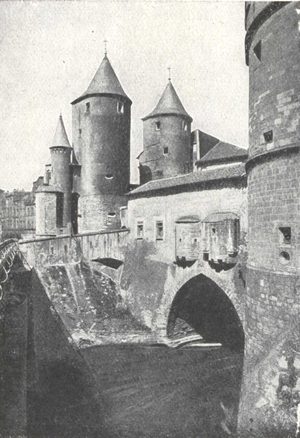
The Porte des Allemands.
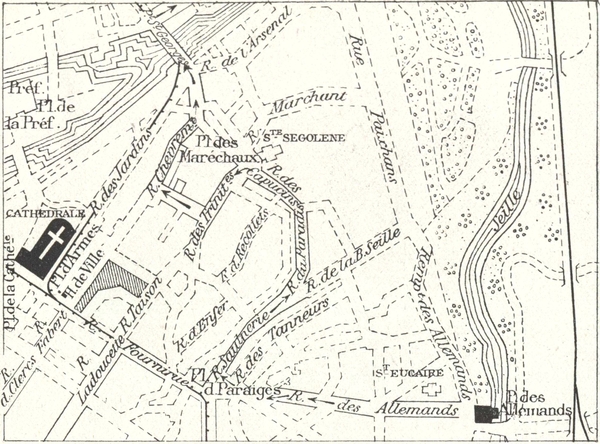
From the Porte des Allemands to the Pont Saint-Georges.
Opposite the Porte des Allemands, take the Rue des Allemands (see the interesting church of Saint-Eucaire on the right) and continue to the Place des Paraiges.
At the end of the Place, turn right along the Rue Saulnerie and its continuation on the left, the Rue du Paradis leading into the Rue des Capucins. At the end of the latter is the Place des Maréchaux where is Sainte-Ségolène Church, built on the site of an oratory founded by Saint Segolene in the 7th century. The present church, built at two different periods (the choirs, the nave and the doorway are earlier than the aisles) dates back to somewhere in the 13th century. The long and narrow windows are mostly in pairs and with a spear-head finish. The side chapels contain beautiful stained-glass windows and there is a curious openwork gallery in the organ-loft and some interesting pictures.
Turn left and take the Rue des Trinitaires, passing an old building with square turrets, near a gateway "Hostel Saint-Ligier". Then turn right into the Rue de la Bibliothèque.
In this street is situated, at the corner of the Rue Chèvremont, a huge building, formerly the church of Petits-Carmes, the work of Sébastien Leclerc, which includes both the Library (80,000 volumes and 1,987 manuscripts) and the Museum (collections of local archaeology, natural history, objets d'arts, and three picture galleries).
At the Museum, take the Rue Chèvremont which ends at the Rue de la Boucherie, into which turn left and so reach the Pont Saint-Georges, over the Moselle.
Cross this bridge from which there is a beautiful view (Photo page 190), and enter the Rue du Pont-Saint-Georges. Immediately to the right branches off the Rue Chambière leading to the Chambière Cemetery where are the graves of the French soldiers who fell during the siege of 1870.
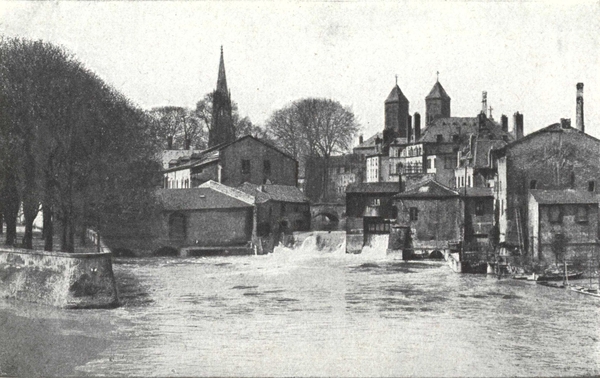
The Moselle as seen from the Pont Saint-Georges.
(Cliché LL.)
The road runs between the vast slaughterhouse, the cattle market and the huts used as an army storehouse. An old cemetery is crossed with some monumental tombs standing in the midst, and then by skirting the Israelite cemetery and the Moselle the military cemetery is reached.
There are plain tombs under bushy trees. In the centre is a tall pyramid 12 m. high; all the base is represented by numerous coffins piled on each other. There rest the soldiers who died in the hospitals of Metz from wounds received at the battles of Borny, Gravelotte, Saint-Privat, Servigny, Pletre and Ladonchamps. There are 7,203 in all.
Wreathes, tri-coloured cockades, and ribbons have never ceased, for 48 years, to adorn these graves which the ladies of Metz piously decorate with flowers every anniversary.
Return by the same route to the Rue du Pont-Saint-Georges. The Rue Vincentrue is soon reached on the left and should be taken.
Then turn right into the Rue des Bénédictins.
Apply, at No. 7 in this street, to visit the Church of Saint-Clement.
It was started in 1668. The choir, the nave and the aisle were begun in 1680 by the Italian, Spinga. The West door was damaged in the Revolution. The church is now part of the College founded by the Jesuits, where Marshal Foch began his education.
Return to the Rue des Bénédictins and continue along it until the Rue Saint-Vincent is reached on the left, leading to the "Place" of the same name, on which stands the remarkable Church of Saint-Vincent built in 1248.
The straight-built nave supported by 12 small-columned pillars, the very regular choir, and the beautiful ogival chapels should certainly be seen.
Continue along the Rue Saint-Vincent on the other side of the "Place". The Rue Saint-Marcel, which is its continuation, leads to the Rue du Pont-à-Morts which should be followed to the left.
Cross the Moselle by the Pont-Moyen (pretty view). Follow the Rue Sainte-Marie which follows the bridge and then turn left along the Rue du Faisan leading to the small and charming Place de Chambre.
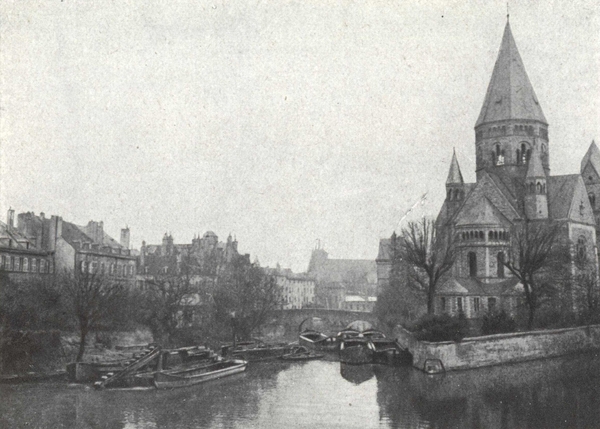
The Pont Saint-Marcel and the Protestant Church.
From the Place de Chambre return to the Cathedral and the Place d'Armes by the little Rue d'Estrées.
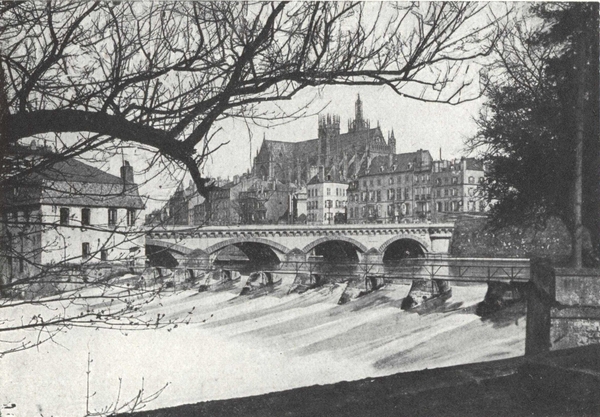
The Pont-Moyen and the Cathedral as seen from Saulcy Island.
(Cliché LL.)