PART II
Reading edition
“They might chirp and chaffer, come and go For pleasure or profit, her men alive— My business is hardly with them I trow, But with the empty cells of the human hive; —With the chapter-room, the cloister-porch, The church’s apsis, aisle or nave, Its crypt, one fingers along with a torch, Its face set full for the sun to shave.” —Browning.
SECTION I Arrival—The Piazza
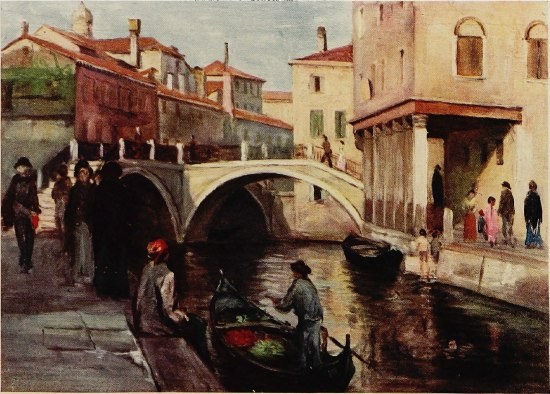
THAT traveller will best attune himself to the peculiar charm of Venice, who arrives after sunset, when evening has veiled the somewhat unlovely approach to the city by railway. For the great lagoon State ever set her face to the sea and adorned herself to welcome her guests as they were rowed from Fusina, or as they sailed up from the Adriatic, to land at the Molo, the chief landing-stage by the Piazzetta. The modern visitor arriving by train is like one who should enter a stately mansion by the stables. Once, however, in his gondola, the “black Triton” of the lagoons, gliding along the waterways to the strangers’ quarter by lines of houses and palaces, whose walls, timeworn or neglected, sometimes degraded, will be mellowed under the dim light of the infrequent lamps, he will be caught by the spell which Venice casts over those who come to her.
But there are two Venices: the Venice of the canals and the Venice of the streets. The traveller will do well therefore to go on foot to some of the sights he would see, for by no other means can he do justice to the varied beauty of the streets, the quaint fragmentary remains of ancient architecture, the brilliant patches of colour, the little shrines, and all the countless details that go to make the by-ways of the city so full of surprise and pleasure to the pedestrian. The difficulty of finding one’s way from point to point has been greatly exaggerated. Anyone with a map and a normal sense of direction can with a little patience reach his destination. The churches are usually situated on or near a campo; a stream of people will generally be found passing along the streets and over the bridges between the campi, and a well-worn track marks the more frequented ways. If he should find himself blocked by a canal or a blind alley, a short deviation to the right or left will generally lead to one of the 380 bridges by which, to use Evelyn’s picturesque phrase, the city is tacked together. Even if hopelessly lost, a soldino given to a boy will soon bring him to where he would go. The waterways, 150 in all, are divided into canali and rii. The canale is the broader, the rio the narrower stream. The rii are by far the greater in number. But the pedestrian is more concerned with street nomenclature. A fondamenta is a way alongside a canale or rio; a calle is a street with houses on either side; ruga or rughetta (French rue, ruelle) was first applied to streets with a few new houses here and there; the appellation was retained in later times when the houses or shops became continuous; a salizzada is one of the earliest of the paved streets, generally near a church; a rio terra, a rio filled up and paved; a piscina, a fish-pond treated in the same way; a ponte, a bridge; a campo, a paved, open place, formerly a field; a campiello, a smaller campo; a corte, a court. Avoid a vico cieco, or a viccolo cieco, which have no thoroughfare. The city is divided into six sestieri or wards, subdivided into parocchie or parishes. The houses are numbered by sestieri, the numbers reaching to thousands. The Merceria, a crowded thoroughfare, leads from under the Clock Tower in St Mark’s Square, after many kinks and turns, to the Rialto bridge over the Grand Canal, which is spanned by two other bridges about equidistant from the Rialto bridge. E. and W. of the Rialto, in addition to these bridges, numerous ferries (traghetti) make either bank of the Grand Canal easy of access, and small steamers (vaporetti) call at frequent piers the whole length of the chief waterway. Travelling by gondola, therefore, is to be regarded as a luxury rather than a necessity. The gondola bears the same relation to Venetian life as does the cab or carriage to the dweller in an ordinary town. The average tide is about twenty inches: on exceptional occasions, the difference between high and low tides has been six feet.
La Piazzetta
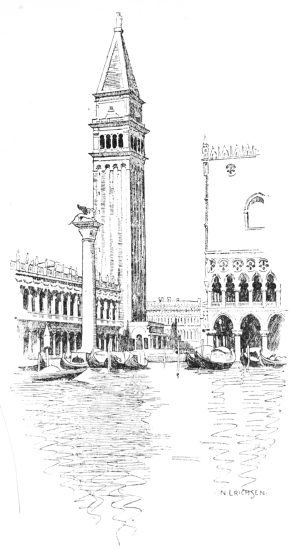
The Piazza of S. Marco offers to the traveller a scene of unparalleled interest. Eastwards it is adorned by the most wonderful group of Byzantine and Gothic architecture in Europe. To the N. is the rhythmic symmetry of Pietro Lombardo’s Procuratie Vecchie, ending with the Clock Tower[80]; to the S. are the Procuratie Nuove, Scamozzi’s tasteless elaboration of Sansovino’s lovely design for the Libreria Vecchia on the Piazzetta. Westward is the baser structure of Napoleonic times. Opposite the Porta della Carta of the Ducal Palace stood for a thousand years the old Campanile, like a giant sentinel set towards the lagoons to watch over the city. On the morning of July 14th, 1902, to the stupefaction of the Venetians, the huge tower, which in its massive strength seemed to defy the tooth of time, gently collapsed, as though weary of its millennial watch, crushing in its fall Sansovino’s beautiful Loggetta and the N. side of the Libreria Vecchia, but miraculously doing no further hurt. When the Venetians recovered from the shock and learned how mercifully exempt from toll of human life the disaster had been, and that St Mark’s and the Ducal Palace were unscathed, they remembered their protector and said: È stato galant’uomo S. Marco (St Mark has been a good fellow). Ten months later, when the King and Queen of Italy, during their visit to Venice, turned to look at the site of the old tower, a lament was heard in the crowd of people: I varda dove gera el nostro pavaro morto (They are going where our poor dead one lies). The foundations laid a thousand years before, were found to be as sound as ever, and a new Campanile has now been raised to replace, though it cannot restore, the old one, which, with all its dramatic history and romantic associations, has disappeared for ever.
It is not by accident that the chief buildings of Venice stand where they do, for this part of the Rialtine islands, called il Morso, offered a soil harder[81] and more tenacious than any other. In early ages the Piazza was a grass-grown field, called the Broglio or Garden, scarce a third of its present area, and a large elder tree flourished on the site of the Campanile. It was bounded on the W. by a rio which ran from N. to S. a few yards beyond the Campanile and discharged into the Grand Canal to the W. of the present Zecca (mint). On the W. bank of the rio, facing the basilica of St Mark, stood the old church of S. Giminiano. In 1176 Doge Ziani filled up the rio, razed the fortifications and extended and paved the Piazza, to its present boundary westward. The church of S. Giminiano was rebuilt at the W. end. It was again rebuilt by Sansovino in 1556 and finally demolished by Napoleon I. to extend the Royal Palace. Houses on the S. abutted on the Campanile. The Piazza was enclosed by stately mansions with columns and arcades on the first floor, “where one walked round as in a theatre.”[82] When Scamozzi built the Procuratie Nuove in 1584, the houses on the S. were demolished and the Piazza set back to its present line. If we would restore its aspect in the fulness of Venetian prosperity, we must imagine a scene brilliant with colour. The archivolts, capitals, friezes and sculptures generally of St Mark’s and the Ducal Palace were richly decorated with gold and vermilion and blue. The Porta della Carta glowed so with gold that it was known as the Porta dorata (the gilded portal). The bronze horses were gilded; so was St Mark’s Lion and St Theodore in the Piazzetta. From Leopardi’s beautiful bronze sockets three tall masts upheld the standards symbolising dominion over Greece, Cyprus and Crete.
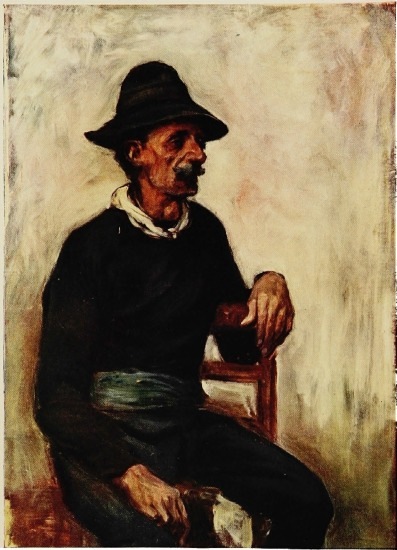
A throng of merchants and strangers from all the corners of the earth, an ever-changing pageant of quaint and gorgeous costumes, passed and repassed. So many strange tongues would you hear, says an old writer,[83] that the Piazza might not inaptly be called the forum orbis non urbis—not the market-place of a city but of the world. Strange tongues are still heard in the Piazza, but of those who come for the pleasure, not for the business of the world: the heart of commerce no longer beats at Venice. The Piazza is, however, a scene of much animation on public holidays when the band is playing. We will sit outside Florian’s coffee-house, as a good Venetian should, and observe the women of the people passing, with their graceful carriage and simple costume, their wealth of hair so charmingly treated; the gondolier, lithe of body and superb in gait; the signore and signorine with their more modern finery; the fashionable youth, dressed, as he fondly imagines, all’ inglese; rich and poor, borghese and popolano, bearing themselves with that ease of manner, vivacity of spirit and social equality so characteristic of the Venetians. In the height of summer, when the rich merchants of Milan and other cities of North Italy with their women folk come to Venice for the Italian season, the Piazza after dinner and far into the night becomes one vast open-air salon, crowded with visitors in the most chic of costumes, many of the ladies promenading in evening dress. As one sits in the Piazza at setting sun, the atmosphere, exquisitely delicate and clear, changes from pale blue to amethyst, pink, turquoise, dark blue and indigo; and the night is lovelier than the day.
SECTION II The Basilica of St Mark
FEW things in the history of art are more remarkable than the revulsion of taste that has taken place with regard to the architecture of Venice. In the early part of the nineteenth century, before Ruskin wrote “The Stones of Venice,” an English architect,[84] giving expression to the professional judgment of the age, speaks of “the lumpy form of the Cathedral which surprises you by the extreme ugliness of its exterior; of the lower part built in the degraded Roman we call Norman; of the gouty columns and ill-made capitals, all in bad taste.” “The Ducal Palace is even more ugly than anything previously mentioned,” vastly inferior to Palladio’s churches of S. Giorgio and the Redentore. Disraeli echoes in “Contarini Fleming” the conventional lay praise of Palladio, and writes of the “barbarous although picturesque buildings called the Ducal Palace.” Even to-day the stranger fresh from the North with memories of the massive towers and lofty spires of his own architecture will hardly escape a sense of disappointment as he stands before St Mark’s. The fabric will seem to lack majesty and to be even less imposing than the Ducal Palace. It must, however, be remembered that the raising of the level of the Piazza has somewhat detracted from the elevation of both the basilica and the Palace. Fynes Moryson notes in his Itinerary (1617) that “there were stairs of old to mount out of the market-place into the church till the waters of the channel increasing they were forced to raise the height of the market-place.”
A GONDOLIER.
Whether there were any such intention in the minds of the builders is doubtful, but in all communities where the sense of municipal liberty or of secular independence is strong, the dominant civic power is actualised in architecture. In Flemish towns the Hôtel de Ville and not the cathedral is often the more important structure; even so in Venice the subordinate position of the church is marked by the accessory character of the ecclesiastical building, which in its origin indeed was but the official chapel of the Doge, and only became the Cathedral in 1807, when Napoleon transferred the patriarchate from S. Pietro in Castello—itself a poor thing architecturally—to St Mark’s.
Joseph Woods gave a shrewd criticism of Venetian architecture when he characterised it as showing riches and power rather than just proportions. St Mark’s was erected by a merchant folk, with all the merchant’s love of display of wealth. Their taste was for costly material rather than for nobility and grandeur of design. For centuries the East was ransacked for precious stones to adorn the sanctuary of their patron saint, and the captain of every ship that traded in the Levant was ordered to bring home marbles or fine stones for the builders. St Mark’s is a jewelled casket wrought to preserve the Palladium of the Venetian people.
S. MARCO—MAIN PORTAL
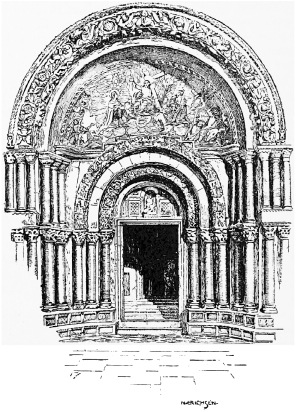
The fabric dates from the early eleventh to the late fourteenth centuries. Its core is of brick, of which most Venetian churches are built, and it is veneered with marble[85] and decorated with mosaic and sculpture. When the eye turns from the whole to examine details, the façade is seen to be composed of two tiers of arches—the lower of seven, the upper of five spans. Of the seven, two form the N. and S. porticos; five the western doors, whose recesses are enriched with rows of columns wanting in unity of design, but of exceeding richness and variety of material. They are mainly the spoils of Eastern churches, and, if closely scrutinised, will be found to be incised with Eastern crosses and curious inscriptions in Greek and oriental characters. The capitals flanking the main portal, with carving of leaves blown by the wind, are probably from the East, their prototype being at the Church of St Sophia in Thessalonica, built in the later years of Justinian’s reign. The main portal is spanned by an inner triple archivolt and an outer main one. The under side of the inner arc of the former, over the relief of St Mark and the Angel, is wrought with sculptures, whose subjects are symbolical, and will be met with again and again in early Venetian decoration: a naked man and woman seated on dragons; a child in the open jaws of a lion; an eagle pecking at a lamb; a lion devouring a stag; camels and other animals, wild and tame, in various groups. On the outer face are similar carvings of boys fighting and robbing birds’ nests; men shooting birds with bows and arrows, and hunting wild beasts. The work is exceedingly quaint, and affords a fruitful theme for interpretation.
S. MARCO—DETAIL OF ARCHIVOLT
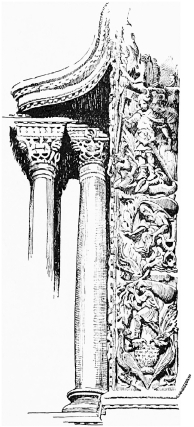
The sculptures on the under side of the outer arc symbolise the months of the year, with their appropriate celestial signs. May, a seated figure holding a rose and crowned with flowers by two maidens, is most beautiful and original in treatment.
On the outer face of the archivolt are represented the Beatitudes and the Virtues, eight on either side of the keystone, which symbolises Constancy.
On the under surface of the main archivolt are fourteen most beautiful carvings, representing the chief guilds and crafts of Venice. To the L.,[86] at the bottom, is a seated figure with finger on lip, said by Ruskin to represent the rest of old age; by tradition it is the portrait of the architect of the building, of whom the following story is told. When Doge Pietro Orseolo determined to restore the church after the fire of 976, a queer, unknown man, lame in both legs, offered to make St Mark’s the most beautiful structure ever erected, if, on completion, his statue were placed in a conspicuous part of the building. His terms were accepted, but after the work had progressed some time, the stranger incautiously let fall a remark to the effect that the church would have been much more magnificent if certain difficulties had not intervened. Word was sent to the Doge, and the statue was set in its present obscure position.
S. MARCO—DETAIL OF MAIN DOOR
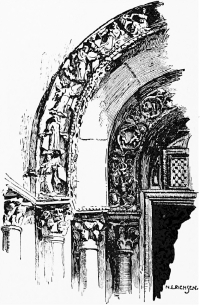
On either side of the main portal are two doorways, spanned by richly decorated Byzantine arches; that to the L., has the figure of Christ in the keystone and two prophets with scrolls in the spandrils; that to the R. has the keystone defaced; in the spandrils to the R. and L. are the archangels Michael and Gabriel. The lateral doorway to the L. has in the lunette a winged figure on horseback and symbols of the Evangelists; on the lintel are some fine Gothic reliefs. The pierced screen-work in the lunette windows should be noted, for in olden times the whole of the window spaces in the domes were thus treated. The corresponding doorway to the R. has in the spandrils, carvings of two archangels, and on the keystone the Virgin and Child.
The beautiful lily capitals are at either end of the façade, and support the arches that span the N. and S. porticos.
The late fifteenth-century Gothic additions consist of pinnacles and gables of no structural value. They are seen in Gentile Bellini’s picture,[87] dated 1496, of the Procession in St Mark’s Square, but are absent in the extant thirteenth-century mosaic on the façade.
The mosaics in the lunettes of the five doorways are, with one exception, poor in craftsmanship, but interesting in their storiation. That of the central portal is a feeble representation of the Last Judgment. Salandri, who executed it in 1836-38, had already been mulcted for bad workmanship. The remaining four tell of the discovery and translation of the body of St Mark. In the fifth porch, to the N., the body of the saint being carried into St Mark’s, though largely renewed, is a precious relic of the beautiful thirteenth-century mosaics that covered the front in Gentile Bellini’s time, as may be seen from the picture already referred to. The four mosaics in the lunettes on either side of the great window above, represent the Deposition from the Cross, the Descent into Hades, the Resurrection, the Ascension—all seventeenth-century work. Beneath the great window stand the four bronze horses, part of the spoils sent from Constantinople by Enrico Dandolo in 1204. They are said to be Greek work of the fourth century B.C., and to have been sent from Rome to the new capital of the Empire by Constantine. They remained in their present position until 1797, when the “gran ladrone,” Napoleon I., sent them to Paris to adorn the Arc du Carrousel. In 1815 they were restored to Venice by Francis I. of Austria, as the Latin inscription under the archivolt beneath tells. A magnificent festa was organised when they were raised to their old position in the presence of the Austrian. The Piazza was bright with gorgeous decorations; a superb loggia erected for the Imperial family; an amphitheatre for the Venetian nobility. Nothing was wanting—but an audience. The amphitheatre was empty; a few loungers idled about the square. Cannons were fired; the bells rang a double peal; the music played; the horses were drawn up—but not a cheer followed them. The Emperor and his suite had the show to themselves.
N.E. BYZANTINE RELIEF, NORTH SIDE, S. MARCO
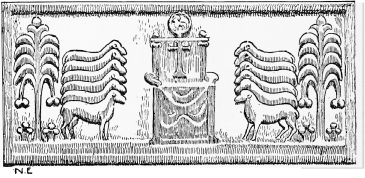
In the lunette of the N. portal, which gives on the Piazzetta dei Leoni, with its two double cusped inner arches, is an early relief of the Nativity, a work of great beauty, framed by the vine decoration so beloved of the early sculptors. Among the many Byzantine reliefs with which this façade is jewelled the most perfect is that of the Twelve Apostles, symbolised as sheep, with the Lamb enthroned in the centre and palm trees on either side. This exquisite carving will be found in the last recess R. of the doorway.
BYZANTINE RELIEF FROM SOUTH SIDE, S. MARCO
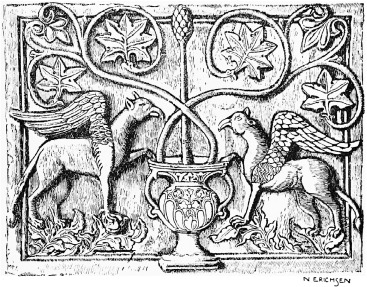
The S. façade, looking as it does towards the Molo, would in olden times arrest the eye of the traveller as he entered the city. It is most lavishly decorated. The reliefs and marble facings towards the Porta della Carta are some of the finest that remain of the ancient basilica. Their lowly position seems to have preserved them from the restorer’s hand. At the angle is a rude Greek relief in porphyry, probably from Acre, of two pairs of armed figures clasping each other. They are said to represent Greek emperors who shared the throne of the East early in the eleventh century. In the foreground stand the two beautifully decorated marble door-posts brought from St Sabbas in Acre. They should, however, change places to occupy the relative position they formerly held in the church. Below the mosaic of the Virgin and Child in the smaller arch above the gallery two lamps burn nightly in perpetual memory of an act of injustice perpetrated by the Ten in 1611, when an innocent man, Giovanni Grassi, was executed. The short porphyry column at the S.W. corner is the old edict stone where the official notices and laws of the Republic were proclaimed to the people.
CAPITALS, ATRIUM, S. MARCO
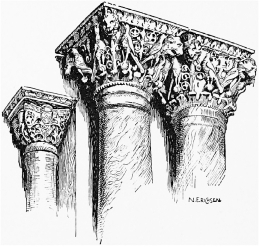
At our feet, as we enter the atrium by the main portal are three slabs of porphyry which mark the legendary, but not the actual, spot where the reconciliation of the Pope and the Emperor Barbarossa took place. The shafts and capitals of the columns in the atrium are among the richest in the basilica. The mosaics, designed to instruct and prepare the catechumen, illustrate Old Testament history, and for their simple beauty will repay perusal.
I TRE PONTI.
In the south cupola are three concentric zones of mosaics which illustrate the six days of Creation, the Institution of the Sabbath, the Fall and the Expulsion from Eden. The number of the day is indicated by a corresponding number of angels standing beside the Creator with hands uplifted in praise. At the institution of the Sabbath the Lord is seen resting from His work with three angels on either side; the seventh kneels receiving the Lord’s blessing.[88] There is a quaint portraiture of the Lord clothing Adam and Eve,—Adam most uncomfortable, and Eve looking reproachfully at the ill-fitting garment.
Five mosaics in the three lunettes under the cupola tell the story of Cain and Abel, and under the vaultings between the first cupola and the central vestibule is the story of Noah.
On the W. side of the next vaulting is the story of the Tower of Babel. Below is the tomb of the Dogaressa Felicia, the young wife of Vitale Falier, who, as the inscription tells, was a true servant of God and of the poor, and who spurned luxury (calcavit luxurium).
The second cupola contains scenes from the life of Abraham. In the lunette over St Peter, above the inner door, Abraham receives the three angels and entertains them. Behind is Sarah at the door of her tent laughing at the promise that she should bear a son. The third cupola tells the story of Joseph, which is continued on the fourth and fifth cupolas to the N. The sixth cupola deals with the story of Moses. In the recess opposite the lunette to the R. once lay the remains[89] (whence they were taken and brought to England) of Thomas Mowbray, Duke of Norfolk—
“Who at Venice gave His body to that pleasant country’s earth, And his pure soul unto his captain, Christ, Under whose colours he had fought so long.” —Richard II., iv. I.
Returning to the main portal of the atrium—in the lunette is St Mark, executed by the brothers Zuccati in 1545 from a cartoon by Titian. Below in seven niches are the Virgin and Child and six Apostles; lower down on either side of the portal, the four Evangelists. In the lunette, R., Raising of Lazarus; lunette over the outer portal, Crucifixion; lunette L., Burial of the Virgin. These, which are among the finest mosaics of the period, formed part of the work that the Zuccati had to answer for in 1563. They were charged by the Bianchini and Bozza with having used the methods of painting and not of true mosaic to produce certain effects. The most famous tribunal ever brought together in the history of art sat to try the case. It was composed of Titian, Paul Veronese, Tintoretto, Jacopo da Pistoia and Schiavone. Although the Zuccati were condemned to remove and replace at their own cost the work that had been gone over with the brush, the honours of the trial rested with them, Titian frankly eulogising their craftsmanship.
No sense of disappointment will be felt at the first view of the interior. The symmetry of the architecture, the gorgeous mosaics, the rich pavement, the precious marbles covering the walls, the manifold variety of the columns, and (if the traveller have the fortune to be present on Easter or St Mark’s Day) the dazzling brilliancy of the Pala d’Oro glittering with jewels make a scene of oriental splendour not easily forgotten. In earlier times, when the windows were filled with pierced screen-work of marble, the church was much darker, for, says Moryson, “the papist churches are commonly dark to cause a religious horror.” Evelyn in 1645 found the interior dark and dismal.
Merely to name the subjects of the 40,000 square feet of mosaics in the interior would weary the reader. We do but indicate the more important and more interesting. The general scheme is designed to illustrate the mysteries of the Christian faith and the story of the patron saint. Over the main entrance is the oldest of the mosaics, probably an eleventh-century work—Christ enthroned between the Virgin and St Mark. In the book held by the Redeemer are the words in Latin, “I am the Door; if any man enter by Me he shall be saved and find pasture.” A similar inscription exists to this day over the Porta Basilica which opens into the nave of St Sophia at Constantinople. In the half dome of the apse the colossal seated figure of Christ in the act of blessing meets the eye of the worshipper as he enters the church and walks towards the sanctuary, even as it did in the apse at St Sophia.[90] In the centre of the dome over the high altar is again the figure of Christ, and, above the windows, the Virgin, and the prophets who foretold Christ’s coming, bearing scrolls inscribed with their testimony. The pendentives bear symbolic figures of the Four Evangelists, that of the Lion of St Mark with a strangely human face, being designed with admirable force and dignity. Scenes in the life of Christ are portrayed on the vault between this and the central dome; the Passion and Resurrection on the vault between the central and western domes. The great central dome is treated with profound thought and fertile invention, and executed with infinite care. In the apex is the glorified Christ seated on a double rainbow, surrounded by exulting angels. Below are the Virgin, the Apostles and the Evangelists alternating with olive and palm trees. The beautiful figure of the Virgin stands between two angels. In the spaces between the windows are the Virtues and the Beatitudes. They may easily be distinguished by their inscriptions and symbols.
The W. dome treats of the Descent of the Holy Ghost. A white dove standing on a book placed on a throne fills the centre, and from this emblem of the Holy Spirit twelve streams of fire descend upon the figures of the Twelve Apostles circling the dome. The men of every nation to whom they spoke, each in his own tongue, are figured at the Apostles’ feet between the windows.
In the dome of the N. transept is figured a Greek cross, in the centre of which are eight Greek letters set in a circle, whose meaning is doubtful. Near this centre, N. and S., is an alpha; E. and W., an omega. On the arms of the cross the Golden Rule is expressed in a curious rhyming Latin paraphrase, beginning on the E. and continuing on the W., N. and S. arms.
The dome of the S. transept bears figures of SS. Leonard, Nicholas, Clement and Blaise. In the pendentives SS. Erasmus, Euphemia, Dorothy and Thecla. While Vicenzo Sebastiani was finishing this last, he fell from the scaffolding and was killed. On the vaultings of the transepts are represented the parables and miracles of Christ. The vaulting to the E., between the S. and the centre domes, has delightfully naive and dramatic representations of the Temptation and the Entry into Jerusalem. On the western side are beautiful representations of the Last Supper and the Washing of the Disciples’ Feet. On the vaultings and the walls of the aisles are stories of the martyrdom of the Apostles.
Modern mosaics illustrating the Book of Revelation, the Last Judgment, Hell and Paradise, cover the vaultings beyond the W. dome and over the W. gallery. They and many other of the mosaics are best seen from the galleries.
On the lower walls of the aisles are repeated the figures of prophets that foretold the coming of Christ bearing the usual scrolls. To the N. are Hosea, Joel, Micah and Jeremiah, with a beautiful representation of the youthful Christ in the centre. S. are Isaiah, David, Solomon and Ezekiel, with the Virgin answering to the figure of Christ.
The story of the patron saint begins on the vaulting of the N. organ loft over the choir, where scenes in his life and martyrdom are portrayed. They are, however, partly concealed by the organ. These, perhaps the oldest mosaics in the church, were largely restored in 1879 by the Venezia-Murano Company. Opposite, to the S., on the vaulting, is most quaintly told how the body of the saint came to Venice. The designers are very frank in their story of the Translation of the body. Furenter, “it is stolen” from Alexandria.
On the W. wall of the S. transept opposite the Chapel of the Holy Blood is told the story of the miraculous rediscovery of the body in 1094: The Doge, clergy and people, with solemn fast and prayer, implore divine aid, and a round column in the church opens and discloses the saint’s body. Tradition, however, says that the body was found in the large pier called St Mark’s pillar, to the left of the Chapel of the Holy Blood. An angel’s head in full relief is carved above the spot, and a lamp burns below an inlaid cross. The line of cleavage is still seen. Tradition, however, would seem to be at fault in this matter, for when the pillar was recently stripped of the marble facing, the solid core had clearly never been disturbed.
The Baptistery and the Zeno Chapel, entered from the right aisle, originally formed part of the atrium. The mosaics in the Baptistery were executed by the order of Doge Andrea Dandolo (1343-54), but have been partly restored[91] by the Venezia-Murano Company. In the lunette above the altar is the Crucifixion. Weeping angels hover over the cross; L., are the Virgin and St Mark; R., St John the Evangelist and St John the Baptist. At the foot of the cross kneels Doge Andrea Dandolo; at the extreme ends kneel his Grand Chancellor, Riafano Caresini, and a Senator. The table of the altar is formed of a massive block of Egyptian granite from which Christ is said to have preached, brought from the siege of Tyre in 1126. In the centre of the cupola above is Christ enthroned; below is a ten-winged angel bearing on his breast the inscription—“Fulness of Wisdom.” This is the first of the nine Intelligences circling the cupola, which in mediæval cosmogony ruled over the nine heavenly spheres.
The story of the Baptist’s life is told in the lunettes and on the walls. The mosaic of the Burial of the Saint’s Body is said by Ruskin to be the most beautiful design of the Baptist’s death that he knew in Italy.
In the centre of the cupola over the font is a figure of Christ seated on a double rainbow and holding a scroll on which is inscribed the injunction to the Twelve to go and preach the gospel to all creatures. Beneath, each is seen obeying the command in that country where tradition places his martyrdom. Quaint local costumes are introduced, and converts are being baptised.
Opposite the entrance is the tomb of Andrea Dandolo, the last Doge buried in St Mark’s. On the workmanship of this beautiful example of fourteenth-century monumental art Ruskin has lavished ecstatic praise. Beneath the noble, peaceful figure of the Doge are the Virgin and Child, two scenes from the Martyrdom of St John the Baptist and of Andrew, the Doge’s patron saint, and an Annunciation. The long Latin epitaph has been attributed to Petrarch.
The vault of the vestibule of the Cappella Zen is decorated with scenes from the life of Christ before His baptism. The tomb in the recess is that of Doge Giovanni Soranzo (1328). The Cappella Zen contains the monument of Cardinal Zeno, executed at the beginning of the sixteenth century. The altar is dedicated to the Virgin of the Slipper, whose figure in bronze has a gilded shoe, in perpetual memory of the miraculous alchemy by which her slipper, given to a poor votary, was changed to gold. The Zeno tomb is a fine Renaissance work in bronze which, together with the altar, was designed by the Lombardi and Aless. Leopardi (p. 191). The walls of the chapel are decorated with the history of St Mark.
S. GIORGIO MAGGIORE
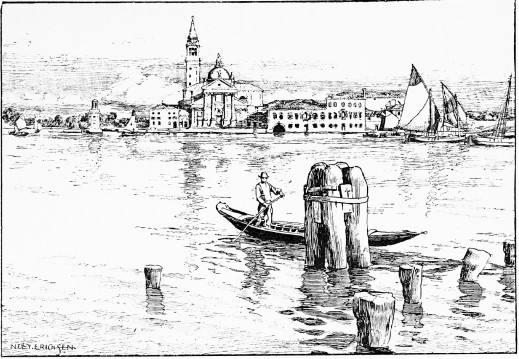
In the little chapel of the Madonna dei Mascoli at the W. angle of the N. transept, where of old a guild of men used to assemble, are some fine fifteenth-century mosaics by Michele Giambono. They are unhappily injured by restoration, but in the main the early Renaissance feeling has been preserved and the more natural modelling of the figures and fuller architectural detail form a pleasing contrast to the stiff and sometimes hard design of the Byzantine workmen.
East of this is the richly decorated chapel of St Isidore founded by the same Doge and scholar who decorated the Baptistery. The work was not, however, completed until 1355 under Dom. Gradenigo. The inscription over the altar tells that the body of the Blessed Isidore was brought from Chios in 1125 by Doge Dom. Michiel and now rests in the tomb below. The sculptured figure of the saint and the reliefs to left and right representing his martyrdom are fine work. The fourteenth-century mosaics so faithfully wrought by the artists of that great epoch have needed but slight repair and remain practically as they left them. Over the altar is Christ seated between S. Mark and Isidore, and balancing this at the opposite end are the Virgin and Child, the Baptist and St Nicholas. The legend of the saint is illustrated on the walls. In this chapel we are standing within part of the actual fabric of the old church of St Theodore. When the S. wall of the chapel was peeled in 1832 it was found to be blackened by exposure to the weather and pierced by a window with an iron grille.
The group of worshippers ever before the altar to the left as the visitor leaves this chapel will tell him that he is approaching the shrine of the Virgin. Under a canopy is the miraculous Nicopeian icon of the Virgin which was captured from Murzuphles and formed part of the spoil of Constantinople. Doge Dandolo sent it to Venice in a specially appointed ship, and in 1618 the present altar was raised by Doge Giov. Bembo. The image (only exposed on Saturdays) was traditionally painted by St Luke. It is lavishly decorated with precious stones and surrounded by ex-votos.
Passing the altar of St Paul, bearing a statue of the saint and a fine relief of the scene of his blindness, the chapel of St Peter is reached. In front is a screen with statues of the Virgin and Child and four women saints, the Massegne. In the apse of this chapel is the entrance to the Sacristy, one of the most beautiful chambers in Europe. The magnificent mosaic ceiling designed by Titian and wrought with perfect art; the rich marble decorations; the symmetry and proportion of the architecture; the chastened glow of colour will not fail to impress the spectator.
Beyond the altar of St Paul is the great N. pulpit. It is one of the finest architectural features in the church and rich in historical memories. Here Enrico Dandolo and other great Doges and prelates addressed the people in national crises. Another pulpit smaller and simpler in style stands to the S. of the choir screen, and an altar to St James balances that to St Paul on the N. On the architrave of the screen stand the crucifix, statues of the Virgin, St Mark and the Twelve Apostles by the Massegne, signed and dated 1394-97. On either side of the choir are three reliefs in bronze by Sansovino. The great bronze-doors by the same master lead from the L. of the choir to the Sacristy. The canopy of the high altar is borne by four marble columns with reliefs (p. 187). The rude timeworn figures tell the story of the life of the Virgin on the N.E. pillar and the life of Christ on the remaining pillars, reading N.W., S.E. and S.W.
The gorgeous Pala d’Oro is exposed to view on Easter Eve and Day, and St Mark’s Eve and Day. It may be seen on other days between twelve and two on payment of 50 centesimi. This magnificent example of the goldsmith’s art was made to the order of Ordelafo Falier by Byzantine craftsmen at Constantinople in 1105. It was added to and restored by Gothic artists under Pietro Ziani in 1209, and under Andrea Dandolo in 1345. The gold, estimated to weigh thirty, the silver three hundred pounds, is set with some 1200 pearls and a like number of precious stones. Most of the jewels were, however, looted by the French in 1797 and are replaced by inferior modern stones, which may be detected by the fact that they are cut in facets. The upper compartment has in the centre St Michael surrounded by sixteen medallions of the doctors of the Church. To the L. are three panels: The Feast of Palms, Descent into Limbo, Crucifixion; to the R., other three, the Ascension, Pentecost, Death of the Virgin. The lower and larger compartment is framed on three sides by twenty-seven small panels whose subjects are taken from the lives of St Mark, Christ and the Virgin. In the middle is a large panel with the figure of the seated Christ and four smaller figures of the Evangelists; above are two archangels and two cherubim. On each side of the large panel are two sets of six medallions, the upper and smaller of archangels, the lower and larger of the Apostles. Beneath the figure of Christ in the large panel are three plaques: the centre contains the figure of the Virgin; L. of her is a crowned figure, which a Latin inscription tells is that of Doge Ordelafo Falier; R. of the Virgin is a crowned figure with a Greek inscription stating it to be the Empress Irene. If, however, the observer will scrutinise the figure of the Doge it will be seen that his head has been substituted for that of the Empress’s consort, John Comnenus. On each side of these three central figures are inscriptions which give the history of the Pala d’Oro and six prophets bearing scrolls. The technique of the gold cloisonné enamels is admirable. They are glorious in colour, partly translucent, and allow the backing of fine gold to shine through.
Behind the high altar is the altar of the Holy Cross, adorned with six columns of precious marble. The two spiral, semi-transparent ones were reputed to come from Solomon’s Temple. The chapel to the S. of the high altar is dedicated to St Clement. Beneath the cornice whence springs the vaulting of the apse is a stern minatory inscription in Latin that met the eye of the Doge, as he entered from the Ducal Palace through an ante-room opening on this chapel. It is now but dimly seen, and runs thus: Love justice, give all men their rights: let the poor and the widow, the ward and the orphan, O Doge, hope for a guardian in thee. Be compassionate to all: let not fear nor hate nor love nor gold betray thee. Thou shalt perish as a flower: dust shalt thou become, and, as thy deeds have been, so after death thy reward shall be.
In the S. transept, answering to the Lady Chapel, is the chapel of the Holy Blood, formerly dedicated to St Leonard.
The old and new crypts open to the public on St Mark’s Day, and at other times on payment of 50 centesimi, are of great interest. In the centre of the new crypt, that of Contarini’s church, is the empty tomb, reaching to the roof, where lay St Mark’s body from 1094 until 1811, when it was removed to the high altar where it now remains. Three steps, topped by a slab of stone worn by pilgrims’ feet, lead to a semi-circular cell with a small window once filled with pierced stone-work. The ancient capitals of the columns of this crypt are of great beauty. The older crypt with its rude brick vaulting that formed part of the ninth-century basilica of Giov. Participazio, was drained and cleared of rubbish, as the inscription tells, in 1890.
The chief object of interest in the Treasury, entered at the W. angle of the S. transept, is the so-called chair of St Mark, wrought from a block of Cipollino marble, said to have been sent to Aquileia from Alexandria by the Empress Helena and to have been carried thence with the other relics to Grado at the time of the Lombard invasion. Some beautiful book-covers from St Sofia; a number of Byzantine chalices made of precious stones; two fine candelabri attributed to Cellini; a ring used at the Wedding of the Adriatic, are among the exhibits. The Treasury was looted at the same time as the Pala d’Oro by the French. The room itself, outside the fabric of the church, is of interest inasmuch as it originally formed part of the tower of the old Ducal Palace. The body of St Mark is said to have lain there from 829 until 832, when the church was ready to receive it.
Before we quit the interior, the old rich mosaic pavement with its quaint and beautiful Byzantine designs is worth notice. The uneven, wavy form is due, not to any intent of imitating the waves of the sea, but to the fact that the pavement is supported by the crypt and has settled into hollows corresponding to the cells of the vaulting which, being filled with loose material, are less rigid than the crown where no settlement has taken place.
SECTION III The Ducal Palace
TO turn from the fair temple of the Christian faith in Venice, warm with the affection and the presence of her people, to the empty splendour of the Palace where her secular princes sat in state, is to turn from life to death. If a patrician of the great days were to revive and enter St Mark’s he would find the same hierarchy, the same ritual, the same prayers and praise uttered in the same language to the God he knew. But if he sought to enter the Ducal Palace, the servant of a then petty dynasty would demand a silver coin before he were permitted to ascend the Golden Staircase. There, on steps once trod by those alone whose names were inscribed in the Book of Gold, he would meet a strange company. He would find the great palace of Venice a museum; her millennial power a memory; and the gorgeous halls that once echoed to the voices of the masters of land and sea occupied by a crowd of sightseers, alien in race and creed, gazing curiously at the faded emblems and pictures which tell of her pride, her glory and her imperial state.
The earliest official residence of the Tribunes of Rivoalto was situated by the church of the Holy Apostles near the Rio dei Gesuiti, whose northern mouth is opposite the channel leading to Murano. The remains of this fortified building, which was furnished with a great gate, always kept closed, and a guarded postern, still existed towards the end of the sixteenth century, and then served as a prison. In 820, Doge Angelo Participazio built another feudal-like structure on the site of the present Ducal Palace, near the church of St Theodore. Nothing could be less like the palazzo fabbricato in aria we know to-day. It and the whole of the Piazza, then but a third of its present area, were enclosed by a strong wall with Ghibelline battlements. One of the old towers is incorporated in the masonry, at whose corner now stand the four figures in porphyry referred to on p. 229.
Angelo’s structure was destroyed by fire during the riots which attended the murder of Doge Pietro Candiano in 976. The rebuilding was undertaken by his successor, Pietro Orseolo, and completed towards the end of the eleventh century by Doge Selvo, who adorned the exterior with marble columns and the interior with mosaics. Doge Sebastiano Ziani extended the buildings in the late twelfth century. Early in the fourteenth, the E. portion of the S. façade was begun under the direction it is believed of the chief mason (Prototaiapiera), Pietro Basseggio, and in the course of about a century the S. wing was completed and the W. façade carried so far as the boundary of Ziani’s building. About 1365 Doge Marco Cornaro had the walls of the Hall of the Grand Council, the necessity for which had been the chief cause of the new buildings, painted with scenes from the story of the reconciliation of Pope Alexander and the Emperor Barbarossa, and the cornice decorated with portraits of the Doges so arranged that his own came exactly over the ducal chair. The Gothic additions made the simple edifice of Ziani look poor in comparison, and a strong desire was evoked to rebuild the old palace; but the Senate, chary of adding to the public burdens, forbade any member to make such a proposal under a fine of 1000 ducats. In 1419 fire injured the old edifice, and the good Doge Tomaso Mocenigo offered to pay the fine, and thus carried a proposal to rebuild Ziani’s portion of the Palace, which reached from the present Porta della Carta to the sixth arch and seventh column N. of the Adam and Eve angle. The Gothic building was completed between 1424 and 1439, under Doge Francesco Foscari, whose kneeling figure (restored) is carved over the Porta.
The ornate façade on the east side, best seen from a gondola or from the Ponte di Canonico, is by Ant. Riccio, and was erected between 1483 and 1500.
After the great fire of 1577, when the conflagration seemed “like Etna in eruption,” the whole structure narrowly escaped demolition to make place for a new building of Palladian architecture. The strenuous opposition of the architects Giovanni Rusconi and Antonio da Ponte alone saved it. The latter’s plans were accepted and the ruin was repaired and redecorated.
The Bridge of Sighs is a later addition by Ant. Contino, about 1600. It is a commonplace structure, and none but commonplace criminals ever crossed it to their doom.
The brick core of the palace may still be seen in the Cortile and from the Ponte della Paglia, on the eastern façade, where Riccio’s beautiful work ends.
The sculptures at the three free angles, the Drunkenness of Noah, the Adam and Eve, and the Judgment of Solomon are placed S.E., S.W. and N.W. The group of the Judgment of Solomon is by two Tuscan sculptors, Pietro di Nicolo di Firenze and Giov. di Martino da Fiesole.
The S. façade, like the W., is composed of a lower arcade and an upper gallery whose columns support the massive walls of the upper storeys, a daring inversion of architectural tradition which is not wholly satisfying. The marble lozenge-shaped incrustation, however, relieves the heaviness. Indeed, from a fourteenth-century drawing[92] in the Bodleian Library, Oxford, it is possible the upper storeys may have been originally set back.
The squat appearance of the columns of the arcade is due to the raising of the level of the Piazzetta, which in the days when the palace was built was some thirty inches below the present pavement.[93] The original building was approached by a stylobate of three steps which greatly added to its dignity and proportion. Under this arcade the Venetian nobility were accustomed to meet and talk of public affairs, for meetings in their own houses would have roused the suspicion of the Ten. When the patricians, as they paced up and down, raised their eyes to the capitals just above their heads they saw a series of sculptures which for beauty of design, richness of invention and craftsmanship were unsurpassed in Europe. Even to-day, largely renewed as they are, they will repay careful inspection. The subjects are of the usual symbolical types: children, birds, famous emperors and kings, the virtues and sins, the signs of the Zodiac, the crafts, the seven ages of man under celestial influences, the months and seasons, famous lawgivers—all treated with the naïveté and didactic purpose so characteristic of Gothic artists. Most of the carvings bear inscriptions which make the interpretation of the subjects comparatively easy. The artists, however, who wrought the fifteenth-century capitals on the W. façade seem to have been lacking in invention, for of the thirteen columns southwards from the Porta della Carta, six are copied from those wrought by the fourteenth-century masons on the S. façade.
PONTE DEI SOSPIRI.
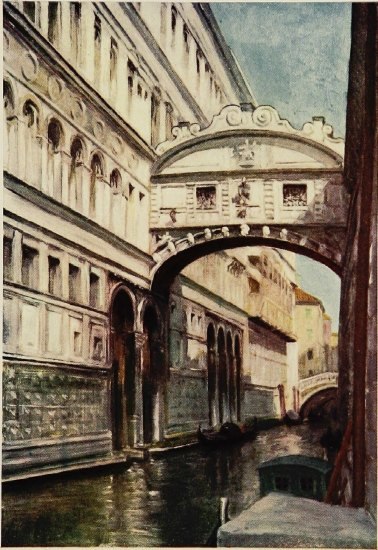
The gallery above is beyond criticism; for originality and grace it is unique in Europe. The eye never tires of its beauty; it adds distinction to the whole structure, and it gives an element of peaceful repose and conscious security so markedly in contrast to the grim civic fortresses of Florence and Siena and other faction-ridden Italian States. The four raised windows of the main storey on the S. are due to the fact that the builders of the Hall of the Great Council cared less for external symmetry than for internal convenience. The two balconied windows, one in each façade, were added soon after the completion of the Porta della Carta. Before 1577 all the windows of the great chamber were decorated with Gothic triforia. It is now proposed to restore them, though the project meets with much opposition.
We pass through the Porta della Carta, enter the Cortile and turn to examine Riccio’s famous statues of Adam and Eve opposite the Giant’s Staircase. The inner façade was begun on the E. side by Riccio and continued by Pietro Lombardo and Scarpagnino. The two cisterns of bronze are fine Renaissance work of 1556-57.
We ascend the stately Scala dei Giganti and pass Sansovino’s statues of Mars and Neptune at the top. Here, between the two pagan deities, the later Doges were crowned. The Doge stood surrounded by the electors, and was acclaimed by the people below in the courtyard; a line of ducal guards kept the staircase.
We mount[94] the Scala d’ Oro to the chambers where the rulers of the Republic held their meetings. Nearly the whole of the architectural decorations and paintings we shall see are later than 1577, when the disastrous fire occurred which destroyed the priceless works of Gentile da Fabriano, Vittore Pisano and the Bellini. With few exceptions they are all by the later Venetian masters, characterised by vigour and breadth of treatment rather than careful execution and reverent feeling. It was a time when the rulers of Venice, their initiative and courage gone, lived on the traditions of a great past, for Lepanto was but a magnificent episode. In few cases was the artist contemporary with the events he depicted. The paintings do, however, enable us to realise the costumes and architecture of the declining Venice of the sixteenth and seventeenth centuries. They have suffered much at the hands of the restorer. When Goethe was examining Titian’s Death of Peter Martyr in S. Zanipolo in 1790, a Dominican friar addressed him and asked if he would like to see the artists at work above. There in the monastery he found an academy of picture restorers established by the Republic working under a director on the paintings of the Ducal Palace. In 1846 Ruskin saw a picture by Paul Veronese, lying on the floor of a room in the palace, in process of restoration. The restorer was working on the head of a white horse, using a brush fixed at the end of a five-foot stick which he dipped into a common house-painter’s pot.
In the vestibule (Atrio Quadrato) is a fine ceiling-painting by Tintoretto, Doge Lorenzo Priuli receiving the Sword of State from the Hands of Justice, one of a series of allegorical and devotional pictures, the main feature being the portrait of the Doge, which we shall meet with again and again in the decoration of the palace. The walls are hung with portraits of Procurators of St Mark by the same master, who was their official portrait painter. To the R. is the Hall of the Four Doors (Sala delle Quattro Porte), designed by Palladio. On the R. wall is a late work by Titian, Doge Antonio Grimani kneeling before Faith, a beautiful creation: the figures on either side are by his nephew, Marco Vecelli. Historical and allegorical scenes cover the remaining walls.
DUCAL PALACE—THE MARRIAGE OF ST CATHERINE By Tintoretto
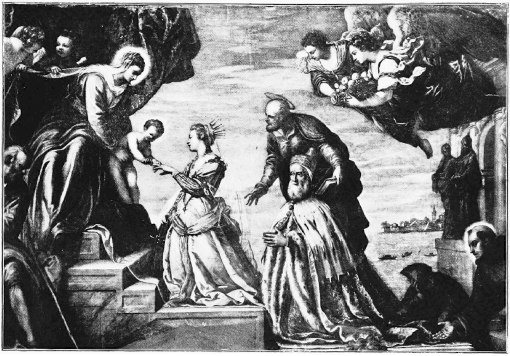
The door opposite the entrance leads to a small ante-room (Anti-Collegio) containing some of the most charming pictures in the palace—Tintoretto’s Ariadne and Bacchus, Minerva repelling Mars, and Mercury with the Graces, painted 1578. Sensuous beauty and poetry of line are their main qualities. A famous painting by Veronese, The Rape of Europa, and Jacopo Bassano’s Return of Jacob are on the wall opposite the windows. A foreshadowing of modern naturalism in the treatment of the sheep and horse in the last picture is especially noteworthy. We now enter the room where the Signory received foreign ambassadors (Sala del Collegio). Over the entrance is a portrait of Doge Andrea Gritti kneeling before the Virgin; over the door of exit, the Marriage of St Catherine, with a ceremonial portrait of Doge Francesco Donà, elaborated with the usual accessories, the figure of the Doge’s name saint, in this case St Francis, is common to all these compositions; to the L. is a portrait of Doge Nicolo da Ponte, with the Virgin in glory; farther on, Doge Alvise Mocenigo adoring the Saviour. All these are by Tintoretto; the figures of the Virgin and of St Catherine in the second and third of these pictures are from his favourite model and in his most gracious manner. Over the throne, Doge Sebastiano Venier returning Thanks for the Victory of Lepanto, is by Veronese. The ceiling, designed by Ant. da Ponte and painted by Veronese in his grandiose style, is considered by Ruskin to be the finest in the palace. Parallel to the last two rooms is the Senate hall (Sala del Senato). The paintings here are of but secondary interest: ceremonial portraits of Doges by Palma Giovane, Marco Vecelli and Tintoretto. The central panel of the gorgeous ceiling—Venice, Queen of the Sea—is by Domenico Tintoretto, son of Jacopo. A door R. of the dais gives access to the vestibule of the Doge’s private chapel (Anti-Chiesetta). Here are the two pictures painted by Tintoretto for the Camerlenghi in 1552; over the entrance door, SS. Jerome and Andrew; opposite, St Louis of Toulouse and St George. Two early Madonnas in the chapel are doubtfully attributed to the schools of Boccacino and Bellini. Christ in Limbo and the Israelites crossing the Red Sea are attributed by Mr Berenson to Previtali. These and other paintings in the chapel afford fruitful themes for critical ingenuity.
Returning through the Senate-hall we cross the Sala delle Quattro Porte, and traverse a small ante-room to the Hall of the Ten (Sala del Consiglio dei Dieci). The ceiling pictures are by Veronese and his pupils. An oval panel, The Elder and the Fair Lady, is a famous painting by the master. We enter next the ante-room of the three Inquisitors of State (Sala della Bussola), formerly a guardroom occupied by the captain of the police and by the guards of the Ten. An opening in the wall was formerly decorated with a lion’s head in marble (bocca del leone). Here secret denunciations were placed from the outside. The delators would ascend the Scala dei Censori and cast their accusations in the opening on the L. at the top of the staircase. The custom of receiving secret information was common in the Republic. To this day similar bocche di leoni remain in various parts of Venice—on the Zattere for denunciations of breaches of sanitary regulations with the inscription: D̃ÑCIE CONTRA LA SANITA PER IL SESTIERE DE OSSODVRO; another in front of St Martin’s Church near the arsenal invites secret denunciations against blasphemers and brawlers in churches.
DOGE’S PALACE—THE CORTILE
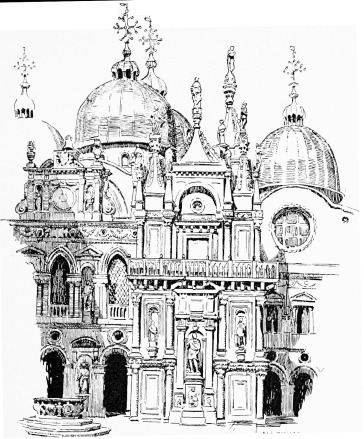
To the R. of the Sala della Bussola is a small chamber (Stanza dei tre Capi del Consiglio) where sat the three chiefs of the Ten. The room contains a simple, refreshing picture by Catena, Doge Leonardo Loredano kneeling and presented by St Mark to the Virgin, a St Christopher by Bonifazio, a Pietà by Giovanni Bellini, hard and realistic in treatment, and portraits of three Senators, by Tintoretto. Returning to the Sala della Bussola (the Sala dei Inquisitori di Stato is not shown), we descend the Scala dei Censori to the lower floor. Here we enter the huge Hall of the Great Council (Sala del Maggior Consiglio), on which the later artists of the Republic lavished all their powers of sumptuous decoration. The entrance wall over the throne is covered by Tintoretto’s famous Paradiso—a tremendous conception which at first almost dazes the spectator by its daring, then leaves a profound impression of the master’s gigantic but unchastened power. After patient contemplation, groups and individuals stand out from the bewildering crowd of figures—Christ and the Virgin in glory; the Archangels; the Intelligences that preside over the heavenly spheres; the Evangelists with their symbols; prophets, saints and martyrs, an exultant host, treated with originality and force, sometimes even with tender grace. But the composition is too vast; it lacks symmetry, and Domenico’s feebler hand is all too evident in parts. The eye wearies of seeing, and none but admirers of the piu terribile cervello che abbia mai avuto la pittura[95] will care to read the canvas in all its details. Tintoretto was seventy-five years of age when commissioned to execute the work. Ruskin estimated the number of figures to be not less than 500. To L. and R. the walls are filled with scenes from the heroic times of Venetian history. Here again the crowded canvases, the conscious straining after effect weary the spectator, and few are they who do not soon turn from detailed examination of the pictures, to rest eye and brain on the beautiful scene that opens out from the loggia on the side of the hall—the island of S. Giorgio; the Giudecca; the waters laughing in the sun; the peaceful lagoon; the Lido far away with its line of trees. The series of paintings on the N. wall represent scenes, mainly legendary, in the story of Pope Alexander III. and the Emperor Barbarossa, mostly by inferior artists. The S. wall is decorated with scenes in the epic story of the conquest of Constantinople under Enrico Dandolo; a single canvas, at the end of the hall opposite the Paradiso, by Veronese, has for its subject the return of Doge Contarini after the defeat of the Genoese at Chioggia. The panels of the magnificent ceiling were painted by Veronese, Tintoretto, Palma Giovane and F. Bassano. Veronese’s Apotheosis of Venice and Tintoretto’s Doge Nic. da Ponte with the Senate and envoys from conquered cities paying homage to Venice are stupendous works of their kind. On the frieze are portraits, mostly imaginary, of seventy-six Doges, by Tintoretto and his assistants, the place of Marino Falier being filled by a black tablet with the inscription: Hic est locus Marini Faletri decapitati pro criminibus. A door to the R. leads to the Hall of the Scrutineers (Sala dello Scrutinio). This, which almost rivals the Hall of the Great Council for magnificence, was the chamber where the Doges and other officers of State were elected. The S. end is filled with an ambitious Last Judgment by Palma Giovane in which that very second-rate artist tried to emulate Tintoretto’s Paradise. The E. and W. walls are decorated with scenes in the history of Venice of small artistic merit. When Garibaldi was at the Ducal Palace his attention was arrested by the resemblance to himself of the figure of Admiral Sebastiano Venier in Vicentino’s Battle of Lepanto. Thirty-nine portraits of Doges complete the line from the Hall of the Great Council ending on the W. wall with Ludovico Manin. At the N. end is the monument to Doge Francesco Morosini.
We retrace our steps to the Scala dei Censori, beyond which is a suite of rooms, once the private apartments of the Doges, now used as an archæological museum. In the corridor are two fine allegorical pictures of St Mark’s Lion by Jacobello del Fiore and Carpaccio; and Bart. Buoni’s remarkable head of Francesco Foscari. The beautiful rooms with their gilded ceilings and fine chimney-pieces by the Lombardi, contain Greek, Roman and Venetian sculpture, Renaissance bronzes, coins, old maps and other objects, many of them of high merit but only of interest to the more leisured student. In the Stanza degli Stucchi are a voting urn from the Scuola della Carità, and another from the Great Council. Before he leaves this room the visitor should ask to be shown one of the most interesting paintings in the palace—an unrestored fresco by Titian of St Christopher, with a view of Venice in the bottom background, at the foot of the staircase leading up to the Doge’s chapel. The Piombi have long since disappeared owing to structural alterations; such of the Pozzi and other cells that are shown may well be left unvisited.
Before descending the Giant’s Staircase permission may be had, on application to the “Ufficio Regionale per la Conservazione dei Monumenti del Veneto,” to inspect the “Cobden Madonna” at the E. end of the S. gallery overlooking the Grand Canal. It is a fine marble relief of the Virgin and Child with attendant angels, wrought probably by Pietro Lombardo to commemorate the reduction of the duties on corn during a severe famine in the reign of one of the Mocenighi towards the end of the fifteenth century. When Richard Cobden was in Venice in 1847, during the course of his triumphant journey through Europe, he wrote his name, which is still visible, over one of the ears of corn beneath the Latin inscription.
SECTION IV The Accademia
AFTER the fall of the Venetian Republic the French government expropriated a group of buildings belonging to the church, monastery and guild of S. Maria della Carità, and there housed the collection of paintings selected from the public offices, the suppressed religious orders, guilds and churches of Venice, by their commissioner, Peter Edwards, who had formerly been chief picture restorer to the Republic. Some conception may be formed, after visiting the Ducal Palace and the magnificent collection treasured in these rooms, of the enormous wealth of paintings existing in the city in the latter half of the eighteenth century; for the commission then appointed to overhaul the artistic possessions of the government decided to restore only the best and allowed the remainder to rot. The Guild of Our Lady of Charity, the earliest of the six greater Scuole[96] of Venice, was founded in 1260 to ransom Christian captives from the Moors and other pirates. Over the portal of the outer cloister are three early reliefs in stone, St Leonard, patron of captives and slaves; the Virgin and Child with kneeling guildsmen; and St Christopher. In the inner court, entered from the corridor of the Istituto delle Belle Arti, may be seen Palladio’s unfinished cloisters, one of the most beautiful examples of the use of brick in N. Italy. Of the old rooms of the guild two only remain, Room XX., the former Guest Chamber, and Room I. Both have magnificent fifteenth-century ceilings; that of the latter is by Giampietro of Vicenza, a famous wood-carver whose figures of eight-winged cherubs have been ingeniously but erroneously interpreted as a rebus on the name of a supposed brother, Cherubino Aliotto (eight-winged), who was believed to have paid for the decoration of the ceiling.
We enter Room I., which is filled with admirable examples of the work of the earliest Venetian masters, Jacobello del Fiore, Giambono, Lorenzo Veneziano, Simone da Cusighe, Andrea and Quirizio da Murano, all dominated by Byzantine models, and giving small promise of the future glories of the Vivarini and Bellini schools.
Before entering Room II. the eye will be arrested by Titian’s famous Assumption, No. 40. A nearer view of this grandiose painting will serve to impress the beholder with the animation and force of the master’s new style and the subtle artifice by which he attracts the eye of the spectator to the ascending Virgin, to whom the whole composition yearns. This great altar-piece created a vast sensation when exposed at the Frari, pregnant as it was with the future development of the grand school of Venetian painting:—its masterly group of a large and complicated subject, its breadth of treatment and habit of massing the warmer and mellower colours of the palette on the canvas. It must be remembered, however, that the features of the Virgin and the picture generally have been coarsened by restoration, for, unhappily, most of the old paintings which have come down to us have been restored more than once, more than twice, more than thrice, and the traveller will need to make allowances for the consequent debasement of the original creation in this and many other works by the old masters. In this room of masterpieces we are enabled, by the juxtaposition of three altar-pieces (38, by Giov. Bellini; 36, by Cima; 37, by Veronese) to compare the treatment of the same subject, the Virgin and Child and Saints, by three great masters. 41, The Death of Abel, by Tintoretto, is an admired work, powerful but sombre. It is considered by Ruskin to be one of the most wonderful works in the gallery and superior in many respects to 42, The Miracle of St Mark, the most popular of the master’s paintings (p. 209). A Christian slave is tortured and ordered to be executed for his devotion to St Mark, who descends from heaven like lightning to rescue him. The executioner exhibits the broken hammer. A work of amazing science and originality which so perplexed the members of the guild[97] for whom it was executed and gave rise to so many discussions, that the impatient artist fetched it away and kept it in his atelier until it was better appreciated. 43, Adam and Eve, is an early work by the master. 44, Carpaccio, Presentation in the Temple, is, in Ruskin’s estimation, the best picture in the Accademia. The painter wrought the work in emulation of his master’s altar-piece (No. 38). All the Bellini features are here—the mosaic half dome, the Renaissance decoration, the sweet boy musicians with instruments almost too big for them to handle. The two paintings adorned the same church.
We pass Room III., which contains a miscellaneous collection of paintings of various Italian schools, and Room IV. (drawings by Italian masters), and reach Room V., where the dominant genius of the Bellini is manifested in the works of their contemporaries with which the room is hung. It contains, 69, The Agony in the Garden, the finest of Basaiti’s paintings in Venice, and some excellent examples of Bissolo’s warm colour and dignified figures. 76, The Supper at Emmaus, is a remarkable and unique work by Marco Marziale. Two powerfully wrought figures seated at the table betray the alien influence of Dürer over this painter. 82, The Virgin and Child enthroned between SS. Jerome, Benedict, Mary Magdalene and Giustina, is Benedetto Diana’s last work. We pass to one of Bissolo’s best productions, 79, Christ presenting the Crown of Thorns to St Catherine of Siena, and showing the crown of gold, her portion in heaven. Near 97, a typical plague picture by Mansueti, are two fine paintings by Lazzaro Sebastiani. 104, St Anthony of Padua enshrined in a tree, beneath which are St Bonaventura and another Franciscan saint, has much puzzled the critics. According to tradition St Anthony composed his last sermons while sitting on the branches of a tree. It is, moreover, an old custom to place shrines, with figures of saints, in the trees by the wayside in Italy. We have seen many such in the hill country of Venetia.
We enter Room VI., which contains a collection of Dutch pictures of no great merit, and cross to Room VII., devoted mainly to the Friulian painters. The chief attraction of this room is, however, 147, a magnificent Sacra Conversazione by Palma Vecchio. It is a late work by the master, and was probably left unfinished at his death.
At the farther end is the entrance to Room VIII., hung with Flemish paintings. Turning L. we ascend the steps which lead from Room V. to Room IX., which glows with the compositions of the sixteenth-century masters Veronese and Tintoretto. 203 is The Supper in the House of Levi (p. 211). Under a spacious Corinthian portico Christ is seated between St John and St Peter. The whole scene is dominated by the princely magnificence of the repast. The details objected to by the Inquisitor are untouched; Peter is still carving the lamb, and between two columns on the L. is the fellow picking his teeth with a fork. Four scenes from the story of S. Cristina, and the Virgin of the Rosary are characteristic paintings by the same master. 210, The Virgin and Child with SS. Mark, Sebastian and Theodore, and three officers of the Treasury, followed by their servants, was one of Ruskin’s favourite Tintorettos. 213, The Crucifixion, by Tintoretto, is a sombre dramatic representation of the scene envisaged in his most naturalistic manner, another of Ruskin’s favourites; he believed that neither the Miracle of St Mark nor the great Crucifixion in S. Rocco cost the artist more pains than this comparatively small work. 214, by Il Moro, is an interesting picture from the Admiralty; it is divided into two parts, (1) St Mark and three functionaries who are recruiting for the navy; (2) view of the Molo or chief quay of Venice, the Piazzetta and the Ducal Palace; gondolas and galleys are seen on the canal. 217, Tintoretto’s Descent from the Cross, is another fine composition, almost Spanish in its gloom. Numerous portraits on the end walls are by the same master. R. of the door is an interesting picture, 243, Virgin and Child and four magistrates of the Salt Office in adoration. It was the custom of the chief civil servants of the Republic to leave as a souvenir of their term of office a picture of their patron saint with their escutcheon and initials painted on it. Most of the Bonifazios in Room X. are such, and came from various public offices; Tintoretto, in this picture, was the first to represent actual portraits. 255, a Crucifixion by Veronese, is painted in the frankly naturalistic style of the later school of Venice. 260, an Annunciation, is in the master’s most spacious and stately manner.
ACCADEMIA—THE RICH MAN’S FEAST By Bonifazio
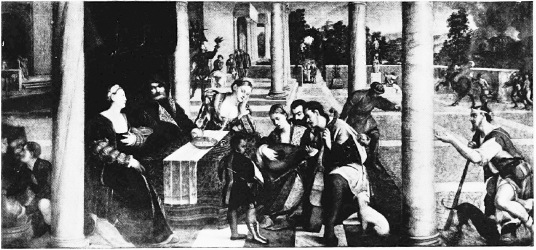
Room X. is largely held by the creations of Bonifazio and his pupils. 281, The Adoration of the Magi, is a beautiful work, painted with great care, by the master, for the Ten. On the opposite wall, 319, The Slaughter of the Innocents is the companion picture. Bonifazio’s receipt, dated 1545, for ten ducats on account of these two pictures still exists among the archives of the Ten. They were hung in their Financial Secretary’s office in the Palazzo dei Camerlenghi. 291, The Rich Man’s Feast (p. 207). For depth of feeling, sumptuous colour, variety and strength of characterisation, one of the most noteworthy creations of Venetian art. Dives[98] is seated in a Venetian country-house at table between two courtesans, one of whom he clasps by the hand. She, with a far-away look, turns aside listening to a woman playing on the lute, accompanied by a man with the bass viol. All the accessories of a rich man’s establishment are present. Hawks are being trained, horses exercised. To the R., Lazarus is seen, a dog licking his sores, and in the background lurid flames forbode impending doom. 284, Christ Enthroned, is a richly coloured picture formerly placed in the chief office of the Customs. On the top line are twelve groups of saints,[99] painted in the Bonifazio atelier, and formerly assigned to Bonifazio III. 318, St Mark, skied among them, is however a finer work, probably by the master’s hand. On the screen are The Judgment of Solomon, another masterly composition, painted in 1533 for the Salt Office, in the Palazzo dei Camerlenghi, and some portraits by Pordenone. 400, a Deposition, is Titian’s last work, a pathetic canvas. An inscription tells that what Titian left unfinished, Palma Giovane completed, and dedicated to God. The Virgin bears the dead Saviour on her knees. To the R. kneels St Joseph of Arimathea; to the L., in an attitude of poignant grief, is St Mary Magdalen. 320, Paris Bordone: scene from the legend of St Mark and the Fisherman (p. 121). The Doge, Bartolomeo Gradenigo, is represented enthroned in the midst of the Council, bending forward to receive the ring. 316 is Pordenone’s masterpiece. The patriarch, S. Lorenzo Giustiniani, with Dantesque features, stands under a Renaissance chapel. Before him kneels S. Francis, behind whom is St Augustine and an acolyte. R., S. John the Baptist, with the muscular development of an athlete, behind whom is St Bernardine of Siena and a kneeling monk.
We turn by the Loggia Palladiana, hung with late Dutch and Flemish paintings, copies and school pictures of minor interest, and enter Room XI. on the R., which is given to some characteristic landscapes, scenes of peasant life and portraits by the Bassani. Rooms XII. and XIII. display work by artists of the seventeenth and eighteenth centuries, including some interesting genre pictures by Pietro Longhi. Room XIV. contains some Tiepolos, among them a fine ceiling painting, No. 462, the Invention of the Cross, three small Guardis, 704, 705, 706, two Canalettos, 463 and 494, and other works of minor interest. In Corridor I.[100] is the much debated, No. 516, The Tempest calmed by SS. Mark, George and Nicholas, illustrating the story of the Fisherman and St Mark.
We now turn to Room XV., where are exhibited the paintings illustrating the miracles of the Holy Cross which Gentile Bellini and his pupils were commissioned to execute for the decoration of the Hall of the Guild of S. Giovanni Evangelista about 1490. The room is specially constructed to display these important pictures to the best advantage. 561 by Lazzaro Sebastiani. A crusader, Filippo de’ Massari, on his return from Jerusalem offers a fragment of the Holy Cross to the brethren of the Guild. 562 by Mansueti. The daughter of one Benvenuto da S. Polo is healed on touching three candles sanctified by contact with the relic. The scene is the interior of an old Venetian palace with costumes of the period. 563 by Gentile Bellini. Pietro de’ Ludovici, sick of a fever, is healed by means of a candle as in the former miracle. We are here in the chapel of the guild with the brethren in their black and crimson robes in the foreground. 564 by Mansueti. The relic is brought over the wooden bridge opposite St Lio to accompany the remains of a brother who during his life had scoffed at its power. The procession which is to accompany the body to its last resting-place is thrown into confusion by the Cross containing the relic refusing to advance into the church where the body lies. The scene is most animated. Spectators look from the windows, from the housetops and from the streets. The gondola of the period is represented. The artist himself stands at the foot of the bridge to the left, holding a paper inscribed with his name, Giovanni Mansueti the Venetian, disciple of Bellini. 565, attributed to Benedetto Diana, is said to portray the healing by the relic of a child fallen from the top of the stairs. Neither the quality of the work nor the subject seems convincing. The woman seems to have slipped on the pavement with her child. If genuine it can be no more than a fragment of a larger composition referred to by the older writers as containing elaborate architectural details and groups of people similar to the other paintings of this series. 566 by Carpaccio. Casting out of a devil by the Patriarch Francesco Querini. The Grand Canal is crowded with gondolas. The old wooden Rialto drawbridge with its bascules and levers spans the canal. Above, L., the patriarch is seen in a loggia of his palace at S. Silvestre casting forth the evil spirit by holding out the relic. A most interesting presentation of old Venetian architecture. Two youths in the foreground, with their backs to the spectator, one of whom has a mermaid embroidered on his hood, are in Calza costume. 567 by Gentile Bellini, Procession in the Piazza. A merchant of Brescia whose son lay dying made a vow to the relic as the procession passed and his son was saved. In the ducal procession to the R. the Doge is seen under the State umbrella with the Procurators of St Mark, chamberlains and senators and trumpeters. This is one of the most precious pictorial documents for the aspect of the Piazza in 1496. The thirteenth-century mosaics of St Mark’s are in their place; the Procuratie Vecchie are there but no Clock Tower; houses abut on the Campanile. The Porta della Carta and the façade of St Mark’s are richly gilded. According to Vasari, Gentile surpassed himself in the next painting (568), which firmly established his reputation. During a procession to the church of St Lorenzo the reliquary falls from a bridge into the canal. Several persons plunge in to save it. To none but the warden of the guild, Andrea Vendramin, was it vouchsafed to recover the shrine. A vivid representation of a piece of old Venice. At the head of the Venetian ladies, kneeling to the L., is Catherine Cornaro, Queen of Cyprus, wearing her crown. This picture, and No. 567, the artist tells us, were painted in pious affection for the Holy Cross. 570, a faded work by the same artist, S. Lorenzo Giustiniani, with two kneeling canons and angels bearing his crook and mitre. In the apse are two important works painted by Mansueti for the Guild of St Mark. 569, St Mark heals the cobbler Anianus, wounded by his awl, a favourite legend; and 571, St Mark preaching at Alexandria.
Room XVI. contains Carpaccio’s St Ursula series, painted 1490-95, for the Guild of St Ursula. The legend, familiar to those who have studied the paintings of Carpaccio’s contemporary, Memling, on the shrine of St Ursula at Bruges, may be briefly summarised. Maurus, the Christian king of Brittany, had a daughter named Ursula (Little Bear), because she came into the world wrapt in a hairy mantle. The pagan king of England, Agrippinus, hearing of her wisdom, virtue and beauty, sent ambassadors to ask the maiden’s hand for his son Conon. King Maurus, knowing his daughter’s vow of perpetual chastity and yet fearing to anger a powerful neighbour by refusal, was in great distress. Just before dawn[101] of the next day, while Ursula lay in her chamber, the angel of the Lord appeared to her in a dream and bade her go to her father, and wisdom would be given her to counsel him aright. When day was fully come she went to his chamber and enumerated to the anxious king the conditions on which the suit would be accepted: For companions she required ten virgins of noblest blood, each with one thousand virgin attendants, herself another thousand virgins; they must be allowed to make a pilgrimage to Rome; the prince and his court to be baptised.
The envoys returned to England bearing such reports of the princess’s beauty that Conon was fired with a desire to marry her, and the conditions were granted. Ursula and her maidens, Conon and his suite, set sail in eleven ships for Rome. Being arrived, the Pope and his clergy came forth to bless them. When they had performed their vows the pilgrims returned accompanied by the Pope and reach Cologne, then besieged by the Huns, who straightway massacred the pilgrims, the Pope and his clergy—all except Ursula, whose beauty destined her to be the bride of the king of the Huns. But she, defying his power, aroused his fury; he ordered her to be put to death.
The artist has illustrated this story in his most charming and dramatic manner, though, as the dates prove, no consistent plan of the series was drawn up. The most popular of the paintings is No. 578. Ursula is sleeping in her chamber and an angel, bearing in his right hand a palm-branch, the sign of martyrdom, appears to her in a vision. The early light of dawn streams through the open door. On the tassel of her pillow is inscribed, Infantia. Every detail in this virgin sanctuary, the little crown at the foot of the bed, the clogs placed side by side, the tidy over her head, the shrine and receptacle for holy water against the wall, betokens maidenly care and piety. The charm of these pictures is perennial. Zanetti[102] used to conceal himself in the hall where they were placed to watch the effect they produced on the ordinary spectator.
Room XVII. is chiefly taken up with pictures by the Vivarini and by Cima. 618 and 619, The Baptist and St Matthew, and 593, St Clare, are all fine examples of Alvise Vivarini’s work; the last is one of his greatest achievements, a living portrait, full of character. 588, Mantegna’s St George and the Dragon, is a precious possession, one of the great Paduan master’s most careful works, painted about 1460. 584 and 585, SS. Mary Magdalen and Barbara, are late works (1490) by Bartolomeo Vivarini. 589, Christ bound to the Column, and 590, The Virgin in Meditation, have been ascribed to Antonello da Messina, but their genuineness is doubtful. Mr Berenson admits the former in his index to the works of the Venetian painters; the official catalogue attributes it to Pietro da Messina, and 590 to an unknown copyist working from an original at Munich. We now come to one of the most delightful and graceful compositions in this room, 600, a Marriage of St Catherine, by the Lombard master Boccaccino: before the Virgin and Child kneel St Peter and the Baptist; to the L. St Catherine holds forth her hand to receive the ring; to the R. stands the beautiful figure of St Rose; to the R. of the charming landscape background are portrayed the Wise Men and the Flight into Egypt. Then follow some guild pictures by Cima. 604, the last of the master’s work in this room, is an early painting of much beauty, The Deposition with the Marys and Nicodemus.
Room XVIII., at the farther end, is the new Bellini room in which are collected the Bellinis formerly hung in XVII. This little treasury includes, 582, a unique example of Jacopo’s work, The Virgin and Child. 596, Giovanni’s famous Virgin of the Trees, has recently been peeled and some strata of repainting removed; it is dated 1487, but this date has been questioned by Morelli and other critics who believe it to be a maturer work painted about 1504. 610, The Virgin and Child between SS. George and Paul, is another popular work by the master; both are admirable for warmth of colour, and dignity and beauty of form. 613, The Virgin and Child between SS. Catherine and Mary Magdalen, is one of the most characteristic of Giovanni’s productions; less virile perhaps than 610, but rich and warm in colour and gentle in feeling. We now turn to 595, a remarkable series of panels painted for a cassone or wedding chest; charming allegories on which the painter has lavished all his skill. Their interpretation still awaits an Œdipus, but the following suggestions by Ruskin will help the visitor: 1, Fortitude quitting the effeminate Bacchus; 2, Domestic Love,—the world in Venus’ hand becoming the colour of heaven; 3, Fortune as Opportunity distinguished from the greater and sacred Fortune appointed by Heaven; 4, Truth; 5, Lust.[103]
Room XIX. contains a small collection of Muranese and Paduan school paintings, and others of no great importance. We descend to Room XX., originally the guest-chamber of the brotherhood. The carved and gilded ceiling, representing Christ in the act of blessing, and the four Evangelists, each in his study, is one of the most beautiful schemes of decoration in Venice. It was here that Titian, between 1534 and 1538, painted the Presentation, now restored to its original place. The high-priest stands before the temple at the top of a grand staircase to receive the little maid who seems somewhat too conscious of her pretty blue frock. A group of richly attired Venetian ladies and gentlemen look on. At the foot of the stairway sits an old, coarse-featured peasant woman with a basket of eggs; the mountains of Cadore are in the background. According to Ruskin, the most stupid and uninteresting work ever painted by the artist. 625, Giov. d’Alemano and Ant. da Murano, Virgin and Child enthroned, and four Latin fathers of the Church, was also executed for the very wall space it now covers. It is obviously much repainted. On a screen is 245, a portrait of Jacopo Soranzo by Titian. Above, on a swing panel, is 316, St John the Baptist, painted when the master had passed his eightieth year.
SECTION V The Grand Canal and S. Georgio Maggiore
SECOND only in architectural interest to St Mark’s and the Ducal Palace are the patrician mansions that line the chief artery of Venice, known to Venetians as the Canalazzo. No more luxurious artistic feast can be enjoyed in Europe than to leisurely examine from a gondola the architectural details of the Grande Rue that so excited the admiration of Philippe de Comines. We begin on the L. side opposite the Piazzetta. The Dogana (Custom House) is a late seventeenth-century structure, low in elevation, in order not to obstruct the view of Longhena’s Salute. This church stands on the most magnificent site in Venice, and despite the baseness of many of its details is, when regarded in the mass, an impressive edifice and one of the architectural features of the city. The noble flight of steps and the symmetry of the domes are most effective and pleasing. The anniversary of its consecration in 1687 is still a great popular festival, and yearly on November 21st a bridge of boats is thrown across the canal to facilitate the foot traffic. On the further side of the rio della Salute is seen the apse of the fine Gothic abbey church of S. Gregorio. We may disembark at the square portal, with a relief of St Gregory over the lintel, which opens on the Grand Canal just beyond the rio. It gives access to one of the most picturesque spots in Venice—the fourteenth-century cloister of the monastery. We continue our voyage, and, passing the rio S. Gregorio, note the Palazzo[104] Dario (fifteenth century), beautifully decorated with discs of porphyry and serpentine in the style of the Lombardi. This fine mansion has altered little since the time of De Comines. The huge ground-floor beyond is the unfinished Pal. Venier, begun in the eighteenth century. Farther on is the Palazzo da Mula, a fine Gothic building of the early fifteenth century, adjacent to which is the Pal. Barbarigo, with its brazen mosaics, now the property of the Venezia-Murano Glass Co. We pass on, and next to a garden note the Pal. Manzoni (1465) by Tullio Lombardi, somewhat later in style than the Pal. Dario. Passing the Accademia and a few houses, we reach the two Palazzi Contarini degli Scrigni (Contarini of the Coffers), the first by Scamozzi (1609), the second fifteenth-century Gothic. The Contarini were a wealthy family pre-eminent in the nobility of their ancestry, and owned many palaces in Venice. The last of the race died in 1902 in lodgings. They had given eight Doges and forty-four Procurators to the Republic. Beyond the rio S. Tomaso is the fifteenth-century Gothic Pal. Durazzo or dell’ Ambasciatore, once the German Embassy. The two statues on the façade are probably by one of the Lombardi. We pass two rii and reach the imposing Palazzo Rezzonico, where Robert Browning died. It was built about 1680 by Longhena; the upper storey is, however, a later addition by Massari (1740). We soon come to a magnificent group of three Gothic palaces in the style of the Ducal Palace and attributed to the Buoni. They once belonged to the powerful Giustiniani family, but the last (now the School of Commerce) was bought and enlarged by Francesco Foscari in 1437 and still bears his name. The iron lamp at the corner is modern. Facing us at the farthest corner of the rio Foscari is the Pal. Balbi by Aless. Vittoria (1582). It is now Guggenheim’s shop. We pass on to the rio S. Tomà, at whose farther corner is the Pal. Persico (formerly a Giustiniani) in the style of the Lombardi. A few houses beyond is the Gothic Pal. Tiepolo. Next but one stands the Pal. Pisani, fifteenth-century Gothic. At the farther corner of the rio S. Polo is the Pal. Cappello-Layard with a most valuable collection of paintings (admission by personal introduction only). Adjacent is the Pal. Grimani of the Lombardi period. Two houses farther on stands the Gothic Pal. Bernardo, now belonging to Salviati. On either side of the next traghetto (della Madonetta) are two smaller twelfth-century palazzi, with beautiful Byzantine details, the Pal. Donà and the Pal. Saibante. Next to a garden is the sixteenth-century Renaissance Pal. Papadopoli (formerly Tiepolo), surmounted by two obelisks. At the farther corner of the rio stands the Pal. Businelli with some interesting Byzantine windows. Next but one is the Pal. Mengaldo, referred to in the “Stones of Venice” as the “terraced house.” It has a beautiful Byzantine portal, and arches of the same style are visible in the older part of the building. Just beyond the S. Silvestre Pier is the site of the old palace of the Patriarchs of Grado and Venice. Little of interest meets us until we reach the Ponte di Rialto, which replaced a wooden drawbridge similar to that represented in Carpaccio’s picture. It was built (1588-92) by Antonio da Ponte from a design by Boldù. Many famous Renaissance architects had at various periods offered designs, among others Michael Angelo, who, when living on the Giudecca, was invited by Doge Gritti to submit a drawing, but this “most rich and rare invention” met the fate of the rest—it was set aside as too costly. An Annunciation is sculptured on the hither side of the bridge: Gabriel and the Virgin on the spandrils; the dove on the keystone.
By the farther side stands the Pal. dei Camerlenghi (1525-28) by Guglielmo Bergamasco, once adorned with pictures by Bonifazio, for the offices of the three Lords of the Treasury. We pass the vegetable and fish-markets. Behind the latter, the last house before reaching the Ponte Pescaria was the old Pal. Querini, known as the Stallone, with the two large Gothic portals of the old shambles (p. 109). It became the poultry-market after the fall of the Republic. A new fish-market is, however, projected, and the old palace will probably be incorporated in the new building. A few houses farther on is the Gothic Pal. Morosini; yet farther the lofty Pal. Corner della Regina (now the municipal pawn-office). It was erected in 1724 by Rossi, the architect of S. Eustacchio, on the site of a palace occupied by the Queen of Cyprus. The huge assertive Pal. Pesaro by Longhena, 1679, now comes into view. It is highly praised by Fergusson.
GRAND CANAL—PALAZZI REZZONICO AND FOSCARI.
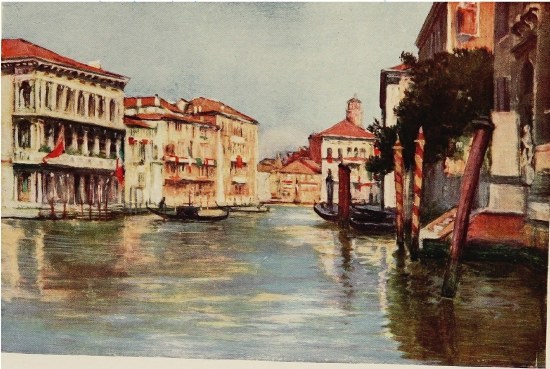
GRAND CANAL, WITH THE RIVA DEL CARBON AND RIALTO BRIDGE
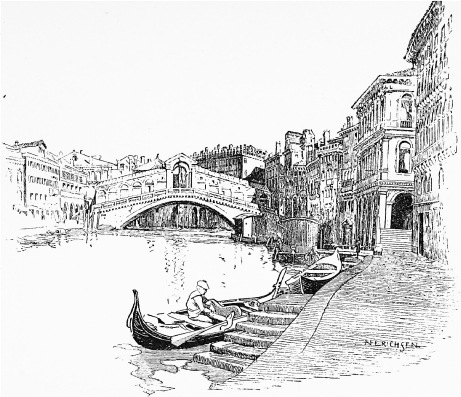
CA’ D’ORO
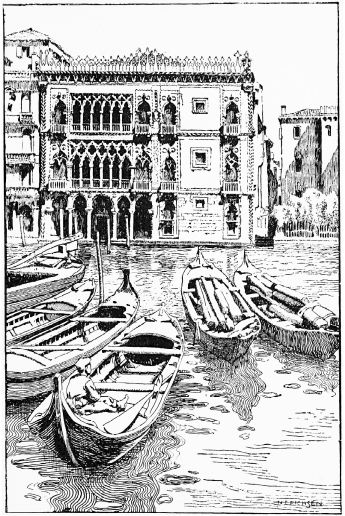
The church of S. Eustacchio (S. Stae), 1709, with its baroque façade will be easily recognised. The bust of the ill-fated Ant. Foscarini will be found in the third chapel L. of entrance, the higher of the two busts to the R. of the chapel. (The church is rarely open and will be more conveniently visited in connection with S. M., Mater Domini, whose sacristan has the key.) At the farther corner of the campo is the Pal. Priuli, with an early transitional Gothic arcade. At the near corner of the rio Tron is the Pal. Tron, sixteenth-century Renaissance; at the farther corner, the Pal. Battaggia by Longhena. The building adjacent is one of the old granaries of the Republic, with the outline of the Lion of St Mark still visible on the façade. Interest ends at the restored Fondaco de’ Turchi (Mart of the Turks) (p. 302).
We cross to the church of S. Marcuola (SS. Ermagora and Fortunato), which contains a doubtful Titian (the infant Christ on a pedestal between SS. Catherine and Andrew), thought, however, by Morelli to be a genuine youthful work of the master. Some distance farther on is the Pal. Vendramin by Pietro Lombardi (1481), one of the finest palaces on the canal. The garden wing is by Scamozzi. Next but one is the Pal. Erizzo, fifteenth-century Gothic. We pass on to the Ca’ d’Oro, the most exquisite little mansion in Venice. It was built (1424-30) for the Contarini, and being richly gilded, was known as the Ca’ d’Oro (the Golden House). The derivation from a supposed Doro family is untenable. The contracts with the Buoni and many another famous tajapiera (stone-cutter), and a contract with Mastro Zuan di Franza, Pintor, for the gilding and the painting of the façade with vermilion and ultramarine still exist. The building was profaned by some ill-designed structural alterations and the beautiful wellhead, by Bart. Buono, was sold to a dealer, when the fabric fell into the hands of the ballet-dancer, Taglioni, in 1847. Recently Baron Franchetti has restored it to somewhat of its original form, and the well-head has been recovered.[105] Beyond the Ca’ d’Oro Pier is the earlier and simpler Gothic Pal. Sagredo, now the Ravà College. The small Pal. Foscari beyond the Campo S. Sofia has interesting Gothic details. The larger, Pal. Michieli delle Colonne, was rebuilt in the seventeenth century. Passing the rio SS. Apostoli we reach the interesting Ca’ da Mosto, twelfth-century Byzantine, but hinting at the coming Gothic. An inscription tells that here was born Alvise da Ca’ Mosto, discoverer of the Cape Verde Islands. Set back in a small court (Corte Remera) is a thirteenth-century house with an external stairway and a fine Byzantine portal. It shows admirably the pointed arch asserting itself in a Byzantine building. Hard by the Rialto bridge is the Fondaco dei Tedeschi (Mart of the Germans), designed in 1505 by Girolamo Tedesco and completed by Scarpagnino. It is now the Central Post Office. The solitary figure that remains of Giorgione’s frescoes will be seen high up between two of the top-floor windows. The sculptures on this side the Rialto bridge represent SS. Theodore and Mark.