PART II (continued 2)
Reading edition
PALAZZO VENDRAMIN
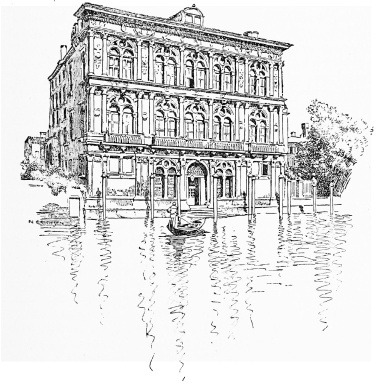
Beyond the bridge the Pal. Manin by Sansovino, now Banca d’ Italia, was the dwelling-place of the last of the Doges. The Pal. Bembo at the farther corner of the rio is early fifteenth-century Gothic. A small palace farther on, the ground floor of which is used as a café, is usually pointed out as the house of Doge Enrico Dandolo. The present Gothic building, however, with its cusped arches is obviously two centuries later in style, though the Byzantine medallions incorporated in the façade may have belonged to the original structure. A Latin inscription on the adjacent house prays the wayfarer to bestow a thought on the great Doge Dandolo, and another inscription in the Pal. Farsetti (see below) states that that palace was built for Enrico Dandolo (volle eretto Enrico Dandolo) in 1203. All that may be said with certainty is that somewhere on the Riva del Carbon stood the Ca’ Dandolo. A few houses farther on is the Pal. Loredan with its deep stilted arches, esteemed by Ruskin the most beautiful palace on the Grand Canal. It is twelfth-century Byzantine, restored once in Gothic, again in Renaissance times. It bears on the façade the scutcheon of Peter Lusignan, King of Cyprus, who lodged there in 1363-66. The next edifice is the Pal. Farsetti, in the same style but simpler. It has a fine staircase with carvings by Canova.
TRAGHETTO AND CAMPO S. SAMUELE
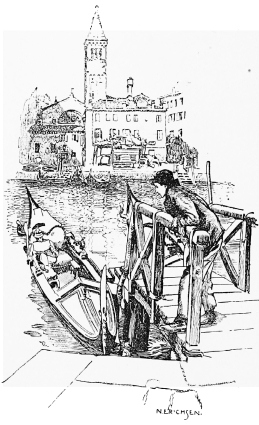
These two buildings are used as the Municipal Offices. At the near corner of the rio S. Luca is Sanmichele’s stately Renaissance Pal. Grimani, rescued by the Austrian Government from the house-breaker’s hands, and used as the Post Office. It is now the Court of Appeal. Ruskin considered this to be the principal type at Venice and the best in Europe of the central style of the Renaissance schools. We may disembark and ascend the noble staircase (the Renaissance masters excelled in the construction of stairways) to the spacious landing and halls on the first floor. At the farther corner of the rio is the Pal. Cavallini, so named from the horses’ heads on the scutcheons. We pass on to the Pal. Corner Spinelli at the farther corner of the rio dell’Albero, another of the works of the Lombardi. Beyond the traghetto S. Angelo we reach the three Palazzi Mocenigo, sixteenth-century architecture. The ducal cap and shield still figure on the posts, for the Mocenighi gave seven Doges to the Republic. Byron lodged in the middle of the three palaces. Another famous heretic, Giordano Bruno, that Ishmaelite of philosophy, was run to earth by the Inquisition in the farther one and taken to Rome to perish at the stake in 1600.[106] The early Renaissance palazzo farther on with shields and torches carved on the façade was another of the Contarini mansions subsequently inhabited by the Countess Guiccioli. We pass two small Gothic palaces and the wide Pal. Moro-Lin, sixteenth-century, by Seb. Mazzoni, a Florentine painter and architect, and reach round the bend the Pal. Grassi (1785), by Massari. At the farther corner of the Campo S. Samuele is the Pal. Malipiero, seventeenth-century. At the near corner of the next rio is the Ca’ del Duca (di Milano), begun for Francesco Sforza when he was the Venetian Captain-General. The construction was vetoed by the Signory at a point easily discernible, when Sforza began to play Carmagnola’s game and was outlawed. The late Gothic Pal. Cavalli beyond the iron bridge has been wholly restored by Baron Franchetti. At the farther corner of the rio dell’ Orso is the fourteenth-century Gothic Pal. Barbaro debased by additions. Beyond the traghetto S. Stefano and a garden is the Pal. Corner della Ca’ Grande now the Prefecture, a stately Renaissance edifice by Sansovino (1532). Past the traghetto S. M. del Giglio are three palaces all more or less restored which form the Grand Hotel. The first, Pal. Gritti, is fourteenth-century Gothic; the second, Pal. Fini, is by Tremignano (1688); the third, Pal. Ferro, fifteenth-century Gothic. The small Pal. Contarini-Fasan is the so-called Desdemona House. The balcony with its rich tracery is unique in Venice. Some distance farther on is the Pal. Tiepolo, now the Hotel Britannia. The Hotel d’ Italia is a new building. The fifteenth-century Pal. Giustiniani is now the Hotel de l’ Europe. The next house but one is the old Ridotto, the famous Assembly Rooms and Gambling Saloon of the later Republic, in its day the Monte Carlo of Europe. It is still used for bals-masqués at Carnival time. We pass the gardens of the Royal Palace; the Zecca (mint), and the S. end of the Libreria Vecchia, both by Sansovino, and reach the Piazzetta, whence we started. Fortunate are they who have the opportunity of seeing the Grand Canal at the time of a royal visit, or other great occasion when steamer traffic being stopped, the waters regain the placidity we see in old engravings, and the lines of palaces hung with tapestry are mirrored in the sea. The grand bissone (festal gondolas) are brought forth, decked with brilliant colours, some of them manned by a score of gondoliers in gorgeous old Venetian costume, and we then catch a glimpse of what Venice was in her splendour.
The traveller will probably choose an afternoon for his survey of the Grand Canal, and no better rounding-off of the day may be imagined than to ferry across from the Molo to the island of S. Giorgio Maggiore, the ancient Isle of the Cypresses, and, after visiting the church, to ascend the campanile and enjoy the beautiful view from the summit. Northwards is the line of the mainland, fringed with trees and dotted with villages; in the foreground the broad curve of the city of a hundred isles; around, as the eye sweeps the horizon, are the lagoons, studded with islands and marked by the bold strokes of the lidi; farther to the S. is the open Adriatic. As the sun sinks to its setting the vast expanse will glow in a symphony of ravishing colour.
Palladio’s beautiful and impressive interior (p. 194) has been little disturbed. Among other works of pictorial interest are two Tintorettos in the choir (R., the Last Supper; L., the Fall of Manna), and five other paintings by the same master, all described at length by Ruskin in the Venetian Index. Noteworthy are the beautiful choir stalls by Albert of Brussels, some of the finest examples of Flemish wood-carving in Italy. Longhena’s modern monument and the old Latin epitaph to puissant Doge Dom. Michieli will be found in a passage behind the choir to the R. In the Sala del Conclave, where the Sacred College met in 1800 and elected Pius VII., is a fine Carpaccio, St George and the Dragon, with a predella, four episodes in the life of the saint. The campanile is a late erection (1774) on the model of the old tower of St Mark. The campanile collapsed in February 1773, doing much damage to the conventual buildings and killing one of the monks. All that remains of the rich and vast Benedictine monastery, one of the four most opulent in Italy, is now a barrack, and of the 150 brothers it once housed, some half-dozen are permitted to linger amid the secularised surroundings and tend the sanctuary.
SECTION VI
S. Zulian—S. Maria Formosa—S. Zanipolo (SS. Giovanni e Paolo)—The Colleoni Statue—The Scuola di S. Marco—S. Maria dei Miracoli
FRESH from memories evoked by the mansions of the ruling families of the Republic, we may now fitly turn to the more important of the two great churches of the Friars which together form the Walhalla of Venice. We enter the Merceria from the Piazza, noting the site of the Casa del Morter (p. 109). A few hundred yards down the busy street the ramo S. Zulian on the right leads to the church of that name, which contains two unimportant Veroneses, an interesting Boccaccino, Virgin and Child, SS. Peter, Michael, and the two Johns, first altar left of entrance, and one of Campagna’s best works, a group in high relief of the dying Christ, to the left of the altar.
From the Campo della Guerra at the back of the church we proceed E., cross the Ponte della Guerra, and continue along the calle until we reach, L., the Salizzada S. Lio. The second calle, to the R., along the salizzada is the picturesque Calle del Paradiso, which leads to the Ponte Paradiso. As we near the bridge we note a beautiful Gothic gable bearing the arms of the Foscari and the Mocenighi, and a fine fourteenth-century relief of the Virgin and Child and a donor. We cross the modern bridge which has replaced the fine old Ponte Paradiso, turn R., over the Ponte dei Preti, and emerge on the spacious Campo. S. Maria Formosa is one of the earliest of Venetian churches (p. 23) but entirely restored after the earthquake of 1689. Palma Vecchio’s grandiose St Barbara, for which his daughter Violante is said to have stood as model, stands over the first altar on the R. It is one of the most insistent of Venetian paintings. The composition is in six compartments. R. and L. are SS. Anthony and Sebastian; above is the Virgin of Mercy between the Baptist and St Dominic. The church has also an early work by Bart. Vivarini, a Pietà by Palma Giovane, and a Last Supper by Bassano.
We traverse the campo in a N.E. direction to the calle Lunga, which we follow to the end. Here we turn L. along the Fondamenta Tetta, cross the bridge and enter the calle of the same name which leads to the Ponte and Calle Ospedaletto; the end of the calle debouches on the Salizzada SS. Giovanni e Paolo. We turn L., noting to the R. the towering brick apse of the huge church of the Preaching Friars, due to the piety of Doge Giacomo Tiepolo (p. 78). The monastery was begun in 1236, the church twelve years later. The conventual buildings (now part of the civic hospital) were finished in 1293, and the church was not ready for consecration until 1430, when it was dedicated to the martyred Roman soldiers SS. John and Paul, and became popularly known as S. Zanipolo. To the L. before we enter are the tombs of Doge Giacomo Tiepolo (1249)[107] and Doge Lorenzo Tiepolo his brother (1275).
The interior is imposing by reason of its vast size and simple plan; though the dome, the Renaissance monuments and rococo details disturb the symmetry. The Mendicant Orders possessing the right to bury the dead within the precincts of their buildings were able to grant permission to wealthy and influential families, their supporters, to erect family chapels and sepulchral monuments in their churches. In this Dominican temple lie buried in monumental pomp Doges and statesmen, great captains and admirals, side by side with famous painters; for the two Bellini and Palma Giovane rest here. The traveller who remembers his Ruskin will doubtless turn first to the two monuments typical of noble and debased sculpture which are contrasted with such vehement rhetoric in the opening chapter of the “Stones of Venice.” He will find the “faithful tender portrait” of Doge Tomaso Mocenigo (1423) in the L. aisle beyond the second altar, recumbent on a beautiful transitional tomb wrought by two Florentine sculptors, Piero di Nicolo and Giov. di Martino. It is the last of the Gothic tombs in Venice and marks the advancing Renaissance. In the choir, L. of the high altar, is the monument, “perfect in workmanship but devoid of thought,” of Doge Andrea Vendramin (1478), executed by Aless. Leopardi and one of the Lombardi. To this “culminating point of the Renaissance,” Ruskin attained “by the ministry of such ancient ladders as he found in the sacristan’s keeping,” and discerned that the figure of the old Doge had but one hand, and that the “wretched effigy was a mere block on the inner side, ... the artist staying his hand as he reached the bend of the grey forehead.” The sculptor of “this lying monument to a dishonoured Doge,” adds the passionate critic, “was banished from Venice for forgery in 1478.” The tomb is, however, a fine example of early Renaissance work, in Burckhardt’s opinion “the most beautiful of all the tombs of the Doges.” Two inferior figures of St Catherine and the Virgin at the base are not by Leopardi; they were substituted for the admirable statues of Adam and Eve by Leopardi’s colleague, which were transferred to the Pal. Vendramin. To the L. of the choir is the early Gothic tomb of Doge Marco Corner (1368), a beautiful and simple monument, probably by the Massegne. Opposite is the “richest monument of the Gothic period in Venice,” the tomb of Michele Morosini (1382). The strongly marked features of the dead Doge, “resolute, thoughtful, serene and full of beauty” are wrought in masterly style. These are the tombs referred to by Ruskin: the former as noble Gothic; the latter is furnishing the exactly intermediate condition in style between the pure Gothic and its final renaissance corruption. L. of this is the monument to Doge Leonardo Loredan (1521) with allegorical figures, late Renaissance, executed in 1572. The statue of the Doge is an early work by Campagna.
Beyond the sacristy door is the fine Renaissance monument of Doge Pasquale Malipiero (1462) by a Florentine of the fifteenth century. In the arcade under the next monument (in the N. aisle) is the recumbent figure of Doge Michel Steno (pp. 124, 139) (1414). The inscription tells that he was a lover of righteousness, peace and plenty. At the end of the aisle against the entrance wall is the monument of Doge Giovanni Mocenigo (1485), a typical and early Renaissance work by Tullio and Ant. Lombardo. Over the main portal are the huge monuments of Doge Alvise Mocenigo (1577), his wife Loredana Marcella, and Doge Giovanni Bembo (1618). Against the entrance wall south aisle is another imposing monument by the Lombardi to Doge Pietro Mocenigo (1476). The growing pride of dominion is clearly seen in these sumptuous mausoleums. Pietro’s tomb wrought from the spoils of his enemies, as the inscription tells, is adorned with two reliefs boasting of his exploits in war. “The Vendramin Statue,” says Ruskin, “is the last which shows the recumbent figure laid in death. A few years later the idea became disagreeable to polite minds, the figures raised themselves on their elbows and began to look about them.[108] ...But the statue soon rose up and presented itself as an actor on the stage in the front of his tomb, surrounded by every circumstance of pomp and symbol of adulation that flattery could suggest or insolence claim.” The development of the sepulchral monument from the simple sarcophagus of the early Doges, as in the Tiepolo tombs on the west front to its culmination in the fourteenth and fifteenth century monuments; its subsequent decline and then its utter degradation in the eighteenth century Bertucci mausoleum, may be traced in this church. In the S. aisle a stone with reliefs of Christ between two angels recalls the memory of Doge Renier Zen (1268). Between the first and second altars is the monument to Marc’ Antonio Brigadin, hero of the defence of Famagosta. Beyond the side chapel is the colossal monument, 60 feet in length, of Bertuccio (1658) and Silvestre Valier (1700), and the latter’s wife Elisabetta, executed by Baratta and other followers of Bernini. This elaborate specimen of rococo art is denounced by Ruskin as exhibiting every condition of false taste and feeble conception.
Among the paintings we note the St Augustine by Bart. Vivarini, one of the master’s greatest works; an altar-piece, The Apotheosis of S. Antonino of Florence, by Lotto; one of Rocco Marconi’s best works, Christ with SS. Andrew and Peter; Alvise Vivarini’s Christ bearing the Cross, highly praised by Mr Berenson; and Bissolo’s Madonna and saints.
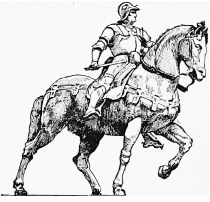
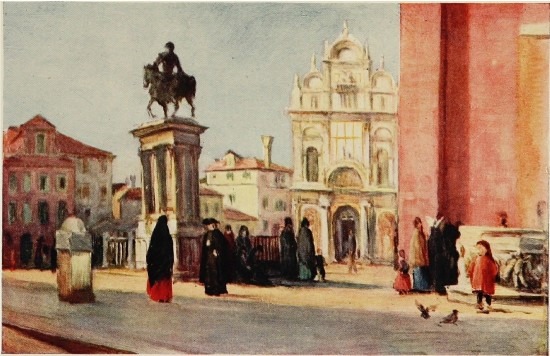
The famous monument of Colleoni, in the Campo outside the Church is the finest equestrian statue in Europe. The great stalwart condottiero in full armour sits erect in his saddle, indomitable will and forceful capacity marked in every line of his stern, clean-cut features. The “vista superba, the deep-set eyes, piercing and terrible,” are rendered with supreme art. The statue was designed by Da Vinci’s master Verrocchio, a Florentine sculptor, who, however, died of a cold caught at the casting, and Aless. Leopardi was charged by the Republic to complete the work. The conception and the modelling of horse and rider are due to the Florentine sculptor; the finishing of it and the design and execution of the pedestal to the Venetian. Colleoni left his fortune to the Republic on condition that his statue should be placed in St Mark’s Square. This the laws forbade, but there being a scuola of St Mark with a spacious campo before it the Senate decided to erect the statue there and accept the inheritance.
STATUE OF BARTOLOMEO COLLEONI
On the N. side of the campo is the Scuola di S. Marco now the city hospital. This, in Ruskin’s estimation, is one of the two most refined buildings in Venice by the Lombardi. It was designed in 1485 by Martino, the decorations are due to Pietro. The beautiful lunette over the doorway is probably by Bart. Buon, the lions and the two fine reliefs—the healing of the Cobbler Anianus and St Mark baptising a convert—are by Tullio Lombardo. The second of the buildings referred to by Ruskin, S. Maria dei Miracoli, may be easily reached by crossing the Ponte del Cavallo, and following the calle opposite the west front of S. Zanipolo. This exquisite gem of Renaissance architecture (1480-89) was designed by Pietro Lombardo. To Tullio are due the half figures of the Annunciation on the top of the choir steps and the best of the charming arabesque decorations in the interior. The St Francis and St Clare are by Campagna.
SCUOLA DI SAN MARCO AND STATUE OF COLLEONI.
SECTION VII The Frari—The Scuola and Church of S. Rocco
IN the “Speculum Perfectionis” is told how that St Francis on coming to Assisi to hold the Chapter of the Order found there a great edifice of stone and mortar, built by the citizens for the meeting place of the brothers, instead of the rude wattle and daub barn in which they were wont to assemble. And the saint, fearing lest the brothers might be tempted to have similar great houses erected where they sojourned, climbed to the roof with his companions, and began to strip off the tiles and cast them to the ground, being minded to destroy the building to the very foundation, nor did he desist until the soldiers forbade him, declaring it to be the property of the town. Up to Doge Giacomo Tiepolo’s time, as we have seen, the friars minor had no monastery in Venice, but here, as elsewhere, the Franciscans were unable to resist that unquenchable impulse in devoted human souls to raise temples made with hands to the glory of God, and about 1230 or 1240 the great monastery and church of Our Glorious Lady of the Friars were begun. The church was opened for service in 1280, and rebuilt during the second half of the fourteenth century. Santa Maria Gloriosa de’Frari may be reached from the S. Tomà Pier on the Grand Canal. It is the largest church in Venice, and one of the finest Gothic churches in Italy. Vasari attributes the design to Nicolo Pisano. The campanile (1361-1396) was erected by the Massegne. From the tracery of the lower windows in the apse, Ruskin derives the tracery of the arcade in the Ducal Palace, the circle of the quatrefoil falling between the arches when it had to support the wall. Over the Porta de’Frari, leading to the left aisle, is a beautiful relief of the Virgin and two angels and kneeling donors by the Massegne.
The nobility and simplicity of the vast interior remind us of the great friars’ churches in Tuscany and Umbria. Few Doges are buried here, the monuments inside being chiefly to famous soldiers, admirals, statesmen and artists. In the R. aisle is the Titian monument executed in 1852, and on the third altar a fine statue of St Jerome by Aless. Vittoria, said to have been modelled from the figure of Titian when he was 98 years old. On the R. wall of R. transept is the tomb of Jacopo Marcelle (1484) in the style of the Lombardi. To the R. of entrance to the sacristy is the beautiful late Gothic tomb, wrought by a Florentine sculptor, of the Franciscan S. Pacifico (1437), under whom the church was completed.
In the second chapel, R. of the choir, R. wall, is the tomb of the Florentine ambassador, Duccio degli Alberti (1336) by a Tuscan sculptor, noted by Ruskin as the first monument in Venice in which images of the Virtues appear; L. wall, the noble and simple fourteenth-century tomb of an unknown knight, “perfect Gothic form.” In the choir are two important works attributed to Ant. Riccio. R. wall, the ornate monument of Doge Francesco Foscari (pp. 141, 151) (1457); L. wall, the mausoleum of Doge Nicolo Tron (1473). The transition of Gothic to Renaissance is admirably illustrated in these two works. Titian’s Assumption stood formerly over the high altar. L. aisle beyond the baptistery is the Renaissance tomb of Jacopo Pesare (1547). The inscription states that the buried bishop conquered the Turks in war, and was transported from a noble family among the Venetians to a nobler among the angels. The monstrous pile of masonry beyond the Titian altar-piece (p. 195), erected to Doge Giovanni Pesaro (1659) by Melchior Barthel (a German) and Longhena, qualified by Ruskin as a huge accumulation of theatrical scenery in marble, will illustrate even more clearly than the Valier tomb in S. Zanipolo the depths of bad taste to which monumental art had fallen in the seventeenth century.
Turning to the pictures, we note two altar-pieces (1474) by Bart. Vivarini, St Mark enthroned, and a Virgin and Child with Saints. In the third chapel L. of the choir is Alvise’s Apotheosis of St Ambrose. Within the sacristy is treasured Giov. Bellini’s altar-piece, the Virgin and Child with four saints (L., St Nicholas and another; R., SS. Benedict and Bernadine), and two of the most exquisitely charming angels in Venetian art. All the master’s qualities are here in their highest manifestation—maternal tenderness; fervent, grave and virile piety; and the joy of childhood. The picture makes a direct appeal to our finer emotions and the traveller will prefer to remain in silent and reverent appreciation without further intrusion of guide or critic. The Titian altar-piece in the choir screen aisle, painted for Bishop Jacopo Pesaro, affords an admirable contrast to the Bellini. Progress even in art must be paid for. Although perfect in technique, grand in composition, rich in colour, it yet lacks the atmosphere of tranquil devotion of the earlier master. The doughty bishop, who is seen kneeling to the left, had the picture painted to commemorate a small naval victory that he gained when in charge of a papal fleet over the Turks (p. 164). Above is the Virgin and Child to whom St Francis commends the kneeling Pesaro family. At the Virgin’s feet sits St Peter who turns from his reading to look on the donor below. Behind the latter stands a knight in full armour holding in his right hand the papal standard crowned by a sprig of laurel, and grasping in his left hand two Turkish captives in chains. The portraits of the Pesari are in Titian’s most perfect manner. This was a favourite of Sir Joshua Reynolds who describes it at length in “The Journey to Flanders and Holland.” Crossing the bridge opposite the main portal and turning L. we reach the great Monastery now the Record Office of Venice (Archivio Centrale). It contains the most famous collection of state documents in the world. The custodian will admit the traveller to the noble double cloisters. We return to the Porta dei Frari and further to the W. find the Scuola and church of S. Rocco.
Towards the end of the thirteenth century a young noble of Montpellier found himself the master of great possessions, and following the injunctions of Christ sold all that he had and gave it to the poor. He set forth as a pilgrim to Rome and on his way passed plague-stricken cities where he devoted himself to the service of the hospitals and by his tenderness, sympathy and fervent prayers wrought many wondrous cures. At length on his return from Rome he was stricken himself at Piacenza and a horrible ulcer broke out on his thigh. Wishing to spare his fellow-sufferers the sound of his groans he dragged himself to a ruined hut in a deserted place hard by, where angels tended his sores and a dog brought him daily bread. When healed he went back to his native city but arrived so changed by suffering that he was arrested as a spy and cast into prison. One morning after he had languished there for five years the jailer on entering his dungeon saw it flooded with a bright light, the prisoner dead, and a writing which promised healing to all stricken by plague who should call on his name. In 1485 some Venetians disguised as pilgrims carried off the saint’s body to Venice; the Church of S. Rocco was erected to contain it and a guild founded in his name for the tending of the sick and the burial of the dead. The church, entrusted to Bart. Buon of Bergamo, was built in the fifteenth century. The Scuola was begun about the same time (1490) by the same architect, carried on by the Lombardi and Scarpagnino (1524-37) and completed about 1550. Here during eighteen years Tintoretto worked on the stupendous series of paintings which decorate the interior. They are fully described and vigorously appreciated and depreciated by Ruskin in the Venetian Index. The Adoration of the Magi, in the lower hall, facing the entrance, he esteems to be “the most finished picture in the Scuola except the Crucifixion.”
SCUOLA DI S. ROCCA.
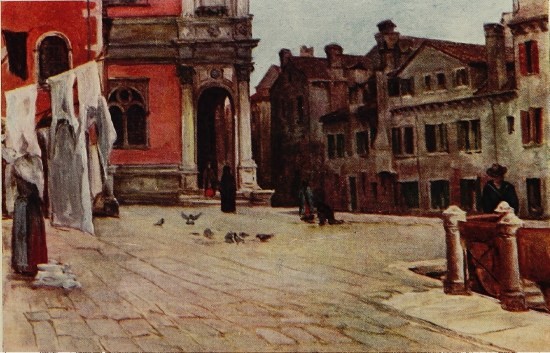
From the first landing as we ascend the stairs may be seen to the L. an early Annunciation by Titian, refreshing in its repose and simplicity; R. is Tintoretto’s Visitation.
On the walls of the upper hall are continued the scenes of New Testament history begun in the lower. They are unequal in merit, and include, according to Ruskin, two of the worst Tintorettos in Venice: The Last Supper and the altar-piece, S. Rocco in Glory. The ceiling, decorated with scenes from Old Testament history, is painted with all the master’s force and decorative science.
The Crucifixion in the Guest-Chamber on the same floor is justly esteemed as Tintoretto’s greatest work. On it he concentrated all his art and all his majestic power. It was his favourite work, and when Carracci’s plate was brought to him for approval he fell on the engraver’s neck and kissed him. Opposite the Crucifixion is the Christ before Pilate; over the door, an Ecce Homo. The series closes with the Christ bearing His Cross. The ceiling is decorated with the Apotheosis of S. Rocco (p. 210) and other allegorical figures. The choir stalls in the large hall are beautifully carved with scenes from the life, of S. Rocco by Giovanni Marchiori. In the small room to R. of entrance is an early Titian, Ecce Homo, and the death-mask of Doge Alvise Mocenigo with his ducal cap.
Church of S. Rocco.
Tintoretto has here dealt with the story of the saint in his most unequal fashion. Not all his art can make the scenes of disease and death envisaged in so realistic a manner other than disagreeable. We turn from their contemplation with relief to the noble and stately SS. Christopher and Martin by Pordenone and to the latest of miracle-working pictures, Christ led to Execution, by Titian, in the chapel to the R. of the choir. In the vestibule of the sacristy is Pordenone’s fresco, St Sebastian.
SECTION VIII
S. Zaccaria—S. Giorgio degli Schiavoni—S. Francesco della Vigna
WE pass the N. portal of St Mark’s, follow the Calle di Canonica, turn R., and first observing the beautiful façade of the Palazzo Trevisan, associated with the memory of the notorious Bianca Cappello,[109] cross the Ponte di Canonica. We continue E., cross the Ponte S. Provolo, pass under a Gothic portal with a restored relief in the lunette of the Virgin and Child, the Baptist and St Mark, and reach the Campo and church of S. Zaccaria, once the chapel of the oldest, richest and most extensive nunnery in Venice (now a barrack), and the burial-place of the early Doges. The present church dates from the second half of the fifteenth century. The visitor will infallibly be drawn to the altar on the L. where stands Giovanni Bellini’s Virgin and Child with four saints. R. of the enthroned Virgin stand SS. Lucy and Jerome: L., SS. Catherine of Alexandria and Peter. Though imperfectly preserved and ill seen its charm is indescribable. Feminine tenderness and virile strength, fervent piety and dignity are expressed with all the lucidity and winning grace of the master. It was painted in 1505 when he was seventy-nine years of age.
The nuns’ choir, entered by a door on the right, has some fine choir stalls by Marco da Vicenza, and some pictures, among them a doubtful Palma Vecchio and a badly-preserved Tintoretto—the Birth of the Baptist. The sacristan will open the chapel of S. Tarasius (p. 31) which contains three gilded, carved altar-pieces of wood with paintings by Giovanni Alemano and Antonio Vivarini. Each altar-piece is inscribed with the name of the donatrix. The expert in the iconography of the saints will find scope for his science in the interpretation of the various symbols. The tomb of Alessandro Vittoria is in the L. aisle.
We return to the Campo S. Provolo and make our way N.E. to the little oratory of S. Giorgio degli Schiavoni (Dalmatians), belonging to the lay foundation (1451) of that name and built (1551) by Zuane Zon, master mason of the arsenal. The foundation is still under Austrian jurisdiction, and a rather poor endowment is helped by a yearly contribution of two lire each from some hundred brethren, the Emperor of Austria assisting by an annual subscription. Three Dalmatian priests serve the chapel. St George’s Day, when high mass is sung and the upper chamber is filled by the brethren and their friends, is a great festival. During six years, 1502-8, Carpaccio was employed in decorating the hall with scenes from the lives of three great Dalmatian saints, SS. George, Tryphonius and Jerome. These charming and naïve paintings, happily still in their original setting, have been described by Ruskin in “St Mark’s Rest.”
L. of the entrance are two panels with scenes from the life of St George. (1) The fight with the dragon; the young princess looks on with clasped hands. The remains of the monster’s victims are a somewhat gruesome detail. (2) The victor drags the slain beast, its head transfixed by a dagger, into the city. The gorgeous dresses of the pagan king, the princess and the oriental spectators, the quaint attempts at local colour, and at investing the dragon with some degree of fearsomeness, make the picture one of the most attractive of the series. The story is concluded on the wall L. of the altar. (3) The saint baptises the king and his daughter, carefully holding his cloak lest it be spoiled by the water. This composition is rich in delightfully conceived details of Eastern splendour. R. of the altar-piece (The Virgin and Child by Catena) is a scene from the life of St Tryphonius. He is portrayed as a lad subduing the basilisk which devastated Albania. On the R. wall are the Agony in the Garden and the Calling of Matthew. Then follow three scenes from the life of St Jerome. (1) The terror of the monks at the sight of the lion; (2) death of the saint; (3) the saint in his study translating the Scriptures. The furniture and surroundings in this last, painted with loving care, betray the refined taste of a Venetian scholar. A shelf of books, some manuscripts, an orrery, works of art, objects of devotion, and, a homely detail—the typical Venetian pet dog. The whole scene is pervaded with an atmosphere of calm and studious retirement.
In a northerly direction, towards the Fondamente Nuove, is the great church of S. Francesco della Vigna, whose site is associated with one of the earliest legends of St Mark (p. 17). The land—one of the most extensive vineyards in Venice—was bequeathed to the Franciscans in 1253 by Marco, son of Doge Pietro Ziani. The church was rebuilt (1534-62) by Sansovino, modified subsequently by Palladio, who designed the imposing façade. In a chapel to the R. in the S. transept is a Virgin and Child by Negroponte. The figures are drawn with great fulness and beauty, and, though much repainted, the picture, executed in 1450, is a remarkable example of the Paduan master’s art. The church contains seven ducal monuments; among them, L. of the choir, the tomb of Andrea Gritti (1538). But of greater interest are the beautiful reliefs by Tullio, Ant., and Sante Lombardi in the Giustiniani chapel, L. of the choir, of the prophets and Evangelists, and eighteen scenes from New Testament history. The church also contains two paintings by the Bergamasque artists Franc. and Girolamo di Santa Croce (1500-50); a Holy Family and a Resurrection by Veronese; and, in the chapel on the way to the old cloisters, a Virgin and Child with four saints and donor by Giov. Bellini, debased by re-painting.
SECTION IX
The Riva degli Schiavoni—S. Maria della Pietà—Petrarch’s House—S. Giovanni in Bragora—S. Martino—The Arsenal—The Public Gardens—S. Pietro in Castello
TURNING S. from the Piazza we pass the Libreria Vecchia, designed by Sansovino to contain the books left to the Republic by Petrarch and Cardinal Bessarione and reach the two columns of grim memories, where Browning delighted to
“observe The swallows soaring their eternal curve ’Twixt Theodore and Mark.”
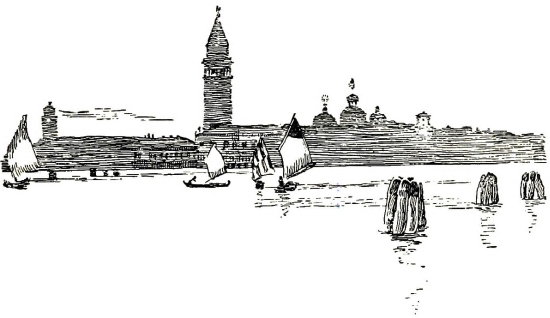
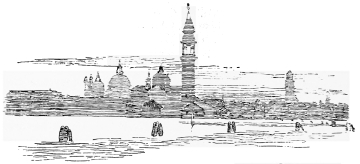
VENICE FROM THE PUBLIC GARDENS
To the W., on the site of the present royal gardens, stood the old granaries of the Republic. We turn E., cross the Ponte della Paglia (straw) where the barges laden with straw used to unload, and reach the Riva degli Schiavoni, in olden times the most bustling quarter of Venice. Here lived the Schiavoni (Dalmatian sailors), who manned the galleons and argosies of the Republic. Here was the starting-point for the galleys bound for the Holy Land. On the site of the present prison, John the Englishman, in the fourteenth century, kept “The Dragon,” a hostelry, with stables, much patronised by English pilgrims, for horses were then almost as common in Venice as in other mediæval towns. Several of the Doges had the finest stables in Italy, and horses and mules were largely used by the Venetians. There was no wide Riva[110] in those days, only a narrow fondamenta beyond the Molo, which was then a projecting quay, the chief landing-stage of Venice. The Riva is the favourite promenade of the Venetian popolani, and affords an ever-changing scene of local colour for the stranger. We cross two bridges to S. Maria della Pietà, which contains a masterpiece (Christ in the House of the Pharisee) by Moretto, the Brescian painter (1498-1560), in the upper choir at the S. end. Just over the next bridge (del Sepolcro, so called because the pilgrims to and from the Holy Sepulchre at Jerusalem lodged near), is the site of the house given by the Republic to Petrarch. Here he lived with his married daughter, entertained Boccaccio, and had a disputation with a notorious atheist of Venice, whom he failed to convert, and ejected from the house.
We turn N., beyond the house, by the calle del Dose, and reach the church of S. Giovanni in Bragora (the marshes). Here we shall find one of the finest Cimas in Venice (The Baptism of Christ), unhappily difficult to see as a whole, owing to its position behind the high altar. It was painted in 1491. On a pillar, R. of the choir, is another work by the same master—SS. Helena and Constantine; on a pillar to the L. is Alvise Vivarini’s Resurrection, painted in 1498. The Virgin and Child in the second chapel R. of the entrance is generally given to Alvise, though by some critics attributed to Giov. Bellini. On the L. wall is a Virgin and Child with the Baptist and St Andrew by Bartolomeo Vivarini, painted in the same year. Beneath are three predelle by Cima, with scenes from the Invention of the Cross. The church contains also a doubtful Bissolo between the first and second chapels in the R. nave, and a Last Supper by Paris Bordone, utterly disfigured by restoration, in the L. nave.
On leaving, we turn again E. to the church of S. Martino, with a Bocca del Leone (p. 248) in the façade. Just beyond the church we sight the main portal of the great arsenal, once fortified with twelve watch-towers and walls two miles in extent, paced night and day by sentinels. The portal is flanked by the four Greek lions in marble brought from the Porta Leoni at Athens by Francesco Morosini, and surmounted by the Lion of St Mark and a statue of St Giustina by Campagna, to commemorate the victory of Lepanto. The museum contains on the first floor, among other objects of interest, models of Venetian ships and galleys of all kinds, a small carved panel from an old Bucintoro, and a fragment of a mast, all that remains of the last Bucintoro which Goethe saw and described as not over-loaded with decoration, since it was all decoration. A model of this gorgeous vessel may be seen in the room. On the second floor is a collection of weapons and spoils of war. The simple, noble statue of Vittor Pisani faces us as we ascend the staircase. A striking contrast is afforded by Canova’s sentimental monument to Angelo Emo. In the room are preserved the armour of Doge Seb. Ziani, with closed visor and bearing a crest on the cuirass, and of Seb. Venier, with open visor, and crest on cuirass; of Henry IV. of France, and of the condottiero Gattamelata. We cross the iron bridge to the L. of the portal of the arsenal, and return to the Riva. We may now proceed past the church of S. Biagio to the Public Gardens.
SECTION X S. Salvatore—Corte del Milione—S. Giovanni Grisostomo
S. FOSCA AND PALAZZO GIOVANNELLI.
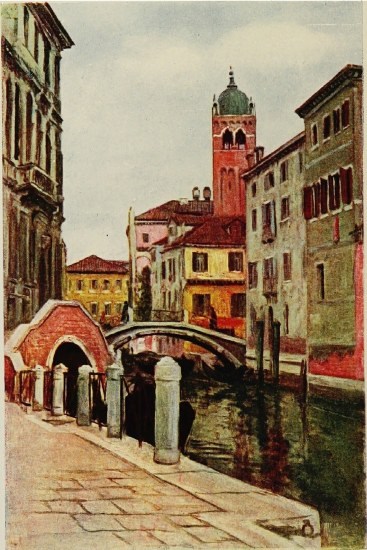
We take our way along the Merceria, past the church of S. Zulian, until we come in sight of the tall apse of S. Salvatore. We enter from the Merceria by the door of the L. aisle. S. Salvatore is one of the most important examples of ecclesiastical Renaissance architecture in Venice. Spavento, four of the Lombardi, Sansovino, Scamozzi and Longhena all contributed at various periods to the building and decoration, not to speak of more modern restorers. Here in the R. transept is the massive memorial to unhappy Queen Catherine Cornaro by Bernardini Contino. A finer specimen of monumental art is Sansovino’s tomb of Doge Franc. Venier (1556), beyond the second altar in the R. aisle. The figures of Faith and Charity, the former said to have been almost wholly carved by the master in his eightieth year, are among the greatest achievements of later Renaissance sculpture. Over the third altar is Titian’s Annunciation and at the high altar his Transfiguration, both painted when he was approaching ninety years of age; the latter, however, by some critics is depreciated to a school painting. In the chapel L. of choir is a most interesting, Christ at Emmaus, generally attributed to Giovanni Bellini, but by Crowe and Cavalcaselle confidently assigned to Carpaccio. Another critic (Molmenti) is convinced it is by no other hand than that of Benedetto Diana.
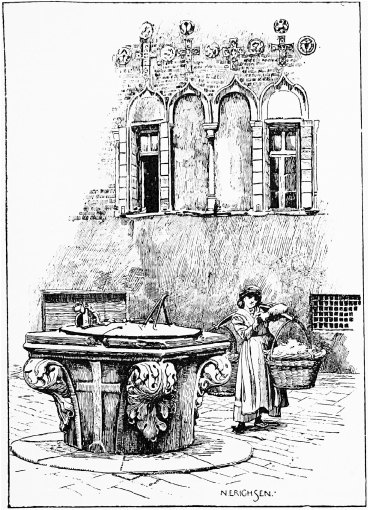
Leaving by the front entrance we find ourselves on the Campo S. Salvatore, where in olden times stood a water trough, and a fig tree to which horses were tied, after the law of 1287 forbade equestrian traffic along the Merceria. We turn R. by the new Merceria due Aprile, pass the Goldoni statue, and cross the Ponte dell’ Olio to the church of S. Giovanni Grisostomo. Before we enter, a slight deviation by the calle Ufficio della Seta and the calle del Teatro (over a fruiterer’s shop will be seen the inscription: Provisores Sirici, p. 117) will bring us on the R. to the entrance to the Corte Milione. On the N. side of this court stood the house of the Polo family which Marco, then a lad of seventeen, left in 1271, with his uncles Nicolo and Maffeo, for the East. A quarter of a century later three travel-stained wanderers, dressed in coarse garb of Tartar cut and speaking broken Venetian with a Tartar accent, were at first refused admission by their kinsmen. The three, to warm the affection of their relatives, invited them to a sumptuous banquet, and when all were seated entered arrayed in flowing crimson robes of satin. Having washed their hands, they retired and returned clothed in crimson damask, and ordered the first dresses to be cut up and distributed among the servants. After a few dishes a similar change was made into crimson velvet and similarly disposed of. Again they changed into dresses of ordinary fashion. When the nine suits had been divided among the servants, Marco rose, went to his chamber, and appeared with the old Tartar coats, and ripping them open with a knife, showered on the table before his amazed guests a glittering and inestimable treasure of jewels and precious stones. The thirteenth century arched doorway and various fragments of sculptured stonework imbedded in the walls of the neighbouring houses almost certainly formed part of the original Polo mansion (p. 99).
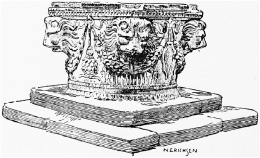
WELL-HEAD: CAMPO S. GIOVANNI GRISOSTOMO.
THE RIALTO BRIDGE
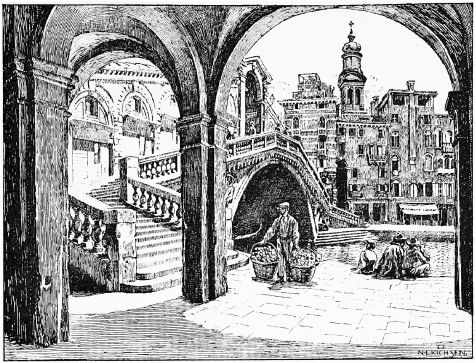
We return to the church of S. Giov. Grisostomo by Tullio or Moro Lombardo. The finely proportioned interior holds one of the most precious of Venetian paintings—the altar-piece by Giov. Bellini, over the first chapel to the R., SS. Jerome, Christopher, and Augustine, dated 1513. It is the last of his signed works, and was painted three years before his death. At the high altar is Sebastiano del Piombo’s sensuous painting of the patron saint, with the Baptist, SS. Augustine, Liberale, Catherine of Alexandria, Agnes, and the Magdalen. Over the second altar, L., is a fine relief by Tullio Lombardo. We note the fine Renaissance well-head in the Campo, and retrace our steps to the foot of the Rialto bridge and the pier on the Rio del Carbon.
SECTION XI S. Moisè—S. Stefano—Site of the Aldine Press—Il Bovolo—S. Vitale—S. Vio—The Salute—The Seminario
FROM the S.W. angle of the Piazza a bustling street leads W. past S. Moisè, a late seventeenth century church by A. Tremignan, whose amazing façade was once thought beautiful. Traversing the Campi S. Maria Zobenigo and S. Maurizio, we reach the large Campo Franc. Morosini. At the N. end of the campo is the fine Gothic brick church of S. Stefano (1294-1320). The principal portal and the windows of the W. front are by the Massegne. The spacious interior contains several good Renaissance monuments, the best being that of Jac. Suriano, L. of entrance; P. Lombardo’s statues of SS. Jerome and Paul stand either side of the third altar, L. aisle; those of the Baptist and St Anthony at either side of the altar in the sacristy. The last is one of the master’s most perfect works in Venice. Near these statues are Bart. Vivarini’s SS. Nicholas and Lawrence. Morosini’s tomb is on the pavement of the nave. We quit the church by the L. aisle, and enter the cloister, with some fragmentary remains of Pordenone’s frescoes.
Crossing the cloister we emerge on the Campo S. Angelo, which we traverse and walk along the Calle della Mandola to the Campo Manin, at the farther end of which is the Cassa di Risparmio (Savings Bank), on the site of the old Aldine Press.
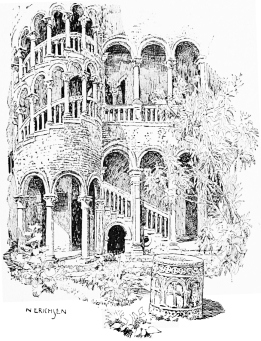
We retrace our steps, and before leaving the campo turn L. by the Calle della Vida, again to the L., and on the R. down the Calle and Corte Contarini del Bovolo reach a beautiful early Renaissance spiral staircase and a Byzantine well-head. We return to the Campo Morosini, at the farther end of which, on the R., is the church of S. Vitale (Vidal), which has a late Carpaccio, S. Vitale on horseback, accompanied by Valeria his wife, his sons Gervasius and Protasius, and other saints. We cross the Grand Canal by the iron bridge, leave the Accademia to the R., turn E. by the calle Nuova S. Agnese, and, after crossing a bridge, reach the church of S. Vio, demolished in 1813 and rebuilt in 1864. A few of the fragments of Tiepolo’s house were incorporated in the new building (p. 109). The church is only open once a year, S. Vio’s day, but admission at other times may be obtained by applying at the stone mason’s, next door. The Campo S. Vio is associated with one of the most charming legends of Venice. Here lived the blessed Contessa Tagliapietra, whose insistent devotion and frequent visits to a priest at S. Maurizio, on the opposite side of the Grand Canal, were deemed unseemly by her family. Entreaties proving vain, the ferrymen were forbidden to row her across; whereupon the Countess took a thread, laid it upon the waters, and crossed to her devotions without human aid.
PALAZZO CONTARINI, WITH SPIRAL STAIRCASE AND BYZANTINE WELL-HEAD
S. MARIA DELLA SALUTE
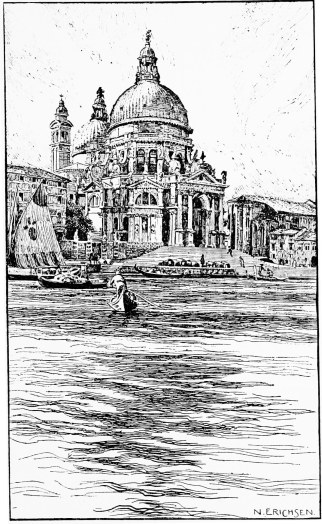
We continue E. and after some turning of corners, pass a picturesque little shrine at the end of the calle Barbaro. We cross the Ponte S. Gregorio and at length reach the great plague church of the Salute. The interior contains over the third altar L., Titian’s somewhat faded but still beautiful Descent of the Holy Ghost. The Virgin is drawn from the same model as that of the Assumption in the Accademia. The small ceiling medallions behind the high altar, the four Evangelists and four Fathers of the Church are also by Titian. The St Matthew is the artist’s own portrait. Over the altar of the sacristy is Titian’s St Mark enthroned, attended by SS. Sebastian, Roch, Cosimo, and Damian (1513), sadly spoilt by restoration. The ceiling paintings—the Death of Abel, Abraham’s Sacrifice (Isaac is a lovely child), and David and Goliath are in Titian’s later manner (1543). The space between the windows on the R. wall is covered by Tintoretto’s Marriage at Cana. It is described at length by Ruskin in the Venetian index and is esteemed by the great critic to be “perhaps the most perfect example which human art has produced of the utmost possible force and sharpness of shadow united with richness of local colour.” In the sacristy are also a St Sebastian by Paris Bordone, and two small oval paintings to the R. of the altar, SS. Augustine and Nicholas, usually assigned to Ant. and Bart. Vivarini, attributed, however, by Mr Berenson to Giambono. In the ante-sacristy is a fifteenth century pietà in relief and an early painting (1339), The Virgin and Child with the kneeling donors, Doge Francesco Dandolo, and the Dogeressa Elisabetta, with their name saints.
E. of the Salute is the Seminario with a small collection of sculpture and pictures. Ascending Longhena’s noble staircase we enter the Galleria Manfredini, which contains works by Filippino Lippi and Veronese, and Giorgione’s Apollo and Daphne (p. 202), probably painted for the panel of a cassone (bridal chest). The ferry from the Salute or the Dogana point will land us near the Piazza.
SECTION XII
SS. Apostoli-Palazzo Falier—I Gesuiti—I Crociferi—S. Caterina—S. Maria dell’ Orto—S. Marziale—Palazzo Giovanelli. (Admission to this last by application to the British Consul, traghetto S. Felice, Grand Canal.)
FROM the Ca’ d’Oro Pier on the Grand Canal a narrow calle leads into the broad Corso Vitt. Emanuele, which we follow to the R. and reach the church of the SS. Apostoli. Admirers of Tiepolo will find his St Lucy receiving the Sacrament before her Martyrdom, at the altar of the Cappella Corner to R. of entrance where are also two family monuments in the best style of the Lombardi school. A Veronese school painting, the Fall of Manna, is at the L. of the choir. The remains of Marino Falier’s house are incorporated in the palazzo over the Ponte SS. Apostoli opposite the church.
N.E. from the campo stands the church of the Gesuiti, built (1715) on the site of the ruined church of the Crociferi in the base style of the age. The interior, lavishly decorated with marble and inlay of verde antico, is incredibly vulgar in taste and contains, first chapel L., Titian’s martyrdom of St Lawrence, painted in 1558 when the old painter was under Michael Angelo’s influence. The work, which was generally esteemed one of the most rare and remarkable of his creations, is now so darkened by time as to be barely legible. The church possesses also an Assumption by Tintoretto.
Nearly opposite the Gesuiti is the oratory of the Crociferi, with Palma Giovane’s, Doge Cigogna visiting the Oratory, and six other paintings in the artist’s best style. The room contains also a Flagellation by Tintoretto and a ceiling painting, the Assumption, by Titian. The large monastery buildings opposite, still bearing the device of the order (three crosses), are now a barrack. We retrace our steps across the campo. About a hundred yards along the fondamenta Zen is the entrance to the little church of S. Caterina, which contains Veronese’s admirably preserved Marriage of St Catherine (p. 211). The church has works by Palma Giovane and the inevitable Tintoretto, but we have eyes alone for the St Catherine, one of the most satisfying examples of the later glories of the Venetian school.
In an outlying part of the city to the N.W. is the church of S. Maria dell’ Orto. Cima’s Baptist with SS. Peter, Mark, Jerome and Paul, in a marble setting by Leopardi (p. 200) stands over the first altar, R. aisle. In the third chapel L., is Tintoretto’s Presentation at the Temple, and in the Cappella Contarini, the same master’s St Agnes. Both have been freely restored, the former, says Ruskin, “has been so daubed as to be a ghastly ruin and a disgrace to modern Venice.” We turn to the choir, R. and L. of which are Tintoretto’s huge canvases, the Last Judgment, and the Worship of the Golden Calf. These are very highly appreciated by Ruskin but “demand resolute study if the traveller is to derive any pleasure from them.” Vasari, who saw them shortly after they were painted, was impressed by the terrible yet capricious invention displayed in the Last Judgment, but lamented the lack of care and diligence which marred what might have been a stupendous creation. Closely scrutinised, however, both seemed to him painted da burla (in jest). The first chapel L. of entrance has (R. wall) a Pietà by Lorenzo Lotto, and over the altar an early Virgin and Child by Giov. Bellini disastrously repainted. Over the sacristy door is a miracle-working half-figure of the Virgin and Child (restored), which was discovered in a garden in 1577 and gave the present name to the church (Our Lady of the Garden). Verocchio, Leopardi and Tintoretto were buried in the sacristy, but most of the tombs were defaced or destroyed by the Austrians when the church was used as a military magazine in 1855.
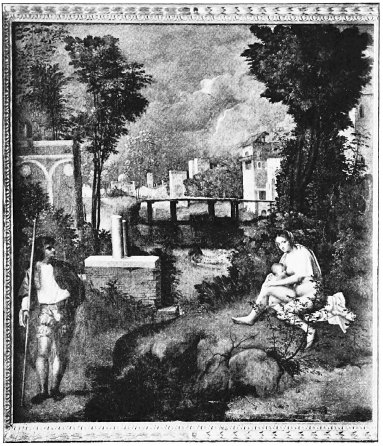
Making our way southward we reach the church of S. Marziale, which contains Titian’s Tobias, and Tintoretto’s last work, the Patron Saint with SS. Peter and Paul. From the Campo S. Marziale we cross the Ponte Zancani and the Ponte S. Fosca, noting the marble footmarks on the crown (p. 305), and pass the statue of Paolo Sarpi erected near the spot where the friar was stabbed. We continue our way by the church, and a short distance to the L. along the Corso Vitt. Emanuele is the Palazzo Giovanelli, one of the best examples of a restored patrician mansion of the period of the Ducal Palace. The interior is sumptuously decorated, and contains the most precious Giorgione in Venice, the so-called Family of Giorgione (p. 202), referred to by a late contemporary as “a stormy landscape with a gipsy and soldier.” Vasari complained that Giorgione’s subjects were difficult to characterise by a phrase. In the foreground on the L., with the characteristic Giorgione pose, stands a figure in the flower of manhood holding a staff. The dress, suggesting both knight and peasant, seems to typify the defender and sustainer of maternity symbolised by the young mother sitting, to the R., on a sloping, sunlit meadow, giving suck to her babe, both modelled with perfect naturalness and beauty. Through the centre of the picture flows a mountain stream crossed by a rustic bridge. In the background of the landscape, with its graceful trees, rises the walled city of Castelfranco, Giorgione’s birthplace, darkened by storm clouds rent by a flash of lightning. The sunny foreground and the louring sky seem to tell of the vicissitudes of human existence. A classic remain with two broken columns adds to the pathetic beauty of this, one of the earliest paintings in which landscape is transfused with human emotion and poetic sentiment.
Among other attractions the gallery possesses a portrait by Antonello, a Santa Conversazione by Paris Bordone, a battle scene by Tintoretto, a portrait by Titian, and a doubtful Giovanni Bellini, attributed by Mr Berenson to Catena. In the ballroom are some very fine Venetian mirrors.
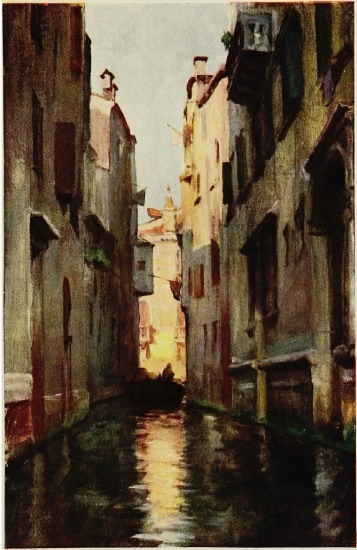
RIO S. CASSIANO.
PALAZZO GIOVANELLI—GIPSY AND SOLDIER By Giorgione
SECTION XIII
The Rialto—S. Giacomo di Rialto—S. Giovanni Elemosinario—S. Cassiano—S. Maria Mater Domini—Museo Civico
WE cross the Rialto bridge, and in the campo on the farther side find the little church of S. Giacomo di Rialto, according to tradition (p. 6) the oldest in Venice. This spot, Shakespeare’s Rialto, was the focus of the commercial life of the old Republic. The colonnade was covered with frescoes, and possessed the famous planisphere or mappa mondo showing the routes of Venetian commerce over the world. Here the patricians were wont to meet before noon to discourse together of private and public affairs. The church, rebuilt and altered more than once, no longer stands on its original site. It was removed in 1322, when the Rialto was enlarged and a loggia made, that the merchants might meet under cover. The beautiful relief of the Virgin and Child over the portico is fourteenth-century work. The six columns of the nave are the sole remains of the eleventh-century church, rebuilt by Doge Dom. Selvo. On the exterior of the apse will be found the (Latin) inscription whose discovery so delighted Ruskin: Around this Temple let the merchant’s law be just, his weight true, and his covenants faithful.[111]
EDICT STONE, RIALTO.
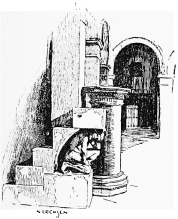
On the farther side of the campo, opposite the W. front, is the Hunchback of the Rialto (Il Gobbo di Rialto), restored in 1892, whence in olden times the decrees of the Republic were promulgated. Beyond the market is the church of S. Giovanni Elemosinario, early sixteenth century, by Scarpagnino. The picturesque campanile has an interesting relief below the cella of the bells. The high altar painting is by Titian, the Patron Saint (St John the Almsgiver). In the chapel to the R. is an altar-piece by Pordenone, SS. Sebastian, Roch and Mary Magdalen. Above on the L. wall is a quaint relief, saved from the fire which destroyed the old eleventh-century church.
We follow the hand pointing to the Museo Civico, and soon reach S. Cassiano, containing three Tintorettos. The Crucifixion, held by Ruskin to be one of the finest paintings in Europe by the master, is a most remarkable and original treatment of the subject—a great and solemn picture in excellent condition. The church has an altar-piece by Palma Vecchio, The Baptist and four saints, said to be the first painted by him at Venice, and three paintings by L. Bassano.
Following the indicator, we reach the little church of S. Maria Mater Domini by one of the Lombardi: the façade by Sansovino. It is situated in an interesting campo, where may be seen a few early Gothic houses with some beautiful Byzantine reliefs and crosses. The church possesses, second altar to the R., Catena’s S. Cristina. The angel to the left holding the millstone is one of the most sweet and guileless of the master’s creations (p. 201). In the R. transept is Tintoretto’s Invention of the Cross. Opposite is a Last Supper attributed to Bonifazio.
We at length reach the Museo Civico in the restored Fondaco de’ Turchi. The original palace, the Ca’ Pesaro, was built for Giac. Palmieri, a rich Guelf refugee from Pesaro, about 1230. In 1861 it was an imposing and picturesque ruin, with a cherry tree growing and fruiting on one of the turrets. In 1869 it was wholly restored (Guasto e profanato, says Boni), all the beautiful capitals and columns were recut and scraped, and subsequently anointed with oil to bring out the veining.
BYZANTINE CROSSES—CAMPO S. MARIA MATER DOMINI
In the court are some fine examples of Venetian well-heads. 2nd Floor, Room I. contains a collection of arms and banners, some of them captured from the Turks, and fine standards of the Republic. In Room II. are:—31, A late work by Carpaccio, The Visitation; 41, Lotto, The Virgin and Child with SS. George and Jerome and kneeling donor; and a number of characteristic scenes of Venetian life by Longhi and Guardi. Rooms III., IV., V., VI. are wholly dominated by Francesco Morosini and contain spoils of war, personal relics, among which are a book of hours (concealing a pistol), a bust, a portrait, costumes, pictures of his victories, models of galleys. Room VII. has an interesting and complete set of oselle,[112] beginning (2200) from Doge Ant. Grimani to (2716) Doge Ludovico Manin. Venetian coins, among which are cases of gold Zecchini with a unique Marïn Falier, and medals of the Carraresi. Rooms VIII. and IX. display some beautiful Venetian lace and rich stuffs; costumes, fans, stilted shoes, and miniatures, a diagram showing the method of electing a Doge, and a remarkable fifteenth-century wooden staircase. Room X., besides some furniture, has, No. 14, a portrait of Goldoni, and some paintings by Longhi. Room XI. has a miscellaneous collection of reliefs from the burnt chapel of the Rosary at S. Zanipolo; bronze works and ornaments. Room XII. contains a fine collection of majolica ware and porcelain, and some glass, among which, 912, is a deep blue wedding goblet by the famous Berovieri of Murano. Room XIV. has a precious collection of illuminated MSS. No. 70 (fifteenth century), (Leggenda dell’ apparizione di S. Marco) shows the pillar near St Clement’s altar from which the hand of the saint is said to have protruded. Here are also a number of Mariegole or guild statutes, one of which (9) shows the Master of the Carpet-makers submitting the statutes to Doge Foscari. A specimen of the manufacture which has been presented to the Doge according to usage is hanging on the balcony; 166 is a portrait of Paolo Sarpi and the dagger with which he was stabbed. Room XV., 43, Basaiti, Virgin and Child with donor. 35, Jac. Bellini, Crucifixion. Room XVI., 2, Alvise Vivarini, St Anthony of Padua. 5, Carpaccio,[113] Two Courtezans with their pets: the stilted shoes then worn by ladies are seen in this picture.[114] Four early works by Giov. Bellini, (6) a Transfiguration, (3) a Pietà with a forged signature of Dürer; (8) a Crucifixion, and (II) Christ mourned by Three Angels. Portraits of Doge Giov. Mocenigo (16) by Gentile Bellini and (19) a Bellini school painting of Doge Franc. Foscari.
The curious old church of S. Giacomo dall’ Orio stands S. of the Museo Civico. The timber coved roof dates from the fourteenth century. On the wall R. of the entrance is a fine picture (1511) SS. Sebastian, Lawrence and Roch by Giov. Buonconsiglio, a Vicenzian painter of the early sixteenth century, sometimes known as Marescalco. In the R. aisle is a richly carved and gilded vaulted frieze beneath which is Franc. Bassano’s Preaching of the Baptist, one of his most beautiful works: opposite is an Ionic column of verde antico of wonderful size and beauty, one of the “jewel shafts”[115] referred to by Ruskin. In a chapel in the L. aisle is a Lorenzo Lotto, Coronation of the Virgin with SS. Andrew, James, Cosimo and Damian (1546). The picture, which has been much restored, brought the artist 130 gold ducats.
SECTION XIV
S. Sebastiano—S. M. del Carmine—S. Pantaleone—The Cobblers’ Guildhall—S. Polo—S. Apollinare
WE follow the route (Section XI.) to the Campo Morosini and turn R. by the church of S. Vitale along the Campiello Loredan. After crossing two bridges and turning an angle to the L., we reach the Campo S. Samuele. The ferry across the Grand Canal will land us at the Calle del Traghetto, which we follow to the Campo S. Barnabà. Crossing the Campo obliquely we reach on the R. the Ponte dei Pugni, as its name implies, one of the bridges where the faction fights between the Castellani and Nicolotti used to take place. The former were distinguished by red, the latter by black caps and scarves. These contests were favoured by the Signory, in order, it is believed, to foster a warlike spirit among the people, and were continued until 1705, when a peculiarly bloody affray in which stones and knives were used, led to their abolition.[116] If the traveller will mount to the crown of the bridge he will see two footmarks in stone let into the paving on either side. Victory smiled on that faction which could thrust their adversaries beyond the line marked by the feet. The bridge then had no parapets and in the course of the struggle many a champion fell into the canal. We resume our way along the Fondamenta as far as the Ponte delle Pazienze. A turning opposite, to the L., brings us to the Calle Lunga, which we follow to the R. direct to the church of S. Sebastiano. No admirer of Veronese should leave this church unvisited. Here the painter, when he came, a young man of twenty seven, to try his fortune at Venice, received his first commission to decorate the sacristy, owing to the influence of his uncle the prior of the monastery. Veronese has made the walls of this temple glorious with some of his greatest creations. Here he desired to be buried, and his two sons and his brother (all fellow artists) piously gave effect to his wishes, and a slab of marble on the pavement, with an inscription, marks his resting-place under his bust to the R. of the organ. A year after his work on the ceiling of the sacristy (the Coronation of the Virgin and the Four Evangelists), he painted in 1556 the ceiling of the church with scenes from the Book of Esther. People crowded to see these novel and daring compositions. At one flight he rose to the highest plane of artistic excellence, to rank with the veteran Titian, and with Tintoretto in the height of his fame. In these creations the Veronese of the Ducal Palace is already revealed with his daring perspective, the grand and victorious sweep of his powerful brush, the pulsating life and movement of his figures. In the plenitude of his genius he subsequently decorated the walls of the choir with two scenes from the martyrdom of SS. Sebastiano, Marco and Marcellino (all three victims of the Diocletian persecution), and the high altar with a Virgin and Child with the Baptist, SS. Sebastian, Peter and Francis, John the Baptist and Elizabeth. In the composition L. of the choir, St Sebastian in armour clasping a banner is seen exhorting SS. Marco and Marcellino to be faithful unto death, while their mothers at the top of the steps entreat them to recant and live. Below, kneeling wives and children add their supplications. This is esteemed by some the masterpiece of the artist, who has painted his own portrait in the figure of St Sebastian. To the R. of the choir is the Martyrdom of St Sebastian.
Veronese designed also the decorations of the organ and painted the panels, (outside) the Purification of the Virgin, (inside) the Pool of Bethesda. The church possesses three altar-pieces by the master (the first altar has a St Nicholas by Titian), and the wall paintings in fresco in the upper choir.
We retrace our steps to the Ponte delle Pazienze, which we cross, and quickly reach the long basilica of S. Maria del Carmine, elaborately renovated in the seventeenth century. The church contains a somewhat faded Cima, Birth of Christ, with a characteristic landscape; an early Tintoretto, the Purification of the Virgin; Lorenzo Lotto’s Apotheosis of St Nicholas, with the Baptist, St Lucy, and angels bearing the bishop’s mitre and crook. In a landscape to R. is seen St George slaying the dragon; in the centre the Princess near a city by the sea; L. are some peasants—a noble and poetic creation.
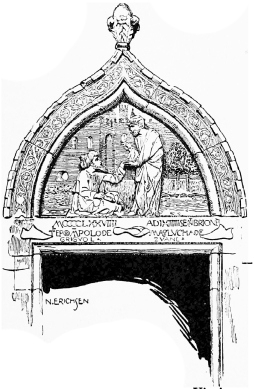
DOORWAY WITH COLOURED RELIEF OF SS. MARK AND ANIANUS: COBBLERS’ GUILD HOUSE, CAMPO S. TOMÀ
We leave by the door of the L. aisle, and make our way through the long Campo S. Margarita to the church of S. Pantaleone, which we visit for the sake of the fine altar-piece, a Coronation of the Virgin, by Giov. Alemano and Antonio Vivarini in the chapel L. of the choir. What art was able to accomplish four centuries later we may see by lifting our eyes to the ceiling of the church over which expatiate Fumiani’s paintings of the Martyrdom and Apotheosis of the patron-saint.
We leave the church on our left, and continue N.E. to the Campo S. Tomà. Here we shall find the old Guild Hall of the Cobblers (Scuola dei Calerghi) with a relief by Pietro Lombardo, St Mark healing the cobbler. The quaint signs of the craft over the portal and Pietro’s sculpture bear traces of the original colouring. We make our way E., passing the fourteenth-century Campanile of S. Polo, one of the finest at Venice. At the base are carved in stone two lions, one of which has a serpent coiled round its neck, the other holds a human head in its claws. They are popularly supposed to symbolise the fate that overtook Marin Faliero. We note on the L. the fine old Gothic S. portal of the church, and emerge into the broad Campo S. Polo.
From the S.E. angle of the campo a way leads along the Calle della Madonetta, and by the Calle del Perdon to the Campo S. Apollinare. On the L., just before we emerge into the campo, are an inscription and a medallion of Pope Alexander III., which mark his legendary resting-place (p. 50). (Another tradition, however, indicates the portico of the old church of S. Salvatore in the Merceria as the spot where he lay.) S. from the campo a way leads to the S. Silvestro Pier on the Grand Canal.
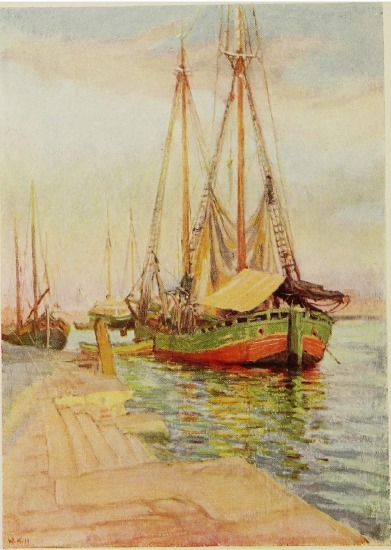
TIMBER BOATS.
SECTION XV Giudecca—The Redentore—S. Trovaso
A STEAMER leaves the Riva degli Schiavoni every hour for the S. Croce Pier on the island of the Giudecca where stands Palladio’s masterpiece, the plague church of the Redentore de’ Cappucini. The island, formerly known as Spinalunga was assigned (giudicata) in the ninth century as a place of banishment to certain of the nobles implicated in the murder of Doge Tradenico. Hence according to some authorities its name: by others it is believed to have been the ancient Jewry.
The fine proportion and symmetry make the interior of the church even more impressive than that of S. Giorgio Maggiore. In the sacristy are three early Venetian paintings once assigned to Giov. Bellini, now generally attributed: (1) Virgin with the Sleeping Jesus attended by two Angels to Alvise Vivarini (p. 196); (2) Virgin and Child with SS. John and Catherine and (3) Virgin and Child with SS. Mark and Francis to Bissolo. The last is by some critics attributed to Pasqualino, a feeble imitator of Giov. Bellini.
We may return by the steamer that crosses every few minutes to the fondamenta of the Zattere (rafts) so called because here the great rafts of timber from the Alps were and still are landed, and follow the rio di S. Trovaso, on which is a most picturesque squero (boat builder’s) purchased by the municipality of Venice to save it from destruction, to the church of S. Trovaso. The church contains two Tintorettos of interest. At the high altar is his Temptation of St Anthony. “A small and very carefully finished picture, marvellously temperate and quiet in treatment,” says Ruskin, who describes the painting in the Venetian Index. There is little tranquillity in the other picture, the Last Supper, in the L. transept. The whole scene is full of “bustle and tumult” and in nearly all its details the composition is coarse and irreverent. The moment chosen is when Christ has uttered the words, “One of you shall betray Me.” An overturned rush-bottom chair is in the foreground. One of the Apostles is leaning down to fill his glass from a large fiasco of wine on the floor; another is in the act of lifting the lid of a soup kettle; a cat is lapping up some of the soup. The solemn scene is degraded to the level of a vulgar beanfeast.
SECTION XVI Palazzo Labia—S. Giobbe—The Ghetti—Gli Scalzi
FROM the S. Geremia Pier on the Grand Canal we turn along the W. bank of the Cannareggio and quickly reach the Pal. Labia. A hall on the first floor is decorated by the finest of Tiepolo’s work existing in Venice. We continue along the fondamenta and at length reach the grass-grown campo, opposite the Ponte Tre Archi, on which stands the Franciscan church of S. Giobbe attributed to Pietro Lombardo. The chief pictures of interest are in the sacristy: the portrait of Doge Cristoforo Moro with a careful representation of a ducal cap is a Bellini school painting; a well-preserved Marriage of St Catherine is by Previtati in the master’s most suave and gracious manner; there is also a not very convincing tryptich by Ant. Vivarini. In the Ante-Sacristy is a much-restored Savoldo, the Birth of Christ. Moro’s tomb is on the ground before the altar in the beautiful chapel erected by the Doge to his personal friend S. Bernardino. The chapel is a fine example of Pietro Lombardo’s decorative genius and power.
FISHING BOATS ON THE GIUDECCA.
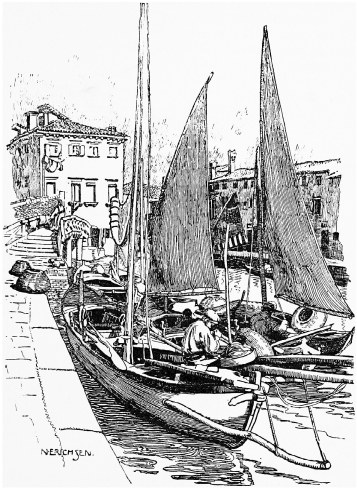
CANNAREGGIO.
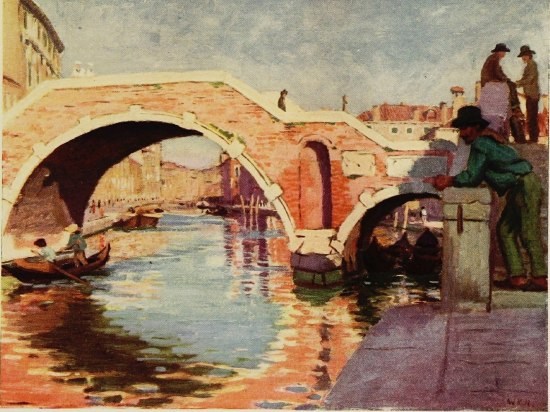
The Ghetto Vecchio and the Ghetto Nuovo may be reached by crossing the Ponte Tre Archi and following the E. bank of the Cannareggio to a portico which gives access to the Jewry of Venice. The term Ghetto is said to have originated from the fact that here were located the old and new foundries for casting (gettando) the ordnance of the Republic. The sites of the old and the new foundries (the Ghetto Vecchio and the Ghetto Nuovo) were in 1516 assigned to the Jews for their quarter. Little that is characteristic now remains. On the L. as we enter the quarter is an inscription declaring the “firm intention of the magistrates of the Republic to severely repress the sin of blasphemy whether committed by Jews or converted Jews. They therefore have ordered this proclamation to be carved in stone in the most frequented part of the Ghetti, and threaten with the cord, stocks, whip, galleys or prisons all who are guilty of blasphemy. Their Excellencies offer to receive secret denunciations and to reward informers by a sum of a hundred ducats to be taken from the property of the offender on conviction.”
We return to the fondamenta and pursue our way to the fine bridge on the R. which spans the Cannareggio and leads to the railway station. We cross the bridge and reach the church of S. Maria agli Scalzi (1648-89), designed by Longhena. The façade by Sardi was restored by the Austrians in 1853-62. The interior is condemned by Ruskin as a vulgar abuse of marble in every way. The ceiling is frescoed by Tiepolo in his most flamboyant style. This heavily decorated edifice (p. 195) was erected, as its name implies, for Our Lady of the Shoeless Friars. Behind the high altar is a doubtful Giov. Bellini. The last of the Doges, Ludovico Manin, lies in this church.
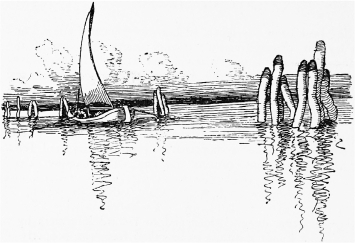
SECTION XVII Titian’s House—S. Michele in Isola—Murano
FEW parts of Venice have suffered more from the disfigurement wrought by national decadence, poverty and insensibility than that now bounded by the Fondamente nuove. In the sixteenth century this was one of the most charming quarters of the city. Here stood the smaller pleasure palaces of the patricians, with delicious gardens sloping down to the sea, whither they could retire after the business of the day to refresh themselves and entertain their friends. The gardens gave on that exquisite prospect where:—
“the hoar And aëry Alps towards the north appeared Thro’ mist an heaven-sustaining bulwark reared Between the east and west; and half the sky Was roofed with clouds of rich emblazonry.”
At evening over the face of the waters, fanned by the cooling breezes of the north, glided the “black Tritons” of the lagoons, graced by the wit and fashion and beauty of Venice. Salutation and repartee were winged with laughter from mouth to mouth, and stanza alternating with stanza of Tasso’s noble verse answered each other in song over the rippling sea. Titian’s palace,[117] where the master entertained all who were celebrated in art and literature, stood near the present Fondamenta. While the tables were being laid the guests were taken to see his great collection of pictures, then for a stroll about his beautiful gardens. The banquet was arranged with delightful art; tables were loaded with the most delicate viands and the most precious wines; music of sweet voices and many instruments accompanied the feast. Pleasures and amusements followed, suited to the season and the guests, until midnight closed the revelry.
MURANO
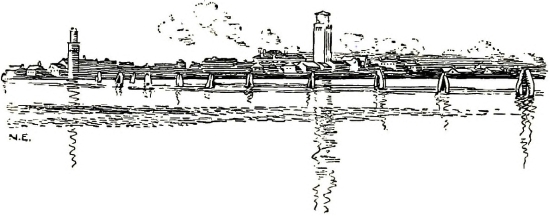
There was no brick wall then fencing about the fair island of S. Michele with its beautiful churches, cloisters and gardens; no cloud of coal smoke fouling the atmosphere of Murano, it too adorned with palaces and lovely pleasaunces.
We make our way to the ferry steamer for Murano, which leaves the Fondamente Nuove every quarter of an hour. How has the glory of Murano departed—Muranum delitiae et voluptas civium Venetorum! Its palaces and pleasure grounds are said by an anonymous writer of the seventeenth century[118] to be beautiful beyond description. Spacious chambers and banqueting halls were hung with tapestry wrought with scenes from the Punic wars, and furnished with the most precious and ornate productions of Venetian craftsmen. Delicious gardens were traversed by artfully designed paths and provided with arbours of interlaced foliage; fountains, fish-ponds, cool grottos adorned with coral and shells in charming taste, pastures gay with the manifold colours of flowers, and trees bearing choicest fruits. Classic peristyles and exedræ, decorated with paintings and arabesques, afforded shelter from the heat of the sun or from rain, and invited to quiet converse.
On gaining the island of Murano we follow the Fondamenta Vetrai and soon reach the church of S. Pietro Martire, which possesses Giov. Bellini’s altar-piece (1488), the Virgin and Child, to whom St Mark presents Doge Agostino Barbarigo. Notwithstanding the clumsiness of restorers this remains one of the most precious of Venetian paintings.
We continue along the Fondamenta, and cross the Ponte Vivarini to the ancient basilica of SS. Mary and Donatus. Legend tells of the Emperor Otho I. caught in a fearful storm, and vowing, if saved, to build a church to the Virgin, who appeared to him in a vision and indicated this very triangular space, bright with a mass of red lilies, as the chosen spot. To the basilica of S. Maria here erected, Doge Dom. Michele gave in 1125 the body of S. Donatus and the bones of the slain dragon, which are still suspended over the high altar. The story of the saint, as related by the worthy sacristan of the church with dramatic gestures, is as follows:—A terrible dragon once devastated Cephalonia, devouring the inhabitants and poisoning the waters of the river up which it swam. The good bishop Donatus determined to rid the land of the monster, and, accompanied by his clergy, went towards the river to confront it. On its appearance the clergy fled, but the saint boldly advanced alone and spat at the beast, which at once fell dead. Donatus then took a cup, and drinking of the water of the river, found it pure and sweet, called back his clergy and showed them the dead monster.
The exterior of the apse, with its masterly decoration of coloured brick and marble so lovingly described by Ruskin in the “Stones of Venice,” is one of the most interesting examples of twelfth century Lombard architecture in North Italy.
We enter and note the rare and precious pavement of the church which is finer even than that of St Mark’s. Much of it has been broken up and reset, but enough has remained undisturbed to rejoice the eye of the traveller. The quaint designs are wrought of opus Alexandrinum, porphyry, verde antico and mosaic. A favourite subject is that of two cocks bearing between them a fox with feet bound—the triumph of watchfulness over cunning. The date, September 1, 1140, may still be read on the pavement in the middle of the nave near the main entrance. The tall, solitary figure of the Virgin in the act of blessing in the apse is a twelfth-century mosaic. An example of Sebastiani’s work—Virgin and Child with the Baptist, St Donatus and the donor (1484)—will be found in the L. aisle.
The local museum possesses a unique collection of Venetian glass of the finest period by the Berovieri family and the Dalmatian Zorzi il Ballerin, some of the ancient luminous red glass contrasted with a modern imitation, and a Libro d’Oro with genealogies of members of this, the closest of the guilds of Venice (p. 213). Descendants of the Berovieri still work for Salviati.
SECTION XVIII Torcello—S. Francesco del Deserto
THE poor and almost desolate island of Torcello lies N.E. of Murano and may be reached by steamer, or by gondola with two rowers.
The ride by gondola is a delightful experience. As we are urged along the channels by the stalwart gondoliers with rhythmic strokes, lagoons, islands and mainland villages unfold themselves to our sight. A little group of cottages amid some poplars to the N.W. is all that remains of the once great and rich Roman city of Altinum. To the N.E., among the islands and groups of trees that seem to float mysteriously poised in the soft grey vaporous atmosphere, is S. Francesco del Deserto, with its cypress groves and solitary stone pine, where St Francis bade his little sisters the birds keep silence while he prayed (p. 73).
The tall, square campanile of Torcello has long been in view. We pass St James of the Marshes (S. Giacomo della Palude), now a powder magazine, then Burano, and at length enter a canal, pass under a decayed bridge,[119] and are landed at the edge of a sloping plot of grass, once the busy market-place of an important city. The cathedral of S. Maria has been twice restored or rebuilt (864 and 1088), but much of the material and probably the apse of the original basilica still survive in the actual fabric. Less than fifteen years since could be seen the old episcopal throne and semi-circular tiers of seats worn by generations of Christian pastors[120] as they sat amid their clergy facing the people. But the seats have been rebuilt and the throne partly restored with ill-fitting slabs of cheap Carrara marble. We remember visiting the cathedral shortly after the renewal with a young Italian architect, who, to our expression of pained surprise, replied, Ma signore, era in disordine (but, sir, it was so untidy). There is no disordine now in the scraped and restored interior. Many of the original marbles, with beautiful and virile designs, however, still remain in the chancel; and in the facings of the pulpit stairs, hewn into blocks and placed in position by the old builders with small regard for continuity of design, we may perhaps gaze on the very stones brought from the mainland at the time of the great migration under Bishop Paul. The restored thirteenth-century mosaic of the Last Judgment on the W. wall, with its ingenuous realism and grim humour, is unrelated in style to anything in St Mark’s, and is the analogue of many a sculptured Gothic west front in northern Europe. The mosaic in the apse, the Virgin and the Twelve Apostles, with an Annunciation on the spandrils, is Byzantine in style, and believed by Saccardo to be late seventh-century work.
We note the old stone shutters of the windows as we pass to the campanile, which lost one-third of its height by a lightning stroke in 1640. A magnificent view of the lagoons and the mainland is obtained from the summit. The remarkable little church of S. Fosca, with its picturesque portico round the apse, is Byzantine in plan, and was in existence before 1011. It was restored in 1247 and again later. The cupola has disappeared and is replaced by a low tiled roof, but the four arches which carried the old dome still remain. A rudely-carved font of alabaster is worth notice. On our way back we may touch at the island of S. Francesco del Deserto. The friars give a gracious welcome, but true followers of the poverello that they are, will accept no gifts in return save reverence and courtesy. A little church and monastery were built around the spot where St Francis prayed, and a small brotherhood have for seven centuries kept unbroken the traditions of their gentle father.
SECTION XIX S. Nicolo del Lido
FROM the Riva degli Schiavoni, and from any pier on the Grand Canal, steamers at frequent intervals will carry the traveller to the Lido di Malamocco, popularly known as the lido, one of the narrow sandbanks which, aided by the wit and industry of man, have preserved Venice from destruction by the patiently eroding, and at times, fiercely aggressive waves of the Adriatic. In earliest times it was covered with pine forest, and many an ancient Doge went hawking there. The Adriatic side, a line of bare, desolate sand dunes, visited only by a few lone fishermen when Byron used to take his daily rides on horseback to and fro between the fort and Malamocco, is now the most frequented bathing-station in North Italy. Along the shore “more barren than the billows of the ocean,” Byron and Shelley rode one evening, and as the sun was sinking held that pregnant talk
“Concerning God, Freewill and Destiny,”
which is immortalised in Julian and Maddalo.
As the vessel steams along St Mark’s Channel, will be seen on the left the once fair island of S. Elena, where the ashes of the mother of Constantine, the discoverer of the True Cross, are reputed to rest, and where many famous scions of the Giustiniani and Loredano families lie buried. But Vulcan has now laid his sooty hand upon it. The old monastery walls with their romantic investure of the erba della Madonna and other mural plants, the cloister with its gardens and tangle of rose-bushes, are now demolished to give place to an iron-foundry; the church, once so magnificent within that it seemed a miracle of sumptuous decoration,[121] is now a machine-room (magazzino da macchine) and tall smoke-stacks smirch the sky.
VENICE FROM THE LIDO.
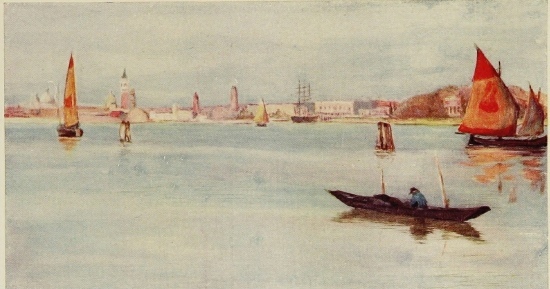
The wanderer who cares for the more silent and intimate charm of Venice will, on the arrival of the steamer, turn aside from the thronged and dusty road to the bathing pavilion, follow to the N.E. the Via S. Nicolo, and walk[122] along the shore by meadows bright in spring-time with blue salvia and the star of Bethlehem to the restored eleventh-century church of S. Nicolo inside the fort. The tomb of the founder (Doge Dom. Contarini) stands over the portal, and in a small chamber in the L. transept, now used as a lumber room, a short inscription of a dozen words tells that there lie the ashes of the stout old Imperial Vicar, “Famous Taurello Salinguerra, sole i’ the world,”[123] who for seven months held Ferrara (p. 77) for his master, the great Frederick, against the allied forces of the Venetians and of the Lombard League. Here in olden times the galleys and argosies of the Republic called to take in sweet water for the voyage and to pray for protection to the mariners’ patron saint, and here stood a fair and costly lighthouse. We retrace our steps to the Jewish cemetery and turn L. down a country lane which we follow as far as the Villa la Favorita; we turn again L. and reach the shore of the open Adriatic, saturated with indescribable tones of blue, from palest turquoise to deepest ultramarine, and dotted with the rich yellow and orange sails of fishing craft.
The walk may be pursued along the grass-grown ramparts of the old Austrian fort to the left, or we may turn to the more material seductions of the Stabilimento dei Bagni to the right.
SECTION XX Chioggia
VENICE FROM THE SOUTH
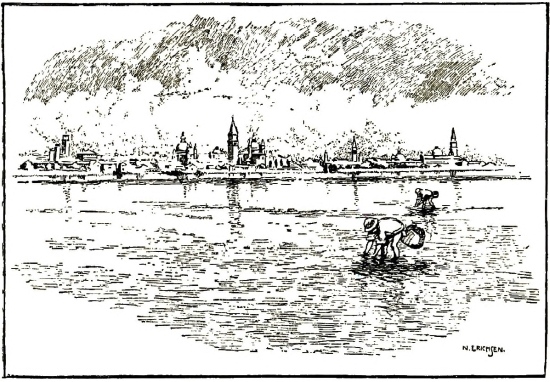
A STILL finer view of the Lidi is obtained by a voyage to Chioggia and back on the steamers which start from the Riva some half-dozen times daily, and if the voyager happen on a sunny, vaporous day he will enjoy a feast of gorgeous colour almost cloying in its richness.
On loosing from the Riva we steam along the canal Orfano, the legendary scene of the slaughter of the Franks and pass the islands of S. Servolo (now the lunatic asylum), S. Lazzaro with the Armenian convent and printing-press, S. Spirito and Poveglia. Beyond the porto of Malamocco on the lido of Pellestrina, a few hundred yards to the south of S. Pietro in Volta, stands the little village of Porto Secco on the filled-up porto of Albiola, where the first stand was made against Pepin and his host (p. 16). The beautiful lines of the low-lying Euganean hills have long been in sight, and the richly coloured sails of the Chioggian fishing craft. We pass the porto of Chioggia and enter the harbour. It is said that the old Venetians were wont to distinguish each of the porti by the colour of the water that flowed through: Tre Porti on the N., which gives on the Torcello and Burano group of islands, being yellow; S. Erasmo (now filled up), blue; Lido, red; Malamocco, green; Chioggia, purple. Chioggia, to the jaded sightseer, has the inestimable advantage of offering nothing of interest save the descendants of a fine and stalwart race of islanders still retaining some of their old characteristic traits of costume and language. The admirable view of Venice as we return in the evening, gradually rising with her domes and towers from the sea, is not the least delightful part of a restful and charming excursion.
L’ENVOI
“THE word Venetia,” says Francesco Sansovino, “is interpreted by some to mean Veni Etiam, which is to say, ‘Come again and again’; for how many times soever thou shalt come, new things and new beauties thou shalt see.”
APPENDIX I List of Doges
Paolo Anafesta, A.D. 697-717.
Marcello Tegaliano, 717-726.
Orso Ipato, 726-737.
Six Mastro Miles, 737-742.
Orso Diodato, 742-755.
Galla Gaulo, 755-756.
Domenico Monegaro, 756-765.
Maurizio Galbaio, 764-787.
Giovanni Galbaio, 787-804.
Obelerio de’ Antenori, 804-809.
Angelo Participazio, 809-827.
Giustiniano Participazio, 827-829.
Giovanni Participazio I., 829-836.
Pietro Tradenico, 836-864.
Orso Participazio I., 864-881.
Giovanni Participazio II., 881-887.
Pietro Candiano I., 887-888.
Pietro Tribuno, 888-912.
Orso Participazio II., 912-932.
Pietro Candiano II., 932-939.
Pietro Participazio, 939-942.
Pietro Candiano III., 942-959.
Pietro Candiano IV., 959-976.
Pietro Orseolo I., 976-977.
Vitali Candiano, 977-978.
Pietro Memo, 978-991.
Pietro Orseolo II., 991-1008.
Otho Orseolo, 1008-1025.
Domenico Centranico, 1026-1032.
Domenico Flabianico, 1032-1043.
Domenico Contarini, 1043-1071.
Domenico Selvo, 1071-1084.
Vitale Falier, 1085-1096.
Vitale Michieli I., 1096-1102.
Ordelafo Falier, 1102-1117.
Domenico Michieli, 1117-1130.
Pietro Polani, 1130-1148.
Domenico Morosini, 1148-1156.
Vitale Michieli II., 1156-1172.
Sebastiano Ziani, 1173-1178.
Orio Malipiero, 1178-1192.
Enrico Dandolo, 1193-1205.
Pietro Ziani, 1205-1229.
Giacomo Tiepolo, 1229-1249.
Marin Morosini, 1249-1252.
Renier Zeno, 1253-1268.
Lorenzo Tiepolo, 1268-1275.
Jacopo Contarini, 1275-1280.
Giovanni Dandolo, 1280-1289.
Pietro Gradenigo, 1289-1311.
Giorgio Marin, 1311-1312.
Giovanni Soranzo, 1312-1328.
Francesco Dandolo, 1329-1339.
Bartolomeo Gradenigo, 1339-1342.
Andrea Dandolo, 1343-1354.
Marin Faliero, 1354-1355.
Giovanni Gradenigo, 1355-1356.
Giovanni Dolfino, 1356-1361.
Lorenzo Celsi, 1361-1365.
Marco Cornaro, 1365-1368.
Andrea Contarini, 1368-1382.
Michele Morosini, 1382.
Antonio Venier, 1382-1400.
Michel Steno, 1400-1413.
Tomaso Mocenigo, 1414-1423.
Francesco Foscari, 1423-1457.
Pasquale Malipiero, 1457-1462.
Cristoforo Moro, 1462-1471.
Nicolo Tron, 1471-1473.
Nicolo Marcello, 1473-1474.
Pietro Mocenigo, 1474-1476.
Andrea Vendramin, 1476-1478.
Giovanni Mocenigo, 1478-1485.
Marco Barbarigo, 1485-1486.
Agostino Barbarigo, 1486-1501.
Leonardo Loredano, 1501-1521.
Antonio Grimani, 1521-1523.
Andrea Gritti, 1523-1539.
Pietro Lando, 1539-1545.
Francesco Donato, 1545-1553.
Marc’antonio Trevisano, 1553-1554.
Francesco Venier, 1554-1556.
Lorenzo Priuli, 1556-1559.
Girolamo Priuli, 1559-1567.
Pietro Loredano, 1567-1570.
Luigi Mocenigo, 1570-1577.
Sebastiano Venier, 1577-1578.
Nicolo da Ponte, 1578-1585.
Pasquale Cicogna, 1585-1595.
Marin Grimani, 1595-1606.
Leonardo Donato, 1606-1612.
Marc’antonio Memo, 1612-1615.
Giovanni Bembo, 1615-1618.
Nicolo Donato, 1618.
Antonio Priuli, 1618-1623.
Francesco Contarini, 1623-1624.
Giovanni Cornare, 1624-1630.
Nicolo Contarini, 1630-1631.
Francesco Erizzo, 1631-1646.
Francesco Molini, 1646-1655.
Carlo Contarini, 1655-1656.
Francesco Cornaro, 1656.
Bertuccio Valieri, 1656-1658.
Giovanni Pesaro, 1658-1659.
Domenico Contarini, 1659-1674.
Nicolo Sagredo, 1674-1676.
Luigi Contarini, 1676-1683.
Marc’antonio Giustiniani, 1683-1688.
Francesco Morosini, 1688-1694.
Silvestre Valier, 1694-1700.
Luigi Mocenigo, 1700-1709.
Giovanni Cornaro, 1709-1722.
Sebastiano Mocenigo, 1722-1732.
Carlo Ruzzini, 1732-1735.
Luigi Pisani, 1735-1741.
Pietro Grimani, 1741-1752.
Francesco Loredano, 1752-1762.
Marco Foscarini, 1762-1763.
Luigi Mocenigo, 1763-1779.
Paolo Renier, 1779-1789.
Ludovico Manin, 1789-1797.
APPENDIX II Bibliography
General Histories.
Brown, H. R. F.—“Venice: A Historical Sketch of the Republic.” London. 1893.
” ” “Venice” in the Cambridge Modern History. Vol. i. Cambridge. 1902.
” ” “The Venetian Republic.” Temple Primers. London. 1902.
Daru, P.—“Histoire de la République de Venise.” 8 Vols. Paris. 1821.
Filiasi, G.—“Memorie storiche dei Veneti.” 7 Vols. Padua. 1811-14.
Fougasses, T. de—“Generall Historie of the Magnificent State of Venice.” Translated by Shute, W. London. 1612.
Hazlitt, W. C.—“The Venetian Republic.” 2 Vols. London. 1900.
Hodgson, F.—“The Early History of Venice.” London. 1901.
Michelet, J.—“Histoire de France. Vol. x. 1879.
Pears, E.—“The Fall of Constantinople.” London. 1885.
Romanin, S.—“Storia documentata di Venezia.” 10 Vols. Venice. 1853.
Chronicles.
Altinate, Cronaca, and Canale, M. de.—“La Cronica dei Veneziani. Archivio Storico Italiano.” Vol. viii. Florence. 1842.
Comines, P. de.—“Les Mémoires.” Lyons. 1559.
Malipiero, D.—“Annali Veneti. Archivio Storico Italiano.” Vol. vii. Florence. 1842.
Romualdi II.—“Archiepiscopo Salernatini Chronicon. Muratori.” Rer. Ital. Script. Vol. vii.
Sanudo, M.—“Diarii di.” (In course of publication.) Venice. 1879-1902.
” “Vite de’ Duchi de Venezia.” Muratori. Rer. Ital. Script. Vol. xxii.
” “Ragguali sulla Vita e sulle Opere di.” Brown, R. 2 Vols. Venice. 1837.
“Venetian Calendar of State Papers.” 10 Vols. London. 1864-1900.
Villehardouin, G. de.—“La Conquête de Constantinople.” Edited by Bouchet, E. 2 Vols. Paris. 1891.
Art.
“Architecture, Dictionary of.” London. 1892.
Berenson, B.—“Lorenzo Lotto.” London. 1901.
” “Study and Criticism of Italian Art.” London. 1901.
” “Venetian Painters of the Renaissance.” London. 1899.
Burckhardt, J.—“Der Cicerone.” Edited by Bode, W. 2 Vols. Leipzig. 1884.
Crowe and Cavalcaselle.—“A History of Painting in N. Italy.” 2 Vols. London. 1871.
” ” “Life and Times of Titian.” 2 Vols. London. 1881.
Jameson, Mrs.—“Sacred and Legendary Art.” 2 Vols. London. 1890.
Kugler.—“Handbook of Painting.” Edited by Layard, A. H. London. 1887.
Lafenestre, G.—“La Peinture en Europe—Venise.” Paris.
Levi, C. A.—“I Campanili.” Venice. 1870.
Ludwig, G.—“Jahrbuch der königlich-preussichen Kunstsammlungen.” Vols. xxii. and xxiii. Berlin. 1901-1902.
Melani, A.—“Architettura italiana.” Milan. 4a edizione.
Morelli, G.—“Italian Masters in German Galleries.” Translated by Richter, L. M. London. 1883.
Morelli, G.—“Italian Painters.” Translated by Foulkes, C. F. London. 1892.
Paoletti, P.—“Catalogo delle R. R. Gallerie di Venezia.” Venice. 1903.
Ruskin, J.—“The Stones of Venice.” 3 Vols. Orpington. 1886.
” “St Mark’s Rest.” 1 Vol. Orpington. 1884.
” “A Guide to the Principal Pictures in the Academy of Fine Arts at Venice.” Venice. 1887.
Saccardo, P.—“Les Mosaïques de S. Marc à Venise.” Venice. 1897.
Sansovino, F.—“Venezia Città nobilissima.” Venice. 1580.
Vasari, G.—“Le Vite dei più excellenti Pittori,” etc. Edited by Milanesi, G. 1878.
“ “Lives,” etc. Translated by Hinds, A. B. Temple Classics. London. 1900.
Zanotto, F.—“Il Palazzo ducale.” Venice. 1841-61.
Woods, J.—“Letters of an Architect.” Vol. i. London. 1828.
Miscellaneous.
Brown, H. R. F.—“Life in the Lagoons.” London. 1900.
Centelli, A.—“Caterina Cornare e il suo Regno.” Venice. 1892.
Coronelli, P.—“Armi Blasoni,” etc. Venice. 1700.
Didot, F.—“Aide Manuce.” Paris. 1875.
Gozzi, C.—“Memoirs.” Translated by J. A. Symonds. 1889.
Howell, J.—“Familiar Letters.” Temple Classics. London. 1903.
Middleton, J. H., and Yriate, C.—“Venice”; Encyclopædia Britannica. 1888.
Molmenti, P.—“Calli e Canali di Venezia.” Venice. 1890.
” “Venezia: Nuovi Studi di Storia e d’ Arte.” Florence. 1897.
” “Studi e Ricerche di Storia e d’ Arte.” Turin. 1892.
Moryson, Fynes.—“Itinerary.” London. 1617.
Robertson, A.—“The Bible of St Mark.” London. 1898.
Symonds, J. A.—“Bergamo and Bart. Colleoni: Sketches and Studies in Southern Europe.” Vol. ii. New York. 1880.
Tassini, A.—“Curiosità Veneziane.” Venice. 1897.
Voragine, J. de—“The Golden Legend.” Englished by William Caxton. Temple Classics. London. 1900.
Yriate, C.—“La Vie d’un Patricien de Venise.” Venice. 1886.
Zanotto, F.—“I Pozzi ed i Piombi, antiche Prigioni di Stato della Repubblica di Venezia.” Venice. 1876.