Part II Student Reports
Reading edition
THE ECONOMIC HISTORY OF VENEZUELA
References Used.—History of South America, W. H. Koebel; With the Trade Winds, Ira Nelson Morris; The Land of Bolívar, Statesman's Yearbook, 1918-1919; Reports of International High Commission; Reports of Minister of Finance (Venezuela); Official Gazette of Venezuela.
GEOGRAPHICAL
The United States of Venezuela occupies the northernmost part of South America bounded on the ocean side by the Atlantic and the Caribbean and on the land side by British Guiana, Colombia and Brazil. It has an area of 393,976 square miles (1,020,396 kilometers) with a population, however, of only 2,848,121 or approximately 7 to the square mile. This is in striking contrast with the figures obtained from the United States Census of 1920 which shows an average population of 35.5 to the square mile.
Venezuela is divided geographically into four zones, the llanos or large plains and river valleys which afford excellent opportunities for the raising of cattle, the mountain section, formed by three mountain ranges, the table lands or plateaus and the mining zone. Venezuela covers the same extent of superficial area as France, Belgium, Holland, Denmark, Switzerland, Portugal, the United Kingdom of Great Britain and Ireland. The country is especially fortunate in having an immense coast line which extends over 1,800 miles. It has 32 ports, some 50 creeks and bays, 7 peninsulas and 7 straits. Besides the Lake of Maracaibo, which is the largest and of special importance, there are also 204 smaller lakes, 60 rivers, 8 of which are of the first magnitude. Along with the variety of physical features Venezuela has a variety of climate which permits the raising of many crops of the tropical and temperate zones.
POLITICAL
Venezuela was sighted by Columbus on his third voyage in 1498, when he entered the Gulf of Paria and sailed along the Delta of the Orinoco. In 1550 this territory became the Captain-generalcy of Caracas and remained under Spanish rule until early in the nineteenth century.
The modern history of Venezuela dates from the year 1813 when Simón Bolívar took up arms against the Spanish Government and finally defeated them at the Battle of Boyaca on August 7, 1819. Two years later at Carabobo the Royalist forces were entirely routed and an end was put to Spanish control in South America.
Simón Bolívar is venerated in Venezuela as the father of his country, a title which he richly deserves. He was born in Caracas in 1783 and from his earliest years his life seemed to be dedicated to the cause of freedom. As a young man he studied in France and was an eye witness to many of the scenes of the French Revolution, so that the spirit of freedom and revolt against despotic government was further intensified in him.
After his victory over the Spanish forces in 1821 Bolívar was formally appointed President of Colombia which then included the present republics of Venezuela and Ecuador. In 1830 Venezuela separated from Colombia and became an independent state. The remainder of Bolívar's public career was devoted to tireless labor in behalf of his people that they might enjoy a stable and beneficial government. He died at Santa Marta on December 17, 1830, almost penniless after having labored throughout his entire life in the interest of his native country.
On March 30, 1845, Spain recognized the independence of Venezuela in the Treaty of Madrid.
A period of successive revolutions followed until finally in 1870 Guzman Blanco assumed control of the country as dictator. Evading the provisions of the constitution which prohibits the election of a President for successive terms, Blanco successfully arranged through two decades for the nomination of some one of his colleagues who was to hold office as a figurehead.
The people finally tired of this procedure and in 1889 there was a revolt against the dictator which resulted in his overthrow. At the elections which followed General Andueza Palacios was elected to the presidency, but another revolution followed in 1891, during which Palacios was unseated and General Crespo, his vanquisher, took up the reins of government.
During the administration of General Crespo trouble arose with Great Britain over the boundary between British Guiana and Venezuela. President Cleveland intervened in 1895, urging arbitration and finally in 1899 the matter was amicably settled. This difference with Great Britain left certain memories with the Venezuelan people which for a long time operated to the discouragement of British capital.
After another series of revolts, General Cipriano Castro became president in 1900. Internal disturbances continued and in addition to this misfortune, Castro ruled as a dictator, employing corrupt and revolutionary methods which not only aggravated the domestic disease but ruined credit before the nations of the world. In 1907 the Belgium debt was repudiated and the following year trouble arose with Holland regarding the harboring of refugees in Curaçao. Diplomatic relations were also broken off with England, Italy and France during Castro's administration. Finally, in 1908 he found it advisable to retire to Europe and in his absence Juan Vicente Gómez, the Vice President, took control and was installed as President in June, 1910. General Gómez still exercises the supreme power in his capacity as Commander-in-Chief of the Army.
PRODUCTS
(See Reports on Agriculture, Minerals, and Animal Industries.)
BANKS AND CURRENCY
There are four national banks in the country—the Bank of Venezuela, the Bank of Caracas, the Bank of Maracaibo and the Commercial Bank. These four banks issue paper currency, which is not legal tender, although generally accepted as such.
Previous to the establishment of branch banks in Venezuela by foreign concerns, the majority of import and export houses doing business in the Republic were engaged in domestic and foreign banking business. As a general rule, these merchants charged such a high rate of interest that individuals could not improve their property nor prosper in their regular agricultural pursuits.
In 1916 the Royal Bank of Canada opened a branch in Caracas and in several other places in the country. Three years later the National City Bank of New York entered the field and opened branches in Caracas and Maracaibo. Other concerns which have opened branches are the Anglo-Spanish-American Bank, Ltd., The Commercial Bank of Spanish America, Grace & Co. of New York through their branch, the Venezuela Commercial Company, and The Mercantile Bank of the Americas.
The currency is on a gold basis and gold coins of foreign countries are accepted as legal tender. The coinage of silver and subsidiary metal is restricted.
The bolivar, named in honor of the Liberator, is the monetary unit and contains 1-1000 part of a kilogram of gold.
Gold coins are issued in 5, 10, 20, 50 and 100 bolivar pieces. Silver coins are issued in 1, 2½, 5 bolivar pieces and 50 and 20 centimo pieces. The smaller, token coins, are of nickel in 12½ and 5 centimo pieces. The five-bolivar piece is commonly known as the "fuerte" and is worth $.96½ in U. S. gold.
AIDS TO ECONOMIC DEVELOPMENT
Capital can be supplied in either of two ways: by investors from foreign countries or through loans made by the government of Venezuela to individuals who are unable to interest outside capital. For the welfare of the country, the latter seems to be more advisable, as it would reach a larger number of small farmers who are not in need of large sums, and who moreover are not familiar with the financial requirements of foreign investors.
A provision similar to the Federal Farm Loan Act passed in the United States in July, 1917, would be of immense importance in aiding agriculture enterprises.
The lack of immigration has long been a serious problem in the economic development of this country; it can only be said that the government has this question under discussion and probably something will soon be done to induce immigrants to come to Venezuela where a multitude of opportunities await them.[2] However, it will be necessary for the government to assure this class of prospective citizens that the bulk of desirable land is still in the hands of small holders and that the power of the government is sufficient to protect the small farmers.
In spite of the fact that the country is very sparsely settled, the present railroad system is inadequate and large tracts of land are of little or no value because of the expense of handling the products. Obviously, the products of these areas can not successfully compete in the world's markets, if the margin of profit has been absorbed antecedently by high transportation expenses.
The oldest railroad is the Bolívar Railroad which was begun in 1873. It is a 24-inch gauge, 176½ kilometers long and extends from Tuscasas to Barquisimeto. The La Ciella line was authorized in 1880 and has a 91-meter gauge and a length of 81½ kilometers.
The most important road and one of the few which has paid any returns is the La Guaira to Caracas line, which is about 23 miles long and was built by British capital.
In passing it can truly be said that railroad development has been retarded as much by political insecurity as by the undeveloped industrial state of the country, the topography and the expense of securing railroad equipment. However, the present administration is giving considerable attention to this need and an extensive program of wagon-road building is now in process of construction and plans have also been perfected for extensive railroad expansion.
GOVERNMENT
The Republic of Venezuela was founded in 1830 by separation from the other members of the "Free State" established by Simón Bolívar within the limits of the old Spanish colony of New Granada. The Constitution was modeled after that of the United States of North America, but greater autonomy is allowed to provincial and local governments.
The chief executive is the President, elected for a term of six years, assisted by six ministers and a Federal Council of 19 members. The Federal Council is appointed by Congress every two years; the Council chooses a President from its own members, who is also President of the Republic. Neither the President nor members of the Federal Council can be re-elected for the following period.
The legislative branch of the government is divided into two houses called the Senate, whose members are elected for six years by the State Legislatures, and the House of Representatives, whose members are also elected for a six year-period, but by direct vote, one to each 40,000 inhabitants.
The country is divided into 20 States, 2 Territories and a Federal District. The National Congress includes 40 Senators and 52 Representatives. Each state has an equal number of representatives, each having a legislative Assembly, whose members are chosen in accordance with its respective constitution.
PROSPECTIVE
Venezuela stands to-day upon the threshold of great interior development especially in agriculture and cattle-raising. Her position is similar to that of the United States after the Civil War when vast areas, sparsely settled, lay awaiting the movement of population to develop them. Her mineral resources are practically untouched and opportunities await foreign capitalists who are familiar with the development of new countries.
The political situation, however, should not be neglected. W. H. Koebel in his "History of South America" says, "No state of South America can show such a perpetual ferment, such a fog of unrest and strife hanging over and choking its development as this." Whether or not the past eight years of stable government and national prosperity has demonstrated to the people of Venezuela the proper course to follow is a question beyond the scope of the present inquiry.
In any event, the foreign investor will be well advised if he places his capital in Venezuela only after mature consideration of the political changes of the last two decades and the ability of the present administration to carry through its policy of enlightened development.
James F. Costello.
POPULATION, IMMIGRATION, EDUCATION
References:
Census Bureau, Caracas, Venezuela, July, 1920.
Memoria del Ministro del Fomento, 1920.
Confidential Report of Department of Commerce, 1919.
Memoria de Instrucción Pública, 1918, 1919, 1920.
Memoria de Obras Públicas, 1920, Vol. 1.
Encyclopaedia Britannica.
The last official census of Venezuela, which was completed in the year 1891, placed the population of the country at 2,323,527. According to the Venezuelan Year Book of 1904, 10% of the people are white and of European descent, but by far the larger part, possibly 70% of the total, is a mixed race in which white and Indian blood prevail, the remainder being pure Indian blood. It is not to be expected that the new census, begun in August, 1919, will show any great changes because of the three following reasons:[3]
1. The neglect of sanitation and hygiene in the past, which was responsible for a heavy death rate.
2. The numerous civil wars and revolutions, which ended however some fifteen years ago, when a reconstruction period commenced under the present régime.
3. Comparative lack of immigration, the actual increase being balanced by the yearly total of emigration of Venezuelans to foreign countries.
The future, however, holds brighter prospects due to the fact that remedies have been found for the first two causes, and energetic efforts are being made to increase immigration, as will be shown in detail later.
Within an area of approximately 394,000 square miles the greater part of the people is found in the regions of Lake Maracaibo, the Federal District of Caracas and along the Coast, the Southern and interior sections being to a great extent unknown and unexplored. The region of Barquisimeto in the state of Lara is the most densely populated area, while in Apure far to the south is found low swampy land, sparsely populated, interlaced with a network of rivers, which in the rainy season cover the entire country with a blanket of water, making travel impossible for months and mail deliveries most difficult and irregular.
The agricultural zone extending along the coast and inland to the Orinoco, employs 20% of the population in this pursuit alone, and contains all the important cities of Venezuela, with the exception of Ciudad Bolívar. The largest city is Caracas, with a population (including the Federal District) estimated to-day at 137,687, an increase of 47,687 since 1891. Its sea-port is La Guaira, connected by a railroad winding around 23 miles of mountains. The second port of importance is Puerto Cabello in the vicinity of Valencia, the second largest city of Venezuela, which has a population estimated at 64,681. Maracaibo with 48,480 is the third largest city in Venezuela, being second in the country in business importance. This last district ought to have the heaviest increase in the future due to the location of the mines and petroleum wells in this area which attract the majority of immigrants, while its heavy coffee exportations offer a wide field for investment and employment.
Mérida, and Barcelona with its port of Juanta which serves the coal and salt mining regions, are two important populous regions while other cities varying in population from 10,000 to 50,000 are Ciudad Bolívar, Barquisimeto, Trujillo and Juanare.
A glance at the following data, with the last two reports approximately estimated, will serve to show the increase.
1891 official census 2,323,027 Ratio per square kilometer 22
1911 " " 2,743,833 " " " " 26
1917 " " 2,848,121 " " " " 27
The most heavily populated districts are:
Federal District 137,687 Density per square kilometer 70.2
Carabobo 193,234 " " " " 43.9
Nueva Esparta 52,431 " " " " 39.6
Trujillo 185,624 " " " " 24.4
The least populated states are:
Bolívar 69,938 Density per square kilometer .03
Apure 30,008 " " " " .04
The territories which have had no increase since 1891:
Amazonas 45,097 Density per square kilometer .02
Delta-Amaeuro 9,243 " " " " .02
Revised statistics June 19, 1920, for the city of Caracas:
Catedral 12,229
Altagracia 14,280
Santa Teresa 6,050
Santa Rosalia 19,284
Candelaria 13,344
San Juan 16,436
La Pastora 11,409
San Jose 6,688
Total 90,720
Remainder of District 46,967
District total 137,687
Yearly increase of population estimated from comparative statistics of births, deaths, immigration and emigration:
1910 28,091
1911 30,310
1912 11,797
1913 24,050
1914 24,988
1915 12,904
1916 9,589
1917 20,359
1918 8,308
1919 20,590
IMMIGRATION
The nationalities that immigrate to Venezuela, in order of numbers, at the present time are Americans, Germans, Italians, Spaniards, Syrians, Hollanders, with few French and English. Of these, the Spaniards, Italians and Syrians alone, with a few odd exceptions, become citizens. Before the war, Germany furnished the preponderant immigrant element but to-day the Germans are coming in fewer numbers, and Americans are increasing proportionately.
The reasons for the American increase are mainly the establishment of three branches of the Royal Bank of Canada in Venezuela in 1916; the National City Bank of New York with two branches, one in Caracas the other in Maracaibo, and the Mercantile Bank of America with branches in the same two cities. As mentioned above, the petroleum activities in San Lorenzo in the Maracaibo district, the mines and coffee ventures, also brought many Americans.
The lack of immigration in the past has been due mainly to sanitary conditions, and the internal troubles of the country. The foreigner, if unmolested long enough to build up a profitable business, faced the danger of having it swept away, and his life endangered during one of the frequent revolutionary outbreaks prior to the present régime. However, great efforts are being expended to promote immigration as vitally necessary for the future successful upbuilding of the country, for Venezuela relies for her increase in population upon this source and consequently several methods have been pursued to attain this end. A glance at the laws of immigration formulated January 7, 1893, will show the favorable inducements offered foreigners.
The Decree of 1893 created a Board of Immigration to promote colonization. The Board is known as the Central Board of Immigration and established subordinate boards throughout the country. These societies, state societies, as well as private companies, were authorized to make the following favorable concessions to induce foreigners to come and colonize unused lands.
1. Payment of the immigrant's passage by land and sea, from the place of embarkation to any of the main immigrant depots. The National Government may also pay the passage of the immigrant from the place of residence to the place of embarkation.
2. Payment of landing expenses and board and lodging for thirty days after arrival.
3. Admission free of duty of their wearing apparel, domestic utensils, and instruments of trade.
4. Exemption of any payments for necessary passports.
SPECIAL PROVISIONS
All rights accorded by law to aliens are guaranteed, and if naturalized they are exempt from military duties, except only in case of foreign wars.
Special provisions were also made in behalf of individuals and companies organizing colonies for settlement in Venezuela.
The manner of making contracts with immigrants is carefully specified in the following manner:
(a) Those who purchase lands during the first two years of their settlement, shall not be bound to pay the price thereof until after the expiration of four years, counted from the day actual possession is taken. They can not dispose of the land, however, during this period.
(b) The title is not to be determined until the stipulated price is paid and the required cultivation and residence proved.
Special provisions and concessions were also made for the colonization of public lands by private individuals and companies.
There is an annual appropriation in the National Budget to promote this project. At the time of this writing, Mr. Simon Barcelo is in Europe, traveling through the different countries inducing immigrants to come, and acting as a forwarding agent. The result of his endeavors is being manifested in the increased number of immigrants arriving within recent months.
Venezuela's immigration is bound to increase in the future, for advertisement is bringing results. The subjoined statistics will show that this is not the only problem confronting the Government, for the balance of immigration and emigration is only slightly in favor of the former, as many Venezuelans leave the country yearly for the West Indies, the United States and Europe. Whereas before the war, the majority of the youths were educated in Europe, and travelers naturally sought Europe, difficulty of communication and transportation during the war turned the stream toward the United States, and the present popularity of Americans in Venezuela bids fair to perpetuate this condition of affairs.
Year Immigration Emigration
1910 8,273 7,233
1911 9,204 7,219
1912 9,615 7,981
1913 11,617 10,708
1914 10,610 9,742
1915 9,818 8,770
1916 8,596 7,639
1917 7,857 7,182
1918 6,153 5,841
1919 12,433 12,897
PUBLIC EDUCATION
Education in Venezuela is free, and in the six primary grades is compulsory, the schools from the ages of 7 to 14 years being maintained by the National Government, State, or Municipality, the Department of Education being under the direct supervision of the Minister of Public Instruction, with subordinate officials forming a board. In 1908 Mr. Guillermo Todd, a distinguished Venezuelan educator, was sent to the United States, where he spent two years in the larger cities inspecting the school system, the normal schools and universities. On his return he was appointed superintendent of schools, and reorganized the system, introducing many American ideas and methods which largely prevail to-day.
The maintenance of the educational system depends upon the receipts from stamps, from post-cards and letters, from fines collected from violators of the instruction laws; from taxes upon inheritances, imposts upon tobacco leaves and manufactures, and from the proceeds of the revenue stamps placed upon boxes of cigars.
During the school year of 1919 there were founded two primary schools with three teachers each, two with two teachers and nine schools with one teacher. Two schools were suspended and eleven changed into co-educational with one teacher, while thirteen schools changed their location. Heretofore education has followed the population only. Outside the cities, towns and large cities near the coast there were scant educational facilities, and the rural population was to a large extent uninstructed, there being no schools nor teachers. During 1917 a movement was inaugurated to establish rural schools in all industrial districts, and migratory schools of this kind are now in operation in Frujillo, in Mario El Cantado and Caracas, the states and municipalities have taken the matter in hand. On September 19, 1919, a decree was passed by the National Government to offer a bonus in the form of wages, of from 100 to 200 bolivares ($20.00 to $40.00) to competent persons possessing a certificate of primary elemental instruction, who would enroll and teach children below fourteen years of age the rudiments of education in localities of small population where there were no public schools nor teachers. The bonus to be received varied according to the number of pupils enrolled; many small classes are now in operation throughout the rural districts.
The Obligatory Instruction Law compelling children from 7 to 14 years of age to attend class has been rigidly enforced by Government decree during 1919; a list of offending parents is compiled and they are visited by educational officers, and fined if found guilty of not sending their children to school. By an order of June 20, 1919, English is to be henceforth taught in all primary schools, in view of its present importance as a commercial language. On September 1, 1919, appropriation being made, two new Manual Training Schools were founded, one at Mérida, the other at San Cristobal. Physical training is now considered an important part of the training, and at least a half-hour a day is spent in calisthenics and gymnastic training. In 1918 the Boy Scouts movement was proposed, and introduced into the schools of Maracaibo, where under the supervision of Mr. W. Douglas it has been intertwined with the courses of the public educational institutions. This movement is now receiving national prominence, and gained favorable commendation in the Memoria de Instrucción Pública (1918).
According to the latest data, there are approximately 1,500 primary schools in Venezuela with 50,000 pupils enrolled, but the system is laboring under the difficulty of a lack of teachers, due to inadequate compensation. The children attend school six days a week, but on Saturday have class in the morning only. The curriculum consists of a daily lecture or assembly, elements of the Spanish language, arithmetic, the legal system of weights and measures, rudiments of etiquette and hygiene, moral and civic instruction, gymnastic exercises or national songs, and elements of manual training. The afternoon classes embrace writing, geography, history, topics of the day and gymnastic exercises.
The Secondary Education of Venezuela is not as generally widespread, in proportion, as primary education. There are 102 schools of this class corresponding to high schools in the United States; 58 are for boys, 38 for girls, and 4 are co-educational. Some are grouped into Federal Colleges and Normal Schools annexed to Federal Schools in Caracas and Valencia.
Caracas is nominally the center of education in Venezuela. Here are found two normal schools, one for men and one for women, and two national schools of arts and trades, one for each sex. In 1917 Schools of Commerce were instituted at Caracas, Maracaibo, Puerto Cabello, Curúpano and Ciudad Bolívar. These are similar to our own commercial schools, teaching languages, bookkeeping, stenography, accounting and the like. Besides, there are found throughout the country thirty-four schools of higher instruction, and twenty-one subsidized by the Government.
One institution, founded June 30, 1919, may be interesting to note, viz, the National Telegraph School of Caracas in which the first pupils were enrolled from July 1 to 7, 1919. The school is situated in the Federal Telephone and Telegraph Building.
The candidate must have the following qualifications:
1. Be a Venezuelan.
2. Over 15 years of age and under 25.
3. Have had elementary primary instructions and the certificate issued for the same.
4. Be of good character.
5. Have no contagious diseases, and no physical defects.
6. In case he is a minor he must have the permission of his legal guardian.
There are six National Universities, located in the following cities:
1. Central University of Caracas.
2. The University of the Andes at Mérida.
3. The University of Valencia in the State of Carabobo.
4. The University of Maracaibo in the State of Julia.
5. The University at Ciudad Bolívar in the State of Bolívar.
6. The University of Barquisimeto in the State of Lara.
The following courses are pursued in the Universities: Medicine, Law, Political Science, Philosophy and Letters, Dentistry and Pharmacy.
The length of these courses is six years with the exception of pharmacy, which is a four-year course.
Among the professional schools the following are of greater importance:
1. School of Engineering at Caracas.
2. School of Naval Construction at Puerto Cabello.
3. School of Political Science at San Cristobal.
4. School of Medicine in Caracas (founded December, 1915). A free dispensary is attached, subsidized by public funds under the direction of Civil Hospitals.
5. School of Dentistry, Caracas (1916).
6. School of Sciences (Physical, Natural and Mathematical) Caracas (December, 1915).
7. School of Chemical Research.
Of the Academies the more important are:
1. Those of natural science, music, oratory and modern languages found in the larger cities.
2. The Academy of Language in Caracas devoted to the national language and literature.
3. The Academy of History in Caracas devoted to national history.
4. One seminary at Caracas,—the Catholic Seminary for Theology and Canonical Jurisprudence.
Under "miscellaneous" we may consider the following:
The National Library of Caracas containing 50,000 volumes; a national museum containing a valuable historical collection; the Cajigal Observatory devoted to Astronomical and Meteorological work; the libraries of Valencia and Maracaibo, and the Pasteur Institute in Caracas.
Among the educational achievements of the past few years, the following are worthy of mention:
1. Departments for engineering work.
2. Departments for the administration of budget.
3. Improvements in laboratories in physics, mineralogy, geology, botany and zoology.
4. Enlargement of the libraries and improvement of the school of medicine.
5. The schools of arts and crafts for men has 541 men enrolled. The clever map making of the students should be especially noted.
6. The meteorological stations in Mérida, Maracaibo and Calabozo.
The appropriation for education for the fiscal year July 1, 1920 to June 30, 1921, recently passed by the Venezuelan Congress, contains the following items:
Bolivares
1. Ministry 120,580
2. National Council of Instruction 119,016
3. Primary Education 2,465,542
4. Secondary Education 259,240
5. Normal Education 203,940
6. Board of Inspection 135,600
7. Superior Instruction and Institutes of University Extension 373,781
8. Special Instruction 326,672
9. Celebrations and Entertainments 143,940
10. General Costs 180,000
Total Bs. 4,328,181
It may be said in conclusion that Venezuela fully recognizes the importance of sound educational institutions and every effort is being expended to bring about the desired results through legislation. The work is slowly materializing but assuredly progressing. By far the greatest problem is the lack of professors. Educational progress has of necessity been retarded in the past but as the era of prosperity of the country has been gradually, but surely, dawning, this important branch has not been neglected, and a brighter future is before the Venezuelan youths which will preclude the necessity of going abroad, as they have done in the past, to complete their training.
The country has need of highly educated men; it is determined to provide the institutions necessary to satisfy these needs.
Thomas F. Morris.
PORTS OF VENEZUELA
With an increasing commerce and steady betterment of domestic economic conditions, the ports of Venezuela are rapidly assuming a position that for continued development and general good condition has never been equalled in the history of the country. All countries recognize the vital economic value of ports and with few exceptions can gauge their own prosperity by the nature and number of their harbors. Few countries are more dependent upon their ports than Venezuela. Because of poor inland communication with neighboring countries, and an inability to maintain itself, largely due to lack of manufactures, and due also to a marked dependence upon the outside world for the marketing of its products, this nation is to a high degree reliant upon its foreign commerce and hence, in turn, upon its ports.
Fortunately, Venezuela has a long coast line of 3,020 kilometers, indented with 32 harbors, 50 small bays and many coves. The most important ports in the approximate order of importance are: La Guaira, Maracaibo, Puerto Cabello, Ciudad Bolívar, Carúpano, Puerto Sucre, La Vela, Cristobal Colón, Caño Colorado, Guanta, Pampatar, Imataca and San Antonio del Táchira. At the present time many of the best natural ports and the most favorably situated are still undeveloped or occupy a secondary position. This is partially due to the lack of development of their naturally rich and fertile hinterlands, difficulties of transportation and unsympathetic government legislation. However, remedies are now being applied and it can safely be predicted that certain of the minor ports will soon outstrip the older and better developed ones. A brief survey will serve to show the general nature and economic status of some of the better known ports.
Chief in importance is La Guaira which, connected with Caracas by 24 miles of railroad, stands as the commercial center of Venezuela and will be treated in more detail later.
MARACAIBO
Situated on a fresh water lake of approximately the same size as Lake Erie, the Port of Maracaibo drains a large hinterland. Coffee and petroleum are its two important exports. Besides that of Venezuela, much coffee of Colombian origin is exported from the port. It may also be noted that there is an ever increasing exploitation of petroleum and a corresponding demand for harbor facilities. Physically the port enjoys a great advantage in being located on a large lake fed by numberless rivers.
The lake itself could accommodate vessels of thirty-foot draft, while three of the largest rivers, the Catatumbo, Lulia and Escalante can be travelled by river steamers of fair size. The two former streams are navigable as far as Villamizar in Colombia, and afford a fine transportation route for the coffee and other products of Santander. However, the port suffers a great disadvantage, as the main channel leading into the port is obstructed by a bar. The depth of water on this bar ranges from seven feet at low tide to twelve feet at high tide. The project of dredging the channel seems to be entirely feasible and if accomplished would add greatly to the general prosperity of Venezuela.
PUERTO CABELLO
Deriving its name from the fact that its waters were considered so placid that a vessel might anchor within its protection sustained by a single strand of hair, Puerto Cabello remains the most sheltered port of Venezuela. Equipped with a floating dock 282 feet long, 80 feet wide and 21 feet high, it is able to take care of vessels up to 2,000 tons and has proved especially serviceable for the small steamers that serve the coast cities of Venezuela and Colombia. Coastwise vessels of light tonnage are constructed here and repairs of an extensive nature may be made. Many improvements to the ship building plant and repair docks are under way and the new floating dry dock when completed will permit the docking of vessels up to 4,000 tons, which means that it will be capable of accommodating practically all vessels that touch Venezuelan ports. The average depth of the harbor is 28 feet. Cattle are an important export, large consignments being made from the surrounding country. A frozen meat establishment controlled by English interests is of considerable value to the port, the meat being shipped to England in special ships. Puerto Cabello is 20 miles distant from Valencia and has railroad connections with both it and Caracas. Other exports besides cattle are coffee, cacao, dyewoods, hides, skins, and copper ores.
CIUDAD BOLÍVAR
A river port situated on the right bank of the Orinoco 240 miles above its mouth, Ciudad Bolívar is the commercial center of the Orinoco basin. A bar which blocks the river channel prevents ships of more than twelve feet draft from navigating the harbor. Due to the large quantity of sand deposited by the river and its tributaries, dredging is practically an impossibility. Vessels of less than twelve feet draft can go up the Orinoco as far as San Fernando de Apure. The principal exports are cattle, horses, mules, tobacco, cacao, rubber, tonka beans, bitters, hides, timber and other forest products. The port has connections with government land lines, regular communication with the lower and upper Orinoco and steamship lines to New York and the Antilles. The government imposes a surtax of 30% on imports from the West Indies which greatly diminishes the commerce of the port.
MINOR PORTS
Carúpano is well located for commerce, being on the Caribbean coast at the opening of two valleys. It is the commercial center of the rich and populous hinterland of the valleys of Tunapui and Pilar and the valuable forests of Coiguar. The principal exports are coffee, cacao, cotton and forest products. Although possessing fair wharves, the harbor is very open and cargo must be moved in lighters and launches to the piers. Traffic is almost entirely of a coastwise nature with La Guaira.
Guanta is one of the eastern ports of the country and has an excellent natural land-locked harbor. Its wharf can accommodate trans-Atlantic steamers, although commerce from abroad is light. The wooden pier, formerly in very bad condition, is being replaced by one of concrete. Guanta is connected by twenty-four miles of railroad with the coal mines of Naricuse and furnishes fuel for coastwise vessels. Large numbers of cattle are raised in the surrounding country and upon the completion of improvements the harbor should have a very bright future. By a government decree of 1917 the port was closed to import commerce and depends almost entirely upon exports for its functioning.
Puerto Sucre is situated west of the city of Cumaná at a distance of less than a mile. It is equipped with a wooden pier constructed by the Cumaná and Carúpano Pier Company. The depth of water varies greatly and the loading and unloading of vessels is accomplished in lighters belonging to the company. The commerce of the port is small, most being undertaken with the neighboring ports of Venezuela.
La Vela borders on a low swampy region and is connected by railroad with Coro. Except for a small coastwise trade with Puerto Cabello, the port enjoys little commercial activity. Coal mines are near by and with their future exploitation an increase in commerce may be expected. The waters of the harbor are unusually rough and lighters must be used for discharging cargo.
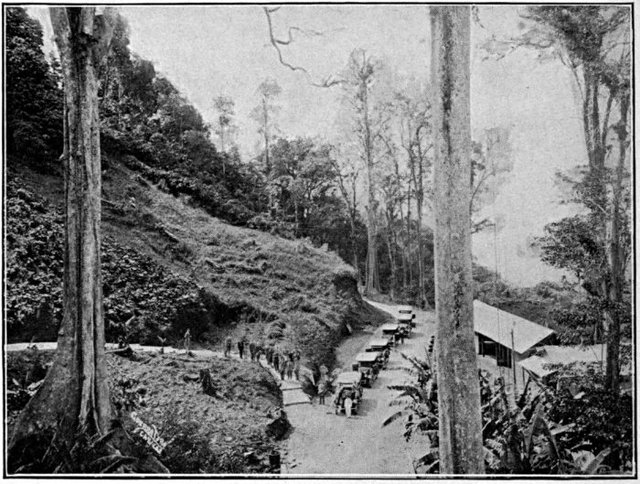
Rancho Grande
The Road through the Mountains
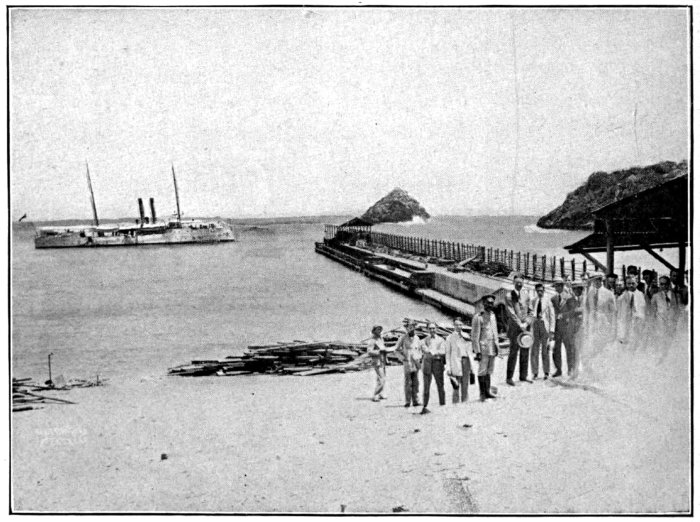
Port of Ocumare de la Costa on the Caribbean
While there are many other ports besides those mentioned above, their commerce is so light and in such a poor state of development that more consideration need not be given them here. For the most part, their commerce is entirely coastwise and is carried on principally in small sailing vessels. The fundamental obstacle to their future progress and indeed to the progress of the entire nation seems to be lack of population—a difficulty which the government is striving hard to overcome by furnishing immigrants with free transportation, and paying passport expenses.
SPECIAL PORT ACTIVITIES
At present there are no free ports in Venezuela and despite many rumors and much discussion the establishment of a free port, at least for some time, seems improbable. However, the Minister of Finance has recommended the installation of bonded warehouses at some port centrally located on the coast mainly for the better accommodation of coastwise trade. Cargoes could be placed for a long period of time in the proposed warehouses and the charges collected with the movement of goods. The advantage of such a plan would be principally the ability of profiting from market conditions and the fluctuation of prices. The execution of this plan depends solely upon the legislation of the government and will be officially considered in the near future.
Of far greater importance is the proposed project of transforming Puerto Ocumare de la Costa from a small harbor with very little commerce into a leading port capable of becoming a formidable rival of La Guaira. For the accomplishment of this the former port would have to be connected by railroad with Maracay, a distance of 43 miles, and goods shipped to the territory which La Guaira now supplies. The railroad would be very difficult to construct as it would have to traverse a mountainous country and would take years to complete. Engineers are considering the feasibility of the undertaking. The reason for the new project is generally believed to be the raise in rates of the La Guaira Harbor Corporation brought about by changing from weight to volume measurement of cargo. The company justifies its charge advance on the grounds that it was necessitated by the increase in wages due to strikes. However, the government insists that the raise is entirely out of proportion to the increase in salary paid. The new rates impose an increase in charge of 37½% on coffee, 87⅓% on cacao and 300% on hides. Proportionate increases are made on many other articles.
It is needless to say that if the plan is carried out it will directly or indirectly affect a large portion of the country. And whether the economic advantages, such as new harbor development, the opening up of new lands, and the increased mileage of railroads will justify the disadvantage of large expenditures and risks involved is a question that time alone can answer.
PORT OF LA GUAIRA
Formerly considered one of the most dangerous harbors on the Caribbean coast, La Guaira is to-day Venezuela's leading port and the recipient of a large volume of commerce both from Venezuela and abroad. Its prosperity may be assigned to several causes. By reason of its proximity to Caracas, the capital and chief city of the republic, the port enjoys a great commercial advantage, as Caracas is a center of transportation activities. Again, the harbor besides being favorably located can accommodate vessels of large draft and possesses harbor and warehouse facilities of an extensive nature. Government legislation has also accomplished much to assure its preeminence as certain laws now in force operate to divert much commerce to La Guaira that would normally go to other Venezuelan ports.
The port works and equipment are owned by the La Guaira Harbor Corporation, an English company that has undertaken improvements totalling $5,000,000 and that have changed the harbor from a natural to an artificial port. Before the improvements, the port was an open roadstead—unsheltered and very dangerous. At the present time it is protected by a stone and concrete sea wall, constructed from an average depth of 29½ feet and rising 19½ feet above water. This protection is ample and ships may move about and anchor in complete safety. The sheltered area of the harbor is 75 acres and has an average depth of from 28 to 30 feet. Entrance is made between the buoy at end of pier No. 5 and buoy No. 4 placed at a distance of 300 feet. The maximum range of tide is approximately 3 feet. Vessels of 23-foot draft can safely navigate the harbor.
Landing is made at jetties inside the breakwater and the cargo is loaded on cars and taken to warehouses. The jetties are three in number and can accommodate three large or four small steamers. These jetties are all equipped with railway facilities. Bunkerage is not available and vessels must coal from lighters or cars on wharf. The port can supply only a limited amount of coal, mostly Cardiff briquettes. Fuel oil can not be obtained, but is available in large quantities at Curaçao, 60 miles distant.
The population of the port is estimated at 26,000. The climate is very hot with an average temperature of 84°. The prevailing winds are northeast by southwest.
Though but 8 miles from Caracas, 24 miles of winding railroad through the mountains are necessary to connect the port with the capital. The line is owned by an English company, has a gradient of 4% and is of 3-foot gauge. From Caracas the Great Railroad of Venezuela operates a road to the city of Valencia which in turn is connected by a third line to Puerto Cabello.
The principal exports of the port are coffee, cacao and hides which are sent principally to the United States, with which commerce is greatly increasing. Much cacao of the better grade is exported to France.
The imports are textiles, chemicals, machinery, hardware, paper products, drugs and medicines, of which 75% come from the United States. Large return cargoes are difficult to get and at times absolutely unobtainable.
The following statistics may serve to show the volume of commerce of the port:
Movement of Cargo from the Port of La Guaira
1918 Metric Tons 1919 Metric Tons Increase (M. T.)
Foreign imports 25,384 38,843 13,459
Foreign exports 26,186 30,632 4,445
Coastwise trade 55,446 64,195 8,748
Total movement 107,017 133,671 26,654
Movement of Passengers from La Guaira
Year
1915 8,216
1916 8,707
1917 9,976
1918 9,897
1919 15,974
Movement of Cargo from Port of La Guaira by Year since 1905
Year
1905 92,489
1906 89,299
1907 93,548
1908 63,012
1909 74,414
1910 81,525
1911 91,996
1912 105,844
1913 116,116
1914 110,498
1915 104,583
1916 113,351
1917 123,963
1918 107,017
1919 133,671
PILOTAGE AND TOWAGE
Pilotage is not compulsory and is little used as entrance to the harbor is easily made. When signalled for, the pilot boards the vessel about 2 miles off shore and proceeds to the port. Towage is very seldom used, the only tug available being owned by the harbor corporation. The charge for towage is $50 for a distance of from 4 to 6 miles off shore.
Mooring and shifts within the harbor are made from swinging buoys and with the vessel's own equipment of capstan and winches. A mooring charge of $0.0286 per net ton register is collected by the harbor corporation both on steamers and sailing vessels.
LIGHTERAGE AND CARTAGE
The port is equipped with six lighters of 30 ton capacity, all of which are owned by the corporation. They are principally used when the mole is overcrowded and for the handling of large packages. Vessels carrying explosives or other dangerous cargo must anchor just inside the breakwater and discharge their goods into lighters.
Cartage for local delivery is accomplished by means of small two-wheeled carts; most of the cargo, however, is handled by the railroad with which the jetties are all connected.
STEVEDORING
Harbor conditions, on the whole, are satisfactory. When experienced, the help is skillful and efficient but unfortunately is hard to obtain. The employees have no union and are for the most part mulattoes. The regular hours of work are from 7 A. M. to 4:30 P. M., while overtime (daylight) is from 4:30 P. M. to 6:30 P. M.
The cost of discharging cargo is 60c. per hour during the regular hours. For overtime in daylight the rate is increased 40c. and in night time 60c. Tally clerks receive $3.00 per day with 40% increase for overtime in daylight and double time after 9:00 P. M.
The time rate for handling cargo is about 20 metric tons per hour by gang of 20 men. The discharging rate varies according to the nature of the cargo as it can not be placed on the wharf faster than the employees of the Customs House can check it.
PORT CHARGES
Of first importance are the charges collected by the government, which include the following: An export tax on coffee, cacao, etc., which is paid by the exporter, the vessel not being charged; a tax by the captain of the port to the value of $2.41; interpreter's service, which, however, is not compulsory, $6.18; port doctor fee $9.65 for steamers and $4.83 for sailing vessels; pilotage, if taken, for steamers $16.21, sailing vessels $11.58; government stamps, $1.93.
Vessels are boarded by the port doctor and a bill of health is required from the Venezuelan Consul at the last port, also lists of passengers and crew.
The port possesses an under-equipped hospital and a fee of $3.86 is collected by the hospital association from each large vessel entering or leaving the harbor. If proceeding to another domestic port a bill of health is required and a charge of $2.35 is made by the government.
The municipality collects a water charge of $46.32 whether water is taken on or not. If additional water is desired, a further charge of 77c. a ton is made. Other charges are made by the Harbor Corporation including $0.0386 per net ton register for mooring and a similar sum for each metric ton loaded or discharged during regular hours.
WHARVES AND WAREHOUSES
The breakwater pier is equipped with 3 jetties of concrete construction, with a vessel clearance of 2,000 feet. The length of jetty No. 1 is 70 meters, while that of No. 2 and No. 3 combined is 215 meters. Their width is 15 meters and the depth of water at low tide is 30 feet. The jetties have a capacity of 6,000 tons of general cargo.
The pier is equipped with ten revolving steam cranes, the largest of which is of 12 ton capacity with boom radius of 60 feet at an angle of 45°. The remaining cranes are of 5 and 3 ton capacity respectively.
The port has four warehouses with a total floor space of 5,134 square meters. All are in charge of the government and are in good condition. Strict regulations are in force and the Custom House processes are of a character to discourage commerce.
The national tariff is highly protective, the government receiving a large percentage of its revenues from this source. Few goods are admitted free and those likely to compete with home industry are severely taxed.
DOCUMENTS
Necessary for port doctor:
Bill of health.
List of crew (register).
List of passengers.
Necessary for customs authorities:
Ship's register (sometimes demanded).
Consular dispatch from Venezuelan Consul, consisting of one sealed package with general manifest of cargo, consular invoices, bills of lading, etc.
Two copies of crew list.
Two copies of the passenger list.
Two copies of the list of provisions and stores.
Two copies of the "Sobordo" in hand.
Two copies of the B/L sealed by Venezuelan Consul in the last port.
Necessary for agency:
Vessels bringing cargo from United States ports:
1 copy of manifest.
1 set of ship's export declarations.
1 set ship's papers (from American vessels).
Paul Babbitt.
OCEAN, CABLE AND RADIO COMMUNICATION WITH VENEZUELA
Venezuela, northernmost of the South American republics, comprises an area of 393,976 square miles, including vast mineral resources and land well suited for agricultural pursuits and cattle raising. Among the principal agricultural products which Venezuela raises in sufficient quantity for export to other parts of the world are coffee, cocoa, sugar, tobacco and rubber. Other exports are gold, hides and skins. Among the principal imports we find cotton goods, wheat flour, and, in short, all manufactured articles used in the tropics except shoes, laundry soap, candles, matches, salt, ready-made clothing and similar articles upon which tariff rates are prohibitive.[4]
It is within my province here to discuss communication facilities between Venezuela and other countries, both in regard to steamship facilities, and cable and wireless communication, for the purpose of determining whether or not the existing lines of communication are best suited to promote commerce between Venezuela and the countries to which and from which she exports and imports products.
The first point to be considered is that of shipping communications, since it is in ships that foreign commerce must be carried. In the following pages we shall briefly discuss Venezuelan ports, volume of shipping entering and leaving these ports and the countries and lines owning and operating these ships.
The principal Venezuelan ports in order of their importance are La Guaira, Maracaibo, Puerto Cabello and Ciudad Bolívar.[5]
La Guaira, due to its geographical position as the port nearest the United States and Europe (2,000 miles from New York and New Orleans), together with the fact that it is near Caracas, the capital and commercial centre of Venezuela, is the most important port in that country. It is therefore a port of egress and entry for Caracas and central Venezuela. Besides being the capital and largest city, Caracas is, to a peculiar degree, the centre of the commercial and industrial, as well as the political life of Venezuela. Practically every company engaged in any sort of business maintains an office in Caracas, which accounts in part for the importance of the nearby port of La Guaira.
Due to the importance of coffee and sugar growing in the district around Maracaibo, this port is the second in importance in Venezuela.[6] It is situated at the entrance of a great lake which opens the way to a territory rich in coffee and sugar plantations as well as in coal mines and petroleum fields. Its only disadvantage is the fact that a shallow channel which must be dredged continually prohibits the entrance of vessels of large tonnage at many periods of the year.
The next port in importance, that of Puerto Cabello, is the inlet and outlet for a district containing three of Venezuela's largest cities, Valencia, Barquisimeto and Coro. This region is preeminently agricultural in its activities and its prosperity is largely dependent on its export trade in coffee, cacao, hides, skins, copper ore and frozen meat.
Ciudad Bolívar,[7] fourth in importance of the ports of Venezuela, is situated on the Orinoco River, about two hundred miles above its mouth. In every respect its commerce is very different from that of the rest of Venezuela, depending not upon the products of manufacturing or agriculture, but upon wild products of the forests; upon gold mined and washed in Venezuelan Guiana, and upon hides which are rafted down the Orinoco and its tributaries from southern Venezuela and eastern Colombia.
In order to give a clear idea of the ships and tonnage entering and leaving the various Venezuelan ports, as well as their nationalities, I have compiled statistics from the official figures given by the Minister of Hacienda for the year 1918, the last year for which figures could be obtained. A study of these figures shows the relative importance of the ports of the country as well as the volume of commerce with foreign nations.[8]
SUMMARY
Number of Ships Entering Each Port, January-June, 1918.
Ports Ships Tonnage Total
Steam Sail Steam Sail Ships Tonnage
La Guaira 52 18 102,762 962 70 103,724
Maracaibo 12 39 9,522 4,380 51 13,902
Puerto Cabello 33 24 107,041 1,563 57 108,604
Ciudad Bolívar 14 1 3,118 9 15 3,127
Carúpano 14 14 17,145 184 28 17,329
Puerto Sucre 5 33 2,474 285 38 2,759
La Vela 33 1,797 33 1,797
Cristobal Colón 13 36 13,250 1,307 49 14,557
Pampator 2 44 511 630 46 1,141
Total 145 242 225,823 11,117 387 266,940
Nationalities of Ships Entering These Ports, January-June, 1918.
Flags Ships Tonnage Total
Steam Sail Steam Sail Ships Tonnage
American 51 10 77,183 2,094 61 79,277
Colombian 6 303 6 303
Spanish 7 26,439 7 26,439
French 6 14,771 6 14,771
Dutch 3 33 7,251 2,913 36 10,164
English 37 7 90,678 272 44 90,950
Italian 3 16,962 3 16,962
Norwegian 11 13,505 11 13,505
Venezuelan 27 186 9,034 5,535 213 14,569
Total 145 242 255,823 11,117 387 266,940
Number of Ships Entering Venezuelan Ports June-December, 1918.
Ports Ships Tonnage Total
Steam Sail Steam Sail Ships Tonnage
La Guaira 72 53 112,498 4,835 125 117,333
Maracaibo 28 19 14,968 1,480 47 16,448
Puerto Cabello 27 25 111,369 915 52 112,284
Ciudad Bolívar 14 1 3,118 8 15 3,126
Carúpano 6 12 1,381 186 18 1,567
Puerto Sucre 15 225 15 225
La Vela 16 735 16 735
Cristobal Colón 12 34 7,720 1,148 46 8,868
Pampator 43 762 43 762
Total 159 218 251,054 10,294 377 261,348
Nationalities of Ships Entering Venezuelan Ports, June-December, 1918.
Flags Ships Tonnage Total
Steam Sail Steam Sail Ships Tonnage
American 68 1 77,359 74 69 77,433
Spanish 13 50,041 13 50,041
French 14 2 3,011 3,060 16 6,071
Dutch 3 28 1,914 1,693 31 3,607
English 27 4 73,319 81 31 73,400
Italian 6 33,924 6 33,924
Norwegian 4 6,184 4 6,184
Venezuelan 24 183 5,302 5,386 207 10,688
Total 159 218 251,054 10,294 377 261,348
Number of Ships Sailing From Each Port, January-June, 1918.
Flags Ships Tonnage Total
Steam Sail Steam Sail Ships Tonnage
La Guaira 49 53 79,593 3,936 102 83,529
Maracaibo 69 121 29,560 11,987 190 41,547
Puerto Cabello 33 108 86,306 5,275 141 91,581
Tucacas 4 5 4,065 557 9 4,622
Ciudad Bolívar 14 1 3,512 9 15 2,521
San Felix 3 942 3 942
Barrancas 9 1 3,494 6 10 3,500
Carúpano 17 29 17,304 614 46 17,912
Rio Carila 15 2 1,096 16 17 1,112
Puerto Sucre 2 45 118 882 47 1,000
Guanta 13 9 5,515 511 22 6,026
La Vela 91 6,954 91 6,954
Cristobal Colón 6 361 10,200 5,421 367 15,621
Pampator 3 104 139 2,687 107 2,826
Total 237 930 241,844 38,855 1,167 280,699
Nationalities of Ships Sailing from Venezuelan Ports.
Flags Ships Tonnage Total
Steam Sail Steam Sail Ships Tonnage
American 63 18 82,332 5,857 81 88,189
Colombian 4 257 4 257
Spanish 6 24,141 6 24,141
French 4 2 14,331 134 6 14,465
Dutch 23 131 17,445 11,019 154 28,464
English 56 8 48,391 407 64 48,798
Italian 3 15,441 3 15,441
Norwegian 15 19,038 15 19,038
Venezuelan 67 767 20,725 21,181 834 41,906
Total 237 930 241,844 38,855 1,167 280,699
Number of Ships Sailing from Each Port, July—December, 1918.
Ports Ships Tonnage Total
Steam Sail Steam Sail Ships Tonnage
La Guaira 45 48 93,167 3,449 93 96,616
Maracaibo 63 121 28,565 8,280 184 36,845
Puerto Cabello 34 135 105,769 2,521 169 108,290
Tucasas 1 9 1,021 746 10 1,767
Ciudad Bolívar 23 1 6,809 9 24 6,818
Barancas 2 17 481 249 19 730
Carúpano 14 23 6,626 578 37 7,204
Rio Cariba 4 6 280 107 10 387
Puerto Sucre 1 24 30 911 25 941
Guanta 6 12 2,080 845 18 2,925
La Vela 68 3,903 68 3,903
Cristobal Colón 8 367 7,974 5,939 375 13,913
Pampator 4 137 111 4,445 141 4,556
Total 205 968 252,913 31,982 1,173 284,895
Nationalities of Ships Sailing from Venezuelan Ports.
Flags Ships Tonnage Total
Steam Sail Steam Sail Ships Tonnage
American 60 7 81,078 1,659 67 82,737
Spanish 15 57,788 15 57,788
French 22 9 11,893 1,910 31 13,803
Dutch 17 106 9,404 5,859 123 15,263
English 44 10 53,090 696 54 53,786
Italian 4 22,772 4 22,772
Norwegian 7 9,582 7 9,582
Venezuelan 36 836 7,306 21,858 872 29,164
Total 205 968 252,913 31,982 1,173 284,895
As can readily be seen from these figures the chief commerce of Venezuela is with American and European countries. The shipping service is of two kinds—line service and tramp or charter service. The former consists of actual steamship lines under an organized company, operating on regular itineraries and on stated dates with regular rates for freight, passenger and mail service. The latter refers chiefly to sailing vessels of small tonnage, either engaged independently in trade or under charter contract with firms or individual shippers for a certain stipulated length of time, at certain rates mutually agreed upon, and for stated cargoes and voyages.
Since, in this connection, line service is of the most importance we shall first take up the various steamship lines operating between Venezuelan ports and other ports of the world.
TRANSATLANTIC COMPANY OF BARCELONA
This is a Spanish line of steamships, having its home office at Barcelona, Spain. It was established January 21, 1882, and supplies a passenger, freight and mail service, making one voyage each month at intervals somewhat irregular. Its itinerary comprises the following ports:
Barcelona, Genoa, Puerto Rico, Habana, Puerto Limon, Colón, Puerto Colombia, Curaçao, Puerto Cabello, La Guaira, Puerto Rico, Barcelona.
The vessels in service are the Montevideo, Buenos Aires, Lyaysi, Montserrat, Antonio Lopez, Manuel Calvo, Satrustyui.
Because of the length of time taken in transit this line does a greater freight than passenger business. Its rates are governed by those of other European steamship companies, since they are united under a gigantic ocean-carriers' agreement, which will be discussed later.
COMPAGNIE GENERAL TRANS-ATLANTIQUE
This is a French line, established June 27, 1872, with its home office in Paris. It supplies a monthly service for passengers, freight and mail. Its itinerary formerly was:
Nazaire, Point a Pitre, La Guaira, Puerto Colombia, Cartagena, Colón, Puerto Colombia, Puerto Cabello, Port de France, St. Nazaire and Bordeaux.
(N. B.—According to information recently received, this line now also calls at Havre.)
The vessels in service are the Perón, Puerto Río, and Haiti. The service is not as regular as could be desired and rates are governed by the same conditions which apply to the Spanish company previously mentioned.
ROYAL DUTCH WEST INDIA MAIL
This is a Dutch line, having its home office in Amsterdam, Holland. Its service was crippled during the war, but it was reestablished in October, 1919. It supplies a freight and passenger service every fifteen days between the following points:
Amsterdam, Holland, La Havre, La Guaira, Puerto Cabello, Curaçao, Puerto Colombia, Cartagena, Puerto Limon and Cristobal.
The vessels now in service are the Stella, Crynssen, Styvessant and Orange Nassam.
HARRISON LINE
This is a British line, established in June 28, 1875, with its home office in Liverpool, England. It supplies a monthly freight and mail service between the following ports:
Liverpool, Barbadoes, Trinidad, La Guaira, Puerto Cabello, Curaçao, Puerto Colombia, Cartagena, Colón, Beloge, Puerto Barrios, New Orleans, Galveston, Liverpool.
The vessels in service are the Dictator, Author, Orator, Senator and Benefactor.
LEYLAND LINE
This is a British line, operating between the same ports as the Harrison Line, and also has its home office in Liverpool. It supplies a semimonthly freight and mail service between these ports. The vessels now in service are the Antillian, Alexandrian, Median, Nortonian, Nobian Asian and Nossian. These two British lines are most important as freight and mail carriers, the passengers carried being relatively small in number.
LA VELOCE LINE
This is an Italian line having its home office in Genoa, Italy. It was established in 1890 and supplies an irregular freight, passenger and mail service between the following ports:
Genoa, Marseilles, Barcelona, Teneriffe, Trinidad, La Guaira, Puerto Cabello, Caracao, Puerto Colombia, Cartagena, Port Limon, Colón and Genoa.
Its vessels in service are the Europa and Bologna.
TRANSATLANTIC ITALIAN COMPANY
This is another Italian company operating steamships between that country and the Americas. It is a new company, the service having been established August 10, 1920, with home office in Genoa, Italy. Its itinerary comprises the following ports:
Genoa, Marseilles, Barcelona, Cadiz, Teneriffe, Trinidad, La Guaira, Puerto Cabello, Curaçao, Puerto Colombia, Cristobal, Balboa, Guayaquil, Callao, Mollendo, Arica, Casigua, Aristo, Fagasta, Valparaiso and Genoa.
This line is equipped with three 12,000 ton motor vessels of recent design; the San Georgio I, San Georgio II, and San Georgio III, and supplies a passenger and freight service.
These ships carry merchandise and raw material from La Guaira and Puerto Cabello to less accessible ports like Ciudad Bolívar, and from the latter port to the northern coast this company is rapidly increasing the number and tonnage of its vessels and undoubtedly will be an important factor in the commercial progress of Venezuela in the years to come.
In referring to the great European steamship lines which touch Venezuelan ports I mentioned the fact that a combination to control freight rates existed. This is simply an agreement by which these companies agree on maximum and minimum rates to be charged on certain classes of goods. Undoubtedly such pooling has its disadvantages, since it tends to keep competition out of the field.
We come now to a consideration of the one American line operating between New York and La Guaira, i.e., the "Red D Line" of steamships. I have purposely saved this for the last since, in considering this subject from an American viewpoint, it is naturally the most important. This line carries the mail, passenger and freight from American ports to those of Venezuela, and is responsible to a great extent for the proper delivery of merchandise sold to Venezuelan companies by American firms.
The Red D Line has its home office in New York City, with branch offices in Caracas, San Juan, P. R.; Curaçao, W. I.; Puerto Cabello and Maracaibo. It is under contract with the United States Government for the transportation of mail, and supplies a weekly service between New York, Porto Rico, Curaçao and Venezuela.
In regard to rates and charges, among the most important of this company's regulations are the following:
(1) Rates are assessed per cubic foot, or 100 pounds ship's option, except as otherwise provided.
(2) Packages containing different articles will be charged the tariff rate for the highest class article contained therein.
(3) Packages of more than $100.00 in value must be noted on ships receipts when such goods are offered at the pier. Charges on packages of this kind will be in addition to tariff ¾ of 1% on all values over $100.00 per package. This company will not be liable in the event of loss or damage from any cause whatever as detailed in bills of lading, for more than $100.00 per package unless such value is shown on shipping receipts and extra freight paid thereon.
(4) Minimum charge to San Juan, P. R., $3.00; to Curaçao, Maracaibo, Coro and Puerto Cabello, $5.00; to La Guaira, Ven., $5.00 plus wharf dues.
(5) Heavy or bulky packages by special arrangement only.
(6) This company requires two copies of bills of lading to San Juan, P. R., and Curaçao, D. W. I., and five copies to La Guaira, Puerto Cabello, Maracaibo and Coro, Venezuela.[9]
There are many additional regulations covering special cases, which it is impossible to enumerate here. For those interested I would recommend a copy of the Red D Line Freight Tariff No. 1-A, which may be secured at any of this company's offices.
The ships now in service for this line are the Caracas, 3,000 tons; Philadelphia, 2,500 tons; Merida, 630 tons, and the twin screw steamers Maracaibo and Zulia, 1,800 tons each. Two additional vessels for use on this line are now under construction in the States.
At the present time, however, it is to be regretted that comparatively poor and irregular service exists between the two Americas. American salesmen and business men operating in Venezuela constantly complain of delays in forwarding mail and merchandise resulting in financial loss for themselves and creating dissatisfied customers. Considering the existing monopoly in communication, it is surprising that trade between Venezuela and America has progressed to the extent that it has. Venezuela is a rich country and can supply many varieties of agricultural products to the United States; on the other hand, she must look to the United States for manufactured goods, machinery, etc., to enable her to prosper. There is a wonderful opening for American capital in the country of Simón Bolívar, but it never can be fully realized until ocean communication between the two sister republics is greatly improved.
CABLE COMMUNICATION
Cable communications with the exterior are at present monopolized by the "French Company of Telegraph and Cables," through a concession which lasts until 1929. This privilege is based on the first article of contract which governs the Company's relations with the Government of Venezuela; the privilege is exclusive and the controlling lines run from La Guaira and La Vela, ports of Venezuela, to the Dutch Island of Curaçao, thence to the Republic of Haiti, and thence to New York and France. The price per word from Venezuela to New York is five bolivares (approximately one dollar under normal exchange) but because of various tariffs assessed by the company, and extra charges in delivery, the rates usually exceed that figure. Moreover the service is poor and uncertain, interruptions are frequent and a cable can not be depended upon in matters of urgent importance. The company has not improved its service and methods to meet the growing needs of an expanding business. Something must be done to solve this difficulty of cable communication before the potentialities of Pan-American trade can ever be realized. But it can not be solved without the abolition or modification of the present monopoly.
WIRELESS COMMUNICATION
Closely linked with the question of cable communication is the problem of establishing wireless communication with foreign countries. In this connection the recent severance of relations with Germany resulting in a scarcity of materials and high prices greatly retarded the installation of an improved wireless system with the outside world. But on October 15, 1919, the government of the Republic of Venezuela decided to call for bids for the construction of a wireless telegraph station in the neighborhood of Caracas, the capital of the Republic.
The geographical situation of Caracas is as follows: Latitude North 10°-30'-24". Longitude 4°-25'-4" West of the Meridian of Greenwich. Its altitude above the sea level is 922 meters and its distance from the Caribbean Sea 10 kilometers. Caracas is separated from the coast by a branch of the Andes Mountains which, in that part nearest to the city, are 1,800 meters above sea level.
The technical conditions of the plant are:
(1) The station must be of sufficient capacity to communicate with similar stations in Europe and the United States of America.
(2) The station shall contain a plant for the emission of loud voices and another plant for the emission of subdued voices intended for communicating with wireless stations not yet equipped with the system of loud waves.
(3) The necessary electric power will be furnished by a private concern in the shape of 190 volt, 50 cycle, 3 phase, alternating current as used in Caracas.
(4) Furthermore, the installation shall include a set of reserve motors.
The bids must contain:
(1) The general plan of the plant and the necessary detailed plans and cuts drawn on a convenient scale.
(2) A general description of the apparatus.
(3) The time necessary for its construction.
(4) Total cost of the station. The amount will be paid in Caracas in quarterly installments, cash, at the end of each quarter, in accordance with the progress of the work. The government will retain 10% of the amounts of each payment, which sum will be paid to the contractor after compliance with the provisions of the next article.
(5) The assumption of an obligation by the bidder to manage the station during six months after its completion as a proof of delivery in good working order. After this has been proved, the aforesaid 10% of the cost of the work will be paid to the contractor.
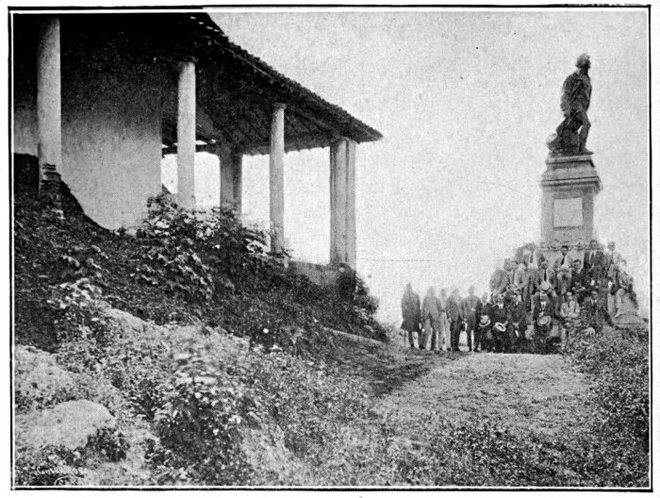
Bolívar's Home in the Mountains with Statue of the hero, Captain Ricaurte
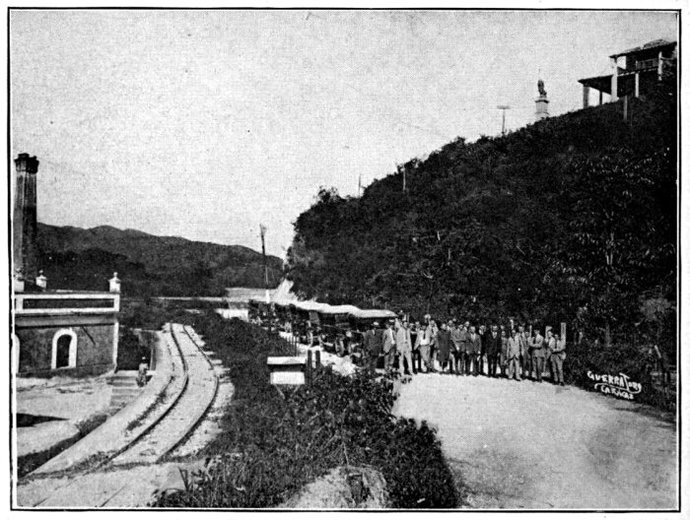
On the Road from Maracay to Caracas
The bids must be sent to the Minister of Fomento of Venezuela before the last day of June, 1920. On the last day of August, 1920, in a Cabinet Meeting, the bid which in the opinion of the Federal Executive offers the greatest advantage will be accepted, while the Government reserves the right to reject all bids if it is deemed convenient.
Any responsible construction concern—national or foreign—specializing in this work may send in a bid.
The importance of this proposed wireless station is very evident to those interested in Venezuela, and its prosperity. By establishing direct and efficient communication between this country and America and Europe, it will open the way to vast trade possibilities.
Having thus discussed the three methods of communication which are of paramount importance in foreign trade, we can not but realize that Venezuela has been working under a serious handicap. However, she has made great progress in the last decade and it is to be hoped that under a wise government she will continue her sound trade policies and before many years will take her proper place among the leading commercial nations of the world.
Philip D. Sullivan.
TRANSPORTATION FACILITIES
Pronounced improvements in the political, economic and social life of the Republic of Venezuela have been effected within the last few years by the construction, upon a broad and comprehensive scale, of a system of national highways totalling, in extent of completed roads, 2,900 kilometers (approximately 1,800 miles). These have been specifically designed to bear the burden of motor transportation both of passengers and freight, as well as of all classes of vehicular and equestrian traffic. Built primarily with a military objective, these roads already have come to serve the routine needs of peace, while being at all times available for the exigencies of war. They provide a means for the quick mobilization of the Venezuelan army of 50,000 men at any of the principal strategic points of the country. Infantry, cavalry or artillery may with equal facility and despatch pass over any of these roads to a given rendezvous. The broad, smooth highways compass distances, grades and defiles that hitherto presented almost impassable barriers to the quick and flexible movement of military forces.
If heretofore the army suffered from a lack of adequate transportation facilities, the commerce of Venezuela too was woefully handicapped. One of the greatest and most coveted of Venezuela's assets is her magnificent coastline of hundreds of miles on the Caribbean Sea. To realize the serious difficulties under which her rich interior labored in seeking an egress to foreign markets, it need only be noted that until the completion, during the last decade, of the highway system with its three separate routes from three chief ports of the republic to the capital and interior centers of industry, the country had the use of only two railway lines. These lines were well constructed, it is true, but offered an indifferent service at a prohibitive tariff with amazingly excessive wharf and terminal charges. The only available alternative to these consisted of old Spanish trails up and down the mountain sides where the necessity of walking in single file hazarded the necks of man and beast.
With respect to the technique of construction and maintenance of the highways of the new system, local considerations and the requirements of the major volume of traffic normally moving into or out of a given section have been carefully taken into account. On the level stretches of the extensive llanos in the interior, advantage has been taken of natural dirt bases for roads that have come to sustain the burden of the enormous production of cattle, grain, corn, coffee, cotton and sugar sent forth from those fertile plains. On the precipitous mountain slopes of the massive watershed that divides the highland llanos from the sea, macadam has been the principal material used; this has been true also in other mountain districts of the Republic. In general, American and English principles of roadbed construction have been employed and great numbers of steel bridges and not a few suspension bridges have been designed, imported and set up by leading American bridge-building corporations.
The improved route from Caracas to Guatire has made the latter accessible at all times to the capital. The route from Caracas to Barquisimeto supplies a direct road from the capital to the center of the Venezuelan Andes, while the one from Maracay to Ocumare de la Costa leads directly to the sea at the point of juncture of the two greatest highways, opening the way to the agricultural and cattle raising industries of the central region of the Republic.
The Great Eastern Highway leads from Caracas through the states of Miranda, Auzoategui and Bolívar to the mineral region of interior Guayana. The Great Western Highway connects the center of the Republic with the remotest western regions, leading from Caracas to Valencia, San Carlos, Guanare, San Antonio de Caparo and San Cristobal. It crosses the most densely populated part of Venezuela and promises to be, in the near future, the principal artery of communication. Telegraphic connection is constantly maintained between the road engineers and the minister of public works. The highway from Turmero to Calabozo is likely to become the bond of union between the great eastern and western highways. It has maintained traffic for the first time in the llanos during the rainy season, thus furnishing a constant outlet for the wonderful productivity of this region. Steam rollers and other standard mechanical apparatus have been employed in the construction work, while recently the authorities have commenced to use the superficial petrolization process for laying the dust and counteracting the impairment of the roadbed by the rapidly increasing automobile traffic.
The equipment of the highways has brought to the fore another characteristic and interesting Venezuelan institution—the road workmen—who fulfill a dual function in the task they assume when a road or section is completed: that of attending to, or assisting in, its upkeep or repair, guarding against violation of the regulations laid down for its use by the public, and otherwise policing a stretch that is three kilometers upon macadam roads and two kilometers upon natural dirt roads. The "peones camineros" represent but another and latter-day application to public service of the marvelously faithful, intelligent and efficient common labor of the country.
The mileage mentioned above is practically for motor vehicles and is constantly used by the 2,000 passenger cars in active service. Had the new road system been inspired and carried into execution by American builders for the advancement of their own people's interests, they could scarcely have served more thoroughly the purpose of American commerce. From the outset, these roads have operated to strengthen this country's position as a producer and exporter of automobiles. Thus a vital public improvement, undertaken by the Venezuelan Government, operated primarily to establish an altogether new market for one of the chief industrial products of the United States. Yet despite the fact that the capital of Venezuela, Caracas, has a population of 100,000 and boasts of having 1,000 automobiles or one car for every hundred citizens, relatively few motor-trucks are to be seen there or, in fact, elsewhere in Venezuela.
Nevertheless, it requires neither seer nor prophet to foresee practically unlimited opportunities throughout the land of Bolívar for every kind and class of American manufactures, from agricultural, mining and factory machinery to the smallest articles of merchandise; and this as the direct result of the building and extension of the Venezuelan highway system. For transporting these manufactures from ship's side to interior communities—some of them Spanish colonial settlements that have flourished for almost four hundred years but which until now have not known American importations—there is only one logical and available instrument,—the American motor-truck.
RAILROADS
The standard gauge of the United States and Canada, 1.435 meters between rails, was adopted by the National Congress of 1912, an act necessary for any great capacity of railroad transportation as well as the assurance of an immediate and adequate supply of materials.
Laws were promulgated June 12, 1917, and June 4, 1918, for the concession, construction and operation of railroads by domestic and foreign companies or individuals, containing the following provisions:
1. That all enterprises be approved by the National Congress; that all controversies be settled in Venezuelan courts; that one-half of the employees be from Venezuela, and that no interest be guaranteed by the government on capital invested.
2. That complete plans of any railroad project be submitted to the minister of public works prior to beginning operations, and that deposits of money be placed in the national treasury as a guarantee of integrity.
3. That regulations and standard measurements be carefully observed; also provisions for roadbeds, crossings, etc.
4. That the right be reserved to the National Government to take over railroads after forty years of service, if desired.
5. That rival lines in close proximity to those already constructed be prohibited, and that branches or prolongations of existing lines be permitted in accordance with regulations.
6. That rates fixed by owners be approved by the public ministry; that mails be carried free, and that reductions be allowed to government employees; and materials destined for the improvement of public works shall be transported at reduced rates.
7. Privileges: that no oppressive taxes be levied on railroads; that a fair proportion of unclaimed lands be conceded to railways; that free transportation be allowed railway construction material; that railways be permitted to erect telegraph and telephone lines provided the government be granted gratuitous use of them; and that the employees be free from military service, except in case of international war.
There are twelve railroad systems in Venezuela at the present time with a combined length of 600 miles and 40 millions of dollars invested capital.
1. The Bolívar Railroad Company owned and financed by the English with a working capital of $5,914,075 was the first railroad of Venezuela. The road is 88½ kilometers long, the gauge 0.61 meters. It has 165 bridges and 20 stations; the route is from Tucacas to Aroa. The number of passengers carried in 1919 was 24,408, and during the same period freight amounted to 38,820 tons.
2. The La Guaira-Caracas Railroad is over 23 miles in length and carries the greatest part of the products of the country; it serves more than half of the central part of the republic. This railroad is the most important railroad in Venezuela, because it has direct connection with the Valencia and Puerto Cabello Railroad and the railroad going to Ocumare de la Costa. The length is 35.5 kilometers, the gauge 0.915 meters. There are 10 bridges, 8 tunnels and 9 stations and the route is from La Guaira to Caracas. It is owned by the English with a capital of $4,175,000. The number of passengers carried in 1919 was 73,305 and freight amounted to 76,335 tons.
3. The Valencia-Puerto Cabello Railroad Company is the second most important railway in Venezuela and performs the same service as the La Guaira to Caracas Railroad. It is owned and financed by the English with a working capital of $4,141,000. It has a length of 54 kilometers, the gauge is 1.07 meters and there are 23 bridges, 1 tunnel and 6 stations along the route from Valencia to Puerto Cabello. The number of passengers carried in 1919 was 53,990 and freight amounted to 55,121 tons.
4. The Grand Railroad of Venezuela is owned and financed by Germans with a working capital of $15,000,000. The length is 179 kilometers, the gauge 1.07 meters, there are 212 bridges, 86 tunnels and 25 stations. The route is from Caracas to Valencia. The number of passengers carried in 1919 was 211,442 and freight amounted to 76,335 tons. The rolling stock of this road consists of 18 locomotives, with a combined weight of 720 tons, 30 passenger coaches, 68 flat cars, 60 box cars and 19 stock cars. The passenger tariff equals 6¼ cents per mile for second class and 7.78 cents for first class. Freight rates are equivalent to 15.65 cents per ton mile. The freight traffic is small and nearly half the revenue is from passengers carried. The management attempted some development work in tree planting, the introduction of new crops, and the improvement of stock, but the grasshopper plague affected the results.
5. The Guanta-Barcelona Railroad is owned and financed by a Venezuelan company with a working capital of $300,000. This road is 18.5 kilometers long, the gauge 1.07 meters; there are 4 bridges and 6 stations. The route is from Guanta to Barcelona. The number of passengers carried in 1919 was 13,553 and freight amounted to 28,863 tons.
6. The Railroad of Carenero is owned and financed by the French with a working capital of $1,576,800. It is 33 kilometers long, the gauge 0.915 meters; there are 57 bridges and 5 stations; the route is from Carenero to San José. The number of passengers carried in 1919 was 20,037 and freight amounted to 6,923 tons.
7. The Maiquetia-Macuto Railroad is owned and financed by the English with a working capital of $100,000. The length is 7 kilometers, the gauge 0.915 meters; there are 8 bridges and 4 stations. The route is from Maiquetia to Macuto. The number of passengers carried in 1919 was 430,668 and freight amounted to 2,563 tons.
8. The Central Railroad of Venezuela is owned and financed by the English with a working capital of $3,484,500. The length is 60 kilometers, the gauge 1.07 meters; there are 23 bridges, 14 tunnels and 7 stations; the route is from Caracas to the station Tereza. The number of passengers carried in 1919 was 326,945 and freight amounted to 22,971 tons.
9. The La Ceiba Railroad is owned and financed by a Venezuelan Company with a working capital of $1,600,000. The length is 81.5 kilometers, the gauge 0.915 meters; there are 43 bridges and 5 stations; the route is from La Ceiba to Roncayolo. The number of passengers carried in 1919 was 9,649 and freight amounted to 21,706 tons.
10. The La Vela-Coro Railroad is owned and financed by the Venezuelan Government with a capital of $208,000. The length is 13.5 kilometers, the gauge 0.915 meters; there are 8 bridges and 3 stations; the route is from La Vela to Coro. The number of passengers carried in 1919 was 6,681 and freight amounted to 10,828 tons.
11. The Grand Railroad of the Táchira is owned and financed by a Venezuelan Company with a capital of $1,500,000. The length is 115 kilometers, the gauge 1.07 meters; there are 3 bridges and 13 stations; the route is from Uraca to Táchira. The number of passengers carried in 1919 was 19,070 and freight amounted to 19,562 tons.
12. The Santa Barbara-El Vigia Railroad is owned and financed by the Venezuelan Government with a working capital of $600,000. The length is 60 kilometers, the gauge 1.07; there are 37 bridges and 3 stations; the route is from Sta. Barbara to El Vigia. The number of passengers carried in 1919 was 11,940 and freight amounted to 17,821 tons.
On several of the main roads traffic is lighter now than twenty-five years ago, and notwithstanding the fact that rail transportation costs no more than that by pack mule, scarcely any of the railway enterprises have earned a fair return upon the capital invested, though certainly transportation has been quickened and rates have been steadied, if not cheapened. The principal reasons for this lack of earning power lie in the sparseness of the population, and its distribution along a long narrow strip of territory skirting the seaboard, a condition which leads to the building of unconnected lines with short hauls. Contributory reasons are the moderate producing and consuming power of the people, and the general refusal of the lines to grant low rates for the transportation of commodities of small value.
The waterways of Venezuela, numerous and general as they appear on the map, are singularly disappointing on closer investigation. The great Orinoco is a fine natural highway, it is true, as far as Pericos, some 600 miles from the mouth, but here the river is broken by the rapids of Atures, and beyond by those of Maipures, hence it is impossible for large boats to pass through to the upper river. The Apure, Arauca, and Meta are, of course, useful means of communication with the Colombian border regions and the southwestern llanos, but the numerous tributaries on the north side are generally too variable in depth for permanent traffic, and those on the south, as we have seen, are broken up by rapids for practically their whole length.
On the other hand, if we take the positive value of the river highways, rather than their actual extent, we shall see that they are of considerable importance; the rivers of Guayana and of the eastern llanos may be of little use for large boats, but the Orinoco forms a great, central artery, from which roads, and perhaps eventually railways, can diverge to the limits of the basin. Some of the llano tributaries, too, are navigable for steamers, and thus the State of Apure is now kept in communication with the outside world. Then, too, there is the great advantage accruing to the State of Zulia from its central lake, with its many tributary navigable rivers, along which large boats can travel throughout the greater part of the State and on to the boundaries of those of the Andes, as well as into the neighboring republic of Colombia. Along most of these natural and easily utilized lines of communication there are already services of steamers, nothing very advanced, it is true, but still a beginning.
The most important of the accessible regions of the country are the great plains stretching from east to west of the Orinoco and Apure rivers, well suited to cattle raising, the rich alluvial region east of Lake Maracaibo and the rich agricultural region around Lake Valencia.
Although these vast plains are open ranges covered with natural grasses for cattle feeding, conditions, in general, are not those prevailing in the Argentine Republic. The climate is much more tropical; tropical diseases are prevalent, and the river valleys are subject to overflow in times of high water. The higher lands farther north along the foot hills of the coast range generally lack sufficient water during the dry season of the year, which is December to June. Much could be done to remedy this by the introduction of water through modern irrigational devices.
The future of Venezuela depends primarily on her own people, upon whom devolves the duty of developing in a conscientious and painstaking manner the many resources of their country. It is certain that in the task which lies before them they will need and obtain assistance of foreign capital and advice, and in this, if American enterprise is alive to a great opportunity, we as a nation should bear no small part.
Edward Fanning.
AGRICULTURE IN VENEZUELA
The Agricultural Zone of Venezuela covers about 300,000 square kilometers, according to recent statistics, and extends from the Atlantic Ocean to Colombia, embracing the territory between the Caribbean seacoast and the plains of the Orinoco towards the south of the country.
Venezuela has fertile soil, perfect adaptability to the growth and maturity of everything that is essential to the existence of man and beast, mild climate, with temperatures varying according to the elevation of the land and latitude, and strategic geographical position. These favorable conditions designate Venezuela as one of the most attractive and advantageous regions for agricultural pursuits. Twenty per cent of the population are engaged in agricultural work, but this proportion is far from being sufficient for an extensive development of the natural resources of this vast area. It is estimated that a population one hundred fold greater could derive a comfortable subsistence from this agricultural region. This vast area, including such a great number of square kilometers, should become one of the most prosperous, rich and accessible agricultural fields of the world following an increase in population, greater and improved transportation facilities, and with the introduction of new methods of cultivation and more general application of modern machinery.
The principal agricultural products of Venezuela are: coffee, cacao, sugar, tobacco, India-rubber, tonka-beans, cotton, corn, vanilla, wheat and kindred products.
The vegetable seeds are also numerous and consist of vetches, bean seed, peas, beans, peanuts and okra.
The vegetable plants consist of: cabbage, cauliflower, melons, asparagus, turnips, radishes, beets, egg plants, garlic, pepper, celery, carrots, cresses, onions, spinach, lettuce and artichokes.
The fruits of Venezuela, of which there are many different species, include: oranges, large sweet lemons, limes, plantains, pineapples, pomegranates, figs, grapes, strawberries, plums, breadfruit, chestnuts, mangoes, zapotes, parchas, medlars, tamarinds, cactus fruit, mandarines, and a great variety of bananas of a very high quality. There is a vast region available for the raising of bananas, but, up to the present no use has been made of it and there is a very small amount of capital invested in the production of this fruit ($100,000 in American gold).
COFFEE
The cultivation of coffee in Venezuela began in 1784. At the present time, it is estimated by experts that there are about 260 million coffee trees under cultivation, which place Venezuela second among the coffee growing countries, according to recent statistics.
Coffee is produced in the temperate climate regions of the Republic from five hundred to two thousand meters above sea level. It is estimated that coffee trees last from forty to fifty years, yielding an average crop of one-eighth of a kilogram of coffee beans per tree. Sixteen million dollars are invested in coffee trees in Venezuela at the present time.
CACAO
Venezuela possesses one of the choicest cacao zones of the world. The natural cacao (Theobroma edenda,—edible food of the Gods) is a seed from a tree indigenous to the soil of Venezuela. From this seed the chocolate of commerce is made. As the cacao tree requires for full development and good crops a temperature of 80 degrees Fahrenheit, and a moist air, therefore the Venezuelan lands along the coast of the Caribbean Sea, sloping from the mountain tops to the shore, and which are bedewed by the exhalation of the sea and irrigated by the many rivers coursing down the valleys, are found to be well adapted in all respects to the very profitable cultivation of cacao. It is, however, also found and cultivated in other parts of Venezuela.
About two hundred trees may be planted in one hectare (about two and one-half acres) and they must be protected from the sun by shade trees until they have acquired normal size. Five years after having been planted the trees begin to bear two crops a year, ripening in June and December. The average life of a tree is about forty years. The seed is similar to a shelled almond; about sixteen of these seeds are enclosed in an elongated pod ribbed like a musk melon. The pods are of a yellow and red color and when they become ripe turn purple. On being gathered and heaped in piles on the ground, after a few days they ferment and burst; then the seeds are shelled, washed and housed.
There are two grades of cacao grown in Venezuela, namely,—the criollo, which is the native cacao, and the trinitario, which was originally imported from the Island of Trinidad. The criollo, a very high grade, grows especially well in the valleys situated near the sea, where the temperature is warm and moist.
The demand for this product in Europe before the war was considerable and large quantities were exported annually. In Spain and Italy cacao is used in the form of chocolate, whereas in France, England and the former German Empire, it is chiefly used in the manufacture of sweets and confections, but its use is becoming so varied and extensive that it will soon be a staple article of consumption as universally needed as coffee or tea. Venezuelan cacao also finds a ready market in the United States where it is known as Caracas and Maracaibo Cacao.
As the cacao-yielding region in the world is comparatively restricted, the planters of this staple need not fear the increasing competition which has been met in the cultivation of other staple products. At the present time it is estimated that $12,400,000 are invested in the cultivation of cacao in Venezuela.
TOBACCO
Tobacco, discovered by the Spaniards in Yucatan, was introduced from there to the West Indies and thence transplanted to Venezuela, where it is most successfully cultivated in Capadare, Yaritagua, Mérida, Cumanacoa, Guanape, Guaribe and Barinas. Excellent tobacco is grown near Cumaná, that from Guacharo being considered exceptionally good. The plant thrives best in humid and fertile soil. Cultivation requires about six months in Venezuela before it is ready for the market, and while the cost of cultivation is not large, great care is required.
Some tobacco is exported from Venezuela, chiefly to Havana, where it is mixed in the manufacture of Havana cigarettes.
The different classes of tobacco grown in Venezuela are distinguished according to the regions where they are produced. These regions are
Maturin:
This grade of tobacco is produced chiefly in Venezuela and is used in the manufacture of Venezuelan cigarettes. It is one of the better known classes of tobacco entering foreign trade. This class of tobacco has:
1. Leaves which are light with relation to their bulk.
2. Medium strength, agreeable aroma.
3. It will keep in good condition for a maximum of two years but then begins to rot and completely loses its strength.
Capadare:
This class of tobacco is considered to be better than the Maturin tobacco. It maintains its strength and does not rot until three or more years after it has been gathered. It has a very agreeable taste and its weight as compared with its bulk is greater than that of the Maturin tobacco and does not burn as fast as the latter. It is classified into first and second class tobacco by the gatherers.
Salon:
On account of the very fine leaves and aroma which this tobacco possesses it is used as the outer leaf in making fine cigars. It burns well, is light in relation to its bulk and is classed by the gatherers as Cover, Inner-cover and Core tobacco.
Golfero:
This region is on the shores of the Gulf of Cariaco and has recently been planted with Havana tobacco seeds and is now producing a superior quality. It has strength, aroma of a fine quality and burns very well. It lasts about two years without rotting and on account of its steady strength and agreeable aroma, it is very much demanded by the manufacturers of cigarettes. It is divided into Principal, Half-tree and Sprouts.