Part II Student Reports (continued 2)
Reading edition
Guaribe:
This tobacco is rather strong, has an agreeable taste and aroma but as a general rule does not burn well. It is used in the manufacture of cigarettes, in small proportions, in order to give strength. It is also divided into Principal, Half-tree and Sprouts.
Cocorote:
This tobacco is mostly used in the manufacture of cigarettes. It has a delicate leaf, is light in weight, has considerable strength and good taste. It is classified as Cover, Inner-cover and Core tobacco.
Guacharo:
This tobacco is produced near the Gulf of Cariaco in the vicinity of the Guacharo Caves. It has an exceptional and superior strength, a better taste and finer aroma than any other tobacco, not only of Venezuela but of any place in the world where tobacco is cultivated. There is only a small supply of this kind of tobacco because it will not grow in any other region on account of the very mature strata formation. The leaf is small and delicate; there is consequently a great demand for it from the cigar manufacturers. Cigarette manufacturers can not make use of it because the quantity produced is too small.
PRODUCTION OF TOBACCO
The annual production of the different classes of tobacco in Venezuela varies a great deal according to the conditions of the season and the demand for the product. The approximate output between the years 1914-1919 was estimated at more than 3,000 tons from the different regions. The average production above referred to is liable to increase to a considerable extent provided the demand requires it, as soil fit for tobacco cultivation is plentiful. The price of tobacco naturally varies with the supply and demand and an increase of exports of tobacco contemplated in the near future will tend to increase the prices. The total value of tobacco exported from Venezuela in 1917 amounted to more than $50,000; in 1918(?) the exportation amounted to more than $800,000.
The total amount of capital invested in Venezuela in the cultivation of the tobacco plant is estimated at $2,000,000.
INDIA RUBBER
Rubber, which was discovered in French Guiana in 1758, is called "caucho" or "goma elastica," in Venezuela. The rubber produced in the Orinoco, Cassiquiare and Rio Negro sections of Venezuela comes from forests of Heveas. There are other species of rubber trees but their sap is less elastic and much thicker. The tree is found in plentiful quantities throughout the Guiana section and the Andes Range, and in some States of the East, West and South of Venezuela. More than twenty tribes of Indians inhabiting the Amazon territory of Venezuela gather rubber and prepare it, but, as a general rule, in a very primitive manner.
In the Orinoco region the Hevea tree produces from 40 to 50 grams of juice; in that of the Rio Negro from 80 to 100 grams and in that of the Cassiquiare from 125 to 150 grams per tree.
Due to the fact that this product as well as many others of the country are gathered within the vast territory bordering on Brazil, they are exported through the Brazilian port of Para and reach American and European markets as of Brazilian origin.
Rubber trees when cultivated in a scientific manner yield an average of 95% of pure rubber, each tree producing about 460 grams of juice.
The exploitation of rubber in Venezuela may be considered as limited entirely to the gathering of the natural product on a small scale, as the many million acres producing rubber would require several million people to exploit them. The investment of capital on a large scale is required to develop this important industry. First and most important, labor must be induced to come to Venezuela in order to develop this immense natural resource now scarcely touched. The world demand for this product is great and rubber would undoubtedly be a profitable investment for American investors if undertaken in a systematic and technical way. It is estimated that not more than $1,200,000 are invested in the rubber industry in Venezuela.
SUGAR CANE
Sugar cane is indigenous in Venezuela and cultivated with good results. Lately, Sugar Cane Central Factories have been established to manufacture the products of the sugar cane. These plants equipped with the best modern improvements as to buildings and machinery have at their disposal sufficient capital to enable them not only to supply the home consumption but to export their products in considerable quantity.
The climate and the fertile soil of Venezuela are the principal factors in the production of sugar cane, as it grows everywhere in Venezuela except in mountainous parts lacking irrigation.
Four species of sugar cane are cultivated in Venezuela, namely: Criolla, the Otati, the Batavian and the Salangore.
The Criolla is cultivated to the largest extent on account of its sweetness and good results.
The planting and cutting of the sugar cane is controlled in such a manner that there is always in the plantations sufficient cane reaped and ready, in order to avoid interruptions in the grinding during the whole year round. To ensure this continuity of crops, the soil must be kept well irrigated at all times.
The region near the Lake of Valencia produces longer and thicker canes having more juice, but they contain less sweetness.
Sugar plantations are usually divided into Tablones covering ninety meters square, each lot separated by a road. Such lots, when well manured, irrigated and sown with sugar cane, produce sixty to eighty loads of "papelon" (brown sugar), or 160 loads of alcohol: that is, 5,120 cones of brown sugar weighing 8,129 kilograms or 9,600 liters of alcohol. Every plantation of any importance has a special building with the necessary machinery and equipment for manufacturing the different sugar products. These are: sugar, brown sugar, alcohol and rum.
Brown sugar is offered for sale molded in different forms such as cones and squares. The best quality of sugar produced in Venezuela is manufactured near Guatire, a town three hours distance from Caracas by motor truck or automobile. Rum is manufactured from sugar cane and alcohol. The previously mentioned Sugar Central Factories command an aggregate capital of $7,700,000, have a total of 12,800 hectares of sugar cane under cultivation and can produce 2,600 metric tons of sugar per day. This product at present commands a high price abroad; therefore, with proper management these plants now offer a Venezuelan product for exportation in large quantities and of a very fine quality, and for which without much difficulty they should be able to establish a wide market.
As far back as 1913 there existed 600 individuals and companies devoted to the cultivation of sugar cane, with an aggregate total capital of more than $10,600,000 invested in this industry.
WHEAT
This product was introduced into Venezuela by the Spaniards at the beginning of the conquest and was cultivated in Aragua, Barquisimeto, Trujillo, Mérida and the Táchira. The high table lands and valleys in the mountainous regions of Western Venezuela are available for cultivation of wheat. Fine crops of this grain are now raised, which, after being made into bread, is the chief breadstuff of all classes of the country.
In the Republic of Colombia wheat is cultivated on a large scale with good results both in cold, temperate and hot zones. Venezuela has similar zones, therefore by sowing the proper kind of grain in each zone as practiced in Colombia and by adopting the same or similar systems of cultivation as are there used, wheat could easily be raised in Venezuela not only for home consumption, but for export.
COTTON
Cotton, although a natural product of Venezuela, was not cultivated until 1782. Its output became important during the Civil War of the United States, but after that event and the subsequent great decline in prices of this staple product, the industry was gradually abandoned. The cotton tree attains the height of a shrub and under usual cultivation produces in Venezuela more than in the United States. At the beginning of 1800 the average exportation of cotton was 450,000 kilograms a year. In 1850 the export of cotton was of 300,000 kilograms and in 1888 of 57,000 kilograms. In 1913, 267,300 kilograms of cotton with a commercial value of $72,120 were exported.
Cotton grows in nearly the whole territory of Venezuela, but the best results have been obtained in the States of Aragua and Carabobo, which produce 54% of the total Venezuelan crop.
The farmers sow cotton when they plant corn or beans during the month of July and the crop of cotton begins to be gathered at the end of the month of November or the beginning of December. This depends upon the time when rains permit the sowing. The crops of corn or beans pay the expense of the whole cultivation of the cotton and the only outlay in the raising of cotton is the gathering. It is estimated that the production of cotton in Venezuela in normal times, excepting droughts, locusts, etc., amounts to 7,000,000 kilograms in the seed. There is an average of 28.5% cotton in the seed, therefore, 1,995,000 kilograms of seeded cotton are produced. The cotton seeds which were sown in the month of June, 1918, began to give a crop in the month of December of the same year, and the gathering of said crop ended in the month of March, 1919. It has been estimated that this crop produced a total of 1,995,000 kilograms of seeded cotton grown in the various states of the Venezuelan Federal Union.
The price of cotton in Venezuela during the last eight years (1911-1919) has fluctuated between Bolivars 70 to 150 per 46 kilograms. The last price of 150 Bs. per 46 kilograms was the one paid at the end of the 1919 crop, due to the high price of cotton in the United States, the country producing the greatest amount of cotton in the world.
Since Venezuela produced in 1919 a total of 1,995,000 kilograms of seeded cotton which were sold at an average of 3.25 Bs. per kilogram, the total value of the Venezuelan cotton crop amounted to Bs. 6,483,750 ($1,296,750 American gold).
Venezuelan cotton is classified as Cotton No. 2. (Egypt produces cotton No. 1.) Due to the difference in seeds, soil, cultivation on a small scale, etc., Venezuelan cotton is mixed in such a manner that a standard quality of uniform length of fibre is not obtainable in a given lot. For this reason the price of Venezuelan cotton is always somewhat less than that of the medium class cotton from the United States.
The State of Zulia produces the best quality of Venezuelan cotton, due to the length of its fibre and because it is more advantageous when manufactured, but as the cloth industry in Venezuela is not intensive enough to warrant the classification of fibres, this advantage is not noticeable in the aggregate cotton trade of Venezuela. The cotton plant gives but one crop a year and requires to be replanted every year. At the present time it is estimated that $200,000 are invested in the cultivation of this product.
TONKA BEANS
These beans, which are exported from Venezuela on a large scale, have the shape of a large black almond and give out a delicious perfume. When dry their peculiar perfume develops still more and it is used as an odorous basis to make high grade perfumes, and to flavor tobacco. The bean is a natural product and needs no cultivation, as a general rule; it is gathered in the Tonka forests existing in the Amazon territory and the District of Cedeno, in the Venezuelan Guianas. Tonka beans are a staple of great value in the regions watered by the Orinoco River and its tributaries, and almost the entire crop of Venezuelan Tonka beans are exported by the way of Ciudad Bolívar.
The gathering process formerly in use brought about the destruction of the trees, but the Venezuelan Government has taken the necessary measures to prevent the trees from being felled as was formerly the case. The large trees now in existence are being protected perfectly. In the year 1913 Venezuela exported more than half a million kilograms of tonka beans having a commercial value of $727,800. One or several well organized companies with the necessary capital at their command would derive great profit from such exploitation.[10]
VANILLA
Venezuela produces an uncultivated vanilla plant called "vanilla lutescens," but that commonly known to commerce is the more aromatic kind called "vanilla plantifola." The cultivation of this product has not been fostered to any great extent. It grows readily in the rich soil of the States of Falçon, Lara, Bolívar, Anzoatequí and Zamora. No official figures are available as to the production, cultivation or export of this product, although there is a good opportunity for further development.
COCOANUTS
There are many cocoanut tree plantations in Venezuela, chiefly in the regions of Zulia, Carabobo, Bolívar, Barcelona and Cumaná. Cocoanuts are used for various reasons abroad and in the United States, therefore the cultivation of this natural product could be fostered so as to make it an article of export on a large scale and it would become a profitable investment not requiring a large capital. In 1913 there were invested in Venezuela in the cultivation of cocoanut trees $1,095,200.
INDIAN CORN
This product is successfully cultivated in all the States of Venezuela where it grows in every kind of soil, from the level of the sea to 2,800 meters above it. It thrives best, however, at an altitude of 500 to 1,000 meters. There are about 73,131 acres in Venezuela devoted to the production of corn, and the total amount raised is estimated at 150,000 metric tons. Special attention has lately been paid to the cultivation of corn, which is the real bread-plant in Venezuela, especially in the interior of the country, and a considerable quantity of Indian corn has been exported.
BEANS
Beans are also successfully grown in all the States of Venezuela and a great variety of them are produced. Those having the greatest demand are the "black beans." Their production not only meets the domestic demand but they have been lately exported in considerable quantities. They grow readily at all times of the year and are one of the principal articles of domestic commerce in Venezuela.
INDIGO
This product was introduced into Venezuela in 1777 and planted near La Victoria and later in many other places. The best quality was produced at San Sebastian. Due to the high price attained by coffee many years ago, the cultivation of indigo was abandoned. In 1902 the exportation of indigo amounted to 1,876,510 pounds having a value of $2,450,000.
This product has now sufficient demand in foreign markets to warrant the revival of its cultivation as a remunerative exportable commodity of Venezuela.
During the year 1917-1918 the products exported from the agricultural zone of Venezuela amounted to $10,400,000; in this zone there is now invested $46,600,000. A presidential decree of March 12, 1917, created an experiment station of agriculture, live stock, and forestry with a garden of acclimatization to be located at Cotiza near Caracas. Its purposes were stated to be:
The study of improved methods of cultivating the agricultural products of the country; the introduction, selection and distribution of seeds; experiments in reforestation; preparation of reports upon nature of soil and most adaptable crops from each region, with practical work for the training of agricultural foremen and forest rangers.[11]
Other purposes are:
To maintain circulating agrarian libraries, to promote expositions, to form nurseries of exotic plants, to introduce new agricultural machinery and implements, and to supply all possible information and assistance to the country.
In the following table the amount of capital invested in Venezuela in the cultivation of its eight principal agricultural products is shown.[12]
Coffee trees $16,000,000
Cacao 13,000,000
Balata and rubber 2,000,000
Cocoanut trees 2,000,000
Tobacco 2,000,000
Bananas 500,000
Cotton 400,000
Sugar cane 11,500,000
Total $47,400,000
The following table shows the principal products exported from the Agricultural Zone of Venezuela from 1917-1918,—weight in Kilograms and values in Bolivares.[13]
Products. Weight in kilograms. Value in Bolivares.
1. Cotton 3,067 4,930
2. Starch 248,801 104,307
3. Sugar 13,260,562 5,526,798
4. Cacao 20,280,865 10,603,372
5. Coffee 34,123,145 29,190,622
6. Bananas 377,636 58,205
7. Indian Corn 21,360,191 4,878,173
8. Brown sugar 5,440,551 1,427,161
9. Tobacco 297,579 324,436
Total 95,392,397 B. 52,118,004
THE FOREST ZONE OF VENEZUELA.
This vast region extends from the Gulf of Maracaibo over the mountains of Yaracuy, San Felipe, Aroa, Tucacas, San Camilo, Guayana and its territories, and from the untouched forest of the Trujillo and Barquisimeto mountains to the fertile woodlands of the State of Zamora.
The Forest Zone of Venezuela comprises about half of its territory; of this half, 98% is still virgin land, a fact which may be regarded as one of the principal hopes for the progressive future of the country. The Zone has an area of 795,640 square kilometers, from which over two thousand specimens were exhibited in Caracas at one time. From this immense region Venezuela can derive natural resources of unlimited wealth, when sufficient labor and capital are available, better means of transportation established, and more modern machinery and implements introduced.
The following figures show the division of the Forest Zone of Venezuela:
Public Forest Lands 295,400 sq. kilometers
[14]Private " " 125,000 " "
The Forest Zone of Venezuela comes within the forest area of South America. Richest in quantity, and, probably in variety of vegetable life, is the well-known land of Guayana, with its vast forests, hot climate and heavy rainfall. Within this area the plants range from the alpine shrubs and reindeer moss found on some of the higher plateaux and hills to the bamboos and orchids of the river banks. The high timber trees grow fairly close together, and their spreading tops fifty, eighty, or one hundred feet from the ground, with the abundant hanging manes and flowering creepers, keep all but a feeble light from the ground; hence it comes that the undergrowth is usually sparse or absent, and progress on foot is comparatively easy.
Of all the forest giants of Guayana, "Schomburgk" is considered the most magnificent; the average diameter of the trunk is about three feet, and it seldom branches at less than forty feet from the ground. Its wood, dark red and fine grained, is said to be excellent for shipbuilding purposes.
Caoba, whose wood is very like mahogany in color, and a certain big tree called "rosewood," which it resembles, are notable among the timber trees. The huge Ceibas have a soft, easily worked wood, excellent for the dugout canoes of the Indians. The equally large Mucurutu or cannon-ball tree furnishes a beautiful but hard grained timber.
Two fruit trees whose products are well known throughout Europe grow in the regions of Guayana, the Brazil nut and tonka bean trees.
The gums and resins of Guayana include the balatá, copaiba-balsam, and rubber-producing trees, the latter chiefly varieties of hevea, while cinchona or quinine, with innumerable creepers and trees possessed of medicinal or toxic properties are found on all sides. There are more than 2,450 known species of plants to be found in the Forest Zone and more are being added to the list daily; it is probable that in such an assembly there must be many of value as yet undiscovered and unused.
The forest plants and trees of Guayana also flourish in the Delta Region and in the forests bordering the Llanos of Maturin, but the vegetation of Northern Venezuela is generally different from that of the South. The great brown plain of the Llanos is beautified by small golden, white, and pink flowers, while sedges and irises make up much of the small vegetation. The banks of the rivers often support denser groves of ceibas, crotons, guamos, etc., and along the banks in front of the trees are masses of reeds and semi-aquatic grasses.
In the region of the Cordilleras many different types of vegetation can be found in the various zones. The very hot section has generally a heavy rainfall and supports thick forests, but along the sea coast there are barren stretches with only cactus, acacia, croton, and similar plants. In this region we have the plantations of cacao, sugar, bananas, plantains, maize and cassava, which are the staple foods of the inhabitants. The growth of cocoanuts is also encouraged. In addition, there are many products of the forests, chief of which are the dyewoods, and tanning barks, including logwood, dividive, mangrove, indigo, and many others. There is also a great deal of valuable timber in this region, the chief woods exported being mahogany and cedar.
In the cooler regions we find a mixture of hot country plants and those of the mountains. One may see in the same valley, within a short distance of one another, bananas, potatoes, sugar cane, wheat, yuca or cassava, peas, maize, cotton, cocoa and coffee, all flourishing, and a single orchard may contain guavas and apples, peaches and oranges, and a variety of other fruits; the garden adjoining will have a mixture of roses, carnations, violets and dahlias and many tropical flowers. Strawberries, mint, nasturtiums and other of our garden plants have been successfully grown in these mountain regions within 10 degrees of the equator.
The higher part of this region exhibits a great variety of plants peculiar to this zone. Along the mountain roads can be seen palms, screw-pines, and beautiful tree ferns, also cranberries, blackberries, ivy, quinine-trees, small bamboos, silver-ferns, and many other beautiful plants and shrubs. In short, here can be seen the greatest variety of color and floral scenery.
In the cold region of the Cordilleras the small woods of the temperate zone gradually die out, and toward the snow line we have the alpine grasses, heaths, and thick leaved, aloe-shaped plants which have lumps of resin clinging to their roots, and seem to take the place of pines, which are not found in Venezuela.
The value of the products of the Forest Zone of Venezuela exported during 1917-1918 was more than $1,800,000. The capital invested in the cultivation of this zone amounts to more than $2,000,000.
Matthew J. Heiler.
THE CATTLE INDUSTRY IN VENEZUELA
This report is based chiefly on conferences and trips with Dr. Martínez Mendoza, Director of the Agricultural Experimental Station, and on notes which he very kindly furnished. The following references have also been consulted:
"Venezuela." Handbook prepared by Dr. N. Veloz Goiticoa for the Ministerio de Fomento.
The Annual Reports of the United States Consul at La Guaira, for 1916 and 1918.
"Venezuela" by L. V. Dalton, 1918.
The article on "Venezuela" in the Encyclopedia Britannica has been consulted.
Venezuela has an area of approximately 393,976 square miles and a population of over 2,848,121.[15] From these figures one may see that the country is very sparsely settled, and that the first requisite of a cattle country is met,—that of plenty of open land.
The main occupation of the people is agriculture. Stock-raising is next in importance and promises soon to be the leading industry of the country. Yet, even though the industry is now important, it is developed to such a slight extent, in view of its possibilities, that the past history means little and statistics mean but little more. The wars for independence, internal strife, political unrest and a certain lassitude on the part of the people have greatly hindered the development of the industry in the past.
There exist no authentic source material or statistics covering the cattle industry in Venezuela. Only during the last few years has the Government succeeded in convincing cattle raisers of the importance of accurate statistics and led the way itself by beginning systematically to compile them.
The following statistics are, consequently, approximations and consist for the most part of rough estimates. They were obtained from the 1919 booklet of N. Veloz Goiticoa and were officially edited by the "Department of Fomento" and are, consequently, the most nearly correct and authentic which could be obtained and also the most complete.
Still, as stated before, it is not the past in which we are interested, so much as the future, and hence we shall merely quote the available figures and then dismiss them from further consideration.
Number of Cattle in Venezuela.
1804 1,200,000
1812 4,500,000
1823 256,000
1833 2,437,150
1839 4,617,560
1847 5,503,000
1864 5,800,000
1873 3,302,670
1883 8,591,860
1894 6,345,560
1899 6,059,480
In 1919 it was estimated that there were only 2,600,000 head of horned cattle within the country.
The figures of 1915-16 for live-stock show:
Horses 191,000
Goats 1,700,000
Sheep 177,000
Cattle 2,000,000
Live-Stock on the Hoof Exported From Venezuela from 1831 to 1918.
1831 1,825
1847 15,976
1852 13,316
1882 5,929
1898 24,000
1901 60,000
1903 60,000
1904 60,000 Wt. in Kilograms. Value in Dollars.
1915 18,339 5,415,000 259,800
1916 18,267 5,115,000 246,000
1917 18,333 5,195,000 325,000
1918 19,020 5,343,000 308,000
Exports of Frozen Meat from 1915 to 1918.
Years. Carcasses. Wt. in Kilograms. Value in Dollars.
1915 17,847 2,197,240 196,663
1916 18,267 3,315,990 334,216
1917 18,335 4,978,420 398,273
1918 5,867,770 467,867
In 1917-18 the exports of the "Pastoral Zone" were:
Products. Value in Dollars.
Salted meat 3,398
Frozen meat 467,867
Animal hair 100
Horns 1,788
Skins 1,673,230
Frozen residue of horned cattle 10,982
Horses, sheep, goats, pigs 24,539
Horned cattle 308,188
Wool 155
Soles 67,442
Total 2,657,689
In 1919 it was estimated that $20,000,000 were invested in stock-raising and pastures. Since that time there has been a great increase and it is safe to estimate that now the sum is nearer $30,000,000.
Topographically Venezuela may be divided into three regions:
1. The mountain area of the north and northwest.
2. The Orinoco Basin, with its spacious "llanos" (plains).
3. The Guiana Highlands.
It is the second region, called "The Pastoral Zone," in which we are most interested. The other two concern us only in two respects: as a source of water supply, and as a hindrance to easy transportation.
"The Pastoral Zone" covers 300,000 square kilometers (187,500 square miles), and extends from East to West, from Barrancas, on the vertex of the Orinoco delta, to the plains of Sarare on the Colombian frontier; and from South to North from the Vichada River to the mountains of El Pao in the State of Carabobo. It includes the states of Portuguesa, Zamora, Cojedes, Apure, Guárico, Anzoátequi, Monagoas, Bolívar and part of the other neighboring states.
This entire region is most admirably suited for the raising of cattle. All year round there is an abundance of green grass and the cattle do not need much care. Here exists one of the finest natural pastures of the world, capable of supporting, with the use of modern methods, 50,000,000 head of cattle, twenty-five times the number now existing.
There are two seasons—wet and dry. During the rainy season, from June to October, the cattle feed in the highlands and mesas, which are not subject to inundation. From January to May, the dry season, they feed in the lowlands, which always retain a natural dampness and abundance of grass.
The climate of this zone is slightly warmer than that of the plains of Texas, and the dampness of the lowlands results in a much greater growth of vegetation suitable for cattle.
Throughout this region are scattered the cattle farms of the country, in most of which the primitive methods of cattle raising are still followed. The "llaneros," as the inhabitants of the plains are called, have not yet commenced to utilize the modern methods for breeding or raising cattle. The cattle run almost wild and considerable loss results from the lack of proper care. The milk is obtained almost entirely by the calf, and thus another great source of income is lost. This accounts for the importation of $400,000 worth of butter annually.
Each year the cattle over three years old are separated from the herd and slaughtered, although the slaughter of cows is prohibited, and General Gómez has absolute control over the slaughter of beef for home consumption. Then, until the next year, the cattle are again allowed to run wild and at will.
The reason for this apparent carelessness is the regrettable lack of sufficient labor to care for the herds. This is also the main reason for loss by disease and drought.
The Orinoco River, 1500 miles long, and 1900 miles long if measured by its Guaviare branch, lies entirely within Venezuela, and drains this great cattle section. It has 436 tributaries, and plays an important part in the transportation of cattle. Here lies the remedy for drought. No steps have yet been taken for the proper storage of water for emergency use; with the installation of water storing facilities the drought loss may be practically eliminated. The screw-worm of the kind existing on our Texas ranches is here in evidence and loss undoubtedly results from this source.
Malarial fever at times works havoc in various sections of the "llanos." Though it may be said that the effects of this disease are greatly exaggerated it is true that the disregard of the laws of hygiene is responsible for the wide prevalence of this disease. It is the supine ignorance of a portion of the half-savage people who inhabit the plains, which allows the disease to gain dangerous headway. These people live and eat in primitive fashion, drinking muddy water, eating badly cooked roots and beef, without salt, sleeping in the open nearly naked, and consuming at every opportunity huge quantities of coffee and spiritous liquors (aguardiente), thus becoming predisposed to end as victims of the dread disease. With the adoption of sanitary methods to combat the fever, it may be wiped out upon the plains, as is now happening in some of the better ranches where the workmen observe the elementary laws of hygiene.
Considering Venezuela's natural advantages and the handsome profits even now realized under the loose methods of breeding followed, it is certain that Venezuela is destined to be primarily a cattle country. "If, notwithstanding the unprogressive methods followed in the breeding of cattle, and despite the lack of care on the part of the 'llanero' in the selection of good males, resulting in a large percentage of weak calves, which, on reaching puberty, give little milk and little beef, it still appears that breeding is the most profitable industry in the country, it can well be imagined how the profits will increase when the Venezuelan breeder puts into full operation the modern improved methods for breeding, such as the selection and crossing of good breeds, the introduction of modern methods of sanitation, and the selection and improvement of the pastures for fattening and the production of milk." (Director of Experimental Station of Agriculture, Dr. Martínez Mendoza).
Until very recently, a decided lack of adequate transportation facilities prevented the development of the industry. Death of stock and loss of healthy condition when transported by the shaky mountain railways decreased the profits of the cattle raisers. Lately, 1,800 miles of motor roads were built under the direction of General Gómez, which afford an outlet for the products of the "llanos." Their construction means the unification of the country and its development. Probably no one factor has been of such prime importance to the nation as this great engineering feat.
Still, it must be acknowledged that these roads are not sufficient and that there is still a lack of transportation facilities. The one saving factor in the situation is the Orinoco and its branches.
In the past very little attention has been given to the systematic crossing of breeds. Of late, several prominent cattle raisers, aided by General Gómez, have begun scientifically to better the breeds of animals by the importation of fine foreign stock. Thus, the Zebu cattle has been in the country for some time. This type excels the native cattle in weight, but is very fierce and wild.
The milk cows are now being selected with great care and good results are being obtained from crossing them with native stock. Dutch, English, Swiss, German and American cows are kept in several up-to-date establishments, where the raisers are beginning to overcome the difficulties of acclimatizing the foreign breeds, and a high average in the production of milk is resulting.
At "La Rinconada," an establishment very near Caracas, the pure breed "Holstein Friesian" is found and the specimens are sold to cattle-men of the interior, showing a commendable tendency on their part to improve their stock. I have visited this establishment and may say that great diligence is exercised in the care of these cattle.
Although the principal income from cattle accrues, of course, from the slaughter of beef and sale of hides, there is another great source of income,—the production of "cincho," cheese, for home consumption. Cattle on the hoof now command a price of Bs. 25 ($5.00) per "arroba" (25 pounds); the price of cheese is Bs. 600 ($125.00) per 100 kilos. Because of the recent advances in the prices of cattle and cheese, the industry has obtained a new impetus as is evinced by the huge investment of foreign capital (mainly English) during recent years.
The Venezuelan government is doing its best to encourage foreign capital to invest in the industry. To stimulate production breeding animals, barbed wire, pumps and well-boring machinery may be imported at a very low rate of duty.
Immigration is being encouraged by the payment of transportation, passport, and incidental expenses, and by grants of land. In spite of this, immigration however is very small, being offset by emigration, and the high death rate that results from unsanitary conditions keeps the population figures of the country practically stationary.
There are laws in operation fixing the price and amount of land to be bought by any one person. One may buy 6,000 acres of first-class grazing land and 10,250 acres of second-class grazing land at very low prices. He must improve the land and have at least ten persons on every 250 acres, in the case of land grants, though I have been unable to ascertain whether this also applies to bought land.
To buy land one first applies, in writing, to the governor of the state in which the land is situated. If no objection is found to the sale, a land commission surveys, classifies, and values the land. The application then goes to the Minister of Fomento, who, if he approves it, issues a deed, upon payment of purchase price in bonds of National International Consolidated Debt, or the equivalent at the current rates. The deed must then be properly recorded.
The government is encouraging the industry by the imposition of very high protective duties. An example may be found in the boot and shoe industry which is protected by a tariff, based in 1918 upon gross weight and, including surtaxes, amounting to $274.10 per 100 pounds.
Of late, more and more impetus has been given to the establishment of canning, tanning and meat packing plants. Yet, there is only one packing house in the country. The "Venezuelan Meat and Products Co., Ltd.," an English company, with a plant at Puerto Cabello, has practically a monopoly of the exportation of frozen and chilled meats and of "tasajo" (jerked beef). The capacity is 300 head of cattle per day and the chief market is Europe. The same company has invested large sums in choice cattle lands near the site of the factory, and since its infancy has shown a consistent tendency to steady expansion.
There are two sizable tanneries at Maracaibo which supply the local demand for coarse leather. Uppers for shoes and finer grades are imported from the United States. Other smaller tanneries are located at Caracas, Valencia and La Guaira.
At Barrancas is located a salt-meat plant which is expected shortly to handle 25,000 head of cattle per year in the production of gelatine, meat extracts, fertilizer and salt meats. The very high price of salt in Venezuela is a severe drawback to the salt-meat industry.
Río Chico is a manufacturing town, making soap and candles and passing the hides to La Guaira for tanning and export.
The Dairy and Canning plant at Maracay is entitled to special mention. It owes its success to the support given by General Gómez, its largest stockholder. It is ideally located, being surrounded by some of the most modern cattle ranches of the country, and has the advantages of nearby and easily accessible markets. The company also owns its own cows, and hogs which are supported by the waste and refuse of the factory.
The building is a specially constructed one, fitted out with a refrigerating plant and modern machinery of American and German make. Even the cans used are made within this building. Two kinds of butter are made here, one with salt and the other without salt. This is the best butter made in the country. Canned sterilized milk and cream are also produced, as is also a high grade of cheese. The capacity is 400 pounds of butter and 100 pounds of cheese per day.
Immediately upon entrance to this factory, one is impressed by the extreme cleanliness and efficiency existing and by the up-to-date methods used.
Finally, we may consider the advisability of investing capital in the cattle industry in Venezuela, as there is no question that real opportunity for profit exists here.
Venezuela is superior to Argentina, the other great cattle country of South America, in every respect except one, that of the amount of pasture land. This handicap, however, is not very important considering that Venezuela is not producing to capacity by 96 per cent and that it will be a very long time before it becomes necessary to look for means of extending the present feeding grounds. When that time comes, alfalfa may be planted on the mesas and highlands not bearing a natural growth of grass. It has been demonstrated that both alfalfa and elephant grass will grow in almost all sections of Venezuela.
Venezuela is a week nearer to Europe than Argentina. The vast importance of this fact is self-evident, for it means that Venezuela will always be called upon up to the limit of her production.
Land is cheap. A square league of meadow land may be had for $80.00. The best pasture land in a good location may be bought for $800.00 per square league. Land is abundant too, and but a small percentage is now in use.
Guanta is a port of the Carribean, in the State of Bermúdez, 12 miles east of Barcelona, with railroad connections. It has a protected harbor, with an easy and safe entrance 1998 feet wide, secure anchorage for large vessels, and a good wharf. Behind Guanto lies fine cattle land, a significant fact when it is recalled how very important is the shipment of live cattle.
Here would be an ideal spot for an American packing house, and the country behind would seem well adapted for the investment of capital in cattle-raising.
The regions just below Ciudad Bolívar would also be a good location for an American enterprise. Stock may be very cheaply bought and brought down the Apure and Orinoco rivers to the plain below the city, where they could be fattened and slaughtered. There is easy access to the Carribean and Atlantic, to Trinidad and other markets.
On the other hand, we may say that the future of the cattle industry depends primarily upon the political situation of the country. It is this factor which has retarded the industry in the past and which is now responsible for the hesitancy on the part of foreign capital. The profit to be derived from any industry here depends upon a firm, stable government. Under such a government the profits to be derived from cattle will be immense. If political wars again break out, however, heavy losses are almost inevitable.
The present administration has done more for the development of the country than any previous government and its attitude towards foreign capital is favorable. It has, furthermore, been firm and stable.
Still, beneath it all, one detects signs of a strange unrest. The observant traveler hears murmurings every day. There is no denying the fact that the present government is a military one. Yet, I believe that the intelligent and influential class of the nation realize the good it has done and feel that the country must never return to the old conditions of ceaseless revolution. I am of the opinion that Venezuela has fairly embarked upon a program of development and prosperity.
Another factor to be seriously considered is the aforementioned shortage of labor. Yet, in spite of this, labor is very cheap. The government has a favorable attitude toward grants for colonization purposes, and in this lies a golden opportunity for a resourceful man with capital to bring his own laborers here and realize great profits in the venture.
If, upon more detailed examination of the conditions than I have been able to institute during my limited stay, it is still the desire of Americans to invest here, such action must be taken soon. The unprecedented success of the packing plant at Puerto Cabello has encouraged other Britons to invest. The company itself is acquiring the best lands about the site of the plant and interested investors are buying the desirable land in other sections. The American who intends to invest should do so immediately or he will find that the choice cattle lands and the best locations for packing houses will be in the hands of the English. Prompt action is imperative.
Willard C. Frazee.
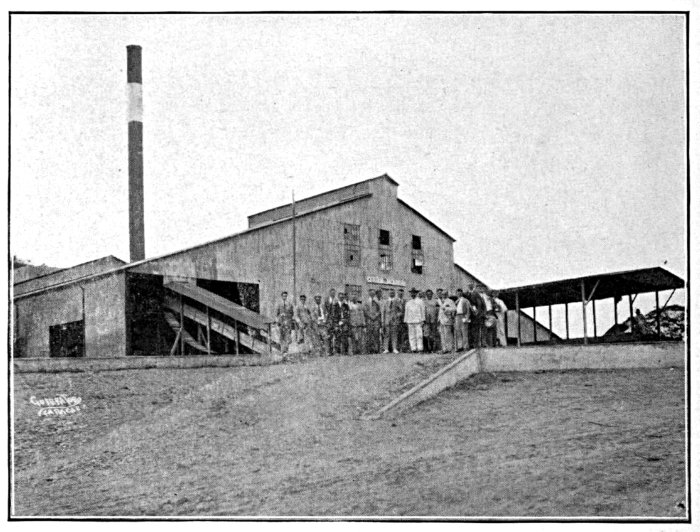
At the Central Tacarigua, a large Sugar Cane Estate
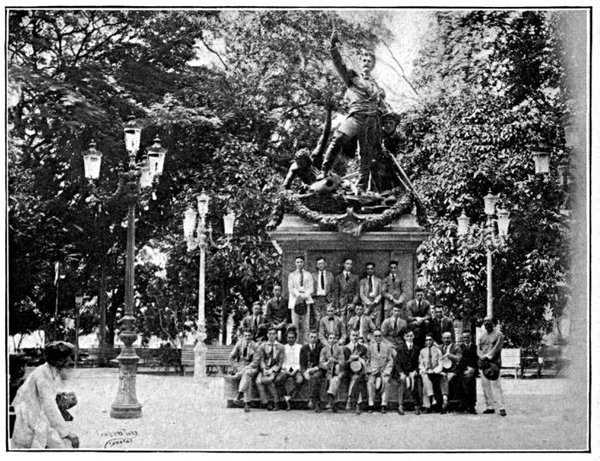
Dr. Sherwell and Dr. Sánchez, Director of the National Library with Georgetown Students at foot of Statue to General Ribas and Student Soldiers of the War for Independence
MINERAL RESOURCES OF VENEZUELA
Before discussing the minerals of Venezuela we shall touch briefly on some of the predominant features of the topographical formation of the country, without, however, entering on a detailed description of the geologic aspects of the rocks and soil. The location of minerals is directly connected with geologic formations, and the findings of geologists should be consulted before we can take up the more intimate study of mineral ores for commercial and industrial purposes.
It has been stated that one of the most ancient land surfaces in the world is the Guayana Highlands, and from observation made on this point they may be said to offer many striking analogies to the western highlands of Scotland, which furnish such frequent opportunities for exalted poetical allusion in the writings of Robert Burns. The great, elevated platform, from which rises the peaks and mountain chains of Guayana appears everywhere to be composed of rock which during the process of integration and disintegration has preserved traces of a primitive land of long ages ago when living organisms, if there were any, had not reached such a stage in their development as to leave relics in the deposits of the time. The mountains are thought to be composed of similar rocks, gneisses, hornblendes, schists, and granite, all containing evidence of great antiquity in point of geologic time. This Guayana complex, as it is called, has been considered by geologists as more or less equivalent in age to the Lewisian gneiss of Scotland and therefore one of the oldest members of the Archaean system.
While in all probability northern Venezuela has no rocks quite as ancient as those of Guayana, the geological history of this part of the country has been much more eventful and the number of earthquakes suggest that even now the form of the earth's crust in this region is undergoing comparatively violent changes. As is commonly the case, to find the oldest rocks one must search the hills. The masses of gneiss, silvery mica, schist, marble, etc., which form the highest part of much of the mountain region, were first studied by Mr. G. P. Wall in the Caribbean Hills in 1860 and named by him the Caribbean Series. The silvery mica flakes of this region are sometimes mistaken for the precious metal and many valueless specimens have been offered for sale as silver to credulous fortune hunters.
The mineral wealth of Venezuela although not as extensively developed as conditions would seem to invite, is without doubt of very great extent, especially in the states of Bolívar and Yuruari. The principal mineral resources consist of gold, silver, copper, iron, zinc, lead, quicksilver, asphalt, petroleum, coal, sulphur and precious stones. There exists hardly any known mineral product that is not found in some part of the vast territory of Venezuela.
GOLD
The yellow lure that drew the early European venturers to the West is still one of the principal sources of wealth in Venezuela. Since the Conquest gold has always been one of the chief attractions offered by Venezuela to prospectors and capitalists. In 1904 Venezuela occupied fifth place in the production of gold in the American Republics and it is acknowledged that the evidence obtained in the various expeditions in search of this precious metal indicates that gold exists in greater quantities than statistics tend to show. The greatest output is in the region of Yuruari, which includes "El Callao." Lack of experience and carelessness of management on the part of early companies have led to the shutting down of mine after mine when once the accessible ore of the vein was exhausted, or lost by faulting. Among the earlier mines, the Callao was perhaps the most famous, though at all times the mining industry in this region has been hampered by the cost and difficulty of transportation, a drawback only to be removed through the construction by the government either of macadamized roads or railroads, at the outset preferably the former. There are rich veins in all the mountainous lands between the Yaracuy River and the cities of San Felipe, Nirgua, and Barcelona. Near Carúpano large mines are being exploited by New York capitalists, who have been able to extract seven ounces per ton out of the ore mined; besides these there are also mines in the vicinity which contain rich deposits of silver, copper and lead.
The value, in average years, of Venezuelan gold production since 1896 has been:
1896 $948,500
1897 1,057,400
1898 1,089,300
1899 593,500
1900 321,200
1901 321,200
1902 433,800
1903 600,000
1915 1,280,217
1916 1,479,218
1917 898,431
COPPER
Copper ores are fairly common in the northern cordilleras, and likewise in the mines of Aroa in Yaracuy, 112 kilometers from Puerto Cabello. Here the pyrite veins occur in the Capache Limestone not far from the point where it has been crossed by a mass of granite. Copper ores are believed to exist in many other places in the mountains of Venezuela, especially in the mines of Seborneo and Bailadores. A rich deposit has recently been opened up near Pao in the northern part of the state of Cojedes. But the development of metals has been so retarded during the past year, that the South American Copper Syndicate Ltd., one of the principal concerns, has practically suspended operations and very little production has been realized since March, 1919. The normal output could not be maintained after the termination of the European war, which accounts for the disproportion observable between the years 1918-1919 in the production of gold and copper. In 1919, 653,456.77 grams of gold were mined as against 712,007.08 in 1918. In 1919, 2,090,290 kilograms of copper were produced as against 29,708,195 kilograms in 1918.
IRON
Many signs of hematite and magnetic iron occur in the coast of the Cordilleras in the mountains above Cora, Barinas, Barcelona, Cumaná and in many spots in the mountains of Parima; the most valuable ore is found near the river Imataca, a tributary of the lower Orinoco, eighty-six kilometers from the mouth. At one point the iron is only 487 meters from the river. There are inexhaustible deposits of magnetic mineral which give 80% pure metal, easily accessible and presenting little if any difficulty in transportation. The veins are said to be numerous and extensive. In 1901 seven hundred tons were shipped to Baltimore where the ore was examined and described as magnetic with 60-70% of iron content. The main deposit is known as Imatoca, but there are several other well known deposits in close proximity such as El Salvador, Nicaragua, La Magdalena, El Encantado, Costa Rica and Yucatan.
Every natural advantage is afforded in the working and developing of iron ore deposits in Venezuela. In a metallic mine, value depends more upon its fertility and less upon its situation.
It is otherwise with coal. The value of a coal mine to a proprietor frequently depends as much upon its situation as upon its fertility; hence we may deduce the conclusion that the iron mines of Venezuela being both fertile and commercially well situated, should have a compelling interest for foreign capital, especially American capital, in its search for profitable fields of investment.
COAL
In many parts of the Caribbean Hills, the Segovia Highlands, the Andes as well as Maracaibo and the Coco Lowlands, deposits of coal exist, but have only been worked in a perfunctory manner in scattered regions. The coal mines west of Maracaibo have produced the best specimens, and seams of a similar nature have been opened near Coco by shallow workings. The most extensive coal mines are those of Naricual some fifteen miles east of Barcelona, where the partially explored area has revealed some hundred deposits of coal of regular formations measuring from 10 centimeters to 2 meters in thickness.
Coal, however, is not one of the great revenue paying staples, due to the fact that the mines are located in a country thinly inhabited, and without good roads or facilities for transportation by water.
SALT
Salt is perhaps the most profitable mineral for the government, due to the fact that it is a government monopoly. The State allows only certain specified companies to mine or otherwise obtain this staple. One of the richest deposits is the salina of Aroga, discovered by Nino in 1499. An extensive surface of pure sodium chloride is found here, which yields large annual incomes to the government. Salt is found in almost all regions of Venezuela as follows:
States and Territories Deposits and Mine
Zulia 5
Falcón 20
Carabobo 5
Anzoátequi 7
Sucre 4
Nueva Esparta 10
Guayana 1
Apure 1
Bolívar
Goagira 6
Colón 5
64
The states of Táchira, Trujillo and Mérida use great quantities of yellow salt, white salt only being consumed in the regions near the salinas of Zulia. From 1874 to 1904 this commodity yielded $2,753,761.44 in revenue to the government.
In 1918 the extent of the mining industry was so broad that a special directory service was suggested by the Minister of Fomento, separate from the present Union of Mines, Government Lands, Industry and Commerce. Mining concessions in 1917 included 9 in iron, 14 in gold, 1 in copper and iron, 8 in copper and 1 in mica. In 1918, 9 were granted in gold, and 5 in iron. The production totalled:
Gold 958,304 grams
Copper 42,270,900 kilograms
Asphalt 54,071,700 "
Petroleum 18,248,524 "
Coal 20,164,915 "
Exports in 1917
Companies. Metal. Quantity. Value.
South American Copper Syndicate, Ltd. Gold 902,510 grams B. 2,669,599.19
La Cumaragua Sindicato Buria Copper 43,701,500 Kilograms
Nat. Government Asphalt 47,124,000 "
So. American Co
N. Y. & Bermúdez Co.
Caribbean Petroleum Co. Petroleum 8,650,700 "
The general mining output of Venezuela in 1918 exhibited the following characteristics:
The production of coal was 25,332 tons in 1918 against 20,165 tons in 1917, all from the two mines operated by the government. Considerable improvements were made at the Naricual mines, and plans have been formulated involving the installation of briquetting machines, and the electrification of the mine by means of the falls of the Neveri River as the power source. The cost of coal at the pit was 13 bolivares ($2.51) per metric ton, and 40 bolivares ($7.72) when delivered to private parties.
Copper production fell from 42,270 tons in 1917 to 29,708 tons of ore in 1918, probably owing to lack of vessels for transportation and the falling off of demand for the metal following the cessation of hostilities in Europe.
Twelve companies were engaged in mining gold, the output being 958,304 grams in 1916 and 712,007 grams in 1918.
Only one company produced commercial asphalt (46,453 tons). (See Report on Petroleum and Asphalt, p. 102.)
The number of mining claims of all kinds taken out was 97 in 1917, 119 in 1918 and 135 in the first three months of 1919.
James J. O'Neil.
THE PETROLEUM AND ASPHALT INDUSTRY IN VENEZUELA
[The writer of this report is much indebted to Mr. W. T. S. Doyle, a graduate of Georgetown University, now manager of the Caribbean Petroleum Company in Venezuela.]
The purpose of this report is to present a complete, yet concise, discussion of the petroleum and asphalt situation in Venezuela. The first part is devoted to petroleum and the second part to asphalt.
Señor N. Veloz Goiticoa, a prominent Venezuelan, says, "There is scarcely a mining product known that can not be found in some part of the vast expanse of Venezuela." This statement, intended to apply to all minerals, is particularly true of petroleum and asphalt in respect of which the great area of Venezuela has as yet hardly been scratched.
PETROLEUM
Some of the natives of Venezuela knew of the properties of petroleum as far back as 1856, and used the oil in lamps. Deposits were later discovered in the interior of the country, particularly near the banks of the Venezuelan lake of Maracaibo. In the year 1883 the Government granted the first concession to a local organization, called the "Compania Petroleo del Táchira," which installed a hand-drilled well in the state of Táchira; this plant is in operation at the present day, although old-fashioned methods are being used to obtain the oil from the ground, consequently the production is negligible. Immediately after this discovery several concessions were granted to various interests, but they lapsed because no work was started on them. No further interest was shown in petroleum until 1893, when a general mining law was enacted which included provisions for petroleum and asphalt. This law was in force until 1904 when a new code was enacted, containing special legislation relating to petroleum and asphalt. The main provisions were that claims could no longer be taken up by denouncement proceedings[16] but only under a special contract entered into with the Federal Executive, the President.
In 1905, during Castro's administration, the mining law of 1904 was remodeled. The act was very short,—containing not more than 13 articles,—but it placed in the hands of the Executive a great deal of power that he had heretofore not possessed.
All dealings regarding concessions were to be negotiated directly with him. In the year 1906, pursuant to authority delegated to the Federal Executive, an Executive decree was formulated which provided for the whole procedure under which concessions were to be granted. Under this, important initial steps were taken and many concessions granted. Four of these concessions are in force to-day; namely:
1. The Colón District (Colón Development Co., Ltd.)
2. The Maracaibo and Bolívar District (Venezuelan Oil Concessions, Ltd.)
3. Buchivacoa District (British Controlled Oilfields, Ltd.)
4. Silva and Zamora District (North Venezuelan Petroleum Co., Ltd.)
Under the new code of 1909-1910, several new contracts were made. A roving concession was granted to John Allen Tregelles, an Englishman, to explore the whole northern part of Venezuela. He located and started to drill a well near Cumaná, but without result. The rest of his concession lapsed, after a period of two years, through non-performance. The next important concession under the code of 1909-1910 was granted to the Bermúdez Company which obtained a small area, not covered by the Tregelles concession; their efforts were rewarded with more success. The Pauji Company, a local organization, also obtained a concession for a small area, but their efforts met with but small success.
On the second of January, 1912, the Caribbean Petroleum Company started the first solid work in the exploitation of the petroleum fields. They obtained permission to explore over 1,000 different sections and was the first company to achieve substantial success. Drilling was begun in 1914, and three wells in Mene Grande, state of Zulia, and one in Perija turned out to be successful. In the same year the "Venezuelan Oil Concessions, Ltd.," a British corporation, drilled a successful well near Cabimas, and the "Colón Development Company," also a British concern, struck oil near the Río de Oro.
The law of 1915 showed that the government was exhibiting a tendency to exert a controlling influence, much more than before, over the various oil fields. It was found no longer possible to obtain the enormous concessions that had heretofore been granted.
In 1918 still another new law was enacted. Just about this time greater interest was being displayed in Venezuelan petroleum, a condition brought about through the operation of the economic law of supply and demand. The European War, and the failure of some of the most important Mexican fields had a great deal to do with the shortage. The world naturally looked for new petroleum fields, and Venezuela seemed to be among the most promising prospects. Pursuant to the 1918 law, an Executive Decree was formulated on October 9, 1918, establishing the conditions required to explore and exploit petroleum, granting to prospectors all the necessary facilities, and, in a word, securing for Venezuela the efficient and profitable exploitation of her valuable deposits. In pursuance to said decree, the Fomento Department having passed several resolutions, opened for bids the zones which were free in the states of Zulia, Táchira, Trujillo, Mérida, Falcón, and Sucre.
In the spring of 1919 sixty-four contracts were made with the government by various interests, as follows:
1. West India Oil Company (Branch of Standard Oil Company.)
2. The Sun Oil Company, with subsidiaries as follows:
a. Venezuela Oil Fields, Lt'd.
b. Venezuelan Sun, Lt'd.
c. Sucre Oil Fields, Lt'd.
d. Trujillo Oil Fields, Lt'd.
e. Merida Oil Fields, Lt'd.
3. Maracaibo Oil Exploitation Company with subsidiaries as follows:
a. Mara Exploitation Company.
b. Miranda Exploitation Company.
c. Perija Exploitation Company.
d. Paez Exploitation Company.
It will be noted that under both the Sun Oil Company and the Maracaibo Oil Exploitation Company there are various subsidiaries. The reason for these combinations are, that under the law of 1918, no one company or individual may control more than 80,000 hectares of land for exploration or more than 40,000 for exploitation (1 hectare = 2.471 acres).
In the spring of the year 1920 about 140 concessions were granted under the law of 1918, and the prospective fields were greatly extended. Whereas in 1918 they were restricted to the western part of Venezuela, by 1920 they had been extended to several sections of eastern Venezuela. In the western part of the country, at the present time, the whole Maracaibo Basin is covered with concessions, and most of these are being exploited by American capital.
At the present day there are five companies of importance operating in Venezuela. The Caribbean Petroleum company, a subsidiary of the General Asphalt Company, has completed eight wells, all of them producing, the combined capacity of which is about 6,000 barrels per day, and the average depth of the wells 1,200 feet. All these wells are located in Mene Grande, in the state of Zulia, east of the lake of Maracaibo. This company is now drilling two wells, also in the State of Zulia; they have already drilled nine dry holes in the State of Zulia, west of Lake Maracaibo. The Caribbean Petroleum possesses the only refinery in Venezuela, located at San Lorenzo, on Lake Maracaibo, with a capacity of about 1,200 barrels per day, intended for local consumption in Venezuela. A pipe line 10 miles long connects the wells at Mene Grande with the refinery at San Lorenzo. The large refinery at Curaçao, D. W. I., completed two years ago, is also refining for the Caribbean Petroleum Company, the crude oil being transported up Lake Maracaibo, and through the port of Maracaibo, in barges.
The Colón Development Company, a British Corporation, has completed four wells, two of 900 feet, one of 1,200 feet, and one of 1,600 feet and is now drilling a fifth well, all in the District of Colón, state of Zulia, south and southwest of Lake Maracaibo. Their four wells are believed to have a capacity of from 400 to 500 barrels a day. The British Controlled Oil Fields, Ltd., a British Corporation, is drilling a well in the State of Falcón, 30 miles east of the city of Maracaibo, and about 10 miles from the Caribbean seacoast. The Maracaibo Oil Company, an American corporation, organized in the autumn of 1919, has made four locations, all in the State of Zulia, with the principal locations in the Parija district. Camps have been established, and drilling material is arriving at the port of Maracaibo. The Bermúdez Company, a subsidiary of the General Asphalt Company, has been drilling for petroleum near Guanoco, for the past 23 months. It is understood that after drilling 3,600 feet, three-fourths of which was in black shale, the work was abandoned.
The petroleum now being produced in Venezuela is of an inferior quality. The wells at Mene Grande, controlled by the Caribbean Petroleum Company, produce petroleum which has a specific gravity of 960, with a heavy asphalt base, and contains about 15% light material, and 85% fuel.
The geographical situation of Venezuela makes particularly interesting the various petroleum enterprises which should contribute considerably to the economic development and prosperity of the country. Furthermore, the Panama Canal is not far distant, and vessels that cross through it,—and they are daily increasing in number,—will be able to utilize easily the petroleum of the country.
As other industries have suffered, so has the petroleum industry been seriously handicapped in Venezuela by the lack of adequate transportation facilities. There are undoubtedly many rich fields of petroleum in the interior of the country, but it is clear that they are worthless without adequate means of transporting the product to the seaports or centers of consumption. The Caribbean Petroleum Company has had considerable difficulty in transporting its product to Curaçao from San Lorenzo, a difficulty due to the fact that at the narrow neck of Lake Maracaibo, there is a bar with only 12 feet of water above it. It is obviously impossible for ships of any great size to come over the bar and into the lake. All the petroleum that is shipped from the Maracaibo district at the present time is handled by shallow-draft barges, but with sufficient capital, and some good engineering, this difficulty could undoubtedly be overcome, and it would then be possible for tank steamers to come into the lake and receive cargoes of crude petroleum from the various producing points. The principal port in this section is Maracaibo, in the state of Zulia, and all petroleum for export is handled through it.
There are numerous opportunities offered for foreign capital in Venezuela in the exploitation of petroleum. As noted before, the surface has as yet only been scratched, and indications to-day point out that there are many possibilities as yet untouched.[17] Geologists say that there are signs on all sides of the existence of petroleum, but just where the big producing fields of the future will be located is difficult to ascertain at the present time.
On the 26th of June, 1920, a new law pertaining to petroleum and asphalt was enacted. A full copy of the act, in Spanish, is presented with this report. (On file in School of Foreign Service.)
The following table gives the names of the principal petroleum and asphalt companies operating in Venezuela, with capital invested:
Names of Companies Capital in Bolivares Capital in Dollars
Caribbean Petroleum Company 20,782,482 4,156,496
New York and Bermúdez Company (asphalt) 8,914,932 1,782,986
Colón Development Company, Ltd. 4,747,000 949,400
Bermúdez Company 4,319,820 863,964
Venezuelan Oil Concessions, Ltd. 2,316,996 463,399
British Controlled Oilfields, Ltd. 1,500,000 300,000
Total Bs. 42,581,230 $8,516,245
There are in addition several small local companies operating in Venezuela; these together with the above companies represent probably a total investment of Bs. 50,000,000 ($10,000,000) in petroleum and asphalt.
It will be interesting to note at this point that during the year 1919 over Bs. 2,000,000 were paid to the Venezuelan Government by North American corporations for the right to exploit concessions.
The following table shows amounts (in metric tons) of petroleum exploited and exported during the last three years:
1917 1918 1919 Totals
Exploited 18,248 24,153 22,957 65,358
Exported 8,650 11,101 1,084 20,835
It will be noted that production and exportation greatly increased in 1918 over 1917. In 1919, production was decreased and exportation greatly decreased in proportion to exportation of 1918. In 1918, almost half of the production was exported while in 1919 the amount exported was about one-twenty-second part of the amount produced. This was due to the fact that a greater amount was being consumed locally in Venezuela.
ASPHALT
The age of asphalt is at hand. This important mineral already has many applications in our lives, and with a greater knowledge of its possibilities, its utility will be largely extended. Asphalt is very old. It was the material that welded together the stones of the Tower of Babel; it was found on the shores of the Red Sea, and the Egyptians used it in the preservation of their dead. The etymology of the word asphalt ("α" privitive and σφαλλω, to slip) indicates its cementatory properties, and the actual ingredients of the substance are common scientific knowledge. Asphalt, asphaltum, bitumen, maltha or mineral pitchmene,—different names for the same substance,—is an amorphous, pitch-like material, black or brownish in color, and lustrous, being composed of various hydrocarbons, whose proportions vary widely according to the locality from which the material is obtained. It is a product of the decay of vegetable matter, and commonly,—perhaps always,—occurs in connection with rocks containing bituminous matter. It melts at a heat of from 195 degrees to 212 degrees Fahrenheit, and burns with a bright, smoky flame. While the pitch-lake of Trinidad, a surface a mile and a half across of pure asphaltum, is perhaps the most remarkable occurrence of this mineral in nature, still the lake of Bermúdez, which covers 1,000 acres in the state of Sucre, Venezuela, is fast equaling the former in commercial importance. Asphalt is also found in the Pedernales district, in the state of Monagas, as well as on the shores of Lake Maracaibo. As an indication of the value of Venezuelan bitumen, we may cite the fact that this special variety is used to protect the tunnels of the New York subway from moisture.
The fact that Venezuela has sent 43,000 tons of asphalt to the United States in one year, is an indication of the future wealth to be derived from the systematic exploitation of asphaltum there.
At the present writing there is but one company producing asphalt,—The New York and Bermúdez Company, a subsidiary of the General Asphalt Trust. This company is working a pitch lake at a point near Guanoco, in the state of Sucre, adjacent to the Gulf of Paria, in the extreme northeastern part of Venezuela. The concession held by this company is known as the Hamilton Concession,—obtained in 1886 for a duration of 99 years, and including about 960 hectares. The grade of asphalt is excellent, and in many respects better than the Trinidad variety, as it tests at a grade of 98% asphalt and 2% water and waste. The pitch lake is only 7 miles from the Rio San Juan and the company is particularly fortunate because the deep water in the river permits ocean steamers to come alongside the company's docks. A railroad, controlled by the New York and Bermúdez Company, is in operation between the lake and the docks, and over this all asphalt produced in this region is transported. The transportation situation here may be contrasted with that in the Maracaibo district in western Venezuela, where transportation conditions are none too good.
The South American Asphalt company of Philadelphia has obtained an asphalt concession in the vicinity of Mene Grande, near the eastern shore of Lake Maracaibo, but as yet no results have been obtained.
The following table shows the capital of the New York and Bermúdez Company, and the amount of asphalt exploited and exported for the last three years:
Capital of New York and Bermúdez Company, Bs. 8,914,932 ($1,782,986 American gold).
Figures in metric tons.
1917 1918 1919 Totals
Exploited 54,071 46,453 45,936 146,460
Exported 47,124 43,347 42,459 132,930
Official Trade Statistics of Finance Department for 1918-1919 show that during budget year, Venezuela exported more than Bs. 1,000,000 ($200,000 American gold) worth of asphalt.
The law of June 26, 1920, referred to in the last part of section one of this report, applies likewise to asphalt. The photographs attached show several phases of the petroleum industry in Venezuela and the accompanying map shows in a general way the petroleum and asphalt concessions and the areas of production.
William H. Johnson.
CHECKS, DRAFTS, BILLS OF EXCHANGE AND TRADE ACCEPTANCES IN VENEZUELA.[18]
"In the primitive ages of commerce, article was exchanged for article without the use of money or credit. This was simple barter. As civilization progressed, a symbol of property—a common measure of value—was introduced to facilitate the exchange of property. This might be iron or any other article fixed by law or by consent, but it has generally been gold or silver. This certainly is a great advance beyond simple barter, but no greater than has been gained in modern times by proceeding from the use of money to the use of credit.
"Commercial credit is a creation of modern times and belongs in its highest perfection only to the most enlightened and best governed nations.
"Credit is the vital air of the system of modern commerce. It has done more—a thousand times more—to enrich nations than all the mines in the world. It has excited labor, stimulated manufacturers, pushed commerce over every sea, and brought every nation, every kingdom and every small tribe among the races of men to be known to all the rest.
"All bills of exchange, all notes running upon time as well as the paper circulation of the banks, belong to the system of commercial credit. They are parts of the one great whole. We should protect this system with increasing watchfulness, taking care, on the one hand, to give it full and fair play and, on the other, to guard it against dangerous excesses."
(Speech of Daniel Webster in U. S. Senate, March 18, 1834.)
These weighty words uttered by the great Webster, more than four-score years ago, indicate the importance of the functions of commercial credit, the red blood which flows through the veins of commerce. It is of vital importance, therefore, when studying the commerce and conditions of a country to consider, as we are about to do, the credit system.
CHECKS
The system used in Venezuela is the same universal check system common to the United States and European countries. Money is deposited in the usual manner on a checking account, in return for which bank credit is received, and the depositor thereafter has the right to direct the bank to pay to the order of a specified person any part of the capital therein deposited.
In regard to the period of time during which this method of payment has been employed in Venezuela it is difficult to secure definite information, although local bankers say that its history is very short. The period of real use is not longer than the last decade.
Considering the proportion of checks devoted to financing commerce, it is necessary to divide the latter into two main parts. First: commerce with the interior of the country, in the life of which checks are practically unknown, all payments being made in gold or silver. Second: transactions of the wholesale merchants and the larger retail dealers of important cities, who make ready use of this efficient and easy method of payment.
Although no statistics have ever been collected showing the amount of checks used in Venezuela, the following reliable data was obtained:
An estimate was made in 1920 by the National City Bank of New York City, sucursal of Caracas, showing that about 75 per cent of the business handled by them was done through the medium of checks. It may be well to note at this point that this bank handles the business of American firms in that city together with other foreign companies who have dealings with the United States. Another estimate made by the Bank of Venezuela, taking the month of January, 1920 as an average, showed that about 50 per cent of the business transactions passing through their hands for that month was similarly completed. It may be observed that this bank is the largest and best recognized national bank in Venezuela.
From these two estimates we may draw the conclusion that the foreign branch banks handle more checks than the old established native banks of the country, due to the fact that foreign firms in Venezuela use a greater amount of checks than the native dealers. But since business with the interior of the country comprises about one-half the commerce of Venezuela, we should divide our estimates and conclude that between 25% and 37%, (31% mean average) is the proportion of checks used in the commerce of Venezuela.
The system of clearing these checks is the same as was formerly the custom of the United States, before the days of the clearing house. The banks of the interior are all branches of the four main banks of Venezuela. They handle very few checks but when occasion arises send them to the main offices for final settlement. Each day the banks gather their checks together and send them by messenger to the respective institutions on which they are drawn. In this manner the clearing takes place, currency being exchanged to settle balances. The size of the country and the proportion of checks used does not necessitate a clearing house.
LAWS REGARDING COMMERCIAL PAPER
Article No. 2 of the National Stamp Tax Law, drawn up by the Congress of the United States of Venezuela in conference assembled in the year 1915 decrees:
"Will be subject to a national tax of stamps, all documents or writings which relate to things, services, laws or legal proceedings, whose value is estimated or determined, that circulate within the interior of the Republic, or that are expedited for foreign use."
"This tax will be collected with the following tariff:
Bs. 25 to 50 Bs. 0.05
" 51 " 100 " 0.10
" 101 " 200 " 0.20
" 201 " 300 " 0.30
" 301 " 400 " 0.40
" 401 " 500 " 0.50
" 501 " 1,000 " 1.00"
DRAFTS AND BILLS OF EXCHANGE
Drafts and Bills of Exchange used in Venezuela may be classified and considered with reference to the following headings: International Trade and Domestic Trade.
We shall first consider the drafts used in foreign exchange. In most countries they may be classified as "clean bills" of exchange, and "documentary bills," i.e. those accompanied by bills of lading (full sets), invoice copy and insurance certificates. But this is not so in Venezuela, as according to the Banking Law of 1919 all drafts on Venezuela, in order to be collectible must have documentary evidence attached. At the termination of the late war many anxious dealers in North America shipped goods to Venezuelan firms, as a rule forwarding a draft to a local consul or bank for collection, only to find that it was useless without documents attached. Hence, if the merchant to whom the goods were sent chose to be dishonest, he might obtain the goods from the docks and sell them, and not be held responsible by law. Although this has very seldom occurred, it is always a wise measure for the drawer of a draft on Venezuela to acquaint himself with the banking laws of that country.
Another noticeable matter of considerable importance is the difference between the drafts drawn on Venezuelan merchants by American houses and those drawn by European houses. It is a commonly understood and most regrettable fact that the time on drafts from the United States do not exceed ninety days, while those from European countries, especially England, will bear six months' time. This fact was brought to the attention of the writer by the Chamber of Commerce and by every representative of banks, both American and Venezuelan, with whom he consulted. The Republic has expressed its desire to maintain and increase the present trade with North America but it demands the same credit from Americans as is granted by European merchants. To-day we live in an age of credit, and Venezuela must have that credit in order to develop her commerce.
From the law quoted herein it will be seen that all drafts on Venezuela are subject to a graduated stamp tax ranging from .05 bolivares for drafts valued at 25 to 50 bolivares up to one bolivar for drafts valued at from 500 to 1,000 bolivares.
Foreign drafts in Venezuela are always drawn in duplicate (first of exchange and second of exchange), each being forwarded by different steamers to insure safety, one becoming void when the other has been paid. Drafts may be drawn to the order of a specific payee, usually the collecting bank, or they may be drawn to the order of the drawers or shippers.
The discounting of drafts and other bills of exchange has developed greatly within the last two years. Commercial liquidation has been made possible by the buying and selling of drafts in all parts of the country at the same price. Funds have been transmitted by telegraph to places where the sending of specie would be extremely costly. Commissions range from ¼% of 1% to 1.
Recently there has been established by private enterprise that type of bills of exchange bearing 8% annual interest, or one per cent less than the current interest, at which wholesale dealers discount the invoices of their sales in the interior. This important branch of banking has been in operation for about two years and it has been noticed that the system, in spite of the short time in existence, has gained firm foothold and been generally adopted. The operations which have been carried on by the Bank of Venezuela in this branch show the following results:[19]
Year Semester Amount
1917 2 Bs. 368,430.53
1918 1 752,118.52
1918 2 967,516.32
1919 1 1,243,576.79
As may be seen from these figures the results have been satisfactory, and the system has also produced still greater results in the development of the commerce of the Republic.
As is natural, the foreign banks recently founded, have also discounted these acceptances of commerce and it is hoped that with their great influence and the cooperation of the banks of Venezuela, this method will continue to grow in use.
The handling of drafts is at the present day perhaps the most important dealing in commercial paper observable in the banks of the country.
TRADE ACCEPTANCES
As expressed in the circular of Feb. 8, 1915, it is the opinion of the Federal Reserve Board that: "the acceptance is still in its infancy in the field of American banking. How rapid its development will be can not be foretold but the development itself is certain."
The Federal Reserve Board in its circular of July 15, 1915, defines the term "trade acceptance": "A bill of exchange—drawn to order, having a definite maturity and payable in dollars in the United States, the obligation to pay which has been accepted by an acknowledgment, written or stamped, and signed, across the face of the instrument, by the company or firm, corporation or person upon whom it is drawn; such agreement to be to the effect that the acceptor will pay at maturity, according to its tenor, such draft or bill without qualifying conditions." An acceptance, therefore, may rightly be called a time bill of exchange which passes from hand to hand like money.
This acceptance differs from what is commonly termed such in Venezuela and also from drafts. The commercial document with bill of lading attached commonly called an acceptance in that country, may be drawn at sight, or may be made payable at a certain time after sight. This enables the title of the goods covered by the bill of lading to remain vested in the seller, the drawer of the draft, or the person to whom the bill of lading may be endorsed, until the draft is paid. Another form not in common use in Venezuela is the sight draft for collection, which is drawn on buyers previously sold on open account. It is generally used as a means of collection when ordinary means have failed to produce payment. The "trade acceptance," on the other hand, is an acknowledgment of obligation and a promise to pay it on a certain date.
Some objection has been made to trade acceptances in this country on the ground that the bidding of the banks in the market of discount, would deprive commercial houses of selling their own single-name paper. It has been proved, however, that the sale of the aforesaid paper has in no way been disturbed by the introduction of acceptances. All banks worthy of consideration have as a rule surplus capital to invest and this is usually attracted by the commercial paper of responsible houses.
The use of trade acceptances, therefore, not only does not impede but tends to increase the banking facilities of merchants.
This most important of all commercial papers has yet to be adopted in Venezuela. The first acceptances cashed in that country were handled by the local branch of the National City Bank of New York. These acceptances—twenty in number—were cashed during the last week of July, 1920. The foundation has thus been laid and it is expected that their use will grow in such numbers that they will eventually surpass all other instruments of commercial credit employed in the country.
The present need of the Venezuelan public, of the bankers and of the nation as a whole is the development of the great natural resources of the land. This, obviously, is an enormous undertaking and requires from all the nations with whom Venezuela has business dealings, especially from the United States, credit. And by what means can that credit be more satisfactorily granted than in that form wherein each party reaps a real benefit, by the instrument known as "trade acceptance"?
Nelson Hopkins.
COMMERCIAL TRAVELERS IN VENEZUELA
The importance of commercial travelers not only as representatives of business concerns, but also as types of a given nationality, has at last been realized and they are being treated as important factors not to be overlooked by corporations or the nation in the formulation of trade policies. They are the spokesmen of their countries and from their lips and by their actions a nation is sometimes judged not only from a business but also from a political standpoint.
The importance of this factor was realized but by few nations before the war, and the nations fortunate enough to appreciate their importance readily provided means for improving their service. The United States of Venezuela and the United States of America were among the nations which had been slow to realize the benefits that could be reaped from commercial travelers for their respective countries. However, once they had realized the necessity, Venezuela and the United States signed a treaty, effective July 3, 1920, which greatly benefited the travelers of all countries and also testified to the influence of their service.
The convention also impressed upon the business houses in both countries, and demonstrated the fact, that commercial travelers are the criterion by which concerns and countries are judged in foreign countries. Representation in overseas commerce requires men of skill and character and without these two qualities no traveler can ever succeed.
Venezuela is one of the best fields in South America for commercial travelers, as the nation is very rich and has a high standing in the financial world. The natural resources are innumerable and rich, as can be readily realized from the number of countries competing for investments and monopolies at the present time. The large amount of money in circulation and the importance of Venezuelan markets in the export trade has encouraged export houses throughout the world to send representatives to study conditions and eventually place their products in that market.
In order for commercial travelers to rightfully represent their principals they must be fully acquainted with climatic, political and legal conditions in Venezuela. The legal requirements for commercial travelers are few and by far less stringent than the laws of other Latin-American countries. Commercial travelers coming to Venezuela are not required by law to present any document other than their passports. No power of attorney is necessary, but it is advisable to have it in case it should be required in business transactions. A letter from the home office of the traveler or from some well established exporting or importing house is not necessary but advisable as a medium of introduction to the prospective buyers.
The recent convention signed between the United States of Venezuela and the United States of America has slightly changed previous customs. The object of the convention was that both countries might encourage commercial relations and increase business by facilitating the activities of commercial travelers. The convention provided for a license in both countries but as yet that provision of the convention has not been complied with and the prospects are that the old custom requiring no licenses will remain in effect.
There are no baggage restrictions, but, as the means of travel are limited in some parts of the country, it is advisable that the traveler confine his baggage to as small a trunk as possible.
In customs treatment of samples it is necessary to follow the provisions of the recent convention:
1. All samples which have no commercial value shall be admitted free of duty.
2. All samples shall be considered without value when they are stamped or rendered unusable.
3. Merchandise having commercial value shall be admitted provisionally, security having first been given for the customs duties and with the understanding that they leave the county within a period of six months.
4. Duties shall be paid on that part which shall not be exported.
Means have been provided at all principal ports in Venezuela for the immediate clearance of samples so as not to delay the commercial travelers. Samples usually receive consideration immediately after personal baggage and in some cases they are first.
In connection with advertising matter it is interesting to note that catalogues are admitted free; but the term is strictly construed. Pamphlets and advertising matter in general, including calendars, are dutiable at $1.37 per hundred pounds gross weight. Advertising matter with lithographed or printed designs not bearing the name and legend of the advertiser is dutiable at $17.13 per hundred pounds gross weight.
Practically all exporting countries are transacting business with Venezuela at the present time. America ranks first with Spain and England second and third respectively. Competition is keen, due to the fluctuation of the foreign exchange and the manufacture of goods. The American commercial travelers are excellent salesmen and thoroughly understand their products. The appearances, personalities and ways of the Americans are very popular in Venezuela, but the English and German travelers are very efficient and have considerable influence.
Before a commercial traveler can successfully sell goods in Venezuela he must understand Spanish. It is necessary to know not only the words but also the construction of the language. Many commercial travelers have failed in their attempts to sell goods due to the fact that they possessed only slight knowledge of the language, which is not alone a fault of the travelers but also of the houses they represent. The German nation was the first to realize that the knowledge of Spanish was indispensable to commercial travelers; knowing that this essential was the basis of business success in South America, the various German concerns prior to the war established schools where they instructed their agents in the language and customs of the countries to which they were to be sent. Offices were opened in the principal cities of various countries and agents sent to them where they remained for fully a year learning the business customs and language, and after mastering both they were given positions as commercial travelers. Consequently the Germans successfully entrenched themselves in numerous countries and were enabled to compete with every advantage in export trade. But many American travelers have neglected to learn Spanish, preferring to talk their own language whenever possible.
The national customs of Venezuela are naturally different from those of the United States and other countries. Business customs, too, are different and so are the customs of the home. It is easy to become used to them and one must know them in order to transact business. In some parts of the country business would seem to be a secondary consideration, social life ranking first, which of course is contrary to the habits of thought in the United States and many European countries.
It is advisable, too, that we consider the variations in climatic conditions in Venezuela and the effect of such conditions on the demand for goods in general. In order intelligently to understand the situation it will be necessary to know the climatic features of each important city.
Caracas, the capital of Venezuela, has a splendid climate, invigorating and refreshing, somewhat similar to that of Los Angeles, California. The days are rather cool with the exception of mid-day which, of course, is very warm. Light-weight clothing is worn during the day while at night medium-weight clothing is preferable. As Caracas is the capital, there is a steady demand there for fashionable clothing. Aside from clothing, many other products are in demand such as drygoods, machinery of all descriptions, autos, hardware, etc. The same products are generally needed in all other cities. The intensity of the heat in Valencia, Maracaibo, Maracay and Ciudad Bolívar allows only light-weight clothing to be worn.
Commercial travelers should acquaint themselves with conditions in all cities and must carefully study the demands for their products. The market for machinery is greater in Caracas than any other city in Venezuela. The demand for farming implements is greater in Valencia than elsewhere. Mining machinery is needed in Maracaibo and surrounding cities where the various mines are located. Dry goods are in demand throughout the country districts. Regardless of the size of the city one can find American goods everywhere. The quality of the goods outranks that of other countries and, moreover, there is a strong feeling of friendship on the part of the Venezuelans in favor of America and American goods.
One of the frequent complaints uttered to American commercial travelers is directed against American methods of packing goods for shipment. During the last two years the majority of American exporting houses sending goods to South America have neglected proper packing with the result that the goods are often received in woefully poor condition. Although a small item, it is of prime importance from the standpoint of the importer and a hindrance to the success of commercial travelers.
We have enumerated the legal requirements and personal duties of commercial travelers and have also mentioned the market. It will be helpful to point out the means of transportation and communication in Venezuela. Companies that have never sent commercial travelers to Venezuela have a wrong impression as to the means of communication and transportation. The roads are excellent and in some cases surpass those in the United States and other countries. The railroads, although not as modern as the roads in the United States or Europe, are well capable of carrying passengers and freight up and down the high mountains. In some cases in Venezuela, a train will ascend from sea level to an altitude of 12,000 feet. There is herewith submitted a complete list of the railroads, showing destinations and number of stations. There is also attached a complete list of the roads showing distances between principal cities en route, the outline further showing the altitude of each city.
[Railroad facilities may be found enumerated on pp. 69-70.]
The following list of the roads and highways in Venezuela show the distances between cities and the altitudes of the respective highways:
Highway from Caracas to Valencia
Distance (Kilometers) Altitude (Meters)
Caracas (Plaza Bolívar) 0 920.00
Antimano 9.30 937.00
Los Adjuntas 14.10 970.00
Les Teques 24.30 1,168.00
Los Teques (Llano de Miquilen) 25.30 1,172.00
Guayas 44.30 470.00
Las Tejerias 46.80 500.00
El Consejo 57.50 576.00
La Victoria 65.60 576.00
San Mateo 75.20 479.00
Turmero 83.70 564.00
Maracay 97.90 450.00
San Joaquin 113.70 440.00
Guacara 122.80 430.00
Los Guayos 141.30 440.00
Valencia 148.80 470.00
Highway from Caracas to La Guaira
Caracas (Plaza Bolívar) 0 920.00
Agua Salud 2.50 935.00
Catia 4.00 960.00
Blanden 7.15 839.00
Cantinas 9.23 871.00
Pauji 15.20 1,004.00
Las Trincheras 16.26 941.00
El Copey 19.70 770.00
Civucutti 26.38 475.00
Manonga 29.38 215.00
Marquetia 32.38 40.00
La Guaira 34.78 8.00
Highway from Caracas to Guatiro
Caracas (Plaza Bolívar) 0 920.00
Quebrada Honda 3.15 880.00
Sabana Grande 4.15 870.00
Chacaito 4.90 860.00
Los Ravelos 5.90 870.00
Chacao 6.90 880.00
Los Dos Caminos 9.25 860.00
Petare (Plaza) 12.50 840.00
La Cortada del Respiro 18.00 960.00
Quintana 23.00 761.00
Caucaquita 25.00 690.00
El Agaucate 26.50 641.00
Ochoa 29.80 563.00
Mampete 35.00 489.00
El Cercado 38.50 443.00
El Tamarindo 39.70 425.00
Guarenas 45.35 396.00
Guatire 52.35 335.00
Highway from Caracas to Ocumare del Tuy
Caracas (Plaza Bolívar) 0 920.00
Puento de Hierro sobre el Guairel 1.75 879.00
El Valle (Plaza) 5.35 889.00
Coche 8.55 901.00
Bermúdez 10.25 920.00
Gato Amarillo 11.65 908.00
Bejarno 14.15
Prim 16.75 1,005.00
Cortado del Guayabo 18.15 1,150.00
Maitana 24.65 1,229.00
Maturin 36.50 669.0
Buena Vista 38.20 736.00
Charallave 41.50 692.00
Cantarrana 52.00 307.00
Vallecito 61.50 210.00
Ocumare del Tuy 70.20 210.00
Highway from Maracay to Ocumare de la Costa
Maracay (Alcabala) 0 425.00
El Diamente 22.30 431.00
El Limon 5.30 453.00
La Quesera 6.00 460.00
Guamitas 14.00 720.00
Guacamauyas 17.40 871.00
Piedra de Tranca 22.00 1,045.00
Rancho Grande 23.00 1,085.00
El Portachuelo 24.00 1,120.00
Periquito 30.00 845.00
El Salto 34.00 660.00
Tio Julian 39.00 405.00
La Tulla 44.30 143.00
Cansa Macho 45.00 123.00
Aponto 47.00 88.00
Pueblo Nuevo 52.60 40.00
Ocumare de la Costa 53.30 30.00
Caserio de la Boca 57.90 3.00
Puerto de Ocumare de la Costa 58.70 2.00
Highway from Llano Cagua to San Fernando de Apure
Cagua 0 472.00
Ciudad de Cura 20.00 556.00
San Juan de los Morros 45.00
Uverito 76.00
Parpara 83.00 556.00
Ortiz 94.00
Los Dos Caminos 100.00
Morrocoyes 120.00
El Rastro 153.00
Calabozo 175.00
San Fernando Apure 334.00 73.00
Highway from Valencia to Puerto Cabello
Valencia (Plaza Bolívar) 0 470.00
Camoruco 1.00 478.00
Mayuanagua 7.80 490.00
El Retobo 9.80
Barbula 12.30
La Entrado 15.30 595.00
Las Trincheras 20.80 360.00
El Cambur 30.80 70.00
Taborda 40.30
El Palito 42.30 3.00
Puerto Cabello (Plaza) 53.60 1.00
Highway from Valencia to Nirgua
Valencia (Plaza Bolívar) 0 470.00
Bejuma 52.25 662.00
Miranda 69.50 625.00
Salorn 85.25 768.00
Nirgua 100.50 793.00
Highway from Valencia to San Carlos
Valencia (Plaza Bolívar) 0 470.00
Tocuyito 17.00 450.00
Tinaquello 50.00 423.00
El Tinaco 78.75 143.00
San Carlos 98.75 150.00
Highway Central from the Táchira to San Cristobal
Estacion Táchira del Gran 0 370.60
Colón 18.00 800.00
Angostura del Lobaterita 27.30 815.00