A Way of Life
Reading edition
In the 1890’s approximately nine-tenths of the wealth of the country was controlled by one-tenth of the population. It was an era of triumphant business enterprise when men of ambition and talent concentrated their energies on gathering the abundant fruits of America’s burgeoning industrial might. It was a time when the income tax had been ruled unconstitutional; a time when the captains of industry and commerce could use their millions for pursuits and pastimes that made even the wonders of Aladdin pale.
The great mansion was typical of these amazing enterprises. And typically, the owners ransacked Europe for art treasures and furnishings with which to fill them. The Vanderbilt family alone built four of these “baronial halls.” Frederick Vanderbilt’s Hyde Park mansion was matched in elegance by those of his three brothers: George Washington Vanderbilt’s Biltmore, near Asheville, N.C., was reputed to have cost $3 million; Cornelius Vanderbilt II built the elaborately decorated Breakers at Newport, R.I.; William K. Vanderbilt’s Spanish-Moorish mansion, Eagle’s Nest, is at Centerport, Long Island. Today, all are open to the public—museums of art, memorials to an age.
A favorite pastime of wealthy sportsmen was yachting—and in the Vanderbilt family, this was almost as fixed a tradition as railroading. From 1889 to 1938, Frederick Vanderbilt kept that tradition alive with a series of four large seagoing luxury craft. During World War I, he donated the third of these, Vedette I, to the United States Government, and it was used by the Navy for submarine patrol in the Atlantic. The fourth ship, Vedette II, was built 15 at Copenhagen in 1924. This twin-screw diesel craft—158 feet long with a 23-man crew—was used by Vanderbilt until his death.
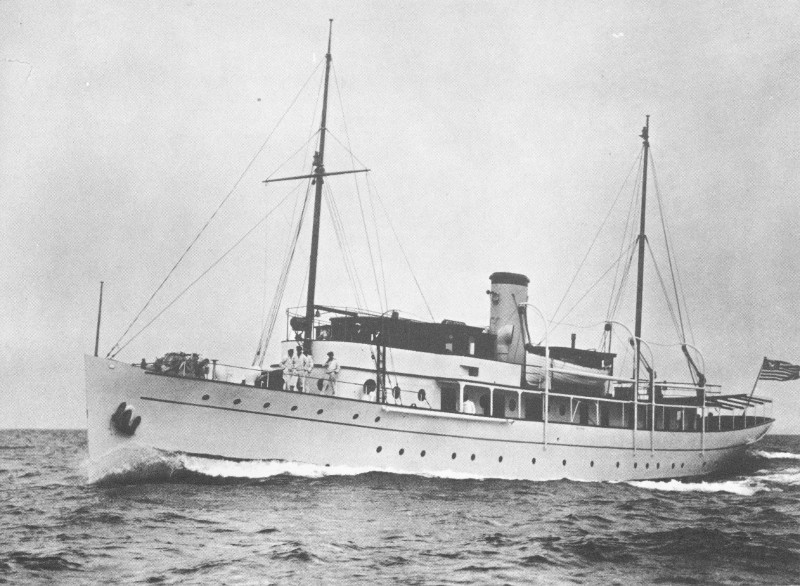
Vedette II, Vanderbilt’s last yacht.
Aside from yacht owning, there were the international yacht races for such prizes as the America’s Cup. Several times Vanderbilt joined with other sportsmen in financing entries to these races. In 1934, one of these entries, the Rainbow, won the cup at Newport.
The pattern of life followed by the Vanderbilt’s was typical, not only of their own Hyde Park neighbors, but of others of their station. A more or less uniform cycle was followed year after year.
New York City was then the hub of the financial and business world, and here were centered the formal social interests of the wealthy. Consequently, it was essential that a townhouse be maintained there, though not necessarily as a principal residence. Depending upon their other interests, the members of this select group often moved about with the seasons.
About the middle of November, the Vanderbilts would go to New York for the opera and social season, staying at their townhouse until the end of January. On weekends in this period and at Christmas, they usually returned to Hyde Park, staying in the pavilion after the mansion was closed up about December 1.
16
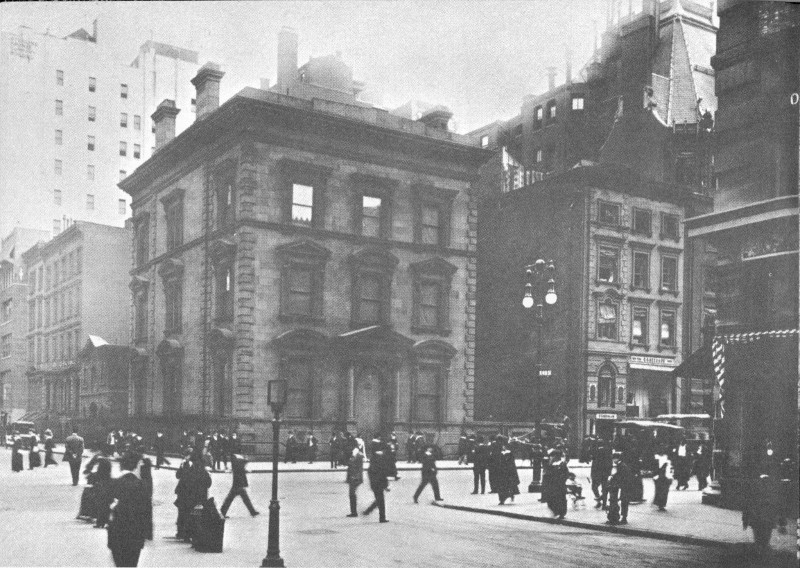
The Frederick Vanderbilt townhouse at Fifth Avenue and 40th Street, New York City, razed in 1914. Courtesy Underhill Studio, New York.
March and April were generally spent at Palm Beach, Fla. Here the Vanderbilts and their guests would cruise on their yacht in southern waters. For variety they sometimes leased a large estate on the West Coast, the family making the trip there and back in its private railroad car. The Vanderbilts would return to Hyde Park about Easter, remaining until shortly after the Fourth of July. Between then and Labor Day, they usually went to one of the several summer mansions that they owned at various times. The first of these was Rough Point, at Newport, R.I. They also had a retreat which they called their Japanese Camp on Upper St. Regis Lake in the Adirondacks; it had been built by 15 “expert mechanics” brought over from Japan. From 1913 until Mrs. Vanderbilt’s death in 1926, they went to Cornfield, a residence at Bar Harbor, Maine.
Part of the summer might be spent in Europe. The Vanderbilts would cross the Atlantic on an ocean liner, having sent the yacht on ahead. Then they would pick up the yacht and cruise along the coast of Europe or in the Mediterranean. In his later years, Vanderbilt spent much of his time at Hyde Park, but would make an occasional summer trip on his yacht.
17
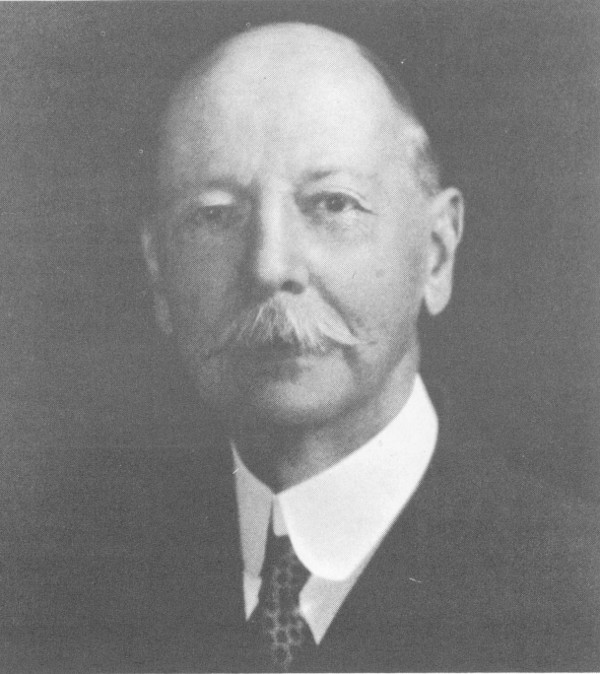
Frederick W. Vanderbilt in his later years.