Chapter VI · THE CITY OF THE EQUATOR (continued 2)
Reading edition
Guayaquil, 22d. Yesterday forty cases of bubonic plague broke out in Public School No. 5. There are seven survivors.
The resident, too, soon learns the real motives that hamper the sanitation of that pest-hole. Once it is “cleaned up,” argue its short-sighted merchants, foreign competitors will flock in upon them. As to themselves, they are, with rare exceptions, immune to the two plagues for which the port is famous, having recovered from them at some earlier period of life. Those who have not recovered have no voice in the matter. There are even foreign residents who bend their energies to upholding this barrier to competition.
These interests now, abetted by unseen European elements fostering the discontent, and the eagerness of the opposing party to make political capital out of any cloth, whole or otherwise, had stirred the noisy little native papers into a furor, genuine or financed, against the Government. The people, in their turn, had worked themselves into the conviction that the invitation was only an opening wedge of the “Colossus of the North” to gain a hand in the rule of the country, which it is always the part of the opposition papers to paint as imminent. We had not been long in Quito when the attitude of the populace grew so serious that a joint meeting of both houses of congress was called to explain the government view of the transaction. The diplomatic corps was present in force, and as much of the public as could find standing-room after the two houses had been seated in the largest chamber available in the government palace. The diminutive old Minister of Foreign Affairs, who had lived abroad long enough to acquire a point of view, explained the exact truth of the situation as clearly as a disinterested foreigner might have done. But neither congress nor the populace would hear his reasoning. The latter hooted him vociferously, calling him “Yanqui!” and accusing him of being in the pay of the United States. The congressmen rose one after another to charge him with fostering a conspiracy to surrender Ecuador to the Yankees, with many references to the “beegee steekee,” and the meeting ended with the roar of a bull-necked senator:
164“Undoubtedly, Señor, we want Guayaquil sanitated; but we want it sanitated by Latin Americans.”
The pesuña and other evidences of sanitary notions of the crowd that hemmed us in gave the speech a ludicrousness that none but an enraged partizan could have missed. But that night the little Minister of Foreign Affairs resigned, and when morning broke he had disappeared.
For all the handicap of the complete absence of factories and street-cars, Quito might easily lay claim to the world’s championship in noise. The din from its church-towers alone would bring it one of the first prizes. It is pleasant to sit out on a sunny hillside listening to the music of ringing church-bells as it is borne by on the Sunday morning breeze; but in Quito they are neither bells nor are they rung. In tone they suggest suspended masses of scrap-iron, and there is not a bell-rope, as we understand the word, in the length and breadth of the Andes. Barely has midnight passed, when Indians, hired for the nefarious purpose, and mobs of street urchins eager for the opportunity, climb into the church-towers and, catching the enormous clappers by a rope-end, beat and pound as if each was vying with the others in an attempt to reproduce the primeval chaos of sound, ceasing only when they drop from exhaustion. No corner of the city is free from the metallic uproar. Santa Catalina tower was a bare hundred yards above my pillow, and I know scarcely a block of the town over which does not rise at least one such source of torture, hung with at least half a dozen bells—to use the word loosely—of varying sizes and degrees of discordance. Once awakened, the city is never permitted to fall asleep again. By the time it has begun to doze off once more, the ringers have recovered, and, taking up their joyful task with renewed vigor, repeat the performance at five-minute intervals until sunrise, and often far into the day.
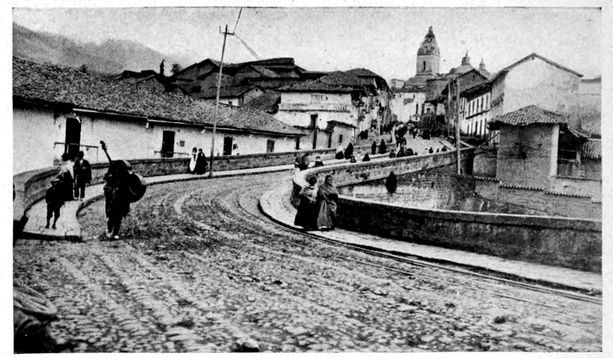
The street by which one leaves Quito on the tramp to the south. In the background the church and monastery of Santo Domingo
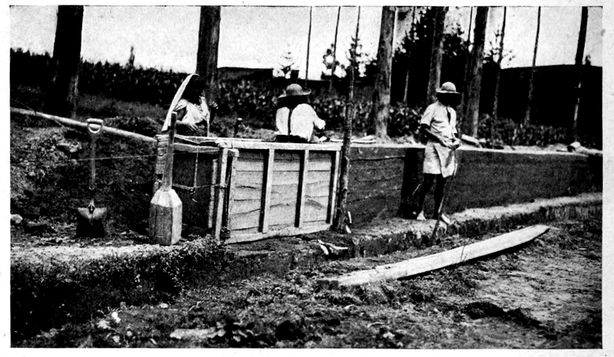
Long before Edison thought of his poured-cement houses, the Indians of the Andes were building their fences in a similar manner. In the regions where rain is frequent they are roofed with tiles or thatch; on the desert coast further south the tops afford a place of promenade sometimes miles in length
This has disturbances of its own. The game-cocks, which no self-respecting cholo would be without, challenge one another shrilly from their respective patios; that moment is rare when a child is not squalling at the top of its voice, the mother, after the passive way of quiteños, making no effort to silence it; cholos whistle all day long at their labors or pastimes; men and boys habitually call one another by ear-splitting finger-whistles; ox-carts, mule-trains, or laden donkeys refuse to move unless several arrieros trot behind them incessantly screaming and whistling; droves of cattle are led through the streets by an Indian blowing a bocina, a horn-like, six-foot length of bamboo; 165unoccupied youths like nothing better than to kick an empty tin can up or down the cobbled street; every school-boy on his way home or to school twice a day takes a big copper coin, or in lieu thereof an iron washer, and throws it at every cobblestone of his route in a local game of “hit it”; the barking of dogs never ends; every Indian who loses a distant relative, or who can concoct some other fancied cause for grief, sits on the sidewalk just out of reach of the contents of one’s slop-bucket, rocking back and forth, and burdening the air with a mournful wail that rises and falls in cadenced volume; for unbroken hours iron-tired coaches clatter over the uneven cobbles; every native on horseback must show off to his admiring friends and the fair sex in general by forcing his animal to canter and capriole up and down the line of flagstones in the middle of the narrow street; three blind newsboys, brothers indistinguishable one from another, appear in succession, pausing every few yards to bellow in deepest bass a complete summary of the day’s news, as if they were reading all the headlines of the papers they carry for sale; and to it all the church-bells add their never broken clanging. Apparently there is no law against disturbing the peace; without the power to silence the church-towers it would be useless, at best.
In those rare moments around midnight when the city threatens to fall silent, it is the police themselves that tide it over. An officer’s whistle screeches at a corner, to be answered down block after block, until it all but dies out in the distance; then back it comes, and continues unbrokenly until the church-bells drown it out. Not only that, but he is a rare policeman who does not while away the night and keep up his courage by playing discordant tunes on his whistle whenever it is not in official use.
To add to its discordance, Quito’s voices, due perhaps to some climatic condition, are often distressing, particularly the shrill, raspy ones of the women of the masses, who have somewhere picked up the habit of shrieking whenever they have anything to say—which is often. Unlike Bogotá, Quito has a very faulty pronunciation. The sound “sh,” for instance, is frequent in the Quichua dialect of the region, and though not all quiteños speak the aboriginal tongue, the sound has crept into their Spanish, and they tack it on at every opportunity—“A ver-sh, Nicanor-sh.” “Le voy á llamar-sh.” As in all South America, the town has the unpleasant habit of hissing at any one whose attention is desired, and the word “pues” has been cut down to a mere “pss” to be hooked on whenever possible:—“Si, pss! Va venir-sh 166mañana, pss.” The “ll” has become a French “j,” as in Central America and Panama, so that a street is not a calle but a “caje,” a key is a “jave,” and the newcomer will have difficulty in recognizing the place mentioned as “Beja-Coja,” however familiar he may be with the Bella Colla. Many localisms and Quichua words have found place in the general speech. A baby is always a “guagua” (wawa), frequently corrupted with a Spanish diminutive to “guaguita”; a boy is more often a “huambra” than a muchacho; and the traveler who does not know the aboriginal term “huasi-cama” would have difficulty in referring to the Indian house-guard and general servant of the lower patio.
But when its noise grows overwhelming and its picturesqueness pales to mere uncleanliness, the stout-legged visitor has only to climb over the outer crust of Quito in almost any direction to revel in the stillness and feast his eyes on vistas of rolling valleys and mountains, fresh spring-green to the very snow-line. A path, for instance, zigzags up the falda of Pichincha, steeper than any Gothic roof, through the scattering of red-tiled Indian huts called Guarico, and climbs until all Quito in its Andean pocket sinks to a toy city far beneath. Another road mounts doggedly round and round mountain-spurs and headlands until it is lost in clouds, and only the immediate world underfoot remains visible. The air grows almost wintry; oxen and Indian women, and now and then a man of the same downcast race, come hobbling down out of the mist above, with bundles of cut brush on their backs. Far up, the road swings around on the brink of things, pauses a moment as if to gather courage, then pitches headlong down out of sight into a light-gray void, as through a curtain shutting off the “Oriente,” the hot lands and unbroken forests of eastern Ecuador, a totally different world, where the Amazon begins to weave its network, and “wild” Indians roam untrammeled.
167