MINERALS.
Reading edition
INTRODUCTION.
1. Minerals are natural bodies destitute of organization and life: and Mineralogy is that branch of natural science which treats of the properties and relations of such bodies.
MINERAL DEPOSITS.
2. If we penetrate beneath the surface of the earth, we observe there a very remarkable arrangement. Instead of a generally uniform appearance, as we see on the surface, we pass through divers substances, as clay, gravel, sand, and numerous others, deposited in beds or strata of various thickness, from a few inches to a great many feet (Pl. I. Fig. 1). These lie, for the most part, nearly horizontal: but in some instances, particularly in mountainous countries, they take different degrees of inclination; and, in places where the country consists of gently sloping hills and vales, the beds have a waving or bending form (Pl. 1, Fig. 3). The strata of which the earth is composed, as deep as the curiosity or the necessities 2of mankind have induced them to explore, satisfactorily demonstrate the wisdom which has been displayed in the arrangement of materials requisite for the use of men and animals.
The first layer is frequently a rich, black mould, formed almost wholly of animal and vegetable remains. This yields sustenance to the vegetable productions; and thereby becomes the actual, though not the immediate, support of the whole animal creation.—Beneath this is often found a thick bed of clay, that furnishes to man a substance of which to make bricks, tiles, various kinds of pottery, and innumerable other articles for the comfort of social life.—Next are deposited vast beds of gravel, that are of use in numerous points of view.—Underneath this are the infinitely varying strata of sandstone, limestone, &c. which not only serve for the construction of buildings, and for other important purposes, but also frequently surround mines which contain the valuable metals.—Beneath a slaty stratum are usually discovered those immense beds of coal so requisite for the comfort, and, in some situations, even for the existence of man.
These strata, it is true, are not always found together, nor are they always discovered in the same order; but the statement will suffice to show the general nature of their arrangement.
3. Minerals are sometimes observed in detached masses of various size, and situated at various depths in the earth (Pl. I, Fig. 1).
5. At the places where dykes or veins pass through the earth, they occasionally disjoint the strata in a very singular manner (Pl. I, Fig. 4). Some of the coal strata, for instance, are thrown down or raised on one side of a dyke upwards of a hundred yards; and the miner, after penetrating through this dyke, instead of finding the same coal again, meets, on the opposite side, with beds of stone or clay. Hence he is frequently at a loss how to proceed in searching for the coal of which he is in pursuit; and hence it is that to such dykes the peculiar name of faults has sometimes been given.
6. In England the metallic ores are generally found in veins, that form a considerable angle with the regular strata. This in Cornwall is uniformly the case. And it is remarkable, concerning the veins of tin and copper of that county, that they run in a direction nearly east and west; whilst the dykes, or veins of other substances, run for the most part north and south.
7. The thickness of veins, and the quantity and quality of the ores they contain, differ in every mine. Some are only a few inches wide, whilst others extend 4to the width of several feet. The vein at Dalcooth mine, in Cornwall, varies from two or three to forty feet and upwards; and, in some parts, it contracts so as to be little more than six inches across.
8. In Cornwall the first traces of tin and copper are usually found at the surface of the ground, and thence to the depth of 80 or 100 feet beneath; and it is said that no miner has ever yet seen the bottom of a vein, although several have been wrought to the depth of more than 1000 feet. The veins of these metals have, in some instances, been worked to the length of three or four miles.
9. It is frequently observed that metallic veins are separated, from the substances they intersect, by a thin wall, or lining, of minerals different from these substances, and also by a layer of clay on each side of the vein. It is also remarked that the same substance which forms the outer coat of the vein is often intermixed with the ore, or forms layers alternately with it. This has usually the denomination of matrix or gangue.
10. There are few mines of any considerable depth that would not be flooded with water from internal springs were not means adopted for drawing off this fluid. The steam engines that are employed for this purpose in some of the Cornish mines are so powerful as to discharge incessantly, both by night and day, a quantity of water, equal to at least 1000 gallons, or near twenty hogsheads, every minute.
SYSTEMATIC ARRANGEMENT OF MINERALS.
11. To a superficial observer, perhaps nothing would appear more easy than to describe a mineral. This, 5however, is by no means the case. The same general appearance sometimes prevails in substances that are very different from each other; and the same stone, in its different states, is often extremely varied in its appearance. To these difficulties it must be added, that the combinations of mineral substances are multiplied to a great extent. A little application, however, particularly if the student be possessed of a collection of arranged and named specimens, which he will have no difficulty in procuring at a reasonable price, will enable him to overcome all the obstacles that otherwise might impede his progress in beginning to acquire a knowledge of this interesting science.[1]
12. The most simple and natural division of minerals is into four classes, of, 1. Stones; 2. Salts; 3. Combustibles; and, 4. Metals; and the following table, which has chiefly been arranged from the system of Werner, the well-known German mineralogist, will exhibit a tolerably correct outline of the classification of these substances. To reduce the whole within the compass of a single page, many of the families, however, have necessarily been omitted.
6
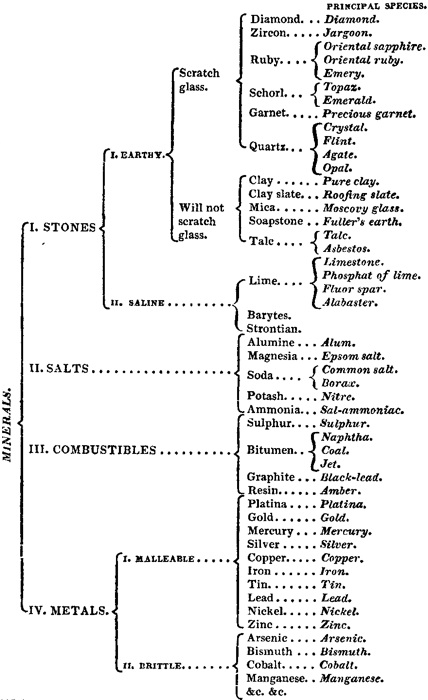
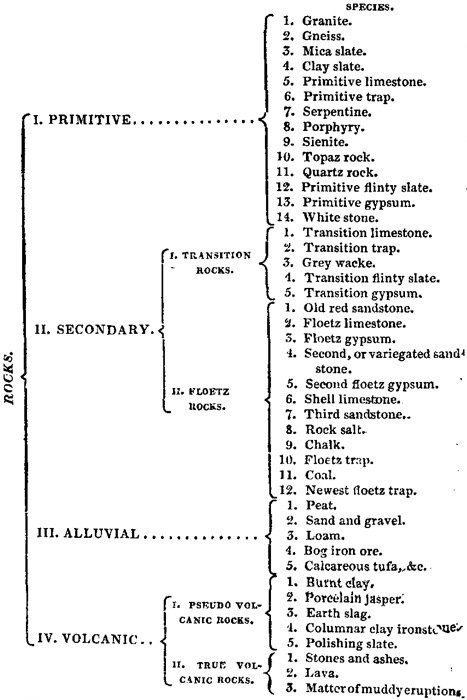
713.To complete a general view of the different productions of the mineral kingdom, it is requisite to subjoin a tabular arrangement of the various kinds of rocks.
8
14. For the purpose of ascertaining the names and characters of minerals, attention must be paid to their form, surface, lustre, fracture, or the appearance of their internal surface when broken; structure, transparence, streak, or the mark left when scratched by any hard body; stain, or trace left when rubbed upon paper; cohesion, whether solid, friable, or fluid: hardness, or the resistance which they oppose when scratched; tenacity, or the resistance which they oppose to the stroke of a hammer; flexibility, or their property of bending without breaking; feel, or the sensation communicated by their surfaces when handled; smell, taste, adherence to the tongue, sound, specific gravity, or weight in comparison with that of water; colour and electricity.
15. To ascertain the chemical properties of minerals, one of the most important instruments is the blow-pipe. This is a tube which terminates in a cavity as fine as a small wire, and through which the air is forced, and made to play upon the flame of a candle. The flame is thus concentrated, and directed against small particles of the mineral to be examined, which is placed upon a bit of charcoal in a spoon of platina or silver. The air is forced into the blow-pipe by the mouth of the person using it, or by bellows attached to it for that purpose. Under this operation we have an opportunity of trying the action of other bodies upon minerals at a very high temperature; and the properties which these experiments bring into view enable us, in many cases, to ascertain, not only the nature, but even the component parts, of minerals.
SIMPLE MINERAL SUBSTANCES.
16. As a necessary introduction to the study of minerals, it is requisite to describe, in a brief manner, such 9simple substances as form their constituent parts. Few of these, it is true, are to be found in a separate, uncombined state; yet that they do exist, and that they are to be obtained from the minerals with which they are united, we have the proof of every day’s experience.
UNCONFINABLE FLUIDS.
17. There are some kinds of unconfinable fluids, the existence even of which is manifested only by their contact with other bodies, or becoming separated from them. They are of a nature too subtile to be collected or confined in our vessels for the purpose of examination, and the investigation of their properties has consequently been attended with peculiar difficulty. Those at present known are caloric, light, electricity, and magnetism; but of these the first only is immediately connected with the subjects of our present investigation.
Were the world deprived of caloric, every species of organized being would, from that moment, cease to 10exist. It is the cause of all fluidity: to it every production of the earth has been most essentially indebted, even for its form and structure; and in no respect do the power and goodness of the Almighty appear more conspicuous than in the creation, dispersion, and continuance, of this most subtile and astonishing fluid.
19. All the various substances with which we are acquainted must be considered either as solid or fluid. Every substance is defined to be a solid in which the parts are so united or connected that it requires an external force to separate them. A fluid, on the contrary, is a body the parts of which are so loosely connected that they not only yield easily to any force impressed upon them, but also move freely amongst each other; and every fluid is a combination of caloric with some other substance.
GASEOUS FLUIDS.
Lead, for instance, combined with oxygen becomes the well-known red and heavy substance used by painters, under the name of minium or red lead (239). This, if deprived of its oxygen, loses its red colour, and returns to its former metallic state. Some of the metals are oxidized by merely being exposed to moisture. Thus the rust which is so readily contracted by iron is an oxide of that metal, produced by its attracting oxygen from the air or from water.
ACIDS.
23. Acid is a word originally synonymous with sour. It has, however, been gradually extended in its signification, and now comprehends all substances possessed of the properties of exciting upon the tongue the sensation called sour; of changing the blue colours of vegetables to red; of uniting with water in almost any proportion; of combining with alkalies (42), metallic oxides, 12and earths, and of forming with them certain compounds called salts.
EARTHS.
1. Silex.
2. Alumine.
3. Zircon.
4. Glucine.
5. Yttria.
6. Barytes.
7. Strontian.
8. Lime.
9. Magnesia.
These, when freed from foreign admixture, are, for the most part, of white colour, not soluble in water, not combustible, and do not exceed four times the weight of water.
32. The whole of these earths have, till lately, been considered simple and uncombined substances; but, by the discoveries of Sir Humphrey Davy, it has been ascertained that four of them have a metallic basis, and are in fact metallic oxides, or compounds consisting of 15a metal united with oxygen (21). These, which have the same affinity with their respective bases as rust has to iron, are silex, lime, barytes, and alumine. Until, however, some further light be thrown upon their nature and constitution, they must continue to hold their former situation of simple earths.
34. Alumine is a kind of earth, so called from its forming the basis of alum (197). It is soft, compact, and tenacious; about twice the weight of water, and, when breathed upon, has a smell which is peculiar to all clayey productions. In the fire it shrinks, and becomes so hard as even to yield sparks when struck against steel. It readily absorbs water, and is dissolved by most acids. Some writers state that pure alumine has been discovered in a native state near Halle, in Germany. It is found in a crystallized form, and nearly in a state of purity, in the Oriental ruby and sapphire. The name of argil, or clay, has sometimes 16been applied to it; but, in mineralogy, this name has usually been given to a mixture of alum, quartz, and other substances. Sir H. Davy has obtained from alumine a metallic basis, called aluminum.
35. Zircon, when freed from those substances with which it is combined, is a white and somewhat rough powder, insipid to the taste, insoluble in water, and about four times as heavy as that fluid. It is found in the two kinds of precious stones called jargoon and hyacinth, and has not hitherto been applied to any useful purpose.
36. Glucine is a kind of earth of peculiar nature, which is found in the emerald and beryl, and, when purified, forms a soft and white powder, without smell, and of sweetish taste. To the last of these qualities it is indebted for its name, which is derived from a Greek word signifying sweet. It is somewhat unctuous to the touch, and about three times as heavy as water. The uses of this earth, whatever they may be, are not known.
37. Yttria is an earth which, among other particulars, differs from glucine by its weight, as it is nearly five times heavier than water. In a natural state it occurs as the basis of a black Swedish mineral, called gadolinite. When cleansed, by chemical process, from all its impurities, it is a fine, white, and inodorous powder.
39. Strontian is an earth which, like barytes, is not found otherwise than in combination with sulphuric and carbonic acids. It occurs in various parts of the world, and, when purified, forms a porous mass of greyish white colour, acrid taste, and somewhat alkaline nature. This earth converts vegetable blue colours to green, but does not act so strongly on animal bodies as barytes, nor is it poisonous, like that substance.
40. Lime, the basis of all those substances which are denominated calcareous, is only to be obtained in a state of purity by artificial process. Combined with carbonic acid (26) it forms limestone (140), chalk, and marble; all of which are capable of being converted into lime by burning. Lime may also be obtained from oyster and other sea shells. When pure, it is of white colour, and moderately hard substance, though it is easily reducible to powder. Its taste is burning and acrid; and, like the alkalies, it changes vegetable blue colours to green. It has likewise the property of corroding and destroying animal substances. Lime, when pure, absorbs water rapidly, becomes hot, and falls into powder. Even if exposed to the open air it gradually attracts moisture, and assumes a powdery form; soon after which it becomes saturated with carbonic acid (26) from the atmosphere, and is thereby again converted into carbonat of lime (140). It occurs abundantly in almost every 18country, but always in combination with some acid, carbonic (26), sulphuric (24), boracic (28), fluoric (27), or phosphoric (25). This substance has a metallic basis, which has been denominated calcium.
41. Magnesia is a light and perfectly white kind of earth, of soft powdery appearance, without taste or smell, and somewhat more than twice as heavy as water. It is not found in this pure state in nature, but may be prepared from Epsom salt, which consists of magnesia in union with sulphuric acid (24). The slightly acrid taste that is perceptible in the magnesia used in medicine arises from a portion of lime which it contains. This substance does not dissolve in water, but is soluble in every kind of acid. It has the property of changing delicate blue colours to green.
ALKALIES.
43. The alkalies at present known are three in number; potash (205), soda (200), and ammonia (207). Of these the two former, although till lately they have been considered simple substances, have been shown by Sir H. Davy to have metallic bases.
19 SIMPLE COMBUSTIBLES.
44. By this term we are to understand all those mineral substances, capable of combustion, which have not been discovered to consist of more than a single component part. They are four in number; hydrogen, sulphur, phosphorus, and carbon.
21
CLASS I.—STONES.
ORDER I.—EARTHY STONES.
I. HARD: those which scratch Glass.
49. OF GEMS IN GENERAL.
Gems, or precious stones, as they are frequently called, are, for the most part, transparent, and have a vitreous or glassy appearance. Their different colours are occasioned by metallic oxides (21) of various kinds, with which they are impregnated. Some writers have classed them by their colours, but this is a very uncertain mode, as different gems have not unfrequently the same colour; and, in many cases, the same gems are of different colours. The usual distinction of gems into Oriental and Occidental is also liable to error, as the best gems, from whatever part of the world they are brought, are always called Oriental. The most estimable of all the kinds are the diamond (50), ruby (54), emerald (67), and sapphire (53); and stones a grain in weight, and equal in quality, are valued in the following proportions, at 8l. per carat for diamonds, 4l. for rubies, and 3l. for each of the others. The amethyst (79), topaz (61), and aqua-marine (61), are considered of nearly equal value with each other; and the garnet (70) is the cheapest of precious stones.
22The ancients engraved upon several kinds of gems; but they appear to have been ignorant of the art of cutting the diamond, the ruby, and the sapphire, which were too hard for them to operate upon. The emerald and the noble opal (102) were too highly esteemed as precious stones to have often found their way into the hands of engravers. It has been asserted that the ancients did not use the topaz for engraving; but there is extant a beautiful intaglio, representing an Indian Bacchus, which is said to be a topaz. The garnet was often engraved upon: and there are many master-pieces of the art in calcedony (91) and carnelian (93.) Onyx and sardonyx (92) were employed for that species of engraving in relief called cameos; and, in many instances, it is pleasing to observe with what dexterity the ancient artists availed themselves of the different colours in the alternate zones to express the different parts and shades of their figures.
Most of the gems may be imitated by artificial preparations of glass, coloured by different metallic substances; and it is not easy, by mere inspection, to distinguish the better kinds of factitious stones from real gems. They are, however, discoverable by a deficiency of lustre, and being so soft as, even in the most perfect kinds, to yield to the point of a steel instrument.
The cutting and polishing of gems is the work of the lapidary, and is in general thus performed:—The shape most proper to be given to any particular gem being determined on, the stone is cemented to the end of a stick, and the different facets are formed by a mill contrived for the purpose. This mill is a plate of copper, or an alloy of lead and tin, to which an horizontal motion is given by very simple machinery, and the surface of which is charged either with diamond powder and oil, or with fine emery and water. A thick peg of wood called a gauge, pierced with small holes in all directions, is set upright on the lapidary’s bench, close to the mill, and the process of shaping the facets thus takes place. The stone is placed on the surface of the 23mill, the opposite end of the stick to which it is cemented being inserted in one of the holes of the gauge. In this position it is kept steady by the workman, with his right hand, whilst, with the other, he puts the mill in motion. The skill of the lapidary depends on regulating the velocity of the mill, and pressing with more or less force on the stick, with an almost imperceptible tendency to one or other direction in different stages of the work, examining each facet at very short intervals, in order to give as great precision as possible to its size and form. This part of the business being completed, the cutting mill is taken out, and replaced by one of brass, on which the polishing is performed by means of fine emery (58), tripoli, and rotten stone (119), exactly in the same manner as is practised in the first stage of the process for setting the facets.
DIAMOND.
In a rough state, diamonds have usually either the form of rounded pebbles, with a shining surface, or they are crystallized in the shape of octohedrons, or double four-sided pyramids. (Pl. II, Fig. 5, 6.) Though for the most part colourless, they are sometimes yellow, green, blue, blackish, or rose-coloured.
The best diamonds are brought from the East Indies. The principal mines are those of Raolconda and Coulour, in the province of Golconda; and that of Soumelpour, or Goual, in Bengal. At Raolconda they are found in the deep crevices of rocks. Persons, by means of long iron rods, with hooks at the end, draw out from these crevices the loose contents, and afterwards wash them in tubs, for the purpose of discovering the diamonds.
The first discovery of diamonds at Coulour was about two centuries ago, by a countryman, who, on digging his ground to sow millet, accidentally found one of these stones of large size. From that period the whole 24adjacent plain began to be searched to the depth of from ten to fourteen feet; and the work was, at one time, so extensively pursued, that nearly 6,000 persons were employed in it. At Soumelpour the diamonds are found amongst the sand and gravel of the river.
Diamonds are likewise found in the island of Borneo, and in several parts of South America. The mode by which they are obtained from one of the rivers of Brazil has been described by Mr. Mawe. The current is turned, and part of the bed of the river being laid dry, the mud is taken up and washed, by negroes, in places prepared for the purpose, through which a portion only of the stream is allowed to flow. As soon as all the earthy particles have been washed away, the gravel-like matter that remains is raked together, the stones are thrown out, and what diamonds happen to be present are found amongst the refuse that is left.
To ascertain whether a stone, that has been found, be really a diamond, the workmen have a mode of placing it upon a hard substance, and striking it with a hammer. If it either resists the blow or separate into leaves, it must be a diamond; but, in the latter case, the discovery is sometimes made at an immense expense, as, by thus diminishing the size, its value must also, of course, be greatly diminished.
Diamonds are generally exported from Madras in a rough state; and in small parcels neatly sewed in muslin, and sealed by the merchants who send them. These, we are informed by Mr. Milburne in his valuable work on oriental commerce, are, for the most part, sold in Europe by the invoice, as it is called; that is, without being opened: and he says that they are always found to contain the value for which they were sold in India.
Of all transparent substances, none for brilliancy can be compared with the diamond. Its hardness is such, that no steel instrument whatever can make any impression upon it. Notwithstanding this, at a temperature not so high as that which is required for the 25melting of silver, it gradually dissipates and burns. Diamonds have been shown to consist principally of carbon or charcoal in a pure and crystallized state.
The ancients, ignorant of the art of cutting diamonds, were contented to set them in a native state; and for this purpose they preferred such stones as had naturally a crystallized form. The four large diamonds which ornament the clasp of the Imperial mantle of Charlemagne, and which are still preserved in Paris, are uncut stones of this description. The extreme hardness of the diamond baffled all attempts to polish it in such manner as to exhibit its peculiar beauty, until the year 1456, when a young man of Bruges, whose name was Berquin, endeavoured to polish two diamonds by rubbing them against each other. Having succeeded in this, he next constructed a wheel, on which, by means of diamond powder, he was enabled to cut and polish these gems in a manner beyond his greatest expectation. Since this period the art of polishing them has been greatly improved both by the Dutch and British jewellers.
In the choosing and valuing of diamonds in a rough state, attention is paid to their colour, their being free from extraneous matter, and their shape. Those that are most perfect are crystalline, and resemble a drop of clear spring water, in the middle of which is to be perceived a strong light, that plays with great spirit on moving them about. When they have a yellowish or greenish tinge they are considered to be bad. Many diamonds have a kind of confused structure, which lapidaries compare to knots formed in wood. These are rejected, from the impossibility of polishing them properly.
Mr. Mawe remarks that diamonds, when rubbed together, have a peculiarly and scarcely to be described grating sound, which is one of their most remarkable characteristics. By this alone rough diamonds may be accurately and expeditiously distinguished from every other gem.
26It is usual to cut diamonds into three principal forms, called brilliant (Pl. II, Fig. 7), rose (Fig. 8), and table diamonds (Fig. 9). Brilliants are, for the most part, cut from such of the stones as have naturally a crystallized shape, and rose diamonds from the flat varieties. The former are so called from their great lustre, in consequence of the facets on both sides being cut. These are always set upon a black ground, whilst rose diamonds, which are much thinner, are set upon a white foil speckled with black, for the purpose of adding to their lustre. Rose-cut diamonds are of course much less estimable than brilliants; so much so indeed, that of late many of them, brought from Holland, have been re-cut into brilliants, notwithstanding the additional expense, and the loss of size necessarily attendant on this operation. The table diamond is the least beautiful of any. This mode of cutting is only adopted for such stones, or rather fragments, as, with a considerable breadth, have only a very trifling depth. The diamond-cutters of England are considered to be the best in Europe, but their number is so small as to occasion many stones to be sent to Holland to be cut.
The value of diamonds is ascertained by their weight in carats; and this value increases, in a very high ratio, according to their magnitude. For instance, a diamond weighing one carat will be worth about 10l. whilst another of five carats will be worth 150l. and of ten carats 800l.[2] This rule, however, can only be taken for diamonds of twenty carats and under. The larger ones, in consequence of the scarcity of purchasers, are generally disposed of at prices greatly inferior to their estimated worth. The value of some diamonds that are peculiarly perfect exceeds the above 27ratio; whilst, for a stone that is cloudy, foul, or of bad colour, even three quarters of the estimated value will perhaps be deducted.
No diamonds are so valuable as those that are perfectly transparent, and of snow-white colour. The green and yellow varieties are, however, much esteemed: the blue kinds were formerly more valued than at present; and the least valuable are those that have a grey or brownish tint. Black diamonds are much prized by collectors.
The principal use of the diamond is in jewellery. It is also used by lapidaries, for slitting hard stones, and for cutting and engraving upon other gems; by clock-makers in the finer kinds of clock-work; in the glass-trade for squaring large pieces or plates of glass, and among glaziers for cutting their glass.
The largest diamond ever known (if it be such, and not a white topaz, as some people have imagined) is in the possession of the Queen of Portugal, and weighs 1,680 carats, or more than eleven ounces. It was found in Brazil, and sent to Lisbon in the year 1746. It is still uncut, and has been valued at 5,644,800l.
The Rajah of Mattan, in the island of Borneo, possesses a large diamond, shaped like an egg, with an indented hollow near the smaller end. It was found in that island about eighty years ago, is said to be of the finest water, and to weigh 367 carats, or more than two ounces and a quarter. Several years ago the Governor of Batavia, desirous of purchasing this gem, sent a Mr. Stuvart to the Rajah, authorizing him to offer for it 150,000 dollars, two large brigs of war, with their guns and ammunition, together with a certain number of great guns, and a quantity of powder and shot. The Rajah, however, refused to deprive his family of so valuable an hereditary possession; for the Malays not only attach to it the miraculous power of curing all diseases by means of water in which it is dipped, but also believe that the fortune of the family is sustained by its continuing in their possession.
28Tavernier, the French Traveller, saw in the possession of the Great Mogul a diamond which weighed near 280 carats. In form and size it resembled half a hen’s egg. This diamond had been obtained from the mine of Coulour, about the year 1550; and was valued at more than 700,000l. sterling.
The sceptre of the Emperor of Russia is adorned with an oriental diamond about the size of a pigeon’s egg, which weighs 195 carats. This diamond is said to have once been placed as the eye of an idol in Seringham, in the Carnatic. A grenadier, who had deserted from the French service in India, contrived to become one of the priests of the idol, in the hope of being able to steal this eye. He at length effected his purpose, and escaped with the diamond to Madras, where he sold it to the captain of a ship for a sum equal to 2,500l. of British money. It was afterwards transferred to a Jew for 18,000l. Coming into the hands of a Greek merchant, he offered it for sale at Amsterdam, in 1766; and the Russian Prince Orloff bought it for the Empress Catharine for about 90,000l. sterling, and an annuity of 4,000l. during the life of the person who sold it.
The Pitt, or Regent diamond (Pl. II, Fig. 10), which lately was set in the handle of the sword of state of Buonaparte, and is now possessed by the king of France, is a brilliant of the most beautiful kind, and weighs 136¾ carats. It was brought from India by Thomas Pitt, Esq. Governor of Fort George. Mr. Pitt has himself stated, respecting it, that, in December, 1701, whilst resident in Madras, several valuable stones, in a rough state, were brought to him for sale by an eminent diamond merchant. One of these, the diamond here spoken of, was so large that the merchant asked for it the sum of 85,000l. After much bargaining, Mr. Pitt purchased it for 20,400l. He afterwards sold it for 135,000l. to the Regent Duke of Orleans; and by him it was placed among the crown jewels of France.
The Pigot diamond weighs forty-seven and a half carats. This, which is an extremely fine stone, was 29disposed of by lottery, in 1800, for 22,000l.; and is now in the possession of Messrs. Rundell and Bridge, jewellers in London.
A large star, cross, and chain, worn on grand gala days by the Prince of Brazil, as Sovereign of the different Portuguese orders of knighthood, are each ornamented with a great number of magnificent diamonds, set in gold. The centre diamond of the star is alone valued at 800,000l.
When the diamond is rubbed it will attract bits of straw, feathers, hairs, and other small objects; and if exposed to the rays of the sun, and immediately taken into a dark place, some diamonds will appear luminous.
ZIRCON FAMILY.
51. JARGOON is a gem usually of smoky yellow or brownish colour, and sometimes limpid: if placed upon any object, it exhibits of it a very distinct double image.
The primitive form of its crystal is an octohedron (Pl. II, Fig. 5), but it is frequently crystallized in right-angled prisms, terminated by four-sided pyramids.
In hardness this stone does not much exceed that of the emerald. The greyish white and yellowish white varieties of jargoon are valuable chiefly on account of their resemblance to the diamond. The darker-coloured varieties can be deprived of their colour by heat; and, in this state, though in lustre they are infinitely inferior to them, they are sometimes substituted for diamonds. Jargoons are now seldom used except for the jewelling of watches and time-pieces. About a century ago, they were much used in mourning ornaments, for which the dark tone of their colour, and their almost adamantine lustre, were supposed to be peculiarly appropriate.
The jargoon is principally brought from the island of Ceylon; but it is occasionally found in France, and Spain, and in granite rocks near Cuffel, in Dumfrieshire, Scotland.
3052. The Hyacinth, or Jacinth, is a dark orange-red variety of jargoon. It is also chiefly imported from Ceylon, where it is generally found in the sand of rivers, in irregularly round pieces, but seldom of large size without flaws.
This stone is indebted for its name to a supposed resemblance in colour to that flower, which, according to the Pagan mythology, Apollo raised from the blood of his favourite youth, Hyacinthus.
When bright, and free from flaws, the hyacinth is a superb ring stone; but it is not of usual occurrence in modern jewellery.
RUBY FAMILY.
It is found crystallized in six-sided pyramids much lengthened and joined base to base (Pl. II, Fig. 13); and also in rounded or pebble-shaped fragments. It has a foliated texture, is extremely hard, and about four times as heavy as water.
We are chiefly indebted for the sapphire to the East Indies and the Island of Ceylon, where it is found amongst the sand of the rivers. When brought into Europe, it is cut by means of diamond powder, and polished with emery. It is now usually set with a foil of its own colour; but it was formerly the practice, instead of foil, to place under this stone the blue part of a peacock’s feather.
In hardness the sapphire ranks next to the ruby (54); and in value it is about equal to the emerald (67). A good sapphire of ten carats’ weight is worth about fifty guineas. In the Museum of Natural History at Paris there is a sapphire which weighs upwards of sixty-six carats: it was placed there from the wardrobe of the crown.
We are informed by M. Hauy that sapphires are found in Bohemia and France, particularly in one part 31of the Ville du Puy, among the sand of a rivulet near Expailly. In the summer-time, when the rivulet is nearly dry, they are collected by persons, each of whom is furnished with a small tray and a linen bag. Where-ever there are small depressions in which the water has been stationary, these persons enter them, and fill their trays with the sand. This they wash in water in such manner that the lighter particles are carried away; whilst the heavier ones of gravel, sapphire, and other articles, remain at the bottom.
Some sapphires exhibit a kind of opalescence, or whitish floating light in their interior. Sapphires lose all their colour in the fire; and, after having been subjected to heat, they are so hard and transparent as sometimes to be sold for diamonds.
In the general form of its crystals it much resembles the sapphire (53).
The ruby is imported into this country from the East Indies, though seldom in a rough state, as the stones are almost always first cut by the Indians for the purpose of ascertaining their value. They are said to be found in the sand of certain streams near the town of Sirian, the capital of Pegu; and with sapphires in the sand of rivers in Ceylon. But they are so seldom seen of large size, that a ruby above thirty-one carats’ weight, of perfect colour, and without flaws, is even more estimable than a diamond of equal weight. The ruby is usually set with a foil; but, if peculiarly fine, it is sometimes set without bottom, that the stone may be seen through.
Tavernier, the Eastern traveller, states that, in the throne of the Great Mogul, he saw 108 rubies, which, on an average, weighed from 100 to 200 carats each. Among the jewels of the King of Candy, that were sold by auction in London, on the 13th of June, 1820, 32was a ruby which measured two inches in length, and one inch in breadth. It was, however, interesting only as a specimen for a cabinet, for it had, in various directions, a great number of small hair-like tubes running through it.
The hardness of this stone is such that the ancients do not appear to have possessed the art of cutting it; and, in the improvements which of late have been made by Mr. Earnshaw in the construction of time-keepers, no stones have been found sufficiently hard for jewelling the holes, except the ruby and the diamond.
There are several modes of counterfeiting rubies; and some persons have succeeded so well in imitating these stones, that even the most able lapidaries, till they try the hardness, may be deceived.
57. The SPINEL and BALAIS RUBY are two kinds of precious stones, which differ from each other principally in colour, the former being of a carmine, and the latter a cochineal red.
They vary from the oriental ruby (54) in being less hard; in the primitive form of their crystals being regular octohedrons (Pl. II, Fig. 5), and in their not being much more than 3 times heavier than water.
33Although these two kinds of rubies are inferior, both in lustre and colour, to the oriental ruby; yet, when they exceed a certain size, they are much esteemed. A spinel that weighs more than four carats is valued at half as much as a diamond of the same weight, and is not unfrequently imposed upon ignorant purchasers for the oriental species. It is easily wrought, takes a high polish, and is certainly a beautiful gem. Being too expensive for necklaces, it is usually set in rings and brooches, surrounded by brilliants.
The spinel ruby is found amongst sand, in one of the rivers of Ceylon, which flows from the high mountains, towards the middle of the island. It is also found in Brazil; and in Hungary, Bohemia, and Silesia.
The Balais ruby is so named from Balacchan, the Indian appellation of Pegu, from which country it is chiefly imported.
The best emery is brought from the Levant, and chiefly from Naxos, and other islands of the Grecian Archipelago, where it occurs abundantly, in large, loose masses, at the foot of primitive mountains. It is also found in some parts of Spain; and is obtained from a few of the iron mines in our own country.
In hardness it is nearly equal to adamantine spar; and this property has rendered it an object of great request in various arts. It is employed by lapidaries in the cutting and polishing of precious stones; by opticians, in smoothing the surface of the finer kinds of glass, preparatory to their being polished; by cutlers, and other manufacturers of iron and steel instruments; by masons, in the polishing of marble: and, in their respective businesses, by locksmiths, glaziers, and numerous other artisans.
For all these purposes it is pulverized in large iron 34mortars, or in steel mills; and is afterwards separated, according to the several degrees of fineness that are required, by washing it in water, and suffering the grosser particles to deposit themselves. By this operation the finer particles, which remain suspended in the water, and which are obtained by decanting the water off, and suffering it to stand for a considerable time, are separated. The particles first deposited are again ground, and again agitated in the water, to separate the finest. By these successive operations the emery is reduced to a powder so fine that, when rubbed between the fingers, it communicates no sensation whatever of grittiness. In general those particles only of the emery which remain suspended in the water, after it has stood about half an hour, are used to polish metals.
59. ADAMANTINE SPAR, or IMPERFECT CORUNDUM, is a very hard and nearly opaque stone, which varies much in colour, but is chiefly grey, with a greenish, brown, or bluish tint.
It is usually found in the form of six-sided prisms, but it sometimes occurs in shapeless masses, has a foliated texture, and is about four times as heavy as water.
The name of adamantine spar was given, by the British lapidaries, to this substance from its hardness being nearly equal to that of the diamond. It was originally discovered among the granite rocks of China; but it has since been found, and in greater purity, in Bengal and Ceylon.
In a powdered state this substance has long been used by the artists of India and China for the cutting and polishing of precious stones, and even of the diamond; but, though it will in some degree operate upon that gem, it is not sufficiently hard to bring out the peculiar beauty of it in a degree at all comparable to that which is effected by the European lapidaries with diamond powder. The Chinese also use adamantine spar for polishing steel, and in the composition of the finer kinds of porcelain or earthenware. For the cutting 35of seals and precious stones European workmen consider it preferable to emery; but, for minute engraving, it is much inferior to diamond powder.
60. CHRYSOBERYL is a gem of yellowish or brownish green colour, harder than quartz (76), and sometimes transparent; but often only semi-transparent, in which case it exhibits a bluish light, floating in the interior of the stone.
It is usually found in rounded pieces, but is sometimes crystallized in compressed six-sided prisms, and in double six-sided pyramids.
So little is this gem in request in Europe, that it is seldom to be found in the possession of jewellers; but in Brazil it is considered inferior only to the diamond. It is usually procured from South America; yet it occurs in Saxony; and, with the ruby and sapphire, amongst sand in the rivers of Ceylon.
Such is the hardness of the chrysoberyl, that, when properly polished, which is a difficult operation, it is capable of receiving a lustre nearly equal to that of the diamond. We are informed that, a few years ago, a considerable number of these gems were imported into this country from Brazil, but that the greater part of them were entirely spoiled by inferior workmen, and that the rest were so ill-cut that they remained unnoticed, and without value. The smaller stones are said to appear to most advantage in circular ear-drops; and the larger specimens form necklaces and ring stones of great beauty.
The variety which exhibits an opalescent appearance, or presents a bluish light, undulating as it were in the interior of the stone, and changing its situation according to the position of the observer, is chiefly valuable as an article of curiosity: the transparent kind is always preferred by the jeweller.
SCHORL FAMILY.
It varies considerably in its crystallization; is 3½ times heavier than water; and, when placed upon any object, shows a double image of it.
The name of topaz is derived from an island in the Red Sea, where the ancients found a stone, but very different from ours, which they denominated topaz. The best topazes are of a deep colour, and are imported from Brazil; the most brilliant ones are supposed to be those of Saxony; but the latter are generally of very pale colour. This species of gem is found in many parts of Europe, but defective in transparency, and sometimes even opaque. It occurs in large crystals, and rolled masses, in an alluvial soil (269), in the upper parts of Aberdeenshire, Scotland; and in veins, along with tin-stone, at St. Anne’s, in Cornwall. Topazes, more than a pound in weight, have been found in Scotland.
Mr. Mawe speaks of a topaz mine at Capon, near Villa Rica, in Brazil. In two breaks or slips of the rocks, he says, there were little soft places where the negroes found the topazes by scraping in them with pieces of iron. He himself observed at least a cart-load of inferior topazes, any number of which he might have taken away; but all that he saw were defective and full of flaws.
These stones vary much in size; some, particularly those of Siberia, being extremely small, and others being upwards of an inch in thickness. In the Collection of Natural History at Paris there is a Brazilian topaz which weighs four ounces and a quarter. These stones are not sufficiently scarce to be, in general, much valued by the jeweller or lapidary. The deep yellow variety is preferred to the pale sort, although the latter is often superior to it both in size and hardness.
Figures have sometimes been engraved on the topaz; and these, when well executed, are of great value. In the National Museum at Paris there is a superb Indian Bacchus engraven on a topaz. The cabinet of the Emperor 37of Russia contains several fine topazes of this description.
Some of the coarse kinds of topaz are broken down, pounded, and used instead of emery for the cutting of hard minerals; and powdered topaz was formerly kept in apothecaries’ shops, and sold as an antidote against madness.
It is a somewhat singular circumstance, that, if the Saxon topaz be gradually exposed to a strong heat in a crucible, it will become white and, on the contrary, that Brazilian topazes by the same process become red or pink. By exposure to a still stronger heat, the Brazilian topaz changes its colour to a violet-blue.
Jewellers usually divide topazes into the following kinds:
62. Brazilian and Saxon, already mentioned.
63. Bohemian.—These are found chiefly in the tin mines of Bohemia, are of small size, deficient in transparency, have only grey or muddy white colours, and are of little value.
64. Blue Topaz.—This is a large Brazilian gem, which varies in size from one or two carats to two or three ounces. A fine blue topaz, without flaw, and which weighed an ounce and a quarter, was sold for 200 guineas. It is sometimes difficult to distinguish a blue topaz from an aqua marine (68).
65. Pink Topaz.—Some beautiful rose-coloured varieties of topaz have been brought from Asia Minor, and others are found in South America; but the pink topazes in the jewellers’ shops are chiefly stones of the yellow Brazilian kind, which have had their colour changed by heat.
66. The White, or Nova Mina Topaz, is a perfectly colourless and transparent variety. It generally occurs of small size, and is in considerable estimation in Brazil for ear-rings, or for being set round yellow topazes. 38Small stones of this description have recently been found at St. Michael’s Mount, in Cornwall.
There is imported from Brazil a yellow kind of crystal (83), which is so similar, in its appearance, to the yellow topaz as sometimes to be imposed upon purchasers for that stone.
Its natural form is a short six-sided prism; but it is sometimes found massive, and rounded like a pebble.
By the ancients the emerald was a gem much in request, and particularly for engraving upon. They denominated it smaragdus, and are said to have procured it from Ethiopia and Egypt; but, besides the true emerald, Pliny, under this title, includes green jasper (96), malachite (231), fluor spar (194), and some other green minerals. The pillars of emerald in the temple of Hercules at Tyre, mentioned by Herodotus, and the large emeralds described by Pliny as having been cut into columns and statues, cannot be referred to the true emerald.
The deepest coloured and most valuable emeralds that we are acquainted with are brought from Peru. They are found in clefts and veins of granite, and other primitive rocks; sometimes grouped with the crystals of quartz (76), felspar (110), and mica (123); and, not unfrequently, loose in the sand of rivers. The most ancient emerald mine is that of Manta, in Peru, but it has been some time exhausted; and most of the emeralds that are now brought to Europe are obtained from a mine situated in the valley of Tunca, between the mountains of New Grenada and Popayan.
The emerald is one of the softest of the precious stones; and is almost exclusively indebted for its value to its charming colour. The brilliant purple of the ruby, the golden yellow of the topaz, the celestial blue of the sapphire, are all pleasing tints; but the green of the emerald is so lovely, that the eye, after glancing 39over all the others, finds delight in resting upon this. In value it is rated next to the ruby; and, when of good colour, is set without foil and upon a black ground, like a brilliant diamond. Emeralds of inferior lustre are generally set upon a green gold foil. These gems appear to greatest advantage when table cut (Pl. II, Fig. 9), and surrounded by brilliants, the lustre of which forms an agreeable contrast with the quiet hue of the emerald. They are sometimes formed into pear-shaped ear-drops; but the most valuable stones are generally set in rings. A favourite mode of setting emeralds among the opulent inhabitants of South America is to make them up into clusters of artificial flowers on gold stems.
The largest emerald that has been mentioned is one said to have been possessed by the inhabitants of the valley of Manta, in Peru, at the time when the Spaniards first arrived there. It is recorded to have been as big as an ostrich’s egg, and to have been worshipped by the Peruvians, under the name of the Goddess, or Mother of Emeralds. They brought smaller ones as offerings to it, which the priests distinguished by the appellation of daughters. Many fine emeralds are stated to have formerly been bequeathed to different monasteries on the Continent; but most of them are said to have been sold by the monks, and to have had their place supplied by coloured glass imitations. These stones are seldom seen of large size, and at the same time entirely free from flaws.
The emerald, if heated to a certain degree, assumes a blue colour; but it recovers its proper tint when cold. When the heat is carried much beyond this, it melts into an opaque coloured mass.
The precious stone called oriental emerald (56) is a green and very scarce variety of the oriental ruby.
These stones are of such frequent occurrence, even 40in large pieces perfectly clear and free from flaws, they are in general so soft, and have so little the brilliancy of other gems, that they are usually considered of inferior value. The most beautiful kinds are brought from Dauria, on the frontiers of China, from Siberia, and from Brazil. They are also found in Saxony and the South of France, and are very common at Baltimore, in North America. Specimens of aqua marine have been obtained from the upper parts of Aberdeenshire, Scotland, where they sometimes occur in alluvial soil, along with rock crystal and topaz. These stones have also been found, embedded in granite, near Lough Bray, and Cronebane, in the County of Wicklow, Ireland; and also in mountain rock, in some parts of Devonshire.
They are cut by means of emery (58), and polished with tripoli (119). The darkest green specimens are set upon a somewhat steel-coloured foil; and the pale ones are either placed, like the diamond, on a black ground, or upon a silvery foil. The aqua marine is usually made into necklaces; but it is likewise employed for brooches, and not unfrequently for steel stones and intaglios. The larger ones are in much esteem among the Turks for the handles of stilettos.
It is occasionally found in shapeless masses, but more frequently crystallized in three, six, or nine-sided prisms, variously truncated or terminated; and its weight is somewhat more than three times that of water.
This stone was first made known in Europe, about the beginning of the last century, by the Dutch merchants, who brought it from the island of Ceylon, where it is principally found. When strongly heated it becomes electric; one of the summits of the crystal negatively, and the other positively. An early writer, by whom it is mentioned, says, that “it has the property 41not only of attracting ashes from the warm or burning coals, but that it also repels them again, which is very amusing: for as soon as a small quantity of ashes leaps upon it, and appears as if endeavouring to writhe themselves by force into the stone, they in a little time spring from it again, as if about to make a new attempt. It was on this account that the Dutch called it the ashes drawer.”
Since the above period, tourmaline has been found in Brazil; and in Norway, Germany, France, and several other parts of Europe. It generally occurs embedded in different kinds of mountain rock; and, in these, is rather confined to single beds or strata, than disseminated through the whole mass of the mountain. A piece of tourmaline, of cylindrical form, and brownish grey colour, was some time ago discovered in the neighbourhood of Kitt-hill, near Callington, Cornwall. Black tourmaline, both in large and small crystals, is found in granite rock, in the vicinity of the Logan, or Rocking-stones, near Treryn, in the same county.
When laid on a table, the tourmaline appears a dark and opaque stone; but, when held against the light, it has generally a pale brownish hue. It is sometimes cut, polished, and worn as a gem; but, on account of the muddiness of its colours, it is not in general much esteemed. Those persons who wear tourmalines set in rings consider them more as objects of curiosity than of elegance: they show them as small electrical instruments, which, after being heated a little while by the fire, will attract and repel light bodies.
In the superb collection of minerals of the British Museum, there is a magnificent specimen of red tourmaline, or rubellite, which has been valued at 1000l. sterling. It was presented by the King of Ava to the late Colonel Symes, when on an embassy to that country, and was afterwards deposited by the latter in Mr. Greville’s collection; with that collection it became the property of the British Museum.
42 GARNET FAMILY.
This stone is found abundantly in many mountains (particularly of primitive rock), in different parts of the world. But garnets of the hardest and best quality are brought from Bohemia, where there are regular mines of them; and a great number of persons are there employed in collecting, cutting, and boring them. The boring is performed by an instrument having a diamond at its extremity, which is rapidly turned by a bow. The work is so expeditiously performed, that an expert artist can bore 150 garnets, or he can cut and polish thirty, in a day. In Suabia there are two towns in which upwards of 140 persons are employed in these operations.
In general garnets are stones of inferior value. When compared with the ruby, those even of finest quality have a very sombre appearance. The kinds most esteemed are such as have a clear and intense red colour, or a rich violet or purplish tinge. The best garnets are cut in the manner of other precious stones, and are usually set upon a foil of the same colour. To heighten the colour and transparency of certain garnets, jewellers either form them into what are called doublets, by attaching to the lower part of the stone a thin plate of silver, or they hollow them underneath.
Crystals of garnet sometimes occur three or four inches in diameter. These are cut into small vases; which, if of good colour, and free from defects, are highly valued. Many fine engravings have been executed on garnet. One of the most beautiful that is known is a figure of the dog Sirius, in the possession of Lord Duncannon.
The coarser kinds of garnet are used as emery for 43the polishing of other minerals; and are thus prepared. They are made red-hot, then quenched in water, reduced to powder in an iron mortar, and lastly diffused through water, poured into other vessels, and allowed to settle, in order to obtain an uniform powder. This powder is known to artists by the name of red emery.
It has been conjectured that our garnet was the same kind of stone which, on account of its colour, the ancients denominated carbuncle.
71. Common Garnet.—A very inferior variety of garnet, of brown or greenish brown colour, is found in our own country, and particularly amongst rocks near Huntley, in Aberdeenshire, Scotland. These garnets, however, are, in general, so soft as to be of little value to the lapidary; and consequently are seldom cut or polished for ornamental purposes. But being easily fused, and abounding in iron, they are occasionally employed as a flux in the smelting of rich iron ores: and as an addition to poor ones.
72. Syrian Garnets are distinguished by their violet or purplish tinge. Some writers state that they have their name from the word Soranus, which signifies a red stone; and others from Sirian, a town in Pegu, where they are said to be found in great beauty.
73. Pyrop Garnets are of a dark blood-red colour, which, when the stones are held between the eye and the light, falls strongly into yellow: they are chiefly brought from Bohemia: are employed in almost every kind of jewellery, and generally set with a gold foil. At Waldkirch, in Suabia, there are twenty-four mills for the cutting and polishing of pyrop garnets: and 140 masters are occupied in manufacturing these stones.
74. Vesuvian is a liver-brown kind of garnet, that was originally found among rocks ejected from Mount Vesuvius; and in the vicinity of which mountain it still occurs in considerable abundance. At Naples it 44is cut into stones for rings and other ornaments. Vesuvian has of late years been found in other parts of Europe; and even at Kilranelagh, and Donegal, in Ireland.
75. Cinnamon Stone is a kind of garnet of hyacinth-red colour, which is found in angular and roundish pieces among the sand of rivers in the island of Ceylon. It is cut as a precious stone; and, when of good colour, and free from flaws, is of considerable value.
QUARTZ FAMILY.
It is generally found in shapeless masses, which are nearly thrice as heavy as water, and the fracture of which is glassy. When crystallized, it most commonly has the form of a six-sided prism, terminated by a pyramid of six sides.
This kind of stone forms a constituent part of many mountains, and is very common in our own, as well as in most other countries. It is sufficiently hard to scratch iron and steel; and it has the property, after having been several times successively made red-hot, and dipped into water, of communicating to that fluid a certain degree of acidity.
Quartz is employed, in place of sand, for making the finer kinds of glass; and also in the manufacture of porcelain. For the latter purpose great quantities are collected from the mountains of Wales, ground into powder, and in that state shipped to Liverpool, and other parts. After having been burnt and reduced to powder, it is sometimes mixed with clay, and formed into bricks for the construction of glass furnaces: these are capable of resisting the intense heat which is requisite in the fusion of glass.
77. Burrstone is a vesicular and corroded variety of quartz, which forms a most excellent and valuable 45kind of millstone. It is chiefly found in France; but is so much esteemed by the English millers, that the Society of Arts, in London, for many successive years, offered a considerable reward for its discovery in Great Britain. At length a vein of burrstone was discovered in the Moel y Golfa hills, North Wales, by a Mr. Evans, who, in consequence received a premium from the Society. About the same time another vein was opened near Conway; and the same Society, in 1800, gave a premium of 100l. to the widow and orphan children of the discoverer. Both these quarries were sufficiently convenient for water carriage; yet the demand for the Cambrian burr did not answer the expectation, and millstones of French production were still preferred to them.
The mode of splitting these stones, as it is practised in some parts of France, is singular, and affords a proof of the extraordinary power of capillary attraction. The blocks are first cut into the form of cylinders, sometimes many feet in height. To split these horizontally into millstones, circular indentations are made round them, at proper distances, according to the thickness that is to be given to the stones; wedges of willow, that have been dried in an oven, are then driven into the indentations with a mallet. When these have been sunk to a proper depth, they are moistened with water; and, after a few hours, the several stones that have been marked out are found to be perfectly separated.
The name of this substance was considered by the ancients to signify ice, or water crystallized; and they imagined that crystal was produced from a congelation of water.
46Its uses are numerous. It is cut into vases, lustres, and snuff-boxes; and many kinds of toys of extremely beautiful appearance are made of it. When pure and perfectly transparent, it is much in request by opticians, who make of it those glasses for spectacles which are called pebbles, and who use it for various kinds of optical instruments. The best crystal is imported from Brazil and Madagascar, in blocks, not unfrequently from fifty to a hundred pounds in weight.
This stone is wrought into the different shapes that are required, by sawing, splitting, and grinding. The sawing is effected by an extended copper wire fixed to a bow: the wire is coated with a mixture of oil and emery, and is drawn backward and forward until the operation is performed. But, as this process is a tedious one, particularly when the mass is large, a more expeditious, although less certain, method is sometimes adopted. The crystal is heated red hot, and a wet cord is drawn across, in the direction that the workman intends to split it. By the rapid cooling thus effected, in the direction of the cord, the stone easily splits by a single blow of the hammer, and generally in the direction required. The grinding is performed by means of emery: and the polishing effected by tin ashes and tripoli.
The ancients held vases that were made of this stone in great estimation, particularly when they were of large size. Of two cups which the tyrant Nero broke into pieces in a fit of despair, when informed of the revolt that caused his destruction, one was estimated to be worth more than 600l. of our money. The most valuable kind of crystal that was known to the ancients was obtained from the island of Cyprus; but it was often faulty in particular parts, having flaws, cracks, and blemishes. When the crystal was used for the engraving of intaglios and cameos, the artist could sometimes conceal these defects amongst the strokes of his work; but, when it was to be formed into cups or vases, this could not be done, and for the latter purpose the purest pieces only could be employed.
47In the counties of Cornwall and Derby, in the neighbourhood of Bristol, and amongst the mountains of North Wales, small crystals of this kind are frequently found: these are respectively called Cornish, Buxton, Bristol, and Snowdon diamonds. We are informed that the crevices of some parts of Mont Blanc and the Alps contain rock crystal in such abundance as to be perfectly bristled with it.
Some crystals contain in their substance drops of water, or other kind of fluid; and these, as curiosities, are usually sold at a rate considerably higher than others. There are in the British Museum specimens of crystal which enclose many kinds of foreign substances, such as ironstone, needle antimony, and asbestos (136).
Various means have been devised for communicating colours to rock crystal. If it be heated and plunged into a solution of indigo, or copper, it acquires a blue colour; or if into a decoction of cochineal, a red colour. A clove-brown colour may be given by exposing it to the vapour of burning wood. Artists sometimes communicate beautiful colours to rock crystals, by forming them into what are called doublets. Two modes of doing this are adopted. In one, a stone that is brilliant-cut at the top is hollowed underneath, filled with the colour that the stone is intended to exhibit, and then closed at the bottom by a plate of glass. If this kind of doublet be dexterously executed, the deception is not easily discovered; for the whole mass will appear of an uniform tint. The second kind of doublet is formed by cementing a coloured plate of glass on the base of a rose or brilliant-cut crystal: by this the whole stone acquires the colour of the plate.
There are found in nature, many coloured kinds of crystal. These are often confounded with precious stones; and, as such, are made into female ornaments of different kinds. The following are the principal of them.
The amethyst being almost the only coloured stone that can be worn with mourning, it derives, from this circumstance, a considerable addition of value.
This species of gem was well known to the ancient Greeks and Romans, and was held by them in great esteem. Its name is derived from the Greek language, and implies a power of preventing intoxication; which (originating no doubt in the resemblance of its colour to that of wine, and the absurd doctrine of sympathies) it was believed by the ancients to possess. They ascribed to it many other virtues, equally surprising and equally absurd; particularly that the wearing of it would expel melancholy, procure the confidence and friendship of princes, render people happy, and even dispel storms of wind and hail. The ancients frequently engraved upon amethyst; and their favourite subject was the representation of Bacchus and his followers.
The most valuable amethysts are imported into 49Europe from India and Ceylon. These, although they are with truth denominated oriental, must be carefully distinguished from the true oriental amethyst (55), which is a much more valuable gem. The amethysts next in esteem are found in Brazil, and are procured in the mining districts of that country. Siberia, and various countries in Europe, especially Germany and Spain, also furnish very beautiful amethysts; and inferior stones of this description are even found in the mountainous districts of some parts both of Scotland and Ireland.
80. False Ruby is a crystal of red colour, and found in Bohemia, Silesia, and Barbary.
81. False, or Water Sapphire is a blue crystal, which does not differ much in appearance from the true sapphire, but is considerably less hard. This kind is found in Bohemia, Silesia, and some parts of Switzerland, but it is not so valuable as the last.
82. False Emerald is a green variety of crystal, the scarcest and most valuable of all the coloured kinds. It is chiefly found in Saxony and Dauphiny.
84. Cairn Gorum Crystals are obtained in various parts of Scotland, but particularly from a mountain of that name in the county of Aberdeen. They are usually of smoky yellow or brown colour, and are, at this time, so much in request for ornamental articles of dress, that several lapidaries have been induced to settle in Aberdeen, who are constantly employed in cutting them for seals, rings, necklaces, brooches, and other trinkets. When these crystals are of deep and good colour, they are nearly as estimable as topazes; and, if clear and large, they are sold at a high rate. The 50price of inferior seal-stones varies from ten shillings to three or four pounds each; but those of superior beauty will produce from five to ten guineas. Such specimens as have a pure and full yellow colour are often sold for topazes. When they are muddy, the lapidaries have the art of entirely dissipating the colour, and giving them a transparent lustre. This is done by means of heat, which will dissipate the colour of every species of crystal.
A French artist, some years ago, having by accident, or “par aventure,” suffered a quantity of brass filings to fall into a vessel of melted glass, afterwards found that it was admirably calculated for vases and different kinds of ornamental work. Hence he denominated it avanturine, a name which mineralogists have since applied to those natural objects of which this production of art was an apparent imitation.
Avanturine is found in some of the countries bordering upon the White Sea, in Spain, and some parts of France. In the late Leverian Museum there was a piece which weighed near five pounds, and was unique both for beauty and magnitude. It had been discovered in 1788, amongst the ruins of the triumphal arch of Julius Cæsar in the valley of Suse, in Piedmont; and was purchased of the person who found it for 200 guineas. Avanturine is cut into various ornamental articles, which are sometimes sold at a very high price.
Imitations of it are very common, and are formed by the simple operation of throwing brass or copper filings into coloured glass in a state of fusion.
It is found in pieces that are rounded, massive, or blunt-edged.
These stones are considered by some writers as varieties of quartz (76), and by others as a kind of opal (102). They are sometimes found in Hanover, but are chiefly brought from the island of Ceylon. It is usual to cut them before they are exported, and generally in a convex and oblong form, without facets, and in such manner as to bring the streak which intersects them into the centre. Among the king of Candy’s jewels, which were sold by auction in London, in June 1820, was a cat’s-eye of extraordinary magnitude and beauty. It was two inches in diameter, of dark colour, and nearly hemispherical. This stone was set in gold, with small rubies round it, and was sold for more than 400l.
Cat’s-eyes are chiefly used for setting in rings. Their size seldom exceeds that of a hazel nut; but there was one in the cabinet of the Dukes of Tuscany, which was nearly an inch in diameter. Those that are the most highly esteemed are of an olive-green, or red colour.
87. WOODSTONE is a very hard mineral substance, supposed to have been wood petrified with a siliceous mineral called hornstone.
It is of various colours; and has not only the external appearance, but the internal organization of wood.
This extraordinary mineral is found embedded in sandy loam, in alluvial soil (269), and occurs in various parts both of Europe and Asia. It has been found in ferruginous sand, near Woburn, in Bedfordshire, and near Nutfield, in Surrey. Immense pieces of it are discovered in some places in the original shape of the trees; trunks, branches, and roots. In the year 1752 the whole under part of the trunk of a tree, with its branches and roots, was found, in a state of woodstone, 52near Chemnitz, in Saxony; and, in the Electoral Cabinet at Dresden, there is part of the trunk of a tree, from the same place, which measures five feet in length and as many in thickness.
Woodstone is in considerable request by lapidaries. It takes a good polish, and is made into beads for necklaces, and other female ornaments. In the East Indies it is generally called Petrified Tamarind Tree.
88. COMMON SAND is a granulated kind of quartz; or consists of rounded grains of small size, which have a vitreous or glassy surface.
It is usually of white or yellowish colour; but is sometimes blue, violet, or black.
In the torrid regions of Africa and Asia there are immense tracts of desert covered only with sand, so dry and light as to be moveable before the wind, and to be formed into vast hills and boundless plains. These are incessantly changing their place, and frequently overwhelm and destroy the travellers whose necessities require them to enter these dreary realms.
Sand has numerous uses. When mixed in due proportion with lime, it forms that hard and valuable cement called mortar. Melted with soda (200) and potash (205) it is formed into glass; white sand being used for the finer kinds, and coarse and more impure sand for bottle glass. A very pure kind of sand which is found in Alum Bay, on the west side of the Isle of Wight, and on some parts of the coasts of Norfolk, is in great request by glass-makers. Sand is also employed in the manufacture of earthenware; and its utility in various branches of domestic economy, but particularly for the scouring and cleaning of kitchen utensils, is well known. In agriculture sand is used by way of manure, to all soils of clayey lands: as it renders the soil more loose and open than it would otherwise be. The best sand for this purpose is that which is washed by rains from roads or hills, or that which is taken from the beds of rivers.
53There is a kind of sand which is naturally mixed with clay, and has the name of Founder’s Sand, from its being chiefly employed in the formation of moulds to cast metals in. At Neuilly, in France, there is a bed of perfectly transparent and crystalline sand. Each grain, when examined with a magnifying glass, is seen to consist of a perfect six-sided prism, terminated by two six-sided pyramids.
The uses of the different kinds of Sandstone will be enumerated in the account of the rocks (267, 268).
89. LYDIAN STONE is a kind of flinty-slate, of greyish or velvet-black colour, not quite so hard as flint, opaque, and about twice and a half as heavy as water.
It is usually massive, and, internally, has a glimmering appearance.
This mineral occurs in beds in primitive clay-slate (257); and is found in Bohemia and Saxony, and also in the Pentland hills near Edinburgh. It was first noticed in Lydia, whence it derived its name.
It is sometimes used as a touchstone to ascertain the purity of gold and silver. This was its use among the ancients. The metal to be examined is drawn along the stone so as to leave a mark, and its purity is judged by the colour of the metallic streak. A good touchstone should be harder than the metals, or metallic compounds to be examined; if softer, the powder of the stone mixes with the trace of the metal and obscures it. A certain degree of roughness on the surface of the best stone is also requisite, that the metal to be tried may leave a trace or streak sufficiently distinct. It must not, however, be too rough, otherwise the particles of the metal will be hid amongst its inequalities, and no distinct trace will be formed. The touchstone should also be of black colour, as this tint shows the colour of the streak better than any other.
It is very common in several parts of England, generally among chalk, arranged in a kind of strata or beds, and in pieces that are for the most part either rounded or tubercular.
The property which flint possesses of yielding sparks, when struck against steel, has rendered it an article of indispensable utility in the system of modern warfare. To this substance the sportsman also is indebted for a means of obtaining his game. The art of cutting, or rather of breaking, this stone into gun-flints is of modern date, and was for a long time kept secret. The most absurd and contradictory accounts have been given of it by various writers; and it is only of late that the true mode has been rendered public. It consists in striking the stone repeatedly with a kind of mallet, and bringing off at each stroke a splinter which is sharp at one end and thick at the other. These splinters are afterwards shaped, by placing them upon a sharp iron instrument, and then giving them repeatedly small blows with a mallet. During the whole operation the workman holds the stone in his hand, or merely supports it on his knee: and the operation is so simple, that a good workman has no difficulty in making 1500 flints in a day. The manufacture of gun-flints is chiefly confined to England, and two or three departments in France. In Prussia an attempt was once made to substitute a kind of earthenware or porcelain for flint; and such was, for some time, used by the Prussian soldiers. All the kinds of flint are not equally adapted for guns: the best are the yellowish grey; the dark smoke and ash-grey varieties are also used, but they are neither so easy to be split, nor do they afford such thin fragments as the other; and, owing to their greater hardness, they wear the lock sooner.
Flint is employed in the manufacture of porcelain and glass. For this purpose it is heated red hot, and, in 55that state, is thrown into cold water. It is then of a white colour, and capable, without difficulty, of being reduced to powder, either in a mortar or by a mill. After this powder has been passed through fine sieves, some aqua fortis is poured upon it, to dissolve any particles of iron which it may have acquired in the grinding. The powder is then several times washed in hot water, and afterwards dried for use. The glass that is manufactured from this substance is perfectly transparent and faultless.
Glass is made by mixing sand, or prepared flint, with a certain proportion of soda (200) or potash (205); and exposing these substances, in a furnace, to a violent heat. When they are in a perfectly fluid state, part of the melted matter is taken out at the end of a long hollow tube. This is done by dipping the tube into it, and turning it about until a sufficient quantity is taken up; the workman, at each turn, rolling it gently upon a piece of iron, to unite it more intimately. He then blows through the tube till the melted mass, at the extremity, swells like a bubble; after which he rolls it again on a smooth surface to polish it, and repeats the blowing until the glass is brought as nearly to the size and form of the vessel required, as he thinks necessary.
If he be forming a common bottle, the melted matter at the end of the tube is put into a mould of the exact size and shape of the body of a bottle; and the neck is formed by drawing out the ductile glass at the upper extremity.
If he be making a vessel with a large or wide orifice, the glass, in its melted state, is opened and widened with an iron tool; after which, being again heated, it is whirled about with a circular motion, and, by the centrifugal force thus produced, is extended to the size required. Should a handle, foot, or any thing of similar kind be required, that is made separately, and stuck on in its melted state.
Window glass is made in a similar manner, except that the mass at the end of a tube is formed into a 56cylindrical shape. This being cut longitudinally by scissars or shears, is gradually bent back until it becomes a flat plate.
Large plate glass for looking-glasses is made by suffering the mass, in a state of complete fusion, to flow upon a casting table, with iron ledges. These confine the melted matter, and, as it cools, a metallic roller is passed over it, to reduce it to an uniform thickness.
Glass utensils, unless very small and thin, require to be gradually cooled in an oven. This operation is called annealing, and is necessary in order to prevent them from cracking by change of temperature, wiping, or slight accidental scratches.
It appears that the manufacture of glass was known very early; but glass perfectly transparent was esteemed of extremely high value. It is stated that the Emperor Nero purchased two glass cups with handles for a sum which was equivalent to 50,000l. of our money. The windows of some of the houses of the ancient city of Pompeii, which was buried by an eruption of Mount Vesuvius, in the year 79, were glazed, but the glass was thick, and not transparent.
By many persons flint is used as a test for ascertaining the purity of silver coins. This is done by rubbing them upon the flint; and if the mark which they leave be not perfectly white, they are rejected as counterfeit.
It is generally found in a massive state, is harder than flint, generally semi-transparent, and 2½ times heavier than water.
The name of this stone is derived from Chalcedon, in Upper Asia, whence it appears to have been originally obtained, and where it is still found in considerable abundance. Several superb specimens of calcedony have been found in Britain, and particularly in 57some of the tin and copper mines of Cornwall. It occurs in several parts of Scotland; and in many of the countries of the Continent. In the Leverian Museum there was a specimen of calcedony, which weighed more than 200 pounds. Its whole surface appeared such that, at first sight, one might imagine it to have formerly been in a liquid state: it had much the appearance that thick oil has while boiling.
Few stones are susceptible of a higher or more beautiful polish than calcedony. Hence the different varieties of it are cut into ring and seal stones, necklaces, ear-pendants, small vases, cups, and snuff-boxes.
Its name is derived from the Greek language, and has been given on account of its resemblance in colour to the whitish band at the base of the human nail. The distinction which appears to be made betwixt onyx and sardonyx, arises from the colours of the former being arranged either concentrically, or in a somewhat confused manner, and those of the latter in regular stripes or bands.
Both these kinds are highly esteemed by lapidaries, for the formation of vases, snuff boxes, and trinkets of various kinds. Of sardonyx the ancients made those beautiful cameos, many of which still ornament our cabinets. The ingenuity they have shown, in the accommodation of the natural veins and marks of the stone to the figures engraven upon them, is such as to excite, in many instances, the greatest admiration.
It is said that we are entirely ignorant of the country whence the ancient artists obtained the large specimens of sardonyx which are now found in some cabinets.
Onyx is imported from the East Indies, Siberia, Germany, and Portugal.
58On several of the British shores carnelians are found with other pebbles: but the most beautiful and valuable kinds are imported from the East Indies. These are sometimes so large as to measure nearly three inches in diameter. The kinds principally in request are those of pure white, and bright red colour; and jewellers have the art of changing the colour of the yellow varieties to red, by heat.
No stone is so much in request for seals as carnelian. It is likewise cut into beads for necklaces, and stones for ear-rings; into crosses, bracelets, and other trinkets, which, in India, form a considerable branch of traffic. The amount of the sale value of different kinds of carnelian goods vended by the East India Company in 1807, was 11,187l.: but, in other years, it has not usually been so much as half that sum.
Formerly carnelians were exported from Japan to Holland; and thence were carried to Oberstein, in France, to be exchanged for the agates of that country, which were exported to China.
The carnelian was much esteemed by the ancients; and many fine engraved carnelians are preserved in different collections.
94. CHRYSOPRASE, an extremely hard kind of stone, of clear and delicate apple-green colour, is considered to be a kind of calcedony.
This beautiful mineral has hitherto been found only in the vicinity of Kosemitz, and in a few other parts of Lower Silesia. It is susceptible of a high polish, and is much prized by jewellers when its colour is deep and pure. Its colour, however, is so fugitive, that, if kept in a warm and dry situation, it loses the greatest part of it; and if exposed to moisture it becomes much altered. Lapidaries assert, that great care ought to be taken in the polishing of it;—pretending that if, from want of sufficient moisture, or by the too rapid motion of the wheel, it be over-heated, it will become whitish or turbid.
59Chrysoprase is generally cut into a convex form, or what jewellers call en cabochon; and is set with green taffeta beneath it, as foil. It is used for ring stones, brooches, and other ornaments; and is found to harmonize well with diamonds and pearls. The larger and more impure masses are cut into snuff-boxes, seal stones, and similar articles. Some of the finest specimens of chrysoprase that are known, are to be seen in the cathedral church of Prague, where a small closet is inlaid with them.
Imitations of chrysoprase are sometimes imposed upon the public; but these are easily known by persons who are acquainted with the nature of precious stones.
95. BLOODSTONE, or HELIOTROPE, is an opaque stone of the quartz family, generally of dark green colour, with a somewhat bluish cast, and marked with blood-red spots or stripes.
It usually occurs in masses of irregular form; and, when cut thin, is sometimes translucent at the edges.
The most valuable kinds of bloodstone are imported from the East. They are not so opaque as those which are found in Germany, and are marked with more vivid spots. As bloodstone is capable of a high polish, and is even better calculated for engraving upon than carnelian (93), it is in great request for seal stones, for the tops and bottoms of snuff-boxes, and other articles on which costly gold mountings are frequently bestowed. Its dark colour and opaque appearance prevent its being much used for beads. Great quantities of it are consumed in China as ornaments to the girdle clasps of the superior ranks of people. Absurd as it may appear, many persons entertain a notion that this stone worn in the dress will prevent bleeding at the nose. Good bloodstone and carnelian are considered to be about the same value.
There are many cameos and intaglios, both by ancients and moderns, executed in bloodstone. In the National Library at Paris, there is a fine engraved stone of this kind, representing the head of Christ whilst undergoing 60the punishment of scourging, and so cut that the red spots are made to represent drops of blood.
The ancients procured bloodstones chiefly from Ethiopia; but, at present, the most highly esteemed varieties are brought from Bucharia, Great Tartary, and Siberia. A kind of mineral nearly resembling this is found in Rum, one of the western isles of Scotland.
The spots in bloodstone are particles of red jasper.
This stone is found in large and shapeless masses, and constitutes an ingredient in mountains of various parts of the world.
Such is the hardness of jasper, that the savages of Canada avail themselves of it for the fabrication of the heads of javelins, and sometimes also of arrows. It is used by artists for the formation of vases, snuff-boxes, seals, and trinkets of various kinds; and formerly cups and saucers were sometimes made of it. Many beautiful antique engravings have been made upon jasper.
In the province of Andalusia, in Spain, there are four fine quarries of jasper. One of these is celebrated for a blood-red stone, streaked with white, exceedingly hard and very handsome, of which the beautiful columns of the tabernacle in the Escurial are made. This quarry is in the territory of Cogullus, in the archbishopric of Seville, and was purchased by the Crown in 1581; but was afterwards so far neglected that even the place where it lay was not remembered. It was, however, again discovered about the end of the reign of Charles the Third, after a very expensive search made by order of the government.
Jasper occurs in the Pentland hills, near Edinburgh, and in several other parts of Scotland; in the Shetland Islands, and Hebrides. It has been observed in most of 61the countries of the Continent; and is found, in great abundance, in Siberia.
97. Red Jasper is an opaque red stone which is found embedded in red clay-ironstone in Baden; and is cut and polished for various ornamental purposes. There are extant many fine antique engravings on red jasper.
98. Egyptian Pebble is a kind of jasper, that is found in globular or rounded pieces, and is distinguishable when cut or broken, by its numerous colours, arranged in concentric stripes or layers. It is chiefly brought from Egypt; and, as it is capable of receiving a fine polish, and when polished is very beautiful, it is manufactured into several kinds of ornamental articles. From the great abundance in which it is supplied, it is, however, much less valuable than carnelian (93). The colours of the Egyptian pebble frequently assume very singular forms. There was one in the Leverian Museum which exhibited, in the centre, the resemblance of a pantaloon, or a man wearing a fool’s cap.
99. Striped, or Ribbon Jasper, is marked with alternate stripes of different colours; and is found in Siberia, Saxony, and even in the Pentland hills, near Edinburgh. It receives an excellent polish, and is frequently cut into the tops and bottoms of snuff-boxes. The red and green layers of jasper, being well defined and regular, this kind is used for several purposes of ornament, particularly for cameos.
100. AGATE, or AGATE JASPER, as some mineralogists denominate it, is a semi-transparent stone of the quartz family, which is capable of receiving a high and very beautiful polish.
These stones are always found in a shapeless or massive form, and nearly of all colours, except bright red and green.
The name of agate is derived from the river Achates, in Sicily, in the vicinity of which these stones were obtained by the ancients in great abundance. They are now found in several parts of Scotland; in Iceland, Saxony, and Hungary; and they are occasionally brought into Europe from China and the East Indies.
62Agates are used in several kinds of ornamental work, and particularly for necklaces and seals. They are occasionally made into cups, the handles of knives and forks, hilts of swords and hangers, and the tops and bottoms of snuff-boxes. The less ornamental kinds are manufactured into small mortars, which are employed by enamellers and others, for pounding such substances as are too hard to be reduced in any other way. They are also made into instruments for grinding colours, and into polishers for the glazing of linen. In the Electoral Cabinet at Dresden, and the Ducal Cabinet in Brunswick, there are several elegant vases formed of agate.
The most beautiful agates which our island produces are known by the name of Scots Pebbles. These are found in various parts of Scotland, but principally on the sea-shore, in the neighbourhood of Dunbar. Agate pebbles are found on several of the English shores, as those of Suffolk, Dorset, Scotland, Wales, and Ireland; and sometimes even in gravel pits. Many of them will bear cutting and polishing as well as the best agates of foreign countries.
Agates are occasionally seen to be figured in very singular manner; but this, in some instances at least, is suspected to be the work of art. One is mentioned in the church of St. Mark, at Venice, which had the representation of a king’s head surmounted by a diadem. On another, was represented a man in the attitude of running. But the most remarkable of all seems to have been one which contained a representation of the nine Muses, with Apollo in the midst of them!
It must be remarked that agate is not, as some mineralogists imagine, a simple mineral, but that it is composed of various species of the quartz family, intimately blended together. It consists chiefly of calcedony (91), with flint, hornstone, carnelian (93), jasper (96), cacholong (105), amethyst (79), and quartz (76). Of these minerals sometimes only two, and sometimes three or more, occur in the same agate. Its varieties, consequently, are extremely numerous.
63101. Mochoa Stone is a kind of agate, which has on its surface the resemblance of moss; and this so nearly approaching a natural appearance, that some persons have actually supposed it to be occasioned by a condensation of moss into stone. Its name is derived from mocks, the German word for moss.
These stones are used for several ornamental purposes; and are not unfrequently imitated, by spreading a solution of copper in nitric acid or aqua fortis (30) over the surface of a plain agate, and then setting a small iron nail on its head in the middle. The acid unites with the iron, and deposits the copper in beautiful ramifications from the centre. The nail must then be removed, and the surface carefully washed by dipping the stone into warm water. Afterwards, on the application of a moderate heat, the copper becomes black. As, however, the deposition is merely superficial, it requires to be covered with glass, to preserve it from injury.
They are always found in a shapeless or massive state, are brittle, and considerably less hard than most other precious stones.
The only opal mines in the world are those of Hungary. About four centuries ago, opals were obtained, in such abundance, from these mines, that upwards of three hundred persons were employed in them. They still produce opals, some of which are so valuable as to pass, in commerce, under the appellation of oriental opals, whilst others are so poor as to be of no value whatever to the jeweller. Opals are also found in other parts of Europe; and in the island of Sumatra and several parts of the East Indies.