Part 2 — FINANCE, TRADE, AND TRANSPORTATION[8] (continued 2)
Reading edition
A PARTIAL THEORY OF RAILROAD FREIGHT RATES
Without attempting in this connection to formulate a complete theory of freight rates, it may be said that there are three factors to which weight should be given in fixing charges: First, the cost of service. The total costs of transportation, including a fair return on invested capital, must be covered by total receipts. Furthermore, the minimum rate charged any particular class of commodities ought to be sufficient to pay the operating expenses incurred in transporting the goods. Second, the value of the service. This fixes the maximum rate that may be charged. Were the railroads to charge more than the service is worth to the shipper the service would not be desired. Third, the value of the commodities. Between the minimum rate fixed by the operating expenses and the maximum charge determined by the value of the service actual rates may vary through a wide possible range. In determining what rates within this range will be theoretically most just and least discriminatory, consideration should be given both to the value of the service and—more than is the case at present—to the value of the articles transported. By doing this rates will be paid by the various articles of freight more nearly in proportion to their ability to pay.
THE EFFECT OF COMPETITION ON RAILROAD RATES AND FARES
Whatever theory of rates may be accepted as ideally best, it cannot be strictly adhered to under the existing conditions of active competition obtaining in the United States. Actual charges have to be fixed and revised to meet the varying circumstances under which railway traffic is conducted. This competition takes several distinct forms. One is that between railways and waterways. A large part of the domestic traffic of the United States has the choice of transportation by rail or by water on the great lakes and the tributary canals, by the navigable rivers, or by one of the many ocean routes followed by our coastwise commerce. There is also the competition of rival railways connecting common termini or serving the same cities. These forms of competition are the ones most frequently noted; but they perhaps exercise a less potent influence over rates than what is known as competition through the markets or through the channels of trade. The competition between rival centres of commerce and industry—between the Atlantic cities and the gulf ports, for instance, or between the manufactures of New York and Philadelphia and those of Chicago or Cincinnati for the markets of the Southern States, to cite another example—is a force that must be considered in making rates and fares. Even towns served by only one railway and by no waterway enjoy the benefits of this industrial competition. Unless the railroad can give the industries in these local towns rates that will enable them to market their products, the industries will decline and the railway will lose its traffic.
An interesting result of the competition of roads connecting common termini or joining a common industrial region with seaboard points is that the road whose line is the longest and whose expenses of transportation are greatest is obliged to charge the lowest rate. The short lines can charge more because they compete for traffic under more favourable circumstances. The lower charge of the longer line is called a differential rate, and it is customary for the shorter or "standard" lines to agree to allow the "differential" line a stipulated differential rate. This is the concession which the standard lines are obliged to make to temper competition and to prevent rate wars. The Grand Trunk, running from Chicago to Boston by way of Montreal, is a good example of a differential line, and the New York Central is a good instance of a standard line.
GOVERNMENTAL REGULATION OF RAILROAD TRANSPORTATION
It is a maxim of common law that transportation charges must be reasonable, and the exaction of an unreasonable rate by a public carrier is a common-law misdemeanour punishable by the courts. But when, as the result of severe competition of railroads with waterways and with each other, unjust discriminations between persons, between places, and as regards classes of traffic—the abuses which constitute the railway question—became prevalent, the common-law provisions applying to railway charges were given statutory form and were supplemented and extended by such legislation as the circumstances peculiar to the situation seemed to demand. The comprehensive railway- and canal-traffic act passed by Great Britain in 1854 has been the model adopted for much of the railway legislation in the United States.
The Constitution of the United States gives Congress power to regulate commerce "among the several States," but the jurisdiction over intrastate traffic lies with the State governments. The States began to pass general laws for the regulation of railroads fully twenty years before Congress acted, and two thirds of the States have established commissions to administer those laws.
THE INTERSTATE COMMERCE LAW
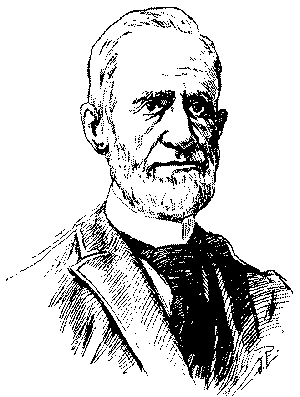
After fifteen years of agitation and investigation the existing interstate commerce law was enacted in 1887. The law prohibits unreasonable rates and unjust discriminations between persons, places, and classes of traffic, prohibits pooling agreements, provides penalties for the violation of the law, and establishes a commission of five men to administer and enforce the statute. Fortunately for the commission and for the country the first chairman of that body was the eminent jurist, Thomas M. Cooley, whose master mind did much to give vitality to the law.
During the first five years after the law was passed it secured a fairly efficient regulation of interstate railway commerce, but recent decisions of the United States Supreme Court have so weakened the law that at present the commission has very little power. The commission can investigate complaints and make reports, it can collect statistical information, it can and does informally adjust many differences between shippers and carriers; but, to quote from the last report of the commission, "it has ceased to be a body for the regulation of interstate carriers." Legislation to amend and strengthen the interstate commerce law is urgently needed.
Judge Thomas M. Cooley. (First chairman of the interstate commerce commission.)
XIII. STOCK AND PRODUCE EXCHANGES
THE STOCK EXCHANGE
The stock exchanges of the world must not be considered simply as noisy congregations of brokers speculating in securities under the guise of legitimate business. They really play an important and necessary part in the financial mechanism of the country, and are instruments of enormous value in subdividing and distributing capital, and in directing its employment in great commercial and industrial enterprises.
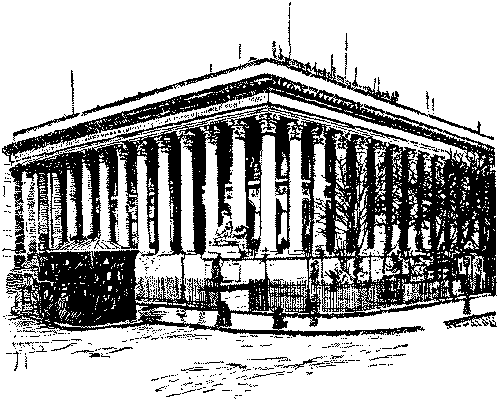
The largest stock exchange of the world is that of London. It is not only the centre of the English market for stocks and securities but, like the Bank of England, it is linked internationally with nearly all the financial centres of the world. Almost every reputable security is marketable in London, either through the ordinary channels provided by arbitrage dealers, who buy in the cheaper and sell in the dearer markets, or through the agency of trusts and investment concerns. The magnitude and extent of the financial resources of the London Stock Exchange are enormous. Its advantages to the business public outweigh altogether the drawbacks imposed by the too-speculative spirit of mankind. It is a great business barometer, extremely sensitive to all conditions likely to disturb the world's finances. The London Stock Exchange has scarcely more than one hundred years of history. In the early part of the century the elder Rothschild was one of the giants "on 'change," and it was in this business that he amassed the great fortune which makes the name of his house a synonym for money power. The membership of the London exchange is not limited to a fixed number, as in Paris and New York. In the Paris Bourse all agents are strictly forbidden to trade on their own account.
The Paris Bourse.
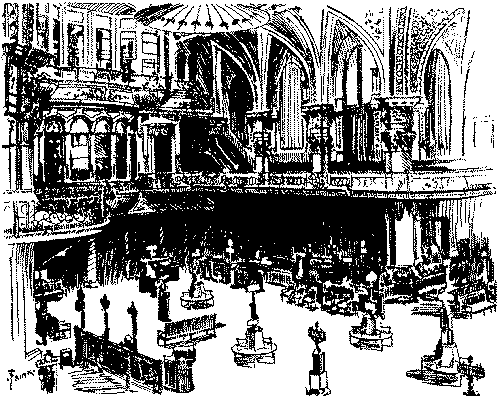
The New York Stock Exchange was formed in 1792. There are 1100 members. Members are elected and must be nominated by two men who will say that they would accept the uncertified cheque of the nominee for $20,000. The initiation fee is $20,000. Memberships have sold as high as $32,500, and the market value of a seat on the Exchange varies only slightly from year to year.
Interior view of New York Stock Exchange.
There are stock exchanges in all large cities, and scattered throughout the country in convenient centres are grain and produce exchanges, cotton exchanges, petroleum exchanges, etc. These exchanges are really the central markets for the commodities they represent. Commodity exchanges deal in actual products, even though the dealers handle nothing but warehouse receipts or promises to deliver. Stock exchanges deal in credits and securities, which may or may not have a tangible value back of them.
There is no reason why bonds and shares should not be publicly dealt in—and in large quantities—as well as dry goods, corn or cotton; but, unfortunately, few stock exchanges confine their transactions wholly to legitimate business. You will look in vain in the quotations for the stock of dozens of corporations whose securities are among the choicest investments. It is upon fluctuations that stock speculations prosper, and it is often true that the largest profits are made on the poorest stocks.
Transactions are quickly collected and reported to the world. In hundreds of offices in New York, Chicago, and other American cities may be seen a little instrument called a ticker, which automatically prints abbreviated names of stocks, with their prices, on a narrow ribbon of paper. These tickers are rented to these offices by the telegraph companies, and as fast as the sales are made the quotations are ticked off in thousands of offices in all parts of the United States.
TECHNICAL TERMS OF STOCK EXCHANGES
The term bull is applied to those who are purchasers of stock for long account, with the purpose of advancing prices, as the tendency of a bull is to elevate everything within his reach. The term bear is applied to those who sell short stock, with the purpose of depreciating values. The bear operates for a decline in prices. The broker's charge for his services is called a commission, which in the New York Stock Exchange is one eighth of one per cent. each way on a par value of the security purchased or sold. A point means one per cent. on the par value of a stock or bond. Stock privileges or puts and calls are extensively dealt in abroad and to some extent here. A put is an agreement in the form of a written or printed contract filled out to suit the case, whereby the signer of it agrees to accept upon one day's notice, except on the day of expiration, a certain number of shares of a given stock at a stipulated price. A call is the reverse of a put, giving its owner the right to demand the stock under the same conditions. A put may serve as an insurance to an investor against a radical decline in the value of stocks he owns; a call may be purchased by a man whose property is not immediately available, but who may desire to be placed in a position to procure the shares at the call price, if they are not below that in the open market when he secures the necessary funds. The speculator usually trades on margins. If he has $500 to invest he buys $5000 worth of stock, his $500 being ten per cent. of the total amount. He expects to sell again before the remaining amount falls due. The margin is usually placed by the speculator in the hands of a broker as a guaranty against loss. Although these brokers are really agents for others, yet on 'change they stand in the mutual relationship of principals. A margin is merely a partial payment, but a broker buying stock for a client on margin is compelled to wholly pay for it. If he has not the necessary capital his usual custom is to borrow from banks or money-lenders, pledging the stock as collateral security. In foreign exchanges the element of credit enters more largely into the conduct of business. Where the credit of the client in London is established his broker does not, ordinarily, call on him for any cash until the next "settlement day." A wash sale is a fictitious transaction made by two members acting in collusion for the purpose of swelling the volume of apparent business in a security and thus giving a false impression of its value. Stocks sell dividend-on between the time the dividend is declared and the day the books of the company close for transfer; after that they sell ex-dividend, in which case the dividend does not go to the buyer. When a company decides not to declare a dividend it is said to pass its dividend. To sell stock buyer 3 is to give the buyer the privilege of taking it on the day of purchase or on any of the three following days, without interest; and to sell stock seller 3 is to give the seller the privilege of delivering it on the day of purchase or on any one of the three following days without interest. Buyer 3 is a little lower and seller 3 a little higher than regular way when the market is in a normal condition. Bucket shops are establishments conducted nominally for the transaction of a stock-exchange business but really for the registration of bets or wagers, usually for small amounts, on the rise or fall of the prices of stocks, there being no transfer or delivery of the commodities nominally dealt in. There are thousands of these counterfeit concerns throughout the country conducted without any regard for legitimate commercial enterprises.
FUTURE DELIVERY
Grain is stored in warehouses until needed for milling or shipment. When we speak of December wheat we mean wheat that is to be delivered to the buyer in December. The carrying charges include storage, interest, and insurance, so that wheat sold for May delivery would necessarily bring a higher price than wheat sold for December delivery. Carrying charges are in favour of the short seller. When sold for immediate delivery it is known as cash grain.
XIV. STORAGE AND WAREHOUSING
BONDED WAREHOUSES
There is a government regulation that an importer who does not wish to pay immediately the customs duties on his goods may have them stored in a warehouse, provided he furnish a bond with a surety that he will pay the duty within three years or export the goods to some other country. It is also a requisite that the goods be deposited in a bonded warehouse in the care and custody of its proprietor, who also must furnish the government with a bond of indemnity. The bond of the proprietor is a general bond and usually covers what might be considered a fair amount of total values due the government at any time. Officers of the United States are stationed at the bonded warehouse during business hours. These are there in evidence of the government's proprietary interest in the merchandise stored. When an importer makes entry at the custom house for bonding his goods, he at that time provides the security required.
By a recent decision of the Treasury Department at Washington goods in bond are in the joint custody of the United States government and the proprietor of the warehouse, and after the government has received its customs duties for the goods they are in the proprietor's sole possession. The government cannot interfere to enforce delivery of the goods to the importer. The claim of the warehouse proprietor for storage charges becomes a first lien after the government's claim is satisfied. When the importer has paid both customs and storage charges he is privileged to remove his goods.
WAREHOUSE REGULATIONS
It is the duty of United States storekeepers to check off the goods as they are received at the warehouse and to report the same to the custom house; and when goods are to be withdrawn to see that delivery is not made until a custom house permit is presented. Upon payment of the import duty on goods in bond at the custom house at any time after importation, the customs officials issue a warehouse permit to the importer ordering the United States storekeeper in charge of the bonded warehouse to deliver the goods to the importer, and upon presentation of the permit the goods are released unless the proprietor holds them subject to storage charges.
Goods may be held in bond for three years with the duty unpaid, but after that time either the duty must be paid or the goods exported. If shipped to another country and afterward re-imported the goods would again be entitled to the three-year privilege. If goods are not exported and the customs charges are due and unpaid, the government may dispose of the goods at public sale to obtain its claim.
Goods arriving by steamer and unclaimed lie at the wharf forty-eight hours. If the owner does not appear to make entry for them within that time, after the entry for the vessel has been made, the goods are sent to a bonded warehouse and remain there on what is known as a general order, and if they stand there unclaimed for a year they may, at the expiration of that time, be sold by the government.
The capital of a warehouse is its storage space. The rates vary from ¼ to ¾ of a cent per cubic foot. The charges may be based on the amount of space consumed and the weight of the merchandise. The latter often determines the floor elevation to which the goods may be assigned. The more convenient of access the storage location is, the greater the cost. Warehouse receipts are issued as evidence of storage. All merchandise is conveniently bulked for numbering and marking, and these distinguishing marks appear on the receipts. Negotiable and non-negotiable receipts are issued as the needs of the owner may require. The former permit advances to be made by bankers upon the merchandise as collateral security.
FREE WAREHOUSES
These differ from bonded warehouses only in the fact that the government has no control or interest in them. They are only for the storage of imported goods on which the customs duty has been paid or for goods imported free of duty or for merchandise of domestic production and manufacture. They are managed entirely by the proprietor, and the contracts for storage are, of course, between the proprietor of the warehouse and the owner of the goods. The storage rates in free warehouses are considerably lower than for goods stored in bonded warehouses—the latter being a much more expensive business to conduct. There is no time limit in free warehouses. Goods may remain indefinitely. When they remain from six months to a year the charges are collected usually at certain periods to avoid accumulation. Experience shows that goods in free warehouses do not stay so long as those in bond. The articles commonly found in these houses are domestic and imported wools, cotton, canned goods, peanuts, yarns, cotton piece goods, mattings, dry goods, etc. Perishable goods, of course, do not find their way into bonded or free warehouses. These are placed in cold storage.
BANKING FEATURES OF WAREHOUSING
Many of the warehouses find it advantageous to do a banking business in connection with the storage features. Very frequently, for the convenience of the importer, goods are consigned to the warehouse and sent subject to a sight draft for the amount of the invoice. The warehouse company will pay the draft with the exception of about twenty per cent., which the importer is expected to furnish. If the duty is paid then the value upon which a loan is estimated is based upon the market value of the goods in this country. After the draft has been satisfied the goods are placed in the stores of the warehouse company subject to the customs and storage charges. The amount advanced by the company bears interest at current money rates. In illustration let us suppose bonded goods to be shipped and invoiced at $10,000, customs duty $4000, and the goods consigned to a bonded warehouse. The draft ($10,000) is sent to the warehousing company, which advances $8000, and together with the $2000 received from the importer pays the draft. The $8000 loan made by the company is then charged to the importer at the usual interest rate, and when the borrower withdraws his merchandise from storage he will have to pay the government the $4000 customs duty and pay back his loan of $8000 to the warehouse company, together with interest and storage charges. If any portion of the goods stored is withdrawn for use in the business of the importer, the company will rebate a proportionate amount of the interest. If goods decline in value as collateral in storage the company will demand additional margin for its protection. If goods appreciate in value the loan may be increased. The market value of the goods is ascertained by the appraisement of some expert, who receives a commission for his services.
COLD STORAGE
The cold-storage warehouse is the natural result of the necessities of our great agricultural interests in the preservation of perishable products so sensitive to the deteriorating effects of temperature. The solution of the problem of the preservation of dairy products, meats, fish, poultry, fruits, and vegetables has developed a system that has eliminated the seasons and made possible the equalisation of prices of the finer class of edibles. The cornering of products and the creation of unreasonable prices are avoided. No article becomes a glut on the market as formerly. When there is a surplus of eggs and fruit, prices may be maintained by putting them in cold storage for a few days and offering them on the market when the conditions of trade warrant.
TEMPERATURE REQUIREMENTS FOR COLD STORAGE
Prior to the year 1890 cold storage was dependent upon the employment of ice, but in the evolution of the cold-storage warehouse ice is no longer a requisite. In fact, the temperature obtained by the employment of ice precluded a thermometric register much below the freezing point. The accepted temperature for butter and eggs was formerly 40° to 50°; but through the introduction of mechanical refrigeration, which has revolutionised the business economically as well as physically, eggs now are held in storage at a temperature of 31° and butter from 10° to 18°. Under the former method of ice storage, goods that were offered on the market as "held goods"—that is, as coming from a cold storage—always brought several cents under the prices of fresh merchandise. But the remarkable modern methods of cold storage permit the carrying of dairy products for a number of months and their successful sale afterward in competition with fresh goods. Eggs stored in March are taken out in the following November and have commanded as high and often higher prices than the fresh commodity. Eggs have been kept two years and found perfectly sweet when used. In freezing poultry and fish the temperature now frequently given is zero and under. Poultry does not carry so well as other merchandise. Although it is possible to keep it for two years, yet it loses its flavour. Five or six months' storage is its usual average limit.
Certain temperatures are maintained in the various compartments of a cold-storage warehouse according to the requirements of the products, and these temperatures are made possible by forcing through pipes arranged around each compartment a brine composed of about ninety-five per cent. of pure salt whose temperature has been reduced by the action of the chemicals. When a shipper stores his goods there is an implied contract with the storage company that the temperature required for the product will be furnished and maintained. Failure to do this renders the company liable for any damage to property. So vital is this feature of the business, which is really the only liability assumed by the company, that the custom prevails of taking the temperature of each room as often as five times in every twenty-four hours, and keeping the record in temperature books open to the inspection of the shippers. A room filled with merchandise may not vary in temperature one degree in six months.
COLD-STORAGE CENTRES
Chicago very naturally is the leading cold-storage centre. Its situation in the heart of the productive area and its advantages as a distributing centre have given it its prestige. But in the last two or three years the Eastern cities, New York, Philadelphia, and Boston, have developed enormous cold-storage facilities, and Chicago no longer is absolute in her dictation to the markets of the world. When it is remembered that the dairy interests of our country during the last three years averaged an annual value of $650,000,000, and that the greater portion of this found its way into cold-storage warehouses, the importance of this new and very necessary business is readily appreciated.
COLD-STORAGE CHARGES
The cold-storage charges for eggs in thirty-dozen cases would be about 15 cents per case for the first month and 9 cents for every additional month. Butter in sixty-pound tubs would be charged at the rate of 12 cents per tub for each month. Cheese would cost one tenth of a cent a pound per month. The rates of Eastern cities are usually higher than in the West. About ninety per cent. of the storage business of the East is in goods shipped from the West. The refrigerator car is a valuable adjunct to the business. The temperature of the cars is about 45°.
Although no ice is used in the modern cold-storage plant, yet the ice has become a very valuable by-product. Since all the facilities for its manufacture are at hand it has become a matter of commercial expediency to employ them to the company's profit in the production and sale of a commodity indispensable to modern life.
QUESTIONS FOR REVIEW
Give some particulars in which the Bank of England differs from our larger national banks.
A bank cheque is a demand order for money drawn by one who has funds in the bank. How does a cheque differ from an order on A—— B—— to pay bearer a certain sum of money?
You are sending a cheque through the mails to John Brown, Chicago. How will you prevent the cheque from falling into the hands of the wrong Brown?
You identify A—— B—— at your bank. The cheque A—— B—— presented turns out to be a forgery. Are you responsible?
What is meant by power of attorney? How should an attorney indorse cheques for any person for whom he is acting?
What is a certified cheque? Brown gives A an ordinary cheque for $1000, and B a certified cheque for $1000. He fails before either cheque is presented. Why is B's security for his claim considered better than A's?
Show how all the banks of the United States are connected through the clearing-house system.
How do State and national banks differ as to their organisation?
A national bank has a capital of half a million. A customer asks for a loan of $62,000 on indorsed paper. Can the bank legally grant the loan?
Give some particulars of the liabilities of the officers and directors of national banks.
What is meant by borrowing money on collaterals? How is this done?
Tell how it is possible for a young man of good character, but without friends who have financial standing, to secure bonds for his faithful conduct in a responsible position.
When rates are high bankers prefer to deal in long-time paper. Why?
Account for the fact that London is the financial centre of the world.
Explain in detail the business of a note broker, giving some particulars of his responsibility in connection with the paper handled.
Enumerate the leading items of resource and liability in a national-bank statement.
A bank receives from the comptroller of the treasury $100,000 in new bank-notes of its own issue. What ledger entry? A bank retires $10,000 of its own bank-notes. What entry?
Discuss fully the points which should enter into a proper estimate of the value of paper offered for discount.
Give the successive and necessary steps in the formation of a joint stock company.
Why are companies which properly exist and belong in one State sometimes organised under the laws of another State?
Explain very fully the difference as to resource and liability between a bondholder and a stockholder.
How may a stock company be dissolved?
What is the difference between a voluntary association, such as a society or club, and a stock company?
Explain very fully the meaning of Limited when it forms part of the legal title of a company.
Is it legal to sell shares of stock and issue mortgage bonds upon the same property? What relationship do they bear one to the other?
EXAMINATION PAPER
Note.—The following questions are given as a means by which the student may test for himself whether he has attentively pursued the lessons of the course or not. It is recommended that each student as he finishes the course write out the answers to the questions in full. Only such answers need be attempted as the student can frame from a careful study of the course.
(a) Give some particulars in which the Bank of England differs from our larger national banks. (b) Enumerate some of the advantages afforded to the community and to commerce in general by banking institutions. (c) How do private banks and trust companies differ from national banks?
(a) What is a stock certificate? How does it differ from a mortgage bond? (b) At what rate must United States 4 per cents be bought to net 3.2465 per cent.? (c) Give the successive and necessary steps in the formation of a stock company. How can the stock of a company or corporation be increased?
(a) What provision is usually made for the redemption of municipal bonds which have a long period to run? (b) What is meant when we say that a certain railway is in the hands of a receiver? (c) Give some of the advantages which stock companies have over partnerships.
(a) Tell how you would receipt for a payment on a note. Why is not an ordinary separate receipt sufficient? (b) Discuss fully the points which should enter into a proper estimate of the value of paper offered for discount. (c) Explain in detail the business of a note broker, giving some particulars of his responsibility in connection with the paper handled.
(a) What are the advantages to the banks of a city of their central clearing-house? (b) Show by a diagram how collections are made between distant points. (c) What is a certified check?
(a) Enumerate some of the abuses of rate discrimination in the United States and tell how they are met. (b) What are the advantages to the public of freight organisations which arrange for through service? (c) Explain in detail the methods adopted by leading and competing railway lines to regulate and adjust freight rates. (d) What are differentials? How are (1) through and (2) local passenger rates regulated?
(a) Give the particulars in which a warehouse receipt resembles and differs from (1) a promissory note, (2) a bill of lading. (b) What are the advantages to the importer of bonded warehouses? (c) What are the duties of our foreign consuls with reference to the importation of goods?