Chapter XII · THE VALLEY OF THE MAGDALENA
Reading edition
“Salud, Salud, majestuoso rio!...
Al contemplar tu frente coronada
De los hijos mas viejos de la tierra,
Lleno solo de ti, siento mi alma
Arrastrada en la espuma de tus olas,
Que entre profundos remolinos braman,
—Manuel M. Madiedo.
While in Guaduas we met a Scotch engineer, who was superintendent of a gold mine in the mountains west of Honda. Desiring to know the truth about the excessive temperature of this place, about which we had heard so many reports, we asked him if it was really true that the heat in Honda was as intense as represented.
“You will,” he said, “find it the hottest place you have ever visited. It is certainly the most torrid place I know, and I have been something of a globe-trotter in my time. Hades, if I have caught the meaning of the word, as used in the Revised Version, is quite temperate in comparison with it. Business frequently calls me to Bogotá, and, on my way thither, I must necessarily pass through Honda, but I never stop there longer than is absolutely necessary, and I always try to avoid being there in the daytime. If I must stop there for a few hours, I time my journey so as to arrive there at night, and make it a point to leave before morning. Hot? I think it is the hottest and most suffocating spot on earth. It has always been a mystery to me how people can live there at all. I know of nothing to compare it with except one of the burning pits of Dante’s Inferno.”
Had we not learned by long experience how to discount such statements, the prospect of spending some days in a town with such a reputation for grilling the stranger within its gates, would have been anything but inviting. But we had heard similar reports about the llanos and the valley of the Orinoco, and had found, on arriving in these regions, that the temperature said to prevail there had been greatly exaggerated. The same we found to be true of Honda. During our sojourn there, our thermometer never registered more than 86° F. in the shade. Of course, around midday it was uncomfortable in the sun, but I have been in many places in the United States where I suffered more from the heat than I did in Honda.
The town is about seven hundred feet above sea level and counts nearly four thousand inhabitants. It is separated into two parts by the river Guali, which here enters the Magdalena. Being the centre of traffic for Bogotá, the upper Magdalena, and the mining district round about Mariquita, it is a place of considerable importance. As soon, however, as the Colombian National Railway, now nearing completion, shall have connected Girardot with Bogotá, Honda will lose the commercial supremacy it has maintained for nearly three centuries. There will then be little reason for a town in this place, and it will lapse into a straggling village similar to many others along the river.
And the Muisca Trail, over which we had so delightful a ride, will be no longer needed, and will soon disappear in the dense and rank vegetation through which it passes. Then, too, will disappear those long and picturesque mule-trains, that so often crowded us to the roadside on our way from Bogotá, and which have been almost the sole means employed for the transportation of freight and passengers since the capital was founded by Quesada nearly four centuries ago. We shall always congratulate ourselves that we were able to make the trip on mule-back rather than by a railway train. We can thus feel that we have, to a great extent, seen the country as it was in colonial times—before its character was modified by the innovations of modern progress and the introduction of modern inventions.
In 1805 Honda was visited by a terrific earthquake, from the effects of which it has never recovered. Everywhere are evidences of the frightful cataclysm. Some of the largest and most important structures are still in ruins. Nor has any attempt ever been made to restore certain quarters of the town to their prior condition.
After a few days’ halt at Honda, we were ready to continue our journey towards the Caribbean. The rapids of the Magdalena make it impracticable for steamers to ascend the river as far as the town. For this reason, it is necessary to go by rail to La Dorada, eighteen miles northwards. But, although the distance is so short, it takes two hours for the train to make the run. The road, however, passes through a picturesque country and time passes pleasantly and quickly. Before one realizes it, one is at La Dorada, where the transfer is made to the steamer bound for Barranquilla.
A glance was sufficient to convince us that the craft on the Magdalena are in every way inferior to those on the Orinoco and its affluents. The Venezuelan boats are larger, and with incomparably better equipment and appointments. They are clean, well kept, and the service is good. Their cabins are commodious and well ventilated. They are, besides, provided with all necessary furniture and the berths are as comfortable as could be desired.
But how different is it on the Magdalena boats! In the cabins, in place of berths with neat bedding, there is a bare cot, usually of questionable cleanliness. Each passenger is supposed to supply his own bedding. As to lavatories and bathrooms, those that we saw were filthy beyond description. Our stewards were half-dressed, barefooted, slovenly, unwashed negro boys, who seemed to have been picked up on the streets at random, just before the boat left its moorings. The cuisine and service were in keeping with everything else, and left very much room for improvement. The natives, having nothing better, seemed to be satisfied with the conditions that obtained. The foreigners, however, and there were representatives of several nationalities aboard, could never become reconciled to the lack of so many things essential to comfortable traveling, and were always glad when their river experiences were at an end.
For ourselves, who had been roughing it so long, the trip down the river was not so trying as it was for many others. We were, besides, better prepared for such a journey than the other passengers. We had our camping outfits with us, together with clean bedding, which had received the attention of the laundress before we left Bogotá. We had, besides, good cumare hammocks, and mosquito nets, so that we had nothing to apprehend from filth, vermin or insects. Thus equipped, we really enjoyed our voyage on the Magdalena, but we were probably the only ones who did.
After we had gotten fairly started down stream, and could contemplate at our leisure the rich tropical vegetation that fringed both banks, our minds reverted to the first trip made down this river by Europeans. The travelers were the celebrated conquistadores, of whom mention has already been made, viz., Quesada, Belalcazar and Federmann. They embarked with a number of soldiers at Guataqui, a short distance above Honda. But they had scarcely started on their downward course, before they encountered the rapids at the mouth of the Guali. They were then obliged to unload their two brigantines and canoes and transport their contents to the lower part of the cataract, whence, after reloading, they were able to proceed again on their long journey to Cartagena.
It was while passing this point that Quesada learned from his Indian boatmen of the existence of gold in the valley of the Guali. In consequence of this information, the town of Marquita was founded without delay, and has ever since been a mining centre of considerable importance. It was in this place that Quesada died after his return from Spain. From here his remains were transferred to the Cathedral of Bogotá, where they still repose.
“Shallow, disreputable, vast
It spreads across the western plains.”
Then progress is difficult, and the boat may run into a sand bar at any moment. And if the river should then be falling, it may be impossible to get the craft free until the water rises. Only a short time before our trip one of the steamers had been held in a sand bank for forty days. As it was not near any place where provisions could be obtained, the passengers suffered greatly from hunger, not to speak of the suspense and enforced detention on an uncomfortable boat.
Owing to the shallowness of the river, the boat was, during the first part of the voyage, always tied up for the night at the first tree or stump that might be found on the bank at sunset. The following morning we were supposed to resume our journey at daybreak, but, as the firemen did not begin to get up steam before that time, it was usually an hour after sunrise before we were under way. We stopped at every village and warehouse along the river, sometimes to deliver the mail, often consisting of only a single letter or package, or to take on a passenger. Two or three times a day, also, we halted to take on wood to supply the furnace with fuel, for here, as on the Meta, coal is not used. Fortunately, we were never obliged, as on the Meta, to delay until the wood could be cut. Large wood piles are found every few miles all along the river. They usually belong to a negro, who has a hut or shed near by, together with a small garden and a few domestic animals which supply him and his family with food in their sequestered home.
We usually went ashore at the different landing places to see the people and familiarize ourselves with their mode of life. It was generally as simple and primitive as possible—almost as primitive, in some instances, as we conceive it to have been in the Quaternary period or in the days of the Troglodytes. Often their dwellings were little more than palm-thatched sheds—barely sufficient to shield their occupants from sun and rain. A tulpa, consisting of three stones, served them in lieu of a stove, and on this they broiled the fish caught in the river, or prepared their arepas—corn cakes—or their sancocho, a kind of ragout, as popular in some parts of Colombia as it is in Venezuela.
We were surprised to see in the houses and shops along the Magdalena valley—what we had often observed in various parts of Colombia and Venezuela—the large number of illustrated circulars of Spanish, English and French proprietary medicines. The insides of certain houses were sometimes quite plastered over with them. But what was more surprising was the number of lithographs we saw of the German Emperor. Sometimes he was represented alone, at others he was depicted as surrounded by the members of his family. In several places we saw pictures not only of the emperor and his family, but also those of his father and grandfather and Bismarck. And the remarkable thing about it was that, in some cases, there were no Germans living within hundreds of miles of where we came across these pictures. Had some enthusiastic Teuton tried to start a propaganda in favor of the Vaterland by distributing broadcast these engravings of the imperial family? I know not, but, judging solely from the number of their pictures we came across in Venezuela and Colombia, one would be led to suppose that the Hohenzollern rulers are the most popular of potentates, at least in this part of South America.
While stopping to take on some rubber at a certain small village, we had a remarkable illustration of the rapidity with which the bed of the river is sometimes changed, even when the water is comparatively low. We had scarcely reached the landing place when there was a terrific crash, occasioned by the falling in of a large section of the bank on which the village was built. Soon afterwards another section gave way, and then a third and a fourth. The whole bank seemed to be undermined by the river, and, although the warehouse was fully fifty feet away from the water when we arrived, so much of the bank had been carried away in less than half an hour, that not only the contents of the building, but also the building itself had to be hurriedly removed in order that it and the merchandise stored within might not be borne away by the resistless current. As the structure was of light bamboo, and put together with a view to such an emergency, the transfer was not a difficult task. When we started to continue our course, it looked as if the eroding action of the river would necessitate the changing of the site of the entire village before nightfall.
Ordinarily the changes in the river bed are gradual and occasion little danger to life or property. Sometimes, however, during the rainy season, and when the flood is unusually high, widespread devastation is the result. Whole villages are swept away by the deluge; and towns, that were before important commercial centres, are suddenly isolated and left far from the navigable part of the river. Places that before were favorably situated are, after the flood, found to be in the midst of pestiferous morasses. Such has been the fate of many places along the waterways of Colombia, but more notably in the great island of Mompos, near the confluence of the Cauca and the Magdalena. Here several places that were at one time centres of industrial and agricultural activity, have long since either ceased to exist or lost entirely their pristine importance.
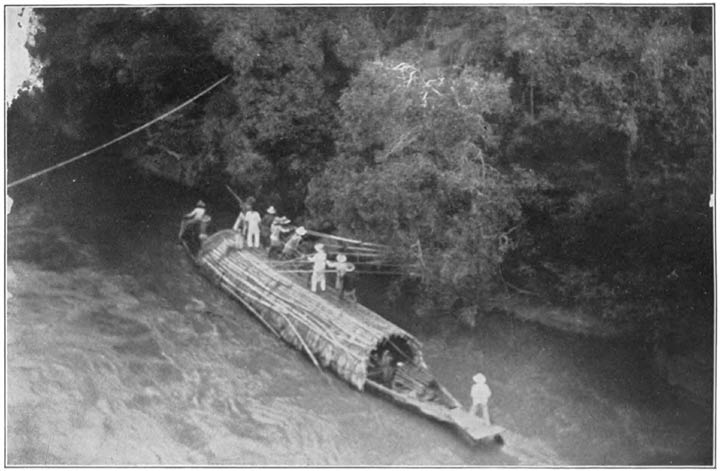
Champan Going Up the Magdalena.
The town of Mompos is probably the most remarkable example of this kind. Founded in 1539 by Alonso de Heredia, it is one of the oldest towns in the republic, and was for generations the most important commercial centre between Cartagena and Honda. But owing to a displacement of the main channel of the river, and the filling in of the branch of the river on which the town was built, it is now practically deprived of its former means of communication with the rest of the country, and is rapidly verging towards extinction.
The Magdalena, as a commercial highway, has been much neglected. As a consequence, no one can calculate when leaving Honda, how long it will take him to reach Barranquilla. It may require five or six days, or it may demand twice that much time. All depends on the shifting bed of the river, or the blocking of the channel by sand bars and accumulations of floating timber. By reason of these obstructions and the ever-varying depth of the main channel, navigation is usually impossible at night, except below the island of Mompos, where the volume of water is swelled by the tribute of the mighty Cauca.
If the Magdalena were under the supervision of a corps of competent engineers, having at their disposal the necessary dredges and other appliances for keeping the main channel in prime condition, a properly constructed boat would easily make the trip from Honda to the mouth of the river in two days, and traverse the same course up stream in three days at most. It is really a pity to see such a splendid water course so neglected. If cared for as it should be, it could easily be rendered an artery for inland commerce of the first importance. As it is, transportation, as now carried on, is always slow and uncertain, and never free from danger and disaster.
As a serviceable means of communication with the outside world we were constantly contrasting the Magdalena with the Meta. From our observations, we should consider the Meta, from its junction with the Orinoco to Cabuyaro or even to the mouth of the Humea, as a safer waterway than the Magdalena. Only twice did our boat graze a sand bank in the Meta, but it continued its course without a moment’s stoppage. In the Magdalena, however, we frequently ran into sand bars, or shallow water, and, on several occasions, had difficulty in extricating and floating our craft. Once we were delayed for some time, and began to fear that, owing to the falling water, we should be stranded for weeks, as other boats had been not long before.
When peace shall have been firmly established in Colombia, and its finances shall have been placed on a satisfactory basis, the patriotic and far-seeing statesmen of the republic, will, I am convinced, see the necessity of carrying out the plan of the former Archbishop and Viceroy of New Granada—Don Antonio Caballero y Gongora—and connecting Bogotá with Europe by means of the Meta and the Orinoco. It will not be a difficult feat of engineering to build a railroad from the capital to a suitable point on the Meta, and the length of such a road need not exceed one hundred and fifty miles at most. This will bring Bogatá within eight or ten hours of the head waters of navigation, and develop the most valuable and most productive grazing section of the country.
What Colombia really needs is the betterment of both its great waterways—the Meta for the eastern and the Magdalena for the western part of the republic. Until they shall both have been put in such condition as to be navigable during the entire year, it will be impossible fully to develop the marvelous resources of this extensive country. River traffic will always remain cheaper than traffic by rail, and, on account of many physical difficulties, it is highly improbable that certain valuable sections of territory will ever be tapped by railroads. When, however, these two main arteries of commerce shall have received the attention they deserve and shall have been put in communication with the rich grazing, mining and agricultural regions by the various lines of railway that are contemplated or in course of construction, Colombia will at once take a position among the richest and most flourishing republics of South America. Only those who have traveled through it can fully realize its wonderful natural riches, or form an adequate conception of its vast extent. Sufficient to state that its area is more than ten times as great as the state of New York, or as great as that of France, Germany and the British Isles combined.
As to the great Pan-American line which has been projected to connect New York with Buenos Ayres, that is talked of in Colombia as well as in the United States. But when one contemplates the enormous engineering difficulties to be encountered in the construction of the section extending from Costa Rica to the frontier of Ecuador, one is compelled to regard the project as a much more arduous undertaking than some of its enthusiastic promoters would have us believe. Railway communication will soon be complete from Buenos Ayres to Central Peru, and, judging by work now being accomplished in Ecuador, steel rails will soon span the country from the northern to the southern boundaries of this republic. But with all this work completed, the most difficult part of the colossal enterprise will still remain untouched. Even should the road eventually be completed, as is possible, it is still doubtful whether long stretches of it would ever pay even a nominal interest on the investment.
The scenery along the Magdalena is much like that along the Meta and the Orinoco, except that along the western river one sees more of the mountains, especially in the southern part. The vegetation is similar in character and quite as varied and exuberant. On both sides of the river trees and bushes are so massed together as to form an impenetrable wall. Everywhere there is a veritable maze of creeping plants, of bromelias, bignonias, passifloras. And everywhere, too, are lianas—aptly named monkey-ladders—which bind tree to tree and branch to branch. Usually they are single, like ropes—whence their name bush ropes—but often they are twined together like strands in a cable. Frequently they are seen descending from the topmost part of a tree to the ground, where they forthwith strike root and present the appearance of the stays and shrouds of a ship’s main mast. And where there is air and sunshine, these lianas, which often form bights like ropes, are loaded with epiphytes of all kinds, and decorated with the rarest and most beautiful orchids. Indeed, the regions on both sides of the Magdalena have long been favorite resorts for the orchid hunters in the employ of the florists and merchant princes of the United States and Europe. From here these bizarre vegetable forms are shipped by thousands. One enthusiastic English collector tells us how he secured, as the result of two months’ work about ten thousand plants of the highly prized Odontoglossum. But to obtain these orchids he was obliged to fell some four thousand trees.
It is when contemplating the marvelous variety and luxuriance of intertropical flora—of which one in our northern climes can have no adequate conception—that one is tempted to exclaim with Wordsworth:—
“It is my faith, that every flower
And if the extraordinary claims which Professors Wagner, France and G. H. Darwin make for plants be true, viz., that they have minds and are conscious of their existence, that they feel pain and have memories, then, indeed, should we be disposed to regard the exuberant and wondrously developed plants of the equatorial world as occupying the highest plane in the evolutionary process of vegetable life.
“A good land! A good land! A land which puts an end to our suffering, a land of gold, a land of plenty. A land for a home, a land of benediction, bright and serene.”
It was then that the enthusiastic soldiers, whose courage would often have faltered, had it not been for the determination and perseverance of their invincible leader, gathered around Quesada to congratulate him on the successful issue of his great undertaking, and to assure him of their undying loyalty in any future enterprise in which he might require their services.
And well they might render the noble licentiate the meed of praise he so well deserved, for had it not been for him, the expedition would have been a failure, and they would undoubtedly have perished before they could have returned to Santa Marta, as had so many of their companions, who had turned back before the ascent of the Cordillera was begun. To some of his officers who, in view of the unheard-of difficulties they had to encounter, recommended that the expedition be abandoned, he replied that he would regard as a personal enemy any one who, in future, would make such a pusillanimous proposal and one so foreign to Spanish valor.
All in all, he was one of the bravest and most humane of the conquistadores, and successfully performed a task before which a less valorous commander would have given up in despair. His achievements obscure by their brilliancy and daring those of Amadis and Roldan and are in no wise inferior to those of any of the conquistadores. They may truthfully, in the words of Bacon, written anent a performance of Sir Richard Grenville, be styled as “memorable beyond credit, and to the height of some heroical fable.”
Quesada has taken his place in Valhalla among the greatest of the world’s heroes, and his memory will endure as long as splendid deeds of prowess shall stir the souls of men. Of him and his gallant companions one can say what Peter Martyr wrote of their countrymen in general:—
Strange as it may seem, the method Heredia resorted to of securing gold, the rifling of the huacas—burial places—of the aborigines, has been continued until the present day. There are still men in Colombia, notably in Antioquia—huaqueros, they are called—who gain a livelihood by searching for huacas and extracting from them the gold and emeralds they frequently contain.
The year before our trip there appeared in an English magazine, the following paragraph in an article purporting to give a picture of the Magdalena valley and its life:—
“Anchored in the forest at midnight, the traveler hears the deep growl of the jaguar, the sharp squeal of the wild cat, the howl of the howler monkey, the long moan of the sloth, and the last scream of the wild pig, pierced by the claws of some patient but ferocious animal ambushed during the past hour, with many other sounds of life, terror and conflict that fall strangely on the European ear, and, if he waits and watches until the dawn, he may see the alligator dragging his ugly bulk out of the water, crowds of turtles trailing on the sands, the deer and the tapir coming down to drink, thousands of white cranes on the branches nearest to their prey, thousands of gray ones already wading leg-deep, and many more thousands of other birds clouding the dim horizon, all waiting for the light ere they begin their work of life and slaughter.... With the alligators in shoals at the bottom of the river, and the millions of birds above its surface, one wonders how any fish are left, yet the river is always literally teeming with fish, as though conscious of the demands it has to meet.”
Although we were always on the alert, so as to miss nothing of interest, especially anything that concerned the animal life of the tropics, we must confess that in all our experience we never heard growls, squeals, howls, moans, screams, or other sounds of terror and conflict, either along the Magdalena or anywhere else in South America. And we spent nearly a year in the country, and often traveled weeks at a time in the wild virgin forest, far away from human habitations of every kind. Nor did we ever perceive any of the animals that certain tourists would lead one to believe can be seen in such numbers everywhere, even from the deck of a passing steamer. Nowhere along the Orinoco, the Meta, the Magdalena, or elsewhere, did we ever catch even a glimpse of a jaguar or a puma, a manati or a sloth, a wild cat or a wild pig. More than this, not once, during our entire trip through Venezuela and Colombia, through forests and plains, did we ever see a single monkey, except two or three that were kept as pets by the natives. This may seem an incredible statement. I would have believed such an experience as ours to be absolutely impossible, especially in view of what writers and travelers in South America have told us regarding the immense number of wild animals of all kinds everywhere visible in equatorial wilds. But I am stating a fact that I am quite unable to reconcile with the contrary experiences of others who, according to their own admission, have seen but little, compared with what we saw, of the lands through which we passed. I have seen more large game on the plains of New Mexico and Wyoming, from the window of a Pullman car, in a single trip to and from the Pacific coast, than I ever saw in the wilds of South America during nearly a twelvemonth.
Nor did we ever see along the Magdalena, or anywhere else, the “thousands of white cranes on branches,” nor the “thousands of gray ones wading leg-deep,” nor the “many more thousands clouding the dim horizon,” of which the writer of the above-mentioned article professes to have been the fortunate spectator. We rarely saw more than a few dozen cranes at a time—never a hundred, and I have reason to believe we enjoyed very favorable opportunities, at least during a portion of our long journey, for seeing what was to be seen. At no time did we ever observe as many birds in the air at one time as I have frequently seen in the United States. I feel safe in asserting positively that the number of wild pigeons I have frequently noted in a single flock in the United States, would more than equal that of all the birds combined that we saw while in the tropics.
The number of birds observed along the Magdalena was not greater than I have frequently seen in the valleys of the Missouri or the Columbia. Most of these were parrots and macaws. Always noisy and restless, always flying and climbing about, except when eating fruit or cracking nuts, one is at times tempted to describe them as feathered relatives of the monkey. The parrots are sometimes seen in flocks, and their piercing cries are at times almost deafening. They are a sociable bird and are usually seen in considerable numbers. The macaws are remarkable for always flying in pairs, and for their brilliant colors. Their body is flaming scarlet, their wings are tinged with various shades of red, yellow, green and blue, while their tail is bright blue and scarlet. They, too, like parrots, are very vociferous, and, although they may occasionally be found in large numbers, they always fly two and two.
The early Spaniards called all these saurians by the general name of lagartos—lizards. The English afterwards spoke of a single animal as a lagarto, whence the present name alligator. Modern writers speak of them indiscriminately as alligators or crocodiles. As a matter of fact, several species of both alligators and crocodiles are found in the equatorial regions. But, notwithstanding all that has hitherto been written about them, their distinction and definition, their classification still remains a matter of difficulty. Some specimens have been found whose classification is so perplexing that naturalists are still undecided whether to regard them as crocodiles or alligators. In this respect they are much like Shakespeare’s two lovers, “Two distincts, division none.”
The name cayman is employed in Venezuela and Colombia to designate any of these saurians. Following the classification adopted in the British Museum the cayman is distinct from both alligator and crocodile. More than this. According to the British system of classification, there are no alligators at all in South America, while, in the waters of Colombia and Venezuela, there are two species of crocodile and three species of cayman.
Probably more fabulous accounts have obtained about crocodiles than about any other animal. In spite of the old saying to the contrary, they never shed tears. And notwithstanding the fact that the ancient Egyptians gave the crocodile divine honors, because, being tongueless, it was made in hieroglyphical writing, a symbol of the Divinity, it is now known that the tongue of this erstwhile god is quite large, except at the tip. Similarly, all the stories that have so long been current about the impenetrability of the animal’s hide, are quite without foundation. How often have we not been told that it is impossible to kill a crocodile, with even the best Winchester, unless the ball enter the eye or strike under the soft, fleshy parts of the front legs? Their plated skin is easily pierced by an ordinary rifle or revolver, and a mortal wound ensues whenever a vital part is penetrated.
The early explorers of the New World had many stories to tell about the cayman and the crocodile, and many of them have apparently survived among the natives until the present day. But there were many other animals that made even a greater impression on them. It will suffice to reproduce Peter Martyr’s quaint account of two of these representatives of the American fauna. The first is the tapir, of which he writes as follows:—
The part of the valley below the confluence of the Cauca and the Magdalena was quite different from that above. The country contained more inhabitants, and the dense forests that had hitherto bordered the river gave place to broad savannas, on which grazed thousands of cattle, so buried in the Para and Guinea grasses, that frequently we could discern only their horns. Along the river banks were the estates of well-to-do haciendados—some of them foreigners—and the villages, that before were extremely rare, became more numerous. The aspect of the country was less wild than that through which we had just passed, and betokened a certain measure of prosperity, at least so far as the grazing interests were concerned.
We could now travel day and night, for the river was so deep that sand bars were no longer to be apprehended. And then we had the most delightful moonlight nights. The air was balmy and laden with an exquisite fragrance,
“Mild as when Zephyrus on Flora breathes,”
a constant invitation to repose and dolce far niente. The surpassing loveliness of the scene, the magic stillness of the vast solitude through which we were so peacefully gliding, the broad expanse of one of the world’s great rivers, the weird silhouettes cast by the passing palms on the moonlit waters—all these things contributed towards rendering our last night on the river a fitting finale to the others—all of which were in the highest degree enjoyable. Seated on the forward deck of our steamer, we could exclaim in the words of the choric song of Tennyson’s Lotos-Eaters:—
“How sweet it were, hearing the downward stream,
With half-shut eyes ever to seem
Falling asleep in a half-dream!
Resting weary limbs at last on beds of asphodel.”
The following morning—our last day on the Magdalena—found us at Calamar. Here some of our fellow-passengers disembarked to take the train to Cartagena, sixty-five miles to the westward. From Calamar to Barranquilla, the chief northern terminus of river navigation, is sixty-six miles. This distance we expected to make in a few hours, but for reasons presently to be given, we were unexpectedly delayed within sight of Barranquilla, the goal that marked the completion of another important stage in our journey.
Our last day on the Magdalena was a bright balmy one in June. We spent the entire time on the forward part of the upper deck, fanned by the delightful breezes that were wafted from the Caribbean. The river here has about the same width as has the Mississippi at New Orleans, but the scenery is far more attractive. It flows through a broad, level, grass-covered savanna, which extends beyond the limits of vision, and which is dotted here and there with small villages and flourishing haciendas. Some of the houses near the river banks have a most cozy appearance. They are almost embowered in a mass of flowers of every hue, and surrounded by lofty palms whose lovely emerald coronals were each a picture of rarest beauty.
It is quite impossible for the inhabitants of our northern climes to have anything approaching an adequate conception of the grace and beauty and surpassing loveliness of the omnipresent palms of the equatorial world. Away from heat and sunshine, they are quite devoid of the luxuriance and stateliness that characterize them in the tropics. In Europe, for instance, there is but a single palm that is indigenous—the Chamærops humilis. The date palm was introduced from the East. In the tropics, however, about eleven hundred species of palms are known, and there is reason to believe that, when this part of the world shall have been thoroughly explored, many new species shall be discovered.
The habits as well as the habitats of palms were a source of unfailing interest to us. Some are solitary and are rarely found forming groups with other trees of their species. Others, like the date palm, are quite gregarious and often form extensive clumps. Others still are said to be “social,” because they occupy extensive tracts almost to the entire exclusion of other kinds of trees. Various species of Mauritia, Attalea, Cocoa and Copernicia are social palms, and the palmares—palm groves—formed by them constitute the most attractive features of tropical landscapes.
We once saw near the river’s bank a grove of this kind composed of palms of unusual height and beauty. It had been selected as the last resting place of the denizens of a neighboring village, and was, to our mind, the most beautiful cemetery in the world. Could we have our choice, we should prefer, by far, to repose under one of those noble frond-bearing shafts to being shelved away in the costliest marble vault of Père Lachaise.
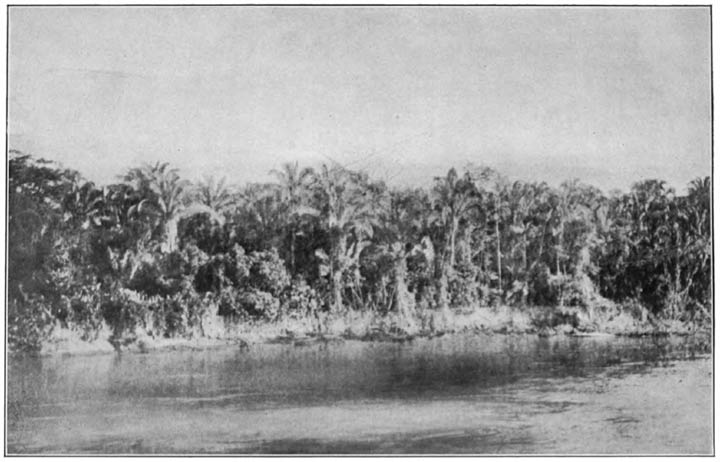
A Palm Forest in the Tropics.
Certain palms affect the open savanna, others seek the solitudes of the forest, while still others are most frequently found midway between these two—that is, on the belt of land that separates forest from plain. Some palms, like the cocoa, seem to require an atmosphere that is slightly saline, and thrive best near the ocean’s shore. Others apparently attain their greatest development in marshes and lowlands, while others again demand the arid plain or the lofty mountain plateau.
In spite of their noble appearance and their aspect of perennial youth, palms, as a rule, are short-lived. None of them ever attain the age of the venerable patriarchs of our northern forests. According to Martius, the span of a palm’s life never exceeds that of a few generations of men. The areca catechu runs its course in forty or fifty years, the cocoa attains an age of one hundred or one hundred and twenty years at most, while the date palm, which probably lives the longest, usually rounds out its existence within the period of two centuries.
In the foregoing pages I have mentioned some of the countless uses made of palms, especially by the inhabitants of the tropics. It would, however, require a large volume to enumerate all the purposes for which they are employed. It can, however, safely be asserted that no family in the great vegetable kingdom more completely meets the necessities of millions of people than does that of the noble and ever-beautiful Palmaceæ.
Like Martius, we always found in the contemplation of the palm a source of special joy and peace. To him the palm was what literature was to Cicero, a consolation in trial and affliction, and the delight and inspiration of maturer years. In the palm we always found something to elevate the mind, something that fascinated us and stirred our emotions in a manner that often surprised us. For us, as for myriads of others who have lived and struggled and attained the goal of the heart’s desire, the palm was the emblem of victory, of a higher and better life beyond the tomb, of a happy, glorious immortality.
While thus musing on the glories of the past and contemplating the splendors of the present, which were passing in rapid succession before our enchanted vision, we instinctively repeated the words of the reverent poet-naturalist, Martius, who, contemplating the marvels of the tropical palm-world, expressed the depth of his emotion by the two words, Sursum corda—hearts heavenward!
Just then our reveries were suddenly and unexpectedly interrupted.
We had, early in the day, been congratulating ourselves on making our voyage down the river without delay and without accident. We were now within sight of Barranquilla and expected to land in less than an hour. We were in the full enjoyment of one of those delightful day-dreams that we always loved to indulge in, whenever Flora displayed before us, as she did then, her choicest treasures, when suddenly, without premonition of any kind, there was a violent lurch of the boat, a creaking and a crushing noise abaft, a quick stoppage of the engine, all of which indicated that something unusual, if not serious, had befallen our ill-fated craft. A hasty examination showed that the steamer had collided with a sunken tree, and that several of the float-boards of the stern-wheel had been loosened, or partially wrenched from their places. After considerable delay the boatmen were able so to repair the damage that we were able to continue on our journey, although at a reduced speed.
“How fortunate,” C. exclaimed, “that this accident did not occur midway up the river!” Such a mishap would have entailed much suffering and might have delayed our arrival at Barranquilla, for days, if not for weeks. And considering our happy escape from the detentions and disasters from which so many others had suffered, and the peculiar episode that characterized our last hours on the Magdalena, we were forcibly reminded of the words of Dante:—
“Let not the people be too swift to judge.
For I have seen
A bark, that all her way across the sea
Ran straight and speedy, perish at the last