Chapter X · THE ATHENS OF SOUTH AMERICA
Reading edition
In the beginning of August, 1538, Gonzalo Jimenez de Quesada, the conqueror of Cundinmarca, and his followers, after one of the most remarkable campaigns ever conducted in the New World, assembled on the present site of Bogatá. Here Quesada dismounted from his charger, and plucking up some grass by the roots, he announced that he took possession of that land in the name of the Emperor Charles V. Having remounted his steed, he drew his sword, and challenged any one to oppose this formal declaration, which, he declared, he was prepared to defend at all hazards. As no one appeared to contest his action, he sheathed his sword, and directed the army notary to make an official record of what had just been accomplished.
Bogotá was then but a rude village, or, rather, a camp, of a dozen hastily constructed huts which barely sufficed to shelter the intrepid sons of Spain. Besides these twelve huts—erected in memory of the twelve apostles—there had also been constructed a small wooden, thatch-covered church, on the very site occupied by the present imposing cathedral of Colombia’s fair capital. The first mass was said in this church the sixth day of August, a few days after the ceremony of occupation just mentioned—and this is regarded as the legal date of the foundation of Bogotá. It was then that the work of the conquest was technically considered as finished. The work of colonization was to follow without delay.
Santa Fé, also known as Santa Fé de Bogotá, was for a long period the capital of the Viceroyalty of New Granada. After the War of Independence the name was changed to Bogotá—from Bacatá—the name of the old Chibcha capital, where the zipa, the most powerful of the Indian caciques, at the arrival of the Spaniards, had his official residence. The city is nearly two miles in length and of varying breadth. Its present population is nearly one hundred and twenty-five thousand. It is situated on a western spur of the great Cordillera of Suma Paz at an elevation, according to Reiss and Stübel, of eight thousand six hundred and sixteen feet above sea level—more than half a mile higher than the summit of Mt. Washington, the highest point in New England.
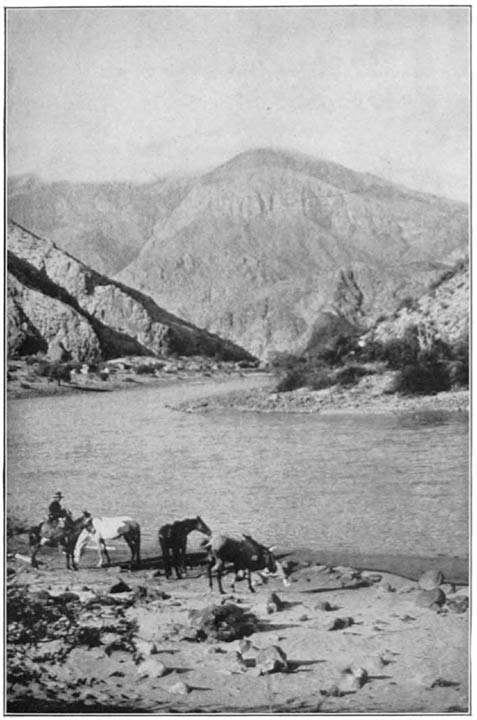
A Valley in the Cordilleras.
The mean annual temperature is 60° F., but, owing to the rarity of the atmosphere, and to its being shielded from the wind by the mountains at whose base it is situated, it seems to be higher than this. During certain seasons of the year one may experience a penetrating cold, as long as one remains in the shade, but when one passes into the sunshine it becomes almost uncomfortably warm. During the rainy season, the newcomer feels the cold very keenly, but, after a short residence in the city, one becomes acclimated and then fancies that he is in the enjoyment of perpetual spring.
Bogotá—called by the aborigines Bacatá—is a city in a state of transition. It has lost, almost entirely, the mediæval, monastic, mozarabic aspect that characterized it while it was the tranquil court of the viceroys. But, great as has been the change that it has undergone during the last few decades, it preserves much of the quaintness of colonial times. Indeed, it is not difficult, in certain parts of the city, to fancy oneself carried back to a typical Spanish town of the time of Charles V or Philip II. As a whole, however, the Bogotá of to-day does not differ materially in appearance from a city of the same size in Spain or Mexico. All Latin-American cities are similar in their leading features, and when you have seen one you have seen all.
The city is adorned by a number of broad and beautiful streets and several plazas and parks. Aside from a few government buildings, the edifices that attract most attention are the monasteries and churches. The cathedral is a noble building and compares favorably with any similar structure in South America. The interior had just been artistically painted and gilded, at the time of our visit, and it reminded us somewhat of the exquisite finish of St. John Lateran, in Rome. An object of interest to the traveler, within these sacred precincts, is the tomb of the illustrious conquistador, Gonzalo Jimenez de Quesada.
The residences of the people are usually two stories high, with a balcony on the second story facing the street. All of the older houses, as well as many of the modern ones, are of the well-known Moorish style of architecture, with a single large entrance—porton—and a patio—courtyard—or two, on which the rooms open. This style of building is well adapted to tropical climates. It is comfortable and secures the maximum of privacy. It is in reality, as well as in fiction, the owner’s castle.
We were surprised to see the number of foreign flowers grown in these patios. One would naturally expect to find representatives of the rich and beautiful Colombian flora, but the ladies of Bogotá seem to prefer the exotic blooms of the temperate zone. We found roses, camellias, pinks and geraniums in abundance, but rarely any of those floral beauties that had so frequently excited our admiration on the way from the llanos to the capital. Our hotel, however, was a notable exception to this rule. Here we were delighted with a veritable exhibition of orchids of many species and of the most wonderful forms and colors. Among them were some truly splendid specimens of oncidiums, cattleyas and odontoglossums. It was then we thought of some of our orchid-loving friends of New York, who would have fairly reveled in such marvels of Flora’s kingdom.
As nearly all the streets are paved with cobblestones, driving is anything but a pleasure. As a matter of fact, the only passable drive in the city is the one that leads to the charming little suburb of Chapinero. This is one of the show places of Bogotá, and its houses are in marked contrast with those found in the older part of the city. Most of them are entirely different in style from the enclosed Moorish structures of which mention has been made. Here one is introduced to cozy Swiss chalets in the midst of delightful flower gardens and picturesque French chateaux, that carry one back to the Seine and the Loire.
Aside from the churches and monasteries, many of which have been converted into government offices, there were two buildings that possessed a special interest for us. One of these was the old Colegio del Rosario—now known as the School of Philosophy and Letters—founded in 1553, nearly a hundred years before the University of Harvard. This institution has long been fondly spoken of by the people of Bogotá as the country’s special glory—la gloria de la patria. The other building was the astronomical observatory—the first intertropical structure of the kind—erected in 1803. After the observatory of Quito, it is said to be the highest in the world.
Some of the streets and houses have been recently lighted by electricity, but as yet horses or mules are used as the motive power for the few street cars that traverse the principal thoroughfares. It were easy to count the number of private carriages in the city. The only ones we saw were those of the archbishop and the president of the republic. Indeed, so rough are the streets that most people prefer walking to using cabs, except in cases of necessity.
The first two objects to arrest our attention, as we approached Bogotá from the south, were the chapels of Guadalupe and Monserrate, the former nearly twenty-two hundred feet above the city, and the latter about two hundred feet lower. Perched high upon the flanks of two picturesque mountain peaks, they are conspicuous objects from all parts of the Savanna. Both of these sanctuaries are reached by a foot path, but, as yet, no attempt has been made to connect them with the city by a carriage road. Owing to the altitude above sea level of these places, a pilgrimage to them is quite a task—especially to the newcomer, who is unaccustomed to the rare atmosphere of the locality. But the magnificent view afforded one from either of these elevated shrines well repays all the effort required to reach them. It is, in some respects, the most beautiful to be found in the whole of Colombia. And then, there are besides certain historical features connected with the panorama spread out before one that make it doubly interesting.
In the morning, when the Savanna is covered by a mist, as often happens, the observer from Monserrate or Guadalupe does indeed seem to be looking down upon a vast lake. The hills, which here and there rise above the fog, look like islands and strengthen the illusion. But this effect is all dissipated as soon as the sun makes his appearance above the crest of Suma Paz. One then has before him one of the most lovely panoramas in the world. The wide verdant expanse is intersected with rivers and streams, all tributaries of the Funza, and dotted with towns and hamlets and haciendas, lakes and lakelets, large herds of cattle, flocks of sheep, troops of horses, mules and burros. All this is enclosed by lofty ramparts of gneiss and granite, which shield the inhabitants of city and plain from the tempestuous moisture-laden winds that would otherwise often sweep over the Savanna with the fury of a Kansas cyclone.
There is nothing more delightful than a stroll along the Rio San Francisco, which flows between Monserrate and Guadalupe and thence through the city of Bogotá. The scenery is thoroughly Alpine in character and, at times, picturesque beyond description. As one follows the narrow path, always near the musical, crystal waters of the impetuous stream, one is delighted at every step by the appearance of some new flower of brightest hue, or some strange shrub of richest foliage. The ground is fairly carpeted with anemones, hepaticæ, gentians, valerians, geraniums, campanulæ, lupines and buttercups. Like similar plants on the Alps, and on the heights of our Rockies, their stems are very short and they seem like so many rosettes attached to the earth, or the rocks that rise up on both sides of our narrow path.
One sees well illustrated here the dividing line between the flora of the paramo and that of the tierra fría. The plants of the latter creep up timidly from the Savanna until a certain point, and then, as if afraid to venture further into the region of frost, halt on the lower edge of the paramo. In a similar manner the plants of the higher altitudes cautiously descend to the upper belt of the tierra fría and there come to a standstill. They meet on a common zone in limited numbers, but this zone is often extremely narrow. One of the agreeable surprises to the traveler in the Andes is to note the sudden and extraordinary changes in the character of the vegetation as he ascends or descends the mountain near the line of demarcation between two zones.
The plateau of Guadalupe is the home of two remarkable tree ferns. One of these is the Cyathea patens, from ten to twelve feet high, with a beautiful, umbrella-shaped crown. The other is the Dicksonia gigantea, which, according to the naturalist, Karsten, is probably the most vigorous and luxuriant tree fern in South America. Its massive, columnar trunk bears forty and more dark-green fronds, from three to four feet wide and from six to seven in length. To get a close view of even one of these noble cryptogams fully repays one for the arduous climb up to its favorite habitat.
Any city in the United States or Europe, having in its immediate vicinity such attractions as has Bogotá, would immediately put them within easy reach of the public. Thus both Monserrate and Guadalupe would, without delay, be connected with the city by a funicular railway, and near by would be a number of restaurants and pleasure resorts.
Incredible as it may seem, but few Colombians have ever seen the falls of Tequendama. Although the people of Bogotá love to talk about them, as among the greatest wonders of their country, it is rarely that one is found who has actually visited them. And yet they are not more than twelve miles from the capital. Even the peons living on the plains only a few miles from the cataract can give the traveler little or no information as to the best way to reach them. How different this would all be if the place were easy of access, and if the visitor, on arriving there, could find the creature comforts to be obtained in similar places in the United States and Europe!
I have alluded to the interesting historical associations connected with the city and plateau of Bogotá. It will suffice to speak of but one of them; but this one is so remarkable that it is like a chapter taken from the Arabian Nights. I refer to the meeting of the three distinguished conquistadores, Gonzalo Jimenez de Quesada, Nicholas Federmann and Sebastian de Belalcazar.
Quesada had left Santa Marta in 1536, having under his command, according to Oviedo, eight hundred men and one hundred horses. He went part of the way by land and part by the Rio Grande, now known as the Magdalena. After reaching the Opon, he followed that river as far as it was navigable, and eventually made his way to the plateau of Bogotá—the land of the Chibchas.
His march was, in some respects, the most difficult and remarkable in the annals of the conquest. He had to contend against relentless savages, dismal swamps and almost impenetrable forests, where he had to cut his way through the tangled vines and bushes, and where it was often impossible to make more than a league a day. His men were decimated by disease and starvation. When he at last arrived at the Valle de Alcazares, near the present site of Bogotá, he could count but one hundred infantry and sixty cavalry. But with this handful of men he had conquered the Chibcha nation, numbering, according to the old chroniclers, one million people and having twenty thousand soldiers in the field.
Scarcely, however, was his campaign against the aborigines successfully terminated, when information was conveyed him of a new danger in the person of a German competitor, who had just arrived from the llanos.
Thus, almost before Quesada was aware that Federmann was in the country, he was constrained by policy to receive him and his one hundred ragged and famished followers—these were all that remained of his gallant band—as his guests. The Spanish conquistador knew that the German leader would put in a claim for a part of the territory that they had both been exploring, and which, until then, each of them had regarded as his own by right of conquest. He was then naturally eager to effect a settlement with his competitor on the best terms possible, and get him out of the country with the least possible delay. Federmann agreed to renounce all his claims in consideration of his receiving himself the sum of ten thousand pesos, and of having his soldiers enjoy all the rights of discoverers and conquistadores accorded to those of Quesada.
“Nuestros sean su oro y sus placeres,
This extraordinary and accidental meeting of the three conquistadores, coming from so great distances, from three different points of the compass, is one of the most interesting episodes in the history of the conquest. It was a critical moment for the Europeans. If they had failed to agree, and had turned their arms against one another, those who would have escaped alive would have been at the mercy of the Indians, who would at once have rallied their forces to repel the invaders. But, fortunately, wise councils prevailed and a clash was averted.
“While the clergy and the religious,” writes Acosta, “were going to and from the different camps endeavoring to prevent a rupture, the three parties of Spaniards, coming from points so distant, and now occupying the three apices of a triangle, whose sides measured three or four leagues, presented a singular spectacle. Those from Peru were clad in scarlet cloth and silk, and wore steel helmets and costly plumes. Those from Santa Marta had cloaks, linens and caps made by the Indians. Those, however, from Venezuela, like refugees from Robinson Crusoe’s island, were covered with the skins of bears, leopards, tigers and deer. Having journeyed more than thirteen hundred leagues through uninhabited lands, they had experienced the most cruel hardships. They arrived poor, naked, and reduced to one-fourth of their original number.
The three went to Spain together, as had been arranged, each of them confident of receiving from the Spanish monarch a reward commensurate with his labors and services to the crown. Each one aspired to the governorship of New Granada and used all his influence to secure the coveted prize.
The net result of their efforts was a sad experience of the vanity of human wishes. All were disappointed in their expectations. The guerdon all so eagerly strove for was awarded to another, who had taken no part in the conquest that had rendered the three aspirants to royal favor so famous.
In adventure and achievement, the three conquistadores above mentioned take rank with Cortes, Pizarro and Orellana. Given a Homer, their wanderings and deeds would afford themes for three Odysseys of intense and abiding interest. Given even an Ercilla, we should have a literary monument, which, in romantic episode and dramatic effect, would eclipse the Araucana, the nearest approach to an epic that South America has yet produced.
The Bogotános have long claimed for their city the distinction of being the Athens of South America. And considering its past and present culture, and the attention which the arts, the sciences and literature have always received there since the foundation of the capital, few, I think, will be disposed to impugn the justness of this claim.
Bogotá’s first man of letters was none other than the licentiate Gonzalo Jimenez de Quesada himself—a man who could wield the pen with as much skill as the sword. Indeed, the detailed knowledge that we have of many features of his memorable campaigns we owe to his fertile pen. He is really the first and, in some respects, the most important chronicler of the events in which he took so conspicuous a part. How unlike, in this respect, is he not, to Pizarro and Almagro, who were unable to sign their own names?
Among the other early writers of New Granada was Padre Juan de Castellanos, the poet-historiographer, who has been so frequently quoted in the preceding chapters. The extent of his work may be gauged by the fact that it contains one hundred and fifty thousand hendecasyllabic verses—more than ten times as many as are in the Divina Commedia—and more than are found in any other metrical work, except the Hindu epic known as the Mahabharata, which contains no fewer than one hundred and ten thousand couplets.
In science, too, Colombia counts many sons who have contributed greatly to our knowledge of nature. It suffices to recall the names of such savants as Francisco Antonio Zea, Francisco José de Caldas and the illustrious Mutis, whom Humboldt called “the patriarch of the botanists of the New World,” and whose name Linnæeus declared to be immortal—“nomen immortale quod nulla aetas unquam delebit.”
There were at one time no fewer than twenty-three colleges in New Granada. The first of these was founded in 1554, for the education of the Indians. The following year another one was established for the benefit of Spanish orphans and mestizos. In one of the colleges was a special chair for the study of the Muisca language. The Royal and Pontifical University began its existence in 1627, thirteen years before the foundation of Harvard College. In 1653 the Archbishop D. Fr. Cristobal de Torres founded the celebrated College del Rosario, which, by reason of its munificent endowment, was able to render such splendid service to the cause of education, and was long recognized as the leading institution of learning in New Granada.
The number of public and private libraries now existing in the city of Bogotá contribute greatly towards justifying its claim to being the chief centre of South American culture. Another evidence of the intellectual atmosphere that obtains there is the number of secondhand book stores. In browsing among these storehouses of old and precious tomes I quite forgot, for the time being, that I was so far from the busy world of action, and could easily fancy myself among the book shops of Florence, Leipsic or Paris. Indeed, some of the most prized volumes in my Latin-American library I picked up on the book stalls of Bogotá.
In Colombia there seem to be as many “doctors,” that is, men who have the degree of Doctor of Laws, as there are generals in Venezuela. Most of them are politicians, or contributors to the various newspapers of the country, or “professors”—there are no pedagogues—in the numerous educational institutions of the Republic.
The number of newspapers published in Bogotá is surprising—more than there are in Boston or Philadelphia. Of course, their circulation is extremely limited. They are mostly partisan organs—an independent paper being unknown—or literary journals remarkable, the majority of them, for long poems, verbose editorials and translations of the latest French novels.
On the way down from the chapel of Guadalupe, near the opening of the gorge between the peaks of Monserrate and Guadalupe, one passes what was once the Quinta Bolivar, a gift to the Liberator by one of his wealthy admirers. It is now the property of a thrifty Antioquenian, who has converted it into a tannery. As we pass along the north side of San Carlos’ palace, which contains the office of the ministry of foreign affairs, we observe the historic window from which, as a memorial tablet informs us, Bolivar escaped assassination, Sept. 25th, 1828. In the centre of the principal plaza, called the Plaza Bolivar, is a bronze statue of the Liberator by Tenerani, a pupil of Canova.
Everywhere in Colombia, as in Venezuela, we are reminded of Bolivar and find monuments to his memory. In Ciudad Bolivar and in Valencia and elsewhere there are statues of him. In Caracas there are several, among them a large equestrian statue which is a replica of one in Lima.
But the people, in their desire to honor their hero, have not been satisfied with statues alone. Coins bear his name and image, towns and states are named after him. More than this, his name has been given to one of the South American republics—Bolivia—a republic, formerly a part of Peru—Upper Peru—which owes its very existence to him.
But who was Simon Bolivar, one will ask, and what has he done to achieve such distinction and to command recognition in such diverse ways and in regions so widely separated?
His admirers say that he was the Washington of South America—the one who secured the independence of the Spanish colonies, after three centuries of misrule and oppression. According to them, he was one of the world’s greatest geniuses in military science, a genius in state-craft, a genius in everything required to make a great and successful leader of men.
Even more extravagant are the claims made for his hero by Don Felipe Larazabel in his bulky two-tome Vida de Bolivar.
“A noble and sublime spirit, humane, just, liberal, Bolivar was one of the most gifted men the world has ever known; so perfect and unique that in goodness he was like Titus, in his fortune and achievements like Trapan, in urbanity like Marcus Aurelius, in valor like Cæsar, in learning and eloquence like Augustus....
“He was a poet like Homer, a legislator like Plato, a soldier like Bonaparte.... He taught Soublett and Heres diplomacy, Santander administration, Gual politics, Marshal Sucre military art.
“Like Charlemagne, but in a higher degree, he possessed the art of doing great things with ease and difficult things with promptness. Whoever conceived plans so vast? Whoever carried them to a more successful issue? A quick and unerring glance; a rapid intuition of things and times; a prodigious spontaneity in improvising gigantic plans; the science of war reduced to the calculation of minutes, an extraordinary vigor of conception, and a creative spirit, fertile and inexhaustible, ... such was Bolivar.
Gen. Holstein, who was the Liberator’s chief-of-staff and who was, therefore, in a position to have intimate knowledge of the man, is even more pronounced in his strictures on the character and capacity of the commander-in-chief of the patriot forces.
In view of all this, Holstein does not hesitate to declare that Bolivar rules “with more power and absoluteness than does the autocrat of Russia or the Sultan of Constantinople,” and that, compared with George Washington, Simon Bolivar was but a Liliputian. Sr. Riva Aguero, the first president of Peru, goes farther and assures us that the terrible characterization, given by Apollocorus, of Philip of Macedon, father of Alexander the Great, is but a true portrait of the Liberator Bolivar.
These estimates of Bolivar, so different from those of Tejera and Larrazabel and many of Bolivar’s other biographers—remind one of what Montesquieu says about the contradictory accounts which partisan writers have given us regarding certain potentates of antiquity. As instances he cites Alexander, who is described as the veriest poltroon by Herodian, and extolled as a paragon of valor by Lampridius; and Gratian, who by his admirers is lauded to the skies and by Philostorgus compared to Nero.
“But, how is it possible, the question naturally arises, that General Bolivar should have liberated his country, and preserved to himself the supreme power, without superior talent?”
Such a marked divergence of views respecting the character of Bolivar and the position he should occupy among the great chieftains of history admits of an explanation, but such an explanation would of itself require a volume. It is safe to say, however, that no reliable biography of the Liberator has yet appeared, and that, when it does appear, it is most likely that Bolivar will occupy a position much below that claimed for him by some of his over-enthusiastic eulogists and above that assigned to him by those who have manifested less admiration for his policy and achievements.
To write a definitive biography of Bolivar will not be an easy task. It will require a man of broad sympathies; one entirely free from all national antipathy and religious bias; one with a judicial mind, who can sift and weigh evidence without prejudice, and render a verdict strictly in accordance with the facts in the case. Most, if not all, who have hitherto written about Bolivar, have exhibited a partisan spirit and allowed themselves to be swayed by political and other considerations, which have so greatly detracted from the value of their work that it cannot be accepted as authentic history.
To do full justice to the subject in all its bearings will require impartial judgment, ripe and varied scholarship, and above all, a keen and comprehensive historic sense. The writer will have to discuss the relation of Spain to her colonies, and consider various social, political, racial, economical and religious questions that are as difficult as they are complicated and conflicting. He must have an intimate and accurate knowledge of the character and aspirations of the different peoples with whom Bolivar and his lieutenants had to deal. He must be familiar with the history and traditions of the various South American presidencies and viceroyalties and captaincies-general, and take note of the passions and prejudices and jealousies that have been the cause of so many sanguinary revolutions and have contributed so much to retard intellectual progress and material advancement. Only when such an one appears, and completes the colossal task, shall we have a definitive life of Simon Bolivar, and an authentic record of the War of Independence.
Before closing this chapter some reference seems necessary to what cannot escape even the most casual student of South American history, but what, to the observant traveler, seems to be a matter of special moment. I refer to Bolivar’s policy of dividing and weakening Peru, and to his uniting under one flag the three northern countries of the continent. The separation of Upper Peru—Bolivia—from Lower Peru seems, in the light of events since the change, to have been a fatal mistake and detrimental to the best interests of Bolivia as well as to those of Peru.
Had the destiny of Colombia, after the union, been entrusted to the direction of wise and unselfish patriots, as was the infant Republic of the United States of North America, one may well believe that the history of this part of South America, during the last three-quarters of a century, would have been quite different from what it has been, and that it would have been spared those countless internecine wars that have deluged the country in blood and rendered civilization, in its higher sense, impossible.
But, sad to relate, Bolivar’s creation was short-lived. After a precarious existence of only eleven years, disintegration took place, and the Liberator, fallen into disfavor and condemned to exile, was forced to be a witness of the collapse of the structure that had cost him so much labor, and which he had fondly hoped would be his greatest and most enduring monument.
Shortly before his death at the hacienda of San Pedro, near Santa Marta, where he perished alone,
“Maligned and doubted and denied, a broken-hearted man,” he wrote to General Flores, of Ecuador, a letter in which occur the following remarkable statements:—
“I have been in power—yo he mandado—for nearly twenty years, from which I have gathered only a few definite results:—
“1. America for us is ungovernable.
“2. He who dedicates his services to a revolution plows the sea.
“3. The only thing that can be done in America is to emigrate.
“4. This country will inevitably fall into the hands of the unbridled rabble, and little by little become a prey to petty tyrants of all colors and races.
“5. Devoured as we shall be by all possible crimes and ruined by our own ferociousness, Europeans will not deem it worth while to conquer us.
Was the Liberator gifted with a seer’s vision when he penned these prophetic words? It would seem so, for even if he had open before him the scroll in which has been recorded the chief events of the history of South America during the past three-quarters of a century, he could scarcely have spoken with greater truth and precision. Certain it is, as Mitre well observes, that none of his designs or ideals have survived him. His political work died with him and all his fond dreams of a vast Andean Empire vanished like mist before the rising sun.
This is not the place to account for the turmoil and anarchy which have so long devastated one of the most fertile quarters of the globe. Considering its immense natural resources and its many advantages of climate and geographical position, it should be one of the most prosperous regions of the earth, and its inhabitants among the happiest and most advanced in culture and the arts of peace. Let it suffice to reproduce the following paragraph from the work, already cited, of Sr. Perez Triana:—
“As to the topsy-turviness of things Spanish and Spanish-American, the story is told that Santiago, the patron saint of Spain, being admitted into the presence of God, asked and obtained for the land of Spain and for its people all sorts of blessings; marvelous fertility for the soil, natural wealth of all kinds in the mountains and the forests, abundance of fish in the rivers and of birds in the air; courage, sobriety, and all the manly virtues for men; beauty, grace and loveliness for the women. All this was granted, but on the point of leaving, the saint, it is said, asked from God that he would also grant Spain a good government. The request was denied, as then, it is said, the Lord remarked, the angels would abandon heaven and flock to Spain. The story has lost none of its point.”