ALLEN JOHNSON (continued 5)
Reading edition
Still farther west lay an almost unknown region of imperial dimensions. Save where venturesome pioneers had pushed up the Arkansas and the Missouri, and where the Spaniards maintained their feeble hold in the Southwest, no white men inhabited the great prairies which swept westward to the foothills of the Rockies. Only nomadic Indian tribes and occasional traders followed the buffalo trails across this wide expanse. Between the Rocky Mountains and the Pacific was the region which Lewis and Clark had penetrated. Along the valley of the northern branch of the Columbia River, the Hudson's Bay Company had planted their trading posts. Farther to the south lay Spanish California and the ill-defined region to the eastward over which presidios maintained a shadowy jurisdiction.
On October 20, 1818, Benjamin Rush and Albert Gallatin, ministers to England and France respectively, concluded a convention with Great Britain which left the fate of the Oregon country in suspense for a period of ten years. To the British claims of prior discovery by Cook and Mackenzie and of prior occupation by the Hudson's Bay Company, the American commissioners opposed the claims based on the voyage of Captain Gray in 1792 and on the founding of Astoria by John Jacob Astor in 1811. It was finally agreed that the northern boundary of the United States should run from the Lake of the Woods to the Stony Mountains, along the forty-ninth parallel, and that the disputed country beyond the mountains should be occupied jointly for a period of ten years. An agreement was also reached regarding the Newfoundland and Labrador fisheries.
On another frontier conditions existed to which Congress could not remain indifferent. East Florida was still a thorn in the side of Georgia and Alabama. The province had become a rendezvous for pirates, filibusters, renegade Indians, and runaway negroes. Creek warriors who would not submit to the loss of their lands had taken refuge with their kinsmen, the Seminoles, and were inciting malcontents of every stripe against the whites. A band of negroes, estimated at not less than a thousand in number, together with some Creek Indians, had taken possession of an abandoned fort on the Apalachicola and had terrorized the country for miles around. The Spanish commander at Pensacola was summoned to destroy this pirates' nest and to disperse the marauders; but he was either unable or unwilling to do so, and in 1816 a red-hot shot from a United States gunboat blew up the magazine of the negro fort, killing nearly three hundred men, women, and children. Early in 1818, in equally summary fashion troops of the United States expelled a band of freebooters from Amelia Island.
The slight regard which the United States paid to the territorial sovereignty of Spain in Florida sprang from a general conviction that Spain could not and would not observe the provisions of the Treaty of 1795. Spain had then agreed to restrain the Indians living within her borders from attacking the citizens or Indians of the United States. President Monroe seemed to assume that Spain had forfeited her rights over Florida. At all events, he authorized General Andrew Jackson to assume command of the forces at Fort Scott and to call on the governors of adjacent States for militia to terminate the war. This order of December 26, 1817, was stated in dangerously broad terms. Jackson did not doubt for an instant that it authorized him to pursue the Indians into Florida. To his mind the time seemed opportune for the seizure of East Florida as an indemnity for the outrages committed by the Seminoles. He wrote to the President to this effect. "Let it be signified to me," said he, "through any channel (say Mr. J. Rhea) that the possession of the Floridas would be desirable to the United States and in sixty days it will be accomplished."
To his dying day Jackson maintained that the President signified his approval through Congressman Rhea, of Tennessee. Monroe denied that he had read Jackson's letter until after the exploits which so nearly plunged the country into war with Spain. Whatever may be the truth of the matter, General Jackson acted in accord with what he believed to be the President's desires. With a thousand men he marched across the border and was soon in possession of St. Mark's. Among those who fell into his hands was Alexander Arbuthnot, a Scotch trader who was suspected of inciting the Indians. Continuing his march, Jackson surprised and captured Suwanee, another rendezvous of Indians and runaway negroes. Here he found Robert Ambrister, another British subject, who was also regarded as a suspicious character. Returning to St. Mark's, Jackson handed these two suspects over to a court martial, which found both guilty of giving aid and comfort to the enemy and of inciting or waging war against the United States. Arbuthnot was hanged from the yardarm of his own schooner; Ambrister was shot. The fall of Pensacola finished the campaign. By the end of May, 1818, Florida was in the possession of the troops of the United States and Jackson was on his way to Tennessee, the idol of his men and a national hero in the estimation of the people of the Southwest.
The outcome of these exploits might easily have been war with both Spain and Great Britain. Don Luis de Onis, the Spanish Minister at Washington, immediately suspended the negotiations then in progress respecting the Floridas and made a spirited protest "against these acts of hostility and invasion." He demanded the immediate restitution of the places which had been seized, indemnity for all damage to property, and the punishment of General Jackson. As for Great Britain, Lord Castlereagh afterward said that, such was the temper of Parliament and the country, war might have been produced by holding up a finger and an address to the Crown carried by an almost unanimous vote.
The Cabinet of President Monroe was divided over the course to be pursued. Calhoun insisted that Jackson had virtually committed an act of war, which should be promptly disavowed. But Adams held—and the President was inclined to side with him—that in reality Spain had been the aggressor, and that Jackson had not violated the spirit of his orders. In order to terminate the war, Jackson had been obliged to cross the Spanish line. He had not done so with the purpose of waging war upon Spain.
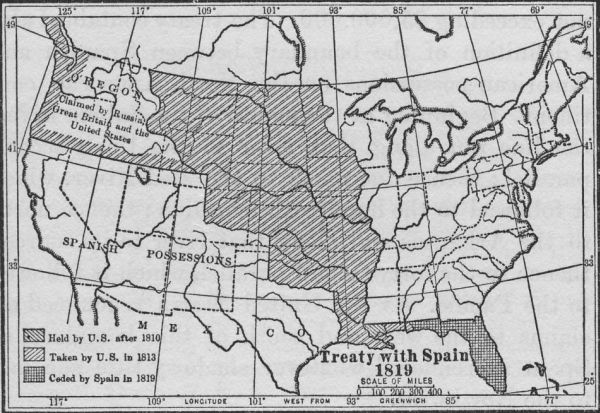
Following a memorandum made by the President, Adams replied to Don Onis in this spirit. Later, in a masterly state paper, he set forth the intolerable conditions which obtained on the Florida frontier. The lax conduct of the Spanish authorities was held to justify the aggressive measures of Jackson. The United States was prepared to restore Pensacola and St. Mark's whenever Spain should give guaranties for the observance of treaty obligations. So far from consenting to punish Jackson, the United States demanded the punishment of those Spanish officials who had so flagrantly violated the obligations of the Treaty of 1795. "Spain must immediately make her election either to place a force in Florida at once adequate for the protection of her territory and to the fulfillment of her engagements, or cede to the United States a province of which she retains nothing but the nominal possession." This latter alternative, indeed, the Administration never lost from view.
Confronted by the revolt of all her American colonies, Spain could hardly resist this insistent pressure upon a province which she could neither govern nor defend. On February 22, 1819, Don Onis set his hand to a treaty which ceded the Floridas in return for the assumption by the United States of claims of American citizens against her to an amount not exceeding $5,000,000. The treaty contained also a definition of the boundary between Spanish and American possessions on the North American continent. Beginning at the mouth of the Sabine River, the line ran along that river to the thirty-second parallel; thence due north to the Red River, which it followed to the hundredth meridian; thence north to the Arkansas and along that river to its source; thence to the forty-second parallel, which it followed to the Pacific. As the United States renounced all claims to the west and south of this boundary, so Spain surrendered whatever shadowy title she had to the Northwest.
The ratification of the Florida Treaty was delayed by the attempt of the Spanish Crown to grant extensive tracts to certain grandees, and by the vigorous opposition of Henry Clay in the House of Representatives. The treaty seemed to him a bad bargain. "What do we get?" he cried. "We get Florida loaded and encumbered with land grants which leave scarcely a foot of soil for the United States. What do we give? We give Texas free and unencumbered, and we surrender all our claims on Spain for damages not included in that five millions of dollars." He challenged the right of the President and Senate to alienate territory without the consent of the House. Behind Clay's opposition lay some personal pique against the President and his Secretary of State; but he voiced, nevertheless, the spirit of the Southwest, which already looked toward Texas as a possible field of expansion and resented its surrender.
BIBLIOGRAPHICAL NOTE
The westward movement is described in various chapters of volumes IV and V of McMaster, History of the People of the United States. The significance of the movement is best explained in F. J. Turner, Rise of the New West, 1819-1829 (in The American Nation, vol. 14, 1906), which contains also excellent chapters on the social and economic life of the different sections of the country. The highways and waterways to the West are described in A. B. Hurlbert, Historic Highways of America (10 vols., 1902-05). A summary account of the development of transportation is given in J. L. Ringwalt, Development of Transportation Systems in the United States (1888). Among the biographies which contribute materially to an understanding of the new West may be mentioned Theodore Roosevelt, Thomas H. Benton (1887), and James Parton, Life of Andrew Jackson (3 vols., 1860). Edward Eggleston, The Circuit Rider (1888), and the Autobiography of Peter Cartwright (1856), touch upon important aspects of frontier life. The importance of the German element in American history is admirably set forth in Faust, The German Element in the United States (2 vols., 1909). The spread of New Englanders in the West is described by L. K. Mathews, The Expansion of New England (1909). The diplomatic negotiations which resulted in the cession of Florida are reviewed by F. E. Chadwick, The Relations of the United States and Spain (1909).
CHAPTER XV
HARD TIMES
The phrase "era of good feelings" applied to the Administration of President Monroe is a misnomer. It is descriptive neither of politics nor of business and industry, for the historic Democratic party was all but rent by bitter personal animosities, and the country was prostrated by a severe industrial crisis.
The first symptoms of hard times appeared in the early months of the year 1819. Undoubtedly the causes of the crisis were world-wide; but local conditions go far to explain the industrial collapse in the United States. All indications point to the conclusion that the country was experiencing the inevitable reaction from a period of too rapid commercial expansion and of unsound speculation. The high prices of commodities after the war had given a sort of fictitious prosperity to industry and trade, and had encouraged unduly the spirit of commercial enterprise. On credit easily secured from wild-cat banks, the Western pioneer had bought lands beyond the purchasing power of his own meager capital; and the speculator in turn had borrowed money to secure title to lands which he would unload upon unsuspecting settlers. State banks had met these demands by liberal issues of notes which were imperfectly covered by their specie reserves. It needed only a sudden demand for liquidation to cause widespread distress.
The unwise management of the National Bank may have contributed to the approaching disaster. The branch banks in the South and West had loaned freely, issuing notes which were payable at any branch of the National Bank. Capital was thus diverted from the East to sections of the country where there was least conservatism in banking. In 1818, the directors of the Bank became alarmed at the excessive expansion of credit, and issued instructions which compelled the redemption of notes at the bank where they were issued. At the same time the branch banks curtailed their loans. This sudden reversal of policy caused a fearful pressure which was transmitted from creditor to debtor all along the line.
Every sufferer by the panic was disposed to blame the National Bank for his misfortunes, particularly as it was common rumor that the directors of the Bank had speculated in its stock and had used their influence to cripple local banks. Congress had been obliged to take cognizance of these charges and to appoint a committee to investigate the condition of the institution. On the report of this committee, in January, 1819, the stock of the Bank fell from 140 to 93. The investigation revealed nothing worse than mismanagement; but a vigorous effort was made in Congress to revoke the charter.
The widespread hostility of the West and South toward the National Bank was born at this time. Everywhere it was known as "the Monster." State after State passed acts to tax the branch banks out of existence. The decision of Chief Justice Marshall, to be sure, in the famous case of M'Culloch v. Maryland, declared emphatically that the States had no constitutional power to tax the branches of an institution chartered under the laws of the United States; nevertheless, the legislature of Ohio deliberately levied such a tax, and when resistance was offered to its collection, withdrew the protection of the State from the branch banks. Feeling themselves the victims of the money power, the people in many of the Western States resorted to the remedies which were broached during hard times under the Confederation. Kentucky became notorious by reason of its laws in behalf of the debtor class. In every Western State there was a disposition to seek shelter from the operation of federal law behind the ægis of State rights. The people of these newer communities were slow to accept the force of precedent in cases decided by the federal courts. Andrew Jackson voiced this feeling when he became President. "Mere precedent," said he, "is a dangerous source of authority, and should not be regarded as deciding questions of constitutional power, except where the acquiescence of the people and the States can be considered as well settled."
That there was much real suffering during this panic admits of no doubt. Niles estimated that not less than twenty thousand persons were seeking employment in Philadelphia in the summer of 1819, and quite as many wandering in the streets of New York looking for work. In both cities soup-houses were established by private charitable societies to relieve distress in the following winter. In the city of New York, during the year 1816, over nineteen hundred unfortunates were imprisoned for debt; and of these, over seven hundred owed less than twenty-five dollars.
But it was not merely the city dweller who felt the pinch of poverty. Thousands of Western settlers who had purchased land under the Act of 1800, which permitted deferred payments, found themselves insolvent. More than $21,000,000, one fifth of the national debt, remained unpaid in the year 1820. To the importunities of these debtors Congress had yielded from time to time, but it was not until 1821 that it passed the first general relief act. Those who had not completed their payments within the prescribed five years were then permitted to give up the land which they had not paid for, and to apply the payments already made to the full purchase of the lands which they retained. Arrears of interest were remitted.
In 1820, Congress passed an act which wrought a far-reaching change in the disposal of the public domain. The credit system was abolished outright. After July 1, 1820, land was to be sold for cash at a minimum price of a dollar and a quarter an acre, and in eighty-acre tracts. A payment of one hundred dollars, then, would make a settler the owner of eighty acres in his own right. The prospect of actual ownership of a small tract made him far less ready to listen to the voice of the tempter in the form of the speculator, who had heretofore lured him to make larger purchases on credit than he could ever pay for by the labor of his hands.
In the midst of this period of financial depression, the Territory of Missouri applied for admission into the Union. On February 13, 1819, while an enabling act was under consideration in the House of Representatives, James Tallmadge, of New York, moved an amendment which touched Southern interests to the quick. "And provided, That the further introduction of slavery or involuntary servitude be prohibited, except for the punishment of crimes, whereof the party shall have been duly convicted; and that all children born within the said State, after the admission thereof into the Union, shall be free at the age of twenty-five years."
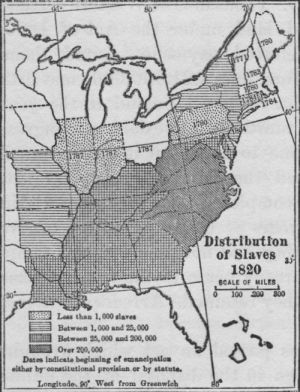
This bold attempt to prevent the spread of slavery provoked a brief but momentous debate. Clay left the Speaker's chair to remonstrate, "in the name of humanity," against a policy which could result, he believed, only in the misery of the slaves of the South. The lot of the negro would be vastly improved if the unfortunate people were more widely dispersed. Taylor, of New York, called this a specious plea. "It is that humanity," said he, "which seeks to palliate disease by the application of nostrums, which scatter its seeds through the whole system." To open the West to slavery would be simply to create an additional demand for the importation of slaves. Of those Southern Representatives who took part in this debate, not a man posed as the defender of slavery in the abstract. Barbour, of Virginia, frankly admitted that slavery "like all other human things is mixed with good and evil—the latter, no doubt, preponderating." And Johnson, of Kentucky, maintained that though slavery might be a necessary evil, "not incompatible with true religion," even so "slavery must still be a bitter draught."
What rankled in the breasts of all Southern men was the insinuation that their social system was founded on hypocrisy and tyranny. Tallmadge commented with biting sarcasm on the willingness of Southern gentlemen to contribute to missionary enterprises for the uplifting of the Hottentots and Hindus, and their determination to keep their African slaves in ignorance. And his colleague contrasted the plantations, overrun with weeds on one side of Mason and Dixon's line, with the cultivated farms on the other: in Pennsylvania, he observed "a neat, blooming, animated, rosy-cheeked peasantry"; in Maryland, "a squalid, slow-motioned black population." These were barbed shafts which left sore wounds.
When the Union was formed, African negroes were held in servitude in all but two of the States. At the time of this debate, slavery had been abolished, or was on the way to ultimate extinction, in every State north of Maryland and Delaware. Climate rather than humanitarian considerations sealed the fate of slavery at the North; and climate, in the last analysis, fastened African slavery on the South. As the South became committed to the raising of a staple, and that staple cotton, the negro was regarded as an indispensable factor in plantation economy. There were far-sighted individuals, it is true, who deprecated slavery on humanitarian grounds; but they were, for the most part, citizens of border States where the profitableness of negro labor was less apparent. Even in these communities opposition to slavery was tempered by dread of what emancipation might bring in its train. The history of Santo Domingo revealed the hideous possibilities of a negro insurrection. No father of a family could contemplate with equanimity the proximity of a large body of free, semi-civilized blacks. For a time even prominent slaveholders favored the aims of the Colonization Society which proposed to deport emancipated blacks to the African coast. So late as 1820 the Governor of Virginia recommended an appropriation by the legislature for the emancipation and removal of the negroes.
Although slavery was a local institution, and regulated by state law, its existence was recognized by the Federal Convention of 1787. The arrangement which obtained under the old Confederation, whereby five slaves were to count as three whites in apportioning representation and taxes, was continued; the mutual obligation of the States to return fugitives from justice and labor was distinctly stated in the Constitution; and the slave trade was permitted to continue at least to the year 1808.
In 1793, Congress had met its constitutional obligations by enacting a law for the return of fugitive slaves; and in 1794, Congress passed an act—"the first national act against the slave trade"—which prohibited all trade in slaves from the United States to any foreign country. By the opening of the new century all the States had forbidden the importation of slaves from abroad. But in 1803, South Carolina again legalized the slave trade; and in 1805, Congress after a brief interdiction removed all restrictions upon the importation of slaves into the Louisiana Territory. The slave trade at once assumed alarming proportions. It was officially stated that between 1803 and 1807, 39,075 negroes were brought into the port of Charleston. Eighteen hundred of these unfortunate blacks were imported in American vessels. One half of the consignees of these slavers were Americans, of whom thirteen were natives of Charleston and eighty-eight of Rhode Island.
This traffic, coupled with the alarm caused by negro insurrections in the West Indies, prepared the public mind for positive action, as the year approached when Congress might constitutionally prohibit the foreign slave trade. The Act of March 2, 1807, however, only partially met the expectations of the anti-slavery people. The African slave trade was forbidden, but negroes illegally imported were to be disposed of as the legislatures of the several States should determine. There was reason to fear that the Southern States would neglect to legislate on this important matter, and that the act would be indifferently enforced. Moreover, the coastwise slave trade for purposes of sale was not interdicted, but forbidden only in vessels under forty tons burden.
That the Act of 1807 did not prevent the African slave trade was patent to every one who knew conditions in the Southern Seaboard States; but the extent of this traffic can only be surmised. During the debates on the Missouri Bill, Tallmadge stated that fourteen thousand negroes had been brought into the country within the last year, and the statement was not challenged.
When the Missouri controversy was renewed in the session of December, 1819, the number of free States equaled the number of slave States. The addition of a twenty-third State, then, would unsettle the equilibrium between the sections in the Senate. A growing antagonism based upon widely different economic and social organizations was coming to be felt—felt rather than clearly perceived and openly recognized. In the year 1800, the two sections had been nearly equal in population; in 1820, the North outnumbered the South by over half a million. This disparity in numbers had a direct political significance, for the national House of Representatives was beyond all question controlled by the delegations from the free States. No great prescience was needed to warn the South that in self-defense it must maintain the even balance of sections in the Senate. The contest for Missouri was therefore essentially "a struggle for sectional domination."
The Tallmadge amendment was passed by the House, but rejected by the Senate, after a heated debate which convinced Southern statesmen that there was a distinct anti-slavery sentiment at the North. The adjournment of Congress threw the whole controversy into the crucible of public opinion. The latent hostility of men and women with humanitarian sympathies was at once raised to white heat. Mass meetings in city, town, and county passed resolutions against the spread of slavery and the admission of more slave States. Yet it can hardly be said that the public conscience was deeply touched. The leaven of abolitionism had to work many years before it could produce results in politics.
The whole question assumed a new guise when Congress met in December, 1820. The people of Maine had held a convention and formed a constitution, and were now applying for admission as a State. Here was a free State which would offset Missouri if it were admitted as a slave State. When the House passed a bill to admit Maine, the Senate promptly attached to it, as a "rider," a bill for the admission of Missouri without any prohibition of slavery. It was to this bill that Senator Thomas, of Illinois, representing a constituency divided against itself on the subject of slavery, offered an amendment in the nature of a compromise. He would admit Missouri as a slave State, but prohibit slavery forever in the rest of the old Province of Louisiana north of 36° 30'. The Senate accepted this amendment and sent the bill to the House. Here the original Maine Bill was stripped of the rider and the Thomas amendment by large majorities. Shortly after this vigorous assertion of independence, the House passed a bill for the admission of Missouri with the prohibition of slavery. The deadlock seemed complete.
The constitutional aspects of the problem called forth some exceedingly able argumentation. Those who favored imposing a restriction upon Missouri argued, plausibly enough, that as Congress was given the power to admit new States, so it was fully warranted in exercising discretion and refusing to admit. Precedents existed for imposing restrictions. Three States carved out of the Northwest Territory had been admitted on condition that their constitutions should not be repugnant to the sixth article of the Ordinance of 1787. The State of Louisiana had been admitted under explicit conditions. It was fully competent for Congress, by virtue of its authority over Territories, to regulate all the stages in the process of framing a constitution, and then to give or to withhold its approval.
The most brilliant argument on the other side was made by William Pinkney, of Maryland. Conceding that the power of Congress was discretionary, he insisted that Congress might not exact terms which would interfere with the results to be accomplished. "What, then," he asked, "is the professed result? To admit a State into this Union. What is that Union?... An equal Union between parties equally sovereign.... It is into that Union that a new State is to come. By acceding to it the new State is placed on the same footing with the original States.... If it comes in shorn of its beams—crippled and disparaged beyond the original States—it is not into the original Union that it comes.... The first was a Union inter pares; this is a Union between disparates, between giants and a dwarf, between power and feebleness, between full proportioned sovereignties and a miserable image of power."
Yet there were Senators and Representatives from the North who would not be diverted from the discussion of the larger sectional and ethical issues involved in the extension of slavery. Chief among these was Rufus King, who then represented New York in the Senate. His cogent arguments made a profound impression. "The great slaveholders in the House," Adams wrote in his journal, "gnawed their lips and clenched their fists as they heard him."
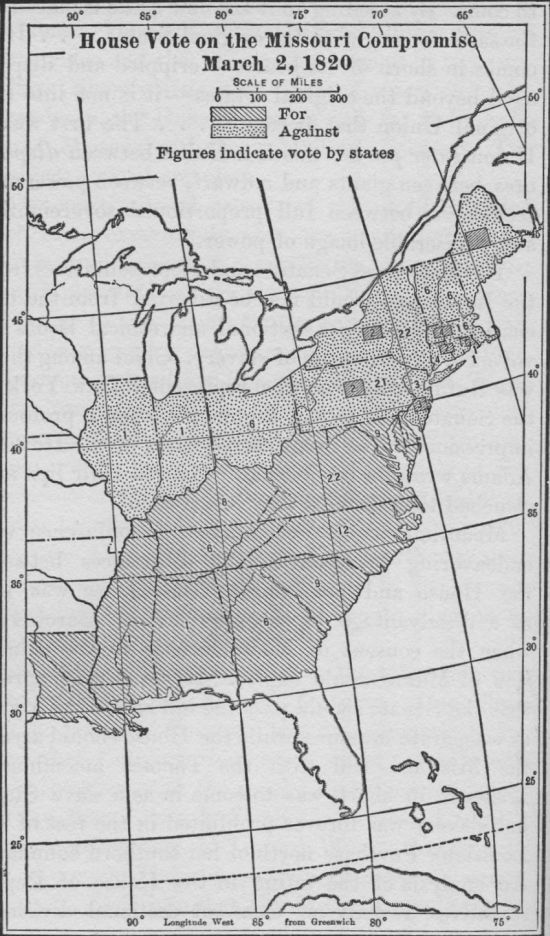
Meantime, a joint committee of conference was endeavoring to reconcile the differences between the House and the Senate. The House was put at a disadvantage by the approach of March 4—when the consent of Massachusetts to the admission of Maine would expire. It was finally agreed that the Senate should pass the bill admitting Maine as a separate measure, while the House should accept the Missouri Bill with the Thomas amendment. Missouri, in short, was to come in as a slave State, but slavery was forever prohibited in the rest of the Louisiana Purchase north of her southern boundary. An analysis of the voting in the House of Representatives reveals no clear-cut sectional divisions, though it forecasts a time when slavery might split parties along sectional lines. In New England and the Middle States public opinion had not yet crystallized into inflexible opposition to the spread of slavery; but the Northwest was distinctly in favor of a restriction upon Missouri. The Southwest and the South were a unit in desiring the admission of Missouri as a slave State.
In the fall of 1820, the Missouri question in another form returned to vex Congress. When the constitution of the State was presented to Congress, it was found to contain a clause which excluded free negroes. Again the two houses locked horns. Passions rose again. The work of the preceding session seemed about to be undone. But under the persuasive leadership of Henry Clay, a joint committee elaborated a resolution which was acceptable to both houses. Missouri was to be admitted on the express condition that the offending clause in her constitution should never be construed so as to authorize the passing of any law by which any citizen of any of the States of the Union should be deprived of his privileges and immunities under the Federal Constitution. The legislature of Missouri was to give its solemn consent to this fundamental condition. Then, and not until then, the President was to declare Missouri a member of the Union. The State complied with the requirement, though in the same breath protesting that all this was an empty form, since Congress could not thus bind a State. On August 10, 1821, President Monroe declared Missouri a State of the Union.
In the midst of this exciting controversy, Monroe was reëlected President. Nowhere but in Pennsylvania was there any serious opposition. Old distinctions of party had so far disappeared that the venerable ex-President John Adams was chosen as a presidential elector in Massachusetts, and voted with his fourteen colleagues—who were half Federalists and half Democrats—for James Monroe. In the electoral count Monroe lacked only a single vote of a unanimous election.
When the electoral vote was about to be counted, an embarrassing question arose with regard to the vote of Missouri. As the State had not yet complied with the condition imposed by Congress, its right to vote was challenged. Again Clay appeared in his rôle of compromiser. The delicate question was adroitly avoided by having the President of the Senate announce the electoral vote with and without the votes of Missouri. At last the Missouri question was disposed of; but words had been uttered which could not be recalled; and wounds had been inflicted which left scars. The South could never quite forget that it had been charged with conniving at crime in maintaining slavery. "You have kindled a fire," said Cobb, of Georgia, to Tallmadge, "which all the waters of the ocean cannot put out, which seas of blood only can extinguish."
BIBLIOGRAPHICAL NOTE
An account of the crisis of 1819 is contained in F. J. Turner's Rise of the New West (in The American Nation, vol. 14, 1906); a shorter and less satisfactory account in A. M. Simons's Social Forces in American History (1911). Much information may be gleaned from the pages of McMaster's history. Detailed information must be sought in the special studies already cited, such as R. C. H. Catterall, The Second Bank of the United States (1903), and P. J. Treat, The National Land System, 1785-1820 (1910). From the vast literature dealing with slavery and the slavery controversy, the following titles may be selected as especially important: W. E. B. DuBois, The Suppression of the African Slave-Trade to the United States of America, 1638-1870 (1896); W. H. Collins, The Domestic Slave-Trade (1904); A. B. Hart, Slavery and Abolition (in The American Nation, vol. 16, 1906); N. D. Harris, The History of Negro Servitude in Illinois (1904); E. R. Turner, The Negro in Pennsylvania (1911); and a number of monographs in the Johns Hopkins University Studies. All the larger histories discourse with great particularity upon the Missouri controversy. Contemporary views of the congressional struggle are presented in J. Q. Adams's Memoirs, and in T. H. Benton's Thirty Years' View; or, A History of the Working of American Government, 1820-1850 (2 vols., 1854).
CHAPTER XVI
THE NATIONAL AWAKENING
There is a measure of truth in speaking of the War of 1812 as a second war of independence. In throwing off the shackles of British commercial ascendency, American society experienced much the same sense of elation and liberation as the peoples of Europe who contemporaneously rose in their might against Napoleon and asserted their right to independent national existence. The war was followed in the United States by an expansion of the vital forces of the nation in all directions. The earliest manifestations of this new national consciousness, however, were characteristically boisterous. An English traveler, who visited the United States soon after the war, found every man, woman, and child talking about the Guerrière, the Java, the Macedonia, the Frolic, Lake Erie, Lake Champlain, and the "vast inferiority of British sailors and soldiers to the true-blooded Yankees." The events of the war were commemorated in songs which this Briton declared—and no doubt truthfully—to be "frothy, senseless bombast." But whatever limitations of culture were disclosed by this outburst of national conceit, no one could doubt for an instant that an exuberant vitality was coursing through the veins of the nation.
It was a fair question, however, whether this national feeling would find expression in any permanent literary form. A literature of its own America did not possess: every one with literary tastes was forced to this humiliating admission. Writing from Berlin in 1801, John Quincy Adams hailed the first number of Dennie's Port Folio with delight. "The object," he declared, "is noble. It is to take off that foul stain of literary barbarism which has so long exposed our country to the reproach of strangers and to the derision of our enemies." But the periodical had a very limited circle of readers, and its literary merits were slight. The Anthology and Boston Review, founded in 1805, had a wider influence upon letters in America; but it is memorable chiefly as the forerunner of the North American Review, modeled upon the English quarterlies, which was first published by William Tudor, in the year 1815, at Boston.
The publication of American books at this time was a hazardous enterprise. "The successful booksellers of the country," wrote one who recalled his own experiences in the book trade, "were for the most part the mere reproducers and sellers of English books." Yet American publishers often showed commendable enterprise. In 1817, Byron's Manfred was received, printed, and published at Philadelphia in a single day. Walter Scott, Moore, Miss Edgeworth, Miss Porter, and Lord Byron were the favorite British novelists and poets whose writings were reprinted in America. Among the American publications advertised by booksellers, were sermons, geographies, and schoolbooks; but rarely any productions which belonged to the category termed by contemporaries belles-lettres.
The slender literary product of the United States from 1815 to 1830 is contained in magazines rather than in books. Prose and verse which could never have found a publisher separately appeared in periodicals of every description. Most of these were ephemeral publications. The more serious reviews, like the American Biblical Repository, the American Law Journal, and the religious reviews, had a longer life; but the lighter magazines, like the Ladies' Literary Cabinet, the Young Ladies' Parental Mentor, and the Casket: or Flowers of Literature, Wit, and Sentiment, rose and fell on the fickle tide of public taste. Even the West had its magazines. Lexington, Kentucky, which disputed with Cincinnati the proud title, "Athens of the West," published the Western Review, one number of which contained a review of Don Juan within six weeks after the poem was published in England.
In the September number of the North American Review, in 1817, appeared an original poem of such merit as to mark an era in the history of American verse. There was in William Cullen Bryant's Thanatopsis, it is true, no such youthful exuberance of feeling as the first stirrings of poetic genius in a new world might be expected to exhibit. The sense of refined form seemed almost un-American; yet there are lines in the poem which suggest the primeval background of American life and its influence upon the American mind. In 1819 appeared Washington Irving's Sketch-Book—the first American book which was widely read in England; and in 1821, Cooper published The Spy, which was the first to win favor on the Continent. Both Cooper and Irving were more or less conscious imitators of English prose writers, the one of Scott and the other of Addison; and they lacked consequently that originality which critics have always demanded as the hall-mark of a genuinely native art. It is easy to forget, however, that the Americans were not a primitive people. They were folk with a literary inheritance, of which albeit they often showed little knowledge. It was not for them to invent new forms, but to press new wine into old bottles. Of Irving, moreover, it should be said that he drew freely upon a vein of delicious humor, as in his Knickerbocker History of New York, which may be truly characterized as American.
The annals of American art in these years are even more bare. Benjamin West, to be sure, was born in Pennsylvania, but he achieved eminence in England. That he could succeed Sir Joshua Reynolds as President of the Royal Academy was a tribute to his fame, but equally convincing proof that he had ceased to be identified with the land of his nativity. Gilbert Stuart owed much to West, but his return to America in 1792 saved him from complete subservience to English models. As a portrait painter he developed power and individuality. Posterity may well be grateful that the portraits of Washington, Jefferson, and Madison were painted with fidelity to nature as Stuart saw it, rather than in the grandiose manner of West. Two other names, Malbone and Allston, deserve brief mention. The one achieved some distinction as a painter of miniatures; the other is remembered both as artist and man of letters in the literary circle which was forming about Boston. The name of Jonathan Trumbull completes the list of American artists. What David was to the great actors in the revolutionary drama in France, Trumbull was to the notable characters of the American Revolution. In his conception of his themes he was perhaps the most genuinely American painter of his time.
In the pages of his autobiography, Trumbull recounts an interview with his father which may take the place of any further comment on the dearth of artistic feeling in the United States. The young man was arguing passionately for his vocation. The father, a typical Yankee, listened with commendable patience, and complimented the lad when he had finished. "'But,' added he, 'you must give me leave to say, that you appear to have overlooked, or forgotten, one very important point in your case.' 'Pray, sir,' I rejoined, 'what was that?' 'You appear to forget, sir, that Connecticut is not Athens'; and with this pithy remark, he bowed and withdrew, and nevermore opened his lips upon the subject. How often have those few impressive words recurred to my memory."
The names of Bryant, Cooper, and Irving are linked with the city of New York which enjoyed for a brief time that primacy in the world of American letters which it was fast acquiring in commerce. The center of literary and scholarly activity in the next generation was Boston, where the New England renaissance began. In this revival of letters Harvard College had a notable part. In 1806, John Quincy Adams was appointed Professor of Rhetoric and gave a course of lectures which moulded the taste of that school of orators to which Edward Everett belonged—a school of oratory which found its models in Demosthenes and Cicero. Everett became Professor of Greek in 1815; and George Ticknor, Professor of Belles-Lettres in 1816. Prescott graduated in 1814, Palfrey in 1815, and George Bancroft in 1817,—all three to add to American historiography works of enduring excellence. In 1817, young Ralph Waldo Emerson entered college.
It was Boston, however, rather than Harvard College, which created the atmosphere that these young scholars—all from Boston families—breathed: for the Athenæum, the American School of Arts and Sciences, and the Massachusetts Historical Society had begun to exercise an increasing influence on the younger generation. Harvard College, like all colleges of the day, was hardly more than a species of higher academy whither boys went at a tender age to continue their study of the classics and mathematics, and incidentally to cultivate rhetoric and belles-lettres.
The liberation of the American mind from time-honored traditions and conventions appeared markedly in the ecclesiastical revolts and religious revivals of the age. Unitarianism took its rise quite as much in protest against the teaching of Calvinism, that man was brought into the world hopelessly depraved, as against the orthodox conception of Christ's nature. The definite separation of Unitarianism from Congregationalism dates from 1815 when William E. Channing published his memorable letter to the Reverend Samuel C. Thacher. The writings of Buckminster, Channing, and other theological liberals have a distinct place in the annals of American intellectual life. Universalism also took its rise at this time and spread with remarkable rapidity under the lead of Hosea Ballou. In western Pennsylvania and Virginia, the Campbells, father and son, led a departure from the established Presbyterian order. The Society of Friends was also rent by the teachings of Elias Hicks.
Revivals had been a recurring feature of New England religious life since the latter years of the seventeenth century. That they stimulated many forms of religious activity appears in the annals of missionary enterprises at home and abroad. In 1810 the American Board of Foreign Missions and in 1814 the American Baptist Missionary Union were founded. In 1812 four young missionaries went out to India; and five years later other devoted young men began their labors among the Cherokees and Choctaws of the Southwest. There is something at once heroic and pathetic in the humanitarian zeal of a people, whom Europeans still regarded with disdain, to carry to the remote ends of the earth a Christian civilization which they had themselves hardly attained. But an incomprehensible idealism has from first to last been interwoven in the texture of American character.
After the cessation of European wars the United States stood singularly aloof from the Old World, yet in the affairs of South America they did not cease to take a lively interest. The successive revolutions by which the provinces of the Rio de la Plata, Chili, Peru, Colombia, Brazil, and Mexico threw off the yoke of Spain woke a thrill in the people of the United States, for they thought they saw the events of their own revolution repeated in the exploits of San Martín and Bolívar. To the imagination of Henry Clay, this was a sublime spectacle—"eighteen millions of people struggling to burst their chains and be free." He would have had the United States recognize these sister republics and join hands with them in forming an American system independent of Europe. And when the Administration hesitated, he exclaimed: "We look too much abroad. Let us break these commercial and political fetters; let us no longer watch the nod of any European politician; let us become real and true Americans, and place ourselves at the head of the American system."
The conception of an American system did not originate in the ardent mind of Henry Clay. It was as old as the Union itself. Foreign encroachment had been feared from the very birth of the nation. "You are afraid of being made the tool of the powers of Europe," said Richard Oswald to John Adams while peace negotiations were pending at Paris. "Indeed I am," rejoined Adams. "What powers?" asked Oswald. "All of them," said Adams; "it is obvious that all the powers of Europe will be continually manœuvring with us to work us into their real or imaginary balances of power.... But I think that it ought to be our rule not to meddle." Washington's refusal to enter into an alliance with France and his firm insistence upon neutrality were inspired by this same fear. Jefferson's negotiations for the purchase of New Orleans were motivated by the fear that France, once in possession of the mouth of the Mississippi, would threaten the isolation of the United States and drive us into the arms of Great Britain. "Jefferson is an American," Adet once said, with rare insight, "and by that title, it is impossible for him to be sincerely our friend. An American is the born enemy of European peoples."
The corollary of the principle of non-intervention was abstention on the part of the United States from the affairs of Europe. Could the United States, then, recognize the colonies of Spain as independent republics without emerging from its traditional isolation? President Monroe would have been glad to recognize the South American republics even before they had demonstrated their ability to maintain their independence; but his cool-headed Secretary of State prevailed upon him to await further evidence. It was not until 1822, indeed, that the President recommended to Congress the establishment of missions in the new republics of South America. Spain protested emphatically against this action; but Adams, now sure of his ground, justified the action of the Administration by an appeal to facts. So long as Spain was attempting to reduce the colonies by arms, the United States had observed "the most impartial neutrality." But war had ceased, and the United States had "yielded to an obligation of duty of the highest order, by recognizing, as independent states, nations which, after deliberately asserting their right to that character, had maintained and established it against all the resistance which had been or could be brought to oppose it."
In the year 1823, the traditional principles of American foreign policy were put to a severer test. Soon after the Congress of Vienna, that combination of the great powers was consummated which contemporaries usually but erroneously styled the Holy Alliance. Austria, Prussia, Russia, and Great Britain covenanted together to meet at fixed periods to consult upon their common interests and to consider the measures "most salutary for the repose and prosperity of nations, and for the maintenance of the peace of Europe." Three years later, France was admitted to the councils of these "self-appointed keepers of the world's peace." Innocent enough in its public professions, this association of the great powers was converted by Metternich of Austria, who had acquired a remarkable ascendency over the mind of his own sovereign and over that of the impressionable czar, into an instrument of reaction and repression, whenever and wherever the specter of revolution raised its head. Within a few years revolutionary uprisings occurred in Italy and Spain. The so-called legitimate sovereigns were driven from their thrones and constitutional governments were established. In successive congresses at Troppau and Laybach, the three powers, Austria, Russia, and Prussia, resolved to suppress these revolutionary movements. An Austrian army was commissioned to carry out this policy of intervention, as it was termed; and the King of the Two Sicilies was restored to his uneasy throne. Neither Great Britain nor France took part in these congresses. It now remained to chastise the revolutionists of Spain. At the Congress of Verona in 1822, the representative of Great Britain openly protested against any intervention in Spain. But again the three powers, now joined by France, resolved to restore the deposed Fernando VII. Early in the following year a French army crossed the Pyrenees and entered Madrid. It was commonly believed that the restoration of the monarchy was to be followed by a reduction of the revolted colonies and a restoration of the Spanish colonial empire.
It was at this juncture that Canning, who had become the head of the British ministry, protested against the policy of intervention and sought for ways and means to make the protest effective. The one power whose traditions of liberty and whose interests in this particular seemed to be identical with those of Great Britain was the United States. In truth, their interests were far from being identical. Two years before, in a conversation with the British minister at Washington, the Secretary of State, in his most uncompromising manner, had challenged the right of Great Britain to the valley of the Columbia River or to any part of the Pacific Coast. And so recently as April of this critical year 1823, Adams had taken alarm at the appearance of a British naval force off the coast of Cuba and had warned the Government at Madrid that "the transfer of Cuba to Great Britain would be an event unpropitious to the interests of the United States." At the same time Adams stated his conviction that within half a century the annexation of Cuba to the United States would be "indispensable to the continuance of the Union itself." Coupled with this prophecy was the equally frank assurance that the United States desired to have Cuba and Porto Rico "continue attached to Spain"—for the present.
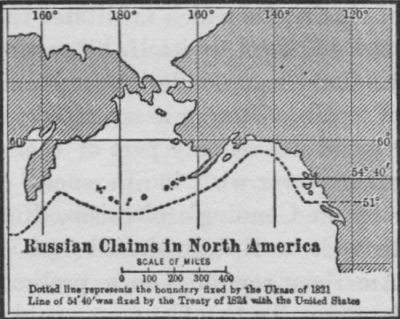
It was in midsummer of this year, too, that Adams protested against the ukase of the czar which had asserted the claim of Russia to the Pacific Coast as far south as the fifty-first degree, and to a maritime jurisdiction one hundred Italian miles from the coast. Adams records in his diary that he told the Russian minister "that we should contest the right of Russia to any territorial establishment on this continent, and that we should assume distinctly the principle that the American continents are no longer subjects for any new European colonial establishments." The time had come when the United States was bound to take more than a sentimental interest in the affairs of Spanish America. The disintegration of the Spanish colonial empire not only invited the Intervention of European powers in the internal affairs of the new republics, but also exposed portions of the North American continent to their aggressions.
On several occasions Canning conferred with Richard Rush, the minister of the United States resident in London, to ascertain whether his Government would join Great Britain in a public declaration against any "forcible enterprise for reducing the colonies to subjugation on behalf of or in the name of Spain; or which meditates the acquisition of any part of them to itself, by cession or by conquest." England had no designs upon the distant colonies of Spain, Canning asseverated; at the same time it "could not see any part of them transferred to any other power with indifference." Not trusting implicitly in Canning's altruism, Rush wisely suggested that Great Britain should first recognize the South American republics as a preliminary to a joint declaration. To this Canning would not commit himself; and Rush would not assume responsibility for a public declaration on any other conditions.
On receiving the dispatches from Rush recounting these interesting conferences, President Monroe took counsel with the two Virginia oracles, Jefferson and Madison. Both advised him to meet Canning's overtures and to make common cause with Great Britain—the one nation, as Jefferson put it, which could prevent America from having an independent system and which now offered "to lead, aid, and accompany us in it." Monroe was disposed to follow this advice. He not only drafted a message to Congress upon these lines, but he went further and urged the recognition of Greek independence in a way which departed widely from the traditional aloofness which earlier Presidents had maintained in matters of European concern. On the other hand, Adams was decidedly of the opinion that Canning's invitation should be declined. He did not wish the country to appear "as a cock-boat in the wake of the British man-of-war." Moreover, Adams was considerably alarmed at the reactionary principles which the Russian ministry had avowed in a communication addressed to the minister at Washington. He urged the President to seize the occasion to make an explicit declaration of American principles. "The ground I wish to take," said he, "is that of earnest remonstrance against the interference of European powers by force with South America, but to disclaim all interference on our part with Europe; to make an American cause and adhere inflexibly to that."
Yielding to his contentious Secretary of State, President Monroe redrafted his message to Congress. In its final form, December 2, 1823, this famous state paper contained the essential principles of what has come to be known as the Monroe Doctrine. It was asserted "as a general principle in which the rights and interests of the United States are involved that the American continents, by the free and independent condition which they have assumed and maintain, are henceforth not to be considered as subjects for future colonization by any European powers." The message expressly disclaimed any purpose to interfere in European politics; but respecting the affairs of the Western hemisphere a direct and immediate interest was frankly avowed. "The political system of the allied powers is essentially different in this respect from that of America." "We should consider any attempt on their part to extend their system to any portion of this hemisphere as dangerous to our peace and safety. With the existing colonies or dependencies of any European power we have not interfered and shall not interfere. But with the Governments who have declared their independence and maintained it, and whose independence we have, on great consideration and on just principles, acknowledged, we could not view any interposition for the purpose of oppressing them, or controlling in any manner their destiny, by any European power in any other light than as the manifestation of an unfriendly disposition toward the United States."
The immediate effects of the message are not easily traced. It is not clear, even, that the favorable treaty made with Russia in the following year was the outcome of what Canning somewhat contemptuously styled "the new Doctrine of the President." Russia, it is true, agreed to waive her claims below fifty-four degrees forty minutes and to exclusive jurisdiction in Bering Sea; but the conflicting claims of England in the Northwest remained, and Canning predicted that England would "have a squabble with the Yankees yet in and about those regions."
Later generations have read strange meanings into the message of President Monroe. Even contemporaries were not clear as to its import. Interpreted in the light of its origin, it was a candid announcement that the United States did not purpose to meddle in the affairs of European states or of their existing dependencies, and a protest against the increase of power of European states in America either by intervention or by new colonization.
BIBLIOGRAPHICAL NOTE
In the concluding volume of Henry Adams's History of the United States are excellent chapters on American literature, art, and religious thought. W. B. Cairns's On the Development of American Literature from 1815 to 1833 (1898) contains much interesting information about periodicals. Barrett Wendell's A Literary History of America (1900) is full of pungent comment on early men of letters. C. C. Caffin, The Story of American Painting (1907), and H. T. Tuckerman, Artist-Life, or Sketches of American Artists (1847), record the small achievements of American art. John Trumbull's Autobiography, Reminiscences, and Letters, from 1756 to 1841 (1841), is a book of great interest. E. G. Dexter's A History of Education in the United States (1904) is an excellent manual. The Unitarian Movement can be best followed in J. W. Chadwick's William Ellery Channing (1903). The history of the various denominations may be found in volumes of the American Church History Series. The genesis of Monroe's message is described by F. J. Turner, The Rise of the New West(in The American Nation, vol. 14, 1906), and F. E. Chadwick, The Relations of the United States and Spain (1909). Both of these accounts are based on W. C. Ford, John Quincy Adams: His Connection with the Monroe Doctrine (in Massachusetts Historical Society Proceedings, 1902). An excellent essay is that by W. F. Reddaway, The Monroe Doctrine (2d. ed., 1905).
CHAPTER XVII
THE NEW DEMOCRACY
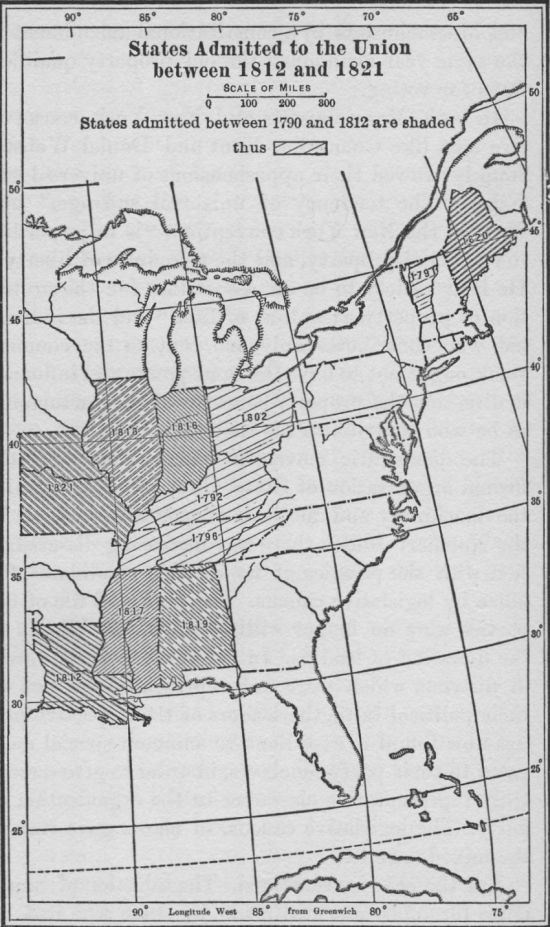
By the year 1824, the West had become a section to be reckoned with by those who were calculating their chances in the presidential race. Since the war six Western States had been admitted into the Union. The population west of the Alleghanies had increased by nearly a million and a half within a decade. The relative importance of this new section appears in the census returns. In 1790, less than six per cent of the total population lived west of the Alleghanies; in 1820, nearly thirty-two per cent were domiciled in this vast region. In the National Legislature the West had acquired notable weight. By the apportionment of 1822, it had forty-seven out of two hundred and thirteen members of the House; in the Senate, eighteen out of forty-eight. But these figures do not tell the whole tale. As Professor Turner has well said, rightly to estimate the weight of Western population we must add the people of western New York and of the interior counties of Pennsylvania, and of the trans-Alleghany counties of Virginia, as well as the people of the back-country of Maine, New Hampshire, Vermont, North Carolina, and Georgia. "All of these regions were to be influenced by the ideals of democratic rule which were springing up in the Mississippi Valley."
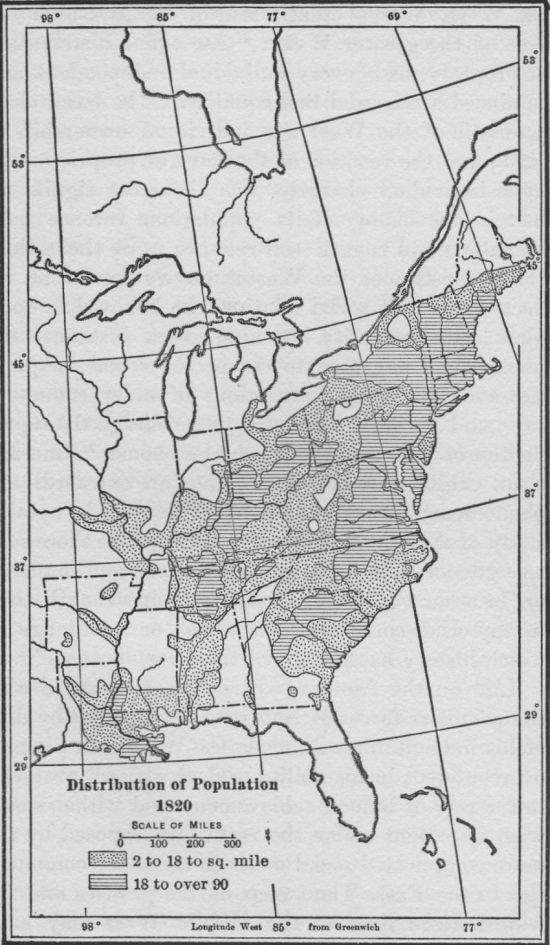
Economic conditions bred a democratic society in the West. What Gallatin said of Pennsylvania was true of the greater West: "An equal distribution of property made every individual independent and produced a true and real equality." The basal characteristic of the West was individual ownership of land; and the reaction of the sense of proprietorship upon individual character was the most significant fact in the history of its population. Intense individualism and rugged self-reliance were the salient characteristics of the Westerner. So far as he reflected upon his social relations, he believed in complete social equality. In numberless instances the pioneer had migrated to escape the social inequalities and depressing conventions of older communities; and he was not minded to encourage the reproduction of these conditions in his new home. "America, then, exhibits in her social state an extraordinary phenomenon," wrote De Tocqueville in his notable study of American democracy. "Men are there seen on a greater equality in point of fortune and intellect, or, in other words, more equal in their strength, than in any other country of the world, or in any age of which history has preserved the remembrance."
Life on the frontier, where a man wrestled with the primitive forces of Nature and conquered by dint of his indomitable will, made the Westerner perhaps overconfident in his ability to deal with all obstacles in the way of human achievement and withal somewhat impatient under the restraints imposed by the more complicated social order in the older communities to the East. The sweep of the prairies and the wide horizon lines of the Middle West may have exercised a subtle influence upon temperament. At all events, the Westerner was buoyant and optimistic, taking large views of national destiny and of the possibilities of human achievement in a democracy.
There was danger, indeed, that in cutting loose from the irritating restraints of the older communities, the people of the West would sacrifice much of the grace and many of the intellectual and spiritual refinements of an older civilization. "In this part of the American continent," observes De Tocqueville, "population has escaped the influence not only of great names and great wealth, but even of the natural aristocracy of knowledge and virtue." It seemed to two young New Englanders who traversed the vast region from the Western Reserve to New Orleans in 1813, in the interests of missionary societies, that the people were wrapped in spiritual darkness, "being ignorant, often vicious, and utterly destitute of Bibles and religious literature." The General Bible Society of the United States was founded in 1816 to dispel this irreligious gloom. Within five years this organization and its numerous auxiliaries had distributed one hundred and forty thousand Bibles and Testaments through the new States.
Yet the irreligion of the West was painted darker than it really was. Methodism had struck root where other denominations could not thrive. Its methods and organization, indeed, were peculiarly adapted to a people which could not support a settled pastor. "A sect, therefore, which marked out the region into circuits, put a rider on each and bade him cover it once a month, preaching here to-day and there to-morrow, but returning at regular intervals to each community, provided the largest amount of religious teaching and preaching at the least expense." The Baptists, too, secured a footing in the new communities and labored effectively in creating religious ties between the old and the new sections of the country. In religion as in politics the people of the West were responsive to emotional appeals. The circuit rider, with his intense conviction of sin and his equally strong conviction of salvation through repentance, wrought great crowds in camp meetings into ecstasies of religious excitement. Odd religious sects and strange "isms" were to be found in the back-country. At New Harmony on the Wabash River were the Rappites, a sect of German peasants who came first to Pennsylvania under their leader George Rapp, and who afterward returned thither. At Zoar in Ohio was the Separatist community led by Joseph Baumeler. Shaker societies were formed at many places; and Mormonism was just beginning its strange history through the revelations of Joseph Smith in western New York.
The intellectual horizon of the Western world was necessarily limited. Absorbed in the stern struggle for existence, the people had no leisure and no heart to enjoy the finer aspects of life. Education was a luxury which only the prosperous might possess. The purpose to make elementary education a public charge developed tardily. Outside of New England, indeed, a public school system did not exist. Throughout the older portions of the West the traveler might find academies and so-called colleges, but none supported at public expense. The State of Indiana, it is true, entered the Union with a constitution which made it the duty of the legislature to provide, as soon as circumstances permitted, "for a general system of education, ascending in a regular gradation from township schools to a State University, wherein tuition shall be gratis, and equally open to all." But years passed before circumstances permitted the realization of this ideal. Meantime, the prosperous planters of the Southwest employed tutors for their children, and the well-to-do farmers of the Northwest paid tuition for their boys at academies. But young Abraham Lincoln had to teach himself Euclid and to cipher on the back of a wooden shovel, by the flickering embers of a log-cabin fire.
The new Commonwealths entered the Union as self-confessed democracies. In all the States formed after the War of 1812, with one exception, property qualifications such as prevailed in the older States were swept away and the right to vote was accorded to every adult white male. In Mississippi alone there was the additional qualification that a voter should be enrolled in the militia or have paid a state or county tax. Everywhere, too, the principle was accepted that representation should be based upon population and not upon property. The men who framed these new constitutions believed that they were establishing the rule of the people. It was, indeed, unthinkable that, believing themselves equal in all other respects, they should not accept the principle of political equality and popular sovereignty.
There is evidence in these new constitutions, however, that the people placed less reliance in their legislative bodies than did the people of the Revolutionary era. Instead of general grants of legislative power, there are specific prohibitions and positive injunctions. Important limitations are imposed upon the form and mode of legislation. It is clear, too, that fear of an over-strong executive had given way to a belief in the necessity of having a stronger countervailing influence, capable of checking the legislative. Everywhere the governor was made elective directly by the people and given the veto power. The conviction was often expressed in constitutional conventions that the governor was peculiarly the representative of the people, a popular tribune who would protect them against the indiscretions of their legislative representatives. The extension of the elective principle to all important offices was accompanied also by a general conviction that life tenure of office is undemocratic. "Rotation in office," said Andrew Jackson, voicing a popular feeling, "is a cardinal principle of democracy."
The spirit of Western democracy leavened also the older States. The people of Maine, breaking away from Massachusetts and her ancient ideals, boldly declared for manhood suffrage in their new constitution. Connecticut adopted a constitution in 1818 to replace the old charter, and dissolved the old union of Church and State by declaring that no preference should be given by law to any Christian sect or mode of worship. At the same time Connecticut extended the suffrage to all who served in the militia or paid a state tax. New York in the constitution of 1821 and Massachusetts by a constitutional amendment in the same year abandoned the old property qualifications for voting.
In both Massachusetts and New York, conservative men like Chancellor Kent and Daniel Webster frankly avowed their apprehensions of universal suffrage. "The tendency of universal suffrage," said Kent in the New York convention, "is to jeopardize the rights of property, and the principles of liberty." He held society to be an association for the protection of property as well as of life, "and the individual who contributes only one cent to the common stock ought not to have the same power and influence in directing the property concerns of the partnership as he who contributes his thousands."
The democratic movement affected not only the formal organization of State Governments, but also the machinery and methods of political parties. In the Northern States there was increasing dissatisfaction with the practice of nominating candidates for office by legislative caucus. The rank and file of the parties were no longer willing to submit blindly to the dictation of leaders. In deference to party voters in districts which were not represented by men of their political faith, the leaders of the respective parties now found it expedient to summon special delegates to their party conclaves, in order to give a more truly representative character to the organization of party. The legislative caucus, in short, gave way to the mixed caucus.
But the old vice remained. The selection of candidates for office was still made by those who had no mandate to act for the party except in a legislative capacity. If the voters of the party were in truth the source of authority within the party, then a means had to be devised of ascertaining their will. The democratic principle, in short, had to be applied to party. In response to this feeling, mass meetings and irregular conventions were held; but these methods of securing an expression of party opinion were only transitional. Indeed, so long as the means of communication were defective, popular gatherings were necessarily poorly attended. The next step in the democratization of party organization could only be taken when the barriers of space were overcome by the application of the steam engine to transportation. The nominating delegate convention waited on the development of transportation.
Much the same popular hostility was directed against the congressional caucus. Candidates for the presidential nomination were not blind to this movement, and for the most part they sought other means of promoting their chances. Monroe had hardly entered upon his second term when state legislative caucuses began to nominate favorite sons. In 1821, the legislature of South Carolina put forward the name of William Lowndes, and upon his death named John C. Calhoun as its candidate for the Presidency. In 1822, the legislature of Tennessee presented the name of Andrew Jackson, "the soldier, the statesman, the honest man," to the consideration of the people of the United States. In the same year Republican members of the legislature of Kentucky recommended Henry Clay "as a suitable person to succeed James Monroe as President." A "joint meeting of the Republican members of the Massachusetts legislature and of Republican delegates from the various towns of the Commonwealth not represented in the legislature" nominated John Quincy Adams for the Presidency in January, 1823. And finally, illustrative of the varied methods in use and of the strange vicissitudes of politics at this time, a public gathering or mass meeting at Fredericksburg, Virginia, in March, 1824, nominated Adams for President and Jackson for Vice-President.
A series of resolutions passed by the legislature of Tennessee in 1823 called attention in no uncertain language to the shortcomings of the congressional caucus and called for its overthrow. A canvass of the members of Congress showed that one hundred and eighty-one out of two hundred and sixty-one believed a caucus inexpedient at this time. Nevertheless, the minority, acting in Crawford's interest, took their courage in both hands and held a caucus on February 14, 1824. Sixty-four out of sixty-eight votes were cast for William H. Crawford, who thus became by all precedents the "regular" candidate of the Republican party. This nomination and the indorsement of Jackson by the Republicans of Pennsylvania spoiled Calhoun's chances. In the spring of 1824, he allied himself with the Jackson faction by accepting the nomination for Vice-President at the hands of a state nominating convention at Harrisburg, which had put Jackson at the head of the ticket.
Such issues as were discoverable in the presidential contest of 1824 were formulated in the debates in Congress during the early part of the year. As the country recovered from financial depression, the question of internal improvements again forged to the front. In 1822, a bill to authorize the collection of tolls on the Cumberland Road had been vetoed by the President. In an elaborate essay Monroe set forth his views on the constitutional aspects of a policy of internal improvements. Congress might appropriate money, he admitted, but it might not undertake the actual construction of national works nor assume jurisdiction over them. For the moment the drift toward a larger participation of the National Government in internal improvements was stayed. Two years later, however, Congress authorized the President to institute surveys for such roads and canals as he believed to be needed for commerce and military defense. The vote on this bill shows that the source of opposition to internal improvements was chiefly in the Northeast, in Virginia, and in the Carolinas. The West and Southwest, with Pennsylvania, Maryland, and New Jersey, were a unit in support of the general survey.
No one pleaded more eloquently for a larger conception of the functions of the National Government than Clay. No one voiced the aspirations of his section more faithfully. He called the attention of his hearers to provisions made for coast surveys and lighthouses on the Atlantic seaboard and deplored the neglect of the great interior of the country. "A new world has come into being since the Constitution was adopted," he exclaimed. "Are the narrow, limited necessities of the old thirteen States, of, indeed, parts only of the old thirteen States as they existed at the formation of the present Constitution, forever to remain the rule of its interpretation?" Of the other presidential candidates, Jackson voted in the Senate for the general survey bill; and Adams left no doubt in the public mind that he did not reflect the narrow views of his section on this issue. Crawford felt the constitutional scruples which were everywhere being voiced in the South, and followed the old expedient of advocating a constitutional amendment to sanction national internal improvements.
The Tariff Act of 1824 also entered somewhat into the presidential campaign. The failure of the protectionists to secure a higher tariff in 1820 had been followed by other efforts to secure congressional action; but none succeeded until Clay was again elected Speaker of the House and thrust the matter into the foreground of discussion. Clay dwelt eloquently upon the loss of the foreign market for agricultural products and upon the consequent widespread distress. To his mind the remedy was the establishment of an American market by fostering manufactures. That such a policy would involve a clash of sectional interests, he did not deny; but he believed that "reconciliation by mutual concessions" could be effected and a genuine "American system" be brought into existence.
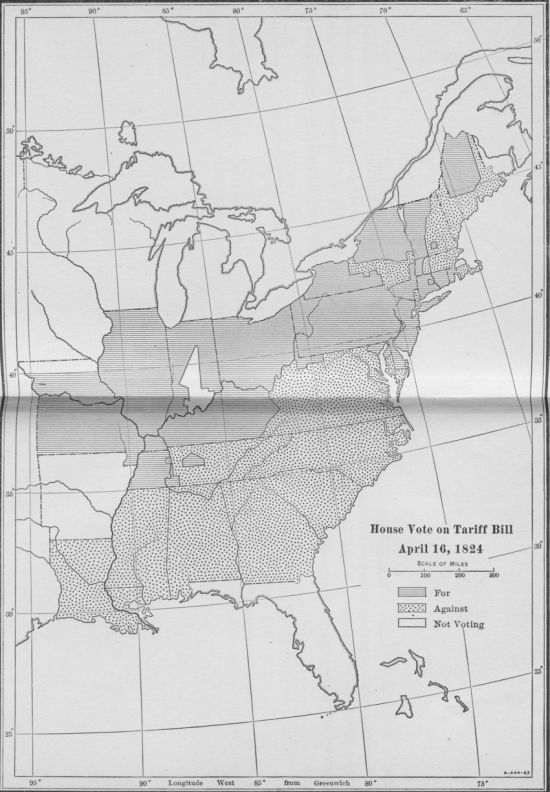
The tariff bill presented in 1824 was avowedly a protective measure. Among lesser changes, increased duties were proposed on iron, lead, wool, hemp, cotton bagging, and cotton and woolen goods. At once the clash of sectional interests began. New England shippers protested against the duty on hemp, which they needed for cordage; and Southern planters made common cause with them on this item, because the cheap bagging which they used for baling their cotton was made of coarse hemp. For the same reason the maritime sections of New England opposed the duty on iron. For precisely opposite reasons, Kentucky clamored for the protection of her hemp-growers, and Pennsylvania, for the protection of her iron-workers. It was well understood that the cotton industry was established and needed no protection; nevertheless, the minimum duty on cotton fabrics was raised. The increased duty on woolens, however, was offset by an increased duty on raw wool, so that the woolen manufacturers profited little by the change of rate. A proposal to apply to woolens the minimum principle which had been extended to cottons in 1816 was defeated by the opposition of the South. Any increase in the cost of cheap woolen goods was bound to enhance the cost of clothing the slaves. On the other hand, the representatives of the great grain-growing and farming States of New York, New Jersey, and Pennsylvania, together with the States of the Ohio Valley, were almost unanimously in favor of the proposed bill. When the bill came to a vote in the House on April 16, 1824, only nine of the combined ninety-five votes of these sections were cast in the negative. Equally emphatic was the protest of the South and Southwest: only six out of seventy-six Representatives favored the bill. New England by its divided vote revealed the internal conflict between the commercial and manufacturing interests. The bill passed both houses of Congress by small majorities and received the signature of the President.
Of the presidential candidates, only one spoke with uncertain sound on the tariff issue. Clay was the outspoken advocate of a far-reaching American system; Adams thought the tariff of 1824 a fair compromise; Jackson, properly coached by his intimates, put himself on record as a supporter of a protective policy to create a home market; only Crawford, representative of the peculiar interests of the South and candidate for Northern support, felt the impossibility of harmonizing the conflicting interests of his followers by a clear-cut and explicit utterance on the tariff.
With so many candidates in the field, it was difficult to forecast the outcome of the presidential campaign. Even if there had been a pronounced popular drift toward any candidate, the result would have remained in doubt until the six States which still gave the choice of electors to their legislatures had completed the complicated electoral process. There was a strong likelihood, however, that the election would go to the House of Representatives. As the choice would then be confined to the three candidates having the highest vote, there was not a little bargaining in the States where the legislatures chose the electors. The completed returns gave Jackson 99 electoral votes; Adams, 84; Crawford, 41; and Clay, 37. Calhoun was elected Vice-President by more than two thirds of the electoral vote. The House, therefore, as wiseacres had foretold, was called upon for the second time to decide a contested presidential election.
The position of Clay was one of unenviable distinction and power. He could not be elected President, but he could, it was believed, determine which of his rivals should have the coveted office. His own State favored Jackson as a second choice; but Clay wrote to a friend that he could not consider the killing of twenty-five hundred Englishmen at New Orleans proved the fitness of Jackson for the chief civil magistracy. Crawford was personally less objectionable to Clay; but he had suffered a paralytic stroke and his health was precarious. Besides, Crawford had opposed some of the policies which Clay had most at heart. For years Clay had been a bitter opponent of Adams; yet after all was said, he was bound to admit that his interests would be best served by an alliance with this stiff-necked New Englander. At an early date, therefore, he determined to throw his support to Adams.
For weeks the capital was enveloped in an atmosphere of intrigue. Clay was courted by all factions. The possibility of securing his support was a standing temptation to wire-pullers. Even Adams wrote in his diary, "Incedo super ignes" (I walk over fires). When Clay announced positively, on January 24, that he and his friends would support Adams, a storm of passionate denunciation broke upon him. An anonymous letter appeared in a Philadelphia newspaper, charging that friends of Adams had offered Clay the Secretaryship of State in return for his support, and that friends of Clay had reported the offer to friends of Jackson, with the intimation that Clay would support the general on similar terms. When the friends of Jackson spurned these overtures, Clay sold out to Adams. With quite unnecessary heat Clay branded the author of this letter as "a base and infamous calumniator, a dastard, and a liar." His first instinct was to challenge the author whoever he might be; but when Representative George Kremer, an odd character who was chiefly conspicuous by reason of the leopard-skin coat which he wore avowed himself the writer of the offensive letter, Clay wisely concluded not to make himself ridiculous by an affair of honor with this Gil Blas. He demanded a congressional investigation instead.
While this investigation of the alleged bargain between Adams and Clay was pending, the House proceeded to the election of a President. On the first ballot, Adams received the votes of thirteen States, while Jackson was the choice of seven States, and Crawford of four. New England, New York, Louisiana, Maryland, and the States of the Northwest, except Indiana, supported Adams. Combined with these were now Missouri and Kentucky, which had voted for Clay. Jackson received the votes of the Southwest, together with those of Pennsylvania, New Jersey, Indiana, and South Carolina. Crawford was supported by Georgia, North Carolina, Virginia, and Delaware. Two days later the President-elect announced that he had invited Henry Clay to be his Secretary of State. After some hesitation, Clay accepted the post.
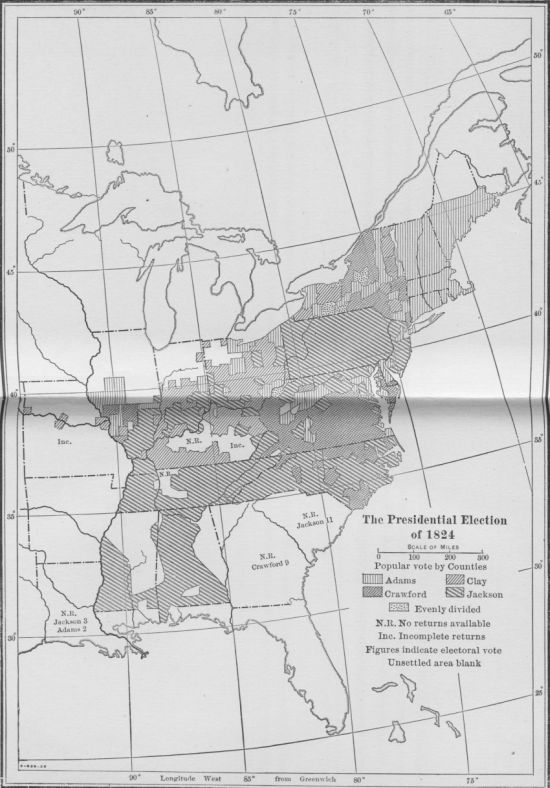
The cry of corruption is a recurrent note in the history of democracies. The American democracy is no exception. With most of the charges of corruption, the historian has little concern; but the bargain and corruption cry of 1825 has a historical significance. The falsity of the charge against Clay has been proved as nearly as a negative can be. Adams may not have been above the uncongenial task of soliciting votes, but he kept safely within the moral domain which his conscience marked out. The motive which governed his appointment of Clay as Secretary of State is stated frankly in a letter to Monroe, two days after the election by the House. He considered the appointment "due to his talents and services to the western section of the Union, whence he comes, and to the confidence in me manifested by their delegations." Upon one individual these considerations made no impression: Andrew Jackson left the capital with wrath in his soul. He felt that he had been defrauded by a corrupt bargain. From this time on his hand was against Clay,—that "Judas of the West," as he afterward called him,—who had conspired to "impair the pure principles of our republican institutions" and to "prostrate that fundamental maxim which maintains the supremacy of the people's will."
Years after the events of 1824-25, the belief of Jackson that the will of the people had been defeated found classic expression in Thomas H. Benton's Thirty Years' View of Congress. What Benton termed "the Demos Krateo principle" was thoroughly in accord with the spirit of the new democracy, but it rested upon an entire misunderstanding of the Constitution. A direct popular election of the President was never contemplated by the framers of the Constitution. It is impossible to find in either the letter or the spirit of the Constitution any justification for the view that the House of Representatives is bound to elect the candidate having the highest popular vote.
What the will of the people really was in the presidential election of 1824 is by no means clear. Even in those States where presidential electors were chosen by popular vote, Jackson received less than half of the popular vote; and in many of these States the actual vote fell far below the potential. In Massachusetts, where 66,000 votes had been cast for governor the year before, only 37,000 voters took the trouble to vote for President. In Pennsylvania, which boasted of a population of over a million, less than 48,000 voted in 1824. Moreover, the six States which chose the presidential electors through their legislatures, contained one fourth of the population of the country. One fact, however, stands out with unmistakable clearness,—and it did not escape politicians like Van Buren, of New York, who had their fingers on the pulse of the people,—this martial hero from out of the West had an unprecedented vote-getting capacity. It were well to observe the Western horizon more intently.
BIBLIOGRAPHICAL NOTE
The best description of the political characteristics of American society in this period is given by Alexis de Tocqueville, Democracy in America (2 vols., trans., 1862). F. J. Turner has pointed out the importance of the West in the development of the nation in several studies, notably: "The Significance of the Frontier in American History" (American Historical Association, Report, 1893); "The Problem of the West" (Atlantic Monthly, vol. 78); "Contributions of the West to American Democracy" (Atlantic Monthly, vol. 91). The political development of the South is set forth with great thoroughness by U. B. Phillips, Georgia and State Rights (American Historical Association, Report, 1901); W. A. Schaper, Sectionalism and Representation in South Carolina (ibid., 1900); and C. H. Ambler, Sectionalism in Virginia from 1776 to 1861 (1910). Important aspects of the tariff are discussed in Edward Stanwood's American Tariff Controversies in the Nineteenth Century (2 vols., 1903), and in C. W. Wright's Wool-Growing and the Tariff (1910).
CHAPTER XVIII
POLITICS AND STATE RIGHTS
The circumstances of his election made the position of President Adams one of very great difficulty. He alluded to his embarrassment in his first message to Congress. "Less possessed of your confidence in advance than any of my predecessors," said he, "I am deeply conscious of the prospect that I shall stand more and oftener in need of your indulgence." It is doubtful, however, if even he appreciated the momentum of the forces which were already combining to discredit his administration. In October, the legislature of Tennessee had again nominated Jackson for the Presidency, and he had accepted the nomination as a summons to wage war upon the forces of evil in high places. The campaign of 1828, indeed, had already begun: and it was to be a campaign of personal vindication as well as of popular rights.
Under similar circumstances most men would have made sure of the loyalty of their constitutional advisers, at least, but Adams flattered himself that he could carry on a non-partisan administration. The results were disastrous, for at least two of the Cabinet were not above using the patronage of office to further the cause of Jackson. In his laudable desire not to allow the Government to become "a perpetual and unintermitting scramble for office," Adams refused to make removals in the civil service on partisan grounds, yet he retained in office underlings who labored incessantly in the cause of the opposition.
Equally impolitic was the attitude of the President toward questions of public policy in his first message to Congress. Just when the opposition was in a fluid state and the winds of conflicting doctrines were ruffling the surface of national politics, Adams gave utterance to opinions on the functions of government which were bound to alienate many of his followers. Entertaining no doubts as to constitutional limitations upon the powers of the National Government, he advocated not only the construction of roads and canals, but the establishment of observatories and a national university. His program included governmental aid to the arts, mechanical and literary, and to the sciences, "ornamental and profound." He was prepared to give encouragement not only to manufacturing but to agriculture and to commerce. Many of these were objects which President Jefferson had recommended to the consideration of Congress in 1806; but whereas he had urged the adoption of amendments to the Constitution which would authorize Congress to provide for roads and canals and education, Adams seemed oblivious to the limitations of the Constitution. In much alarm Jefferson suggested to Madison the desirability of having Virginia adopt a new set of resolutions, bottomed on those of 1798, and directed against the acts for internal improvements. In March, 1826, the general assembly declared that all the principles of the earlier resolutions applied "with full force against the powers assumed by Congress" in passing acts to protect manufactures and to further internal improvements. That the Administration would meet with opposition in Congress, whatever its program might be, was a foregone conclusion. The only question was whether the diverse and mutually hostile factions which had followed the fortunes of Crawford, Calhoun, and Jackson could coalesce into a consistent opposition. The first test occurred when the Administration proposed the Panama mission.
The overthrow of the authority of Spain in South America had left the way clear for the long-projected union of the republics. Early in the year 1825, the ministers of Mexico, Guatemala, and Colombia waited on Clay to learn whether the United States would accept an invitation to a great council or congress which had been called by the revolutionist Bolívar, now President of Colombia. The project appealed strongly to Clay. A league of young republics in the New World to offset the Holy Alliance in Europe was, as his biographer remarks, "one of those large, generous conceptions well calculated to fascinate his ardent mind." The imagination of the President was not so easily touched: he instructed Clay to inquire more particularly into the purposes of the congress.
The condition of affairs in the countries bordering on the Caribbean Sea—the American Mediterranean—was such, indeed, as to justify extreme caution in dealing with the Latin-American republics. It was matter of common knowledge that Colombia and Mexico had designs upon Cuba, the last of the Spanish outposts in the New World. So long as Spain continued at war with her old colonies, the United States was bound to be uneasy about the fate of Cuba and Porto Rico. Even if the islands were liberated by the republican armies of Central and South America, they were likely to fall a prey to some European power. The appearance of a French fleet off the coast of Cuba during the summer of 1825 gave point to these not unwarranted apprehensions. It was rumored that Cuba was to be made the basis for an expedition against Mexico in behalf of Spain. This episode prompted Clay to make strong representations to France that the United States could not consent to the occupation of Cuba by any other European power.
When, then, a formal invitation came to participate in the Panama Congress, the Administration determined to seize the occasion to exercise a wholesome restraint by friendly advice upon the assembled delegates of the republics, and at the same time to ascertain their purposes. In asking the Senate to confirm the nomination of two delegates, however, the President voiced his own expectation of what the Congress would be and do, rather than the purposes of Bolívar and his associates. The occasion would be favorable, the President intimated, for the discussion of commercial reciprocity, of neutral rights, and of principles of religious liberty. An alliance with the Latin-American republics was not contemplated. On the contrary, the delegates from the United States would urge "an agreement between all of the parties represented at the meeting, that each will guard by its own means against the establishment of any future European colony within its borders." At this stage in its evolution the Monroe Doctrine was not understood to include any obligation on the part of the United States to police the territories of the lesser republics of the New World.
The instructions given to the envoys leave no doubt as to the intentions of the Administration. Every possible endeavor was to be made to dissuade Colombia and Mexico from their designs upon Cuba and Porto Rico. The recognition of Hayti as an independent state was to be deprecated. In short, the status quo in the Caribbean Sea was to be maintained; and throughout, the congress was to be regarded as a diplomatic conference and in no wise as a convention to constitute a permanent league of republics.
Nevertheless, the opposition in Congress persisted in misrepresenting the President's purposes. It was pointed out that the republics to the south very generally believed that the United States was pledged by Monroe's message to make common cause with them when their independence was threatened. "Are we prepared," asked Hayne, of South Carolina, "to send ministers to the Congress of Panama for the purpose of making effectual this pledge of President Monroe as construed by the present administration and understood by the Spanish-American states?" With greater sincerity Southern Representatives protested against participating in a congress which proposed to discuss the suppression of the slave trade and the future of Hayti. "Slavery in all its bearings," said Hayne, "is a question of extreme delicacy, concerning which there is but one safe rule either for the States in which it exists or for the Union. It must ever be treated as a domestic question. To foreign governments the language of the United States must be that the question of slavery concerns the peace and safety of our political family, and that we cannot allow it to be discussed." Least of all, he continued, could the United States touch the question of the independence of Hayti in connection with revolutionary governments which had marched to victory under the banner of universal emancipation and which had permitted men of color to command their armies and enter their legislative halls.
In the end the Administration had its way and the nominations were confirmed; but the delay was most unfortunate. On their way to the Isthmus, one of the delegates died, and the other arrived too late to take part in the congress. From the viewpoint of domestic politics, the controversy over the mission was only an incident in the evolution of a party within the bosom of the Democratic party. The animus of the opposition is revealed in the often-quoted remark of Martin Van Buren, who was trying to drill the varied elements in the Senate into a coherent organization: "Yes, they have beaten us by a few votes, after a hard battle; but if they had only taken the other side and refused the mission, we should have had them."
Of far more serious import than this factional opposition in Congress was the resistance which the authorities of Georgia offered to the National Administration in the matter of Indian lands. On March 5, 1825, the Senate ratified the Treaty of Indian Springs with the Creek Indians, which provided for the cession of practically all the lands of the tribe between the Flint and Chattahoochee Rivers. For years the planters of Georgia had coveted these fertile tracts, awaiting with impatience the negotiations of the Federal Government with the reluctant Indians. Although the title to the lands was not to pass to Georgia until September 1, 1826, Governor Troup ordered them to be surveyed with a view to their immediate occupation. Meantime, well-founded charges were current that the treaty had been made by a faction among the Creeks, without the consent of the responsible chiefs. President Adams at once ordered the state authorities to desist from their survey; but the governor replied that Georgia was convinced of the validity of the treaty and fully determined to enter into possession of her own. The tone of the governor's letter was ominous. Nevertheless, the President instituted negotiations for a new treaty. The diplomatic shifts resorted to by the Indian agents in this instance were not above suspicion, but the President seemed to entertain no misgivings, for he assured the Senate that the new Treaty of Washington (January 24, 1826) was the will and deed of "the chiefs of the whole Creek Nation." The grant left the Indians still in possession of some lands west of the Chattahoochee.
The feelings of all loyal Georgians were outraged by the course of the Administration. The legislature protested against the Treaty of Washington as "illegal and unconstitutional," and denounced the President's action as "an instance of dictation and federal supremacy unwarranted by any grant of powers to the General Government." "Georgia owns exclusively the soil and jurisdiction of all the territory within her present chartered and conventional limits," read the resolutions of December 22, 1826. "She has never relinquished said right, either territorial or jurisdictional, to the General Government."
The ebullient governor hardly needed the indorsement of the legislature. He pushed on the surveys to the limits set by the original treaty. But the surveyors soon met with resistance from the Indians; and the Indians appealed to the President. The Secretary of War then notified Troup that the President felt himself compelled to employ all the means under his control to maintain the faith of the nation and to carry the treaty into effect. Governor Troup replied defiantly that the "military character of the menace" was well understood. "You will distinctly understand, therefore, that I feel it my duty to resist to the utmost any military attack.... From the first decisive act of hostility, you will be considered and treated as a public enemy, and with less repugnance because you, to whom we might constitutionally have appealed for our defense against invasion, are yourselves the invaders, and, what is more, the unblushing allies of the savages whose course you have adopted." He at once issued orders to the state military officers to hold the militia in readiness to repel any invasion of the soil of Georgia.
The tension which had now become acute was relieved by the intelligence that the President had ordered the Indian agent to the Creeks to resume negotiations for the cession of the rest of their lands. The governor hastened to point out jubilantly that the President had beaten a retreat. Meantime, the President had laid the whole matter before Congress in a special message. A committee of the House advised the purchase of the rest of the Indian lands, but in the mean time the maintenance of the terms of the Treaty of Washington. A committee of the Senate, however, with Benton as chairman, took an opposite view of the situation, and deprecated any action looking toward the coercion of a sister State. A treaty concluded with the Creeks in November, 1827, fortunately satisfied all parties and put an end to this exciting controversy—a controversy in which the President had played a lone and not very successful hand.