ALLEN JOHNSON (continued 4)
Reading edition
Before the end of the year the failure of the embargo was patent to every fair-minded observer. The alternatives, war or submission, were not pleasant to contemplate. From force of habit the party in power looked to Jefferson for leadership; but since Madison's election, he had assumed the rôle of "unmeddling listener," not wishing to commit his successor to any policy. The abdication of Jefferson thus left the party without a leader and without a program at a most critical moment.
Under the circumstances it was easier to continue the embargo than to face the probability of war. Gallatin had already urged the need of more stringent laws for the enforcement of the embargo,—laws which he admitted were both odious and dangerous. On January 9, 1809, Congress passed the desired legislation. Thereafter coasting vessels were obliged to give bonds to six times the value of vessel and cargo before they were permitted to load. Collectors were authorized to refuse permission if in their opinion there was "an intention to violate the embargo." Only loss at sea released a shipowner from his bond. In suits at law neither capture nor any other accident could be pleaded. Collectors at the ports and on the frontiers were authorized to seize goods which were "apparently on their way toward the territory of a foreign nation." And for such seizures the collectors were not liable in courts of law. The army, the navy, and the militia were put at their disposal.
The "Force Act" was the last straw for the Federalists of Massachusetts. Town after town adopted resolutions which ran through the whole gamut of partisan abuse. The General Court of Massachusetts resolved that it would coöperate with other States in procuring such amendments to the Constitution as were necessary to obtain protection for commerce and to give to the commercial States "their fair and just consideration in the government of the Union." Governor Trumbull, of Connecticut, flatly declined to allow the militia to assist the collectors in the enforcement of the embargo, holding that the act to enforce the embargo was unconstitutional, "interfering with the state sovereignties, and subversive of the guaranteed rights, privileges, and immunities of the citizens of the United States." The legislature rallied to the support of the governor with resolutions which breathe much the same spirit as the Virginia and Kentucky Resolutions of 1798.
The incessant bombardment by the New England towns was too much for Jefferson's equanimity. "I felt the foundation of the government shaken under my feet by the New England townships," he said in after years. His control over his own party was gone. Northern Republicans combined with Federalists to force the repeal of the embargo through Congress; and on March 1, 1809, with much bitterness of spirit, Jefferson signed the bill that terminated his great experiment. Instead of interdicting commerce altogether, Congress suspended intercourse with France and Great Britain after March 15 and until one or the other of the offenders repealed its obnoxious orders. Meantime, American vessels were free to pick up what trade they could with other nations.
BIBLIOGRAPHICAL NOTE
The historical writings of Henry Adams are indispensable aids to an understanding of the foreign policy of Jefferson. On the effect of the embargo, Channing, The Jeffersonian System, takes sharp issue with Adams. There is a mass of valuable data on social history in the third volume of McMaster, History of the People of the United States. E. L. Bogart, Economic History of the United States (1913); Katherine Coman, Industrial History of the United States (1913); and C. D. Wright, Industrial Evolution of the United States (1907), are manuals containing much valuable matter. The brief introductions to the chapters in G. S. Callender, Selections from the Economic History of the United Slates (1909), are always illuminating. The foreign policy of Jefferson and Madison is extensively reviewed in A. T. Mahan, Sea Power in its Relations to the War of 1812 (2 vols., 1905).
CHAPTER XI
THE APPROACH OF WAR
The Administration of James Madison began with what seemed like a diplomatic triumph. Negotiations with the new British minister, Erskine, led to a complete agreement on all the points in dispute. Full reparation was to be made for the Chesapeake affair. The offensive orders in council of 1807 were to be withdrawn on a fixed date. Thereupon, with undisguised satisfaction, the President issued a proclamation, April 21, 1809, renewing commercial intercourse with Great Britain. General rejoicing followed. Ships which had been tied up to wharves for eighteen months put to sea with crowded holds. Those Republicans who had stanchly upheld the Jeffersonian policy of peaceable coercion boldly claimed for the embargo the credit of having brought about this happy consummation. Some misgivings were excited, to be sure, by the report of a new order in council which substituted a blockade of Holland, France, and Italy for the order of November, 1807; yet weeks of smug satisfaction were enjoyed by the Administration before it was bewildered by the tidings that Canning had recalled Erskine and repudiated all his acts. Madison had to submit to "the mortifying necessity" of issuing another proclamation reviving the Non-Intercourse Act against Great Britain.
Erskine was replaced by Francis James Jackson, a typical representative of the governing class,—intolerant, overbearing, and contemptuous. He had been chosen in 1807 for the brutal destruction of the Danish fleet at Copenhagen. Pinkney described him as "completely attached to all those British principles and doctrines which sometimes give us trouble." Madison was speedily convinced that conciliation was not the keynote of this man's mission. After the first exchange of notes, he took the pen out of the hand of Robert Smith, his incompetent Secretary of State, in order to deal more effectually with the adversary. When Jackson intimated that Erskine had been disavowed for disobedience to instructions and that the Administration was somehow responsible for this misconduct, Madison warned him sharply that "such insinuations are inadmissible in the intercourse of a foreign minister with a government that understands what it owes itself"; and a few days later, after an exhibition of domineering temper on the part of Jackson, Madison informed him that no further communications would be received. Months passed, however, before Jackson was recalled; and in the mean time he made a tour through the Eastern States where he was warmly welcomed by the Federalists. No better evidence was needed to convince the Administration of the unpatriotic and pro-British attitude of Federalist New England.
The Non-Intercourse Act had brought some measure of relief to New England shipping. Trade with parts of the European continent could now be carried on by those who wished to incur the hazard. A greater volume of trade was probably carried on illicitly with England. Amelia Island, just across the Florida line, and Halifax, in Nova Scotia, became intermediate ports to which American goods went for reshipment to Europe and to which British merchandise was shipped for distribution in the United States. Notwithstanding these well-known evasions of the law, Congress would probably have been content to leave well enough alone but for the fact that the Non-Intercourse Act would expire by limitation in the spring of 1810. Some action was imperative. A bill was drawn by the Administration to meet the situation and introduced in the House by Macon; but it failed to command the support of the party and was dropped in favor of a second bill, commonly known as Macon's Bill No. 2, though he was not the author of it. This measure eventually became law, May 1, 1810. "It marked the last stage toward the admitted failure of commercial restrictions as a substitute for war," writes Mr. Adams. By repealing the Non-Intercourse Act it left commerce free once more to seek the markets of the world. In case either Great Britain or France should revoke or modify its hostile policy, the President was authorized to revive the Non-Intercourse Act against the delinquent nation.
After the Non-Intercourse Act of 1809, Napoleon had begun the "sequestration" of American vessels in European ports. Sequestration proved to be only a euphemistic expression for confiscation. On May 14, he issued from Rambouillet a decree which authorized the seizure and condemnation of all American ships in French ports. With an eye to the needs of his war chest, the Emperor calculated that by drawing in this net he would make a catch amounting to about six million dollars. As a matter of fact, this was a conservative estimate. The American consul at Paris reported the seizure of one hundred and thirty-four vessels between April, 1809, and April, 1810. The actual loss to American shipowners could not have been less than ten millions of dollars.
The news of the passage of Macon's bill suggested another stroke to the wily conqueror of Europe. On August 5, he announced to the American Minister that the decrees of Berlin and Milan were revoked and would be inoperative after November 1, "it being understood that in consequence of this declaration the English are to revoke their orders in council and renounce the new principles of blockade," and that the United States, conforming to its act of May 1, 1810, would "cause their rights to be respected by the English."
Accepting this letter at its face value, with a credulity which now seems incredible, President Madison proclaimed on November 2 that France had withdrawn its decrees, and that in consequence commercial intercourse with Great Britain would be suspended on and after February 2, 1811. Madison's haste was due to a very natural desire to coerce Great Britain into a similar renunciation, but to his chagrin, the British Ministry refused to accept the mere notification of Napoleon as evidence of the repeal of the various decrees. Even the supporters of the Administration became uneasy as months passed without any formal edict of revocation. Might not the courts adjudge that the decrees had not been repealed pro forma? The Administration was greatly perturbed in December, too, by the news that two American vessels had been sequestered at Bordeaux. After much hesitation, Congress came to the support of the President and revived the Non-Intercourse Act against Great Britain, at the same time admitting the weakness of its position by the additional provision that the courts should not entertain the question whether the French decrees were or were not revoked. On the same day, February 28, 1811, Pinkney took formal leave of the Prince Regent under circumstances which presaged, if they did not imply, a rupture of diplomatic relations. Yet the British Ministry had so little comprehension of the temper of the American people that at this very moment Wellesley was drafting instructions for the new Minister, Mr. Augustus John Foster, which bade him yield not a jot or a tittle to the alleged rights of neutrals. He was, however, to make proper reparation for the Chesapeake affair.
In these months of struggle for the rights of neutral commerce, the question of impressments had been relegated to second place in the minds of Americans. The blockade of New York by British frigates in the spring of 1811 suddenly revived the old controversy. For a year past an American squadron under the command of Commodore John Rodgers had patrolled the coast, under instructions to protect all merchantmen from molestation by armed foreign cruisers within the three-mile limit.
The British frigate Guerrière had made itself particularly offensive by its search crews and arbitrary seizures of alleged deserters. On May 16, 1811, Commodore Rodgers's flagship, the frigate President carrying forty-four guns, sighted a British sloop-of-war some fifty miles east of Cape Henry, which he believed to be the Guerrière, and wishing to make inquiries about a certain seaman who was reported to have been impressed, Rodgers sailed toward the stranger. The vessel acted in a manner which was thought suspicious, so the President gave chase. On coming within range about dusk, the American frigate was fired upon, so it was alleged in a subsequent court of inquiry. The President then opened its batteries and in less than fifteen minutes had overpowered the British corvette. To his surprise and disappointment, Rodgers then learned that his antagonist was not the Guerrière, but the Little Belt, a vessel far inferior to his own and carrying only twenty guns. When the new British Minister arrived in Washington, he found the Administration singularly indifferent to the historic Chesapeake affair. In the opinion of the American public, the President had avenged the Chesapeake.
While Congress was vacillating between non-intercourse and partial non-intercourse, in the early months of 1810, with a strong inclination toward the path of least resistance, one voice was raised for war. Henry Clay was then filling out an unexpired term in the Senate upon appointment by the Governor of Kentucky. Born in Virginia, thirty-three years before, he had sought his fortune as a young lawyer in the new communities beyond the Alleghanies. Closely identified with the aggressive spirit of his section, he voiced a growing sense of humiliation that his country should be buffeted by every British ministry. The people of Kentucky and Tennessee had little patience with half measures in defense of national rights. The petty diplomacy of closet statesmen did not appeal to the soul of the frontiersman who was accustomed to hew his way to his goal. The people of this section, imperial in its dimensions, were prepared for large tasks done in a bold way. Their ideas of the Union transcended the policies of Eastern statesmen, whose eyes saw no farther than the tops of the Alleghanies and whose ears listened all too readily to the admonitions of European chancellors. Clay spoke heatedly of the "ignominious surrender of our rights"—heritage of the heroes of the Revolution. He would have Congress exhibit the vigor of their forbears. "The conquest of Canada is in your power," he cried. "I trust I shall not be deemed presumptuous when I state that I verily believe that the militia of Kentucky alone are competent to place Montreal and Upper Canada at your feet." This was a new and unfamiliar style of oratory in the Senate of the United States.
At this moment, however, the United States seemed far more likely to acquire the Floridas than Canada. In the summer of 1810, Americans who had crossed the border and settled in and around the district of West Feliciana rose in revolt against the Spanish governor at Baton Rouge, and declared West Florida a free and independent state, appealing to the Supreme Ruler of the world for the rectitude of their intentions. What their intentions were appeared in a petition to the President for annexation to the United States. This was an opportune moment for the realization of the hopes which Madison had cherished ever since the acquisition of Louisiana. On October 27, 1810, he issued a proclamation, announcing that Governor Claiborne would take possession of West Florida to the river Perdido, in the name of the United States.
Not satisfied with this achievement, President Madison called attention in a secret message to the condition of East Florida and asked Congress for authority to take temporary possession of any part or parts of the territory. With equal secrecy Congress gave the desired authorization, and the President immediately sent two commissioners with large discretionary powers to the St. Mary's River. In March, 1812, another "revolution" took place. The Spanish governor of East Florida was forced to surrender and to permit the occupation of Amelia Island in the name of the United States. The farce was too broad, however, even for the eager Administration. The President was obliged to disavow the acts of his agents. But Amelia Island was not evacuated until May, 1813, and West Florida was never released. After much deliberation Congress annexed part of the region to the new State of Louisiana and joined the rest to the Territory of Mississippi.
In the Northwest also American pioneers were overrunning the bounds, not those fixed by international agreement, to be sure, but those marked by Indian treaties, which commanded even less respect. A society which believed that the only good Indian was a dead Indian was not likely to be over-nice in its appraisal of his property rights. The line of intercourse marked by the Treaty of Greenville in 1795 had receded somewhat as home-seekers had pushed their way up the rivers from the Ohio into the Indiana Territory; but the vast interior around the upper waters of the Wabash River was still closed to white men. Governor William Henry Harrison fully shared the irritation of the settlers that Indians should monopolize the best lands. He was therefore a willing agent of the President when in 1804 and 1805 he took advantage of the necessities of certain chieftains, whom he called "the most depraved wretches on earth," to despoil whole tribes of their lands, under the guise of treaties.
Among the better class of Indians this policy aroused the bitterest resentment. The rise of Tecumseh, son of a Shawnee warrior, and of his brother the Prophet, dates from this time. It was the aim of these remarkable individuals to prevent the further alienation of Indian lands by limiting the authority of irresponsible local chiefs and conferring it upon a congress of warriors from all allied tribes. During the year 1808, Tecumseh and the Prophet laid the foundation of a confederacy by establishing an Indian village on Tippecanoe Creek, one hundred and fifty miles above Vincennes.
In the following year (1809), Governor Harrison anticipated the formation of this Indian confederation by beginning negotiations with the same irresponsible sachems for the cession of more lands. The treaty, which was readily concluded, carried despair to the heart of every follower of Tecumseh, for it conveyed to the National Government three millions of acres of the best lands in the Indian country, extending along both banks of the Wabash for a hundred miles. An alliance with the British seemed to be the only recourse of the Indians. Only a spark was needed to start a conflagration along the whole frontier.
Although war was believed to be imminent by the people of Indiana, the winter and summer of 1811 passed without untoward events. Toward the end of October, Harrison began a forward movement into the Indian country. On the morning of November 7, his camp on the banks of the Tippecanoe was attacked. A sharp engagement followed, in which the army narrowly escaped disaster; but the troops rallied and finally succeeded in routing the Indians. In the abandoned village of the Prophet were found English arms—confirmatory evidence, it was said, of the part which the British in Canada had taken in the projects of Tecumseh and the Prophet. Occurring at a moment of tension between the United States and Great Britain, the battle of Tippecanoe may be regarded properly as "a premature outbreak of the great wars of 1812." An unforeseen consequence of this skirmish on the frontier was the rise of a new popular hero in the West.
Nationally minded men indulged high hopes of the new Congress which convened at the capital in November, 1811. The presence of some seventy new members, many of whom belonged to a younger generation, warranted the expectation that the Twelfth Congress would exhibit greater vigor than its predecessor. In organizing, the House passed over Macon, who belonged to the old school of statesmen, and chose as Speaker Henry Clay, who had exchanged his seat in the Senate for this more stirring arena. Clay's conception of the Speakership was novel. He was determined to be something more than a mere presiding officer. As a leader of his party he proposed to use his powers of office to shape legislation. His heart was set upon an aggressive policy. War had no terrors for him. He therefore named his committees with the possibility of war in mind.
There were many young men who shared Clay's impatience with the policy of peaceable coercion and its humiliating sequel. Grundy, of Tennessee, had been elected because he openly favored war. He admitted that he was "anxious not only to add the Floridas to the south, but the Canadas to the north of this Empire." John C. Calhoun, a new member from South Carolina, openly repudiated the restrictive system of the President as a mode of resistance suited neither to the genius of the people nor to the geographical character of the country. "We have had a peace like a war," he cried; "in the name of Heaven let us not have the only thing that is worse—a war like a peace!" Clay left the chair frequently to stir the House by his glowing eloquence. Whatever else might be said about these young stalwarts, no one could doubt their ardent nationalism and devotion to the Union. Even the President was moved to allude gently in his annual message to the duty of assuming "an attitude demanded by the crisis and corresponding with the national spirit and expectations."
The response of Congress was exasperatingly slow. It was January before a bill to increase the standing army by twenty-five thousand men became law. Another month passed before Congress would agree to a bill authorizing the President to raise a volunteer force of fifty thousand men. No arguments would move the House to vote an appropriation of seven and a half million dollars for a navy of twenty frigates and twelve ships-of-the-line. Even more discouraging was the reluctance of Congress to anticipate the financial drain of war by levying the internal revenue taxes which Gallatin strongly recommended, now that Congress had suffered the charter of the National Bank to expire. Without that important instrument of credit, he saw no alternative but to revive the excise which was so hateful to Republicans. In the end Congress authorized a loan of eleven million dollars, but no additional taxes.
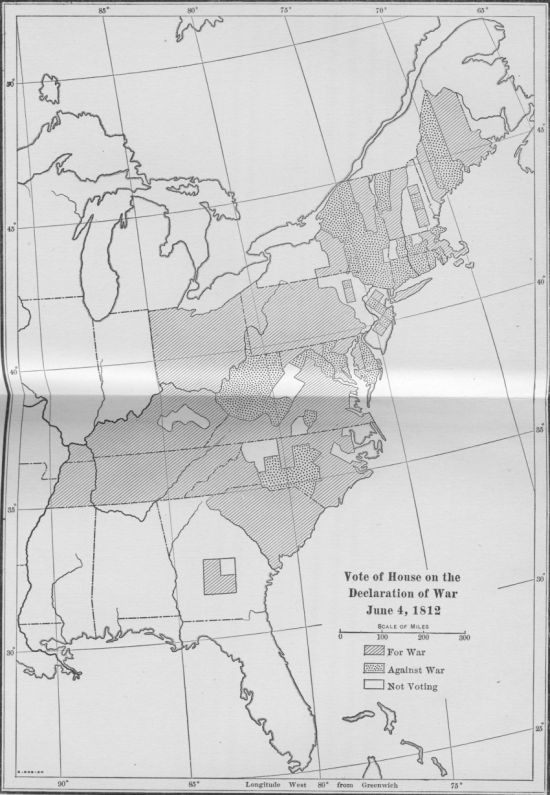
From the first the war party had fixed upon Great Britain as the object of attack. In the sober light of history, France appears to be quite as much an enemy to American commerce. But so long as the Administration maintained that Napoleon had withdrawn his decrees, and that England had not, consistency required that Great Britain should be regarded as the greater offender. Reparation had been made for the Chesapeake affair, to be sure, but no guaranties had been given that the rights of neutral vessels would be respected on the high seas. Besides, the group of young Republicans led by Clay and Grundy had looked forward to the conquest of Canada on the north and of Florida on the south as the result of war. Madison was too keen a politician not to know that he could not afford to alienate this group if he wished a second term in office. On April 1, he recommended an embargo for sixty days, and two months later, on June 1, he sent his famous war message to Congress.
In reciting the grievances of the United States, the President thrust into the foreground "the continued practice of violating the American flag on the great highway of nations, and of seizing and carrying off persons sailing under it." No one could deny that these were real grievances, but they had not been pressed in recent negotiations as a possible cause of war. A second grievance was the blockade of American ports by British cruisers. "They hover over and harass our entering and departing commerce," said the President. "To the most insulting pretentions they have added the most lawless proceedings in our very harbors; and have wantonly spilt American blood within the sanctuary of our territorial jurisdiction." This grievance was also real, but not of recent date. When the President alluded to "pretended blockades" under which "our commerce has been plundered in every sea," he touched upon outrages which were still fresh in the minds of all. "Not content with these occasional expedients for laying waste our neutral trade," continued the message, "the Cabinet of Great Britain resorted, at length, to the sweeping system of blockades, under the name of Orders in Council." Finally, the President did not refrain from the plain intimation that the Indian hostilities on the frontier were due to the influence of British traders and British garrisons.
Three days later the House of Representatives passed a bill declaring war by a vote of 79 to 49. The opposition came largely from the Northeast. The representatives from Connecticut and Rhode Island were to a man against war, and they were supported by Federalists from Massachusetts, New York, New Jersey, Maryland, and Delaware. In the Senate the vote stood 19 for war and 13 against it. "Except Pennsylvania, the entire representation of no Northern State declared itself for the war; except Kentucky, every State south of the Potomac and Ohio voted for the declaration."
While Congress was debating the alternatives of peace or war, the British Government took a step which under modern conditions would have averted hostilities. Taking advantage of a decree of Napoleon dating from 1810, which declared his edicts revoked so far as American vessels were concerned, the Ministry announced on June 23 that the British orders would be withdrawn. But just five days earlier, President Madison had proclaimed a state of war between the United States and Great Britain.
BIBLIOGRAPHICAL NOTE
A brief account of the events which formed the prelude to the War of 1812 may be found in K. C. Babcock, The Rise of American Nationality (in The American Nation, vol. 13, 1906). The diplomatic and military antecedents of the war are set forth at greater length in A. T. Mahan, Sea Power in its Relation to the War of 1812 (2 vols., 1905). Biographies contribute much that is of interest. Carl Schurz, Henry Clay (2 vols., 1887), is one of the best. J. T. Morse, John Quincy Adams (1882), and Edmund Quincy, Life of Josiah Quincy of Massachusetts (1867), also contain interesting information. M. P. Follett, The Speaker of the House of Representatives (1896); Edward Stanwood, History of the Presidency (1898); and M. L. Hinsdale, History of the President's Cabinet (1911), touch upon important aspects of politics. The volume entitled Memoirs and Letters of Dolly Madison (1886) gives many charming glimpses of social life at the capital. The discomforts and hazards of travel in the West are described with great vivacity by Margaret Van Horn, A Journey to Ohio in 1810 (1912).
CHAPTER XII
THE WAR OF 1812
When hostilities began in North America, the war establishment of the United States stood officially at 36,700 men. Actually the army consisted of ten regiments with ranks half filled, scattered in garrisons from Mackinac to Lake Champlain,—a force of less than 10,000 men, of whom 4000 were raw recruits. The staff was made up of old and incompetent officers; and from a military point of view the new appointments left much to be desired. The navy which was to contest the supremacy of the seas with the victor at Trafalgar consisted of twelve sea-going vessels and some two hundred gunboats, which were useless except for coast defense. There was bitter truth in the manifesto issued by the Federalist members of Congress when it said: "Our enemy is the greatest maritime power that has ever been on earth, and to her we offer the most tempting prizes. Our merchantmen are on every sea. Our rich cities lie along the Atlantic seaboard close to the water's edge. And to defend these from the cruisers of Great Britain we are to have an army of raw recruits yet to be raised and a navy of gunboats now stranded on the beaches and frigates that have long been rotting in the slime of the Potomac."
The worst aspect of the war was its sectional character. New England was in opposition. From the outset the activity of the National Administration was weakened by the indubitable fact that the United States, as the Federalists were never tired of repeating, began the war "as a divided people." When General Dearborn made requisition upon the governors of Massachusetts and Connecticut for militia to defend the coast, Governor Strong ignored the summons. Pressed for a reply, he finally stated to the Secretary of War that the judges of the Supreme Court of Massachusetts had advised him that the commanders-in-chief of the militia in the several States, rather than the President, had the right to determine whether any of the exigencies contemplated by the Constitution existed so as to require them to place the militia in the service of the United States. The judges also advised the governor that the militia, when in the service of the United States, could not lawfully be commanded by any federal officers below the President, but only by state officers. The general assembly of Connecticut sustained Governor Griswold in a similar attitude toward the federal authorities, holding that the war was an offensive war to which the provisions of the Constitution respecting the militia did not apply.
From the first the war-hawks had cried, "On to Canada," for their hope of conquest was undisguised. "Agrarian cupidity," declared Randolph, "not maritime right, urges the war. Ever since the report of the Committee on Foreign Relations came into the House, we have heard but one word,—like the whippoorwill, but one eternal monotonous tone,—Canada, Canada, Canada!" Military considerations, however, probably determined the campaign of 1812,—so far, indeed, as any well-considered plans were worked out. A general advance was to be made along the route by Lake Champlain to Montreal. Three expeditions were also to be sent against Sackett's Harbor, Niagara, and Malden. All were strategic points on the Lakes; but Malden was particularly important as the center of British influence among the Indians of the Northwest.
The expedition against Malden, which was entrusted to General William Hull, not only failed to accomplish its purpose, but terminated in the most humiliating reverse of the war. For reasons that have never been adequately explained, Hull laid siege to Malden instead of attacking it at once with his superior force; and when British reënforcements appeared, he not only abandoned the siege, but on August 15, surrendered Fort Detroit without firing a shot. The army, the fort, and the undisputed control of the Michigan country passed into the hands of the British. On the same day occurred the surrender of Fort Dearborn and the massacre of its garrison by the Indians.
The other military operations on the northern frontier were scarcely less inglorious. The failure of the attack upon Queenston, October 13, was due largely to the incompetence of the commanding general. Nowhere did the American troops pierce the Niagara or Lake Champlain frontier. The Duke of Wellington was well within the truth when he declared the American campaign of 1812 "beneath criticism."
The smart of these humiliating failures was only relieved by the series of stirring naval victories which began with the duel between the Constitution and the Guerrière. The frigates met on August 19, some three hundred miles off Cape Race. "In less than thirty minutes from the time we got alongside of the enemy," reported Captain Hull of the Constitution, "she was left without a spar standing, and the hull cut to pieces in such a manner as to make it difficult to keep her above water." The effect of this victory was electric. When the Constitution reached Boston Harbor, even Federalists broke into exultation. The cry in every New England home was, "Thank God for Hull's victory!" Nothing could have been better timed and more dramatic. The papers which announced the humiliating surrender of General Hull contained the news of his nephew's victory.
If the victory of the Constitution was won on unequal terms,—the Guerrière was undoubtedly inferior,—the British Admiralty could not excuse a second naval defeat on this score. On October 17, the American sloop-of-war Wasp encountered the brig Frolic convoying merchantmen six hundred miles east of Norfolk. There was little to choose between the vessels either in size or equipment, yet the marksmanship of the American gunners was so far superior that in forty-three minutes the crew of the Wasp had boarded the Frolic. Not even the subsequent capture of both vessels by a British ship-of-the-line could dim the glory of this victory. A week later the frigate United States under Captain Decatur captured the Macedonia and brought her into New London—"the only British frigate ever brought as a prize into an American port." In December the Constitution, now commanded by Captain Bainbridge, added to her laurels by overpowering the powerful frigate Java.
The effect of these disasters upon the British public was out of all proportion to the actual value of the vessels lost. Canning afterward declared that the loss of the Guerrière and the Macedonia produced a sensation scarcely to be equaled by the most violent convulsion of nature. "The sacred spell of the invincibility of the British navy was broken by those unfortunate captures."
In the midst of the war occurred a presidential election. Madison had been the unanimous choice of the congressional caucus held in May; but only eighty-three out of one hundred and thirty-three Republicans had attended, and the discontent of New York Republicans was well known. The nomination of De Witt Clinton by the New York legislative caucus opened wide the breach in the party. In September a convention of Federalists repeated the error of 1804 and indorsed Clinton's nomination, naming as his partner Jared Ingersoll, of Pennsylvania. Elbridge Gerry, of Massachusetts, was finally nominated for Vice-President by the Republicans. The alternatives presented to the people seemed to be Madison and continued war ineffectively conducted, or Clinton and still more humiliating peace. New York, New Jersey, Delaware, and all the New England States but Vermont, preferred Clinton. The South and West supported Madison; but without the vote of Pennsylvania Madison would have been defeated.
To retrieve Hull's disaster, General William Henry Harrison, the hero of Tippecanoe, was placed in command of the Western army in the fall of 1812; but a succession of mishaps overtook his expedition into the Northwest. He not only failed to reach Detroit, but lost most of his available troops by disease, desertion, and the onset of British detachments from Fort Malden.
It was now clear that the control of the Lakes was indispensable for a successful invasion of Canada. At the close of the year 1812, there was not a war-vessel flying the American flag on Lake Erie. To create a fleet was the task set for Oliver Hazard Perry, a young naval officer, who was sent from Newport to Presqu' Isle. Of the needful supplies only timber was abundant; the rest had to be brought overland from Philadelphia by way of Pittsburg. Surmounting all obstacles, nevertheless, the energetic Perry finally got together a flotilla of vessels which was quite equal to the British squadron. The two fleets met in battle off Sandusky on September 10, 1813. The American boat Lawrence, Perry's flagship, was obliged to strike her colors, but Perry boarded another vessel of his fleet and succeeded in turning defeat into a brilliant victory. "We have met the enemy and they are ours," was his triumphant dispatch to General Harrison.
The way was now open to the invasion of Canada. Under the protection of Perry's fleet, Harrison was able to transport his army to the Canadian shore below Fort Malden. The British troops were already in full retreat. On October 5, 1813, the American army overtook them and in a short but decisive battle on the river Thames revenged the loss of Detroit. Among the dead on the British side was found the body of Tecumseh. In point of numbers, the battle of the Thames is insignificant; but it has an important place in the annals of the war because it destroyed the British military power in the Northwest and recovered control of the Michigan Territory.
No such success attended the movement of American troops on the Niagara and St. Lawrence frontier. The control of Lake Ontario was in doubt throughout the year 1813. The military operations, first under Dearborn, and then under Wilkinson and Hampton, were indecisive. Indeed, the events of the year served only one good purpose: they revealed the incompetence of the older generals and the ability of the younger officers.
The loss of the Chesapeake in a duel with the Shannon, on June 1, 1813, outside of Boston Harbor, left the United States with an available sea-going navy of just two frigates and a few small sloops. All the other frigates were shut up in various ports by the British blockade, which extended from Cape Cod to Florida. The burden of offense during the rest of the war fell upon privateers. During the war more than five hundred fitted out in American ports. In the year 1813 they took over three hundred prizes, while the frigates took but seventy-nine. While British cruisers were blockading the coast of the United States, these craft, with their beautiful lines and wonderful spread of canvas, carried consternation to all British shippers in the English Channel and in the Irish Sea. They "seize prizes in sight of those that should afford protection," complained the London Times, "and if pursued put on their sea-wings and laugh at the clumsy English pursuers." No exploits of the regular navy contributed so much to dispose the British governing class to peace as the depredations of these privateers.
In the remote Southwest, the war assumed a different character. There the enemy on the border was not Great Britain but Spain. The people of the Carolinas and Georgia fully expected to acquire the Floridas while the North was wresting Canada from British control. Had President Madison been given his way, this wish would have been gratified; but Congress refused to countenance the seizure of East Florida, and in May, 1813, Madison very reluctantly ordered the troops to evacuate Amelia Island. No scruples deterred Congress from authorizing the occupation of West Florida. In the spring of 1813, General Wilkinson forced the surrender of the only Spanish fort on Mobile Bay and took possession of the country as far as the Perdido—"the only permanent gain of territory made during the war."
During the first year of the war the younger warriors of the Western Creeks, in what is now Alabama, had been incited to hostilities by Tecumseh, and in the following spring began depredations which culminated in the capture of Fort Mims and the massacre of its inhabitants on August 30, 1813. The horrors of an Indian war brought every able-bodied settler in the adjoining States to arms. Before the end of the year seven thousand whites had invaded the Indian territory and had killed about one fifth of the Creek warriors. The hero of the war was General Andrew Jackson, who at the head of an army of Tennessee militiamen won a decisive battle at Horseshoe Bend on the Tallapoosa River. On August 9, 1814, he forced the chieftains who had not fled across the Florida border to sign a treaty of capitulation at Fort Jackson and to cede nearly two thirds of their lands in southern Georgia and in what afterward became central Alabama. This phase of the war opened up a vast territory to settlement and made the military reputation of Andrew Jackson.
Operations on the Niagara frontier were resumed by the American troops in 1814; but they were now directed by one of the new major-generals, Jacob Brown, who infused a new spirit into his soldiers. On July 5, General Winfield Scott's brigade won a signal victory at Chippewa. Three weeks later, on July 25, the entire army fought a desperate battle at Lundy's Lane, which lasted from sunset to midnight. The Americans claimed a victory, but the losses were about even and the British remained in possession of the field. At the close of the year, despite the valiant fighting of Brown's army, the situation on the Niagara had not changed materially. The invasion of Canada and a peace dictated from Quebec seemed as remote as ever.
The British plans for the campaign of 1814 called for "a diversion on the coasts of the United States, in favor of the army employed in the defense of Upper and Lower Canada." For the first time since the opening of hostilities, British military authorities could concentrate their attention on the war in North America. The defeat of Napoleon on the plains of Leipzig had thrown his shattered columns back upon France. Thither the allied armies had followed him and forced his capitulation. With the end of European wars in sight, Wellington could release his veteran troops for service in America. In early summer eleven thousand seasoned troops were sent to Canada. Four thousand more were dispatched under Major-General Ross, of the Peninsular army, to coöperate with the navy under Admiral Cochrane on the shores of Chesapeake Bay. Later in the year Major-General Pakenham, also a veteran of the Peninsular campaign, was sent with ten thousand troops to seize the mouth of the Mississippi and to force the capitulation of the West by closing the ports on the Gulf.
Those whose memories went back thirty-seven years may well have recalled Burgoyne's expedition, for it was by the old Lake Champlain route that Sir George Prevost began his invasion of New York in September, 1814. His objective was Plattsburg, where an American army of not more than two thousand men was stationed. Accompanying his army, to insure its line of communication with Canada, was a fleet consisting of a frigate, a brig, and a dozen smaller vessels. To this fleet, Captain Thomas Macdonough could oppose only a corvette and a dozen small craft. The fleets met in a battle for the control of the lake on September 11. The resourcefulness of the young American officer saved the day. By winding his corvette, the Saratoga, about, so as to bring her unused guns to bear just when the fight seemed lost, he forced the formidable Confiance to strike her colors. The surrender of the smaller British boats followed. The battle of Plattsburg was decisive of the invasion. Fearing greater disasters if he pressed on without the control of the waterway at his rear, Prevost at once ordered a retreat.
The expedition directed toward Chesapeake Bay was well under way before Prevost's ill-starred invasion began. On August 19, General Ross landed his forces on the banks of Patuxent River, within striking distance of Washington. Marching leisurely across country toward the capital, the British finally met at Bladensburg a motley array of some seven thousand Americans, hastily summoned from the countryside. What followed is not easily described. Some show of resistance was made by the marines from the American gunboats in the Patuxent; but for the most part the Americans were seized with a panic and fled in wild disorder. The President and his Cabinet took to the Virginia woods, leaving the enemy to wreak their vengeance on the government buildings. Having fired the Capitol, the White House, and other edifices, the British forces returned to their fleet and reëmbarked. The historian can take no pleasure in dwelling upon details which are discreditable to all concerned; for if the British committed acts of vandalism, the Americans had provoked retaliation when they burned the parliament houses at York in the campaign of 1813.
An attack upon Baltimore which might have resulted in further outrages was frustrated by the measures of defense which the government of the city had already wisely undertaken. After a skirmish in which General Ross was killed, and an ineffective bombardment of the harbor defenses, the British withdrew.
A visitor to the national capital after its capture described the President as "miserably shattered and woe-begone," and heart-broken at the defection of New England. To prosecute the war, money and men were needed; but both were wanting. The Administration hoped, but hoped in vain, that the victories at Chippewa, Lundy's Lane, and Plattsburg would stimulate enlistments; but recruits were not likely to be lured by promises which every one knew the Government could not redeem. It became clearer every day that unless Congress was disposed to adopt Monroe's plan of conscription, the National Government would have to put its dependence upon state armies. In September, after Castine and the eastern part of Maine to the Penobscot had been occupied by the British, Governor Strong consented to call out the militia of Massachusetts, but he was careful to place the troops under the command of state officers. At the same time he made inquiry of the Secretary of War whether the expenses of the militia would be assumed by the National Government. Monroe replied rather sharply that so long as Massachusetts refused to put her troops under the command of national officers, she need not expect the United States to maintain them. The Governor of Connecticut had already withdrawn the militia of that State from national service. At the moment when Prevost was beginning his invasion, the Governor of Vermont declined to call out the state militia because he doubted his authority to order the militia out of the State. The Union seemed on the point of disintegrating into its original elements.
The anxieties of the Administration were further increased by the action of the Massachusetts General Court, which called a convention of those States "the affinity of whose interests is closest," with the avowed purpose of devising some mode of common defense and of securing a convention of delegates from all the States to revise the National Constitution. In spite of vigorous opposition, delegates were chosen, to meet on December 15 with "such as may be chosen by any or all of the other New England States." The legislatures of Connecticut and Rhode Island responded promptly; but the legislature of Vermont unanimously declined the invitation, and New Hampshire failed to reply. The movement seemed all the more ominous after the fall elections, which resulted in the choice of thirty-nine Federalist Congressmen from New England and of only two Republicans. In the preceding Congress there had been thirty Federalists and eleven Republicans.
That members of the Essex Junto would gladly have seized this opportunity to remake the Federal Union by excluding the Western States appears clearly enough in the correspondence of men like Timothy Pickering. A new Union of the "good old thirteen States" on terms set by New England was believed to be well within the bounds of possibility. Radical newspapers referred with enthusiasm to the erection of a new federal edifice. Little wonder that the harassed President was obsessed with the idea that New England was on the verge of secession.
From the first, however, this movement in New England was kept well in hand by men like Harrison Gray Otis, who always insisted that the object of a convention was to defend New England against the common enemy and to prevent radical action under the stress of popular excitement. If this be true, it was unfortunate, to say the least, that these patriots chose just this moment, when the Federal Government was about to succumb to the common enemy, to propose alterations in the Constitution; and it was equally unfortunate for the reputations of all concerned that they should have held their deliberations in secret, giving an air of conspiracy to their proceedings. The official journal of the Convention at Hartford was not published until 1823. When the Convention adjourned on January 5, 1815, all that the general public was permitted to know of its deliberations was contained in its famous report.
The Convention was at no little pains to reassure a waiting world that it did not contemplate or countenance secession. It was not yet ready to concede that the defects in the Constitution were incurable nor that multiplied abuses justified a severance of the Union, "especially in a time of war." "If the Union be destined to dissolution, ... it should, if possible, be the work of peaceable times, and deliberate consent." But these philosophical considerations did not deter the author of the report from a vicious and partisan attack upon "the multiplied abuses of bad administrations."
President Madison must have read this document with mingled feelings, for the Convention held, almost in the words of his Resolutions of 1798, that the infractions of the Constitution were so "deliberate, dangerous, and palpable" as to put the liberties of the people in jeopardy and to make it the duty of a State "to interpose its authority for their protection." The legislatures of the several States were recommended to adopt measures for protecting their citizens against all unconstitutional acts of Congress which should subject the militia or other citizens to forcible drafts, conscriptions, or impressments. They were also urged to apply to the Federal Government for consent to some arrangement whereby the States, separately or in concert, could undertake their own defense and retain a reasonable proportion of the national taxes for the purpose. Finally, seven amendments to the Constitution were proposed, to prevent a recurrence of the grievances from which the New England States suffered. Four of these proposed amendments put limitations upon Congress: a two-thirds vote of both houses was to be required to admit a new State, to interdict commerce, to lay an embargo, and to declare war. In future, representation and direct taxes were to be apportioned according to the respective numbers of free persons. Naturalized citizens were to be excluded from all federal civil offices; and finally—a blow at the Virginia dynasty—"the same person shall not be elected President of the United States a second time; nor shall the President be elected from the same State two terms in succession."
The General Court of Massachusetts acted promptly. Three commissioners were dispatched at once to Washington, to work out an amicable arrangement for the defense of the State. On February 3, 1815, the "three ambassadors," as they styled themselves, set out for the capital. Ten days later, en route, they learned that General Andrew Jackson had decisively repulsed an attack of the British upon New Orleans on January 8. On reaching Washington the commissioners were met with the news that a treaty of peace had been signed at Ghent. Their cause had met with the most unlucky fate which can befall any cause in the United States: it had become ridiculous. The tension of war-times relaxed in a roar of laughter at their expense.
Early in the year 1813, Russia had endeavored to mediate between her ally and the United States. President Madison had at once, and as it appeared somewhat precipitately, sent Albert Gallatin and James A. Bayard as peace commissioners to St. Petersburg; but Great Britain declined the Czar's good offices. The American envoys, however, remained in Europe. When, then, in October, the British Ministry intimated that it was prepared to begin direct negotiations, President Madison created a new commission by sending John Quincy Adams, Henry Clay, and Jonathan Russell to join Gallatin and Bayard. In the last week in June, the commissioners repaired to Ghent, which had been chosen as the place of meeting. Thither the British negotiators followed them in leisurely fashion. The first joint conference was not held until August 8, 1814.
The task of the American commissioners was one of very great difficulty. Confronted by the unexpected demand that the revision of the Canadian boundary, the fisheries, and the establishment of an Indian state in the Northwest should be included in the pourparler, they could only reply that they had been instructed to discuss only matters of maritime law—impressments, blockades, and neutral rights. There seemed so little likelihood of agreement that the American commissioners prepared to leave Ghent. But the British Ministry abated its extreme demands and continued the negotiations. At the same time new instructions from Washington advised the American representatives that they might drop the subject of impressments if they found it an insuperable obstacle in the way of peace.
The insistence of the British agents upon the principle of uti possidetis—the state of possession at the close of the war—again threatened to break off negotiations, for the Americans resolutely insisted on the status quo ante bellum, a restoration of all places taken during the war. It was at this juncture that tidings arrived of the British repulse at Plattsburg. For a week the British Ministry debated the feasibility of renewing the war; but the complications at the Congress of Vienna, the "prodigious expense" of continued war, the change in public opinion, and the emphatic conviction of Wellington that the Ministry had "no right from the state of the war to demand any cession of territory"—these and many lesser considerations disposed the Cabinet to ask the American envoys to prepare a draft of a treaty.
Strong differences of opinion developed among the Americans when they set to work upon their preliminary draft. As the representative of Western interests, Clay set himself obstinately against any further recognition of the British right—secured by the treaty of 1783—of free navigation of the Mississippi. Adams was equally determined not to sacrifice the correlative right to the Labrador and Newfoundland fisheries, which his father had secured in the Treaty of Paris. Gallatin, the peacemaker, was in favor of offering to renew both privileges; and he finally succeeded in winning Clay's reluctant assent to this plan. But when the British commissioners objected, both sides agreed to omit all reference to these vexing questions.
The treaty which was signed on December 24, 1814, is remarkable for its omissions. The reader will scan it in vain for any allusion to impressments, blockades, and neutral rights. It is equally silent as to the control of the Lakes, Indian territories, the fisheries, and the navigation of the Mississippi. It was "simply a cessation of hostilities, leaving every claim on either side open for future settlement." Clay probably reflected the disappointment of Republicans when he pronounced it "a damned bad treaty." Nevertheless, it brought what was most desired by the exhausted Administration—peace. Moreover, the treaty must be viewed in the light of events in Europe. The overthrow of the Napoleonic Empire and the exile of Bonaparte gave promise of a return to normal conditions so far as maritime rights were concerned. The victories of American seamen in the war were after all better guaranties of neutral rights than any declarations on parchment.
BIBLIOGRAPHICAL NOTE
Besides the larger histories, which contain abundant information about the war, mention should be made of B. J. Lossing's Pictorial Field-Book of the War of 1812 (1868), written by one who visited most of the battlefields of the war. A well-balanced account of the military operations is contained in K. C. Babcock's The Rise of American Nationality (in The American Nation, vol. XIII, 1906). Theodore Roosevelt, The Naval War of 1812 (various editions); E. S. Maclay, History of the United States Navy from 1775 to 1901 (3 vols., 1901-02), and History of American Privateers (1899); J. R. Spears, History of Our Navy (4 vols., 1897); and C. O. Paullin, Commodore John Rodgers (1910), give the history of the maritime war. The most comprehensive study of the naval operations of the war is the work by Admiral Mahan already cited. The part of Jackson in the war is set forth in many biographies. The most picturesque is James Parton, Life of Andrew Jackson (3 vols., 1860); the most recent is J. S. Bassett, Life of Andrew Jackson (2 vols., 1911). S. E. Morison, Life and Letters of Harrison Gray Otis (2 vols., 1913), gives a fresh account of the disaffection in New England and of the Hartford Convention. The peace negotiations at Ghent are set forth circumstantially by Henry Adams in his History of the United States (9 vols., 1889-91).
CHAPTER XIII
THE RESULTS OF THE WAR
In a message to Congress transmitting the treaty of peace, President Madison congratulated the country on the termination of a war "waged with a success which is the natural result of the wisdom of the legislative councils, of the patriotism of the people, of the public spirit of the militia, and of the valor of the military and naval forces of the country." The verdict of history does not sustain this pæan of victory. "The record, upon the whole," declares Admiral Mahan, "is one of gloom, disaster, and governmental incompetence, resulting from lack of national preparation, due to the obstinate and blind prepossessions of the Government, and, in part, of the people." Public opinion indorsed the President's estimate of the late struggle.
As a matter of fact, the people of the United States had seen little of the disasters and ravages of war. All the important battles took place on the borders. The great mass of the people were undisturbed in their vocations. There was hardly a day during the war when a farmer could not till his acres in tranquillity. Not an important city save Washington was taken during the war. Nor was the loss of life large in proportion to population. All told, the killed and wounded did not exceed five thousand men. Napoleon lost nearly two hundred thousand French soldiers in his disastrous Russian campaign.
American character appeared at its best and at its worst in these three years of war. Even the British press could not gainsay the resourcefulness and intelligence of the American soldier and sailor, though the phrase "Yankee smartness" conveyed also the unpleasant imputation of trickiness and moral laxity. Wherever conditions permitted a fair test, the superiority of the American gunner was incontestable. The greater losses of the British whenever the armies met on even terms proved the superior marksmanship of the American militiaman. The adaptation of the fast-sailing schooner to privateering was further evidence of an alert intellect which was quick to adapt means to ends. This quality, to be sure, has been bred in every frontier folk by the very necessities of existence, but it appeared in marked strength in the American of this time. While the shipbuilders of New England were laying the keels of these privateers, Robert Fulton was perfecting his steamboat on the Delaware and Hudson rivers. In the year before the war, the first steamboat appeared on the Ohio, and before the end of the war fourteen were plying on Western waters, and opening up a new era in the American colonization of the continent.
This instinctive adaptation of means to ends was less successful in the realm of American politics. No celerity could compensate for want of prevision on the part of the authorities at Washington. The lesson of the war was not lost upon James Madison, at least. "Experience has taught us," said he in a message to Congress,—and the words amounted to a confession of error,—"that neither the pacific dispositions of the American people nor the pacific character of their political institutions, can altogether exempt them from that strife which appears, beyond the ordinary lot of nations, to be incident to the actual period of the world; and the same faithful monitor demonstrates that a certain degree of preparation for war is not only indispensable to avert disaster in the onset, but affords also the best security for the continuance of peace."
The indirect effects of war were more widely felt. The blockade affected adversely all the extractive industries upon which the vast majority of the people in all the States depended. Only New England escaped unscathed—and the circumstance was not creditable to the section. In the latter months of 1814 ruin stared the Southern planter in the face. The lifting of the blockade wrought a transformation. Planters in the Old Dominion, who could find no market for their tobacco and wheat on February 13, sold their produce on February 14 at prices which made them rich again. Flour which had found almost no purchasers at seven and a half dollars a barrel sold readily at ten. Imported commodities fell in price correspondingly. Ships put to sea at once laden with the accumulated produce of two long years. The export trade, which had fallen to less than $7,000,000, leaped to $46,000,000 between March and October. Fully two thirds of this wealth accrued to the Southern planters who raised the three great staples, tobacco, cotton, and rice. The people of the Middle States shared only moderately in this prosperity. The value of the wheat and corn which the farmers of Pennsylvania, New York, and New Jersey raised for export did not much exceed that of tobacco alone.
The return of peace brought relief also to the shipping industry of New England. Vessels which the embargo and the restrictive policy and the hazards of war had kept in port now put to sea again. But the European conditions which had created such immense profits for the Yankee skipper in 1805, 1806, and 1807 had passed away. Foreign ships now bid for the carrying trade of the Atlantic, and their competition cut down freight rates to a point which caused melancholy forebodings in the homes of Boston and Salem shipowners.
The long period of commercial restriction followed by three years of war caused a dislocation of industry in New England. Capital which had been invested in shipping now sought larger returns in the manufacture of those commodities hitherto supplied by British factories. When the embargo was laid, only fifteen cotton mills were in operation, representing a capital of about $500,000. Two years later, capital to the amount of $4,000,000 had been invested in factories which employed nearly 4000 hands. At the close of the war, $40,000,000 were invested in cotton mills which consumed 27,000,000 pounds of raw cotton and gave employment to 100,000 men and women. Hitherto much of the weaving had been done on hand looms in the farmhouses of New England: only the spinning had been done by machinery. In 1814, Francis Lowell introduced the power loom into his mill at Waltham, Massachusetts, and brought the various processes of cotton manufacturing under one roof. The foundation of the New England factory system was thus laid before the end of the war. In the following decade the famous factory towns on the Merrimac came into existence. The metamorphosis of the section had begun.
The woolen industry received a great impetus in this same period of artificial stimulation, but it failed to expand with the same rapidity, owing to the scarcity and cost of the finer grades of wool. Nevertheless, in the year 1816, about $12,000,000 were invested in the manufacture of woolen fabrics. Like the cotton industry, this owed its development to the policy of Presidents from Virginia. It is one of the ironies of history that Jefferson and Madison should have unwittingly sacrificed Southern planters to build up industries in the North, and that New Englanders should have excoriated those worthies for policies which became the source of New England prosperity.
To these new industries peace spelled disaster. English manufacturers seized the opportunity to unload the goods which they had been piling up in their warehouses for years. Importations which had amounted to $13,000,000 in 1813 rose to the staggering sum of $147,000,000 in 1816. Not even import duties stemmed the tide, for as Lord Brougham stated in Parliament, "It was well worth while to incur a loss upon the first exportation, in order, by a glut, to stifle in the cradle those rising manufactures in the United States which the war had forced into existence, contrary to the natural course of things."
In October, 1815, the cotton manufacturers of Rhode Island sent a memorial to Congress, stating that their one hundred and forty factories were threatened with destruction by this cut-throat competition. Such complaints seemed unduly apprehensive; yet before the year closed, most of the textile mills had shut down. The distress of New England was no longer feigned. Caught in a process of transition from shipping to manufacturing, capital could neither advance nor retreat. It was a legitimate case for governmental aid. Even Jefferson laid aside his early prepossessions in favor of a simple bucolic life for the American citizen, and admitted that "to be independent for the comforts of life, we must fabricate them for ourselves. We must now place the manufacturer by the side of the agriculturist." Madison, too, departed from the Virginia faith so far as to recommend sufficient protection of "the enterprising citizens whose interests are now at stake" to guard them "against occasional competition from abroad."
Within sight of the blackened walls of the Capitol, in temporary quarters which it had rented, Congress set its hand to the work of national reconstruction. Before many months had passed, the new Capitol, under the supervision of Latrobe, began to rise from the ruins of the old, a symbol of a new era. On the walls of the rotunda, John Trumbull painted scenes which were to remind coming generations of the heroic days of the Revolution, and within its confines was eventually installed what was left of the library of Congress, with the gaps supplied in part by Jefferson's private collection, which Congress purchased. The new nation was not to disdain wholly the finer aspects of life nor to despise the garnered wisdom of the ages.
In March, 1816, Congress took under consideration a tariff bill which had been drafted on lines marked out by the new Secretary of the Treasury, A. J. Dallas, of Pennsylvania. The debates brought out a wide diversity of interests. Daniel Webster represented admirably the mingled feelings of his New England constituents when he professed to favor existing manufactures, but deprecated any action calculated to produce new industries. He never wished to see the time when the young men of the country would be forced to close their eyes to heaven and earth, and open them in the dust and smoke of unwholesome factories. On the other hand, Calhoun, eschewing a narrow sectionalism, declared that manufacturing must be encouraged as a wise national policy. "Neither agriculture, manufactures, nor commerce, taken separately, is the cause of wealth," said he. "It flows from the three combined and cannot exist without each." The South showed little of the apprehension which John Randolph expressed when he cried, "Upon whom bears the duty on coarse woolens and linens and blankets, upon salt, and all the necessaries of life?" and answered, "On poor men, and on slaveholders."
The bill which Congress eventually passed fixed somewhat lower duties than Dallas had advised. A duty of twenty-five per cent was placed on cotton and woolen goods until June 30, 1819, when it was to be reduced to twenty per cent. By what was known as the minimum principle, all cotton fabrics costing less than twenty-five cents a square yard were held to have cost that amount and were made to pay corresponding duties. The object of this provision was to exclude from India the coarser and cheaper cotton textiles which would menace the products of New England looms. Other important articles were made subject to higher duties, such as rolled and hammered iron, leather goods, hats, carriages, and writing-paper. A comparison of these duties with those of the tariff of 1789 shows a marked increase. Where the average duty was seven and one half per cent in 1789, it was thirty per cent in the tariff of 1816. So far as the intent of the law is concerned, this tariff act committed the country to a fiscal policy in which "revenue was subordinated to industrial needs."
Although the largest vote against the tariff bill came from the South and Southwest, twenty-three out of fifty-seven Representatives voted for the bill. New England showed a prepondering opinion in favor of protection: only ten out of twenty-seven Representatives opposed the bill. The Representatives of the Middle States ranged themselves emphatically on the side of protection; and with them stood the Congressmen from Ohio and Kentucky.
The close of the war found the country with a badly disordered currency and with a bankrupt treasury. Nowhere were the remedial efforts of Congress needed more. The condition of the currency was due, in part at least, to the failure of Congress in 1811 to perceive the regulative influence of a national bank. By refusing to recharter the United States Bank, Congress not only deprived the Treasury of an exceedingly valuable fiscal agent during the war, but also threw the door wide open to indiscriminate and unregulated state banking. Between 1811 and 1816 the number of these state institutions increased from eighty-eight to two hundred and forty-six, all of which exercised the right of issuing notes with little or no restriction. Inflation followed inevitably. During the blockade the banks of the Middle and Southern States suffered great distress by the constant drain of specie to New England and abroad. After the capture of Washington, practically all banks outside of New England were forced to suspend specie payments. The country experienced once more all the evils of a depreciated currency. Southern bank notes were refused for deposit in Philadelphia banks. Notes of these institutions in Philadelphia, in turn, were subject to a discount of twenty-four per cent in Boston. Uncertainty and distrust demoralized financial operations everywhere.
Wiser by the experience of five years, Congress was now disposed to establish another national bank. A first bill, however, fell short of the President's desires and was vetoed. A second bill became law on April 10, 1816. The provisions of this Bank of the United States differed in several particulars from that chartered in 1790. Its capital was three and one half times as large. One fifth of the total capital of $35,000,000 was to be subscribed by the Government, and the remainder by individuals. Five of the twenty-five directors were to be appointed by the President of the United States. The funds of the Government were to be deposited in the Bank unless the Secretary of the Treasury should otherwise direct, laying his reasons for any such change before Congress. In return for the privileges granted in the charter, the Bank was required to transfer the government funds from place to place without charge, and to pay $1,500,000 to the Government. On its side the Government agreed not to charter any other bank except in the District of Columbia. The circulation of the Bank was limited to the amount of its capital. Its notes were to be payable on demand in specie and to be receivable in all payments to the Government.
Such an institution gave promise of serving the Government as a sound fiscal agent and of assisting materially in the restoration of the currency to a specie basis. The stock was subscribed promptly by 31,334 individuals, all but three thousand of whom resided in the Middle States. New England was still reluctant to support the plans of Mr. Madison; the South had other uses for its capital. To facilitate the resumption of specie payments, Congress passed a joint resolution, that after February 20 of the following year (1817), all dues to the Government should be paid in specie, treasury notes, national bank notes, or notes of banks payable in the "said currency of the United States." This was strong medicine for the state banks. Unwilling or unable to contract their circulation and to call in their loans, the banks of the Middle States asked to have the date of resumption deferred, on the ostensible ground that the new bank could not be organized in time to assist them. The energetic Secretary of the Treasury disposed of this plea by putting the Bank in operation in January, 1817. On the date set by Congress the banks very generally resumed specie payments.
The propulsive force given to the Government by the war seemed likely to continue. The task of the National Government no longer seemed merely negative,—to "restrain men from injuring one another," in the Jeffersonian phrase,—but positive and constructive. Even Madison, in his annual message of 1815, recommended liberal provision for defense, more military academies, an improved and enlarged navy, protection to manufactures, new national roads and canals, and a national university. He gave his support to Monroe's proposal to fix the peace establishment at twenty thousand men; and he experienced the unique sensation of finding himself in advance of his party, which finally agreed upon an army of ten thousand men. Still more striking evidence of the change which had passed over the party of Jefferson was its willingness to retain the entire naval establishment and to appropriate $4,000,000 for frigates and ships-of-the-line. Clay and Calhoun, speaking for the younger Republicans, agreed that the greatest danger of the future lay in weak government. They were not in the least intimidated by the addition of $80,000,000 to the national debt as the result of war. That sum represented to their minds simply the price, none too large, of commercial and industrial independence.
These young aggressive spirits seemed at times quite indifferent to nice questions of constitutional law. Calhoun dismissed constitutional objections to a national bank with a wave of the hand: he thought discussion of such abstract themes "a useless consumption of time." On introducing his bill for internal improvements, in December, 1816, he intimated that he did not propose to indulge in metaphysical subtleties respecting the Constitution. "The instrument was not intended as a thesis for the logician to exercise his ingenuity on; ... it ought to be construed with plain good sense." If Clay exhibited more sensitiveness to constitutional limitations, it was because he had to clear himself from the charge of inconsistency. In supporting the Bank Bill in 1816 he frankly confessed that he had changed his mind on the point of constitutionality. He had believed the incorporation of a bank in 1811 unwarranted by the Constitution; but conditions had changed. What was then neither necessary nor proper was now both necessary and proper. The interpretation of the Constitution must always take existing circumstances into account. If Clay did not add to his reputation as an expounder of the Constitution by this speech, he represented admirably, nevertheless, the changes which circumstances had wrought in the convictions of his associates.
Against these new tendencies John Randolph set himself stark and grim. "The question is," said he, replying to Calhoun's new nationalism, "whether or not we are willing to become one great consolidated nation, or whether we have still respect enough for those old, respectable institutions [the States] to regard their integrity and preservation as a part of our policy." Randolph spoke for a generation which was passing away; but his words touched a responsive chord in the breast of President Madison. On March 3, 1817, as he was about to leave office, he sent to Congress a message vetoing the Internal Improvements Bill and warning his party associates of the danger of latitudinarian views of the Constitution. This message was Madison's farewell address. It was thoroughly characteristic of the man and the statesman.
The relaxing of Republican doctrines, and of party ties generally, divested the presidential election of any real political significance. The Federalists were thoroughly discredited. As a party they made no concerted effort to nominate candidates. Virtually, therefore, the selection of a President rested with the congressional caucus of the Republican party. The choice lay between two members of the President's Cabinet: James Monroe, Secretary of State, and William H. Crawford, Secretary of the Treasury. Governor Tompkins, of New York, was put forward by enthusiastic partisans from that State, but he was not a national figure in any sense and commanded no support outside of his State. Intrigue played a part in this caucus, if contemporary testimony may be believed. Tradition has it that Martin Van Buren and Peter B. Porter prevented their New York delegation from voting for Crawford and thus threw the nomination to Monroe. Governor Tompkins was the choice of the caucus for Vice-President. No one could safely affirm that these nominees were the choice of the rank and file of the party. Here and there public meetings were held to protest against the dictation of the congressional caucus; but no organized opposition developed. The campaign proved to be a tame affair. Nowhere was there a real contest. Only three States, Massachusetts, Connecticut, and Delaware, chose Federalist electors. Not a ripple of excitement stirred the public when announcement was finally made that Monroe had received 183 electoral votes and Rufus King, 34. For the fourth time a Virginian had been raised to the Presidency.
BIBLIOGRAPHICAL NOTE
Of the general histories, only that by McMaster contains any great amount of information bearing on the economic changes wrought by war and the preceding period of commercial restriction. Adams summarizes the economic results of war in a single chapter in the last volume of his work. K. C. Babcock, The Rise of American Nationality (in The American Nation, vol. 13, 1906), attempts the same task. Besides the manuals on economic history which have already been mentioned, there are several excellent volumes dealing with various phases of national life: such as, D. R. Dewey, Financial History of the United States (1903); F. W. Taussig, Tariff History of the United Stales (rev. ed., 1913); R. C. H. Catterall, The Second Bank of the United Stales (1903); J. L. Bishop, History of American Manufactures from 1608-1860 (2 vols., 1861-64); C. W. Wright, Wool-Growing and the Tariff (1910). Among the biographies of statesmen of the new generation, the best are: G. T. Curtis, Life of Daniel Webster (2 vols., 1869); W. W. Story, Life and Letters of Joseph Story (2 vols., 1851); G. Hunt, John C. Calhoun (1908).
CHAPTER XIV
THE WESTWARD MOVEMENT
At the end of the second decade of the nineteenth century, the people of the United States were still in the main a homogeneous folk, native-born descendants of native-born ancestors. The tide of immigration which was by the end of the century to inundate the nation and transform its character was just beginning to flow. Its volume between the close of the Revolution and the year 1820, when the first official statistics were collected, must remain a matter of conjecture. In 1817, the painstaking Niles, in his Register, estimated that about twenty-two thousand immigrants had arrived in that year in the ports of New York, Philadelphia, and Boston, of whom four thousand were Germans and the rest inhabitants of the British Isles. Fully one half of these British subjects were brawny Irishmen, often a turbulent lot, but always in demand for hard labor on the roads and canals which were projected in every part of the Union. Among these newcomers, however, were many undesirables. Not a few English parishes emptied their poorhouses by sending the helpless inmates to the New World. Some of these deported paupers, no doubt, found a livelihood and became respectable citizens; but the records of almshouses in the Eastern States indicate that many of these unfortunates had only exchanged one asylum for another. In the Philadelphia poorhouses in the early thirties, from one third to one half of the inmates were foreign-born. Cargoes of redemptioners came into American ports as late as the year 1818. Of that traffic which was bringing helpless Africans into bondage in the Southern States, more will be said in a subsequent chapter.
Among the new arrivals, it goes without saying, were men and women, who, and whose descendants, contributed mightily to the building up of American Commonwealths. Entire communities seeking an asylum in the New World continued to arrive as in the early years of the seventeenth century. In 1817, a body of German separatists from Württemberg, under the leadership of Joseph Baumeler, landed at Philadelphia. Like the English Pilgrims they sought freedom from religious persecution, but the Plymouth which they founded was on a new frontier—at Zoar in the wilderness of Ohio.
What particularly impressed every foreign traveler in America during these years of transition and expansion was the incessant movement of society. The earlier westward movement of population had never wholly ceased, but it had been retarded by the war. The return of peace was like the first warm days of spring. The roads leading West were fairly inundated by a swelling stream of emigrants. An observer at the Genesee turnpike noted a train of some twenty wagons and one hundred and sixteen persons on their way to Indiana from a single town in Maine. A traveler on his way from Nashville to Georgia, in January, 1817, met an astonishing number of people from the Carolinas and Georgia who were bound for the cotton lands of Alabama. He counted over two hundred conveyances and three thousand people, driving herds of cattle and droves of hogs before them. But the great highway to the West lay through Pennsylvania. On the road from Chambersburg to Pittsburg, Fearon, an intelligent and in such particulars a trustworthy English traveler, counted one hundred and three stage-wagons, drawn by four and six horses, proceeding from Philadelphia and Baltimore to Pittsburg, and seventy-nine wagons bound in the opposite direction. "On the road," comments Fearon, "every emigrant tells you he is going to Ohio; when you arrive in Ohio, its inhabitants are 'moving' to Missouri and Alabama; thus it is that the point for final settlement is forever receding as you advance, and thus it will hereafter proceed, and only be terminated by that effectual barrier—the Pacific Ocean."
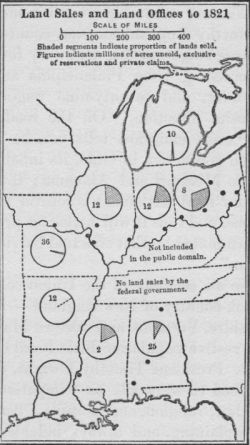
To this emigration all sections of the Union contributed. In the back-country of New England—in Maine, New Hampshire, Vermont, and western Massachusetts—was a restive population little loved by the governing class. President Timothy Dwight, of Yale College, described these people as "impatient of the restraints of law, religion, and morality," contentious, always complaining, and always indebted. They were likely to be Baptists or Methodists, by persuasion, and Democrats in politics. As small farmers their lot was a hard one. They needed only the incentive of cheap lands in the West to sever the slender ties which bound them to the stony hillsides of New England. Yet the older towns of New England also complained of the Western fever which was carrying off the available labor supply. Fearon found "the small and middling tradesmen" always ready to sell out when business got bad and "pack up for the back-country." The immediate destination of these New Englanders was western New York. Within a decade what had been a frontier area was filled with an industrious population eager to secure markets for the surplus products of their farms.
Before a very large number of New Englanders passed beyond western New York, emigrants from the Middle States were pushing into the Ohio country, where Harrison's victories had opened vast tracts to the white settlers. The earliest settlers in Indiana and Illinois, however, were of Southern extraction. Tennessee and Kentucky, having no longer a supply of good land at low prices, sent the younger generation on to a new frontier. In the year 1816 the father of Abraham Lincoln took his family across the Ohio on a raft and hewed his way into the timber lands along the river bottoms of Indiana. With these migratory Kentuckians went also descendants of the Germans and the Scotch-Irish who had peopled the Great Valley in the previous century. Even from the Carolinas came all sorts and conditions of men,—poor whites, Quakers, Baptists,—small farmers whom the advancing plantation system was driving from the uplands.
Even more significant than this advance of population into the region north of the Ohio was the contemporaneous movement from the Southern Seaboard States into the cotton lands of the Gulf plains. The way had been prepared by Andrew Jackson's conquest of the Creeks. Alabama was the immediate goal of the migrating Southerner. From Kentucky, also, but more particularly from Tennessee, stalwart pioneers entered this new El Dorado. The father of Jefferson Davis was one of those who tried their luck in the alluvial plains of the lower Mississippi. By the year 1820, the area of settlement had extended from southern Tennessee to Mobile, and from Mobile to the Mississippi along the Gulf.
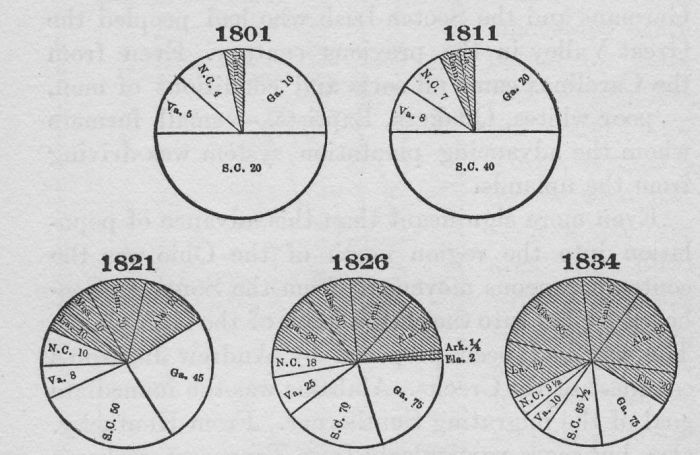
The causes and consequences of this colonization of the Southwest form a vital chapter in the economic history of the country. In the year before the war, Virginia, the Carolinas, and Georgia produced 75,000,000 pounds of cotton; the only other cotton-raising States, Tennessee and Louisiana, produced 5,000,000 pounds. Ten years later, the Seaboard States raised 117,000,000 pounds; the Southwest, 60,000,000. In another decade the States of the Southwest had outstripped the Old South. This comparison throws a flood of light upon Southern history. The invention of the cotton gin had made possible the cultivation of the short-staple cotton plant, which was the only variety that could be raised profitably in the uplands. Occurring just at the moment when the use of the power loom in factories was giving an unprecedented stimulus to the manufacture of cotton, the cotton gin worked a revolution in Southern life and industry. From the tidewater, with its large plantations worked by African slaves, the cultivation of cotton passed into the region above the fall-line of the rivers, where the small farmer practiced a diversified agriculture. Socially and politically the two regions had always been distinct. The gentlemen planters of the tidewater, with much the same outlook as the English gentry of the same period, regarded the democratic yeomen of the Piedmont with distrust not unmixed with contempt. By excluding them from their proportionate representation in the state legislatures, the aristocratic planters maintained an ascendency which was at once political and social. But as cotton-growing became more profitable and advanced into the interior, the farmer of the uplands found himself pushed to the wall. Either he must adopt the plantation system and purchase slaves, or sell his land and move on. For want of capital large numbers chose the latter alternative and swelled the numbers of those who had already set their faces westward.
The communities which within six years after the Treaty of Ghent were admitted into the Union as the States of Mississippi and Alabama, did not at first differ materially from Indiana and Illinois, which became Commonwealths at the same time. Much the same obstacles confronted the pioneer in the pine forests of Mississippi as in the hard woods of the Northwest. Either as squatter or bona fide purchaser he had with the aid of his neighbors hewed out a clearing, or single-handed girdled the trees, and laid the sills of his log cabin. A "raising" or "frolic" was one of the few opportunities for social intercourse in the hard life of the frontiersman. Between the stumps of his clearing he planted his first crop of Indian corn; and what the soil did not yield for his sustenance, he supplied with his trusty rifle. Time wrought vast transformations in these new communities. The thriftless, who scratched the surface of the ground and then sold out to a newcomer of sterner fiber, passed on to a new frontier. Log cabins gave way to frame houses. Clearings became well-tilled farms. Better methods of cultivation extracted a surplus of produce which could be sent to market. Along the rivers of the Northwest, cities sprang up like mushrooms.
From this point the history of the Southwest diverged from that of the Northwest. The virgin lands of the Gulf attracted also the planter with his capital invested in African slaves. Once again the small farmer felt the combined pressure of social and economic forces. He saw his wealthier neighbor acquire the more fertile lands; he found himself thrust into a socially inferior class; and again he yielded to fate. While a democratic society of self-reliant yeomen was developing in the northern half of the Mississippi Valley, a society based upon a plantation economy and aristocratic in its outward characteristics was forming in the Gulf States. Yet in its aggressiveness and commercial enterprise, the new South resembled the Northwest rather than the old South.
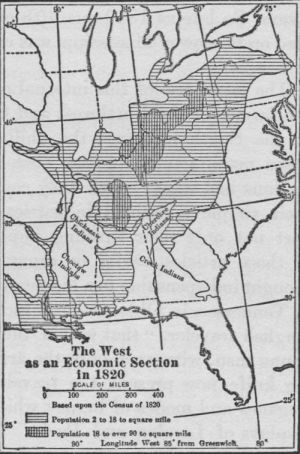
While the South was producing staples for an ever-growing market, it became itself the market for the surplus products of the Northwest. An active internal trade sprang up between the sections in spite of the natural barriers to commercial intercourse. Live stock could be driven to market. It was a common occurrence to see droves of thousands of "razor-back" hogs on their way from Kentucky to the Seaboard States, feeding on nuts and roots by the way. Rivers were the chief highways for such produce as could not provide for its own locomotion. The Western waters floated all sorts of craft, from the lumber raft to the flatboat, laden with pork, cheese, butter, flour, corn, and whiskey. The greater part of these boats were makeshifts, and made no return voyage. It was not until 1809 that a barge was warped upstream from New Orleans to Nashville. The entire traffic on the Mississippi and the Ohio was carried on until 1817 in less than a score of keel boats, which made the voyage downstream from Louisville to New Orleans in about forty days, and upstream in ninety. When, then, a steamboat succeeded in making a return voyage in twenty-five days, it was hailed as an epoch-making performance. In the next year twenty steamboats were competing for the river traffic; and three years later (1820) seventy-two were in actual service. Yet the steamboat did not drive the flatboat from the Western rivers. So late as 1840 one fifth of the freight handled on the lower Mississippi was carried in flatboats or barges.
The rapid rise of this internal commerce between the farmer of the Northwest and the cotton planter of the South increased the ability of both to purchase manufactures in the Eastern markets. Both sections had wants which they could not supply by their simple household industries. They had to import not only their farming implements, but most of those articles, useful or ornamental, which were thought indispensable to a higher civilization. "Spots in Tennessee, in Ohio, and Kentucky," comments an English traveler, "that within the lifetime of even young men, witnessed only the arrow and the scalping knife, now present the traveler with articles of elegance and modes of luxury which might rival the displays of London and Paris." Most of this stock was transported over the mountains from Philadelphia or Baltimore. In 1820, three thousand wagons carried to Pittsburg, the distributing center of the West, nearly eighteen million dollars' worth of merchandise.
The commercial interests of the East were quick to see the possibilities of this new market. An eager rivalry sprang up between the merchants of New York, Philadelphia, and Baltimore. Everywhere ways and means of cheaper transportation were discussed. In this subject the Western farmer was vitally interested, for freight charges added nearly one third to the cost of merchandise transported over the mountains. The cotton planter of the Seaboard States, also, feeling the competition of the Southwest, where riverways were abundant and easily navigable, saw the need of better roads to tidewater, in order to lessen the cost of marketing his produce.
The popular demand for better roads was not recent. All the States had encouraged, directly or indirectly, the building of turnpikes and bridges. Between 1793 and 1812, Pennsylvania had chartered fifty-five turnpike companies, and other States had been scarcely less ready to grant articles of incorporation to stock companies. Private enterprise had, indeed, done much to improve communication along the seaboard. Turnpikes and bridges had shortened the journey by stage from Boston to Washington to four and a quarter days by the year 1815. The city of New York was in 1816 within twenty-four hours of Albany by the Hudson River steamboats.
Numerous canal companies had also been chartered; but of all the canals projected, only three had been completed when the War of 1812 began: the Dismal Swamp Canal in Virginia, the Santee Canal in South Carolina, and the Middlesex Canal in Massachusetts. It remained for New York to usher in a new era in internal communication by authorizing in 1817 the construction of the Erie Canal. In the ardent imagination of its chief promoter, De Witt Clinton, this canal was destined to be "a bond of union between the Atlantic and Western States" and "an organ of communication between the Hudson, the Mississippi, the St. Lawrence, the Great Lakes of the North and West, and their tributary rivers," creating "the greatest inland trade ever witnessed" and transforming New York into a vast emporium of commerce and "the granary of the world."
This bold bid for Western trade alarmed the merchants of Philadelphia, particularly as the completion of the national road threatened to divert much of their traffic to Baltimore. In 1825, the legislature of Pennsylvania grappled with the problem by projecting a series of canals which were to connect its great seaport with Pittsburg on the west and with Lake Erie and the upper Susquehanna on the north.
The magnitude of the transportation problem was such, however, that neither individual States nor private corporations seemed able to meet the demands of an expanding internal trade. As early as 1807, Albert Gallatin had advocated the construction of a great system of internal waterways to connect East and West, at an estimated cost of $20,000,000. But the only contribution of the National Government to internal improvements during the Jeffersonian era was an appropriation in 1806 of two per cent of the net proceeds of the sales of public lands in Ohio for the construction of a national road, with the consent of the States through which it should pass. By 1818 the road was open to traffic from Cumberland, Maryland, to Wheeling, Virginia.
In 1816, with the experiences of the war before him, no well-informed statesman could shut his eyes to the national aspects of the problem. Even President Madison invited the attention of Congress to the need of establishing "a comprehensive system of roads and canals." Soon after Congress met, it took under consideration a bill drafted by Calhoun which proposed an appropriation of $1,500,000 for internal improvements. Because this appropriation was to be met by the moneys paid by the National Bank to the Government, the bill was commonly referred to as the "Bonus Bill." "Let it not be forgotten," said Calhoun in advocacy of his bill, "that it [the size of the Union] exposes us to the greatest of all calamities,—next to the loss of liberty,—and even to that in its consequences—disunion. We are great, and rapidly—I was about to say fearfully—growing. This is our pride and our danger; our weakness and our strength.... We are under the most imperious obligation to counteract every tendency to disunion.... Whatever impedes the intercourse of the extremes with this, the center of the Republic, weakens the Union."
The one section which was impervious to these national considerations at this moment was New England; but it was President Madison, and not New England, who defeated the Bonus Bill. On the day before he left office, Madison sent to Congress a notable veto message. Reverting to his earlier faith, he pronounced the measure unconstitutional. Neither the express words of the Constitution nor any fair inference could, in his judgment, warrant the exercise of such powers by Congress. To pass the bill over his veto was impossible. Monroe, too, in his first message to Congress intimated that he also held strict views of the powers of Congress. The policy of internal improvements by Federal aid was thus wrecked on the constitutional scruples of the last of the Virginia dynasty.
Having less regard for consistency, the House of Representatives recorded its conviction, by close votes, that Congress could appropriate money to construct roads and canals, but had not the power to construct them. As yet the only direct aid of the National Government to internal improvements consisted of various appropriations, amounting to about $1,500,000 for the Cumberland Road.
Circumstances were also pressing the claims of the Far West upon the Government. Beyond the scattered settlements of Illinois and Indiana extended vast forests, known only to the Indians and the fur traders. With the experiences of the war fresh in mind, the new Secretary of War, Calhoun, urged upon the Government the necessity of taking resolute measures to hold this territory. Laws excluding foreigners from the Indian trade were passed; forts were established at strategic points like Chicago, Prairie du Chien, and Green Bay; and in 1820, Governor Cass, of the Michigan Territory, was sent on an expedition through the Wisconsin forests into Minnesota, to assert American claims wherever British influence was still felt.