UNGAVA BOB (continued 4)
Reading edition
There was no cessation in the storm or change in the conditions the next day. In the morning while they were drinking their hot tea Bob told Akonuk and Matuk of the apparition he had seen in the night.
"That," they said in awe, "was the spirit of Torngak," and Bob was duly impressed.
Upon a visit later to the other igloos he missed Chealuk. She had always sat in one corner plying her needle, and had always had a word for him when he came in to pay a visit. Her absence was therefore noticeable and Bob asked one of the Eskimos where she was.
"Gone," said the Eskimo.
And this was all he could learn from them. Poor old Chealuk had been sent away, and it must have been she, then, that he had seen in the darkness.
That night Bob was aroused again, and he immediately realized that something of moment had occurred. Akonuk and Matuk were awake and talking excitedly, and through the shrieking of the gale outside came a distinct and unusual sound. It was like the roar of distant thunder, but still it was not thunder. He sat up sharply to learn the meaning of it all.
XXIToC
ADRIFT ON THE ICE
The unusual sound that Bob heard was the pounding of ice driven by the mighty force of wind and tide against the island rocks. This the Eskimos verified with many exclamations of delight. The hoped for had happened and release from their imprisonment was at hand. Bob thanked God for remembering them.
"I were thinkin' th' Lard would not be losin' sight o' me now He's been so watchful in all th' other times I were needin' help," said he as he lay down.
To the Eskimos it was a proof of the efficacy of the appeal to the Angakok.
During the next day the high wind and snow continued until dusk. Then the weather began to calm and before morning the sky was clear and the stars shining cold and brilliant, and the sun rose clear and beautiful. Kangeva Bay, a solid held of ice again, as it was when Bob first saw it, stretched away unbroken and white to the northward.
No time was lost in making preparations for their escape. The komatiks were packed at once with the camp goods and the little food that still remained, the dogs were harnessed and a quick march took them safely to the mainland.
Here the Eskimos had an ample cache of seal and walrus meat killed earlier in the season. New igloos were built, as the old ones in use before they transferred to the island were not considered comfortable, the previous occupancy having softened the interior snow, which was now encrusted with a thin glaze of ice and this glaze prevented a free circulation of air.
Bob wanted to go on without delay but Akonuk and Matuk had found none of the Eskimos willing to proceed with him. It was therefore necessary for them to go with him until another camp was reached, and they insisted upon delaying the start a day in order as they said to give the dogs a good feed and get them in better shape for the journey, as they for some time had been fed only each alternate day instead of every day as was customary, and even then had received but half their usual portion. This seemed quite reasonable, but when Bob saw his friends a little later consuming raw seal meat themselves in enormous quantities, he concluded that the dogs were not the only object of their consideration.
They were still busily engaged arranging their new quarters when one of the Eskimos called the attention of the others to a black object far out upon the ice in the direction from which they had come. Slowly it tottered towards them and in a little while it was made out to be old Chealuk, who had been in hiding somewhere on the island. The poor old woman, nearly starved and with frozen hands and feet, was barely able to drag herself into camp. Some of the men protested against receiving her but she was finally permitted to enter the igloos and take up her old place, though with the understanding that she should leave again immediately at the first indication of Torngak's displeasure.
It was a great relief to Bob to know that she had not perished. The old woman had only been able to keep from freezing to death, as he learned, by hollowing out a place in a snow-bank in which to lie and letting the snow drift thickly over her and remaining there until the storm had spent itself.
"Sure I'm glad t' see she back again," thought Bob, and he voiced the sentiment to Matuk.
"Atsuk"—I don't know—said the Eskimo with a shrug of the shoulders.
While, as we have seen, none of the Eskimos would take the place of Akonuk and Matuk, they gave them sufficient seal meat and blubber for a two weeks' journey, and early the next morning the march eastward was resumed.
Bob was now driven to eating seal meat, as all his other provisions were exhausted, though, fortunately, he still had an abundance of tea. He had often eaten seal meat at home and was rather fond of it when it was properly cooked, but now no wood with which to make a fire was to be had. The land was absolutely barren, and even the moss was so deeply hidden beneath the snow it could not be resorted to for this purpose. Evenings in the igloo he boiled some meat over the stone lamp—enough to last him through the following day—but at best he could get it but partially cooked. However, he soon learned not to mind this much, for hunger is the best imaginable sauce, and in the cold of the Arctic north one can eat with a relish what could not be endured in a milder climate.
For several days they traversed mountain passes where they were shut in by towering, rugged peaks which seemed to reach to the very heavens. Bleak and desolate as the landscape was it possessed a magnificence and grandeur that demanded admiration and called forth Bob's constant wonder. He would gaze up at the mysterious white summits and ejaculate,
"'Tis grand! 'Tis wonderful grand!"
Such mountains he had never seen before, and like all wilderness dwellers he was a lover of Nature's beauties and a close observer of her wonders.
It was near the middle of April now and the sun's rays, reflected by the snow, were growing dazzlingly bright and beginning to affect their eyes. Goggles should have been worn as a protection against this glare but they had none and did not trouble to make them until one night Matuk found that he was overtaken by a slight attack of snow-blindness. This is an extremely painful affliction which does not permit the sufferer to approach the light or, in fact, so much as open his eyes without experiencing agony. The sensation is that of having innumerable splinters driven into the eyeballs with the lids when opened and closed grating over the splinters.
While they were waiting for Matuk to recover his eyesight Akonuk and Bob removed one of the wooden cross-bars from the komatik and with their knives cut from it three pieces each long enough to fit over the eyes for a pair of goggles. These were rounded to fit the face and a place whittled out for the nose to fit into. Then hollow places were cut large enough to permit the eyelids to open and close in them, and opposite each eye hollow a narrow slit for the wearer to look through. Then the interior of the eye places were blackened with smoke from the stone lamp, and a thong of sealskin was fastened to each end of the goggles with which to tie them in place upon the head.
Thus a pair of goggles was ready for each when, after a three days' rest Matuk's eyes were well enough for him to continue the journey, and by constantly wearing them on days when the sun shone, further danger of snow-blindness was averted.
Two days later, upon emerging from a mountain pass, they suddenly saw stretching far away to the eastward the great ocean ice. The sight sent the blood tingling through Bob's veins. Nearly half the journey from Ungava to Eskimo Bay had been accomplished!
"Th' coast! Th' coast!" shouted Bob. "Now I'll be gettin' home inside a month!"
He began at once to plan the surprise he had in store for the folk and an early trip that he would make over to the Post, when he would tell Bessie about his great "cruise" and hear her say that she was glad to see him back again. But Fortune does not wait upon human plans and Bob's fortitude was yet to be tried as it never had been tried before.
That afternoon an Eskimo village of snow igloos was reached. The Eskimos swarmed out to meet the visitors and gave them a whole-souled welcome, and in an hour they were quite settled for a brief stay in the new quarters.
Akonuk told Bob that now after the dogs, which were very badly spent, had a few days in which to rest, he and Matuk would turn back to Ungava. They would try to arrange for two more Eskimos with a fresh team to go on with him, but as for themselves, even were the dogs in condition to travel, they did not know the trail beyond this point.
The Eskimos here, like those they had met on the island at Kangeva, were engaged in seal hunting, and none of the men seemed to care to leave their work for a long, hard journey south. They did not say, however, that they would not go. When they were asked their answer was:
"In a little while—perhaps."
This was very unsatisfactory to Bob in his anxious frame of mind. But he had learned that Eskimos must be left to bide their time, and that no amount of coaxing would hurry them, so he tried to await their moods in patience. He understood the reluctance of the men to go away during one of the best hunting seasons of the year and could not find fault with them for it.
The seals were the mainstay of their living and to lose the hunt might mean privation. They were in need of the skins for clothing, kayaks and summer tents, and the flesh and blubber for food for themselves and their dogs, and the oil for their stone lamps.
Later in the season they would harpoon the animals from their kayaks, but this was the great harvest time when they killed them by spearing through holes in the ice where the seals came at intervals to breathe, for a seal will die unless it can get fresh air occasionally. Early in the morning each Eskimo would take up his position near one of these breathing holes, and there, with spear poised, not moving so much as a foot, sometimes for hours at a time, await patiently the appearance of a seal, which, having many similar holes, might not chance to come to this particular one the whole day.
The spear used had a long, wooden handle, with a barbed point made of metal or ivory, and so arranged that the barbed point came off the handle after it had been driven into the animal. To the point was fastened one end of a long sealskin line, the other end of which the hunter tied about his waist.
The moment a seal's nose made its appearance at the breathing hole the watchful Eskimo drove the spear into its body. Then began a tug of war between man and seal, and sometimes the Eskimos had narrow escapes from being pulled into the holes.
The seals of Labrador, it should be explained, are the hair, and not the fur seals such as are found in the Alaskan waters and the South Sea. There are five varieties of them, the largest of which is the hood seal and the smallest the doter or harbour seal. The square flipper also grows to a very large size. The other two kinds are the jar and the harp.
These all have different names applied to them according to their age. Thus a new-born harp is a "puppy," then a "white coat"; when it is old enough to take to the water, which is within a fortnight after birth, it becomes a "paddler," a little later a "bedlamer," then a "young harp" and finally a harp. The handsomest of them all is the "ranger," as the young doter is called.
Finally, one evening when all the men were assembled in the igloos after their day's hunt, Akonuk announced that he and Matuk were to return home the next morning. This renewed the discussion as to who should go on with Bob, and the upshot of it was that two young fellows—Netseksoak and Aluktook—with the promise that Mr. Forbes would reward them for aiding to bring the letters which Bob carried, volunteered to make the journey.
This settled the matter to Bob's satisfaction and it was agreed that, as the season was far advanced, it would be necessary to start at once in order to give the two men time to reach home again before the spring break-up of the ice.
Long before daylight the next morning the Eskimos were lashing the load on the komatik and at dawn the dogs were harnessed and everything ready. Bob said good-bye to Akonuk and Matuk and the two teams took different directions and were soon lost to each other's view.
"'Twill not be long now," said Bob to himself, "an' we gets t' th' Bay."
The sun at midday was now so warm that it softened the snow, which, freezing towards evening, made a hard ice crust over which the komatik slipped easily and permitted of very fast travelling until the snow began to soften again towards noon. Therefore the early part of the day was to be taken advantage of.
The new team, containing eleven dogs, was really made up of two small teams, one of six dogs belonging to Netseksoak and the other of five dogs the property of Aluktook. At first the two sets of dogs were inclined to be quarrelsome and did not work well together. At the very start they had a pitched battle which resulted in the crippling of Aluktook's leader to such an extent that for two days it was almost useless.
However, with the good going fast time was made. Usually they kept to the sea ice, but sometimes took short cuts across necks of land where, as had been the case near Ungava, the men had to haul on the traces with the dogs.
The new drivers were much younger men than Akonuk and Matuk and they were in many respects more companionable. But Bob missed a sort of fatherly interest that the others had shown in him and did not rely so implicitly upon their judgment.
Able now as he was to understand very much of their conversation, he took part in the discussion of various routes and expressed his opinion as to them; and the Eskimos, who at first had looked upon him as a more or less inexperienced kablunok, soon began to feel that he knew nearly as much about dog and komatik travelling as they did themselves. Thus a sort of good fellowship developed at once.
One evening after a hard day's travelling as they came over the crest of a hill the first grove of trees that Bob had seen since shortly after leaving Ungava came in sight. It was the most welcome thing that had met his view in weeks, and when the dogs were turned to its edge and he saw a small shack, he knew that he was nearing again the white man's country.
The shack was found to have no occupants, but it contained a sheet iron stove such as he had used in his tilts, and that night he revelled in the warmth of a fire and a feast of boiled ptarmigan and tea.
"'Tis like gettin' back t' th' Bay," said Bob, and he asked the Eskimos, "Will there be igloosoaks (shacks) all the way?"
"Igloosoaks every night," answered Aluktook.
The following morning a westerly breeze was blowing and the Eskimos were uncertain whether to keep to the land or follow the sea ice along the shore. The former route, they explained to Bob, passed over high hills and was much the harder and longer one of the two, but safer. The ice route along the shore was smooth and could be accomplished much more quickly, but at this season of the year was fraught with more or less danger. For many miles the shore rose in precipitous rocks, and should a westerly gale arise while they were passing this point, the ice was likely to break away and no escape could be made to the shore. The wind blowing then from the West was not strong enough yet, they said, to cause any trouble, and they did not think it would rise, but still it was uncertain.
"Which way should they go?"
Bob's experience at Kangeva made him hesitate for a moment, but his impatience to reach home quickly got the better of his judgment; and, especially as the Eskimos seemed inclined to prefer the outside route, he joined them in their preference and answered,
"We'll be goin' outside."
And the outside route they took.
All went well for a time, but hourly the wind increased. The dogs were urged on, but the wind kept blowing them to leeward and they began to show signs of giving out. Finally a veritable gale was blowing and the Eskimos' faces grew serious.
They were now opposite that part of the shore where it rose a perpendicular wall of rock towering a hundred feet above the sea, and offered no place of refuge. So they hurried on as best they could in the hope of rounding the walls and making land before the inevitable break came. Presently Aluktook shouted,
"Emuk! Emuk!"—the water! the water!
Bob and Netseksoak looked, and a ribbon of black water lay between them and the shore.
They lashed the dogs and shouted at them until they were hoarse, in a vain effort to urge them on. The poor brutes lay to the ice and did their best, but it was quite hopeless. In an incredibly short time the ribbon had widened into a gulf a quarter of a mile wide. Then it grew to a mile, and presently the shore became a thin black line that was soon lost to view entirely. They were adrift on the wide Atlantic!
They stopped the dogs when they realized that further effort was useless and sat down on the komatik in impotent dismay.
The weather had grown intensely cold and the perspiration that the excitement and exertion had brought out upon their faces was freezing. Snow squalls were already beginning and before nightfall a blizzard was raging in all its awful fury and at any moment the ice pack was liable to go to pieces.
XXIIToC
THE MAID OF THE NORTH
"The's no profit in this trade any more," said Captain Sam Hanks, as he sat down to supper with his mate, Jack Simmons, in the little cabin of his schooner, Maid of the North. "I won't get a seaman's wages out o' th' cruise, an' I'm sick o' workin' fer nothin'. Now there was a time before th' free traders done th' business t' death that a man could make good money on th' Labrador, but that time's past They pays so much fer th' fur they's spoiled it fer everybody, an' I'm goin' t' quit."
"Th' free traders don't go north o' th' Straits much. Why don't ye try it there, sir?" suggested the mate.
"Ice. Too much ice. I've been thinkin' it over. Th' trouble is we couldn't get through th' ice in th' spring until after th' Hudson's Bay people had gobbled up everything. Th' natives down that coast is poor as Job's turkey, an' they has t' sell their fur soon's th' furrin' season's over. I hears th' company gets th' fur from 'em fer a song. Them natives'll give ye a silver fox fer a jackknife an' a barrel o' flour, an' a marten fer a gallon o' molasses. But the's money in it if a feller could get there in time," he added thoughtfully.
"What's th' matter with goin' down in th' fall before th' ice blocks th' coast? Th' Maid o' th' North is sheathed fer ice, an' we could freeze her in, some place down th' coast, an' be on hand t' sail when th' ice clears in th' spring, We could let th' folks know where we were t' freeze up, an' we'd pick up a lot o' fur before th' ice breaks, an' th' natives'd hold th' rest until we calls comin' south. The's a big chanct there," said the mate, conclusively.
"I dunno but yer right. I hadn't thought o' goin' down in th' fall t' freeze up. We'd have t' be gettin' t' our anchorage by th' first o' October."
"The's plenty o' time t' do that, sir. 'Twon't take more'n ten days t' fit out."
"Then the's th' cost o' shippin' th' crew t' be taken into account, 'n havin' 'em doin' nothin' th' hull winter. I don't know's the'd be much in it after everythin's counted out."
"That's easy 'nuff fixed. Take a lot o' traps an' let th' crew hunt in th' winter. Ye wouldn't have t' pay 'em then when ye wasn't afloat. Ye could give 'em their keep an' let 'em hunt with th' traps on shore an' make a little outen 'em. The's always fools 'nuff as thinks they'll get rich if they has a chanct t' try their hand doin' somethin' they ain't been doin' before, an' you kin get a crew o' fellers like that easy 'nuff."
"I dunno. Maybe I kin an' maybe I can't. Sounds like it's worth tryin' an' I'll think about it."
Every spring for ten years Captain Hanks—Skipper Sam he was generally called—had sailed out of Halifax Harbour with his schooner Maid of the North to work his way into the Gulf of St. Lawrence when the waters were clear of ice, and trade a general cargo of merchandise for furs with the Indians and white trappers along the north shore and the Straits of Belle Isle—the southern Labrador.
At first he found the trade extremely lucrative, and during the first four or five years in which he was engaged in it accumulated a snug sum of money, the income of which would have been quite sufficient to keep him comfortably the remainder of his life in the modest way in which he lived.
But Skipper Sam was much like other people, and the more he had the more he wanted, so he continued in the fur trade. The fact that he had purchased some city real estate for the purpose of speculation became known, and other skippers sailing schooners of their own, with an eye to lucrative, trade, decided that "Skipper Sam must be havin' a darn good thing on th' Labrador," and when the Maid of the North made her fifth voyage she had another schooner to keep her company, and another skipper was on hand to compete with Skipper Sam.
Each year had brought additions to the trading fleet, and competition had raised the price of fur until now the trappers, with a ready market, were growing quite independent, and Skipper Sam, instead of paying what he pleased for the pelts, which, when he had a monopoly of the trade, was a merely nominal price as compared with their value, was forced in order to get them at all to pay more nearly their true worth.
Even now he was making a fair profit, but his mind constantly reverted to the "good old days" when his returns were from five hundred to a thousand per cent. on his investment, and he felt injured and dissatisfied. At the end of every voyage he declared solemnly that he was no longer making more than seamen's wages and would quit the trade, and the mate, who was well aware of the captain's comfortable financial position, always believed he meant it.
It should be said to Captain Hanks' credit that he paid his mate and crew of five men the highest going wages, and treated them well and kindly. So long as they attended strictly to their duties he was their friend. They were provided with the best of food and they appreciated the good treatment and were loyal to Captain Hanks' interest and very much attached to the Maid of the North, as seamen are to a good ship that for several voyages has been their home.
So it was that the mate made his suggestions so freely. If Captain Hanks were to quit the trade he knew that it would be many a day before he secured another such berth, and his solicitude was therefore not alone in the captain's interests but was largely a matter of looking out for himself.
The voyage just completed had not, in fact, been a very profitable one, for the previous winter had been a poor year for the trappers that they dealt with, just as it had been farther north in Eskimo Bay, and Skipper Sam had good reason for feeling discouraged.
It was early in August now, and the Maid of the North was entering Halifax Harbour with the expectation of tying up at her berth the next morning. If she were to go north it would be necessary for her to be fitted out for the voyage immediately in order to reach her winter quarters before the ice began to form in the bays.
The two men ate their supper and both went on deck to smoke their pipes. Skipper Sam had no more to say about the proposed undertaking until late in the evening, when he called the mate to his cabin, where he had retired after his smoke, and there the mate found him poring over a chart.
"D'ye know anything about this coast?" the skipper asked, without looking up.
The mate glanced over his shoulder.
"Not much, sir. I was down on a fishin' cruise once when I was a lad."
"Well, how far down ought we t' go, d' ye think, before we lays up?"
"I think, sir, we should go north o' Indian Harbour. Th' farther north we gets, th' more fur we'll pick up."
"Well," said the skipper, standing up, "I'm goin' t' sail just as quick as I can fit out. Ship th' crew on th' best terms ye can. We got t' move smart, fer I wants time t' run well down before th' ice catches us."
"All right, sir."
Thus it happened that the Maid of the North, spick and span, with a new coat of paint on the outside, and a good stock of provisions and articles of trade in her hold, sailed out of Halifax Harbour and turned her prow to the northward on the first day of September, and was plowing her way to the Labrador at the very time that Bob Gray with his mother and Emily were returning so disconsolate to Wolf Bight after hearing the verdict of the mail boat doctor, and Bob was making the plans that carried him into the interior.
The Maid of the North called at many harbours by the way and the fame of Captain Hanks spread amongst the livyeres, as the native Labradormen are called. He told them what fabulous prices he would pay them for their furs in the spring when he came south, with open water, and they promised him to a man to reserve the bulk of their catch for him, and all had visions of coming wealth.
It was decided that they winter in the Harbour of God's Hope, just north of Cape Harrigan, and after passing Indian Harbour the natives were notified that if they wished any supplies during the winter they could bring their furs there and get what they needed.
The Harbour of God's Hope was found to be a deep, narrow inlet, not as well protected from the sea as might be desired, but still comparatively well sheltered, and particularly advantageous from the fact that the shores of the upper end of the inlet were wooded, an essential feature, as it provided an abundance of good fuel, and the supply on board was far from adequate for their needs.
The Maid of the North was made as snug as possible for the freeze-up, but could not be brought as close to shore as desirable, because of shoals. However, her position was deemed quite safe, and Skipper Sam experienced a sense of supreme satisfaction at his achievements and the prospects for a profitable trade in the spring.
The crew were put at work immediately to build a log shack for shore quarters, which was shortly accomplished. This shack was of ample size and was furnished with a stove brought from Halifax for the purpose, some chairs, a table and a kitchen outfit.
The skipper, the mate and the cook remained on board at first, but the crew were given permission to go ashore and hunt and trap in the hills back of the harbour, an opportunity of which they promptly took advantage.
As the cold weather came on and the ice formed thick and hard around the vessel it seemed unnecessary to keep a watch aboard, and as the shack was much more roomy than the cabin, and therefore more comfortable, all hands finally took up their quarters in it.
As the winter wore on livyeres began to pay frequent visits to Skipper Sam from up and down the coast, and they all brought furs to trade. With the approach of spring the skipper found to his satisfaction that he had already collected more pelts than he had been able to purchase on his previous spring's voyage in the South, and at prices that even to him seemed ridiculously low. These furs were duly stored aboard the Maid of the North, and by the first of May she had a cargo that could have been disposed of in Halifax or Montreal for several thousand dollars.
It was at this time that the skipper suggested to the mate one evening,
"Jack, les go caribou huntin' t'-morrer. I'm gettin' stiff hangin' 'round here."
"All right, sir," acquiesced the mate, "but," he asked, "th' crew's all away exceptin' th' cook, an' who'll look after things here if we both goes t' once?"
"We kin leave the cook alone fer one day I guess. If any o' th' livyeres come he kin keep 'em till we comes back in th' evenin'."
The arrangements were therefore made for the hunt, and the following morning bright and early they were off.
At sunrise there was a slight westerly breeze blowing, and the skipper suggested,
"Th' wind might stiffen up a bit an' we better keep an eye to it."
They were well back in the hills before the predicted stiffening came to such an extent that they decided it was wise to return to the shack.
Skipper Sam and his mate were not accustomed to land travelling and the hurried retreat soon winded them and they were held down to so slow a walk that the afternoon was half spent and the wind had grown to a gale when they finally came in view of the harbour. Skipper Sam was ahead, and when he looked towards the place where the Maid of the North had been snugly held in the ice in the morning he rubbed his eyes. Then he looked again, and exclaimed:
"By gum!"
The harbour was clear of ice and nowhere on the horizon was the Maid of the North to be seen. The gale had swept the ice to sea and carried with it the Maid of the North and all her valuable cargo. The cook, asleep in his bunk in the shack, was quite unconscious of the calamity when the skipper roused him to demand explanations.
But there were no explanations to be given. The schooner was gone, that was all, and Captain Sam Hanks and his crew were stranded upon the coast of Labrador.
XXIIIToC
THE HAND OF PROVIDENCE
Bob and his companions were indeed in a most desperate situation, and even they, accustomed and inured as they were to the vicissitudes and rigours of the North, could see no possible way of escape. Men of less courage or experience would probably have resigned themselves to their fate at once, without one further effort to preserve their lives, and in an hour or two have succumbed to the bitter cold of the storm. But these men had learned to take events as they came largely as a matter of course, and they did not for a moment lose heart or self-control.
The dogs were driven a little farther towards the interior of the ice, for if the pack were to break up the outer edge would be the first to go. Here immediate preparations were made to camp.
There was no bank from which snow blocks could be cut for an igloo, and the blinding snow so obscured their surroundings that they could not so much as find a friendly ice hummock to take refuge behind. The gale, in fact, was so fierce that they could scarce hold their feet against it, and had they released their hold of the komatik even for an instant, it is doubtful if they could have found it again.
The deerskin sleeping bags were unlashed and the sledge turned upon its side. In the lee of this the bags were stretched upon the ice and with their skin clothes on they crawled into them. Each called "Oksunae"—be strong—have courage—to the others, and then drew his head within the folds of his skin covering.
Bob wore the long, warm coat that Manikawan had made for him, and as he snuggled close into the bag he thought of her kindness to him, and he dreamed that night that he had gone back and found her waiting for him and looking just as she did the morning she waved him farewell, as she stood in the light of the cold winter moon—tall and graceful and comely, with the tears glistening in her eyes.
The dogs, still in harness, lay down where they stood, and in a little while the snow, which found lodgment against the komatik, covered men and dogs alike in one big drift and the weary travellers slept warm and well regardless of the fact that at any moment the ice might part and they be swallowed up by the sea.
The storm was one of those sudden outbursts of anger that winter in his waning power inflicts upon the world in protest against the coming spring supplanting him, and as a reminder that he still lives and carries with him his withering rod of chastisement and breath of destruction. But he was now so old and feeble that in a single night his strength was spent, and when morning dawned the sun arose with a new warmth and the wind had ceased to blow.
The men beneath the snow did not move. It was quite useless for them to get up. There was nothing that they could do, and they might as well be sleeping as wandering aimlessly about the ice field.
The dogs, however, thought differently. They had not been fed the previous night, and bright and early they were up, nosing about within the limited area afforded them by the length of their traces. One of them began to dig away the snow around the komatik. He paused, held his nose into the drift a moment and sniffed, then went vigorously to work again with his paws. Soon he grabbed something in his fangs. The others joined him, and the snarling and fighting that ensued aroused Bob and the sleeping Eskimos.
Aluktook was the first to throw off the snow and look out to see what the trouble was about Then he shouted and jumped to his feet, kicking the dogs with all his power. Bob and Netseksoak sprang to his aid, but they were too late.
The dogs had devoured every scrap of food they had, save some tea that Bob kept in a small bag in which he carried his few articles of dunnage.
This was a terrible condition of affairs, for though they were doubtless doomed to drown with the first wind strong enough to shatter the ice, still the love of living was strong within them, and they must eat to live.
Separating and going in different directions, the three hunted about in the vain hope that somewhere on the ice there might be seals that they could kill, but nowhere was there to be seen a living thing—nothing but one vast field of ice reaching to the horizon on the north, east and south. To the west the water sparkled in the sunlight, but no land and no life, human or otherwise, was within the range of vision.
After a time they returned to their bivouac and then drove the dogs a little farther into the ice pack to a high hummock that Aluktook had found, and with an axe and snow knives cut blocks of ice from the hummock and snow from a drift on its lee side, and finally had a fairly substantial igloo built. This they made as comfortable as possible, and settled in it as the last shelter they should ever have in the world, as they all firmly believed it would prove.
They were now driven to straits by thirst, but there was not a drop of water, save the salt sea water, to be had.
"We'll have to burn the komatik," said Aluktook.
Netseksoak knocked two or three cross-bars from it and built a miniature fire, using the wood with the greatest possible economy, and by this means melted a kettle of ice, and Bob brewed some tea.
The warm drink was stimulating, and gave them renewed ambition. They separated again in search of game, but again returned, towards evening, empty handed.
"Too late for seals," the Eskimos remarked laconically.
All were weak from lack of food, and when they gathered at the igloo it was decided that one of the dogs must be killed.
"We'll eat Amulik, he's too old to work anyway," suggested Netseksoak.
Amulik, the dog thus chosen for the sacrifice, was a fine old fellow, one of Netseksoak's dogs that had braved the storms of many winters. The poor brute seemed to understand the fate in store for him, for he slunk away when he saw Netseksoak loading his gun. But his retreat was useless, and in a little while his flesh was stored in the igloo and the Eskimos were dining upon it uncooked.
Though Bob was, of course, very hungry, he declined to eat raw dog meat, and to cook it was quite out of the question, for the little wood contained in the komatik he realized must be reserved for melting ice, as otherwise they would have nothing to drink. Another day, however, and he was so driven to the extremes of hunger that he was glad to take his share of the raw meat which to his astonishment he found not only most palatable but delicious, for there is a time that comes to every starving man when even the most vile and putrid refuse can be eaten with a relish.
The dog meat was carefully divided into daily portions for each man. Some of it, of course, had to go to the remaining animals, to keep them alive to be butchered later, if need be, for this was the only source of food the destitute men had.
Every day Bob and the Eskimos wandered over the ice, hoping against hope that some means of escape might be found. Bob realized that nothing but the hand of Providence, by some supernatural means, could save him now. Again, he said,
"Th' Lard this time has sure been losin' track o' me. Maybe 'tis because when He were showin' me a safe trail over th' hills I were not willin' t' bide His time an' go that way, but were comin' by th' ice after th' warnin' at Kangeva."
But he always ended his musings with the comfortable recollection of his mother's prayers. Which had helped him so much before, and this did more than anything else to keep him courageous and brave.
The days came and went, each as empty as its predecessor, and each night brought less probability of escape than the night before.
Another dog was killed, and a week passed.
The komatik wood was nearly gone, although but one small fire was built each day, and the end of their tea was in sight.
This was the state of affairs when Bob wandered one day farther to the southward over the pack ice than usual, and suddenly saw in the distance a moving object. At first he imagined that it was a bit of moving ice, so near was it to the colour of the field. This was quite impossible, however, and approaching it stealthily, he soon discovered that it was a polar bear.
The animal was wandering leisurely to the south. Bob carried the rifle that Mr. MacPherson had given him, as he always did on these occasions, and keeping in the lee of ice hummocks, that he might not be seen by the bear, ran noiselessly forward. Finally he was within shooting distance and, raising the gun, took aim and fired.
Perhaps it was because of weakness through improper food, or possibly as the result of too much eagerness, but the aim was unsteady and the bullet only grazed and slightly wounded the bear.
The brute growled and turned to see what it was that had struck him. When it discovered its enemy it rose on its haunches and offered battle.
Bob was for a moment paralyzed by the immense proportions that the bear displayed, and almost forgot that he had more bullets at his disposal. But he quickly recalled himself and throwing a cartridge into the chamber, aimed the rifle more carefully and fired again. This time the bullet went true to the mark, and the great body fell limp to the ice.
As he surveyed the carcass a moment later he patted his rifle, and said;
"'Tis sure a rare fine gun. I ne'er could ha' killed un wi' my old un.". "Now th' Lard must be watchin' me or He wouldn't ha' sent th' bear, an' He wouldn't ha' sent un if He weren't wantin' us t' live. Th' Lard must be hearin' mother's an' Emily's prayers now, after all—He must be."
The bear was a great windfall. It would give Bob and the Eskimos food for themselves and oil for their lamp, and the lad was imbued with new hope as he hurried off to summon Netseksoak and Aluktook to aid him in bringing the carcass to the igloo.
The afternoon was well advanced before he found the two Eskimos, and when he told them of his good fortune they were very much elated, and all three started back immediately to the scene of the bear hunt. As they approached it Aluktook shouted an exclamation and pointed towards the south. Bob and Netseksoak looked, and there, dimly outlined in the distance but still plainly distinguishable, was the black hull of a vessel with two masts glistening in the sunshine.
"Tis th' hand o' Providence!" exclaimed Bob.
The three shook hands and laughed and did everything to show their delight short of hugging each other, and then ran towards the vessel, suddenly possessed of a vague fear that it might sail away before they were seen. Bob fired several shots out of his rifle as he ran, to attract the attention of the crew, but as they approached they could see no sign of life, and they soon found that it was a schooner frozen tight and fast in the ice pack.
When they at last reached it Bob read, painted in bold letters, the name, "Maid of the North."
XXIVToC
THE ESCAPE
They lost no time in climbing on deck, and what was their astonishment when they reached there to find the vessel quite deserted. Everything was in spick and span order both in the cabin and above decks. It was now nearly dark and an examination of her hold had to be deferred until the following day. One thing was certain, however. No one had occupied the cabin for some time, and no one had boarded or left the vessel since the last snow-storm, for no footprints were to be found on the ice near her.
It was truly a great mystery, and the only solution that occurred to Bob was that the ice pack had "pinched" the schooner and opened her up below, and the crew had made a hurried escape in one of the boats. This he knew sometimes occurred on the coast, and if it were the case, and her hull had been crushed below the water line, it was of course only a question of the ice breaking up, which might occur at any time, when she would go to the bottom. There was one small boat on deck, and if an examination in the morning disclosed the unseaworthiness of the craft, this small boat would at least serve them as a means of escape from the ice pack.
Whatever the condition of the vessel, the night was calm and the ice was hard, and there was no probability of a break-up that would release her from her firm fastenings before morning; and they decided, therefore, to make themselves comfortable aboard. There was a stove in the cabin and another in the forecastle, plenty of blankets were in the berths, and provisions—actual luxuries—down forward. Bob was afraid that it was a dream and that he would wake up presently to the realities of the igloo and raw dog meat, and the hopelessness of it all.
He and the Eskimos lighted the lamps, started a fire in the galley stove, put the kettle over, fried some bacon, and finally sat down to a feast of bacon, tea, ship's biscuit, butter, sugar, and even jam to top off with. It was the best meal, Bob declared, that he had ever eaten in all his life.
"An' if un turns out t' be a dream, 'twill be th' finest kind o' one," was his emphatic decision.
How the three laughed and talked and enjoyed themselves over their supper, and how Bob revelled in the soft, warm blankets of Captain Hanks' berth when he finally, for the first time in weeks, was enabled to undress and crawl into bed, can better be imagined than described.
After an early breakfast the next morning the first care was to examine the hold, and very much to their satisfaction, and at the same time mystification, for they could not now understand why the schooner had been abandoned, they found the hull quite sound and the schooner to all appearances perfectly seaworthy.
Another astonishment awaited Bob, too, when he came upon the quantities of fur, and the stock of provisions and other goods that he found below decks.
"'Tis enough t' stock a company's post!" he exclaimed. But its real intrinsic value was quite beyond his comprehension.
When it was settled, beyond doubt, that the Maid of the North was entirely worthy of their confidence and in no danger of sinking, the three returned to the igloo and transferred their sleeping bags and few belongings, as well as the dogs, to their new quarters on board of her.
After this was done they skinned and dressed the polar bear, which still lay upon the ice where it had been killed, and some of the flesh was fed to the half famished dogs. Bob insisted upon giving them an additional allowance, after the two Eskimos had fed them, for he said that they, too, should share in the good fortune, though Netseksoak expressed the opinion that the dogs ought to have been quite satisfied to escape being eaten.
The choicest cuts of the bear's meat the men kept for their own consumption, and Bob rescued the liver also, when Aluktook was about to throw it to the dogs, for he was very fond of caribou liver and saw no reason why that of the polar bear should not prove just as palatable. He fried some of it for supper, but when he placed it on the table both Aluktook and Netseksoak refused to touch it, declaring it unfit to eat, and warned Bob against it.
"There's an evil spirit in it," they said with conviction, "and it makes men sick."
This was very amusing to Bob, and disregarding their warning he ate heartily of it himself, wondering all the time what heathen superstition it was that prejudiced Eskimos against such good food, for, as he had observed, they would usually eat nearly anything in the way of flesh, and a great many things that he would not eat.
In a little while Bob began to realize that something was wrong. He felt queerly, and was soon attacked with nausea and vomiting. For two or three days he was very sick indeed and the Eskimos both told him that it was the effect of the evil spirit in the liver, and that he would surely die, and for a day or so he believed that he really should.
Whether the bear liver was under the curse of evil spirits or was in itself poisonous were questions that did not interest Bob. He knew it had made him sick and that was enough for him, and what remained of the liver went to the dogs, when he was able to be about again.
The days passed wearily enough for the men in their floating prison, impatient as they were at their enforced inactivity, but still helpless to do anything to quicken their release. May was dragging to an end and June was at hand, and still the ice pack, firm and unbroken, refused to loose its bands. Slowly—imperceptibly to the watchers on board the Maid of the North—it was drifting to the southward on the bosom of the Arctic current. But the sun, constantly gaining more power, was rotting the ice, and it was inevitable that sooner or later the pack must fall to pieces and release the schooner and its occupants from their bondage. Then would come another danger. If the wind blew strong and the seas ran high, the heavy pans of ice pounding against the hull might crush it in and send the vessel to the bottom. Therefore, while longing for release, there was at the same time an element of anxiety connected with it.
Finally the looked for happened. One afternoon a heavy bank of clouds, black and ominous, appeared in the western sky. A light puff of wind presaged the blow that was to follow, and in a little while the gale was on.
The Maid of the North, it will be understood, lay in bay ice, and all the ice to the south of her was bay ice. This was much lighter than that coming from more northerly points, and when the open sea which skirted the western edge of the field began to rise and sweep in upon this rotten ice the waves crumbled and crumpled it up before their mighty force like a piece of cardboard. It was a time of the most intense anxiety for the three men.
Just at dusk, amid the roar of wind and smashing ice, the vessel gave a lurch, and suddenly she was free. Fortunately her rudder was not carried away, as they had feared it would be, and when she answered the helm, Bob whispered,
"Thank th' Lard."
They were at the mercy of the wind during the next few hours, and there was little that could be done to help themselves until towards morning, when the gale subsided. Then, with daylight, under short sail they began working the vessel out of the "slob" ice that surrounded it, and before dark that night were in the open sea, with now only a moderate breeze blowing, which fortunately had shifted to the northward.
Here they found themselves beset by a new peril. Icebergs, great, towering, fearsome masses, lay all about them, and to make matters worse a thick gray fog settled over the ocean, obscuring everything ten fathoms distant. They brought the vessel about and lay to in the wind, but even then drifted dangerously near one towering ice mass, and once a berg that could not have been half a mile away turned over with a terrifying roar. It seemed as though a collision was inevitable before daylight, but the night passed without mishap, and when the morning sun lifted the fog the ship was still unharmed.
There was no land anywhere to be seen. What position they were in Bob did not know, and had no way of finding out. He did know, however, that somewhere to the westward lay the Labrador coast, and this they must try to reach.
Fortunately he could read the compass, and by its aid took as nearly as possible a due westerly course.
Alutook and Netseksoak, expert as they were in the handling of kayaks, had no knowledge of the management of larger craft like the Maid of the North, and without question accepted Bob as commander and followed his directions implicitly and faithfully; and he handled the vessel well, for he was a good sailor, as all lads of the Labrador are.
They made excellent headway, and were favoured with a season of good weather, and like the barometer Bob's spirits rose. But he dared to plan nothing beyond the present action. A hundred times he had planned and pictured the home-coming, but each time Fate, or the will of a Providence that he could not understand, had intervened, and with the crushing of each new hope and the wiping out of each delightful picture that his imagination drew, he decided to look not into the future, but do his best in the present and trust to Providence for the rest, for, as he expressed it,
"Th' Lard's makin' His own plans an' He's not wantin' me t' be meddlin' wi' un, an' so He's not lettin' me do th' way I lays out t' do, an' I'll be makin' no more plans, but takin' things as they comes along."
In this frame of mind he held the vessel steadily to her course and kept a constant lookout for land or a sail, and on the morning of the third day after the release from the ice pack was rewarded by a shout from Netseksoak announcing land at last. Eagerly he looked, and in the distance, dimly, but still there, appeared the shore in low, dark outline against the horizon.
Towards noon a sail was sighted, and late in the afternoon they passed within hailing distance of a fishing schooner bound down north. He shouted to the fishermen who, at the rail, were curiously watching the Maid of the North, as she plowed past them.
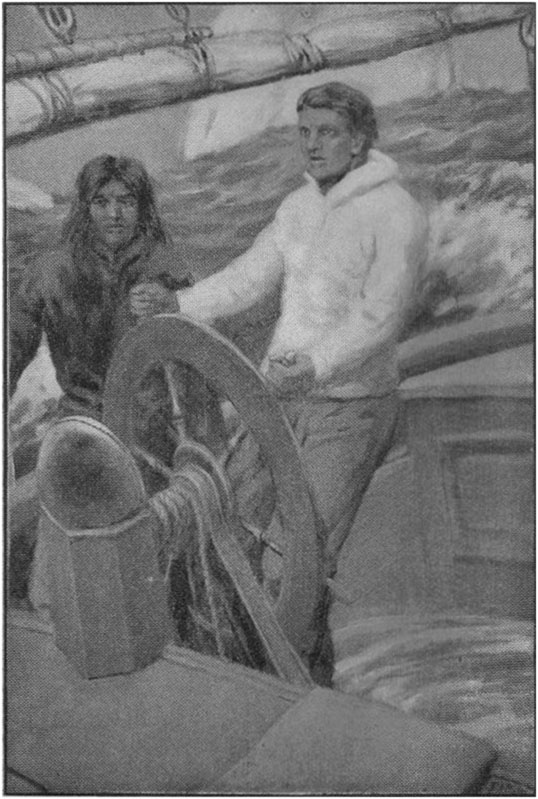
"He held the vessel steadily to her course"
"What land may that be?" pointing at a high, rocky head that jutted out into the water two miles away.
"Th' Devil's Head," came the reply.
"An' what's th' day o' th' month?"
"Th' fifteenth o' June," rang out the answer. "Where un hail from?"
"Ungava," Bob shouted to the astonished skipper, who was now almost out of hearing.
The information that the land was the Devil's Head came as joyful news to Bob. He had often heard of the Devil's Head, and knew that it lay not far from the entrance to Eskimo Bay, and therefore in a little while he believed he should see some familiar landmarks.
Bob's hopes were confirmed, and before dark the Twin Rocks near Scrag Island were sighted, and as they came into view his heart swelled and his blood tingled. He was almost home!
That night they lay behind Scrag Island, and with the first dawn of the morning were under way again. The wind was fair, and before sunset the Maid of the North sailed into Fort Pelican Harbour and anchored.
Bob's heart beat high as he stepped into the small boat to row ashore, for the whitewashed buildings of the Post, the air redolent with the perfume of the forest, and the howling dogs told him that at last the dangers of the trail and sea were all behind him and of the past, and that he would soon be at home again.
Mr. Forbes was at the wharf when Bob landed, and when he saw who it was exclaimed in astonishment:
"Why it's Bob Gray! Where in the world, or what spirit land did you come from? Why Ed Matheson brought your remains out of the bush last winter and I hear they were buried the other day."
"I comes from Ungava, sir, with some letters Mr. MacPherson were sendin'," answered Bob, as he made the painter fast.
"Letters from Ungava! Well, come to the office and we'll see them. I want to hear how you got here from Ungava."
In the office Bob told briefly the story of his adventures, while he ripped the letters from his shirt, where he had sewed them in a sealskin covering for safe keeping.
"Has un heard, sir, how mother an' Emily an' father is?" he asked as he handed over the mail.
"Mr. MacDonald sent his man down the other day, and he told me your mother took it pretty hard, when they buried you last week, although she has stuck to it all along that the remains Ed brought out were not yours and you were alive somewhere. Emily don't seem to change. Your father and nearly every one else in the Bay has had a good hunt. Go out to the men's kitchen for your supper now and when you've eaten come back again and we'll talk things over."
In the kitchen he heard some exaggerated details of Ed's journey out, and something of the happenings up the bay during the winter. When he had finished his meal he returned to the office, where Mr. Forbes was waiting for him.
"Well, Ungava Bob, as Mr. MacPherson calls you in his letter," said Mr. Forbes, "you've earned the rifle he gave you, and you're to keep it. Now tell me more of your adventures since you left Ungava."
Little by little he drew from Bob pretty complete details of the journey, and then told him that he had better sail the Maid of the North up to Kenemish, where Douglas Campbell and his father would see that he secured the salvage due him for bringing out the schooner.
"An' what may salvage be, sir?" asked Bob.
"Why," answered Mr. Forbes, "you found the schooner a derelict at sea and you brought her into port. When you give her back to the owner he will have to pay you whatever amount the court decides is due you for the service, and it may be as much as one-half the value of the vessel and cargo. You'll get enough out of it to settle you comfortably for life."
Bob heard this in open-mouthed astonishment. It was too good for him to quite believe at first, but Mr. Forbes assured him that it was usual and within his rights.
They arranged that Netseksoak and Aluktook should go with him to Kenemish and later return to Fort Pelican to be paid by Mr. Forbes for their services and to be sent home by him on the company's ship, the Eric, on its annual voyage north.
Then Bob, after thanking Mr. Forbes, rowed back to the Maid of the North, too full of excitement and anticipation to sleep.
With the first ray of morning light the anchor was weighed, the sails hoisted and but two days lay between Bob and home.
As he stood on the deck of the Maid of the North and drank in the wild, rugged beauty of the scene around him Bob thought of that day, which seemed so long, long ago, when he and his mother, broken hearted and disconsolate were going home with little Emily, and how he had looked away at those very hills and the inspiration had come to him that led to the journey from which he was now returning. Tears came to his eyes and he said to himself,
"Sure th' Lard be good. 'Twere He put un in my head t' go, an' He were watchin' over me an' carin' for me all th' time when I were thinkin' He were losin' track o' me. I'll never doubt th' Lard again."
XXVToC
THE BREAK-UP
One evening a month after Ed Matheson started out with his gruesome burden to Wolf Bight, Dick Blake was sitting alone in the tilt at the junction of his and Ed's trails, smoking his after supper pipe and meditating on the happenings of the preceding weeks. There were some things in connection with the tragedy that he had never been able to quite clear up. Why, for instance, he asked himself, did Micmac John steal the furs and then leave them in the tilt where they were found? Had the half-breed been suddenly smitten by his conscience? That seemed most unlikely, for Dick had never discovered any indication that Micmac possessed a conscience. No possible solution of the problem presented itself. A hundred times he had probed the question, and always ended by saying, as he did now,
"'Tis strange—wonderful strange, an' I can't make un out."
He arose and knocked the ashes out of his pipe, filled the stove with wood, and then looked out into the night before going to his bunk. It was snowing thick and fast.
"'Tis well to-morrow's Sunday," he remarked. "The's nasty weather comin'."
"That they is," said a voice so close to his elbow that he started back in surprise,
"Why, hello, Ed. You were givin' me a rare start, sneakin' in as quiet's a rabbit. How is un?"
"Fine," said Ed, who had just come around the corner of the tilt in time to hear Dick's remark in reference to the weather. "Who un talkin' to?"
"To a sensible man as agrees wi' me," answered Dick facetiously. "A feller does get wonderful lonesome seem' no one an' has t' talk t' hisself sometimes."
The two entered the tilt and Ed threw off his adikey while Dick put the kettle over.
"Well," asked Dick, when Ed was finally seated, "how'd th' mother take un?"
"Rare hard on th' start off," said Ed. "'Twere th' hardest thing I ever done, tellin' she, an' 'twere all I could do t' keep from breakin' down myself. I 'most cried, I were feelin so bad for un.
"Douglas were there an' Bessie were visitin' th' sick maid, which were a blessin', fer Richard were away on his trail.
"I goes in an' finds un happy an' thinkin' maybe Bob'd be comin'. I finds th' bones gettin' weak in my legs, soon's I sees un, an' th' mother, soon's she sees me up an' says she's knowin' somethin' happened t' Bob, an' I has t' tell she wi'out waitin' t' try t' make un easy's I'd been plannin' t' do. She 'most faints, but after a while she asks me t' tell she how Bob were killed, an' I tells.
"Then she's wantin' t' see a bit o' the clothes we found, an' when she looks un over she raises her head an' says, 'Them weren't Bob's. I knows Bob's clothes, an' them weren't his! When I tells 'bout findin' two axes she says Bob were havin' only one axe, an' then she's believin' Bob wasn't got by th' wolves, an' is livin' somewheres.
"Douglas goes for Richard, an' when Richard comes he says th' clothes's Bob's an' th' gun ain't, an' Bob were havin' only one axe.
"Richard's not doubtin' th' remains was Bob's though, an' o' course the's no doubtin' that. Th' clothes's gettin' so stained up I'm thinkin' th' mother'd not be knowin' un. But Richard sure would be knowin' th' gun, an' that's what I'm wonderin' at."
"'Tis rare strange," assented Dick. "An' I'm wonderin' why Micmac John were leavin' th' fur in th' 'tilt after stealin' un. That's what I'm wonderin' at."
The whole evening was thus spent in discussing the pros and cons of the affair. They both decided that while the gun and axe question were beyond explanation, there was no doubt that Bob had been destroyed by wolves and the remains that they found were his.
The plan that Bill had suggested for hunting the trails without taking Sunday rest, thus enabling them to attend to a part of Bob's Big Hill trail, was resorted to, and the winter's work was the hardest, they all agreed, that they had ever put in.
January and February were excessively cold months and during that period, when the fur bearing animals keep very close to their lairs, the catch was indifferent. But with the more moderate weather that began with March and continued until May the harvest was a rich one, for it was one of those seasons, after a year of unusual scarcity, as the previous two years had been, when the fur bearing animals come in some inexplicable way in great numbers, and food game also is plentiful.
At length the hunting season closed, when the mild weather with daily thaws arrived. The fur that was now caught was deteriorating to such an extent that it was not wise to continue catching it. The traps on the various trails were sprung and hung upon trees or placed upon rocks, where they could be readily found again, and Dick and Ed joined Bill at the river tilt, where the boat had been cached to await the breaking up of the river, and here enjoyed a respite from their labours.
Ptarmigans in flocks of hundreds fed upon the tender tops of the willows that lined the river banks, and these supplied them with an abundance of fresh meat, varied occasionally by rabbits, two or three porcupines and a lynx that Dick shot one day near the tilt. This lynx meat they roasted by an open fire outside the tilt, and considered it a great treat. It may be said that the roasted lynx resembles in flavour and texture prime veal, and it is indeed, when properly cooked, delicious; and the hunter knows how to cook it properly. Trout, too, which they caught through the ice, were plentiful. They had brought with them when coming to the trails in the autumn, tackle for the purpose of securing fish at this time. The lines were very stout, thick ones, and the hooks were large. A good-sized piece of lead, melted and moulded around the stem of the hook near the eye, weighted it heavily, and it was baited with a piece of fat pork and a small piece of red cloth or yarn, tied below the lead. The rod was a stout stick three feet in length and an inch thick.
With this equipment the hook was dropped into the hole and moved up and down slowly, until a fish took hold, when it was immediately pulled out. The trout were very sluggish at this season of the year and made no fight, and were therefore readily landed. The most of them weighed from two to five pounds each, and indeed any smaller than that were spurned and thrown back into the hole "t' grow up," as Ed put it.
One evening a rain set in and for four days and nights it never ceased. It poured down as if the gates of the eternal reservoirs of heaven had been opened and the flood let loose to drown the world. The snow became a sea of slush and miniature rivers ran down to join forces with the larger stream.
At first the waters overflowed the ice, but at last it gave way to the irresistible force that assailed it, and giving way began to move upon the current in great unwieldly masses.
The river rose to its brim and burst its banks. Trees were uprooted, and mingling with the ice surged down towards the sea upon the crest of the unleashed, untamed torrent. The break-up that the men were awaiting had come.
"'Tis sure a fearsome sight," remarked Bill one day when the storm was at its height, as he returned from "a look outside" to join Dick and Ed, who sat smoking their pipes in silence in the tilt.
"An' how'd un like t' be ridin' one o' them cakes o' ice out there, an' no way o' reachin' shore?" asked Ed.
"I wouldn't be ridin' un from choice, an' if I were ridin' un I'm thinkin' 'twould be my last ride," answered Bill.
"Once I were ridin' un, an' ridin' un from choice," said Ed, with the air of one who had a story to tell.
"No you weren't never ridin' un. What un tell such things for, Ed?" broke in Dick. "Un has dreams an' tells un for happenin's, I'm thinkin'."
Ed ignored the interruption as though he had not heard it, and proceeded to relate to Bill his wonderful adventure.
"Once," said he,—"'twere five year ago—I were waitin' at my lower tilt for th' break-up t' come, an' has my boat hauled up t' what I thinks is a safe place, when I gets up one mornin' t' find th' water come up extra high in th' night an' th' boat gone wi' th' ice. That leaves me in a rare bad fix, wi' nothin' t' do, seems t' me, but wait for th' water t' settle, an' cruise down th' river afoot.
"I'm not fancyin' th' cruise, an' I watches th' ice an' wonders, when I marks chance cakes o' ice driftin' down close t' shore an' touchin' land now an' agin as un goes, could I ride un. Th' longer I watches un th' more I thinks 'twould be a fine way t' ride on un, an' at last I makes up my pack an' cuts a good pole, an' watches my chance, which soon comes. A big cake comes rollin' down an' I steps aboard un an' away I goes.
"'Twere fine for a little while, an' I says, 'Ed, now you knows th' thing t' do in a tight place.'
"'Twere a rare pretty sight watchin' th' shore slippin' past, an' I forgets as 'tis a piece o' ice I'm ridin' till I happens t' look around an' finds th' cake o' ice, likewise myself, in th' middle o' th' river, an' no way o' gettin' ashore. The's nothin' t' do but hang on, an' I hangs.
"Then I sees th' Gull Island Rapids an' I 'most loses my nerve. 'Tis a fearsome torrent at best, as un knows, but now wi' high flood 'tis like ten o' unself at low water. Th' waves beats up twenty foot high."
Ed paused here to light his pipe which had a way of always going out when he reached the most dramatic point in his stories. When it was finally going again, he continued:
"Lucky 'twere for me th' rocks were all covered. In we goes, me an' th' ice, an' I hangs on an' shuts my eyes. When I opens un we're floatin' peaceful an' steady below th' rapids, an' I feels like breathin' agin.
"Then we runs th' Porcupine Rapids, an' I begins t' think I has th' Muskrat Falls t' run too which would be th' endin' o' me, sure. But I ain't. I uses my pole, an' works up t' shore, an' just as we gets th' rush o' th' water above th' falls, I lands.
"That were how I rid th' river on a' ice cake."
"Where'd ye land, now?" asked Dick. "This side o' th' river or t' other?"
"This side o' un," answered Ed, complacently.
"'Tis sheer rock this side, an' no holt t' land on," said Dick, triumphantly.
"'Th' water were t' th' top o' th' rock," explained Ed.
"Then," said Dick, with the air of one who has trapped another, "th' hull country were flooded an' there were no falls."
Ed looked at him for a moment disdainfully.
"I were on th' ice six days, an' I knows."
The men were held in waiting for several days after the storm ceased for the river to clear of debris and sink again to something like its normal volume, before it was considered safe for them to begin the voyage out. Then on a fair June morning the boat was laden with the outfit and fur.
"Poor Bob," said Dick, as Bob's things were placed in the boat. "Th' poor lad were so hopeful when we were comin' in t' th' trails, an' now un's gone. 'Twill be hard t' meet his mother an Richard."
"Aye, 'twill be hard," assented Ed. "She'll be takin' un rare hard. Our comin' home'll be bringin' his goin' away plain t' she again."
"An' Emily, too," spoke up Bill. "They were thinkin' so much o' each other."
Then the journey was begun, full of danger and excitement as they shot through rushing rapids and on down the river towards Eskimo Bay, where great and unexpected tidings awaited them.
XXVIToC
BACK AT WOLF BIGHT
Bob's apparent death was a sore shock to Richard Gray. When Douglas found him on the trail and broke the news to him as gently as possible, he seemed at first hardly to comprehend it. He was stunned. He said little, but followed Douglas back to the cabin like one in a mesmeric sleep. A few days before he had gone away happy and buoyant, now he shuffled back like an old man.
Mechanically he looked at the remains and examined the gun and the axe—Ed had brought out but one of the axes found by the rock with the remains—and said, "Th' gun's not Bob's. Th' axe were his."
"Th' gun's not Bob's!" exclaimed Mrs. Gray "Th' clothes is not Bob's! Now I knows 'tis not my boy we've found."
"Yes, Mary," said he broken-heartedly. "Tis Bob th' wolves got. Our poor lad is gone. No one else could ha' had his things."
He and Douglas made a coffin into which the remains were tenderly placed, and it was put upon a high platform near the house, out of reach of animals, there to rest until the spring, when the snow would be gone and it could be buried.
For a whole week after this sad duty was performed the father sat by the cabin stove and brooded, a broken-hearted, dispirited counterpart of what he had been at the Christmas time. It was the man's nature to be silent in seasons of misfortune. During the previous year, when luck had been so against him, this characteristic of silent brooding had shown itself markedly, but then he did not remain in the house and neglect his work as he did now. He seemed to have lost all heart and all ambition. He scarcely troubled to feed the dogs, and the few tasks that he did perform were evidently irksome and unpleasant to him, as things that interfered with his reveries.
From morning until night Richard Gray nursed the grief in his bosom, but never referred to the tragedy unless it was first mentioned by another; and at such times he said as little as possible about it, answering questions briefly, offering nothing himself, and plainly showing that he did not wish to converse upon the subject.
Over and over again he reviewed to himself every phase of Bob's life, from the time when, a wee lad, Bob climbed on his knee of an evening to beg for stories of bear hunts, and great gray wolves that harried the hunters, and how the animals were captured on the trail; and through the years into which the little lad grew into youth and approached manhood, down to the day that he left home, looking so noble and stalwart, to brave, for the sake of those he loved, the unknown dangers that lurked in the rude, wild wastes beyond the line of blue mysterious hills to the northward. And now the poor remains enclosed in the rough box that rested upon the scaffold outside were all that remained of him. And that was the end of all the plans that he and the mother had made for their son's future, of all their hopes and fine pictures.
Mrs. Gray had never seen her husband in so downcast and despondent a mood, and as the days passed she began to worry about him and finally became alarmed. He had lost all interest in everything, and had a strange, unnatural look in his eyes that she did not like.
One evening she sat down by his aide, and, taking his hand, said:
"Be a brave man, Richard, and bear up. Th' Lard's never let Bob die so. That were not Bob as th' wolves got. I'm knowin' our lad's somewheres alive. I were dreamin' last night o' seem' he—an'—I feels it—I feels it—an' I can't go agin my feelin'."
"No, Mary, 'twere Bob," he answered.
"I feels 'tweren't, but if 'twere 'tis th' Lard's will, an' 'tis our duty t' be brave an' bear up. Tis hard—rare hard—but bear up, Richard—an' bear un like a man. Remember, Richard, we has th' maid spared to us."
And so, heart-broken though she was herself, she comforted and encouraged him, as is the way of women, for in times of great misfortune they are often the braver of the sexes. Her husband did not know the hours of wakeful uncertainty and helplessness and despair that Mrs. Gray spent, as she lay long into the nights thinking and thinking, until sometimes it seemed that she would go mad.
Bessie, gentle and sympathetic, was the pillar upon which they all leaned during those first days after the dreadful tidings came. It was her presence that made life possible. Like a good angel she moved about the house, unobtrusively ministering to them, and Mrs. Gray more than once said,
"I'm not knowin' what we'd do, Bessie, if 'twere not for you."
After a week of silent despondency the father roused himself to some extent from the lethargy into which he had fallen, and returned to his trail. The work brought back life and energy, and when, a fortnight later, he came back, he had resumed somewhat his old bearing and manner, though not all of the buoyancy. He entered the cabin with the old greeting—"An' how's my maid been wi'out her daddy?" It made the others feel better and happier; and he was almost his natural self again when he left them for another period.
The report of Bob's death did not appear to affect Emily as greatly as her mother feared it would. She was silent, and took less interest in her doll, and seemed to be constantly expecting something to occur. One day after her father had left them she called her mother to her, and, taking her hand to draw her to a seat on the couch, asked:
"Mother, do angels ever come by day, or be it always by night?"
"I'm—I'm—not knowin', dear. They comes both times, I'm thinkin'—but mostly by night—I'm—not knowin'," faltered the mother.
"Does un think Bob's angel ha' been comin' by night while we sleeps, mother? I been watchin', an' he've never come while I wakes—an' I'm wonderin' an' wonderin'."
"No—not while we sleeps—no—I'm not knowin'," and then she buried her face in Emily's pillow and wept.
"Bob's knowin', mother, how we longs t' see he," continued Emily, as she stroked her mother's hair, "an' he'd sure be comin' if he were killed. He'd sure be doin' that so we could see un. But he's not been comin', an' I'm thinkin' he's livin', just as you were sayin'. Bob'll be home wi' th' break-up, mother, I'm thinkin'—wi' th' break-up, mother, for his angel ha' never come, as un sure would if he were dead."
On two or three other occasions after this—once in the night—Emily called Mrs. Gray to her to reiterate this belief. She would not accept even the possibility of Bob's death without first seeing his angel, which she was so positive would come to visit them if he were really dead; and it was this that kept back the grief that she would have felt had she believed that she was never to see him again.
Bessie remained with them until the last of February, when her father drove the dogs over to take her home, as many of the trappers were expected in from their trails about the first of March to spend a few days at the Post, and her mother needed her help with the additional work that this entailed. Emily was loath to part from her, but her father promised that she should return again for a visit as soon as the break-up came and before the fishing commenced.
Douglas Campbell was very good to the Grays, and at least once each week, and sometimes oftener, walked over to spend the day and cheer them up. Often he brought some little delicacy for Emily, and she looked forward to his visits with much pleasure.
One day towards the last of May he asked Emily:
"How'd un like t' go t' St. Johns an' have th' doctors make a fine, strong maid of un again? I'm thinkin' th' mother's needin' her maid t' help her now."
"Oh, I'd like un fine, sir!" exclaimed Emily.
"I'm thinkin' we'll have t' send un. 'Twill be a long while away from home. You won't be gettin' lonesome now?"
"I'm fearin' I'll be gettin' lonesome for mother, but I'll stand un t' get well an' walk again."
"Now does un hear that," said Douglas to Mrs. Gray, who at that moment came in from out of doors. "Your little maid's goin' t' St. Johns t' have th' doctors make she walk again, so she can be helpin' wi' th' housekeepin'."
"The's no money t' send she," said Mrs. Gray sadly. "'Tis troublin' me wonderful, an' I'm not knowin' what t' do—'tis troublin' me so."
"I'm thinkin' th' money'll be found t' send she—I'm knowin' 'twill," Douglas prophesied convincingly. "Ed were sayin' Bob had a rare lot o' fur that he'd caught before th'—before th' New Year—a fine lot o' martens an' th' silver foxes. Them'll pay Bob's debt an' pay for th' maid's goin' too. That's what Bob were wantin'."
"Did Ed say now as Bob were gettin' all that fur?" she asked. "I were feelin' so sore bad over Bob's goin' I were never hearin' un—I were not thinkin' about th' lad's fur—I were thinkin' o' he."
"Aye, Ed were sayin' that. Emily must be ready t' go on th' cruise t' meet th' first trip o' th' mail boat. Th' maid must be leavin' here by th' last o' June," planned Douglas.
"But we'll not be havin' th' money then—not till th' men comes out, an' then we has t' sell th' fur first t' get th' money," Mrs. Gray explained. "Then—then I hopes th' maid may go. 'Tis what Bob were goin' t' th' bush for—an' takin' all th' risks for—my poor lad—he were countin' on un so——"
"We'll not be waitin'. We'll not be waitin'. I has th' money now an' th' maid must be goin' th' first trip o' th' mail boat," said Douglas, in an authoritative manner.
"Oh, Douglas, you be wonderful good—so wonderful good." And Mrs. Gray began to cry.
"Now! Now!" exclaimed the soft-hearted old trapper, "'Tis nothin' t' be cryin' about. What un cryin' for, now?"
"I'm—not—knowin'—only you be so good—an' I were wantin' so bad t' have Emily go—I were wantin' so wonderful bad—an' 'twill save she—'twill save she!"
"'Tis no kindness. 'Tis no kindness. 'Tis Bob's fur pays for un—no kindness o' mine," he insisted.
Emily took Douglas' hand and drew him to her until she could reach his face. Then with a palm on each cheek she kissed his lips, and with her arms about his neck buried her face for a moment in his white beard.
"There! There!" he exclaimed when she had released him. "Now what un makin' love t' me for?"
Richard returned that evening from his last trip over his trail for the season, and he was much pleased with the arrangement as to Emily.
"Your daddy'll be lonesome wi'out un," said he, "but 'twill be fine t' think o' my maid comin' back walkin' again—rare fine."
"An' 'twill be rare hard t' be goin'," she said. "I'm 'most wishin' I weren't havin' t' go."
"But when you comes back, maid, you'll be well, an' think, now, how happy that'll make un," Mrs. Gray encouraged. "Th' Lard's good t' be providin' th' way. 'Twill be hard for un an' for us all, but th' Lard always pays us for th' hard times an' th' sorrow He brings us, wi' good times an' a rare lot o' happiness after, if we only waits wi' patience an' faith for un."
"Aye, mother, I knows, an' I is glad—oh, so glad t' know I's t' be well again," said Emily very earnestly. "But," she added, "I'm thinkin' 'twould be so fine if you or daddy were goin' wi' me. Bob were countin' on un so—I minds how Bob were countin' on my goin'—an' he's not here t' know about un—an' I feels wonderful bad when I thinks of un."
Of course it was quite out of the question for either the father or the mother to go with her, for that would more than double the expense and could not be afforded. There was no certainty as to how much would be coming to them after Bob's share of the furs were sold. This could not be estimated even approximately for they had not so much as seen the pelts yet. Richard, grown somewhat pessimistic with the years of ill fortune, even doubted if, after Bob's debt to Mr. MacDonald was paid, there would be sufficient left to reimburse Douglas for the money he had agreed to advance to meet Emily's expenses. "But then," he said, "I suppose 'twill work out somehow."
At last the great storm came that opened the rivers and smashed the bay ice into bits, and when the fury of the wind was spent and the rain ceased the sun came out with a new warmth that bespoke the summer close at hand. The tide carried the splintered ice to the open sea, wild geese honked overhead in their northern flight, seals played in the open water, and the loon's weird laugh broke the wilderness silence. The world was awakening from its long slumber, and summer was at hand.
Tom Black kept his word, and when the ice was gone brought Bessie over in his boat to stay with Emily until she should go to the hospital. It was a beautiful, sunny afternoon when they arrived and Bessie brought a good share of the sunshine into the cabin with her.
"Oh, Bessie!" cried Emily, as her friend burst into the room. "I were thinkin' you'd not be comin', Bessie! Oh, 'tis fine t' have you come!"
Tom remained the night, and he and Bessie cheered up the Grays, for it had been a lonely, monotonous period since their last visit, and never a caller save Douglas had they had.
Time, the great healer of sorrow, had somewhat mitigated the shock of Bob's disappearance, and had reconciled them to some extent to his loss. But now the sore was opened again when, one day, a grave was dug in the spruce woods behind the cabin, and the coffin, which had been resting upon the scaffold since January, was taken down and reverently lowered into the earth by Richard and Douglas. Mrs. Gray, though still firm in the intuitive belief that her boy lived, wept piteously when the earth clattered down upon the box and hid it forever from view.
"I knows 'tis not Bob," she sobbed, "but where is my lad? What has become o' my brave lad?"
Bessie, with wet eyes, comforted her with soothing words and gentle caresses.
Richard and Douglas did their work silently, both certain beyond a doubt that it was Bob they had laid to rest.
Nothing was said to Emily of the burial. That would have done her no good and they did not wish to give her the pain that it would have caused.
The days were rapidly lengthening, and the sun coming boldly nearer the earth was tempering and mellowing the atmosphere, and every pleasant afternoon a couch was made for Emily out of doors, where she could bask in the sunshine, and breathe the air charged with the perfume of the spruce and balsam forest above, and drink in the wild beauties of the wilderness about her.
Here she lay, alone, one day late in June while her mother and Bessie washed the dinner dishes before Bessie came out to join her, and her father and Douglas, who had come over to dinner, smoked their pipes and chatted in the house. She was listening to the joyous song of a robin, that had just returned from its far-off southland pilgrimage, and was thinking as she listened of the long, long journey that she was soon to take. Her heart was sad, for it was a sore trial to be separated all the summer from her father and mother and never see them once.
She looked down the bight out towards the broader waters of the bay, for that was the way she was to go. Suddenly as she looked a boat turned the point into the bight. It was a strange boat and she could not see who was in it, but it held her attention as it approached, for a visitor was quite unusual at this time of the year. Presently the single occupant stood up in the boat, to get a better view of the cabin.
"Bob! Bob! Bob!" shouted Emily, quite wild and beside herself. "Mother! Father! Bob is coming! Bob is coming!"
Those in the house rushed out in alarm, for they thought the child had gone quite mad, but when they reached her they, too, seemed to lose their reason. Mrs. Gray ran wildly to the sandy shore where the boat would land, extending her arms towards it and fairly screaming,
"My lad! Oh, my lad!"
Bessie was at her heels and Richard and Douglas followed.
When Bob stepped ashore his mother clasped him to her arms and wept over him and fondled him, and he, taller by an inch than when he left her, bronzed and weather-beaten and ragged, drew her close to him and hugged her again and again, and stroked her hair, and cried too, while Richard and Douglas stood by, blowing their noses on their red bandana handkerchiefs and trying to took very self-composed.
When his mother let him go Bob greeted the others, forgetting himself so far as to kiss Bessie, who blushed and did not resent his boldness.
Emily simply would not let him go. She held him tight to her, and called him her "big, brave brother," and said many times:
"I were knowin' you'd come back to us, Bob. I were just knowin' you'd come back."
An hour passed in a babble of talk and exchange of explanations almost before they were aware, and then Mrs. Gray suddenly realized that Bob had had no dinner.
"Now un must be rare hungry, Bob," she explained. "Richard, carry Emily in with un now, an' we'll have a cup o' tea wi' Bob, while he has his dinner."
"Let me carry un," said Bob, gathering Emily into his arms.
In the house they were all so busy talking and laughing, while Mrs. Gray prepared the meal for Bob, that no one noticed a boat pull into the bight and three men land upon the beach below the cabin; and so, just as they were about to sit down to the table, they were taken completely by surprise when the door opened and in walked Dick Blake, Ed Matheson and Bill Campbell.
The three stopped short in open-mouthed astonishment.
"'Tis Bob's ghost!" finally exclaimed Ed.
They were soon convinced, however, that Bob's hand grasp was much more real than that of any ghost, and the greetings that followed were uproarious.
Nearly the whole afternoon they sat around the table while Bob told the story of his adventures. A comparison of experiences made it quite certain that the remains they had supposed to have been Bob's were the remains of Micmac John and the mystery of the half-breed's failure to return to the tilt for the pelts he had stolen was therefore cleared up.
"An' th' Nascaupees," said Bob, "be not fearsome murderous folk as we was thinkin' un, but like other folks, an' un took rare fine care o' me. I'm thinkin' they'd not be hurtin' white folks an' white folk don't hurt they."
Finally the men sat back from the table for a smoke and chat while the dishes were being cleared away by Mrs. Gray and Bessie.
"Now I were sure thinkin' Bob were a ghost," said Ed, as he lighted his pipe with a brand from the stove, "and 'twere scarin' me a bit. I never seen but one ghost in my life and that were——"
"We're not wantin' t' hear that ghost yarn, Ed," broke in Dick, and Ed forgot his story in the good-natured laughter that followed.
The home-coming was all that Bob had hoped and desired it to be and the arrival of his three friends from the trail made it complete. His heart was full that evening when he stepped out of doors to watch the setting sun. As he gazed at the spruce-clad hills that hid the great, wild north from which he had so lately come, the afterglow blazed up with all its wondrous colour, glorifying the world and lighting the heavens and the water and the hills beyond with the radiance and beauty of a northern sunset. The spirit of it was in Bob's soul, and he said to himself,
"'Tis wonderful fine t' be livin', an' 'tis a wonderful fine world t' live in, though 'twere seemin' hard sometimes, in the winter. An' th' comin' home has more than paid for th' trouble I were havin' gettin' here."
XXVIIToC
THE CRUISE TO ST. JOHNS
When Bob and the two Eskimos sailed the Maid of the North up the bay from Fort Pelican it was found advisable to run the schooner to an anchorage at Kenemish where she could lie with less exposure to the wind than at Wolf Bight. The moment she was made snug and safe Bob went ashore to Douglas Campbell's cabin, where he learned that his old friend had gone to Wolf Bight early that morning to spend the day.