UNGAVA BOB (continued 3)
Reading edition
Ed left immediately after for his home, to spend a day or two before returning to his inland trail, and Mrs. Gray and Emily and Bessie were left alone again in a gloom of sorrow that approached despair.
That night long after the light was out and they had gone to bed, Mrs. Gray, who was still lying awake with her trouble, heard Emily softly speak:
"Mother."
She stole over to Emily's couch and kissed the child's cheek.
"Mother, an' th' wolves killed Bob, won't he be an angel now?"
"Bob's livin'—somewheres—child, an' I'm prayin' th' Lard in His mercy t' care of th' lad. Th' Lard knows where un is, lass, an' th' Lard'll sure not be forgettin' he."
"But," she insisted, "he's an angel now if th' wolves killed un?"
"Yes, dear."
"An' th' Lard lets angels come sometimes t' see th' ones they loves, don't He, mother?"
"Be quiet now, lass."
"But He does?" persisted the child.
"Aye, He does."
"Then if Bob were killed, mother, he'll sure be comin' t' see us. His angel'd never be restin' easy in heaven wi'out comin' t' see us, for he knows how sore we longs t' see un."
The mother drew the child to her heart and sobbed.
XVToC
IN THE WIGWAM OF SISHETAKUSHIN
Day after day the Indians travelled to the northward, drawing their goods after them on toboggans, over frozen rivers and lakes, or through an ever scantier growth of trees. With every mile they traversed Bob's heart grew heavier in his bosom, for he was constantly going farther from home, and the prospect of return was fading away with each sunset. He knew that they were moving northward, for always the North Star lay before them when they halted for the night, and always a wilder, more unnatural country surrounded them. Finally a westerly turn was taken, and he wondered what their goal might be.
Cold and bitter was the weather. The great limitless wilderness was frozen into a deathlike silence, and solemn and awful was the vast expanse of white that lay everywhere around them. They, they alone, it seemed, lived in all the dreary world. The icy hand of January had crushed all other creatures into oblivion. No deer, no animals of any kind crossed their trail. Their food was going rapidly, and they were now reduced to a scanty ration of jerked venison.
At last they halted one day by the side of a brook and pitched their wigwam. Then leaving the women to cut wood and put the camp in order, the two Indians shouldered their guns and axes, and made signs to Bob to follow them, which he gladly did.
They ascended the frozen stream for several miles, when suddenly they came upon a beaver dam and the dome-shaped house of the animals themselves, nearly hidden under the deep covering of snow. The house had apparently been located earlier in the season, for now the Indians went directly to it as a place they were familiar with.
Here they began at once to clear away the snow from the ice at one side of the house, using their snow-shoes as shovels. When this was done, a pole was cut, and to the end of the pole a long iron spike was fastened. With this improvised implement Sishetakushin began to pick away the ice where the snow had been cleared from it, while Mookoomahn cut more poles.
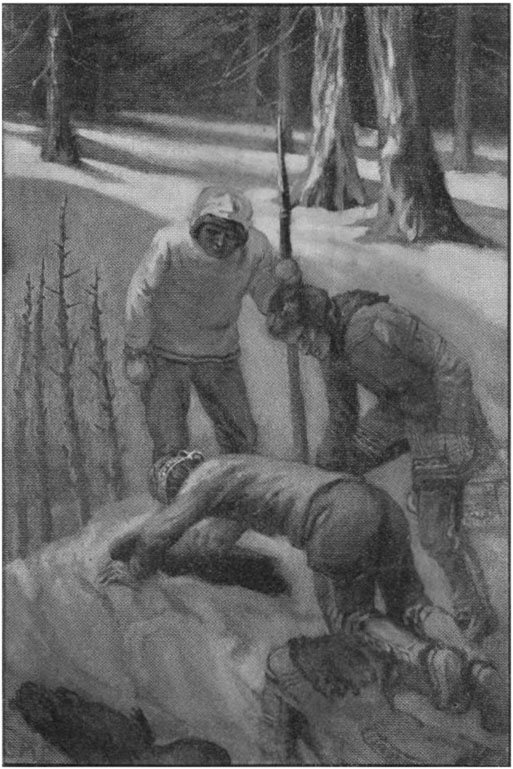
"It was dangerous work"
Though the ice was fully four feet thick Sishetakushin soon reached the water. Then the other poles that Mookoomahn had cut were driven in close to the house.
Bob understood that this was done to prevent the escape of the animals, and that they were closing the door, which was situated so far down that it would always be below the point where ice would form, so that the beavers could go in and out at will.
After these preparations were completed the Indians cleared the snow from the top of the beaver house, and then broke an opening into the house itself. Into this aperture Sishetakushin peered for a moment, then his hand shot down, and like a flash reappeared holding a beaver by the hind legs, and before the animal had recovered sufficiently from its surprise to bring its sharp teeth into action in self-defense, the Indian struck it a stinging blow over the head and killed it. Then in like manner another animal was captured and killed. It was dangerous work and called for agility and self-possession, for had the Indian made a miscalculation or been one second too slow the beaver's teeth, which crush as well as cut, would have severed his wrist or arm.
There were two more beavers—a male and a female—in the house, but these were left undisturbed to raise a new family, and the stakes that had closed the door were removed.
This method of catching beavers was quite new to Bob, who had always seen his father and the other hunters of the Bay capture them in steel traps. It was his first lesson in the Indian method of hunting.
That evening the flesh of the beavers went into the kettle, and their oily tails—the greatest tidbit of all—were fried in a pan. The Indians made a feast time of it, and never ceased eating the livelong night. This day of plenty came in cheerful contrast to the cheerless nights with scanty suppers following the weary days of plodding that had preceded. The glowing fire in the centre, the appetizing smell of the kettle and sizzling fat in the pan, and the relaxation and mellow warmth as they reclined upon the boughs brought a sense of real comfort and content.
The next day they remained in camp and rested, but the following morning resumed the dreary march to the westward.
After many more days of travelling—Bob had lost all measure of time—they reached the shores of a great lake that stretched away until in the far distance its smooth white surface and the sky were joined. The Indians pointed at the expanse of snow-covered ice, and repeated many times, "Petitsikapau—Petitsikapau," and Bob decided that this must be what they called the lake; but the name was wholly unfamiliar to him. In like manner they had indicated that a river they had travelled upon for some distance farther back, after crossing a smaller lake, was called "Ashuanipi," but he had never heard of it before.
The wigwam was pitched upon the shores of Petitsikapau Lake, where there was a thick growth of willows upon the tender tops of which hundreds of ptarmigans—the snow-white grouse of the arctic—were feeding; and rabbits had the snow tramped flat amongst the underbrush, offering an abundance of fresh food to the hunters, a welcome change from the unvaried fare of dried venison.
Bob drew from the elaborate preparations that were made that they were to stop here for a considerable time. Snow was banked high against the skin covering of the wigwam to keep out the wind more effectually, an unusually thick bed of spruce boughs was spread within, and a good supply of wood was cut and neatly piled outside.
The women did all the heavy work and drudgery about camp, and it troubled Bob not a little to see them working while the men were idle. Several times he attempted to help them, but his efforts were met with such a storm of protestations and disapproval, not only from the men, but the women also, that he finally refrained.
"'Tis strange now th' women isn't wantin' t' be helped," Bob remarked to himself. "Mother's always likin' t' have me help she."
It was quite evident that the men considered this camp work beneath their dignity as hunters, and neither did they wish Bob, to whom they had apparently taken a great fancy, to do the work of a squaw. They had, to all appearances, accepted him as one of the family and treated him in all respects as such, and, he noted this with growing apprehension, as though he were always to remain with them.
They began now to initiate him into the mysteries of their trapping methods, which were quite different from those with which he was accustomed. Instead of the steel trap they used the deadfall—wa-neé-gan—and the snare—nug-wah-gun—and Bob won the quick commendation and plainly shown admiration of the Indians by the facility with which he learned to make and use them, and his prompt success in capturing his fair share of martens, which were fairly numerous in the woods back of the lake.
But when he took his gun and shot some ptarmigans one day, they gave him to understand that this was a wasteful use of ammunition, and showed him how they killed the birds with bow and arrow. To shoot the arrows straight, however, was an art that he could not acquire readily, and his efforts afforded Sishetakushin and Mookoomahn much amusement.
"The's no shootin' straight wi' them things," Bob declared to himself, after several unsuccessful attempts to hit a ptarmigan. "Leastways I'm not knowin' how. But th' Injuns is shootin' un fine, an' I'm wonderin' now how they does un."
With no one that could understand him Bob had unconsciously dropped into the habit of talking a great deal to himself. It was not very satisfactory, however, and there were always questions arising that he wished to ask. He had, therefore, devoted himself since his advent amongst the Indians to learning their language, and every day he acquired new words and phrases. Manikawan would pronounce the names of objects for him and have him repeat them after her until he could speak them correctly, laughing merrily at his blunders.
It does not require a large vocabulary to make oneself understood, and in an indescribably short time Bob had picked up enough Indian to converse brokenly, and one day, shortly after the arrival at Petitsikapau he found he was able to explain to Sishetakushin where he came from and his desire to return to the Big Hill trail and the Grand River country.
"It is not good to dwell on the great river of the evil spirits" (the Grand River), said the Indian. "Be contented in the wigwam of your brothers."
Bob parleyed and plead with them, and when he finally insisted that they take him back to the place where they had found him, he was met with the objection that it was "many sleeps towards the rising sun," that the deer had left the land as he had seen for himself, and if they turned back their kettle would have no flesh and their stomachs would be empty.
"We are going," said Sishetakushin, "where the deer shall be found like the trees of the forest, and there our brother shall feast and be happy."
So Bob's last hope of reaching home vanished.
Manikawan's kindness towards him grew, and she was most attentive to his comfort. She gave him the first helping of "nab-wi"—stew—from the kettle, and kept his clothing in good repair. His old moccasins she replaced with new ones fancifully decorated with beads, and his much-worn duffel socks with warm ones made of rabbit skins. Everything that the wilderness provided he had from her hand. But still he was not happy. There was an always present longing for the loved ones in the little cabin at Wolf Bight. He never could get out of his mind his mother's sad face on the morning he left her, dear patient little Emily on her couch, and his father, who needed his help so much, working alone about the house or on the trail. And sometimes he wondered if Bessie ever thought of him, and if she would be sorry when she heard he was lost.
"Manikawan an' all th' Injuns be wonderful kind, but 'tis not like bein' home," he would often say sadly to himself when he lay very lonely at night upon his bed of boughs and skins.
At first Manikawan's attentions were rather agreeable to Bob, but he was not accustomed to being waited upon, and in a little while they began to annoy him and make him feel ill at ease, and finally to escape from them he rarely ever remained in the wigwam during daylight hours.
"I'm wishin' she'd not be troublin' wi' me so—I'm not wantin' un," he declared almost petulantly at times when the girl did something for him that he preferred to do himself.
Mornings he would wander down through the valley attending to his deadfalls and snares, and afternoons tramp over the hills in the hope of seeing caribou.
One afternoon two weeks after the arrival at Petitsikapau he was skirting a precipitous hill not far from camp, when suddenly the snow gave way under his feet and he slipped over a low ledge. He did not fall far, and struck a soft drift below, and though startled at the unexpected descent was not injured. When he got upon his feet again he noticed what seemed a rather peculiar opening in the rock near the foot of the ledge, where his fall had broken away the snow, and upon examining it found that the crevice extended back some eight or ten feet and then broadened into a sort of cavern.
"'Tis a strange place t' be in th' rocks," he commented. "I'm thinkin' I'll have a look at un."
Kicking off his snow-shoes and standing his gun outside he proceeded to crawl in on all fours. When he reached the point of broadening he found the cavern within so dark that he could see nothing of its interior, and he advanced cautiously, extending one arm in front of him that he might not strike his head against protruding rocks. All at once his hand came in contact with something soft and warm. He drew it back with a jerk, and his heart stood still. He had touched the shaggy coat of a bear. He was in a bear's den and within two feet of the sleeping animal. He expected the next moment to be crushed under the paws of the angry beast, and was quite astonished when he found that it had not been aroused.
Cautiously and noiselessly Bob backed quickly out of the dangerous place. The moment he was out and found himself on his feet again with his gun in his hands his courage returned, and he began to make plans for the capture of the animal.
"'Twould be fine now t' kill un an' 'twould please th' Injuns wonderful t' get th' meat," he said. "I'm wonderin' could I get un—if 'tis a bear."
He stooped and looked into the cave again, but it was as dark as night in there, and he could see nothing of the bear. Then he cut a long pole with his knife and reached in with it until he felt the soft body. A strong prod brought forth a protesting growl. Bruin did not like to have his slumbers disturbed.
"Sure 'tis a bear an' that's wakenin' un," he commented.
Bob prodded harder and the growls grew louder and angrier.
"He's not wantin' t' get out o' bed," said Bob prodding vigorously.
Finally there was a movement within the den, and Bob sprang back and made ready with his gun. He had barely time to get into position when the head of an enormous black bear appeared in the cave entrance, its eyes flashing fire and showing fight. Bob's heart beat excitedly, but he kept his nerve and took a steady aim. The animal was not six feet away from him when he fired. Then he turned and ran down the hill, never looking behind until he was fully two hundred yards from the den and realized that there was no sound in the rear.
The bear was not in sight and he cautiously retraced his steps until he saw the animal lying where it had fallen. The bullet had taken it squarely between the eyes and killed it instantly. This was the first bear that Bob had ever killed unaided and he was highly elated at his success.
It was not an easy task to get the carcass out of the rock crevice, but he finally accomplished it and outside quickly skinned the bear and cut the meat into pieces of convenient size to haul away on a toboggan when he should return for it. Then, with the skin as a trophy, he triumphantly turned towards camp.
Night had fallen when he reached the wigwam and Sishetakushin and Mookoomahn had already arrived after their day's hunt. It was a proud moment for Bob when he entered the lodge and threw down the bear skin for their inspection. They spread it out and examined it, and a great deal of talking ensued. Bob, in the best Indian he could command, explained where he had found the "mushku" and how he had killed it, and his story was listened to with intense interest. When he was through Sishetakushin said that the "Snow Brother," as they called Bob, was a great hunter, and should be an Indian; for only an Indian would have the courage to attack a bear in its den single handed. Bob had risen very perceptibly in their estimation. All doubt of his skill and prowess as a hunter had been removed. He had won a new place, and was now to be considered as their equal in the chase.
The following morning the two Indians assisted Bob to haul the bear's meat to camp. No part of it was allowed to waste. In the wigwam it was thawed and then the flesh stripped from the bones, and that not required for immediate use was permitted to freeze again that it might keep sweet until needed. The skull was thoroughly cleaned and fastened to a high branch of a tree as an offering to the Manitou. Sishetakushin explained to Bob that unless this was done the Great Spirit would punish them by driving all other bears beyond the reach of their guns and traps in future.
For several days a storm had been threatening, and that night it broke with all the terrifying fury of the north. The wind shrieked through the forest and shook the wigwam as though it would tear it away. The air was filled with a swirling, blinding mass of snow and any one venturing a dozen paces from the lodge could hardly have found his way back to it again. For three days the storm lasted, and the Indians turned these three days into a period of feasting. A big kettle of bear's meat always hung over the fire, and surrounding it pieces of the meat were impaled upon sticks to roast. It seemed to Bob as though the Indians would never have enough to eat.
Finally the storm cleared, and then it was discovered that the ptarmigans and rabbits, which had been so plentiful and constituted their chief source of food supply, had disappeared as if by magic. Not a ptarmigan fluttered before the hunter, and no rabbit tracks broke the smooth white snow beneath the bushes.
The jerked venison was gone and the only food remaining was the bear meat. A hurried consultation was held, and it was decided to push on still farther to the northward in the hope of meeting the invisible herds of caribou that somewhere in those limitless, frozen barrens were wandering unmolested.
XVIToC
ONE OF THE TRIBE
If Bob Gray had held any secret hope that the Indians would eventually listen to his plea to guide him back to the Big Hill trail it was mercilessly swept away by the next move, for again they faced steadily towards the north. Whenever he thought of home a lump came into his throat, but he always swallowed it bravely and said to himself:
"'Tis wrong now t' be grievin' when I has so much t' be thankful for. Bill'll be takin' th' silver fox an' other fur out, and when father sells un 'twill pay for Emily's goin' t' th' doctor. Th' Lard saved me from freezin', an' I'm well an' th' Injuns be wonderful good t' me. Maybe some time they'll be goin' back th' Big Hill way—maybe 'twill be next winter—an' then I'll be gettin' home."
In this manner the hope of youth always conquered, and his desperate situation was to some extent forgotten in the pictures he drew for himself of his reunion with the loved ones in the uncertain "Sometime" of the future.
On and on they travelled through the endless, boundless white, over wind-swept rocky hills so inhospitably barren that even the snow could not find a lodgment on them, or over wide plains where the few trees that grew had been stunted and gnarled into mere shrubs by winter blasts. On every hand the mountains began to raise their ragged austere heads like grim giant sentinels placed there to guard the way. Finally they turned into a pass, which brought them, on the other side of the ridge it led through, to a comparatively well-wooded valley down which a wide river wound its way northward. The trees were larger than any Bob had seen since leaving the Big Hill trail, and this new valley seemed almost familiar to him.
As they emerged from the pass a wolf cry, long and weird, came from a distant mountainside and broke the wilderness stillness, which had become almost insufferable, and to the lad even this wild cry held a note of companionship that was pleasant to hear after the long and deathlike quiet that had prevailed.
They took to the river ice and travelled on it for several miles when, rounding a bend, they suddenly came upon a cluster of half a dozen deerskin wigwams standing in the spruce trees just above the river bank. An Indian from one of the lodges discovered their approach, and gave a shout. Instantly men, women and children sprang into view and came running out to welcome them. It was a curious, medley crowd. The men were clad in long, decorated deerskin coats such as Sishetakushin and Mookoomahn wore, and the women in deerskin skirts reaching a little way below the knees, and all wearing the fringed buckskin leggings.
The greeting was cordial and noisy, everybody shaking hands with the new arrivals, talking in the high key characteristic of them, and laughing a great deal. Two of the men embraced Sishetakushin and Mookoomahn and shed copious tears of joy over them. These two men it appeared were Mookoomahn's brothers. The women were not so demonstrative, but showed their delight in a ceaseless flow of words.
When the first greetings were over Sishetakushin told the assembled Indians how Bob had been found sleeping in the snow, and that the Great Spirit had sent the White Snow Brother to dwell in their lodges as one of them. After this introduction and a rather magnified description of his accomplishments as a hunter they all shook Bob's hand and welcomed him as one of the tribe.
A few caribou had been killed, and the travellers received gifts of the frozen meat with a good proportion of fat, and that night a great feast was held in their behalf.
With plenty to eat there was no occasion to hunt and the Indians were living in idleness during the intensely cold months of January and February, rarely venturing out of the wigwams. This was not only for their comfort, but because the fur bearing animals lie quiet during this cold period of the winter and the hunt would therefore yield small reward for the exposure and suffering it would entail.
They had an abundance of tobacco and tea. Sishetakushin and his family had been without these luxuries, and it seemed to Bob that he had never tasted anything half so delicious as the first cup of tea he drank. His Indian friends could not understand at first his refusal of their proffered gifts of "stemmo"—tobacco—but he told them finally that it would make him sick, and then they accepted his excuse and laughed at him good naturedly.
Manikawan had never ceased her attentions to Bob, and the others of her family seemed to have come to an understanding that it was her especial duty to look after his comfort. From the first she had been much troubled that he had only his cloth adikey instead of a deerskin coat such as her father and Mookoomahn wore, and she often expressed her regret that there was no deerskin with which to make him one. He insisted at these times that his adikey was quite warm enough, but she always shook her head in dissent, for she could not believe it, and would say,
"No, the Snow Brother is cold. Manikawan will make him warm clothes when the deer are found."
On the very night of their arrival at the camp she went amongst the wigwams and begged from the women some skins of the fall killing, tanned with the hair on, with the flesh side as fine and white and soft as chamois. In two days she had manufactured these into a coat and had it ready for decoration. It was a very handsome garment, sewn with sinew instead of thread, and having a hood attached to it similar to the hoods worn by Sishetakushin and Mookoomahn.
With brushes made from pointed sticks she painted around the bottom of the coat a foot-wide border in intricate design, introducing red, blue, brown and yellow colours that she had compounded herself the previous summer from fish roe, minerals and oil. Other decorations and ornamentations were drawn upon the front and arms of the garment before she considered it quite complete. Then she surveyed her work with commendable pride, and with a great show of satisfaction presented it and a pair of the regulation buckskin leggings to Bob. She was quite delighted when he put his new clothes on, and made no secret of her admiration of his improved appearance.
"Now," she said, "the brother is dressed as becomes him and looks very fine and brave."
"'Tis fine an' warm," Bob assented, "an' I'm thinkin' I'm lookin' like an Injun sure enough."
Bob's aversion to Manikawan's attentions was wearing off, and he was taking a new interest in her. He very often found himself looking at her and admiring her dark, pretty face and tall, supple form. Sometimes she would glance up quickly and catch him at it, and smile, for it pleased her. Then he would feel a bit foolish and blush through the tan on his face; for he knew that she read his thoughts. But neither he nor Manikawan ever voiced the admiration that they felt for each other.
Bob was lounging in the wigwam one day a week or so after the arrival at the camp when he heard some one excitedly shouting,
"Atuk! Atuk!"
He grabbed his gun and ran outside where he met Sishetakushin rushing in from an adjoining wigwam. The Indian called to him to leave his gun behind and get a spear and follow. He could see that something of great moment had occurred and he obeyed.
The Indians from the lodges, all armed with spears, were running towards a knoll just below the camp, and Bob and Sishetakushin and Mookoomahn joined them. When they reached the top of the knoll Bob halted for a moment in astonishment. Never before had he beheld anything to compare with what he saw below. A herd of caribou containing hundreds—yes thousands—like a great living sea, was moving to the eastward.
Some of the Indians were already running ahead on their snow-shoes to turn the animals into the deep snowdrifts of a ravine, while the other attacked the herd with their spears from the side. The caribou changed their course when they saw their enemies, and plunged into the ravine, those behind crowding those in front, which sank into the drifts until they were quite helpless. From every side the Indians rushed upon the deer and the slaughter began. Bob was carried away with the excitement of the hunt, and many of the deer fell beneath his spear thrusts. The killing went on blindly, indiscriminately, without regard to the age or sex or number killed, until finally the main herd extricated itself and ran in wild panic over the river ice and out of reach of the pursuers.
In the brief interval between the discovery of the deer and the escape of the herd over four hundred animals had fallen under the ruthless spears. When Bob realized the extent of the wicked slaughter he was disgusted with himself for having taken part in it.
"'Twas wicked t' kill so many of un when we're not needin' un, an' I hopes th' Lard'll forgive me for helpin'," he said contritely.
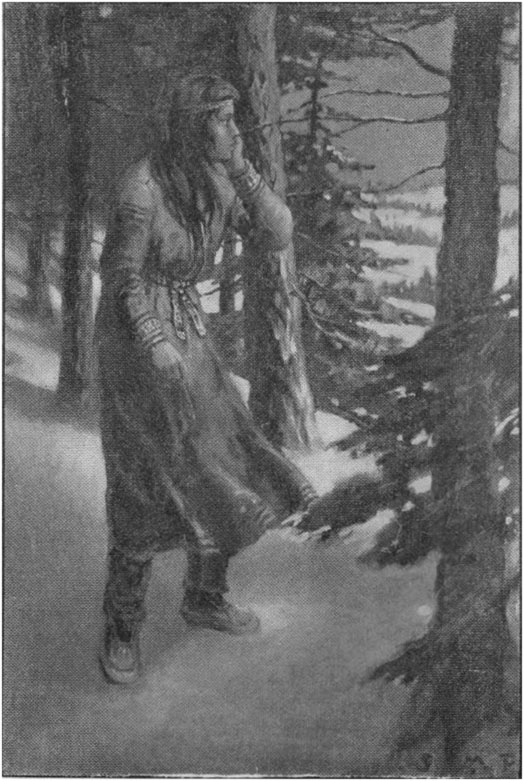
"Saw her standing in the bright moonlight"
Aside from the inhumanity of the thing, it was a terrible waste of food, for it would only be possible to utilize a comparatively small proportion of the meat of the slaughtered animals. Perhaps seventy-five of the carcasses were skinned, after which the flesh was stripped from the bones and hung in thin slabs from the poles inside the wigwams to dry. The tongues were removed from all the slaughtered animals, for they are considered a great delicacy by the Indians; and some of the leg bones were taken for the marrow they contained. The great bulk of the meat, however, was left for the wolves and foxes, or to rot in the sun when summer came.
The deer killing was followed by a season of feasting, as is always the case amongst the Indians after a successful hunt. In every wigwam a kettle of stewing venison was constantly hanging, night and day over the fire, and marrow bones roasting in the coals, and for several days the men did nothing but eat and smoke and drink tea.
It was, however, a busy time for the women. Besides curing the meat and tongues, they rendered marrow grease from the bones and put it up neatly in bladders for future use; and it fell to their lot, also, to dress and tan the hides into buckskin.
The passing deer herds brought in their wake packs of big gray and black timber wolves, and the country was soon infested with these animals. At night their howls were heard, and they came boldly to the scene of the caribou slaughter and fattened upon the discarded carcasses of the animals. Now and again one was shot. With plenty to eat, they were, however, comparatively harmless, and never molested the camp.
February was drawing to a close when one day Sishetakushin, Mookoomahn and two other Indians packed their toboggans preparatory to going on an excursion. Bob noticed the preparations with interest, and inquired the meaning of them.
"The tea and tobacco are nearly gone, and we are in need of powder and ball," Sishetakushin answered.
To get these things Bob knew they must go to a trading post, and here, he decided, was a possible opportunity for him to find a means of reaching home. He asked the Indians at once for permission to accompany them. There was no objection to this from any of them, though they told him it would be a tiresome journey, that they would travel fast, and be back in a few days.
But Bob did not propose to let any chance of meeting white men pass him, and he hurriedly got his things together for the expedition. He had no intimation of the name or location of the post they were going to further than that the Indians told him they were going to Mr. MacPherson, who was, he felt sure, a Hudson's Bay Company Factor, and he believed that if he could once reach one of the company's forts a way would be shown him to get to Eskimo Bay. That night was one of excitement and anticipation for Bob.
Manikawan seemed to read his thoughts, for the whole evening she looked troubled, and her eyes were wet when Bob said good-bye to her in the morning. As the little party turned down upon the river ice, he looked back once and saw her standing near the wigwam, in the bright moonlight, her slender figure outlined against the snow, and he waved his hand to her.
He never knew that for many days afterwards, when the dusk of evening came, she stole alone out of the wigwam and down the trail where he had disappeared to watch for his return, nor how lonely she was and how she brooded over his loss when she knew that she should never see her White Brother of the Snow again.
XVIIToC
STILL FARTHER NORTH
Bob and the Indians travelled in single file, with Mookoomahn leading, and kept to the wide, smooth pathway that marked the place where the river lay imprisoned beneath ice a fathom thick. The wind had swept away the loose snow and beaten down that which remained into a hard and compact mass upon the frozen river bed, making snow-shoeing here much easier than in the spruce forest that lay behind the willow brush along the banks. The Indians walked with the long rapid stride that is peculiar to them, and which the white man finds hard to simulate, and good traveller though he was Bob had to adopt a half run to keep their pace. They drew but two lightly loaded toboggans, and unencumbered by the wigwam and other heavy camp equipment, and with no trailing squaws to hamper their speed, an even, unbroken gait was maintained as mile after mile slipped behind them.
Not a breath of air was stirring, and the absolute quiet that prevailed was broken only by the moving men and the rhythmic creak, creak of the snow-shoes as they came in contact with the hard packed snow.
The very atmosphere seemed frozen, so intense was the cold. The moon like a disk of burnished silver set in a steel blue sky cast a weird, metallic light over the congealed wilderness. The hoar frost that lay upon the bushes along the river bank sparkled like filmy draperies of spun silver, and transformed the bushes into an unearthly multitude of shining spirits that had gathered there from the dark, mysterious forest which lay behind them, to watch the passing strangers. Presently the light of dawn began to diffuse itself upon the world, and the spirit creations were replaced by substantial banks of frost-encrusted willows. In a little while the sun peeped timorously over the eastern hills, but, half obscured by a haze of frost flakes which hung suspended in the air, gave out no warmth to the frozen earth.
No halt was made until noon. Then a fire was built and a kettle of ice was melted and tea brewed. Bob was hungry, and the jerked venison, with its delicate nutty flavour, and the hot tea, were delicious. The latter, poured boiling from the kettle, left a sediment of ice in the bottom of the tin cup before it was drained, so great was the cold.
After an hour's rest they hit the trail again and never relaxed their speed for a moment until sunset. Then they sought the shelter of the spruce woods behind the river bank, and in a convenient spot for a fire cleared a circular space, several feet in circumference, by shovelling the snow back with their snow-shoes, forming a high bank around their bivouac as a protection from the wind, should it rise. At one side a fire was built, and in front of the fire a thick bed of boughs spread. While the others were engaged in these preparations Bob and Sishetakushin cut a supply of wood for the night.
It was quite dark before they all settled themselves around the fire for supper. Two frying pans were now produced, and from a haunch of venison, frozen as hard as a block of wood, thin chips were cut with an axe, and with ample pieces of fat were soon sizzling in the pans and filling the air with an appetizing odour, and in spite of the bleak surroundings the place assumed a degree of comfort and hospitality.
After supper the Indians squatted around the fire on deerskins spread upon the boughs, smoking their pipes and telling stories, while Bob reclined upon the soft robes that Manikawan had thoughtfully provided him with, watching the light play over their dark faces framed in long black hair, and thought of the Indian girl and wondered if he was always to live amongst them, and if he would ever become accustomed to their wild, rude life.
Finally they lay down close together, with their feet towards the fire, and wrapped their heads and shoulders closely in the skins, leaving their moccasined feet uncovered, to be warmed by the blaze, and the lad was soon lost in dreams of the snug cabin at Wolf Bight. Once during the night he awoke and arose to replenish the fire. The stars were looking down upon them, cold and distant, and the wilderness seemed very solemn and quiet when he resumed his place amongst the sleeping Indians.
They were on their way again by moonlight the following morning. Shortly after daybreak they turned out of the river bed and towards noon came upon some snow-shoe tracks. A little later they passed a steel trap, in which a white arctic fox straggled for freedom. They halted a moment for Sishetakushin to press his knee upon its side to kill it and then went on. The fox he left in the trap, however, for the hunter to whom it belonged. This was the first steel trap that Bob had seen since coming amongst the Indians and he drew from its presence here that they must be approaching a trading station where traps were obtainable and in use by the hunters.
In the middle of the afternoon they turned into a komatik track, and Bob's heart gave a bound of joy.
"Sure we're gettin' handy t' th' coast!" he exclaimed.
They would soon find white men, he was sure. The track led them on for a mile or so, and then they heard a dog's howl and a moment later came out upon two snow igloos. Eskimo men, women, and children emerged on their hands and knees from the low, snow-tunnel entrance of the igloos at their approach, but when they saw that the travellers were a party of Indians, gave no invitation to them to enter, and said nothing until Bob called "Oksunie" to them—a word of greeting that he had learned from the Bay folk. Then they called to him "Oksunie, oksunie," and began to talk amongst themselves.
"They're rare wild lookin' huskies," thought Bob.
As much as Bob would have liked to stop, he did not do so, for the Indians stalked past at a rapid pace, never by word or look showing that they had seen the igloos or the Eskimos.
These new people, particularly the women, who wore trousers and carried babies in large hoods hanging on their backs, did not dress like any Eskimos that Bob had ever seen before. Nor had he ever before seen the snow houses, though he had heard of them and knew what they were. The dogs, too, were large, and more like wolves in appearance than those the Bay folk used, and the komatik was narrower but much longer and heavier than those he was accustomed to. He was surely in a new and strange land.
More igloos were seen during the afternoon, but they were passed as the first had been, and at night the party bivouacked in the open as they had done the night before.
On the morning of the third day they passed into a stretch of barren, treeless, rolling country, and before midday turned upon a well-beaten komatik trail, which they followed for a couple of miles, when it swung sharply to the left towards the river, and as they turned around a ledge of rocks at the top of a low ridge a view met Bob that made him shout with joy, and hasten his pace.
At his feet, in the field of snow, lay a post of the Hudson's Bay Company.
XVIIIToC
A MISSION OF TRUST
As Bob looked down upon the whitewashed buildings of the Post, his sensation was very much like that of a shipwrecked sailor who has for a long time been drifting hopelessly about upon a trackless sea in a rudderless boat, and suddenly finds himself safe in harbour. The lad had never seen anything in his whole life that looked so comfortable as that little cluster of log buildings with the smoke curling from the chimney tops, and the general air of civilization that surrounded them. He did not know where he was, nor how far from home; but he did know that this was the habitation of white men, and the cloud of utter helplessness that had hung over him for so long was suddenly swept away and his sky was clear and bright again.
A man clad in a white adikey and white moleskin trousers emerged from one of the buildings, paused for a moment to gaze at Bob and his companions as they approached, and then reentered the building.
As they descended the hill the Indians turned to an isolated cabin which stood somewhat apart from the main group of buildings and to the eastward of them, but Bob ran down to the one into which the man had disappeared. His heart was all aflutter with excitement and expectancy. As he approached the door, it suddenly opened, and there appeared before him a tall, middle-aged man with full, sandy beard and a kindly face. Bob felt intuitively that this was the factor of the Post, and he said very respectfully,
"Good day, sir."
"Good day, good day," said the man. "I thought at first you were an Indian. Come in."
Bob entered and found himself in the trader's office. At one side were two tables that served as desks, and on a shelf against the wall behind them rested a row of musty ledgers and account books. Benches in lieu of chairs surrounded a large stove in the centre.
"Take off your skin coat and sit down," invited the trader, who was, indeed, Mr. MacPherson of whom the Indians had told.
"Thank you, sir," said Bob.
When he was finally seated Mr. McPherson asked:
"That was Sishetakushin's crowd you came with, wasn't it?"
"Yes, sir," Bob answered.
"Where did you hail from? It's something new to see a white man come out of the bush with the Indians."
"From Eskimo Bay, sir, an' what place may this be?"
"Eskimo Bay! Eskimo Bay! Why, this is Ungava! How in the world did you ever get across the country? What's your name?"
"My name's Bob Gray, sir, an' I lives at Wolf Bight." Then Bob went on, prompted now and again by the factor's questions, to tell the story of his adventures.
"Well," said Mr. MacPherson, "you've had a wonderful escape from freezing and death and a remarkable experience. You'd better go over to the men's house and they'll put you up there. Come back after you've had dinner and we'll talk your case over. The dinner bell is ringing now," he added, as the big bell began to clang. "Perhaps I'd better go over with you and show you the way."
The men's house, as the servants' quarters were called, was a one-story log house but a few steps from the office. As Bob and Mr. MacPherson entered it, a big man with a bushy red beard, and a tall brawny man with clean shaven face, both perhaps twenty-five or thirty years of age, and both with "Scot" written all over their countenances, were in the act of sitting down to an uncovered table, while an ugly old Indian hag was dishing up a savory stew of ptarmigan.
Bob's eye took in a plate heaped high with white bread in the centre of the table and he mentally resolved that it should not be there when he had finished dinner.
"Here's some company for you," announced the factor. "Ungava Bob just ran over from Eskimo Bay to pay us a visit. Take care of him. This," continued he by way of introduction, indicating the red-headed man, "is Eric the Red, our carpenter, and this," turning to the other, "is the Duke of Wellington, our blacksmith. Fill up, Ungava Bob, and come over to the office and have a talk when you've finished dinner."
"Sit doon, sit doon," said the red-whiskered man, adding, as Mr. MacPherson closed the door behind him, "my true name's Sandy Craig and th' blacksmith here is Jamie Lunan. Th' boss ha' a way o' namin' every mon t' suit hisself. Now, what's your true name, lad? 'Tis not Ungava Bob."
"Bob Gray, an' I comes from Wolf Bight."
"Now, where can Wolf Bight be?" asked Sandy.
"In Eskimo Bay, sir."
"Aye, aye, Eskimo Bay. 'Tis a lang way ye are from Eskimo Bay! Th' ship folk tell o' Eskimo Bay a many hundred miles t' th' suthard. An' Jamie an' me be a lang way fra' Petherhead. Be helpin' yesel' now, lad. Ha' some partridge an' ye maun be starvin' for bread, eatin' only th' grub o' th' heathen Injuns this lang while," said he, passing the plate, and adding in apology, "'Tis na' such bread as we ha' in auld Scotland. Injun women canna make bread wi' th' Scotch lassies an' we ne'er ha' a bit o' oatmeal or oat-cake. 'Tis bread, though. An' how could ye live wi' th' Injuns? 'Tis bad enough t' bide here wi' na' neighbours but th' greasy huskies an' durty Injuns comin' now an' again, but we has some civilized grub t' eat—sugar an' molasses an' butter, such as 'tis."
Sandy and Jamie plied Bob with all sorts of questions about Eskimo Bay and his life with the Indians, and they did not fail to tell him a good deal about Peterhead, their Scotland home, and both bewailed loudly the foolish desire for adventure that had induced them to leave it to be exiled in Ungava amongst the heathen Eskimos and Indians in a land where "nine minths o' th' year be winter an' th' ither three remainin' minths infested wi' th' worst plagues o' Egypt, referrin' t' th' flies an' nippers (mosquitoes)."
Strange and new it all was, and while he ate and talked, Bob took in his surroundings. The room was not unlike the Post kitchen at Eskimo Bay, though not so spotlessly clean. Besides the table there were two benches, four rough, home-made chairs and a big box stove that crackled cheerily. At one side three bunks were built against the wall and were spread with heavy woollen blankets. Two chests stood near the bunks and several guns rested upon pegs against the wall. Upon ropes stretched above the stove numerous duffel socks and mittens hung to dry. The Indian woman passed in and out through a passageway that led from the side of the room opposite the door at which he had entered and her kitchen was evidently on the other side of the passageway.
Bob did not forget his resolution as to the bread, to which was added the luxury of butter, and more than once the Indian woman had to replenish the plate. When they arose from the table Jamie pointed out to Bob the bunk that he was to occupy. Then, while they smoked their pipes, they gossiped about the Post doings until the bell warned them that it was time to return to their work.
In accordance with Mr. MacPherson's instructions Bob walked over to the factor's office where he found a young man of eighteen or nineteen years of age writing at one of the desks.
"Sit down," said he, looking up. "Mr. MacPherson will be in shortly. You're the young fellow just arrived, I suppose?"
"Yes, sir," said Bob.
"You've had a long journey, I hear, and must be glad to get out. When did you leave home?"
"In September, sir, when I goes t' my trail."
"I came here on the Eric in September, and if you want to see home as badly as I do you're pretty anxious to get back there. But there isn't any chance of getting away from here till the ship comes. This is the last place God ever made and the loneliest. What did you say your name is?"
"Bob Gray, sir."
"Well, Mr. MacPherson will call you something else, but don't mind that. He has a new name for every one. He calls Sishetakushin, one of the Indians you came in with, Abraham Lincoln because he's so tall, and one of the stout Eskimos is Grover Cleveland. That's the name of an American president. Mr. MacPherson gets the papers every year and keeps posted. He received, on the ship, all last year's issues of a New York paper called the Sun besides a great packet of Scotch and English papers. But this Sun he thinks more of than any of them and every morning he picks out the paper for that date the year before and reads it as though it had just been delivered. One year behind, but just as fresh here. He finds a lot of new names in 'em to give the Eskimos and Indians and the rest of us that way. I'm Secretary Bayard, whoever he may be. I don't read the American papers much. The chief clerk is Lord Salisbury, the new premier. You know the Conservatives downed the Liberals, and Gladstone is out. Good enough for him, too, for meddling in the Irish question. I'm a conservative, or I would be if I was home. We don't have a chance to be anything here. Now, I suppose you——"
Here Mr. MacPherson entered and the loquacious Secretary Bayard became suddenly engrossed in his work. The factor opened a door leading into a small room to the right.
"Come in here, Ungava Bob," said he, "and we'll have a talk. Now," he continued when they were seated, "what do you think you'll do?"
"I don't know, sir. I wants t' get home wonderful bad," said Bob.
"Yes, yes, I suppose you do. But you're a long way from home. It looks as though you'll have to stay here till the ship comes next summer. I can send you back with it."
"'Tis a long while t' be bidin' here, sir, an' I'm fearin' as mother'll be worryin'."
"There's no way out of it that I can see, though. I'll give you work to do to pay for your keep, and I'm afraid that's the best we can do unless," continued the factor, thoughtfully "unless you go with the mail. I find I've got to send some letters to Fort Pelican. How far is that from Eskimo Bay,—a hundred miles?"
"Ninety, sir."
"Do you speak Eskimo?"
"No, sir."
"Well, the dog drivers will be Eskimos. The men that leave here will go east to the coast. They will meet other Eskimos there who will go to Pelican. It's a hard and dangerous journey. Are you a good traveller?"
"Not so bad, sir, an' I drives dogs."
Mr. MacPherson was silent for a few moments, then he spoke.
"These Eskimos are careless scallawags with letters and they lose them sometimes. The letters I am sending are very important ones or I wouldn't be sending them. I think you would take better care of them than they. Will you keep them safe if I let you go with the Eskimos?"
"Yes, sir, I'd be rare careful."
"Well, we'll see. I think I'll let you take the letters. I can't say yet just when I'll have you start but within the month."
"Thank you, sir."
"In the meantime make yourself useful about the place here. There'll be nothing for you to do to-day. Look around and get acquainted. You may go now. Come to the office in the morning and one of the clerks will tell you what to do."
"All right, sir."
When Bob passed out of doors he was fairly treading upon air. A way was opening up for him to return home and in all probability he should reach there by the time Dick and Ed and Bill came out from the trails in the spring and if they had not, in the meantime, taken the news of his disappearance to Wolf Bight, the folks at home would know nothing of it until he told them himself and would have no unusual cause for worry in the meantime. He felt a considerable sense of importance, too, at the confidence Mr. MacPherson reposed in him in suggesting that he might place him in charge of an important mail. And what a tale he would have to tell! Bessie would think him quite a hero. After all it had turned out well. He had caught a silver fox and all the other fur—quite enough, he was sure, to send Emily to the hospital. God had been very good to him and he cast his eyes to heaven and breathed a little prayer of thanksgiving.
Sishetakushin and Mookoomahn had been quite forgotten by Bob in the excitement of the arrival at the Fort. Now he saw them and the two other Indians coming over from the cabin to which they had gone when he left them to meet Mr. MacPherson, and he hurried down to meet them and tell them that he had found a way to reach home. It was plain that they did not approve of the turn matters had taken, for they only grunted and said nothing.
They turned to a building where the door stood open and Bob accompanied them and entered with them. This was the Post shop, and a young man, whom Bob had not seen before, presumably "Lord Salisbury," the chief clerk of whom the talkative "Secretary Bayard" had spoken, was behind the counter attending to the wants of an Eskimo and his wife, the latter with a black-eyed, round-faced baby which sat contentedly in her hood sucking a stick of black tobacco. The clerk spoke to the Indians in their language, said "good day" to Bob in English, and then continued his dickering in the Eskimo language with his customers, who had deposited before them on the counter a number of arctic fox pelts.
When the clerk had finished with the Eskimos he turned to the Indians in a very businesslike way and asked to see the furs they had brought. They produced some marten skins which, after a great deal of wrangling, were bartered for tobacco, tea, powder, shot, bullets, gun caps, beads, three-cornered needles and a few trinkets. Much time was consumed in this, for the Indians insisted upon handling and discussing at length each individual article purchased.
Bob had brought with him the marten skins that he had trapped during his stay with the Indians and he exchanged them for a red shawl and a little box of beads for Manikawan, a trinket for the old woman, Manikawan's mother, and a small gift each for Sishetakushin and Mookoomahn, besides some much needed clothing for himself.
These tokens of his gratitude he presented to the two Indians, who had indicated their intention of returning to the interior camp the next morning. They had not fully realized until now that Bob was actually going to leave them and attempt to reach home with the Eskimos, and they protested vigorously against the plan. Sishetakushin told him the Eskimos were bad people and would never guide him safely to his friends. Indeed, he asserted, they might kill him when they had him alone with them. On the other hand, the Indians were kind and true. They had recognized his worth and had adopted him into the tribe. With them he had been happy and with them he would be safe. He could have his own wigwam and take Manikawan for his wife; and sometimes, if he wished, he could go to visit his people.
The failure of their arguments to impress Bob was a great disappointment to the Indians, and Bob, on his part, felt a keen sense of sorrow when, the following morning, he saw his benefactors go. They had saved his life and had done all they could in their rude, primitive way for his comfort, and he appreciated their kindness and hospitality.
Ungava Bob, as every one at the Post called him, made himself generally useful about the fort and was soon quite at home in his new surroundings. He cut wood and helped the Eskimo servants feed the dogs, and did any jobs that presented themselves and soon became a general favourite, not only with Mr. MacPherson but with the clerks and servants also.
His quarters with Sandy and Jamie seemed luxurious in contrast with the rough life of the interior to which he had so long been accustomed, and when the three gathered around the red hot stove those cold evenings after the day's work was done and supper eaten, the Scotchmen held him enthralled with stories they told of their native land and the wonderful and magnificent things they had seen there.
Besides the factor and the two clerks these were the only white people at the Fort, and naturally they grew to be close companions. The white men, too, were the only ones of the Post folk that could speak English, for the few Eskimos and Indians that lived on the reservation knew only their respective native tongue.
And so the time passed until, at last, the middle of March came, with its lengthening days and stormy weather, and Bob was beginning to fear that Mr. MacPherson had abandoned the project of sending him out with a mail, for nothing further had been said about his going since the conversation on the day of his arrival. For two or three days he had been upon the lookout for a favourable opportunity to ask whether or not he was to go, and was thinking about it one Friday morning as he worked at the wood-pile, when "Secretary Bayard" hailed him:
"Hey, there, Bob! The boss wants you."
This was auspicious, and Bob hurried over to the factor's inner office, where he found Mr. MacPherson waiting for him.
"Well, Ungava Bob," the factor greeted, "are you getting tired of Ungava and anxious to get away?"
"I'm likin' un fine, sir, but wantin' t' be goin' home wonderful bad," answered Bob.
"I suppose you are. I suppose you are. I remember when I was young and first left home, how badly I wanted to go back," he said, reminiscently. "That was a long while ago and there's no one for me to go home to now—they're all dead—all dead—and it's too late."
He was silent for a little in meditation, and seemed to have quite forgotten Bob. Then suddenly bringing himself from the past to the present again, he continued:
"Yes, yes, you want to go home, and I'm going to start you on Monday morning. I'll give you a packet of very important letters that you will deliver to Mr. Forbes, the factor at Fort Pelican, and I shall hold you responsible for their safe delivery. Akonuk and Matuk will go with you as far as Kangeva, where they will try to get two other Eskimos with a good team of dogs to take you on to Rigolet. But it may be they'll have to go farther, to find drivers that know the way, and that will delay you some. You'll have time to reach Rigolet, however, before the break-up if you push on. The Eskimos will lose some time visiting with their friends when they meet them on the way, and I've allowed for that. Now, be ready to start on Monday. The clerks will fix you up with what supplies you will need for the journey."
"Yes, sir. I'll be ready, an' thank you, sir."
"Hold on," said the factor as Bob turned to go. "Here's a rifle that I'm going to let you take with you, for you may need it." He picked up a gun that had been leaning against the wall beside him. "It's a 44 repeating Winchester that I've used for three or four years, and it's a good one. I've got a heavier one now for seals and white whales, and I'll give you this if you take the letters through safely. Is that a bargain?"
Bob's eyes bulged and his pleasure was manifest.
"Yes, sir. Thank you, sir. I'll not be losin' th' letters."
It was the first repeating rifle—the first rifle, in fact, of any kind—that he had ever seen, and as Mr. MacPherson explained and illustrated to him its manipulation, he thought it the most marvellous piece of mechanism in the world.
"Now be careful how you handle it," cautioned the factor after the arm had been thoroughly described. "You see that when you throw a cartridge into the barrel by the lever action it cocks the gun, and if you're not going to discharge it again immediately you must let the hammer down. It shoots a good many times farther, too, than your old gun, so be sure there are no Eskimos within half a mile of its muzzle or you'll be killing some of them, and I don't want that to happen, for I need them all to hunt. Besides, if you killed one of them his friends would be putting you out of the way so you'd kill no more, and then my packet of letters wouldn't be delivered. Now look out."
"I'll be rare careful of un, sir."
"Very well, see that you are. Be ready to start, now, at daylight, Monday."
"I'll be ready, sir."
Bob's delight was little short of ecstatic as he strode out of the office with his rifle.
The next day (Saturday) "Secretary Bayard," with voluminous comments and cautions in reference to the undertaking, the Eskimos and things in general, helped him and the two Eskimos that were to accompany him put in readiness his supplies, which consisted of hardtack, jerked venison, fat pork—the only provisions they had which would not freeze—tea, two kettles, sulphur matches, ammunition, and a reindeer skin sleeping bag. The Eskimos possessed sleeping bags of their own. Blubber and white whale meat, frozen very hard, were packed for dog food.
An axe, a small jack plane and two snow knives were the only tools to be carried. This knife had a blade about two feet in length and resembled a small, broad-bladed sword. It was to be used in the construction of snow igloos. The jack plane was needed to keep the komatik runners smooth.
Instead of the runners being shod with whale-bone, as in many places in the North, the Eskimos of Ungava apply a turf—which is stored for the purpose in the short summer season—and mixed with water to the consistency of mud. This is moulded on the runners with the hands in a thick, broad, semicircular shape, and freezes as hard as glass. Then its irregularities are planed smooth, and it slips easily over the snow and ice.
Finally, all the preparations were completed, and Bob looked forward in a high state of excited anticipation to the great journey of new experiences and adventures that lay before him to be crowned by the joy of his home-coming.
But a thousand miles separated Bob from his home and danger and death lurked by the way. Human plans and day-dreams are not considered by the Providence that moulds man's fortune, and it is a blessed thing that human eyes cannot look into the future.
XIXToC
AT THE MERCY OF THE WIND
In the starlight of Monday morning Akonuk and Matuk harnessed their twelve big dogs. Fierce creatures these animals were, scarcely less wild than the wolves that prowled over the hills behind the Fort, of which they were the counterpart, and more than once the Eskimos had to beat them with the butt end of a whip to stop their fighting and bring them to submission.
The load had already been lashed upon the komatik and the mud on the runners rubbed over with lukewarm water which had frozen into a thin glaze of ice that would slip easily over the snow.
Mr. MacPherson gave Bob the package of letters, with a final injunction not to lose them when at length the dogs were harnessed and all was ready. Good-byes were said and Bob and his two Eskimo companions were off.
The snow was packed hard and firm, so that neither the dogs nor the komatik broke through, and the animals, fresh and eager, started at a fast pace and maintained an even, steady trot throughout the day.
Occasionally there were hills to climb, and some of these were so steep that it was necessary for Bob and the Eskimos to haul upon the traces with the dogs, and now and then they had to lift the komatik over rocky places, and on one river that they crossed they were forced to cut in several places a passage around ice hills, where the tide had piled the ice blocks thirty or forty feet high. But for the most part the route lay over a rolling country near the coast.
Only at long intervals were trees to be seen, and these were very small and stunted, and grew in sheltered hollows. At noon they halted in one of these hollows to build a fire, over which they melted snow in one of the kettles and made tea, with which they washed down some hardtack and jerked venison.
That night when they stopped to make their camp, sixty miles lay behind them. The going had been good and they had done a splendid day's work.
Before unharnessing the dogs, which would have immediately attacked and destroyed the goods upon the sledge had they been released, the Eskimos went about building an igloo.
A good bank of snow was selected and out of this Akonuk cut blocks as large as he could lift and placed them on edge in a circle about seven feet in diameter in the interior. As each block was placed it was trimmed and fitted closely to its neighbour. Then while Matuk cut more blocks and handed them to Akonuk as they were needed, the latter standing in the centre of the structure placed them upon edge upon the other blocks, building them up in spiral form, and narrowing in each upper round until the igloo assumed the form of a dome. When it was nearly as high as his head, the upper tier of blocks was so close together that a single large block was sufficient to close the aperture at the top. This block was like the keystone in an arch, and held the others firmly in place. Akonuk now cut a round hole through the side of the igloo close to the bottom, and large enough for him to crawl through on his hands and knees.
When the Eskimos began building the snow house Bob commenced unloading the komatik, but Matuk called "Chuly, chuly,"—wait a little—to him, and said "tamaany,"—here—a suggestion that he would be more useful in helping to chink up the crevices between the blocks of snow on the igloo after Akonuk placed them This he did, and in half an hour from the time they halted the igloo was completed and was so strongly built a man could have stood on its top without fear of breaking it down.
The tops of spruce boughs were now cut and spread within, after which they unlashed the komatik, and, covering the bed of boughs with deerskins, stored everything that the dogs would be likely to destroy safely inside the igloo. This done the dogs were unharnessed and fed, the men standing over the animals with stout sticks to prevent their fighting while they ravenously gulped down the chunks of frozen whale meat.
This function completed, a fire was made outside the igloo and tea brewed. With the kettle of hot tea the three crawled into the igloo, dragging after them a block of snow which Akonuk fitted neatly into the entrance and chinked the edges with loose snow.
Matuk now brought forth an Eskimo lamp into which he squeezed the oil from a piece of seal blubber, first pounding the blubber with the axe head, and with moss to serve the purpose of a wick, the lamp was lighted. This lamp, which was made of stone cut in the shape of a half moon, was about ten inches long, four inches wide and an inch deep. The moss that served as a wick was arranged along the straight side, and gave out a strong, fishy odour as it burned.
Besides the tea, hardtack and jerked venison, Bob ate pieces of the frozen fat pork which had been boiled before starting, and found it very delicious, as fat always is to a traveller in the far North. The Eskimos each accepted a small piece of it from him, but when he offered them a second portion they both said "Taemet,"—Thank you, enough—and instead helped themselves liberally to raw seal blubber, which they ate with an evident relish and gusto along with the jerked venison and hardtack.
Akonuk, the older of these men, was perhaps thirty-five years of age, nearly six feet in height and well proportioned. Matuk was not so tall, but like Akonuk was well formed. Both were muscular and powerful men physically, and both had round, fat faces that were full of good nature.
Intense as was the cold out of doors, the stone lamp soon made the igloo so warm within that all were compelled to remove their outer skin garments. The snow, however, was not melted, but remained quite hard and firm.
The Eskimos talked and smoked for a whole hour after supper, before stretching in their sleeping bags, but Bob crawled into his almost immediately, for he was very weary after his long day's travel. His knowledge of their language was not sufficient for him to take part in the conversation, or, indeed, to understand much they said, and the constant talk soon became tiresome to him, though he kept his ears open with a view to adding to his Eskimo vocabulary whenever an opportunity offered.
"'Tis a strange language an' I'm wonderin' how they understands un," he observed as he turned over to go to sleep.
Very early the next morning he heard Akonuk calling to Matuk to wake up. Then for a little while the two Eskimos conversed together and finally the lamp was lighted. Over this a snow knife was stuck into the side of the igloo and the kettle hung upon the knife in such a position that it was directly over the flame, and snow, cut from the side of the igloo near the bottom, was melted for tea, and thus the simple breakfast was prepared without going out of doors.
When Bob came out of his bag to eat he realized that a storm was raging outside, for he could hear the wind roaring around the igloo, and Akonuk made him understand that a heavy snow-storm was in progress and a continuation of the journey that day quite out of the question. When daylight finally filtered dimly through the igloo roof, he removed the snow block that closed the entrance, and crawled to the outer world, where he verified Akonuk's statement.
The air was so filled with snow that it would be quite useless to attempt to move in it. The previous night the dogs had dug holes for themselves in the bank and were now completely covered with the drift, and invisible, and the komatik, too, was quite hidden. The aspect was dreary in the extreme, and he returned to spend the day dozing in his sleeping bag.
For two days they were held prisoners by the storm, and when finally the third morning dawned clear and cold, a deep covering of soft snow had spoiled the good going and they found travelling much slower and more difficult than the day they started.
Akonuk and Bob ran ahead on their snow-shoes to break the way for the dogs, which Matuk drove, and found it necessary to constantly urge the animals on with shouts of "Oo-isht! Oo-isht! Ok-suit! Ok-suit!" and sometimes with stinging cuts of his long whip. This whip was made of braided strands of walrus hide, and tapered from a thickness of two inches at the butt to one long single strand at the tip. Its handle was a piece of wood about a foot long and the whole whip was perhaps thirty-five feet in length. When not in use a loop on the handle was dropped over the end of one of the forward crosspieces of the komatik, and its lash trailed behind in the snow. Here it could be readily reached and brought into instant service. Matuk was an expert in the manipulation of this cruel instrument, and the dogs were in deadly fear of it. When he cracked it over their heads they would plunge madly forward and whine piteously for mercy. When he wished to punish a dog he could cut it with the lash tip even to the extent of breaking the skin, if he desired, and he never missed the animal he aimed at.
Each dog had an individual trace which was fastened to a long, single thong of sealskin attached to the front of the komatik. These traces were of varying length, the leader, or dog trained to the Eskimos' calls, having the longest trace, which permitted it to go well in advance of the others.
For several days the journey was monotonous and uneventful. Gradually as they advanced the travelling improved again, as the March winds drifted away the soft, loose snow and left the bottom solid and firm for the dogs.
Ptarmigans were plentiful, as were also arctic hares, and a white fox and one or two white owls were killed. The flesh of all these they ate, and were thus enabled to keep in reserve the provisions they had brought with them. Bob was rather disgusted than amused to see the Eskimos eat the flesh of animals and birds raw. They appeared to esteem as a particular delicacy the freshly killed ptarmigans, still warm with the life blood, eating even the entrails uncooked.
One afternoon they turned the komatik from the land to the far stretching ice of a wide bay directing their course towards a cove on the farther side, where the Eskimos said they expected to find igloos.
All day a stiff wind had been blowing from the southwest and as the day grew old it increased in velocity. The komatik was taking an almost easterly course and therefore the wind did not seriously hamper their progress, though it was bitter cold and searching and made travelling extremely uncomfortable.
Less than half-way across the bay, which was some twelve miles wide, a crack in the ice was passed over. Presently cracks became numerous, and glancing behind him Bob noticed a wide black space along the shore at the point where they had taken to the ice, and could see in the distance farther to the northwest, as it reflected the light, a white streak of foam where the angry sea was assailing the ice barrier. He realized at once that the wind and sea were smashing the ice.
They were far from land and in grave peril. The Eskimos urged the dogs to renewed efforts, and the poor brutes themselves, seeming to realize the danger, pulled desperately at the traces.
After a time the ice beneath them began to undulate, moving up and down in waves and giving an uncertain footing. Between them and the cove they were heading for, but a little outside of their course, was a bare, rocky island and the Eskimos suddenly turned the dogs towards it. The whole body of ice was now separated from the mainland and this island was the only visible refuge open to them. Behind them the sea was booming and thundering in a terrifying manner as it drove gigantic ice blocks like mighty battering rams against the main mass, which crumbled steadily away before the onslaught.
It had become a race for life now, and it was a question whether the sea or the men would win. Once a crack was reached that they could not cross and they had to make a considerable detour to find a passage around it, and it looked for a little while as though this sealed their fate, but with a desperate effort they presently found themselves within a few yards of the island.
Here a new danger awaited them. The ice upon the shore was rising and falling and crumbling against the rocks with each incoming and receding sea. To successfully land it would be necessary to make a dash at the very instant that the ice came in contact with the shore. A moment too soon or a moment too late and they would inevitably be crushed to death. It was their only way of escape, however. The howling dogs were held in leash until the proper moment, and all prepared for the run.
Akonuk gave the word. The dogs leaped forward, the men jumped, and they found themselves ashore. The three grabbed the traces and helped the dogs jerk the komatik clear of the next sea, and all were at last safe.
Five minutes later a landing would have been impossible, and two hours later the entire bay surrounding their island was swept clear of ice by the gale and outgoing tide.
During the whole adventure the Eskimos had conducted themselves with the utmost coolness and gave Bob confidence and courage. Dangers of this kind had no terrors for them for they had met them all their lives.
They had landed upon the windward side of the island at a point where they were exposed to the full sweep of the gale.
"Peungeatuk"—very bad—said Akonuk.
Then he told Bob to remain by the dogs while he and Matuk looked for a sheltered camping place. In half an hour Matuk returned, his face wreathed in smiles, with the information,
"Innuit, igloo."
Then he and Bob drove the dogs to the lee side of the island, where they found four large snow igloos and several men, women and children, standing outside waiting to see the white traveller.
The Eskimos received Bob kindly, and they asked him inside while some of the men helped Akonuk and Matuk erect an igloo and fix up their camp.
The several igloos were all connected by snow tunnels, which permitted of an easy passage from one to the other without the necessity of going out of doors. A piece of clear ice, like glass, was set into the roof of each to answer for a window. They were all filled with a stench so sickening that Bob soon made an excuse to go outside and lend a hand in unpacking and helping Akonuk and Matuk make their own snow house ready.
There were no boughs here for a bed, as the island sustained no growth whatever, and in place of the boughs the dog harness was spread about before the deerskins were put down. In a little while the place was made quite comfortable.
It was not until they sat down to supper that Bob realized fully the serious position they were in. Akonuk and Matuk, after much difficulty, for he could understand their Eskimo tongue so imperfectly, explained to him that there was no means of reaching the mainland as there were no boats on the island, and that after the food they had was eaten there would be no means of procuring more, as the island had no game upon it. They also told him that no one would be passing the island until summer and that there was therefore no hope of outside rescue.
But one chance of escape was possible. If the wind were to shift to the northward and hold there long enough it would probably drive the ice back into the bay and then it would quickly freeze and they could reach the mainland. This their only hope, at this season of the year, for March was nearly spent, was a scant one.
XXToC
PRISONERS OF THE SEA
The party of Eskimos that Bob and his companions found encamped upon the island had come from the Kangeva mainland to spear seals through the animals' breathing holes in the ice, which in this part of the bay were more numerous than on the mainland side. In the few days since they had established themselves here they had met with some success, and had accumulated a sufficient store of meat and blubber to keep them and their dogs for a month or so, but further seal hunting, or hunting of any kind, was now out of the question, as no animal life existed on the island itself, and without boats with which to go upon the water the people were quite helpless in this respect.
Limited as was their supply of provisions, however, they unselfishly offered to share with Bob and his two companions the little they had, as is the custom with people who have not learned the harder ways of civilization and therefore live pretty closely to the Golden Rule. This hospitality was a considerable strain upon their resources, for the twelve dogs in addition to their own would require no small amount of flesh and fat to keep them even half-way fed; and the whale meat that had been brought for the dogs from Ungava Post was nearly all gone.
Akonuk had been instructed by Mr. MacPherson to discover the whereabouts of these very Eskimos and arrange with two of them to go on with Bob, after which he and Matuk were to secure from them food for themselves and their team and return to Ungava.
A good part of the hardtack, boiled pork and venison still remained, for, as we have seen, the game they had killed on the way had pretty nearly been enough for their wants. It was fortunate for Bob that they had these provisions, which required no cooking, for otherwise he would have had to eat the raw seal as the Eskimos did. They understood his aversion to doing this, and generously, and at the same time preferably, perhaps, ate the uncooked meat themselves, and left the other for him.
March passed into April, and daily the situation grew more desperate, as the provisions diminished with each sunset. Bob was worried. It began to look as though he and the Eskimos were doomed to perish on this miserable island. He was sorry now that he had not waited at Ungava for the ship, and been more patient, for then he would have reached Eskimo Bay in safety. At first the Eskimos were very cheerful and apparently quite unconcerned, and this consoled him somewhat and made him more confident; but finally even they were showing signs of restlessness.
Every day he was becoming more familiar with their language and could understand more and more of their conversation, and he drew from it and their actions that they considered the situation most critical. Back of the igloos was a hill a couple of hundred feet high, and many times each day the men of the camp would climb it and look long and earnestly to the north, where the heaving billows of Hudson Straits and the sky line met, broken only here and there by huge icebergs that towered like great crystal mountains above the water. They were watching for the ice field that they hoped would drift down with each tide to bridge the sea that separated them from the distant mainland.
The early April days were growing long and the sun's rays shining more directly upon the world were gaining power, though not yet enough to bring the temperature up to zero even at high noon, but enough to remind the men that winter was aging, and the ice hourly less likely to come back.
One of the Eskimos, Tuavituk by name, was an Angakok, or conjurer, and claimed to possess special powers which permitted him to communicate with Torngak, the Great Spirit who ruled their fortunes just as the Manitou rules the fortunes of the Indians. Tuavituk one day announced to the assembled Eskimos that something had been done to displease Torngak, and to punish them he had caused the storm to come that had so suddenly carried away the ice and left them marooned upon this desolate island, and here they would all perish eventually of starvation unless Torngak were appeased.
This announcement occasioned a long discussion as to what the cause of their trouble could have been. One old Eskimo suggested that the ice had broken up at the very moment that the kablunok—stranger—arrived, and that his presence was undoubtedly the disturbing influence. White men, he said, showed no respect for Torngak, and it was quite reasonable, therefore, that Torngak should resent it and wish not only to destroy the white men, but punish the innuit who gave the kablunok shelter or assistance. If this were the case they could only hope for relief after first driving Bob from their camp. When once purged of his presence Torngak would be satisfied, he would send the ice back into the bay and they would be enabled to return to the mainland and to renew their hunting.
A long discussion followed this harangue in which all the men took part with the exception of Tuavituk, who as Angakok reserved his opinion until it should be called for in a professional way; and all agreed with the first speaker save Akonuk and Matuk, who, being visitors, spoke last.
Akonuk asserted that he and Matuk had travelled with the kablunok all the way from Ungava and had enjoyed during that time not only perfect safety and comfort, but had made an unusually quick and lucky journey, killing all the ptarmigans and small game they wanted, and experiencing with the exception of one snow-storm excellent weather until they approached Kangeva. Then the ill wind blew upon them and brought disaster as they came to the camp on the island; therefore it seemed quite certain that not the kablunok but some of the innuit in the camp had offended the great Torngak, and amongst themselves they must look for the cause of their misfortune.
Matuk followed this speech with an address in which he bore out Akonuk's statements, and, doubtless having in mind Bob's plentiful supply of tea, of which beverage Matuk was passionately fond and partook freely, he stated it as his opinion that the presence of the kablunok had actually been the source of the good luck they had had previous to their arrival at Kangeva. Then he wound up with the startling announcement that he believed he knew the cause of Torngak's anger: that on the very day of their arrival he had seen Chealuk—one of the old women—sewing a netsek—sealskin adikey—with the sinew of the tukto—reindeer.
Every one turned to Chealuk for confirmation and she said simply,
"It is true."
The Eskimos were struck dumb with horror. This, then, was the cause of their trouble. For the women to work with any part of the reindeer while the men were hunting seals was one of the greatest affronts that could be offered the Great Spirit. Torngak had been insulted and angered. He must be appeased and mollified at any cost.
Tuavituk, the Angakok, it was decided, must do some conjuring. He must get into immediate communication with Torngak and learn the spirit's wishes and demands and what must be done to dispel the evil charm that Chealuk had worked by her thoughtlessness. Tauvituk was quite willing—indeed anxious—to do this, but he demanded to be well paid for it, and every man had to contribute some valuable pelt or article of clothing.
When all preparations for the seance had been made the Angakok's head was covered and in a few moments he began to utter untelligible exclamations, which were shortly punctuated by shouts and screams and ravings. He fell to the floor and seemed stricken with a fit, and Bob thought the man had gone stark mad. He struck out and grasped those within his reach, and they were glad to escape from his iron clutch. For several minutes this wild frenzy lasted before he said an intelligible word.
"The deer! The deer! The deer's sinew! Chealuk! Chealuk! Chealuk! Torngak! The evil spirit is in Chealuk! She must go! Must go! Send Chealuk away! Send her away! Send her away! Send her away!"
Finally from sheer exhaustion he quieted down and came out of his trance. He probably thought that he had given them their value's worth and what they had wanted, and that they should be satisfied.
It was now decreed that, this being the direct command of Torngak, Chealuk must be expelled from the camp. Some even asserted that she should be killed, but the majority decided that as Torngak had said merely that "Chealuk must go" that meant only that she must be sent away. If this did not prove sufficient to counteract their ill luck, why she could, after a reasonable time, be sought out and dispatched, if she had not in the meantime perished.
The feeble old woman heard it all with outward stoic indifference. It was a part of her religion and she probably thought the punishment quite just, and whatever shrinking of spirit she felt, she hid it heroically from the others. To have been killed immediately would have been more humane than banishment, for the latter only meant a slower but just as sure a death, from exposure and starvation.
To Bob, who had listened intently and was able to grasp the situation in a general way, it seemed heartless in the extreme; but his protests would not only have been powerless to move the Eskimos from their purpose, but in all probability would have worked harm for himself and to no avail. These people that at first had seemed so amiable and hospitable, and almost childlike in their nature, had been by their heathen superstitions suddenly transformed into cruel, unsympathetic savages.
"Oh," thought Bob, "if I had but heeded Sishetakushin's warning!"
But it was too late now to repent of the course he had taken and he had only to abide by it. It seemed to him that his own life hung by a mere thread and that at any moment some fancy might strike them to sacrifice him too. He had indeed but barely escaped Chealuk's fate, and the next time he might not be so fortunate.
In this disturbed state of mind he withdrew from the igloos and climbed the hill, where he stood and gazed longingly at the mainland hills to the southward, wondering where, beyond those cold, white ranges, lay Wolf Bight and his little cabin home, warm and clean and tidy, and whether his mother and father and Emily thought him safe or had heard of his disappearance and were mourning him as dead. And here he was far, far away in the north and hopelessly—apparently—stranded upon a desolate island from which he would probably never escape and never see them again.
Oh, how lonely and disconsolate he felt. Every day since he left home he had prayed God to keep the loved ones safe and to take him back to them.
"I hopes they're safe an' Emily's better, but th' Lard's been losin' track o' me," he said to himself with a wavering faith.
"But th' Lard took me safe t' Ungava, an' He must be watchin' me," he exclaimed after further thought. "An' He's been rare good t' me."
Then like a bulwark to lean against there came to him the words of his mother as they parted that beautiful September morning:
"Don't forget your prayers, lad, an' remember your mother's prayin' for you every night an' every mornin'."
And Emily had said, too, that she would ask God every night to keep him safe. This brought him a renewal of his faith and he argued,
"Th' Lard'll sure not be denyin' mother an' Emily, an' they askin' He every day t' bring me back. He sure would not be denyin' they for He knows how bad 'twould be makin' they feel if I were not comin' home. An' He wouldn't be wantin' that, for they never does nothin' t' make He cross with un."
This thought comforted him and he said confidently to himself,
"Th' Lard'll be showin' th' way when th' right time comes an' I'll try t' bide content till then."
But there was little in the surroundings to warrant Bob's faith. Looking about him from the hilltop he could see nothing but open sea around the island with an expanse of desolation beyond—snow, snow everywhere, from the water's edge to where the rugged mountains to the south and east held their cold heads into the gray clouds that hid the sky and sun. The sea was sombre and black. Not a breath of air stirred, not a sound broke the silence, and it seemed almost as though Nature in anxious suspense watched the outcome of it all. But Bob's faith was renewed—the simple, childlike faith of his people—and he felt better and more content with himself and his fortune.
It was growing dusk when he returned to the igloos. As he descended the hill a flake of snow struck his face and it was followed by others. A breath of wind like a blast from a bellows swirled the flakes abroad. The elements were awakening.
In the igloos Akonuk and Matuk were brewing tea for supper and the three ate in silence.
Bob asked once,
"What's to be done with Chealuk?"
"Nothing," they answered laconically.
This relieved the anxiety he felt for her, and he crawled into his sleeping bag and went to sleep, thinking that after all the judgment of the Angakok was a mere form, not to be executed literally.
After some hours Bob awoke. The wind was blowing a gale outside. He could hear it quite distinctly. From what direction it came he could not tell, and after lying awake for a long while he decided to arise and see.
When he removed the block of snow from the igloo entrance and crawled outside he was all but smothered by the swirling snow of a terrific, raging blizzard. He turned his back to the blast, and realized that it came from the north-east. The cold was piercing and awful. The elements which had been held in subjection for so long were unleashed and were venting themselves with all the untamed fury of the North upon the world.
As he turned to reënter the igloo an apparition brushed past him rushing off into the night.
"Who is it?" he shouted.
But the wind brought back no answer and overcome with a feeling of trepidation and a sense of impending tragedy, half believing that he had seen a ghost, he crawled back to his cover and warm sleeping bag to wonder.