Front matter (continued 3)
Reading edition
One bone four feet long, he told them, and weighing several hundred pounds, had been found in fragments in the shale, but it had been fitted together again, done up in plaster bandages and braced with splints, quite as a surgeon treats a broken leg. Another, found embedded in solid rock, had to be shipped in the rock, each piece being numbered as it was removed from the cliff as an aid to fitting it together again. Then with hammer and chisel the delicate feat of cutting away the rock and leaving the bone exposed was slowly and painstakingly accomplished. Thus have the bones buried before ever man trod the earth been made to tell their story. Often it takes more than a single specimen to reconstruct for the scientist the whole of the creature, but relics of fully thirty Triceratops have been discovered in different parts of the world, and where one skull has a broken nose, another shows it intact, and so on through its entire anatomy.
Its habits may in part be reasoned out, as for instance, if its hind legs are disproportionately long, it likely walked erect at least sometimes.
“That, as it happens, was not the case with Triceratops,” he added. “There was only a slight difference between his fore and hind legs. Triceratops had teeth made for browsing, not for rending flesh; his single claw, round and blunt, does not indicate any pugnacious tendency on his part, and the solidity of his bones are found to-day in either a very sluggish animal or a partially aquatic one. The shape and rapid taper of the tail vertebræ indicates a rather short tail, round rather than flat,—ill adapted for swimming,—and so following through the list, till we have a Triceratops elephantine in general build, though more like a rhinoceros in face with a horn over his nose and two over his eyes, a horn-supported neck ruff, and a generally sluggish mode of life.
“In the coal fields complete imprints of Ichthyosauria have been found, doubtless due to the carbonization of the animal matter. And impressions have been left in stone of the very feathers worn by some of the now fossilized creatures.”
It was by comparison of fossil remains that the well known evolution of the horse from a little fellow the size of a fox was learned. Ted often thought of that three-toed Miocene horse, and the giant monsters of his time,—of the upthrust of the Rocky Mountains, cutting off the moist sea breeze from the marshy country to the Eastward and making desert of it. This made life too hard for the heavy, slow-witted creatures, and they failed to survive the change. But the nimble footed little horse trotted long distances with ease, to find food and water.
Norris convulsed them by describing the creature on which he declared the aeroplane was modeled,—the pteranodon, that giant lizard, largest of flying creatures even in Mesozoic age, whose bat-like wings reached 20 feet from tip to tip,—as the fossil skeletons plainly prove.
This interesting specimen was a link in the chain between the birds of to-day and their ancestral archeopteryx, no larger than a crow whose front legs metamorphosed to short wings, whose skeletons have been found perfectly preserved in the limestone.
Ted was frantic for fear they would not find the place again, then could hardly wait to hear the Geological Survey man’s pronouncement on his find. Norris chipped and chipped, with knife and hammer, till he had uncovered the impress of a great, membranous wing.
It was a fossil dinosaur,—a pterodactyl!
Ted’s college education was secure!
CHAPTER X
HOW THE EARTH WAS MADE
Ted’s fossil would have to wait to be exhumed. In fact, Norris told him, he could sell it as it stood, and let the purchaser do the work. Then it occurred to him to wonder if Ted would not have first to take up a claim,—for it was Government land. Anyway, he would see to it that the boy was rewarded for his find.
The fire now being extinguished, Radcliffe had flown to other battle lines, first taking Rosa—as she insisted—back to her fire outlook. The plan was for the two boys to keep on hunting for the Mexicans, (as the harried Ranger now counted on their doing), joining the rest of the camping party every night, at points they would agree upon. But first, Ace had made a flight to Fresno for supplies and to start his pilot home by train. He then carried them one at a time to where the burros had been left,—and where the lazy rascals still browsed on the rich mountain meadows.
For a day or two, all the boys could talk, think or dream about was the adventures they had just been through. But at last they had relieved their minds to some extent, and one evening around the fire, Norris gave them his long promised explanation of some of the natural wonders they had seen.
“I have already told you,” began Norris, “how the earth probably originated. That much the astronomer has given us. And before the geologist can begin to interpret the evolution of our earth, he has to know what scientists have established in the fields of chemistry, mechanics and geodesy,—the study of the curvature and elevation of the earth’s surface. He then proceeds to theorize, hand in hand with the paleontologist, or student of ancient life. The newest theory is in line with what I learned in 1917 at Yale.”
“It’s all theory, then?” asked Ted.
“Just as all sciences are, to some extent. Did I tell you that when our planetary system was disrupted from the sun, it was less than a hundredth part of the parent body? And our earth is a good deal less than a millionth of the size of our sun, and our sun is among the smaller of the stars of the firmament.”
“Phew!” whistled Long Lester, round eyed, while Ted and Pedro sat motionless.
“Picture the earth and moon, revolving about the sun, gathering by force of their own gravity-pull the tiny planetesimals nearest them, these bodies hurling themselves into the earth mass at the rate of perhaps ten miles a second!––”
“It shore must have het things up some,” said Long Lester.
“It did! Literally melted the rocks. On top of that, this original earth mass, composed of molten rock and gases and water vapor, was condensing. Probably by the time it had engulfed all the stray planetesimals it could, it was anywhere from 200 to 400 times as large as it is now. It has been shrinking ever since.”
“Is it still shrinking?” gasped the old prospector.
“Sure thing! But not so fast that you will ever know the difference in your lifetime. It only shrinks at times; then the earth’s surface wrinkles into mountain ranges.”
“How many times has that been, sixteen?” suggested Ace.
“We’ll come to that. As I was going to say, while the earth was so hot, it kept boiling, as it were, inside, and the molten matter kept breaking through the cold outer shell in volcanoes, as the heat rose to the surface.”
“Thet sure must have been hell,” laughed the old man.
“As the cold crust was churned into the hot interior, of course it melted and expanded, and that caused more volcanoes, and so on in a vicious circle, till finally, by the end of the Formative Era, so called, the rock that contained more heavy minerals sank to the lower levels, while the lighter ones rose as granite.”
“Gee!” said Ted, “I’d have called granite heavy.”
“Not so heavy as the specimens of basic rock we’ll find. Well, in this Formative Era our atmosphere, and the hydrosphere or oceanic areas were being formed, along with the granite continents. But while we are on the subject, I hope you boys will some day see The Valley of Ten Thousand Smokes, in Alaska, where the earth is still boiling so close to the surface that you have to watch your step or you’ll break through into––”
“The Hot Place?” laughed Pedro.
“Literally, yes.”
“Oh, tell us about that!”
“Some time!—The interior of the earth is still hot, but the rock crust allows very little of it to rise to the surface. After the Formative Era came the Archeozoic Era, when life began in the form of amœbas or some simple form of protoplasm. For with the formation of the gases of the earth mass into an envelope of air, to moderate the sun’s warmth by day and retain some of it by night,—life became possible.”
“But where did those first creatures come from?” Ted could not restrain himself from asking.
“According to one theory, the first germs of life flew here from some other planet, and not necessarily one of those revolving around our own sun, for space is full of suns and planetary systems. But that theory can neither be proved nor disproved. When I was a student, Osborn’s theory was the latest. That was in 1916. Without going into it too deeply, it had to do with the electric energy of the chemical elements that compose protoplasm, and these always had been latent in the earth mass.”
“Then they must have been latent in the sun, too,” marveled Ted. “And in other suns and their planets too.”
“Very likely,” assented the Geological Survey man. “Now of course the ocean waters collected in the depressed areas over the heavier rock bottoms, the basalt. You remember just after we lost the burro we were on a basalt formation––”
“Then that was formerly a part of the ocean floor?” asked Ted.
“Either that or volcanic lava.”
“But how did it––”
“Just a minute. Of course land masses have gone down as well as up, but the general trend has been decidedly upward, while the trend of the ocean floor has been downward. At that, the shell of the earth—so to speak—is only about 150 miles thick or a fiftieth of the earth’s present diameter.”
“Then I should think the oceans would be growing deeper,” ventured Pedro.
“Right again. When this earth reaches its old age,—speaking in terms of centuries,—it will likely be all ocean. And there used to be far more land, in proportion, than there is now. There was less ocean water then because of all that is continually pouring through hot springs.
“Of course the land is slowly being washed back into the ocean. And the higher the mountains, the steeper the stream beds, and hence the faster the streams, and the faster they erode the high elevations, till finally all is reduced to sea level again.”
“Then how do the mountains get rebuilt?” Pedro testified his interest.
“The earth has, as I think I said before, shrunk between 200 and 400 miles in diameter,—since the beginning,—‘when the earth was unformed and void, and darkness was upon the face of the deep.’ It is still shrinking. And this internal movement is felt on the surface in differences that generally amount to only a few hundred feet. I can show you places over there on the East wall of the Sierras where the mountains have been upthrust that way.
“Then, every now and again, the interior activities fairly break the rocky earth shell or lithosphere, and whole mountain ranges are raised. There have been at least eight such minor breaks in the earth crust in North America alone, and each time ranges perhaps a thousand miles long, or more, have been raised near one end of the continent or the other. In addition, there have been major re-adjustments that thrust whole continents higher and ocean beds lower. Geologists find evidence of at least six of these major breaks in the earth crust,—marking the beginnings of the Archeozoic Era, when life originated, the Proterozoic Era, or age of invertebrates, the Paleozoic Era or age of fish dominance, the Mesozoic Era or age of reptile dominance, the Cenozoic Era or age of mammal dominance, and the present Psychozoic Era or age of man.”
“Phew!” whistled Long Lester again. “Don’t tell me this earth used to be all fish.”
“It did, though. We’ll go into that some other time. I’ll just finish about continent building now, and then we’ll turn in. At these times when the lands are at their highest and the oceans are smallest in breadth, (because greatest in depth), the continents are united by land-bridges such as those we have now uniting North and South America.”
“And Alaska and Asia?” suggested Ted.
“Practically, yes. And probably, at one time, South America and Australia. These land-bridges changed the direction of the ocean streams. You know in the age of reptiles there was nothing to divide the Atlantic from the Pacific. Added to that, the high mountain ranges took the moisture out of the winds from the oceans, as the Rockies now do the Pacific trade winds, so that by the time they reach Nevada there is no moisture left in them to form clouds and fall in rain, and we have desert.
“Of course the animals that lived on the earth in its flatter, more temperate stage now have to adapt themselves to life on high, cold elevations, or in dry, hot desert areas, or to migrate via the land-bridges to more favorable climates. Those unable to do this perished.
“For instance, take the age of reptile dominance, (the Mesozoic Era), which was in turn divided into four periods, those of dinosaurs, (the Triassic period, a rock from which I showed you, if you remember), the Jurassic period, which gave rise to flying reptiles, from which our first birds were derived; the Comanchean period, which gave rise to flowering plants and the higher insects, and the Cretaceous period, when our most primitive mammal forms evolved.
“At first the earth was peopled with dinosaurs and flying dragons, and the seas by squid-like mollusks. In those days all the earth was level, swampy, tropic and overgrown with giant tree ferns and a primitive conifer.
“As the high mountain ranges arose and deserts were made, these forms gradually gave way to flowers and hardwood forests, peopled with insects and mammals. Only the most intelligent forms survived, and the struggle itself developed a higher degree of intelligence.”
“What in tarnation were dinosaurs?” asked Long Lester.
“Oh, haven’t you ever seen pictures of them?” laughed Ace. “Picture a giant lizard, perhaps 40 feet long––”
“Here, here,” protested the old man. “I don’t bite.”
“It is perfectly true,” said Norris soberly.
“Honest Injun!” vowed Ace. “One of these fellows was a sort of cross between a crocodile and a kangaroo, what with his long hind legs that he could walk half erect on. There were some as small as eight or ten inches, too, and some so large that you wouldn’t have come to his knee. His big toe was as long as your arm.”
“And how do you know all that?” protested the old prospector feebly.
“By their bones,—fossils. Why, there have been fossil bones of a dinosaur found right in the Connecticut Valley! There was one found a hundred years ago in Oxford, England. We have heaps of fossils of them out West here. In fact, this part of the world used to be their stamping ground, though fossils of them have been found as far away as New Zealand.”
“Did they eat people?” gasped Lester.
“There weren’t any people in those days to eat, but some of them preyed on other animals, and some browsed on the herbage of the swamps. They didn’t have much of any brains, the Triceratops, dinosaurs twice as heavy as elephants, that looked like horned toads, didn’t have two pounds of brains apiece, or so we infer from the size of their skulls. They knew just about enough to eat when they were hungry, and not enough to migrate when things got unlivable for them, and so they perished off the face of the earth.”
“I’m shore glad of that,” the old man heaved a sigh of relief. “I’d shore hate to ’ve met up with one of them fellows.”
“And next time I want to cast aspersions on any one’s intelligence,” shouted Pedro, “I’m going to call him a—what was it?”
“Triceratops,” said Norris. “Some dinosaurs,—in fact, most of them,—lived in the swamps, and had long, snakelike necks and flat, apparently earless heads, and long tails. But Triceratops had a three-horned face, one horn over each eye to protect it in battle and one over the nose. Of course he was the largest animal of his time, but he probably fought rival swains for his lady love. We have a pair of Triceratops horns in the National Museum. One is broken, and it must have been broken during life, for the stump is healed over. There were many other kinds of dinosaurs. If we come to any fossil remains, I’ll tell you more about them. But,” (stifling a yawn), “I guess you fellows have had about all you can stand for to-night.”
The boys protested to the contrary, but Norris promised the rest of the story their next evening together around a bon-fire.
In the middle of the night the boys were awakened by a terrific racket. Long Lester was yelling for all he was worth. Every one started wide awake, and Norris threw a handful of browse on the fire to light the scene. Then the old man managed to articulate: “Gosh A’mighty!—I sure thought the Dinosaurs were arter me!”
“You’ve been dreaming,” Norris laughed, while the boys fairly rolled over one another in their enjoyment.
Ace and Ted now made two flights daily in search of the Mexicans, or the smoke of their cook-fire.
Next day they came to a canyon that filled the Geological Survey man with profound enthusiasm, for, he said, it illustrated both the last glacial period and the last period of volcanic mountain building. First they noted that the little mountain stream had worn its torrential way through the basalt or volcanic rock in a narrow canyon perhaps 200 feet deep. A flow of molten basalt, accompanied by cinders, had been erupted from the 8,000 foot peak at the upper end of the canyon, and had flowed down in a layer 200 feet thick when it hardened. It had flowed,—as the underlying rock still showed in places,—over a lateral moraine or rock débris left by a glacier as it flowed down that way. And from the weathered condition of this rock débris, Norris said, it must have been a glacier, not of the last ice age, but of the one preceding,—for of the four glacier periods generally recognized by geologists to-day, evidences of the last two can be seen in the Sierras.
What made this little canyon even more of a find, (from the point of view of what he wanted to show the boys), was that on top of the volcanic rock lay the deposit from another glacier, one that flowed in the last ice age, as the condition of the rock débris plainly showed the expert.
The boys tucked a few rock specimens into their packs and launched an avalanche of questions. But he made them wait till they had established all snug for the night beside a stretch of rapids, where they could look forward to catching trout for breakfast. Then, lighting his pipe, and stretching his feet to the bon-fire,—for the night wind swept cool upon them,—Norris began with Ted’s question as to glaciers and volcanoes.
“During the times I spoke of last night, when the earth crust is breaking, the molten rock and gases and water vapor in the interior of the planet rise in the hearts of the mountain ranges, and often break through as active volcanoes, pouring their lava and ash over the underlying granite, and building it still higher.
“These heightened mountain ranges bring about the glacial climates. For the snows on their cold peaks do not melt when summer comes, and consequently they accumulate, and accumulate, till their own weight presses them down as hard as ice,—that is, makes glaciers of them. I am going to be on the look-out for a glacier, for you will have a good chance to see them in this region. At the same time, during these glacial periods, the astronomer could explain how it is that the temperature is from ten to twenty degrees colder in both winter and summer than it is now, so that helps the ice to accumulate. Then the glacier, flowing slowly, slowly, (a river of ice), down the mountainsides, carries with it quantities of the underlying rocks, till it reaches a lower level where the ice melts and it becomes a river and carries those rocks and soil to the sea. That way, the mountains are gradually worn down to sea level and the whole cycle is ready to start over again.”
“I see,” said the ranch boy. “How long ago did you say the last glacier period came?”
“Probably not since the time of the first men,—perhaps 30,000 years ago.”
“And those glacial deposits you showed us to-day are 30,000 years old?” the boy breathed.
“Yes, and the deposits from the glacial period before that are older still,—a souvenir from the age of reptile dominance.”
“Then when did the other ice ages come? Did you say there were five?”
“I did, but only four great ones. There were two away back in the age of invertebrates.”
“Then has the climate been the same since the last ice age?”
“Not at all. The change is gradual, and geologists naturally conclude that some time we will have another ice age. We’ll hope man has found a better way to keep warm by that time. Our climate, with all its ups and downs, is little by little, through the centuries, growing colder!”
“And how do you know about all these ups and downs of climate?” challenged Long Lester.
“Why, for one thing,—we don’t have to read it all from the rocks,—there is a plain story in the rings of growth in the Big Trees. Don’t you remember those cut stumps, and the thousands of rings we counted, one for a year? And some were wider than others, because in those years there had been more rainfall.”
“Well, I never!” was all the old prospector could articulate, as all hands once more called it a day.
Next day Ace searched in concentric circles, but without finding a trace of Mexicans, or, indeed, of any one.
The next night found the little party encamped an eight hours’ hike up the side of another glacial polished slope. The trail,—that is to say the way they picked to go,—led first to the upper end of the canyon and over the rocks that bordered a green-white water-fall. The wind blowing the spray in first one direction and then another, they got well wetted, though the clear California sunshine soon dried them again. But the most curious part of their climb past the falls was the rainbow that persisted in following them till they seemed to be at the hub of a huge semicircle of opalescent tints.
Above, (perhaps eight hundred feet higher than their camp at the hot spring), they came to where the river slid green and transparent over granite slopes just bordered by a fringe of pine. The water ran deep and swift, though, and as Ted stooped to drink, he found that, rhythmically, a larger swell, (call it a wave), would slap him in the face, till once, blinded by the unexpected onslaught, he all but lost his balance. It would have been inevitable, had he done so, that he should almost instantly go hurtling over that eight hundred foot drop, whose waters roared till the boys had to shout at each other to be heard even a few paces away. But the water was deliciously icy, from its fountain-head in the glacier above.
Wide slopes just steep enough to make climbing demand considerable sure-footedness widened this hanging valley on either side, with no greenery save the picturesque bits that grew along the weathered cracks. Beyond this, the canyon walls continued to rise abruptly.
Trailing along beside the river till it had widened out and quieted its song, they found one of the typically open, parklike, forests of silver firs, jeweled with occasional emerald meadows fragrant with purple lupin and gay with crimson columbine and golden buttercups. Under foot were white violets and wee, monkey-faced mimulus, with occasionally a rare scarlet monkey-flower.
They passed one of the tributaries of the river, crossed it on a log, and paused to drink deep of its sweet fluid. They found a huge fallen log with a mushroom growth that Pedro pronounced edible and which they found not unlike cooked crab meat. They crossed other brooklets, paused at noon to eat a dry lunch, and to their amazement spied a doe and her half-grown fawn in the edge of the clearing watching them wistfully as they threw their scraps away. Pedro, approaching softly, and casting peace offerings before him, was able to approach to within several paces of the mother, though her young hopeful was less trustful. Having probably never seen a biped before, both animals were consumed with curiosity and comparatively unafraid. The old prospector suggested with a wink that a little “wild mutton” would not go amiss, the game laws being adaptable to the needs of those in extremity, but Norris reminded him that they were no longer in extremity, and the boys voted unanimously not to betray the trust of this wild mother.
Now came a stiff climb around a rocky shoulder of the mountain, and along the cracks of the smooth rock slopes, as once more they traversed the path of an ancient glacier. The opening here between the two folds of mountains again disclosed their river, now smaller, but if anything even noisier, by reason of its race over a series of cascades. They had left the silver fir belt and were in the region of dwarfed mountain pines. They estimated that they must be about 8,000 feet high.
Ace joined them with still no news of the fugitive fire setters. It was mysterious.
It being Ted’s and Pedro’s turn to make camp that night, they dropped the packs under a gnarled old juniper whose trunk had been split by lightning into seven splinters that curved out over a little hollow, making an ideal shelter, with its fubsy foliage, its storm-twisted limbs making natural seats, and a flat-topped rock a table. They had to carry pine boughs some distance for their beds, as they did wood and water. Then they sallied forth for a string of fish.
All this gave Ace, Norris and Long Lester time to climb the short remaining distance to the top of the ridge, where they could gaze across at snow-capped peaks on which the alpine glow of approaching sunset had spread a luscious rose.
While they were reclining in quiet enjoyment around the supper fire,—the last flutter of the breeze fanning their faces,—a tawny, catlike form suddenly came tip-toeing out from behind an edge of rock. It was an animal possibly a hundred pounds in weight,—the California mountain lion is not a heavy animal,—and for all its wide, heavy looking feet it trod with lithe grace. (Those paws, so well adapted to travel over deep snow, would enable it to seek its prey when white winter shut down over all its hunting grounds.)
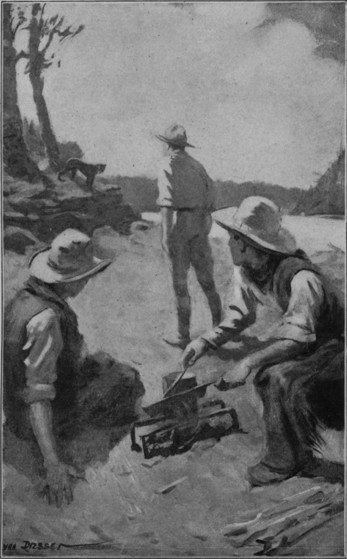
It was a rare treat to see a lion so close.
Now it was to all of them a rare treat to see a lion so close to. Of all the denizens of the wild, none are so shy of human kind, in regions where they are hunted,—none so thoroughly nocturnal. The three men fairly held their breaths to watch.
First the animal leapt to a branch of a wind-beaten tree and crouched along its limb, lying so still that, had they not seen it move, they might have glanced squarely in that direction and never noticed. And there it lay, sharpening its claws, cat fashion.
Suddenly it began narrowing its yellow eyes at what must have been a movement behind the rock whence it had emerged. Gathering its feet for a spring, it laid its ears back, and the great muscles rippling beneath its skin, leapt at a second lion whose head could now be seen peering around the rock. But did they fight? Not a bit of it! With hiss and arching back, and all claws out like the picture of a witch cat, the young cougar challenged his playfellow, then retreated as the other would have given him a swipe of his paw. Back to his tree he raced, the other after him. But no sooner had he reached the vantage point of his horizontal branch than he turned and chased the other back. This play was repeated several times, while the three men watched to the windward, silent and motionless, and hence unseen by the near-sighted animals.
A small rock had been loosened by their scramble, and as it went rolling over the granite slope, the first cat pounced after it playfully, finally catching the rolling stone and leaping about it as a cat does a mouse. Then he retired to his tree.
Norris, reflecting that the near presence of two such animals would stampede the burros, picked up a stone and threw it at the lion, intending, not to hit it, but to chase it away. To the surprise of the onlookers, the huge cat pounced on the stone as playfully as before. Ace now hurled a small rock so that it just escaped the tawny flank, but again she pounced, as playful as a kitten, at each missile, and it was not till the three men rose and shouted that the lion took alarm and raced away.
“I declare!” exclaimed Pedro, when he heard about it, “I’d never have believed it!”
“I was out in Devil’s Gulch one day,” remarked Long Lester, “with a coupla dogs. It’s all granite,—hard for the dogs to get a scent, but there’s lots of lions there, in among the rocks. Finally, though, they got one into a little Digger Pine. I took a shot at her, and out she tumbled.”
“Dead?” asked Norris.
“Yes. The dogs found her den, and dragged out three cubs.”
“How large?”
“About the size of house cats, that’s all.”
“Then what?”
“Oh, I put ’em into my shirt and tuk ’em home. I sold ’em afterwards to a circus man.”
“Well, do lions always act the way this one did to-night?”
“I heard tell of a boy that was out with an old three dollar Winchester 22, and a dog that had lost a leg in a bear trap. Pretty soon he barked ‘treed.’ He had a lion up in a scrub oak. It came down fighting, so the boy had to circle around trying to find a chance to shoot. Then it jumped up into a pine tree and lay with its head over the limb looking down at him. He shot at it, but I guess it didn’t hit, for it ran again, and by jings, it finally got clean away!”
“Don’t they ever fight?” marveled Pedro.
“They’ll fight a dog if they come down wounded, but the big cats are mostly cowards.”
“But bears are not?”
“Bears? No, nothing cowardly about them. They’re more lazy’n anything else.”
CHAPTER XI
THE VALLEY OF TEN THOUSAND SMOKES
The next morning they had a good look around before deciding which way to go. On one side pointed firs in patches on the canyon walls contrasted with the snow in the ravines. There was a brook that divided, then reunited in white strands, only to spread out into a smooth, glistening sheet, golden in the sunlight, to join the green river.
The notches between two rounding, glacier-smoothed granite masses disclosed distant peaks, snow-capped, their jagged ledges thrusting through the mantling white, dazzling in the sunshine like a mirror,—now gray under a hazing sky, now dappled under a passing shower cloud.
They finally decided to wind through the gap, and Pedro, Norris and Long Lester started on with the burros, while Ace and Ted started fine-combing the map beneath them for the elusive Mexicans. Very probably, they thought, they had been hiding in some of the caves that honeycombed the region, and sooner or later they would have to reappear. Their supplies could not hold out forever.
All along the Western flank of the Sierra, (as both Norris and Long Lester were able to assure them), from the McCloud River in the North to the Kaweah,—a distance of at least 400 miles,—stretched a belt of metamorphic limestone, reaching up to as high as 7,000 feet, and it was fairly riddled with caves.
But again the day went by without success. Ace only squared his chin. Ted offered to abdicate his observer’s seat in favor of any one of the party, but Pedro and Long Lester preferred terra firma, and even Norris found more to interest him in the rocks beneath their feet.
Once a little spiral of smoke drew them to a canyon head where they found three fishermen with a pack train of seven horses,—but no Mexicans. They searched Southward along the John Muir trail, returning along the Eastern flank,—but to no purpose, so far as the fugitives were concerned.
As no one had had time to fish, they dined on tinned corned beef, which Ace, the cook for the day, made the mistake of salting. (After that he had to make tea twice.)
“One thing I’d like fer to ask you, Mr. Norris,” said Long Lester that night around the bon-fire, “is where does the salt in the ocean come from? I don’t see for the life of me, from what you’ve told us––”
“The salt was originally in the rock of the earth’s crust,” Norris explained with a pleased smile at the old man’s interest. “As this igneous rock weathered with time, the rain and the streams washed it into the ocean. Then when the sea water evaporates––”
“To make clouds, to make more rain?” Long Lester recited.
“Yes,—the salt of course remained behind, so that the oceans have been growing constantly saltier since the earth began. Yet even now sea water must be nine-tenths evaporated before the sodium begins to precipitate, as we say.”
“So there is room for a lot more.”
“Especially as the oceans are growing larger all the time.”
“But doesn’t the ocean give it back to the land when it leaves these sediments along the shore?”
“Not to any extent, speaking comparatively. But one of the interesting things about the salt in the sea is this: Chemists and geologists estimate that, for the amount of salt in the sea, enough of the original earth crust must have been weathered away to have covered the continents over 6,000 feet high. And that calculation just about fits what we believe to have happened.
“The United States Geological Survey gave out an official statement in 1912 that this country is annually being washed back into the ocean at the rate of two hundred and seventy million tons of matter dissolved in the streams and five hundred and thirteen millions of tons of matter held in suspension in the same streams. That is to say, the oceans every year receive from the surface of the United States seven hundred and eighty-three millions of tons of rock materials.
“That means that, here in this part of the country at least, one hundred and seventy-seven tons per square mile are being washed back each year.”
“Gee!” said Ted. “I should think, at that rate, that the continents would have been all washed away long ago.”
“Yes, there have been, since geological history began, at least twenty whole mountain ranges as high as the Rockies worn to sea level. Of course the oceans have periodically flooded the margins of the continents at such times, in long troughs where now stand our Appalachian and Rocky Mountain ranges, leaving their deposits.
“In the Rockies there are coarse sediments miles deep, together with limestone formed of the ground-up shells of marine animals of the earlier times. Now think of this!
“If all that stands above sea level in the United States to-day were to be washed into the sea, as it undoubtedly will be, in time,—(but not in our time), the level of the oceans will rise, (just as the level of a half glass of water rises if you drop in a handful of sand), until—it has been estimated—everything under six hundred and fifty feet above sea level will be inundated. That means that probably half of the continent would be under water. It has been so in times past, and it will be again. In fact, in the age of reptile dominance, (the Cretaceous Period), when the earth was just beginning to be peopled with birds and flying reptiles, and the first, primitive mammals,—the Atlantic flowed straight from what is now the Gulf of Mexico, through what is now the Rocky Mountain Region, and through the Eastern part of Alaska, to the Arctic. That left one strip of land that reached along what is now the Pacific Coast, clear from the Isthmus of Panama to the Aleutian Islands and straight across to Siberia. The Northern part of the Atlantic Coast formed another land area, broken by the fresh water bodies of America and Canada and in one with a strip of land that extended across Greenland to Europe.
“It is pretty well established, in fact, that the United States has been more or less flooded by warm, shallow marine waters at least sixteen times since the age of fish dominance began. But not since the age of man!” he hastened to assure the old prospector, who was beginning to look uneasy.
“Of course these flood times brought a moist, warm climate to the land areas, and life was easy for the then existing animal forms. Then when readjustments in the earth’s crust again raised up mountain ranges and the climate became colder and drier, the struggle for existence became more intense, the process of evolution was stimulated, and new forms originated.
“We are living in one of those periods now. The organic world is being stimulated to develop even better bodies, endowed with even more alert brains.
“Life is easiest of all for the inhabitants of the ocean. That is why they have developed so little intelligence.”
“Is that why it’s such an insult to call any one a poor fish?” grinned Ted.
“An ichthyosaurus?” supplemented Ace.
“As has been said before,” Norris took up the thread of his talk, “with a drier climate and soil, comes the need of developing a faster mode of locomotion, for food no longer lies or swims everywhere about, as it did in the ocean, and in the swamps, and tropic humidity. Food and water are scarce, and it is the speediest animal that fulfills his needs. This speediness on his part means that he uses up more energy, and hence needs more food, and he needs to assimilate it faster. In other words, it means increased metabolism. This in turn means that he keeps his body at a higher temperature. He needs it too, now, with the increased cold. This results in the development of warm blood, by which the animal can maintain his body warmth regardless of winter cold. If it had not been for conditions that forced certain reptiles to develop warm-bloodedness, we would have no birds or mammals to-day, for as you doubtless know, birds and mammals both were evolved from reptiles.”
“I swan!” was all the old prospector could say.
“Yes, the first mammals developed from a reptile known as the cynodont. Many of these reptiles had long legs and could travel with the body well off the ground. Birds originated from the same reptilian stock as did the dinosaurs. First their hind-legs grew long so that they could run on them,—and you will notice at the Museum how the legs of a dinosaur are joined to the body exactly like a bird's,—then their scales gradually evolved into feathers.
“There is a lot more to it than I can tell you now, but after various ups and downs, dinosaurs became extinct and Nature tried out several kinds of warm-blooded, furry mammals, some of them herbivorous and built for speed to run away from their enemies, some of them swamp-dwelling monsters with heavy legs and small brains, who, slow of movement, relied on horns and other armor and sharp teeth for their defense.
“But there is no end to this subject. I only mean to make the point that it was geological changes that drove the fish to land, and the land animal to higher forms, till finally other geological changes drove man’s ancestors down out of the trees.” The boys, no less than the old prospector, testifying their interest in the last named operation, he continued.
“When the Alps, the Andes and the Himalayas arose, man’s ancestors still lived in trees. But high mountains hold a large part of the moisture of the atmosphere in the form of snow and ice, and at the same time the decreased oceanic areas offer less surface for evaporation. Not only does that mean a drier climate, but the sun’s rays pass more freely through dry air, and the days are hotter, and the heat passing freely back through the same dry air at night, the nights are colder. Seasons are more extreme, and ice accumulates on the mountain tops and around the polar region, precursor of a glacier period. The aridity decreases the amount of forest, and the manlike tree dweller had to descend to the ground to get his living. That necessitated the development of his hind legs for speed, and that speed necessitated his assuming a wholly erect posture. That in turn freed his hands, and he, or the man descended from him, could defend himself by throwing stones at the huge beasts who then peopled the earth. The cold winters necessitated the use of the skins of beasts for clothing, and so on through the list. It was geological necessity that drove man into his higher development.
“Changes of climate and environment, however, are stimulating, even to-day. Statistics show that stormy weather actually increases people’s energy.”
The next day they passed a long crack in a rock slope, which Norris felt sure had been made by an earthquake, perhaps as recent as that of 1906, to judge from the cleanness and newness of it. The crack was no more than a foot or two in width, but in places eight feet deep, they estimated, and along the Western side of it stood a fault scarp, in this case a wall of granite bowlders of various sizes up to four or five feet in height.
“This,” pronounced the geology man, “is evidently a region overlying subterranean volcanoes, which might even yet build the range higher. I’ll bet that kind of mountain building may still be going on around here.”
Again and again Norris, or even Ace, had been able to point out, in the record of the rocks, the evidences of the two glacier periods that had helped shape the Sierra Nevada, the earlier one much larger, and enduring longer, as shown by the moraines (or deposits) left behind. The lower end of a canyon would be no wider than the stream that incised it, but the upper portion would have been smoothed into grassy parks or lakelets on each tread of a giant stairway to the summit of the range.
Rounded waterworn pebbles and cobblestones among a mass of angular bowlders, left behind by glacier streams, together with an occasional striated pebble, were “sermons in stones” to the geologist.
“Hey, Ted,” his chum had challenged him that day, “did you ever see a pirate?”
“Don’t know as I did,” admitted the ranch boy.
“Then I’ll show you one. Climb in,” and he prepared to search once more for the Mexicans.
“Show me one! You speak as if they kept them in museums.”
“This pirate will be a river. A river pirate,—I mean a pirate river! If I could find the divide just North of Muah Mountain I’d show you where streams are being captured this minute. Cottonwood Creek has already captured one of the tributaries of Mulkey Creek, I hear, and diverted it into an eastward flow, and further captures are likely to be pulled off any time. Isn’t it a scandal?”
“I say, Ace,” protested his chum, “I’ve swallowed a lot since we started on this trip, but I’m not so gullible as you seem to think.”
“Look here, old kid,” said Ace seriously. “It’s a fact. Along a divide, a stream flowing one way will divert one flowing the other way into its own channel.”
They found a pirate river,—but still no trace of the incendiaries. However, that merely determined the Senator’s son the more.
That night Norris told them the long promised tale of his Alaskan trip.
“Nothing like the Valley of Ten Thousand Smokes has ever been seen by the eye of man,” he declared. “If we could take all the other volcanic regions of the world to-day and set them down side by side, they would present less of a spectacle, except, of course, at the time of a dangerous eruption. There has been nothing like it in the memory of man,—though geologists can read from the rocks that such conditions must have existed in past ages. The Mt. Katmai eruption of 1912, one of the most dangerous in history, first attracted attention to this region, and the National Geographic Society has since sent various expeditions to Alaska. It was that way that the Valley came to be discovered, in 1916.
“I happened to be a member of the last expedition.”
“Honestly!” the boys exclaimed.
“Yes, and I tell you, boys, when I first looked through Katmai Pass, it just looked as if the whole valley were full of smoke. Of course it was steam.”
“Weren’t you afraid of another volcano?” asked the boys, snuggling down ready for a real story.
“No, because with all those vents letting off steam, it must relieve the pressure from below, like so many safety-valves. Two black, glassy looking lava mountains guard the pass. The wind on the side of Observation Mountain was blowing so hard it honestly lifted us off our feet at times, and it blew a hail of pumice stone in our faces that literally cut the flesh. Of course we wore goggles.
“Once in the valley, there were certainly all of ten thousand smokes rising from the ground. We were simply speechless, it was such an awesome spectacle.”
“I’ll bet you were!” breathed Ted.
“Personally, I consider it more wonderful than either the Grand Canyon or the geysers of the Yellowstone. As far as we could see in any direction,—and there seemed to be three arms to the valley,—the white vapor was steaming out of the ground until it mingled with a great cloud that hung between the mountain walls. And we later camped in places where we could keep our food in a hollow of a glacier while we boiled our breakfast in a steam hole, and the ground was almost too warm for comfort.”
“Must have been an ideal camping place,” said Ace.
“Far from that. Too much danger of breaking through. And then of course there wasn’t a tree or a grass blade anywhere, much less a stick of firewood. But we sure had steam heat at night, and we cooked, in the milder of the fumaroles.”
“Wasn’t there a lot of gas coming up with the steam?” asked Ace.
“Yes, but it didn’t taint our food any. It was an ideal steam cooker. Farther down the valley were some vents hot enough to fry bacon.”
“I should think it would have steamed it,” said Ted.
“No, we found one vent where the steam came so hot that it didn’t condense for several feet above ground; the only trouble was that the frying pan had a tendency to go flying up in the air and the cook had to have a strong arm to hold it down.”
At the picture his memory evoked, Norris burst into hearty chuckles. “As the bacon got crisp, of course it didn’t weigh so heavy, and there always came a point where it began to fly out of the pan. Then we’d all stand around, and it was the liveliest man that caught the most breakfast.
“There was another camp convenience, too, there in Hades, as the valley has been named.”
“Thar, didn’t I tell you so?” triumphed Long Lester.
“And they named the river Lethe. A river that ran down from the melting glaciers,—though it almost all goes up in smoke, as it were,—in steam, before it gets out of the hot part. This river whirls along, and in places the steam actually boils up through the ice water, or along the banks. I used to think it was an awful pity there were no fish in that stream, because we could have cooked them without taking them off the hook.”
“Huh!” The old prospector shook his head. “I’ve thought all along this here was a fish story.”
“But it’s gospel truth,” Norris assured him. “I mean about the valley. I said there were no fish. Everything we ate, by the way, had to be packed in on our backs. It was no place for horses, where in places the ground fairly shook beneath our feet, and if it were to give way, we’d find ourselves sure enough in hot water.”
“It must have been almighty dangerous,” gasped Ted.
“Well, not after we learned the ropes. Sometimes we accidentally put a foot through a thin place and steam came through. I assure you we stepped lively then. At other times our feet sank into the soft, hot mud.
“By the way, there is a mountain across the head of the valley that looks like a crouching dog, and it has been named Cerberus.”
“Were those geysers, those ten thousand smokes?” asked the old prospector.
“No, a geyser comes after volcanic activity, while here something is still likely to happen. A geyser begins as a column of steam and hot water, which erupts as often as the water gets to the boiling point. It follows that the water must accumulate in rock not so hot that it would instantly vaporize it. But the rock underlying this valley is so hot that no water can accumulate.”
“How large are the vents through which the steam comes?” asked Ted.
“All sizes down to nothing at all. There are even a few craters 100 feet across, that have been produced by volcanic explosions. You will find these craters, generally, along a large fissure, just the way you find the Aleutian chain of volcanoes along a fissure in the earth’s crust several hundred miles in length.
“There are fissures all along the margins of the valley, besides those in the center, and many of these have one side standing higher than the other, showing them to be earthquake faults,—the same sort of thing we see here in the rocks of the Sierras. And you should hear the hissing and roaring of the steam as it forces its way up through these fissures from the hot depths beneath. Sometimes it looks like blue smoke, it is so full of gases, especially sulphur dioxide, the gas that is given off by burning sulphur. So the popular notion of Hades isn’t so far off after all, eh?”
“Could you smell the sulphur fumes?”
“Sometimes, yes,—when the other gases did not overwhelm the odor. But the weirdest part of all is the incrustations along the borders of the vents. All colors of the rainbows—shapes as fantastic as anything in fairyland. Lots of yellow, of course, from the sulphur,—crystals of it, some of them neighbor to an orange tinted crystal, lying in the blue mud. It was a beautiful color combination. Then there were green and gray alum crystals which looked like growing lichens. There were also deep green algæ actually growing. Strange how certain designs are used over and over again in nature! In other places the mud is actually burned brick red, especially where the fumaroles are burnt out. This shades to purple, and in other places to pink. But the most surprising, perhaps, were the white vents just tinted with a delicate pink or cream.
“The largest fissure of all, one lying at the foot of Mt. Mageik, is filled with the clear green water of a melted glacier. And above, the mountain smokes away into the clouds!”
“It must be a marvelous place!” said Ace. “I suppose it was regular ice water.”
Norris laughed. “That is the funny part of it. It’s not. The water is actually warm, or rather, tepid, in places, on account of the heat from below.”
“So you had good swimming even in Alaska.”
“We might have had. And then I must tell you about Novarupta. That’s the largest vent in the valley, and it is something you won’t see very many places in the world, a new volcano. It was only formed at the time of the eruption of 1912, and it is one of the largest volcanoes in the world to-day,—with a crater much larger than that of Vesuvius.”
“But Mr. Norris, do y’ mind my asking,” Pedro hesitated, “but how do you know it is a new volcano? Don’t volcanoes sometimes burst forth again after many years of quiet?”
“They do, but there is where the rocks tell the story again. Instead of bursting forth from a mountain top, through igneous rock, (left from the time when the earth-crust was molten), this one erupted in the valley, in sandstone. On a still day, the smoke will rise as high as ten thousand feet.”
Norris, then a student, had been one of the first to view Lassen Volcano when, in 1914, it broke its slumber of 200 years. Indeed, he had had a real adventure, as the second outburst had caught him within half a mile of the crater and he had barely escaped with his life. Of course the boys had to hear all about it.
While the Sierra south of Lassen has been built more through uplift than volcanic activity, at least since the Tertiary period, he explained, the Cascades and indeed, the whole range to the northward through Oregon and Washington, is a product of lava flow.
Happening to be about to start on a camping trip in the Feather River region at the time of the first eruption, he and his companion had hastened immediately to the scene of so much geological history making. The smoke and ashes that billowed forth had been visible for fifty miles, and the accompanying earthquake shocks had been accompanied by a downpour of rain.
Climbing the path of a recent snow-slide, which had cleared a narrow path in the fifteen-foot drifts, they could smell sulphur strongly from near the South base onward. Veering around to the East, past half a dozen cinder cones, they finally reached a narrow ridge leading directly to, as yet unoccupied, the fire outlook station. Clambering over crags so steep, finally, that they could not see ahead, they came to the little square building, now tattered by the stones that had fallen through its roof, tethered to the few feet of space available by wire cables that seemed to hold it down in the teeth of the winds. Suddenly below them lay the bowl of the ancient crater, bordered by snow fields now gray with ash. That the ash had not been hot they judged from the fact that it had nowise melted the snow, but lay on its surface. From the ragged edge of the steaming basin, yellow with sulphur, rose the oppressive fumes they had been getting more and more strongly. How deep was this funnel to the interior of the earth? To their amazement it appeared to be only about 80 feet deep. That, they decided,—coupled with the fact that the ash and rocks exploded had not been hot, but cold, must be because the sides of the crater, as they gradually caved in, must have choked the neck of the crater with débris, which had been expelled when the smoke and gases had been exploded. There had been no lava flow, then!
They had retraced their steps to perhaps half a mile’s distance when of a sudden the earth beneath their feet began to heave and rumble thunderously. Ashes and rocks, some the size of flour sacks, some huge bowlders, began shooting into the air,—observers at a distance assuring them afterwards that the smoke must have risen 3,000 feet above the peak. It grew black as midnight, the smoke stung their eyes and lungs and whiffs of sulphur nearly overwhelmed them.
It was a position of deadly peril. Quick as thought, they ran, Norris dragging his companion after him, beneath the shelter of an overhanging ledge, where at least the rocks could not fall on them, and there they buried their faces in the snow and waited.
What seemed hours was later pronounced to have been but fifteen minutes, though with the roaring as of mighty winds, and the subterranean grumblings and sudden inky night, the crashing of stones and thundering of rolling bowlders, it seemed like the end of the world.
Norris’s companion had suffered a blow that dislocated his shoulder, but otherwise they emerged unhurt. They afterwards found several areas on the sides of Lassen where sulphurous gases were escaping from pools of hot mud or boiling water. They also visited a lake that had been formed at the time of the lava flow of 200 years ago, (now a matter of legend among the Pitt River Indians), this lava having formed a dam across a little valley which later filled from the melting snows. The stumps of the inundated trees could still be seen.
A geyser, said the Geological Survey man, is just like a volcano, only it expels steam and boiling water from the interior. There is a line of volcanic activity up and down the Pacific Coast, from Alaska to Central America, though Lassen is the only active peak in California, Shasta having become quiescent save for the hot spring that steams through the snow near its summit.
The North half of the range, he added, is covered with floods of glassy black lava and dotted with extinct craters, whereas the Southern half is almost solid granite, though there are plenty of volcanic rocks to be found among its wild gorges. The rocks around Lassen tell a vivid story of the chain of fire mountains that must have again and again blazed into geysers of molten rock, till the whole smoking range was quenched beneath the ice of that last glacier period, which through the ages has been sculpturing new lake and river beds, and grinding soil for the rebirth of the mighty forests.
The boys drowsed off that night to dream of fire mountains and explorations in the nether regions.
The next day they planned to bi-plane up and down the John Muir trail again and see if the Mexicans could have crossed to the Eastern side of the range. They might have made their way through some pass, traveling after nightfall and hiding by day, and once on the desert around Mono Lake they would be easy to locate. For it seemed ridiculous that they could actually make a get-away.
CHAPTER XII
GOLD!
In the pass between two appalling peaks the two boys sighted the smoke of a cook-fire, and without once reflecting that they were unarmed, pan-caked down for a closer inspection. But there was no need to land. It was a band of Indians. And though they searched till they were ready to drop with fatigue,—and all but frozen stiff in those high altitudes,—not the sign of a Mexican did they sight after that.
They returned utterly discouraged.
“What kind of Indians were they?” asked Long Lester.
“Oh, just Indians,” said the ranch boy.
“That is like saying, oh, just whites,” said Norris. “Indians differ more than you would ever imagine.”
“Why is that, Mr. Norris?” Ted wanted to know. “They’re mostly mighty good for nothing specimens, to judge from our Diggers.”
“I’ll tell you after supper,” Norris promised them.
Pedro had been out with his trout rod. Descending to the river, which here circled around a huge bowlder from which he thought he could cast, he had a string in no time.
Now Pedro was thoroughly well liked, with his Castilian courtesy and his ever ready song. The lack of physical courage had been his greatest drawback. Always had the fear been secret within him that at some crucial moment he might show the white feather. His experience with the Mexicans had removed that, but he was still mortally afraid of three things,—bears, rattlesnakes, and thunder storms,—that is, real wild bears, not the half tame kind that haunt the Parks.
Still, he had not noticed the furry form that stood neck-deep in the riffles, fishing with his great, barbed paw,—so perfectly did he blend into the background.
The shadow of the canyon wall had made twilight while yet the sun sent orange shafts through the trees on the canyon rim. Suddenly around the turn of the trail rose a huge brown form that gave a startled grunt, rising inquiringly on its shaggy hind legs and swinging its long head from side to side. Pedro’s heart began beating like a trip-hammer. (He wondered if the bear could hear it).
He wanted to run, to scream,—a course that would have been most ill-advised, for the bear might then have given chase. As it was, the boy remembered that the animal was probably more afraid than he,—or more likely merely curious at this biped invasion of his wilderness,—and would not harm him if no hostile move were made. The cinnamon bear of the Sierras, like his blood brother, the New England black bear, is a good-natured fellow.
With an iron grip on his nerves, he forced himself to stand stock-still, then back—ever so amenably—off the trail. The bear, finding no hostility intended, turned and lumbered up the mountain-side.
“‘Minds me of one time,’ said Long Lester, when he heard the story, ‘I was down to the crick once when I was a shaver, and along came a big brown bear. The bear, he stood up on his haunches, surprised like, and just gave one ’woof.’ About that time I decided to take to the tall timber.” (At this, Pedro looked singularly gratified.) “Well, that bear, he took to the same tree I did, and I kept right on a-climbin’ so high that I get clear to the top,—it were a slim kind of a tree,—and the top bends and draps me off in the water!”
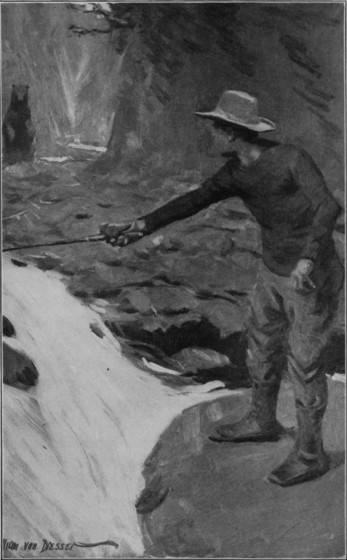
Around the turn of the trail rose a huge brown form.
“What became of the bear?” Pedro demanded.
“I dunno. I didn’t wait to see. But Mr. Norris here were a-sayin’ there’s nothin’ in the back country a-goin’ to hurt you unless’n it’s rattlesnakes. Now when I was a-prospectin’ I allus used to carry a hair rope along, and make a good big circle around my bed with it. The rattler won’t crawl over the hair rope.”
The boys thought he was joshing them, but Long Lester was telling the literal truth. “Once I was just a-crawlin’ into bed,” he went on, “when I heard a rattle,” and with the aid of a dry leaf he gave a faint imitation of the buzzing “chick-chick-chick-chick-chick” that sounds so ominous when you know it and so harmless when you don’t. “I flung back the covers with one jerk, and jumped back myself out of the way. There was a snake down at the foot of my blankets. They are always trying to crawl into a warm place.”
“Then what?” breathed three round eyed boys.
“First I put on my shoes and made up a fire so’s I could see, ’n’ then I take a forked stick and get him by the neck, and smash his head with a stone.”
“And yet I’ve heard of making pets of them,” said Norris.
“They do. Some do. But I wouldn’t,” stated Long Lester emphatically. “Ner I wouldn’t advise any one to trust ’em too fur, neither.”
“They say a rattler has one rattle on his tail for every year of his age,” ventured Pedro.
“A young snake,” spoke up Ted, “has a soft button on its tail. And then the rattle grows at the rate of three joints a year, and you can’t tell a thing about its age, because by the time there are about ten of them, it snaps off when it rattles.”
“Down in San Antonio,” said Ace, “we had an hour between trains once, and we went into a billiard parlor where they had a collection of rattlesnakes, stuffed. And they showed some rattles with 30 or 40 joints to them.”
“Huh!” laughed Ted. “That’s easy! You can snap the rattles of several snakes together any time you want to give some tourist a thrill.”
“You seem to know all about it,” gibed Ace. “They had 13 species of rattlesnakes down in this—it used to be a saloon. And ten of them Western. They had a huge seven foot diamond back, and they had yellow ones and gray ones and black ones and some that were almost pink. I mean, they had their skins. All colors––”
“To match their habitat,” supplemented Norris. “Our California rattler is a gray or pale brown where it’s dry summers, and in the Oregon woods where it’s moist, and the foliage deeper colored, it’s green-black all but the spots. I’ve seen them tamed. There was one guide up there who kept one in a cage, and it would take a mouse from his fingers.”
“I wouldn’t chance it,” shivered Ted.
“Oh, this one would glide up flat on the floor of the cage. They can’t strike unless they’re coiled.”
“I suppose he caught it before it was old enough to be poison,” said Pedro.
“A rattlesnake can strike from the moment it’s born. It’s perfectly independent a few hours after birth.”
“Ugh! Bet I dream of them now.” But such was their healthy out-of-door fatigue that they all slept like logs.
It was only the next day, however, that the two boys, Ace and Ted, poking exploratively into a deep cleft in a rock ledge, were startled by an abrupt, ominous rattle, and beheld in their path the symmetrical coils of the sinister one. The inflated neck was arched from the center of the coil and the heart-shaped head, with red tongue out-thrust, waved slowly as the upthrust tail vibrated angrily. A flash of that swift head would inject the deadly virus into the leg of one of the intruders. Yet Ted knew the reptile would never advance to the attack.
Dragging Ace back with him, he instantly placed at least six feet between them, so that, should the snake charge, it could not reach them. But with the enemy obviously on the retreat, the snake glided to cover in a tumbled mass of rocks at one side.
“Gee! We nearly stepped on him!” the ranch boy exclaimed, with a voice that was not quite steady. “Next time we go poking into a place like that, let’s poke in a stick first, or throw a stone, to make sure there’s ‘nobody home.’”
“Wish I’d a brought a hair rope,” mused Ace. “We might have had one that would go clear around all our sleeping bags. First chance we get, I’m going to buy one.”
“Naw! We won’t need one. Did you ever see a rattler catch a rabbit?” asked his chum.
“No, d’you?”
“Once I was going along when I noticed the trail of some sort of snake going across the road. Next thing I heard a rabbit squeal, and by the time I spotted the snake it had a hump half way down its throat, and it was swallowing and swallowing trying to get that rabbit down whole.”
“I consider the possibility of rattlesnake bite the one biggest danger in the whole Sierra,” declared Norris, one night, lighting each step carefully over the rocks. “And he does his hunting by night.”
“Considerate of him!” laughed Ace, “seeing that campers do most of theirs by day. But why is it such a danger? I’ve heard opinions pro and con.”
“Rattlesnake venom disintegrates the blood vessels, makes the blood thin and unable to clot. I knew a man who was struck in the ankle, and they had to amputate the leg, and the very bones of that leg were saturated with the blood that had seeped through the weakened walls of the blood vessels.”
“How does it feel to be struck, I wonder?” the boy shuddered.
“This man’s ankle became discolored practically immediately and began to swell. Of course the bite was through his sock, which must have kept a little of the poison out of it, and it fortunately did not happen to penetrate an artery. We could have cut and kneaded the wound instantly to clear out as much as possible of the venom before it had time to enter the blood system, but the fellow refused such heroic measures. We should have taken him by force; it would have saved his leg, likely, for ordinarily this, and a ligature, will do the work.
“Or we could have burned it clean, or injected the serum if we’d had it. But as I was about to explain, he soon became dull and languid, breathing noisily, for the poison affected heart and lungs. It was then that he let us get to work,—almost too late,—or rather, that he ceased his protest. His whole leg swelled and turned black, clear up, he got feverish and nauseated, and for hours he kept swooning off, while we worked over him, almost giving up hope, and one of our men had gone post-haste for an old guide who made the serum,—anti-venom serum.”
“Did he finally pull through?”
“With the loss of a leg. If he hadn’t had that off pronto, gangrene would likely have set in and he’d have gone.”
“But this serum—where do you get it?”
“I don’t know. We got it of a man who made it. First he injected into a mule a tiny drop of the venom.”
“How did he get the venom?”
“Killed a snake. You know the poison is in a tiny sac at the root of each fang. Well, after he had given the mule the first dose and he had recovered, he tried a larger one, then a still larger one, and so on, every few weeks for a year or more, until the mule’s blood serum had developed enough anti-toxin to make him immune to rattlesnake bite.”
“But then what?”
“He let some of the mule’s blood, separated the serum, sterilized it, and put it up in sealed tubes, which he kept in the cellar. This serum is injected into the victim’s blood with a hypodermic syringe, and if it is used before he has collapsed, it will cure him every time. We really ought to have brought some along, just in case of extreme emergency. I have, however, a bottle of permanganate of potash crystals,” and he showed a little hard rubber tube two and a half inches long, one end of which contained the crystals and the other a well sharpened lancet, as the stuff has to be put right into the wound. This outfit, he explained, had only cost a dollar, and was so tiny it could be carried right on the person when in danger of being snake bitten. However, it has to be used instantly, (within three or four minutes at the outside), “if it is to neutralize the corroding acid of the poison and do any good.”
That night a bon-fire built up into a log cabin with a tepee of pine fringed poles atop sent the sparks flying, but was not uncomfortably hot except on their faces. These they shaded with their hat brims.
“I wonder why there is so much difference in Indians,” mused Ace. “When Dad and I visited the Hopis, there, on our way to the Grand Canyon, we were impressed by their high degree of civilization. Like all the Pueblos, they raised good crops, had a regular government, and even an art. And look at these Digger Indians, filthy, thieving creatures, grubbing for roots like wild animals, eating slugs and lizards, because they are too lazy to cultivate a piece of ground!”
“I remember,” said Norris, “one of my favorite professors at Yale always said that civilization was largely dependent upon civilization,” and he pointed out the Indians as an illustration. Of course he gave due credit to what he termed inherent mental capacity. But to climate he laid the energy with which that capacity is developed,—always provided there were sufficient material resources. That is to say, even white men with fine brains could not evolve as high a degree of civilization in the Arctic Circle as they can where they have the material resources necessary to supply the physical needs.
“But I should think the material resources of the Arctic Circle were a result of the climate.”
“In large part, they are. That just strengthens the point that climate has had a lot to do with civilization, and incidentally with the differences between different tribes of Indians. I wonder if I can give his theory straight! Well, anyway, here’s the general idea. It applies quite as much to all nationalities as it does to Indians in particular.
“What is our conception of The Noble Red Man? He is observant, he has unlimited physical endurance, but he does not adapt himself to our civilization, nor does he work out new methods for himself, as we have done since America was settled. He is conservative, in other words,—lacking in originality and inventiveness.
“Of course they came at some stage of their evolution from the primitive home of man in Asia. So also did the Scandinavians,—so also did the Japanese. But while both of these finally located in cold but not too cold climates, nor steadily cold, they were merely stimulated. The Indian, though,—the American Indian,—likely migrated by way of Bering Strait, and passing generations in the Esquimo lands, where it is about all they can manage to keep alive at all during the long, dark winters. The result? Those who were high strung nervously went insane,—just as many an Esquimo and many a white man does to-day, under the necessity of idling in a stuffy hut in the cold and darkness. It was only the mentally lazy who could survive that phase of their evolution. That accounts for certain differences between all Indians and all white men.
“Remember, it wasn’t the sheer cold so much as the monotony of the unbroken cold and darkness. The negroes of Africa also failed to progress, but in their case it was the energy-inhibiting equatorial climate, and especially the monotony of unbroken equatorial conditions. The European Nordics,—remember, of ancestral stock originating in that same Asiatic cradle,—had severe cold, and in summer, often, extreme heat,—but there was no monotony.
“The too active Hottentot soon killed himself off, and only the indolent survived. The races that have had long sojourns, in the course of their racial wanderings, under desert conditions, where patient endurance is an asset, also suffered a decimation of their more alert members. The stolid were the more fit to survive desert conditions. You will find races now dwelling in favorable climates who may exhibit these unprogressive qualities, but back of them is a history of some experience that has weeded out the more active individuals.
“But am I getting too long-winded?”
“You haven’t told us yet why one tribe of Indians will be so different from another, if they both came here via the Arctic Circle,” urged Ace.
“Well, there is where another factor comes in,—that of material resources. What could an Arab have accomplished with nothing but desert sands to work with? What can the Esquimos accomplish with little but ice to grow crops? They must secure their food by hunting, and hunters must be nomadic. Nomads cannot carry many creature comforts with them, nor can scattered groups be much mental stimulus to one another. Nor can the arts develop when the mere struggle for animal existence demands one’s whole energy.
“These Digger Indians came from the as yet unirrigated deserts around Los Angeles, with its long dry season, whereas Hopis and other Pueblos around Santa Fe, though up against as dry a climate, taking it in actual number of inches rainfall per year, have enough of their rain during the summer months to enable them to raise crops, and hence to establish permanent habitats, and hence to work out a form of government, a social system, an art and an organized religion.”
“But the Utes around Salt Lake City, who were living on grasshoppers when the Pueblos were eating squash and beans,—utter savages,—didn’t they have much the same climate as the Pueblos?”
“What I said of the Diggers of Los Angeles applies to them. Their rainfall did not come at the right time of year to raise crops, and of course in such desert conditions there were practically no wild fruits.
“The Indians of the more fertile parts of North America, like the early people of Europe, had wild vegetation to supply the means of subsistence. And the wild vegetation also gave wild game a means of subsistence, to say nothing of the means for clothing and shelter. Of course that is not the whole of the story. There is, for instance, coal and iron, but iron has to be smelted where there is forestation, and we come right back to climate, as one of the principal factors in civilization.
“There is also energy,—zeal, determination. But what about the effect of proper food and shelter on those qualities? And more important, what about the effect of climate?
“Elaborate tests have been made. Without going into all that, perhaps you will take my word for it. But the best climate for either physical or mental efficiency is one that is variable,—for change is stimulating,—and that goes to no unlivable extreme, but offers the cold, dry winter and the warm, slightly rainy summer of, say, for instance, the Eastern United States, or Central Europe, Italy, or Japan.”
“But why does a winter in Southern California do an invalid so much good?”
“The change. The beneficial effects wear off with time.
“And just one word more, while we are on the subject. I’d hardly do my old professor justice unless I mentioned that he lays that third factor in civilization, inherent mental capacity, to the climatic conditions, not of the present, but of the ancestral history of the past. But remember, the climate of, say, Greece, has not always been what it is to-day. Our Big Trees show, by an examination of their annual rings, the same story that the rocks tell,—and that history tells,—that there have been constant fluctuations of climate, within certain limitations. The records of geology lead us to believe that California and the Mediterranean countries have undergone the same climatic variations.”
The next day the boys were so tired of sleuthing for the fire-bugs that they decided to join the others in a holiday and explore one of the neighboring peaks, leaving the burros and outfit at their camp of the night before. About noon, the trail ended abruptly at a peak of granite blocks each no larger than a foot-stool. Off to the left they could see a peak higher than the one immediately before them. It seemed to be a ridge of three peaks, theirs the middle one, and once on the ridge, they could pick a course along the crest.
A little further on, the trail narrowed till they could see a tiny lake on either side, and a stone’s throw below, pools as clear as mirrors reflecting the twisted growth about their brims. Then Ace gave a shout, for down a hollow between two ridges to the north lay a patch of snow.
Sliding,—on their feet if they could manage it,—and snow-balling, the boys were surprised to find how short of breath they were at this elevation, a trifle over ten thousand feet, Norris estimated,—for on their steady upward plod they had not particularly noticed it, or had not attributed their slightly unusual heaviness to altitude.
They were therefore willing enough to rest on top, though even at noon the wind blew cold upon them. Stretching almost north and south before them rose the main crest of the Sierras,—peak after peak that they could name from the map. They could see for at least a hundred miles. First the wild green gorges that made the peaks seem higher, then snow-capped and glacier-streaked altitudes rising one above another till they faded into purple nothingness.
They did their climbing single file, with arms free, having disposed of their lunch at timberline. But where Norris had led the way up, Pedro was the first to start back. “Come on, why not take a short cut?” he shouted in competition with the wind.
“All right.” Norris stepped on a rock at that moment that turned with him, barely escaping a wrenched ankle. He kept his eyes on his footing for some moments after that. It was therefore not surprising that he did not notice where Pedro was leading, till the latter called:
“Why, there’s our lake, isn’t it?”
The way began to be all bowlders, larger and larger ones. “Here, that isn’t the way we came,” cautioned Norris.
“I know it,” Pedro assured him, “but see, Mr. Norris, we’re just going around this middle peak instead of over it.”
“Better not try any stunts,” warned the Geological Survey man. Had he been by himself, he would have gone straight back till he came to the way they had gone up. But the boys were tired, and he hated to ask them to retrace their steps. Besides, he did not want to discourage initiative in the Spanish boy.
But soon they found themselves scrambling over slabs so high that they had to take them on all fours, clambering over one as high as their heads, then letting themselves down into the cranny between that and the next.
“We sure never came over anything like this!” the rest of the party began complaining. But on they scuttled, leapt and sprawled, no one finding any better way.
“Hurry, there’s our lake!” shouted Pedro finally. “I’ll bet if I could throw a stone hard enough, it would scare the fish.”
But Norris spoke in alarm: “We couldn’t see any lake on the trail going up. On the contrary, we saw the peak to our left. Don’t you remember? Now see! That peak is on our right!”
“Fellows, we are on the wrong side of this ridge,” he decided. “And what is more, instead of going back down the middle crest, we have gone clear on to the third peak.” (For the ridge was a three peaked affair, the middle being the lowest.) “The best thing now is to circle around as near the top as we can go, till we strike the trail. If we keep circling, we are bound to strike it sooner or later. But let’s not all go together, or we might start a rock-slide. Let’s ‘watch our step!’ What would we do if one of you put his ankle out of commission?”
The boys had little breath to waste on comment. Probably none but Norris had any vivid realization of the danger they were in, but each fellow had a keen eye to keeping his footing. Rock-slides the three boys had never seen, but a sprained knee or a crushed foot was something they could understand. Pedro also had a weather eye out for rattlesnakes, to whom these rocks would have been paradise if it had not been such a chill elevation.
As the sun sank lower and lower, they began secretly to wonder what it would be to have to spend the night on this windy peak, without even an emergency ration,—unpardonable over-thought! They circled steadily, Norris now in the lead, the boys spreading out fan-wise as they followed, Pedro even getting clear to the foot of the granite where he thought he would have easier going through the woods, though he would also have a larger arc to traverse. He felt safer on solid ground, though had he measured, he might have seen that he had climbed as far in going down as did the others in circling around.
Once a huge bowlder that overhung a precipice rocked under Ted, and it was only by a swift spring that he saved himself. Many of the smaller rocks tipped warningly, and he frequently stumbled. How slow their progress seemed! How fast the sun was sinking in the west! And how astoundingly their shoes were wearing through! It was three hours later that Pedro, down in the edge of the woods, gave a shout and began waving his arms in the wildest manner. Then along the way that he picked in coming to meet them, Norris with his glasses could just make out the brown ribbon of the trail.
Fifteen minutes more and they were lined up ready for the homeward march, cured once and for all of short-cuts, and divided only as to whether it would be better to run, at the risk of a turned ankle, while there was light to see their footing, or walk, and have to go the last half of the way in darkness.
They finally did some of both, running where the trail lay free from stones, and eventually having to make their way by the feel of the ground under the feet, and the memory of the mountain meadows whose perfume they passed, and the sound of the creek to their right. The stars were out, giving a faint but welcome light that served as guide when finally they stumbled into camp, bone-weary but safe, and nothing loth to set all hands for a square meal before tumbling in.
Throwing some of their reserve supply of fuel on the fire-place, they soon had the home fires burning cheerily, and Pedro was demonstrating his can-opener cookery.
Next day a glitter from beneath the water of a rivulet high on the mountain-side, caught Ted’s eye. Dipping with his tin cup, he brought up a specimen of sand and water. Could it be only mica that glistened so? Saying nothing to Ace, (for he remembered Long Lester’s tale of salting a mine once when “the boys” wanted some one of their number to stand treat by way of celebration of his new-found riches), he slyly slipped an aluminum plate from out the pack and began that primitive operation that used to be known as pan and knife working. Falling a little behind, he kept at it until he had separated out some heavy yellow grains that proved malleable when he set his teeth on them. It was coarse gold!
It was now time to announce his find, which he did to the amazement of all but the old prospector. A more careful inspection of the bend where he had found it proved it to be only the tiniest of pockets, though under their combined efforts that day it yielded what the old man pronounced to be about a hundred and fifty dollars’ worth of dust. Still, even that was not to be sneezed at, as Long Lester put it, in terms of Ted’s college fund,—for they all insisted on contributing their labor to his find. Ted, though, insisted equally that it be their stake for another camping trip.
Later that same day they came to the remains of an old hut, now overgrown inside and out with vines and underbrush. In one corner the old man unearthed what he pronounced to be the rusted mining tools of the early days. A fallen tree that lay across the doorway had to be chopped through and cleared away before they could enter, and on stripping a bit of the dry bark away for firewood, Pedro was puzzled to find what appeared like hieroglyphics on its nether side. He showed Norris, but what it could be he could not imagine, till Norris happened to try his pocket shaving mirror on it. Then, clear as carving, only inverted, they spelled out the legend:
“CLAME NOTISE — JUMPERS WILL BE SHOT.”
These were evidently the letters that had been carved on the tree trunk—as they judged, about six feet above its base, and though the sap had long since obliterated the original, the bark still told the story where it had grown over the wound. By chopping through the log at that point and making a rough count of the annual rings of growth, they estimated that all this had happened forty years ago. What had become of the old miner? For such his tools acclaimed him. Why had he never come back? Had he been overtaken by bandits, robbed of his buckskin bag of dust, and murdered? Or had he struck a richer claim elsewhere?
They dug beneath what once had been his crude stone hearth, in the hope of buried treasure, but no such luck rewarded them, and finally they moved on up the mountainside, past vistas of green-black firs and yellow-green alders. As usual in these dry altitudes, the fiery sun of noonday had grown chill at sunset, the wind stopped singing through the pines, and the weird bark of a coyote seemed to accentuate the loneliness that the wilderness knows most of all when some abandoned human habitation brings it home to one.
But a heaped up bon-fire and a singing kettle soon drove the shadows from the circling mountain meadow that was to be their home for the night.
“Thet there cabin,” drawled Lester, “sure made me feel as if I were back on my old stamping grounds. ‘Minds me of the place where I once found a chunk o’ glassy white quartz half the size of my head with flakes of color in it that netted me $200. I spent quite consid’able time hunting for the vein that came from, but I never did, nohow.”
Norris explained to Ted and Pedro that a quartz bowlder will often be washed along a river.
They were awakened by the usual concert of hee-haws, as the burros, who followed at their heels all day like dogs, (except when they got contrary), woke the echoes with their loneliness.
That day led them over another of the parallel ridges that comb the West flank of the Sierra, and into a precipitous canyon, over red sandstones and green shales, and slates of Tertiary formation, till they came to another hot spring and decided to pitch camp and all hands make use of the hot water. A natural bath tub and a smaller wash tub were found hollowed out of the stony banks, doubtless carved by whirling bowlders from the spring floods, and with the joy known only to the weary camper they performed their ablutions, filling the tubs, each in turn, by means of the nested pails. What grinding and whirling it must have taken, they reflected, as they felt the smoothness of their symmetrical bowls, to have hollowed these from the solid rock! With accompaniment of drift logs tumbling end for end, as the river rose and foamed beneath the thousand trickles of melting snow!
“Ever been up here in winter?” Ace asked the old prospector.
“Not exactly here, but I been places almighty like it.”
The old prospector told them how, in the days of the 49ers, (vivid recollections of which his father had collated to his youthful ears), the Mexicans had been treated in a way they had practically never forgiven. The land was free. Discovery and appropriation of a mining claim gave title, provided it was staked out and a notice scratched on a tin plate affixed to the claim stake, and likewise provided that the size of the claim accorded with the crude ruling for that region. Fifty feet was generally allowed along a river, or even a hundred where the claim was uncommonly poor and inaccessible, though where it was uncommonly rich, miners were sometimes restricted to ten square feet apiece.
But Mexicans were generally refused the benefits of the gold claims, the “greasers” often being ejected by force of arms from the more valuable claims. Sometimes they were given three hours’ grace for their getaway. More within the letter of the law, a tax was imposed on alien claim holders, but at first such a heavy one that it was practically prohibitive. This resulted in border warfare, and to many of the Mexicans originally on the land, abject poverty. At the Mexican dry diggings, which, with their bull rings and fandangoes, had sprung up here and there in the foothills, there was bloody defiance of the tax collector. Other groups became highwaymen, who robbed and murdered the blond race whom they felt had cheated and maltreated them, stabbing from ambush, or organizing into bands of road agents, who systematically robbed miners of their dust and stage drivers of their express boxes, and as often murdering their victims.
There was Rattlesnake Dick, among other desperadoes, who with two gangsters, Alverez and Garcia, had terrorized the gold diggings till, five years after the gold rush, he had been killed by a rival bad man.
Ace was so tired, he rested again that day, merely bringing his bi-plane in to the new camp site.
As Long Lester drawled over the camp fire, the drowsy boys lived again in the days when a pinch of gold dust in a buckskin bag was currency, and red shirted miners gambled away their gains or drank it up, in a land of hot sunshine and hard toil, where a tin cup and a frying pan largely comprised their bachelor housekeeping apparatus, their provender such as could be brought in on jingle belled mule teams, their chief diversions the occasional open air meeting or the lynchings of their necessarily rough and ready justice.
The more adventurous always abandoned a moderate prospect for a gold rush. Some of them made rich strikes; others ended their days in poverty, after all.
The fire drowsed to a bed of red coals and the old man’s chin was sunk in his whiskers, but still he talked on, almost as if in his sleep, and still the boys propped their eyes open while they stowed away in their memories pictures of the pony express riders, of the horse thieves branded—in this land of horseback distances—by having their ears cut off, and of the unshaven miners, sashes bound Mexican fashion around the tops of their pantaloons, the bottoms thrust into their boots, slouch hats shading their unshaven faces, as they panned the glittering sediments or built their sluices, with rocks for retaining the heavy particles of gold washed over them.
Gold had been found in a belt 500 miles long by 50 wide,—and it was a cherished myth that somewhere along the crest of the range lay a mother lode.
But that, Norris told them, was not the way of the precious metal. The “mother lode” was a myth.