Front matter (continued 2)
Reading edition
Their run at such an altitude had given Pedro a touch of mountain sickness, and he had to lie flat till his heart beat more normally and his nose stopped bleeding.
The big ’plane carried a relay of provisions for the fire fighters already established, whom it had brought for the purpose from the Zuni Mine. As corned beef and hardtack were distributed, the hungry campers thought they had never tasted anything so good in their lives. Not even the Thanksgiving turkeys of later years were ever spiced with such appetites.
This fire,—or rather, these three fires, so mysteriously concomitant, the Ranger explained when the boys returned, had broken so far from any ranch or work camp that they were hard pressed for men to fight it.
“You fellows will have a mighty important part to play for the next few days,” he assured them, “or I miss my guess.”
“Hurray!” shouted Ace. “Three cheers for the U. S. Airplane Patrol!” For he knew something of the work started at the close of the war. Following regular daily routes, this patrol not only detects fires and follows up campers or others who may have started them, (carelessly or otherwise), but in times of emergency carries the fire leader from one strategic point to another,—where as likely as not there are neither roads for him to go in his machine, nor even horse-back trails,—till he has shown the volunteer firemen how to trench and back-fire.
They needed some one, the Ranger said, to hold the top of the next ridge,—between which and the boys lay that inaccessible canyon it would have taken them days to have scaled afoot. By day they were merely to watch for flying brands. Their chief work would come at night, when the wind would turn and blow down canyon, and they might successfully back-fire.
The fire had started in two places on the opposite bank of the Kawa, and in one place this side of the river, and was eating its way along the slopes with the wind which swept them by day. It certainly looked like the work of incendiaries.
Ace begged permission to wireless for his little Spanish ’plane, in its hangar in Burlingame, that it might be employed in some volunteer capacity, and Radcliffe accepted his offer.
The huge DeHaviland required all of the flat surface afforded by the butte, for its preliminary run. They were off with a roar. As they glided across to the flat-topped ridge on the other side of the canyon, they could see the ravenous flames climbing tall pines and firs, racing from limb to limb, through the forest roof, devouring the steeps, doubtless richly coated with underbrush and downwood. The roar and crackle of it filled their ears sickeningly, as they thought of the naked mountainsides that would be left,—mere skeletons of barkless tree trunks, where they had camped on brown pine needles,—smooth, silent, inches deep, soft under their tired feet, dry as tinder and aromatic with Nature’s finest perfume.
How the devourer would relish the pitch and resin oozing from the juicy bark! How secure it must feel, on those slopes never climbed by man, with the autumn rains months away, and the fire fighters like so many ants trying with axe and shovel to mark off on the hot forest floor a boundary beyond which the fiery tongues must not lick.
Had the wind not been in the other direction, they would have been overwhelmed with the smoke that billowed darkly till it could have been seen 50 miles away, the red sun scarcely lightening the gloom. Even where they landed, an occasional hot breath scorched their faces and set their eyes to smarting, while their winged ship nosed frantically up and away again before she should meet Icarus’ fate.
“Some day,” Radcliffe had told them that day at the rodeo, “the Forest Service Air Patrol, which serves now to give warning of the tiniest smoke, and so saves men and millions where every minute counts, will fight with glass bombs of fire extinguisher, whose trajectory falling from a ’plane in rapid flight will have to be calculated to a nicety, but which, delivered while the fire is in its infancy, will do the work of many men.”
The worst difficulty would be at night, when though the fire shows plainer, the pilot would have to depend largely on his own sense of equilibrium to tell him at what angle his ship was inclined. True, acetylene gas lamps properly protected from the wind could be made to light up the ground below when alighting, but at an altitude of even a mile, little can be seen of the landscape to guide one on one’s course. The 2,000-foot firs of the Sierra slopes appear but as green-black billows.
As the great ship raced toward the flaming forest, their talk at the barbecue raced through the mind of the Senator’s son. “Some day,” Radcliffe had challenged them, “you want to see Glacier National Park, with its ice-capped peaks and its precipices thousands of feet deep, its glacier-fed lakes and Alpine scenery. And of course you must all see the geysers of the Yellowstone, its petrified forests and mud volcanoes.”
“And bears?” Ted had laughed with a glance at Pedro.
“Yes, all sorts of wild animals. And some time you want to explore the cliff dwellings in Mesa Verde and the 14,000 foot peaks in Rocky Mountain National Park. By that time you will be ready to go to Southern Alaska and try Mt. McKinley, which is worth while not so much because it is the highest mountain in North America, (Mt. Whitney is nearly as high), but because it stands the highest above the surrounding country of any mountain in the world. Mt. Whitney is just an easy climb above a sea of surrounding peaks; you don’t realize the height at all.
“Then you know we have a National Park in Hawaii?—But Roosevelt,—or Greater Sequoia Park,—is going to remain an unspoiled wilderness for a good many years to come, with three great canyons larger than that of Yosemite itself.”
“Kings’ River and the Kern,” Ace had agreed, “but what is the third?”
“Tehipite.”
“Oh, of course.”
“We wanted to go over the John Muir Trail right along the crest of the Sierras to Yosemite.”
“You’ve hundreds of miles of almost unexplored country! Enough vacation places to last a lifetime! Rivers alive with trout! Bears! Cougars!” the Ranger had commented.
“And rattlers,” Long Lester had added grimly.
“And rattlers. And they’re the only living thing we need fear.”
“Not excluding range cattle?” Pedro had wanted to be assured.
“Not when you’re all together. Of course if you were alone you might break a leg or something that would leave you helpless, and you’d sure be a long way from anything to eat unless you had it with you.
“But unless we look alive the Big Interests are going to wrest away these beauty spots that we have set aside for our National playgrounds,” Radcliffe had declared.
“That’s just what Dad says!” Ace had remembered.
“And why? Not because they need the irrigation and water power of the big falls, for they can have it after the streams leave the parks, but because it would cost them a good deal less to secure these things of Uncle Sam than it would to build their projects outside Park limits. There isn’t a beauty spot in the West that some commercial interest hasn’t designs on.”
“That’s one thing I mean to fight!” Ace squared his chin as the DeHaviland whisked them to their particular ridge, a table mountain, or butte, where half a dozen recruits had already been landed with tools and grub.
“Sure seems as if these fires had been set,” mused Long Lester, as Radcliffe bade them good-by,—for he had to be in a dozen places at once, that day.
“But who did it?” demanded Ace fiercely.
“No savvy dat kind feller,” said a Canadian half breed, who was just starting off with a pick. “’E’s bad feller, dat!”
“Sure is!” agreed Ace. “I don’t savvy him either,—any one who would deliberately burn—that!” with a wave of his arm toward the forested gorge, up which already rose a noticeable heat. The red tongues, racing through the spruce and cedar tops, shone through the smoke gloom, whence issued a distant roaring which was the wind created by the super-heated stretch of territory.
To the left, a gleaming-eyed cougar crept through the shadows, himself a shadow. To the right, a huge, furry looking shadow ran clumsily, flat-footedly. A tiny shadow hopped from almost under their feet, and above their heads flapped a small covey of lighter shadows. Writhing above the dark tops of the doomed trees rose the yellow-gray smoke that was their departing shades.
The faces of the fire-fighters were grimly blackened with smoke and grime, their shirts clung wet with perspiration to their swelling muscles, and their dry throats clacked when they tried to swallow.
“I’d sure like to find the fellow that started that!” muttered Ace.
CHAPTER V
A DARING FEAT
As sun-set turned the wind down canyon, all hands made a sally down the mountain side in the hope of establishing a line of back-fire, but the ground soon became too hot for them, while the air was filled chokingly with ash and char-dust. They had to retreat to the ridge. It was a night never to be forgotten.
When the wind turned at dawn,—with their line still intact,—the exhausted party took turn and turn about, snatching a few hours’ sleep, wrapped in their blankets on the rocks, or making coffee.
Ace had forgotten all about his wireless message when, shortly after noon, his own ship arrived. It had had a search for him, and had landed, apparently, on the very ledge of basalt where the DeHaviland had picked them up.
The beauty of the Spanish ship was that it was built to land on a space no bigger than a house roof. It carried two propellers at the top. The pilot had only to start these and it sucked itself straight up into the air. Then he twirled the propeller on the front and sailed away, as easily as you please.
He landed by reversing these operations. He could alight on a shed roof if he had to, (provided, of course, that the roof was flat). The only danger would be if the propellers should go on strike.
“I’ve been getting a wireless message,” said the pilot. “There! Better take it, Mr. King,” to Ace.
Ace’s eyes grew dark as he interpreted the frantic ticking that his apparatus gave him. “Why—Rosa’s sending this!—She’s marooned—there at the Red Top fire-outlook!—‘Fire on three sides, on fourth, rapids of Kawa River Gorge. Send help—if you can,’” he translated, while the boys waited, breathless. “Three men where first-fire started—silver buttons—shining in the sun.”
“That sounds like Mexicans!” said Pedro.
“Now what?” asked Norris. “Where’s the Ranger, do you suppose?” But just then he saw a flaming branch blown across their line. Like tinder the dried firs burst into a shower of sparks, and with a call to the men, he darted after it. Ace remained behind to wireless, and Ted to quench their cook-fire, while Ace’s pilot flung off his coat and ran after the fire fighters.
Ace King did one thing supremely well. He knew his ship. He was born to fly.
“Hey, Ted,” he brought a certain line of reasoning to a head, “the Ranger can’t land with that DeHaviland, if he does go after Rosa. You know the lay-out on Red Top.” (The boys had passed that way.)
“Yeh,—Cæsar!—That’s right. No place there half large enough for the bombing-plane!—That poor kid!” He shuddered. “What’s the answer?” for he saw that Ace had some plan. “I’m with you!”
“Just this. We can’t leave her there to be burned alive. Radcliffe can’t do any more than we can about it. Besides, he’s got his hands full, wherever he is. But a forest guard was killed last year directing fire fighters from a plane. Went into a tail spin and fell into the flames.”
“I know. It’s mighty dangerous flying over a fire. Isn’t there anything Rosa can do?”
“That’s just what––” Ace hesitated, deep in thought.
“I’ve heard of people taking refuge in caves, but where would she find the cave?—’N’ I’ve heard of ’em going to a rock-slide and piling up a barricade of stone and lying behind it while the fire swept that way. It cuts off some of the heat and flying sparks––”
“Look here!” Ace vociferated with the suddenness of a machine gun. “I’m going for her.”
“What––!”
“Yes, sir! I can land there, anyway. Then if it queers the machine, I’ll take Rosa down to the rapids. I know a fellow that was in a big fire in Montana. When it cut them off, each man soaked his blanket and got under it in midstream while the fire jumped to the other bank. They made a sort of tepee around their heads, got clear under water, and just came up for an occasional breath. Gee! He says it roared like a thousand trains as it swept over them. So that’s what we’ll do—that is, unless we can get back in the ship.”
Unconsciously he patted his machine, and Ted knew what it would mean to him to lose it.
“Perhaps—perhaps you can bring it back,” he ventured.
“Sure thing!” Ace gave his spirits a toss. “Anyway, here goes!—Good-by.”
“What’s the idea?” yelled Ted aggrievedly. “Going to leave your side-kick behind?” and he climbed into the observer’s place.
“Coming!” Ace wirelessed the girl. “Be on meadow—we’ll pick you up.”
“If our propellers don’t go on strike,” he added to himself. Still he knew he could slow to 80 miles an hour and pancake down. He would first circle well away from the fire, with its super-heated air column, till they came to the gorge of the Kawa. There would be a narrow zone, he figured, of less destructive atmosphere, the air channel over the 2,000 foot canyon.
With a peek at castor oil and gasoline, they started, looping and curving straight to 15,000 feet, then Westward, away from the fire zone. Though the day was fair, the spiral of hot air rising above the flaming forest kept them pitching and lurching in a short chop that made Ted look green, and gave even Ace a cold feeling at the pit of his stomach.
The sea of snow-clad peaks slid by beneath them, the sun flashing from the granite slopes. Rising and falling, rising and falling in the rough, upper air, they felt as if they were in a swift elevator. A cloud to the West looked like a fleecy carpet beneath them. The West wind kept swinging the machine till Ace had continually to bring it back in line with the rapids of the Kawa which was his objective point.
It took but instants, though it seemed ages to both boys. Now it was time to race quivering down the gorge of canyon-cooled air. Would they make it against the devastating breath of the flames!—Now they were looking straight down into that picture of red and—black. Rosa, watching frantically from the wee patch of green which was her mountain meadow, looked like a dot with waving arms. The air became a stretch of dizzy rapids. The combined roar of the flames and the river beneath nearly drowned the nearer sound of the descending ’plane.
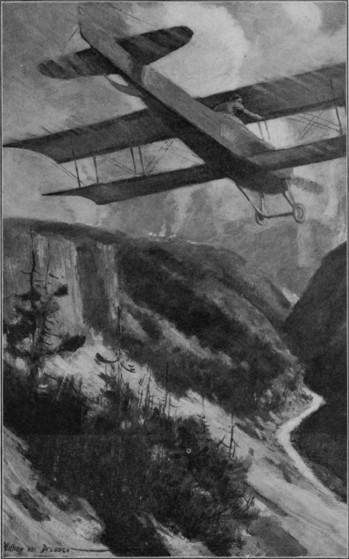
Raced quivering down the gorge of canyon-cooled air.
With heart that fluttered near to bursting, Ace accomplished the quick swoop, Ted snatched the girl aboard, and they were up again.
The miracle had been accomplished!—The mountains lay like a relief map beneath them, greenest down the canyons that branches Westward from the gleaming crest of the main divide, the snow-capped peaks gleaming silver in the sunlight. The fire zone lay like a small inferno behind them.
Back at fire-fighting headquarters, Ace’s nerves took toll of him in trembling knees. He had been all steel. Now he literally dropped in his tracks, and in ten minutes was fast asleep.
Rosa, now that the danger was all over, broke down and wept hysterically, to Ted’s infinite embarrassment.
Norris was just returning with the triumphant fire-fighters. They had actually not missed them. When, four hours later, Ace awoke and responded to Pedro’s “Come and get it!” as he ladled out the ham and beans, he found himself a hero, and Ted his press agent.
“This country would do well to emulate France,” Norris was explaining. “France offers a government subsidy to encourage commercial aviation. Our Congress has thus far refused to realize the need of appropriations. For it is by trade that aviation will develop.
“We need above all things more airplane fire patrols. We have the men, trained aviators left from the war,—we have the equipment, and the men could protect not only our National Forests, but at the same time keep a watchful eye on the millions of acres of state lands and timber privately owned, which lie adjacent to Government holdings.
“Do you fellows realize that in five years, areas have been burned that would more than fill the state of Utah! At that rate how long will our forests last? And think what a paper famine alone would mean!” He paused for lack of breath to express the intensity of his feeling.
“Hundreds of men have given up their lives in the service,—fighting fire.”
“Yes,” said Ace, “but Dad says there’s a bigger fight to put up in Congress for forestry appropriations.”
“Your father is doing good work,” stated Norris.
“He’s trying to, you bet!”
“These fire-fighting ’planes can sail over the highest peaks in the United States. They can travel 14 hours without a landing. They can communicate with those below by radio. And they don’t have to have smooth landing places, merely ground that is free from stumps. We have over twenty million acres of National Forests alone, (not counting those in Alaska), and they are worth $220,000,000.”
“Gee! And there’s just as much risk as in dodging enemy ’planes,” Ted enthused, “flying over fires, and finding landing places when your motor goes on strike.” His eyes glowed across at Ace.
“Huh, you’re safe enough above a thousand feet,” minimized Ace, modestly. “These accidents practically all happen below a thousand feet.”
But by now supper was eaten, and it was time to get back to work. Norris, acting on Radcliffe’s suggestion, had been stationing the men at intervals to back-fire as far down the ridge as they could stand the heat. If anything, the fire seemed bigger than it had the night before,—a maelstrom of the inferno.
They worked in pairs, Ace being his, Norris’s, right hand man. He now assorted the six miners along the slope, planning himself to take the extreme Western post, where the ridge ran lowest and where the rocky crest dwindled to a dangerous line of mountain pines.
Ted and Pedro he directed to the opposite end of the ridge, where, like the tooth of a comb, it joined the main crest of the Sierra,—another strategic point.
“If worst comes to worst,” his final words were, “take refuge in some cave. This is a limestone region,—as you may have noticed,—and it’s likely riddled with caves. Keep an eye out for indications of cave mouths. I saw one yesterday, somewhere down there, when I didn’t have time to investigate.”
“All right,” acquiesced the boys, though inwardly scorning the possibility.
Rosa remained at camp to have food ready for the men on their return.
She began by taking stock. There was flour and lard, but no bread. She would have to bake for eleven hungry men. There were rice, beans, onions and tomatoes, dried fruits and coffee, and fresh meat for one meal, and for the next, erbwurst and pickles, macaroni to be baked with cheese, and tea. She hoped—for more reasons than one—that the Ranger would bring more supplies. She got out the Dutch oven and the gallon coffee pot, and with the hatchet provided with the outfit, started getting in a supply of down-wood.
As on the day of the rodeo, she was attired in trim khaki riding breeches and high-heeled moccasin boots,—good on horse-back but mighty hard to walk in, where the ground was rough. Her bobbed curly hair, red silk blouse and fringed sash added a touch of the Rosa that underlay her gritty side. She would surprise Radcliffe with her ability to cook for a fire crew.
The huge loaf safely ensconced in a Dutch oven buried in red coals, she sallied forth on a little exploring expedition. She wished she might find some fir sugar to cap the feast. She had, once, when camping in the Thompson River Valley. She had found the delectable sweet on a Douglas fir. Some of the dry white masses had been all of two inches long, though most of it had been in the form of mere white drops at the tips of the needles. There had also been a quantity of it in a semi-liquid condition on the ground underneath the tree, where some rain had dissolved it from the branches.
Just where should she search? The Indians had told her that time to look on the dry Eastern slopes of the range, in open areas where the trees got lots of sunlight, but where the ground has not dried out too quickly after the spring rains, as moisture is necessary as well as sunlight,—(so long as it does not rain and melt off this excess of the tree’s digested starch). She had a hunch that she could find some on the desert side of the Sierras, that being, of course, unattainable—unless Ace could take her over in his ’plane. It would do no harm to look on this side.
Neither did it do any good. She returned to camp empty-handed save for some cones of the sugar pine, which she proceeded to roast that the nuts might fall out of the spiny masses.
She found the deserted camp over-run with chipmunks. The little striped rascals had ravaged all the food supplies they could nibble into. She watched a couple of them actually shoving on the tin lid that she had left insecurely loose on the syrup can. Finally sending it clattering to the stony ground,—as she watched from behind two trees that grew close together,—the wee things sat up there on the edge of the can, dipping out its contents with their hand-like paws and licking them. Then one tried to reach down and drink it outright, at which he fell in, and Rosa felt impelled to fish him out and launder him,—to his terror,—before turning him loose, then put the syrup on the fire to sterilize.
Meantime what of the fire fighters? Ted and Pedro, with their pick and shovel, had descended rapidly into that deathly silence of the doomed forest slopes, deserted alike by song birds and chipmunks, the hum of insects and sound of any living thing, save alone the never-ceasing roar of the ravenous flames.
The fire had been eating slowly through a stretch of manzanita chaparral, whose hard stems resisted them as the evergreens could not. Though the wind still blew up-canyon, they approached the river gorge at right angles, and were able to make their way to the lower levels in the shelter of the East side of a dry creek bed, where the hot blast could not reach them.
They were stooping to drink at a spring when the terrified neigh of a horse sounded from a clump of saplings almost behind them. In the same instant the stretch of seedling firs that clothed the creek bank, showering into sparks at the far end, shot toward them sky rockets of leaping flame. Turning in a panic to race out at right angles from this unexpected peril, they thought to make time on horse-back. The animal was tied and hobbled with a rawhide lariat!
Frantically the hobbled horse jerked at the rawhide.
Pedro plucked Ted by the arm and tried to drag him on, for the fire was snapping through the under-brush at the speed of an express train. Its sound was that of many trains, and its wind hot as the breath of a blast furnace.
But as Ted had stooped to cut the thongs, his parched nostrils had caught a cooler breath. It seemed to issue from a cranny in the rocks behind the clump of saplings. Then it was too late: The shooting tongues of red were upon them. Dragging Pedro down beside him,—for the roar drowned his voice,—he waited, reasoning that the two- or three-foot seedlings would go like tinder, leaving a strip of ground hot, to be sure, but no longer flaming.
If they could but endure its passing! He turned to press his scorched face against the rock wall.
To his amazement, he fell into a cave mouth, tripping Pedro, who stumbled after him. Quick as thought they dragged the horse in after them and held him, trembling and snorting, his eyes rolling wildly, during that blistering moment until the line of fire had passed them.
“We’re safer now than before,” declared Ted. “This made a fine back-fire, didn’t it?—Let’s rest awhile.” His nerves were taking toll of him. “Ground’s too hot yet anyway.”
For perhaps an hour they rested, flat on the floor of the cave,—after having tied the horse to a bowlder just outside. He was a fine animal, black as jet and as high-spirited as Spitfire himself. Ted appraised him with longing eyes, for he loved horses as Ace loved his ship. But who could he belong to, and how did he come to be there?
His bridle was embellished with silver. “Mexican handiwork, that!” Pedro thought. But the mystery was no nearer solution.
The answer came sooner than they expected.
CHAPTER VI
THE INCENDIARIES
The red glow of the sun on the snow-clad peaks of the main ridge had begun glinting through the smoke gloom when voices seemed to echo from within the very rock against which they were leaning. The boys crept to look behind it. Then their eyes rounded in astonishment. As Ted would have spoken, Pedro clapped his hand over his mouth with a look that bade silence. Crouched motionless at the side of the cave mouth,—for a deep cave it now disclosed itself,—the two boys peered at the spectacle that greeted their eyes.
Three Mexicans, aglitter with the silver buttons of their native costume, appeared suddenly from some black depth, carrying torches.
With these one of their number kindled a bon-fire, whose flame revealed a couple of burros standing patiently under their packs, tied to a mammoth stalagmite. For the red flare behind the three figures of the Mexicans, showed a cave roofed with amber-tinted icicles of smoke-stained rock, beneath which up-rose for each a pyramid of the same formation.
The Mexicans might have been father and son and old servant, from their general appearance and from the fact that most of the work of supper-getting was performed by the shabby, white-haired one, while the fat middle-aged one struck the younger a blow that was not reciprocated. They were talking in a tongue that Ted could not translate, though from the peppery tone of it, he judged they were quarreling. Pedro assured him later they were not. (He knew Mexican.) They were merely regretting that their horse had been burned.
The fat one, evidently too fagged to move, was demanding that one of the others go see for sure, while they argued that it was no use, the animal could not have survived. They must have been exhausted, lame, besides, to judge from the creaky way they moved. The fat one poured some verbal vitriol on their heads for not having brought the horse inside, while the white haired one deprecated that they had not intended to be gone so long.
“It’s the fat one’s, and now he’ll have to hoof it like the others; he’d sure break the back of a burro,” translated Pedro in huge enjoyment, to his mystified companion. “Wonder if they’re the fire bugs Rosa saw?”
“Let’s listen and find out,” said Ted.
As the blaze by which they dried their mysteriously muddy feet died down to red coals, from the pack of one of the burros the old peon extracted some ready-made tamales and proceeded to add the heat of cooking to the hotter peppers within their enwrapping corn husks. This fiery mixture they quenched from a round-bellied bottle passed from lip to lip, though the fat one took his first and longest.
“They’re the fire bugs, all right,” said Pedro softly into Ted’s ear. And it was agreed that they might safely creep in along the shadows till Pedro could hear more plainly.
Sanchez was the name of the fat leader, and his son and his servant the others proved to be. They had, it developed, a grouch against the lumber company down on the Kawa, (in which, as it happened, Ace’s father had an interest). They had been fired from the crew, and no punishment was too great for a company that would do that to a workman who merely asked his accustomed afternoon siesta.
“Detestablemente!” (And other remarks that sounded like fire-works.) The pigs of Americanoes! Pedro convulsed Ted with his recital when they had crept back to the cave mouth, despite the seriousness of the situation.
That they would start more fires at their first opportunity had also been established by their conversation.
“We can’t let ’em go,” argued the ranch boy.
“We can’t capture them,” the Castilian was as positive. “We are unarmed, and they have their daggers.”
Ted pondered, peered out at the still, smoking ground, soothed the nervous horse, then came to a conclusion, which he unfolded to his comrade.
He must go for help. He would ride that horse, find Norris, get Ace to wireless Radcliffe, and summon help. But—he eyed Pedro doubtfully, knowing his uncourageous bearing at the rodeo.
“But what?” insisted the Spanish boy. But had he not guessed it! Of course he would remain behind to keep track of the desperadoes.
But how could Ted start with the ground so hot? He would have to wait awhile, then make up for lost time by break-neck riding.
So be it. They were hungry now, and ate the ration of tinned corned beef and hardtack from their pockets. Ted also fed the horse some hardtack, and brought him several hatfuls of water from the spring,—scorching his soles as he crossed the charred ground.
Pedro propped his tired body in a sitting posture with one ear cocked for the conversation within. Ted flung himself flat on his back in the smoky gloom, which obscured even the light of the moon. He was mentally exploring that cave,—remembering what Norris had once told them of the region and wondering into what limed recesses the Mexicans were likely to retire when capture threatened. That the cave had its depths he felt assured by their having so suddenly appeared with their torches. And what could Pedro do if they tried to leave before help came?—My, but he must ride! Three such incendiaries loose in those dry forests, and there would be no end to the harm they could do!
The limestone of which these caves were formed,—sediment of the shells of myriads of sea creatures,—had been deposited in the primeval ocean that once flowed over that whole region from the Gulf of California. Uplifted by contractions of the earth crust, it had been cut as the surrounding granite could not have been by the percolating rains and streams, flowing along the cracks of the uplift.
This cave was probably a network of water-worn passage-ways extending no telling how far underneath the ridge. There were reputed to be caves almost as large as Mammoth in these unexplored recesses of the Southern Sierras. Could this be one of them, or was it just a two- or three-cavern affair, he wondered? On that depended a very great deal of their success in the coming capture, for once entrenched within these labyrinthian caves, the Mexicans could hold them at bay until they had made good their get-away. It had been so, he had been told by military men, in chasing Mexicans over the border.
Perhaps there were other caves in the region. Where, indeed, had these men secreted themselves while the fire had raged in a semi-circle about them? In a cave, the air would be damp and cool, no matter what was going on outside, and they could have been genuinely comfortable with the inferno raging over their very heads. Unless, of course, the smoke suffocated them! That would all depend on the air passages that fed their particular cavern. Some of those caves across the Mexican border were miles in extent, and had exits galore.
Pondering the pendant stalactites that had gleamed like onyx in the firelight, he pictured the water percolating drop by drop through the limestone crevices, dissolving the lime and forming the stalactites a drop at a time through the years. How wonderful it was! He wished he too might study. Perhaps, if he could make a go of his mother’s fruit ranch?—He was half asleep. He roused himself by trying to recall what it was that Norris had told them about stalactites.
The rain water, charged with the carbonic acid gas of the atmosphere, seeps in from the surface and falls drop by drop. Each slow drop remains long enough upon the ceiling to deposit some of its dissolved lime in a ring to which the next succeeding drop adds another layer.
In time this ring lengthens into a pipe-stem of soft lime. It fills and crystallizes, thickens and elongates, as the constant drip, evaporating from the outside, deposits more and more of the lime. Thus these stone icicles are formed, sometimes an inch a year.
At the same time the drops that fall to the floor, solidifying one at a time, build up a slender pyramid beneath,—a stalagmite,—which reaches higher and higher as its stalactite hangs lower and lower. In time these two formations meet in a slender pillar, the pillar thickens through the same slow process and if the pillars stand close enough together,—as where the drip follows a long rock fissure,—the pillars will eventually join in a solid partition.
This dripstone, as the material of the formation is termed, began as soft carbonate of lime; it hardens into gypsum or, sometimes, alabaster, or calcite.
The boy peered once more into the carved gallery, waiting till an up-flare of the dying fire again illumined the fantastic ceiling, whose fairy architecture gleamed opalescent in the orange glow. He thought of the old fairy tales of gnomes hammering on their golden anvils in their jeweled caves in the hearts of the mountains, and wondered if such lore had not arisen from the fact of just such cave formations, coupled with the echoes the slightest sound set to reverberating. After all, most folk tales had some foundation.
Once these Mexicans were captured and the forest fire brought under control, he meant to ask Norris if their camping expedition might not include an exploration of some of the caves he had assured them honeycombed this part of the Sierra.
He little dreamed in what fantastic fashion his wish was to come about, as he lay there waiting till he could start his ride for help!
Nor did Pedro, drowsing, exhausted, beside him, dream of the test that was to be made of his courage while he remained behind. He seemed so fagged that Ted did not even wake him, when at last he deemed it time to sally forth.
Ted loved nothing better than a good horse.
The plainsman, he used to argue, may have his twin six, the airman his ship, but for the outdoor man, give him the comrade who can take the mountain trails, the needle carpeted forest floor, the unbridged streams, the glacier polished slopes.
The black horse wore the high Visalia saddle, against which his rider could rest on steep grades. It would be more dangerous, should the animal throw him, though of course the high horn would help him to pull leather should need arise. He had lengthened the stirrups, Western fashion, till his long legs dangled easily and he could have raised himself scarce an inch above the saddle by standing in his stirrups. His long, lean legs would give him a good hold where the going was rough, and if he had only a quirt, or even a pair of drop-shank spurs, he would have felt confident of making time. (For he knew how to use the spurs so that they would not torture his animal.) He regretted that the mysterious owner had not fitted the poor brute with the old spade bit, for should the horse fall, on the uneven ground, it would be likely to cut his mouth badly. He had once seen an animal bleed to death from such a hurt. Well, they must not fall!
Mechanically he opened the reins, as was his habit:—His own horse had been trained to hitch to the ground, and all he had to do when he dismounted in a hurry was to drop rein. He was glad to find that the saddle was rim fire, (or double-rigged), as it would stay in place, no matter what acrobatics they might be forced to perform. So far, so good!
With right hand on the saddle horn, left grasping rein and mane, he swung up, and before ever he touched leather, they were off.
Would his mount prove broncho? Had his probably Mexican owner uglied his disposition? That remained to be discovered. And on that detail would depend much of the success of his race for help. For with Norris at the far end of the ridge, there would be several hours of tough going, he surmised.
“Yes, sir, you shore gotta slope some!” he told the mustang, in imitation of the cow-men. “Or those Greasers will just naturally fade out of the landscape.”
As the night wind blew the smoke down canyon, he could very nearly tell his way, and the time as well, by the stars. Being early in July, he knew that in the constellation of Hercules, almost directly above, the hero’s head pointed South. It was something Norris had told them one night when they had to travel late to find a fit camping spot. The crest of the ridge lay South, and along the crest he should find more open going. He would then have to veer to the West. As Venus rose brilliantly in the East, he knew he had now about two hours and a half till sunrise.
Breasting the wind, he headed around the twisting stems of unyielding manzanita, then up, straight South, over slide rock and fallen tree trunks, turning aside for only the larger bowlders. The mountain-bred horse was lithe as a greyhound, as he alternately climbed and slid, or made wide leaps over the uneven slope.
The ridge attained, however, he found it harder going than he had imagined, by reason of the broken shale, weathered by the frost of unnumbered winters. But just on the other side,—that furthest from the fire zone,—stretched a smooth granite slope, where the going would be unobstructed. But these smooth slopes, bed of that prehistoric river of ice, slanted slowly but surely to the cascading mountain stream whose roar now assailed his ears. One slip on that smooth surface and his horse would never stop till he had reached the rapids! The boy wondered if the animal were sufficiently sure-footed. The answer would mean, at the very least, the difference between a broken leg and a sound one, for the boy speeding to secure help in the capture of the fire bugs. But there seemed a fighting chance, and he would take it.
At intervals the granite was blocked out by cracks, and he found the slight unevenness of a crack lent his mount a surer footing. At times it was fairly level and he ventured a gallop; again it was precarious even at a walk.
Suddenly a monotonous “chick-chick-chick” buzzed beneath their feet. The horse leapt violently to one side,—just in time to evade the coiled spring of four feet of green-black rattlesnake, on whose sinister form he had all but trod. By that instant leap he had avoided the speedy death of the injected virus of the stroke. Ted’s heart was in his mouth.
On—on—on he urged the black. It became mechanical; he ceased to think. Exhausted alike by his long vigil and the strain he had been under, he now sat his horse in a daze, just keeping his nose generally Westward, while he skirted the crest of the ridge. He felt half numb as he rounded the end of the crest where Norris was to have been stationed. To his stupefaction, the fire fighters had completed their trench and gone!
Where could they be? Probably back at the camp, which he had skirted by this detour, never dreaming he would find any one but Rosa there. Well,—he was “outa luck!” Back he went the way he had come, till he thought it time to climb the ridge. A flare of cook-fire through the graying dawn showed him where to head, and the huge sun was just slipping blood-red through the smoke gloom as he took the last log at a leap and dropped off beside the moving figures.
The men were all there,—as was Ranger Radcliffe, whom the DeHaviland had evidently returned with fresh supplies. It took but few words to acquaint them with the situation.
By the time Ted had drank a quart of coffee with his breakfast, he was able to pull himself together again and lead the possé to the hidden cave mouth. The Ranger would have to be the one to go, to make the arrest, and he deputized Ace to help him. That meant leaving Norris to head the firemen. (It never occurred to any of them that they would not be right back with Pedro and the Mexicans. The foam-flecked horse Ted left to Rosa’s care.)
The cave mouth accomplished, Radcliffe entered first, with revolver cocked, though Ace almost trod on his heels. Ted staggered after with a flaming pine knot flickering in his almost nerveless hand.
The cavern was absolutely empty!
To Pedro, left in the cave mouth to watch the Mexicans, the night had been the crucial test.
He had been asleep when Ted departed, while the Mexicans had slept within the cave. He awoke to find the three dark visages bending over him, their verbal fireworks hissing about his ears. At first “caballo” was all he could make of it,—(the horse). Then as Sanchez the stout, soared rhetorically above the others, he gathered that they dared not leave him and they could not carry him. “El Diablo!” How much simpler to thrust a dagger between his ribs. “Muerte!—Presto!” But no, wait! For the time being he would walk between them carrying two extra torches. There must be another exit to the cave, but could the burros make it with the packs? Try it they must, for this way their choice lay between the fire fighters and the flames. The doomed forest still glowed red and black down canyon, and with the morning light, the wind veered till the smoke assailed them chokingly. There was no time to be lost.
Never for an instant dreaming that Pedro understood, they gave him the torches he was to bear, and started into the depths of the cavern. And the boy? Too frightened at first to have spoken had he tried to, he had the wit to see that protest would be useless. They were three to one, armed, and desperate, and they counted him a likely witness to their incendiarism.
Besides, now that the wind had changed, he could not have gone ten paces without having been blinded by the smoke till he could not see where he was heading. This side of the canyon was going to go like tinder, too. Besides,—this came later,—how could he allow the fire bugs to get away? His job was to keep tabs on them, and that he would now have an exceptional opportunity to do, he cheered himself.
At first the flare of the torches revealed merely the cavern of onyx stalactites he had seen the night before. This formation wound in a narrowing labyrinth until they made a sharp turn to the left. Presently they came to a pit of inky water, around which they had to skirt on a sloping shelf. The burros could not make it and they left them there. Either, Pedro argued, they meant to return that way or else they had other supplies awaiting them. But now they could no longer smell the smoke. From somewhere came pure air, damp and refreshingly chilly. The sounds of the outer world were cut off completely. On and on they wandered as in a dream. Pedro began surreptitiously pinching himself to make sure he was not having some weird nightmare.
They came to a grotto that might have been brown marble, whose curious carvings he had no time to study. From this they had to crawl on hands and knees through an opening into another twisting passageway, floored with muddy water and barely high enough for them to stand erect. Their voices echoed and reechoed. Then came arches of stalactites almost meeting the stalagmites beneath them, through which they edged their way as through a frozen forest.
This opened into a vast cavern hung as with icicles of alabaster, which their torch light warmed to onyx.
“If these fellows weren’t so free with their knives,” Pedro told himself, “it would be an adventure worth having. But they certainly have too much dynamite in their dispositions to suit me,”—for the Mexicans were now quarreling among themselves. The boy and the old man were for turning back before they lost themselves,—for at every turn there were branching ways.
But Sanchez, the heavy-handed, was for going on,—and on they went, shivering in the unaccustomed chill.
Pedro wondered what the rescue party would do when they found them gone. If only he could leave some sign of his whereabouts! Could he drop his handkerchief at one turning of the ways, his hat at another, without detection? Or was it already too late? Why had he not thought of that before?—Tucking one torch into the crook of the other elbow for a moment, he dropped his bandanna as again they took the left-hand of two turns.
But now their little flare of light revealed a blind passageway. The water-worn rock had been hollowed out by some eddying pool, no doubt, while the main stream had flown on past. How he wished he knew more of cave formations! Should he find opportunity to escape, how would he ever find his way out again?
Retracing their steps, they took the right hand turn. Here was another high roofed vault,—he could not see how high, he could only guess from the reverberation of their voices,—whose stalactites had become great pillars that gleamed yellowly. The floor sloped toward them till they had stiff climbing. On one wall was a limestone formation like a frozen cataract. And thrust into the wall beside it he saw a torch stick. Who had left it there, and what ages ago, he wondered? In this cavern some of the stalactites hung as huge as tree trunks, and had not Sanchez bade the others keep an extra eye on him, the lad might easily have hid behind one.
Some of these huge pillars were cracked with age, and again the thought occurred to him that if only he might insert himself into one of the cracks,—a few were all of a foot in width,—he could easily escape detection in that uncertain light. But now he was under surveillance every instant. Besides, (tardy thought), was he not pledged to keep an eye on the villains? He smiled through his fears at the recollection that they, not he, were captive.
Meantime Ace and Radcliffe, (leaving Ted to sleep off his exhaustion in the cave mouth), were examining the onyx cavern and the ground outside for some sign as to what had happened, and which way Pedro and the Mexicans had gone. Radcliffe had his electric flash, and at the turn of the winding passageway discovered scratches on the sandstone floor where the burros had left hoof marks. But had they taken the turn to the right or that to the left? There were hoof prints both going and coming, in each passageway. Which had been made the more recently? They could not tell.
Ace hoped that the Ranger would propose each following a different direction, but instead, Radcliffe remarked that they ought to have brought a ball of twine to unwind as they went, as people had been known to get lost in unknown caves, and stay lost for days. The best alternative was to make a rough map of their turnings in his note-book.
They advanced along the right hand passageway, whose breath seemed like that of another world from that of the parched mountain side,—cool and moist and wonderfully exhilarating. Had it not been for his uneasiness as to Pedro’s whereabouts, Ace would have enjoyed this expedition into the unexplored. His was a nature that craved the tang of adventure, even more than most. It was one of the things that had led him to take up geology, for in the U. S. Geological Survey his life would lead him, likely, to far places.
He wished, though, that Ted were with them. A good pal certainly doubles one’s enjoyments.
They had gone what seemed like miles, (though cave miles are deceptive, so completely is one cut off from space and time), bearing always to the right, when Radcliffe’s light suddenly burned out, leaving them in primeval darkness. At first breath they tried to laugh at their predicament, then the utter blackness seemed to press upon them till it suffocated, and Ace suppressed a sudden desire to scream. His panic moment was dissipated by Radcliffe’s discovery of a bit of candle. Ace had, of course, that most important part of a camper’s equipment, a waterproof match-box, linked to his belt, and in it a few matches. But even then it meant going back the way they had come, for without a good light they could do nothing. Perhaps it was just as well, for they were bound on no hour’s adventure, and should have brought food as well. How Radcliffe wished he had his acetylene lamp!
To their surprise they found Norris at the cave mouth trying to arrange his coat under the sleeping Ted. And around him lay the coiled lariat he had taken from the saddle-horn of Ted’s recent mount, also three canteens, some cooked food, and a supply of hard candles from the fire crew supplies. There were also the boys’ sweaters,—Radcliffe, of course, had his woolen uniform,—and to cap the climax, a ball of twine and the Ranger’s pet lamp, with its tin of carbide powder.
To their amazed query Norris explained that he had explored dozens of caves in his time, including some hundreds of miles of that honeycomb formation that underlies a portion of Kentucky, to say nothing of the caverns of the Shenandoah Valley of Virginia, the Black Hills of South Dakota, and the Ozarks. Of the caves of California, however, he as yet knew nothing.
Had he not been needed to head the fire crew, he would have loved nothing better than to have gone with them.
“I knew this was a cave region,” he told them as they ate and refreshed themselves before going back into the black depths—for they had been gone several hours, it seemed. “Fissured limestone—I noticed it yesterday when we were down here trying to backfire. Then what feeds the Kawa? Not these little flood creeks that dry up almost before the spring floods are over. Where does all that snow water go to? Some underground passageway, of course. It seeps through the porous rock to subterranean channels. By the way, I see there are tracks of muddy feet inside here, and your feet are dry! The mud must have been left by the Mexicans.”
“That’s a fact!” exclaimed Radcliffe. “Ace, did you notice any mud along that passageway? Then we surely took the wrong turn.”
“Not necessarily,” said Norris. “They might have come from some muddy cavern, but gone back another way. However, I was going to give you a little idea of the probable layout of a cave. This one, if—as I suspect—it feeds the Kawa—likely descends to other levels, till the lowest one is very nearly on that of the river. Seeping through, here and there, the rains and melting snows probably collect into a stream.”
“Wish you could go with us, old chap,” said the Ranger. “But––”
“You’ll get along all right, with these things,” sighed Norris, “and if you don’t show up again within a few hours, we’ll follow your twine,” and he tied one end of the cord ball to a manzanita bush, handing the ball to Ace. At that moment Ted awoke and insisted that he join them. Norris reluctantly returned to the fire crew.
CHAPTER VII
THE CAVE
Electing the turn to the left, Radcliffe led the way with his carbide lamp. Ace and Ted followed with their candles.
This time their choice was quickly verified by the discovery of the burros, standing patiently with their packs before the pool. (That accounted for the muddy footprints.) Skirting this on the shelving ledge as had Pedro and the Mexicans, they traversed the winding passageway that led to the grotto of brown cauliflower-like encrustations. But here, when they found that the left-hand passageway meant going on hands and knees, they chose the other turn. (They came that near to catching up with the fugitives!)
With the suddenness of events in a dream, they came into a vast chamber that at first glimpse, lighted as it was by the carbide lamp, gave the impression of a baronial ruin. The boys whistled simultaneously under their breath. At the far end stood a huge stone elephant,—or so it appeared at the first startled glance,—and beside him a gnome and several weird beasts vaguely reminiscent of the monsters of prehistoric times.
When Ted could speak, he whispered, “What are they? Fossils?”
Ace laughed. “I should say not. They’re nothing but dripstone, can’t you see?—They’d be ‘some fossils’! Why, if we could find just one fossil as big as that, our fortunes would be made—absolutely.”
“Gee! Then I’m sure going to keep my eyes peeled.”
“I thought,” put in Radcliffe, “that fossils were little stone worms. I’ve found those aplenty.”
“Fossils,” explained Ace, (fresh from first-year geology), “are any remains of plants or animals that lived, either on land or in the sea, in ancient times. A lot of those we find to-day were shell-fish and other marine life.”
“Gee!” grinned Ted, “doesn’t he talk like a professor? I’m going to call you professor after this, old Scout!”
“Go on,” the Ranger urged, ignoring this sally, “I’m interested.”
“So am I, honestly,” amended Ted contritely.
“There were land animals, too, that got buried in the accumulating sediments and fossilized. Times when the ocean over-ran the land, they got drifted into it, and sank, and got buried under the sands that made our sandstones––”
“This floor is sandstone!” interpolated Ted.
“Yes. Or they got buried in the ground-up shells that made our limestone,—like the walls of the cave,—or some of them were buried in mud.”
“I suppose,” offered Ted facetiously, “that the mud made mudstones,” and he laughed till his voice echoed and reëchoed startlingly.
“Ha, ha! You’re right!” Ace turned the laugh on him. “Go to the head of the class. I’ll show you mudstone when we come to it.”
“Why, then,” ventured the Ranger, “this must be a topping place to find fossils.”
“Provided,” Ace admitted, “the cave is not of too recent formation. But as I was about to say,” (seeing their undoubted interest), “geologists can just about piece together the history of the earth from the fossils that have been found, but no one locality gives it all. They have found part of the story in America and part in Africa, and parts in Europe and Asia. And from that series of fossils—and some other evidence—scientists have about agreed that since the earth was formed, about twenty whole mountain ranges, one after another, must have been formed and worn away almost to sea level.”
“How do they make that out?” Ted looked skeptical.
“That’s another long story. I’m no professor. But––”
“You can’t prove it.”
“Neither can you disprove it, any more than you can the conclusions on which astronomy, higher mathematics, any of the sciences—are based.”
“I suppose so! Gee, I’d like to study those things for myself!” sighed Ted, seating himself beside the others on a dry ledge while they ate their sandwiches.
“Find a valuable fossil and you’ve earned a college education,” Ace challenged him. “And you know, fossils are not necessarily fish or insects or skeletons or tree trunks that have been turned to stone.”
“To stone?”
“By the removal of their own tissues and replacement by mineral matter. A fossil may be merely the print of a leaf of some prehistoric plant on sandstone, or the footprint of some antediluvian reptile. In the National Museum they have a cast of a prehistoric shad that shows the imprint of every bone and fin ray.”
“How on earth could that have been formed?” marveled Ted.
“Why, it was simply buried in fine mud, which first protects it from the air, (and consequent immediate decay), then gradually fills every pore of every bone, till by the time the mud has turned to stone, the bones are ossified. Of course the animal matter has all dissolved away by this time. Now if this mud that filled the pores happened to be silica, (a sandy formation), it is possible to eat the surrounding limestone away with acids and uncover the silica formation, see, old kid?”
“Aw, that stuff makes my head ache,” protested Tim. “If I see any ossified bones lying around, or even a footprint or leaf print in the stone, I’ll know I’ve found a fossil. But I thought we were chasing fire-bugs.”
“The impatience of youth!” Ace playfully squelched him, from the vantage point of his slight seniority.
“What does the Bible say,” laughed the Ranger, “about truth from the mouths of babes?” And he arose a bit stiffly,—for he had had a strenuous time of it the past few days, and the cave damp had set his tired limbs to aching.
For upwards of an hour they followed dark and winding passageways, (rats and lizards and occasional colonies of bats fleeing before them), naturally without the slightest sign of the fugitives, when they came to another grotto, the loveliest they had yet seen. It might have been a fairy cavern, aglitter with pure crystal. The carved prisms shone dazzlingly in the light of the carbide lamp, and the boys stuffed their pockets with some of the jewel-like bits that had fallen to the floor.
From this they presently entered into what seemed like a Gothic cathedral, with a dome whose highest point must have been several hundred feet above. The boys were fairly awed by its beauty, while the Ranger’s eyes gleamed appreciatively. On the walls were what might have been carvings of flowers and lacework, creamy to smoke color, gypsum, Ace told them.
“Are these fossils?” demanded Ted excitedly.
“I should say not, you poor fish!—You ichthyosaurus,” laughed Ace teasingly.
“You what?” asked the Ranger.
“That means ancient fish.”
“All right,” grinned Ted. “If I’m an ich––”
“Ich-thy-o-saur-us?” Radcliffe came to his rescue.
“Then you’re a dinosaur,” grinned Ted.
“Here, here, stop calling each other names!” commanded Radcliffe. “And perhaps Ace will tell us about this gypsum formation.”
“Thunder! Wish Norris was here! I tell you I’m no professor. But if you’re after fossils, don’t you remember what he told us, that day just before we lost the pack burro?—That in this part of California we have rock from the Cambrian era a mile thick, and I’ll bet it’s full of fossils of the fish age!”
“Well,” Radcliffe briskly interposed, as they came to another turn, “we’ll never find those Mexicans unless we separate and hunt faster than we’ve been doing. Are you fellows game for taking one way while I go back to that last turn and try the left hand passageway? Of course the instant you get wind of them, report back to me.” They signified their gameness by picking a precarious footing, (Ted first), along the slippery floor, their candles thrust in their hat bands.
Above they came to another but a smaller forest of alabaster stalactites, shining like icicles or mosses, some white as snow, some yellow as gold, and some so like maple sugar in appearance that Ace actually tasted it. In one place there was a bit of what Ace said was needle gypsum, that hung as fine as fur.
Radcliffe, retracing his steps, (with the aid of the twine ball), till he came to the cross roads, as it were, turned to the left and forged ahead with his carbide lamp, treading softly as a cougar, with revolver cocked in his right hand. Ever and anon he stopped breath-still to listen.
Passing through the same alabaster cavern that had so impressed the Spanish boy, his eye caught the bandanna Pedro had dropped in the left-hand passageway. With an inward exclamation, he hurried on till he had reached the end of the blind. Stooping with his lamp, he could see the fresh scratches their feet had made. Darting back to the turn of the tunnel, where he had picked up the bandanna, he took the only choice left to him, the right hand way, with all the satisfaction of a hound on the scent. More scratches on the sandstone floor assured him that they had really gone this way, instead of turning back the way they had come, and presently he too was standing in the gallery of the sloping floor and yellowed pillars, at whose far end the dripstone cataract hung, turned to soundless stone. But of the three Mexicans and Pedro there was no trace.
“I say, when do we eat?” Ace was just beginning, when the floor suddenly gave way beneath him, and he fell down a ten foot well, landing on all fours, in Stygian blackness. And no sooner had his bulk padded the stone beneath than Ted came, plunk! almost on top of him.
At the moment both were slightly stunned. Their candle flames had of course been flicked out. Then Ted reached mechanically for his matches, by whose flare he found his hat, and still firmly stuffed into the band, his candles. The light disclosed a cavern with muddy walls dripping above them, and to their right, an inky pool of water. The air was all aflutter with the bats they had startled from their pendant slumbers, lizards scuttled away in all directions, and a fish flopped in the pool, with a splash that sounded out of all proportion to its exciting cause. Ted grinned as he saw Ace first pinch himself to see if he were dreaming, then slowly feel his joints to make sure none were seriously damaged.
The fall had rather jolted his nerves, but otherwise he was unhurt, as was his chum. But how to return the way they had come they could not see, for the walls were too slippery to climb, there was not a spear of anything movable in sight on which they might gain a foot-hold, and when Ted tried it from Ace’s shoulders, the rim of the well was too slippery with mud for him to gain a hand-hold.
The bats, blind from their lightless lives, bumped against them and added the final touch of weirdness by their gnome-like faces.
With the uncanny feeling that they ought to whisper, the shaking boys started to explore the cavern, which they found led off in three directions. It must be on the same level they had left when they said good-by to Radcliffe, but in their panic they were completely turned around, and they had not explored for ten minutes before they were so confused that they could not even have found their way back to the cavern of the pool.
Now Ted had been lost before. He knew the panic feeling, the sudden sense of utter and helpless isolation, the absurd fearfulness, almost the temporary insanity of it. His scalp prickled,—as did Ace’s,—and for a little while his wits seemed befogged. Then he remembered that bed-rock advice Long Lester had once given him. When you don’t know which way to go, sit down and don’t move one step for half an hour. And try to think out the way you got there, or some plan of campaign for finding yourself again.
Ted had once been lost in the chaparral,—a thorny tangle of low growths that reached higher than his head. When he first discovered he was off the trail, he wandered about as in a mystic maze, till a shred of his own gingham shirt, (caught on a stub of manzanita), told him he had circled.
He had had to spend the night there, but in the end he had stumbled upon the trail again, not ten feet from where he lost it.
As Long Lester afterwards pointed out, had he but blazed his trail from the very first step, he could at least have back-tracked. Or better, if he had with his jack-knife made a blaze sufficiently high on some stunted tree to have seen it and come back to it, he might have circled, and in ever widening circles would surely, in time, have found the trail.
Or, again, he might have—had he known—at least hacked a straight course by the stars, (always provided that he knew in which direction lay the way out).
“Ace,” he managed to steady his voice when they had been seated on a dry ledge for some little time, “your knowledge of cave formations might help us to find the way out of here. Gee! If this was only in the woods, or even on some mountain side above the clouds! But it’s up to you now.”
“Well,” Ace began, “the map of the typical cave, say like Mammoth, wiggles around a little like a river with its tributaries, though nothing like so regularly, with here and there a wider place, and––”
“Here and there,” contributed his chum, “a well to a lower level.”
“Yes. You see, the water that wears a cave out of the softer layers of rock seeps in along the fissures of the surface rock, and at first they make subterranean rivers. Where you find these big springs in the hillsides, they may be the outlets of these underground waterways.”
“I get that, all right,” said Ted.
“Well, then, sometimes these Stygian streams––”
“Keep it up, Professor!” Ted clapped him on the shoulder.
“Huh!—These rivers wear away the soft limestone layer,—if it is this kind of a cave,—’till they come to the harder sandstone. Then the first chance they find to get through the sandstone,—perhaps through a crack made by an earthquake or something,—they go down and wear away a deeper level. Mammoth Cave is on five levels. That leaves the upper galleries dry. Now the one we were on was dry except for the moisture that is always seeping into a cave, but I suspect now we’re on a level with the river, it’s so muddy, and we’ll find it somewhere.”
“Then we’ll find it somewhere!” brightened Ted. “And we can follow it. That’s the plan of action!” and he jumped to his feet.
“We’ll follow it if we can. Thunder! I wish we had a boat.”
“So long as you’re wishing, why don’t you wish for a fat steak with onions?”
“It has been some time since we ate.” Ace tightened his belt. “Must be getting late in the day! Let’s run!” And run they did, till they began slipping on a muddy slope.
They had to place each foot with care now, and their progress was slow. At the same time their candles were nearly gone. “Now let’s put out all but one,” suggested Ted. “Just burn one at a time. What would we do without any light?” But Ace did not know the answer.
What of Pedro, meantime? At that particular instant he had just tried to make his get-away, with the result that three drawn daggers were being flourished threateningly and most unhealthily near his heart. He had overheard enough evidence to convict all three of the Mexicans, thanks to his knowledge of the parent language, but as the desperadoes pushed farther and farther into the labyrinth, he gathered that they would come out a good safe distance from where they had entered,—probably on the other side of the ridge. Had he known the Ranger’s whereabouts at that precise moment, he would have felt very differently.
Radcliffe, meantime, was staring into the dark recess of the cavern, but all he could see was the two shining eyes of whatever occupant was there. Was it bear or cougar? For both, he knew, took refuge in caves. The largeness of the eyes inclined him to the belief that it was a California mountain lion, and such it was part of his work to exterminate,—though the state also hires an official lion hunter.
That the great cats are cowards he well knew. But this one was cornered, and might prove no mean antagonist. With revolver cocked in his right hand, his lamp in the other, he advanced toward those two shining fires. A faint scratching along the rocky floor warned him that the animal was gathering for a spring. He was still rather far for a revolver shot, but he aimed straight between the eyes. His shot reverberated with a thousand echoes. The sounds, ear-splitting in the smoke-filled gloom,—thundered like a thousand siege guns, it seemed to Radcliffe, stalactites tumbled about his ears like crockery, and more appalling than all the rest was the weird, almost human scream of the wounded animal, which likewise reëchoed for several minutes. The unwitting cause of all this turmoil was in a cold perspiration when things finally quieted down. But the puma, (for such it proved to be), lay dead at his feet.
The three Mexicans likewise heard the racket, for they, as it happened, were not far away. The Ranger had very nearly trailed them. With rolling eyes and hands that mechanically traced the sign of the cross, they listened, while the thunders died away.
Pedro, though his nerves were more than a little shaken, was quick to seize his opportunity. Slipping like an eel through a narrow opening between two columns, where the dripstone had all but closed the way into another chamber, he would have escaped observation entirely had it not been for his betraying torch-light.
Sanchez darted after him. But remember, Sanchez was at least a hundred pounds heavier than even well-fed Pedro. The result might have been expected. He stuck mid-way! And there he dangled his fat legs in an endeavor to free himself, while Pedro doubled with laughter and the other Mexicans stared, too amazed to move.
“Pull, can’t you, pull!” was Pedro’s expurgated version of Sanchez’s reiterated discourse with his followers. And when no one came to his rescue, he nearly burst a blood vessel in his helpless wrath.
Pedro, feeling safe from pursuit, with such a plug in the only approach to his sanctuary, now for the first time disclosed his knowledge of Mexican. Sanchez’s astonishment was as huge as his attitude was undignified, and if words could have seared, Pedro would have been well scorched. But the boy only told him of an item he had read in the paper, where a fat man got stuck in a cave and had to fast for three days before his girth had diminished sufficiently that he could be extricated.
With that, Pedro bade them a fond farewell, and departed along a labyrinthian way they could not follow. That some one was on their trail he suspected from the revolver shot, and the fire bugs would be nicely trapped.
Now the Ranger reasoned that the lion’s den would not be far from the outer world, and in that he was right, as he proved by following it to its end. The last lap of the way he had to wriggle along on hands and knees, but he could see the glow of the setting sun in a circle of light at the end, and in a very few minutes he had poked his head and shoulders beneath an overhanging bowlder on a rock ledge. It was the Southern slope of the spur, and after a little reconnoitering he discovered that it was the selfsame spur on which fire-fighting headquarters had been established. The cave, then, pierced clear through the ridge, and he had been exactly all day in following its windings.
Hiking wearily up the slope to the ridge, he could see the glow of the cook-fire perhaps a mile away, while down in the canyon on the other side the fire still glowed in red embers where it continued to devour the blackened tree trunks, though it was under far better control than it had been the day before.
Rosa’s solicitude at his haggard face and tattered, mud stained clothing restored him wonderfully. (After all, there were compensations in the scheme of things.)
“We were just about to start a search party in there,” said Norris. “I would have before, if it hadn’t been for the fire. But where are the boys?” He paled in alarm.
“I don’t know,” Radcliffe dragged from white lips.
“Oh!” gasped Rosa, her eyes filling with tears which she promptly hid by turning her back.
Without a word Long Lester gathered up the paraphernalia the Ranger now saw he had stacked and ready on the ground, and fitted it into a back-pack. There was food, rope, and candles, another tube of carbide for Radcliffe’s lamp, a box of matches in a tight lidded tin, and even a short length of rustic ladder made for the occasion.
Norris shouldered part of it as by previous agreement.
Radcliffe explained the diagram he tore from his note-book, marking a black cross at the point where he had left the boys.
“I dunno,” said the old prospector, “but what we might as well go in one way as another. I reckon we can folly this yere map backwards as well as forrud, and we’ll just hike down and go in the way you kem out.”
“That’s a go,” agreed Norris, striding after him.
“Oh,” yelled the Ranger after them. “Come back! I’ll deputize you both. Here, Norris,” and he gave the younger man his revolver and cartridge belt, with his official pronouncement.
“I swan!” said Long Lester. “Here I were a-thinkin’ so much about them boys I clean forgot the Mexicans,” and he slung his rifle atop his pack.
CHAPTER VIII
THE SNOW-SLIDE
“I’m glad they got in a few hours’ sleep this noon,” solicitized Rosa, placing homemade bread and coffee before the Ranger, then dipping up a bowl of soup. She looked fagged to death herself, and Radcliffe made her promise to roll up in a blanket on a browse bed.
“Oh, if only it would rain!” she sighed, “and put out the fire!”
“Sure wish it would!” he agreed. “Haven’t had such a big one in years.”
“The DeHaviland was back with more supplies,” one of the men reported.
“It sure takes tons of grub to keep these firemen stoked,” sighed Rosa drowsily from her blankets. “But they work like lumbermen, and I’d give every last man here a medal if I could.”
Norris and Long Lester skirted the South slope its whole length without finding the cave mouth from which Norris had exited. But by now it was dark, and the task doubly difficult. “If it wasn’t for them boys being most likely just plumb panicky from being lost,” said the old man, “I’d call it sense to camp for the night. Once it’s sun-up, we’ll find the place easy enough.”
But Norris was too uneasy to leave any stone unturned. What might not have happened in the hours since he had last seen his charges! His imagination, given free rein, pictured everything from murder to raving mania.
As they neared the head of the gulch, they could see, on the side of the main ridge that towered above them, patches of snow that gleamed white in the star-light. The canyon here headed sharply to the left.
The side they were on, the short side of the turn, was becoming impassable with rough bowlders and tangling underbrush.
Of a sudden a low rumbling sounded faintly from seemingly beneath their feet. The ground wavered dizzily. Trees swayed, rocks started rolling down the canyon side, and the very bowlder they were on tilted till they had to make a quick leap for it. It was just one of the slight earthquake shocks to which all Californians are accustomed. But never before had either Norris or Long Lester been on such dangerous footing when one happened.
Quick as thought, the old man went leaping up over the bowlders, yelling frantically to Norris to follow him. The geologist knew in a theoretical way what to do when a snow-slide threatened, and with that lightning speed with which our minds work in an emergency he had seen that the shock of the ’quake would precipitate snow-slides, and that they were directly in the path of one.
He knew theoretically,—as the old prospector knew from observation of several tragedies,—that the river of snow and rock-slide would flood down canyon till it came to a turn, then hurtle off in fine spray—on the side of the curve! (It all happened in an instant.) Their one salvation lay in taking the short side of the curve,—though the going was rougher.
With the roar of an express train,—whose speed it emulated,—the oncoming slide tore down at them. Down 3,000 feet of canyon the crusted snows of what was still spring at that altitude rushed like a river at flood. The wind of its coming swayed tall trees.
The two men escaped by the skin of their teeth!
“It shore would’a scrambled us up somethin’ turrible!” the old man kept exclaiming.
Next day, he knew, they would find a clean swath cut down the mountain-side,—tall pines swept away, root and branch. He had seen many of these scars, which in later years had become a garden of fire-weed and wild onion, a paradise for birds and squirrels and onion loving bears.
He had seen steep mountains fairly striped by the paths of slides, the forest still growing between stripes. For the steeper the slope, the swifter the slide, as might be expected.
Lucky for them this had been a Southwest slope; for on the North, away from the sun, a slide is even swifter!
He had seen one man buried by crossing the head of a slide which gave way under his foot. Its roar had been heard for miles. Frost-cracked from the solid granite, the side rock that accompanied it had been weathered from the peak. Thus are high mountains worn away.
For perhaps an hour after the near-catastrophe, the air was filled with blinding snow,—not that from the skies, but that of the snow dust raised by the slide.
The circle of the rising moon threw a silver glamor over the scene. “What do you figure makes these ’quakes, anyway?” asked Long Lester.
“The boys have asked that too, and I can’t give it to you all in a breath. But I’ll give you the story before we end this trip.”
At the moment of the earthquake, Ace and Ted, immured on a lower level of the cave, were following a subterranean river. They got well splashed by the waves set up, and worse scared, but it was all over in a minute and they were only a degree more uncomfortably damp than they had been before. Suddenly Ted gave an exclamation. A crag of drip-rock had been shaken from the roof, and there, imbedded in the limestone, lay the plain foot-print of—it might have been a giant!
The boys stared, marveling a moment, then Ted voiced his guess. The fossil of some giant of prehistoric ages! “A fossil, all right,” Ace agreed. “But that isn’t a human footprint, even if there had been men that size. That was made by some animal! If we ever get out of here, let’s bring Norris and come back with picks and find out.”
“Then I can quarry this fossil out and sell it?” ventured Ted.
“Right-o!” with a congratulatory slap that made Ted wince.
But the inky stream had once more become placid, and skirting the muddy ledge alongside, they threaded their way through arches of varying height till finally the roof was so low that they had to go on hands and knees. Then the bank became so narrow that Ace slipped off into the unknown depths. To his surprise, his feet touched bottom. Moreover, the water was not so cold as he had imagined. (It was about the same temperature as the air).
“Come on in, the water’s fine!” he encouraged Ted. “Do you know, we could swim this if we had to, and don’t you think it must lead out?”
“Stands to reason. But how about our candles?”
“Hold ’em in your teeth. Haven’t you ever seen any one smoke a cigarette when he was in swimming? It’s a stunt, but––”
“Ever tried it?”
“Sure. Have you?”
“No.” And the deepening water soon proved that he could not keep his candle going. But Ace managed it for a few strokes. Then they had to swim in darkness. An increasing roar told them that they were nearing white water, possibly the outlet, and just as the current from a branch stream would have caught them, they felt an overhanging ledge and scrambled up on it, Ace lending a hand to his less proficient chum.
From the far end of the tunnel shone a faint glow, as through a sheet of water! They had reached a cave mouth.
Creeping cautiously along the ledge, they approached the light. From its pallor and from the roaring of the rapids they at first thought they were behind a waterfall. But a closer approach showed them that it shone through leaves of plants that grew just outside, where they over-arched the escaping stream (gooseberries, they later found, and other vines that completely hid the exit of the stream).
It was a ticklish proposition getting out along the rock ledge, which narrowed to a mere rough crack into which they could dig the sides of their soles. But by holding hands and clinging with all their might, while they propitiated the law of gravity by leaning their weight against the wall, they slowly scaled a way above the churning stream, and so to where they could cling to the thorny bushes.
It was night. The light had been the moon shining straight into the cave mouth. But where they were, on what side of the ridge, they could not tell.
They were safe, though! Saved from the blind horror of being lost in the cave! But wet and chilled to the marrow now in the night wind that blew down canyon, famished, footsore, and aching for sleep. Still how wonderfully fresh and perfumed everything smelled after the cave.
“Got any matches in your waterproof match box?” asked Ted with chattering teeth, throwing himself flat on the up side of a rock that would keep him from rolling. “Why, this is funny!” for there was no sign of the stream a few yards beyond the cave mouth. They were at the head of some former rock slide, and the stream simply disappeared, percolating underneath it to its destination, (wherever that might be).
But an exclamation from Ace caused him to look in the direction of his pointing arm. In the canyon below them a bon-fire burst into bloom. “The folks?” cried Ace joyously.
“Maybe the Mexicans,” Ted restrained him.
“Let’s slip up on them and find out,” urged the other. “Thunder! Wouldn’t it be great if it was our bunch?”
“All the same, we gotta act just as if it was the Mexicans, till we know for sure.”
“They’ve sure got a good fire,” Ace shivered. “Let’s hurry.”
“All right, maybe it’s Radcliffe come clear through the cave on a higher level, and maybe he’s got the Mexicans.”
“And Pedro?”
“And Pedro!”
“Sure, who else could it be?” they cheered each other.
But it was neither.
CHAPTER IX
TED’S FOSSIL DINOSAUR
An hour later two famished and exhausted boys were peering at the huge bon-fire by which Norris and Long Lester had decided to camp till dawn.
“Wal, durn yer hide, I’m that glad to see you I’ve a notion to wallop you,” the old guide welcomed them. “But I’m not a-goin’ to ask you a single word till you’ve et,” and he proceeded to build up a brighter fire. “Peel off them duds, and roll up here in our blankets whilst we dry things for you.”
The bedraggled boys allowed Norris to help them out of their heavy, water-soaked clothing, for their hike down the mountainside in the night wind had fairly stiffened their joints. First Long Lester administered a quart apiece of scalding tea, then insisted that, fagged as they were, they bathe their feet. “A camper is as good as his feet,” and Pedro had yet to be located.
It was decided that, as they were all of them worn out, and Pedro, wherever he was, would likely sleep himself when night came, they would wait till dawn to search for him and the Mexicans. While it was a question as to whether they were still in the cave, it seemed best to search there first.
At the moment of the earthquake, Pedro had been crawling through a narrow passageway, bed of some former watercourse, whose walls dripped black in the glow of his dying torch. Then came a crash before him!—A chunk of rock had fallen from the roof into the passageway. When the alarming swaying motion and the thunder of the bowlder’s fall had subsided, and he had relighted the torch, (which had been extinguished), he found his forward progress effectually blocked. Behind were the Mexicans,—Sanchez possibly still plugging the opening into the passageway. He was a prisoner! He was entombed!
At first, utter panic possessed him. In like situation, those of weak, nervous timbre have been known to go insane. Then he got a grip on himself and reasoned that Norris and the rest would not leave him to his fate. They would never give him up till they had searched the cave thoroughly, and had he not left his bandanna at one turn, his handkerchief at another, and the end of a freshly charred torch at a third? Besides, (he smiled grimly), if his own party did not find him, the Mexicans might. Or if they captured the Mexicans, they would wring from them a confession of his near whereabouts. (This time he laughed outright at thought of Sanchez the Stout still dangling his helpless legs when the Ranger found him. The sound echoed and reëchoed weirdly.)
This experience had done much for Pedro’s untried courage. For after all, is it not the unknown that terrifies us rather than the actual calamity to be faced? Another thing that helped the Spanish boy to be reasonably philosophical,—probably the biggest factor, after all,—was Nature’s medicine, his extreme physical fatigue. Thrusting his hat through a narrow crevice so that it would be seen and recognized by any one coming that way, he stretched himself out flat on his back on a bit of smooth, dry rock, thriftily extinguished the remaining bit of torch, and was instantly asleep.
He awoke, he knew not how much later,—but he felt refreshed,—to hear the sound of voices echoing and reëchoing faintly, far down the passageway. Fumbling frantically for a match, he yelled for help with all the power of his trained voice. (And the sound echoed back and forth.) At first Norris and the boys could not tell from which direction it came. Then Long Lester, who was in advance, saw the hat, and it but remained to remove the bowlder.
Now it was that they had use for their ingenuity, for their combined efforts did not suffice to budge the fallen rock. The cavern in which Pedro had become immured was off a lateral passageway leading,—if he had taken the turn to the right instead of the one to the left,—to the very cave mouth by which the rescue party had reëntered; for Long Lester had found, not far from the waterway through which the two boys had come,—but on a higher level,—some scratches on the rocks and a heel print in the scanty soil that told the old mountaineer as plain as words that that was the way Radcliffe had come. Every heel in the party was different, one having Hungarian hob-nails set in a semi-circle, another a solid design in the same nails, a third the larger hobs, a fourth none. He knew the differences in size and the ones that were worn deeper on the inside of the foot. To him a footprint was as good as a signature, and better, for like an Indian, a “hill billy” can often read how fast you were going from a group of two or three foot-prints, how tired you were, and much besides. This knowledge had served them in good stead. He now hurried back to the cave mouth with Ace, found a down log that would serve as a lever, and they pried away the bowlder that kept Pedro a prisoner.
Sign of the Mexicans they could not find, save that Sanchez had been removed from the crevice of the stalactites, (at least he was no longer there), but whether he had had to fast or not, they could not tell. The Mexicans evidently knew the cave and they had been near the southern end of it. Though Long Lester could find no trace of their footprints at either of the exits they knew, there were doubtless others, and it seemed the wisest course now to look for them outside. For the boys were still unwilling to give up the chase.
Reporting back to Radcliffe, they learned, to their amazement, that the pack burros the Mexicans had left near the northern cave mouth had disappeared, but where, they could not tell from any sign left on the charred ground outside.
The Ranger would start a search for them in the DeHaviland, once the fire was under better control. The Forest Service finds its air service as useful in keeping track of law breakers as of fires. It would be an extraordinary thing if the careless camper should escape detection, for the air men can spy them out as easily as anything. But the fire still ate angrily through the timber, and would spread in all directions if left to itself. Fire fighting is sometimes a matter of weeks.
It was a dry summer, and all up and down the Sierras, the Rangers were kept busy fighting the fires that would break out from one cause or another. The Service ’planes were all busy.
The five campers were back at fire-fighting headquarters,—and Norris too,—when Ace had an idea. He and Ted would go in search of the Mexicans in his little Spanish ’plane. Would Radcliffe let them off the fire-fighting? He would, though he could not give official sanction to their plan. It was enough. The two boys were off before he could change his mind,—to Norris’s slight uneasiness and Pedro’s envy. (But Pedro was subject to altitude sickness.)
Sometime, Norris had promised Ted, they would go back into the cave and look for his fossil. But that could wait.
All that afternoon the two boys curveted over the surrounding scenery,—careful to keep their distance from the whirlwind of fire-heated air, for they were flying low. The most minute search failed to reveal the fire setters, but Ace only set his jaw the more determinedly.
They returned to sleep twelve hours at a stretch. Aviation is the best cure yet for insomnia, and neither Ace nor Ted had ever been troubled with that malady. The next day they flew farther, carrying with them an emergency camp kit. They landed about every two hours, rested awhile, and finally went into camp about four in the afternoon, intending to take a look in the night to see if the fugitives would betray themselves by a bon-fire. They camped in a meadow where they had seen something like smoke arising. This proved to be steam from a hot spring, and they thought with longing how fine their chilled bones would feel in a good hot bath. But the spring water came too hot. (If they had had eggs, they could have cooked them in it.)
Then it occurred to them to dig a little trench, line it with stones, and carry the spring water by the folding canvas pailful to fill it. It would quickly cool to the right temperature. The scheme worked wonderfully.
The water had a strong mineral taste, not altogether agreeable, but its effect on aching bones was wonderful. A flint arrowhead buried in the soil they excavated told its tale of Indians, who must have valued the spring and fought for its possession against covetous tribes.
“What makes these hot springs, anyway?” asked Ted. “Have you had that yet in your geology?”
“Yes, but you’ll understand better when Norris tells us the story he’s promised about the formation of the earth. I’m no professor.” And he turned a former laugh on Ted. “Tell you what, Old Top, once we get these fire bugs located for our Uncle Sammy, what say we fly up and have a look at Lassen volcano before I send the ’plane back?”
“Bully! I’d like to fly over a glacier, too, and see what it looks like. Can you go that high?”
“I—guess so. Never tried it! We will, though!”
“Gee! Wouldn’t this be a great way to teach geography—from an aeroplane!”
“Sure would!—Great way to go camping, too.”
“’S right, only—it would be if there was just the two of us,” sighed Ted ungrammatically. “Could you carry enough grub?”
“We could get fresh supplies every few days, from some ranch.”
The next day they went back for the rest of the party and showed them Ted’s fossil, entering the cave the way Radcliffe had left it. Norris had spent one summer with fossil hunters in the dry gullies of the Southern end of California, he told them, where through scorching days and thirsty nights they had searched for any bit of bone that might lie amid the shale or imbedded in strata the edges of which might be seen on the face of a sun-baked bluff. The summer before, a group of geology men from a rival University had actually camped within a hundred yards of what was later discovered to be a deposit of rare fossils. It was therefore with heightened satisfaction that their reconnaissance had resulted in the discovery and excavation, bone by bone, of the complete skeleton of several most interesting prehistoric monsters that had lain all these ages embedded in the shale.