Volume 2 / Part 2 — CHAPTER XV. RETURN TO DJÚPIVOGR AND END OF JOURNEY.
Reading edition
Section I.—Ride to Herðubreið.
August 10.
We were humanly threatened with rain on the fourth day, but my aneroid gave me better news. The principal difficulty was to find a guide for the southern Öræfi. Hr Pètur’s sons shrugged their shoulders and pleaded illness—“pituitam habent” explains the student—they swore that the farm horses were not strong enough to traverse the grassless waste. After a three days’ search, I managed to secure a dummer junger, named Kristián Bjarnason of Eilífr, who had once almost reached the base of Herðubreið; and old Shylock lent him, for a consideration, two lean nags, with orders to go so far and no farther. My own stud consisted of eight, and only one of these carried the little tent and provisions—a loaf of brown rye-bread, two tins of potted meat, a diminutive keg of schnapps, and rations for my companions, the student Stefán and Gísli Skulk. The latter showed some alacrity in preparing to return home; as he had a grudge against Mr Lock, so he contrived to nobble all the ropes, and tried furtively to drive off all the baggage-horses. I looked carefully to the tethers of my nags, and personally saw them shod with good irons and new-made nails: I strongly suspect my henchman of having stolen a march upon me; he could not smash my hammer, but he managed to lose the extra nails. More than one shoe proved to be broken on the second day, and several were found fastened with only three mere “tacks,” the best contrivance in the world for permanently injuring a hoof.
The start was, as usual, painfully slow; although I rose at five A.M., the journey did not begin before 10.30. The Messrs Lock accompanied me part of the way; we were all to meet at Djúpivogr on the seventh day, but that meeting was not written in the Book of Fate. After shaking hands with the good Bowers, I pricked sharply over the plain, glad to escape the reeking valley of Mý-vatn; the cool and clear north-easter at once swept away the mournful grisaille of the charged sky; presently the sun came out, afflicting the horses, and the dust rose, troubling the riders. About half-way to the river we turned off south-eastward, and rode over the usual mounds, which resemble
“The grassy barrows of the happier dead.”
After this rough, tussocky ground came black sand, bordering black and ropy lava; the former was grown with oat-clumps seven to eight feet high, many of them dead at this season: they sheltered the normal vegetation, and extended immense roots to collect nutriment from the barren soil. The path was pitted, especially on the outskirts of the various stone-floods, with blind holes (Gjá), wearying, and even dangerous, to horses—I soon preferred the rougher riding. The floor-rock again was yellow Palagonite, barred with white waves, soda and potash. At four P.M. we crossed the Fjallagjá, a yellow wady, which might have been in the heart of Arabia Deserta; we were approaching its recipient, the foul Jökulsá. Finally, after entering broken ground of deep sand, and crossing a black hill, Gleðahús, the gled’s house, we come to our halting-ground, Valhumall-lá,[170] the “low land of milfoil,” another wady, but black with sand, and showing lava-streams to the south. The guide declared that we were on the parallel of Víðidalr, which, however, could not be seen.
The day’s work had been thirty-two miles, in six hours twenty minutes, and I was much pleased with it; no better proof was wanted to show the feasibility of travelling in the wilderness, at least wherever a river is found. All the features have names given during the annual sheep-hunts. We found tracks of the flocks and the ponies which had followed them, extending up to the Vatnajökull. To the south-west, and apparently close at hand, rose Herðubreið: viewed from the north, its summit, which is tilted a few degrees to westward, appears like a cornice perpendicular, and in places even leaning forward, whilst a solid conical cap of silvery snow ends the whole. In the evening air the idea of an ascent looked much like mounting upon a cloud; the more you craned at it, as the phrase is, the less you liked it; but I trusted that a nearer approach would level difficulties, and that the sides must be striped by drainage couloirs. The cold became biting before eight P.M., another reminiscence of the Asiatic desert, in which you perspire and freeze, with the regularity of the tides, every twenty-four hours: in both cases the cause is the exceeding clearness and dryness of the atmosphere, so favourable to the radiation of heat and to the deposit of dew. I slept comfortably in the tent pitched upon the sands, disturbed only by Stefán’s hearty snores.
August 11.
The day broke badly indeed: at early dawn (aner., 28·55; therm., 41°) a white fog lay like wool-pack on the ground, making the guide despair of finding his path: at nine A.M. it began to lift, promising a fiery noon, which, however, was tempered by a cool north breeze. The men persuaded me to leave the tent; there are no thieves in the Icelandic desert, in this point mightily different from that of Syria: they declared that we should easily reach Herðubreið in two to three hours. We presently crossed a new lava-stream, the usual twisted, curled, “tumbled together,” and contorted surface, in places metallic and vitrified by fire; here and there it was streaked with level, wind-blown lines of dust and ashes. Thence we passed into the usual sand, black and cindery, based upon tawny Palagonite, and curiously beached with pebble-beds; the rounded stones had been scattered on the path by ponies’ hoofs. This sand was deeply cracked, and our nags, panting with heat, sank in it to the fetlock. The maximum of caloric at certain hours of a summer’s day during a long series of years is far more equally distributed over earth than men generally suppose. Some have gone so far as to assert that it is “the same in all regions from the Neva to the banks of the Senegal, the Ganges and the Orinoco;” and the range has been placed “between 93° and 104° (F.) in the shade. In this island we are preserved from extremes by the neighbourhood of the sea, yet the power of the sun at times still astonishes me. The “Ramleh” (arenaceous tract) ended in a pleasant change, a shallow, grassy depression, with willows, red and grey, equisetum, “blood-thyme,” wild oats, which abhor the stone tracts, and the normal northern flora. Here, as I afterwards found, we should have skirted the Jökulsá, made for the mouth of the Grafarlandsá, and ridden up the valley of the dwarf stream. The guide preferred a short cut, which saved distance and which lost double time.
To the right or north-west we could trace distinctly the golden crater, the Sighvatr pyramid, and the familiar features of the Fremrinámar. I again ascertained that a line of high ground, a blue range streaked with snow, trending from north-west to south-east (mag.), and representing the fanciful Trölladýngjur (Gigantum cubilia) of the map, also connects Bláfjall with the Herðubreiðarfell. The latter, separated by “Grave-land Water,” a common name for deeply encased streams, from the “Broad-Shouldered” proper, is a brown wall with frequent discolorations, a line of domes and crater cones, now regular, then broken into the wildest shapes; in one place I remarked the quaint head and foot pillars of a Moslem tomb. A single glance explained to me the ash-eruption from the Trölladýngjur recorded in 1862, and the many stone-streams supposed to have been ejected from Herðubreið; they extended to the very base of the latter, and all the “Hraunards” (lava-veins) which we crossed that day had evidently been emitted by these craters.
At noon, after four hours fifteen minutes (= fifteen very devious miles), we entered a line of deep, chocolate-coloured slag and cinder, unusually bad riding. It presently led to the soft and soppy, the grassy and willowy valley of Grafarlönd, which is excellently supplied with water. I naturally expected to find a drain from the upper snow-field of the Great Cone; the whole line is composed of a succession of springs dividing into two branches, a northern, comparatively narrow, and a southern, showing a goodly girth of saddle-deep water. The weeds of the bed and the luxuriant pasture amid the barrenest lava, “Beauty sleeping in the lap of Terror,” suggested that in this veritable oasis, if anywhere, birds would be found. A single snipe and three Stein-depill[171] (wheat-ear) showed how systematic throughout this part of the country had been the depopulation of the avi-fauna. A few grey-winged midges hovered about, but I looked in vain for shells. The spring showed only a difference of + 0·5 from our sleeping-place. And now my error began to dawn upon me: the ride to Herðubreið would be seven hours instead of two to three; the tent had been left behind; the men had no rations, and “alimentary substances” were confined to a few cigars and a pocket-pistol full of schnapps.
But regret was now of no avail; and time was precious. After giving the nags time to bite, I shifted my saddle, and, at two P.M., leaving Gísli Skulk in charge of the remounts, I pushed on south, accompanied by Stefán and Kristián. We crossed the two streamlets, each of which has its deeper cunette, luckily a vein of hard black sand. Beyond the right bank of the Grafarlandsá we at once entered the wildest lava-tract, distinguished mainly by its green glaze, fresh as if laid on yesterday. It was like riding over domes of cast-iron, a system of boilers, these smooth or corrugated, those split by Gjás and showing by saw-like edges where the imprisoned gases had burst the bubbles: near the broken cairns we found lines of dust which allowed the shortest spurts; the direct distance to Herðubreið was not more than two miles, but the devious path had doubled it. Again we had been led by the worst line; on our return, Kristián, having recovered his good temper, showed us a tolerable course. He frequently halted, declaring that his master had forbidden him to risk the nags where the Útilegumenn might at any moment pounce upon them.
At 4.30 P.M. I reached the base of Herðubreið, and found it, as was to be expected, encircled by a smooth, sandy, and pebbly moat, a kind of Bergschrund, whose outer sides were the lava-field, and whose inner flanks formed in places high cliffs and precipices. The formation at once revealed itself. The Broad-Shouldered mountain is evidently only the core of what it was. Its lower part is composed of stratified Palagonite clay, which higher up becomes a friable conglomerate, embedding compact and cellular basalt, mostly in small fragments. The heaps at the base are simply slippings, disposed at the natural angle, and they are garnished with many blocks the size of an Iceland room. Above them rise the organs, buttresses, and flying buttresses, resembling pillars of mud, several exceeding 300 feet; the material assumes the most fantastic shapes: in one place I found a perfect natural arch resting upon heat-altered basalt. The heads of the columns form a cornice, and from the summit of the cylinder an unbroken cone of virgin snow sweeps grandly up to the apex. Evidently the Herðubreið is not the normal volcano: it may be a Sand-gýgr after the fashion of Hverfjall, but of this we cannot be assured until the cap is examined. The chief objection would be the shape, the reverse of the usual hollow.
Leaving Kristián in charge of the horses, I attacked the slope in company with Stefán, from the north-east, and we gradually wound round to the east of the cone. The slopes were clothed with small and loose fragments of basalt, making the ascent difficult. Here rain-gullies radiated down the incline; to the south-east yawned a great marmite, a breach probably formed by a long succession of clay-slips and avalanches. The adhesive snow clinging to the rough conglomerate lay in fans and wreaths even against perpendicular walls, whereas in Europe large masses cannot accumulate at an angle of 45°, and the meteor is unstable and apt to break away when the angle exceeds 30°; here it seems plastered upon the steepest sides, looking from afar like glistening torrents. After seeing the huge névé which clothes the mountain from the shoulders upwards, I was surprised to find that, although the ascent was broken by huge gullies which in spring must discharge torrents, the flanks are absolutely waterless; as on Western Snæfell, the drainage sinks through the porous matter and, passing underground, reappears in springs upon the plain, a familiar feature to the traveller in Syria. Yet the slopes carried the usual Iceland flora, of course shrunk and stunted by the cold thin air. I picked up the vermiform earths of some wild animal, which crumbled to pieces in my pocket: the farmers recognised the description, declared that they knew them well, but could not tell me what the creature was. None would believe me when I assured them that Herðubreið was a formation of “Mó-berg.”
As we approached the upper pillars the lowlands lay like a map before us. Hard by the south-eastern foot sat the little tarn Herðubreiðarvatn, surrounded by soft mud, instead of rush and reed: the Vatn has no outlet, but it is perfectly sweet. Farther north there is a streamlet flowing, like the Grafarlandsá, through patches and streaks of green: it rejoices in the name of Herðubreiðarlindá, the “river of the spring of the Broad-Shouldered.” Beyond the blue cone Jökullsclidá—I am not sure of my orthography—which rises to the south-east, the Great Jökulsá, after broadening into apparently a shallow bed, forks, divided by a lumpy ridge, the Fagradalsfjall, which we had seen like a blue cloud from Möðrudalr. It has the appearance of a ford, but Stefán assured me that the farmers are deterred from crossing it by quicksands: this was afterwards contradicted. The eastern branch, lying upon a higher plane, again splits, enclosing the Fagridalr. On the “Fair Hill,” and in the “Fair Dale,” where outlaws are said formerly to have mustered strong, sheep from the eastern farms are fed upon the very edge of the Ódáða Hraun. We had an admirable study of the Kverk and the (Eastern) Snæfell, making the student remark that he was close to his home at Bessastaðir. As the sun sank, the peak projected a gnomon-like shadow on the plain, an affecting reminiscence of the Jebel el Mintar, which acts dial to “Tadmor in the Wilderness.”
After an hour and a half of very hard work, for we had scrambled up nearly 2000 feet (aneroid, 26·60; thermometer, 35°), we reached the mud-pillars, and serious difficulties began. My camaro, who walked pluckily enough, could mount no more. I had taught him the rule of volcano-climbing on stones and descending on cinders; of using the toes when going up and the heel when going down; and the consequence was that his Iceland slippers and stockings were clean worn away, and in a few minutes his feet would be cut. I left him and sought a couloir, which by careful “swarming,” might have opened a passage. But here a new difficulty was added to ever-increasing darkness and to numbing cold. In Switzerland the rock cannonades are most frequent between midnight and dawn: here the blocks of basalt, detached by the leverage of sun and frost, begin to fall as soon as the temperature lowers. The couloir was too narrow for swarming up the sides, which are less risky than the centres. After three narrow escapes, in one of them my right hand saving my head, I judged that the game was not worth the candle. Though close to the snow (aneroid, 26·55), it would have been impossible to reach the summit alone, in the night and over an unknown field.
Descending in double-quick time—“devouring space,” as Belmontel says—we soon reached the moat which separates the castle from its outworks of lava, and refreshed ourselves at the little tarn. During the descent I observed a feature, before hidden from view; a lumpy tail with two main bulges prolonging Herðubreið to the south-west: perhaps the next attempt might succeed if this line be followed. From the Heröubreiðarvatn we took the south-eastern line, where the lava-field was by no means so horrid. After an hour, striking the Herðubreiðarlindá, also an influent of the Jökulsá, we hurried down the right bank, frequently crossing when the soft and rotten ground threatened to admit the ponies. Finally, we traversed in fifteen minutes a divide of lava, we forded the double channel of the Grafarlandsá, and at 9.45 we were received with effusion by the solitary Gísli. Those who follow me will do well to ascend the left bank of the Jökulsá, to trace the Grave-land Water to its source, to pass over the lava-breach, and to follow the Lindá where it rises from the plain.
The day’s ride had occupied nine hours thirty minutes, and the unfortunate “tattoos” were not prepared for some four more: moreover, les genous m’entraient dans le corps, as the gamin says. The blood-red sunset promised a fair night, free from wind and fog, and, although we were some 1400 feet above sea-level, a bivouac in the glorious air of the desert under
“Cette obscure clarté qui tombe des étoiles,”
could not be considered a hardship. No one thought of a fire till I set the example of collecting willow-roots, and then all, beasts as well as men, were greatly comforted by the short, sharp bursts of blaze. The poor fellows offered me a share of their only viaticum, a bit of bread and sausage, but I saw by their longing, hungry eyes that their necessities were greater than mine. A blanket instead of the oilskin from my saddle-bag would have been a comfort; but even without it I slept like un bienheureux, and awoke lively as a lark. What a different matter was my night in the open below Fernando Po peak!
That morning I had set out to “plant a lance in Iceland,” by mastering the Herðubreið; for once utterly deceived by the clearness of the air, I had despised my enemy, and he got the better of me—the general verdict will be, “Serve you right.” My consolation was that, though beaten, I had hardly been fairly beaten; the fog was not to be controlled; the guide led us by the worst paths, and we crept over lava after expecting to move fast. The altitude is laid down at 5447 English feet above sea-level; and as we rode up to the base, about 1500 feet high, there remained only 4000 feet, which would not have taken more than five hours. Such was my calculation, and it erred by being drawn too fine. Nor could the attempt be renewed next day. I had promised to send back to Mr Lock my only companion, Stefán, whose foot-gear was in tatters; Gísli and Kristián would have seen me in Ná-strönd, the shores of the ignoble “straw-dead,” rather than accompany me over an unknown snow-field, and such climbing must not be done single-handed.
Section II.—Return to Valthiófstaðir and Stay There.
August 12-16.
There is little to say concerning these five days, which were spent in returning to Valthiófstaðir by devious ways. On August 12th the world, according to local belief, was to have been destroyed; knowledge has increased since A.D. 1000, so no one made preparation, spiritual or material, for what Hindus call the Pralaya, hourly expected by primitive Christianity. Je m’en moque comme de l’an quarante (1740). At three A.M. we rode down the cold valley of the Grafarlandsá, picked up the tent, and bidding adieu to the good Stefan and the miserable Kristián, we reached the Jökulsá ferry after a total of six hours forty-five minutes. The blood-red sunset had kept its promise till clouds rolled up from the south, and I have seldom had a more thorough dusting.
At early nightfall suddenly appeared Mr Pow and his guide, Jón Pètursson, son of the old priest of Valthiófstaðir: they had been paying a visit to Mý-vatn, and now they were hastening home for a wedding. The former had been making inquiries about sheep-farming; he believed that, in that line, something might be done whilst the pony traffic was thoroughly worked out. Farms ranging from $3000 to $6000 are readily bought throughout this part of the country. As the snow begins upon the Heiðis in November, lies deep in December and January, and lasts till May, it would be necessary to allow one ton of hay per thousand head, and the import price, excluding freight, must be computed at £2,10s. rising to £4. He was sanguine enough to expect a cent. per cent. profit: I never heard that the project had any results.
Next day we started betimes in the cool east wind, which presently chopped round to the south, and gave us a taste of Sind and the Panjáb—all the sand of the Arabian desert seemed to be in the air, and it was the sharpest of its kind. We enjoyed a headlong gallop not unworthy of the Argentine Pampas, halted a few minutes at the Möðrudalr oasis, and pressed on to Vetur-hús: here we parted as I wished to examine the lake region, and to inspect the Brú of the Jökulsá.
On the next morning, which, after the stillness of dawn, also obliged me with a dust-storm, I set out at eight, rounded the swamps and black bogs, and, after crossing a marshy divide, entered the valley between the Eiríkr and Thríhyrning hills. The land is poor, but it manages to support two little Sels. At last we came upon the Thverárvatn, the southernmost of the tarns, and following the right bank of its drain, the Thverá,[172] we reached the Brú after an hour and a half’s hard riding. It still preserves the traditional name although the natural arch of rock fell in 1750: in Henderson’s day it was succeeded by a wooden bridge, and now there is only a cradle. Horses are forded about a mile up stream, where the break becomes a broad, split by holms and sand-banks. The seedy little chapel of Brú wants cross and steeple: it is built of turf, like that of Mý-vatn.
We left the river at 10.30 A.M., and resolved to inspect the Aðalbólsvegr, the southernmost road across the Heiði. It begins by crossing a divide, after which, rounding the Vaðbrekka, or ford-ledge hill, it ascends the dusty valley of the Hrafnkelsá. Two farmlets, Vaðbrekka and Aðalból,[173] the latter with four gables of wood and turf, and backed by Laugs of warm water, hug the left bank. After fording the stream thrice we walked up another divide, where the path was cobwebbed and all in holes—these “dead roads” are by no means pleasant travelling. The upper plateau was, like the northern line, the usual scene of standing waters and flowing waters, especially the Höllná and the Heiðará; all these soppy black beds are named, but none appear in the map. The list of this day’s birds comprised a few snippets, three ravens, and a couple of whoopers (C. ferus or C. Bewickii?) which travellers often mistake for sheep. It was not my fate in Iceland ever to hear the sweet song of the swan, which borrows an additional charm on dark wintry nights from the popular belief that it promises a thaw; the poetical fancy of its being a death-lay seems here unknown. The descent to the Fljótsdalr occupied half-an-hour, and after seven hours forty-five minutes of rough riding from the Brú I reached Valthiófstaðir, where they did not expect me before nightfall.
There was revelling at the parsonage, and though I missed the howling of hymns and hollaing of anthems, the splendid “upholstering” of the girls, and the starry veil which takes the place of orange-flowers, I was in time for the feast. The daughter of the house, a notably good manager, was the bride; the bridegroom was a well-to-do widower of eighteen months’ standing. Hr Nikólás Jónsson had learnt joinery at Copenhagen, and found his handicraft pay well at Seyðisfjörð. Ponies, with all manner of gear, including the “handsome brass woman’s saddle” of a certain English traveller, filled the stables, or browsed about the tún, showing a goodly gathering of relatives and friends; even Seyðisfjörð sent forth its contingent. Those who had dined were chatting and “touching pipes” on the green: despite my garb being the reverse of a wedding garment, I was hospitably pressed to join the second detachment. After we had satisfied hyperborean appetites, the speeches began, prefaced by loud cries of “Silentium!” As many of the orators were priests and students training for the priesthood, few could plead “unaccustomed to public speaking,” and most of them acquitted themselves remarkably well. Mr Pow, after delivering his sentiments in English, sprang out of the window to prepare for a wild ride; I aired my Latin, concluding with an effective sentence, “Deus sit propitius his potatoribus”—of course ignoring Walter de Mapes. Having talked ourselves “dry,” we installed a “magister bibendi,” and fell to with a will; we were loud in our mirth “as the Ritur (tarrock-gull) on the rocks,” and the bottles of Cognac and rye-brandy required repeated replenishing, till the small hours sent us to bed. The newly-married couple slept at home, and next morning, after coming to breakfast, they took horse and went their ways.
At Valthiófstaðir I was fortunate enough to meet Prófastr Sigurður Gunnarson of Hallormstaðir, whose name has already been mentioned. A portly, good-looking man of sixty, hardly showing fifty, he is a good Latinist, and his genial manners make him a general favourite. He first accompanied Professor Gunnlaugsson in 1832 to the Vatnajökullsvegr, and since that time he has made three trips to the northern edge. He gave me the position of the volcano (N. lat. 64° 20´, and W. long. G. 30° 20´), which appears upon the map. When told that Herðubreið was a mass of Palagonite, he declared that he had seen Mó-berg at Lomagnúpr and other hills of Sera and Floskeldar; moreover, that he suspected it to be the constituent of the Kistufell and the Kverk, which he had passed in the dark. He assured me that he had found the Western Jökulsá easily fordable after its fork, where it is called Kreppa, or the Squeezer.[174] Among other places which
[larger image] [largest image (2MB)]
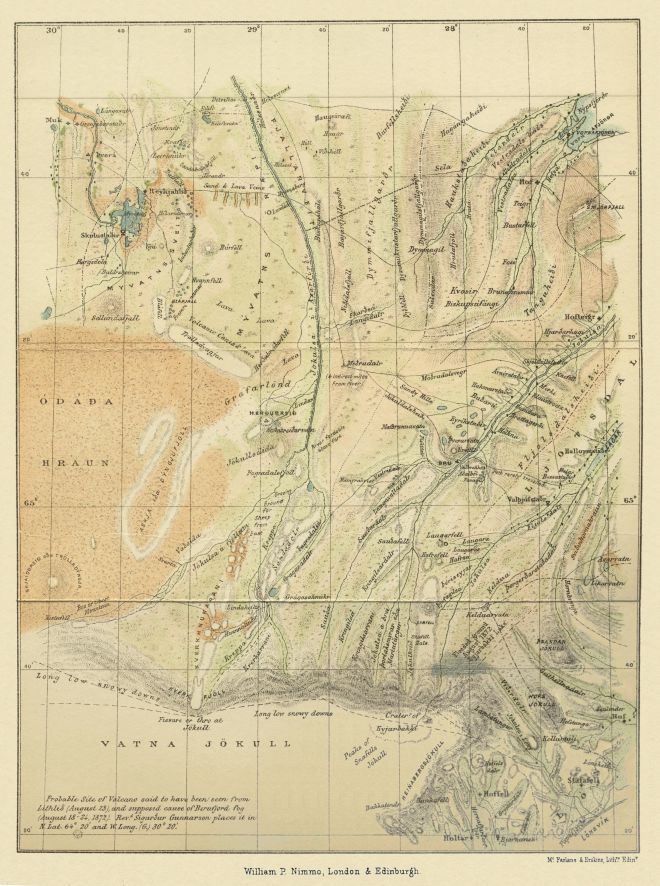
are shown by the map, he mentioned the Lindákeilir (fountain-pyramid) with its two springs, the northern cold, the southern hot; the Hvannalindir, rich, as the name shows, in Angelica; and the Kringilsá, or encircling water.
The morning after the feast was spent in breakfasting, in chess-playing, and at cards, with coffee-beans for counters: on this occasion the men ate first, and after them the women, somewhat after the fashion of the Druses: the parson’s wife also waited, like an “Oriental,” upon her younger brothers. The friends mounted their stout nags, and disappeared after the normal salutations: amongst them was the Prófastr, with coarse woollen stockings sensibly drawn over his shoes. The kith and kin waited till two P.M. on the next day, and, when the heartiest and smackingest of busses had been duly planted upon projecting lips, all rode off, escorting the bride and bridegroom, and escorted by the family honoris causâ as far as the next farm. Mr Pow had agreed to join me in attempting the Vatnajökull; but, whilst I remained to collect provaunt and to avoid the heavy weather which threatened, he resolved upon a preliminary trip, with the prime object of shooting a reindeer. He hired for $2 an old round-ball Enfield from the farmer-ferryman of Bessastaðir, who, apparently convinced of the Enskimaður’s insanity, snatched it three times out of his hands, till he received a watch in pledge. The solitary march was hardly to be recommended. About the Vatnajökull fog or snow may cover the world at any moment, even in July, the best month; and dozens of sheep are often killed by a single violent storm. Mr Pow set out early on the 15th, missed the road, and returned at eleven A.M. on the next day, thoroughly dazed, and apparently unable to give any account of his march—Jón Pètursson’s eyes filled with tears at the sight. That trial proved sufficient for my intended companion, who, as soon as his two nags could move, set out for Seyðisfjörð.
The weather, which had been surly and wrathy for some time, could no longer restrain its rage: the afternoon (August 16) was bad, and the evening was very bad. The day sped wearily watching the cloud-battalions as they scaled the seaward hills: here this easter and deflected norther brings heavy rains and thick raw mists; the souther and the south-wester are little better, and men rely only upon the western wind, which comes from the arid lavas and sands of the Ódáða. The night was one long howl of storm; “drip-drip” resounded from the church floor, and the wind flung itself against the building, threatening to bear away the frail steeple into space. Huge black nimbi, parted by pale and sickly gleams, ever greeted my sight as I gazed in sorrow from the casement of my ecclesiastical lodging. But joy came in the morning: first a glimpse of blue sky between the flirts of rain, then a sign of the sun. The river was reported to be rapidly filling—never mind, unlucky Friday has passed by, and we may look for better things on Saturday.
The provisions, bread, meat, and cheese ($3), with the unfinished keg of schnapps, were awaiting our departure. But Stefán Pètursson, who was to accompany me, had fallen ill, the malady being probably that popularly called in India a “squiffy quotidian:” so I engaged as guide the student Thorsteinn, who had led us to Thorskagerði, paying for him and his nag $3, 3m. Osk. per diem. Gísli, the “coal-biter,” when drawn badger-like from the kitchen, again tried to shirk, pleading the weakness of the ponies, but a threat to withhold wages reduced all opposition to a slackness of the knees, a settled melancholy, and a hurt-feeling expression of countenance. This time he was never left alone with the horses after they had been shod: he presently revenged himself by displaying an amount of appetite which threatened the party with starvation, if it lingered in the wilderness a day longer than he liked.
Section III.—The Ride to Snæfell: View OF THE Vatnajökull.
Saturday, August 17.
I managed to draw the sleep-thorn from Gísli’s ears and, after the usual silly delays, to set off at 9.45 along the left bank of the Fljótsdalr, alias the Norðurdalr: the wind was still southerly, clouds came from the east, but the aneroid was rising and the sun was taking the master’s place. The broad trap valley supports, on either side, many farms and Sels; Glúmstaðir, Hóll, Thuriðarstaðir; the large Egilstaðir, highest on the map, reached in two orette; and Kleif, with its Sætur and backing of western hill. The angry stream is crossed in many places by ropes and cradles; gradually it becomes a torrent-gorge, and the whole length receives a least a dozen rain-bred cataracts: everywhere we saw their smokes and heard the dull charge of cavalry, whilst the rattling of stones upon the sandy beds sounded like the distant pattering of musketry. There was, however, no difficulty in crossing the mouths and, after three hours fifteen minutes of mild work, we rested the nags and changed saddles at the sheep-house of Kleif.
Beyond this point the torrent-gorge is impracticable, and we ascended the rough, steep left bank, whose lower levels were garnished with stunted birches: it led to the monotonous Heiði, which I had now passed thrice. The streams on this line were more troublesome, owing to the slippery crossings of sheet-rock. We forded the Stóri-lækr (big rivulet) four times, and twice the upper waters of the Öxará above its ugly little cataract in a dwarf valley. A short tract of sandy, willow-grown ground led to the Laugará, which was girth-deep. Riding down its right bank, we came to the Laug, which much resembles that of Reykjavik: the waters show boiling point at the source, and 115° (F.) a few yards below. It lies on the north-eastern slope of Laugarfell, and nearly due east (mag.) of the pointed black cone Hafrsfell: these two detached hills, disposed upon a meridian, are mere outliers of Snæfell. Fifteen yards west of the Laug is the Laugarkofi, or the Warm-spring-cell, a hut some 7 feet by 6, with dry stone walls sunk two feet in the ground: the raftered roof is supported by a central post, and made tight with turfs. We were happy to find it in repair. The weather again broke, and a Scotch mist settled stubbornly upon the dreary landscape; the aneroid showing 27·60, and the thermometer 38°. Our day’s march had lasted only five hours fifteen minutes, and on return we easily covered it in three hours fifty minutes. The night in a warm and (comparatively) clean nest, with the howling wind outside, would have been delightful, but for misgivings about the morrow.
August 18.
I rose at dawn with no little anxiety; in these altitudes man is wholly dependent upon weather: it is like a Polar expedition on a small scale. The rainy and windy night had cleared the air, and the sun rose bright, bringing with him a stinging and intensely dry[175] south wind from off the Jökulls. The baggage pony was loaded, and all preparations were made by 8.45. We began with the rotten and boggy ground, draining the Snæfell and its north-eastern outliers to the Jökulsá. Here began the trouble which lasted more or less throughout the morning. The surface is cut by gullies and earth-cracks, often twenty feet deep, and varying from a yard to ten yards in breadth. Few could be leaped by untrained animals, and the many which could not be crossed caused detours either up or down, often a furlong to cover a perch. The smaller sort were the most troublesome, owing to the badness of the take off and landing: the nags made themselves ridiculous in attempting to scramble over, with their hind legs in the hollows, whilst the forehand was holding on the farther bank. In the worst places, at least one of the caravan was sure to be sprawling upon the ground. The best parts were the stony spots, and the medium were the swamps, especially where Fífa and bright mosses spangled the ground.
The wind now veered to the south-west, and after two hours we easily forded the Hafrsá, a drain rising in the south-east of its “fell.” The latter, seen from the eastward, proves not to be a single cone, as the map shows; behind the knob lie a jagged, saw-toothed ridge and sundry outliers. At a distance, it appears to be lava, but when riding over it in the afternoon I noticed that such form of erupted rock is wholly absent from this line. The material, like that of Herðubreið, is Palagonite, which doubtless forms the base of the northern Vatnajökull. Unlike the basaltic conglomerate of the Broad-Shouldered, however, it is puddinged with cinders reddened and charred by the flames. The colours are ruddy, black-brown, chalky-white, green, and yellow, the two latter extending in a band through Snæfell from
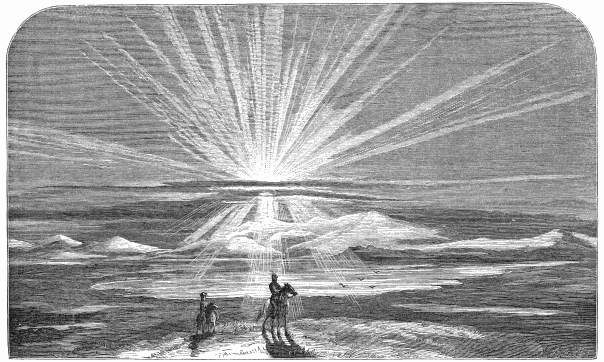
R. F. B. delt. VIEW OF THE VATNAJÖKULL FROM THE SOUTHERN SLOPE OF (EASTERN) SNÆFELL.
south-west to north-east. Scoriæ also are scattered upon the sand, and these, with a strew of basalt, make up the sum of the surface rocks.
At noon we forded the Thjófagilsá (water of the thief’s gil) below the little waterfall dashing down columnar basalt, and we halted near the Hálskofi, a hut like the nest near the Laug. After half-an-hour we resumed our ride along the eastern flank of Snæfell, which greatly altered in shape. The first view (August 2) from the heights above Hallormstaðir showed a Háls or col to the north, in fact the Snæfellsháls of the map, which should be countermarched to the south: “Snowfell” also seemed attached to the Vatnajökull by a long Rani, or tongue of raised ground, to which it acts tip: this must be changed for lowland and lake; and the shape suggested climbing on the western side, where it is almost perpendicular. Viewed from the north-west (August 14), Snæfell hill assumed a sphinx shape, the hindquarters being like those of Herðubreið to the south.
Snæfell projects to the north-north-east, or above our path, a long clean arête of yellow Palagonite, flanking a great fissure: the lower parts are here snowy, the upper are revetted with dark conglomerate. Behind, or to the west of this ridge, is a large snow-field, one of the many buttresses, extending to the flat-topped summit. We ascended stony ground when working to the south; and here an unpleasant surprise awaited me. Instead of the clear course of the little Jökulsá draining the peaks and pins of the Snæfellsjökull, a northern section of the Vatnajökull, the whole expanse lying between the glacier and the height upon which we stood formed a broad and apparently shallow lake, in part composed of clear pools, and the rest of muddy veins. At its head is a great depression in the Jökull, marked eastward by Eyjarbakki (island bank), a black cone, which may be a crater. The delta-shaped mass of water projects its point to the north, where we can distinctly see it falling over the Eyjarbakka-foss into the Jökulsá gorge. This formation may be temporary, dry ground flooded by the late rains: the farmers, however, know it by the name of Eyjarbakka-vatn. Permanent or not, it was utterly impassable without boats, whilst the Jökulsá was too full to be forded.
A near view of the Vatnajökull, from the south of Snæfell, confirmed my previous impressions. The snowy base-line is formed by the descending angle of the wind: this must explain how all is congealed at a height where Snæfell is free from frost (aneroid, 27·75): perhaps the thrust from behind may perpetuate the névé. Beyond the long white wave, pure ermine above, and below spotty like a Danish dog, stretching far to the west, rose the quaint form of Kverk, the throat or angle beneath the chin,[176] with two big, blue buttresses to the east: the black outlier of conical shape has a deep gullet to the north, vomiting a light-blue glacier upon the snow-fields lying at the base; it is prolonged north by the Kverkhnúkrrani (snout of the gullet-knoll), apparently containing two distinct patches of volcanic aspect.
Resuming our ride to the west over the true Snæfellsháls, whose stony flanks delivered us from bog and earth-crack, we found that even here the summer pasturages are not unused. The dandelion and the violet, dead elsewhere, still enjoyed the autumn of life; sign of reindeer was seen in two places, and we flushed sundry coveys of ptarmigan. A couple of ravens and a snow-tit composed the remnant of animal life; happily for us the midges were absent.
At two P.M. we reached our farthest southern point, the long dorsum which prolongs Snæfell southwards to the Snæfellsháls. On the far side of the col rose Thjófahnúkr, a big, black, cindery cone, like the rest. Between it and the northern hypothenuse of the Vatnajökull lay a dark saddleback, with all the appearance of a volcanic crater; the absence of lava may be explained by its vomiting, like Hverfjall and Herðubreið, cinder and ashes. As we turned up the Thjófadalr, between the Thieves’ Knoll and the Snæfell proper, the ice-wind struck full on our backs. The amphitheatre was girt on both sides by jagged, rocky peaks, like the edges of bursten bubbles and blisters; and the shoulders of Snæfell projected to the south-west, a sharp ridge and a cone of warm-yellow Palagonite—here the ascent would have offered no difficulties. This part of the valley discharges to the south many streamlets of melted snow, some clear, others of white water. Crossing the divide, we struck the Hrafnkelsá, which is prolonged by the Jökulkvisl and the Sauðará (sheep-water) to “Jökulsá of the Bridge.” The line presently became a deep and grisly gorge of black and copper-coloured Palagonite; and we passed sundry long bridges of hard snow which were excellent riding. So far I can confirm the experience of the French naval officers, who assured me that in Iceland these formations, so redoubtable farther south, offer no risk.
At four P.M. we halted for an hour at the head of the Eastern Jökulsá, quietly enjoying the warm western exposure. From this point there was an extensive view of the river-drained plain which, broken by detached lumps of hill and broken ridges, separates Snæfell from the eastern edge of the Ódáða Hraun. When the nags had enjoyed a bite we resumed the descent of the deep and broken river-valley that passes between the Hafrsfell and its western outliers: the buttresses and banks of loose wind-blown sand descended bodily with our weight. Again we saw a spine of Palagonite, showing a fair ascent to the upper snow-field; and we looked in vain for the delicate ripple-marks which from a distance betray hidden crevasses. Here the surface material melting in the sun sinks into the lower strata, making the whole a solid mass—hence the glacier growth which exists in Greenland, and which is suspected in Iceland. As we rode under the precipices of North-western Snæfell, the snow, sliced off as if by a razor, forms a wall some fifty feet thick, soft above, and below pale-blue, like the Blaabreen of Norway, where hardened to ice by excessive pressure. This fine “snout” showed a few thin ribbons, but nothing like “veined structure,” that vexed subject of the glacialists. The whole “snow-fond” for perfect beauty wanted only the lovely background of mazarine-coloured skies to be seen in more southern latitudes.
At six P.M. we forded the Hauká (hawk-water), one amidst a score of shallow, bubbling, pebbly streams, random rivulets, which the afternoon heat was setting free from the vast sheets of snow. Beyond Hafrsfell we recognised with disgust the sodden, rotten ground of the morning, and the weary ponies so lost their tempers that they seemed unwilling to rise after the frequent falls. Yet I could not but admire the pathos, the strange double nature of the wild prospect. Here it was a hard and uncompromising photograph, a weird etching by Rembrandt or Doré, in which, from the vivid whiteness of the snow and the blackness of the rocks, the far appeared near: amongst the chaotic rubbish heaps there was no shadow within shadow, no dark as opposed to a light side. There, beyond a middle ground of steely blue plain, lay a “lovely Claude,” a dream-landscape of distant Jökull. The delicate tints, cool azure-white and snow warm with ethereal rose-pink, seemed to flush and fade, to shift and change places, as though ghostly mists, unseen by the eye of sense, were sailing in the pale beryl-coloured sky. Anon the sun sinking towards the hilly horizon rained almost horizontal floods of light, transfiguring the scene with golden glory as every feature kindled and lit up with a peculiar freshness of expression—a region so calm and bright did not seem to be of this world. Yet a few moments more and its rare spiritual loveliness, passing through gradations of matchless tenderness, began to fade; the pale-grey shadow came, “stealing like serious thought o’er joyous face,” and all disappeared in the dark nothingness of night. These splendours of the Trolls’ home were well worth a journey to the “Brumous Isle,” but the long search and the short fruition almost tempt me to “point a moral.”
After some ten hours’ hard work for man and beast, we were cheered by the steam rising from the Laug, and we again thanked Iceland for laying on such plenteous supplies of hot water. The memory of the last touching view, with its “wild beauty of colouring,” moved me to issue, about midnight, from the nest and to compare the dark with the light hours. But the moon and stars seemed to count for nothing in that “inspissated gloom.” The scene was
“All ruined, desolate, forlorn, and savage.”
The deepening glooms made the silence something more oppressive—τῆς σιγῆς βάρος—than the mere negative of sound; it became an indescribably awful presence, weighing on and deadening to the spirit as the sense of utter solitude—even the nasal music within the Laugarkofi was a positive relief. I can easily imagine a man lost in this utter stillness and swoon of Nature finding the horror and oppression unendurable.
Section IV.—From the Snæfell to Djúpivogr.
To Gísli’s infinite satisfaction, a vile sea-fog crept up the Jökulsá valley, slowly, but persistently, and, meeting scant opposition in the air, which the falling aneroid showed to be unusually deficient in weight, it spread, like the magical “Foka” of folk-lore, over the face of the upper world. Below us, we afterwards heard, all was merry as a fine May-day. I had intended to make the Kverk direct from “Snowdon,” and from that vantage-ground to prospect the Kistufell and the Skjaldbreið, with “Trölladyngja,” the bower of the Troll-Carline. But in the words of Wordsworth’s happy warrior, I did not see what I foresaw, and had only the cold comfort of reflecting—
“Est quiddam prodire tenus, si non datur ultra.”
Icelandic exploration is “chancy” as Central African, and the traveller must expect to be the sport of circumstances far beyond his control, unless, at least, he can afford unlimited time.
The next morning (August 20) was also foggy: I waited till 8.45 A.M., and then all the munitions de bouche being thoroughly exhausted, the word was given for a retreat. The approach to Valthiófstaðir was perfumed, after the rancid moss and the hard snow-wind, by the fragrant crop of newly-mown hay. I bade friendly adieu to the family which had shown me so much kindness; to Stefán, who was still abed, and to Björn, the eldest son. A man of forty-six, and suffering from rheumatism, for which the parsonage is famous, he was the only Icelander who in physique realised my idea of a Saga-hero. The gentlemanly old-fashion parson put into my hands, when parting, an appeal which touched me, “Opto ubi de Islandiâ locutus estis, benè rem referere.”
My return-ride need not be described: it was over the same path, the only difference being the last half of the last day, which is noticed in Chapter XIII. At Hallormstaðir I again missed Síra Sigurðr, who appears not to be of a very domestic turn. Reaching the Berufjörð parsonage at 4.45 P.M. on August 21, I found the ponies far too much fagged by a day’s work of 5500 feet, up and down, for riding another twelve miles round the firth. The Reverend was absent from the Prestagarð, but his wife kindly found me a boat and a boat-boy, the student Thorsteinn taking the other oar. Progress was painfully slow, and the tall ghostly loom of Búlandstindr seemed to follow us like a “Fylgja,” or fetch. We enjoyed all the pleasures of l’humidité spéciale de l’eau de mer pulverisée; the bright phosphoric lights of the tropical seas were absent—indeed, I never saw them in Iceland. At this season the nights become real nights; the smooths in the water, alternating with ripple-lines, had no worse effect than to persuade the inexperienced lads that they were approaching land, and, as the skerries and drongs are thickly ranged along the southern shore, we were fortunate that there was no gale—
“Only the sea-fogs to and fro Skipped like the ghosts of the streams below.”
After six hours of mortal weariness, I landed with feet dead from sitting in cold water, and awoke Captain Tvede. My good friend turned out of his bunk; the cooper put the kettle on; sundry glasses of red-hot toddy were administered medicinally; and I went to my old quarters, well satisfied with having ridden, from under the very shadow of the Vatnajökull, in two days to the eastern coast.
The “balance” of my stay at Djúpivogr would not have been pleasant without the Ancient Mariner, who energetically assisted in preparing my diary and in paying off the guides, a matter of $49. Hospitable Hr Weÿvadt’s son, the acting Syslumaðr, presently joined us from Eskifjörð, and lectured me upon taxation in Iceland which, as the reader has seen, is “no joke.” The only drawback was a certain nervousness touching the movements of the “Diana,” which was to touch at Deep Bay for the last time this season. Alternate fog and rain, with faint attempts at clearing about mid-day, had lasted for a week, and on August 24 the “Postdampskibet” was due. The seamist rolled thick as a bolster up the narrow line of Fjörð; I had almost abandoned hope, when suddenly we received the glad tidings of her being anchored at the mouth of the voe. Hurried adieux were exchanged, and we steamed for Reykjavik the same evening.
Rain and fog accompanied us the whole way; fortunately for me, Dr Hjaltalín was on board, returning from a visit to Denmark, or the lively “Diana” would have been a very purgatory of dullness. The rest of my tale is soon told. We made Reykjavik on the 26th. On September 1, I embarked on board an old friend, the “Jón Sigurðsson;” and steaming southwards cast a farewell view, while Iceland faded into the past, at the palegold and glittering silver of the Öræfajökull.
On September 15, I landed at Granton.