Volume 5 — CHAPTER VIII Marking Time (April-June 1953)
Reading edition
The Peace Talks Resume—Operation LITTLE SWITCH—Interval Before the Marines Go Off the Line—The May Relief—Training While in Reserve and Division Change of Command—Heavy May-June Fighting—Developments in Marine Air—Other Marine Defense Activities—The Division Is Ordered Back to the Front
The Peace Talks Resume392
It was April 1953, but it wasn’t an April Fool’s mirage. On 6 April, representatives of the United Nations Command and the Communist delegation sat down at the Panmunjom truce tents to resume the peace talks that had been stalemated six months—since October 1952. If there was a word that could be said to reflect the attitude of American officials and private citizens alike—for that matter, the atmosphere at Panmunjom itself—it was one of caution—not real optimism, not an unbridled hopefulness, but a wearied caution born of the mountains of words, gulfs of free-flowing dialogue and diatribe, and then ultimate plateaus of intransigence that had marked negotiations with Communist leaders since the original truce discussions had begun in July 1951.
Diplomatic maneuverings had been underway since the end of 1952 for the exchange of sick and wounded prisoners of both sides. This was considered a first step towards ending the prisoner of war dispute and achieving an ultimate truce. A resolution introduced in mid-November by India at the United Nations session dealing with settlement of nonrepatriate prisoners had been adopted in early December. Later that month the Red Cross international conference had officially gone on record favoring the exchange of sick and wounded prisoners in advance of a truce. A letter written on 22 February by the UNC commander, General Clark, calling for the immediate exchange of ailing prisoners had been delivered to the NKPA and CCF leaders.
Initially, the Communist answer was an oppressive silence that lasted for more than a month. During this time the Communist hierarchy had been stunned by the death, on 5 March, of Premier Stalin. Then, on 28 March, in a letter that reached General Clark at Tokyo in the middle of the night, came an unexpected response from the two Communist spokesmen. They not only agreed unconditionally to an exchange of the sick and injured prisoners but further proposed that “the delegates for armistice negotiations of both sides immediately resume the negotiations at Panmunjom.”393
This favorable development astonished not only the United Nations Commander but the rest of the Free World as well. Several steps were quickly put in motion. The UN Commander’s reply to the Kim-Peng offer was expressed in such a way that resumption of full negotiations was not tied in as a condition for the preliminary exchange of ailing POWs. President Eisenhower, commenting on the new Communist proposals at his 2 April press conference, stated he thought the country should “now take at face value every offer made to us until it is proved unworthy of our confidence.”394 He also further enjoined major military commanders and subordinates to avoid anything that might be contrary to this view when they made public remarks or issued press releases.
In Korea, the Munsan-ni Provisional Command was established on 5 April under the Commanding General, Eighth Army, in the vicinity of the 1st Marine Division railhead at Munsan-ni. The command was to prepare for the many housekeeping details involved in the receiving and orderly processing of all UNC prisoners. The anticipated exchange itself was dubbed Operation LITTLE SWITCH. Two Army officers, one Marine Corps, and one ROKA representative were designed to direct the administrative machinery of the provisional command. Heading the organization was Colonel Raymond W. Beggs, USA.
The Marine representative, Colonel Wallace M. Nelson, was named commanding officer of the United Nations Personnel and Medical Processing Unit. His responsibility was not limited to the obvious medical aspects of the exchange, but extended to other details involving clothing issue, personnel, security, chaplains, food, communication, motor transport, engineering, and the operation of unit headquarters. Among those matters to which the Munsan-ni command directed its immediate attention was the setting up of a temporary facility for Communist prisoners currently held in UNC camps at Koje, Cheju, and Yongcho Islands and a hospital near Pusan. Arrangements were also made for in interpreter pool, debriefing teams, and press center facilities.
As the new week began on Monday, 6 April, and the world looked to Panmunjom for the next set of signals in the war, a new stage developed in the truce negotiations. Within five days after the talks had begun, both sides agreed to return the disabled prisoners in their custody. Final papers for the preliminary exchange were signed at noon on 11 April by Rear Admiral John C. Daniel, USN, for the United Nations Command, and Major General Lee Sang Cho, of the Communist delegation. The week-long transfer of sick and wounded POWs was scheduled to begin 20 April, at Panmunjom.
The Communists announced they intended to release 600 sick and wounded UNC prisoners (450 Korean, 150 non-Korean), a figure which Admiral Daniel called “incredibly small.”395 For its part, the UNC indicated that it planned to free nearly ten times that number of North Korean and Chinese POWs. Communist and Allied representatives also agreed that truce talks would be resumed at Panmunjom, once the prisoner exchange was completed.
Security precautions went into effect at both Panmunjom396 and the entire Munsan-ni area, 10 miles southeast, on the first day of the prisoner talks. All facilities at both Panmunjom and Munsan-ni were placed off limits to Eighth Army personnel not directly involved in the operations. Regulations were strictly enforced. Even before the negotiations opened at Panmunjom, actual construction work for LITTLE SWITCH was well under way by Marine engineers. “Operation RAINBOW,” as the building of the facilities for the POW exchange was called, began 5 April.
In a little over a day—actually 31 working hours—a task force of less than 100 Marine construction personnel had erected the entire Freedom Village POW recovery station at Munsan-ni. The special work detachment was composed of men from Company A, 1st Shore Party Battalion, under Major Charles E. Gocke, and attached to the engineer battalion; utility personnel from Headquarters and Service Companies; and a Company D platoon, 1st Engineer Battalion.397
Early Sunday morning the Marines moved their giant bulldozers, earth movers, pans, and other heavy duty equipment into Munsan-ni. Ground leveling started at 0800 and work continued around the clock until 0100 Monday. After a five-hour break the men dug in again at 0600 and worked uninterruptedly until 2000 that night. Furniture, tentage, and strongbacking stored at the 1st Engineer Battalion command post, meanwhile, had been transported and emplaced. When it was all done the Freedom Village complex, like ancient Gaul, had been divided into three parts. The command area comprised receiving lines, processing and press tents, and related facilities for United Nations troops. Adjacent to this was the 45th Mobile Army Surgical Hospital tent, completely wood-decked, equipped for mass examinations and emergency treatment. Across the road from the UN site proper was the area reserved for returning South Korean prisoners, who would form the bulk of the repatriates.
Altogether the three camp areas represented some 35,100 square feet of hospital tentage, 84 squad tents, and 5 wall tents. Gravel to surface three miles of standard combat road, plus two miles of electrical wiring, was hauled and installed. More than 100 signs, painted in Korean and English, were erected, as well as the large one that stretched clear across the road at the Freedom Village entrance. Six welcome signs were raised above the UN and ROK processing tents, while another mammoth Korean-English sign was installed at the Panmunjom exchange site.
Special areas for ambulance parking; helicopter landing strips; five 50-foot flagpoles; graded access roads and foot paths; sanitation facilities; and storage areas for food, blankets, and medical supplies were also constructed. And timing was important. It had been anticipated that the prisoner exchange might take place on short notice. For this reason 1st Marine Division work and processing teams had conducted their rehearsals so that they could complete all duties within 36 hours after first receiving the “go ahead” signal for the switch.
Operation LITTLE SWITCH398
Nine days after the truce talks were temporarily suspended, 11 April, Operation LITTLE SWITCH (code-named Little Swap) began the morning of Monday, 20 April. By the time it ended on 26 April, a total of 6,670 North Korean and Chinese Communist prisoners had been returned by the UNC. The enemy released 684 captives,399 of whom 149 were Americans. Among them were 15 Marines, 3 Navy corpsmen who had been attached to the 1st Marine Division, and a Navy aviator. The first day Allied prisoners—walking, some hobbling along on crutches, and others carried on litters—were delivered in two groups. The initial 50 men reached Panmunjom at 0825, and the second group, two hours later. The first Marine freed was Private Alberto Pizarro-Baez, H/3/7, a Puerto Rican, who had been captured at Frisco in the early October 1952 outpost clashes. Later that day, another POW taken in the same action, Private Louis A. Pumphrey, was also released.
Early moments of the exchange were tense as UNC sick and wounded captives were shipped in a long line of CCF ambulances from Kaesong, five miles northwest of Panmunjom, down the neutral corridor past enemy lines to the exchange point. Despite the fact that all official papers and agreements had been concluded more than a week earlier, no one was absolutely sure until the last moment that the prisoner exchange would actually take place. The mechanics of the transfer operation itself, as it turned out, went off practically without hitch. One minor unsavory incident had occurred when 50 North Korean prisoners in UNC custody en route from Pusan to Panmunjom, had dumped their mess kits into garbage cans, noisily complaining about breakfast.
There was also a long taut moment of uneasy silence when the first Communist ambulance pulled up in front of the Panmunjom receiving center. An American MP, who in the excitement had gotten his orders confused, forgot to tell the enemy driver where to turn. The ambulance almost went past the center. A UN officer raced out to the road and motioned to the driver, who backed around and pulled into the parking lot.
One of the first things the liberated POWs saw was the big sign “Welcome Gate to Freedom” raised the preceding night over the Panmunjom receiving tents. Here they could get a cup of coffee and momentarily relax before starting the long one-and-a-half hour ambulance trip south to Freedom Village. The returnees were outfitted in blue Communist greatcoats, utilities, caps, and tennis shoes. Some of the men were bearded; some wore thin smiles; some had half-hidden tears in their eyes. Primarily, there was a subdued and businesslike air to the day’s proceedings, however, with a marked absence of levity. Admiral Daniel, whose UNC liaison group had negotiated the exchange, in commenting on the smoothness of the first day’s operation observed: “It’s been a tremendous emotional experience for us all. Not much was said between us here, but we are all very happy.”400
From Panmunjom all Allied prisoners were taken to Freedom Village at Munsan where they received a medical check, and the more seriously wounded were flown to a field hospital near Seoul. The first American prisoner to reach Freedom Village was an Army litter patient, Private First Class Robert C. Stell, a Negro. Helicoptered in from Panmunjom at 1007, he was treated “like a 5-star general by all hands, including General Clark, UN commander.”401 By noon the routine, agreed upon in the earlier exchange talks, was moving along evenly and would be in effect throughout the week-long exchange. The Communist quota was 100 prisoners freed daily, in two groups of 50 each, while the Allies returned 500. Thirty Americans were among the 100 UNC men released that first day.
Upon their arrival at Freedom Village the Marine POWs, all of whom had been wounded prior to being captured, were greeted by representatives of the 1st Marine Division. In addition to General Clark, other ranking officials on hand included Lieutenant General Maxwell D. Taylor, new EUSAK commander, Major General Pollock, 1st Marine Division CG, Brigadier General Joseph C. Burger, in one of his first public duties since assuming the post of assistant division commander on 1 April, and Dr. Otto Lehner, head of the International Red Cross inspection teams.
Each Marine prisoner was met by a 1st Division escort who gave him physical assistance, if necessary, as well as a much-prized possession—a new utility cap with its Marine Corps emblem. Recovered personnel received a medical examination. Waiting helicopters stood by to transport seriously sick or wounded Marines to the hospital ships Haven and Consolation riding at anchor in the Inchon harbor. Chaplains chatted as informally or seriously as a returnee desired. Newspapers and magazines gave the ex-prisoners their first opportunity in months to read unslanted news. And a full set of utility uniforms, tailored on the spot for proper fit, were quickly donned by Marines happy to discard their prison blues.
Although returnees received their initial medical processing at Freedom Village, no intelligence processing was attempted in Korea. Within 24 hours after their exchange, returned personnel were flown to K-16 (Seoul) and from there to Haneda Air Force Base at Tokyo. Upon arrival at the Tokyo Army Hospital Annex, a more detailed medical exam was conducted, including a psychiatric interview by officials from the newly formed Special Liaison Group of Commander, Naval Forces, Far East. Lieutenant Colonel Regan Fuller, USMC, was designated by ComNavFE as OIC of the detailed briefing of all returned personnel at Tokyo. Other Marine officers participating in the debriefings included Lieutenant Colonel Thell H. Fisher and Major James D. Swinson, of FMFPac headquarters; Major Jack M. Daly, representing the 1st Marine Division; and Captain Richard V. Rich, of the 1st Marine Air Wing.
Each Marine returnee was interviewed by a two-man debriefing team that consisted of a Marine and a Navy officer, the latter usually a counterintelligence expert. The three-phase interrogation averaged 9–12 hours and covered personal data, counterintelligence, and a detailed military questionnaire. The latter, particularly, sought information about UN personnel still held captive by the enemy. Since all of the 15 Marine POWs had been captured relatively recently (either in the October outpost contests or the Vegas battle the previous month), the information they had about the enemy was of limited intelligence value. From debriefing reports of Marine returnees, many of whom brought address books with them, it was learned that at least 115 more USMC and Navy prisoners were alive and still held in POW camps.
Upon completion of counterintelligence processing, returned personnel were available for press interviews. Long-distance telephone calls to parents or other family members were arranged by the Red Cross. Summer service uniforms and campaign ribbons were issued, pay provided, and administrative records updated by representatives dispatched by Colonel John F. Dunlap, Commanding Officer, Marine Barracks, Yokosuka.
All of the 19 Marine and Navy POWs had been released by 25 April. After final processing and clearance for return to the U.S. the men were flown home, via Hawaii, in three groups that departed 28 April, 30 April, and 4 May. Each was accompanied by a Marine Corps officer. Members of the first contingent of POWs arrived at Travis Air Force Base, California, on 29 April, thereby completing their 7,000-mile journey from Communist prison camps. Another small group of POWs considered possible security risks were airlifted directly from Japan to Valley Forge Hospital, near Philadelphia, for further interviewing. No Marines were among them. With the initial prisoner exchange completed, staffs of the major Far East commands began to prepare for the final return of all POWs. Operation BIG SWITCH would take place after the ceasefire that, hopefully, was not too far away.
On the day that Operation LITTLE SWITCH ended, 26 April, plenary truce talks resumed at Panmunjom. The stormy issue of repatriation of prisoners, which had already prolonged the war by more than a year, was still the one major problem preventing final agreement. There was indication, however, that the Communists appeared to be softening on their rigid insistence of forced repatriation. And, on 7 May, the Communists accepted the UN proposal that nonrepatriate prisoners be kept in neutral custody within Korea (rather than being removed to a foreign neutral nation) and offered an eight-point armistice plan. With modifications, this ultimately became the basis for the armistice. While discussions and disagreements continued on this proposal, another real problem developed from a totally different source.
Since early in April rumblings had been heard, through the polite ambassadorial circuits, that Syngman Rhee, the aging South Korean president, was dissatisfied with major truce issues. In particular, he was disturbed over the possibility that Korea would not become reunited politically. Further, Rhee gave indication that he might take some kind of action on his own. The Korean leader had advised President Eisenhower that if any armistice was signed that permitted Chinese Communist troops to remain south of the Yalu, with his country divided, he would withdraw ROK military forces from the UN command. Since South Korean troops, backed by American specialized units, presently manned the bulk of the UNC front line, Rhee’s threat to remove them from General Clark’s command presented harrowing possibilities.
Meanwhile, on 13 May, General Harrison, senior UN representative at Panmunjom, made a counterproposal to the Communist plan. This incorporated three measures aimed at reconciling differences in the long-controversial repatriation issue.402 Arguments flew back and forth at Panmunjom, with a temporary recess called in the talks; but on 4 June the Communists accepted this UN final offer. The dispute of 18 months’ duration had ended and the Allied principle of voluntary repatriation had won out in the end. About the only homework left for the negotiating teams was to map out final details of the Demilitarized Zone.
President Rhee now even more violently denounced the projected armistice plan. He declared that he and the Koreans would fight on alone, if necessary. South Korean delegates boycotted the Panmunjom truce meetings, and Rhee began a campaign to block the cease-fire. Final agreement on the POW issue was reached 8 June. It provided that the NNRC offer a “civilian status” to former POWs who did not exercise their right of repatriation within four months after being taken into custody by the commission. Those POWs who desired asylum would be set free. The South Korean National Assembly unanimously rejected the truce terms the following day.
Revision of the truce line, to correspond to current battle positions, and other concluding details of the truce were being settled by 17 June. On 18 June, chaos suddenly replaced progress. Acting on orders from Rhee, during early morning hours ROK guards at the South Korean prisons released approximately 27,000 North Korean anti-Communist POW inmates (the majority of the large group of NKPA who did not wish to be repatriated). They quickly escaped and became absorbed into the civilian populace of South Korea. Immediately the Communists charged the Americans with complicity and demanded to know whether the United Nations Command was able to control its South Korean ally or not.
For the next two weeks the American ambassadorial and military team tried to restore some measure of international good grace and hope to the crisis. Daily talks (and pressure) took place with Rhee, as well as with the Communist negotiators, to set the course back on track again in the direction of a final truce agreement. At the end of June, UNC Commander Clark was authorized by Washington to work out a way in which it would be possible to sign the tenuous armistice—without the Koreans, if necessary.
Interval Before the Marines Go Off the Line403
Shortly after the heavy Vegas fighting in late March, Colonel Funk’s 7th Marines, which had been in reserve, exchanged positions with the 5th Marines. The new line regiment assumed responsibility for the critical, action-prone right sector of the MLR on 4–5 April. In the center part of JAMESTOWN, the 1st Marines of Colonel Adams continued to man the MLR and its 12 outposts, including the strategic COP-2 tucked down by the Panmunjom peace corridor. With the resumption of truce talks on 6 April, this position had again taken on renewed importance with its tank-infantry covering force of 5 armored vehicles and 245 Marines on call at all times.
After its relief from the MLR in early April the 5th Marines, as the new division reserve unit, assumed the regular missions of serving as a counterforce for Marines in the I Corps sector, if required; maintenance of the secondary KANSAS line; and a rigorous training program. On 10 April, the 3d Battalion moved out to the KANSAS position for a two-day field exercise. By midmonth, spring thaws and heavy rains had so weakened the trench and bunker fortifications of KANSAS that an all-out effort was temporarily diverted from refresher training to reconstruction. The 2d Battalion, meanwhile, under Operation Plan 24-53, pursued an intensive five-day shore-based training program, 7–11 April, in preparation for its coming amphibious exercise, MARLEX XX. On the 13th, BLT 2/5 under Lieutenant Colonel Finch, with armored amphibian, tank, amtrac, and 1/11 detachments, proceeded to the landing area, Tokchok-to, one of the WCIDE command offshore islands southwest of Inchon. Battalion assault companies hit the southern Tokchok-to beaches on D-Day, 15 April, according to schedule, although high winds and rough seas subsequently modified the exercise.404
Not long afterward a training exercise involving UNC personnel got underway when the 5th405 and 1st Marines, together with the artillerymen, combined with the Army, ROK, and Commonwealth Division on 20 April for a four-day I Corps command post exercise (CPX) EVEREADY GEORGE, not far from Seoul.
Along the division front the war was still a daily survival contest, despite the promising outlook at Panmunjom. The most ambitious attempt by the Chinese during the month took place over a three-day period in the right regimental sector, not long after the 7th Marines had moved to the MLR. On 9 April, following a heavy two-hour ballistic downpour of 2,000 rounds of enemy mortar and artillery, a reinforced company of about 300 Chinese soldiers launched a strong probe against Carson at 0345. Attacking in two echelons, the enemy approached from the direction of Arrowhead on the north and the Reno ridgeline. In an hour’s time, the enemy had reached the Marine trenches and protective wire, at some places, and was being unceremoniously repulsed by the 1/7 detachment at Carson. For an hour and a half a heavy fire fight raged at the outpost while intruders and defenders battled at point-blank range to settle the dispute.
A reinforcement platoon, from 4/2/7, dispatched from the MLR at 0530, made it as far as the newly established Marine outpost at Elko, about 400 yards southeast of Carson, before being held up by a heavy shower of mortar rounds, and small arms fire. Tankers from the Company A direct element406 plus a section (two tanks) from the regiment’s armored platoon leveled their lethal 90mm fires to discourage the enemy, as did the defender’s barrage of 60mm, 81mm, and 4.2-inch mortars.
Two rocket ripples and 22 defensive fire concentrations unleashed by 2/11, also in direct support of Lieutenant Colonel Henry C. Lawrence Jr.’s 1st Battalion, plus additional reinforcing fires by batteries of 1/11 and 4/11 drove off the enemy at 0700. As a security measure, a company from the regimental reserve (E/2/7) was assigned to Carson to buttress the position and assist in reorganizing the outpost defense. The enemy’s activity had cost him 60 known dead. Additional casualties were estimated to be 90 killed and 70 wounded. Marine losses numbered 14 killed, 4 missing, 44 wounded/evacuated, and 22 non-seriously wounded. Meanwhile, beginning at 0715, Marine prop-driven attack AUs from VMAs-212 and -323 and ADs from VMA-121 were aloft over prime Chinese targets to perform CAS missions and MPQ drops.
Between the morning’s first strike and midafternoon the three MAG-12 squadrons completed 43 sorties and blasted enemy hills and weapons positions north of Carson with a total of 67½ tons of bombs. Later that night three Chinese platoons, operating in small units, reappeared in the Carson-Elko-Vegas vicinity to recover casualties. Although they reached an unoccupied caved-in bunker 50 feet from Carson, the enemy’s nocturnal activity only cost him more casualties from the COP’s defense fires: 15 known dead, 15 estimated killed, 7 known wounded, and 27 estimated wounded.
The following day, Panther jets from Marine Fighter Squadrons 311 and 115 contributed to the further destruction of hostile emplacements, but the enemy himself was nowhere to be seen. Again that night, ground-controlled radar bombing runs were made by VMA-121 and VMF(N)-513 to help keep the enemy off balance. In the early-morning hours of the 11th, however, a band of 30 grenade-slinging Chinese renewed the assault on 7th Marines positions by attacking the reverse slope of Elko. This ambition was deterred by outpost organic weapons and box-me-in fires. After a brief fire fight the CCF withdrew, and the two MAG-33 squadrons later that morning returned to station for CAS strikes against CCF trouble spots. Another raid on Carson began at 2115 that night when 70 Chinese moved out from Ungok to the west ridge of the Marine position. Ten minutes later, Marine 81mm and 4.2-inch mortars, artillery, machine guns, and tanks forced them back with approximately 20 CCF killed and wounded to show for their efforts.
A brief repeat action occurred the following night when two squads of Chinese reappeared at Elko, but they were dispatched by Marine infantry, artillery, and armor direct fires following a 15-minute spirited exchange. During the night of the 12th407 Chinese probes and harassing efforts diminished. Other than a few spotty, abortive skirmishes in the KMC sector, this pattern of reduced enemy effort would continue for the next several weeks, until after the change of the Marine line in early May. As the peace talks at Panmunjom were beginning to show some progress, enemy psychological warfare efforts in the KMC, 1st, and 7th regimental sectors became more zealous, an indication of the Chinese attempt to increase their propaganda offensive. This included not only loudspeaker broadcasts and propaganda leaflet fired in mortar shells but a more unusual tactic, on 6 April, of enemy messages dropped over the COP Vegas area by airplane.
Little ground action took place in the division sector throughout the rest of the month. During the last three days of April, as the operational period for the Marines drew to an end, both infantry and artillery units noticed an unusual lull across the front. Marine patrols made few contacts, and there was a sharp decrease in the heavy enemy sightings of midmonth. Chinese incoming, in fact, during the latter part of the month decreased markedly, with a total of 873 rounds compared to the 4,149 tallied during the 1–15 April period. An average of 58.2 rounds daily made it, in fact, the quietest period in the Marine division sector since the holiday calm of late December when only 84.2 rounds had fallen the last 10 days of the month.
The May Relief408
By late April, plans had moved into high gear for relief of the 1st Marine Division by the 25th U.S. Infantry Division and transfer of the Marines to U.S. I Corps reserve at Camp Casey. Although the Marine division had been in active defense positions for 20 months (first in the eastern X Corps and, for the past year, on the western front), some observers noted that there was a reluctance to turn over their presently occupied positions and that the Marines were coming out “under protest from commanders who wanted the Division to remain on the line.”409
For its part, the 25th Division, commanded by Major General Samuel T. Williams, was to shift over to the I Corps far west coastal area from its own neighboring IX Corps sector on the right. Marine association with the Army division went back to the early days of the war.410 In August 1950, when the Korean Conflict was then only a few weeks old, the 25th Division, with the 1st Provisional Marine Brigade and the Army’s RCT-5, had spearheaded the first UN counteroffensive on the far southern front, in the Sachon-Chinju area. Now fresh from its own recent period in reserve411 the 25th Division, including its attached Turkish Brigade, was to take over the 33-mile 1st Marine Division line, effective 5 May. Marine armor and artillery, however, would remain in support of the 25th Division and transfer to I Corps control.
Another change at this time affected the designation of the United Nations MLR. Called Line JAMESTOWN in the I Corps sector (and variously in other parts of the EUSAK front as MISSOURI, DULUTH, MINNESOTA, and CAT), the Allied front was redesignated simply as “main line of resistance,” beginning 28 April, and was to be so known in all future orders and communications throughout the entire Eighth Army. A further modification dropped the reference “in Korea” from the acronym EUSAK, the title becoming “Eighth U.S. Army.”
In the Marine sector, the last few days of April were a study in contrasts. While Marine frontline infantrymen and cannoneers were having a comparatively peaceful interlude during this period of minimal CCF activity, division engineers were the proverbial colony of beavers. Following up their rigorous schedule in early April of building Freedom Village from scratch within 36 hours, engineer personnel moved out from the division sector late that month to begin construction of the rear area camps that would shortly be occupied by the Marines while in I Corps reserve.
Located approximately 15 miles east of the Marine MLR, the Camp Casey reserve complex consisted of three major areas. They were: the central one, Casey, which gave its name to the entire installation and would house the new division CP and 5th Marines; Indianhead, to the north, where the 7th Marines, 1st KMC Regiment, Division Reconnaissance Company, machine gun and NCO schools were to be established; and Britannia, to the south, assigned to the 1st Marines. Motor transport, engineer, and medical units in support of the respective regiments were to locate nearby.
On 27 April, the day after resumption of truce talks at Panmunjom, Company A engineers began the work of clearing the camp site, erecting prefabricated buildings, and pioneering roads in the 7th Marines northern area. Two days later the 1st KMC Engineer Company was also detailed to Indianhead for work on the 1st KMC Regimental camp. Company C engineers and Company A, 1st Shore Party Battalion, attached to the Engineer Battalion, meanwhile moved into the Casey sector to ready the relocated Division CP and the 5th Marines camp.
Tactical relief of the 1st Marine Division officially began 1 May. By the time it was over, four days later, more than 2,370 truckloads of Marine personnel and equipment had been used in the transfer to Camp Casey. Described another way: if placed bumper to bumper in a continuous convoy, this would have extended more than six miles, the length of the MLR held by a Marine regiment in any major defense sector. As a preliminary step in the relief, on 29 April the division assumed operational control of several incoming Army artillery units (the 8th, 64th, 69th, and 90th Field Artillery Battalions, and the 21st Antiaircraft Automatic Weapons Battalion) plus elements of the Turkish command, including the TAFC Field Artillery Battalion. By midafternoon, the first of the Army infantry relief personnel had also arrived in the division sector, when elements of the three battalions of the 35th Infantry Regiment had reported in to respective 1st Marines412 host units, preparatory to assuming responsibility for the center sector of the Marine line.
On 1 May the 5th Marines, then in reserve at Camp Rose, took over responsibility for the 14th Infantry Regiment, designated as the Army maneuver unit. Later that day, when Colonel Tschirgi’s regiment closed its headquarters and moved out by motor march to Casey, control of the Army unit transferred to the division. The same day, the 1st KMC/RCT artillery battalion—which, like the 11th Marines units, was to remain on line although KMC infantry personnel were to move to I Corps reserve—came under control of I Corps; two days later an Army armored unit, the 89th Tank Battalion, rolled into position in the KMC rear support area and came under division command.
The 7th Marines right regimental sector, with its critical Nevada Cities and two Berlin positions, became the new home for the Turkish battalions of Brigadier General Sirri Acar in a four-day phased operation, beginning 0115 on 3 May. Actual bulk displacement of the first Marine MLR units and their respective outposts got underway on this date, when responsibility for the 7th Marines left battalion sector transferred from 2/7413 to the 1st Battalion, TAFC, and the 7th Marines battalion began displacing to Indianhead. On the same day the division opened its advance command post at Camp Casey.
The first Marine sector to complete the relief was the 1st Amphibian Tractor Battalion, to the south of the Munsan-ni railhead; at midnight on 4 May, with the assumption of sector responsibility by the Army Task Force Track, it moved to the logistical complex at Ascom City where it opened its new CP. Throughout the BMNT hours of 4 and 5 May, Marine positions were transferred to the incoming organic and/or attached units of the U.S. Army 25th Division. Relief of three of the major sectors in the Marine division line was thus well under way by the early hours of the 5th. Final relief and its elaborate phasing operations were completed that morning. On the left flank, the 1st KMC was relieved at 1030 by the incoming U.S. Army 27th Infantry;414 30 minutes later, the 1st Marines was replaced in the line by the Army 35th Infantry; and on the right, the 7th Marines sector was taken over by the TAFC. (See Map 28.)
Sharply at 1120 on 5 May,415 the U.S. Army 25th Division assumed responsibility for defense of the MLR in what had been the 1st Marine Division sector for more than 13 months. At the same time all 25th Infantry Division units under operational direction of the division also reverted to parent control. In addition to the Kimpo Regiment, several small Korean Service Corps and medical units retained in the sector also came under Army command.
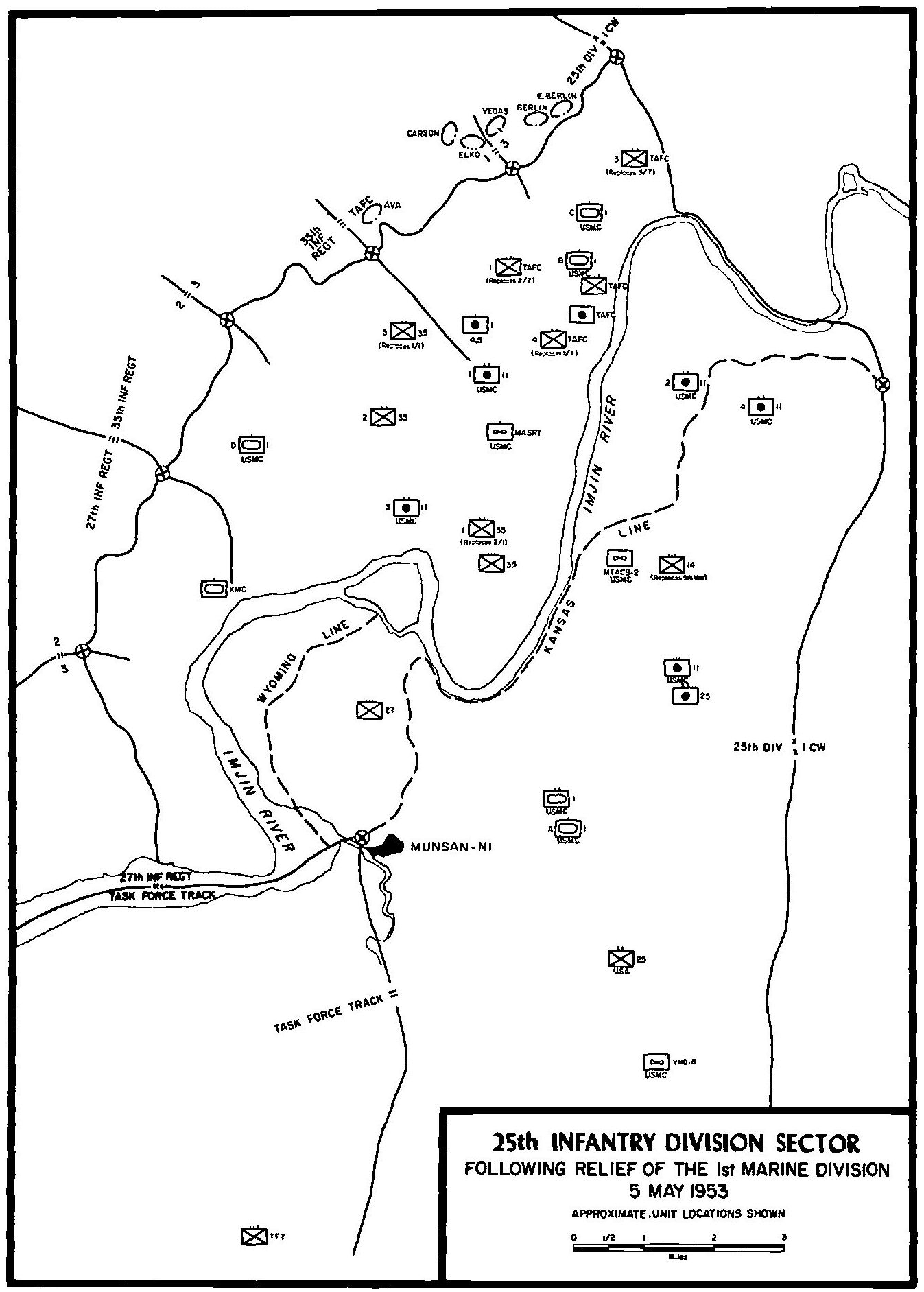
MAP 28 K. White
25th INFANTRY DIVISION SECTOR
FOLLOWING RELIEF OF THE 1st MARINE DIVISION
5 MAY 1953
I Corps Operation Orders No. 31 and 32 had directed that the 11th Marines remain on line in the sector attached to I Corps Artillery, with a general support mission of reinforcing the fires of the 25th Division artillery, and a secondary task of coordinating counterbattery support. The medium battalion, 4/11, and the 1st 4.5-inch Rocket Battery, furnished general support for I Corps. Regimental and battalion CPs, as well as the rocket battery, continued to occupy their same locations. A change affected the KMC artillery battalion, however; when transferred to I Corps artillery control it displaced from the Marine sector, with a new general support role of reinforcing the I Corps line.
Also on 5 May, at 1130, the 1st Tank Battalion416 passed to 25th Division control. Two companies, C and B, were assigned to the TAFC (which had no armored units) in the left and right battalion areas, respectively. Company D vehicles came under command of the 35th Infantry Regiment, in the center sector; while A, the remaining company, was designated as the single reserve unit. This was a modification of the Marine system of maintaining two tank companies in reserve, one a short distance behind the MLR and the other, at the armored battalion CP near Munsan-ni. A change in tactics also took place when the Marine tanks came under Army operational control. It had been the Marine practice to retain the tanks at the company CP from where they moved to prepared firing slots at the request of the supported infantry unit.
When the 1st Tank Battalion was attached to the 25th Division, the armored vehicles were shifted to firing slots near the MLR where they occupied semifixed positions.417 Armored personnel carriers (APCs) were assigned by the Army to Company B and used by both B and C as resupply vehicles to haul food, water, fuel, and ammunition to the tanks on line. Also as part of the relief, control of the KMC tank company was transferred from the Marine 1st Tank Battalion to I Corps, although the company still continued in its same location in the old KMC sector.
Also remaining in their same positions were MASRT-1 (Marine Air Support Radar Team One), in support of the 25th Infantry Division, MTACS-2 (Marine Tactical Air Control Squadron Two), and VMO-6. The mobile air support section of the observation squadron, however, had moved with the 1st Marine Division to the new Casey area for participation in the coming MARLEX operations scheduled during the reserve training period.
Thus with the relief completed, components of the old Marine division front, from left to right, were: the Kimpo Provisional Regiment; Task Force Track; the 27th Infantry Regiment; 35th Infantry Regiment in the center sector, including its armor and heavy mortar company and 2d and 3d Battalions forward, replacing the 1st Marines 3d and 1st Battalions; and in the right sector, the Turkish Brigade 4.2-inch mortar company and its 1st and 3d Battalions initially located418 in the MLR positions vacated by the 2d and 3d Battalions, 7th Marines.
In addition to the 1st Marine Division railhead and truckhead at Munsan-ni and Ascom City, a subsidiary railhead/truckhead was opened at Tongduchon-ni, two miles southwest of the new division CP at Casey. No change was made in the airhead at K-16. Effective with the 5 May change, remaining elements of the division CP staff at Yongji-ri joined the advance elements at Casey. As the Marines moved off the front lines they received “well-done” messages from the Commandant, General Shepherd, and the U.S. Pacific Fleet Commander in Chief, Admiral Arthur W. Radford, as well as the new I Corps Commander, Lieutenant General Bruce C. Clarke419 who cited the “excellence of the planning, coordination and cooperation which enabled the operation of the past few days to be successfully accomplished.”420
Training While in Reserve and Division Change of Command421
While the division was in reserve, its tactical mission consisted of preparation for commitment on I Corps order as a counterattack force in any of the four division sectors of I Corps. Division Operation Plan 7-53 implemented this I Corps Plan “RESTORE” and set forth the designated blocking positions in the 25th Army, Commonwealth, 1st ROK, and 7th Army Division sectors in event of threatened or actual enemy penetration of the MLR.
The 1st Marine Division’s Training Order 8-53, issued on 6 May, the day after the relief was officially effected, outlined the training to be accomplished during the eight-week reserve period, 10 May-5 July. Following a few days’ interval devoted to camp construction and improvement of facilities, an active training program commenced. Its objective was the continued improvement of amphibious and ground offensive combat potential of all personnel. Three major regimental combat team MARLEXES were scheduled.422 The training syllabus called for a four-phased progressive schooling from individual to battalion and regimental level conducted in all phases of offensive, defensive, and amphibious warfare. Weaponry familiarization, small unit tactics, and combined unit training, with tank-infantry deployment and integration of helicopters at company-level exercises, were emphasized, culminating in a week-long field maneuver.
Lectures were to be kept to a minimum, with at least 50 percent of the tactical training conducted at night. Specialty training in intelligence, signal communications, antitank and mortar, machine gun, mine warfare, and staff NCO schools was also prescribed. Numerous command post exercises were programmed to obtain a high standard of efficiency in both battalion and regimental-level staff functioning. It was the first time the division had been in reserve since a brief two-week period in late July-August of 1951. A brisk 40–44 hour week, plus organized athletics, insured that the training period was to be fully utilized.
No time was lost getting under way. At a staff conference with battalion commanders on 11 May, General Pollock, division CG, stressed the importance of using the time they were in reserve for enhancing division combat-readiness. Even as he spoke, his 5th Marines had the day before boarded ships at Inchon and were en route to the Yongjong-ni landing area for MARLEX I. Since the 5th Marines, in division reserve, had been the first of the regiments to displace and on 1 May had turned its sector over to the incoming 14th Infantry Regiment, it got the jump on training during the reserve period. Regimental Operation Plan 12-53, of 28 April, had outlined requirements for the 5th Marines RCT LEX 1; from 2–9 May the regiment had participated in a week of intensive amphibious training, including reduced and normal distance CPX dry runs for the coming MARLEX.
With ships from CTE 90.85,423 and air defense by VMFs-311 and -115, Colonel Tschirgi’s RCT-5 made the D-Day landing on 13 May with its two assault BLTs securing the objective. An unexpectedly shallow beach gradient and difficulties encountered in unloading vehicles from the causeway resulted in less than a 100 percent performance rating. These were deficiencies that might have been prevented had not the customary rehearsal been cancelled the previous day when a heavy fog obscured the landing beaches. Besides regimental antitank and 4.2-inch mortar units, participating support elements included Company D, 1st Tank Battalion; Company A, 1st Armored Amphibian Battalion; Company C, 1st Engineer Battalion; 1/11; and helicopters from HMR-161 and VMO-6.
Meanwhile, on 15 May, command post and subordinate units from the 1st, 5th (less RCT-5 currently deployed in MARLEX I), and 7th Marines and support elements took part in a one-day division CPX at Camp Casey stressing mobility, security and operational procedures. Another CPX on 22–23 May by 11th Marines and engineer personnel emphasized dispersion, camouflage, and message handling under simulated combat conditions. Units of the three infantry regiments plus the KMCs training with the 7th Marines at Indianhead combined in a CPX-FEX (command post-firing exercise) on 26–27 May. Realism bowed to current ordnance supply economics in that ammunition was carried for individual weapons, but it would “not be loaded except on specific orders from an officer.”424
The CPX-FEX was held as a trial exercise for an Eighth Army CPX scheduled later in the month, which was postponed indefinitely on 29 May because of the critical battlefront situation and continuing enemy attacks across the EUSAK front. Extensive preparations were also underway for MARLEX II, with RCT-7, from 2–10 June; and concluding MARLEX III, scheduled 14–23 June, with RCT-1.
Armor and advance regimental elements had left for the Ascom City-Inchon staging area by 1 June, preparatory for departure to the Yongjong-ni beaches on the Korean west coast in the vicinity of Kunsan. The troop list included approximately 250 officers and 4,450 enlisted from Colonel Funk’s 7th Marines and support units, including USN and KMC. Infantry personnel from the regiment’s three battalions formed the three assault teams plus a reserve battalion composed of 475 Korean Marines designated as BLT 5/KMC. Regimental support units included Company C, 1st Engineer Battalion; Company D, 1st Medical Battalion; Company C, 1st Shore Party Battalion; Company B, 1st Armored Amphibian Battalion, and various motor transport, amphibian truck, military police, and helicopter detachments.
R-Day on 5 June went off per schedule. Despite intelligence estimates which cheerily predicted that only “nine days of rain can be expected during the month of June”,425 RCT-7 drew one out of the barrel with its D-Day landing, 6 June. This took place during heavy rains and decreased visibility which threw the boat waves off phase by minutes and required more than the allotted time for HMR-161 troop and cargo lifts.
Use of a 144-foot-long M-2 steel treadway pontoon bridge loaned by the Army, emplaced from the end of the causeway to the beach high water mark, was considered highly successful. It solved unloading problems encountered in the earlier MARLEX, in that all heavy equipment and vehicles were landed on the designated beaches. Further experimentation with this novel employment of the M-2 was recommended to test the coupling system of bridge and causeway during periods of heavy surf. On the minus side, shore party officers noted that night transfer operations had been hindered because of the lack of running lights on the amtracs.
On 9 June, as RCT-7 was on the way back from its amphibious exercise, a directive from ComNavFE (Vice Admiral Robert P. Briscoe) notified the division of cancellation of the forthcoming RCT MARLEX III. All available shipping was being held on 24-hour readiness for the expected final repatriation of POWs (Operation BIG SWITCH). All afloat training exercises by Marine, Army, and Navy units between 6 June and 15 October were to be cancelled.
The division was host to ranking I Corps, Eighth Army, Korean, and 1st Commonwealth officials when a special helicopter assault demonstration was staged 11–12 June at Camp Casey. Two rocket launcher sections, 14 HMR-161 copters, and 2/5 infantrymen were deployed to show the diverse combat capabilities of the aerial workhorse. While in I Corps reserve, the division was also host—and winner—of the I Corps Pistol Matches. And 3/11, which the previous month had taken the Army Training Test 6-2 (a) Modified, was notified the battalion had scored 92.91 percent and received congratulations from the CGs, I Corps Artillery and Eighth Army.
A change of command within the 1st Marine Division took place on 15 June with the arrival of Major General Randolph McC. Pate. The retiring CG, General Pollock, was presented the Distinguished Service Medal by the I Corps commander, General Clarke, for his “outstanding success in the defense of Carson, Vegas, and Elko.” The previous month, General Pollock had received the Korean Order of Military Merit, Taiguk for his active part in the formation, development, and training of the Korean Marine Corps. Attending the change of command ceremonies were General Megee, CG 1st MAW, General Schilt, CG AirFMFPac, and other Marine, I Corps, Commonwealth, and Korean senior officers.
The new 1st Marine Division CG was coming to his Korean post from Camp Lejeune, N. C. where (like General Pollock before him) he had most recently commanded the 2d Marine Division. Commissioned originally in the Marine Corps Reserve in 1921, General Pate was to later rise to four-star rank. Prior to World War II, he had seen expeditionary service in Santo Domingo, in 1923–1924, and in China from 1927–1929, and also served in Hawaii. For his outstanding service and skill in complicated staff duties, first at Guadalcanal, and later during amphibious operations at Peleliu, Iwo Jima, and Okinawa, General Pate had been awarded the Legion of Merit and a Gold Star in lieu of a second Legion of Merit.
After the war, he had served two tours as head of the Division Reserve, in 1946 and 1951. Other assignments included Director of the Marine Corps Educational Center at Quantico and Deputy Director of Logistic Plans in the Office of the Joint Chiefs of Staff.426
Heavy May-June Fighting427
After the early May change of lines, the Chinese lost little time in testing the new UNC defenses. Shortly after 0200 on 15 May, the CCF directed a two-battalion probe on the Carson-Elko-Vegas trio and the Berlin-East Berlin outposts newly held by the Turkish brigade. Supported by heavy concentrations of mortar and artillery, one battalion of enemy soldiers moved against each of the two major defense complexes. Marine Company C tanks, occupying the firing slots that night, accounted for heavy enemy losses in the action, estimated at 200 CCF killed and 100 wounded. Assisting the TAFC Field Artillery Battalion in throwing back the attack were 1/11, 2/11, and 4/11 which sent 3,640 rounds into the sharp four-hour engagement.
The TAFC defense was further reinforced later that day with 21 air strikes against hostile personnel and weapons positions north of the Turkish sector. Adding their weight to the clash, 3/11 and the rocket battery also brought their guns into action, for a combined 5,526 Marine rounds428 dispatched against the enemy.
It was not until 25 May, after the UNC had made its final offer at the truce talks, however, that CCF artillery really began to open up on the Nevada complex. The increased activity by hostile pieces, during the 25–27 May period, was duly noted by the artillery Marines who laconically reported, “Operations followed the recent pattern: enemy shelling of the Turkish Brigade increased during the afternoon; no contacts were reported.”429
This latter situation changed abruptly on 28 May. Beginning at 1800, major elements of the Chinese 120th Division launched simultaneous attacks over 17,500 yards of I Corps front that stretched from COP-2 eastward to that consistent trouble-spot, the Nevada Cities, on to the Berlins, and finally the Hook area in the adjacent Commonwealth Division sector. Supported by heavy artillery fires, one CCF battalion moved in towards Carson and Elko. Another battalion,430 under cover of smoke, attacked central COP Vegas, while a third struck Berlin and East Berlin on the right flank. Three hours after the initial attack, defenders at Carson and Elko were engaged in hand-to-hand combat with the Chinese.
By midnight the men of the 35th Infantry had beaten back the attack at COP-2. The Turks, likewise, were still in possession of the two Berlin (platoon-strength) outposts, but Commonwealth forces were involved in a pitched battle at Ronson and Warsaw. The situation was even grimmer at this time in the Nevada Cities area outposted by the TAFC. Although the Turkish troops continued to hold Vegas, where 140 men were dug in, Carson (two-platoon size) had fallen and Elko (platoon-strength) was heavily besieged. Shortly thereafter, the 25th Division ordered that the TAFC withdraw from the latter position to its own MLR. The diversionary attack against Berlin-East Berlin had been broken off and the twin positions were secured.
During the first six hours of the attack, the night of 28–29 May, Colonel Mills’ 11th Marines, now under I Corps command, had sent 9,500 rounds crashing into Chinese strongpoints, while Marine air observers directed eight missions against active enemy artillery positions. Ripples from the 1st 4.5-inch Rocket Battery, transferred to the Commonwealth sector to support the Hook defense, were fired on CCF troop activity there. Another curtain of flame engulfed the Carson intruders. When the fighting started, 15 Marine tanks were positioned in the Turkish sector. Company B and C vehicles, under Captains James M. Sherwood and Robert J. Post, relentlessly pounded the approaching CCF columns, while Company D was put on a 30-minute standby. As the action developed, additional tanks were committed until 33 were on line at one time or another.431
When savage Chinese pummeling of the 25th Division outposts continued the following day, Colonel Nelson’s 1st Marines was transferred at 1315 to operational control of I Corps. The regiment’s three infantry battalions, antitank, and heavy mortar companies promptly moved out from their Britannia headquarters and within two hours had relocated at 25th Division bivouac areas south of the KANSAS line in readiness for counterattack orders. The 1st Marine Division Reconnaissance Company was similarly ordered to 25th Division control to relieve a 14th Infantry Regiment reserve company in position along the east bank Imjin River defenses.
Overhead, close air support runs were being conducted by pilots of Marine Attack Squadrons 212, 121, and 323. A series of seven 4-plane strikes hit repeatedly from noon on those Chinese troops, hardware, and resupply areas north of the 25th Division line. The aerial assault continued late into the night with MPQ missions executed by VMA-121 and VMF-311.
During the 29th, control of the Vegas outposts—where 1st Division Marines had fought and died exactly two months earlier—changed hands several times between the indomitable Turkish defenders and the persistent Chinese. By dark, the CCF had wrested the northern crest from the TAFC which still held the southeastern face of the position. In the 24-hour period from 1800 on the 28th through the 29th, the 11th Marines had expended 41,523 rounds in 531 missions. At one point in the action Chinese counterbattery fire scored a direct hit on Turkish gun emplacements, knocking six howitzers out of action from the explosions of charges already loaded. As a result 2/11, under its new battalion commander, Major Max Berueffy, Jr., took over the direct support mission of the TAFC Brigade. Marine artillery spotters on station from 0450 to midnight directed 42 fire missions on CCF guns, while the rocket battery unleashed 20 ripples against troop activity, one of which caused 50 WIAs. Although an Allied counterattack early in the day had restored Elko to friendly control, the enemy refused to be dislodged from Carson.
I Corps had previously regarded the defensive positions of the Nevada complex as “critical,” with the TAFC having been “instructed to hold them against all enemy attacks.”432 By midday on the 29th, however, the I Corps commander, General Clarke, and 25th Division CG, General Williams, had apparently had a change of mind. The Vegas strength was down to some 40 Turks. Altogether more than 150 men under the 25th command had been killed and another 245 wounded in defense of Nevada positions. It appeared that the Chinese, constantly reinforcing with fresh battalions despite estimated losses of 3,000, intended to retain the offensive until the outposts were taken.
With Carson and Vegas both occupied by the enemy, the Elko position became untenable without the support of its sister outposts. Six times the CCF had crossed over from Carson to Elko to try to retake the latter position, but had been thus far deterred by Allied firepower. Accordingly, at 2300, the 25th Division ordered its reserve 14th Regiment, earlier committed to the Elko-Carson counterattack, to withdraw from Elko and the Turks to pull back from Vegas to the MLR. By daybreak the withdrawal was completed and 25th Division and Turkish troops had regrouped on the MLR.
The Army reported that more than 117,000 rounds of artillery and 67 close air support missions had buttressed the UNC ground effort. Official estimates indicated that in the three-day action the Chinese had fired 65,000 rounds of artillery and mortar, “up to this point an unprecedented volume in the Korean War.”433 The Marine artillery contribution from its four active battalions during this 28–30 May period totaled 56,280 rounds in 835 missions.
During the three-day siege, 15 to 33 Marine tanks poured their lethal 90mm projectiles on the enemy from MLR firing slots. At times the action was so heavy that the tanks were refueled on line. As they ran out of ammunition and fuel, “armored utility vehicles of the battalion, with a basic load of ammunition aboard, maneuvered beside the tanks in position and rearmed them on the spot,”434 to permit virtual uninterrupted tank firing. One Marine was killed in the action the first night. Although 4,162 rounds of Chinese fire fell near the tank positions, no damage to materiel was reported. For their part the M-46s and flames were responsible for 721 enemy deaths, an estimated 137 more killed, 141 wounded, and an estimated 1,200 injured.
During the second day of action, nearly 20 missions were flown by Corsairs and Skyraiders of the three Marine attack squadrons and the jet fighters of VMF-311 and -115. Altogether throughout 28–30 May, Marine aircraft had flown no less than 119 sorties for the inflamed sectors of the U.S. Army 25th Division and adjacent British 1st Commonwealth Division. Of these, 99 were in support of the sagging Carson-Elko-Vegas-Berlins line.
Ground action ceased the following day as rain drenched the battlefield, although the 11th Marines reported sightings of more than 200 Chinese soldiers, most of them on the three recently lost outposts. Benched while the fierce battle was going on, the 1st Marines remained under operational control of I Corps as a possible contingency force from 29 May to 5 June. On the latter date, following the Eighth Army decision not to retake the Carson-Elko-Vegas outposts, the regiment reverted to Marine control and returned to Camp Britannia. The previous day the Communists had agreed on all major points of the UNC final offer and it appeared that a ceasefire was close at hand.
Diplomats and military leaders both felt this latest Chinese assault was to show a strong military hand and win dominating terrain features along the MLR. Thus the enemy would be able to improve his defensive posture when final battlelines were adjusted at the truce. It was not believed that the CCF effort was an attempt to expand their operations into a general offensive. In any event, the Nevada positions were downgraded from their previous designation as major outposts. I Corps also decreed no further effort would be made to retake them and that a “revaluation of the terrain in view of the destruction of the defensive work indicates these hills are not presently essential to defense of the sector.”435
If things were now relatively quiet along the battlefront of the I Corps coastal sector, the situation had begun to heat up in the central part of the UNC defense line. On 10 June, following a CCF realignment of troops and supply buildup that had not gone unnoticed by Eighth Army intelligence officials, elements of the CCF 60th and 68th Armies struck the ROK II Corps area, on the east-central front. (See Map 29.) Advancing south along both sides of the Pukhan River with two divisions, the Chinese struck at the ROK II defense line which originally had bulged out to form a salient in the Kumsong vicinity. Within six days the ROK line had been forced back 4,000 yards. In subsequent assaults the enemy made new penetrations further west in the ROK II MLR. Although the main Communist thrust was directed against the ROK II Corps, secondary attacks were also made in the X Corps sector east of ROK II, in the Punchbowl area manned by the ROK 20th Division. It was the heaviest, all-out drive since the CCF spring offensive of April-May 1951, when the UNC had been pushed south approximately 30 miles across the entire Korean front.
By 18 June, the CCF assaults started to settle down. During the nine days of flaming action, ROK units had suffered some 7,300 casualties to enemy losses of 6,600. Boundaries had been redrawn and three ROK divisions had been redeployed in counterattacks to plug holes in the line that the Chinese had punched open. Nearly 15,000 yards of ROK front had been pushed 4,000 yards south and several hill positions east of the Pukhan had been lost.
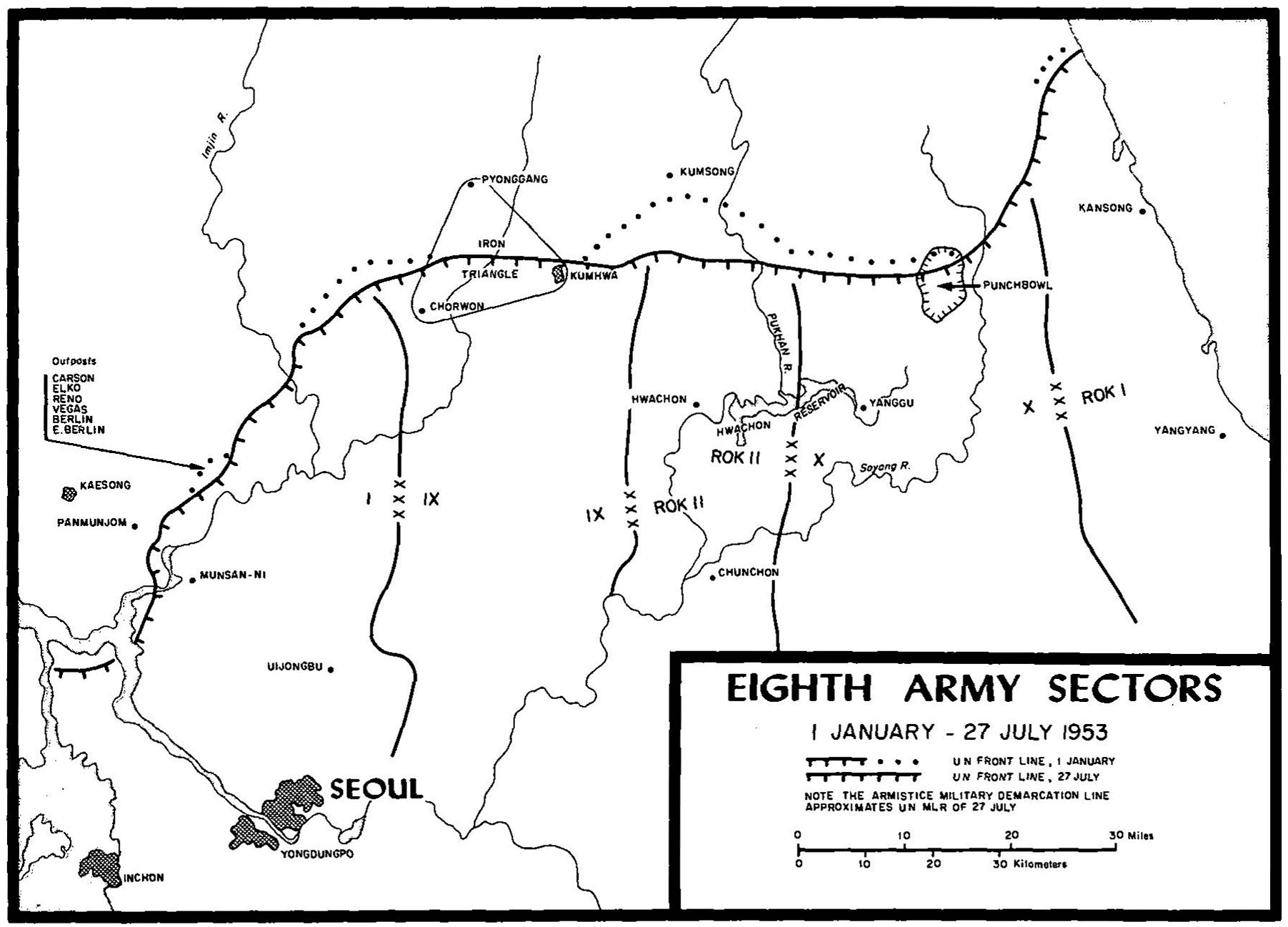
MAP 29 K. WHITE
EIGHTH ARMY SECTORS
1 JANUARY-27 JULY 1953
The brief respite ended 24 June when the CCF again directed heavy blows against the ROK troops, ignoring other UN forces in the Eighth Army line. It was generally considered a retaliatory move for the 18 June mass release of anti-Communist prisoners by South Korean President Rhee. This time the major target of the renewed Chinese offensive was the ROK 9th Division, in the IX Corps sector immediately west of the ROK II Corps. On 25 June the 1st ROK Division on the eastern flank of I Corps, to the right of the 1st Commonwealth Division, was pounded by another Chinese division. Significantly, the date was the third anniversary of the invasion of South Korea.436 The 7th Marines, training in I Corps reserve, was put on standby status. The regiment was removed the following day when the 1st KMC/RCT (minus its 3d Battalion) was instead placed in readiness,437 and subsequently moved out from its Indianhead area to be committed as a relief force in the left sector of the 1st ROK line.
By the 26th, the persistent Chinese probes of the 1st ROK sector had resulted in several forward outposts being overrun. To help stem the action the Marine 1st 4.5-inch Rocket Battery was displaced on I Corps Artillery order from its regular position (in the right regimental sector) 20 miles east to support the hard-pressed ROK division. On at least two occasions the battery placed ripples between ROK positions only 600 yards apart and it was felt that these “continued requests for fire close to friendly troops attested to the gunnery of the unit.”438 Between that date and the 30th, the rocket battery remained in the ROK sector, firing a total of 25 ripples. For the 25th Infantry Division sector, however, the front continued undisturbed throughout the entire month of June.
Developments in Marine Air439
While the division was in I Corps reserve during the greater part of the April-June period, the 6,800-man 1st Marine Aircraft Wing continued its missions as an operational component of Fifth Air Force. For the Marine air arm it was a time of a major tactical innovation, a number of new air records set, and rapid personnel changes in the squadrons.
Shortly before the Marine division went off the line, a new method of close air support at night was introduced. This employed the use of two or more ground controlled 24-inch searchlights located on prominent terrain features along the MLR in the 7th Marines left battalion sector where the missions were to be flown. Enemy-held reverse slopes—in some cases less than 500 yards from Marine positions—were thereby pinpointed by the powerful intersecting searchlight beams. These long pencil-shaped beams created an excellent artificial horizon and enabled pilots to make bombing or strafing runs with a high degree of accuracy even on the blackest of nights. Manned by ANGLICO personnel, the lights were employed either for target location or illumination (both shadow and direct). A tactical airborne observer in an OE light liaison plane of VMO-6 directed the searchlight teams and controlled the missions.
A week of experimentation and trial runs to perfect the night close air support (NCAS) was conducted by several VMF(N)-513 pilots under direction of Colonel Jack R. Cram. Formerly CO of Marine Air Control Group Two at K-3, he had extended his tour in Korea to complete work on the new program. On 12 April, the first night of operations, Major Charles L. Schroeder and Second Lieutenant Thomas F. St. Denis flew two night support missions in F7F Tigercats. Although employed only a few weeks prior to the division going into reserve on 5 May, the new system rated an enthusiastic response from both pilots and ground commanders, all the way up to the division CG. As the latter reported to the Commandant following the first week of night close support missions, “results ... exceeded all expectations.”440
Between 12 April and 5 May, the night fighter squadron conducted 58 NCAS sorties in the division right sector employing this new control system with excellent results.441 The procedure was a marked success and made it possible to provide continuous 24-hour-a-day close support to Marine infantry units. It was considered a supplement to, not a replacement for the MPQ (radar controlled bombing) missions of MASRT-1. Plans called for F9F aircraft to be integrated into the program, since the F7F Tigercats were being replaced by jets. Allied psychological warfare teams on 17 April introduced a different theme in their broadcasts to the enemy: that of the dangers to the CCF from the new searchlight marking of targets. As a Marine training bulletin noted: “It is believed that this method of attack by aircraft is particularly demoralizing to the enemy because he is unable to anticipate where the strike will hit, and therefore has no means of defending himself against it.”442
Another tactical improvement about this same time dealt with artillery flak suppression in support of close support aircraft. Two refinements made in the procedure in the late spring of 1953 involved firing of HE rounds during the actual run of planes over the target. Basically, the plan consisted of releasing a TOT or VT concentration on the most lucrative enemy antiaircraft positions within a 2,500-yard circle around the strike area. A continuous rain of HE-fuzed projectiles was placed on these targets for a three-minute period, during which Marine planes made their runs.
Favorable results were achieved in that new system tended to keep enemy antiaircraft gunners off-balance for a longer period of time and thus decreased the danger to friendly attacking aircraft. On the other hand, pilots quickly noted that this became an “unimaginative employment of an unvarying flak suppression schedule which Communist AA gunners soon caught onto and turned to their own advantage.”443
With respect to squadron hardware, Marine combat potential increased substantially during the spring months with the phasing out of F7Fs in Night Fighter Squadron 513 and introduction of the new F3D-2 twin-jet Skyknight intruder. By late May the Allocation of 24 of these jet night fighters had been augmented by 4 more jets from the carrier USS Lake Champlain and the squadron “assumed its primary night-fighter mission for the first time in the Korean War.”444 While the sturdy, dependable Tigercats445 made their final contribution to the United Nations air effort early in May with the experimental NCAS program, the new Skyknights continued the squadron’s unique assignment inaugurated in late 1952 as night escort to Air Force B-29 bombers on their strike missions. Not a single B-29 was lost to enemy interceptors after 29 January 1953. The capabilities of the skilled Marine night-fighters were noted in a “well done” message received by the CO, VMF(N)-513 in April from the Air Force.446
Organizational changes within the wing included the arrival, on 29 May, of a new MAG-12 unit to replace the “Checkerboard” squadron. VMA-332 (Lieutenant Colonel John B. Berteling) was slated to operate on board the USS Bairoko (CVE-115) for the F4U carrier-based squadron VMA-312447 due for return to CONUS. Veteran of 33 months of combat while attached to the wing as West Coast (CTE 95.1.1) aerial reconnaissance and blockade squadron, VMA-312 (Lieutenant Colonel Winston E. Jewson) was officially relieved 10 June. The change, moreover, was the first phase of a new personnel policy, carrier unit rotation, that was expected to implement a unit rotation program for land-based squadrons. It was anticipated that the new unit rotation program would eliminate inherent weakness of the individual pilot rotation system and thus increase the combat effectiveness of the wing.448
During the period other organizational changes included transfer of administrative control of VMF(N)-513 on 15 May from MAG-33 to MAG-12.449 The squadron, with its new twin-engined jet fighters, moved from K-8 (Kunsan) further up the coast to the MAG-12 complex at K-6 (Pyongtaek), upon completion of the new 8,000-foot concrete runway there. This phased redeployment of nightfighter personnel and equipment began in late May and was concluded on 6 June without any interim reduction of combat commitments. Replacement of the squadron F7F-3Ns with F3D-2s was also completed in early June.
Late that month, plans were underway for two additional changes: the Marine photographic squadron, VMJ-1, was due to be separated administratively and operationally from MAG-33 on 1 July and revert to 1st MAW; and Marine Wing Service Squadron One (MWSS-1) was to be deactivated, effective 1 July.
The change of command relationships between CG, FAF and CG, 1st MAW earlier in the year450 which had restored operational control of certain designated Marine air units to the wing commander, increased the efficiency of 1st MAW operations. Despite the fact that VMJ-1 at times contributed nearly 40 percent to the total FAF input of all daylight combat photographs,451 aerial intelligence (both pre- and post-strike photos) supplied to wing and group headquarters was considered inadequate. As a MAG-33 intelligence officer commented with some exasperation as late in the war as May 1953:
The Section continued to experience difficulty in obtaining 1:50,000 scale overlays of friendly MLR and OP positions. These overlays are important for making up target maps for close support missions, but they are continually held up for long periods by higher echelons, and, if received here at all, are then often too old to be considered reliable.452
Similarly, at the individual squadron level, the carrier unit VMA-312 shortly before its relief, reported: “The one limitation on squadron activities continued to be photo coverage of the strikes. With limited facilities available, the squadron has no clear cut pictures of strike results.”453 Return of VMJ-1 to operational control of General Megee ultimately “gave the Wing adequate photo-intelligence for the first time since commencement of combat operations in Korea.”454
Indoctrination of new replacement personnel within the 1st Marine Aircraft Wing took a swift upturn during the spring period. Pilots who had completed 100 combat missions were transferred to staff duty elsewhere in the wing in Korea or rotated Stateside. The average squadron personnel strength ran to 88 percent of T/O for enlisted; and officer strength, considerably less, frequently dipped as low as 61 percent. Under the 100-missions policy, it was a time of rapid turnover of unit commanders, too, as witnessed from the following squadron diary entries:
VMA-212—Lieutenant Colonel James R. Wallace assumed command from Major Edward C. Kicklighter, effective 19 June; the latter had been squadron ExO and acting CO in interim period following 30 April departure of former CO, Lieutenant Colonel Smunk;
VMA-323—Lieutenant Colonel Clarence H. Moore vice Lieutenant Colonel Frash, on 11 April; and Major Robert C. Woten succeeding Lieutenant Colonel Moore on 27 June;
VMA-121—Major Richard L. Braun vice Lieutenant Colonel Hughes, on 21 April;
VMF(N)-513—Lieutenant Colonel Ross S. Mickey vice Lieutenant Colonel Conley, on 6 May; in June, Lieutenant Colonel Robert L. Conrad, acting CO, named CO for Lieutenant Colonel Mickey, hospitalized for injuries received in a May aircraft accident;
VMJ-1—Lieutenant Colonel Leslie T. Bryan, Jr. vice Lieutenant Colonel William M. Ritchey, on 15 May;
VMF-311—Lieutenant Colonel Arthur M. Moran vice Lieutenant Colonel Coss, on 21 April; Lieutenant Colonel Bernard McShane vice Lieutenant Colonel Moran, on 1 June;
VMF-115—Lieutenant Colonel Lynn H. Stewart vice Lieutenant Colonel Warren, 5 June.
With respect to CAS activities, excellent weather in April—only a single day of restricted flying—brought the 1st MAW air tally that month for its land-based squadrons to 3,850 effective combat sorties (440 more by VMA-312) and 7,052.8 combat hours. This was a substantial increase over the preceding months. Not surprisingly, the average daily sortie rate for the month was correspondingly high: 128.3. Of 1,319 CAS sorties the largest proportion, 579 and 424 (43.9 percent, 32.1 percent), were for Marine and ROK operations, respectively.
The outstanding day of the month was 17 April. During the 24-hour reporting period, 262 sorties were completed by MAGs-33 and -12 pilots,455 who expended a combined total of 228.3 tons of bombs and 28,385 rounds of 20mm ammunition. For the two MAG-33 fighter bomber squadrons, it represented maximum effort day. Preparation had been made a week earlier to devise the targeting and best all-round flight schedules for ordnance and line sections. Objective areas for the mass attack were picked by the wing G-3 target selection branch and approved by the EUSAK-Fifth Air Force JOC. It was decided that “flights of eight aircraft staggered throughout the day would offer the best efficiency in expediting reloading and refueling with not more than sixteen aircraft inactive on the flight line at one time.”456 Throughout the day, from 0410 to 2030, VMFs-311 and -115 continuously pounded designated targets in support of the U.S. 7th and 3d Infantry Divisions.457 Commented MAG-33:
Hitting an all-time high in the annals of memorable days, this, the seventeenth of April not only further proved MAG-33’s ability to cripple the enemy’s already diminishing strength but it also allowed VMF-115 to set records in total airborne sorties launched in a single day plus a record total ordnance carried and expended in one day by jet type aircraft.458
VMF-115 alone, with 30 pilots and 23 aircraft, had flown 114 sorties and delivered 120 tons of bombs on North Korean targets.
A sample of the intensity of this maximum day was a series of three early-morning interdiction strikes led by three VMF-115 pilots that launched the effort. Led by Lieutenant Colonel Joe L. Warren, Major Samuel J. Mantel, Jr., and Major John F. Bolt, the 23 attacking Panther jets lashed the objective with 22.35 tons of ordnance and 4,630 rounds of 20mm ammunition. The three missions destroyed half of the buildings and inflamed 95 percent of the target area in the enemy supply concentration point T’ongch’on on the Korean east coast.
By contrast, wing operations in May were considerably hampered by the bad weather peculiar to this time of the year in Korea. Restricted flying conditions were recorded for 18 days of the month. A total of 153 CAS sorties were flown for the Marine division before its 5 May relief from the front lines. Of the wing’s 3,359 sorties459 during the month, 1,405 were for close support to forward units beating back Communist encroachment efforts. The allocation of CAS sorties was 412 for U.S. infantry divisions (including 211 for the 25th Division occupying the customary Marine sector); 153 for the 1st Commonwealth Division at the Hook which the Communists assaulted on 27–28 May as part of their overall thrust against western I Corps defenses; 412 sorties for ROK units; and 63, miscellaneous. Heaviest action for Marine aviators took place towards the end of the month to thwart enemy blows in the I Corps sector where Army and Turkish units were attempting to repulse the Chinese.
The renewed effort of the Chinese Communists against UNC ground forces in late May continued sporadically the following month. A number of new records were set by Marines flying CAS assignments under the Fifth Air Force. During the intense mid-June attacks on the ROK II Corps area and adjacent X Corps sector, MAGs-12 and -33 pilots chalked up some busy days. Between 10–17 June, Marine, Navy, and Air Force aircraft had flown 8,359 effective sorties, the bulk of this massive FAF effort to buttress the crumbling ROK defense. Of this number, Marine sorties totaled 1,156, or nearly 14 percent. (Combat sorties for the 1st MAW throughout June came to 3,276 despite 23 days of marginal to nonoperational weather.) Marine pilots scored as high as 48 percent of a single day’s interdiction strikes made by FAF. This occurred 15 June when the 1st MAW flew a record-breaking 283 sorties, followed by another peak 227 sorties the next day.
Actually, when the ground situation in the ROK II Corps front began to deteriorate on 12 June, the new Fifth Air Force commander, Lieutenant General Samuel E. Anderson, “waived the [3,000 foot] minimum-altitude restrictions on his fighter-bombers and ordered his wings to give all-out support to the Eighth Army.”460 The Seventh Fleet commander, Admiral Clark, likewise kept his carriers on line for seven days and ordered its naval pilots to “team with Marine and Fifth Air Force airmen for a close-support effort exceeding anything up to that time.”461 When the ROK II Corps defenses cracked open on 15 June, temporary clearing weather “allowed General Anderson and Admiral Clark to hit the Reds with everything they had. FEAF planes flew a total of 2,143 sorties of all kinds for the largest single day’s effort of the war.”462
Commenting on this heavy action period, 14–17 June, a dispatch to General Megee from the new FAF commander, who had succeeded General Barcus the previous month, noted:
The figures are now in. From 2000, 14 Jun 53, to 0001, 17 Jun 53, Fifth Air Force units flew a total of 3,941 combat sorties. The cost was 9 pilots lost, 11 aircraft lost, 11 aircraft major damage, 42 aircraft minor damage. The results: 1 enemy offensive stopped cold. I very deeply appreciate the splendid efforts of all members of the 5th AF at all levels. Only a concerted team effort made the foregoing possible.463
This came, incidentally, only five days after receipt by the 1st Marine Aircraft Wing of the Korean Presidential Unit Citation.464 The award cited the wing’s “outstanding and superior performance of duty” between 27 February 1951 and 11 June 1953. During this period Marine fliers executed more than 80,000 combat sorties for UNC divisions.
The fighter-bombers of MAG-33 and the MAG-12 attack planes saw heavy action during 24–30 June when the Chinese again concentrated their attention on ROK divisions in the UNC line. Peak operational day was 30 June. Marine squadrons alone executed 301 sorties, including 28 percent of the CAS and 24 percent of total FAF interdiction missions. It was also an outstanding day for MAG-12 which “outdid itself by flying 217 combat sorties against enemy forces. The 30th of this month saw MAG-12 establish a new ordnance record when an all-time high of 340 tons of bombs and napalm were dropped on North Korea.”465 Contributing heavily to this accomplishment was Marine Attack Squadron 121. It unleashed 156 tons of ordnance, a squadron record. It was believed this also established an all-time record for tonnage expended on the enemy by a Marine single-engine propeller squadron.
Other Marine Defense Activities466
Like their counterparts on the Korean mainland, the Marines, naval gunfire teams, and ROK security troops comprising the West Coast and East Coast Island Defense Commands felt the alternating pressure build-up and slow-down that typified the closing months of the war. At both installations the defense had been recently strengthened, more or less by way of response to a CINCPacFleet intelligence evaluation in December 1952. This alerted the isolated island forces to the possibility of a renewed Communist attempt to recapture their positions. The Allied east coast defense structure at Wonsan, right at the enemy’s own front door just above the 39th Parallel, was considered particularly vulnerable.
As in the preceding months, the mission of the west coast island group remained unchanged—namely, the occupation, defense, and control of its six island components. These, it will be remembered, were: Sok-to, Cho-do, Paengyong-do (command headquarters), Yongpyong-do, and the two lesser islands at Taechong-do and Tokchok-to.467 Formal designation of the island commands was modified on 1 January 1953. At this time the West Coast and East Coast Island Defense Elements (TE 95.15 and TE 95.23) were redesignated as Task Units (TU 95.1.3 and TU 95.2.3) respectively. Korean Marines, who represented the bulk of these task units, were provided from the 2d KMC Regiment, the island security force. This unit constituted the main defense for the important U.S. Marine-controlled islands off the Korean west and east coasts.
Approximately 17 Marine officers and 100 enlisted men were assigned to the western coastal complex, with two battalions of Korean Marines fleshing out the garrison defense. The primary mission of this island group was to serve as offshore bases for UNC intelligence activities, including encouragement of friendly guerrilla operations conducted by anti-Communist North Korean personnel. Artillery based on the Marine-controlled islands provided both defensive fires and counterbattery missions against enemy guns sited on the nearby mainland.
The secondary mission of WCIDU, that of training Korean troops in infantry and weapons firing exercises, continued to be hampered somewhat by faulty communication. As one officer observed, the training program to qualify selected KMCs for naval gunfire duties “met with only modest success, due primarily to the language barrier and lack of communications equipment in the Korean Marine Corps. Personnel who had received this training did prove to be extremely helpful in accompanying raiding parties on the mainland in that they were able to call for and adjust fires.”468
Enemy pressure against the West Coast Islands, both from Communist shore guns and bombing, had increased during the fall and winter of 1952. Cho-do, shaped roughly like a giant downward-plunging fish, as previously noted had been bombed in October for the first time in the history of the command. This new trend was repeated for the next two months. By way of response, two 90mm guns were transferred to Cho-do from Kanghwa-do (a more peaceful guerrilla-controlled island northwest of Inchon) for use there as counterbattery fire against aggressive mainland batteries. The islands of Sok-to and Paengyong-do had likewise been bombed during this period, although no damage or serious casualties resulted. In December, enemy shore guns fired 752 rounds against Task Force 95 (United Nations Blockading and Escort Force) ships charged with responsibility for the island defense, in contrast to the 156 rounds of the preceding month.
Intelligence in December from “Leopard,” the friendly Korean guerrilla unit at Paengyong-do, also reported the presence of junks, rubber boats, and a nearby enemy artillery battalion off Chinnampo, believed to be in readiness to attack the island. A captured POW, moreover, on 22 December reported that elements of the 23d NKPA Brigade located on the mainland across from Sok-to would attempt to seize the island group before the end of the year. The next day, shortly after dusk, when a concentration of 200 rounds469 of 76mm suddenly fell on Sok-to, and another 125 rounds struck neighboring Cho-do, it looked as if it might be the beginning of trouble. Naval gunfire (NGF) spotters on the islands directed the fire from UNC patrol boats cruising the Yellow Sea. This counterbattery fire quickly silenced the enemy guns. Again, at the end of the month, West Coast islands were alerted for an invasion, but it never materialized.
A matter of continuing concern to the command during the fall and winter months was the North Korean refugee problem. So serious was the situation, in fact, that it had warranted a directive from the TF 95 commander (Rear Admiral John E. Gingrich). In the early fall, a large number of refugees had filtered into the West Coast Islands, raising serious doubts as to their feeding and ultimate survival during the Korean winter. Through the United Nations Civil Assistance Command, a tentative date of September had been set for evacuating these North Korean refugees to South Korea. By November the question of their relocation was still not settled, although the feeding problem had been eased somewhat by two LST-resupply loads of emergency rations and grain by CTF 90.
Activities followed a fairly consistent pattern during early 1953, with harassing fire striking the islands from the North Korean shore batteries and sporadic bomb and propaganda drops. Periodically USAF pilots who had strayed off course, planes from the nearby British carriers HMS Glory or Ocean, or Marine fliers from USS Badoeng Strait or Bataan made emergency landings on the beach airstrips at Paengyong-do for engine repairs or refueling. Logistical support continued to be a problem, due to the peculiarities of the joint ordering system through the Army. In January the western islands had unfilled requisitions dated from as early as February 1952. Official unit reports also noted the difficulty of obtaining medical supplies either promptly or in full.
In April, with the hot-cold cease-fire talks again taking one of their spasmodic upswings, WCIDU commander, Colonel Harry N. Shea, conferred with American and British naval officials regarding CTG 95.1’s (Royal Navy Commander, West Coast Blockading and Patrol Group) Operation PANDORA. This called for the evacuation of Sok-to and Cho-do, the two WCIDU islands north of the 38th Parallel, at the time of the armistice.
Increased naval gunfire and artillery missions against active enemy mainland targets, caves, and observation posts gave the two new 90mm guns delivered to the Sok-to garrison the month before and the pair already at Cho-do, as well as their gun crews, some unscheduled practice. Marine garrison personnel at the two islands and nearby patrol ships were busy 25 days of the month knocking out or neutralizing Communist mainside batteries. Late that month, the battleship USS New Jersey stationed off the east coast, sailed around the Korean peninsula to add its 16-inch guns to the bombardment. Enemy shelling of the two western islands increased in June, with 1,815 rounds expended in response by the two Marine gun sections.
During June, as it appeared the end of the war was in sight, the first phase of PANDORA got underway with the evacuation by CTF 95 of approximately 19,425 partisans, their families, and refugees from Sok-to and Cho-do to islands south of the 38th Parallel. A new WCIDU commander, Colonel Alexander B. Swenceski, had also arrived by this time, since the average tour of duty was but a brief four months at both island commands.
Across the Korean peninsula, the east coast Allied offshore island defense centered on a cluster of islands in Wonsan Harbor. Situated more than 100 miles north of the battleline, these strategically-placed islands comprised the northernmost UN-held territory in Korea. The East Coast Island Defense Command numbered approximately 35 Marines, 1,270 Korean Marines, and 15 Naval personnel. Headquarters for TU 95.2.3 was Yo-do, the largest installation, which was garrisoned by approximately 300 Korean Marines and a limited detachment of USMC and USN personnel. Smaller defense forces were located on the other islands under ECIDU command.470 In addition, an improvised NGF spotting team was also stationed at the three forward islands (Mo-do, Tae-do, and Hwangto-do). Mission of the ECIDU was a defensive one: to hold the islands as a base for covert intelligence activities. The island defense system existed for the purpose of “containing and destroying any enemy forces who escape detection or who press home an attack in the face of Navy attempts at their destruction.”471
Individual island commanders were responsible for the defense of their small parcels of seaborne real estate, control of both defensive and offensive NGF missions in the area, and evaluation of intelligence regarding enemy troop locations, the movement of supplies north, or new emplacements of hostile guns. Fire support for the ECIDU islands, exposed to the enemy shore batteries above the 39th Parallel, was available from Task Force 95, which maintained a task, group of ships off both the east and west coasts. Aircraft and ships of Task Force 77 (Seventh Fleet Striking Force), operating off the East Korean coastline, were also on call. In December, for instance, the Corsairs of TF 77 had resumed their rail-bridge interdiction. All-out attacks on railroad and highway bridges, as well as bombing runs on the 90-mile stretch of east coast railroad from Hungnam to Songjin, were undertaken to cut off supplies being moved north for Communist industrial use.
February marked the second anniversary of the siege of Wonsan by the UNC, the longest blockade of a port in recent U.S. history. Some naval authorities by this time argued that the venture had become one of doubtful merit which “should never have been undertaken, but its long history made it difficult to abandon without apparent admission of defeat.”472 In any event, the month also signaled increasing attention paid by hostile shore batteries to the little island enclave. For seven consecutive days, 9–15 February, the harbor islands were targets for enemy mixed artillery and mortar shells. Minor materiel damage and casualties were sustained at Yo-do during a Valentine’s Day bombardment, 14 February.
Altogether, the enemy harassed the harbor islands for 16 days during the month, expending 316 rounds, compared with 11 days in January. Hostile fire, not limited to the Wonsan Harbor islands, was also directed against friendly ships USS DeHaven and USS Moore. These provided counterbattery fire and were, in turn, fired upon, the nearest shells landing only 400 yards from the two vessels. This attack, also on 14 February, was described as an “unusually determined and precise”473 effort. The enemy, moreover, did not appear to take his usual precautions with respect to disclosing his positions. The fact that a Communist shore battery would cease fire when subjected to friendly counterbattery, with other positions then immediately taking up the delivery, “indicated some sort of central control for the first time.”474 The I Corps, NKPA artillery units across from the Wonsan Island command revealed the “heavy, effective artillery capability of enemy batteries which encircle Wonsan Harbor.”475
Unseasonably good weather the latter part of February improved the transportation and supply situation. With the bitter cold and wind subsiding, maintenance crews could repair the ravages of the past several months. Craft, up to LCVP size, were hoisted in on a large pontoon for repair. For most of December and January, “this small, physically remote Marine Corps command,”476 as the ECIDU commander, Lieutenant Colonel Robert D. Heinl, Jr. himself described it, had been snowbound. Winds howled in excess of 40 knots, and temperatures dropped to 10° below at night. Personnel at the command island, Yo-do, subsisted on C rations for eight days. With boating operations suspended because of the high winds, it was not possible to send supplies or water to Hwangto-do which for several days relied solely on melted snow.
The prolonged foul weather, moreover, interrupted all classified radio communications between the ECIDU and the outside world. Crypto guard for the Wonsan islands was maintained by elements of the East Coast TG 95. Coded and decoded security radio messages had to be picked up by patrol boat which could not reach the islands during extreme conditions of icy seas and heavy snows.
As with the men on the front line, the Communists stepped up their pressure and gunfire against the island command Marines during March. The record477 524 rounds which fell on the ECIDU islands in March doubled the following month when the command received 1,050 rounds from active mainland batteries. In April the persistent NKPA artillerymen kept up a continuing bombardment of the eastern coastal UNC islands, missing only three days of the entire month, that caused nine casualties when a direct hit was made on the Tae-do CP bunker. It was the highest rate of incoming since UN occupation of the islands. Another April record was enemy mine laying, which increased sharply in both the WCIDU and ECIDU command areas. A total of 37 mines were sighted, the highest number since August 1952. Communist shore gunners, in addition to harassment of the island themselves, fired 2,091 rounds against TF 95 ships, another all-time high.
With respect to personnel, the situation had improved markedly. An increase in ECIDU command strength authorized by CG, FMFPac in March provided for an additional 9 Marine officers, 38 enlisted Marines, and 6 Navy personnel. These were exclusive of the current detachments of 1st ANGLICO shore party and naval maintenance personnel, and represented nearly a 40 percent strength increase.478 Not long afterward the new ECIDU commander, Lieutenant Colonel Hoyt U. Bookhart, Jr., arrived to succeed Lieutenant Colonel Heinl, who had held the position since the preceding November.
As with the WCIDU force, by late spring it appeared that the days of UNC control and occupation of the east coast islands were numbered. In view of the imminent armistice, a CinCFE directive of 11 June called for the evacuation of all civilians, supplies, and equipment “in excess of immediate needs.”479 This was a preliminary step towards full evacuation of the islands once the armistice agreement was reached. Accordingly, on 11 June, as evacuation of the friendly west coast partisans got under way, villagers from Yo-do, the largest and ECIDU headquarters site, and the far northern island of Yang-do were similarly moved south. The evacuation was completed by mid-June.
The Division is Ordered Back to the Front480
A rash of political activity in June markedly affected the tenor of military operations in Korea. Intensified Communist aggression broke out north of ROK sectors in the Eighth Army line, largely as a reaction to President Rhee’s unprecedented action on 18 June of freeing, with the help of ROK guards, approximately 25,000 North Korean anti-Communist prisoners at POW camps in the south. Other anti-Communist POWs at Camp No. 10, near Ascom City, staged violent break-out attempts at that same time and Company A, 1st Amphibian Tractor Battalion passed to operational control of the camp commanding officer there to help prevent a repetition of any such incidents in the future. Following a recess of truce talks, pending a clarification of the status of the current military-diplomatic agreements, key delegates held crisis meetings at Panmunjom and Tokyo to get the beleaguered talks back on track.
Despite the furor, signing of the armistice agreement was expected shortly. As a result, the Munsan-ni Provisional Command was reorganized with the 1st Marine Division assigned the responsibility of reactivating the United Nations Personnel and Medical Processing Unit for the anticipated post-truce exchange of prisoners of war. This was to be conducted along lines similar to that for Operation LITTLE SWITCH, the initial limited exchange. The Division Inspector was named processing unit commander and functional sections (S-1, S-2, S-3, S-4, interpreters, messing, medical, engineer) were also activated. As the division training tour in I Corps reserve drew to a close, a number of regimental CPXs were held during June. And the 5th Marines drew a new assignment: training in riot control. Following civilian demonstrations that had erupted in various populated areas of Eighth Army, including the I Corps sector, the regiment was ordered “to be prepared to move in battalion size increments, to be employed as army service area reserve in suppression of civil disturbances anywhere in army service area.”481
While the Marine infantry regiments concluded their training period, the 1st Tank Battalion, Kimpo Provisional Regiment, and Division Reconnaissance Company remained under operational control of the frontline U.S. 25th Infantry Division. Marine artillerymen likewise continued under orders of CG, I Corps Artillery, in the forward area, reinforcing division artillery fires. Tentative plans were underway for movement of the 1st Marine Division back to its former position on the MLR in early July. After the signing of the cease-fire, the division would comply with provisions of the truce agreement by closing out its former MLR and withdrawing to designated positions two kilometers south of the former defensive positions.